Comparative Effects of Diet, Exercise, and Pharmacotherapy on Metabolic Syndrome Severity in Overweight and Obese Cohorts: A Systematic Review and Meta-Analysis



Abstract
1. Introduction
2. Materials and Methods
2.1. Search Strategy
2.2. Study Selection and Inclusion Criteria
2.3. Data Extraction
2.4. Quality Assessment and Sensitivity Analyses
2.5. Statistical Analysis
3. Results
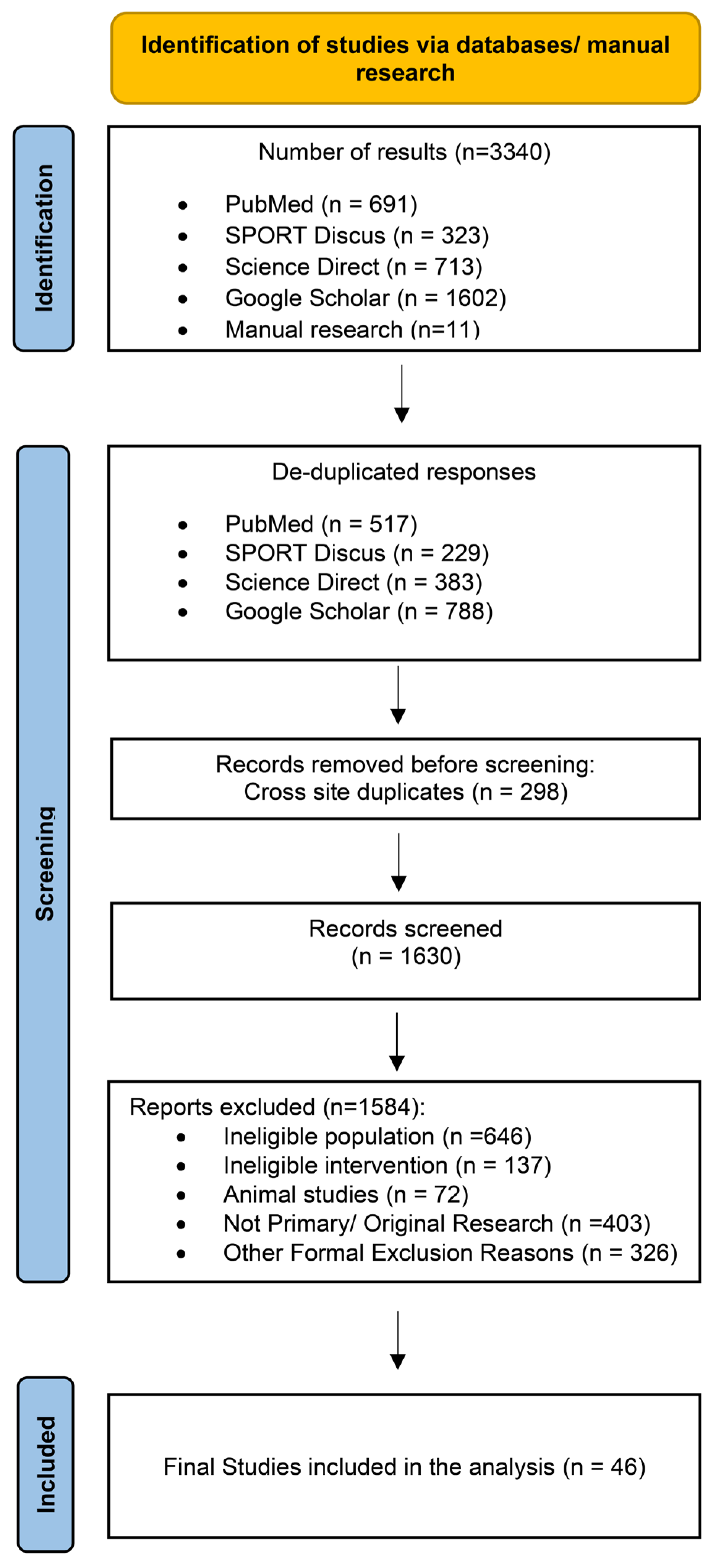
3.1. Included Studies
3.2. Participant and Intervention Characteristics
3.3. Quality of Included Studies
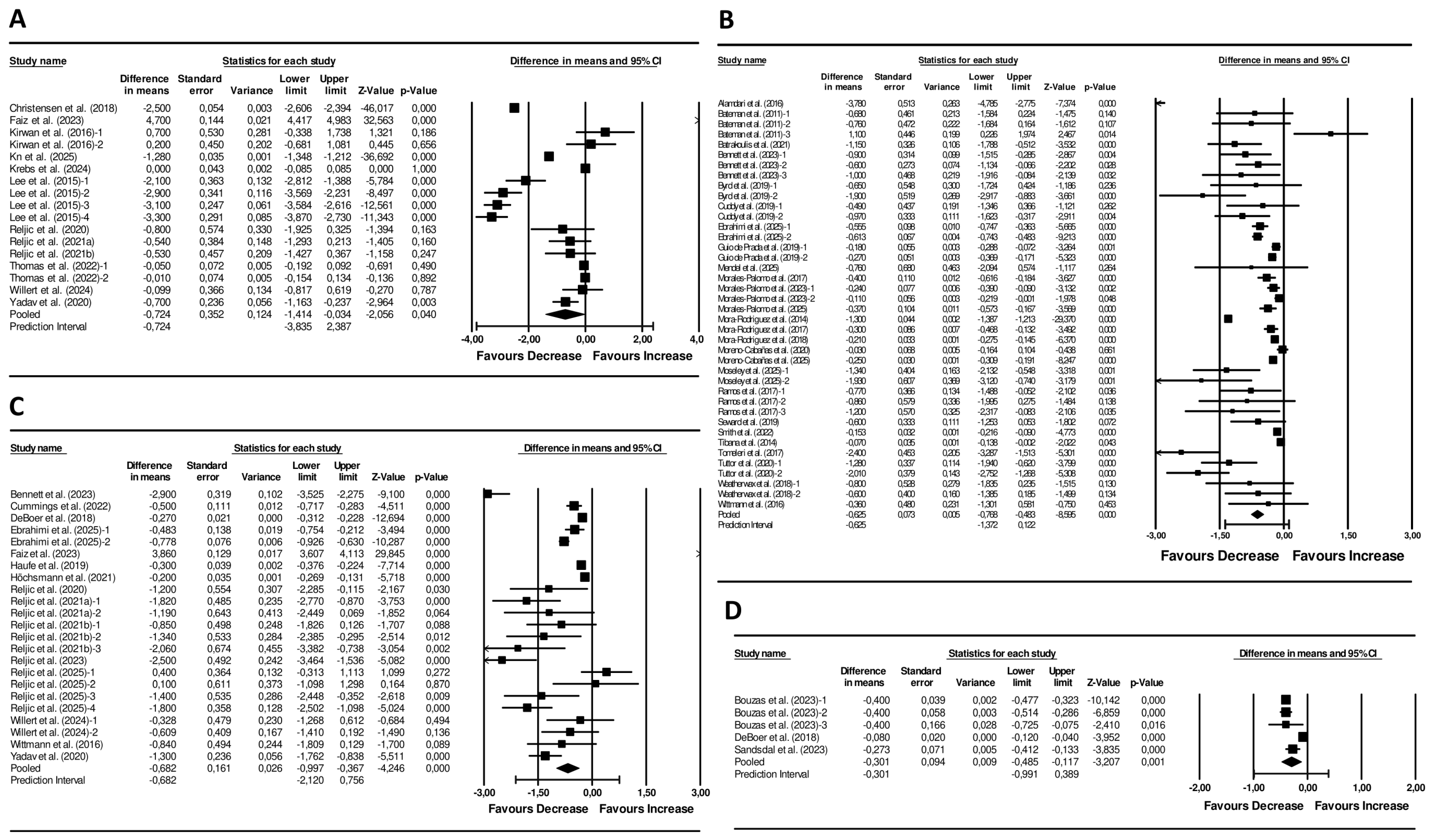
3.4. Meta-Analyses on Dietary Interventions
3.4.1. Subgroup Analyses for Diet Interventions
3.4.2. Meta Regressions for Diet Interventions
3.5. Meta-Analyses on Exercise Interventions
3.5.1. Subgroup Analyses for Exercise Interventions
3.5.2. Meta Regressions for Exercise Interventions
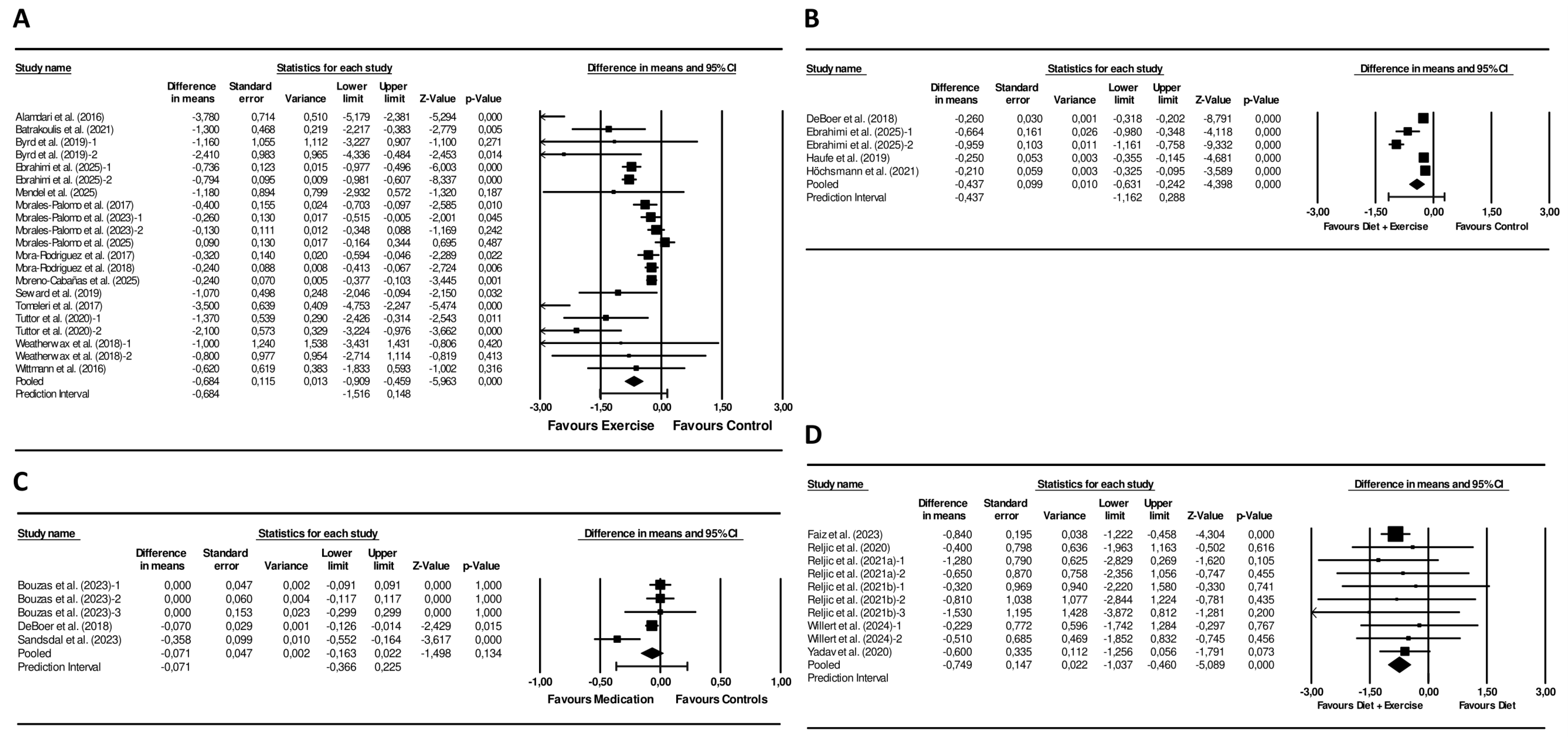
3.5.3. Meta-Analyses on Exercise Interventions Versus Controls
3.6. Meta-Analysis on Combined Diet and Exercise Interventions
3.6.1. Subgroup Analyses for Combined Diet and Exercise Interventions
3.6.2. Meta Regressions for Combined Diet and Exercise Interventions
3.6.3. Meta-Analyses on Combined Diet and Exercise Versus Control Interventions
3.7. Meta-Analysis on Combined Diet and Exercise Versus Diet Interventions
3.8. Meta-Analysis on Pharmacological Interventions
3.8.1. Subgroup Analyses for Pharmacological Interventions
3.8.2. Meta Regressions for Pharmacological Interventions
3.8.3. Meta-Analyses on Pharmacological Interventions Versus Controls
3.9. Characteristics of Higher-Quality Interventions
4. Discussion
5. Practical Implications
6. Limitations and Strengths
7. Conclusions
Supplementary Materials
Author Contributions
Funding
Institutional Review Board Statement
Informed Consent Statement
Data Availability Statement
Acknowledgments
Conflicts of Interest
References
- GBD 2021 Adult BMI Collaborators. Global, regional, and national prevalence of adult overweight and obesity, 1990–2021, with forecasts to 2050: A forecasting study for the Global Burden of Disease Study 2021. Lancet 2025, 405, 813–838. [Google Scholar] [CrossRef]
- Jin, X.; Qiu, T.; Li, L.; Yu, R.; Chen, X.; Li, C.; Proud, C.G.; Jiang, T. Pathophysiology of obesity and its associated diseases. Acta Pharm. Sin. B 2023, 13, 2403–2424. [Google Scholar] [CrossRef] [PubMed]
- Li, W.; Qiu, X.; Ma, H.; Geng, Q. Incidence and long-term specific mortality trends of metabolic syndrome in the United States. Front. Endocrinol. 2023, 13, 1029736. [Google Scholar] [CrossRef] [PubMed]
- Huang, P.L. A comprehensive definition for metabolic syndrome. Dis. Models Mech. 2009, 2, 231–237. [Google Scholar] [CrossRef] [PubMed]
- DeBoer, M.D.; Gurka, M.J.; Jones, M.K.; Smolkin, M.E. Using metabolic syndrome severity in the “real world”: Associations with diabetes and cardiovascular disease in all of us vs. NHANES. Metab. Open 2025, 28, 100415. [Google Scholar] [CrossRef]
- Hsu, P.W.; Chen, Y.R.; Sheu, W.H. MetS-Z: A gender- and age-specific scoring system for predicting type 2 diabetes. J. Diabetes Investig. 2025, 16, 907–916. [Google Scholar] [CrossRef]
- DeBoer, M.D.; Gurka, M.J. Clinical utility of metabolic syndrome severity scores: Considerations for practitioners. Diabetes Metab. Syndr. Obes. 2017, 10, 65–72. [Google Scholar] [CrossRef]
- Khazdouz, M.; Hasani, M.; Mehranfar, S.; Ejtahed, H.S.; Djalalinia, S.; Mahdavi Gorabi, A.; Esmaeili-Abdar, M.; Karbalahi Saleh, S.; Arzaghi, S.M.; Zahedi, H.; et al. Validity of continuous metabolic syndrome score for predicting metabolic syndrome; a systematic review and meta-analysis. J. Diabetes Metab. Disord. 2021, 20, 497–510. [Google Scholar] [CrossRef]
- Castro-Barquero, S.; Ruiz-León, A.M.; Sierra-Pérez, M.; Estruch, R.; Casas, R. Dietary strategies for metabolic syndrome: A comprehensive review. Nutrients 2020, 12, 2983. [Google Scholar] [CrossRef]
- Joseph, M.S.; Tincopa, M.A.; Walden, P.; Jackson, E.; Conte, M.L.; Rubenfire, M. The impact of structured exercise programs on metabolic syndrome and its components: A systematic review. Diabetes Metab. Syndr. Obes. 2019, 12, 2395–2404. [Google Scholar] [CrossRef]
- Peri, K.; Eisenberg, M. Review on obesity management: Diet, exercise and pharmacotherapy. BMJ Public Health 2024, 2, e000246. [Google Scholar] [CrossRef] [PubMed]
- Olateju, I.V.; Opaleye-Enakhimion, T.; Udeogu, J.E.; Asuquo, J.; Olaleye, K.T.; Osa, E.; Oladunjoye, A.F. A systematic review on the effectiveness of diet and exercise in the management of obesity. Diabetes Metab. Syndr. 2023, 17, 102759. [Google Scholar] [CrossRef] [PubMed]
- Xie, Y.; Gu, Y.; Li, Z.; He, B.; Zhang, L. Effects of different exercises combined with different dietary interventions on body composition: A systematic review and network meta-analysis. Nutrients 2024, 16, 3007. [Google Scholar] [CrossRef] [PubMed]
- Wang, W.; Liu, Y.; Li, Y.; Luo, B.; Lin, Z.; Chen, K.; Liu, Y. Dietary patterns and cardiometabolic health: Clinical evidence and mechanism. MedComm 2023, 4, e212. [Google Scholar] [CrossRef]
- Belanger, M.J.; Rao, P.; Robbins, J.M. Exercise, physical activity, and cardiometabolic health: Pathophysiologic insights. Cardiol. Rev. 2022, 30, 134–144. [Google Scholar] [CrossRef]
- Amer, B.E.; Abdelgalil, M.S.; Hamad, A.A.; Abdelsayed, K.; Elaraby, A.; Abozaid, A.M.; Abd-ElGawad, M. Metformin plus lifestyle interventions versus lifestyle interventions alone for the delay or prevention of type 2 diabetes in individuals with prediabetes: A meta-analysis of randomized controlled trials. Diabetol. Metab. Syndr. 2024, 16, 273. [Google Scholar] [CrossRef]
- Pu, R.; Shi, D.; Gan, T.; Ren, X.; Ba, Y.; Huo, Y.; Bai, Y.; Zheng, T.; Cheng, N. Effects of metformin in obesity treatment in different populations: A meta-analysis. Ther. Adv. Endocrinol. Metab. 2020, 11, 2042018820926000. [Google Scholar] [CrossRef]
- Velija-Asimi, Z.; Izetbegovic, S.; Karamehic, J.; Coric, J.; Panjeta, M.; Macic-Dzankovic, A.; Djelilovic-Vranic, J.; Dizdarevic-Bostandzic, A. The effects of dipeptidyl peptidase-4 inhibitors in treatment of obese patients with type 2 diabetes. Med. Arch. 2013, 67, 365–367. [Google Scholar] [CrossRef]
- Jastreboff, A.M.; Aronne, L.J.; Ahmad, N.N.; Wharton, S.; Connery, L.; Alves, B.; Kiyosue, A.; Zhang, S.; Liu, B.; Bunck, M.C.; et al. Tirzepatide once weekly for the treatment of obesity. N. Engl. J. Med. 2022, 387, 205–216. [Google Scholar] [CrossRef]
- Kosiborod, M.N.; Bhatta, M.; Davies, M.; Deanfield, J.E.; Garvey, W.T.; Khalid, U.; Kushner, R.; Rubino, D.M.; Zeuthen, N.; Verma, S. Semaglutide improves cardiometabolic risk factors in adults with overweight or obesity: STEP 1 and 4 exploratory analyses. Diabetes Obes. Metab. 2023, 25, 468–478. [Google Scholar] [CrossRef]
- Rizzo, M.; Nikolic, D.; Patti, A.M.; Mannina, C.; Montalto, G.; McAdams, B.S.; Rizvi, A.A.; Cosentino, F. GLP-1 receptor agonists and reduction of cardiometabolic risk: Potential underlying mechanisms. Biochim. Biophys. Acta Mol. Basis Dis. 2018, 1864, 2814–2821. [Google Scholar] [CrossRef] [PubMed]
- Wilding, J.P.H.; Batterham, R.L.; Calanna, S.; Davies, M.; Van Gaal, L.F.; Lingvay, I.; McGowan, B.M.; Rosenstock, J.; Tran, M.T.D.; Wadden, T.A.; et al. Once-weekly semaglutide in adults with overweight or obesity. N. Engl. J. Med. 2021, 384, 989–1002. [Google Scholar] [CrossRef] [PubMed]
- Yin, Y.; Zhang, M.; Cao, Q.; Lin, L.; Lu, J.; Bi, Y.; Chen, Y. Efficacy of GLP-1 Receptor agonist-based therapies on cardiovascular events and cardiometabolic parameters in obese individuals without diabetes: A meta-analysis of randomized controlled trials. J. Diabetes 2025, 17, e70082. [Google Scholar] [CrossRef] [PubMed]
- Sannidhi, D.; Abeles, R.; Andrew, W.; Bonnet, J.P.; Vitale, K.; Niranjan, V.; Gulati, M.; Pauly, K.; Moran, R.; Alexander, L.; et al. Lifestyle medicine for obesity in the era of highly effective anti-obesity treatment. Nutrients 2025, 17, 2382. [Google Scholar] [CrossRef]
- Rahmanian, M.; Mollahosseini, M. Comparing the effectiveness of metformin with lifestyle modification for the primary prevention of type II diabetes: A systematic review and meta-analysis. BMC Endocr. Disord. 2023, 23, 198. [Google Scholar] [CrossRef]
- Moher, D.; Liberati, A.; Tetzlaff, J.; Altman, D.G. Preferred reporting items for systematic reviews and meta-analyses: The PRISMA statement. BMJ 2009, 339, b2535. [Google Scholar] [CrossRef]
- Higgins, J.P.; Green, S. Cochrane Handbook for Systematic Reviews of Interventions: Cochrane Book Series; Wiley: Hoboken, NJ, USA, 2008. [Google Scholar]
- DeMorton, N.A. The PEDro scale is a valid measure of the methodological quality of clinical trials: A demographic study. Aust. J. Physiother. 2009, 55, 129–133. [Google Scholar] [CrossRef]
- Egger, M.; Davey Smith, G.; Schneider, M.; Minder, C. Bias in meta-analysis detected by a simple, graphical test. BMJ 1997, 315, 629–634. [Google Scholar] [CrossRef]
- Christensen, P.; Meinert Larsen, T.; Westerterp-Plantenga, M.; Macdonald, I.; Martinez, J.A.; Handjiev, S.; Poppitt, S.; Hansen, S.; Ritz, C.; Astrup, A.; et al. Men and women respond differently to rapid weight loss: Metabolic outcomes of a multi-centre intervention study after a low-energy diet in 2500 overweight, individuals with pre-diabetes (PREVIEW). Diabetes Obes. Metab. 2018, 20, 2840–2851. [Google Scholar] [CrossRef]
- Faiz, H.; Malin, S.K. A low-calorie diet raises β-aminoisobutyric acid in relation to glucose regulation and leptin independent of exercise in women with obesity. Front. Physiol. 2023, 14, 1210567. [Google Scholar] [CrossRef]
- Kirwan, J.P.; Malin, S.K.; Scelsi, A.R.; Kullman, E.L.; Navaneethan, S.D.; Pagadala, M.R.; Haus, J.M.; Filion, J.; Godin, J.-P.; Kochhar, S.; et al. A whole-grain diet reduces cardiovascular risk factors in overweight and obese adults: A randomized controlled trial. J. Nutr. 2016, 146, 2244–2251. [Google Scholar] [CrossRef] [PubMed]
- Kn, M.; Agarwal, R.; Patange, A.; Rao, P.; Ganu, G.; Khan, K.; Sawant, S. Impact of a probiotic-fiber blend on body weight, metabolic regulation, and digestive function in obese adults: A randomized, placebo-controlled, multicentric trial. Cureus 2025, 17, e82613. [Google Scholar] [CrossRef] [PubMed]
- Krebs, J.D.; Parry-Strong, A.; Braakhuis, A.; Worthington, A.; Merry, T.L.; Gearry, R.B.; Foster, M.; Weatherall, M.; Davies, C.; Mullaney, J.; et al. A Mediterranean dietary pattern intervention does not improve cardiometabolic risk but does improve quality of life and body composition in an Aotearoa New Zealand population at increased cardiometabolic risk: A randomised controlled trial. Diabetes Obes. Metab. 2025, 27, 368–376. [Google Scholar] [CrossRef] [PubMed]
- Lee, H.-C.; Cheng, W.-Y.; Hsu, Y.-H.; Su, H.-Y.; Huang, B.E.T.-G.; Lin, Y.-K.; Chan, W.P.; Su, C.-T.; Huang, S.-Y. Effects of calorie restriction with n-3 long-chain polyunsaturated fatty acids on metabolic syndrome severity in obese subjects: A randomize-controlled trial. J. Funct. Foods. 2015, 19, 929–940. [Google Scholar] [CrossRef]
- Reljic, D.; Frenk, F.; Herrmann, H.J.; Neurath, M.F.; Zopf, Y. Effects of very low volume high intensity versus moderate intensity interval training in obese metabolic syndrome patients: A randomized controlled study. Sci. Rep. 2021, 11, 2836. [Google Scholar] [CrossRef]
- Reljic, D.; Herrmann, H.J.; Neurath, M.F.; Zopf, Y. Iron beats electricity: Resistance training but not whole-body electromyostimulation improves cardiometabolic health in obese metabolic syndrome patients during caloric restriction-a randomized-controlled study. Nutrients 2021, 13, 1640. [Google Scholar] [CrossRef]
- Reljic, D.; Konturek, P.C.; Herrmann, H.J.; Neurath, M.F.; Zopf, Y. Effects of whole-body electromyostimulation exercise and caloric restriction on cardiometabolic risk profile and muscle strength in obese women with the metabolic syndrome: A pilot study. J. Physiol. Pharmacol. 2020, 71, 89–98. [Google Scholar] [CrossRef]
- Thomas, M.S.; Puglisi, M.; Malysheva, O.; Caudill, M.A.; Sholola, M.; Cooperstone, J.L.; Fernandez, M.L. Eggs improve plasma biomarkers in patients with metabolic syndrome following a plant-based diet-a randomized crossover study. Nutrients 2022, 14, 2138. [Google Scholar] [CrossRef]
- Willert, S.; von Stengel, S.; Kohl, M.; Uder, M.; Kemmler, W. Effects of whole-body electromyostimulation and lifestyle modifications on the metabolic syndrome in premenopausal overweight women. A randomized controlled trial. Ger. J. Sports Med. 2024, 75, 72–78. [Google Scholar] [CrossRef]
- Yadav, R.; Yadav, R.K.; Khadgawat, R.; Pandey, R.M.; Upadhyay, A.D.; Mehta, N. Randomized controlled trial of a 12-week yoga-based (including diet) lifestyle vs. dietary intervention on cardio-metabolic risk factors and continuous risk score in indian adults with metabolic syndrome. Behav. Med. 2020, 46, 9–20. [Google Scholar] [CrossRef]
- Alamdari, K.A.; Choobineh, S. Metabotrophic effects of aerobic training in male patients with metabolic syndrome. Adipobiology 2016, 7, 21. [Google Scholar] [CrossRef]
- Bateman, L.A.; Slentz, C.A.; Willis, L.H.; Shields, A.T.; Piner, L.W.; Bales, C.W.; Houmard, J.A.; Kraus, W.E. Comparison of aerobic versus resistance exercise training effects on metabolic syndrome (from the studies of a targeted risk reduction intervention through defined exercise—STRRIDE-AT/RT). Am. J. Cardiol. 2011, 108, 838–844. [Google Scholar] [CrossRef] [PubMed]
- Batrakoulis, A.; Jamurtas, A.Z.; Draganidis, D.; Georgakouli, K.; Tsimeas, P.; Poulios, A.; Syrou, N.; Deli, C.K.; Papanikolaou, K.; Tournis, S.; et al. Hybrid neuromuscular training improves cardiometabolic health and alters redox status in inactive overweight and obese women: A randomized controlled trial. Antioxidants 2021, 10, 1601. [Google Scholar] [CrossRef] [PubMed]
- Bennett, W.C.; Collins, K.A.; Johnson, J.L.; Slentz, C.A.; Willis, L.H.; Bales, C.W.; Huffman, K.M.; Kraus, W.E. Effects of exercise amount and intensity versus a combined exercise and lifestyle intervention on metabolic syndrome in adults with prediabetes: A STRRIDE-PD randomized trial. Front. Physiol. 2023, 14, 1199763. [Google Scholar] [CrossRef] [PubMed]
- Byrd, B.R.; Keith, J.; Keeling, S.M.; Weatherwax, R.M.; Nolan, P.B.; Ramos, J.S.; Dalleck, L.C. Personalized moderate-intensity exercise training combined with high-intensity interval training enhances training responsiveness. Int. J. Environ. Res. Public Health 2019, 16, 2088. [Google Scholar] [CrossRef]
- Cuddy, T.F.; Ramos, J.S.; Dalleck, L.C. Reduced Exertion High-intensity interval training is more effective at improving cardiorespiratory fitness and cardiometabolic health than traditional moderate-intensity continuous training. Int. J. Environ. Res. Public Health 2019, 16, 483. [Google Scholar] [CrossRef]
- Ebrahimi, A.; Azizi, M.; Tahmasebi, W.; Hoseini, R. Combined effects of sodium alginate supplementation with HIIT and MICT on CCK and PYY levels in men with metabolic syndrome. J. Diabetes Metab. Disord. 2025, 24, 150. [Google Scholar] [CrossRef]
- Guio de Prada, V.; Ortega, J.F.; Morales-Palomo, F.; Ramirez-Jimenez, M.; Moreno-Cabañas, A.; Mora-Rodriguez, R. Women with metabolic syndrome show similar health benefits from high-intensity interval training than men. PLoS ONE 2019, 14, e0225893. [Google Scholar] [CrossRef]
- Mendel, L.; Kast, S.; von Stengel, S.; Kohl, M.; Roemer, F.W.; Uder, M.; Kemmler, W. The effect of whole-body electromyostimulation on metabolic syndrome in affected adults: A subanalysis of a randomized controlled trial. Front. Sports Act. Living 2025, 7, 1585579. [Google Scholar] [CrossRef]
- Morales-Palomo, F.; Moreno-Cabañas, A.; Alvarez-Jimenez, L.; Mora-Gonzalez, D.; Ortega, J.F.; Mora-Rodriguez, R. Efficacy of morning versus afternoon aerobic exercise training on reducing metabolic syndrome components: A randomized controlled trial. J. Physiol. 2024, 602, 6463–6477. [Google Scholar] [CrossRef]
- Morales-Palomo, F.; Moreno-Cabañas, A.; Alvarez-Jimenez, L.; Mora-Gonzalez, D.; Mora-Rodriguez, R. Long-term effects of high-intensity aerobic training on metabolic syndrome: An 8-year follow-up randomized clinical trial. J. Cachexia Sarcopenia Muscle 2025, 16, e13780. [Google Scholar] [CrossRef] [PubMed]
- Morales-Palomo, F.; Ramirez-Jimenez, M.; Ortega, J.F.; Lopez-Galindo, P.L.; Fernandez-Martin, J.; Mora-Rodriguez, R. Effects of repeated yearly exposure to exercise-training on blood pressure and metabolic syndrome evolution. J. Hypertens. 2017, 35, 1992–1999. [Google Scholar] [CrossRef] [PubMed]
- Mora-Rodriguez, R.; Fernandez-Elias, V.E.; Morales-Palomo, F.; Pallares, J.G.; Ramirez-Jimenez, M.; Ortega, J.F. Aerobic interval training reduces vascular resistances during submaximal exercise in obese metabolic syndrome individuals. Eur. J. Appl. Physiol. 2017, 117, 2065–2073. [Google Scholar] [CrossRef] [PubMed]
- Mora-Rodriguez, R.; Ortega, J.F.; Hamouti, N.; Fernandez-Elias, V.E.; Cañete Garcia-Prieto, J.; Guadalupe-Grau, A.; Saborido, A.; Martin-Garcia, M.; Guio de Prada, V.; Ara, I.; et al. Time-course effects of aerobic interval training and detraining in patients with metabolic syndrome. Nutr. Metab. Cardiovasc. Dis. 2014, 24, 792–798. [Google Scholar] [CrossRef]
- Mora-Rodriguez, R.; Ortega, J.F.; Morales-Palomo, F.; Ramirez-Jimenez, M. Weight loss but not gains in cardiorespiratory fitness after exercise-training predicts improved health risk factors in metabolic syndrome. Nutr. Metab. Cardiovasc. Dis. 2018, 28, 1267–1274. [Google Scholar] [CrossRef]
- Moreno-Cabañas, A.; Morales-Palomo, F.; Alvarez-Jimenez, L.; Mora-Gonzalez, D.; Garcia-Camacho, E.; Martinez-Mulero, B.; Mora-Rodriguez, R. Clinical and physiological effects of high-intensity aerobic training on metabolic syndrome: Understanding the individual exercise response variability. J. Appl. Physiol. (1985) 2025, 138, 144–156. [Google Scholar] [CrossRef]
- Moreno-Cabañas, A.; Ortega, J.F.; Morales-Palomo, F.; Ramirez-Jimenez, M.; Alvarez-Jimenez, L.; Pallares, J.G.; Mora-Rodriguez, R. The use of a graded exercise test may be insufficient to quantify true changes in VO2max following exercise training in unfit individuals with metabolic syndrome. J. Appl. Physiol. (1985) 2020, 129, 760–767. [Google Scholar] [CrossRef]
- Moseley, G.A.; Ross, L.M.; Collins-Bennett, K.A.; North, R.; Johnson, J.L.; Kraus, W.E. Cumulative effects of training at different weekly energy expenditures on cardiorespiratory fitness and markers of metabolic syndrome in STRRIDE-Extension. J. Appl. Physiol. (1985) 2025, 138, 1532–1542. [Google Scholar] [CrossRef]
- Ramos, J.S.; Dalleck, L.C.; Borrani, F.; Beetham, K.S.; Wallen, M.P.; Mallard, A.R.; Clark, B.; Gomersall, S.; Keating, S.E.; Fassett, R.G.; et al. Low-volume high-intensity interval training is sufficient to ameliorate the severity of metabolic syndrome. Metab. Syndr. Relat. Disord. 2017, 15, 319–328. [Google Scholar] [CrossRef]
- Seward, S.; Ramos, J.; Drummond, C.; Dalleck, A.; Byrd, B.; Kehmeier, M.; Dalleck, L. Inter-individual variability in metabolic syndrome severity score and VO2max changes following personalized, community-based exercise programming. Int. J. Environ. Res. Public Health 2019, 16, 4855. [Google Scholar] [CrossRef]
- Smith, B.E.; Peterman, J.E.; Harber, M.P.; Imboden, M.T.; Fleenor, B.S.; Kaminsky, L.A.; Whaley, M.H. Change in metabolic syndrome and cardiorespiratory fitness following exercise training—The Ball State adult fitness longitudinal lifestyle study (BALL ST). Diabetes Metab. Syndr. Obes. 2022, 15, 1553–1562. [Google Scholar] [CrossRef] [PubMed]
- Tibana, R.A.; Nascimento Dda, C.; de Sousa, N.M.; de Souza, V.C.; Durigan, J.; Vieira, A.; Bottaro, M.; Nóbrega Ode, T.; de Almeida, J.A.; Navalta, J.W.; et al. Enhancing of women functional status with metabolic syndrome by cardioprotective and anti-inflammatory effects of combined aerobic and resistance training. PLoS ONE 2014, 9, e110160. [Google Scholar] [CrossRef]
- Tomeleri, C.M.; Souza, M.F.; Burini, R.C.; Cavaglieri, C.R.; Ribeiro, A.S.; Antunes, M.; Nunes, J.P.; Venturini, D.; Barbosa, D.S.; Sardinha, L.B.; et al. Resistance training reduces metabolic syndrome and inflammatory markers in older women: A randomized controlled trial. J. Diabetes 2018, 10, 328–337. [Google Scholar] [CrossRef]
- Tuttor, M.; von Stengel, S.; Kohl, M.; Lell, M.; Scharf, M.; Uder, M.; Wittke, A.; Kemmler, W. High intensity resistance exercise training vs. high intensity (endurance) interval training to fight cardiometabolic risk factors in overweight men 30–50 years old. Front. Sports Act. Living 2020, 2, 68. [Google Scholar] [CrossRef] [PubMed]
- Weatherwax, R.M.; Ramos, J.S.; Harris, N.K.; Kilding, A.E.; Dalleck, L.C. Changes in metabolic syndrome severity following individualized versus standardized exercise prescription: A feasibility study. Int. J. Environ. Res. Public Health 2018, 15, 2594. [Google Scholar] [CrossRef]
- Wittmann, K.; Sieber, C.; von Stengel, S.; Kohl, M.; Freiberger, E.; Jakob, F.; Lell, M.; Engelke, K.; Kemmler, W. Impact of whole body electromyostimulation on cardiometabolic risk factors in older women with sarcopenic obesity: The randomized controlled FORMOsA-sarcopenic obesity study. Clin. Interv. Aging 2016, 11, 1697–1706. [Google Scholar] [CrossRef]
- Cummings, P.J.; Noakes, T.D.; Nichols, D.M.; Berchou, K.D.; Kreher, M.D.; Washburn, P.J. Lifestyle therapy targeting hyperinsulinemia normalizes hyperglycemia and surrogate markers of insulin resistance in a large, free-living population. AJPM Focus 2022, 1, 100034. [Google Scholar] [CrossRef]
- DeBoer, M.D.; Filipp, S.L.; Gurka, M.J. Use of a metabolic syndrome severity z score to track risk during treatment of prediabetes: An analysis of the diabetes prevention program. Diabetes Care 2018, 41, 2421–2430. [Google Scholar] [CrossRef]
- Haufe, S.; Kerling, A.; Protte, G.; Bayerle, P.; Stenner, H.T.; Rolff, S.; Sundermeier, T.; Kück, M.; Ensslen, R.; Nachbar, L.; et al. Telemonitoring-supported exercise training, metabolic syndrome severity, and work ability in company employees: A randomised controlled trial. Lancet Public Health 2019, 4, e343–e352. [Google Scholar] [CrossRef]
- Höchsmann, C.; Dorling, J.L.; Martin, C.K.; Newton, R.L., Jr.; Apolzan, J.W.; Myers, C.A.; Denstel, K.D.; Mire, E.F.; Johnson, W.D.; Zhang, D.; et al. Effects of a 2-year primary care lifestyle intervention on cardiometabolic risk factors: A cluster-randomized trial. Circulation 2021, 143, 1202–1214. [Google Scholar] [CrossRef]
- Reljic, D.; Frenk, F.; Herrmann, H.J.; Neurath, M.F.; Zopf, Y. Maximum heart rate- and lactate threshold-based low-volume high-intensity interval training prescriptions provide similar health benefits in metabolic syndrome patients. Healthcare 2023, 11, 711. [Google Scholar] [CrossRef] [PubMed]
- Reljic, D.; Herrmann, H.J.; Neurath, M.F.; Zopf, Y. Impact of different low-volume concurrent training regimens on cardiometabolic health, inflammation, and fitness in obese metabolic syndrome patients. Nutrients 2025, 17, 561. [Google Scholar] [CrossRef] [PubMed]
- Bouzas, C.; Pastor, R.; Garcia, S.; Monserrat-Mesquida, M.; Martínez-González, M.Á.; Salas-Salvadó, J.; Corella, D.; Goday, A.; Martínez, J.A.; Alonso-Gómez, Á.M.; et al. Comparative effects of glucagon-like peptide-1 receptors agonists, 4-dipeptidyl peptidase inhibitors, and metformin on metabolic syndrome. Biomed. Pharmacother. 2023, 161, 114561. [Google Scholar] [CrossRef] [PubMed]
- Sandsdal, R.M.; Juhl, C.R.; Jensen, S.B.K.; Lundgren, J.R.; Janus, C.; Blond, M.B.; Rosenkilde, M.; Bogh, A.F.; Gliemann, L.; Jensen, J.-E.B.; et al. Combination of exercise and GLP-1 receptor agonist treatment reduces severity of metabolic syndrome, abdominal obesity, and inflammation: A randomized controlled trial. Cardiovasc. Diabetol. 2023, 22, 41. [Google Scholar] [CrossRef]
- Soare, A.; Weiss, E.P.; Pozzilli, P. Benefits of caloric restriction for cardiometabolic health, including type 2 diabetes mellitus risk. Diabetes Metab. Res. Rev. 2014, 30, 41–47. [Google Scholar] [CrossRef]
- Stelmach-Mardas, M.; Walkowiak, J. Dietary interventions and changes in cardio-metabolic parameters in metabolically healthy obese subjects: A systematic review with meta-analysis. Nutrients 2016, 8, 455. [Google Scholar] [CrossRef]
- Voglhuber, J.; Ljubojevic-Holzer, S.; Abdellatif, M.; Sedej, S. Targeting cardiovascular risk factors through dietary adaptations and caloric restriction mimetics. Front. Nutr. 2021, 8, 758058. [Google Scholar] [CrossRef]
- Battista, F.; Ermolao, A.; van Baak, M.A.; Beaulieu, K.; Blundell, J.E.; Busetto, L.; Carraça, E.V.; Encantado, J.; Dicker, D.; Farpour-Lambert, N.; et al. Effect of exercise on cardiometabolic health of adults with overweight or obesity: Focus on blood pressure, insulin resistance, and intrahepatic fat-A systematic review and meta-analysis. Obes. Rev. 2021, 22, e13269. [Google Scholar] [CrossRef]
- Chen, X.; He, H.; Xie, K.; Zhang, L.; Cao, C. Effects of various exercise types on visceral adipose tissue in individuals with overweight and obesity: A systematic review and network meta-analysis of 84 randomized controlled trials. Obes. Rev. 2024, 25, e13666. [Google Scholar] [CrossRef]
- Chen, Z.; Zhou, R.; Liu, X.; Wang, J.; Wang, L.; Lv, Y.; Yu, L. Effects of aerobic exercise on blood lipids in people with overweight or obesity: A systematic review and meta-analysis of randomized controlled trials. Life 2025, 15, 166. [Google Scholar] [CrossRef]
- Cortes, M.B.; da Silva, R.S.N.; de Oliveira, P.C.; da Silva, D.S.; Irigoyen, M.C.C.; Waclawovsky, G.; Schaun, M.I. Effect of aerobic and resistance exercise training on endothelial function in individuals with overweight and obesity: A systematic review with meta-analysis of randomized clinical trials. Sci. Rep. 2023, 13, 11826. [Google Scholar] [CrossRef]
- Schmidt-Trucksäss, A.; Lichtenstein, A.H.; von Känel, R. Lifestyle factors as determinants of atherosclerotic cardiovascular health. Atherosclerosis 2024, 395, 117577. [Google Scholar] [CrossRef] [PubMed]
- Anderssen, S.A.; Carroll, S.; Urdal, P.; Holme, I. Combined diet and exercise intervention reverses the metabolic syndrome in middle-aged males: Results from the Oslo diet and exercise study. Scand. J. Med. Sci. Sports 2007, 17, 687–695. [Google Scholar] [CrossRef] [PubMed]
- Deanfield, J.; Lincoff, A.M.; Kahn, S.E.; Emerson, S.S.; Lingvay, I.; Scirica, B.M.; Plutzky, J.; Kushner, R.F.; Colhoun, H.M.; Hovingh, G.K.; et al. Semaglutide and cardiovascular outcomes by baseline and changes in adiposity measurements: A prespecified analysis of the SELECT trial. Lancet 2025, 406, 2257–2268. [Google Scholar] [CrossRef] [PubMed]
- Lincoff, A.M.; Brown-Frandsen, K.; Colhoun, H.M.; Deanfield, J.; Emerson, S.S.; Esbjerg, S.; Hardt-Lindberg, S.; Hovingh, G.K.; Kahn, S.E.; Kushner, R.F.; et al. Semaglutide and cardiovascular outcomes in obesity without diabetes. N. Engl. J. Med. 2023, 389, 2221–2232. [Google Scholar] [CrossRef]
- Verma, S.; Emerson, S.; Plutzky, J.; Kahn, S.E.; Stensen, S.; Weeke, P.E.; Musinga, D.; Poirier, P.; Lingvay, I.; Lincoff, A.M. Semaglutide improves cardiovascular outcomes in patients with history of coronary artery bypass graft and obesity. J. Am. Coll. Cardiol. 2025, 85, 541–545. [Google Scholar] [CrossRef]
- Chan, B.S.; Yu, D.S.F.; Wong, C.W.Y.; Li, P.W.C. Multi-modal interventions outperform nutritional or exercise interventions alone in reversing metabolic syndrome: A systematic review and network meta-analysis. Eur. J. Prev. Cardiol. 2025, Epub ahead of print. [Google Scholar] [CrossRef]
- Forte, M.; Rodolico, D.; Ameri, P.; Catalucci, D.; Chimenti, C.; Crotti, L.; Schirone, L.; Pingitore, A.; Torella, D.; Iacovone, G.; et al. Molecular mechanisms underlying the beneficial effects of exercise and dietary interventions in the prevention of cardiometabolic diseases. J. Cardiovasc. Med. 2023, 24, e3–e14. [Google Scholar] [CrossRef]
- Beals, J.W.; Kayser, B.D.; Smith, G.I.; Schweitzer, G.G.; Kirbach, K.; Kearney, M.L.; Yoshino, J.; Rahman, G.; Knight, R.; Patterson, B.W.; et al. Dietary weight loss-induced improvements in metabolic function are enhanced by exercise in people with obesity and prediabetes. Nat. Metab. 2023, 5, 1221–1235. [Google Scholar] [CrossRef]
- Johns, D.J.; Hartmann-Boyce, J.; Jebb, S.A.; Aveyard, P.; Behavioural Weight Management Review Group. Diet or exercise interventions vs combined behavioral weight management programs: A systematic review and meta-analysis of direct comparisons. J. Acad. Nutr. Diet. 2014, 114, 1557–1568. [Google Scholar] [CrossRef]
- Guo, Z.; Li, M.; Cai, J.; Gong, W.; Liu, Y.; Liu, Z. Effect of high-intensity interval training vs. moderate-intensity continuous training on fat loss and cardiorespiratory fitness in the young and middle-aged a systematic review and meta-analysis. Int. J. Environ. Res. Public Health 2023, 20, 4741. [Google Scholar] [CrossRef] [PubMed]
- Sabouri, M.; Amirshaghaghi, F.; Hesari, M.M. High-intensity interval training improves the vascular endothelial function comparing moderate-intensity interval training in overweight or obese adults: A meta-analysis. Clin. Nutr. ESPEN 2023, 53, 100–106. [Google Scholar] [CrossRef]
- MacIntosh, B.R.; Murias, J.M.; Keir, D.A.; Weir, J.M. What is moderate to vigorous exercise intensity? Front. Physiol. 2021, 12, 682233. [Google Scholar] [CrossRef]
- Yan, R.; Chen, L.; Lin, G.; Shi, Y.; Huang, W.; Mai, Y.; Sun, J.; Li, D. Comparative effectiveness of different exercise modality on glycaemic control and lipid profile for prediabetes: Systematic review and network meta-analysis. Front. Endocrinol. 2025, 16, 1518871. [Google Scholar] [CrossRef] [PubMed]
- Paluch, A.E.; Boyer, W.R.; Franklin, B.A.; Laddu, D.; Lobelo, F.; Lee, D.C.; McDermott, M.M.; Swift, D.L.; Webel, A.R.; Lane, A.; et al. Resistance exercise training in individuals with and without cardiovascular disease: 2023 Update: A scientific statement from the American Heart Association. Circulation 2024, 149, e217–e231. [Google Scholar] [CrossRef]
- Rao, P.; Belanger, M.J.; Robbins, J.M. Exercise, physical activity, and cardiometabolic health: Insights into the prevention and treatment of cardiometabolic diseases. Cardiol. Rev. 2022, 30, 167–178. [Google Scholar] [CrossRef]
- Sabag, A.; Little, J.P.; Johnson, N.A. Low-volume high-intensity interval training for cardiometabolic health. J. Physiol. 2022, 600, 1013–1026. [Google Scholar] [CrossRef]
- Yin, M.; Li, H.; Bai, M.; Liu, H.; Chen, Z.; Deng, J.; Deng, S.; Meng, C.; Vollaard, N.B.J.; Little, J.P.; et al. Is low-volume high-intensity interval training a time-efficient strategy to improve cardiometabolic health and body composition? A meta-analysis. Appl. Physiol. Nutr. Metab. 2024, 49, 273–292. [Google Scholar] [CrossRef]
- Berisha, H.; Hattab, R.; Comi, L.; Giglione, C.; Migliaccio, S.; Magni, P. Nutrition and lifestyle interventions in managing dyslipidemia and cardiometabolic risk. Nutrients 2025, 17, 776. [Google Scholar] [CrossRef]
- Dombrowski, S.U.; Knittle, K.; Avenell, A.; Araújo-Soares, V.; Sniehotta, F.F. Long term maintenance of weight loss with non-surgical interventions in obese adults: Systematic review and meta-analyses of randomised controlled trials. BMJ 2014, 348, g2646. [Google Scholar] [CrossRef]
- Garvey, W.T.; Mechanick, J.I.; Brett, E.M.; Garber, A.J.; Hurley, D.L.; Jastreboff, A.M.; Nadolsky, K.; Pessah-Pollack, R.; Plodkowski, R.; Reviewers of the AACE/ACE Obesity Clinical Practice Guidelines. American Association of Clinical Endocrinologists and American College of Endocrinology Comprehensive Clinical Practice Guidelines for Medical Care of Patients with Obesity. Endocr. Pract. 2016, 22, 1–203. [Google Scholar] [CrossRef] [PubMed]
- Middleton, K.R.; Anton, S.D.; Perri, M.G. Long-term adherence to health behavior change. Am. J. Lifestyle Med. 2013, 7, 395–404. [Google Scholar] [CrossRef] [PubMed]
- Gillies, C.L.; Abrams, K.R.; Lambert, P.C.; Cooper, N.J.; Sutton, A.J.; Hsu, R.T.; Khunti, K. Pharmacological and lifestyle interventions to prevent or delay type 2 diabetes in people with impaired glucose tolerance: Systematic review and meta-analysis. BMJ 2007, 334, 299. [Google Scholar] [CrossRef] [PubMed]
- Kolanu, N.D.; Syeda, Z.R.; Joshi, N.; Singh, P.; Erukulla, M. The differential impact of medical therapy and lifestyle modification on cardiovascular health and risk of adverse cardiovascular events: A narrative review. Cureus 2024, 16, e57742. [Google Scholar] [CrossRef]
- Marques-Vidal, P. Comparison of lifestyle changes and pharmacological treatment on cardiovascular risk factors. Heart 2020, 106, 852–862. [Google Scholar] [CrossRef]
- Price, S.; Le, Q.N.; White, N.D. Lifestyle and pharmacotherapy for weight loss in preventing or delaying diabetes. Am. J. Lifestyle Med. 2017, 12, 34–37. [Google Scholar] [CrossRef]



| Study | C-1 | C-2 | C-3 | C-4 | C-5 | C-6 | C-7 | C-8 | C-9 | C-10 | C-11 | Pedro Score |
|---|---|---|---|---|---|---|---|---|---|---|---|---|
| Alamdari et al. [42] | Yes | 1 | 1 | 1 | 0 | 0 | 0 | 1 | 1 | 1 | 1 | 7 |
| Bateman et al. [43] | Yes | 1 | 0 | 1 | 0 | 0 | 0 | 0 | 1 | 1 | 1 | 5 |
| Batrakoulis et al. [44] | Yes | 1 | 1 | 1 | 0 | 0 | 0 | 1 | 1 | 1 | 1 | 7 |
| Bennett et al. [45] | Yes | 1 | 0 | 1 | 0 | 0 | 0 | 1 | 1 | 1 | 1 | 6 |
| Bouzas et al. [74] | Yes | 1 | 0 | 1 | 0 | 0 | 0 | 1 | 1 | 1 | 1 | 6 |
| Byrd et al. [46] | Yes | 1 | 0 | 1 | 0 | 0 | 0 | 1 | 1 | 1 | 1 | 6 |
| Christensen et al. [30] | Yes | 1 | 0 | 1 | 0 | 0 | 0 | 1 | 1 | 1 | 1 | 6 |
| Cuddy et al. [47] | Yes | 1 | 0 | 1 | 0 | 0 | 0 | 1 | 1 | 1 | 1 | 6 |
| Cummings et al. [68] | Yes | 0 | 0 | 0 | 0 | 0 | 0 | 0 | 0 | 0 | 1 | 1 |
| DeBoer et al. [69] | Yes | 1 | 1 | 1 | 0 | 0 | 0 | 1 | 1 | 1 | 1 | 7 |
| Ebrahimi [48] | Yes | 1 | 0 | 1 | 0 | 0 | 0 | 1 | 0 | 1 | 1 | 6 |
| Faiz et al. [31] | Yes | 1 | 0 | 1 | 0 | 0 | 0 | 1 | 1 | 1 | 1 | 6 |
| Guio de Prada et al. [49] | Yes | 0 | 0 | 1 | 0 | 0 | 0 | 0 | 1 | 1 | 1 | 4 |
| Haufe et al. [70] | Yes | 1 | 1 | 1 | 0 | 0 | 1 | 1 | 1 | 1 | 1 | 8 |
| Höchsmann et al. [71] | Yes | 1 | 1 | 0 | 0 | 0 | 0 | 1 | 1 | 1 | 1 | 6 |
| Kirwan et al. [32] | Yes | 1 | 0 | 0 | 0 | 0 | 0 | 1 | 1 | 1 | 1 | 5 |
| Kn et al. [33] | Yes | 1 | 1 | 1 | 1 | 1 | 1 | 1 | 0 | 1 | 1 | 9 |
| Krebs et al. [34] | Yes | 1 | 0 | 1 | 0 | 0 | 1 | 1 | 1 | 1 | 1 | 7 |
| Lee et al. [35] | Yes | 1 | 0 | 1 | 1 | 1 | 0 | 1 | 1 | 1 | 1 | 8 |
| Mendel et al. [50] | Yes | 1 | 1 | 1 | 0 | 0 | 1 | 1 | 1 | 1 | 1 | 8 |
| Morales-Palomo et al. [51] | Yes | 1 | 0 | 1 | 0 | 0 | 0 | 0 | 1 | 1 | 1 | 5 |
| Morales-Palomo et al. [52] | Yes | 1 | 1 | 1 | 0 | 0 | 0 | 1 | 1 | 1 | 1 | 7 |
| Morales-Palomo et al. [53] | Yes | 1 | 0 | 1 | 0 | 0 | 0 | 1 | 0 | 1 | 1 | 5 |
| Mora-Rodriguez et al. [54] | Yes | 1 | 0 | 1 | 0 | 0 | 0 | 1 | 1 | 1 | 1 | 6 |
| Mora-Rodriguez et al. [55] | Yes | 0 | 0 | 0 | 0 | 0 | 0 | 1 | 1 | 1 | 1 | 4 |
| Mora-Rodriguez et al. [56] | Yes | 1 | 1 | 1 | 0 | 0 | 0 | 1 | 1 | 1 | 1 | 7 |
| Moreno-Cabañas et al. [57] | Yes | 0 | 1 | 0 | 0 | 0 | 0 | 1 | 1 | 1 | 1 | 5 |
| Moreno-Cabañas et al. [58] | Yes | 1 | 0 | 1 | 0 | 0 | 0 | 0 | 1 | 1 | 1 | 5 |
| Mosely et al. [59] | Yes | 1 | 1 | 1 | 0 | 0 | 0 | 0 | 0 | 1 | 1 | 5 |
| Ramos et al. [60] | Yes | 1 | 1 | 1 | 0 | 0 | 0 | 0 | 1 | 1 | 1 | 6 |
| Reljic et al. [38] | Yes | 1 | 1 | 1 | 0 | 0 | 1 | 0 | 1 | 1 | 1 | 7 |
| Reljic et al. [36] | Yes | 1 | 1 | 1 | 0 | 1 | 1 | 0 | 1 | 1 | 1 | 8 |
| Reljic et al. [37] | Yes | 1 | 0 | 1 | 0 | 0 | 0 | 1 | 1 | 1 | 1 | 6 |
| Reljic et al. [72] | Yes | 1 | 1 | 0 | 0 | 0 | 1 | 1 | 1 | 1 | 1 | 7 |
| Reljic et al. [73] | Yes | 1 | 1 | 1 | 0 | 0 | 1 | 0 | 1 | 1 | 1 | 7 |
| Sandsdal et al. [75] | Yes | 1 | 1 | 1 | 1 | 0 | 1 | 1 | 1 | 1 | 1 | 9 |
| Seward et al. [61] | Yes | 1 | 1 | 1 | 0 | 0 | 0 | 1 | 1 | 1 | 1 | 7 |
| Smith et al. [62] | Yes | 0 | 0 | 0 | 0 | 0 | 0 | 1 | 0 | 0 | 1 | 2 |
| Thomas et al. [39] | Yes | 1 | 0 | 1 | 0 | 0 | 0 | 1 | 1 | 1 | 1 | 6 |
| Tibana et al. [63] | Yes | 0 | 0 | 0 | 0 | 0 | 0 | 0 | 0 | 0 | 1 | 1 |
| Tomeleri et al. [64] | Yes | 1 | 1 | 1 | 0 | 0 | 1 | 1 | 0 | 1 | 1 | 8 |
| Tuttor et al. [65] | Yes | 1 | 1 | 1 | 0 | 0 | 1 | 1 | 1 | 1 | 1 | 8 |
| Weatherwax et al. [66] | Yes | 1 | 0 | 1 | 0 | 0 | 0 | 1 | 0 | 1 | 1 | 5 |
| Willert et al. [40] | Yes | 1 | 1 | 1 | 0 | 0 | 1 | 1 | 1 | 1 | 1 | 8 |
| Wittmann et al. [67] | Yes | 1 | 1 | 1 | 0 | 0 | 1 | 1 | 1 | 1 | 1 | 8 |
| Yadav et al. [41] | Yes | 1 | 0 | 1 | 0 | 0 | 1 | 0 | 1 | 1 | 1 | 6 |
| Study | Study Characteristics | Participant Characteristics | Intervention Characteristics | ||||
|---|---|---|---|---|---|---|---|
| Arms | Sample Size (Sex) | Duration (Weeks) | Health Status | Age (Years) | BMI (kg/m2) | Protocol Description | |
| Christensen et al. [30] | DI | 2020 (M + F) | 8 | Overweight with prediabetes | 51.6 ± 11.6 | 35.4 ± 6.6 | Caloric restriction (810 kcal/day): 4 bags filled with 250 mL milk+ intake of Psyllium + 375 g low-carb vegetables |
| Faiz et al. [31] | DI | 12 (F) | 2 | Obese with MetS | 48.4 ± 2.5 | 37.8 ± 1.5 | Low calorie diet (1200 kcal/day) provided as prepared breakfast + lunch drinks |
| Kirwan et al. [32] | DI-1 | 33 (M + F) | 8 | Overweight/obese with MetS | 39.0 ± 7.0 | 32.9 ± 4.5 | DI-1: Whole grain diet |
| DI-2 | 33.1 ± 4.3 | DI-2: Refined diet | |||||
| Kn et al. [33] | DI-1 | 53 (M + F) | 13 | Obese with MetS | 37.9 ± 4.5 | 33.2 ± 2.9 | DI-1: Probiotic-fiber blend |
| CON | 51 (M + F) | 37.1 ± 4.7 | 33.3 ± 2.8 | DI-2: Placebo | |||
| Krebs et al. [34] | DI | 102 (M + F) | 12 | Obese with MetS | 49.9 ± 10.2 | 36.9 ± 8.2 | DI: Mediterranean diet |
| CON | 98 (M + F) | 49.8 ± 11.6 | 37.4 ± 8.3 | CON: No diet intervention | |||
| Lee et al. [35] | DI-1 | 44 (M + F) | 12 | Overweight/obese with MetS | 50.0 ± 12.6 (mean) | 30.2 ± 4.6 | DI-1: Caloric restriction |
| DI-2 | 45 (M + F) | 30.3 ± 4.9 | DI-2: Caloric restriction (meal replacement) | ||||
| DI-3 | 44 (M + F) | 29.5 ± 3.2 | DI-3: Caloric restriction + fish oil | ||||
| DI-4 | 46 (M + F) | 29.0 ± 4.0 | DI-4: Caloric restriction (meal replacement) + fish oil | ||||
| Reljic et al. [36] | DI | 14 (F) | 12 | Obese with MetS | 56.0 ± 10.9 | 37.4 ± 4.8 | Caloric restriction (500 kcal deficit/day; 1 g protein/kg) |
| Reljic et al. [37] | DI | 22 (M + F) | 12 | Obese with MetS | 51.7 ± 11.7 | 37.6 ± 5.8 | Caloric restriction (500 kcal deficit/day; 1 g protein/kg) |
| Reljic et al. [38] | DI | 18 (M + F) | 12 | Obese with MetS | 48.8 ± 13.2 | 37.5 ± 5.4 | Caloric restriction (500 kcal deficit/day; 1 g protein/kg) |
| Thomas et al. [39] | DI-1 | 24 (M + F) | 4 | Overweight/obese with MetS | 49.3 ± 8.0 (mean) | 34.3 ± 4.6 | DI-1: Two eggs + 70 g spinach for breakfast |
| DI-2 | 24 (M + F) | 34.3 ± 4.6 | DI-2: Egg supplement + 70 g spinach for breakfast | ||||
| Willert et al. [40] | DI | 30 (F) | 16 | Premenopausal overweight/obese | 35.3 ± 7.4 | 30.7 ± 6.2 | 500 kcal/d deficit + 1.2 g protein/kg/d |
| Yadav et al. [41] | DI | 130 (M + F) | 12 | MetS | 37.7 ± 6.4 | n.s. | Low fat, high fiber diet |
| Study | Study Characteristics | Participant Characteristics | Intervention Characteristics | ||||
|---|---|---|---|---|---|---|---|
| Arms | Sample Size (Sex) | Duration (Weeks) | Health Status | Age (Years) | BMI (kg/m2) | Protocol Description | |
| Alamdari et al. [42] | EX | 14 (M + F) | 8 | Obese with MetS | 57.9 ± 5.1 | 31.4 ± 1.3 | EX: Walking/running @ 50–60% VO2peak; 45 min per session; 3 sessions/week |
| CON | 14 (M + F) | 55.8 ± 5.4 | 31.7 ± 1.7 | CON: No exercise | |||
| Bateman et al. [43] | EX-1 | 31 (M + F) | 72 | Overweight with MetS | 51.8 ± 11.0 | 30.3 ± 3.1 | EX-1: RT (8 weight lifting exercises); 3 sets, 8–12 reps; 3 sessions/week |
| EX-2 | 30 (M + F) | 51.1 ± 9.5 | 30.8 ± 3.2 | EX-2: AT (treadmill, elliptical trainer, or cycle ergometers @ 75% VO2max); total exercise/week: 120 min | |||
| EX-3 | 25 (M + F) | 45.8 ± 11.8 | 30.4 ± 3.8 | EX-3: RT + AT protocol | |||
| Batrakoulis et al. [44] | EX | 28 (F) | 20 | Overweight/obese with MetS | 36.6 ± 4.6 | 28.7 ± 2.9 | EX: High-intensity hybrid training (combined aerobic + resistance exercise drills @ 75% HRmax); 23–41 min per session; 3 sessions/week |
| CON | 21 (F) | 36 ± 4.2 | 29.6 ± 3.0 | CON: No exercise | |||
| Bennett et al. [45] | EX-1 | 35 (M + F) | 24 | Overweight with prediabetes | 57.9 ± 7.5 | 30.7 ± 2.6 | EX-1: Low-amount/moderate-intensity AT @ 40–55% VO2max; 3 sessions/week; total exercise/week: 158 min |
| EX-2 | 31 (M + F) | 61.0 ± 6.9 | 30.1 ± 2.8 | EX-2: High-amount/moderate-intensity AT @40–55% VO2max; 4 sessions/week; total exercise/week: 239 min | |||
| EX-3 | 32 (M + F) | 61.0 ± 7.1 | 30.6 ± 2.7 | EX-3: High-amount/vigorous-intensity AT @ 65–80% VO2max; 3 sessions/week; total exercise/week: 166 min Modalities for all arms: treadmill, elliptical trainer, rowing or cycle ergometers | |||
| Byrd et al. [46] | EX-1 | 16 (M + F) | 13 | MetS | 34.2 ± 9.8 | n.s. | EX-1: MICT @ 60–70% HRR + RT (4 exercises, 2 sets, 12 reps); 30–50 min per session; 3–5 sessions/week |
| EX-2 | 16 (M + F) | 32.1 ± 6.9 | EX-2: MICT @ VT + once weekly HIIT (8–12 × 60 s @ 100% VO2max) + RT (4 exercises, 2 sets, 12 reps); 40–60 min per session; 3–5 sessions/week MICT and HIIT modalities for both arms: cycling, rowing, running, or walking | ||||
| CON | 15 (M + F) | 33.9 ± 6.9 | CON: Continuation of usual lifestyle | ||||
| Cuddy et al. [47] | EX-1 | 15 (M + F) | 8 | MetS | 42.2 ± 9.7 | n.s. | EX-1: MICT @ 40–65% HRR; 25–30 min per session; 3–5 sessions/week |
| EX-2 | 12 (M + F) | 40.8 ± 10.8 | EX-2: REHIT (2 × 20 s cycle ergometer sprints); 10 min per session; 2–4 sessions/week | ||||
| Ebrahimi et al. [48] | EX-1 | 8 (M) | 8 | MetS | 20.9 ± 1.6 | 31.3 ± 2.3 | EX-1: 4 × 4 min HIIT on treadmill @ 85–95% HRpeak; ~45 min per session; 3 sessions/week |
| EX-2 | 8 (M) | 25.9 ± 3.6 | 31.0 ± 3.1 | EX-2: 30 min treadmill walking @ 60–70% HRpeak; ~50 min per session; 3 sessions/week | |||
| CON | 8 (M | 22.9 ± 4.3 | 28.9 ± 2.2 | CON: No exercise | |||
| Guio de Prada et al. [49] | EX-1 | 63 (F) | 16 | Overweight/obese with MetS | 53.0 ± 7.0 | 32.8 ± 4.9 | Both arms: HIIT on cycle ergometers (4 × 4 min @ 90% HRpeak); 43 min per session; 3 sessions/week |
| EX-2 | 56 (M) | 55.0 ± 8.0 | 32.1 ± 4.4 | ||||
| Mendel et al. [50] | EX | 17 (M + F) | 29 | Overweight/obese with knee osteoarthritis and MetS | 58.2 ± 5.7 | 32.1 ± 4.8 | EX: WB-EMS; 20 min per session; 1.5 sessions/week |
| CON | 15 (M + F) | 57.5 ± 6.8 | 29.6 ± 3.5 | CON: No exercise; 6 sessions of physiotherapy | |||
| Morales-Palomo et al. [51] | EX-1 | 42 (M + F) | 16 | Obese with MetS | 57.0 ± 7.0 | 30.0 ± 2.9 | EX-1: HIIT on stationary bikes (4 × 4 min @ 90% HRpeak); 44 min per session; 3 sessions/week (morning exercise) |
| EX-2 | 59 (M + F) | 59.0 ± 7.0 | 30.5 ± 2.9 | EX-2: HIIT on stationary bikes (4 × 4 min @ 90% HRpeak); 44 min per session; 3 sessions/week (afternoon exercise) | |||
| CON | 38 (M + F) | 60.0 ± 7.0 | 31.6 ± 3.0 | CON: Maintaining normal physical activity | |||
| Morales-Palomo et al. [52] | EX | 22 (M + F) | 416 | Obese with MetS | 53.0 ± 8.0 (mean) | 33.4 ± 4.6 | EX: HIIT on stationary bikes (4 × 4 min @ 90% HRpeak); 44 min per session; 3 sessions/week |
| CON | 25 (M + F) | 33.5 ± 3.9 | CON: No exercise/standard medical care | ||||
| Morales-Palomo et al. [53] | EX | 23 (M + F) | 16 | Obese with MetS | 53 ± 9 | 33.0 ± 3.8 | EX: HIIT on stationary bikes (4 × 4 min @ 90% HRpeak); 43 min per session; 3 sessions/week |
| CON | 26 (M + F) | 55 ± 6 | 32.2 ± 3.7 | CON: Maintained normal sedentary lifestyle and dietary habits | |||
| Mora-Rodriguez et al. [54] | EX | 49 (M + F) | 16 | Overweight/obese with MetS | 52.0 ± 8.8 | 32.8 ± 0.6 | HIIT on cycle ergometers (4 × 4 min @ 90% HRpeak); 58 min per session; 3 sessions/week |
| Mora-Rodriguez et al. [55] | EX | 18 (M + F) | 24 | Overweight/obese with MetS | 54.0 ± 9.0 (mean) | 33.2 ± 3.1 | EX: HIIT on cycle ergometers (4 × 4 min @ 90% HRpeak); 45 min per session; 3 sessions/week |
| CON | 16 (M + F) | 32.0 ± 3.0 | CON: Waitlist (maintaining baseline daily activities) | ||||
| Mora-Rodriguez et al. [56] | EX | 138 (M + F) | 16 | Overweight/obese with MetS | 54.0 ± 8.0 (mean) | 32.3 ± 4.6 | EX: HIIT on cycle ergometers (4 × 4 min @ 90% HRpeak); 43 min per session; 3 sessions/week |
| CON | 22 (M + F) | 33.2 ± 4.8 | CON: Waitlist (maintaining baseline daily activities) | ||||
| Moreno-Cabañas et al. [57] | EX | 44 (M + F) | 16 | Overweight/obese with MetS | 58.0 ± 7.0 | 31.8 ± 4.8 | HIIT on cycle ergometers (4 × 4 min @ 90% HRpeak); 43 min per session; 3 sessions/week |
| Moreno-Cabañas et al. [58] | EX | 177 (M + F) | 16 | Overweight/obese with MetS | 55.9 ± 7.1 | 31.9 ± 4.4 | EX: HIIT on cycle ergometers (4 × 4 min @ 90% HRpeak); 43 min per session; 3 sessions/week |
| CON | 42 (M + F) | 57.9 ± 7.7 | 33.6 ± 5.3 | CON: No exercise | |||
| Moseley et al. [59] | EX-1 | 14 (M + F) | 26–104 | Overweight/Obese with dyslipidemia | 51.8 ± 8.4 (mean) | 29.7 ± 3.1 | EX-1: AT @ 65–80%VO2peak; 2–3 sessions/week; 106 min total exercise/week |
| EX-2 | 8 (M + F) | 29.8 ± 3.2 | EX-1: AT @ 65–80%VO2peak; 2–3 sessions/week; 161 min total exercise/week Modalities for both arms: treadmill, elliptical trainer, or cycle ergometers | ||||
| Ramos et al. [60] | EX-1 | 22 (M + F) | 16 | MetS | 55 ± 10 | 32 ± 6 | EX-1: MICT (30 min @ 60–70% HRpeak); 3 sessions/week |
| EX-2 | 22 (M + F) | 56 ± 10 | 35 ± 9 | EX-2: HIIT (4 × 4 min @ 85–95% HRpeak); 38 min per session; 3 sessions/week | |||
| EX-3 | 21 (M + F) | 57 ± 8 | 32 ± 5 | EX-3: HIIT (1 × 4 min @ 85–95% HRpeak); 17 min per session; 3 sessions/week | |||
| Seward et al. [61] | EX | 70 (M + F) | 12 | Prediabetes | 46.6 ± 16.7 | n.s. | EX: RT (8 weight lifting exercises); 2 sets, 25–50 min per session; 3 sessions/week |
| CON | 72 (M + F) | 45.6 ± 12.5 | CON: No exercise | ||||
| Smith et al. [62] | EX | 336 (M + F) | 16–24 | MetS | 45.8 ± 10.9 | 30.0 ± 6.1 | EX: AT (walking, jogging, or ergometer) @ 40–85% HRR; 20–60 min per session; 3–5 sessions/week |
| Tibana et al. [63] | EX | 13 (F) | 10 | MetS | 35.4 ± 6.2 | 34.3 ± 5.1 | EX: AT (treadmill walking/running @ 65–70% HRR for 30 min) followed by RT (8 exercises, 3 sets of 8–12 reps); 3 sessions/week; ~180 min total exercise/week |
| CON | 12 (F) | 39.5 ± 10.3 | 33.4 ± 4.5 | CON: Maintaining regular daily activities; no exercise | |||
| Tomeleri et al. [64] | EX | 22 (F) | 12 | MetS | 71.4 ± 6.2 | 26.9 ± 3.2 | EX: RT (8 exercises, 3 sets of 8–12 reps); 3 sessions/week |
| CON | 23 (F) | 68.9 ± 4.6 | 27.0 ± 4.5 | CON: No exercise | |||
| Tuttor et al. [65] | EX-1 | 27 (M) | 16 | Overweight withMetS | 43.9 ± 5.7 | 28.3 ± 1.4 | EX-1: Single-set RT (10–12 exercises to failure); ~45 min per session; 3 sessions/week |
| EX-2 | 27 (M) | 43.3 ± 5.8 | 28.1 ± 1.2 | EX-2: HIIT (treadmill, 2 min @ ≥90% HRmax/1 min rest); 15–35 min per session; 2 sessions/week | |||
| CON | 27 (M | 43.9 ± 5.9 | 28.1 ± 1.2 | CON: No exercise | |||
| Weatherwax et al. [66] | EX-1 | 11 (M + F) | 12 | MetS | 50.3 ± 9.6 | 33.9 ± 3.1 | EX-1: AT (treadmill or elliptical trainer @ intensities between VT1 and VT2, up to >VT2); 30–45 min per session; 3 sessions/week |
| EX-2 | 11 (M + F) | 53.0 ± 10.1 | 33.6 ± 4.3 | EX-2: AT (treadmill or elliptical trainer @ intensity between 40 and 55% HRR); 30–45 min per session; 3 sessions/week | |||
| CON | 11 (M + F) | 51.2 ± 9.8 | 33.3 ± 4.4 | CON: No exercise | |||
| Wittmann et al. [67] | EX | 25 (F) | 26 | Sarcopenic obesity | ≥70 (mean) | n.s. | EX: 20 min of WB-EMS; 1 session/week |
| CON | 25 (F) | CON: Maintaining habitual lifestyle | |||||
| Study | Study Characteristics | Participant Characteristics | Intervention Characteristics | ||||
|---|---|---|---|---|---|---|---|
| Arms | Sample Size (Sex) | Duration (Weeks) | Health Status | Age (Years) | BMI (kg/m2) | Protocol Description | |
| Bennett et al. [45] | DI + EX | 32 (M + F) | 24 | Overweight/obese with MetS | 59.2 ± 7.9 | 30.6 ± 3.0 | DI: Energy-intake restriction (−500 kcal/day) and low-fat diet; EX: Low-amount/moderate-intensity AT @ 40–55% VO2max; 3 sessions/week; 156 min exercise/week |
| Cummings et al. [68] | DI + EX | 536 (M + F) | ~12 | MetS | 48.3 ± 11.2 | 32.4 ± 7.4 | DI: Low-carbohydrate, high-fat diet and elimination of refined carbohydrates and seed oils; EX: Combined AT (moderate and high-intensity) and RT; 3–5 sessions/week; 150–300 min exercise/week |
| DeBoer et al. [69] | DI + EX | 837 (M + F) | 156 | Prediabetes | 50.6 | n.s. | DI: Low-calorie, low-fat diet; EX: Moderate physical activity ≥150 min/week (e.g., brisk walking) |
| Ebrahimi et al. [48] | DI + EX-1 | 8 (M) | 8 | MetS | 24.4 ± 1.6 | 30.0 ± 2.8 | DI: 1.5 g sodium alginate supplementation in both intervention arms; EX-1: 4 × 4 min HIIT on treadmill @ 85–95% HRpeak; ~45 min per session; 3 sessions/week |
| DI + EX-2 | 8 (M) | 24.6 ± 2.3 | 29.4 ± 2.0 | EX-2: 30 min treadmill walking @ 60–70% HRpeak; ~50 min per session; 3 sessions/week | |||
| CON | 8 (M) | 22.9 ± 4.3 | 28.9 ± 2.2 | CON: No exercise | |||
| Faiz et al. [31] | DI + EX | 11 (F) | 2 | Obese with MetS | 47.6 ± 4.3 | 37.9 ± 2.3 | DI: Low-calorie diet (1200 kcal/day); EX: HIIT on cycle ergometers with alternating 3 min intervals at 90% HRpeak for 60 min/session; 12 sessions over 13 days |
| Haufe et al. [70] | DI + EX | 160 (M + F) | 24 | Obese with MetS | 48.3 ± 7.9 | 33.6 ± 5.3 | DI: Dietary recommendations of the Diabetes Prevention Program; EX: 150 min of moderate-intense physical activity per week |
| CON | 154 (M + F) | 47.8 ± 8.5 | 33.0 ± 5.3 | CON: No exercise | |||
| Höchsmann et al. [71] | DI + EX | 452 (M + F) | 104 | Obese | 49.2 ± 12.5 (mean) | 39.5 ± 7.1 | DI: Caloric restriction (goal: 1200–1500 kcal/day) and meal replacements (shakes/bars) during the initial weight loss phase; EX: Brisk walking or similar moderate-intensity aerobic activity (goal: 200–300 min/week) |
| CON | 351 (M + F) | 39.0 ± 6.8 | CON: Continued normal primary care | ||||
| Reljic et al. [38] | DI + EX | 15 (F) | 12 | Obese with MetS | 56.0 ± 10.9 | 36.1 ± 4.5 | DI: Caloric restriction (500 kcal deficit/day; 1 g protein/kg); EX: 20 min session of WB-EMS; 2 sessions/week |
| Reljic et al. [36] | DI + EX-1 | 32 (M + F) | 12 | Obese with MetS | 49.6 ± 12.3 | 38.5 ± 6.8 | DI: Caloric restriction (500 kcal deficit/day; 1 g protein/kg) in both arms; EX-1: LOW-HIIT on cycle ergometers (5 × 1 min @ 80–95% HRmax); 14 min per session; 2 sessions/week |
| DI + EX-2 | 22 (M + F) | 51.1 ± 15.4 | 35.7 ± 5.0 | EX-2: LOW-MIIT on cycle ergometers (5 × 1 min @ 60–79% HRmax); 14 min per session; 2 sessions/week | |||
| Reljic et al. [37] | DI + EX-1 | 20 (M/F) | 12 | Obese with MetS | 51.5 ± 12.1 | 37.6 ± 4.4 | DI: Caloric restriction (500 kcal deficit/day; 1 g protein/kg) in all arms; EX-1: 20 min session of WB-EMS; 2 sessions/week |
| DI + EX-2 | 21 (M/F) | 53.8 ± 12.4 | 37.2 ± 7.6 | EX-2: Single-set RT (1 set of 5 exercises on weight machines); 2 sessions/week | |||
| DI + EX-3 | 21 (M/F) | 53.9 ± 11.3 | 40.2 ± 9.1 | EX-2: 3-set RT (3 sets of 5 exercises on weight machines); 2 sessions/week | |||
| Reljic et al. [72] | DI + EX | 20 (M + F) | 12 | Obese with MetS | n.s. | 39.5 ± 8.2 | DI: Caloric restriction (500 kcal deficit/day; 1 g protein/kg); EX: LOW-HIIT on cycle ergometers (5 × 1 min @ 95–105% LT); 14 min per session; 2 sessions/week |
| Reljic et al. [73] | DI + EX-1 | 23 (M/F) | 12 | Obese with MetS | 50.8 ± 11.5 | 38.1 ± 5.7 | DI: Caloric restriction (500 kcal deficit/day; 1 g protein/kg) in all arms; EX-1: LOW-HIIT (cycle ergometer, 5 × 1 min @ 80–95% HRmax) followed by 20 min WB-EMS; 34 min per session; 2 sessions/week |
| DI + EX-2 | 22 (M/F) | 48.4 ± 13.6 | 40.4 ± 5.9 | EX-2: WB-EMS followed by LOW-HIIT; 34 min per session; 2 sessions/week | |||
| DI + EX-3 | 25 (M/F) | 50.8 ± 10.0 | 37.8 ± 7.9 | EX-3: LOW-HIIT followed by Single-set RT (1 set of 5 exercises on weight machines); 35 min per session; 2 sessions/week | |||
| DI + EX-4 | 23 (M/F) | 50.1 ± 11.0 | 36.2 ± 4.4 | EX-4: Single-set RT followed by LOW-HIIT; 35 min per session; 2 sessions/week | |||
| Willert et al. [40] | DI + EX-1 | 30 (F) | 16 | Premenopausal overweight/obese | 38.4 ± 8.0 | 32.8 ± 6.8 | DI: 500 kcal/d deficit + 1.7 g protein/kg/d in both arms; EX-1: 20 min WB-EMS; 1.5 sessions/week |
| DI + EX-2 | 30 (F) | 34.4 ± 8.3 | 30.5 ± 6.1 | EX-2: Moderate-intensity walking (goal: 6000–10,000 steps/day) | |||
| Wittmann et al. [67] | DI + EX | 25 (F) | 26 | Sarcopenic obesity | 70.7 ± 4.1 (mean) | 27.9 ± 3.6 | DI:40 g protein powder supplementation/day; EX: 20 min session of WB-EMS; 1 session/week |
| CON | 25 (F) | CON: Maintained habitual lifestyle | |||||
| Yadav et al. [41] | DI + EX | 89 (M + F) | 12 | MetS | 37.6 ± 6.3 | n.s. | DI: Low fat, high fiber diet; EX: Yoga; session duration: 120 min; 5 sessions/week |
| Study | Study Characteristics | Participant Characteristics | Intervention Characteristics | ||||
|---|---|---|---|---|---|---|---|
| Arms | Sample Size (Sex) | Duration (Weeks) | Health Status | Age (Years) | BMI (kg/m2) | Protocol Description | |
| Bouzas et al. [74] | MED-1 | 766 (M + F) | 52 | Obese with MetS | 65.2 ± 4.8 | 32.6 ± 3.5 | MED-1: Metformin (dose not specified) |
| MED-2 | 397 (M + F) | 65.0 ± 5.0 | 32.4 ± 3.4 | MED-2: DPP-4I (dose not specified) | |||
| MED-3 | 49 (M + F) | 63.6 ± 4.9 | 34.8 ± 3.2 | MED-3: GLP-1RA (dose not specified) | |||
| CON | 4963 (M + F) | 64.9 ± 4.9 | 32.5 ± 3.4 | CON: No treatment | |||
| DeBoer et al. [69] | MED | 851 (M + F) | 156 | Prediabetes | 49.8 ± 8.6 | n.s. | MED: Metformin (850 mg twice daily) |
| CON | 788 (M/F) | 49.0 ± 19.1 | CON: Placebo | ||||
| Sandsdal et al. [75] | MED | 36 (M + F) | 52 | Obese with MetS | 43.0 ± 12.0 | 37.0 ± 2.9 (mean) | MED: Liraglutide (3.0 mg/day) |
| CON | 30 (M + F) | CON: Placebo | |||||
Disclaimer/Publisher’s Note: The statements, opinions and data contained in all publications are solely those of the individual author(s) and contributor(s) and not of MDPI and/or the editor(s). MDPI and/or the editor(s) disclaim responsibility for any injury to people or property resulting from any ideas, methods, instructions or products referred to in the content. |
© 2026 by the authors. Licensee MDPI, Basel, Switzerland. This article is an open access article distributed under the terms and conditions of the Creative Commons Attribution (CC BY) license.
Share and Cite
Werndle, V.V.; Stefanovic, J.; Reljic, D. Comparative Effects of Diet, Exercise, and Pharmacotherapy on Metabolic Syndrome Severity in Overweight and Obese Cohorts: A Systematic Review and Meta-Analysis. Nutrients 2026, 18, 473. https://doi.org/10.3390/nu18030473
Werndle VV, Stefanovic J, Reljic D. Comparative Effects of Diet, Exercise, and Pharmacotherapy on Metabolic Syndrome Severity in Overweight and Obese Cohorts: A Systematic Review and Meta-Analysis. Nutrients. 2026; 18(3):473. https://doi.org/10.3390/nu18030473
Chicago/Turabian StyleWerndle, Valentina Victoria, Julijan Stefanovic, and Dejan Reljic. 2026. "Comparative Effects of Diet, Exercise, and Pharmacotherapy on Metabolic Syndrome Severity in Overweight and Obese Cohorts: A Systematic Review and Meta-Analysis" Nutrients 18, no. 3: 473. https://doi.org/10.3390/nu18030473
APA StyleWerndle, V. V., Stefanovic, J., & Reljic, D. (2026). Comparative Effects of Diet, Exercise, and Pharmacotherapy on Metabolic Syndrome Severity in Overweight and Obese Cohorts: A Systematic Review and Meta-Analysis. Nutrients, 18(3), 473. https://doi.org/10.3390/nu18030473