Gut Microbiota and Nutritional Profiles of Colon Cancer Patients Undergoing Chemotherapy: A Longitudinal Pilot Study



Abstract
1. Introduction
2. Materials and Methods
2.1. Design
2.2. Sample
2.3. Recruitment Strategies
2.4. Data Collection
2.5. Measures
2.5.1. Sociodemographic Data at Baseline
2.5.2. Clinical Data at Baseline
2.5.3. Diet Quality (At Baseline and 6-Month Post-Chemotherapy Initiation)
2.5.4. Fecal Microbiota Profile (At Baseline and 6-Month Post-Chemotherapy Initiation)
2.6. Statistical Analysis
3. Results
3.1. Characteristics of Participants
3.2. Nutritional Profiles Pre- and Post-Chemotherapy
3.3. Microbiota Profiles Pre- and Post-Chemotherapy
3.3.1. Microbiota Alpha and Beta Diversity
3.3.2. Relative Abundance (%) of Microbiota Phylum Pre- and Post-Chemotherapy
3.3.3. Relative Abundance (%) of Microbiota Genus Pre- and Post-Chemotherapy
3.4. Associations Between Diet Quality Measured with HEI and Microbiota Profiles
3.4.1. Diet Quality and Shannon Diversity (Table 6)
3.4.2. Diet Quality and Microbial Phyla (Table 6)
3.4.3. Diet Quality and Microbiota Genus (Table 7)
4. Discussion
4.1. Diet Changes
4.2. Microbiota Diversity
4.3. Microbiota Taxa
4.4. Associations Between Diet Quality (Measured as HEI) and Microbiota Profiles
4.5. Clinical Implications
4.6. Strengths and Limitations
5. Conclusions
Author Contributions
Funding
Institutional Review Board Statement
Informed Consent Statement
Data Availability Statement
Acknowledgments
Conflicts of Interest
Abbreviations
| 5-FU | 5-fluorouracil |
| 16S rRNA | 16S ribosomal ribonucleic acid |
| BMI | body mass index |
| CI | confidence interval |
| DNA | deoxyribonucleic acid |
| FOLFIRI | folinic acid, fluorouracil, and irinotecan |
| FOLFOX | folinic acid, fluorouracil, and oxaliplatin |
| GI | gastrointestinal |
| HEI | Healthy Eating Index |
| HIV | human immunodeficiency virus |
| HRQOL | health-related quality of life |
| IQR | interquartile range |
| IRB | Institutional Review Board |
| OSU BSSR | Ohio State University Biospecimen Services Shared Resource |
| QIIME 2 | Quantitative Insights Into Microbial Ecology 2 |
| REDCap | Research Electronic Data Capture |
| SCFA(s) | short-chain fatty acid(s) |
| SD | standard deviation |
| SF-FFQ | Short Form Food Frequency Questionnaire |
| US | United States |
References
- Siegel, R.L.; Kratzer, T.B.; Giaquinto, A.N.; Sung, H.; Jemal, A. Cancer statistics, 2025. CA Cancer J. Clin. 2025, 75, 10–45. [Google Scholar] [CrossRef] [Scilit]
- Morgan, E.; Arnold, M.; Gini, A.; Lorenzoni, V.; Cabasag, C.J.; Laversanne, M.; Vignat, J.; Ferlay, J.; Murphy, N.; Bray, F. Global burden of colorectal cancer in 2020 and 2040: Incidence and mortality estimates from GLOBOCAN. Gut 2023, 72, 338–344. [Google Scholar] [CrossRef] [Scilit] [PubMed]
- Sung, H.; Siegel, R.L.; Laversanne, M.; Jiang, C.; Morgan, E.; Zahwe, M.; Cao, Y.; Bray, F.; Jemal, A. Colorectal cancer incidence trends in younger versus older adults: An analysis of population-based cancer registry data. Lancet Oncol. 2025, 26, 51–63. [Google Scholar] [CrossRef] [Scilit]
- Spaander, M.C.W.; Zauber, A.G.; Syngal, S.; Blaser, M.J.; Sung, J.J.; You, Y.N.; Kuipers, E.J. Young-onset colorectal cancer. Nat. Rev. Dis. Primers 2023, 9, 21. [Google Scholar] [CrossRef] [Scilit]
- Pu, W.; Xu, B.; Wang, Y.; Sun, G.; Jiang, J.; Hu, J.; Chen, H. A novel approach in colon cancer treatment successful conversion of locally advanced colon cancer using endoscopic rendezvous technique combined with multimodal therapy—A case report and literature review. Photodiagn. Photodyn. Ther. 2025, 55, 104761. [Google Scholar] [CrossRef] [Scilit]
- Balderas-Peña, L.-M.-A.; González-Barba, F.; Martínez-Herrera, B.-E.; Palomares-Chacón, U.-R.; Durán-Anguiano, O.; Salazar-Páramo, M.; Gómez-Sánchez, E.; Dávalos-Cobián, C.; Nava-Zavala, A.-H.; Hernández-Chávez, G.-A.; et al. Body composition and biochemical parameters of nutritional status: Correlation with health-related quality of life in patients with colorectal cancer. Nutrients 2020, 12, 2110. [Google Scholar] [CrossRef] [Scilit]
- Gebremedhin, T.K.; Cherie, A.; Tolera, B.D.; Atinafu, B.T.; Demelew, T.M. Prevalence and risk factors of malnutrition among adult cancer patients receiving chemotherapy treatment in cancer center, Ethiopia: Cross-sectional study. Heliyon 2021, 7, e07362. [Google Scholar] [CrossRef] [Scilit]
- Rock, C.L.; Thomson, C.A.; Sullivan, K.R.; Howe, C.L.; Kushi, L.H.; Caan, B.J.; Neuhouser, M.L.; Bandera, E.V.; Wang, Y.; Robien, K.; et al. American Cancer Society nutrition and physical activity guideline for cancer survivors. CA Cancer J. Clin. 2022, 72, 230–262. [Google Scholar] [CrossRef] [Scilit] [PubMed]
- Xue, M.; Zhang, N.; Dong, X.; Tian, Q.; Shen, K.; Wu, B. The feasibility and safety of fasting-mimicking diet in breast cancer patients with chemotherapy in China. Breast Cancer Res. Treat. 2025, 213, 313–323. [Google Scholar] [CrossRef] [Scilit] [PubMed]
- Crowder, S.L.; Welniak, T.L.; Hoogland, A.I.; Small, B.J.; Rodriguez, Y.; Carpenter, K.M.; Fischer, S.M.; Li, D.; Kinney, A.Y.; Rotroff, D.; et al. Diet quality indices and changes in cognition during chemotherapy. Support. Care Cancer 2022, 31, 75. [Google Scholar] [CrossRef] [Scilit]
- Kleckner, A.S.; Reschke, J.E.; Kleckner, I.R.; Magnuson, A.; Amitrano, A.M.; Culakova, E.; Shayne, M.; Netherby-Winslow, C.S.; Czap, S.; Janelsins, M.C.; et al. The effects of a mediterranean diet intervention on cancer-related fatigue for patients undergoing chemotherapy: A pilot randomized controlled trial. Cancers 2022, 14, 4202. [Google Scholar] [CrossRef] [Scilit] [PubMed]
- Lazăr, D.-C.; Chiriac, S.-D.; Drăghici, G.-A.; Moacă, E.-A.; Faur, A.C.; Avram, M.-F.; Turi, V.-R.; Nicolin, M.-R.; Goldiș, A.; Salehi, M.A.; et al. Gastric cancer and microbiota: Exploring the microbiome’s role in carcinogenesis and treatment strategies. Life 2025, 15, 999. [Google Scholar] [CrossRef] [Scilit]
- Yan, R.; Zheng, R.; Han, Y.; Song, G.; Huo, B.; Sun, H. Meta-analysis of gut microbiome reveals patterns of dysbiosis in colorectal cancer patients. J. Med. Microbiol. 2025, 74, 002042. [Google Scholar] [CrossRef] [Scilit]
- Asseri, A.H.; Bakhsh, T.; Abuzahrah, S.S.; Ali, S.; Rather, I.A. The gut dysbiosis-cancer axis: Illuminating novel insights and implications for clinical practice. Front. Pharmacol. 2023, 14, 1208044. [Google Scholar] [CrossRef] [Scilit]
- Artym, J.; Zimecki, M. Colostrum proteins in protection against therapy-induced injuries in cancer chemo-and radiotherapy: A comprehensive review. Biomedicines 2023, 11, 114. [Google Scholar] [CrossRef] [Scilit]
- Montassier, E.; Gastinne, T.; Vangay, P.; Al-Ghalith, G.A.; Bruley des Varannes, S.; Massart, S.; Moreau, P.; Potel, G.; de La Cochetière, M.F.; Batard, E.; et al. Chemotherapy-driven dysbiosis in the intestinal microbiome. Aliment. Pharmacol. Ther. 2015, 42, 515–528. [Google Scholar] [CrossRef] [Scilit]
- Goubet, A.G.; Daillère, R.; Routy, B.; Derosa, L.; MRoberti, P.; Zitvogel, L. The impact of the intestinal microbiota in therapeutic responses against cancer. Comptes Rendus Biol. 2018, 341, 284–289. [Google Scholar] [CrossRef] [Scilit] [PubMed]
- Zmora, N.; Suez, J.; Elinav, E. You are what you eat: Diet, health and the gut microbiota. Nat. Rev. Gastroenterol. Hepatol. 2019, 16, 35–56. [Google Scholar] [CrossRef] [Scilit]
- Carding, S.; Verbeke, K.; Vipond, D.T.; Corfe, B.M.; Owen, L.J. Dysbiosis of the gut microbiota in disease. Microb. Ecol. Health Dis. 2015, 26, 26191. [Google Scholar] [CrossRef] [Scilit]
- Zhang, P. Influence of foods and nutrition on the gut microbiome and implications for intestinal health. Int. J. Mol. Sci. 2022, 23, 9588. [Google Scholar] [CrossRef] [Scilit] [PubMed]
- Aarnoutse, R.; Ziemons, J.; Hillege, L.E.; de Vos-Geelen, J.; de Boer, M.; Bisschop, S.M.P.; Vriens, B.E.P.J.; Vincent, J.; van de Wouw, A.J.; Le, G.N.; et al. Changes in intestinal microbiota in postmenopausal oestrogen receptor-positive breast cancer patients treated with (neo)adjuvant chemotherapy. npj Breast Cancer 2022, 8, 89. [Google Scholar] [CrossRef] [Scilit]
- Grant, C.V.; Loman, B.R.; Bailey, M.T.; Pyter, L.M. Manipulations of the gut microbiome alter chemotherapy-induced inflammation and behavioral side effects in female mice. Brain Behav. Immun. 2021, 95, 401–412. [Google Scholar] [CrossRef] [Scilit]
- Chan, W.L.; Lau, S.K.; Mak, A.; Yau, C.M.; Fung, C.F.; Hou, H.L.; Kwong, D.; Lee, V.H.; Choi, H.C. Prediction models for severe treatment-related toxicities in older adults with cancer: A systematic review. Age Ageing 2025, 54, afaf070. [Google Scholar] [CrossRef] [Scilit]
- Carson, T.L.; Byrd, D.A.; Smith, K.S.; Carter, D.; Abaskaron, M.; Little, R.B.; Holmes, S.T.; van Der Pol, W.J.; Lefkowitz, E.J.; Morrow, C.D. A case–control study of the association between the gut microbiota and colorectal cancer: Exploring the roles of diet, stress, and race. Gut Pathog. 2024, 16, 13. [Google Scholar] [CrossRef] [Scilit] [PubMed]
- He, T.; Cheng, X.; Xing, C. The gut microbial diversity of colon cancer patients and the clinical significance. Bioengineered 2021, 12, 7046–7060. [Google Scholar] [CrossRef] [Scilit]
- Colombo, F.; Illescas, O.; Noci, S.; Minnai, F.; Pintarelli, G.; Pettinicchio, A.; Vannelli, A.; Sorrentino, L.; Battaglia, L.; Cosimelli, M. Gut microbiota composition in colorectal cancer patients is genetically regulated. Sci. Rep. 2022, 12, 11424. [Google Scholar] [CrossRef] [Scilit]
- Hosein, K.; Nagpal, T.S.; Bgeginski, R.; Prapavessis, H.; Giroux, I.; Mottola, M.F. A cross-sectional comparison of the functionality of the short-form FFQ to a 3-day food intake record completed early in the second trimester of pregnancy. Br. J. Nutr. 2025, 134, 156–160. [Google Scholar] [CrossRef] [Scilit] [PubMed]
- Jubayer, A.; Nowar, A.; Islam, S.; Islam, M.H.; Nayan, M.M. Evaluation of Bangladesh Healthy Eating Index (BD-HEI). BMC Nutr. 2025, 11, 159. [Google Scholar] [CrossRef] [Scilit]
- Nutritional Pro, Version 2025; Healthy Living Software Inc.: Chicago, IL, USA, 2024.
- Pu, Y.; Zhou, X.; Cai, H.; Lou, T.; Liu, C.; Kong, M.; Sun, Z.; Wang, Y.; Zhang, R.; Zhu, Y.; et al. Impact of DNA extraction methods on gut microbiome profiles: A comparative metagenomic study. Phenomics 2025, 5, 76–90. [Google Scholar] [CrossRef] [Scilit]
- Baughman, C.; Norman, K.; Mukamal, K. Adherence to American Cancer Society nutrition and physical activity guidelines among cancer survivors. JAMA Oncol. 2024, 10, 789–792. [Google Scholar] [CrossRef] [Scilit]
- Rashidi, A.; Kaiser, T.; Graiziger, C.; Holtan, S.G.; Rehman, T.U.; Weisdorf, D.J.; Khoruts, A.; Staley, C. Specific gut microbiota changes heralding bloodstream infection and neutropenic fever during intensive chemotherapy. Leukemia 2020, 34, 312–316. [Google Scholar] [CrossRef] [Scilit]
- Al-Rashidi, H.E. Gut microbiota and immunity relevance in eubiosis and dysbiosis. Saudi J. Biol. Sci. 2022, 29, 1628–1643. [Google Scholar] [CrossRef] [Scilit]
- Anhê, F.F.; Roy, D.; Pilon, G.; Dudonné, S.; Matamoros, S.; Varin, T.V.; Garofalo, C.; Moine, Q.; Desjardins, Y.; Levy, E.; et al. A polyphenol-rich cranberry extract protects from diet-induced obesity, insulin resistance and intestinal inflammation in association with increased Akkermansia spp. population in the gut microbiota of mice. Gut 2015, 64, 872–883. [Google Scholar] [CrossRef] [Scilit] [PubMed]
- Hills, R.D., Jr.; Pontefract, B.A.; Mishcon, H.R.; Black, C.A.; Sutton, S.C.; Theberge, C.R. Gut microbiome: Profound implications for diet and disease. Nutrients 2019, 11, 1613. [Google Scholar] [CrossRef] [Scilit] [PubMed]
- Böhm, D.; Russ, E.; Guchelaar, H.J.; Ziemons, J.; Penders, J.; Smidt, M.L.; van Best, N.; Deenen, M.J. The role of the gut microbiota in chemotherapy response, efficacy and toxicity: A systematic review. npj Precis. Oncol. 2025, 9, 265. [Google Scholar] [CrossRef] [Scilit] [PubMed]
- Kuugbee, E.D.; Shang, X.; Gamallat, Y.; Bamba, D.; Awadasseid, A.; Suliman, M.A.; Zang, S.; Ma, Y.; Chiwala, G.; Xin, Y.; et al. Structural change in microbiota by a probiotic cocktail enhances the gut barrier and reduces cancer via TLR2 signaling in a rat model of colon cancer. Dig. Dis. Sci. 2016, 61, 2908–2920. [Google Scholar] [CrossRef] [Scilit]
- Kober, M.M.; Bowe, W.P. The effect of probiotics on immune regulation, acne, and photoaging. Int. J. Womens Dermatol. 2015, 1, 85–89. [Google Scholar] [CrossRef] [Scilit]
- Rock, C.L.; Thomson, C.; Gansler, T.; Gapstur, S.M.; McCullough, M.L.; Patel, A.V.; Andrews, K.S.; Bandera, E.V.; Spees, C.K.; Robien, K.; et al. American Cancer Society guideline for diet and physical activity for cancer prevention. CA Cancer J. Clin. 2020, 70, 245–271. [Google Scholar] [CrossRef] [Scilit]
- Guinter, M.A.; McCullough, M.L.; Gapstur, S.M.; Campbell, P.T. Associations of pre-and postdiagnosis diet quality with risk of mortality among men and women with colorectal cancer. J. Clin. Oncol. 2018, 36, JCO1800714. [Google Scholar] [CrossRef] [Scilit]
- Han, C.J.; Reding, K.W.; Kalady, M.F.; Yung, R.; Greenlee, H.; Paskett, E.D. Factors associated with long-term gastrointestinal symptoms in colorectal cancer survivors in the women’s health initiatives (WHI study). PLoS ONE 2023, 18, e0286058. [Google Scholar] [CrossRef] [Scilit]
- Vandebroek, A.J.V.; Schrijvers, D. Nutritional issues in anticancer treatment. Ann. Oncol. 2008, 19, v52–v55. [Google Scholar] [CrossRef] [Scilit]
- Ravasco, P. Nutrition in cancer patients. J. Clin. Med. 2019, 8, 1211. [Google Scholar] [CrossRef] [Scilit]
- Ohnishi, S.; Takeda, H. Herbal medicines for the treatment of cancer chemotherapy-induced side effects. Front. Pharmacol. 2015, 6, 14. [Google Scholar] [CrossRef] [Scilit] [PubMed]
- Kurt, B.; Oksuzoglu, B.O.C. Factors influencing chemotherapy-induced taste alterations in cancer patients receiving cisplatin treatment: A path analysis. Cancer Control 2025, 32, 10732748251363323. [Google Scholar] [CrossRef] [Scilit]
- Cok, O.Y.; Eker, H.E.; Pelit, A.; Canturk, S.; Akin, S.; Aribogan, A.; Arslan, G.T. The effect of paracetamol on postoperative nausea and vomiting during the first 24 h after strabismus surgery: A prospective, randomised, double-blind study. Eur. J. Anaesthesiol. 2011, 28, 836–841. [Google Scholar] [CrossRef] [Scilit]
- Thomas, N.S.; Neale, M.C.; Kendler, K.S.; van Loo, H.M.; Gillespie, N.A. Prospective associations between major depressive disorder, generalized anxiety disorder, fibromyalgia, and myalgic encephalomyelitis/chronic fatigue syndrome. Psychol. Med. 2025, 55, e232. [Google Scholar] [CrossRef] [Scilit] [PubMed]
- Bergerot, C.D.; Bergerot, P.G.; Philip, E.J.; Bitz, C.; Hadaegh, S.; Clark, K.; Loscalzo, M.; Pal, S. Distress and emotional support needs of patients with stage IV cancer and their partners: A biopsychosocial assessment. Psychooncology 2025, 34, e70232. [Google Scholar] [CrossRef] [Scilit] [PubMed]
- Hasan, N.; Yazdanpanah, O.; Khaleghi, B.; Benjamin, D.J.; Kalebasty, A.R. The role of dietary sugars in cancer risk: A comprehensive review of current evidence. Cancer Treat. Res. Commun. 2025, 43, 100876. [Google Scholar] [CrossRef] [Scilit]
- Wilcox, S.; Sharpe, P.A.; Liese, A.D.; Dunn, C.G.; Hutto, B. Socioeconomic factors associated with diet quality and meeting dietary guidelines in disadvantaged neighborhoods in the Southeast United States. Ethn Health. 2020, 25, 1115–1131. [Google Scholar] [CrossRef] [Scilit]
- White, E. Exploiting the bad eating habits of Ras-driven cancers. Genes Dev. 2013, 27, 2065–2071. [Google Scholar] [CrossRef] [Scilit]
- Seto, T.; Grondin, J.A.; Khan, W.I. Food additives: Emerging detrimental roles on gut health. FASEB J. 2025, 39, e70810. [Google Scholar] [CrossRef] [Scilit]
- Jiang, Y.; Li, Y. Nutrition intervention and microbiome modulation in the Management of Breast Cancer. Nutrients 2024, 16, 2644. [Google Scholar] [CrossRef] [Scilit]
- Salberg, S.; Macowan, M.; Yamakawa, G.R.; Beveridge, J.K.; Noel, M.; Marsland, B.J.; Mychasiuk, R. Gut instinct: Sex differences in the gut microbiome are associated with changes in adolescent nociception following maternal separation in rats. Dev. Neurobiol. 2023, 83, 219–233. [Google Scholar] [CrossRef] [Scilit]
- Mitra, A.; Grossman Biegert, G.W.; Delgado, A.Y.; Karpinets, T.V.; Solley, T.N.; Mezzari, M.P.; Yoshida-Court, K.; Petrosino, J.F.; Mikkelson, M.D.; Lin, L.; et al. Microbial diversity and composition is associated with patient-reported toxicity during chemoradiation therapy for cervical cancer. Int. J. Radiat. Oncol. Biol. Phys. 2020, 107, 163–171. [Google Scholar] [CrossRef] [Scilit]
- Oh, B.; Boyle, F.; Pavlakis, N.; Clarke, S.; Guminski, A.; Eade, T.; Lamoury, G.; Carroll, S.; Morgia, M.; Kneebone, A.; et al. Emerging evidence of the gut microbiome in chemotherapy: A clinical review. Front. Oncol. 2021, 11, 706331. [Google Scholar] [CrossRef] [Scilit]
- Yu, Z.K.; Xie, R.L.; You, R.; Liu, Y.P.; Chen, X.Y.; Chen, M.Y.; Huang, P.Y. The role of the bacterial microbiome in the treatment of cancer. BMC Cancer 2021, 21, 934. [Google Scholar] [CrossRef] [Scilit] [PubMed]
- Otto-Dobos, L.D.; Strehle, L.D.; Loman, B.R.; Seng, M.M.; Sardesai, S.D.; Williams, N.O.; Gatti-Mays, M.E.; Stover, D.G.; Sudheendra, P.K.; Wesolowski, R.; et al. Baseline gut microbiome alpha diversity predicts chemotherapy-induced gastrointestinal symptoms in patients with breast cancer. npj Breast Cancer 2024, 10, 99. [Google Scholar] [CrossRef] [Scilit] [PubMed]
- Rajagopala, S.V.; Singh, H.; Yu, Y.; Zabokrtsky, K.B.; Torralba, M.G.; Moncera, K.J.; Frank, B.; Pieper, R.; Sender, L.; Nelson, K.E. Persistent gut microbial dysbiosis in children with acute lymphoblastic leukemia (ALL) during chemotherapy. Microb. Ecol. 2020, 79, 1034–1043. [Google Scholar] [CrossRef] [Scilit]
- Bai, J.; Behera, M.; Bruner, D.W. The gut microbiome, symptoms, and targeted interventions in children with cancer: A systematic review. Support Care Cancer 2018, 26, 427–439. [Google Scholar] [CrossRef] [Scilit] [PubMed]
- Di Vincenzo, F.; Del Gaudio, A.; Petito, V.; Lopetuso, L.R.; Scaldaferri, F. Gut microbiota, intestinal permeability, and systemic inflammation: A narrative review. Intern. Emerg. Med. 2024, 19, 275–293. [Google Scholar] [CrossRef] [Scilit]
- Ribatti, D. Gut microbiota, intestinal permeability, and systemic inflammation: A narrative review. Comment. Intern. Emerg. Med. 2024, 19, 1515–1516. [Google Scholar] [CrossRef] [Scilit]
- Nobels, A.; van Marcke, C.; Jordan, B.F.; Van Hul, M.; Cani, P.D. The gut microbiome and cancer: From tumorigenesis to therapy. Nat Metab. 2025, 7, 895–917. [Google Scholar] [CrossRef] [Scilit]
- Miknevicius, P.; Zulpaite, R.; Leber, B.; Strupas, K.; Stiegler, P.; Schemmer, P. The impact of probiotics on intestinal mucositis during chemotherapy for colorectal cancer: A comprehensive review of animal studies. Int. J. Mol. Sci. 2021, 22, 9347. [Google Scholar] [CrossRef] [Scilit]
- Maddern, A.S.; Coller, J.K.; Bowen, J.M.; Gibson, R.J. The association between the gut microbiome and development and progression of cancer treatment adverse effects. Cancers 2023, 15, 4301. [Google Scholar] [CrossRef] [Scilit]
- Kennedy, M.S.; Chang, E.B. The microbiome: Composition and locations. Prog. Mol. Biol. Transl. Sci. 2020, 176, 1–42. [Google Scholar] [CrossRef] [Scilit] [PubMed]
- Manor, O.; Dai, C.L.; Kornilov, S.A.; Smith, B.; Price, N.D.; Lovejoy, J.C.; Gibbons, S.M.; Magis, A.T. Health and disease markers correlate with gut microbiome composition across thousands of people. Nat. Commun. 2020, 11, 5206. [Google Scholar] [CrossRef] [Scilit] [PubMed]
- Ruan, W.; Engevik, M.A.; Spinler, J.K.; Versalovic, J. Healthy human gastrointestinal microbiome: Composition and function after a decade of exploration. Dig. Dis. Sci. 2020, 65, 695–705. [Google Scholar] [CrossRef] [Scilit]
- Oliphant, K.; Ali, M.; D’Souza, M.; Hughes, P.D.; Sulakhe, D.; Wang, A.Z.; Xie, B.; Yeasin, R.; Msall, M.E.; Andrews, B.; et al. Bacteroidota and Lachnospiraceae integration into the gut microbiome at key time points in early life are linked to infant neurodevelopment. Gut Microbes 2021, 13, 1997560. [Google Scholar] [CrossRef] [Scilit] [PubMed]
- Portincasa, P.; Bonfrate, L.; Vacca, M.; De Angelis, M.; Farella, I.; Lanza, E.; Khalil, M.; Wang, D.Q.; Sperandio, M.; Di Ciaula, A. Gut microbiota and short chain fatty acids: Implications in glucose homeostasis. Int. J. Mol. Sci. 2022, 23, 1105. [Google Scholar] [CrossRef] [Scilit]
- Otto-Dobos, L.D.; Grant, C.V.; Lahoud, A.A.; Wilcox, O.R.; Strehle, L.D.; Loman, B.R.; Yiadom, S.A.; Seng, M.M.; Halloy, N.R.; Russart, K.L.G.; et al. Chemotherapy-induced gut microbiome disruption, inflammation, and cognitive decline in female patients with breast cancer. Brain Behav. Immun. 2024, 120, 208–220. [Google Scholar] [CrossRef] [Scilit]
- Martínez-Porchas, M.; Villalpando-Canchola, E.; Vargas-Albores, F. Significant loss of sensitivity and specificity in the taxonomic classification occurs when short 16S rRNA gene sequences are used. Heliyon 2016, 2, e00170. [Google Scholar] [CrossRef] [Scilit]
- Wu, G.D.; Chen, J.; Hoffmann, C.; Bittinger, K.; Chen, Y.Y.; Keilbaugh, S.A.; Bewtra, M.; Knights, D.; Walters, W.A.; Knight, R.; et al. Linking long-term dietary patterns with gut microbial enterotypes. Science 2011, 334, 105–108. [Google Scholar] [CrossRef] [Scilit]
- Li, S.; Wang, J.; Zhang, Y.; Wang, J.; Zhou, T.; Xie, Y.; Zhou, Y.; Tang, L.; Hu, L.; Dong, Q.; et al. Gut microbiota and short-chain fatty acids signatures in postmenopausal osteoporosis patients: A retrospective study. Medicine 2024, 103, e40554. [Google Scholar] [CrossRef] [Scilit]
- Xu, Z.; Wang, T.; Wang, Y.; Li, Y.; Sun, Y.; Qiu, H.J. Short-chain fatty acids: Key antiviral mediators of gut microbiota. Front. Immunol. 2025, 16, 1614879. [Google Scholar] [CrossRef] [Scilit]
- David, L.A.; Maurice, C.F.; Carmody, R.N.; Gootenberg, D.B.; Button, J.E.; Wolfe, B.E.; Ling, A.V.; Devlin, A.S.; Varma, Y.; Fischbach, M.A.; et al. Diet rapidly and reproducibly alters the human gut microbiome. Nature 2014, 505, 559–563. [Google Scholar] [CrossRef] [Scilit] [PubMed]
- Huang, F.; Li, S.; Chen, W.; Han, Y.; Yao, Y.; Yang, L.; Li, Q.; Xiao, Q.; Wei, J.; Liu, Z.; et al. Postoperative probiotics administration attenuates gastrointestinal complications and gut microbiota dysbiosis caused by chemotherapy in colorectal cancer patients. Nutrients 2023, 15, 356. [Google Scholar] [CrossRef] [Scilit]
- Shastry, R.P.; Rekha, P.D. Bacterial cross talk with gut microbiome and its implications: A short review. Folia Microbiol. 2021, 66, 15–24. [Google Scholar] [CrossRef] [Scilit]
- Del Chierico, F.; Vernocchi, P.; Dallapiccola, B.; Putignani, L. Mediterranean diet and health: Food effects on gut microbiota and disease control. Int. J. Mol. Sci. 2014, 15, 11678–11699. [Google Scholar] [CrossRef] [Scilit] [PubMed]
- Bielik, V.; Kolisek, M. Bioaccessibility and bioavailability of minerals in relation to a healthy gut microbiome. Int. J. Mol. Sci. 2021, 22, 6803. [Google Scholar] [CrossRef] [Scilit] [PubMed]
- Frame, L.A.; Costa, E.; Jackson, S.A. Current explorations of nutrition and the gut microbiome: A comprehensive evaluation of the review literature. Nutr. Rev. 2020, 78, 798–812. [Google Scholar] [CrossRef] [Scilit]
- Velly, H.; Britton, R.A.; Preidis, G.A. Mechanisms of cross-talk between the diet, the intestinal microbiome, and the undernourished host. Gut Microbes 2017, 8, 98–112. [Google Scholar] [CrossRef] [Scilit] [PubMed]
- Wiertsema, S.P.; van Bergenhenegouwen, J.; Garssen, J.; Knippels, L.M.J. The interplay between the gut microbiome and the immune system in the context of infectious diseases throughout life and the role of nutrition in optimizing treatment strategies. Nutrients 2021, 13, 886. [Google Scholar] [CrossRef] [Scilit] [PubMed]
- Ross, F.C.; Patangia, D.; Grimaud, G.; Lavelle, A.; Dempsey, E.M.; Ross, R.P.; Stanton, C. The interplay between diet and the gut microbiome: Implications for health and disease. Nat. Rev. Microbiol. 2024, 22, 671–686. [Google Scholar] [CrossRef] [Scilit]
- Mansour, S.R.; Moustafa, M.A.A.; Saad, B.M.; Hamed, R.; Moustafa, A.A. Impact of diet on human gut microbiome and disease risk. New Microbes New Infect. 2021, 41, 100845. [Google Scholar] [CrossRef] [Scilit] [PubMed]



| Characteristic | n (%) or Mean ± Standard Deviation (SD) [Range] |
|---|---|
| Demographic Characteristics | |
| Age (years) | 69.4 ± 6.7 [59–86] |
| Sex | |
| Male | 26 (54.2%) |
| Female | 22 (45.8%) |
| Marital Status | |
| Married | 28 (58.3%) |
| Single | 20 (41.7%) |
| Body Mass Index | 29.4 ± 3.2 [22.1–44.6] |
| Employment Status | |
| Employed | 13 (27.1%) |
| Not Employed | 35 (72.9%) |
| Education Level | |
| High School or Less | 15 (31.3%) |
| Some College | 12 (25.0%) |
| Undergraduate Degree | 14 (29.2%) |
| Graduate Degree | 7 (14.5%) |
| Race | |
| Black/White | 24 (50.0%)/24(50.0%) |
| Insurance Type | |
| Private | 18 (37.5%) |
| Public | 28 (58.3%) |
| None | 2 (4.2%) |
| Smoking Status | |
| Never Smoker | 30 (62.5%) |
| Former Smoker | 13 (27.1%) |
| Current Smoker | 5 (10.4%) |
| Income Levels | |
| Low income (<$35,000/year) | 16 (33.3%) |
| Middle income ($35,000–$74,999/year) | 18 (37.5%) |
| High income (≥$75,000/year) | 14 (29.2%) |
| Alcohol Use | |
| Yes/No | 9 (18.8%)/39(81.2%) |
| Healthy Diet Adherence | |
| Yes/No | 19 (39.6%)/29 (60.4%) |
| Routine Physical Activity | |
| Yes | 17 (35.4%) |
| No | 31 (64.6%) |
| Clinical Characteristics | |
| Colon Cancer Stage | |
| Stage II | 11 (23.1%) |
| Stage III | 37 (76.9%) |
| Years Since Diagnosis | 0.8 ± 0.9 [0.3–4.0] |
| Chemotherapy Regimen | |
| FOLFOX (Folinic acid, Fluorouracil, and Oxaliplatin) | 24 (50.0%) |
| 5-FU (single agent) | 14 (29.2%) |
| FOLFIRI (Folinic acid, Fluorouracil, and Irinotecan) | 10 (20.8%) |
| History of Colectomy, Yes | 48 (100.0%) |
| History of Radiation | |
| Yes | 12 (25.0%) |
| No | 36 (75.0%) |
| Modified Charlson Comorbidity Index (≥2) | 46 (95.4%) |
| Component | Pre-Chemo (Mean ± SD) | Post-Chemo (Mean ± SD) | Change (Post–Pre) | % Change | p |
|---|---|---|---|---|---|
| Macronutrients | |||||
| Total Calories (kcal) | 1925 ± 420 | 1680 ± 390 | −245 | −12.7% | 0.012 |
| Protein (g) | 72.3 ± 15.8 | 64.7 ± 14.2 | −7.6 | −10.5% | 0.021 |
| Carbohydrates (g) | 230.5 ± 50.3 | 205.8 ± 48.1 | −24.7 | −10.7% | 0.033 |
| Total Fat (g) | 78.9 ± 16.7 | 69.1 ± 15.2 | −9.8 | −12.4% | 0.018 |
| Fiber (g) | 21.6 ± 5.4 | 17.9 ± 4.8 | −3.7 | −17.1% | 0.009 |
| Micronutrients | |||||
| Vitamin D (IU) | 310 ± 140 | 245 ± 115 | −65 | −21.0% | 0.041 |
| Calcium (mg) | 925 ± 210 | 812 ± 185 | −113 | −12.2% | 0.027 |
| Folate (mcg) | 380 ± 96 | 345 ± 84 | −35 | −9.2% | 0.085 |
| Iron (mg) | 13.5 ± 3.2 | 11.9 ± 2.9 | −1.6 | −11.9% | 0.034 |
| Sodium (mg) | 2300 ± 460 | 2285 ± 450 | −15 | −0.7% | 0.770 |
| Water Intake (ml) | 1400 ± 310 | 1250 ± 285 | −150 | −10.7% | 0.045 |
| Dietary Intake (Food Groups/Serving per day) | |||||
| Added Sugar (g) | 45.6 ± 14.9 | 38.2 ± 13.2 | −7.4 | −16.2% | 0.026 |
| Red Meat (servings/day) | 1.1 ± 0.5 | 0.9 ± 0.4 | −0.2 | −18.2% | 0.048 |
| Fruits and Vegetables (serving/day) | 3.4 ± 1.2 | 2.5 ± 1.0 | −0.9 | −26.5% | 0.004 |
| Whole Grains (servings/day) | 2.6 ± 1.1 | 2.0 ± 0.9 | −0.6 | −23.1% | 0.007 |
| HEI score (0–100), the higher the score, the better the diet quality | 62.4 ± 8.5 | 54.2 ± 9.3 | −8.2 | −13.1% | 0.015 |
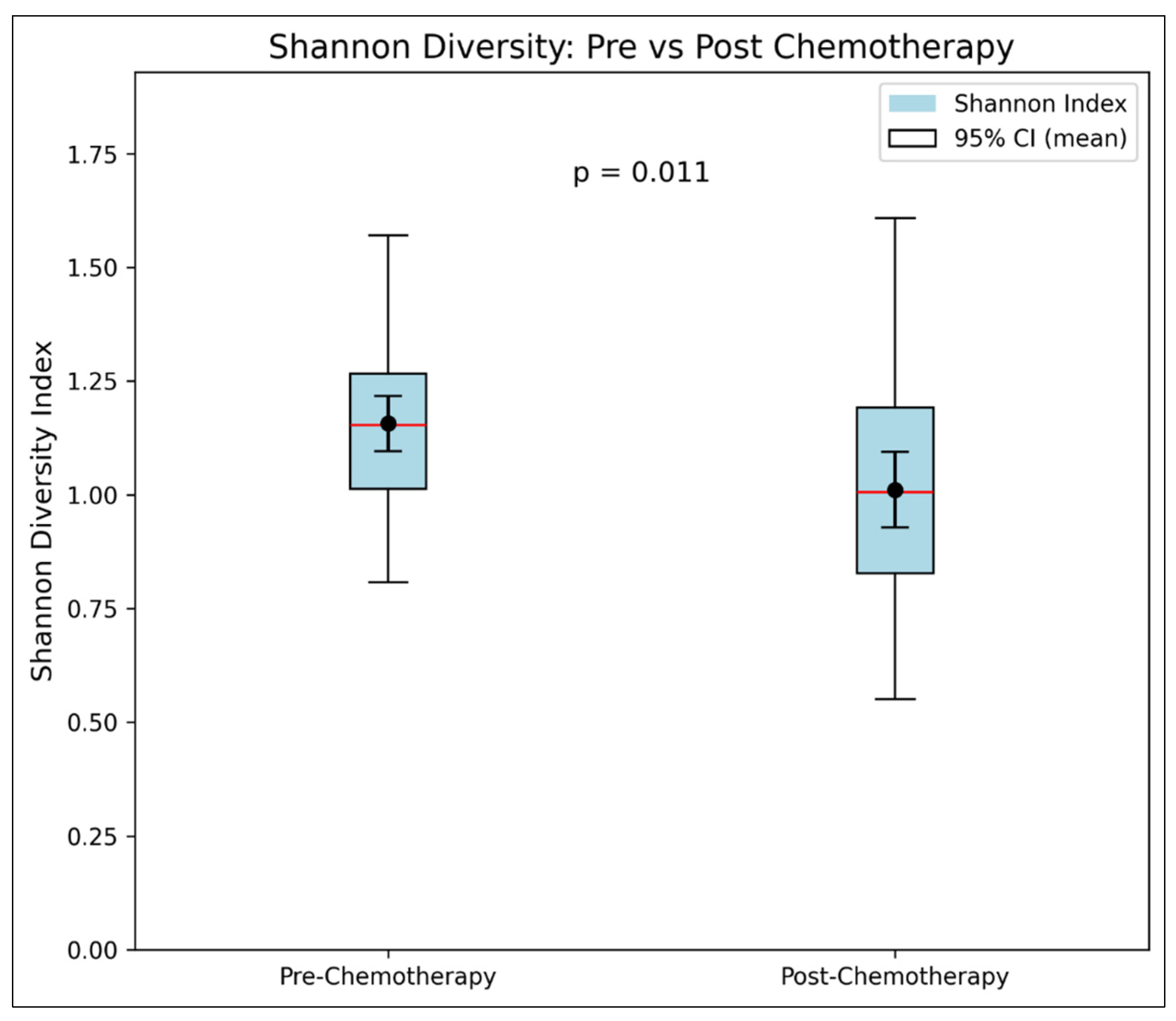
| Metric | Pre-Chemotherapy | Post-Chemotherapy | p |
|---|---|---|---|
| Mean ± SD | 1.20 ± 0.20 | 1.05 ± 0.21 | 0.011 for mean values |
| Median [IQR] | 1.19 [1.05, 1.34] | 1.03 [0.88, 1.20] | |
| 95% CI for mean | [1.13, 1.27] | [0.97, 1.13] |
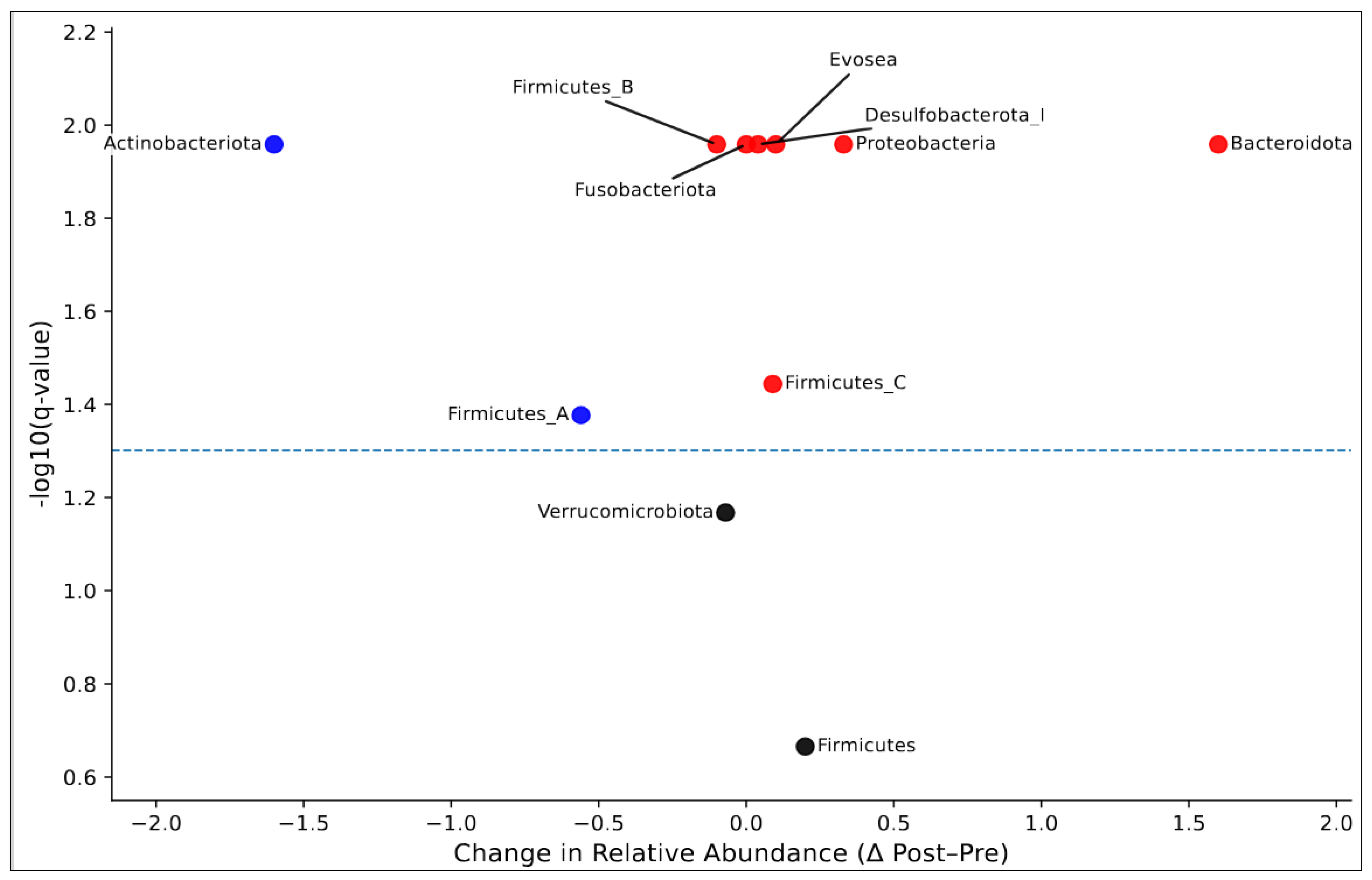
| Phylum | Relative Abundance (%) | % Change | p | q (FDR) | ||
|---|---|---|---|---|---|---|
| Pre% | Post% | Δ (Post − Pre) | ||||
| Firmicutes_A | 51.19 | 50.63 | −0.56 | −1.1% | 0.019 | 0.042 |
| Bacteroidota | 29.08 | 30.68 | 1.6 | 5.5% | 0.003 | 0.011 |
| Firmicutes | 6.14 | 6.34 | 0.2 | 3.2% | 0.131 | 0.216 |
| Actinobacteriota | 6.71 | 5.11 | −1.6 | −23.8% | 0.002 | 0.011 |
| Proteobacteria | 3.62 | 3.95 | 0.33 | 9.1% | 0.003 | 0.011 |
| Firmicutes_C | 1.35 | 1.44 | 0.09 | 6.6% | 0.013 | 0.036 |
| Verrucomicrobiota | 1.19 | 1.12 | −0.07 | −5.8% | 0.037 | 0.068 |
| Desulfobacterota_I | 0.20 | 0.24 | 0.04 | 20% | 0.002 | 0.011 |
| Firmicutes_B | 0.02 | 0.02 | 0 | 0% | 0.002 | 0.011 |
| Fusobacteriota | 0.01 | 0.01 | 0 | 0% | 0.002 | 0.011 |
| Evosea | 0.01 | 0.01 | 0 | 0% | 0.002 | 0.011 |
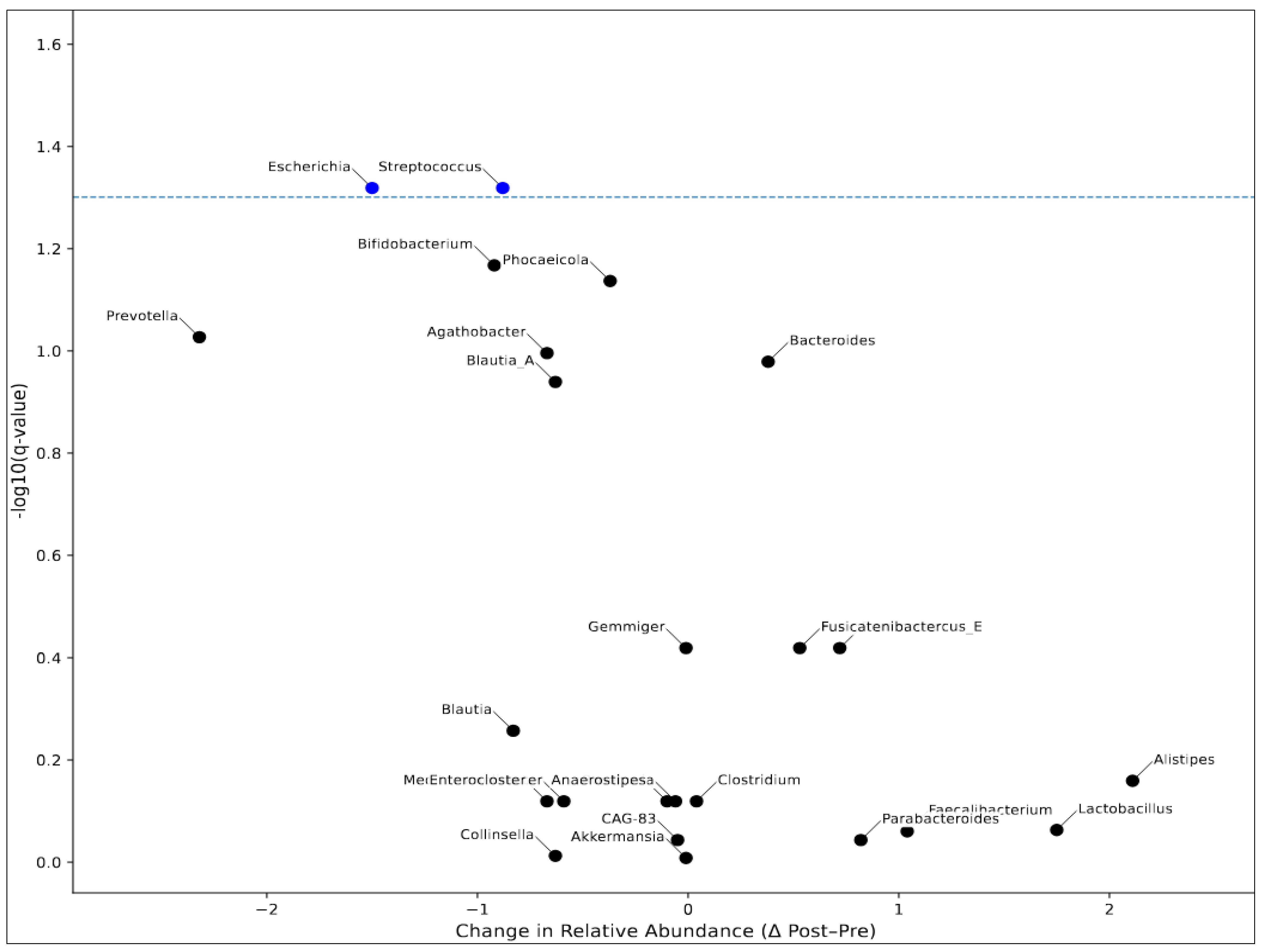
| Genus | Relative Abundance (%) | % Change | p | q (FDR) | ||
|---|---|---|---|---|---|---|
| Pre% | Post% | Δ (Post − Pre) | ||||
| Bacteroides | 20.67 | 21.05 | +0.38 | +1.8% | 0.042 | 0.105 |
| Blautia_A | 12.94 | 12.31 | −0.63 | −4.8% | 0.046 | 0.115 |
| Phocaeicola | 9.62 | 9.26 | −0.37 | −3.8% | 0.021 | 0.073 |
| Agathobacter | 6.06 | 5.40 | −0.67 | −11.0% | 0.039 | 0.101 |
| Bifidobacterium | 5.55 | 4.64 | −0.92 | −16.5% | 0.019 | 0.068 |
| Streptococcus | 3.95 | 3.07 | −0.88 | −22.2% | 0.012 | 0.048 |
| Faecalibacterium | 3.46 | 4.50 | +1.04 | +30.0% | 0.521 | 0.870 |
| Parabacteroides | 3.13 | 3.95 | +0.82 | +26.1% | 0.663 | 0.905 |
| Alistipes | 2.19 | 4.30 | +2.11 | +96.5% | 0.312 | 0.693 |
| Escherichia | 2.37 | 2.87 | +0.50 | 36.5% | 0.012 | 0.048 |
| Prevotella | 4.00 | 1.68 | −2.32 | −58.0% | 0.031 | 0.094 |
| Enterocloster | 3.17 | 2.51 | −0.67 | −21.1% | 0.412 | 0.760 |
| Collinsella | 2.78 | 2.15 | −0.63 | −22.6% | 0.851 | 0.972 |
| Ruminococcus_E | 2.10 | 2.82 | +0.72 | +34.3% | 0.122 | 0.381 |
| Fusicatenibacter | 1.93 | 2.46 | +0.53 | +27.6% | 0.122 | 0.381 |
| Clostridium | 2.01 | 2.06 | +0.04 | +2.1% | 0.412 | 0.760 |
| Gemmiger | 1.82 | 1.82 | −0.01 | −0.2% | 0.122 | 0.381 |
| Roseburia | 1.71 | 1.65 | −0.06 | −3.5% | 0.412 | 0.760 |
| Akkermansia | 1.64 | 1.62 | −0.01 | −0.9% | 0.897 | 0.981 |
| Anaerostipes | 1.66 | 1.56 | −0.10 | −5.9% | 0.412 | 0.760 |
| CAG-83 | 1.50 | 1.45 | −0.05 | −3.5% | 0.632 | 0.905 |
| Blautia | 1.82 | 0.99 | −0.83 | −45.7% | 0.233 | 0.553 |
| Lactobacillus | 0.47 | 2.21 | +1.75 | +374.8% | 0.512 | 0.865 |
| Diversity/Phyla | Input | Outcome | B (95% CI) | p | B (95% CI) | p | q (FDR) |
|---|---|---|---|---|---|---|---|
| Shannon Diversity | Baseline HEI | Baseline M | 0.23 (0.08, 0.38) | 0.01 | 0.20 (0.06, 0.34) | 0.02 | N/A |
| Baseline HEI | Δ M | 0.31 (0.15, 0.48) | 0.01 | 0.26 (0.09, 0.43) | 0.01 | ||
| Baseline M | Δ HEI | 0.78 (0.07, 1.15) | 0.31 | 0.75 (0.03, 1.03) | 0.32 | ||
| ΔM | Δ HEI | 0.19 (0.07, 0.31) | 0.01 | 0.16 (0.03, 0.29) | 0.02 | ||
| Firmicutes_A | Baseline HEI | Baseline M | 1.12 (0.03, 2.21) | 0.04 | 0.98 (0.02, 1.94) | 0.05 | 0.067 |
| Baseline HEI | Δ M | 0.67 (−0.40, 1.75) | 0.21 | 0.81 (0.04, 1.58) | 0.04 | 0.053 | |
| Baseline M | Δ HEI | 0.66 (−0.10, 1.42) | 0.09 | 0.58 (−0.07, 1.23) | 0.08 | 0.107 | |
| ΔM | Δ HEI | 0.61 (−0.18, 1.40) | 0.13 | 0.55 (−0.15, 1.25) | 0.12 | 0.160 | |
| Bacteroidota | Baseline HEI | Baseline M | 0.88 (−0.05, 1.81) | 0.07 | 0.75 (−0.12, 1.62) | 0.09 | 0.120 |
| Baseline HEI | Δ M | 0.55 (−0.47, 1.56) | 0.29 | 0.60 (−0.25, 1.46) | 0.15 | 0.200 | |
| Baseline M | Δ HEI | 0.52 (−0.20, 1.24) | 0.15 | 0.45 (−0.20, 1.10) | 0.17 | 0.227 | |
| ΔM | Δ HEI | 0.48 (−0.24, 1.20) | 0.18 | 0.42 (−0.22, 1.06) | 0.19 | 0.253 | |
| Firmicutes | Baseline HEI | Baseline M | 1.50 (0.30, 2.70) | 0.02 | 1.35 (0.15, 2.55) | 0.02 | 0.049 |
| Baseline HEI | Δ M | 0.91 (−0.27, 2.08) | 0.13 | 1.02 (0.05, 1.99) | 0.03 | 0.051 | |
| Baseline M | Δ HEI | 0.57 (−0.11, 1.25) | 0.10 | 0.50 (−0.12, 1.12) | 0.11 | 0.138 | |
| ΔM | Δ HEI | 0.73 (0.01, 1.45) | 0.05 | 0.65 (0.01, 1.29) | 0.06 | 0.075 | |
| Actinobacteriota | Baseline HEI | Baseline M | 0.49 (−0.18, 1.16) | 0.15 | 0.42 (−0.23, 1.07) | 0.20 | 0.267 |
| Baseline HEI | Δ M | 0.27 (−0.27, 0.81) | 0.33 | 0.43 (−0.06, 0.91) | 0.09 | 0.120 | |
| Baseline M | Δ HEI | 0.40 (−0.25, 1.06) | 0.23 | 0.35 (−0.27, 0.97) | 0.26 | 0.347 | |
| ΔM | Δ HEI | 0.31 (−0.32, 0.94) | 0.33 | 0.25 (−0.34, 0.84) | 0.40 | 0.533 | |
| Proteobacteria | Baseline HEI | Baseline M | −1.11 (−1.86, −0.36) | 0.01 | −1.00 (−1.80, −0.20) | 0.01 | 0.040 |
| Baseline HEI | Δ M | −0.94 (−1.67, −0.21) | 0.03 | −0.87 (−1.68, −0.06) | 0.04 | 0.045 | |
| Baseline M | Δ HEI | −0.95 (−1.70, −0.20) | 0.02 | −0.85 (−1.62, −0.08) | 0.03 | 0.040 | |
| ΔM | Δ HEI | −0.88 (−1.60, −0.15) | 0.03 | −0.80 (−1.55, −0.05) | 0.04 | 0.045 |
| Genus | Input | Outcome | Unadjusted Models | Adjusted Models | |||
|---|---|---|---|---|---|---|---|
| B (95% CI) | p | B (95% CI) | p | q (FDR) | |||
| Bacteroides | Baseline HEI | Baseline M | +0.15 (−0.07, 0.37) | 0.18 | +0.10 (−0.12, 0.32) | 0.37 | 0.28 |
| Baseline HEI | Δ M | +0.12 (−0.10, 0.34) | 0.28 | +0.08 (−0.14, 0.30) | 0.47 | 0.37 | |
| Baseline M | Δ HEI | +0.08 (−0.14, 0.30) | 0.47 | +0.05 (−0.17, 0.27) | 0.65 | 0.47 | |
| ΔM | Δ HEI | +0.21 (−0.03, 0.45) | 0.09 | +0.18 (−0.07, 0.43) | 0.15 | 0.24 | |
| Blautia_A | Baseline HEI | Baseline M | −0.22 (−0.42, −0.02) | 0.03 | −0.18 (−0.38, 0.02) | 0.03 | 0.04 |
| Baseline HEI | Δ M | −0.15 (−0.35, 0.05) | 0.14 | −0.12 (−0.32, 0.08) | 0.24 | 0.19 | |
| Baseline M | Δ HEI | −0.10 (−0.30, 0.10) | 0.33 | −0.07 (−0.27, 0.13) | 0.49 | 0.33 | |
| ΔM | Δ HEI | −0.25 (−0.47, −0.03) | 0.03 | −0.21 (−0.43, 0.01) | 0.03 | 0.04 | |
| Phocaeicola | Baseline HEI | Baseline M | +0.10 (−0.12, 0.32) | 0.37 | +0.07 (−0.15, 0.29) | 0.54 | 0.37 |
| Baseline HEI | Δ M | −0.05 (−0.27, 0.17) | 0.65 | −0.03 (−0.25, 0.19) | 0.79 | 0.65 | |
| Baseline M | Δ HEI | +0.03 (−0.19, 0.25) | 0.79 | +0.01 (−0.21, 0.23) | 0.93 | 0.79 | |
| ΔM | Δ HEI | −0.12 (−0.34, 0.10) | 0.29 | −0.09 (−0.31, 0.13) | 0.42 | 0.37 | |
| Agathobacter | Baseline HEI | Baseline M | −0.18 (−0.38, 0.02) | 0.08 | −0.15 (−0.35, 0.05) | 0.14 | 0.11 |
| Baseline HEI | Δ M | −0.22 (−0.42, −0.02) | 0.03 | −0.19 (−0.39, 0.01) | 0.06 | 0.06 | |
| Baseline M | Δ HEI | −0.07 (−0.27, 0.13) | 0.49 | −0.05 (−0.25, 0.15) | 0.63 | 0.49 | |
| ΔM | Δ HEI | −0.28 (−0.50, −0.06) | 0.01 | −0.24 (−0.46, −0.02) | 0.03 | 0.04 | |
| Bifidobacterium | Baseline HEI | Baseline M | +0.19 (0.02, 0.36) | 0.03 | +0.15 (−0.02, 0.32) | 0.09 | 0.09 |
| Baseline HEI | Δ M | +0.10 (−0.07, 0.27) | 0.25 | +0.07 (−0.10, 0.24) | 0.42 | 0.25 | |
| Baseline M | Δ HEI | +0.12 (−0.05, 0.29) | 0.17 | +0.09 (−0.08, 0.26) | 0.30 | 0.23 | |
| ΔM | Δ HEI | +0.16 (−0.01, 0.33) | 0.06 | +0.13 (−0.04, 0.30) | 0.13 | 0.09 | |
| Streptococcus | Baseline HEI | Baseline M | −0.20 (−0.40, 0.00) | 0.05 | −0.16 (−0.36, 0.04) | 0.12 | 0.07 |
| Baseline HEI | Δ M | −0.25 (−0.45, −0.05) | 0.01 | −0.21 (−0.41, −0.01) | 0.04 | 0.03 | |
| Baseline M | Δ HEI | −0.12 (−0.32, 0.08) | 0.24 | −0.09 (−0.29, 0.11) | 0.38 | 0.24 | |
| ΔM | Δ HEI | −0.30 (−0.52, −0.08) | 0.004 | −0.26 (−0.48, −0.04) | 0.02 | 0.02 | |
| Faecalibacterium | Baseline HEI | Baseline M | +0.31 (0.08, 0.54) | 0.01 | +0.26 (0.03, 0.49) | 0.03 | 0.03 |
| Baseline HEI | Δ M | +0.25 (0.02, 0.48) | 0.04 | +0.21 (−0.02, 0.44) | 0.07 | 0.09 | |
| Baseline M | Δ HEI | +0.18 (−0.05, 0.41) | 0.12 | +0.14 (−0.09, 0.37) | 0.23 | 0.12 | |
| ΔM | Δ HEI | +0.38 (0.14, 0.62) | 0.002 | +0.33 (0.09, 0.57) | 0.01 | 0.01 | |
| Parabacteroides | Baseline HEI | Baseline M | +0.13 (−0.09, 0.35) | 0.24 | +0.09 (−0.13, 0.31) | 0.41 | 0.24 |
| Baseline HEI | Δ M | +0.22 (0.00, 0.44) | 0.05 | +0.18 (−0.04, 0.40) | 0.11 | 0.09 | |
| Baseline M | Δ HEI | +0.15 (−0.07, 0.37) | 0.18 | +0.12 (−0.10, 0.34) | 0.28 | 0.24 | |
| ΔM | Δ HEI | +0.26 (0.02, 0.50) | 0.03 | +0.22 (−0.02, 0.46) | 0.07 | 0.09 | |
| Alistipes | Baseline HEI | Baseline M | +0.11 (−0.11, 0.33) | 0.32 | +0.07 (−0.15, 0.29) | 0.53 | 0.32 |
| Baseline HEI | Δ M | +0.35 (0.13, 0.57) | 0.002 | +0.31 (0.09, 0.53) | 0.006 | 0.01 | |
| Baseline M | Δ HEI | +0.14 (−0.08, 0.36) | 0.21 | +0.10 (−0.12, 0.32) | 0.37 | 0.28 | |
| ΔM | Δ HEI | +0.42 (0.18, 0.66) | 0.001 | +0.37 (0.13, 0.61) | 0.004 | 0.01 | |
| Escherichia | Baseline HEI | Baseline M | −0.28 (−0.50, −0.06) | 0.01 | −0.24 (−0.46, −0.02) | 0.03 | 0.03 |
| Baseline HEI | Δ M | −0.34 (−0.58, −0.10) | 0.006 | −0.29 (−0.53, −0.05) | 0.02 | 0.02 | |
| Baseline M | Δ HEI | −0.19 (−0.41, 0.03) | 0.09 | −0.15 (−0.37, 0.07) | 0.18 | 0.09 | |
| ΔM | Δ HEI | −0.41 (−0.65, −0.17) | 0.001 | −0.36 (−0.60, −0.12) | 0.003 | 0.01 | |
| Mediterraneibacter | Baseline HEI | Baseline M | +0.17 (−0.05, 0.39) | 0.12 | +0.13 (−0.09, 0.35) | 0.24 | 0.16 |
| Baseline HEI | Δ M | +0.29 (0.07, 0.51) | 0.01 | +0.25 (0.03, 0.47) | 0.03 | 0.03 | |
| Baseline M | Δ HEI | +0.14 (−0.08, 0.36) | 0.21 | +0.10 (−0.12, 0.32) | 0.37 | 0.21 | |
| ΔM | Δ HEI | +0.33 (0.09, 0.57) | 0.004 | +0.29 (0.05, 0.53) | 0.02 | 0.02 | |
| Prevotella | Baseline HEI | Baseline M | −0.21 (−0.43, 0.01) | 0.06 | −0.18 (−0.40, 0.04) | 0.11 | 0.08 |
| Baseline HEI | Δ M | −0.38 (−0.62, −0.14) | 0.002 | −0.34 (−0.58, −0.10) | 0.005 | 0.01 | |
| Baseline M | Δ HEI | −0.15 (−0.37, 0.07) | 0.18 | −0.12 (−0.34, 0.10) | 0.29 | 0.18 | |
| ΔM | Δ HEI | −0.44 (−0.68, −0.20) | 0.001 | −0.39 (−0.63, −0.15) | 0.002 | 0.01 | |
| Enterocloster | Baseline HEI | Baseline M | −0.12 (−0.34, 0.10) | 0.29 | −0.09 (−0.31, 0.13) | 0.42 | 0.24 |
| Baseline HEI | Δ M | −0.19 (−0.41, 0.03) | 0.09 | −0.15 (−0.37, 0.07) | 0.18 | 0.12 | |
| Baseline M | Δ HEI | −0.08 (−0.30, 0.14) | 0.47 | −0.05 (−0.27, 0.17) | 0.65 | 0.47 | |
| ΔM | Δ HEI | −0.23 (−0.47, 0.01) | 0.06 | −0.19 (−0.43, 0.05) | 0.12 | 0.12 | |
| Collinsella | Baseline HEI | Baseline M | −0.26 (−0.48, −0.04) | 0.02 | −0.22 (−0.44, 0.00) | 0.05 | 0.04 |
| Baseline HEI | Δ M | −0.31 (−0.55, −0.07) | 0.01 | −0.27 (−0.51, −0.03) | 0.03 | 0.03 | |
| Baseline M | Δ HEI | −0.14 (−0.36, 0.08) | 0.21 | −0.11 (−0.33, 0.11) | 0.34 | 0.21 | |
| ΔM | Δ HEI | −0.35 (−0.59, −0.11) | 0.003 | −0.30 (−0.54, −0.06) | 0.01 | 0.01 | |
| Ruminococcus_E | Baseline HEI | Baseline M | +0.16 (−0.06, 0.38) | 0.15 | +0.12 (−0.10, 0.34) | 0.29 | 0.20 |
| Baseline HEI | Δ M | +0.28 (0.06, 0.50) | 0.01 | +0.24 (0.02, 0.46) | 0.03 | 0.03 | |
| Baseline M | Δ HEI | +0.13 (−0.09, 0.35) | 0.24 | +0.09 (−0.13, 0.31) | 0.41 | 0.24 | |
| ΔM | Δ HEI | +0.32 (0.08, 0.56) | 0.004 | +0.28 (0.04, 0.52) | 0.02 | 0.02 | |
| Fusicatenibacter | Baseline HEI | Baseline M | +0.18 (−0.04, 0.40) | 0.11 | +0.14 (−0.08, 0.36) | 0.22 | 0.15 |
| Baseline HEI | Δ M | +0.31 (0.09, 0.53) | 0.006 | +0.27 (0.05, 0.49) | 0.02 | 0.02 | |
| Baseline M | Δ HEI | +0.15 (−0.07, 0.37) | 0.18 | +0.11 (−0.11, 0.33) | 0.32 | 0.18 | |
| ΔM | Δ HEI | +0.36 (0.12, 0.60) | 0.003 | +0.31 (0.07, 0.55) | 0.01 | 0.01 | |
| Clostridium | Baseline HEI | Baseline M | −0.05 (−0.27, 0.17) | 0.65 | −0.03 (−0.25, 0.19) | 0.79 | 0.65 |
| Baseline HEI | Δ M | +0.07 (−0.15, 0.29) | 0.53 | +0.05 (−0.17, 0.27) | 0.65 | 0.65 | |
| Baseline M | Δ HEI | +0.04 (−0.18, 0.26) | 0.72 | +0.02 (−0.20, 0.24) | 0.86 | 0.72 | |
| ΔM | Δ HEI | +0.09 (−0.13, 0.31) | 0.42 | +0.07 (−0.15, 0.29) | 0.54 | 0.56 | |
Disclaimer/Publisher’s Note: The statements, opinions and data contained in all publications are solely those of the individual author(s) and contributor(s) and not of MDPI and/or the editor(s). MDPI and/or the editor(s) disclaim responsibility for any injury to people or property resulting from any ideas, methods, instructions or products referred to in the content. |
© 2026 by the authors. Licensee MDPI, Basel, Switzerland. This article is an open access article distributed under the terms and conditions of the Creative Commons Attribution (CC BY) license.
Share and Cite
Han, C.; Spakowicz, D.; Von Ah, D.; Noonan, A.; Pyter, L. Gut Microbiota and Nutritional Profiles of Colon Cancer Patients Undergoing Chemotherapy: A Longitudinal Pilot Study. Nutrients 2026, 18, 438. https://doi.org/10.3390/nu18030438
Han C, Spakowicz D, Von Ah D, Noonan A, Pyter L. Gut Microbiota and Nutritional Profiles of Colon Cancer Patients Undergoing Chemotherapy: A Longitudinal Pilot Study. Nutrients. 2026; 18(3):438. https://doi.org/10.3390/nu18030438
Chicago/Turabian StyleHan, Claire, Daniel Spakowicz, Diane Von Ah, Anne Noonan, and Leah Pyter. 2026. "Gut Microbiota and Nutritional Profiles of Colon Cancer Patients Undergoing Chemotherapy: A Longitudinal Pilot Study" Nutrients 18, no. 3: 438. https://doi.org/10.3390/nu18030438
APA StyleHan, C., Spakowicz, D., Von Ah, D., Noonan, A., & Pyter, L. (2026). Gut Microbiota and Nutritional Profiles of Colon Cancer Patients Undergoing Chemotherapy: A Longitudinal Pilot Study. Nutrients, 18(3), 438. https://doi.org/10.3390/nu18030438