You are currently on the new version of our website. Access the old version .
NutrientsNutrients
  • This is an early access version, the complete PDF, HTML, and XML versions will be available soon.
  • Review
  • Open Access

13 January 2026

Caffeine as an Ergogenic Aid for Neuromuscular Performance: Mechanisms of Action from Brain to Motor Units


,
,
,
and
Laboratory of Exercise Physiology, Department of Movement, Human and Health Sciences, University of Rome “Foro Italico”, 00135 Rome, Italy
*
Author to whom correspondence should be addressed.
This article belongs to the Special Issue Nutrition, Exercise, and Health: Nutritional Supplements, Exercise Training, Skeletal Muscle Health, and Performance

Abstract

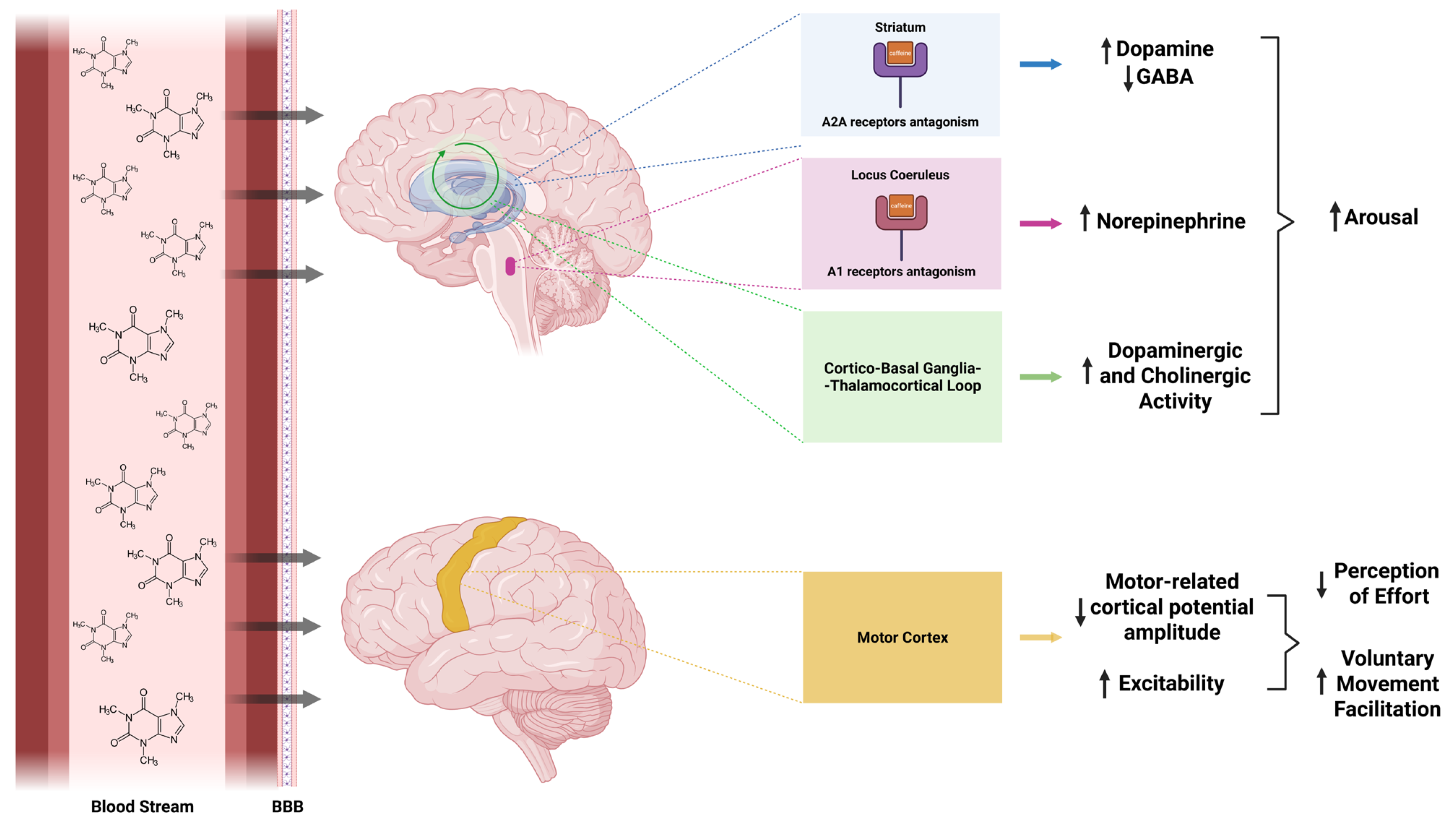
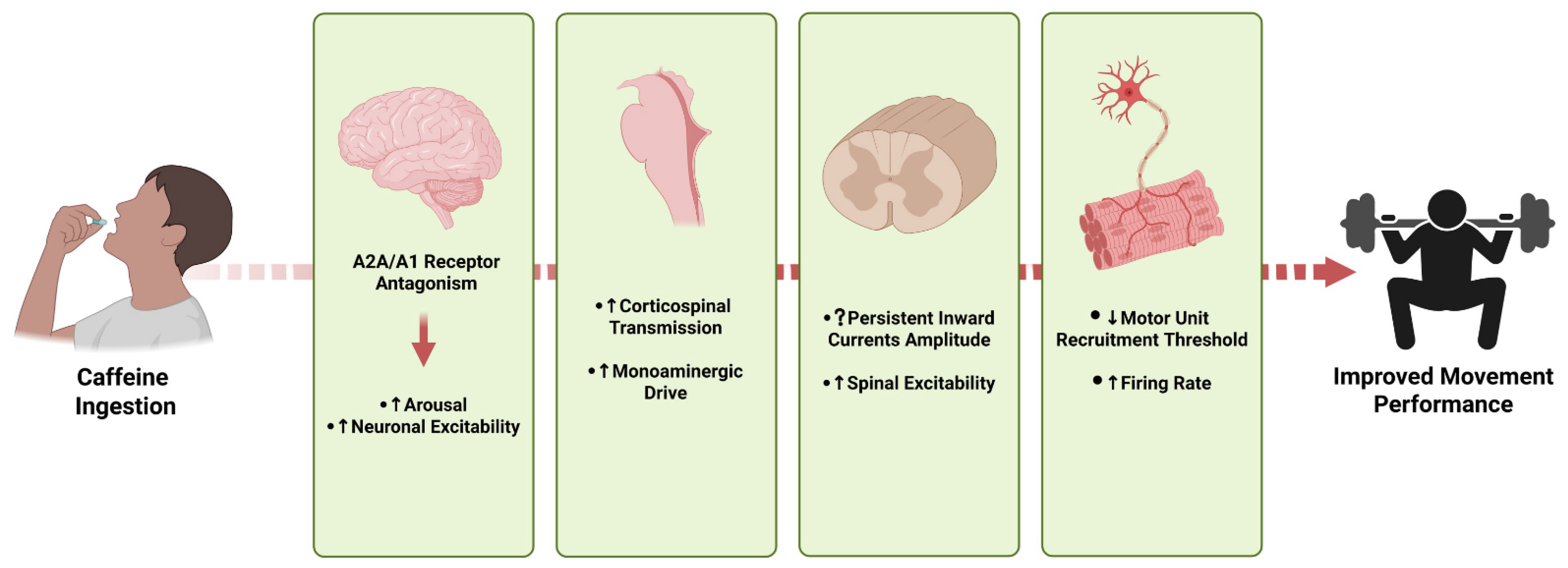
Ergogenic aids have long attracted scientific interest for their potential to enhance neuromuscular performance, with caffeine being among the most extensively studied. While traditionally attributed to peripheral actions on skeletal muscle, accumulating evidence indicates that, at physiological doses, caffeine’s ergogenic effects are predominantly mediated by antagonism of central adenosine receptors. This antagonism leads to increased arousal, reduced inhibitory neuromodulation, enhanced corticospinal excitability, and altered motor unit recruitment and firing behavior. Importantly, the concentrations required to elicit direct effects on excitation–contraction coupling via ryanodine receptors exceed those compatible with human safety, rendering such mechanisms unlikely in vivo. This narrative review synthesizes contemporary neurophysiological evidence to propose that caffeine acts primarily by “tuning” motor system gain through central neurotransmitter modulation, rather than by directly augmenting muscle contractile properties. Additionally, we highlight unresolved questions regarding persistent inward currents, sex-dependent neuromodulatory influences—including the potential role of estrogen in regulating adenosine receptor expression—and the implications of repeated caffeine use during training for neural adaptation and motor control. Finally, we outline key methodological and conceptual directions for future research aimed at refining our understanding of caffeine’s neuromuscular effects in both acute and chronic contexts.

Article Metrics

Citations

Article Access Statistics

Article metric data becomes available approximately 24 hours after publication online.