Unqualified Advice and Product Promotions: Analysis of Health and Nutrition Content on Social Media Consumed by Young Adults

Abstract
1. Introduction
2. Materials and Methods
3. Results
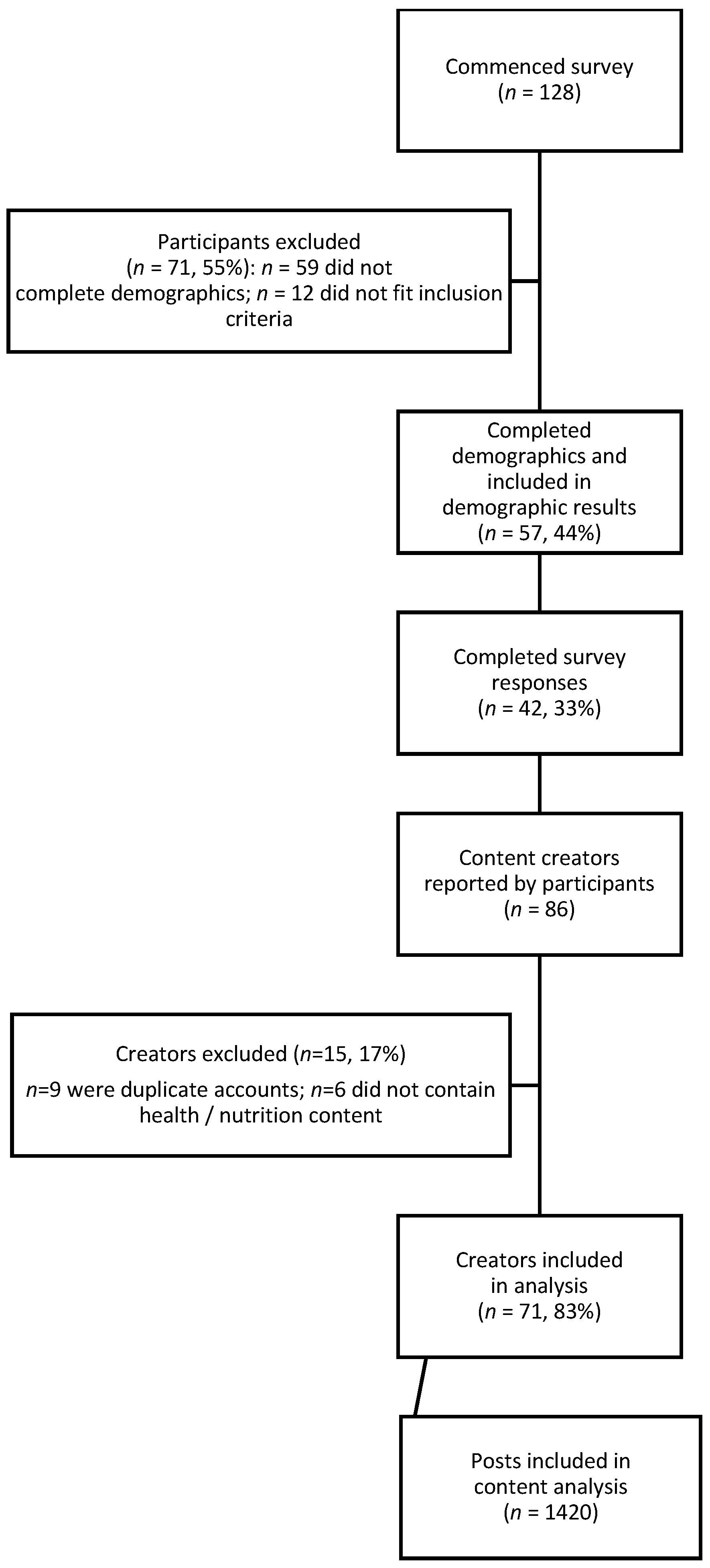
3.1. Participant Characteristics
3.2. Time Spent on Social Media
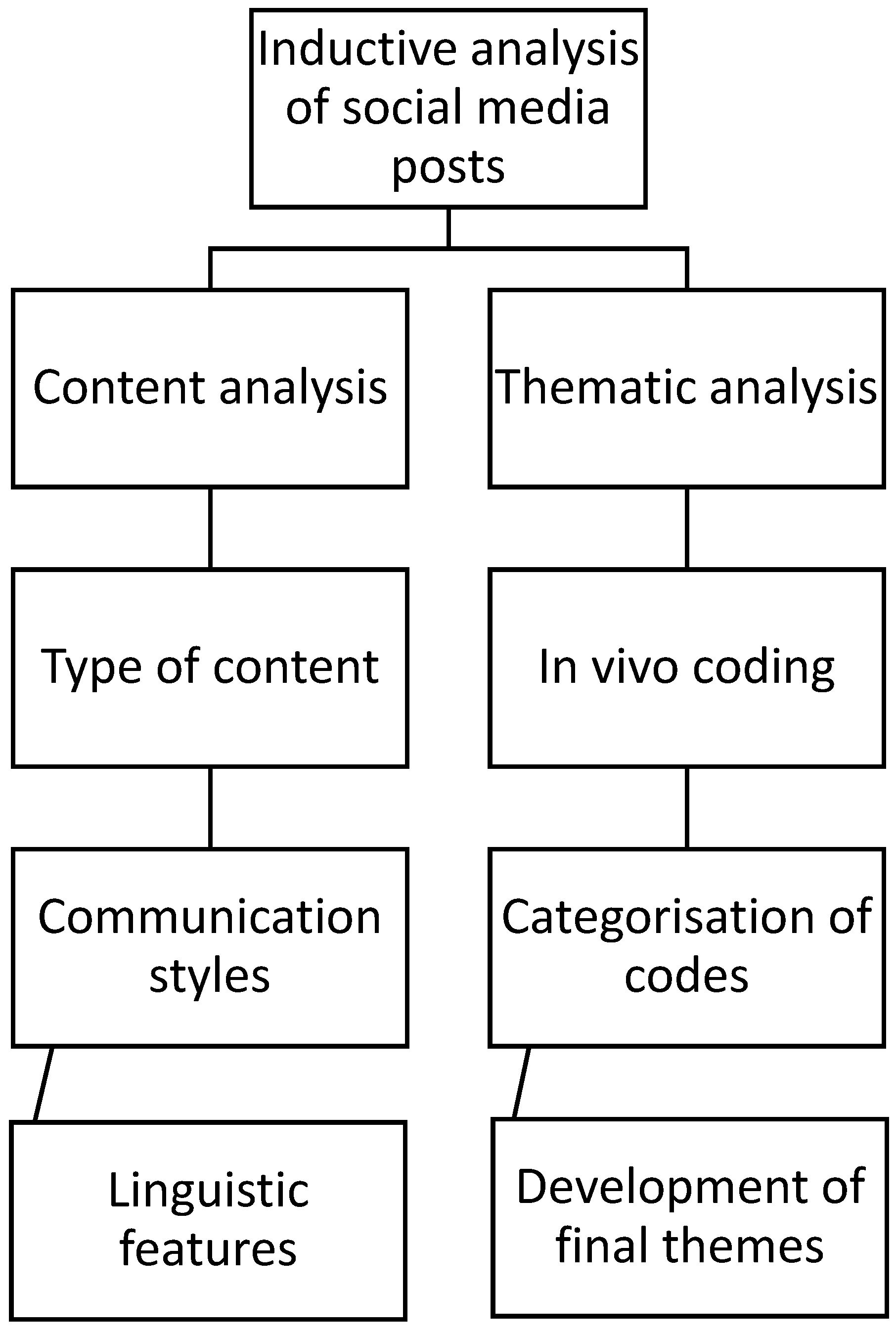
3.3. Content Analysis of Social Media Posts
3.4. Thematic Analysis of Social Media Posts
4. Discussion
5. Conclusions
Author Contributions
Funding
Institutional Review Board Statement
Informed Consent Statement
Data Availability Statement
Conflicts of Interest
References
- Australian Communications and Media Authority. The Digital Lives of Younger Australians Communications and Media in Australia; Australian Government: Canberra, Australia, 2021.
- Kemp, S. Digital 2024: Australia; Kepios: Vancouver, BC, Canada, 2024. [Google Scholar]
- Gazi, M.A.; Rahaman, M.A.; Rabbi, M.F.; Masum, M.; Nabi, M.N.; Senathirajah, M. The Role of Social Media in Enhancing Communication among Individuals: Prospects and Problems. Environ. Soc. Psychol. 2024, 9, 2979. [Google Scholar] [CrossRef]
- Doub, A.E.; Small, M.L.; Levin, A.; LeVangie, K.; Brick, T.R. Identifying users of traditional and Internet-based resources for meal ideas: An association rule learning approach. Appetite 2016, 103, 128–136. [Google Scholar] [CrossRef] [PubMed]
- Lambert, M.; Chivers, P.; Farringdon, F. In their own words: A qualitative study exploring influences on the food choices of university students. Health Promot. J. Austr. 2019, 30, 66–75. [Google Scholar] [CrossRef] [PubMed]
- Vaterlaus, J.M.; Patten, E.V.; Roche, C.; Young, J.A. #Gettinghealthy: The perceived influence of social media on young adult health behaviors. Comput. Hum. Behav. 2015, 45, 151–157. [Google Scholar] [CrossRef]
- Athanasoula, D.; Salpa, A.; Apergi, F.S.; Vlachos, I.I. The Relationship Between Social Media Use and Disordered Eating in Young Adults Aged 18–30: A Narrative Review. Nutrients 2025, 17, 3288. [Google Scholar] [CrossRef]
- Rounsefell, K.; Gibson, S.; McLean, S.; Blair, M.; Molenaar, A.; Brennan, L.; Truby, H.; McCaffrey, T.A. Social media, body image and food choices in healthy young adults: A mixed methods systematic review. Nutr. Diet. 2020, 77, 19–40. [Google Scholar] [CrossRef]
- Wu, Y.; Kemps, E.; Prichard, I. Digging into digital buffets: A systematic review of eating-related social media content and its relationship with body image and eating behaviours. Body Image 2024, 48, 101650. [Google Scholar] [CrossRef]
- Goerke, K.; Ng, A.; Trakman, G.; Forsyth, A. The influence of social media on the dietary behaviors of young Australian adults: A mixed methods exploration. Ment. Health Sci. 2023, 2, 21–26. [Google Scholar] [CrossRef]
- Denniss, E.; Lindberg, R.; Abbott, G.; McNaughton, S.A. Social media use for nutrition-related information and dietary behaviours: A cross-sectional survey of Australian young adults. Proc. Nutr. Soc. 2025, 84, E94. [Google Scholar] [CrossRef]
- Barklamb, A.M.; Molenaar, A.; Brennan, L.; Evans, S.; Choong, J.; Herron, E.; Reid, M.; McCaffrey, T.A. Learning the Language of Social Media: A Comparison of Engagement Metrics and Social Media Strategies Used by Food and Nutrition-Related Social Media Accounts. Nutrients 2020, 12, 2839. [Google Scholar] [CrossRef]
- Munro, E.; Wells, G.; Paciente, R.; Wickens, N.; Ta, D.; Mandzufas, J.; Lombardi, K.; Woolard, A. Diet culture on TikTok: A descriptive content analysis. Public Health Nutr. 2024, 27, e169. [Google Scholar] [CrossRef]
- Kemp, S. Digital 2025: Global Overview Report; Kepios: Vancouver, BC, Canada, 2025. [Google Scholar]
- Lim, M.S.C.; Molenaar, A.; Brennan, L.; Reid, M.; McCaffrey, T. Young Adults’ Use of Different Social Media Platforms for Health Information: Insights From Web-Based Conversations. J. Med. Internet Res. 2022, 24, e23656. [Google Scholar] [CrossRef] [PubMed]
- Maher, C.A.; Lewis, L.K.; Ferrar, K.; Marshall, S.; De Bourdeaudhuij, I.; Vandelanotte, C. Are health behavior change interventions that use online social networks effective? A systematic review. J. Med. Internet Res. 2014, 16, e40. [Google Scholar] [CrossRef] [PubMed]
- Freberg, K.; Graham, K.; McGaughey, K.; Freberg, L.A. Who are the social media influencers? A study of public perceptions of personality. Public. Relat. Rev. 2011, 37, 90–92. [Google Scholar] [CrossRef]
- Denniss, E.; Lindberg, R.; Marchese, L.E.; McNaughton, S.A. #Fail: The quality and accuracy of nutrition-related information by influential Australian Instagram accounts. Int. J. Behav. Nutr. Phys. Act. 2024, 21, 16. [Google Scholar] [CrossRef]
- Freeman, B.; Kelly, B.; Vandevijvere, S.; Baur, L. Young adults: Beloved by food and drink marketers and forgotten by public health? Health Promot. Int. 2016, 31, 954–961. [Google Scholar] [CrossRef]
- Hocevar, K.P.; Metzger, M.; Flanagin, A.J. Source Credibility, Expertise, and Trust in Health and Risk Messaging; Oxford University Press: Oxford, UK, 2017. [Google Scholar] [CrossRef]
- Jenkins, E.L.; Ilicic, J.; Barklamb, A.M.; McCaffrey, T.A. Assessing the Credibility and Authenticity of Social Media Content for Applications in Health Communication: Scoping Review. J. Med. Internet Res. 2020, 22, e17296. [Google Scholar] [CrossRef]
- Keser, A.; Bayındır-Gümüş, A.; Kutlu, H.; Öztürk, E. Development of the scale of effects of social media on eating behaviour: A study of validity and reliability. Public Health Nutr. 2020, 23, 1677–1683. [Google Scholar] [CrossRef]
- Australian Bureau of Statistics. Socio-Economic Indexes for Areas (SEIFA), Australia; Australian Bureau of Statistics: Belconnen, Canberra, 2021.
- The Jamovi Project, Version 2.6. Computer software. Jamovi Project: Sydney, Australia, 2025. Available online: https://www.jamovi.org (accessed on 14 April 2025).
- Munaro, A.C.; Barcelos, R.H.; Francisco Maffezzolli, E.C.; Rodrigues, J.P.S.; Paraiso, E.C. Does your style engage? Linguistic styles of influencers and digital consumer engagement on YouTube. Comput. Hum. Behav. 2024, 156, 108217. [Google Scholar] [CrossRef]
- Srivastava, S. Discourse Analysis of Sigma Social Media Influencers. Available online: https://medium.com/@imshub13/discourse-analysis-of-sigma-social-media-influencers-c3600ddb3877 (accessed on 14 April 2025).
- Elo, S.; Kyngäs, H. The qualitative content analysis process. J. Adv. Nurs. 2008, 62, 107–115. [Google Scholar] [CrossRef]
- Braun, V.; Clarke, V. Using thematic analysis in psychology. Qual. Res. Psychol. 2006, 3, 77–101. [Google Scholar] [CrossRef]
- Eşer Durmaz, S.; Keser, A.; Tunçer, E. Effect of emotional eating and social media on nutritional behavior and obesity in university students who were receiving distance education due to the COVID-19 pandemic. J. Public Health 2022, 31, 1645–1654. [Google Scholar] [CrossRef] [PubMed]
- Noguti, V. Post language and user engagement in online content communities. Eur. J. Mark. 2016, 50, 695–723. [Google Scholar] [CrossRef]
- Nan, X.; Wang, Y.; Thier, K. Why do people believe health misinformation and who is at risk? A systematic review of individual differences in susceptibility to health misinformation. Soc. Sci. Med. 2022, 314, 115398. [Google Scholar] [CrossRef]
- Liu, Z.; Zou, W. Breaking Taboos in Women’s Reproductive Health: The Communication Strategies Used by Top OB/GYN Influencers in Chinese Social Media. Health Commun. 2024, 39, 685–696. [Google Scholar] [CrossRef]
- Kaňková, J.; Binder, A.; Matthes, J. Helpful or harmful? Navigating the impact of social media influencers’ health advice: Insights from health expert content creators. BMC Public Health 2024, 24, 3511. [Google Scholar] [CrossRef]
- Rogers, A.; Wilkinson, S.A.; Truby, H.; Downie, O. Communication of Nutrition Information by Influencers on Social Media: A Scoping Review. Health Promot. J. Aust. Off. J. Aust. Assoc. Health Promot. Prof. 2021, 33, 657–676. [Google Scholar] [CrossRef]
- Taba, M.; Ayre, J.; McCaffery, K.; Vassilenko, D.; Ma, I.C.K.; Haynes, T.; Leask, J.; Wilson, A.; Bonner, C. Co-Designing a Framework for Social Media Health Communication to Young People: A Participatory Research Study. Health Expect. 2025, 28, e70203. [Google Scholar] [CrossRef]



| Characteristics | Frequency (n = 57) | Percentage (%) |
|---|---|---|
| Sex | ||
| Female | 38 | 67.9 |
| Male | 17 | 30.4 |
| Do not wish to disclose | 1 | 1.8 |
| SEIFA rating 1 | ||
| 10 | 12 | 21.8 |
| 9 | 4 | 7.3 |
| 8 | 11 | 20.0 |
| 7 | 2 | 3.6 |
| 6 | 16 | 29.1 |
| 4 | 3 | 5.5 |
| 3 | 3 | 5.5 |
| 2 | 2 | 3.6 |
| 1 | 2 | 3.6 |
| Highest level of education | ||
| Advanced diploma/diploma | 1 | 1.8 |
| Bachelor’s degree | 19 | 33.3 |
| Trade or certificate (I–IV) | 5 | 8.8 |
| Year 12 or equivalent qualification | 32 | 56.1 |
| Category of post school qualification (n = 50) | ||
| Agriculture, environmental, and related studies | 1 | 1.9 |
| Creative arts | 3 | 5.7 |
| Education | 4 | 7.5 |
| Engineering and related technologies | 3 | 5.7 |
| Food, hospitality, and personal services | 3 | 5.7 |
| Health | 26 | 49.1 |
| Management and commerce | 2 | 3.8 |
| Natural and physical sciences | 2 | 3.8 |
| Society and culture | 6 | 11.3 |
| Current main occupation | ||
| Carer and support work | 4 | 8.5 |
| Civil engineer | 1 | 2.1 |
| Cyber security | 1 | 2.1 |
| Education and tutoring | 4 | 8.5 |
| Fitness coach and trainer | 3 | 6.4 |
| Horticulturalist | 1 | 2.1 |
| Hospitality | 17 | 36.2 |
| Lifeguard | 1 | 2.1 |
| Marketing | 2 | 4.2 |
| Nutritionist | 1 | 2.1 |
| Pharmacy | 1 | 2.1 |
| Retail and sales | 11 | 23.1 |
| Special diet followed | ||
| Yes 21 (36.8%) | ||
| Following evidence-based diet (n = 11) | ||
| Gluten free | 2 | 4.8 |
| Low FODMAP 2 | 2 | 4.8 |
| Mediterranean | 3 | 7.1 |
| Vegan | 2 | 4.8 |
| Vegetarian/pescetarian | 2 | 4.8 |
| Following other type of special diets (n = 10) | ||
| Carnivore | 1 | 2.4 |
| High protein | 1 | 2.4 |
| Intermittent fasting/time-restricted eating | 1 | 2.4 |
| Low carb | 1 | 2.4 |
| Calorie deficit | 4 | 9.5 |
| Wholefood | 2 | 2.8 |
| Type of Content | Frequency (n = 71) | Percentage (%) |
|---|---|---|
| Ancestral diet nutrition education and dietary advice | 2 | 2.8 |
| Athlete/performance-focused nutrition coaching | 2 | 2.8 |
| Bodybuilding content | 2 | 2.8 |
| Client body transformations | 2 | 2.8 |
| Critiques modern medical practices | 3 | 4.2 |
| Critiques public health paradigms | 3 | 4.2 |
| Discredits online health myths and trends | 2 | 2.8 |
| Display/update of personal physique updates | 9 | 12.7 |
| Event-specific training and preparation | 3 | 4.2 |
| Evidence-based health education advice | 4 | 5.6 |
| Exercise routines and regimes | 11 | 15.5 |
| Fat loss and weight management strategies and advice | 10 | 14.1 |
| Fitness motivation | 21 | 29.6 |
| Fitness/training education, tips, and coaching | 10 | 14.1 |
| Fitness/weight loss journey reflections | 8 | 11.3 |
| General wellness advice and strategies | 10 | 14.1 |
| Health and wellness motivation content | 2 | 2.8 |
| Health/fitness product endorsement/advertisement | 40 | 56.3 |
| Healthy recipes and meal inspiration | 30 | 42.6 |
| Herbal medicine education and advice | 2 | 2.8 |
| High-protein/low-calorie recipes | 7 | 9.9 |
| Holistic health and lifestyle coaching content | 5 | 7.1 |
| Innovative recipe demonstrations | 6 | 8.5 |
| Meal prep recipes | 3 | 4.2 |
| Mental health awareness, personal reflection, or support | 4 | 5.6 |
| Nutrition education and dietary advice | 33 | 46.5 |
| Personal athletic/fitness achievements | 7 | 9.9 |
| Personal fitness goals | 2 | 2.8 |
| Personal health struggles | 2 | 2.8 |
| Plant-based or vegan recipes | 5 | 7.1 |
| Promotion of personal health/fitness products | 27 | 38 |
| Sports and performance nutrition advice | 7 | 9.9 |
| What I eat in a day | 5 | 7.1 |
| Content Creator Type and Linguistic Features | Frequency | Percentage (%) |
|---|---|---|
| Type of Creator (n = 71) | ||
| Certified medical professional | 2 | 2.8 |
| Dietitian | 8 | 11.3 |
| Fitness professional | 9 | 12.7 |
| Government organisation | 1 | 1.4 |
| Lay person | 40 | 55.3 |
| Medical doctor | 1 | 1.4 |
| Nutritionist | 11 | 15.5 |
| Dominant Communication Style | ||
| Coaching and mentoring | 12 | 16.9 |
| Expert advice | 34 | 47.9 |
| Intimate experience | 26 | 36.6 |
| Middle-of-the-road | 4 | 5.6 |
| Motivation and guidance | 32 | 45.1 |
| Storytelling | 4 | 5.6 |
| Struggle and overcoming | 8 | 11.3 |
| Linguistic Styles | ||
| Authenticity claims | 20 | 28.2 |
| Entrepreneurship | 40 | 56.3 |
| Humour | 32 | 45.1 |
| Individualism | 33 | 46.5 |
| Informal language | 61 | 85.9 |
| Jargon/slang | 58 | 81.7 |
| Masculinity | 29 | 40.8 |
| Non-conformity | 24 | 33.8 |
| Profanity | 15 | 21.1 |
| Rhetorical question | 60 | 84.5 |
| Shock value | 32 | 45.1 |
| Storytelling | 27 | 38 |
| Key Theme | Example Codes from Posts 1 |
|---|---|
| Emotional and psychological content was used to evoke feelings, memories, and psychological responses | “Train your body, but don’t forget that your heart is your strongest muscle. Lift heavy but be kind.” “POV: You show up for yourself every day because that’s what the person you aspire to be would do.” “Never say you can’t do anything. You are stronger than you believe! Find your motivation and don’t look back!” “Guilt doesn’t deserve to be part of Christmas this year. Here’s how you can actually enjoy food this Christmas.” “Sign up for your free trial to workout with me. Let’s feel more connected, challenged, and stronger together!” “We’re so incredibly proud of what we have built and of who we are. Together, women are better.” |
| Influencers presented themselves as knowledgeable and authoritative | “Race day planning should be tried and tested weeks or even months before your event. Grab a copy of one of our training and nutrition plans to make sure this is your best run yet.” “If you consistently under-consume calories, the body can downregulate processes like digestion to conserve energy.” “This breakfast is packed with protein, healthy fats and fibre and is a great way to stabilise your blood sugar for energy all day.” “It’s so important for our gut to get a wide range of vitamins and minerals.” “If you like chewing gum, skip the ones with aspartame, artificial flavours, and blue1 colouring. Try these better options instead.” “Obviously I’m not female, but I’ve done a bit of research.” “Micronutrients are essential for our bodies and play a HUGE role in brain health, energy metabolism, sleep, mood, and immunity. Micros could be the missing piece if you are feeling sluggish or struggling with recovery!” |
| Social and cultural framing of content | “Carbs don’t make you fat. Whoever told you that is lying.” “Give yourself permission to include all foods, because food is more than just fuel.” “It’s time to stop labelling foods as good or bad.” “You don’t have to make everything from scratch. I don’t!” “How could these meals be healthy? I’ve recreated each one of your favourite cheat day meals to be lower in calories and higher in protein so you can eat them and still achieve your weight loss goals.” “Aim for a source of protein at every meal and with your snacks to help you stay full, build muscle, and lose fat.” |
| Social media content was designed to address the practicalities and logistics of managing one’s health and nutrition in everyday life | “Pre-prepared meals can be a super convenient option for when you haven’t had the chance to do meal-prep. Tips: Choose the high protein brands, add frozen veggies to them for extra nutrients and fibre.” “Healthy eating is not black and white: it’s about balance and flexibility. Some days you won’t have the energy to cook a fresh, well-balanced meal and that’s ok! Having options of foods you can throw together for a quick simple meal is important as its about consistency, not perfection.” “It’s all about awareness. Maintaining a healthy weight can be achieved by making sure you don’t consume more calories than you burn day to day.” “We can’t be perfect all the time, but reduce the likelihood of making the wrong choice by planning ahead.” |
Disclaimer/Publisher’s Note: The statements, opinions and data contained in all publications are solely those of the individual author(s) and contributor(s) and not of MDPI and/or the editor(s). MDPI and/or the editor(s) disclaim responsibility for any injury to people or property resulting from any ideas, methods, instructions or products referred to in the content. |
© 2025 by the authors. Licensee MDPI, Basel, Switzerland. This article is an open access article distributed under the terms and conditions of the Creative Commons Attribution (CC BY) license.
Share and Cite
Evans, S.; Lambert, K.; Dinale, A.; Quinn, M.; Cosier, D. Unqualified Advice and Product Promotions: Analysis of Health and Nutrition Content on Social Media Consumed by Young Adults. Nutrients 2026, 18, 44. https://doi.org/10.3390/nu18010044
Evans S, Lambert K, Dinale A, Quinn M, Cosier D. Unqualified Advice and Product Promotions: Analysis of Health and Nutrition Content on Social Media Consumed by Young Adults. Nutrients. 2026; 18(1):44. https://doi.org/10.3390/nu18010044
Chicago/Turabian StyleEvans, Sophie, Kelly Lambert, Adrian Dinale, Myah Quinn, and Denelle Cosier. 2026. "Unqualified Advice and Product Promotions: Analysis of Health and Nutrition Content on Social Media Consumed by Young Adults" Nutrients 18, no. 1: 44. https://doi.org/10.3390/nu18010044
APA StyleEvans, S., Lambert, K., Dinale, A., Quinn, M., & Cosier, D. (2026). Unqualified Advice and Product Promotions: Analysis of Health and Nutrition Content on Social Media Consumed by Young Adults. Nutrients, 18(1), 44. https://doi.org/10.3390/nu18010044