Maternal Serum Ferritin Levels in Third Trimester and Risk of Small for Gestational Age in Northern Thailand: Implications for Management in Pregnancy

 ,
,
Abstract
1. Introduction
2. Materials and Methods
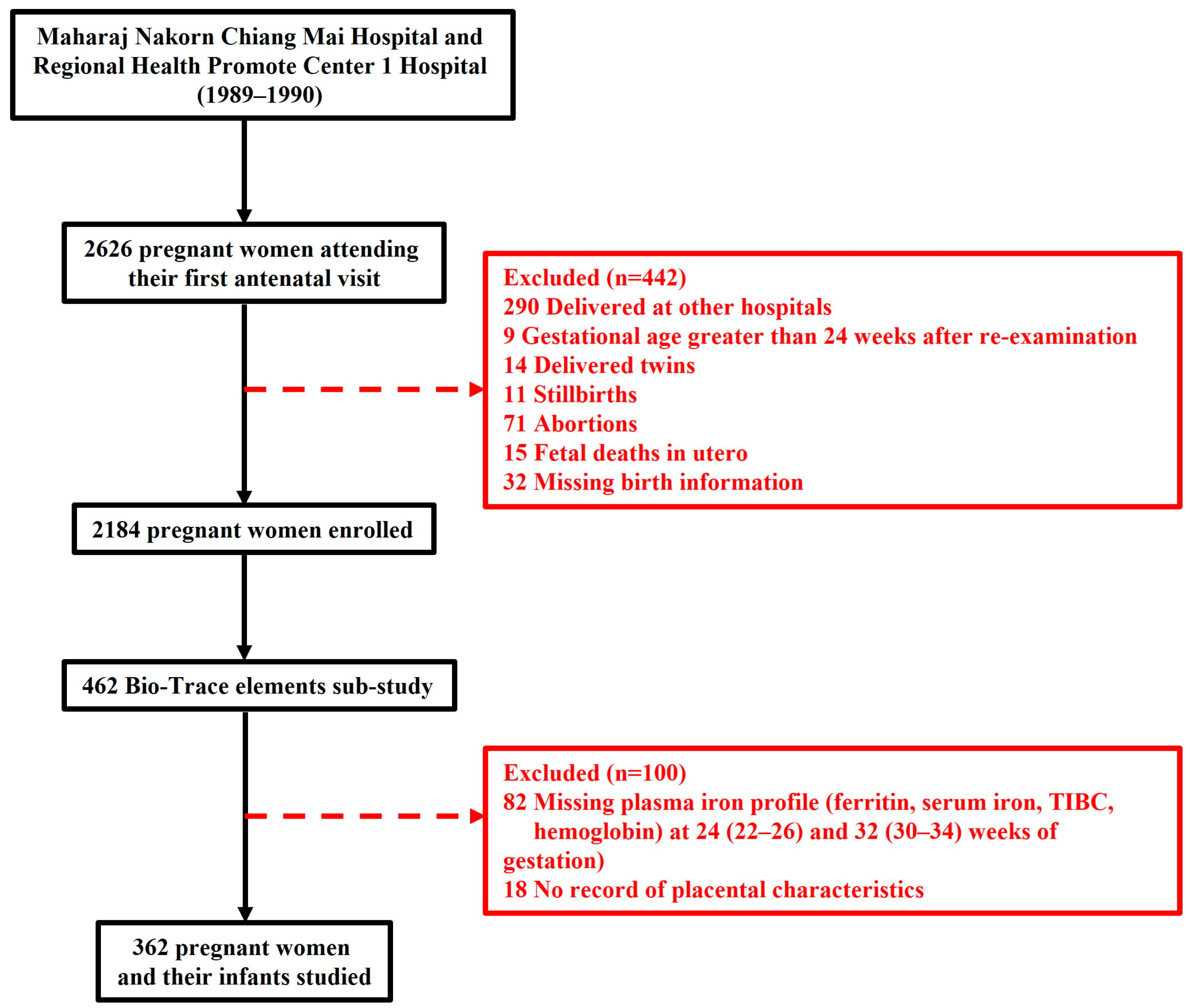
2.1. Study Design and Population
2.2. Maternal Iron Status Assessment and Outcome Definitions
2.3. Laboratory Assessment
2.4. Statistical Analysis
3. Results
3.1. Study Population Characteristics
3.2. Maternal Iron Status Parameters and Their Association with Preterm Birth and Small for Gestational Age in Third Trimester
3.3. Association Between Serum Ferritin Levels and Birth Outcomes
3.4. Association Between Maternal Serum Ferritin Levels and Placental Characteristics
3.5. Association Between Placental Characteristics and Infant Birth Weight
4. Discussion
5. Conclusions
Supplementary Materials
Author Contributions
Funding
Institutional Review Board Statement
Informed Consent Statement
Data Availability Statement
Acknowledgments
Conflicts of Interest
References
- Hamner, H.C.; Nelson, J.M.; Sharma, A.J.; Jefferds, M.E.D.; Dooyema, C.; Flores-Ayala, R.; Bremer, A.A.; Vargas, A.J.; Casavale, K.O.; de Jesus, J.M.; et al. Improving Nutrition in the First 1000 Days in the United States: A Federal Perspective. Am. J. Public Health 2022, 112, S817–S825. [Google Scholar] [CrossRef] [PubMed]
- Wang, X. Prenatal Nutrition and Developmental Origins of Health and Disease. Precis. Nutr. 2023, 2, e00040. [Google Scholar] [CrossRef]
- Quezada-Pinedo, H.G.; Cassel, F.; Duijts, L.; Muckenthaler, M.U.; Gassmann, M.; Jaddoe, V.W.V.; Reiss, I.K.M.; Vermeulen, M.J. Maternal Iron Status in Pregnancy and Child Health Outcomes After Birth: A Systematic Review and Meta-Analysis. Nutrients 2021, 13, 2221. [Google Scholar] [CrossRef]
- Ataide, R.; Fielding, K.; Pasricha, S.R.; Bennett, C. Iron deficiency, pregnancy, and neonatal development. Int. J. Gynaecol. Obstet. 2023, 162, 14–22. [Google Scholar] [CrossRef]
- Sangkhae, V.; Fisher, A.L.; Ganz, T.; Nemeth, E. Iron Homeostasis During Pregnancy: Maternal, Placental, and Fetal Regulatory Mechanisms. Annu. Rev. Nutr. 2023, 43, 279–300. [Google Scholar] [CrossRef] [PubMed]
- Daru, J.; Colman, K.; Stanworth, S.J.; De La Salle, B.; Wood, E.M.; Pasricha, S.R. Serum ferritin as an indicator of iron status: What do we need to know? Am. J. Clin. Nutr. 2017, 106, 1634s–1639s. [Google Scholar] [CrossRef]
- Dewey, K.G.; Oaks, B.M. U-shaped curve for risk associated with maternal hemoglobin, iron status, or iron supplementation. Am. J. Clin. Nutr. 2017, 106, 1694S–1702S. [Google Scholar] [CrossRef]
- Fite, M.B.; Tura, A.K.; Yadeta, T.A.; Oljira, L.; Roba, K.T. Prevalence, predictors of low birth weight and its association with maternal iron status using serum ferritin concentration in rural Eastern Ethiopia: A prospective cohort study. BMC Nutr. 2022, 8, 70. [Google Scholar] [CrossRef]
- Dande, A.; Pajai, S.; Gupta, A.; Dande, S.; Sethi, N. Unraveling the Role of Maternal Serum Ferritin Levels in Preterm Delivery: A Comprehensive Review. Cureus 2024, 16, e54515. [Google Scholar] [CrossRef]
- Tao, Y.; Kang, J.; Liu, J.; Duan, J.; Wang, F.; Shi, Y.; Li, Y.; Wang, C.; Xu, D.; Qu, X.; et al. Association of low birthweight and small for gestational age with maternal ferritin levels: A retrospective cohort study in China. Front. Nutr. 2022, 9, 1002702. [Google Scholar] [CrossRef] [PubMed]
- Yang, L.; Wu, L.; Liu, Y.; Chen, H.; Wei, Y.; Sun, R.; Shen, S.; Zhan, B.; Yang, J.; Deng, G. Association Between Serum Ferritin Concentration and Risk of Adverse Maternal and Fetal Pregnancy Outcomes: A Retrospective Cohort Study. Diabetes Metab. Syndr. Obes. 2022, 15, 2867–2876. [Google Scholar] [CrossRef] [PubMed]
- Chawla, D. Small for Gestation Age Neonates: Unmet Clinical Care and Research Need. Indian J. Pediatr. 2019, 86, 572–573. [Google Scholar] [CrossRef] [PubMed]
- Lawn, J.E.; Ohuma, E.O.; Bradley, E.; Idueta, L.S.; Hazel, E.; Okwaraji, Y.B.; Erchick, D.J.; Yargawa, J.; Katz, J.; Lee, A.C.C.; et al. Small babies, big risks: Global estimates of prevalence and mortality for vulnerable newborns to accelerate change and improve counting. Lancet 2023, 401, 1707–1719. [Google Scholar] [CrossRef]
- Hwang, I.T. Long-term care, from neonatal period to adulthood, of children born small for gestational age. Clin. Pediatr. Endocrinol. 2019, 28, 97–103. [Google Scholar] [CrossRef]
- Gnawali, A. Prematurity and the Risk of Development of Childhood Obesity: Piecing Together the Pathophysiological Puzzle. A Literature Review. Cureus 2021, 13, e20518. [Google Scholar] [CrossRef]
- Applegate, J.A.; Islam, M.S.; Khanam, R.; Roy, A.D.; Chowdhury, N.H.; Ahmed, S.; Mitra, D.K.; Mahmud, A.; Islam, M.S.; Saha, S.K.; et al. Young Infant Mortality Associated with Preterm and Small-for-Gestational-Age Births in Rural Bangladesh: A Prospective Cohort Study. J. Pediatr. 2024, 269, 114001. [Google Scholar] [CrossRef]
- Roberts, H.; Woodman, A.G.; Baines, K.J.; Jeyarajah, M.J.; Bourque, S.L.; Renaud, S.J. Maternal Iron Deficiency Alters Trophoblast Differentiation and Placental Development in Rat Pregnancy. Endocrinology 2021, 162, bqab215. [Google Scholar] [CrossRef]
- Zhang, Y.; Lu, Y.; Jin, L. Iron Metabolism and Ferroptosis in Physiological and Pathological Pregnancy. Int. J. Mol. Sci. 2022, 23, 9395. [Google Scholar] [CrossRef] [PubMed]
- Broekhuis, A.; Koenen, S.V.; Broeren, M.A.C.; Krabbe, J.G.; Pop, V.J.M. High first trimester ferritin levels differ according to parity and are independently related to preterm birth: A prospective cohort study. Acta Obstet. Gynecol. Scand. 2024, 103, 1437–1443. [Google Scholar] [CrossRef]
- Zhou, H.; Lu, Y.; Luo, J.; Pan, B.; Zhao, Q.; Chen, M.; Ma, Z.F. Maternal iron deficiency assessed by serum ferritin and birth outcomes in mainland China. Sci. Rep. 2025, 15, 1098. [Google Scholar] [CrossRef]
- Mangklabruks, A.; Rerkasem, A.; Wongthanee, A.; Rerkasem, K.; Chiowanich, P.; Sritara, P.; Pruenglampoo, S.; Yipintsoi, T.; Tongsong, T.; Marshall, T.; et al. The risk factors of low birth weight infants in the northern part of Thailand. J. Med. Assoc. Thail. 2012, 95, 358–365. [Google Scholar]
- Papageorghiou, A.T.; Kennedy, S.H.; Salomon, L.J.; Altman, D.G.; Ohuma, E.O.; Stones, W.; Gravett, M.G.; Barros, F.C.; Victora, C.; Purwar, M.; et al. The INTERGROWTH-21(st) fetal growth standards: Toward the global integration of pregnancy and pediatric care. Am. J. Obstet. Gynecol. 2018, 218, S630–S640. [Google Scholar] [CrossRef]
- International Committee for Standardization in Haematology (ICSH). The theory of reference values. Clin. Lab. Haematol. 1981, 3, 369–373. [Google Scholar] [PubMed]
- Behrouzi-Lak, T.; Mortazavi, M.; Vazifeshenas, S. Maternal Serum Ferritin Level in Prediction of Mothers with Appropriate-For-Gestational-Age (AGA), Small-For-Gestational Age (SGA), and Intrauterine Growth Restriction (IUGR). J. Pediatr. Perspect. 2021, 9, 13993–14002. [Google Scholar] [CrossRef]
- Mégier, C.; Peoc’h, K.; Puy, V.; Cordier, A.G. Iron Metabolism in Normal and Pathological Pregnancies and Fetal Consequences. Metabolites 2022, 12, 129. [Google Scholar] [CrossRef] [PubMed]
- Yu, Y.; Woloshun, R.R.; Lee, J.K.; Ebea, P.O.; Zhu, S.; Nemeth, E.; Garrick, L.M.; Garrick, M.D.; Collins, J.F. Fetal factors disrupt placental and maternal iron homeostasis in murine β-thalassemia. Blood 2023, 142, 185–196. [Google Scholar] [CrossRef] [PubMed]
- Cacoub, P.; Vandewalle, C.; Peoc’h, K. Using transferrin saturation as a diagnostic criterion for iron deficiency: A systematic review. Crit. Rev. Clin. Lab. Sci. 2019, 56, 526–532. [Google Scholar] [CrossRef]
- Yang, J.; Chang, Q.; Du, Q.; Liu, X.; Dang, S.; Tian, X. Maternal iron nutrition during pregnancy and fetal intrauterine growth. Nutr. J. 2024, 23, 140. [Google Scholar] [CrossRef] [PubMed]
- Banerjee, A.; Athalye, S.; Shingade, P.; Khargekar, V.; Mahajan, N.; Madkaikar, M.; Khargekar, N. Efficacy of daily versus intermittent oral iron supplementation for prevention of anaemia among pregnant women: A systematic review and meta-analysis. eClinicalMedicine 2024, 74, 102742. [Google Scholar] [CrossRef]
- Kent, L.; McGirr, M.; Eastwood, K.A. Global trends in prevalence of maternal overweight and obesity: A systematic review and meta-analysis of routinely collected data retrospective cohorts. Int. J. Popul. Data Sci. 2024, 9, 2401. [Google Scholar] [CrossRef]
- Ratnasiri, A.W.G.; Lee, H.C.; Lakshminrusimha, S.; Parry, S.S.; Arief, V.N.; DeLacy, I.H.; Yang, J.S.; DiLibero, R.J.; Logan, J.; Basford, K.E. Trends in maternal prepregnancy body mass index (BMI) and its association with birth and maternal outcomes in California, 2007–2016: A retrospective cohort study. PLoS ONE 2019, 14, e0222458. [Google Scholar] [CrossRef]
- Winichagoon, P.; Margetts, B.M. The double burden of malnutrition in low- and middle-income countries. In Energy Balance and Obesity; IARC Working Group Reports; Romieu, I., Dossus, L., Willett, W.C., Eds.; International Agency for Research on Cancer: Lyon, France, 2017. [Google Scholar]
- Nicholson, W.K.; Silverstein, M.; Wong, J.B.; Chelmow, D.; Coker, T.R.; Davis, E.M.; Jaén, C.R.; Krousel-Wood, M.; Lee, S.; Li, L.; et al. Screening and Supplementation for Iron Deficiency and Iron Deficiency Anemia During Pregnancy: US Preventive Services Task Force Recommendation Statement. JAMA 2024, 332, 906–913. [Google Scholar] [CrossRef]
- O’Toole, F.; Sheane, R.; Reynaud, N.; McAuliffe, F.M.; Walsh, J.M. Screening and treatment of iron deficiency anemia in pregnancy: A review and appraisal of current international guidelines. Int. J. Gynaecol. Obstet. 2024, 166, 214–227. [Google Scholar] [CrossRef]
- Roemhild, K.; von Maltzahn, F.; Weiskirchen, R.; Knüchel, R.; von Stillfried, S.; Lammers, T. Iron metabolism: Pathophysiology and pharmacology. Trends Pharmacol. Sci. 2021, 42, 640–656. [Google Scholar] [CrossRef]
- Beressa, G.; Whiting, S.J.; Kuma, M.N.; Lencha, B.; Belachew, T. Association between anemia in pregnancy with low birth weight and preterm birth in Ethiopia: A systematic review and meta-analysis. PLoS ONE 2024, 19, e0310329. [Google Scholar] [CrossRef]
- Khezri, R.; Salarilak, S.; Jahanian, S. The association between maternal anemia during pregnancy and preterm birth. Clin. Nutr. ESPEN 2023, 56, 13–17. [Google Scholar] [CrossRef]
- Munaf, Z.; Baloch, F.N.; Bosan, R.; Ismail, A.; Punar, Z.A.; Khan, S. Correlation Between Placenta Weight and Birth Weight at Full Term Pregnancy: Placenta Weight and Birth Weight Correlation. Pak. J. Health Sci. 2025, 6, 265–270. [Google Scholar] [CrossRef]
- Ng, S.W.; Norwitz, S.G.; Norwitz, E.R. The Impact of Iron Overload and Ferroptosis on Reproductive Disorders in Humans: Implications for Preeclampsia. Int. J. Mol. Sci. 2019, 20, 3283. [Google Scholar] [CrossRef] [PubMed]
- Lakhal-Littleton, S. Advances in understanding the crosstalk between mother and fetus on iron utilization. Semin. Hematol. 2021, 58, 153–160. [Google Scholar] [CrossRef] [PubMed]
- Liao, Y.; Zeng, T.; Guo, X.; Li, X. Ferritin’s role in infectious diseases: Exploring pathogenic mechanisms and clinical implications. New Microbes New Infect. 2025, 65, 101582. [Google Scholar] [CrossRef] [PubMed]
- Bardan, C.R.; Ionita, I.; Iordache, M.; Lighezan, D.; Gluhovschi, A.; Enatescu, I.; Bernad, E. Hepcidin as the Central Regulator in Pregnancy-Associated Iron Deficiency Anemia and Vitamin D Deficiency. Timis. Med. J. 2024, 2024, 28. [Google Scholar] [CrossRef]
- Finkelstein, J.L.; Cuthbert, A.; Weeks, J.; Venkatramanan, S.; Larvie, D.Y.; De-Regil, L.M.; Garcia-Casal, M.N. Daily oral iron supplementation during pregnancy. Cochrane Database Syst. Rev. 2024, 8, Cd004736. [Google Scholar] [CrossRef]
- Pavord, S.; Daru, J.; Prasannan, N.; Robinson, S.; Stanworth, S.; Girling, J. UK guidelines on the management of iron deficiency in pregnancy. Br. J. Haematol. 2020, 188, 819–830. [Google Scholar] [CrossRef] [PubMed]
- Vornic, I.; Buciu, V.; Furau, C.G.; Gaje, P.N.; Ceausu, R.A.; Dumitru, C.S.; Barb, A.C.; Novacescu, D.; Cumpanas, A.A.; Latcu, S.C.; et al. Oxidative Stress and Placental Pathogenesis: A Contemporary Overview of Potential Biomarkers and Emerging Therapeutics. Int. J. Mol. Sci. 2024, 25, 12195. [Google Scholar] [CrossRef] [PubMed]


| Characteristics | Study Participants | Non-Study Cohort | p |
|---|---|---|---|
| 362 | 1822 | ||
| Maternal Characteristics | |||
| Age (years) | |||
| <20 years | 27 (7.5) | 156 (8.6) | 0.685 |
| 20–35 years | 324 (89.5) | 1620 (88.9) | |
| >35 years | 11 (3.0) | 46 (2.5) | |
| Pre-pregnancy BMI (kg/m2) A | |||
| Underweight (<18.5) | 44 (12.2) | 184 (10.1) | 0.230 |
| Normal weight (18.5–22.9) | 252 (69.6) | 1172 (64.3) | |
| Overweight (23.0–24.9) | 37 (10.2) | 265 (14.6) | |
| Obese (≥25.0) | 29 (8.0) | 201 (11.0) | |
| Occupation | |||
| Agriculture | 58 (16.0) | 265 (14.5) | 0.498 |
| Employee | 64 (17.7) | 334 (18.3) | |
| Government official and Enterprise official | 52 (14.4) | 344 (18.9) | |
| Trader | 29 (8.0) | 129 (7.1) | |
| Handicraft | 32 (8.8) | 136 (7.5) | |
| Unemployed women | 109 (30.1) | 518 (28.4) | |
| Others | 18 (5.0) | 96 (5.3) | |
| Education | |||
| No education and Primary school | 259 (71.5) | 1168 (64.1) | 0.007 |
| Secondary school or higher | 103 (28.5) | 654 (35.9) | |
| Parity | |||
| Nulliparous women | 236 (65.2) | 1026 (56.3) | 0.002 |
| Parous women | 126 (34.8) | 796 (43.7) | |
| Smoking before Pregnancy | 12 (3.3) | 30 (1.7) | 0.075 |
| Alcohol consuming before pregnancy | 3 (0.8) | 15 (0.8) | 0.992 |
| Fetal Characteristics | |||
| Gestational age at delivery (weeks) | 39 (38, 40) | 39 (38, 40) | 0.778 |
| Birthweight (grams) | 2850 (2420, 3060) | 3050 (2780, 3320) | <0.001 |
| Infant sex | |||
| Male | 842 (46.2) | 189 (52.2) | 0.583 |
| Female | 980 (53.8) | 173 (47.8) | |
| Mode of delivery | |||
| Vaginal delivery | 1628 (89.3) | 324 (89.5) | 0.663 |
| Cesarian section | 194 (10.7) | 38 (10.5) |
| Preterm Birth A | Term Birth | SGA B | Non-SGA | ||
|---|---|---|---|---|---|
| n (%) | 45 (12.4) | 317 (87.6) | 120 (33.2) | 242 (66.8) | |
| median (IQR) | 36 (35, 36) | 39 (38, 40) | 3.7 (1.4, 6.5) | 30.0 (19.8, 46.6) | |
| Iron status parameters | |||||
| Ferritin (µg/L) | |||||
| median (IQR) | 31 (17, 41) | 23 (14, 38) | 26 (17, 48) | 23 (12, 37) | |
| range | 5–149 | 3–312 | 3–312 | 3–270 | |
| Serum Iron (µg/dL) | |||||
| median (IQR) | 101 (68, 127) | 94 (71, 112) | 96 (77, 117) | 92 (68, 112) | |
| range | 29–208 | 21–284 | 32–284 | 21–236 | |
| Total iron binding capacity (µmol/L) | |||||
| median (IQR) | 462 (420, 543) | 497 (435, 561) | 497 (442, 545) | 497 (423, 568) | |
| range | 277–822 | 70–847 | 279–726 | 70–847 | |
| Transferrin Saturation (%) | |||||
| median (IQR) | 18.6 (14.2, 31.8) | 18.3 (13.8, 23.8) | 19.5 (15.0, 24.6) | 17.7 (13.3, 24.3) | |
| range | 5.1–66.7 | 5.0–100 | 7.0–62.7 | 5.0–100 | |
| Mean Cell Hemoglobin Concentration | |||||
| median (IQR) | 32.0 (30.9, 32.8) | 32.1 (31.1, 32.9) | 32.0 (31.0, 32.8) | 32.2 (31.2, 33.0) | |
| range | 27.3–34.4 | 28.8–37.1 | 27.3–35.6 | 28.8–37.0 | |
| Hemoglobin (g/dL) | |||||
| median (IQR) | 11.6 (11.0, 12.41) | 11.5 (11.0, 12.1) | 11.4 (11.0, 12.3) | 11.6 (11.0, 12.1) | |
| range | 7.8–13.5 | 9.2–13.9 | 9.1–13.7 | 8.6–13.8 | |
| Outcome | Serum Ferritin at 30–34th Weeks of Gestation (µg/L) | p Trend | Per-SD Increase | ||||
|---|---|---|---|---|---|---|---|
| Quintiles 1 (<13.0) | Quintiles 2 (13.0–20.0) | Quintiles 3 (20.1–30.0) | Quintiles 4 (30.1–43.0) | Quintiles 5 (>43.0) | |||
| n (%) | 77 (21.3) | 72 (19.9) | 77 (21.3) | 64 (17.7) | 72 (19.9) | ||
| Preterm birth | |||||||
| Rate: n (%) | 6 (7.8) | 10 (13.9) | 6 (7.8) | 12 (18.8) | 11 (15.3) | ||
| Crude OR (95% CI) | 0.45 (0.17, 1.21) | 0.72 (0.29, 1.79) | 0.37 (0.13, 1.04) | 1.00 (Reference) | 0.80 (0.33, 1.96) | 0.182 | 1.05 (0.78, 1.40) |
| Adjusted OR (95% CI) | 0.71 (0.24, 2.10) | 1.00 (0.37, 2.72) | 0.46 (0.15, 1.39) | 1.00 (Reference) | 1.10 (0.41, 2.96) | 0.484 | 1.01 (0.71, 1.44) |
| Small for gestational age | |||||||
| Rate: n (%) | 16 (20.8) | 23 (31.9) | 30 (39.0) | 17 (26.6) | 34 (47.2) | 0.001 | |
| Crude OR (95% CI) | 0.88 (0.40, 1.90) | 1.63 (0.78, 3.40) | 1.98 (0.97, 4.04) | 1.00 (Reference) | 3.16 (1.54, 6.50) | 0.005 | 1.32 (1.06, 1.64) |
| Adjusted OR (95% CI) | 1.06 (0.46, 2.44) | 1.72 (0.78, 3.82) | 2.04 (0.94, 4.41) | 1.00 (Reference) | 3.31 (1.51, 7.28) | 0.044 | 1.31 (1.01, 1.71) |
| Placental Parameter | Category | Range | n (%) | Crude OR (95% CI) | p | Adjusted OR (95% CI) | p |
|---|---|---|---|---|---|---|---|
| Placental Weight (grams) | Low (<−1 SD) | <415 | 61 (16.9) | 3.27 (1.77, 6.05) | <0.001 | 3.02 (1.61, 5.69) | 0.001 |
| Normal (−1 SD to +1 SD) | 415–629 | 248 (68.5) | 1.00 (Reference) | - | 1.00 (Reference) | - | |
| High (>+1 SD) | >629 | 53 (14.6) | 0.77 (0.32, 1.82) | 0.549 | 0.80 (0.33, 1.93) | 0.615 | |
| Placental Diameter (cm) | Small (<−1 SD) | <14.5 | 13 (3.6) | 1.16 (0.31, 4.35) | 0.821 | 1.02 (0.27, 3.89) | 0.982 |
| Normal (−1 SD to +1 SD) | 14.5–23.8 | 332 (91.7) | 1.00 (Reference) | - | 1.00 (Reference) | - | |
| Large (>+1 SD) | >23.8 | 17 (4.7) | 0.24 (0.03, 1.86) | 0.173 | 0.25 (0.03, 1.97) | 0.190 | |
| Umbilical Cord Length (cm) | Short (<−1 SD) | <38.9 | 47 (13.0) | 1.39 (0.67, 2.87) | 0.371 | 1.31 (0.63, 2.74) | 0.467 |
| Normal (−1 SD to +1 SD) | 38.9–58.3 | 253 (69.9) | 1.00 (Reference) | - | 1.00 (Reference) | - | |
| Long (>+1 SD) | >58.3 | 62 (17.1) | 0.78 (0.37, 1.64) | 0.515 | 0.90 (0.42, 1.93) | 0.791 |
| Placental Parameter | Birth Weight Z-Score | Birth Weight Centile | ||
|---|---|---|---|---|
| β Coefficient (95% CI) | p | β Coefficient (95% CI) | p | |
| Placental Weight (per 100 g) | 0.39 (0.32, 0.47) | <0.001 | 8.58 (6.78, 10.37) | <0.001 |
| Placental Diameter (per cm) | 0.02 (−0.01, 0.03) | 0.075 | 0.24 (−0.14, 0.62) | 0.219 |
| Umbilical Cord Length (per cm) | 0.00 (−0.01, 0.01) | 0.107 | −0.15 (−0.35, 0.04) | 0.121 |
Disclaimer/Publisher’s Note: The statements, opinions and data contained in all publications are solely those of the individual author(s) and contributor(s) and not of MDPI and/or the editor(s). MDPI and/or the editor(s) disclaim responsibility for any injury to people or property resulting from any ideas, methods, instructions or products referred to in the content. |
© 2025 by the authors. Licensee MDPI, Basel, Switzerland. This article is an open access article distributed under the terms and conditions of the Creative Commons Attribution (CC BY) license (https://creativecommons.org/licenses/by/4.0/).
Share and Cite
Thaichana, P.; Mangklabruks, A.; Rerkasem, A.; Wongthanee, A.; Wongsrithep, S.; Rerkasem, K. Maternal Serum Ferritin Levels in Third Trimester and Risk of Small for Gestational Age in Northern Thailand: Implications for Management in Pregnancy. Nutrients 2025, 17, 3911. https://doi.org/10.3390/nu17243911
Thaichana P, Mangklabruks A, Rerkasem A, Wongthanee A, Wongsrithep S, Rerkasem K. Maternal Serum Ferritin Levels in Third Trimester and Risk of Small for Gestational Age in Northern Thailand: Implications for Management in Pregnancy. Nutrients. 2025; 17(24):3911. https://doi.org/10.3390/nu17243911
Chicago/Turabian StyleThaichana, Pak, Ampica Mangklabruks, Amaraporn Rerkasem, Antika Wongthanee, Suthathip Wongsrithep, and Kittipan Rerkasem. 2025. "Maternal Serum Ferritin Levels in Third Trimester and Risk of Small for Gestational Age in Northern Thailand: Implications for Management in Pregnancy" Nutrients 17, no. 24: 3911. https://doi.org/10.3390/nu17243911
APA StyleThaichana, P., Mangklabruks, A., Rerkasem, A., Wongthanee, A., Wongsrithep, S., & Rerkasem, K. (2025). Maternal Serum Ferritin Levels in Third Trimester and Risk of Small for Gestational Age in Northern Thailand: Implications for Management in Pregnancy. Nutrients, 17(24), 3911. https://doi.org/10.3390/nu17243911