Investigating the Impact of Glycogen-Depleting Exercise Combined with Prolonged Fasting on Autophagy and Cellular Health in Humans: A Randomised Controlled Crossover Trial

 ,
,  , , , ,
  , and
, and Highlights
- The first randomised controlled trial comparing two fasting protocols with a comprehensive multi-omics analysis of autophagic flux;
- A novel combination of exercise-induced glycogen depletion with prolonged fasting to enhance autophagy;
- The integration of continuous glucose monitoring and ketone measurements to ensure protocol safety and compliance;
- A systematic investigation of blood-based autophagy biomarkers to move towards easier monitoring in future studies.
Abstract
1. Introduction
2. Aims of Profasta Trial
3. Methods
3.1. Study Design
3.2. Eligibility Criteria
3.3. Recruitment and Initial Screening
3.4. Baseline Visit

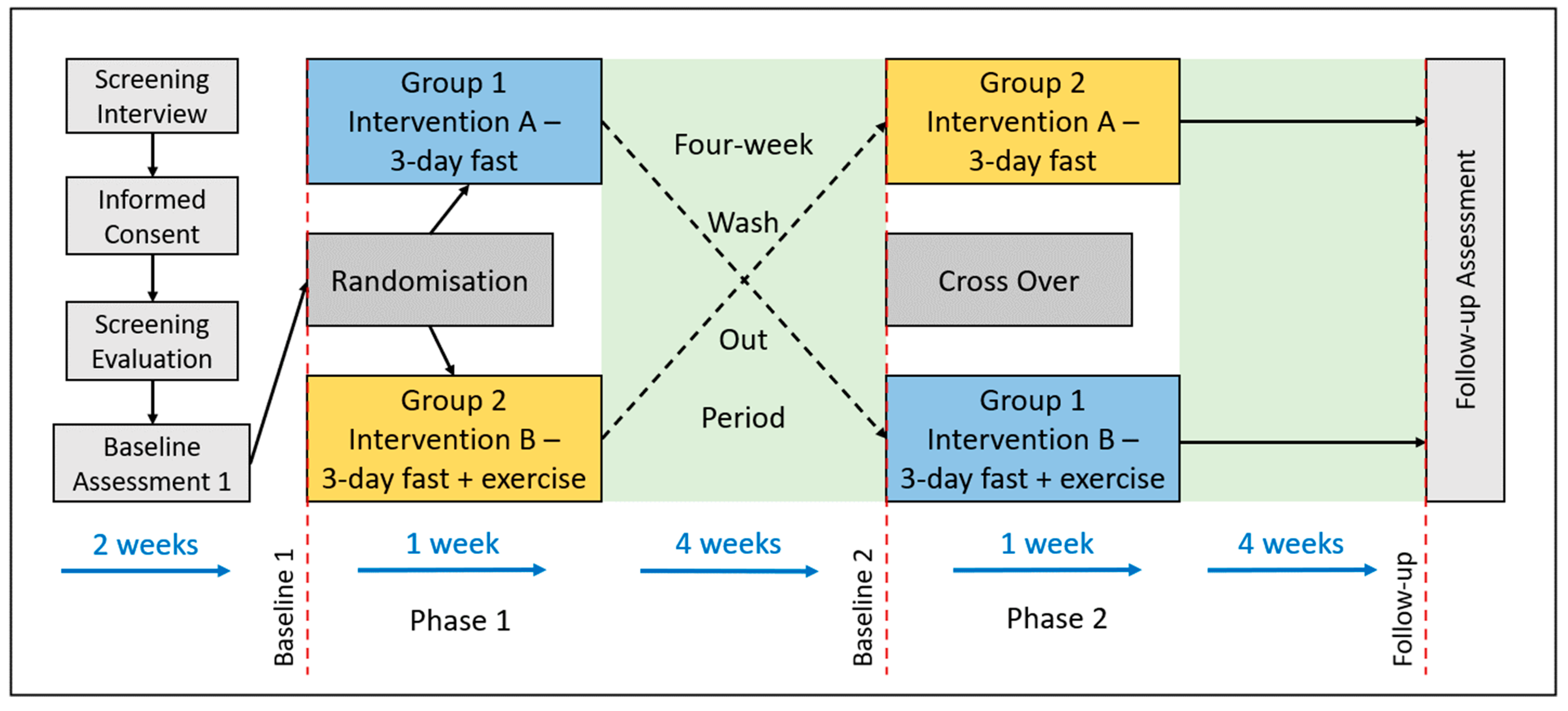
| Study Phase | Visit | Visit Title | Approximate Duration of the Visit | Notes |
|---|---|---|---|---|
| Screening | 1 | Screening evaluation | 3 h | Medical history, blood sample, VO2peak test |
| Phase 1 | 2 | Baseline assessment 1 | 2 h | Clinical measurements |
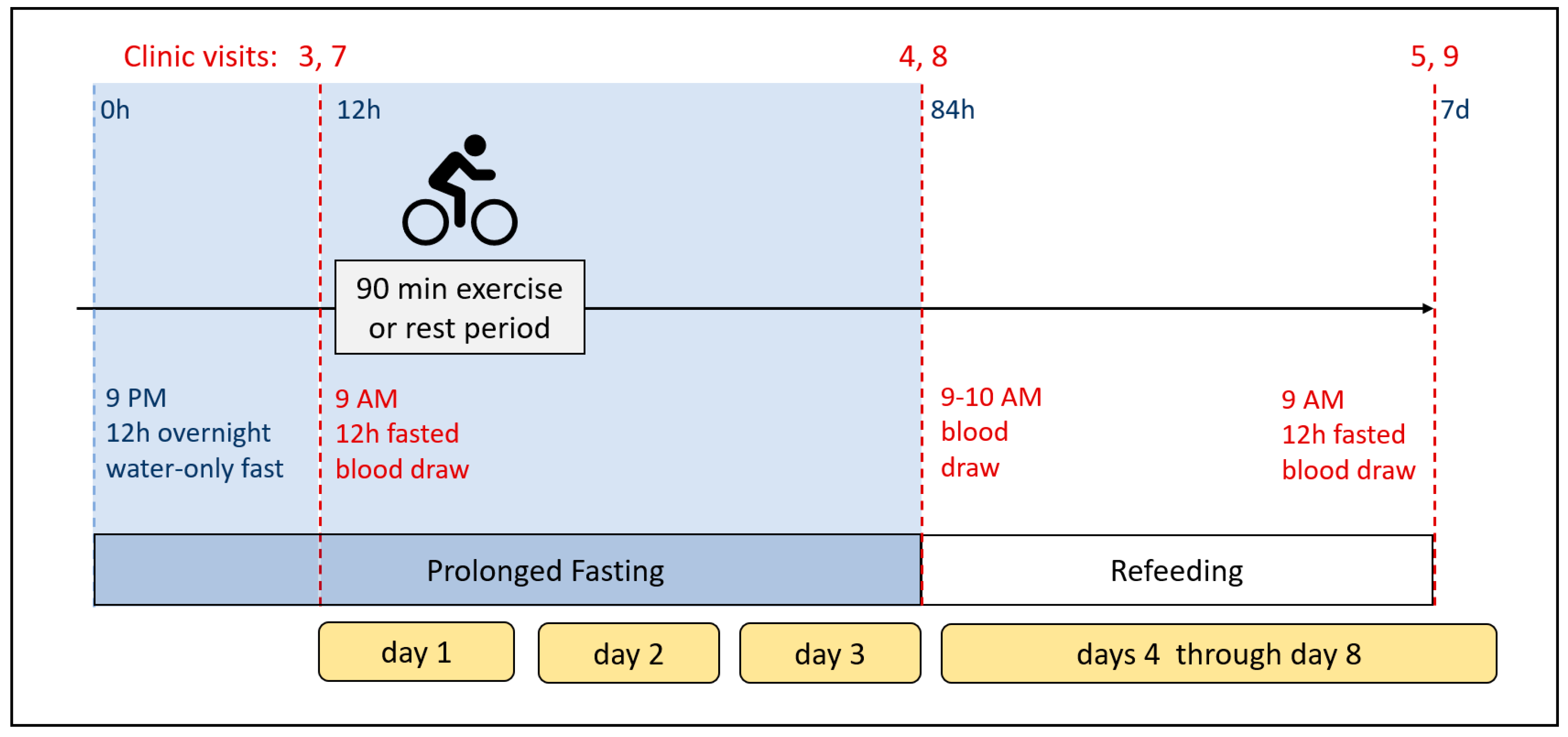
| 3 | Start of fasting and cycling exercise/rest period | 3.5 h | Fasting starts a night before | |
| 4 | End of fasting 1 | 2 h | Refeeding starts after this visit | |
| 5 | End of refeeding 1 | 2.5 h | 4 days after of end of fasting visit | |
| Phase 2 | 6 | Baseline assessment 2 | 2 h | 4 weeks after visit 4 |
| 7 | Start of fasting and cycling exercise/rest period | 3.5 h | Fasting starts a night before | |
| 8 | End of fasting 2 | 2 h | Refeeding starts after this visit | |
| 9 | End of refeeding 2 | 2.5 h | 4 days after of end of fasting visit | |
| 10 | Follow up assessment | 4 h | 4 weeks after visit 8 |
3.5. Randomisation
3.6. Follow-Up Assessments
| Phase 1 | Phase 2 | |||||||||
|---|---|---|---|---|---|---|---|---|---|---|
| Visit | 1 | 2 | 3 | 4 | 5 | 6 | 7 | 8 | 9 | 10 |
| Screening Evaluation | Baseline Assessment 1 | Start of Fasting and Exercise | End of Fasting 1 | End of Refeeding 1 | Baseline Assessment 2 | Start of Fasting and Exercise 2 | End of Fasting 2 | End of Refeeding 2 | Follow Up Assessment | |
| Visit duration | 3 h | 2 h | 3.5 h | 2 h | 2.5 h | 2 h | 3.5 h | 2 h | 2.5 h | 4 h |
| Consent | ☒ | |||||||||
| Full body examination (BP, weight, waist/hip cm, vital signs) | ☒ | ☒ | ☒ | ☒ | ☒ | ☒ | ☒ | ☒ | ☒ | ☒ |
| Medical history | ☒ | ☒ | ||||||||
| Psychosocial questionnaires | ☒ | ☒ | ☒ | ☒ | ☒ | |||||
| Inclusion/Exclusion | ☒ | |||||||||
| Randomisation | ☒ | |||||||||
| Fitbit wearable | ☒ | ☒ | ☒ | ☒ | ☒ | ☒ | ☒ | ☒ | ☒ | ☒ |
| Food diary | ☒ | ☒ | ☒ | ☒ | ☒ | ☒ | ☒ | ☒ | ||
| Urine and faeces sample | ☒ | ☒ | ☒ | ☒ | ☒ | ☒ | ☒ | |||
| Exercise test/intervention | ☒ | ☒ | ☒ | |||||||
| Fasting blood sample | ☒ | ☒ | ☒ | ☒ | ☒ | ☒ | ☒ | ☒ | ||
| Capillary glucose and ketones | ☒ | ☒ | ☒ | ☒ | ☒ | ☒ | ☒ | ☒ | ☒ | ☒ |
| CGM | ☒ | ☒ | ||||||||
| OGTT | ☒ | ☒ | ||||||||
| DXA | ☒ | ☒ | ||||||||
| Bodpod | ☒ | ☒ | ☒ | ☒ | ☒ | ☒ | ☒ | ☒ | ☒ | |
| FMD | ☒ | ☒ | ☒ | ☒ | ☒ | ☒ | ☒ | |||
| Autonomic function (ECG) | ☒ | ☒ | ☒ | ☒ | ☒ | ☒ | ☒ | |||
| Buccal mucosa brush sample | ☒ | ☒ | ☒ | ☒ | ☒ | ☒ | ||||
| Wellbeing/symptoms questionnaire | ☒ | ☒ | ☒ | ☒ | ☒ | ☒ | ☒ | ☒ | ☒ | |
| Adverse Event Assessment | ☒ | ☒ | ☒ | ☒ | ☒ | ☒ | ☒ | ☒ | ☒ | ☒ |
3.7. Intervention
| Inclusion Criteria | Exclusion Criteria |
|---|---|
| • Healthy males and females without disabilities affecting cycling ability | • Pregnancy, breastfeeding, or unwillingness to use contraception if of childbearing potential |
| • Age 18–70 years | • History of chronic diseases affecting exercise capacity or result interpretation |
| • BMI 20–40 kg/m2 | • Presence of comorbidities (hypertension, diabetes, cardiovascular disease) |
| • Ability to comply with all study procedures and assessments | • Current use of supplements or medications that may affect results |
| • Health conditions, dietary requirements, or psychosocial factors affecting compliance | |
| • Unintentional weight loss >10% of body weight in past 5 years | |
| • Current smoking, psychiatric conditions, or history of substance abuse/eating disorders | |
| • Inability to complete baseline exercise tests (incremental peak power test or 90-min glycogen-depleting exercise) |
4. Fasting and Exercise Interventions
4.1. Three-Day Fasting Protocol
4.2. Exercise-Induced Glycogen Depletion (80–90 Min)
5. Outcomes
5.1. Primary Outcome
5.2. Secondary Outcomes
- Body weight, waist circumference, and body composition measured by DXA and Bod Pod;
- Autonomic function, including heart age and heart rate variability, assessed through resting electrocardiography;
- Blood pressure;
- Endothelial function evaluated by flow-mediated vasodilation;
- Continuous monitoring of blood glucose kinetics;
- Capillary ketones and glucose levels using a portable test strip-based meter;
- Oral glucose tolerance test to assess glucose tolerance and insulin action;
- Serum fasting free fatty acids, BHB, acetoacetate, BHB-to-acetoacetate ratio, and lipid profile;
- Serum concentration of insulin, IGF-1, IGFBP-1, IGFBP-2, IGFBP-3, FGF21, cortisol, testosterone, estradiol, sex hormone-binding globulin (SHGB), T3, Klotho, BDNF, and Beta-Amyloids (Aβ40 and Aβ42);
- Markers of inflammation, including high-sensitivity C-reactive protein, cytokines (IL-6, TNF-alpha), and chemokines (MCP1);
- Markers of oxidative stress, including urinary F-2 isoprostanes and 8-hydroxy-2′-deoxy Guanosine.
5.3. Exploratory Outcomes
- Levels of autophagy cargo receptor proteins in PBMCs such as p62/SQSTM1, NBR1, and OPTN;
- Calculated adjusted autophagy score based on (a) the primary outcome, (b) changes in PBMC pool make up, and (c) pre-existing data from cell type-specific autophagy calculated using flow cytometry;
- Plasma proteomics using Olink’s Proximity Extension Assay (PEA) technology to detect over 5400 proteins;
- Mass spectrometry-based proteomics and metabolomics of PBMCs;
- Plasma lipidomics and metabolomics;
- Detailed profiling of circulating immune cell populations and their functional states, along with molecular markers assessed via flow cytometry, including the lymphoid/myeloid ratio and a marker of protein acetylation in B cells;
- DNA methylation and genomic analysis in isolated PBMCs and buccal mucosa cells, including methylation-based ageing biomarkers such as DunedinPACE and GrimAge;
- Platelet characterisation involving proteomic analysis, flow cytometry, and activation assays to elucidate biochemical composition, surface marker expression, and functional responsiveness;
- Characterisation of plasma extracellular vesicles (EVs) using nanoparticle tracking analysis, transmission electron microscopy, and the proteomics of isolated EVs to determine size distribution, morphology, and cargo composition;
- Analysis of the gut microbiome through 16S ribosomal RNA (rRNA) gene amplicons and shotgun metagenomics.
5.4. Safety Monotoring and Reporting
5.5. Sample Size Calculation
5.6. Statistical Analysis Plan
5.7. Ethics Statement
6. Discussion
7. Conclusions
Supplementary Materials
Author Contributions
Funding
Institutional Review Board Statement
Informed Consent Statement
Data Availability Statement
Acknowledgments
Conflicts of Interest
References
- Longo, V.D.; Di Tano, M.; Mattson, M.P.; Guidi, N. Intermittent and periodic fasting, longevity and disease. Nat. Aging 2021, 1, 47–59. [Google Scholar] [CrossRef] [PubMed]
- Cahill, G.F., Jr.; Herrera, M.G.; Morgan, A.P.; Soeldner, J.S.; Steinke, J.; Levy, P.L.; Reichard, G.A., Jr.; Kipnis, D.M. Hormone-fuel interrelationships during fasting. J. Clin. Investig. 1966, 45, 1751–1769. [Google Scholar] [CrossRef] [PubMed]
- Cahill, G.F., Jr. Fuel metabolism in starvation. Annu. Rev. Nutr. 2006, 26, 1–22. [Google Scholar] [CrossRef] [PubMed]
- Owen, O.E.; Felig, P.; Morgan, A.P.; Wahren, J.; Cahill, G.F., Jr. Liver and kidney metabolism during prolonged starvation. J. Clin. Investig. 1969, 48, 574–583. [Google Scholar] [CrossRef] [PubMed]
- Felig, P.; Marliss, E.; Owen, O.E.; Cahill, G.F., Jr. Role of substrate in the regulation of hepatic gluconeogenesis in fasting man. Adv. Enzym. Regul. 1969, 7, 41–46. [Google Scholar] [CrossRef]
- Cahill, G.F., Jr. Starvation in man. N. Engl. J. Med. 1970, 282, 668–675. [Google Scholar] [CrossRef] [PubMed]
- Stewart, W.K.; Fleming, L.W. Features of a successful therapeutic fast of 382 days’ duration. Postgrad. Med. J. 1973, 49, 203–209. [Google Scholar] [CrossRef] [PubMed]
- Green, C.L.; Lamming, D.W.; Fontana, L. Molecular mechanisms of dietary restriction promoting health and longevity. Nat. Rev. Mol. Cell Biol. 2022, 23, 56–73. [Google Scholar] [CrossRef] [PubMed]
- Clifton, K.K.; Ma, C.X.; Fontana, L.; Peterson, L.L. Intermittent fasting in the prevention and treatment of cancer. CA A Cancer J. Clin. 2021, 71, 527–546. [Google Scholar] [CrossRef]
- Aman, Y.; Schmauck-Medina, T.; Hansen, M.; Morimoto, R.I.; Simon, A.K.; Bjedov, I.; Palikaras, K.; Simonsen, A.; Johansen, T.; Tavernarakis, N.; et al. Autophagy in healthy aging and disease. Nat. Aging 2021, 1, 634–650. [Google Scholar] [CrossRef] [PubMed]
- Pietrocola, F.; Demont, Y.; Castoldi, F.; Enot, D.; Durand, S.; Semeraro, M.; Baracco, E.E.; Pol, J.; Bravo-San Pedro, J.M.; Bordenave, C.; et al. Metabolic effects of fasting on human and mouse blood in vivo. Autophagy 2017, 13, 567–578. [Google Scholar] [CrossRef]
- Klionsky, D.J.; Abdel-Aziz, A.K.; Abdelfatah, S.; Abdellatif, M.; Abdoli, A.; Abel, S.; Abeliovich, H.; Abildgaard, M.H.; Abudu, Y.P.; Acevedo-Arozena, A.; et al. Guidelines for the use and interpretation of assays for monitoring autophagy (4th edition). Autophagy 2021, 17, 1–382. [Google Scholar] [CrossRef]
- Clemmons, D.R.; Klibanski, A.; Underwood, L.E.; McArthur, J.W.; Ridgway, E.C.; Beitins, I.Z.; Van Wyk, J.J. Reduction of plasma immunoreactive somatomedin C during fasting in humans. J. Clin. Endocrinol. Metab. 1981, 53, 1247–1250. [Google Scholar] [CrossRef]
- Isley, W.L.; Underwood, L.E.; Clemmons, D.R. Dietary components that regulate serum somatomedin-C concentrations in humans. J. Clin. Investig. 1983, 71, 175–182. [Google Scholar] [CrossRef] [PubMed]
- Fontana, L.; Villareal, D.T.; Das, S.K.; Smith, S.R.; Meydani, S.N.; Pittas, A.G.; Klein, S.; Bhapkar, M.; Rochon, J.; Ravussin, E. Effects of 2-year calorie restriction on circulating levels of IGF-1, IGF-binding proteins and cortisol in nonobese men and women: A randomized clinical trial. Aging Cell 2016, 15, 22–27. [Google Scholar] [CrossRef] [PubMed]
- Fontana, L.; Weiss, E.P.; Villareal, D.T.; Klein, S.; Holloszy, J.O. Long-term effects of calorie or protein restriction on serum IGF-1 and IGFBP-3 concentration in humans. Aging Cell 2008, 7, 681–687. [Google Scholar] [CrossRef]
- Fontana, L.; Partridge, L.; Longo, V.D. Extending healthy life span—From yeast to humans. Science 2010, 328, 321–326. [Google Scholar] [CrossRef] [PubMed]
- Brunet, A.; Bonni, A.; Zigmond, M.J.; Lin, M.Z.; Juo, P.; Hu, L.S.; Anderson, M.J.; Arden, K.C.; Blenis, J.; Greenberg, M.E. Akt promotes cell survival by phosphorylating and inhibiting a Forkhead transcription factor. Cell 1999, 96, 857–868. [Google Scholar] [CrossRef] [PubMed]
- Calnan, D.R.; Brunet, A. The FoxO code. Oncogene 2008, 27, 2276–2288. [Google Scholar] [CrossRef]
- Ristow, M.; Zarse, K. How increased oxidative stress promotes longevity and metabolic health: The concept of mitochondrial hormesis (mitohormesis). Exp. Gerontol. 2010, 45, 410–418. [Google Scholar] [CrossRef]
- Nisoli, E.; Tonello, C.; Cardile, A.; Cozzi, V.; Bracale, R.; Tedesco, L.; Falcone, S.; Valerio, A.; Cantoni, O.; Clementi, E.; et al. Calorie restriction promotes mitochondrial biogenesis by inducing the expression of eNOS. Science 2005, 310, 314–317. [Google Scholar] [CrossRef]
- Hansen, M.; Rubinsztein, D.C.; Walker, D.W. Autophagy as a promoter of longevity: Insights from model organisms. Nat. Rev. Mol. Cell Biol. 2018, 19, 579–593. [Google Scholar] [CrossRef]
- Cuervo, A.M. Calorie restriction and aging: The ultimate “cleansing diet”. J. Gerontol. Ser. A Biol. Sci. Med. Sci. 2008, 63, 547–549. [Google Scholar] [CrossRef] [PubMed]
- Moqri, M.; Herzog, C.; Poganik, J.R.; Ying, K.; Justice, J.N.; Belsky, D.W.; Higgins-Chen, A.T.; Chen, B.H.; Cohen, A.A.; Fuellen, G.; et al. Validation of biomarkers of aging. Nat. Med. 2024, 30, 360–372. [Google Scholar] [CrossRef] [PubMed]
- Sun, Y.V.; Hu, Y.J. Integrative Analysis of Multi-omics Data for Discovery and Functional Studies of Complex Human Diseases. Adv. Genet. 2016, 93, 147–190. [Google Scholar] [CrossRef]
- Chan, A.W.; Tetzlaff, J.M.; Gøtzsche, P.C.; Altman, D.G.; Mann, H.; Berlin, J.A.; Dickersin, K.; Hróbjartsson, A.; Schulz, K.F.; Parulekar, W.R.; et al. SPIRIT 2013 explanation and elaboration: Guidance for protocols of clinical trials. BMJ 2013, 346, e7586. [Google Scholar] [CrossRef] [PubMed]
- Gollnick, P.D.; Piehl, K.; Saltin, B. Selective glycogen depletion pattern in human muscle fibres after exercise of varying intensity and at varying pedalling rates. J. Physiol. 1974, 241, 45–57. [Google Scholar] [CrossRef] [PubMed]
- Heigenhauser, G.J.; Sutton, J.R.; Jones, N.L. Effect of glycogen depletion on the ventilatory response to exercise. J. Appl. Physiol. Respir. Environ. Exerc. Physiol. 1983, 54, 470–474. [Google Scholar] [CrossRef]
- Bensalem, J.; Teong, X.T.; Hattersley, K.J.; Hein, L.K.; Fourrier, C.; Liu, K.; Hutchison, A.T.; Heilbronn, L.K.; Sargeant, T.J. Basal autophagic flux measured in blood correlates positively with age in adults at increased risk of type 2 diabetes. Geroscience 2023, 45, 3549–3560. [Google Scholar] [CrossRef]
- Bensalem, J.; Hattersley, K.J.; Hein, L.K.; Teong, X.T.; Carosi, J.M.; Hassiotis, S.; Grose, R.H.; Fourrier, C.; Heilbronn, L.K.; Sargeant, T.J. Measurement of autophagic flux in humans: An optimized method for blood samples. Autophagy 2021, 17, 3238–3255. [Google Scholar] [CrossRef] [PubMed]
- Wilhelmi de Toledo, F.; Grundler, F.; Bergouignan, A.; Drinda, S.; Michalsen, A. Safety, health improvement and well-being during a 4 to 21-day fasting period in an observational study including 1422 subjects. PLoS ONE 2019, 14, e0209353. [Google Scholar] [CrossRef]
- López-Otín, C.; Blasco, M.A.; Partridge, L.; Serrano, M.; Kroemer, G. Hallmarks of aging: An expanding universe. Cell 2023, 186, 243–278. [Google Scholar] [CrossRef]
- Hargreaves, M.; Spriet, L.L. Skeletal muscle energy metabolism during exercise. Nat. Metab. 2020, 2, 817–828. [Google Scholar] [CrossRef]
- Ivy, J.L. Muscle glycogen synthesis before and after exercise. Sports Med. 1991, 11, 6–19. [Google Scholar] [CrossRef]
- Wasserman, D.H. Four grams of glucose. Am. J. Physiol. Endocrinol. Metab. 2009, 296, E11–E21. [Google Scholar] [CrossRef] [PubMed]
- van Loon, L.J.; Greenhaff, P.L.; Constantin-Teodosiu, D.; Saris, W.H.; Wagenmakers, A.J. The effects of increasing exercise intensity on muscle fuel utilisation in humans. J. Physiol. 2001, 536, 295–304. [Google Scholar] [CrossRef] [PubMed]
- Coyle, E.F. Substrate utilization during exercise in active people. Am. J. Clin. Nutr. 1995, 61, 968s–979s. [Google Scholar] [CrossRef]
- Yang, L.; Licastro, D.; Cava, E.; Veronese, N.; Spelta, F.; Rizza, W.; Bertozzi, B.; Villareal, D.T.; Hotamisligil, G.S.; Holloszy, J.O.; et al. Long-Term Calorie Restriction Enhances Cellular Quality-Control Processes in Human Skeletal Muscle. Cell Rep. 2016, 14, 422–428. [Google Scholar] [CrossRef] [PubMed]
- Cagigas, M.L.; Twigg, S.M.; Fontana, L. Ten tips for promoting cardiometabolic health and slowing cardiovascular aging. Eur. Heart J. 2024, 45, 1094–1097. [Google Scholar] [CrossRef] [PubMed]

Disclaimer/Publisher’s Note: The statements, opinions and data contained in all publications are solely those of the individual author(s) and contributor(s) and not of MDPI and/or the editor(s). MDPI and/or the editor(s) disclaim responsibility for any injury to people or property resulting from any ideas, methods, instructions or products referred to in the content. |
© 2024 by the authors. Licensee MDPI, Basel, Switzerland. This article is an open access article distributed under the terms and conditions of the Creative Commons Attribution (CC BY) license (https://creativecommons.org/licenses/by/4.0/).
Share and Cite
Masedunskas, A.; de Ciutiis, I.; Hein, L.K.; Ge, A.; Kong, Y.X.; Qi, M.; Mainali, D.; Rogerson-Wood, L.; Kroeger, C.M.; Aguirre Candia, Y.A.; et al. Investigating the Impact of Glycogen-Depleting Exercise Combined with Prolonged Fasting on Autophagy and Cellular Health in Humans: A Randomised Controlled Crossover Trial. Nutrients 2024, 16, 4297. https://doi.org/10.3390/nu16244297
Masedunskas A, de Ciutiis I, Hein LK, Ge A, Kong YX, Qi M, Mainali D, Rogerson-Wood L, Kroeger CM, Aguirre Candia YA, et al. Investigating the Impact of Glycogen-Depleting Exercise Combined with Prolonged Fasting on Autophagy and Cellular Health in Humans: A Randomised Controlled Crossover Trial. Nutrients. 2024; 16(24):4297. https://doi.org/10.3390/nu16244297
Chicago/Turabian StyleMasedunskas, Andrius, Isabella de Ciutiis, Leanne K. Hein, Anjie Ge, Yvonne X. Kong, Miao Qi, Drishya Mainali, Lara Rogerson-Wood, Cynthia M. Kroeger, Yvonne A. Aguirre Candia, and et al. 2024. "Investigating the Impact of Glycogen-Depleting Exercise Combined with Prolonged Fasting on Autophagy and Cellular Health in Humans: A Randomised Controlled Crossover Trial" Nutrients 16, no. 24: 4297. https://doi.org/10.3390/nu16244297
APA StyleMasedunskas, A., de Ciutiis, I., Hein, L. K., Ge, A., Kong, Y. X., Qi, M., Mainali, D., Rogerson-Wood, L., Kroeger, C. M., Aguirre Candia, Y. A., Cagigas, M. L., Wang, T., Hutchinson, D., Sabag, A., Passam, F. H., Piccio, L., Sargeant, T. J., & Fontana, L. (2024). Investigating the Impact of Glycogen-Depleting Exercise Combined with Prolonged Fasting on Autophagy and Cellular Health in Humans: A Randomised Controlled Crossover Trial. Nutrients, 16(24), 4297. https://doi.org/10.3390/nu16244297