Review

Risks Associated with the Use of Garcinia as a Nutritional Complement to Lose Weight
1
Nutrition and Obesity Group, Department of Pharmacy and Food Science, Lucio Lascaray Research Institute, University of the Basque Country (UPV/EHU), 01006 Vitoria, Spain
2
Department of Pharmacology, Faculty of Pharmacy, University of Valencia, 46100 Burjassot, Spain
3
Spanish Agency of Food Safety and Nutrition (AESAN), 28014 Madrid, Spain
4
Bioaraba Health Research Institute, 01009 Vitoria, Spain
5
CIBEROBN Physiopathology of Obesity and Nutrition, Institute of Health Carlos III, 01006 Vitoria, Spain
*
Author to whom correspondence should be addressed.
Nutrients 2021, 13(2), 450; https://doi.org/10.3390/nu13020450
Submission received: 4 December 2020 / Revised: 23 January 2021 / Accepted: 24 January 2021 / Published: 29 January 2021
(This article belongs to the Special Issue New Research in Dietary Supplements and Healthy Foods)

Abstract

Nowadays, obesity is one of the great nutritional problems facing public health. The prevalence of this pathology has increased in a worrying way over recent years, currently reaching epidemic proportions. In this context, nutritional supplements are presented as a therapeutic alternative to which more and more people are turning to. Nutritional supplements to lose weight based on the Garcinia plant, specifically on Garcinia cambogia, are commonly used. The active principle of this plant to which these properties have been attributed, is hydroxycitric acid (HCA). The aim of the present review is to gather reported data concerning the effectiveness of nutritional supplements based on Garcinia extracts on weight loss and their possible negative effects. Contradictory results have been observed regarding the effectiveness of the supplements. While statistically significant weight loss was observed in some studies, no changes were found in others. Regarding safety, although Garcinia supplements have been revealed as safe in the vast majority of the studies carried out in animal models and humans, some cases of hepatotoxicity, serotonin toxicity and mania have been reported. In conclusion, the results suggest that Garcinia-based supplements could be effective in short-term weight loss, although the data are not conclusive. In addition, the safety of the complement should be further studied.
Keywords: Garcinia cambogia; nutritional supplements; weight loss; hepatotoxicity; serotonin toxicity Garcinia cambogia; nutritional supplements; weight loss; hepatotoxicity; serotonin toxicity
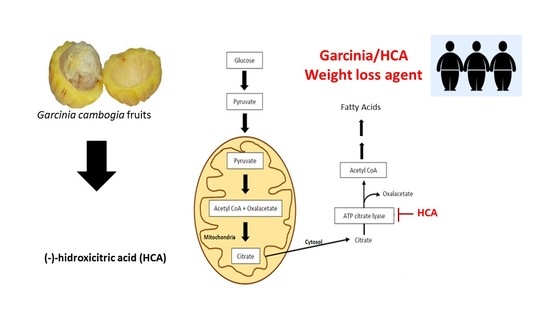
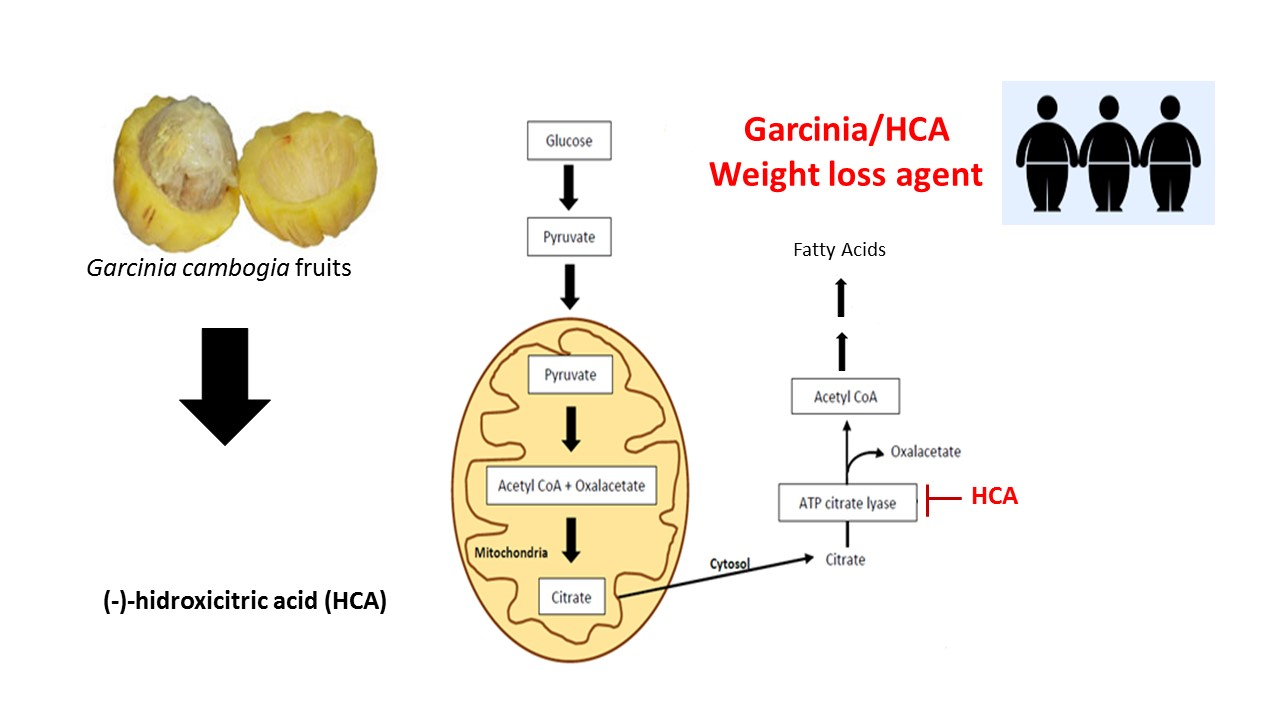
Graphical Abstract