Highlights
What are the main findings?
- The study demonstrates that the use of a multi-product ensemble approach can reduce the variability between satellite products, providing a more robust estimate of Sea Surface Salinity (SSS) in regions with complex dynamics.
- Multi-mission global products perform best overall; single-mission SMAP/SMOS products show larger and more variable discrepancies, especially near Greenland and in coastal-influenced Mediterranean and Gibraltar areas.
What are the implications of the main findings?
- High latitude and coastal areas remain the main bottlenecks for satellite SSS, motivating more targeted in situ validation and additional satellite algorithmic development.
- Region-aware multi-product approaches (global + regional, guided by uncertainty/spread) can provide more robust SSS estimates than relying on a single dataset.
Abstract
Sea surface salinity (SSS) is a critical climate variable influencing ocean circulation, deep water formation, and the global hydrological cycle. This study evaluates a broad suite of satellite-derived SSS products against in situ measurements collected at 4.5 m depth along a transect conducted in 2021 from western Greenland to Sardinia, spanning the subpolar North Atlantic and western Mediterranean Sea. All satellite products capture the large-scale salinity increase from high latitudes to the Mediterranean and show generally high correlations with in situ data. However, differences exist among specific products and at different latitudes. Multi-mission and optimally interpolated global products exhibit the smallest discrepancies, remaining close to the in situ reference along most of the transect, whereas single-mission Soil Moisture Active Passive (SMAP) and Soil Moisture Ocean Salinity (SMOS) products show larger and more variable differences, especially in dynamically complex or coastal areas. Regional products provide additional insights: the European Space Agency (ESA) CCI-Salinity Northern Hemisphere product and the Barcelona Expert Center Arctic Version 4 dataset are examined near Greenland and the subpolar North Atlantic, while the ESA 4D Mediterranean V3 product performs consistently in the western Mediterranean, highlighting scale and representativeness effects. A simple multi-product ensemble approach reduces product-specific noise and provides a balanced representation across diverse regimes and latitudes. These findings underline persistent regional challenges in satellite SSS retrievals and emphasise the need for more in situ observations and for further development of multi-product approaches.
Keywords:
sea surface salinity; Northern Hemisphere; Atlantic ocean; Mediterranean; SMAP; SMOS; Aquarius 1. Introduction
Oceans cover more than two-thirds of the Earth’s surface, and their deep circulation is largely driven by density gradients arising from variations in temperature and salinity. As an Essential Climate Variable [1], sea surface salinity (SSS) plays a central role in regulating seawater density, deep water formation and large-scale ocean circulation, and it is closely linked to air–sea freshwater exchanges and the global hydrological cycle [2].
In high-latitude regions of the North Atlantic, the Greenland Ice Sheet has experienced substantial mass loss since the early 1990s, increasing freshwater fluxes to the ocean and contributing to a marked surface freshening and enhanced upper ocean stratification [3,4,5]. Observational and modelling studies reveal pronounced decadal variability, including episodes of very deep convection in the 2010s, and a non-linear, regionally complex relationship between Labrador Sea processes and the large-scale Atlantic Meridional Overturning Circulation (AMOC) [6,7]. Current assessments indicate that the AMOC is very likely to weaken during the twenty-first century [8], but there is only low to medium confidence in the magnitude of the decline and in the timing, if any, of a possible tipping point [9,10]. The contribution of Greenland freshwater forcing to these future changes therefore remains uncertain and actively debated. SSS also acts as an integrated tracer of the global hydrological cycle, reflecting the balance between evaporation and precipitation and, in specific regions, the additional influence of ice formation/melt and river runoff [2,11].
In semi-enclosed basins such as the Mediterranean Sea, characterised by high evaporation and relatively limited freshwater input, salinity variations are particularly sensitive to changes in atmospheric forcing and to the regional water budget [12,13]. Several studies have shown that Mediterranean SSS, sea level and upper-ocean properties respond to large-scale climate modes, in particular to the North Atlantic Oscillation (NAO) and to internal modes of Mediterranean variability, which modulate regional wind patterns, surface heat and freshwater fluxes and the exchange through the Strait of Gibraltar [14,15]. Recent analyses based on in situ observations, reanalyses and satellite products indicate that the Mediterranean has undergone significant warming and salinification over recent decades, with coherent trends in sea surface temperature, sea surface salinity and sea level and important implications for water-mass properties, dense water formation and circulation [16,17].
Monitoring SSS in both the subpolar North Atlantic and the Mediterranean is therefore essential for understanding ongoing climate variability and for constraining ocean and climate models.
In situ direct observations through Conductivity, Temperature, and Depth (CTD) instrument and water samples remain the reference for SSS, providing high accuracy measurements from research cruises, moorings and autonomous platforms such as Argo floats. Their spatial and temporal coverage, however, is still limited, particularly in high latitude and coastal regions. Since 2010, satellite missions based on L-band radiometry, namely ESA’s Soil Moisture and Ocean Salinity (SMOS), NASA–CONAE’s Aquarius and NASA’s Soil Moisture Active Passive (SMAP), have provided routine global SSS estimates and demonstrated the capability of satellite observations to resolve large scale and, in some regions, mesoscale salinity variability [2,18,19,20]. Building on these missions, several multi-mission and optimally interpolated products have been developed, including the ESA Climate Change Initiative SSS datasets, which combine SMOS, Aquarius and SMAP measurements into long, homogeneous time series [21], and the multi-mission Optimal Interpolation of Satellite Salinity Signals (OISSS) analysis, which merges L-band satellite observations using optimum interpolation and large-scale bias correction based on in situ data [22]. Additional regional products, such as the enhanced BEC SMOS Arctic SSS fields [23] and Mediterranean specific analyses based on multivariate optimal interpolation [24,25], have been designed to better capture the particular dynamics of high-latitude and semi-enclosed basins.
Despite these advances, satellite-derived SSS still exhibits region-dependent limitations. High-latitude oceans remain challenging because of the lower radiometric sensitivity in cold waters, strong winds and rough seas that modify surface emissivity, and the presence of sea ice and meltwater fronts that contaminate the L-band signal [18,20,26,27]. Coastal and marginal seas pose additional difficulties due to land–sea contamination in the radiometer footprint, radio frequency interference from anthropogenic sources and strong small-scale gradients that are not fully resolved by the satellite sampling [2,28,29]. For sensors such as SMOS, where contamination extends well beyond the radiometer footprint, its correction is critical in semi-enclosed seas. Validation and reprocessing efforts based on Argo, gridded in situ products and dedicated objective analyses have documented clear improvements over time, but also persistent biases and increased uncertainties in high-latitude, coastal and semi-enclosed regions [20,30,31]. These issues motivate continued algorithm development, advanced bias correction and the use of independent in situ datasets for targeted evaluation [2].
In this context, dedicated ship-based observations along extended transects provide valuable benchmarks, particularly when they cross multiple dynamical regimes and include poorly sampled areas [29,32]. The present study makes use of an independent in situ surface salinity dataset collected at 4.5 m depth during an oceanographic campaign from western Greenland to Sardinia, across the North Atlantic and the western Mediterranean Sea, in fall 2021. The cruise track intersects key circulation features such as the Labrador Current and the North Atlantic Current, and crosses the Strait of Gibraltar and the Algerian Basin, including regions influenced by Alboran gyres and the meanders of the Algerian Current where mesoscale and submesoscale activity can be intense [33,34,35]. Water samples were collected aboard MV St. Helena as part of the Italian National Antarctic Programme (PNRA) SWIMMING project, in collaboration with Extreme E, the motor racing series that owned the vessel and hosted the project on board. Salinity was measured using an Autosal laboratory salinometer according to standard oceanographic procedures and expressed on the Practical Salinity Scale (PSS-78) [36], ensuring compatibility with satellite based estimates.
The in situ salinity data are compared with a wide set of state-of-the-art satellite products, including single mission SSS fields from SMOS and SMAP and several multi mission or optimally interpolated datasets such as ESA CCI Salinity, OISSS, Copernicus Marine Environment Monitoring Service (CMEMS) Multiobs, BEC Arctic and ESA 4D Mediterranean, as well as with a simple ad hoc ensemble obtained by averaging the available satellite estimates at each matchup location. By analysing their performance and regional sensitivities, the work aims to (i) improve the understanding of satellite-based surface salinity retrievals in dynamically complex and coastal-influenced environments and (ii) provide information that may support the development of improved satellite products and multi product approaches.
The paper is organised as follows. Section 2 describes the in situ sampling strategy, the processing of the water samples and the satellite products used, and outlines the methodology adopted for co-locating in situ and satellite data. Section 3 presents the comparison between satellite-derived and in situ SSS, discussing the results along the full transect and within the three analysed sectors (i.e., Northwest Atlantic, Central Atlantic and Western Mediterranean). Section 4 summarises the main findings and their implications for the use and future development of satellite based SSS products in climate and oceanographic applications.
2. Materials and Methods
2.1. In Situ SSS Observation
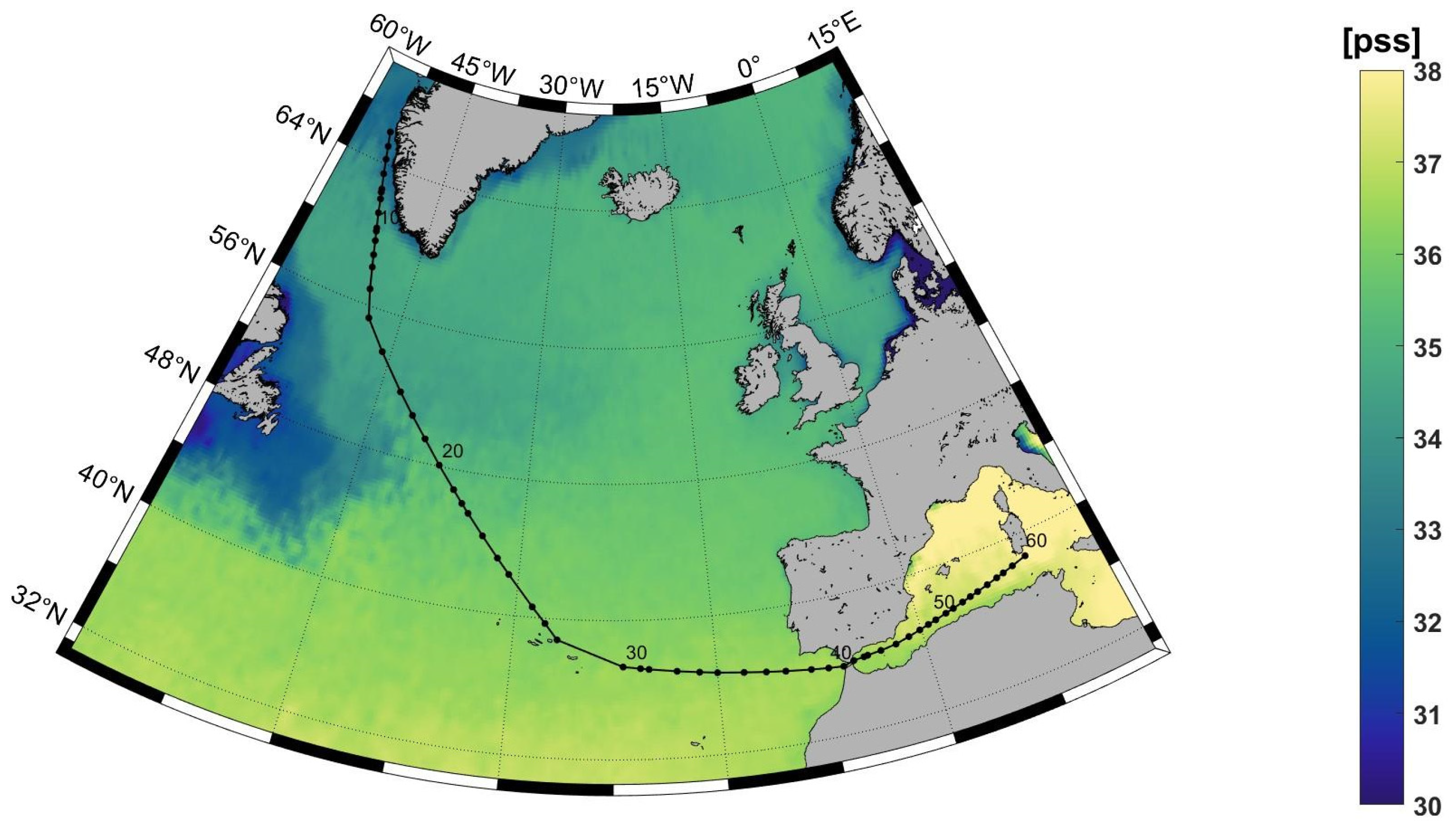
In situ water samples were collected at 77 stations at a depth of 4.5 m, from MV St. Helena during field activities carried out as part of the Italian PNRA SWIMMING project. These operations were hosted on board by the Extreme-E racing series organisation during the transfer from Greenland to Sardinia in 2021. Sampling was conducted between 13 September and 3 October 2021, beginning in Kangerlussuaq Fjord (Greenland) and concluding upon arrival in Cagliari (Sardinia, Italy), covering approximately 4000 nautical miles (Figure 1). Water samples were collected from the uncontaminated underway lab supply at regular intervals, with a sampling frequency of 4 to 6 h. Samples were taken in 250 mL double-cap glass bottles with rubber stoppers and filled completely to minimise evaporative errors. Additionally, a limited number of surface salinity samples were collected concurrently with the 4.5 m measurements. These showed non-negligible differences relative to the subsurface values. However, because these surface samples were not collected following best-practice procedures and were mostly acquired in areas that are particularly challenging for satellite SSS retrievals, they were not considered in the present analysis. However, they highlight how pronounced vertical gradients can be in specific regions and how these gradients may affect validation metrics.
Subsequent laboratory analyses were performed at Italian National Research Council Institute of Marine Sciences (CNR-ISMAR) in La Spezia (Italy), using an Autosal Portable Salinometer by Guildline Instruments Ltd., Smiths Falls, ON, Canada. The instrument was carefully calibrated with IAPSO standard salinity solutions appropriate for the different oceanic regions sampled (i.e., Greenland, Atlantic Ocean, and Mediterranean Sea), provided by Ocean Scientific International Ltd. (OSIL), Havant, Hampshire, UK. To ensure data accuracy, each salinity measurement was repeated three times per water sample. For the purposes of this study, only data collected at the 4.5 m depth were considered, excluding samples collected in the Kangerlussuaq Fjord. This resulted in a final dataset of 59 samples publicly available at https://zenodo.org/records/17911277 (accessed on 15 December 2025) [37].
Figure 1.
A smoothed version of the fall Sea Surface climatology [38] map of the study area. The black line shows the ship’s trajectory from Greenland to Sardinia (Italy). Black dots indicate sampling sites at 4.5 m depth.
Figure 1.
A smoothed version of the fall Sea Surface climatology [38] map of the study area. The black line shows the ship’s trajectory from Greenland to Sardinia (Italy). Black dots indicate sampling sites at 4.5 m depth.

2.2. SSS L3/L4 Data
For comparative analysis, we employed several satellite-derived SSS products released by leading international data centres. These datasets are based on either averaged single-satellite observations (L3 data) or multi-mission merged data (L4 data). Below is an overview of the products used in this study, along with their details, while key characteristics are reported in Table 1:
- Multi Observation Global Ocean Sea Surface Salinity and Sea Surface Density Product: This is a daily, global, gap-free Level-4 dataset providing SSS and Sea Surface Density at a spatial resolution of 1/8°. Developed by the Italian National Research Council (CNR) Production Unit (MULTIOBS-CNR-ROMA-IT), the dataset is obtained using a multi-dimensional optimal interpolation algorithm that combines salinity measurements from multiple satellite missions (e.g., SMAP, SMOS), in situ data, and satellite-derived sea surface temperature (SST). In this study, we used the reprocessed daily dataset, available at https://doi.org/10.48670/moi-00051. This product is hereafter referred to as CMEMS Multiobs.
- Climate Change Initiative+ (CCI+) v5.5 Sea Surface Salinity: This Level-4 product integrates gridded SSS estimates from SMOS, Aquarius, and SMAP, offering multi-mission coverage. It features a weekly temporal resolution, with data sampled on a 0.25° grid using a 7-day running mean at daily time steps. The native spatial resolution is approximately 50 km. Produced under the European Space Agency (ESA) Climate Change Initiative programme, this product is part of the ESA SSS v5.5 collection, available at Dataset Collection Record: ESA Sea Surface Salinity Climate Change Initiative (Sea_Surface_Salinity_cci): Weekly and monthly sea surface salinity products from L-band, v5.5. Hereafter it is referred to as ESA CCI-Salinity.
- Climate Change Initiative+ (CCI+) v5.5 Sea Surface Salinity product for the Northern Hemisphere (NH): This Level-4 dataset provides weekly SSS fields for the Northern Hemisphere (≈north of 45°N) over the period 2010–2023, with an effective spatial resolution of ~50 km. The data are distributed on a NH polar 25 km EASE-2 (equal-area) grid and delivered with 1-day time sampling (i.e., a 7-day running-mean product provided at daily steps). The dataset is available at Dataset Record: ESA Sea Surface Salinity Climate Change Initiative (Sea_Surface_Salinity_cci): Weekly sea surface salinity product for the Northern Hemisphere on a 25 km EASE grid, v5.5, for 2010 to 2023. Hereafter it is referred to as ESA CCI-Salinity NH.
- De-biased SMOS SSS L3 V10: This is the tenth version of the CATDS SMOS Level-3 SSS dataset, covering the period from January 2010 to December 2024. Systematic biases in the original SMOS SSS data have been corrected using an improved de-biasing technique, and an additional bias correction accounting for solar emission has also been applied. The dataset has a 4-day temporal resolution and a spatial resolution of 25 × 25 km2, with spatial smoothing applied using a 30 km radius average. Produced by the LOCEAN/IPSL laboratory and ACRI-st company, it is available at https://doi.org/10.17882/52804#120028. This product is referred to as De-biased SMOS hereafter.
- NASA/RSS SMAP Salinity Version 6.0: The SMAP SSS V6.0 dataset includes several products; for this study, we used the Level-3, 8-day running average product with daily time steps. Two spatial configurations are provided; we selected the smoothed version with an effective spatial resolution of approximately 70 km, generated via nearest-neighbour averaging from the original 40 km dataset. The data, produced by Remote Sensing Systems (RSS) and supported by the NASA Ocean Salinity Science Team, are available at www.remss.com/missions/smap (accessed on 11 November 2025). This product is referred to as SMAP RSS hereafter.
- JPL SMAP Level 3 CAP Sea Surface Salinity v5.0: This Level-3 dataset, derived from the SMAP satellite using the Combined Active-Passive (CAP) retrieval algorithm developed at NASA Jet Propulsion Laboratory (JPL), provides 8-day running mean SSS fields with daily updates. It has global coverage on a 0.25° grid and an effective spatial resolution of about 60 km. Data are available with a latency of approximately 7 days and can be accessed at http://podaac.jpl.nasa.gov/smap (accessed on 11 November 2025). The product is referred to as SMAP CAP hereafter.
- Multi-Mission Sea Surface Salinity Optimum Interpolation (OISSS) Analysis Version 2.0: This is a Level-4 dataset combining observations from NASA’s Aquarius/SAC-D and SMAP missions into a continuous and consistent salinity time series. It also incorporates ESA SMOS data to fill gaps during SMAP observations. The dataset provides weekly SSS fields on a 0.25° grid at a 4-day update interval. Produced by Earth and Space Research, it is available at https://www.esr.org/data-products/oisss/data-access/ (accessed on 11 November 2025). This product is referred to as OISSS hereafter.
- Arctic Sea Surface Salinity Level 3 v4: This regional product provides daily SSS measurements in the Arctic Ocean, smoothed using a 9-day running mean. Based on data from the ESA SMOS mission, it covers the spatial domain from 45°N to 90°N and from 180°W to 180°E longitude, with a spatial mapping of 25 km. The dataset spans from 1 February 2011 to 31 December 2023 and is provided by the Barcelona Expert Center (BEC). The product is referred to as BEC Arctic hereafter, and it is available at https://bec.icm.csic.es/arctic-sss-v4-0/, doi:10.20350/digitalCSIC/16251 (accessed on 11 November 2025).
- ESA 4DMED-SEA—Mediterranean Multivariate Optimal Interpolated Salinity and Density fields: This Level-4 product provides daily, gap-free analyses of SSS and Sea Surface Density over the Mediterranean Sea at a spatial resolution of 1/24°. The dataset covers the period 2016–2022 and is generated using a multivariate optimal interpolation scheme that integrates SSS observations from multiple satellite missions (including NASA’s SMAP and ESA’s SMOS), in situ salinity measurements, and ultra–high-resolution satellite-derived SST fields. The resulting product offers dynamically consistent salinity and density fields tailored to the specific characteristics of the Mediterranean basin. The product is available at https://doi.org/10.5281/zenodo.13753090. Hereafter, it is referred to as ESA 4D Mediterranean. This dataset also provides salinity along the water column; therefore, given that the in situ samples were collected at about 4.5 m depth, we additionally performed an in situ comparison using the product extracted at 4 m, hereafter referred to as ESA 4D Mediterranean 4 m. Moreover, because the ESA 4D Mediterranean has a substantially higher native spatial resolution than the other products considered, we also generated coarser-resolution versions regridded to 0.25° to ensure a more consistent intercomparison. These are hereafter referred to as ESA 4D Mediterranean 0.25° and ESA 4D Mediterranean 4 m 0.25°.

Finally, to contribute to the broader understanding of how well satellite observations capture SSS variability, we developed a dedicated ensemble salinity product, computed as the mean of all satellite-derived SSS estimates associated with the grid cell containing each in situ sampling location. In building the ensemble, all satellite products were included. However, only the native-resolution, very-surface ESA 4D Mediterranean fields were considered, while derived variants (e.g., the 4 m product and the 0.25° regridded versions) were excluded from the ensemble computation. When comparing satellite-derived ensemble salinity and the in situ measurements (Section 3), we additionally report two complementary uncertainty metrics: (i) the ensemble spread, defined as the standard deviation of the satellite SSS values contributing to each matchup, and (ii) an uncertainty metric based on the root mean square (RMS) of the individual product uncertainties, computed using all valid uncertainty estimates (i.e., excluding missing or undefined data) associated with the satellite values included in the ensemble mean for that matchup.
Table 1.
Key characteristic of the satellite products. The ESA 4D Mediterranean product refers also to his derived variants.
Table 1.
Key characteristic of the satellite products. The ESA 4D Mediterranean product refers also to his derived variants.
| Satellite Product Short Name | Satellite Product Full Name | Product Reference | Data Level | Grid | Frequency | Average Period |
|---|---|---|---|---|---|---|
| SMAP CAP | JPL SMAP Level 3 CAP Sea Surface Salinity Standard Mapped Image 8-Day Running Mean V5.0 Validated Dataset | [39] | 3 | 0.25° | Daily | 8 days |
| SMAP RSS | NASA/RSS SMAP Salinity: Version 6.0 Validated Release | [40] | 3 | 0.25° | Daily | 8 days |
| Debiased SMOS | De-biased SMOS SSS L3 V10 maps generated by LOCEAN/ACRI-ST Expertise Center | [21] | 3 | 25 km | Every 4 days | 9 days |
| ESA CCI-Salinity | ESA Sea Surface Salinity Climate Change Initiative (Sea_Surface_Salinity_cci): Weekly and monthly sea surface salinity products from L-band, v5.5 | [41] | 4 | 0.25° | Daily | 7 days |
| ESA CCI-Salinity NH | ESA Sea Surface Salinity Climate Change Initiative (Sea_Surface_Salinity_cci): Weekly sea surface salinity product for the Northern Hemisphere on a 25km EASE grid, v5.5, for 2010 to 2023 | [41] | 4 | 25 km | Daily | 7 days |
| OISSS | Multi-Mission Sea Surface Salinity Optimum interpolation (OISSS) Analysis Version 2.0 | [42] | 4 | 0.25° | Every 4 days | 7 days |
| CMEMS Multiobs | Multi Observation Global Ocean Sea Surface Salinity and Sea Surface Density Product | [43] | 4 | 0.125° | Daily | 7 days |
| BEC Arctic | Arctic Sea Surface Salinity v4 maps | [23] | 3 | 25 km | Daily | 9 days |
| ESA 4D Mediterranean | ESA 4DMED-SEA—Mediterranean Multivariate Optimal Interpolated Salinity and Density fields | [44] | 4 | 1/24° | Daily | 7 days |
2.3. In Situ Data Sensitivity
Satellite L-band missions sense salinity in the upper few centimetres of the ocean, while in situ measurements in this study were collected at 4.5 m depth. Under typical conditions, 4.5 m measurements are generally representative of the satellite-observed SSS. Nevertheless, vertical geophysical gradients in salinity can influence the comparison, particularly in regions with strong stratification, such as near the Greenland coast, where freshwater from ice melt may accumulate at the surface. During the campaign, limited surface measurements were also collected, showing differences up to 0.08 pss relative to 4.5 m values; however, these sparse data (11 stations) were not collected under standardised protocols and were therefore excluded from our analysis.
To quantify the representativeness of the 4.5 m measurements, we compared the ESA 4D Mediterranean product at 0 m and 4 m along the transect. The mean difference was ΔS(0–4 m) ≈ 0.045 pss, which is substantially smaller than the typical satellite–in situ differences (~0.27 pss for both surface and 4 m ESA 4D products; see Table 2). This indicates that vertical gradients in the upper 4.5 m contribute only marginally to the observed discrepancies.
Table 2.
Validation metrics between satellite-derived and in situ SSS data. Datasets that are specific to a given sector are marked with an asterisk and are included only in the corresponding regional evaluation, and not in the overall assessment.
Additionally, in the Mediterranean Sea strong wind mixing and high evaporation rates generally maintain a well-mixed upper layer, further supporting the validity of using 4.5 m measurements for satellite comparisons. In the high-latitude North Atlantic, vertical stratification due to meltwater or freshwater input can locally enhance near-surface gradients; however, observed differences between 0 and 4 m in situ samples (0.11 pss) remain small relative to the satellite–in situ mismatches along the transect.
Lastly, ref. [45] assessed that, while episodic near-surface stratification can be significant (e.g., in rainy-dominated areas), its average overall effect in the salinity error budget is not substantial.
Overall, the 4.5 m in situ salinity data provide a reliable reference for evaluating satellite SSS, and the representativeness error due to vertical mismatch can be an be considered secondary relative to other uncertainty sources in satellite retrievals such as, for instance, the inherent sub-footprint horizontal variability.
2.4. Satellite to In Situ Data Co-Location
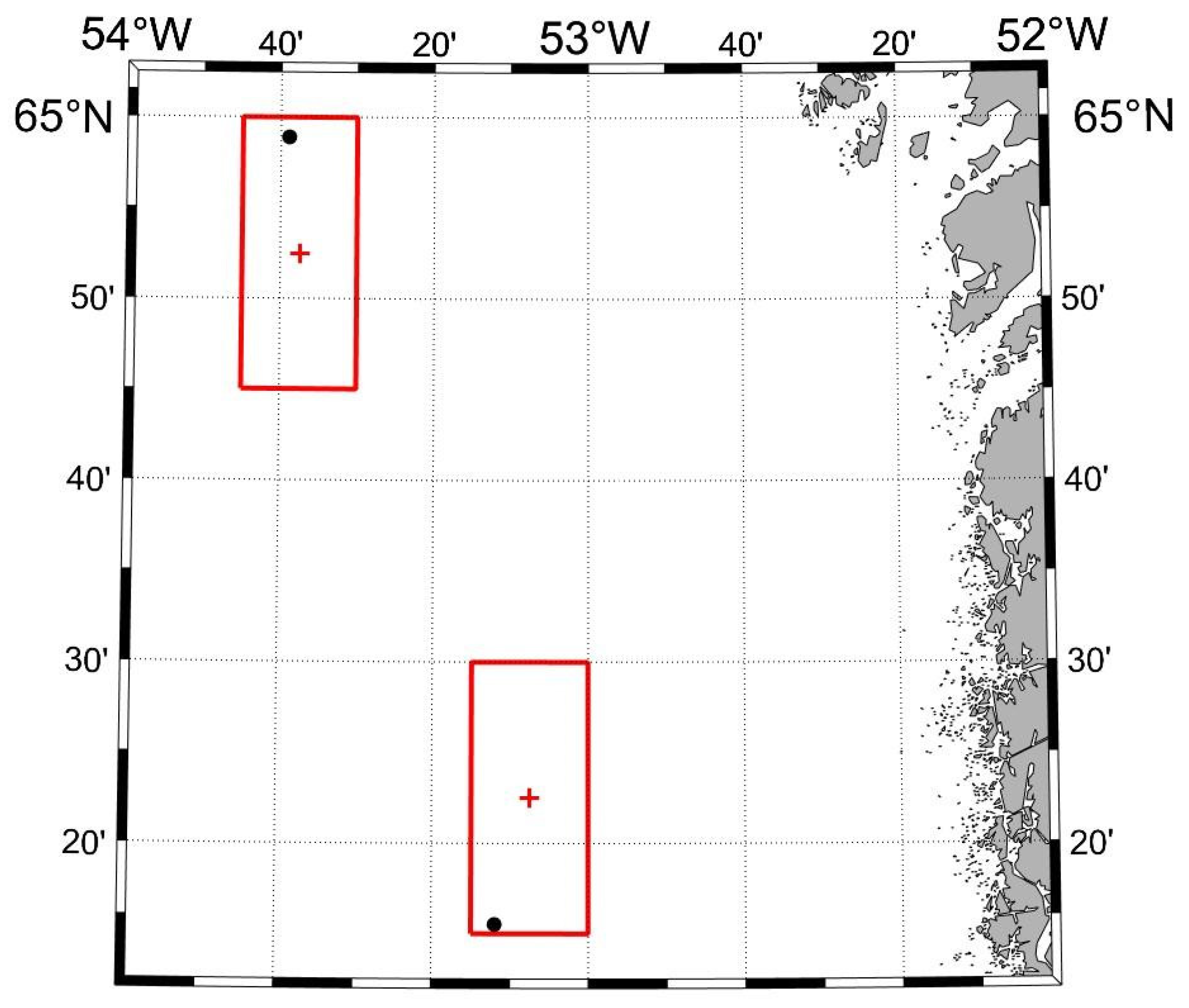
To compare satellite-derived and in situ SSS data, each in situ measurement was first temporally matched to the corresponding satellite data from the same day (Figure 2). For satellite products that are not provided daily, it was ensured that the in situ measurement fell within the temporal window over which the satellite data were mapped. Given the different moving-average time windows used to generate the products, together with their different mapping frequencies, we opted for this approach which, although it may introduce a slight bias, ensures a unique (one-to-one) association between satellite and in situ observations. To this aim, the different products were not regridded to a common grid, but just co-located with in situ observations within their native grids. Then, each matched measurement was spatially assigned to the satellite L3/L4 grid cell within which it was included. This co-location process involved verifying whether the geographic coordinates of the in situ measurement fell within the area represented by the satellite cell. Satellite products are defined on fixed spatial grids that correspond to square areas at the equator. However, due to the Earth’s geoid shape, these grid cells deform with increasing latitude, becoming progressively narrower in the zonal (east–west) direction and elongated in the meridional (north–south) direction. This distortion affects products provided on regular latitude–longitude (degree-based) grids, whereas those defined on equal-area grids do not exhibit this effect. To account for this distortion, each satellite grid cell was approximately a rectangle for each latitudinal band. The cell height (meridional extent) was defined as the distance between two consecutive latitude steps at the same longitude, while the width (zonal extent) was calculated as the distance between centre of two adjacent cells at the same latitude, thereby incorporating the variable longitudinal spacing with latitude. In the few instances where multiple in situ measurements occurred within one satellite grid cell, their values were averaged to enable a consistent and meaningful comparison with the corresponding satellite measurement.
Figure 2.
Graphical representation of the co-location method. The map shows the western coast of Greenland, where the red cross marks the satellite grid cell centre, the red box represents the satellite pixel area, and the black dots indicate the positions of two consecutive in situ measurements.
3. Results
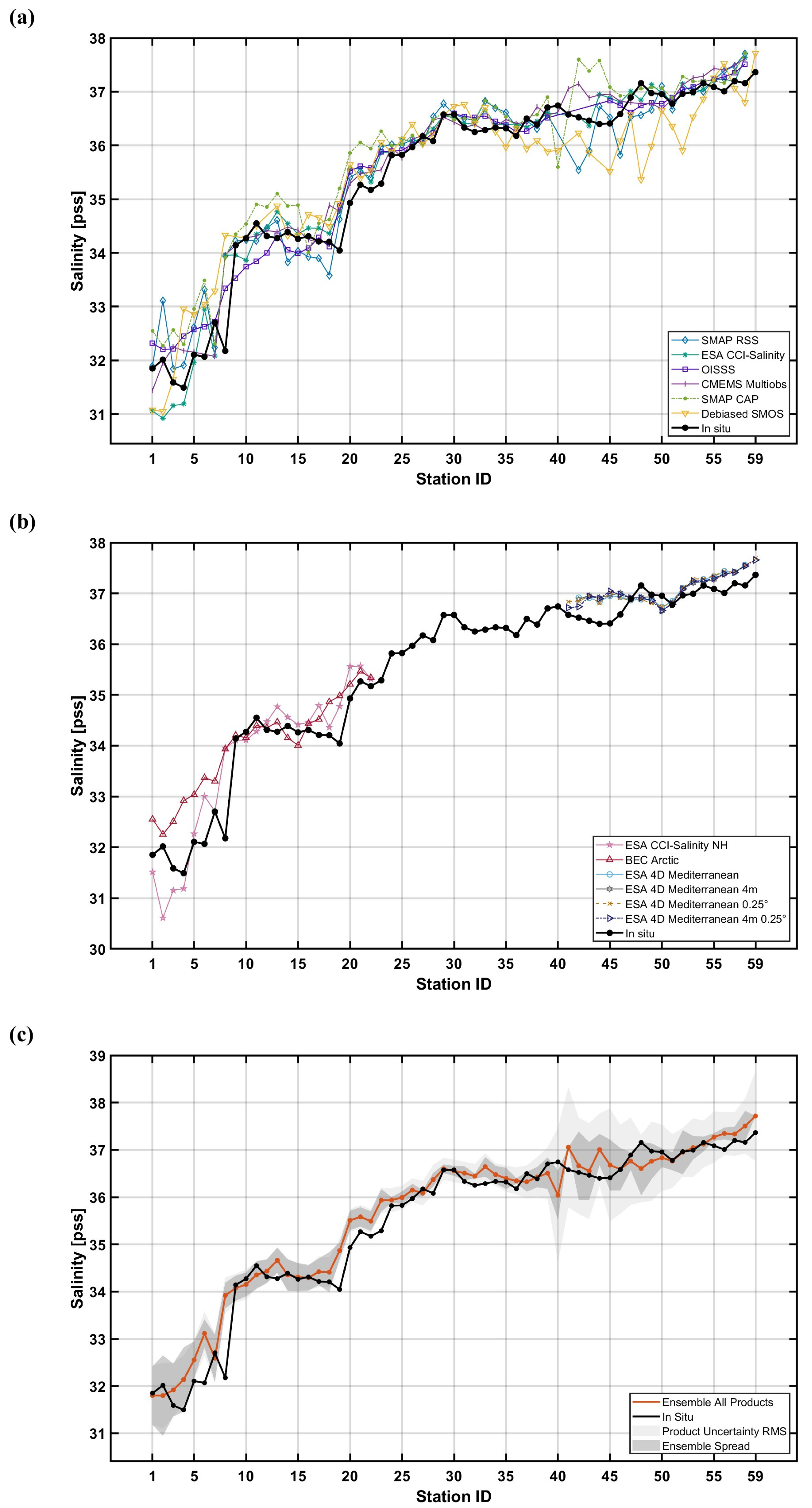
Figure 3a,b show that all satellite products capture the overall trend of increasing salinity along the transect, with peak values observed toward the end of the campaign. This pattern closely mirrors the in situ measurements and reflects the transition from the low salinity waters near Greenland to the more saline conditions of the western Mediterranean Sea (see Figure 1). While satellite products generally follow the observed salinity pattern, they exhibit variability, with alternating overestimations and underestimations along the track, which are likely influenced by regional oceanographic and atmospheric conditions as well as the intrinsic uncertainties of the products.
Figure 3.
SSS estimated from (a) global and (b) regional satellite products, shown as coloured lines and co-located with the corresponding in situ measurements, plotted as a function of station ID. (c) SSS from the ensemble-mean product together with in situ measurements, shown as colored dots connected by lines as a function of station ID. The shaded areas respectively represent the Root Mean Square (RMS) of the product’s uncertainties and the standard deviation of the product’s salinity values for each matchup.
The largest discrepancies occur at the beginning and end of the transect, in the high-latitude waters near the Greenland coast and in the Mediterranean basin, where complex coastal dynamics and proximity to land reduce satellite SSS retrieval accuracy.
Figure 3c illustrates the comparison between the satellite-derived ensemble salinity and the in situ measurements, together with two complementary uncertainty estimates. Overall, the ensemble slightly overestimates SSS, and the largest ensemble-in situ mismatches generally coincide with a widening of the uncertainty envelopes. Nevertheless, the in situ salinity values fall within the estimated uncertainty bounds for the majority of stations, indicating that the reported uncertainty levels are broadly consistent with the observed variability.
The two uncertainty metrics provide complementary information. Where the ensemble spread (i.e., inter-product standard deviation) is comparable to the RMS of the reported product uncertainties, the variability among satellite products is consistent with the expected retrieval error. In contrast, for most matchups (e.g., for approximately half of the stations beyond ID ≈ 30), the ensemble spread is narrower than the RMS-based uncertainty, suggesting that the contributing satellite products are largely mutually consistent and likely share correlated error components. In these cases, the RMS-derived envelope provides a more conservative estimate of the overall retrieval uncertainty.
Table 2 summarises the key performance metrics used to compare the satellite-derived SSS products with the in situ measurements. For each product, the table reports the number of matchups, the Pearson linear correlation coefficient and the coefficient of determination (R squared), which indicate how well the observed SSS variability is reproduced. It also includes the root mean square difference (RMSD), which reflects the combined effect of systematic and random differences, and the mean absolute difference (MAD), which quantifies the average magnitude of the discrepancies between satellite and in situ SSS. The standard deviation of the MAD provides information on the variability of these discrepancies, whereas the interquartile range (IQR) offers a robust measure of the spread of the differences that is less sensitive to outliers. Analysing the overall performance along the ship trajectory, we restricted the assessment to the global SSS products. All of them exhibit high Pearson correlation coefficients with in situ SSS (from 0.93 to 0.98) and R2 values between 0.87 and 0.96, indicating that they are generally able to reproduce the observed salinity variability. Differences become more evident when considering the metrics based on satellite and in situ differences. ESA CCI-Salinity, OISSS and CMEMS Multiobs are characterised by relatively low RMSD values (about 0.38 to 0.43 pss) and small mean absolute differences (around 0.28 to 0.29 pss), together with moderate MAD standard deviations and interquartile ranges. This suggests that these products tend to remain close to the in situ reference and that their discrepancies are comparatively stable along the transect. SMAP RSS shows slightly higher RMSD and MAD values and a larger IQR, pointing to somewhat larger and more variable differences, although the correlation with in situ data remains strong. SMAP CAP and Debiased SMOS exhibit the largest RMSD (0.61 pss) and the widest spread of differences, as indicated by their higher MAD standard deviations and IQR values, which points to a noisier behaviour and to a greater sensitivity to local conditions. These values are broadly consistent with previous global and regional validation studies, which also report high correlations and RMSDs of a few tenths of a pss for the best-performing products [29]. The along-track statistics obtained here therefore fall within, or slightly below, the range reported for broader coastal and high-latitude evaluations, while highlighting similar patterns of product-dependent performance.
Given the variable performance of the satellite products along the ship’s route (Figure 3), we further divided the comparison into three oceanic regions. First, the Northwest Atlantic sector, defined as the portion of the cruise north of 45°N, consistent with the spatial domain of the Northern Hemisphere products (ESA CCI-Salinity NH and BEC Arctic). Second, the Central Atlantic sector, corresponding to the cruise track between 45°N and the Strait of Gibraltar. Third, the Western Mediterranean sector, associated with the track between Gibraltar and Sardinia. This regional subdivision ensures that sector-specific products (BEC Arctic, ESA CCI-Salinity NH, and ESA 4D Mediterranean) are evaluated against the same matchup subsets as the global products within their respective domains, enabling a consistent and robust inter-comparison.
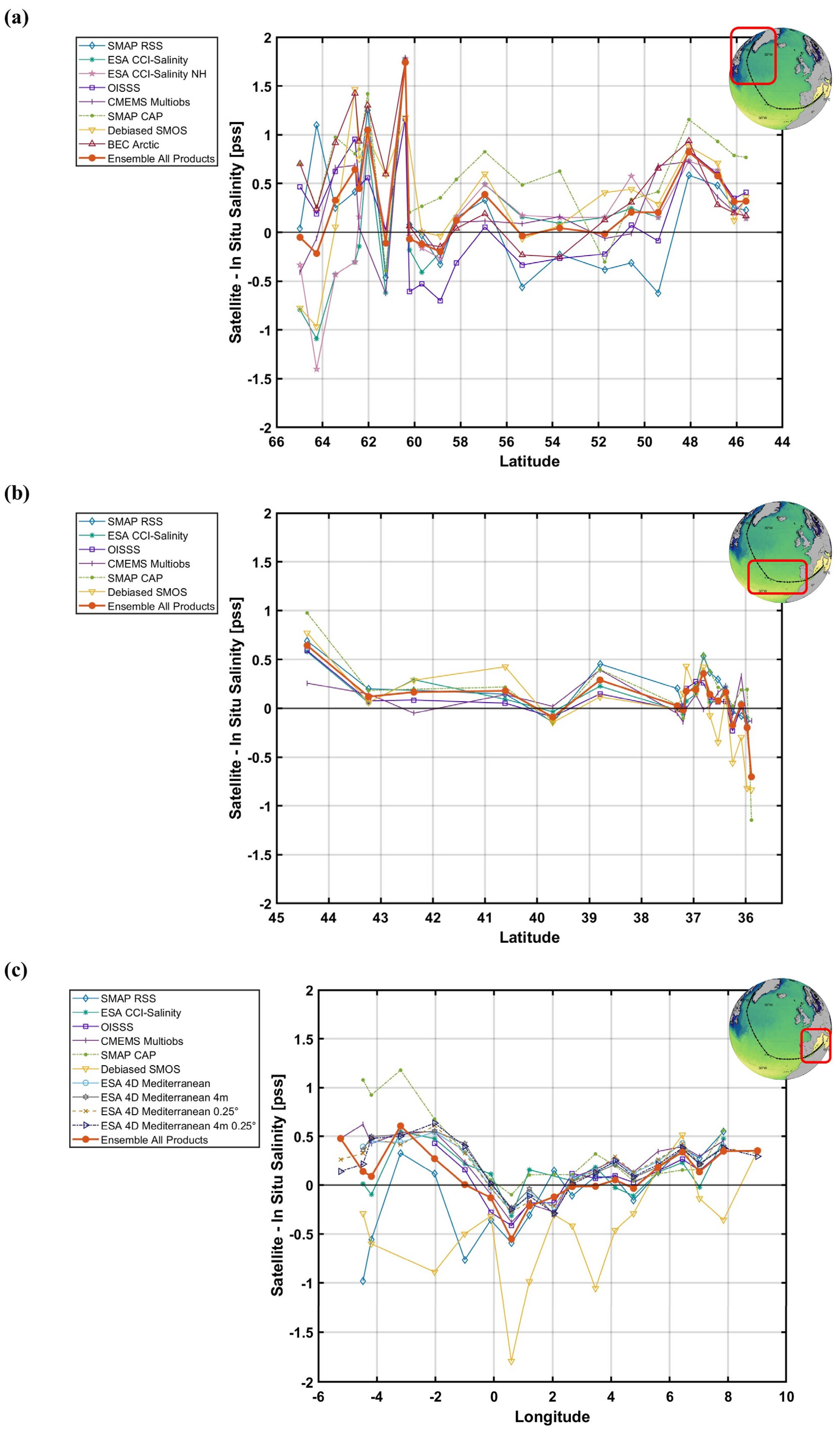
Figure 4a shows the difference between satellite and in situ SSS plotted against latitude in the Northwest Atlantic sector. In this region, satellite products generally tend to overestimate salinity, although both over- and underestimations are observed, particularly at higher latitudes (60–65°N). As noted above, these discrepancies are likely caused by signal degradation near the Greenland coast and by retrieval challenges in cold waters. Table 2 also presents performance metrics for each satellite product within these two defined sectors.
Figure 4.
Difference between various satellite-derived salinity products and in situ salinity, represented by lines in different colours. For the (a) Northwest and (b) Central Atlantic sector, the difference is depicted as a function of latitude. (c) For the Western Mediterranean sector, the difference is depicted as a function of longitude. Red boxes indicate the subset of in situ measurements included in each plot.
In the Northwest Atlantic sector, the validation metrics confirm that all satellite products reproduce the main features of the observed SSS variability, with Pearson correlations typically between 0.88 and 0.92 and R squared values mostly in the 0.77–0.85 range. Among the global products, OISSS and CMEMS Multiobs show the lowest overall error magnitudes (RMSD ~ 0.53–0.54 pss). Notably, CMEMS Multiobs also exhibits the lowest MAD (~0.35 pss) and the narrowest IQR (~0.42 pss) in this subset, suggesting that it remains comparatively close to the in situ reference and that its discrepancies are relatively stable along the high-latitude segment. ESA CCI-Salinity and SMAP RSS retain high correlations but display larger RMSD and MAD values (RMSD~0.61–0.62 pss, MAD ~0.46–0.47 pss), with SMAP RSS also showing a broader IQR, indicative of more variable differences. Debiased SMOS and especially SMAP CAP present the largest discrepancies (RMSD up to ~0.79 pss for SMAP CAP). For SMAP CAP, the combination of high correlation but large MAD/RMSD together with a comparatively tighter spread of differences (lower MAD STD/IQR) suggests more systematic offsets rather than purely random, matchup-to-matchup variability. Regarding the two Northern Hemisphere products, BEC Arctic shows correlation levels comparable to the global datasets, while maintaining relatively large RMSD and IQR values over the same matchup set. This suggests that, for the conditions sampled here, the regional configuration does not substantially reduce the magnitude or spread of satellite–in situ differences, which likely remain influenced by the challenging high-latitude setting (e.g., lower sensitivity, sharp salinity gradients, freshwater influence, and coastal/ice-affected waters). ESA CCI-Salinity NH yields results that are fully consistent with the global ESA CCI-Salinity product, with only minor differences in the error statistics. Overall, these results align with previous high-latitude validation efforts reporting that satellite SSS generally captures the dominant variability and large-scale gradients but with increased RMSD and dispersion under subpolar conditions [26,46], and with recent analyses south of Greenland emphasising the strong spatial heterogeneity and the difficulty of fully resolving sharp fronts and freshwater features at L-band radiometer resolution [47].
Figure 4b shows that, in the Central Atlantic sector, all global satellite products consistently overestimate SSS down to approximately 38°N, with the onset of this behaviour already evident north of ~45–48°N in Figure 4a. Further south, as the ship approaches the Strait of Gibraltar (≈36–37°N), the salinity signal shows increased degradation, with a corresponding rise in uncertainty. In this region, the different satellite products exhibit distinct degradation patterns, with some showing positive biases and others negative biases relative to the in situ SSS reference (notably between IDs 35 and 50).
In line with this latitudinal behaviour, the Central Atlantic metrics (Table 2) show a markedly improved agreement for several products compared with both the overall statistics and, especially, the Northwest Atlantic sector. In particular, CMEMS Multiobs, OISSS, and ESA CCI-Salinity achieve the lowest error levels (RMSD ≈ 0.17–0.21 pss; MAD ≈ 0.14–0.15 pss) and maintain relatively high correlations (r ≈ 0.84–0.89), indicating close consistency with the in situ observations in this region. By contrast, SMAP CAP and Debiased SMOS exhibit a pronounced loss of skill in terms of variability, with low correlations (r ≈ 0.29 and 0.14, respectively) and higher differences (RMSD ≈ 0.42 pss; MAD ≈ 0.31–0.34 pss).
In the Western Mediterranean sector, Figure 4c shows that all satellite products are clearly affected by coastal proximity between 5°W and 2°W, near the Strait of Gibraltar, where discrepancies with in situ SSS increase. Further east, away from the strait, the products tend to behave more coherently, following the in situ signal with similar sequences of relative minima and maxima. The validation metrics (Table 2) indicate a more challenging situation than along the full transect and in the Atlantic. Correlation coefficients are generally lower, with R squared values seldom exceeding 0.5, which reflects the difficulty of capturing variability in a narrow basin strongly influenced by coastal processes and exchanges through the Strait of Gibraltar. Among the global products, ESA CCI-Salinity and OISSS show comparatively small RMSD and MAD values, suggesting limited average discrepancies with respect to in situ SSS, although their correlation remains only moderate (r~0.55–0.69). SMAP RSS and Debiased SMOS display larger RMSD, higher MAD standard deviation and broader interquartile ranges, pointing to more variable differences and a less stable behaviour. In this limited matchup set SMAP CAP performs particularly poorly, with negligible R squared and relatively large difference metrics, indicating that it does not adequately track the observed SSS variability in this region. The regional ESA 4D Mediterranean product shows intermediate behaviour. Its correlation and R squared are comparable to those of the better performing global products, while RMSD and MAD remain relatively low and the spread of differences is moderate. Because the in situ samples were collected at ~4.5 m, we evaluated both the very-surface ESA 4D Mediterranean fields and the product extracted at 4 m (Figure 3b). The 4 m version yields a slightly lower correlation than the surface field (r = 0.54 vs. 0.59) but very similar RMSD and MAD values, suggesting that, under these circumstances, using the subsurface level does not markedly change the overall mismatch statistics. Moreover, given the much finer native resolution of ESA 4D Mediterranean (1/24°) relative to the other products, we additionally produced coarser versions regridded to 0.25° and repeated the comparison for both the surface and 4 m fields. At 0.25°, correlations increase (to r = 0.67 and 0.65 for the surface and 4 m products, respectively) while RMSD remains essentially unchanged and the spread of differences generally decreases (notably for the surface product, IQR 0.28).
4. Discussion
The presented results report different performances for the satellite-derived SSS products evaluated along the Greenland to Sardinia transect in fall 2021. Overall, the satellite products captured the large-scale increase in salinity from the subpolar North Atlantic to the western Mediterranean Sea and generally showed high correlation with the in situ reference. Nonetheless, systematic overestimations and region-dependent discrepancies were evident, particularly in high-latitude waters near Greenland and in coastal areas, such as the Strait of Gibraltar and the western Mediterranean basin. The observed discrepancies between satellite-derived and in situ SSS are strongly region-dependent and reflect known limitations of L-band radiometer retrievals. Reduced accuracy at high latitudes and in coastal regions is consistent with signal degradation due to cold surface waters, land–sea contamination, sharp salinity gradients, and enhanced small-scale variability [48,49].
In particular, in the Northwest Atlantic, increased RMSD and dispersion reflect the challenging subpolar environment, where freshwater inputs, sharp fronts, and reduced radiometric sensitivity complicate retrievals. The relatively stable behaviour of CMEMS Multiobs and OISSS suggests that multi-mission approaches help mitigate both random and systematic errors. The larger discrepancies observed for SMAP CAP likely indicate more systematic offsets rather than purely random noise.
In the Central Atlantic, improved agreement across several products highlights the more favourable open-ocean conditions for satellite SSS retrievals. Here, ESA CCI-Salinity, OISSS and CMEMS Multiobs provide the most consistent representation of observed variability. Moving southward, consistency among products declines, with alternating over- and underestimations toward the Strait of Gibraltar. As in the coastal segment near Greenland (Figure 4a), this transition is likely linked, although less pronounced here, to increasing coastal influence and enhanced small-scale variability, which can degrade L-band SSS retrievals and amplify representativeness mismatches. In these regions, as in other coastal and marginal sea zones, degradation due to coastal proximity has a significant influence on retrieval performance, leading to larger uncertainties and variable biases among products, owing to land–sea signal contamination and complex nearshore dynamics that affect microwave radiometer measurements in shallow and heterogeneous waters [50,51].
The Western Mediterranean remains the most challenging region, owing to its narrow geometry, strong coastal influence, and exchanges through the Strait of Gibraltar. The improved performance of the ESA 4D Mediterranean product after spatial averaging suggests that part of the mismatch arises from scale and representativeness effects rather than retrieval noise alone. This interpretation is consistent with previous coastal and semi-enclosed basin studies, e.g., [48].
Overall, the 0.25° regridding improves consistency with the in situ observation. The reduced correlations and comparatively larger RMSDs in this narrow coastal sector are also consistent with recent global coastal evaluations, which show that satellite–in situ differences increase sharply within the first ~100 km from the coast and in regions with strong small-scale salinity gradients [29]. Mediterranean-focused studies based on SMAP and multivariate analyses likewise highlight that, although satellite products can robustly capture basin-scale salinity patterns and trends, mesoscale structures and sharp coastal fronts remain challenging to resolve, particularly near straits and boundary currents [52]. Comparable levels of performance have been reported in other semi-enclosed, freshwater-influenced basins, such as the Gulf of St. Lawrence, where SMOS and SMAP products achieve correlations typically below those found along our open-ocean transect and show a pronounced sensitivity to regional dynamics and proximity to land and sea ice [32].
Finally, when considered across the full transect and within the three regional subsets, the ensemble built from all available satellite products shows consistent and relatively balanced behaviour. It should be noted that the ensemble approach may partially smooth out small-scale ocean features captured by high-resolution, data-driven products (e.g., ESA 4D Mediterranean), which we regridded to 0.25°. At the same time, the ensemble reduces product-specific noise and mitigates differences between individual satellite products, providing a robust summary of the available SSS information. These advantages make ensemble products particularly well suited for describing large-scale patterns.
However, the results also confirm that individual products may remain preferable for applications requiring higher temporal resolution or regional optimisation. Based on the evaluation of global and regional SSS products along this transect, practical guidance for users may be summarised as follows:
- High-latitude, subpolar regions (e.g., Northwest Atlantic near Greenland): multi-mission products such as CMEMS Multiobs and OISSS show the most stable performance, minimising random and systematic differences relative to in situ data;
- Central Atlantic: all global products generally perform well; ESA CCI-Salinity, OISSS, and CMEMS Multiobs are recommended for applications requiring low RMSD and consistent representation of mesoscale variability;
- Western Mediterranean: regional products (ESA 4D Mediterranean) better capture local variability and coastal gradients, while global products may be used for large-scale pattern analyses;
- Ensemble product: averaging multiple satellite datasets reduces product-specific noise and provides a robust general-purpose field; however, individual products remain preferable when specific operational or research applications require higher temporal resolution or regional optimisation.
These insights are intended to support scientific and operational users in selecting satellite SSS products tailored to regional conditions and specific research objectives, rather than to serve as prescriptive recommendations
5. Conclusions
This study evaluated a broad suite of satellite-derived SSS products along a ship transect from Greenland to Sardinia in fall 2021, using an independent in situ dataset collected at 4.5 m depth. This transect dataset provides several unique advantages over previous SSS validation efforts. First, it combines high-quality, independent in situ measurements along a single coherent observational track (≈4000 nautical miles) crossing contrasting oceanic regimes, from high-latitude, ice- and freshwater-influenced waters of western Greenland, through the central Atlantic, to the semi-enclosed western Mediterranean. Second, the dataset spans dynamically complex and coastal-influenced regions where satellite retrievals are particularly challenging, including frontal zones, strong mesoscale variability, and narrow straits such as the Strait of Gibraltar. Third, all in situ samples were collected at a consistent depth of 4.5 m with rigorous quality control and standardisation, providing a homogeneous reference for evaluating multiple global and regional satellite products.
Overall, the evaluated satellite products reproduced the dominant basin-scale salinity variability from the subpolar North Atlantic to the western Mediterranean but showed systematic, region-dependent discrepancies, especially near Greenland and in coastal Mediterranean regions. The comparison across datasets reveals a spectrum of behaviours rather than a single best-performing product. Global multi-mission products, such as ESA CCI-Salinity, OISSS and CMEMS Multiobs, remained comparatively close to the in situ reference along most of the transect, with relatively small and stable differences and reasonably stable statistics. By contrast, several single-mission datasets (i.e., SMAP RSS, SMAP CAP and De-biased SMOS) exhibited larger and more variable differences, especially in dynamically complex regions. Regional products provided complementary information within their respective domains. The Northern Hemisphere products (BEC Arctic, ESA CCI-Salinity NH) preserved high correlations yet showed non-negligible errors, highlighting the difficulty of high-latitude retrievals. In the western Mediterranean, ESA 4D Mediterranean remained consistent across 4 m and 0.25° configurations, supporting the interpretation of residual mismatches as partly scale-related.
These results underscore the need for expanded in situ observations and dedicated validation efforts in high-latitude and coastal regions, where satellite SSS retrievals remain most uncertain. The independent dataset and analysis presented here provide an initial step towards a more systematic characterisation of satellite salinity products along complex oceanic transects, and highlight the benefit of combining multiple global and regional datasets. Future work building on larger matchup databases, longer temporal coverage and complementary observing platforms will be essential for further refining retrieval algorithms and advancing the development of robust satellite-based SSS products for climate and process studies.
In this context, future efforts may benefit from systematic multi-product strategies, in which selected global datasets are complemented by regionally optimised fields. Region-dependent combinations of global products (e.g., ESA CCI-Salinity, OISSS, CMEMS Multiobs) with regional fields (such as ESA CCI-Salinity NH, BEC Arctic at high latitudes, and ESA 4D Mediterranean in the western Mediterranean) could be explored, using simple or uncertainty-weighted averaging schemes where the ensemble spread informs SSS robustness. While an ensemble product can offer an “optimal” general-purpose field, individual datasets will likely remain preferable for specific scientific or operational applications. A dual approach, delivering both well-characterised single products and transparent, well documented ensembles, would therefore best support future climate and process studies.
Author Contributions
Conceptualization, A.I.F. and G.A.; methodology, A.I.F. and G.A.; data curation, G.A. and C.C.; writing—original draft preparation, A.I.F. and G.A.; writing—review and editing, E.O., R.S., Y.C., P.W., C.C. and V.G.-G.; funding acquisition, G.A. and P.W. All authors have read and agreed to the published version of the manuscript.
Funding
This study was made possible through the contribution of the Italian National Antarctic Research Programme (PNRA) project Sea Ice–Wave Interaction Monitoring for Marginal Ice NaviGation (SWIMMING), under grant PNRA18_00298, and the support of the Extreme-E organisation (https://www.extreme-e.com).
Data Availability Statement
The in situ salinity dataset supporting this study is publicly available on Zenodo at https://zenodo.org/records/17911277 (accessed on 15 December 2025). The SSS datasets analysed are publicly available from their respective providers: CMEMS Multiobs at https://doi.org/10.48670/moi-00051 (accessed on 11 November 2025); De-biased SMOS SSS L3 V10 at https://doi.org/10.17882/52804#120028 (accessed on 11 November 2025); SMAP SSS Version 6.0 (Remote Sensing Systems; www.remss.com/missions/smap, accessed on 11 November 2025); JPL SMAP Level-3 CAP SSS v5.0 (NASA PO.DAAC; http://podaac.jpl.nasa.gov/smap, accessed on 11 November 2025); OISSS v2.0 (Earth and Space Research; https://www.esr.org/data-products/oisss/data-access/, accessed on 11 November 2025); BEC Arctic SSS v4.0 (https://bec.icm.csic.es/arctic-sss-v4-0/; https://doi.org/10.20350/digitalCSIC/16251, accessed on 11 November 2025); and ESA 4D Mediterranean v3 (https://doi.org/10.5281/zenodo.13753090, accessed on 11 November 2025). ESA CCI-Salinity v5.5 and ESA CCI-Salinity Northern Hemisphere v5.5 are available from the ESA Sea Surface Salinity Climate Change Initiative dataset records (ESA CCI Surface Salinity Climate Change Initiative dataset records, ESA CCI SSS v5.5 collection, accessed on 15 December 2025).
Acknowledgments
The authors gratefully acknowledge the captain, officers, and crew of the St. Helena vessel for their invaluable logistical support during the campaign. Special thanks are extended to Alexander Vanhaelen and Adam Pantelis Galatoulas for their contributions to the collection of water samples along the ship route from Greenland to Sardinia, and to Izabella Rekiel for documenting the scientific activities for media dissemination and public outreach. The authors also thank Mireno Borghini for his assistance at CNR-ISMAR La Spezia (Italy), with the laboratory analysis of the in situ samples using an Autosal Portable Salinometer.
Conflicts of Interest
The authors declare no conflicts of interest.
References
- GCOS. The Global Climate Observing System (GCOS) Essential Climate Variables (ECVs). Available online: https://gcos.wmo.int/en/essential-climate-variables (accessed on 11 November 2025).
- Sabia, R.; Boutin, J.; Reul, N.; Lee, T.; Yueh, S.H. The Bright Decade of Ocean Salinity from Space. Remote Sens. 2025, 17, 2261. [Google Scholar] [CrossRef]
- Sasgen, I.; van den Broeke, M.; Bamber, J.L.; Rignot, E.; Sørensen, L.S.; Wouters, B.; Martinec, Z.; Velicogna, I.; Simonsen, S.B. Timing and Origin of Recent Regional Ice-Mass Loss in Greenland. Earth Planet. Sci. Lett. 2012, 333–334, 293–303. [Google Scholar] [CrossRef]
- Mu, Y.; Wei, Y.; Wu, J.; Ding, Y.; Shangguan, D.; Zeng, D. Variations of Mass Balance of the Greenland Ice Sheet from 2002 to 2019. Remote Sens. 2020, 12, 2609. [Google Scholar] [CrossRef]
- Bamber, J.; van den Broeke, M.; Ettema, J.; Lenaerts, J.; Rignot, E. Recent Large Increases in Freshwater Fluxes from Greenland into the North Atlantic. Geophys. Res. Lett. 2012, 39, L19501. [Google Scholar] [CrossRef]
- Yashayaev, I.; Loder, J.W. Further Intensification of Deep Convection in the Labrador Sea in 2016. Geophys. Res. Lett. 2017, 44, 1429–1438. [Google Scholar] [CrossRef]
- Menary, M.B.; Jackson, L.C.; Lozier, M.S. Reconciling the Relationship Between the AMOC and Labrador Sea in OSNAP Observations and Climate Models. Geophys. Res. Lett. 2020, 47, e2020GL089793. [Google Scholar] [CrossRef]
- IPCC. International Panel on Climate Change 2021—The Physical Science Basis: Working Group I Contribution to the Sixth Assessment Report of the Intergovernmental Panel on Climate Change; Cambridge University Press: Cambridge, UK, 2023. [Google Scholar]
- McCarthy, G.D.; Caesar, L. Can We Trust Projections of AMOC Weakening Based on Climate Models That Cannot Reproduce the Past? Philos. Trans. R. Soc. A Math. Phys. Eng. Sci. 2023, 381, 20220193. [Google Scholar] [CrossRef]
- Ditlevsen, P.; Ditlevsen, S. Warning of a Forthcoming Collapse of the Atlantic Meridional Overturning Circulation. Nat. Commun. 2023, 14, 4254. [Google Scholar] [CrossRef]
- Vinogradova, N.T.; Ponte, R.M. In Search of Fingerprints of the Recent Intensification of the Ocean Water Cycle. J. Clim. 2017, 30, 5513–5528. [Google Scholar] [CrossRef]
- Mariotti, A. Recent Changes in the Mediterranean Water Cycle: A Pathway toward Long-Term Regional Hydroclimatic Change? J. Clim. 2010, 23, 1513–1525. [Google Scholar] [CrossRef]
- García-García, D.; Vigo, M.I.; Trottini, M.; Vargas-Alemañy, J.A.; Sayol, J.-M. Hydrological Cycle of the Mediterranean-Black Sea System. Clim. Dyn. 2022, 59, 1919–1938. [Google Scholar] [CrossRef]
- Yan, X.; Tang, Y. Multidecadal Variability in Mediterranean Sea Surface Temperature and Its Sources. Geophys. Res. Lett. 2021, 48, e2020GL091814. [Google Scholar] [CrossRef]
- Liu, C.; Liang, X.; Yu, L. Salinity Trends and Mass Balances in the Mediterranean Sea: Revisit the Role of Air-Sea Freshwater Fluxes and Oceanic Exchange. Ocean Sci. 2025, 21, 2069–2083. [Google Scholar] [CrossRef]
- Vargas-Yáñez, M.; García-Martínez, M.C.; Moya, F.; Balbín, R.; López-Jurado, J.L.; Serra, M.; Zunino, P.; Pascual, J.; Salat, J. Updating Temperature and Salinity Mean Values and Trends in the Western Mediterranean: The RADMED Project. Prog. Oceanogr. 2017, 157, 27–46. [Google Scholar] [CrossRef]
- Menna, M.; Gačić, M.; Martellucci, R.; Notarstefano, G.; Fedele, G.; Mauri, E.; Gerin, R.; Poulain, P.-M. Climatic, Decadal, and Interannual Variability in the Upper Layer of the Mediterranean Sea Using Remotely Sensed and In-Situ Data. Remote Sens. 2022, 14, 1322. [Google Scholar] [CrossRef]
- Reul, N.; Fournier, S.; Boutin, J.; Hernandez, O.; Maes, C.; Chapron, B.; Alory, G.; Quilfen, Y.; Tenerelli, J.; Morisset, S.; et al. Sea Surface Salinity Observations from Space with the SMOS Satellite: A New Means to Monitor the Marine Branch of the Water Cycle. Surv. Geophys. 2014, 35, 681–722. [Google Scholar] [CrossRef]
- Reul, N.; Grodsky, S.A.; Arias, M.; Boutin, J.; Catany, R.; Chapron, B.; D’Amico, F.; Dinnat, E.; Donlon, C.; Fore, A.; et al. Sea Surface Salinity Estimates from Spaceborne L-Band Radiometers: An Overview of the First Decade of Observation (2010–2019). Remote Sens. Environ. 2020, 242, 111769. [Google Scholar] [CrossRef]
- Kolodziejczyk, N.; Hamon, M.; Boutin, J.; Vergely, J.-L.; Reverdin, G.; Supply, A.; Reul, N. Objective Analysis of SMOS and SMAP Sea Surface Salinity to Reduce Large-Scale and Time-Dependent Biases from Low to High Latitudes. J. Atmos. Ocean. Technol. 2021, 38, 405–421. [Google Scholar] [CrossRef]
- Boutin, J.; Vergely, J.-L.; Khvorostyanov, D. SMOS SSS L3 Maps Generated by CATDS CEC LOCEAN. Debias V8.0 2023. Available online: https://www.seanoe.org/data/00417/52804/ (accessed on 3 November 2025).
- Melnichenko, O.; Hacker, P.; Potemra, J.; Meissner, T.; Wentz, F. Multi-Mission Sea Surface Salinity Optimum Interpolation (OISSS) Analysis Version 2.0; PODAAC: Pasadena, CA, USA, 2023.
- García-Espriu, A.; González-Gambau, V.; Olmedo, E.; Gabarro, C.; Umbert, M.; Sánchez-Urrea, M.; González-Haro, C.; Guimbard, S.; Bertino, L.; Raj, R.P.; et al. ESA Arctic+ Salinity Product V4: Reducing the Contamination Close to the Ice-Edge. In Proceedings of the IGARSS 2024—2024 IEEE International Geoscience and Remote Sensing Symposium, Athens, Greece, 7–12 July 2024; pp. 5843–5846. [Google Scholar]
- Sammartino, M.; Aronica, S.; Santoleri, R.; Nardelli, B.B. Retrieving Mediterranean Sea Surface Salinity Distribution and Interannual Trends from Multi-Sensor Satellite and In Situ Data. Remote Sens. 2022, 14, 2502. [Google Scholar] [CrossRef]
- Buongiorno Nardelli, B.; Droghei, R.; Santoleri, R. Multi-Dimensional Interpolation of SMOS Sea Surface Salinity with Surface Temperature and in Situ Salinity Data. Remote Sens. Environ. 2016, 180, 392–402. [Google Scholar] [CrossRef]
- Garcia-Eidell, C.; Comiso, J.C.; Dinnat, E.; Brucker, L. Satellite Observed Salinity Distributions at High Latitudes in the Northern Hemisphere: A Comparison of Four Products. J. Geophys. Res. Oceans 2017, 122, 7717–7736. [Google Scholar] [CrossRef]
- Savin, A.; Krinitskiy, M.; Osadchiev, A. Improved Sea Surface Salinity Data for the Arctic Ocean Derived from SMAP Satellite Data Using Machine Learning Approaches. Front. Mar. Sci. 2024, 11, 1358882. [Google Scholar] [CrossRef]
- Olmedo, E.; Martínez, J.; Turiel, A.; Ballabrera-Poy, J.; Portabella, M. Debiased Non-Bayesian Retrieval: A Novel Approach to SMOS Sea Surface Salinity. Remote Sens. Environ. 2017, 193, 103–126. [Google Scholar] [CrossRef]
- Jarugula, S.; Fournier, S.; Reager, J.T.; Pascolini-Campbell, M. Intercomparison of In Situ and Satellite Sea Surface Salinity Products for Global Coastal Ocean Studies. J. Atmos. Ocean. Technol. 2025, 42, 3–16. [Google Scholar] [CrossRef]
- Meissner, T.; Wentz, F.J.; Le Vine, D.M. The Salinity Retrieval Algorithms for the NASA Aquarius Version 5 and SMAP Version 3 Releases. Remote Sens. 2018, 10, 1121. [Google Scholar] [CrossRef]
- Houndegnonto, O.J.; Fournier, S.; Fenty, I.G.; Steele, M.; Pacini, A. Comparison between SMOS and SMAP Sea Surface Salinity and SASSIE In Situ Measurements in the Arctic Ocean. J. Atmos. Ocean. Technol. 2025, 42, 1009–1025. [Google Scholar] [CrossRef]
- Dumas, J.; Gilbert, D. Comparison of SMOS, SMAP and In Situ Sea Surface Salinity in the Gulf of St. Lawrence. Atmos.-Ocean 2023, 61, 148–161. [Google Scholar] [CrossRef]
- Cotroneo, Y.; Aulicino, G.; Ruiz, S.; Pascual, A.; Budillon, G.; Fusco, G.; Tintoré, J. Glider and Satellite High Resolution Monitoring of a Mesoscale Eddy in the Algerian Basin: Effects on the Mixed Layer Depth and Biochemistry. J. Mar. Syst. 2016, 162, 73–88. [Google Scholar] [CrossRef]
- Aulicino, G.; Cotroneo, Y.; Ruiz, S.; Sánchez Román, A.; Pascual, A.; Fusco, G.; Tintoré, J.; Budillon, G. Monitoring the Algerian Basin through Glider Observations, Satellite Altimetry and Numerical Simulations along a SARAL/AltiKa Track. J. Mar. Syst. 2018, 179, 55–71. [Google Scholar] [CrossRef]
- Aulicino, G.; Cotroneo, Y.; Olmedo, E.; Cesarano, C.; Fusco, G.; Budillon, G. In Situ and Satellite Sea Surface Salinity in the Algerian Basin Observed through ABACUS Glider Measurements and BEC SMOS Regional Products. Remote Sens. 2019, 11, 1361. [Google Scholar] [CrossRef]
- UNESCO. The Practical Salinity Scale of 1978 and the International Equation of State of Seawater 1980; Tenth Report of the Joint Panel on Oceanographic Tables and Standards (JPOTS). UNESCO Technical Papers in Marine Science, 36; UNESCO: Paris, France, 1985; Available online: https://unesdoc.unesco.org/ark:/48223/pf0000047932 (accessed on 12 December 2025).
- Aulicino, G.; Ferola, A.I.; Cotroneo, Y. Sea Surface Salinity In Situ Data in the North and Western Mediterranean Sea during Fall 2025. Available online: https://zenodo.org/records/17911277 (accessed on 15 December 2025).
- Garcia, H.E.; Wang, Z.; Bouchard, C.; Cross, S.L.; Paver, C.R.; Reagan, J.R.; Boyer, T.P.; Locarnini, R.A.; Mishonov, A.V.; Baranova, O.K.; et al. World Ocean Atlas 2023, Volume 3: Dissolved Oxygen, Apparent Oxygen Utilization, Dissolved Oxygen Saturation, and 30-Year Climate Normal; A Mishonov Technical Editor. NOAA Atlas NESDIS 91; National Centers for Environmental Information (U.S.): Silver Spring, MD, USA, 2024; 109p. [CrossRef]
- JPL. JPL SMAP Level 3 CAP Sea Surface Salinity Standard Mapped Image 8-Day Running Mean V5.0 Validated Dataset; Jet Propulsion Laboratory: Pasadena, CA, USA, 2020. Available online: http://podaac.jpl.nasa.gov/smap (accessed on 3 November 2025).
- Meissner, T.; Wentz, F.J.; Manaster, A.; Lindsley, R.; Brewer, M.; Densberger, M. Remote Sensing Systems SMAP Ocean Surface Salinities [Level 2C, Level 3 Running 8-Day, Level 3 Monthly], Version 6.0 Validated Release; Remote Sensing Systems: Santa Rosa, CA, USA, 2024; Available online: www.remss.com/missions/smap (accessed on 3 November 2025).
- Boutin, J.; Vergely, J.-L.; Reul, N.; Catany, R.; Jouanno, J.; Martin, A.; Rouffi, F.; Bertino, L.; Bonjean, F.; Corato, G.; et al. ESA Sea Surface Salinity Climate Change Initiative (Sea_Surface_Salinity_cci): Weekly sea surface salinity product on a 0.25 degree global grid, v5.5, for 2010 to 2023. NERC EDS Centre for Environmental Data Analysis, 2025. Available online: https://catalogue.ceda.ac.uk/uuid/4321d9b540fe48f8943179aa3ef06c79 (accessed on 3 November 2025).
- Melnichenko, O. Multi-Mission L4 Optimally Interpolated Sea Surface Salinity; Ver. 2.0; PO.DAAC: Pasadena, CA, USA, 2023. [CrossRef]
- Multi Observation Global Ocean Sea Surface Salinity and Sea Surface Density. E.U. Copernicus Marine Service Information (CMEMS). Marine Data Store (MDS). Available online: https://data.marine.copernicus.eu/product/MULTIOBS_GLO_PHY_S_SURFACE_MYNRT_015_013/description (accessed on 3 November 2025).
- Sammartino, M.; Buongiorno Nardelli, B. ESA 4DMED-SEA—Mediterranean Multivariate Optimal Interpolated Salinity and Density Fields. Zenodo. 2024. Available online: https://zenodo.org/records/13753090 (accessed on 3 November 2025). [CrossRef]
- Boutin, J.; Chao, Y.; Asher, W.E.; Delcroix, T.; Drucker, R.; Drushka, K.; Kolodziejczyk, N.; Lee, T.; Reul, N.; Reverdin, G.; et al. Satellite and In Situ Salinity: Understanding Near-Surface Stratification and Subfootprint Variability. Bull. Am. Meteorol. Soc. 2016, 97, 1391–1407. [Google Scholar] [CrossRef]
- Fournier, S.; Lee, T.; Tang, W.; Steele, M.; Olmedo, E. Evaluation and Intercomparison of SMOS, Aquarius, and SMAP Sea Surface Salinity Products in the Arctic Ocean. Remote Sens. 2019, 11, 3043. [Google Scholar] [CrossRef]
- Reverdin, G.; Bonjean, F.; Kilian, L.; Boutin, J.; Guimbard, S.; Vergely, J.-L.; Foukal, N.; de Jong, M.F.; Duyck, E.; Stedmon, C.A.; et al. Sea Surface Salinity Variability from Satellite and In Situ Observations around Greenland. J. Atmos. Ocean. Technol. 2025, 42, 1247–1261. [Google Scholar] [CrossRef]
- Olmedo, E.; Gabarró, C.; González-Gambau, V.; Martínez, J.; Ballabrera-Poy, J.; Turiel, A.; Portabella, M.; Fournier, S.; Lee, T. Seven Years of SMOS Sea Surface Salinity at High Latitudes: Variability in Arctic and Sub-Arctic Regions. Remote Sens. 2018, 10, 1772. [Google Scholar] [CrossRef]
- Isern-Fontanet, J.; Olmedo, E.; Turiel, A.; Ballabrera-Poy, J.; García-Ladona, E. Retrieval of eddy dynamics from SMOS Sea Surface Salinity measurements in the Algerian Basin (Mediterranean Sea). Geophys. Res. Lett. 2016, 43, 6427–6434. [Google Scholar] [CrossRef]
- Dinnat, E.; Yin, X. Editorial for the Special Issue “Sea Surface Salinity Remote Sensing”. Remote Sens. 2019, 11, 1300. [Google Scholar] [CrossRef]
- Tang, W.; Yueh, S.; Fore, A.; Vazquez-Cuervo, J.; Gentemann, C.; Hayashi, A.; Akins, A. Assessment of SMAP SSS in Coastal Region using Saildrones. In Proceedings of the IGARSS 2022—2022 IEEE International Geoscience and Remote Sensing Symposium, Kuala Lumpur, Malaysia, 17–22 July 2022; pp. 6749–6752. [Google Scholar] [CrossRef]
- Sánchez-Urrea, M.; Umbert, M.; Galí, M.; De Andrés, E.; García-Espriu, A.; González-Gambau, V.; Olmedo, E.; McPherson, R.; Gabarró, C. Assessing the Regional Accuracy of Arctic Satellite Sea Surface Salinity: Insights from Reanalyses and In Situ Observations. IEEE J. Sel. Top. Appl. Earth Obs. Remote Sens. 2026, 19, 7471–7497. [Google Scholar] [CrossRef]
Disclaimer/Publisher’s Note: The statements, opinions and data contained in all publications are solely those of the individual author(s) and contributor(s) and not of MDPI and/or the editor(s). MDPI and/or the editor(s) disclaim responsibility for any injury to people or property resulting from any ideas, methods, instructions or products referred to in the content. |
© 2026 by the authors. Licensee MDPI, Basel, Switzerland. This article is an open access article distributed under the terms and conditions of the Creative Commons Attribution (CC BY) license.