


Highlights
What are the main findings?
- High-resolution UAV LiDAR captured a sharp treeline transition (~60–80 m vertical range) in the Manang Valley, with concurrent canopy simplification and species turnover from Pinus wallichiana to Abies spectabilis and Betula utilis.
- A random forest classifier using LiDAR-derived structural and intensity metrics achieved high accuracy (>85%) for species identification, with intensity variability emerging as a key predictor.
What are the implications of the main findings?
- UAV LiDAR enables crown-level monitoring of forest structure and species composition across steep elevational gradients, offering a scalable tool for detecting early signals of biome shifts due to climate change.
- This approach helps overcome the limitations of satellite or field-only studies by providing detailed, three-dimensional insight into ecological thresholds and structural transitions at the treeline.
Abstract
Mountain treelines are among the most climate-sensitive ecosystems on Earth, yet their fine-scale structural and species level dynamics remain poorly resolved in the Himalayas. In particular, the absence of three-dimensional, crown level measurements have hindered the detection of structural thresholds and species turnover that often precede treeline shifts. To bridge this gap, we introduce UAV LiDAR—applied for the first time in the Hindu Kush Himalayas—to quantify canopy structure and tree species distributions across a steep treeline ecotone in the Manang Valley of central Nepal. High-density UAV-LiDAR data acquired over elevations of 3504–4119 m was used to quantify elevation-dependent changes in canopy stature and cover from a canopy height model derived from the 3D point cloud, while individual tree segmentation and species classification were performed directly on the 3D, height-normalized point cloud at the crown level. Individual trees were delineated using a watershed-based segmentation algorithm while tree species were classified using a random forest model trained on LiDAR-derived structural and intensity metrics, supported by field-validated reference data. Results reveal a sharply defined treeline characterized by an abrupt collapse in canopy height and cover within a narrow ~60–80 m vertical interval. Treeline “threshold” was quantified as a breakpoint elevation from a piecewise model of tree cover versus elevation, and the elevation span over which modeled cover and height distributions rapidly declined from forest values to near-zero. Segmented regression identified a distinct structural breakpoint near 3995 m elevation. Crown-level species predictions aggregated by elevation quantified an ordered turnover in dominance, with Pinus wallichiana most frequent at lower elevations, Abies spectabilis peaking mid-slope, and Betula utilis concentrated near the upper treeline. Species classification achieved high overall accuracy (>85%), although performance varied among taxa, with broadleaf Betula more difficult to discriminate than conifers. These findings underscore UAV LiDAR’s value for resolving sharp ecological thresholds, identifying elevation-driven simplification in forest structure, and bridging observation gaps in remote, rugged mountain ecosystems.
1. Introduction
High-elevation ecosystems, especially the alpine and subalpine zones of the Himalayas, are increasingly recognized as climate-sensitive biodiversity hotspots and early-warning systems for global environmental change [1]. These regions harbor species uniquely adapted to narrow climatic envelopes, and even modest warming can trigger outsized shifts in community composition, phenology, and vegetation structure [2,3]. Recent satellite evidence also points to climate-driven greening [4] and vegetation expansion in the upper subnival zones of the Himalayas, above and beyond established treeline limits [5], indicating that high-elevation ecosystems are already undergoing rapid reorganization [6]. Among these, treeline ecotones—the transition between closed-canopy forest and alpine shrub or grassland—are particularly crucial for understanding the biotic responses to temperature-driven thresholds [1,7]. Treelines respond not only in position (i.e., elevational shift), but also in form and structure—exhibiting canopy simplification, reduced complexity, and altered individual tree morphology that often precede broader biome transitions [8]. Quantifying these coupled structural and compositional changes requires measurements that resolve vegetation in three dimensions. UAV LiDAR provides vertically explicit (3D) point cloud structures from which both landscape-scale canopy surfaces (e.g., canopy height models) and individual crowns can be derived, enabling treeline thresholds to be evaluated alongside crown-level patterns in species turnover.
Despite this potential, treeline research in the Himalayas remains limited relative to the Andes or Alps [9], even though the region harbors the highest treelines in the Northern Hemisphere, often reaching >4000 m [10]. Himalayan treelines exhibit diverse physiognomic forms—abrupt, krummholz, diffuse, or patchy islands—shaped by both climate and anthropogenic legacies such as grazing, fire, and wood harvesting [2,3]. As emphasized in recent studies [1], detecting early, structure-based indicators of ecosystem reorganization in these zones is essential for anticipating tipping points in alpine environments under warming scenarios. Recent conceptual reviews have also underscored the need to shift from tracking the mere position of treelines to analyzing changes in physiognomy, structure, and species turnover at fine scales using trait-oriented remote sensing tools [11]. Field studies show that Himalayan treeline advance is highly variable, with some sites responding to warming while others remain stagnant due to microenvironmental or biotic constraints [12,13]. This variability underscores the need for spatially resolved, structural and species-level measurements across the treeline ecotone.
While ecological field studies in the Himalayas have offered invaluable insights into species composition and elevational limits [14], they are often restricted in spatial coverage and poorly suited for capturing fine-scale heterogeneity across steep gradients [15]. Satellite-based approaches, though broader in scope, lack the vertical resolution required to detect structural transitions at the scale of individual trees [16,17,18]. For instance, spaceborne LiDAR (Light Detection and Ranging) from GEDI (Global Ecosystem Dynamics Investigation) provides valuable canopy height metrics, but its large footprint size (~25 m) and sparse sampling limit its utility in steep, fragmented treeline zones [19,20]. While recent efforts [21] have used gridded canopy height maps derived from GEDI and Landsat data [22] to explore topographic controls of forest structure in the Himalayas, such modeled products—though spatially continuous—lack the vertical precision and crown-level detail needed to resolve fine-scale treeline dynamics [23].
In response to this limitation, recent Himalayan studies have employed handheld LiDAR scanners to map tree structure and complexity [24], demonstrating the promise of 3D data in inaccessible terrain. However, handheld systems are constrained by coverage, operator dependence, and inconsistent point densities [25]. Other studies using manned airborne LiDAR [26,27] offer improved spatial reach, but often lack the resolution and flexibility required to capture individual crowns in high-relief treeline zones. Concurrently, there is a growing call for remote sensing approaches that explicitly target physiognomic traits—tree form, height, canopy shape—as ecological indicators [28]. Structural trait mapping (e.g., canopy height, crown shape, and indicators of canopy structural variability) is increasingly recognized as central to diagnosing treeline sensitivity and responses to climate change [11]. Physiognomic trait mapping has lagged behind in the Himalayas, due to the limited adoption of LiDAR and trait-oriented workflows. Early efforts demonstrated the feasibility of species-level mapping in Himalayan treeline ecotones using UAV-based RGB imagery [29], yet they were constrained by the lack of 3D structural information. More recently, a study in the Italian Alps used UAV (Unoccupied Aerial Vehicle) photogrammetry to extract crown traits, underscoring the value of a single-tree approach for exploring spatial turnover and facilitation–competition dynamics [30]. While UAV photogrammetry is efficient in mapping areas lacking vegetation cover [31], it is limited in complex forests, as it cannot penetrate canopy layers and often produces lower-fidelity point clouds—particularly in tall, dense, or high-relief environments [32,33].
UAV LiDAR overcomes these limitations by capturing dense, vertically resolved point clouds that preserve canopy structure, crown geometry, and terrain detail even in steep, discontinuous forests [34,35]. It balances resolution and spatial coverage, retains vertical detail, and enables single-tree detection in steep, discontinuous terrain—traits that are critical for studying Himalayan treelines. Although LiDAR generally improves canopy-layer characterization relative to photogrammetry, limitations are most pronounced in continuous, closed-canopy forests and for understory/ground retrieval; these constraints are less influential in the discontinuous treeline stands. Therefore, this study leverages UAV LiDAR to address three interrelated questions using two complementary information products, CHM-based canopy height/cover metrics for treeline threshold detection and point cloud/crown-based 3D structural + intensity features for individual tree delineation and species mapping: (i) How do canopy height and vegetation stature vary across an elevational gradient spanning the treeline? (ii) Is the treeline characterized by an abrupt or gradual structural transition and can this be quantified using CHM-derived metrics? (iii) Do species distributions and crown morphologies reflect ordered elevational turnover (species zonation) along the gradient and how accurately can they be classified using LiDAR-derived features? The goal is not regional treeline mapping, but a transferable, crown-resolved workflow demonstrated at a benchmark Himalayan treeline site spanning the full ecotone.
2. Methods
2.1. Study Site
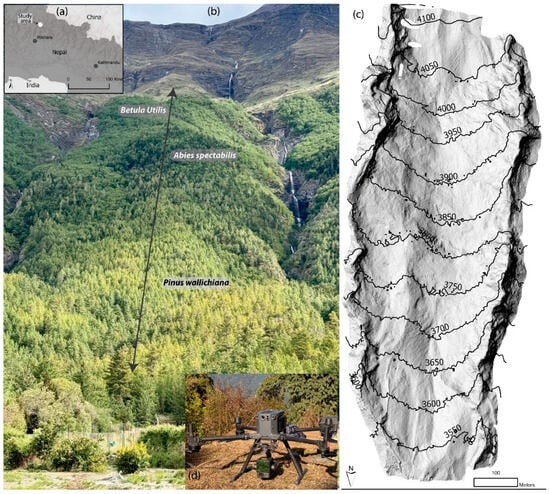
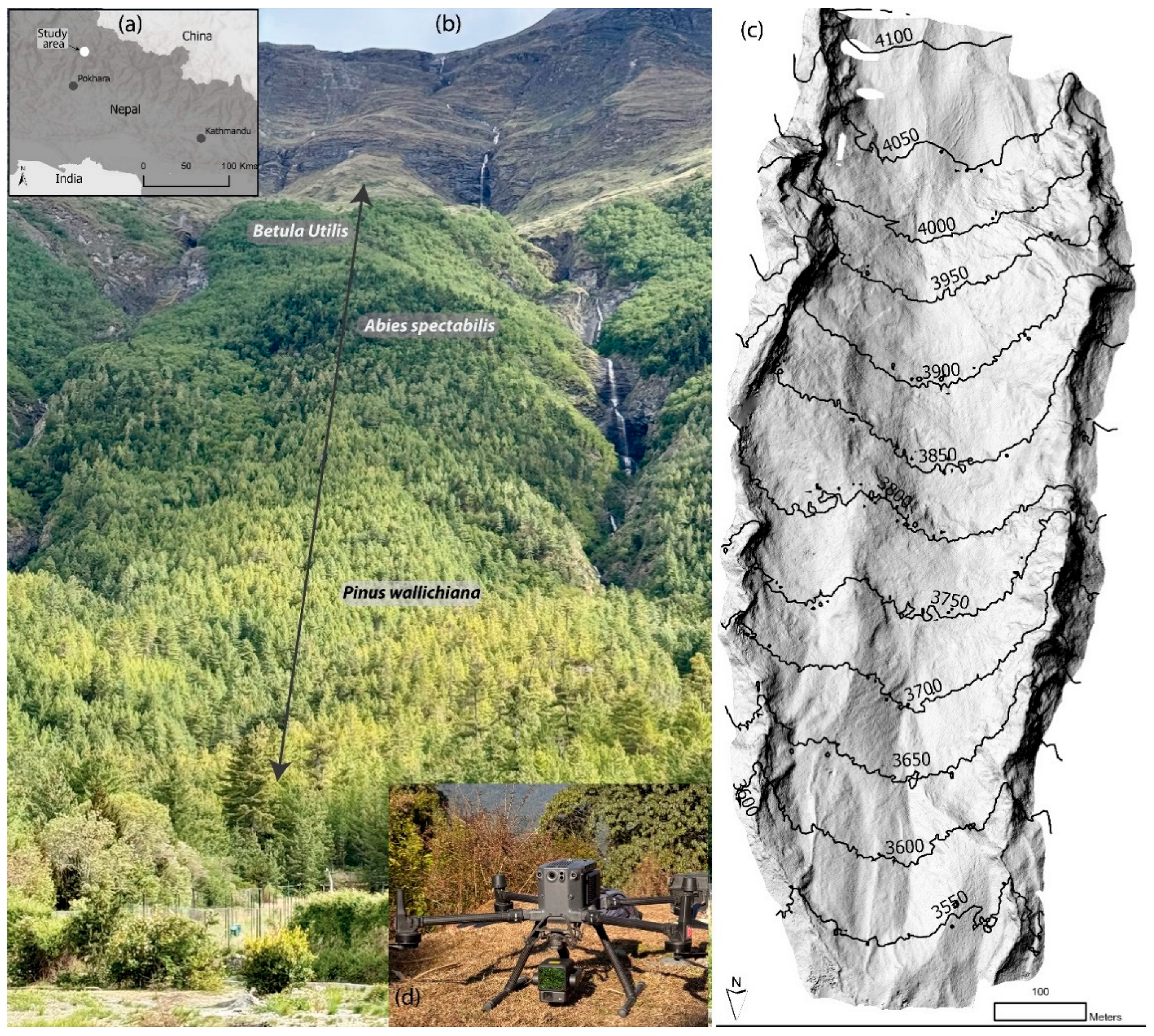
The study was conducted in the Manang Valley, located within the Annapurna Conservation Area (ACA) of central Nepal. The site lies on the northern slopes of the Annapurna range in the Manang District, at approximately 28.62°N latitude and 84.09°E longitude (Figure 1a). Geographically, the region falls within the Trans-Himalayas, a rain-shadow zone that receives around 840 mm annual rainfall [36], which is considerably less than the southern slopes of the Himalayas due to the orographic barrier of the Annapurna massif. This creates a semi-arid alpine environment with rugged terrain and sharp elevational gradients that strongly shape vegetation distribution and treeline dynamics. The site was selected for its pronounced treeline expression, logistical accessibility for UAV and ground surveys, and the absence of obvious recent disturbance indicators during reconnaissance (e.g., fresh stumps/lopping, burn scars, heavily trampled grazing trails). Disturbance context was further evaluated through consultations with local residents and conservation personnel; these qualitative observations are reported here because site-specific disturbance inventories are not available for this location [37].
Figure 1.
(a) Location of the Humde (Manang) study site in Nepal, central Himalayas, (b) oblique field photograph of the mapped area, indicating dominant taxa, (c) high-resolution digital terrain model showing elevational gradient, and (d) quadcopter platform and sensor used for data acquisition.
The total mapped area covered by the UAV-LiDAR survey was approximately 0.46 km2, with elevation ranging from 3504 m to 4119 m above sea level (Figure 1c). Along this elevational gradient, the three dominant canopy-forming taxa were Pinus wallichiana, Abies spectabilis, and Betula utilis (Figure 1b), which are widely reported components of Nepal’s treeline forests [38]. With increasing elevation, Pinus became progressively interspersed and eventually replaced by Abies (Himalayan Silver Fir). At higher elevations, Abies spectabilis was gradually mixed with, and then completely supplanted by, Betula (Himalayan Birch), marking the upper limits of forest growth near the treeline ecotone. These shifts in species composition across elevation reflect both ecological zonation and physiological constraints imposed by altitude and climate [39]. The only subcanopy or understory woody species recorded during field validation was Rhododendron anthopogon, which was restricted to a narrow elevational band between 3800 and 4000 m.
2.2. Data Sources
2.2.1. Field-Based Measurements
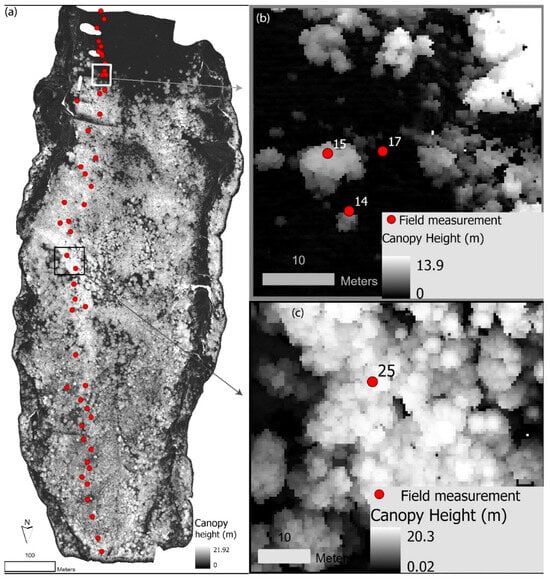
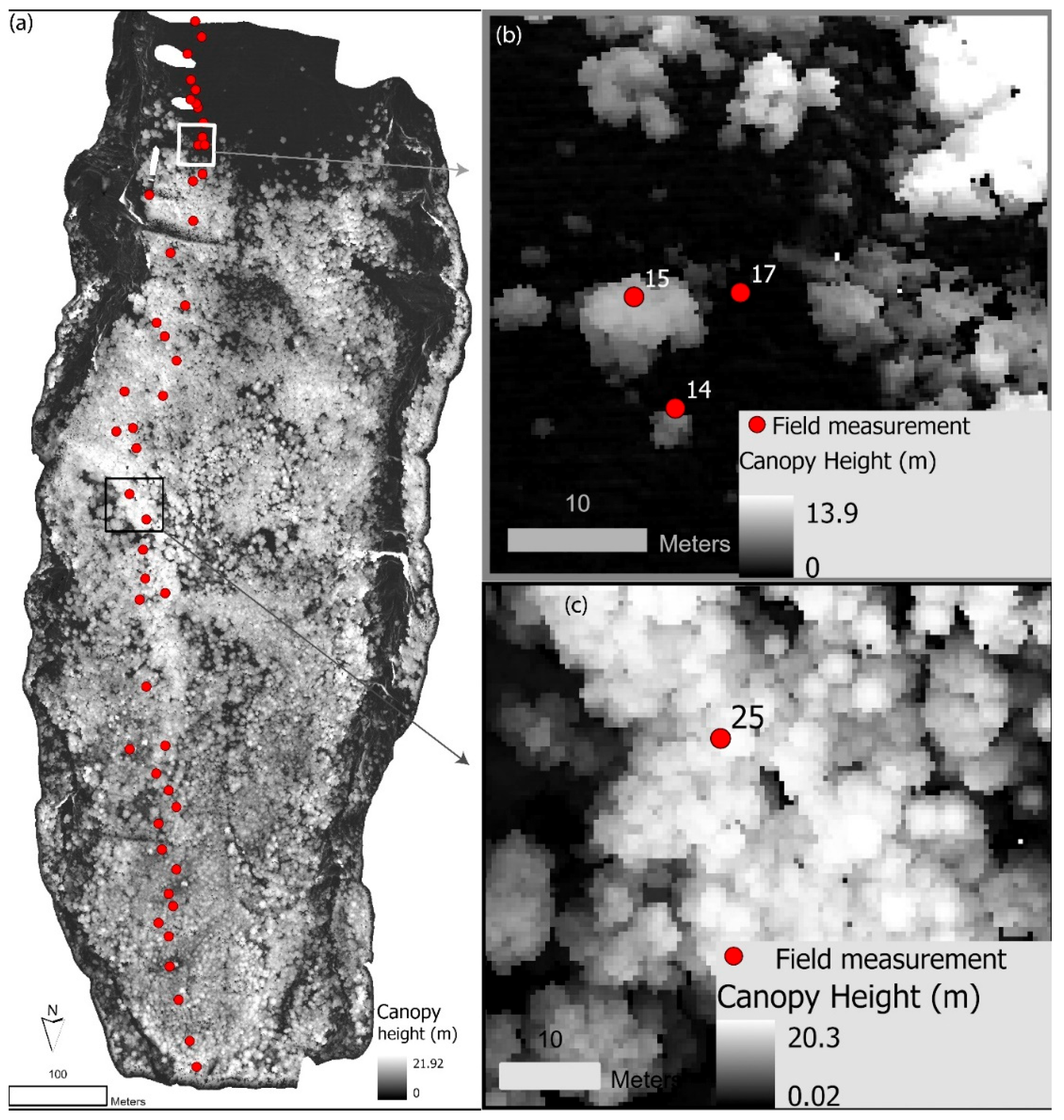
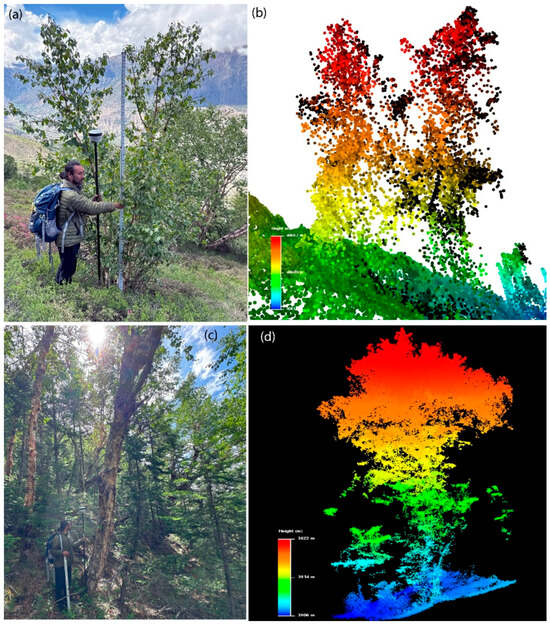
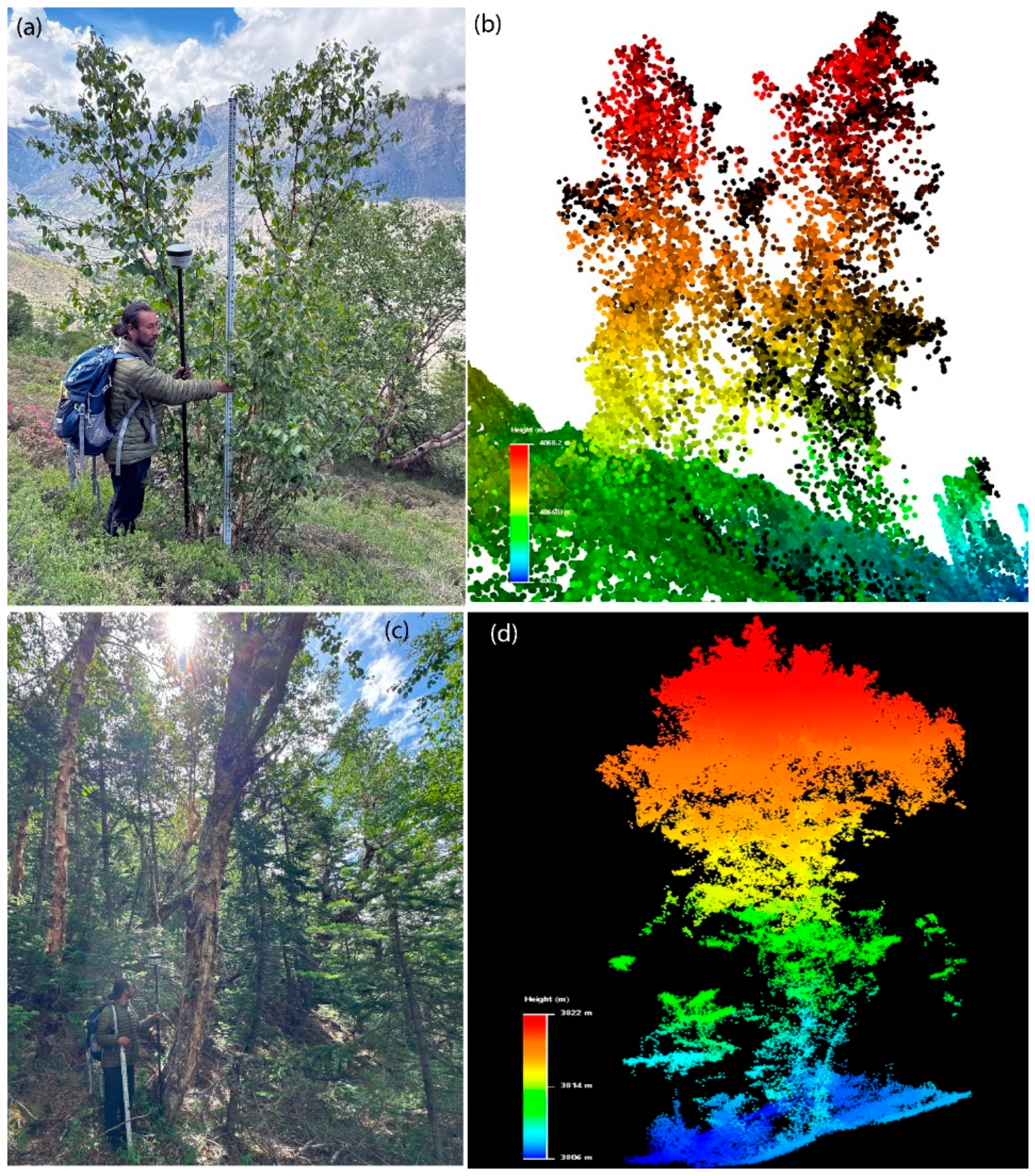
Field vegetation data were collected on 22 June 2025, concurrently with the UAV-LiDAR flights over the same area to provide ecological context and ground-truthing for the remote sensing data. Data were collected at 78 locations distributed along the elevational gradient using an elevationally stratified design to ensure representation from the upper treeline zone to the lower forest (Figure 2). At each location, a focal tree was selected randomly from the trees within a small neighborhood of the point (e.g., nearest tree meeting the inclusion criteria) and species identity, height, and DBH were recorded. The target number of locations was established prior to fieldwork based on the time available and the goal of sampling across elevation bands; locations were adjusted in the field only where access or safety in steep terrain prevented reaching the planned point. In addition to these individual tree measurements, observations were made regarding the dominant surrounding vegetation life form, vegetation species, local slope condition, species diversity, and the presence or absence of understory vegetation. At each site, oblique photographs were also taken using a handheld camera to visually document vegetation structure and site conditions (e.g., Figure 3).
Figure 2.
(a) Site-wide canopy height model; red circles mark in situ data collection locations distributed along the elevational transect, (b,c) show zoomed example in the upper slope and mid-slope areas.
Figure 3.
Side-by-side views of field oblique photographs and co-located UAV-LiDAR point clouds at two representative sites: (a) oblique field photo at Site 15 (high-elevation treeline; see Figure 2b); (b) corresponding LiDAR point cloud colored by height/elevation; (c) oblique field photo at Site 25 (mid-elevation forest; see Figure 2c); (d) corresponding LiDAR point cloud colored by height/elevation. The paired panels highlight how in situ conditions relate to 3D canopy structure; the ranging pole provides scale.
2.2.2. UAV-LiDAR Data Collection and Processing
The LiDAR data were collected using a DJI Matrice 350 quadcopter equipped with a Zenmuse L2 and a discrete return LiDAR sensor (Figure 1d). A Trimble R12 GNSS base station was set up near the launch site, logging data at 1 s intervals throughout the survey. Five flights were conducted between 12:13 PM and 2:31 PM. Each flight was performed at a speed of 3 m/s using terrain-follow mode to maintain a consistent height of 40 m above ground level. The Zenmuse L2 operated in repetitive scan mode with a pulse repetition rate of 240 kHz and recorded up to five discrete returns (penta-return) per pulse. The sensor also featured a 20-megapixel RGB camera that acquired overlapping imagery used to colorize the point cloud.
The raw LiDAR and GNSS base data were processed using a post-processed kinematic (PPK) workflow to generate a high-density point cloud covering the full study area. Point clouds were generated at full resolution (100%), with the ground-type parameter set to “steep slope” to better account for the mountainous terrain [40]. The final processed LAS dataset had an average point density of 2516 points per square meter.
Initial visualization revealed high data quality, with only minor noise from a few misclassified points above the canopy, which were manually removed. Ground classification was then performed using the Cloth Simulation Filter (CSF) algorithm, which is effective in complex terrain [41]. The classified ground returns were interpolated using adaptive triangulation to produce a 0.3 m resolution digital terrain model (DTM). Simultaneously, first-return points were interpolated to create a Digital Surface Model (DSM). Subtracting the DTM from the DSM yielded a high-resolution canopy height model (CHM), enabling fine-scale analysis of vegetation structure. The CHM is a gridded (2.5D) derivative of the 3D point cloud and is used here specifically for canopy-height summaries and tree-cover estimation, whereas crown delineation and species classification use the full 3D point cloud.
2.3. Segmented Regression to Detect the Treeline Breakpoint
To identify the elevation at which forest structure transitions sharply—corresponding to the ecological treeline—a segmented (piecewise) linear regression was fit to tree-cover estimates derived from the CHM. Tree cover was defined as the proportion of pixels exceeding 2 m in height within 10 m elevation bins created using the CHM. To capture nonlinear shifts, this study fitted a piecewise linear model with a single breakpoint using a custom function in R:
where x0 represents the estimated breakpoint elevation. The coefficients and denote the slopes of the linear segments before and after the breakpoint, respectively, and is the intercept of the first segment. This formulation ensures continuity at the breakpoint by adjusting the intercept of the second segment accordingly. A difference between and indicates a shift in the rate of canopy-cover change across the treeline ecotone. Parameter fitting was performed using nonlinear least squares with initial guesses based on visual inspection of tree-cover trends. This approach captures potential threshold dynamics indicative of treeline boundaries.
2.4. Individual Tree Segmentation
Individual trees were delineated in LiDAR360 using the individual tree segmentation workflow applied to a height-normalized LiDAR point cloud. The method detects candidate treetops as local maxima and delineates crowns by expanding from each seed through a region-growing procedure constrained by local neighborhood geometry and vertical continuity of the 3D point distribution [42,43]. To ensure stable segmentation across the steep elevational gradient, multiple parameter sets were tested and compared across low-, mid-, and near-treeline zones. The final parameterization used a 0.4 m grid size, a 10-pixel buffer, and a 2 m height-above-ground threshold to exclude low vegetation. A Gaussian smoothing filter (σ = 0.3; radius = 5 pixels) was applied to reduce spurious local maxima and suppress over-segmentation in dense conifer stands. This configuration minimized crown splitting in closed-canopy areas while preserving narrow and isolated crowns near the treeline.
Following segmentation, crowns were optionally summarized at the stand scale by aggregating adjacent crown polygons whose boundaries touched or whose centroids were separated by <2 m. Small groups below a minimum mapping threshold were removed, and remaining groups were merged to form contiguous stand units. Species classification was performed at the individual-tree level; stand-scale summaries (e.g., height statistics, crown area, and species composition) were calculated for contextual visualization and interpretation [44].
2.5. Species Classification
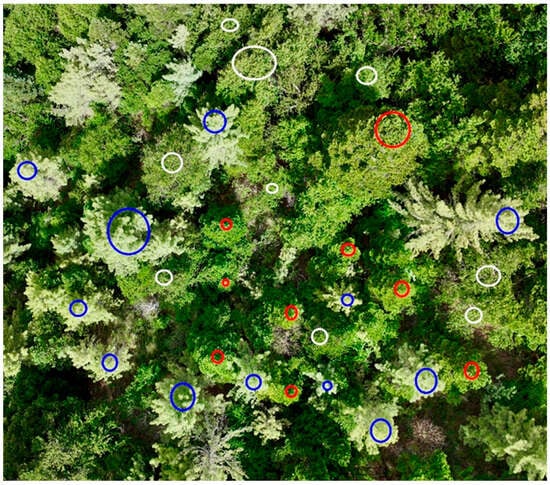
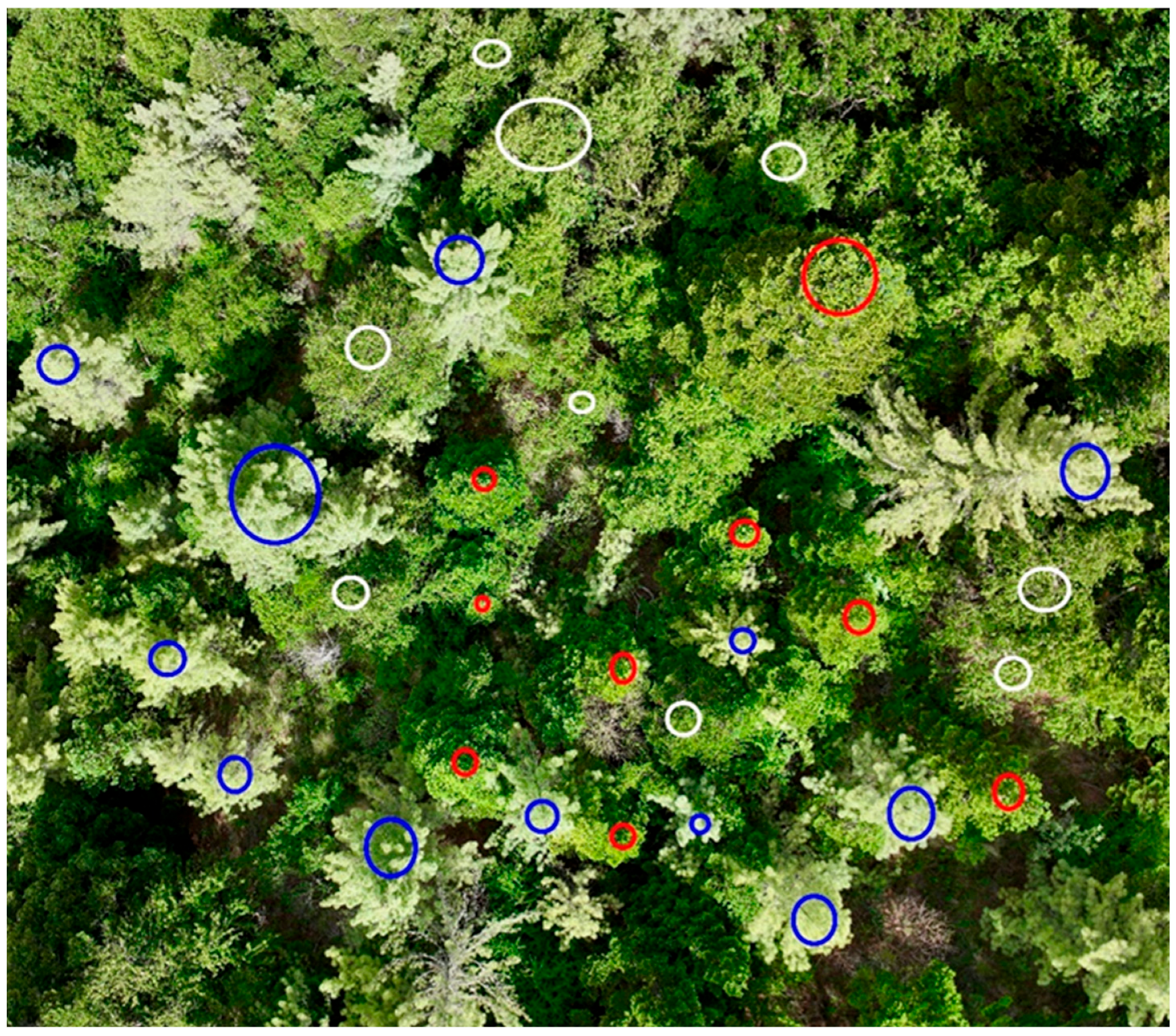
Reference trees were identified and labeled in the Quick Terrain Modeler [45] using field photographs, field observations, and high-resolution RGB imagery (Figure 4). In total, 766 reference crowns representing the three dominant taxa (Pinus, Abies, and Betula) were digitized as marker points and exported as an ESRI shapefile [46]. Training labels were assigned by spatially linking markers to segmented crown centroids using a nearest-neighbor match within a fixed distance tolerance (0.5 m). Where multiple markers linked to the same crown or where the nearest match was ambiguous, records were excluded from training to prioritize label fidelity.
Figure 4.
RGB photograph from the onboard camera of the DJI Zenmuse L2 (used to colorize the co-registered LiDAR point cloud) showing mapped tree species within a mixed stand. Circles indicate crowns: blue = Pinus wallichiana (Pine), red = Abies spectabilis (Abies), and white = Betula utilis (Betula). Symbols mark crown centers for visual reference (not to scale).
Species identity was predicted for each segmented crown using a supervised random-forest classifier [47] trained on LiDAR-derived structural and radiometric features in R statistical software (version 4.5.1) [48]. Predictors included crown geometry (e.g., height and crown diameter), height-distribution summaries derived from within-crown returns (e.g., mean height, median height, standard deviation, and upper-percentile heights), and return-intensity statistics summarizing within-crown backscatter [44]. A canopy-occupancy index, defined as the proportion of returns above the crown’s 90th percentile height (i.e., within the upper 10% of the crown), was calculated to represent vertical foliage concentration [49]. Tree identifiers and coordinates were retained for spatial joins and mapping but were excluded from model fitting.
Model training and evaluation used stratified five-fold cross-validation to preserve class proportions in each fold. Class imbalance was addressed using inverse-frequency class weights. The random-forest model was fit with 800 trees; the number of candidate variables at each split was set to mtry ≈ √p (where p is the number of predictors used after screening). Performance was evaluated using a confusion matrix and class-wise precision, recall, and F1, along with macro-averaged scores to summarize performance across classes. Precision was defined as TP/(TP + FP), recall as TP/(TP + FN), and F1 as 2·(precision·recall)/(precision + recall), where TP, FP, and FN denote true positives, false positives, and false negatives, respectively [50].
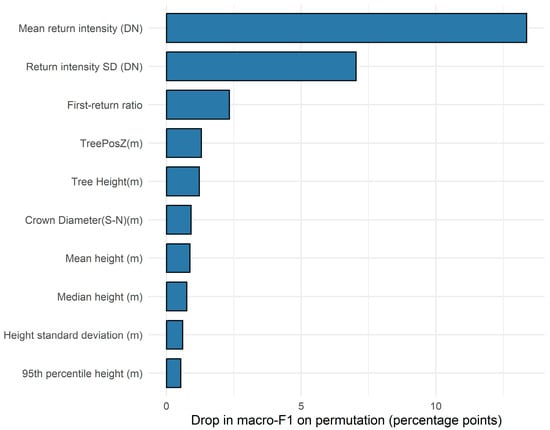
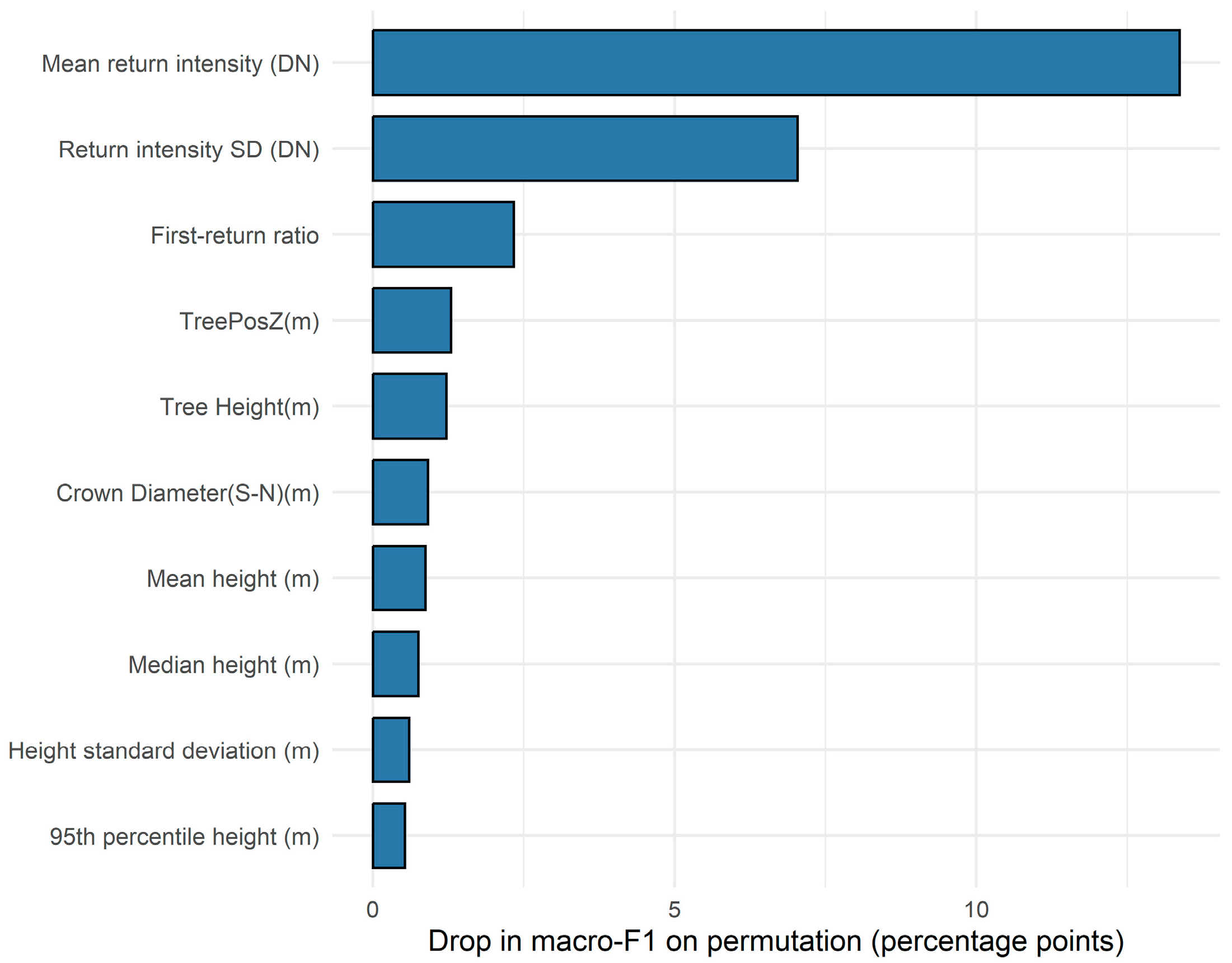
Predictor importance was quantified using permutation importance under cross-validation [47]. For each fold, a baseline macro-F1 was computed on the held-out data; then each predictor was permuted in the held-out fold (all other predictors unchanged) and the resulting decrease in macro-F1 was recorded. Importance was reported as the mean percentage-point drop in macro-F1 across folds [51].
2.6. Modeling Elevation Effects on Forest Structure and Species Turnover
Analyses were designed to quantify how forest structure and species composition vary with elevation and to identify thresholds associated with treeline transitions. Here, structural simplification is defined as an elevation-linked decline in canopy stature accompanied by a contraction in canopy-height variability (i.e., narrowing of CHM height distributions) and decreasing tree cover. We quantify this using CHM summaries across elevation bins (median and distributional spread visualized with box/violin plots) and a segmented regression of tree cover (proportion of CHM pixels > 2 m) versus elevation to identify a threshold associated with treeline transition. Canopy height trends were summarized from the CHM using elevation bins (50 m across the full range, and 20 m near the upper ecotone) to capture both gradual and abrupt changes in vegetation stature. Boxplots and violin plots were used to visualize central tendencies and spread in canopy height distributions. To locate the treeline, a segmented linear regression was fit to tree cover (proportion of CHM pixels > 2 m) as a function of elevation. This model allowed estimation of a breakpoint where canopy cover declined sharply, signaling the transition from continuous forest to sparse subalpine vegetation. Tree species distributions were examined by aggregating classified crowns across elevation. Elevation boxplots, empirical cumulative distribution functions, and filled elevation series of species counts were used to describe spatial turnover and niche separation among the three tree species. Because the dataset represents a single-season survey, the observed pattern is interpreted as spatial elevational turnover rather than temporal replacement or successional change. Species-specific crown height patterns were summarized with binned means (±95% CIs) and smoothed medians to assess how stature responds to elevation within each taxon.
3. Results
3.1. CHM-Based Elevation Patterns in Canopy Height
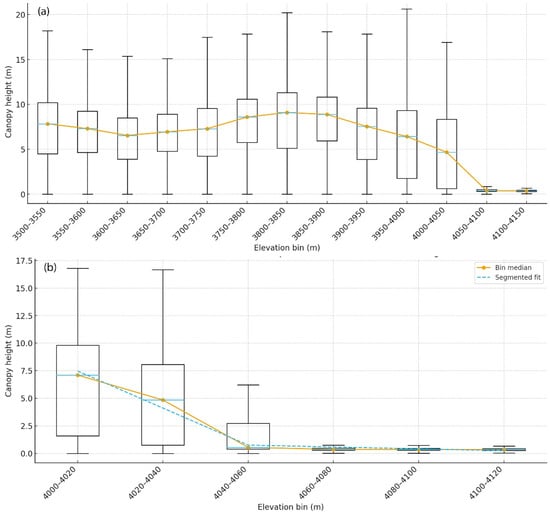
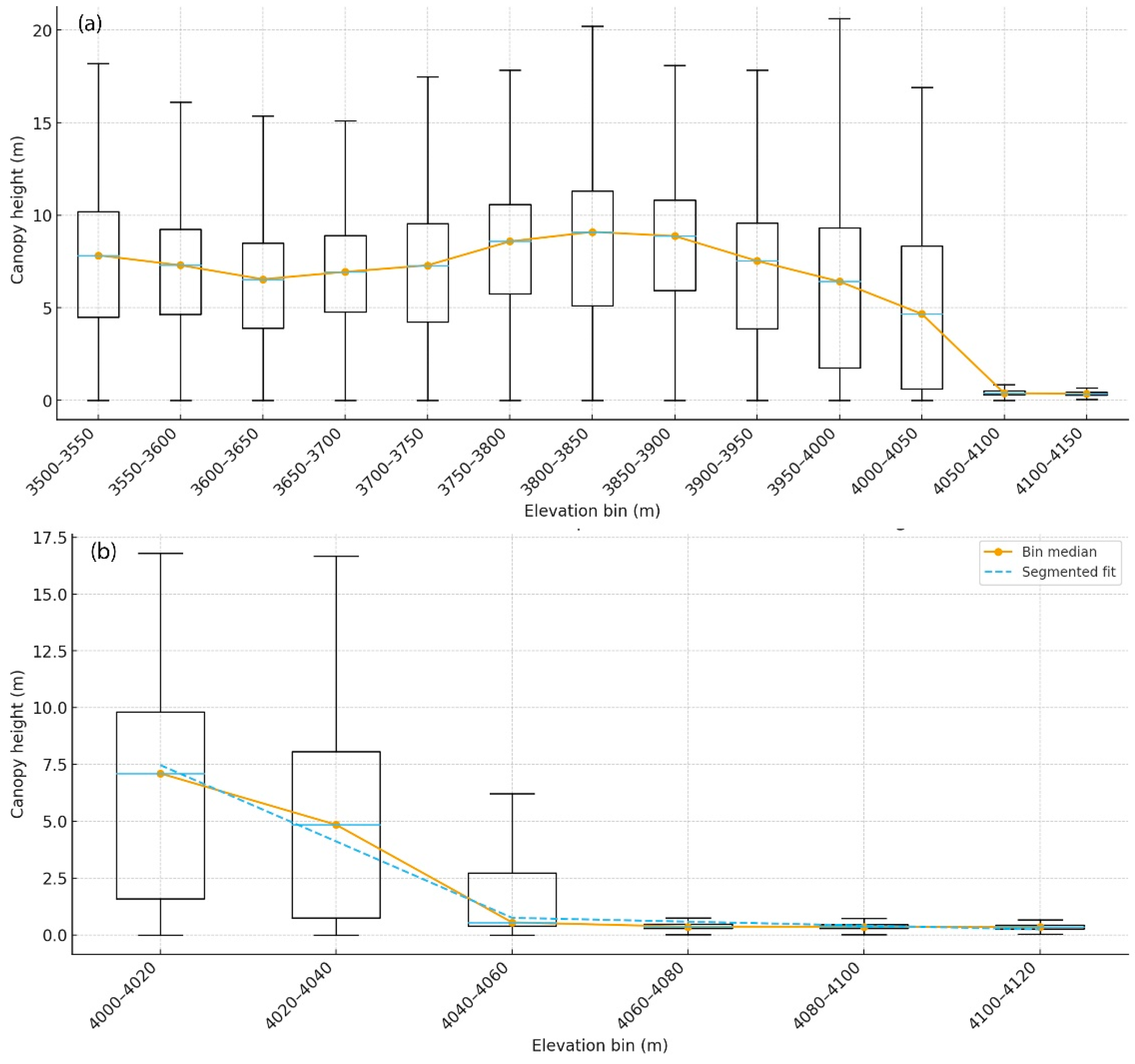
Across the full gradient, canopy height declined systematically with elevation. CHM boxplots aggregated in 50 m bands (3500–4120 m) show a gradual decrease in medians from ~7–9 m at lower elevations to <2 m in the highest bands (Figure 5a). Violin plots emphasize both the shift in central tendency and the contraction of distributional spread toward the upper ecotone. Finer-scale binning in the 4000–4120 m zone (20 m bands) reveals an abrupt reduction in canopy stature: medians drop from ~7–8 m at 4000–4040 m to ~0.5–1 m by 4060–4120 m, with narrow interquartile ranges indicative of low and uniform vegetation (Figure 5b). These CHM summaries are consistent with a rapid transition from forest to subalpine shrub or low-stature vegetation within ~60–80 m of vertical distance above ~4000 m.
Figure 5.
(a) Canopy height by elevation in 50 m bins (3500-4120 m) showing gradual decline with increasing elevation and (b) a sharper decline above ~4040 m is visible using 20 m bins and segmented fit, indicating a distinct treeline transition.
3.2. CHM-Based Treeline Threshold and Sharpness
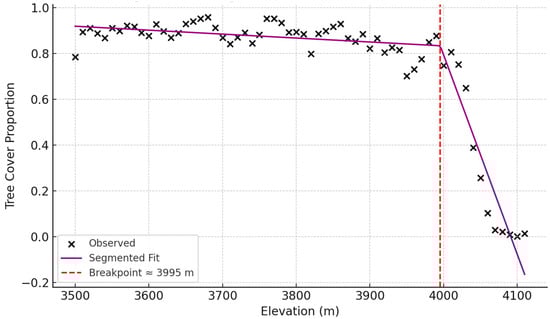
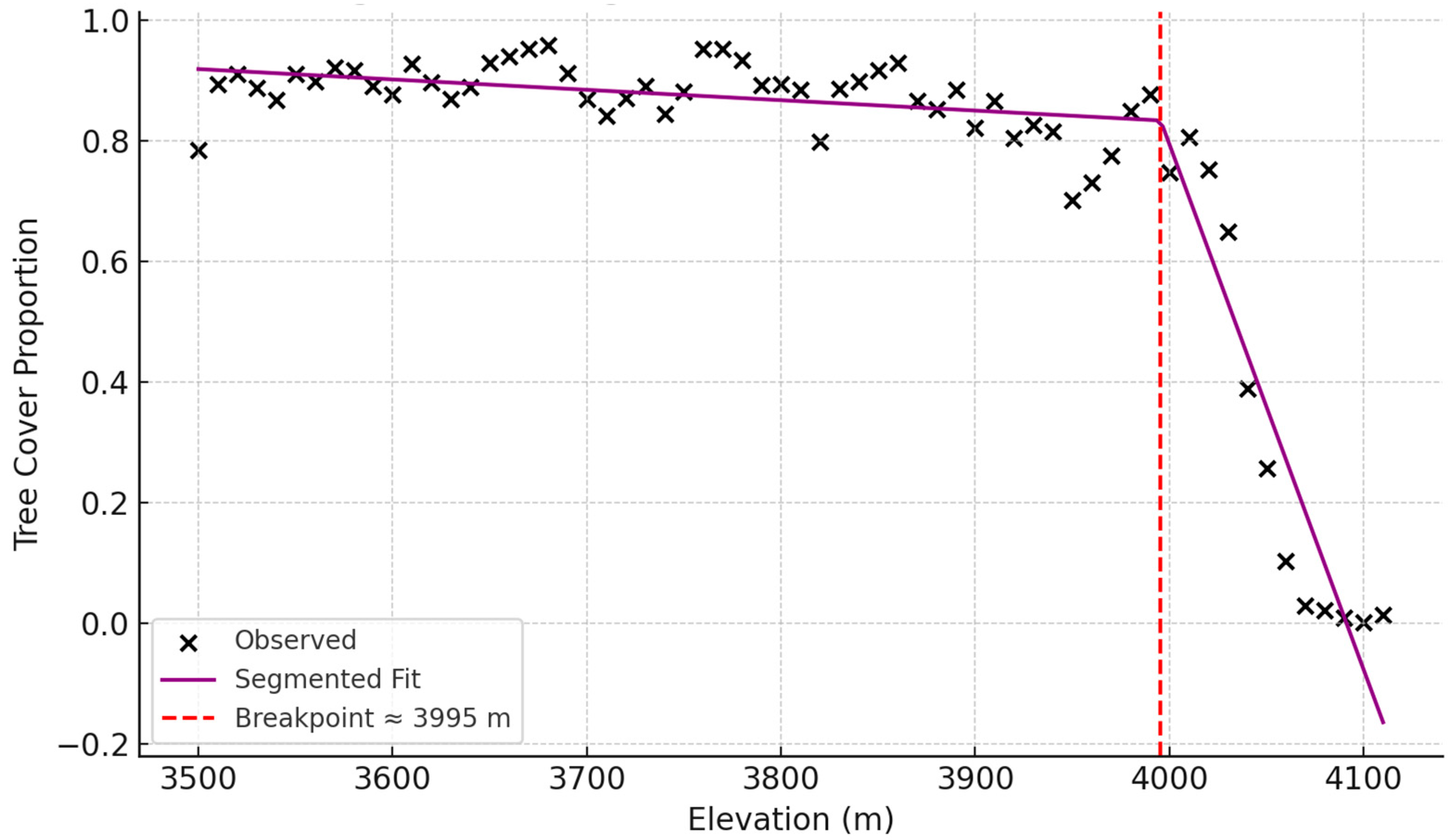
Segmented regression of tree cover (>2 m) vs. elevation identified a single interior breakpoint at ~3995 m (Figure 6). Below the breakpoint, cover remained high and weakly varying (0.85–0.92). Above the breakpoint, the fitted slope steepened dramatically, and cover declined to near zero by ~4110 m. The location and slope change of this piecewise fit align with the CHM distributional collapse in the 4000–4120 m window, indicating a narrow and sharp treeline zone centered at ~3995 m. The estimated breakpoint aligns with the visual and ecological definition of a treeline, where closed-canopy forest gives way to isolated krummholz and shrub-dominated zones. The model fit accurately captured the two-phase pattern in canopy structure, with distinct slopes on either side of the breakpoint and minimal residual variance.
Figure 6.
Segmented regression showing tree cover decline with elevation. A breakpoint at ~3995 m (red dashed line) marks a sharp drop in cover, indicating the ecological treeline.
3.3. Crown-Based Species Distribution Along Elevation
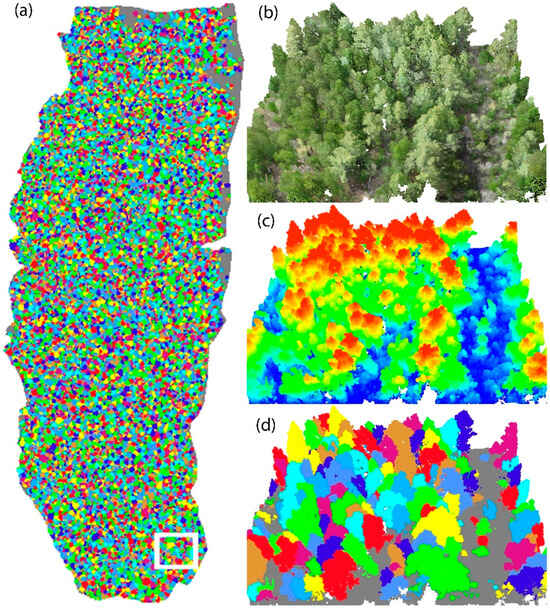
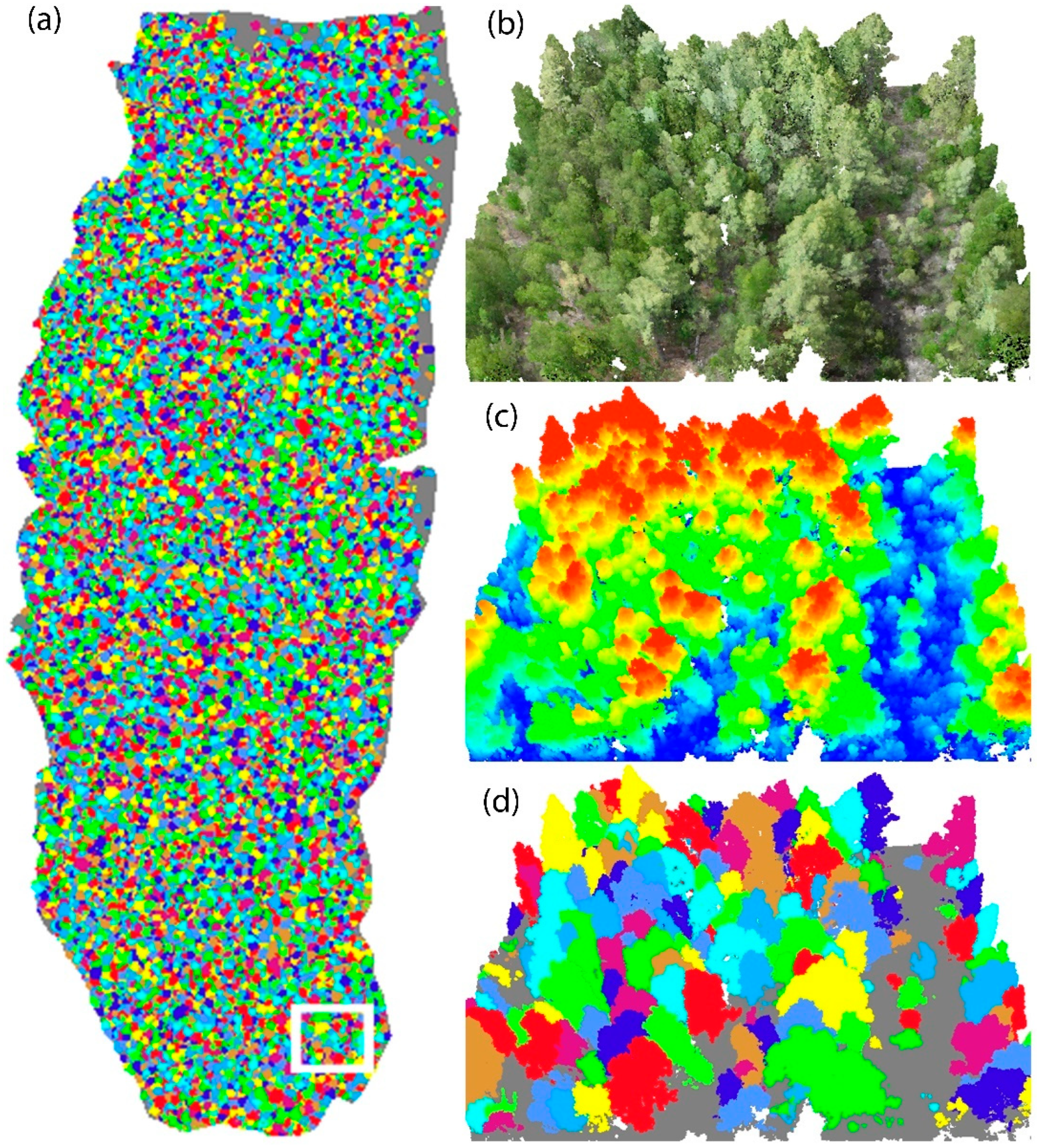
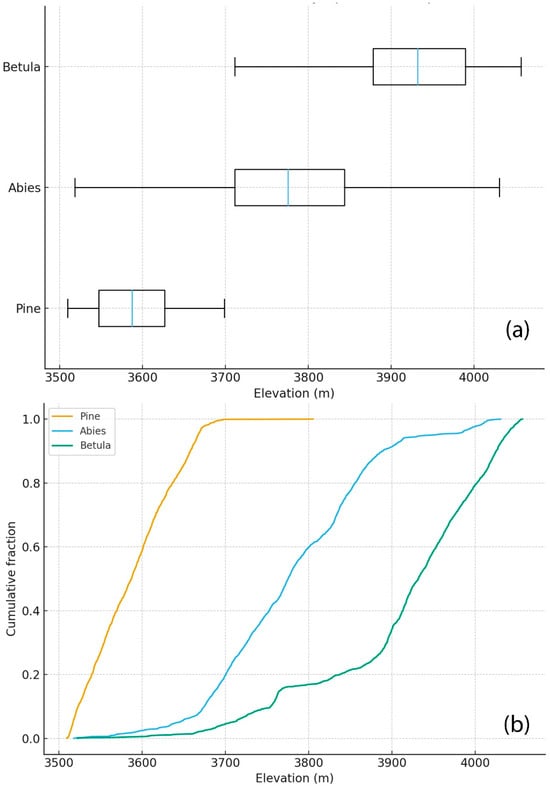
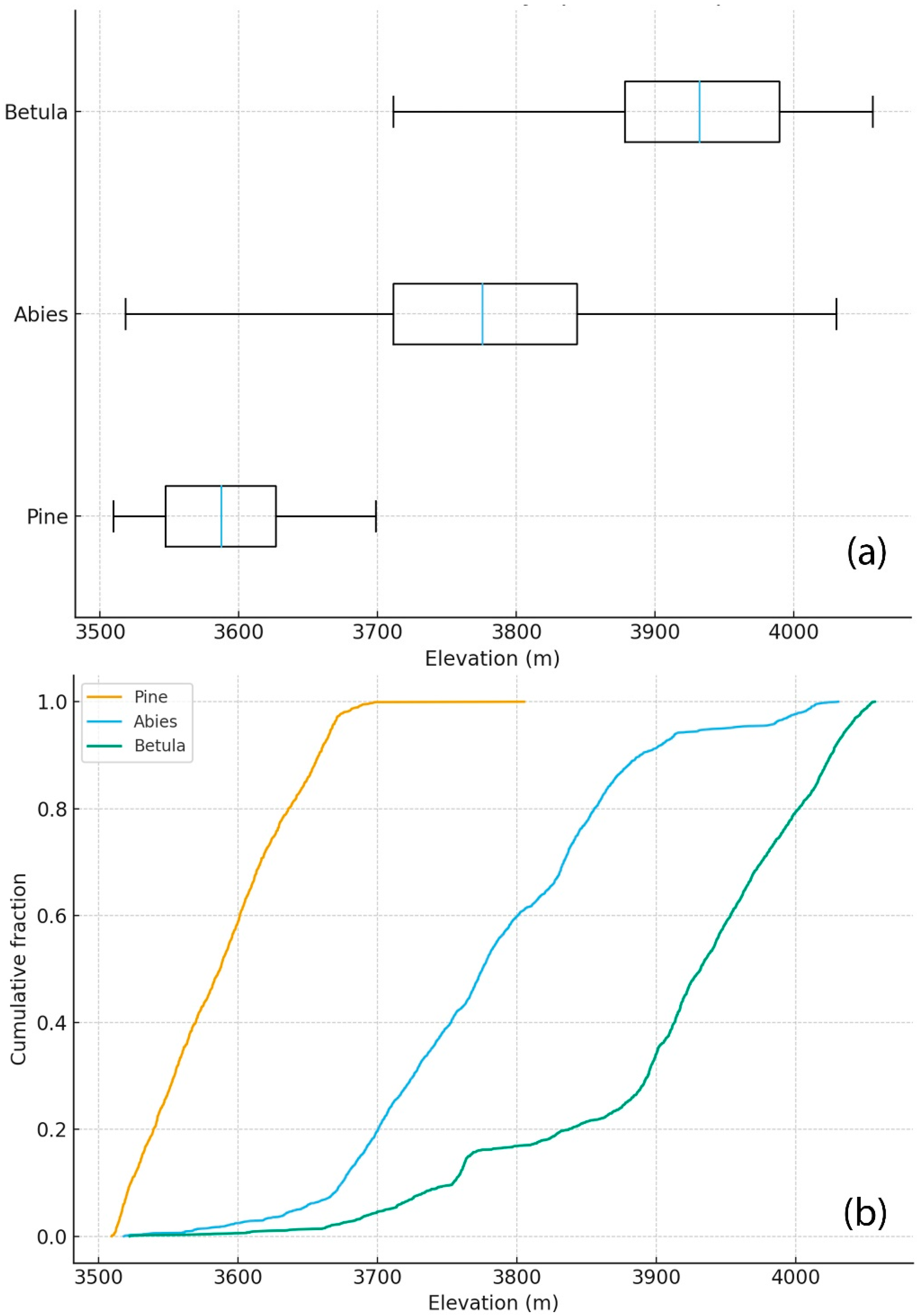
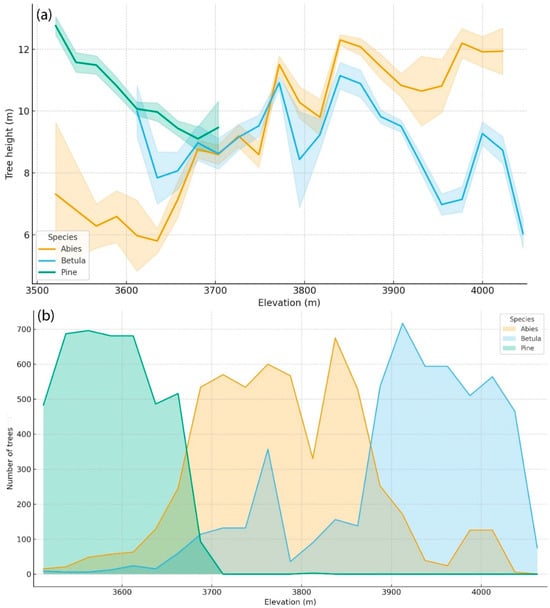
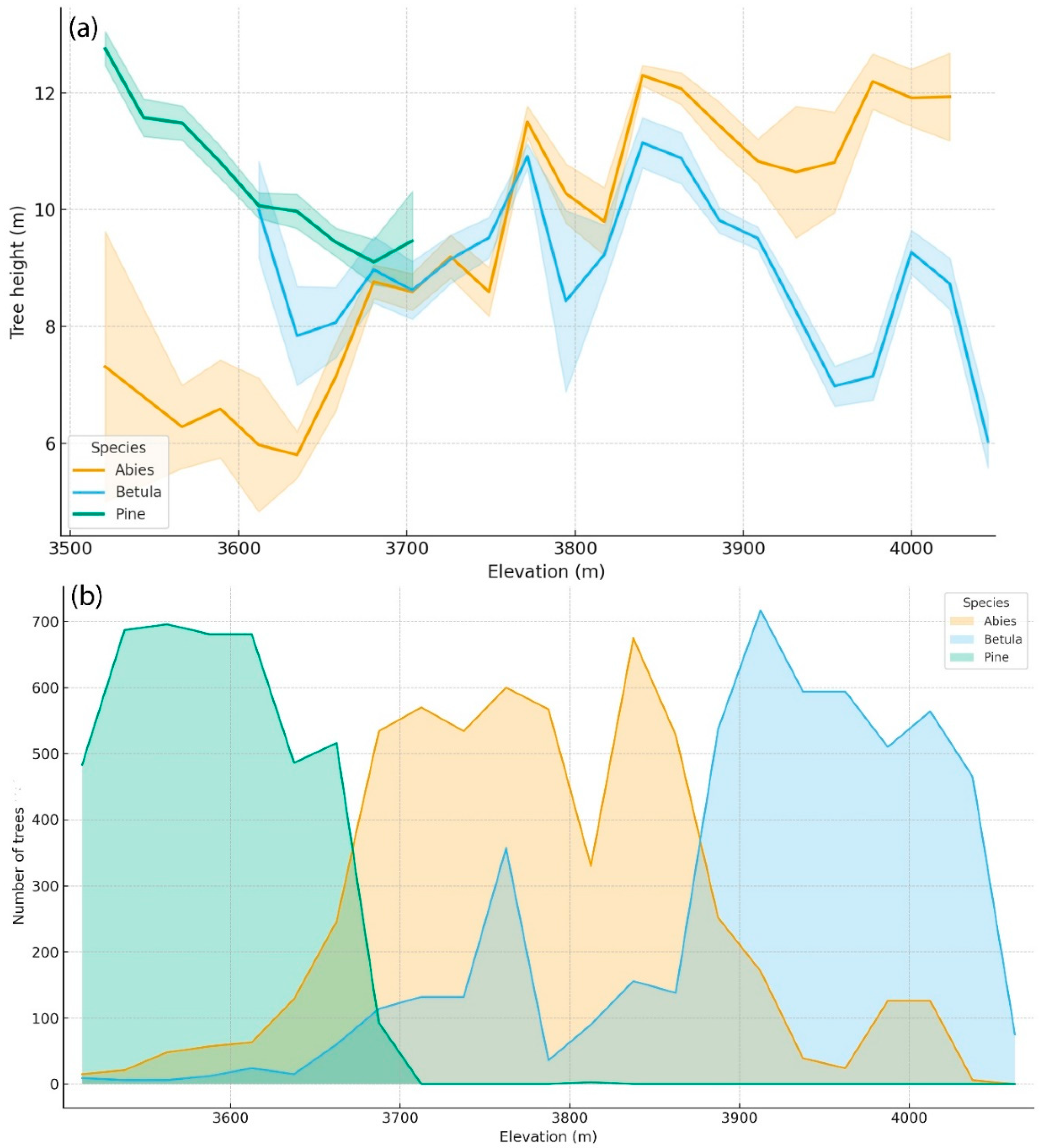
Results for watershed-based point cloud segmentation to detect individual trees for the entire area is shown in Figure 7. Spatial analysis of these results considering elevation revealed nuanced ecological patterns. Species summaries show a structured shift in dominance with elevation, with distinct elevation ranges of peak occurrence for each species. Boxplots of elevation by species display separated medians and limited interquartile overlap, with Pine confined to lower elevations, Abies spanning intermediate elevations, and Betula concentrated highest (Figure 8a). Empirical CDFs corroborate this sequence: Pine reaches its upper quantiles by ~3650–3700 m, Abies accumulates through mid-elevations, and Betula dominates above ~3850–3900 m (Figure 8b). Filled series of tree counts by elevation further illustrate the turnover: Pine declines to near zero by the mid-slope, Abies peaks mid-gradient and contracts rapidly near ~3900–4000 m, and Betula increases sharply in the upper slope before declining in stature near the treeline (Figure 9b).
Figure 7.
Individual tree detection and segmentation from LiDAR point cloud data, (a) tree-level segmentation results for the entire study area, visualized by unique tree IDs, (b) RGB-colored point cloud for a subset region (white rectangle in panel (a)) at lower elevation, (c) elevation-colored point cloud for the same subset, highlighting topographic variation and (d) segmentation map of individual trees within the subset area, showing distinct tree stands.
Figure 8.
(a) Elevation distribution of predicted tree species from segmented crowns, showing median and interquartile ranges for Pine, Abies, and Betula and (b) cumulative elevation distribution functions illustrate distinct elevational preferences.
Figure 9.
Tree height and abundance patterns by elevation and species, (a) mean tree height (±95% CI) across elevation for each species, showing contrasting elevational trends. (b) Number of trees per 20 m elevation bin, indicating species turnover with increasing elevation.
3.4. Species-Specific Height Responses to Elevation
Species-stratified binned means with 95% CIs and rolling medians indicate distinct responses (Figure 9a). Pine shows a monotonic decline in height across its realized range. Abies exhibits a mid-elevation maximum followed by tapering toward the upper limit. Betula displays a hump-shaped pattern with a pronounced fall-off above ~3900–4000 m. Together with the CHM summaries, these trends indicate strong elevation-driven simplification of canopy stature in the upper ecotone.
3.5. Segmentation and Classification Performance
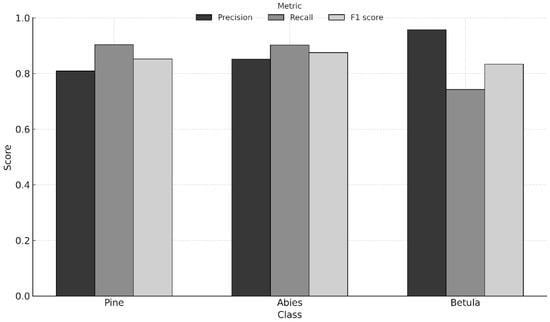
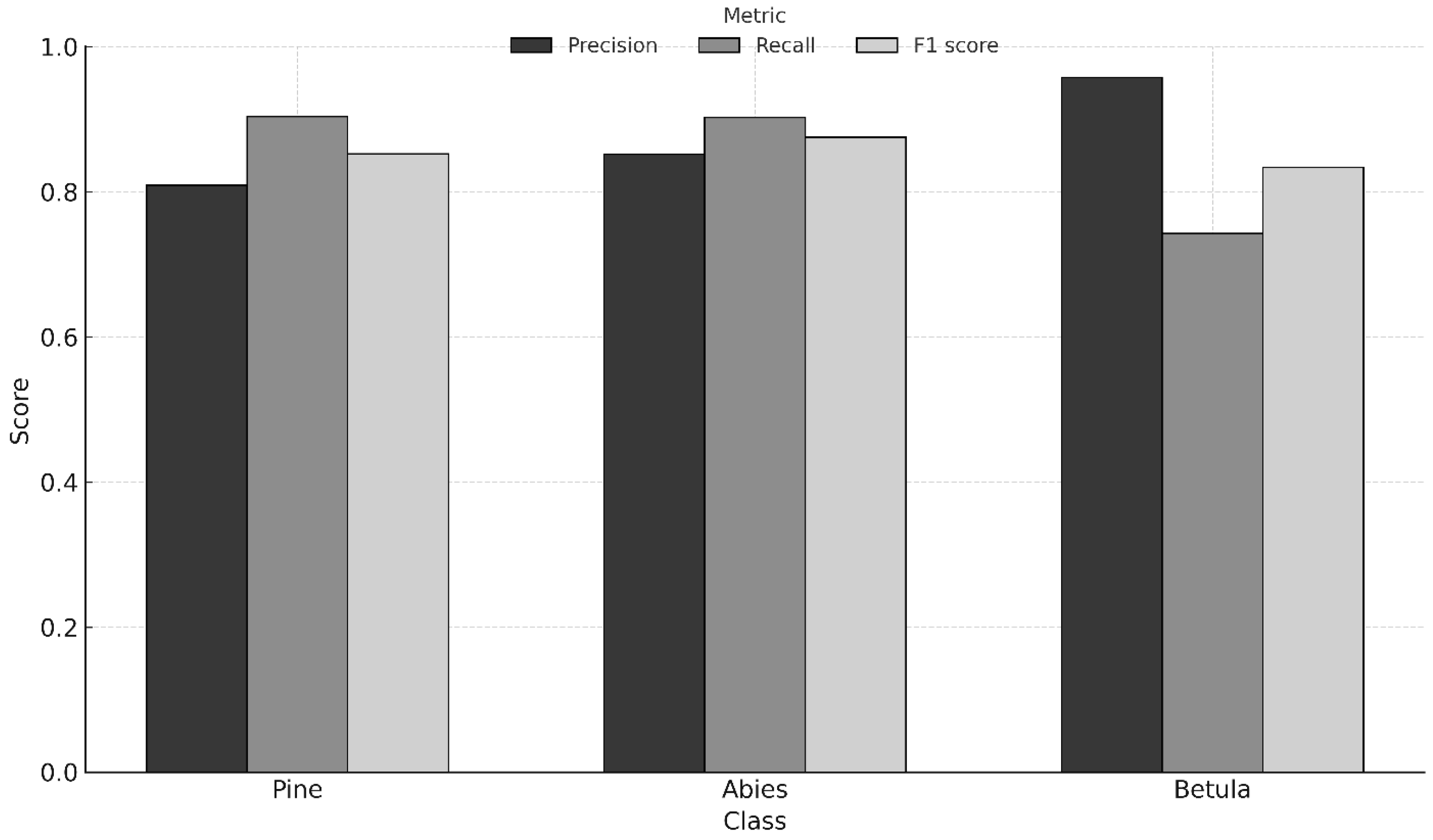
Individual tree segmentation produced tree stands (Figure 7a) across the full gradient and enabled species mapping with associated class probabilities. The three-class random-forest classifier achieved consistently high cross-validated performance: per-class F1 typically ~0.82–0.90; Betula exhibited the highest precision (~0.9) with comparatively lower recall (~0.7–0.8), whereas Pine and Abies showed balanced precision and recall in the high 0.8 range (Figure 10). Macro-averaged scores and overall accuracy were similarly high. These accuracies support the reliability of the mapped species patterns and the inferred elevation responses.
Figure 10.
Precision, recall, and F1 scores for tree species classification across Pine, Abies, and Betula classes.
The top 10 predictors show that return-intensity features dominate species discrimination (Figure 11). Mean return intensity is most influential (12–13 pp drop), followed by intensity SD (7 pp), indicating that absolute backscatter and within-crown heterogeneity provide the strongest separability among Pinus, Abies, and Betula. First-return ratio contributes additional signal (2–3 pp), consistent with differences in canopy porosity/branching that affect multi-return behavior. Elevation of crown center (TreePosZ) and tree height add smaller but meaningful information (1 pp each), reflecting elevational niches and stature. Crown diameter and height summaries (mean, median, SD, P95) have modest effects (≲1 pp), suggesting redundancy or weaker discrimination at this scale.
Figure 11.
Top 10 most influential features for tree species classification, based on mean decrease in macro-F1 score from permutation importance analysis.
4. Discussion
4.1. Treeline Sharpness and Structural Thresholds
The results clearly reveal a narrow and sharp ecological treeline in the Manang Valley, characterized by an abrupt decline in canopy height and tree-cover over a ~60–80 m vertical interval centered around 3995 m. Together, the CHM-based threshold detection and the crown-level 3D species mapping provide complementary evidence for a sharp structural transition coincident with elevational turnover in dominant taxa. In this study, treeline sharpness is quantified as the rate of change in tree cover with elevation derived from the piecewise (breakpoint) regression of vegetation cover (>2 m) vs. elevation (Figure 6). Treeline narrowness is defined as the vertical span over which modeled tree cover declines from high forest cover to near-zero cover; at this site, this transition occurs within ~60–80 m of elevation (Figure 6), consistent with the concurrent collapse of CHM height distributions in the same elevation window (Figure 5b). This aligns with previous reports of sharp treeline transitions in parts of the Himalayas [12,13], yet contrasts with diffuse or patchy forms observed elsewhere due to grazing, fire, or other anthropogenic disturbances [2]. The breakpoint model estimated the elevation of rapid cover decline, reinforcing the utility of CHM-based methods for delineating treeline thresholds. Compared to previous satellite-derived canopy cover models [21], the fine-scale LiDAR-derived CHM here allows a much sharper localization of the structural transition. This sharpness in forest structure suggests that microclimatic or physiological thresholds, rather than land-use legacies, dominate treeline formation at this site. The narrow vertical interval over which both canopy height and cover collapse points to strong ecological filtering mechanisms near the treeline, likely driven by frost sensitivity, mechanical limitations, or short growing seasons that limit tree recruitment and stature [52]. While direct climatic measurements (e.g., temperature, frost frequency, or snow cover duration) were not available for this site, the inference of microclimatic or physiological thresholds is supported by the abrupt structural collapse observed in a relatively undisturbed landscape—patterns that are consistent with ecological theory and previous treeline studies [53,54]. This limitation highlights the value of future work integrating UAV LiDAR with in situ or modeled climate data to test mechanistic drivers of treeline position and shift.
4.2. Elevation-Driven Simplification of Forest Structure
A consistent decline in canopy height with increasing elevation was observed across all structural metrics. The uppermost elevation bands showed minimal vertical heterogeneity, reduced canopy complexity, and low-stature vegetation—features that mirror trends seen in both temperate and tropical treeline ecotones globally [55]. This pattern of simplification is particularly pronounced in the final 100 m of vertical ascent, where interquartile spread in CHM height narrows considerably. Such simplification is ecologically meaningful, as it signals both loss of structural buffering capacity and increased exposure of vegetation to abiotic stressors such as wind, frost, or radiation. While some degree of simplification is expected with altitude, the fine-scale quantification presented here demonstrates that changes in canopy height precede complete vegetation turnover, and may serve as an early-warning indicator of biome transition.
4.3. Species Turnover and Niche Segregation
Species mapping based on LiDAR-derived crown traits shows a clear elevational zonation sequence: Pinus wallichiana dominates at lower elevations, gives way to Abies spectabilis mid-slope, and is replaced by Betula utilis near the upper treeline. The elevation-specific distributions and height patterns of these species are consistent with their known ecological tolerances—Betula, for instance, is more tolerant of cold and wind [36] and can persist at higher elevations despite its shorter stature [10]. Such species turnover patterns support niche segregation across elevation, with relatively sharp ecological boundaries. Importantly, these results describe spatial turnover across elevation and are not interpreted as temporal succession. Compared to previous field-only studies [12,36], this analysis offers a more spatially continuous and crown-resolved perspective, revealing individual-tree-level responses to elevation rather than relying solely on plot-averaged data. Importantly, the high classification accuracy achieved (~85–90% F1) suggests that LiDAR-derived structural and intensity features carry strong taxonomic signal in these ecosystems—particularly the backscatter intensity and its variability, which emerged as dominant predictors.
Beyond documenting treeline position, these results contribute a crown-resolved benchmark for how abruptly structure and composition change across a Himalayan treeline ecotone. Treeline theory predicts strong climatic constraint modulated by local exposure and geomorphology, producing both abrupt and diffuse transition forms across mountain systems [1,54,55]; the sharp breakpoint detected here aligns with the ‘threshold’ end of that spectrum. Recent remote-sensing studies have mapped treeline patterns using very-high-resolution imagery in Alpine landscapes [30], but canopy-cover patterns alone do not resolve vertical structure or crown-level attributes needed to interpret mechanistic changes through the ecotone. In this study, UAV LiDAR enables simultaneous quantification of height-distribution collapse and crown-level species zonation [11], and the permutation-importance results indicate that return-intensity statistics provide substantial discriminatory power alongside structural predictors—supporting the use of LiDAR-derived radiometric and 3D features for species mapping in high-relief treeline terrain [43,44].
4.4. Methodological Insights and Constraints
UAV-borne LiDAR-enabled high-resolution characterization of treeline structure and species distribution in steep Himalayan terrain bridges the gap between field plots and satellite data. Despite these advantages, several methodological constraints remain. First, the classification relied on crowns taller than 2 m, omitting seedlings and juvenile individuals that often mark the leading edge of treeline advance. This detection threshold limits insight into incipient colonization processes, especially in upper subalpine zones where vegetation expansion is reportedly dominated by saplings <1.5 m in height [5]. Future work should explicitly focus on detecting and analyzing sub-canopy or seedling-scale vegetation using either denser point clouds or supplementary data (e.g., multispectral imagery or close-range photogrammetry). Second, the study area in Manang, located on the drier leeward slopes of the Himalayas, has relatively low tree-species diversity compared to wetter, south-facing flanks [56]. The effectiveness of this LiDAR-based approach—particularly in terms of intensity-based species classification—needs to be tested in more floristically complex settings where spectral or structural traits may overlap [11,29]. For instance, Betula utilis showed lower classification accuracy compared to conifers, suggesting that current trait-based models may underperform on broadleaf species with variable canopy architecture and backscatter response. Exploring alternative algorithms, such as deep learning or transformer-based classifiers, may improve performance in such cases [30]. Finally, UAV-LiDAR datasets are data-intensive—this study’s full-density point cloud exceeded 50 GB for a small region. While powerful, these systems are not yet suited for exhaustive regional coverage. A more feasible future approach might involve targeted UAV-LiDAR sampling in representative elevational bands or microclimatic zones, which can then inform or calibrate broader-scale remote sensing models [1,30]. Integration with lower-density airborne or satellite LiDAR (e.g., GEDI) could facilitate scalable monitoring, especially when anchored by UAV-based structural baselines.
4.5. Implications for Monitoring Climate Sensitivity and Forecasting Treeline Shifts
Findings from this study have important implications for climate change detection and forecasting in alpine environments. The observed simplification of structure, combined with species turnover and height tapering, aligns with early indicators of climatic filtering. The narrow treeline transition zone (~60 m vertically) suggests that even small temperature increases could enable significant upslope migration—provided microclimatic or substrate constraints are not limiting. To monitor such changes, UAV LiDAR offers a scalable and replicable method. However, future work should focus on detecting and characterizing vegetation below the 2 m height threshold, where most colonization likely begins. Integration with repeat surveys, thermal or hyperspectral data, and microclimate models could further enhance the ability to detect early-warning signs of treeline shift. Given the global emphasis on biodiversity refugia and tipping points, especially in the Himalayas [1], such trait-based, crown-level approaches may be central to early detection systems for alpine biome reorganization. It is also worth noting that while this study focuses on structural and compositional shifts, the role of biotic interactions such as facilitation or competitive exclusion [57] remains an underexplored but critical factor influencing treeline dynamics.
5. Summary
This study highlights the value of UAV LiDAR for detecting fine-scale structural transitions and species turnover at treeline ecotone in the central Himalayas. In the Manang Valley, results reveal a sharp ecological treeline—marked by abrupt declines in canopy height and cover within a narrow ~60 m vertical band—indicating strong filtering mechanisms near the forest–alpine boundary. The high-resolution CHM enabled precise delineation of this transition, offering sharper localization than previous satellite-derived canopy models. Species-level mapping showed a clear elevational turnover from Pinus to Abies to Betula, aligning with known ecological tolerances and reflecting niche segregation along the gradient. Structural simplification with increasing elevation, including reduced height and vertical heterogeneity, was especially pronounced in upper bands—serving as an early signal of climatic filtering and biome transition. Compared to plot-based or coarse satellite studies, this crown-level approach captures spatially continuous and ecologically relevant patterns.
High classification accuracy using LiDAR intensity and structural traits underscores the method’s potential for species-level monitoring in rugged terrain. Yet, key limitations remain: the >2 m crown threshold excludes seedlings and juveniles, single-date data preclude temporal trends, and model performance in more diverse or wetter Himalayan zones is untested. High data volume also limits scalability across large areas. Future efforts should target lower-stature vegetation, incorporate repeat acquisitions, and test generalizability across regions with higher species richness. Combining UAV LiDAR with microclimate, hyperspectral, or broader-scale LiDAR products may enhance early-warning systems for treeline advance. As Himalayan treelines face increasing climate pressure, trait-based, high-resolution monitoring offers a crucial tool for anticipating ecosystem tipping points and informing conservation strategies.
Author Contributions
Conceptualization, N.B.M. and P.B.S.; Methodology, N.B.M.; Software, N.B.M.; Validation, N.B.M.; Formal analysis, N.B.M.; Investigation, N.B.M. and P.B.S.; Resources, P.B.S.; Data curation, N.B.M.; Writing—original draft, N.B.M.; Writing—review & editing, N.B.M.; Visualization, N.B.M.; Supervision, N.B.M. and P.B.S.; Project administration, N.B.M.; Funding acquisition, N.B.M. and P.B.S. All authors have read and agreed to the published version of the manuscript.
Funding
This research was partially supported by Faculty Research Grant from the University of Wisconsin-La Crosse.
Data Availability Statement
The data is available from the corresponding author on reasonable request.
Acknowledgments
The authors acknowledge the help of Siddhant Chaudhary, Pragya Joshi, and Ramkrishna Bohora for their assistance during the June 2025 field campaign. NBM is thankful to Shalik Sigdel, Kumar Mainali, and Bharat Shrestha for their inputs during the planning phase of this research. Permission for ground-truthing data acquisition was kindly provided by the Annapurna Conservation Area Project (ACAP) and the Civil Aviation Authority of Nepal. The authors also thank colleagues at GeoSat Solutions, Nepal, for their assistance with UAV operations and base-station setup in challenging conditions. The authors thank the four anonymous reviewers for their constructive peer review, and especially Reviewer #2 for a particularly thorough and detailed evaluation that substantially improved the clarity and rigor of the revised manuscript.
Conflicts of Interest
The authors declare no conflicts of interest.
References
- Lu, X.; Zheng, X.; Liang, E.; Piao, S.; Babst, F.; Elliott, G.P.; Sigdel, S.R.; Wang, T.; Wang, Y.; Li, X.; et al. Patterns, dynamics and drivers of alpine treelines and shrublines. Nat. Rev. Earth Environ. 2025, 6, 489–502. [Google Scholar] [CrossRef] [Scilit]
- Schickhoff, U.; Bobrowski, M.; Böhner, J.; Bürzle, B.; Chaudhary, R.P.; Gerlitz, L.; Heyken, H.; Lange, J.; Müller, M.; Scholten, T.; et al. Do Himalayan treelines respond to recent climate change? An evaluation of sensitivity indicators. Earth Syst. Dyn. 2015, 6, 245–265. [Google Scholar] [CrossRef] [Scilit]
- Singh, S.; Sharma, S.; Dhyani, P. Himalayan arc and treeline: Distribution, climate change responses and ecosystem properties. Biodivers. Conserv. 2019, 28, 1997–2016. [Google Scholar] [CrossRef] [Scilit]
- Mishra, N.B.; Mainali, K.P. Greening and browning of the Himalaya: Spatial patterns and the role of climatic change and human drivers. Sci. Total Environ. 2017, 587, 326–339. [Google Scholar] [CrossRef] [Scilit]
- Anderson, K.; Fawcett, D.; Cugulliere, A.; Benford, S.; Jones, D.; Leng, R. Vegetation expansion in the subnival Hindu Kush Himalaya. Glob. Change Biol. 2020, 26, 1608–1625. [Google Scholar] [CrossRef] [Scilit]
- Pandit, M.K. Life in the Himalaya: An Ecosystem at Risk; Harvard University Press: Cambridge, MA, USA, 2017. [Google Scholar]
- Harsch, M.A.; Hulme, P.E.; McGlone, M.S.; Duncan, R.P. Are treelines advancing? A global meta-analysis of treeline response to climate warming. Ecol. Lett. 2009, 12, 1040–1049. [Google Scholar] [CrossRef] [Scilit]
- Holtmeier, F.; Broll, G. Treeline research–From the roots of the past to present time. A review. Forests 2019, 11, 38. [Google Scholar] [CrossRef] [Scilit]
- Singh, S.; Reshi, Z.A.; Joshi, R. Treeline research in the Himalaya: Current understanding and future imperatives. In Ecology of Himalayan Treeline Ecotone; Springer: Berlin/Heidelberg, Germany, 2023; pp. 1–29. [Google Scholar]
- Sigdel, S.R.; Zheng, X.; Babst, F.; Camarero, J.J.; Gao, S.; Li, X.; Lu, X.; Pandey, J.; Dawadi, B.; Sun, J.; et al. Accelerated succession in Himalayan alpine treelines under climatic warming. Nat. Plants 2024, 10, 1909–1918. [Google Scholar] [CrossRef] [Scilit]
- Garbarino, M.; Morresi, D.; Anselmetto, N.; Weisberg, P.J. Treeline remote sensing: From tracking treeline shifts to multi-dimensional monitoring of ecotonal change. Remote Sens. Ecol. Conserv. 2023, 9, 729–742. [Google Scholar] [CrossRef] [Scilit]
- Mainali, K.; Shrestha, B.B.; Sharma, R.K.; Adhikari, A.; Gurarie, E.; Singer, M.; Parmesan, C. Contrasting responses to climate change at Himalayan treelines revealed by population demographics of two dominant species. Ecol. Evol. 2020, 10, 1209–1222. [Google Scholar] [CrossRef] [Scilit]
- Schwab, N.; Bürzle, B.; Bobrowski, M.; Böhner, J.; Chaudhary, R.P.; Scholten, T.; Weidinger, J.; Schickhoff, U. Predictors of the success of natural regeneration in a himalayan treeline ecotone. Forests 2022, 13, 454. [Google Scholar] [CrossRef] [Scilit]
- Salick, J.; Ghimire, S.K.; Fang, Z.; Dema, S.; Konchar, K.M.; Collaborating authors. Himalayan alpine vegetation, climate change and mitigation. J. Ethnobiol. 2014, 34, 276–293. [Google Scholar] [CrossRef] [Scilit]
- Wang, Z.; Ginzler, C.; Eben, B.; Rehush, N.; Waser, L.T. Assessing changes in mountain treeline ecotones over 30 years using CNNs and historical aerial images. Remote Sens. 2022, 14, 2135. [Google Scholar] [CrossRef] [Scilit]
- Padalia, H.; Rai, I.D.; Pangtey, D.; Rana, K.; Khuroo, A.A.; Nandy, S.; Singh, G.; Sekar, K.C.; Sharma, N.; Uniyal, S.K.; et al. Fine-scale classification and mapping of subalpine-alpine vegetation and their environmental correlates in the Himalayan global biodiversity hotspot. Biodivers. Conserv. 2023, 32, 4387–4423. [Google Scholar] [CrossRef] [Scilit]
- Purekhovsky, A.G.; Gunya, A.N.; Kolbowsky, E.Y.; Aleinikov, A.A. Methods Of Studying The Alpine Treeline: A Systematic Review. Geogr. Environ. Sustain. 2025, 18, 105–116. [Google Scholar] [CrossRef] [Scilit]
- Wei, B.; Zhang, Y.; Liu, L.; Zhang, B.; Gong, D.; Gu, C.; Li, L.; Paudel, B. Upper Elevational Limit of Vegetation in the Himalayas Identified from Landsat Images. Remote Sens. 2024, 17, 78. [Google Scholar] [CrossRef] [Scilit]
- Adam, M.; Urbazaev, M.; Dubois, C.; Schmullius, C. Accuracy assessment of GEDI terrain elevation and canopy height estimates in European temperate forests: Influence of environmental and acquisition parameters. Remote Sens. 2020, 12, 3948. [Google Scholar] [CrossRef] [Scilit]
- Li, H.; Li, X.; Kato, T.; Hayashi, M.; Fu, J.; Hiroshima, T. Accuracy assessment of GEDI terrain elevation, canopy height, and aboveground biomass density estimates in Japanese artificial forests. Sci. Remote Sens. 2024, 10, 100144. [Google Scholar] [CrossRef] [Scilit]
- Mathew, J.R.; Singh, C.; Mohapatra, J.; Agrawal, R.; Solanki, H.; Khuroo, A.A.; Hamid, M.; Malik, A.; Ahmad, R.; Kumar, A. Quantifying variation in canopy height from LiDAR data as a function of altitude along alpine treeline ecotone in Indian Himalaya. In Ecology of Himalayan Treeline Ecotone; Springer: Berlin/Heidelberg, Germany, 2023; pp. 191–203. [Google Scholar]
- Potapov, P.; Li, X.; Hernandez-Serna, A.; Tyukavina, A.; Hansen, M.C.; Kommareddy, A.; Pickens, A.; Turubanova, S.; Tang, H.; Silva, C.E.; et al. Mapping global forest canopy height through integration of GEDI and Landsat data. Remote Sens. Environ. 2021, 253, 112165. [Google Scholar] [CrossRef] [Scilit]
- Mishra, N.B.; Singh, P.B. Mountains of Error: UAV LiDAR Benchmarking of GEDI and GEDI-Derived Global Canopy Height Products in Steep Himalayan Forests. Department of Geography & Environmental Science, University of Wisconsin-La Crosse, La Crosse, WI, USA, 2026. manuscript in preparation. [Google Scholar]
- Das, S.; Basnet, P.; Seidel, D.; Röll, A.; Ehbrecht, M.; Hölscher, D. Tree architecture and structural complexity in mountain forests of the Annapurna region, Himalaya. Ecol. Evol. 2025, 15, e71341. [Google Scholar] [CrossRef] [Scilit]
- Balenović, I.; Liang, X.; Jurjević, L.; Hyyppä, J.; Seletković, A.; Kukko, A. Hand-held personal laser scanning–current status and perspectives for forest inventory application. Croat. J. For. Eng. J. Theory Appl. For. Eng. 2021, 42, 165–183. [Google Scholar]
- Karna, Y.K.; Hussin, Y.A.; Gilani, H.; Bronsveld, M.; Murthy, M.; Qamer, F.M.; Karky, B.S.; Bhattarai, T.; Aigong, X.; Baniya, C.B. Integration of WorldView-2 and airborne LiDAR data for tree species level carbon stock mapping in Kayar Khola watershed, Nepal. Int. J. Appl. Earth Obs. Geoinf. 2015, 38, 280–291. [Google Scholar] [CrossRef] [Scilit]
- Kc, Y.B.; Liu, Q.; Saud, P.; Gaire, D.; Adhikari, H. Estimation of Above-Ground Forest Biomass in Nepal by the Use of Airborne LiDAR, and Forest Inventory Data. Land 2024, 13, 213. [Google Scholar] [CrossRef] [Scilit]
- Mathew, J.R.; Singh, C.P.; Solanki, H.; Sedha, D.; Pandya, M.R.; Bhattacharya, B.K. Role of LiDAR remote sensing in identifying physiognomic traits of alpine treeline: A global review. Trop. Ecol. 2024, 65, 341–355. [Google Scholar] [CrossRef] [Scilit]
- Mishra, N.B.; Mainali, K.P.; Shrestha, B.B.; Radenz, J.; Karki, D. Species-level vegetation mapping in a Himalayan treeline ecotone using unmanned aerial system (UAS) imagery. ISPRS Int. J. Geo-Inf. 2018, 7, 445. [Google Scholar] [CrossRef] [Scilit]
- Carrieri, E.; Morresi, D.; Meloni, F.; Anselmetto, N.; Lingua, E.; Marzano, R.; Urbinati, C.; Vitali, A.; Garbarino, M. Very-high resolution aerial imagery and deep learning uncover the fine-scale spatial patterns of elevational treelines. EGUsphere 2024, 2024, 6393–6409. [Google Scholar]
- Mishra, N.B.; Miles, E.S.; Chaudhuri, G.; Mainali, K.P.; Mal, S.; Singh, P.B.; Tiruwa, B. Quantifying heterogeneous monsoonal melt on a debris-covered glacier in Nepal Himalaya using repeat uncrewed aerial system (UAS) photogrammetry. J. Glaciol. 2022, 68, 288–304. [Google Scholar] [CrossRef] [Scilit]
- Frey, J.; Kovach, K.; Stemmler, S.; Koch, B. UAV photogrammetry of forests as a vulnerable process. A sensitivity analysis for a structure from motion RGB-image pipeline. Remote Sens. 2018, 10, 912. [Google Scholar] [CrossRef] [Scilit]
- Liang, X.; Kukko, A.; Balenović, I.; Saarinen, N.; Junttila, S.; Kankare, V.; Holopainen, M.; Mokroš, M.; Surový, P.; Kaartinen, H.; et al. Close-range remote sensing of forests: The state of the art, challenges, and opportunities for systems and data acquisitions. IEEE Geosci. Remote Sens. Mag. 2022, 10, 32–71. [Google Scholar] [CrossRef] [Scilit]
- Li, L.; Peng, Z.; Chen, Q.; Wang, Z.; Huang, Q.; Wang, B.; Cai, Q.; Fang, W.; Ma, S.; Zhang, Z. Mapping elevational patterns of functional diversity of canopy species in an alpine forest using drone multispectral and LiDAR data. Ecol. Indic. 2024, 169, 112965. [Google Scholar] [CrossRef] [Scilit]
- Neuville, R.; Bates, J.S.; Jonard, F. Estimating forest structure from UAV-mounted LiDAR point cloud using machine learning. Remote Sens. 2021, 13, 352. [Google Scholar] [CrossRef] [Scilit]
- Shrestha, K.; Hofgaard, A.; Vandvik, V. Recent treeline dynamics are similar between dry and mesic areas of Nepal, central Himalaya. J. Plant Ecol. 2015, 8, 347–358. [Google Scholar] [CrossRef] [Scilit]
- Bajracharya, S.B.; Furley, P.A.; Newton, A.C. Impacts of community-based conservation on local communities in the Annapurna Conservation Area, Nepal. Biodivers. Conserv. 2006, 15, 2765–2786. [Google Scholar] [CrossRef] [Scilit]
- Bhatta, K.P.; Aryal, A.; Baral, H.; Khanal, S.; Acharya, A.K.; Phomphakdy, C.; Dorji, R. Forest structure and composition under contrasting precipitation regimes in the high mountains, western Nepal. Sustainability 2021, 13, 7510. [Google Scholar] [CrossRef] [Scilit]
- Chhetri, P.K.; Bista, R.; Shrestha, K.B. How does the stand structure of treeline-forming species shape the treeline ecotone in different regions of the Nepal Himalayas? J. Mt. Sci. 2020, 17, 2354–2368. [Google Scholar] [CrossRef] [Scilit]
- DJI. DJI Terra User Guide; DJI: Shenzhen, China, 2024. [Google Scholar]
- Zhang, W.; Qi, J.; Wan, P.; Wang, H.; Xie, D.; Wang, X.; Yan, G. An easy-to-use airborne LiDAR data filtering method based on cloth simulation. Remote Sens. 2016, 8, 501. [Google Scholar] [CrossRef] [Scilit]
- Tao, S.; Wu, F.; Guo, Q.; Wang, Y.; Li, W.; Xue, B.; Hu, X.; Li, P.; Tian, D.; Li, C.; et al. Segmenting tree crowns from terrestrial and mobile LiDAR data by exploring ecological theories. ISPRS J. Photogramm. Remote Sens. 2015, 110, 66–76. [Google Scholar] [CrossRef] [Scilit]
- McGaughey, R.J.; Kruper, A.; Bobsin, C.R.; Bormann, B.T. Tree species classification based on upper crown morphology captured by uncrewed aircraft system lidar data. Remote Sens. 2024, 16, 603. [Google Scholar] [CrossRef] [Scilit]
- Ørka, H.O.; Næsset, E.; Bollandsås, O.M. Classifying species of individual trees by intensity and structure features derived from airborne laser scanner data. Remote Sens. Environ. 2009, 113, 1163–1174. [Google Scholar] [CrossRef] [Scilit]
- Zaki, N.A.M.; Rajuli, M.F.; Abd Latif, Z.; Suratman, M.N.; Omar, H.; Norashikin, S.; Zainal, M.Z.; Talib, N. Analysis of canopy height model (CHM) extraction using quick terrain modeller (QTM) for tropical forest area. In IOP Conference Series: Earth and Environmental Science, Proceedings of the 10th IGRSM International Conference and Exhibition on Geospatial & Remote Sensing, Kuala Lumpur, Malaysia, 20–21 October 2020; IOP Publishing: Bristol, UK, 2020; p. 012045. [Google Scholar]
- Imagery, A. Available online: https://appliedimagery.com/download/ (accessed on 16 August 2025).
- Breiman, L. Random forests. Mach. Learn. 2001, 45, 5–32. [Google Scholar] [CrossRef] [Scilit]
- Team, R.C. R: A language and environment for statistical computing and graphics. Found. Stat. Comput. 2022, 1, 409. [Google Scholar]
- Vauhkonen, J.; Ene, L.; Gupta, S.; Heinzel, J.; Holmgren, J.; Pitkänen, J.; Solberg, S.; Wang, Y.; Weinacker, H.; Hauglin, K.M.; et al. Comparative testing of single-tree detection algorithms under different types of forest. Forestry 2012, 85, 27–40. [Google Scholar] [CrossRef] [Scilit]
- Congalton, R.G.; Green, K. Assessing the Accuracy of Remotely Sensed Data: Principles and Practices; CRC press: Boca Raton, FL, USA, 2019. [Google Scholar]
- Kohavi, R. A study of cross-validation and bootstrap for accuracy estimation and model selection. In Proceedings of the International Joint Conference on Articial Intelligence (IJCAI), Montréal, QC, Canada, 20–25 August 1995; pp. 1137–1145. [Google Scholar]
- Zeng, X.-M.; Berdugo, M.; Saez-Sandino, T.; Tao, D.; Ren, T.; Zhou, G.; Liu, Y.-R.; Terrer, C.; Reich, P.B.; Delgado-Baquerizo, M. Temperature thresholds induce abrupt shifts in biodiversity and ecosystem services in montane ecosystems worldwide. Proc. Natl. Acad. Sci. USA 2025, 122, e2413981122. [Google Scholar] [CrossRef] [Scilit]
- Körner, C. Alpine treelines. In Alpine Plant Life: Functional Plant Ecology of High Mountain Ecosystems; Springer: Berlin/Heidelberg, Germany, 2021; pp. 141–173. [Google Scholar]
- Holtmeier, F.K.; Broll, G. Sensitivity and response of northern hemisphere altitudinal and polar treelines to environmental change at landscape and local scales. Glob. Ecol. Biogeogr. 2005, 14, 395–410. [Google Scholar] [CrossRef] [Scilit]
- Körner, C.; Paulsen, J. A world-wide study of high altitude treeline temperatures. J. Biogeogr. 2004, 31, 713–732. [Google Scholar] [CrossRef] [Scilit]
- Miehe, S.; Miehe, G.; Miehe, S.; Böhner, J.; Bäumler, R.; Ghimire, S.; Bhattarai, K.; Chaudhary, R.; Subedi, M. Vegetation ecology. In Nepal: An Introduction to the Natural History, Ecology and Human Environment in the Himalayas. Royal Botanic Garden Edinburgh, Edinburgh, United Kingdom; Royal Botanic Garden Edinburgh: Edinburgh, UK, 2015; pp. 385–472. [Google Scholar]
- Sigdel, S.R.; Liang, E.; Wang, Y.; Dawadi, B.; Camarero, J.J. Tree-to-tree interactions slow down Himalayan treeline shifts as inferred from tree spatial patterns. J. Biogeogr. 2020, 47, 1816–1826. [Google Scholar] [CrossRef] [Scilit]
Disclaimer/Publisher’s Note: The statements, opinions and data contained in all publications are solely those of the individual author(s) and contributor(s) and not of MDPI and/or the editor(s). MDPI and/or the editor(s) disclaim responsibility for any injury to people or property resulting from any ideas, methods, instructions or products referred to in the content. |
© 2026 by the authors. Licensee MDPI, Basel, Switzerland. This article is an open access article distributed under the terms and conditions of the Creative Commons Attribution (CC BY) license.