An Optimized Approach for Methane Spectral Feature Extraction Under High-Humidity Conditions

 , ,
, , 
Highlights
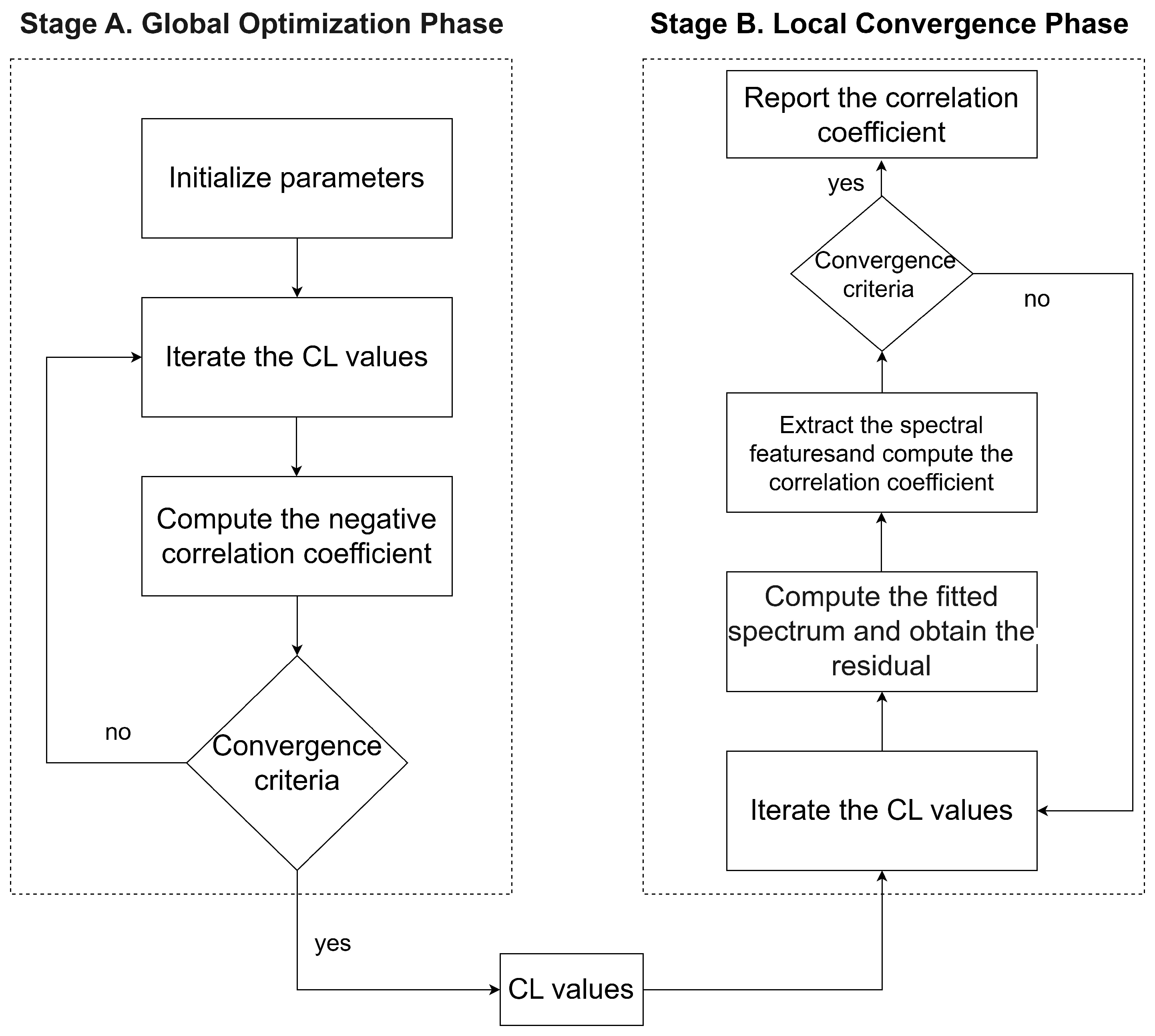
- A hybrid D-LM algorithm is proposed that abandons traditional discrete spectral library searching, instead employing a “global search–local optimization” architecture to dynamically generate reference spectra based on real-time environmental parameters (temperature, humidity, and distance).
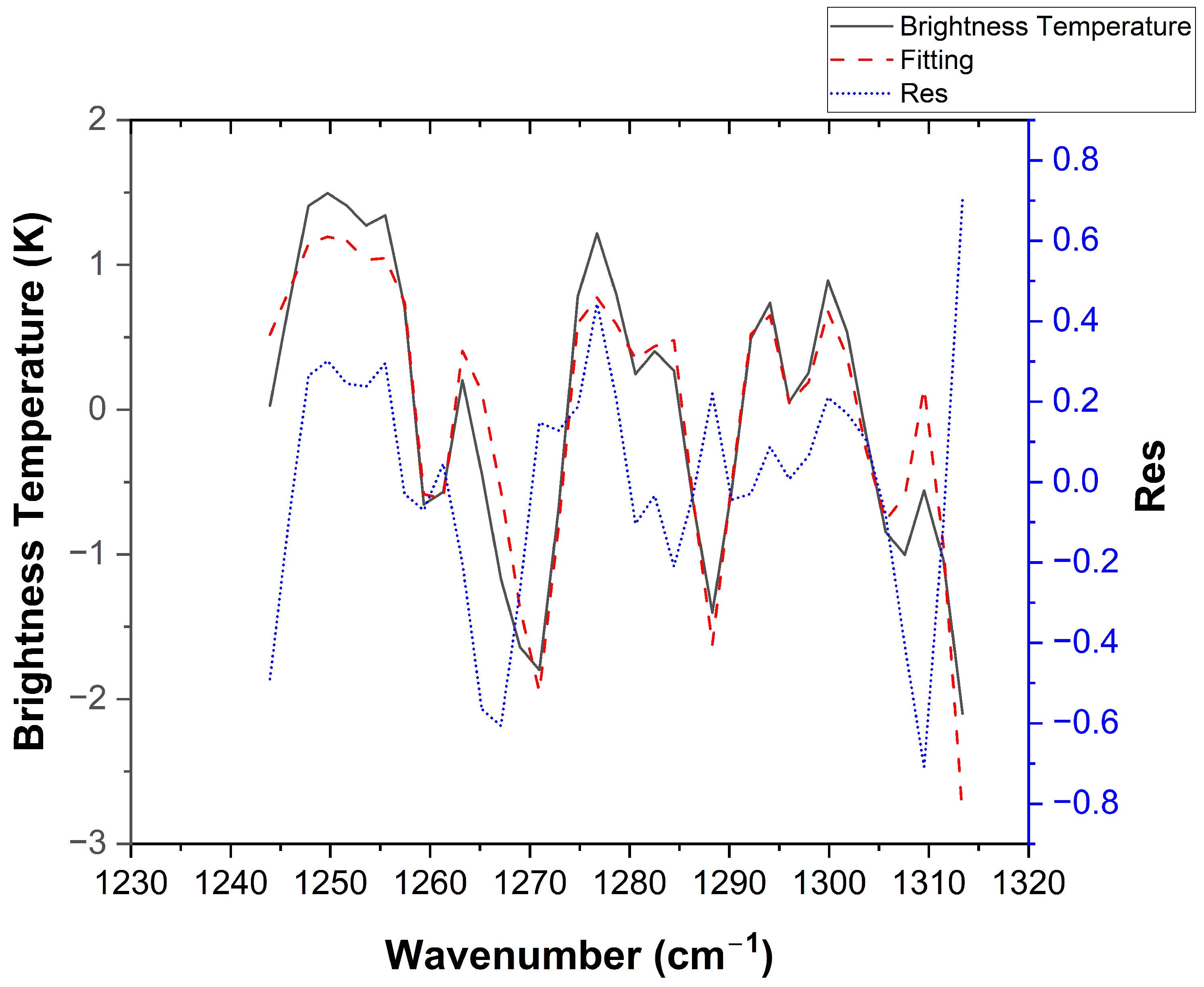
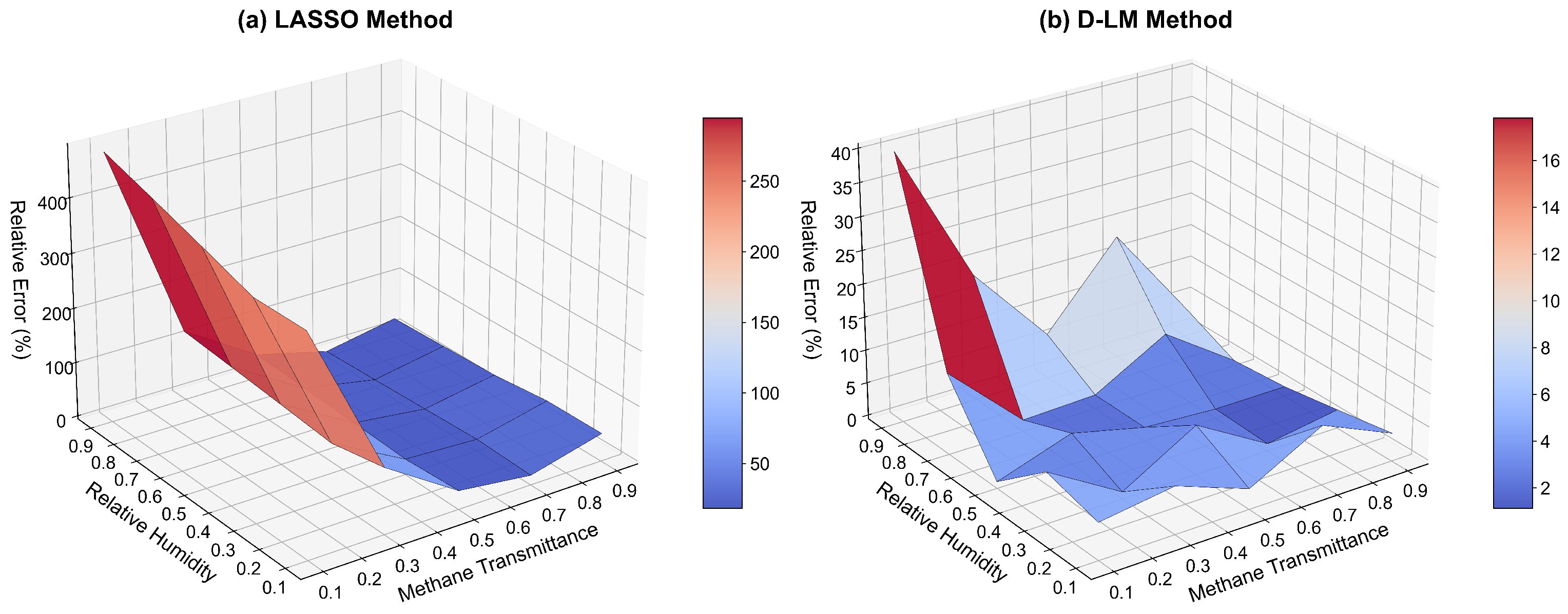
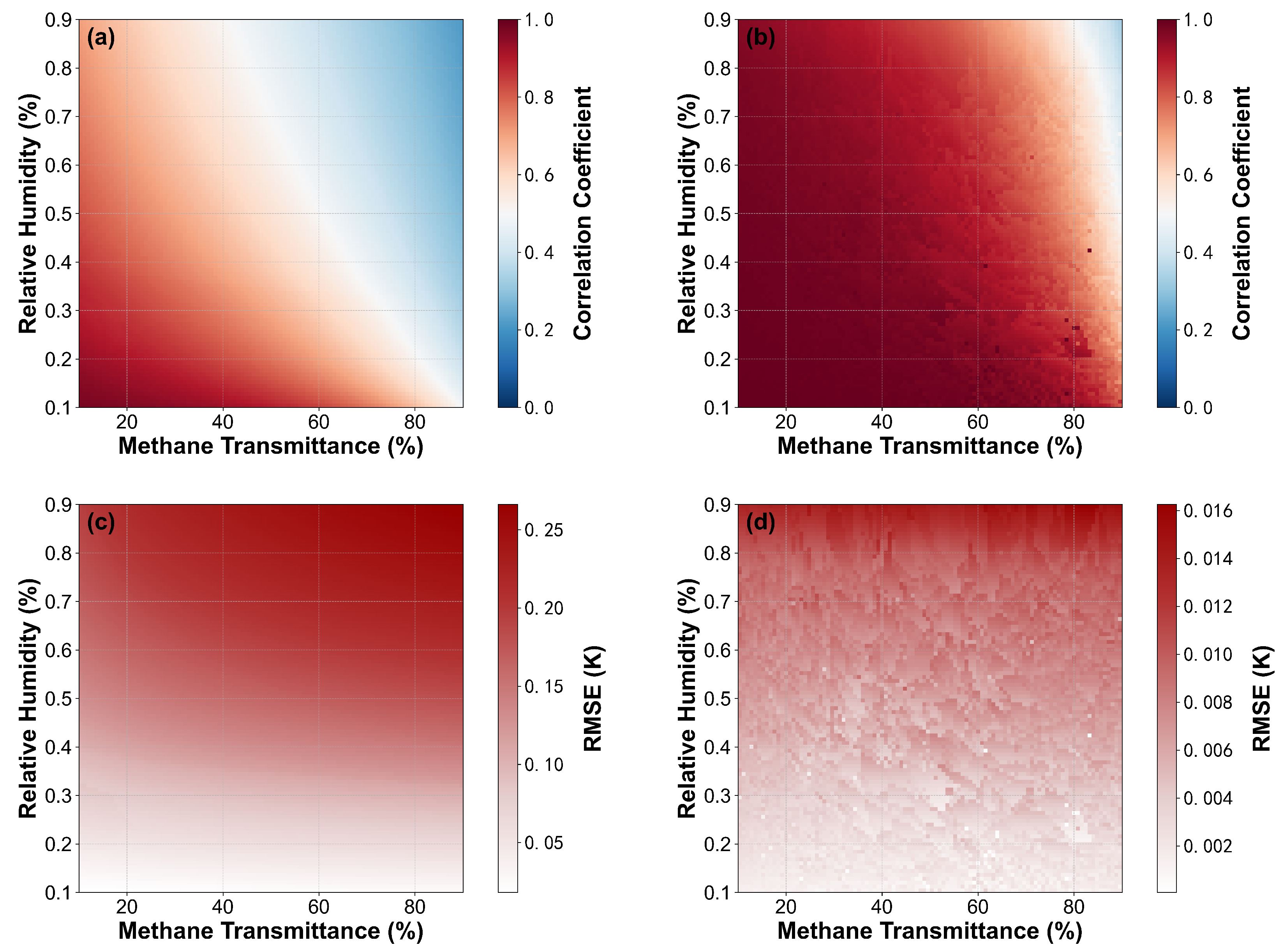
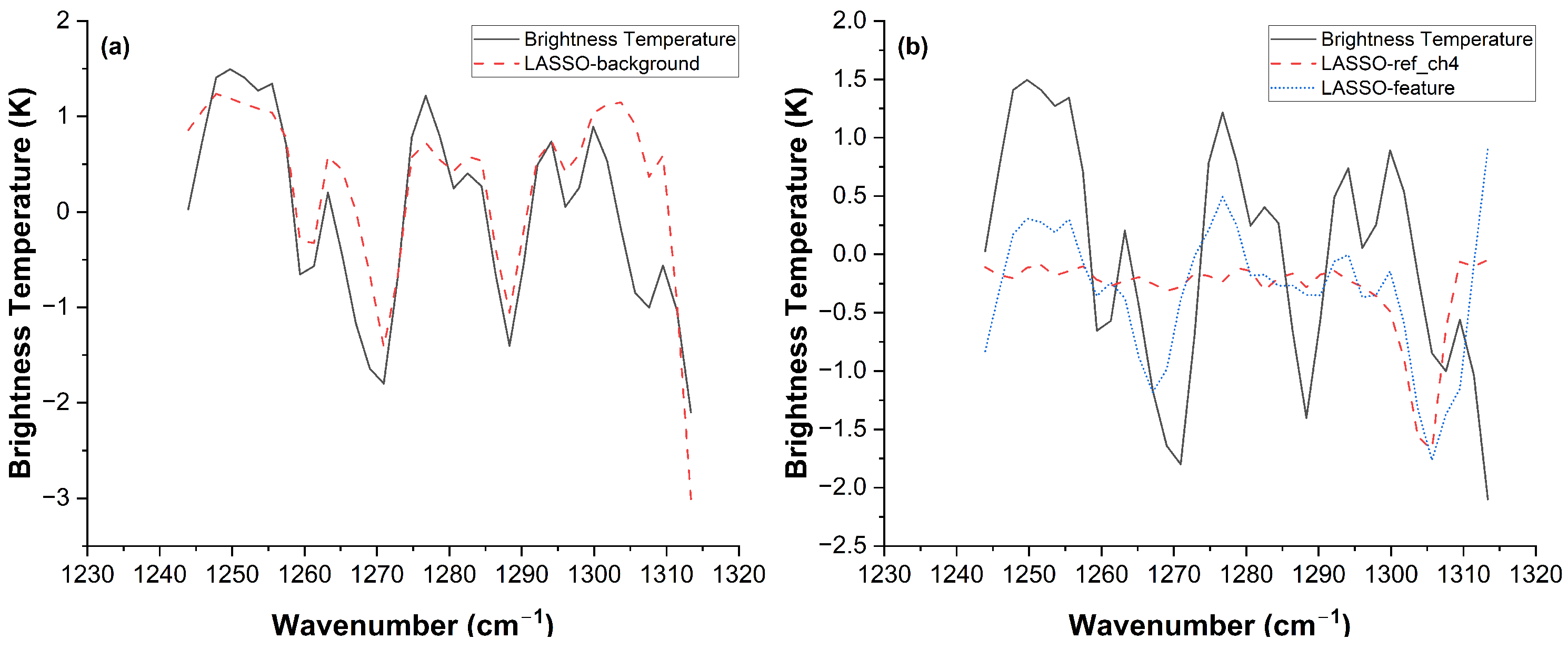
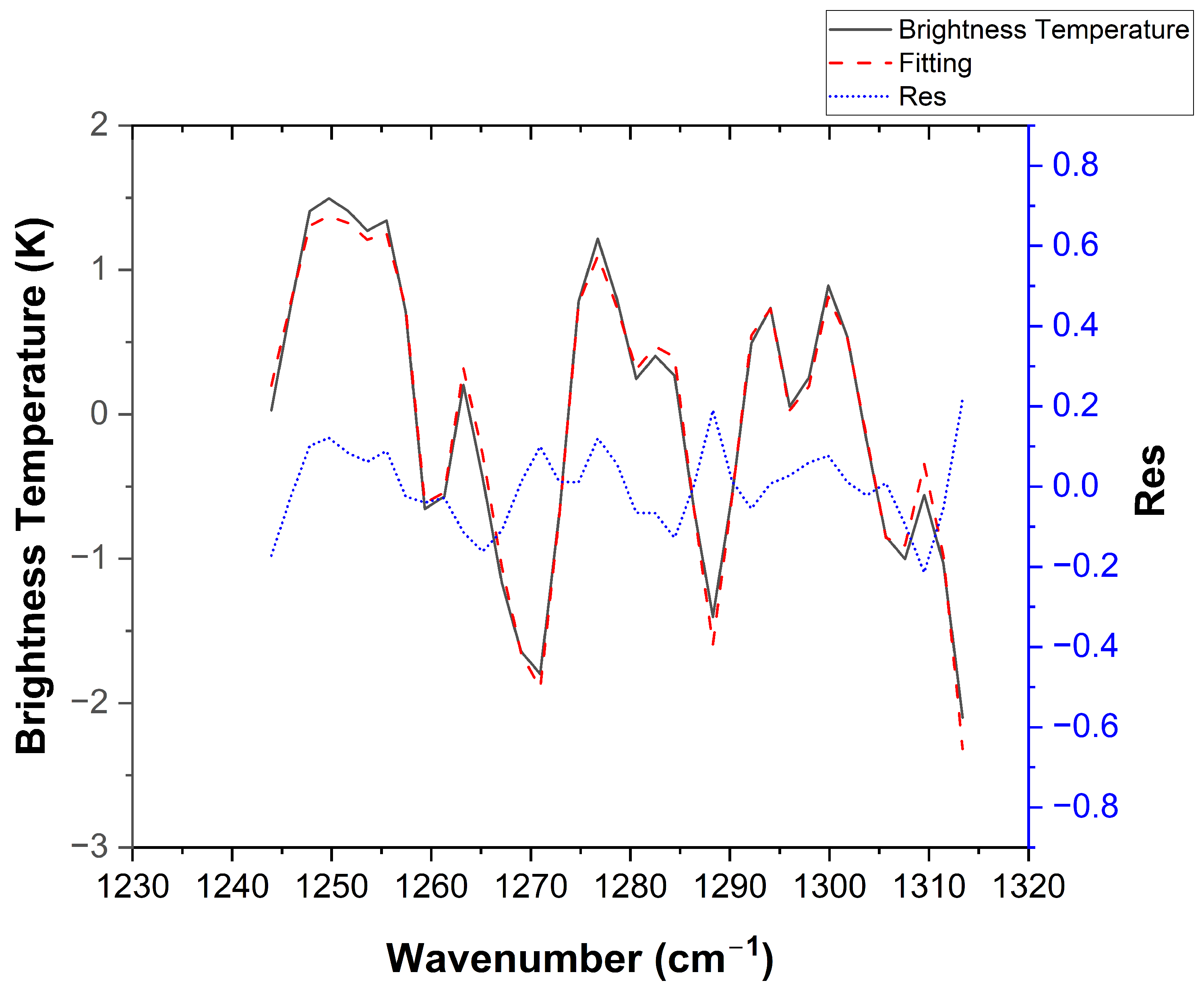
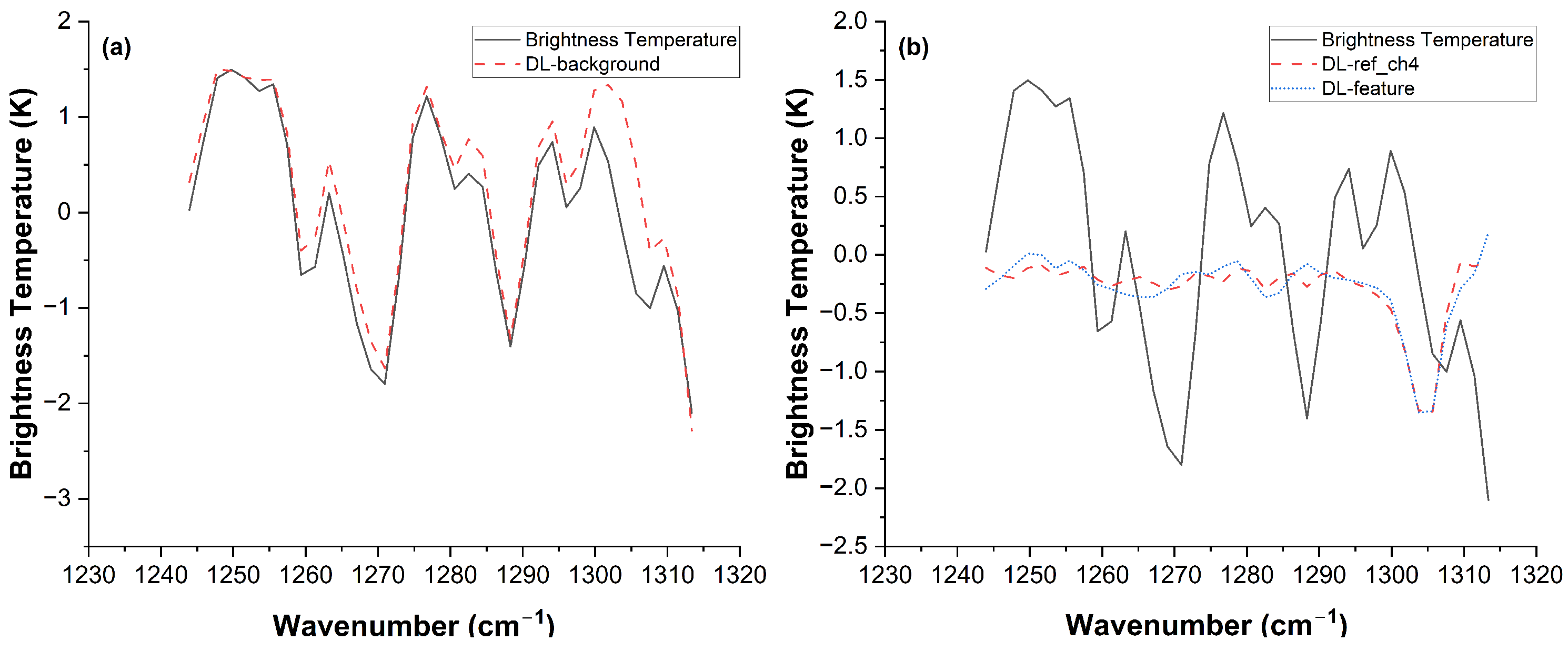
- Validation in high-humidity field environments demonstrates that the method outperforms the LASSO algorithm, reducing spectral fitting residuals by approximately 57% and improving the methane feature extraction correlation coefficient from 0.75 to 0.87.
- By establishing a continuous physical optimization space, the method fundamentally resolves the “library mismatch” issue inherent in static matching, enabling precise descriptions of spectral variations caused by atmospheric parameter changes.
- The approach effectively overcomes strong water vapor interference at the edge of the atmospheric window, extending the applicability of passive remote sensing to complex, high-humidity environments where signal distortion typically compromises accuracy.
Abstract
1. Introduction
2. Theory
2.1. Brightness Temperature Remote Sensing and Synthetic Reference Spectrum Method
2.2. Limitations of Discrete Search for Synthetic Reference Spectra
2.3. Improved Reference Brightness Temperature Spectrum Selection Method
2.4. D-LM Detection Algorithm
- Parameter Initialization: Initialize mutation factor F’s interval range to [0.5, 1], and fix crossover probability at 0.7 [20]. Additionally, set the maximum iteration count to 200 to ensure adequate population iteration, set the convergence threshold to 0.01, and set the population size to 30.
- Input atmospheric parameters. Calculate the water vapor value’s upper limit based on relative humidity, saturated vapor pressure, and the ideal gas equation, with the methane value’s upper limit fixed at the value corresponding to 30% transmittance. Utilize atmospheric parameters and current values to calculate simulated brightness temperature spectra [13], using negative Pearson correlation coefficients between simulated and measured spectra as the cost function, aiming to find value combinations closest to the measured data.
- Terminate iteration when the algorithm reaches the convergence condition or maximum iteration count.
- Use value combinations obtained from the DE algorithm as initial guess values, maintaining the same value range constraints as the DE phase.
- Calculate target gas cloud component reference spectra in real time based on value combinations, combining broad Gaussian function baseline fitting to construct complete reference matrix . Each iteration replaces target and atmospheric spectra in reference matrix, generating new reference matrices.
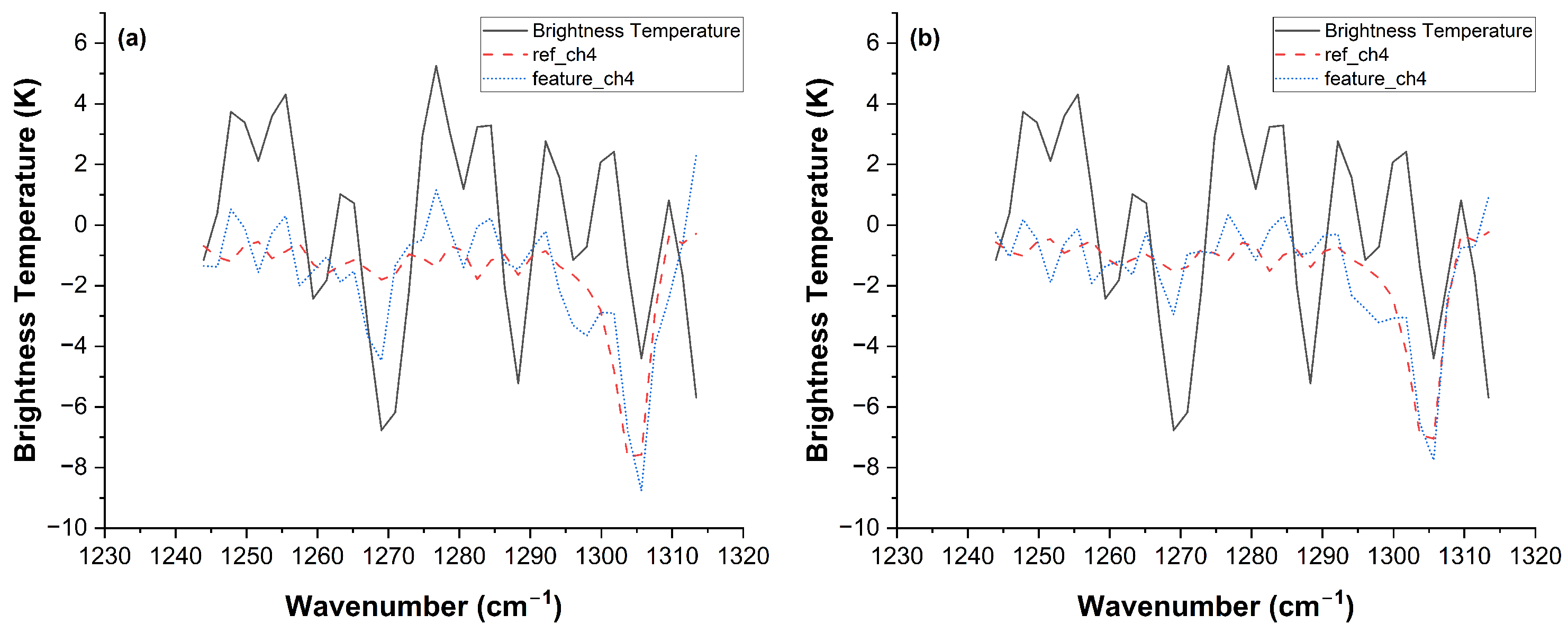
- Reconstruct background spectra using atmospheric and baseline references in . Extract target feature signals by subtracting reconstructed background spectra from the measured spectra. Calculate the Pearson correlation coefficients, , between target features and target reference spectra from step 2 as cost function and gas identification evaluation metrics.
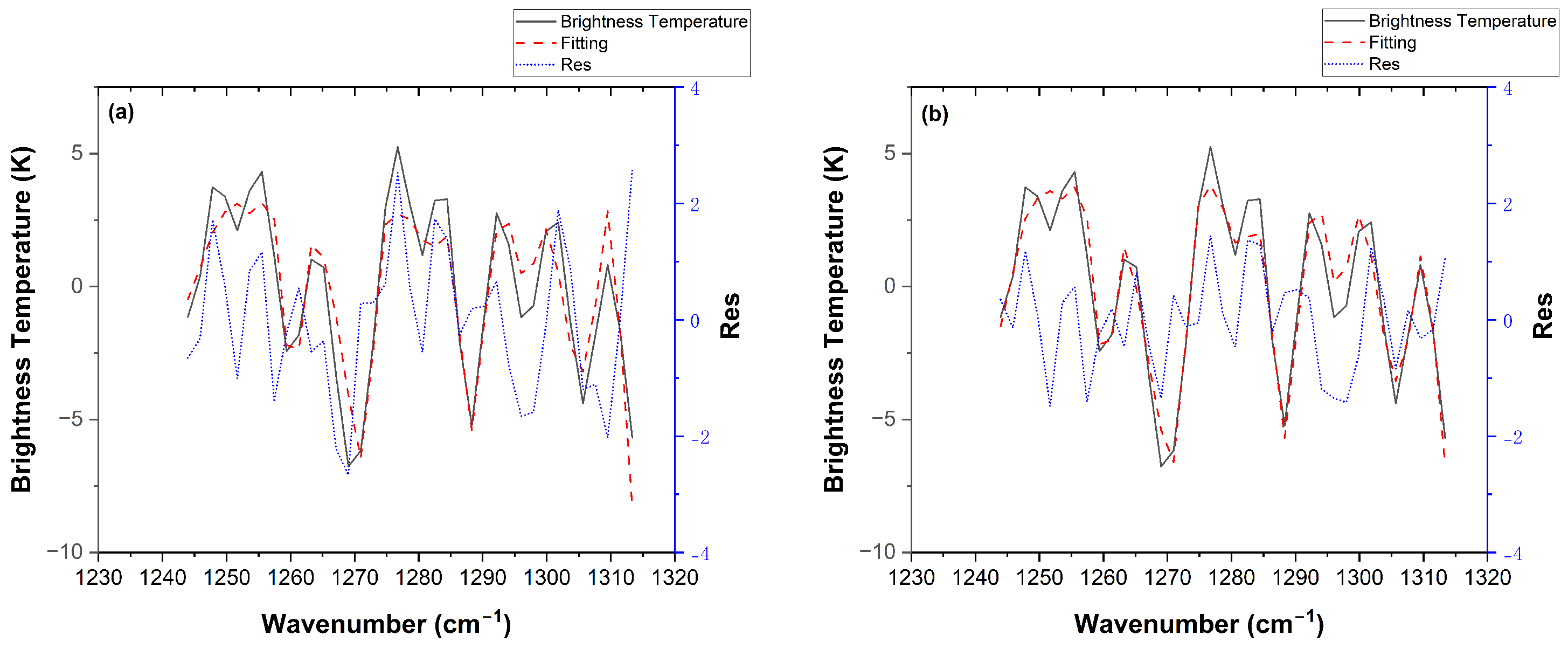
- Calculate the least-squares-fitted spectra [13], subtracting them with the measured spectra to form residual terms as a standard for evaluating algorithm fitting effectiveness.
3. Experiments and Discussion
3.1. Methane Simulation Experiments
3.2. Field Methane Experiments
3.3. Discussion
4. Conclusions
Author Contributions
Funding
Data Availability Statement
Conflicts of Interest
References
- IPCC. Climate Change 2021: The Physical Science Basis. Contribution of Working Group I to the Sixth Assessment Report of the Intergovernmental Panel on Climate Change; Cambridge University Press: Cambridge, UK, 2021. [Google Scholar] [CrossRef] [Scilit]
- Manolakis, D. Signal processing algorithms for hyperspectral remote sensing of chemical plumes. In Proceedings of the IEEE International Conference on Acoustics, Speech and Signal Processing, Las Vegas, NV, USA, 31 March–4 April 2008; pp. 1857–1860. [Google Scholar]
- Charlton, C.M.; Mizaikoff, B. Sensing trace gases with quantum cascade lasers. Photon. Spectra 2006, 40, 64. [Google Scholar]
- Mlawer, E.J.; Taubman, S.J.; Brown, P.D.; Iacono, M.J.; Clough, S.A. Radiative transfer for inhomogeneous atmospheres: RRTM, a validated correlated-k model for the longwave. J. Geophys. Res. 1997, 102, 16663–16682. [Google Scholar] [CrossRef] [Scilit]
- Rouet-Leduc, B.; Hulbert, C. Automatic detection of methane emissions in multispectral satellite imagery using a vision transformer. Nat. Commun. 2024, 15, 3801. [Google Scholar] [CrossRef] [Scilit] [PubMed]
- Harries, J.E. Atmospheric radiation and atmospheric humidity. Q. J. R. Meteorol. Soc. 1997, 123, 2173–2186. [Google Scholar] [CrossRef]
- Harig, R.; Matz, G.; Rusch, P.; Gerhard, J.H.; Schäfer, K.; Jahn, C.; Schwengler, P.; Beil, A. Remote detection of methane by infrared spectrometry for airborne pipeline surveillance: First results of ground-based measurements. In Proceedings of the Remote Sensing of Clouds and the Atmosphere VIII, Barcelona, Spain, 8–12 September 2003; Volume 5235, pp. 435–446. [Google Scholar] [CrossRef] [Scilit]
- Bouffard, F.; Thériault, J.M. Background contributions in direct and differential Fourier transform LWIR measurements: A comparative analysis. Int. J. High Speed Electron. Syst. 2008, 18, 263–276. [Google Scholar] [CrossRef] [Scilit]
- Yang, Z.; Yu, C.; Zhang, W.; Zheng, W.; Wang, H.; Lei, Z.; Zhang, P. Remote sense for environment pollution gases in wide infrared spectral range. In Proceedings of the AOPC 2019: Optical Spectroscopy and Imaging, Beijing, China, 7–9 July 2019; Volume 11337. [Google Scholar] [CrossRef] [Scilit]
- Beil, A.; Daum, R.; Harig, R.; Matz, G. Remote sensing of atmospheric pollution by passive FTIR spectrometry. In Proceedings of the Spectroscopic Atmospheric Environmental Monitoring Techniques, Barcelona, Spain, 21–25 September 1998; Volume 3493, pp. 32–43. [Google Scholar]
- Chowdhury, M.A.Z.; Oehlschlaeger, M.A. Deep learning for gas sensing via infrared spectroscopy. Sensors 2024, 24, 1873. [Google Scholar] [CrossRef] [Scilit] [PubMed]
- Hesham, A.; Zeyad, L.; ElZahraa, F.; ElGamal, A.; Mohammed, P.; Sakr, M.; Sabry, Y.M. Deep learning enabling analysis of exhaled breath using Fourier transform spectroscopy in the mid-infrared. In Proceedings of the 2021 Tenth International Conference on Intelligent Computing and Information Systems (ICICIS), Cairo, Egypt, 5–7 December 2021; pp. 124–129. [Google Scholar]
- Li, D.; Cui, F.; Wang, A.; Li, Y.; Wu, J.; Qiao, Y. Adaptive detection algorithm for hazardous clouds based on infrared remote sensing spectroscopy and the LASSO method. IEEE Trans. Geosci. Remote Sens. 2020, 58, 8649–8664. [Google Scholar] [CrossRef] [Scilit]
- Chakraborty, S.; Saha, A.K.; Ezugwu, A.E.; Agushaka, J.O.; Zitar, R.A.; Abualigah, L. Differential Evolution and Its Applications in Image Processing Problems: A Comprehensive Review. Arch. Comput. Methods Eng. 2023, 30, 985–1040. [Google Scholar] [CrossRef] [Scilit] [PubMed]
- Li, X.; Wang, G. Optimal band selection for hyperspectral data with improved differential evolution. J. Ambient Intell. Humaniz. Comput. 2015, 6, 675–688. [Google Scholar] [CrossRef] [Scilit]
- Zhang, F.; Xu, H.; Wang, Z. Spectral design methods for multi-channel LED light sources based on differential evolution. Appl. Opt. 2016, 55, 7771–7781. [Google Scholar] [CrossRef] [Scilit] [PubMed]
- Bi, Y.; Xie, Q.; Peng, S.; Tang, L.; Hu, Y.; Tan, J.; Zhao, Y.; Li, C. Dual stacked partial least squares for analysis of near-infrared spectra. Anal. Chim. Acta 2013, 792, 19–27. [Google Scholar] [CrossRef] [Scilit] [PubMed]
- Wu, Y.; Peng, S.; Xie, Q.; Xu, P. Nonlinear least squares with local polynomial interpolation for quantitative analysis of IR spectra. Spectrochim. Acta A Mol. Biomol. Spectrosc. 2018, 206, 147–153. [Google Scholar] [CrossRef] [Scilit] [PubMed]
- Fischer, A.; Izmailov, A.F.; Solodov, M.V. The Levenberg–Marquardt method: An overview of modern convergence theories and more. Comput. Optim. Appl. 2024, 89, 33–67. [Google Scholar] [CrossRef] [Scilit]
- Storn, R.; Price, K. Differential evolution–a simple and efficient heuristic for global optimization over continuous spaces. J. Glob. Optim. 1997, 11, 341–359. [Google Scholar] [CrossRef] [Scilit]
- Harig, R. Passive remote sensing of pollutant clouds by Fourier-transform infrared spectrometry: Signal-to-noise ratio as a function of spectral resolution. Appl. Opt. 2004, 43, 4603–4610. [Google Scholar] [CrossRef] [Scilit] [PubMed]






Disclaimer/Publisher’s Note: The statements, opinions and data contained in all publications are solely those of the individual author(s) and contributor(s) and not of MDPI and/or the editor(s). MDPI and/or the editor(s) disclaim responsibility for any injury to people or property resulting from any ideas, methods, instructions or products referred to in the content. |
© 2026 by the authors. Licensee MDPI, Basel, Switzerland. This article is an open access article distributed under the terms and conditions of the Creative Commons Attribution (CC BY) license.
Share and Cite
Li, Y.; Wu, J.; Xiong, W.; Li, D.; Li, Y.; Wang, A.; Cui, F. An Optimized Approach for Methane Spectral Feature Extraction Under High-Humidity Conditions. Remote Sens. 2026, 18, 175. https://doi.org/10.3390/rs18010175
Li Y, Wu J, Xiong W, Li D, Li Y, Wang A, Cui F. An Optimized Approach for Methane Spectral Feature Extraction Under High-Humidity Conditions. Remote Sensing. 2026; 18(1):175. https://doi.org/10.3390/rs18010175
Chicago/Turabian StyleLi, Yunze, Jun Wu, Wei Xiong, Dacheng Li, Yangyu Li, Anjing Wang, and Fangxiao Cui. 2026. "An Optimized Approach for Methane Spectral Feature Extraction Under High-Humidity Conditions" Remote Sensing 18, no. 1: 175. https://doi.org/10.3390/rs18010175
APA StyleLi, Y., Wu, J., Xiong, W., Li, D., Li, Y., Wang, A., & Cui, F. (2026). An Optimized Approach for Methane Spectral Feature Extraction Under High-Humidity Conditions. Remote Sensing, 18(1), 175. https://doi.org/10.3390/rs18010175