Article

Physics-Guided Conditional Diffusion Model for GPR Denoising and Signal Recovery in Complex Mining Environments

1
School of Artificial Intelligence, China University of Mining and Technology (Beijing), Beijing 100083, China
2
State Key Laboratory for Fine Exploration and Intelligent Development of Coal Resources, China University of Mining & Technology (Beijing), Beijing 100083, China
*
Author to whom correspondence should be addressed.
Remote Sens. 2025, 17(23), 3837; https://doi.org/10.3390/rs17233837
Submission received: 21 October 2025 / Revised: 25 November 2025 / Accepted: 25 November 2025 / Published: 27 November 2025

Highlights

What are the main findings?
  • A physics-guided conditional diffusion model is proposed, integrating physical prior constraints with deep learning to achieve intelligent denoising and weak-signal recovery of high-noise GPR data in mining environments.
  • A dual-path Gaussian mixture model (GMM) is designed to probabilistically model both feature signals and complex noise, while the wave equation constraint ensures that the denoised results conform to electromagnetic propagation principles.
What is the implication of the main finding?
  • First bullet. The proposed method significantly improves noise suppression and signal reconstruction, enhancing the clarity of geological interfaces and the accuracy of subsurface structure identification.
  • Field experiments in underground coal mines confirm the model’s practical applicability and potential to support safer and more intelligent coal mining operations.

Abstract

Coal mining faces critical challenges due to variable geological conditions that affect intelligent mining and safe production. Ground-penetrating radar (GPR), a high-resolution and non-destructive sensing technology, is essential for precise geological detection. However, underground electromagnetic interference, multiple reflections, and complex media significantly degrade the signal-to-noise ratio (SNR), causing reflection signals to be obscured and geological interfaces to become blurred, thereby hindering accurate subsurface interpretation. Traditional denoising methods struggle to extract weak reflection signals under such complex noise conditions. To address these challenges, this study proposes a physics-guided conditional diffusion model that integrates physical constraints with deep learning to achieve intelligent denoising and weak-signal recovery for high-noise GPR data. Specifically, a dual-path GMM probabilistically models both feature signals and complex noise, while incorporating the wave equation ensures physical consistency with electromagnetic propagation. Experiments using a hybrid dataset combining field-measured noisy data and simulated features—evaluated using SSIM, PSNR, MAE, peak alignment, and structural continuity—demonstrate that the proposed method outperforms existing techniques in both noise suppression and signal reconstruction. Field tests in underground coal mines further confirm its practical applicability.

1. Introduction

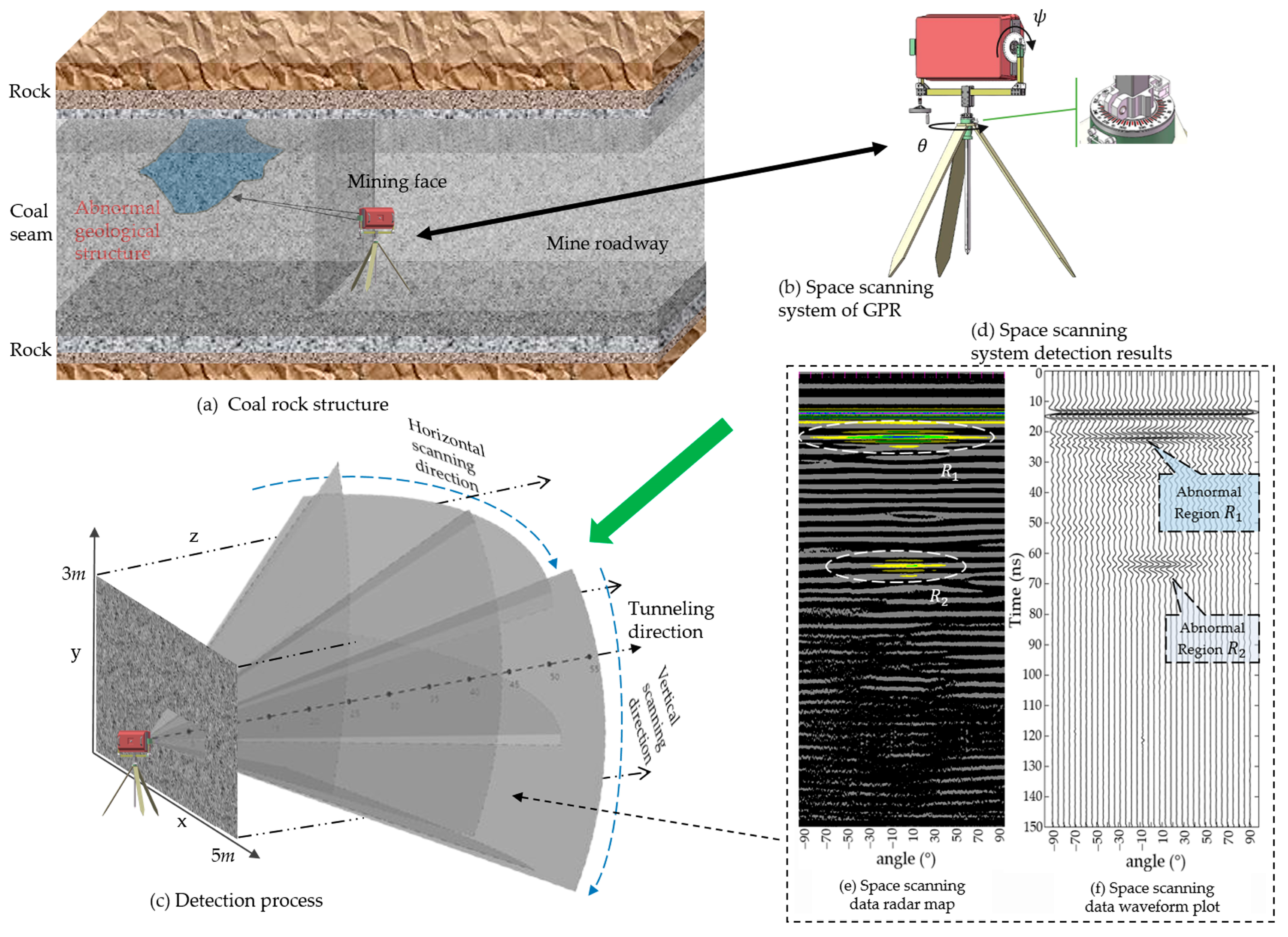
Ground-penetrating radar (GPR), as an efficient and non-destructive sensing technology, enables the advanced detection of geological structures—such as faults and fractures—potentially occurring ahead of mining excavation faces, as well as hazardous zones including aquifers and goafs. This capability is of significant importance for enhancing intelligent and safe coal-mine operations [1]. In recent years, extensive research has been conducted by scholars in China and abroad on the application of GPR in coal-mining environments [2,3,4]. Existing studies have demonstrated that GPR exhibits high detection efficiency and increased penetration depth in thin-coal-seam thickness estimation and surface coal-bed exploration. Compared with traditional geophysical methods such as borehole drilling, GPR offers pronounced advantages in low-resistivity and strongly dispersive media [5,6,7,8,9]. Furthermore, to meet the demands of intrinsic safety and deep detection in underground coal mines, domestic researchers have developed ultra-deep GPR systems, enabling advanced detection distances of several tens of meters [10,11,12]. To address the non-uniqueness problem inherent in conventional GPR interpretation, Yang et al. proposed a spatial scanning detection method (as shown in Figure 1b,c), which introduces an additional angular-domain dimension into the acquisition process. Subsequent studies conducted a detailed analysis of geological-structure responses in the radargram (Figure 1d), revealing stable reflection characteristics that provide a reliable basis for identifying and interpreting geological structures in mine environments [13,14,15]. However, the complex underground environment in coal mines severely degrades GPR signal quality. Major challenges include strong electromagnetic noise (generated by electrical equipment, mechanical vibration, and ventilation systems), multiple reflections (caused by tunnel walls and supporting structures), signal attenuation (due to energy absorption in surrounding rock), medium heterogeneity (variations in electrical parameters at coal–rock interfaces, faults, and fractures), and geometric effects (diffraction and scattering induced by tunnel geometry) [16,17,18,19,20]. These factors often cause valid geological reflections to be submerged in strong noise, making the extraction of weak geological signatures extremely difficult [21]. Thus, mitigating environmental interference and enhancing geological-structure reflection features remains a critical and urgent problem to be solved.
Traditional GPR signal-processing techniques primarily rely on wavelet-based denoising methods. Approaches such as wavelet decomposition combined with empirical mode decomposition and soft-thresholding have demonstrated certain effectiveness; however, they remain limited in handling weak reflections and often fail to sufficiently separate useful signals from noise [22,23]. In addition, methods such as singular value decomposition (SVD) and principal component analysis (PCA) have been employed for clutter suppression and compared with wavelet-threshold denoising and band-pass filtering, confirming their effectiveness on both synthetic noisy data and field measurements [24,25,26]. Nevertheless, the application of PCA and SVD to GPR image enhancement is also prone to structural information loss and excessive smoothing. In recent years, deep learning models, particularly convolutional neural networks (CNNs), have been increasingly adopted for GPR signal processing. Examples include 1D-CNN architectures for feature denoising and U-Net models for B-scan image restoration. Despite their strong nonlinear modeling capability, deep learning–based approaches remain sensitive to noise and lack explicit mechanisms to model the continuity of geological structures [27,28,29,30]. Conditional generative models—especially diffusion probabilistic models (DPMs)—have gained considerable attention due to their stable generative performance and strong representation capability. Denoising diffusion probabilistic models (DDPMs) have shown remarkable performance in image reconstruction, and variants such as ScoreSDE and latent diffusion models (LDMs) have achieved significant success in speech and medical-image denoising [31,32,33,34]. However, most existing approaches predominantly emphasize image-feature modeling and do not sufficiently incorporate the structural characteristics of geophysical signals. In particular, they lack physical interpretability when dealing with typical GPR phenomena such as “asymmetric echoes” and “layered reflection structures.” In summary, current methods exhibit limited capability in extracting weak reflection signals under high-noise conditions and fail to embed physical constraints derived from electromagnetic-wave propagation during GPR image denoising. Moreover, most deep learning-based approaches require large training datasets, whereas acquiring high-quality GPR measurements in complex underground coal-mine environments is extremely time-consuming and costly.
To address the aforementioned challenges, this paper proposes a novel Physics-Guided Conditional Diffusion Model (PGCDM) for denoising GPR data and enhancing geological structures in high-noise underground mining environments. In contrast to existing approaches, the proposed method introduces a dual-path GMM prior, which separately characterizes the distribution of simulated feature signals (low-noise) and field-measured background noise. A controllable conditional vector c is then constructed to guide the diffusion model in recovering valid reflection signals from noisy observations. To further improve the interpretability of the generated results, physics-based constraints are incorporated to ensure consistency with electromagnetic wave propagation principles. The effectiveness of the proposed method is subsequently validated through in situ experiments conducted in underground coal mines. The remainder of this paper is organized as follows. Section 2 provides an overview of the research workflow, with emphasis on the technical details of the PGCDM framework. Section 3 introduces the geological structure generation algorithm for coal mines and describes the construction of the GprMax simulation dataset. Section 4 discusses the performance of the proposed algorithm on synthetic datasets, followed by comparative analysis with existing approaches and validation through field experiments. Finally, Section 5 concludes the paper by summarizing the findings, highlighting the limitations, and outlining potential directions for future research.

2. Materials and Methods

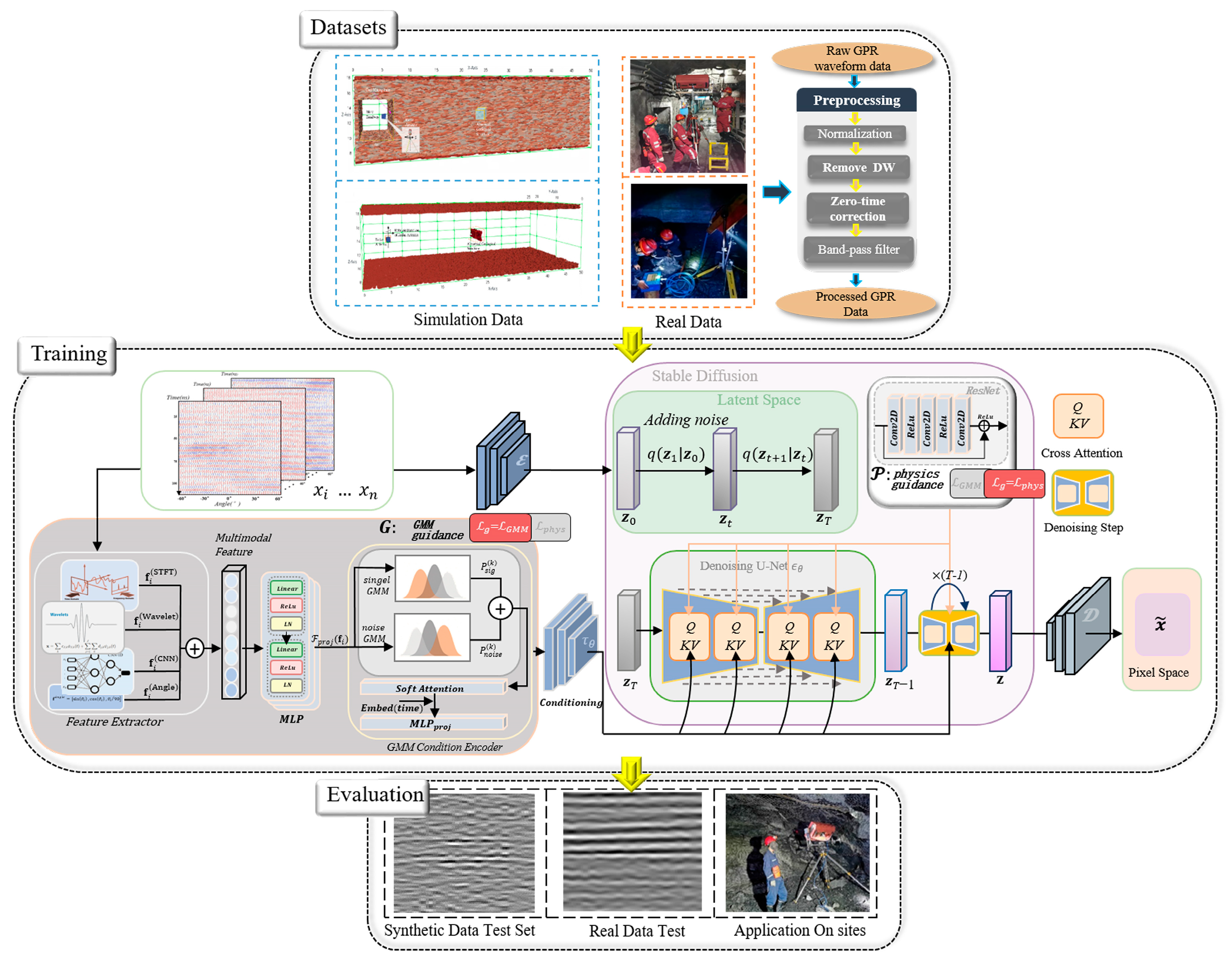
Figure 2 illustrates the overall methodological framework adopted in this study. Synthetic datasets were constructed through numerical simulations and in situ coal mine GPR surveys. After preprocessing, the proposed PGCDM was trained on these datasets and its performance was thoroughly evaluated on the corresponding test sets. Finally, the algorithm was applied to real-world detection scenarios to further validate the practicality and effectiveness of the model.

2.1. Diffusion Model Framework

In underground coal mines, GPR data are frequently contaminated by severe noise due to the complex and harsh operating conditions. This noise manifests in several forms: (1) the superposition of multi-source interferences—such as periodic noise, trailing effects, and metallic reflections—which leads to waveform broadening and overlapping of subsurface layers; (2) the masking or complete obliteration of effective reflection signals; (3) interference patterns that exhibit non-Gaussian characteristics and statistical dependence. Mathematically, the data processing task is formulated as an ill-posed inverse problem: given an observed mixed signal xreal = xsignal + ε, the objective is to recover the true signal xsignal. Here, the interference term ε is characterized by an unknown distribution, potential structured artifacts, strong spatial correlations, temporal non-stationarity, and large amplitude fluctuations. Conventional discriminative models (e.g., CNNs) typically seek to directly learn a mapping function F δ from xreal to xsignal. However, in high-interference scenarios, such approaches are prone to amplifying pseudo-structures and excessively smoothing primary structures. To address these issues, this study proposes a conditional diffusion generative model. Diffusion models, a class of robust generative techniques, learn data distributions by simulating the processes of noise addition and subsequent removal [35]. In this framework, signal recovery is reformulated as a reverse Markov generative chain whereby the model incrementally reconstructs the true structural representation from pure noise. The complete model comprises two fundamental components: the forward diffusion process and the reverse denoising process.
In a diffusion model, the forward diffusion process starts from the original data f0 and gradually adds Gaussian noise to generate a sequence of noisy samples {f0, f1, f2, …, fT}. This sequence satisfies the Gaussian conditional distribution defined in (1):
q ( f t | f t 1 ) = N ( f t ;   1 β t f t 1 , β t I )
where { β t } t = 1 T denotes a predefined noise schedule controlling the noise variance at each timestep, and T is the total number of diffusion steps. Leveraging the properties of the Gaussian distribution, ft can be directly sampled from f0 at an arbitrary timestep t , as expressed in (2):
q f T f 0 = N f t ; α ¯ t f 0 ,   1 α ¯ I
where I is the identity matrix, α t = 1 β t , and α ¯ = s = 1 t α s . Thus, ft can be further expressed as (3):
f t = α ¯ t f 0 + 1 α ¯ ϵ ,   ϵ ~ N
This process defines the pathway by which a clean signal is gradually perturbed into a pure noise sample ft. The reverse denoising process aims to learn the conditional distribution of recovering f0 from ft, as shown in (4):
p ϑ f t 1 f t , c = N f t 1 ; μ ϑ ( f t ,   t ,   c ) ,   ϑ ( f t , t )
where c denotes the conditional vector guiding the generative process, and   μ ϑ   and ϑ represent the mean and covariance predicted by a neural network parameterized by ϑ . In practice, the network is often designed to predict the noise ϵ ϑ ( f t ,   t ,   c ) , and the mean can then be computed using (5):
  μ ϑ ( f t ,   t ,   c ) = 1 α t ( f t β t 1 α ¯ t ϵ ϑ ( f t ,   t ,   c ) )
The training objective of the diffusion model is to minimize the variational lower bound of the likelihood. However, in practice, this is typically simplified to minimizing the mean squared error (MSE) between the true noise ϵ and the predicted noise ϵ ϑ , as expressed in (6):
L = E t , f 0 , ϵ , c ϵ t ϵ ϑ f t ,   t ,   c 2 2
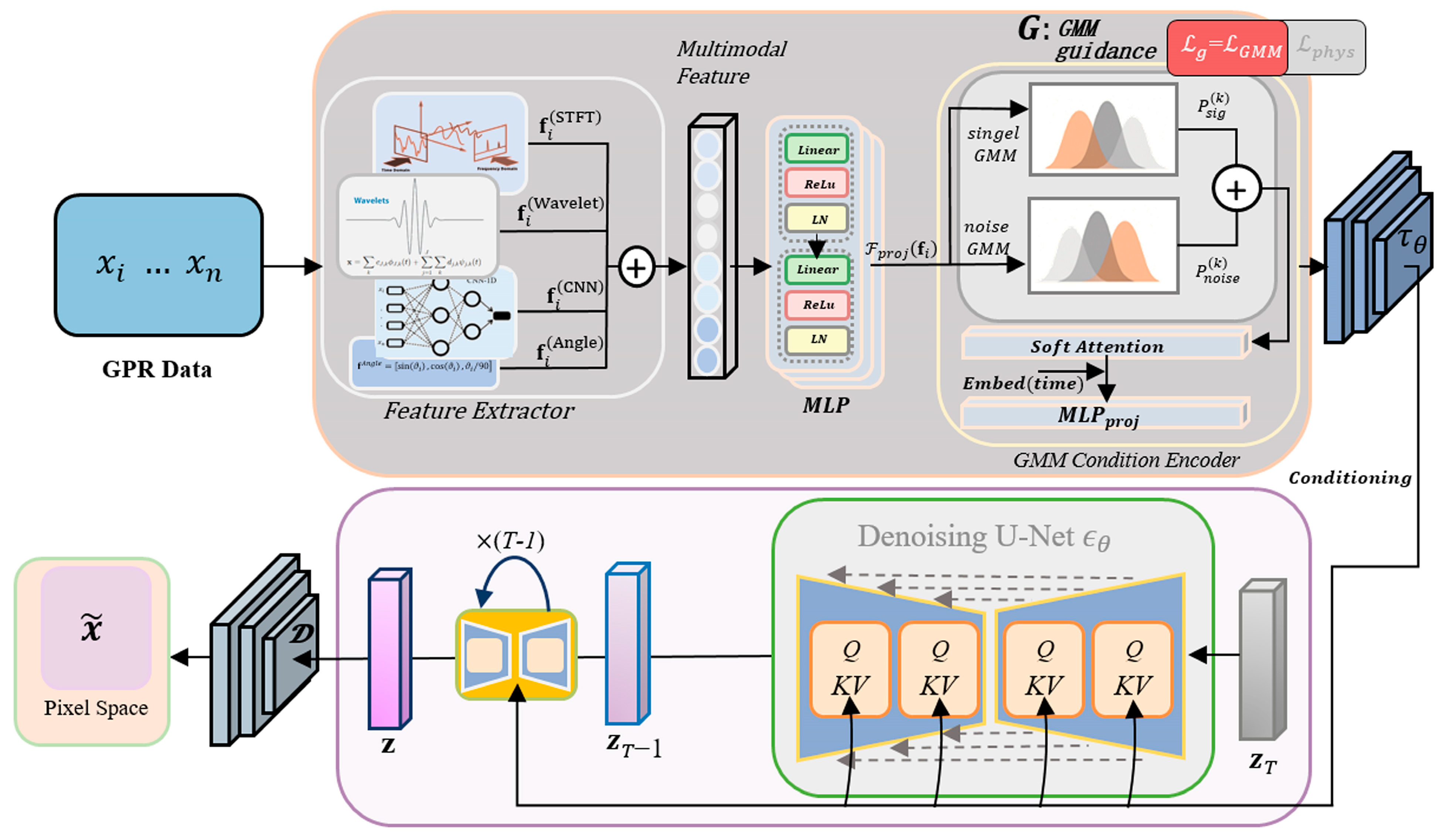
As shown in Figure 3, both the forward and reverse diffusion processes are parameterized Markov chains [36]. To address the unconditional limitation of traditional diffusion models, conditional diffusion models introduce a conditional vector c as an input to control the generation process, ensuring that the generated samples meet specific conditions. In this work, the conditional information is provided by the GMM probability distribution. The conditional vector c mainly includes the following components: (1) a structural probability vector derived from the GMM encoding of noise and signal, and (2) a temporal position encoding used to enhance the distinguishability of time steps. This vector is fused with the conditional information using a cross-attention mechanism, which is injected into the Cross-attention module of the conditional U-Net model (U-Net 2D Condition Model), guiding each sampling step toward the true structural prior region [37]. The cross-attention mechanism is expressed as:
A t t e n t i o n Q ,   K ,   V = s o f t m a x Q K T d V
where Q = W Q F e a t u r e M a p , K = W Q c , and V = W V c , Here,   W Q ,   W K ,   a n d   W V denote the learnable projection matrices used to linearly map the input feature map and the conditional information c into the query ( Q ), key ( K ), and value ( V ) representations, respectively. These matrices are optimized during training to enable the model to effectively compute the attention mechanism. Specifically,   W Q projects the input feature map into the query space, whereas W K ,   a n d   W V map the conditional information into the key and value spaces. Such projections ensure that the model can generate appropriate Q ,   K   and   V , representations conditioned on both the feature map and auxiliary information, thereby facilitating effective information fusion within the attention module. The parameter d denotes the dimensionality of the attention space. The cross-attention mechanism provides a flexible means of integrating GMM-based conditional information with the U-Net feature representations and allows the model to handle conditional sequences of varying lengths. Introducing conditional vectors to guide the diffusion process is physically more interpretable than using a black-box function approximator, as it aligns more naturally with the physical characteristics of radar echo attenuation and the propagation of inter-layer interference.

2.2. GMM Conditional Coding and Prior Modeling

The true reflection signals induced by geological structures typically exhibit distinct spatial continuity, periodicity, and adherence to physical propagation laws. In contrast, under high-noise conditions, interference signals in the feature space are often characterized by high-frequency components, unstructured patterns, and cross-scale distributions. These differences offer strong statistical separability between signal and noise. Motivated by this observation, this study proposes a dual-path GMM-based prior modeling strategy. Specifically, high-SNR simulated signals and low-SNR field data are individually represented in a distributed feature space, while a controllable conditional vector c is generated during the inference stage of the diffusion model to guide the recovery of valid reflection information from noisy backgrounds. As a robust probabilistic model, the GMM effectively represents complex multimodal distributions. However, conventional GMMs may encounter the curse of dimensionality and optimization difficulties when processing high-dimensional, complex data [38,39]. To address these challenges, this work incorporates a neural network-based feature transformation, leading to the development of a deep GMM. The probability density function of the deep GMM is defined as shown in Equation (8):
p ( f | Θ ) = k = 1 K π k N ( S ϕ ( f ) | μ k , k )
In this context, f R D   represents the feature vector, and Θ = { π 1 , μ 1 , Σ 1 , , π k , μ k , Σ k } denotes the model parameters, where K is the number of mixture components, π k is the weight of the k-th component, subject to the constraint k = 1 K π k = 1 and π k 0 , The term N ( S ϕ ( f ) | μ k ,   k ) represents the multivariate Gaussian distribution with mean μ k and covariance matrix k · S ϕ ( ) is a neural network encoder parameterized by ϕ , which maps the original feature f to a latent space better suited for GMM modeling. During the two-path GMM modeling process, as shown in Figure 4, a multi-modal feature extractor is constructed. This extractor generates different features for each signal using various methods: Spectral statistical features f i S T F T extracted through Short-Time Fourier Transform (STFT), Local mutation features f i W a v e l e t through wavelet transform, Sub-waveform contour change features f i C N N extracted using a 1D-CNN morphological convolution, and Angle-based encoding features f i A n g l e , which build the relationship between the signal x i ( t ) and the detection angle θ i in the detection space. These multi-modal features are then fused using a multi-layer MLP projection network (Figure 4) and mapped to a low-dimensional embedding space that can be processed by the GMM and conditional generator. The fused features are represented as (9):
f f u s e d = M L P f i S T F T ,   f i W a v e l e t ,   f i C N N ,   f i A n g l e
where the fusion process combines the aforementioned feature types into a single embedded representation suitable for further processing by the GMM and conditional generator. For each sample, the features output by the multimodal feature extractor are denoted as f i R D . Two independent GMM are trained on the simulation and real-world sample features, respectively, to estimate the probability density functions of the signal and noise domains. The prior models for the signal and noise can be represented by the following Equations (10) and (11):
G s i g ( f | Θ ) = k = 1 K π k ( s ) N ( S ϕ ( f ) | μ k s ,   k ( s ) )
G n o i s e ( f | Θ ) = k = 1 K π k ( n ) N ( S ϕ ( f ) | μ k n ,   k ( n ) )
where π k ( ) [ 1 , 1 ] , and k π k = 1 , representing the mixing weight of the k -th Gaussian component. μ k s and k ( ) R D × D denote the mean vector and covariance matrix, respectively. The signal and noise GMMs share the same feature encoder   S ϕ (⋅), but each has its own mixing weights, mean vectors, and covariance parameters. This design leverages the efficiency of shared representation learning while maintaining the ability to distinguish between different data patterns.
To leverage the distribution differences between signal and noise in the feature space to enhance the generative guidance of the diffusion model, we employ the GMM as a prior knowledge encoder within the conditional diffusion framework. As shown in Figure 4, this process is divided into three stages: GMM training, prior-posterior fusion, and conditional embedding generation. During training, the signal GMM is trained using features from simulation data (without or with low noise), while the noise GMM is trained using features from high-noise real-world data. After training, the two GMMs can “identify” which patterns correspond to geological structure reflections and which correspond to mine noise in the feature space. In the inference phase, the model feeds the input sample feature vector f into both GMMs. The posterior probability vectors P s i g ( k ) and P n o i s e ( k ) for each mixture component are computed using G s i g   and   G n o i s e , as shown in Equations (12) and (13):
P s i g ( k ) = π k ( s ) N ( S ϕ ( f ) | μ k s ,   k ( s ) ) j = 1 K π j ( s ) N ( S ϕ ( f ) | μ j s ,   j ( s ) )
P n o i s e ( k ) = π k ( n ) N ( S ϕ ( f ) | μ k n ,   k ( n ) ) j = 1 K π j ( n ) N ( S ϕ ( f ) | μ j n ,   j ( n ) )
The two probability vectors above are of dimension K, representing the probability distribution of the current sample in the signal and noise spaces, respectively. The two prior information vectors are then fused using a soft attention mechanism [40] to build the final conditional encoding. The fusion weight α 0 ,   1   is automatically learned by a lightweight neural network as follows:
α = σ ( M L P a t t ( [ P s i g ,   P n o i s e ] ) ) 0 ,   1
Specifically, during training, the network optimizes its parameters based on the posterior probabilities of the input signal and noise priors ( P s i g   a n d   P n o i s e ), and outputs a fusion weight α constrained between 0 and 1. Through this learning process, the network acquires the ability to dynamically adjust α according to varying input patterns—such as distinctive signal and noise characteristics—thereby balancing their respective contributions when generating the conditional vector. This adaptive mechanism enables the model to select an appropriate weighting between signal and noise for different types of data. Since different values of α have a substantial impact on the final generative performance, the experiments in this study employ a diverse range of training samples to ensure that the neural network can learn optimal fusion strategies under a variety of conditions. In Equation (14), σ denotes the sigmoid activation function, which maps the output of the multilayer perceptron (MLP) to the range 0 ,   1 to produce the fusion weight α . This weight dynamically adjusts the proportion of signal and noise in the fusion process. The sigmoid function is mathematically defined as σ ( x ) = ( 1 + e x p ( x ) ) 1 . Through this mechanism, the model can adaptively modulate the relative contributions of signal and noise in the final conditional encoding based on the characteristics of each input sample. The final fused prior vector is given by:
P f u s e d = α P s i g + ( 1 α ) P n o i s e
This fusion mechanism is essentially a “prior adaptive scheduler” that dynamically adjusts the signal and noise guidance weights based on the distribution properties of the current sample, enhancing the model’s generalization ability. The fused prior distribution P f u s e d , along with the diffusion time step embedding E m b e d ( t ) , is then passed into the conditional mapping network M L P p r o j to generate the final conditional vector c used to guide the U-Net backbone, as shown in Equation (16):
c = M L P p r o j ( [ P f u s e d ,   E m b e d ( t ) ] ) R d c o n d
where E m b e d ( t ) is the diffusion step embedding (such as position encoding), and d c o n d is the conditional dimension (256 in this model). The M L P p r o j consists of two fully connected layers, activation, and normalization. This conditional vector c serves as the key and value input for the cross-attention mechanism in the U-Net backbone of the diffusion model, thereby enabling dynamic guidance during the generation process. The GMM-guided loss is measured by the log-likelihood of matching the denoised result with the signal distribution. It can be expressed as (17):
L G M M = l o g ( P s i g ( f p r e d ) )
where f p r e d   is the denoised feature vector, and f p r e d   is the probability density of the denoised feature in the signal distribution. By minimizing the GMM-guided loss, the network learns a denoising strategy that conforms to the signal distribution, recovering more accurate signals.

2.3. Physical Consistency Constraint

The reflected signals received by GPR essentially represent spatiotemporal records formed by electromagnetic waves reflecting at interfaces between different subsurface media. True geological reflectors generally follow fundamental physical principles such as propagation continuity, velocity consistency, and wavefield conservation, whereas pseudo-structures—such as high-frequency noise or metallic interference—typically exhibit abrupt spatial variations and discontinuous directional patterns. Although the previously introduced GMM–based probabilistic modeling constrains, to some extent, the reliability of signal and noise components within the content distribution, it still lacks structural constraints derived from physical propagation laws. Therefore, incorporating a physical-consistency module is particularly necessary to further enhance the physical interpretability and structural coherence of the generated radar images. The electromagnetic waves transmitted by GPR propagate through subsurface media according to the fundamental principles of wave propagation, and the wave equation—widely used to describe seismic, acoustic, optical, and electromagnetic waves—serves as the basic formulation for characterizing wave behavior in homogeneous media. Since GPR wavefields also obey the wave equation, we embed this physical prior into the deep learning framework during the denoising process. For the one-dimensional wave equation, its standard form is given by:
2 u ( x ,   t ) t 2 = υ 2 2 u x ,   t x 2
In this formulation, u ( x ,   t ) denotes the wavefield (or signal) as a function of spatial position x and time t , reflecting the temporal–spatial evolution of the propagating wave. The parameter υ represents the propagation velocity of the medium, which is influenced by its dielectric permittivity and electrical conductivity. The terms 2 u x 2 and 2 u t 2 correspond to the second-order spatial and temporal derivatives of the wavefield, respectively, characterizing the rate of change across space and over time. The wave equation establishes the relationship between spatial and temporal accelerations of the signal, both of which are governed by the medium-dependent velocity υ .To incorporate the wave equation as a physical constraint within the deep learning model, it must be discretized—given that the input data are discrete—to enable numerical computation on a computer [41]. In this process, the spatial coordinate x is discretized into trace indices i , and the time axis t is discretized into depth-sampling indices j . The term u ( i , j ) therefore denotes the signal value at the i -th trace and the j -th sampling layer of the 2D radar image. Let x and t denote the spatial and temporal step sizes, respectively. The discrete form of the wave equation can then be written as Equation (19):
u ( i , j + 1 ) 2 u ( i , j ) + u ( i , j 1 ) ( t ) 2 = υ 2 u ( i , j + 1 ) 2 u ( i , j ) + u ( i , j 1 ) ( x ) 2
This formulation approximates the propagation behavior of electromagnetic waves in discrete space and time by applying central-difference schemes to the temporal and spatial derivatives in the wave equation. To ensure that the radar images generated by the model comply with the physical laws governing electromagnetic-wave propagation, a physical-consistency residual term is further constructed to quantify whether the propagation patterns in the generated images satisfy physical continuity—that is, whether discontinuities or abrupt changes occur in the simulated wavefield. To this end, a dimensionless scaling coefficient a is introduced to regulate the smoothness of physical propagation, defined as a = υ 2 ( t ) 2 ( x ) 2 .   Subsequently, we define the physical-consistency residual term R i , j , which measures the discrepancy between the local propagation behavior at each point and the ideal wave-propagation process, as expressed in Equation (20):
R i , j = | u ( i , j + 1 ) 2 u ( i , j ) + u ( i , j 1 ) a · u ( i , j + 1 ) 2 u ( i , j ) + u ( i , j 1 ) |
The smaller the residual, the closer the point is to the ideal propagation process. Conversely, a larger residual indicates the presence of propagation discontinuities or anomalies, which could correspond to pseudo-structures, metallic interference, or multiple reflections. Let x ^ R H × W represent the radar image generated by the model. The consistency loss over the entire image can be expressed as shown in Equation (21):
L p h y s = 1 H W i , j | x ^ ( i , j + 1 ) 2 x ^ ( i , j ) + x ^ ( i , j 1 ) α · ( x ^ ( i , j + 1 ) 2 x ^ ( i , j ) + x ^ ( i , j 1 ) ) |
This residual term is incorporated into the training loss as a supervisory signal, with the objective of guiding the network to generate radar waveforms that adhere to propagation smoothness and spatial continuity. To effectively channel this residual into the learning path of the generator, a residual prediction branch network is constructed. This network consists of three lightweight convolutional layers embedded at the end of the U-Net architecture, designed to predict the physical residual correction. The final output is the radar image:
x ^ p h y s = x ^ + λ p · x p h y s
where λ p   is the residual enhancement weight, controlling the intensity of the structural correction. Given that the diffusion model itself is an iterative process over time steps (i.e., progressively denoising the image from noise to a clearer representation), the physical constraint guidance should be synchronized with the time step t . Therefore, in this work, a residual network branch is appended to the predicted image x ^ t at each time step t , and its residual is incorporated into the overall optimization objective as expressed in Equation (23):
L t o t a l = E t , f 0 , ϵ ϵ ϵ θ f t ,   t 2 2 + λ p L p h y s + λ G L G M M
λ p and λ G are training parameters that represent the weights of the loss terms, controlling the contribution of each component to the overall loss. This mechanism enables the entire network to dynamically participate in the diffusion mapping process at each step, not only correcting the final output image but also providing real-time guidance throughout the intermediate stages.

2.4. Dataset and Evaluation Metrics

2.4.1. Experimental Environment and Dataset Construction

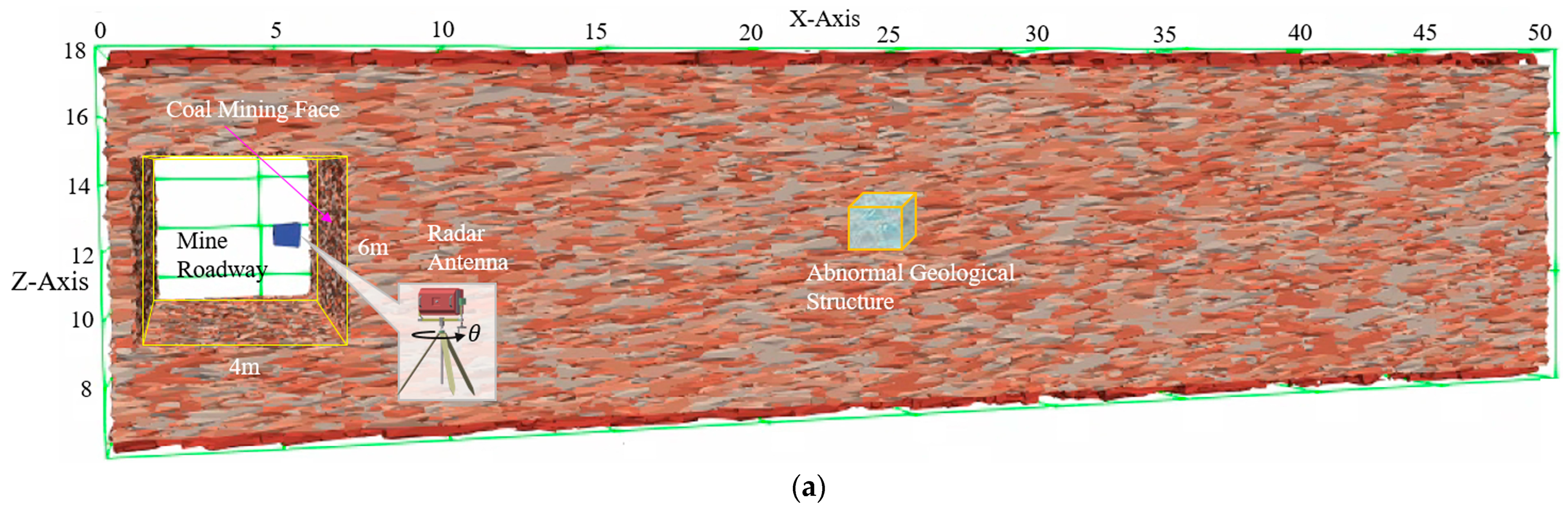
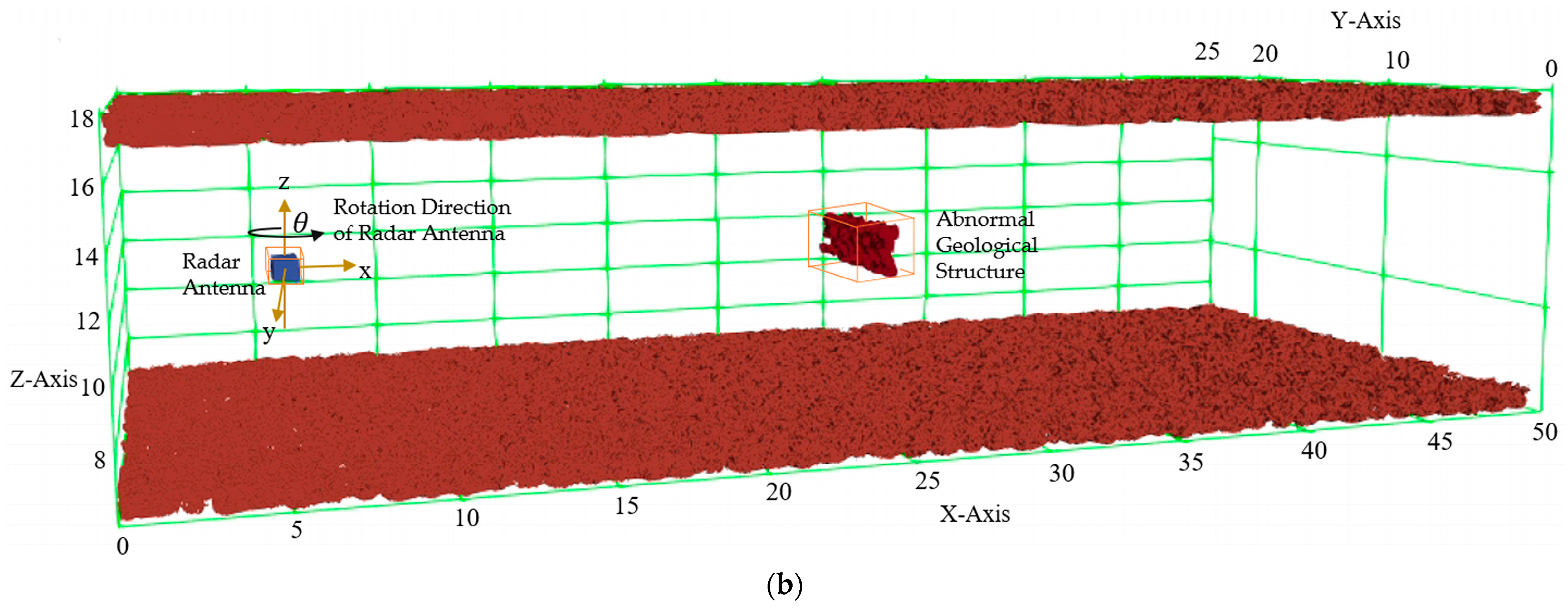
The dataset employed in this study consists of two major components. The first part includes two categories of data for model training: (1) high-noise data collected from field measurements, and (2) low-noise data generated via simulation models that exhibit distinct geological structural features. The second part comprises testing and validation datasets, constructed through the fusion of field-acquired and simulated data. The division ratio of training, testing, and validation datasets is 8:1:1. During the construction of simulated data, geological structures were generated according to parameters such as length, burial depth, and dip angle. As illustrated in Figure 5b, the geological structures within the central region of the model were assigned a width and thickness of 2 m , with lengths varying from 4 m to 8 m , distributed at 0.5 m intervals. The vertical distance between the geological structures and the excavation face was set within the range of 10 m to 30 m , with a spacing of 5 m . Furthermore, the dip angles of the geological structures in the horizontal direction ranged from −45° to 45°, with a 5° interval. Based on the above spatial distribution parameters, a total of 855 geological structure distribution models were constructed. All numerical simulations were conducted on an NVIDIA GeForce RTX4090-GPU with 24 GB of memory, requiring approximately 28.6 days to complete. Among the simulation results, 550 representative geological-structure models were selected as low-noise datasets for subsequent analysis.
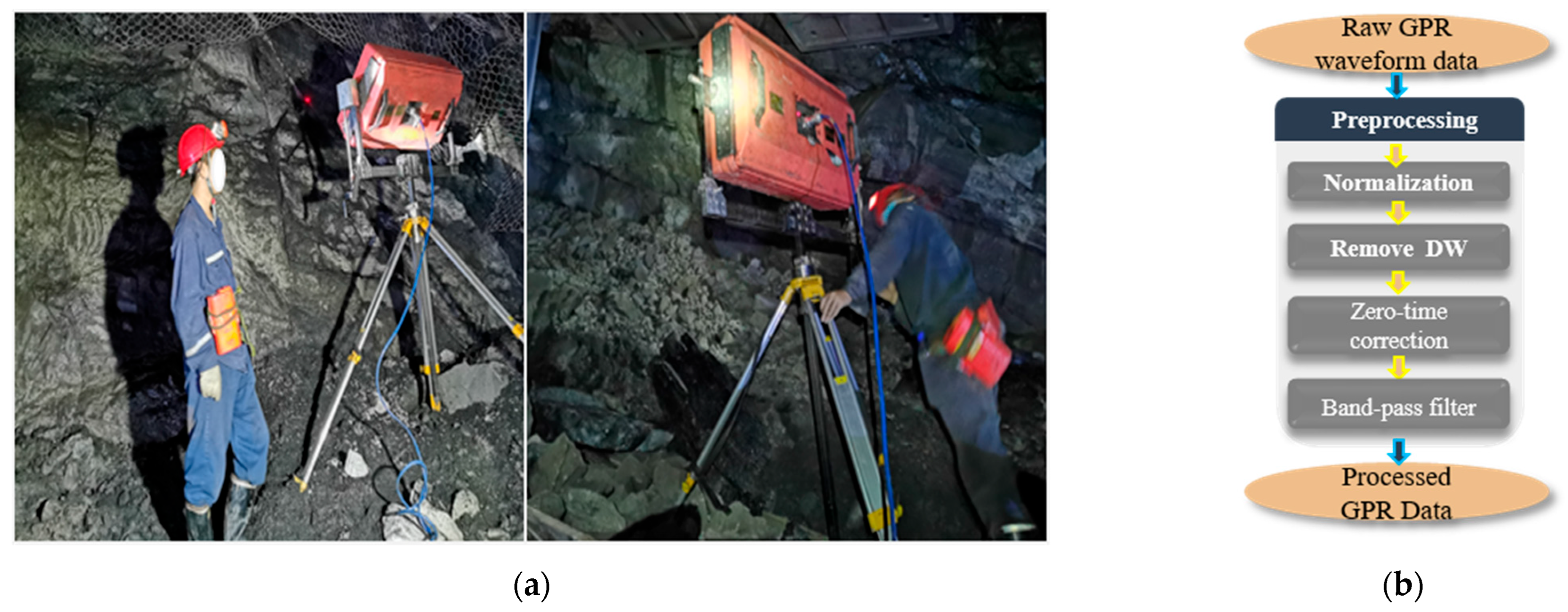
The construction of the field dataset was based on the actual survey environment illustrated in Figure 6a, with the acquisition process designed to remain consistent with the simulation workflow. To maximize data diversity, the field data were collected from multiple coal mines, including Mine No. 1 and Mine No. 2 in Yangquan, Shanxi Province; Mine No. 8, Chaochuan Mine, and Xiadian Mine in Pingdingshan, Henan Province; Jiulong Mine and Yangdong Mine in Handan, Hebei Province; as well as Renjiazhuang Mine in Ningxia. A total of 550 B-scan datasets were obtained from advanced detection conducted across dozens of excavation faces. Notably, no significant geological structures were discovered in the surveyed regions during subsequent mining operations. The acquired data were subjected to basic preprocessing to achieve standardization, which is a crucial step before feeding the data into the network model for training. Given the significant scale differences between simulated and field data, all datasets were first normalized to a consistent numerical range. Furthermore, to preserve the original distribution characteristics and minimize human-induced distortions, only relatively simple preprocessing operations were performed, as shown in Figure 6b. After normalization, the direct wave was removed, followed by zero-time calibration to correct potential baseline shifts. Once the zero-time alignment was completed, background noise suppression was applied to eliminate obvious environmental interference.
Considering the complexity of the survey environment, constructing testing and validation datasets by simply adding Gaussian noise to the simulated data was insufficient. To address this issue, a wavelet-based data fusion strategy was adopted. Specifically, both field and simulated data were subjected to wavelet multi-scale decomposition, enabling efficient data fusion across multiple scales. The wavelet transform is formally defined as follows (24):
W x a ,   b = x ( t ) ψ * t b a d t
In this formulation, x t   denotes the original signal, while ψ ( t ) represents the mother wavelet function, which is characterized by a zero mean and finite support in both the time and frequency domains. The scale factor a controls the dilation or compression of the wavelet function, whereas the translation factor b adjusts its temporal position. The symbol ψ * denotes the complex conjugate of the mother wavelet. It is important to note that different data sources typically contain unique local features, and the wavelet transform provides a means to explicitly extract these features across multiple scales. The data fusion procedure begins by performing wavelet decomposition on both the simulated and field signals,   x 1 t   and x 2 t , to obtain their coefficients at different scales. Subsequently, coefficient-level fusion is applied at each scale. Finally, an inverse wavelet transform is conducted to reconstruct a new signal from the fused coefficients [42].
The training of the proposed network model was conducted on a Windows 10 operating system configured with an Intel Xeon Gold 6133 CPU (The CPU is produced by Intel Corporation (Santa Clara, California, USA)) operating at 2.5 GHz and an NVIDIA GeForce RTX4090-GPU with 24 GB of memory. Within this computational environment, a conditional diffusion model network, integrating GMM-based conditional encoding and physical constraints, was implemented using the PyTorch (Version 2.9.1) framework and systematically evaluated through experiments. In the experimental settings, the initial learning rate was set to 2 × 10⁻⁴, and the Adam optimizer was employed for network training and parameter updates. The batch size was configured as 16, and the number of training epochs was fixed at 500 to ensure network convergence and reliable completion of the GPR image restoration task.

2.4.2. Performance Evaluation Methods

To comprehensively evaluate the effectiveness of the proposed method in processing GPR B-scan data, this study systematically analyzes the method from both qualitative and quantitative perspectives. First, the changes in image texture characteristics before and after processing are visually presented by comparing the images, enabling a qualitative assessment of the restoration performance. Given that qualitative analysis may be influenced by subjective factors, this study further introduces evaluation metrics such as SSIM (structural similarity index measure), PSNR, and MAE (mean absolute error) for a more objective quantitative assessment. Specifically, a higher SSIM value indicates better consistency between the images; a higher PSNR value reflects improved image quality; and a lower MAE value suggests smaller pixel differences between the images. The following sections provide detailed explanations of the three evaluation metrics: SSIM simulates the human visual system’s perception of an image through three main components—luminance, contrast, and structure—emphasizing the preservation of structural information. The SSIM value ranges from [0, 1], where 1 indicates that the two images are identical, and 0 indicates that the images exhibit significant differences. The calculation of SSIM is given by the formula in Equation (25):
S S I M x ,   y = 2 μ x μ y + C 1 2 σ x y + C 2 μ x 2 + μ y 2 + C 1 σ x 2 + σ y 2 + C 2
where μ x , μ y   represent the mean values of images   x and y , respectively;   σ x 2 , σ y 2 are the variances of images x and y , respectively, and   σ x y denotes the covariance between the two images. C 1 , C 2 and C 3 are constants. PSNR, defined based on MSE, is used to quantify the quality of an image restoration. For an original image I of size m × n   and its corresponding restored image K, where the maximum pixel value of the image is denoted as M A X I , the MSE and PSNR are calculated as follows in Equations (26) and (27):
M S E = 1 m n i = 0 m 1 j = 0 n 1 I i ,   j K i ,   j 2
P S N R = 10 · log 10 M A X I 2 M S E
MAE is a metric that measures the error between predicted and actual values, describing the average deviation of the predicted values from the true values. The value of MAE ranges from [ 0 ,   + ) , where a value of 0 indicates perfect agreement between the predicted and true values, and larger values correspond to greater error. The calculation is provided in Equation (28), where y i ^ denotes the predicted value, and y i is the true value:
M A E = 1 n i = 1 n | y i ^ y i |
In addition, given the unique characteristics of GPR data and the reflected geological structural features, this study introduces two additional metrics—Peak Energy Angle Prediction Error Average (AEPEA) and Spatial Continuity of Reflective Features in the Angle Domain (SFC)—to further assess the advantages of the processing results. AEPEA aims to evaluate the average deviation between the predicted angle corresponding to the peak energy (i.e., the intensity peak of the reflected signal) in the processed radar image and the actual or ideal reflection angle. Since the reflected signals in GPR images typically exhibit directional properties, the peak energy angle is an important indicator of the reflection feature. Therefore, by calculating the error between the predicted and true reflection angles for each sample, AEPEA provides a quantitative assessment of the precision in the restoration of the reflection signal’s directional orientation. The formula for AEPEA is as follows:
A E P E A = 1 N i = 1 N | θ p r e d , i θ t r u e , i |
where θ p r e d , i is the predicted reflection angle corresponding to the peak energy of the i-th sample after processing; θ t r u e , i is the true reflection angle of the i-th sample; N is the total number of samples. A smaller AEPEA value indicates that the model is more accurate in restoring the peak energy angle, leading to better recovery of the reflection feature’s directional properties. SFC measures the similarity of reflection features between adjacent data traces, reflecting the smoothness and consistency of the geological structure across different angles. The spatial continuity of reflection features is crucial for accurately recovering geological structural information and reducing noise and discontinuous reflections. By calculating the similarity between adjacent data traces, SFC quantifies the variations in the reflection layer across different angles, ensuring that the generated image exhibits smooth propagation characteristics in space. The similarity between adjacent traces is typically quantified using either cross-correlation or mean squared error (MSE). The formula for SFC is as follows:
S F C ( i ) = t = 1 T ( x i ( t ) x ¯ i ) ( x i + 1 ( t ) x ¯ i ) t = 1 T ( x i ( t ) x ¯ i ) 2 t = 1 T ( x i + 1 ( t ) x ¯ i + 1 ) 2
where   x i ( t ) and   x i + 1 ( t ) are the signal values of the i-th and (i + 1)-th data traces at time point t ; x ¯ i and x ¯ i + 1 are the mean values of their respective data traces; T is the number of time samples. A higher SFC value indicates that the reflection features between adjacent data traces are more similar, leading to better spatial continuity of the image across angles.

3. Numerical Modeling

3.1. Geological Structure Generation Algorithm

In the domain of GPR numerical modeling, research on algorithms for generating geological structures in the front mining face of underground coal mines remains relatively sparse, and those specifically designed to simulate the distribution of geological structures within the three-dimensional space of coal mines are even rarer. Currently, there exist some relevant GPR modeling studies in other fields. For instance, Wang et al. [43] employed the discrete element method to construct a three-dimensional irregular polygonal particle model for simulating Martian rock layers; however, this approach is constrained by the limited number of irregular three-dimensional particles that can be generated. Similarly, Benedetto et al. [44] utilized the random sequential adsorption technique to establish a two-dimensional ballast model for railway simulation, yet this model approximated ballast particles as circular shapes, inadequately reflecting their true geometry. To achieve a more accurate simulation of real-world distributions, Li et al. [45] proposed a modeling method based on two-dimensional random irregular polygons (RIP) for ballast, which involves generating a RIP model to simulate ballast particles and attempting to densely place these particles within a designated collision area. This approach, however, requires collision detection between the new particle and those already placed at each iteration. As the unfilled area diminishes, the risk of particle collisions increases considerably, often leading to prolonged periods of repeated random placement and collision detection attempts. To address the limitations of the two-dimensional RIP ballast modeling approach, Yang et al. [46] introduced an enhanced two-dimensional RIP modeling algorithm. This improved method divides the target area into a spatial grid, randomly distributing particles within unfilled grid cells. The RIP algorithm is then employed to generate ballast particles, followed by local grid collision detection to determine whether any conflicts arise between the new and existing particles. By confining collision detection to the local grid, redundant computations are minimized, ensuring that particles are consistently placed in vacant areas. The grid-based allocation of unfilled regions facilitates the rapid identification of suitable positions even in later stages, thereby significantly enhancing the algorithm’s efficiency and practicality.
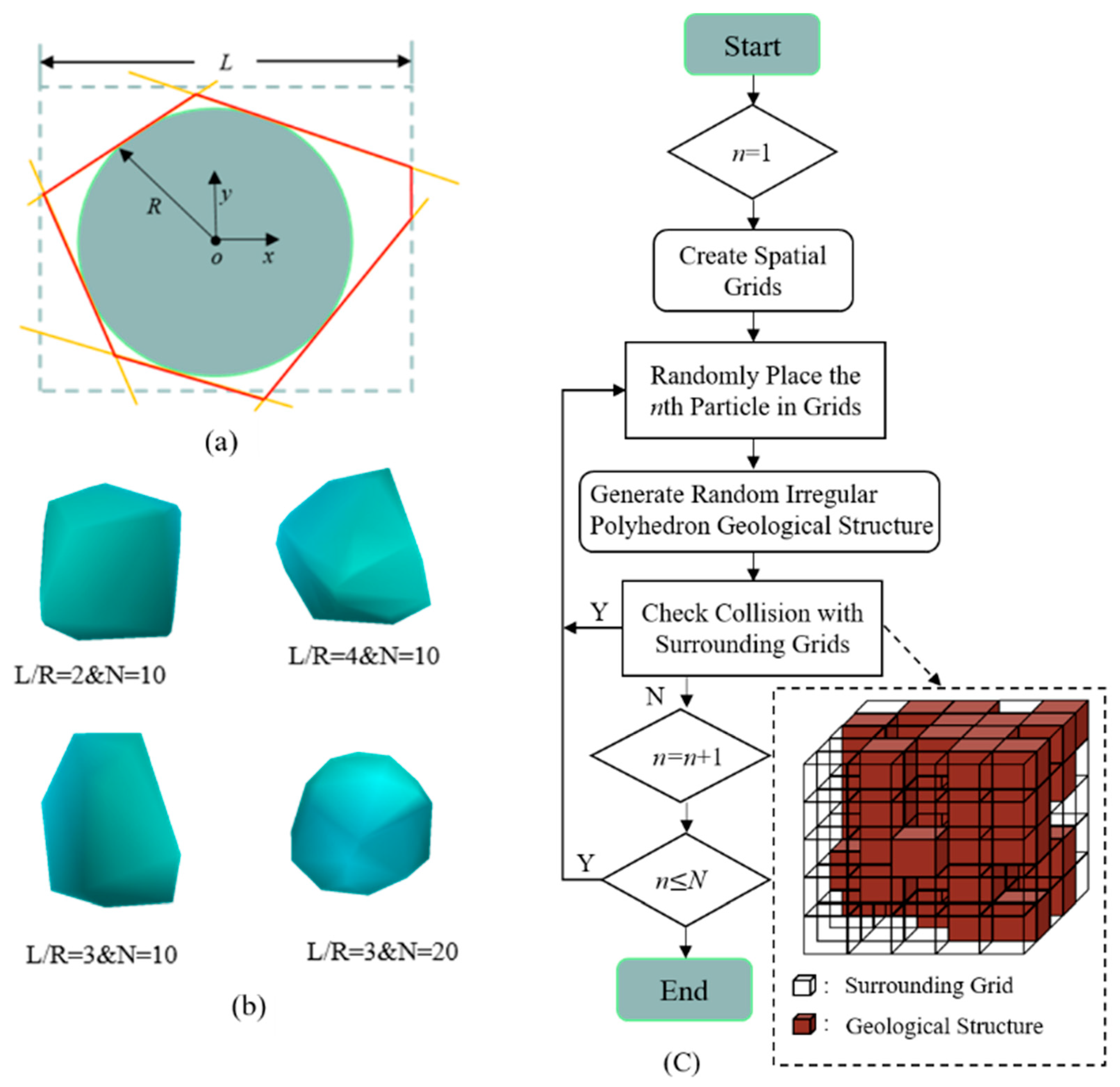
Based on the above research, this paper extends the two-dimensional RIP modeling algorithm into three-dimensional space to develop a modeling algorithm for random irregular polyhedra, aimed at simulating the spatial distribution of irregular geological structures (primarily planar geological structures). Figure 7c provides an overview of the proposed algorithm’s general flow. The algorithm achieves particle packing and collision detection in space, and the process of determining whether a new particle conflicts with an existing one is based on the core idea of the two-dimensional RIP algorithm. The key difference is the extension from two-dimensional planes to three-dimensional space. Additionally, this paper introduces an algorithm for random plane segmentation of a regular hexahedron [47] to generate irregular polyhedra for simulating geological structures. Specifically, the algorithm first constructs a regular hexahedron with side length L centered at the origin O in the spatial coordinate system (i.e., the initial particle). It then randomly selects a point O′ (which can coincide with O) as the center and defines a radius R to form a hypothetical sphere. N points are randomly sampled on this sphere. Finally, a tangent plane is established at each sampled point, tangential to the hypothetical sphere. Through these steps (Figure 7a), the spatial geometric shape of the irregular polyhedron can be obtained. Furthermore, by adjusting the radius R of the hypothetical sphere and the number of tangent planes N, the particle size can be controlled, resulting in various polyhedron structures (Figure 7b), thereby providing a rich diversity in the simulated spatial distribution. The detailed procedure is as follows. First, a regular hexahedron with a side length of 4 m is discretized into unit grids of 0.05 m   ×   0.05 m   ×   0.05 m . Second, a grid cell inside the hexahedron (e.g., the central cell) is selected as the center of an imaginary sphere, and a sphere of radius R is constructed. The entire grid space is then traversed, and numerical values are assigned to all grid cells located within the spherical region, as illustrated by the different colors in Figure 7c. Subsequently, N grid points are randomly sampled on the spherical surface, and a tangent plane is generated at each sampled point. Grid cells lying inside and outside each tangent plane are identified, with the interior region assigned the same numerical value as the spherical domain (representing the geological structure), and the exterior assigned a different value (representing the background). On this basis, a grid region within the three-dimensional space is randomly selected, and the RIP algorithm is applied to embed the hexahedral grid into the 3D grid domain (Figure 5), thereby simulating the spatial distribution of geological structures. As shown in Figure 5b, the z-axis and y-axis correspond to the width and height of the model, respectively, whereas the x-axis represents the extension depth. The geological structure is numerically filled within the 3D space, with different values (distinguished by colors) representing the geological body and the background. In addition, by taking the center coordinate of the filled geological region as the origin and rotating around either the z-axis and y-axis, the extension direction of the geological structure can be adjusted accordingly.

3.2. GprMax Numerical Modeling

In this study, the GprMax (Version 3.1.7) simulation software [48] was utilized to construct a three-dimensional geological structure distribution model in front of the mining face of an underground coal mine, using the 3D Finite Difference Time Domain (3D-FDTD) method. The geological structures in this simulation are primarily planar, with relatively complete electromagnetic wave reflection surfaces. The 3D spatial model was built based on various geological structures, considering different sizes, tilt angles, and distribution positions, as well as models with and without geological structures. Through reviewing relevant materials, a three-dimensional underground structural model was established, as shown in Figure 5a,b. The model has dimensions of 25 m × 25 m in the vertical direction, with a horizontal depth of 50 m . The electromagnetic parameters of the materials in each layer are detailed in Table 1. To better reflect the actual distribution of coal seam media (Figure 5a), three materials—fat coal, lean coal, and coking coal—were selected from Table 1. After being randomly mixed, these materials were used to fill the entire model background, constructing a heterogeneous distribution of the coal seam. The model includes, from left to right: an air layer, with dimensions of 6 m × 25 m in the vertical direction and a horizontal depth of 4   m , filled with air media to simulate the ideal distribution of a coal mining roadway; a radar antenna placed 0.5   m away from the mining face, with its casing made of Perfect Electric Conductor (PEC) material. Additionally, as shown in Figure 5a,b, the geological structures are distributed in front of the mining face, with a horizontal depth range between 10 m and 30 m , and a width and thickness of 2 m . The length ranges from 4 m to 8 m , with a tilt angle in the Y-axis direction varying between −45° and 45°. The filling materials are a mixture of mudstone and sandstone, as listed in Table 1. To align with real-world conditions, the geological structures were generated using the randomly irregular shapes algorithm described in Section 3.1, with sizes adjustable via parameters. The discretization intervals for dx, dy, and dz were set to 0.05 m . The time step, as determined by Equation (31), was set to 96.225 ps for this study.
d t 1 c ( d x ) 2 + ( d y ) 2 + ( d z ) 2
The time window for each scan was set to 600 n s , resulting in a total of 6235 time steps per A-scan, corresponding to a horizontal detection depth of approximately 30 m. To eliminate boundary reflection effects, the model boundaries were configured with a Perfectly Matched Layer (PML) consisting of 10 grid cells. The GPR pulse utilized a Ricker wave with a center frequency of 100 MHz. Both the transmitting and receiving antennas were positioned 0.5 m in front of the mining face. As shown in Figure 1b and Figure 5b, the antennas were rotated around the model’s Z-axis in the X-Y plane by an angle θ for horizontal scanning. During the scanning process, the emission point Tri, where i =   θ 1 , θ 2 , θ 3 , , θ k , and the reception point Rei varied accordingly with the emission points. The antenna’s horizontal scanning range was from −60° to 60°, with a step size of 2°, generating a total of 60 A-scan data points.

3.3. Impulse Shape Verification Test

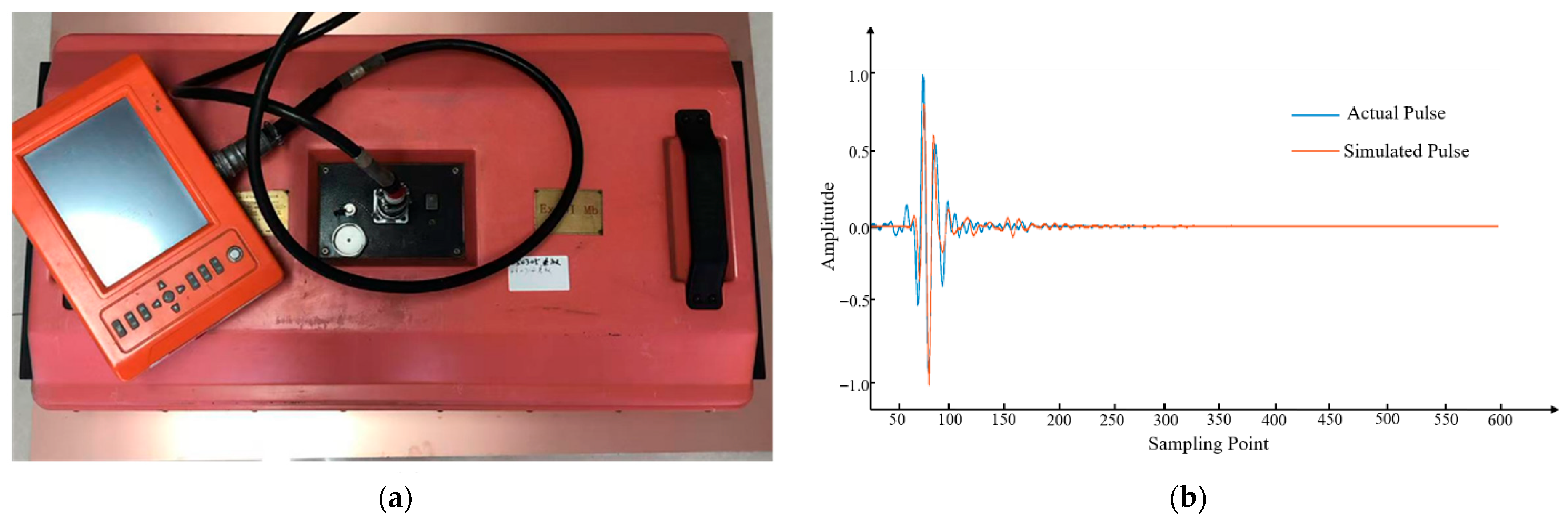
The GPR pulse waveform is designed by the manufacturer; however, subtle differences may exist between the actual pulse waveform and the simulated pulse waveform. To ensure high similarity between the simulated and actual data, this study experimentally compares and verifies the waveform differences between the actual and simulated pulses. As shown in Figure 8a, an 80 cm × 120 cm × 0.3 cm copper plate, which can be treated as a Perfect Electrical Conductor (PEC), was selected for the experiment, with its dimensions precisely covering the radar radiation area. The copper plate was placed in an open space, and the actual waveform data was collected using a 100 MHz mine-use shielded enhanced GPR antenna from China University of Mining and Technology (Beijing), positioned above the copper plate. Simultaneously, corresponding simulated waveform data was obtained using a numerical model containing PEC material. As shown in Figure 8b, after simple processing to remove the direct wave, and normalizing the pulse waveforms to the same scale, both sets of waveform data indicate that the actual and simulated pulse waveforms exhibit nearly identical phase responses in both the main lobe and side lobes, with minimal amplitude differences in the peak. The primary distinction lies in the slightly reduced stability of the actual pulse waveform, particularly at the beginning and end, where minor fluctuations are observed. This could be attributed to the combined effect of system noise from the GPR and environmental noise. Such small differences are considered within an acceptable range.

4. Results

4.1. Analysis of Simulation Experiment Results

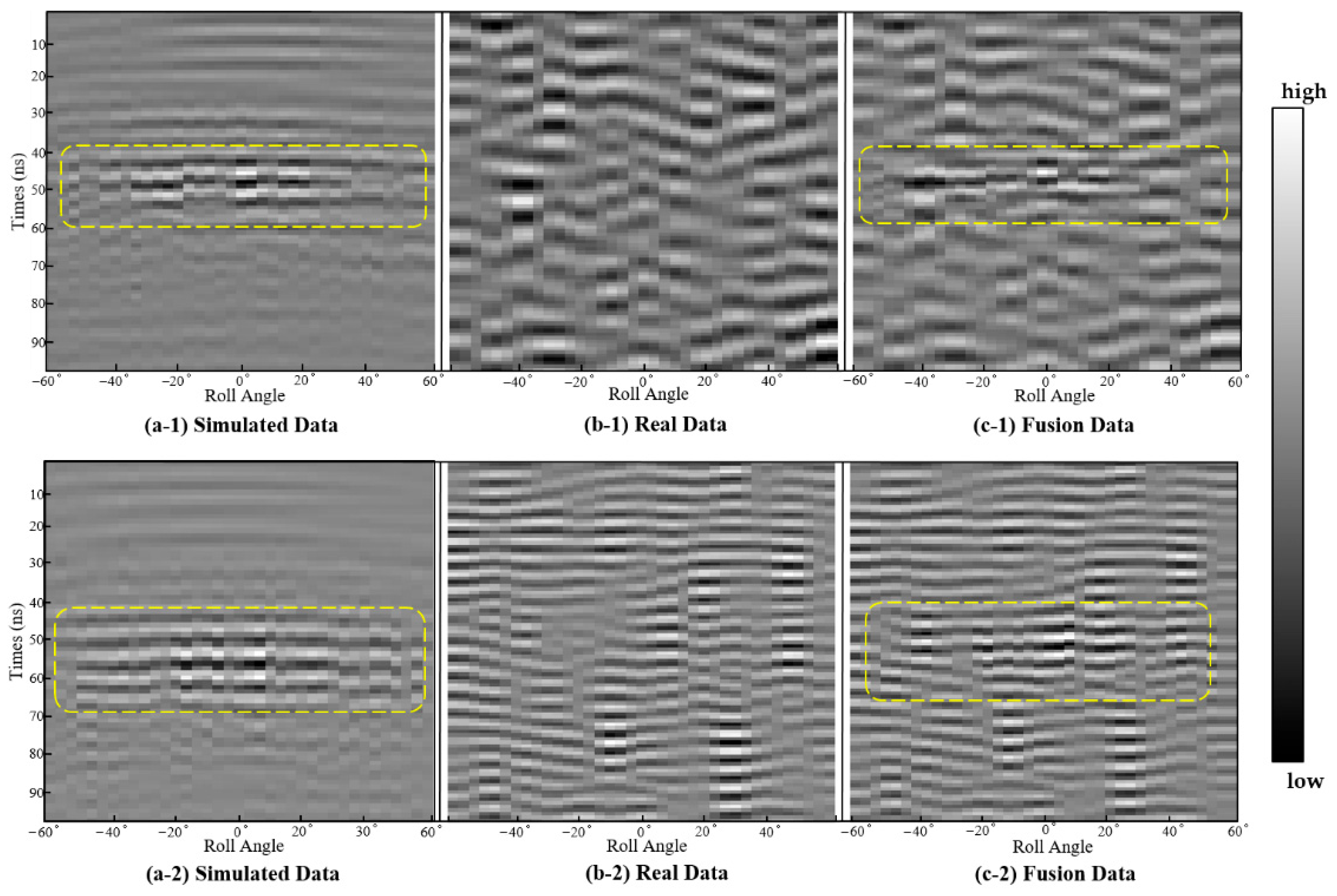
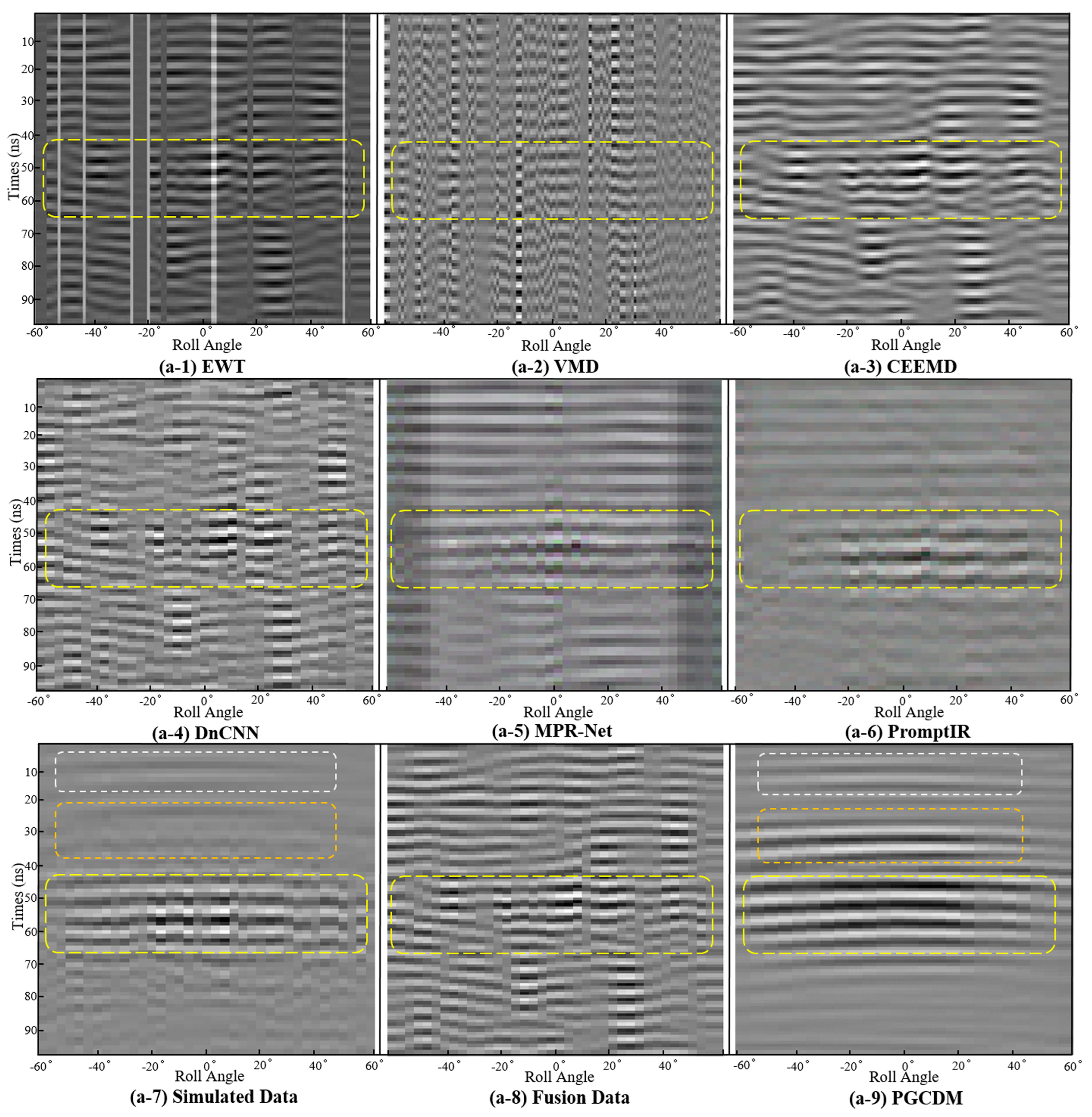
As illustrated in Figure 9, two representative datasets were selected for a detailed analysis of GPR signals within 100 ns that capture responses from geological structures. In Figure 9a-1, the radargram displays response characteristics for a simulated geological structure measuring 4 m in length, 2 m in width and thickness, buried at a depth of 20 m with a horizontal dip angle of 0°. In contrast, Figure 9a-2 corresponds to a simulated model in which the geological structure is 6 m long, 2 m wide and thick, buried at 40 m, with a horizontal dip angle of −10°. To ensure consistency with the spatial distribution of actual geological formations, heterogeneous media were employed in the simulation models. Consequently, both figures exhibit reflection wave groups whose energy first increases and subsequently decays spatially, with attenuation extending progressively outward from the center in the angular domain. During this process, the side lobes of the wavelets in the upper and lower portions of the reflection group decayed more noticeably due to lower energy levels, whereas the central region maintained stronger energy with less pronounced attenuation. This resulted in a central area that appeared brighter and thicker, flanked by narrower and darker regions. In terms of phase continuity, the reflection signals were generally continuous; however, slight misalignments, fragmentation, and undulations were observed due to the heterogeneous distribution of the medium. Notably, the detection angle corresponding to the energy peak closely aligned with the structural dip angle. Based on the distribution of two-way travel time (TWT) in the radargrams, field background data corresponding to the same TWT windows were selected from surveys conducted at the Xiadian Coal Mine in Pingdingshan, Henan, and the Renjiazhuang Coal Mine in Ningxia, as shown in Figure 9b-1,b-2, respectively. The dataset in Figure 9b-1 pertains to shallow subsurface detection and is characterized by relatively strong overall energy dominated by low-frequency components, whereas the dataset in Figure 9b-2 corresponds to deeper detection, exhibiting overall weaker energy and higher frequency components. Figure 9c-1,c-2 present the results after fusing simulated and field data. Specifically, in Figure 9a-1, the shallow reflection signals displayed strong energy with abrupt local variations. Although the corresponding background field data also exhibited relatively high energy, the structural features remained only faintly discernible, yielding a SNR of −20.89 dB, characteristic of shallow reflection. In contrast, the fused data in Figure 9c-2 achieved superior integration, where geological reflection features became nearly indistinguishable from noise, with an SNR of −6.55 dB, indicative of overall weak reflection characteristics.
To evaluate the overall performance of the proposed algorithm on synthetic data (see Figure 10), This paper selected six representative comparative methods. These methods comprise three conventional denoising techniques for GPR data—the empirical wavelet transform (EWT), variational mode decomposition (VMD), and complementary ensemble empirical mode decomposition (CEEMD)—as well as three deep-learning–based image denoising networks: the denoising convolutional neural network (DnCNN), the multi-stage progressive image restoration network (MPR-Net) [49], and the prompt-based image restoration framework (PromptIR) [50]. For the weak reflection features observed in Figure 10a-8, the results obtained using the EWT and VMD methods (Figure 10a-1,a-2) failed to clearly differentiate between the geological features and the background within the two-way travel time of 40–70 n s . In contrast, the CEEMD-based result (Figure 10a-3) enhanced the continuity of the feature regions in the angular domain and produced a smoother overall image; however, insufficient noise suppression resulted in limited contrast between the features and the background. Furthermore, the DnCNN method (Figure 10a-4) exhibited unsatisfactory performance, as the minimal difference between the pre- and post-processed data resulted in a cluttered image that obscured the geological features. Although MPR-Net and PromptIR demonstrated relatively strong denoising capabilities, they exhibited certain limitations for GPR image restoration, as shown in Figure 10a-5,a-6. Specifically, in Figure 10a-5, the feature distribution was partially discernible, yet the low contrast and weak signal intensity between the features and the background led to unsatisfactory noise suppression, and the horizontal stripe-like background noise was not effectively attenuated. In comparison, the PromptIR-based result in Figure 10a-6 effectively suppressed background noise, enhanced the contrast between the feature and background regions, and provided a clearer representation of reflection wave groups. Nonetheless, the continuity of the feature regions in the angular domain was insufficiently improved, and the energy peak appeared at a detection angle of 2°, deviating from the actual dip. In contrast, the result obtained with the proposed method (Figure 10a-9) demonstrated nearly complete suppression of background noise, thereby significantly enhancing the contrast between the feature regions and the background. Furthermore, the reflection wave groups exhibited clearer spatiotemporal patterns, and their continuity in the angular domain was markedly improved. Notably, the energy peak was observed at a detection angle of −8°, which is closer to the actual dip angle of −10°. Additionally, the proposed method effectively enhanced weak signals in the upper portions of Figure 10a-9,a-7, achieving performance that substantially surpassed that of all other algorithms.
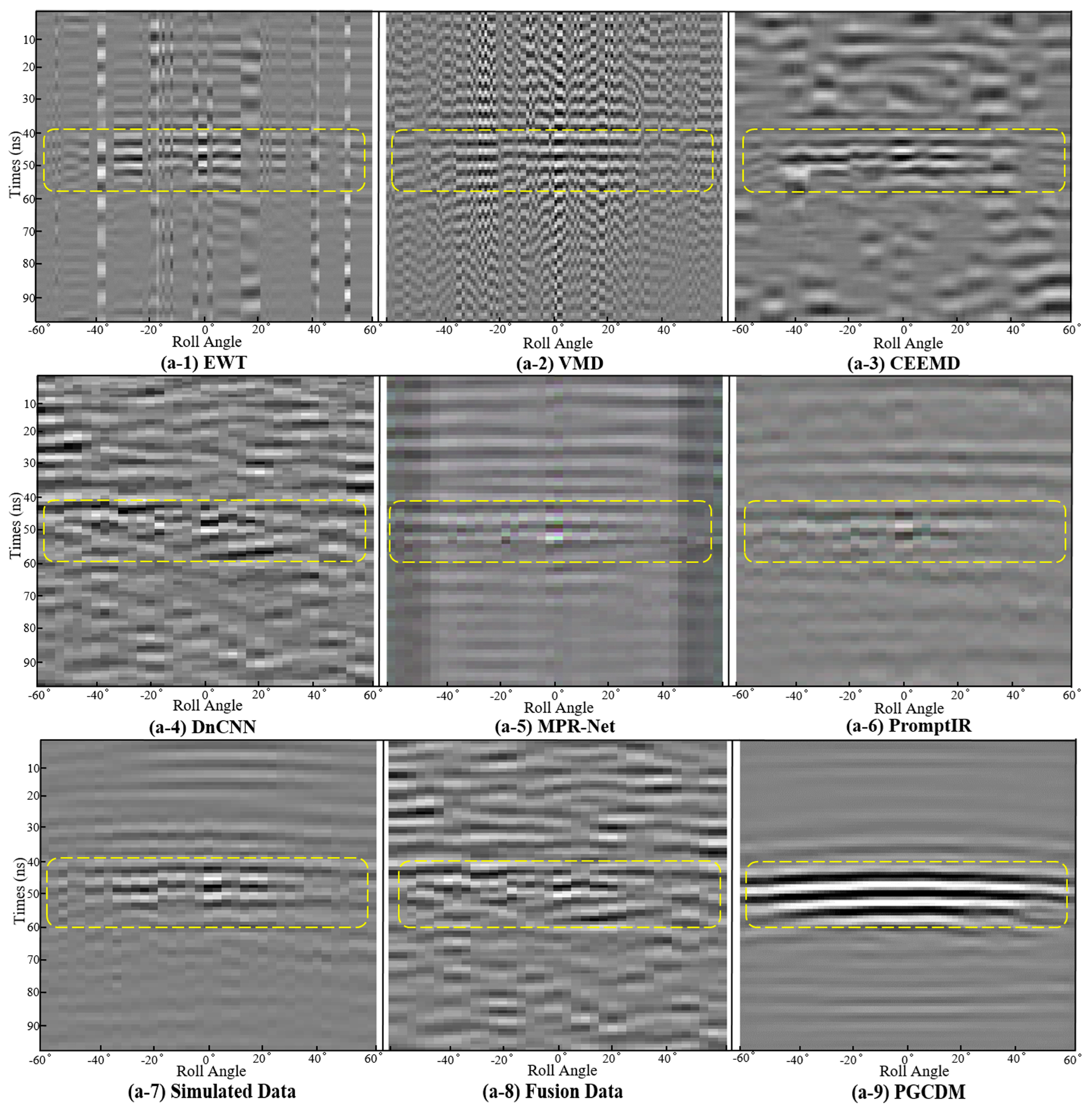
As depicted in Figure 11a-8, compared with the weak reflection features shown in Figure 10a-8, the reflection characteristics of the geological structure are significantly more pronounced. Consequently, all algorithms demonstrate enhanced performance when processing these shallow reflection features. Figure 11a-1 through Figure 11a-6 reveal preliminary trends in the variation in the reflection features. In terms of noise suppression, the MPR-Net and PromptIR algorithms continue to exhibit superior performance. However, regarding weak signal enhancement, improved continuity of reflection structures, and alignment of peak energy positions, the proposed PGCDM algorithm yields notably superior results, as illustrated in Figure 11a-9. Table 2 quantitatively summarizes the primary evaluation metrics on the test dataset, including the SSIM, PSNR, MAE, AEPEA and SFC. In all of these indicators, the PGCDM algorithm demonstrates overall superior performance compared with the other methods.
In summary, the proposed PGCDM algorithm demonstrates superior performance on the synthetic dataset. The algorithm not only effectively suppresses background noise but also significantly enhances the contrast between feature regions and the background, rendering the variations in the reflection wave groups in both the angular and temporal domains more pronounced and improving structural continuity. The peak energy detection angle closely aligns with the actual geological dip, minimizing deviation. Furthermore, PGCDM exhibits a clear advantage in enhancing weak signals, as illustrated in Figure 10d-7. Quantitative metrics reported in Table 2 further validate that PGCDM outperforms other comparative algorithms in overall performance. In particular, the AEPEA and SFC metrics are of critical importance: the lateral continuity of geological reflection features in the radar profiles (angular domain) serves as a key indicator of geological structure distribution, while the peak energy detection angle, corresponding to the strongest vertical energy received by GPR, is a crucial measure of the spatial dip of subsurface structures. According to the results in Table 2, MPR-Net and PromptIR underperform PGCDM in both metrics. This advantage of PGCDM primarily stems from the integration of physical constraints and Gaussian Mixture Model (GMM) priors in its design. Specifically, the physical constraints preserve the wave fluctuation patterns in the angular–time domain, simultaneously accounting for the continuity of reflection wave groups and the physical characteristics of subsurface structures, thereby enhancing structural continuity (SFC), particularly within weak reflection regions, where features exhibit smoother and more continuous behavior across angles. On the other hand, the GMM priors effectively distinguish geological signals from random noise, achieving a balance between noise suppression and signal enhancement. As a result, background noise is well suppressed while true reflection features are preserved, leading to a significant reduction in AEPEA. It should be noted that, although PGCDM exhibits robustness on synthetic datasets, its computational cost is relatively high, and the current training sample size remains limited. Future work should focus on collecting real-world GPR measurements to further improve algorithm performance and to address challenges arising from complex subsurface environments.

4.2. Verification Experiment in Underground Coal Mines

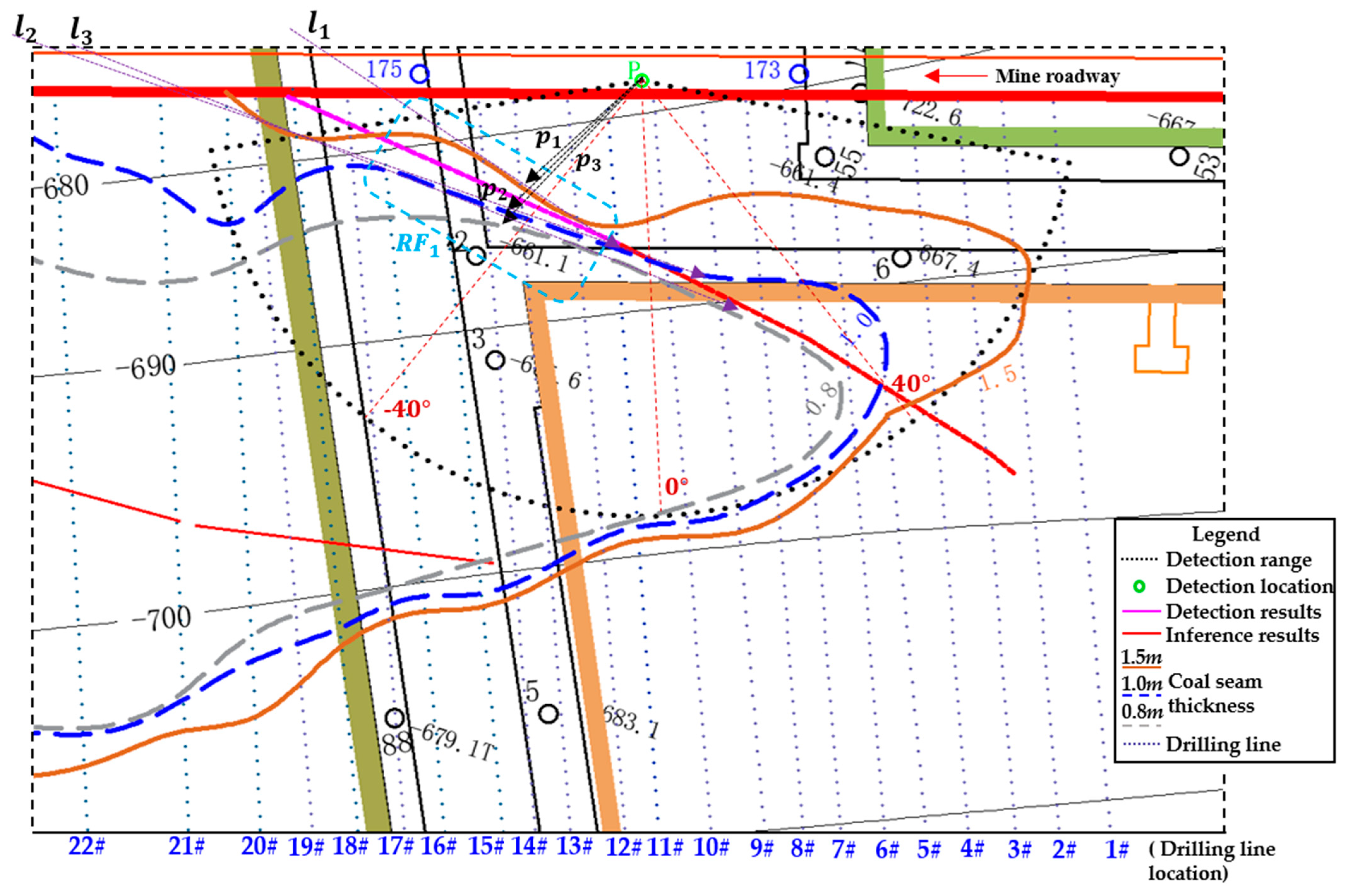
Figure 12 illustrates the distribution of coal seams in the recovery area of a coal mine in Pingdingshan, Henan. To comprehensively understand the distribution of coal seams in this area, detailed drilling operations were conducted. As shown, the drilling area measures 130 m in length and 80 m in width, with drilling points numbered 1# to 22# representing the distribution of surface drilling points, where denser drilling points were placed in regions with significant coal seam undulation. The drilling results indicate an uneven distribution of coal seam thickness in the recovery area, with specific thicknesses of 1.5 m, 1.0 m, and 0.8 m represented by brown solid, blue dashed, and gray dashed contour lines, respectively. From the contour distribution, a distinct coal-rock boundary ( R F 1 ) is identified within the detection area. In this region, the coal seam thickness changes significantly over a short distance, forming a well-defined reflection interface. Tangents l 1 , l 2 and l 3 were drawn at 0.8 m, 1.0 m, and 1.5 m coal seam contour lines in the R F 1 area, respectively. Measured results show that the angles between these tangents and the tunnel are 33.63°, 31.29°, and 55.81°, with an average value of 40.24°. The corresponding distances p 1 , p 2 and p 3 at detection point P along the horizontal direction of −40.24° are 16.6 m, 21.6 m, and 23.8 m, respectively, with an average depth of approximately 20.7 m.
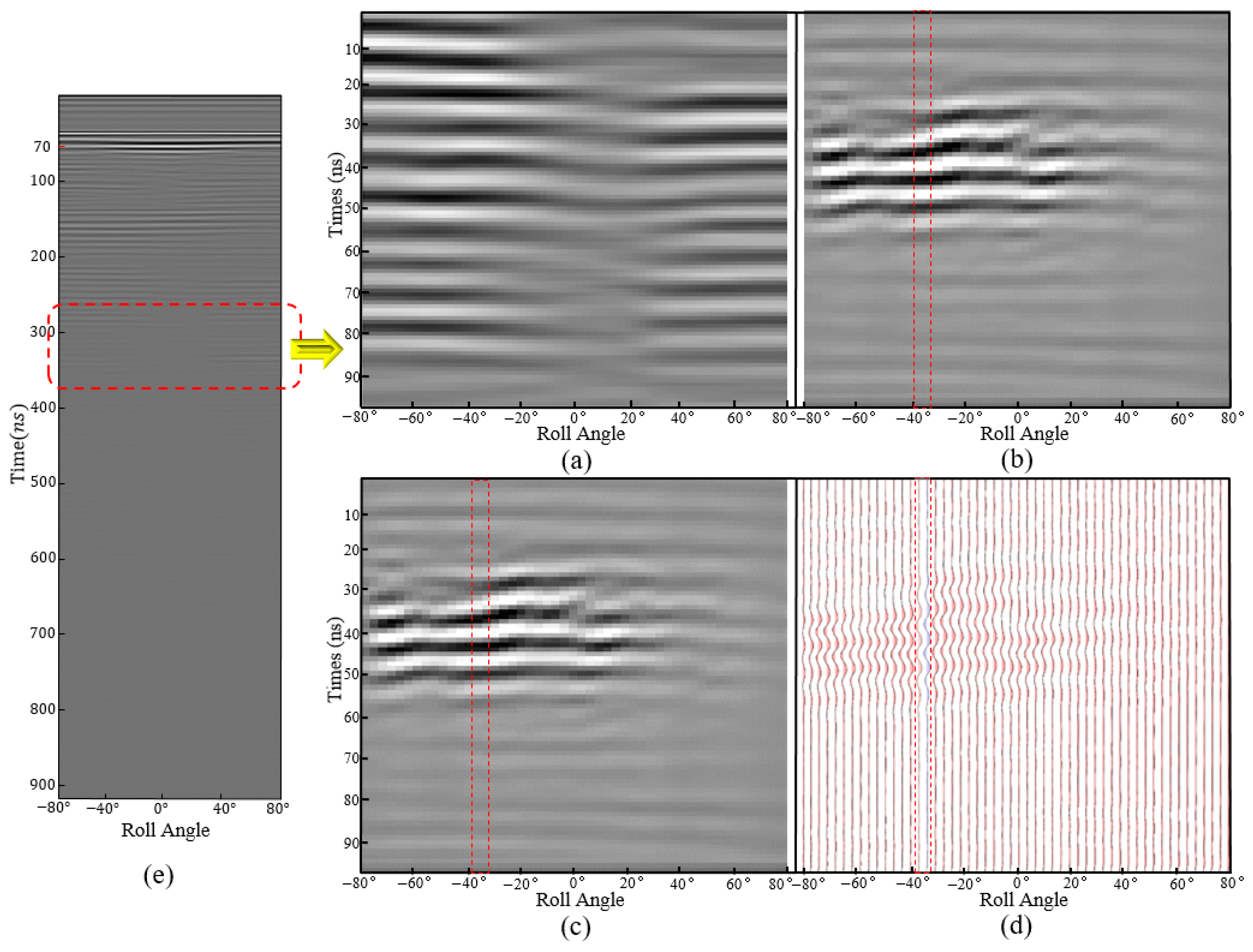
Figure 13e displays the data collected from the survey, where a clear reflection interface of the coal mine tunnel wall is observed around 70 n s . Since the coal seam in the recovery area mainly consists of coking coal and lean coal, the estimated electromagnetic wave propagation velocity in the medium is approximately 0.156 m / n s , resulting in a round-trip travel time of about 265 n s at a depth of 20.7 m . Therefore, data from the time window of 285 n s to 385 n s (shown in Figure 13a) was selected for processing. Notably, the lateral strip noise in Figure 13a gradually increases from the center toward both sides and exhibits a periodic decrease along the time, which is characteristic of typical tunnel wall interference signals. Figure 13b presents the results after applying the proposed algorithm, where noise is effectively suppressed and the contrast between structural features and the background is significantly enhanced, with improved structural continuity. Figure 13c and Figure 13d, respectively, show the radargram and waveform comparison of the processed data. The energy peak is highlighted by a red dashed box. For clearer visualization, a blue curve is additionally used in the waveform plot (Figure 13d) to distinguish the peak response. As shown in the figure, the peak energy corresponds to an incidence angle of approximately 38°, with a time window of about 37 ns. According to the aforementioned analysis, the corresponding depth is approximately 19.66 m, which exhibits a certain deviation from the calculated value. Considering the locally non-uniform distribution of the coal seam, this deviation remains within an acceptable range.

5. Conclusions

This study proposes a novel Physics-Guided Conditional Diffusion Model (PGCDM) designed to recover weak reflection signals embedded in high-noise ground-penetrating radar (GPR) measurements collected in underground coal-mine environments. The method innovatively integrates multimodal feature extraction, probability-prior encoding based on a dual Gaussian Mixture Model (GMM), and a physics-consistency constraint derived from the wave equation. The synergistic interaction of these modules provides strong guidance for the conditional diffusion process, enabling the effective reconstruction of clear subsurface reflection signals from noisy observations. PGCDM fully exploits the characteristics of both signal and noise across the time–frequency domain, texture domain, and angular domain, while the dual-path GMM encodes these multimodal features to guide the diffusion trajectory. The physics-consistency constraint further ensures that the generated reflections remain continuous within the angular domain. Experimental results demonstrate that PGCDM achieves outstanding performance, with PSNR, SSIM, MAE, AEPEA, and SFC reaching 30.05, 0.876, 0.824, 3.6°, and 0.986, respectively—outperforming traditional denoising methods and existing deep-learning-based models. Notably, AEPEA and SFC show improvements of 6.2° and 0.221, respectively, which are crucial for accurately identifying the spatial distribution of geological structures during deep subsurface investigations. These metrics highlight PGCDM’s superior capability under high-noise conditions, particularly in restoring complex subsurface reflections. Moreover, experiments conducted on real GPR measurements from underground coal mines further validate the model’s advantages in recovering weak and shallow reflections that are highly susceptible to environmental noise. This demonstrates the potential of PGCDM to support safer and more reliable subsurface imaging and mining monitoring applications. Despite its strong performance on both synthetic and real data, the model remains dependent on the quality and diversity of the training dataset, and the diffusion process incurs substantial computational cost, which may pose challenges for real-time deployment. Future work will focus on extending PGCDM to broader applications, particularly 3D GPR reconstruction and multimodal geophysical data integration (e.g., combining seismic and GPR measurements). Additionally, we aim to develop lightweight variants suitable for real-time deployment in embedded mine monitoring systems, facilitating practical implementation in operational underground environments.

Author Contributions

Conceptualization, J.L. and F.Y.; methodology, J.L. and F.Y.; software, F.Y. and X.Q.; validation, J.L. and F.Y.; formal analysis, J.L. and F.Y.; investigation, J.L., F.Y., X.T. and X.H.; resources, F.Y. and S.P.; data curation, J.L., F.Y. and X.H.; writing—original draft preparation, J.L.; writing—review and editing, J.L., F.Y. and S.P.; visualization, J.L. and X.H.; supervision, F.Y. and X.H.; project administration, J.L.; funding acquisition, S.P. and F.Y. All authors have read and agreed to the published version of the manuscript.

Funding

This research was funded by the National Natural Science Foundation of China (grant number 52427901).

Data Availability Statement

Restrictions apply to the availability of these data. Data were obtained from the China University of Minning and Technology (Beijing) and are available from the authors with the permission of the China University of Minning and Technology (Beijing).

Conflicts of Interest

The authors declare no conflicts of interest.

References

  1. Wu, Z.; Xia, T.; Nie, J.; Cui, F. The shallow strata structure and soil water content in a coal mining subsidence area detected by GPR and borehole data. Environ. Earth Sci. 2020, 79, 500. [Google Scholar] [CrossRef]
  2. Davis, J.L.; Annan, A.P. Ground-penetrating radar for high-resolution mapping of soil and rock stratigraphy 1. Geophys. Prospect. 1989, 37, 531–551. [Google Scholar] [CrossRef]
  3. Benson, A. Applications of ground penetrating radar in assessing some geological hazards: Examples of groundwater contamination, faults, cavities. J. Appl. Geophys. 1995, 33, 177–193. [Google Scholar] [CrossRef]
  4. Toshioka, T.; Tsuchida, T.; Sasahara, K. Application of GPR to detecting and mapping cracks in rock slopes. J. Appl. Geophys. 1995, 33, 119–124. [Google Scholar] [CrossRef]
  5. Strange, A.D. Robust Thin Layer Coal Thickness Estimation Using Ground Penetrating Radar. Doctoral Dissertation, Queensland University of Technology, Queensland, Australia, 2007. [Google Scholar]
  6. Thomas, S.B.; Roy, L.P. Measurement; Technology. Impact of GPR antenna height in estimating coal layer thickness using spatial smoothing techniques. IET Sci. Meas. Technol. 2020, 14, 906–912. [Google Scholar] [CrossRef]
  7. Strange, A.D.; Jecny, Z. Coal subsurface mapping for selective mining. In Proceedings of the 2018 17th International Conference on Ground Penetrating Radar (GPR), Rapperswil, Switzerland, 18–21 June 2018; pp. 1–4. [Google Scholar]
  8. Volkomirskaya, L.; Gulevich, O.; Reznikov, A.; Varenkov, V. Deep GPR in The Exploration of Coal Deposits. In Proceedings of the Engineering and Mining Geophysics 2021, Gelendzhik, Russia, 26–30 April 2021; pp. 1–8. [Google Scholar]
  9. Kosaroglu, S.; Erik, N.Y. Ground penetrating radar (GPR) method of geological properties of coal seams near the surface. In Proceedings of the 14th International Multidisciplinary Scientific GeoConference SGEM 2014, Albena, Bulgaria, 17–26 June 2014; Volume 1, p. 467. [Google Scholar]
  10. Fernández-Álvarez, J.-P.; Rubio-Melendi, D.; Castillo, J.A.Q.; González-Quirós, A.; Cimadevilla-Fuente, D. Combined GPR and ERT exploratory geophysical survey of the Medieval Village of Pancorbo Castle (Burgos, Spain). J. Appl. Geophys. 2017, 144, 86–93. [Google Scholar] [CrossRef]
  11. Xu, X.; Peng, S.; Yang, F. Development of a ground penetrating radar system for large-depth disaster detection in coal mine. J. Appl. Geophys. 2018, 158, 41–47. [Google Scholar] [CrossRef]
  12. Xu, X.; Ma, Z.; Sun, T.J.I.G.; Letters, R.S. A whole closed space intrinsically safe GPR system for detection of geological hazard sources in coal mines. IEEE Geosci. Remote Sens. Lett. 2021, 19, 1–5. [Google Scholar] [CrossRef]
  13. Anbazhagan, P.; Dixit, P.N.; Bharatha, T. Identification of type and degree of railway ballast fouling using ground coupled GPR antennas. J. Appl. Geophys. 2016, 126, 183–190. [Google Scholar] [CrossRef]
  14. Liu, J.; Tang, X.; Yang, F.; Qiao, X.; Li, F.; Peng, S.; Huang, X.; Fang, Y.; Xu, M. Study on the Identification Method of Planar Geological Structures in Coal Mines Using Ground-Penetrating Radar. Remote Sens. 2024, 16, 3990. [Google Scholar] [CrossRef]
  15. Tang, X.; Liu, J.; Yang, F.; Qiao, X.; Fu, T.; Peng, S. Research on the penetration performance of rotary ground-penetrating radar in detecting coal-rock interfaces of roofs based on numerical simulation and actual exploration. Eng. Geol. 2025, 349, 107978. [Google Scholar] [CrossRef]
  16. Cheng, J.-L.; Guang-Dong, S.; Tong-Yu, L.; Bin-Xin, H.; Ji-Qiang, W.; Jin-Yu, W. High precision location of micro-seismic source in underground coal mine. Chin. J. Geophys. 2016, 59, 734–743. [Google Scholar] [CrossRef]
  17. Mutton, A.J. The application of geophysics during evaluation of the Century zinc deposit. Geophysics 2000, 65, 1946–1960. [Google Scholar] [CrossRef]
  18. Benedetto, A.; Tosti, F.; Ciampoli, L.B.; Calvi, A.; Brancadoro, M.G.; Alani, A.M.J.C.; Materials, B. Railway ballast condition assessment using ground-penetrating radar–An experimental, numerical simulation and modelling development. Constr. Build. Mater. 2017, 140, 508–520. [Google Scholar] [CrossRef]
  19. Lan, R.; Liu, Z.; Liu, M.; Guan, Q.; Yan, Y.; Sun, H.; Zhou, D. Detection of karst caves during tunnel construction using ground-penetrating radar and advanced drilling: A case study in guangxi province, China. Near Surf. Geophys. 2022, 20, 265–278. [Google Scholar] [CrossRef]
  20. Liu, C.; Song, C.; Lu, Q.J.J.o.A.G. Random noise de-noising and direct wave eliminating based on SVD method for ground penetrating radar signals. J. Appl. Geophys. 2017, 144, 125–133. [Google Scholar] [CrossRef]
  21. Shlykov, V.; Spitsyn, D.; Guzhov, S.; Tutubalin, V.; Vityazev, S.; Andreev, S.; Fan, R.; Dvorkovich, A. Signal Processing in GPR Applications for Cave-in Prediction in Road Assessment: A Review. In Proceedings of the 2025 27th International Conference on Digital Signal Processing and its Applications (DSPA), Moscow, Russia, 26–28 March 2025; pp. 1–10. [Google Scholar]
  22. Riaz, M.M.; Ghafoor, A. Wavelet transform and principal component analysis based clutter reduction for through wall imaging. In Proceedings of the IECON 2012-38th Annual Conference on IEEE Industrial Electronics Society, Montreal, QC, Canada, 25–28 October 2012; pp. 1597–1602. [Google Scholar]
  23. Liu, L.; Chen, Q.; Han, Y.; Xu, H.; Li, J.; Wang, B. Improved clutter removal by robust principal component analysis for chaos through-wall imaging radar. Electronics 2019, 9, 25. [Google Scholar] [CrossRef]
  24. Jonnala, N.S.; Banavathu, K.; Bhimavarapu, A.; Kumar, C.G.; Gowthami, N. Effective Clutter and Noise Elimination in GPR: A Hybrid PCA and Wavelet Packet Approach. In Proceedings of the 2025 International Conference on Intelligent Computing and Control Systems (ICICCS), Erode, India, 19–21 March 2025; pp. 1–5. [Google Scholar]
  25. Yao, Q.; Chun-lin, H.; Min, L.; Wei, X. Adaptive clutter reduction based on wavelet transform and principal component analysis for ground penetrating radar. J. Radars 2015, 4, 445–451. [Google Scholar]
  26. Bi, W.; Zhao, Y.; An, C.; Hu, S. Clutter elimination and random-noise denoising of GPR signals using an SVD method based on the Hankel matrix in the local frequency domain. Sensors 2018, 18, 3422. [Google Scholar] [CrossRef]
  27. Iqbal, I.; Xiong, B.; Peng, S.; Wang, H. A convolutional neural network for creating near-surface 2D velocity images from GPR antenna measurements. J. Geophys. Eng. 2024, 21, 725–737. [Google Scholar] [CrossRef]
  28. Guo, J.; Xu, H.; Zhong, Y.; Yu, K. Preliminary Insights on Moisture Content Measurement in Square Timbers Using GPR Signals and 1D-CNN Models. Forests 2024, 15, 1800. [Google Scholar] [CrossRef]
  29. Liu, Z.; Xiao, J.; Shen, R.; Liu, J.; Guo, Z. Deep Learning-Based Suppression of Strong Noise in GPR Data for Railway Subgrade Detection. IEEE Trans. Geosci. Remote Sens. 2024, 62, 1–9. [Google Scholar] [CrossRef]
  30. Kan, Q.; Liu, X.; Meng, A.; Yu, L. Intelligent Recognition of Road Internal Void Using Ground-Penetrating Radar. Appl. Sci. 2024, 14, 11848. [Google Scholar] [CrossRef]
  31. Ho, J.; Jain, A.; Abbeel, P.J. Denoising diffusion probabilistic models. Adv. Neural Inf. Process. Syst. 2020, 33, 6840–6851. [Google Scholar]
  32. Lyu, Y.; Damianou, C.; Zhao, J.; Cui, G.; Yi, H.; Zhang, T.; Kontolemi, E. DDPM-EMF: A denoising diffusion probabilistic model-based feature-enhancement fusion network for medical image fusion. J. Opt. Soc. Am. A 2025, 42, 549–562. [Google Scholar] [CrossRef]
  33. Chewi, S.; Kalavasis, A.; Mehrotra, A.; Montasser, O. DDPM Score Matching and Distribution Learning. arXiv 2025, arXiv:2504.05161. [Google Scholar] [CrossRef]
  34. Gan, Y.; Miao, J.; Wang, Y.; Yang, Y. Silence is Golden: Leveraging Adversarial Examples to Nullify Audio Control in LDM-based Talking-Head Generation. In Proceedings of the Computer Vision and Pattern Recognition Conference, Nashville, TN, USA, 11–15 June 2025; pp. 13434–13444. [Google Scholar]
  35. Chang, Z.; Koulieris, G.A.; Chang, H.J.; Shum, H.P. On the design fundamentals of diffusion models: A survey. Pattern Recognit. 2025, 169, 111934. [Google Scholar] [CrossRef]
  36. Bazrafshan, P.; Morris, I.; Ebrahimkhanlou, A. Synthetic ground-penetrating radar image generation using denoising diffusion probabilistic models. In Proceedings of the Health Monitoring of Structural and Biological Systems XIX, Vancouver, BC, Canada, 17–20 March 2025; pp. 329–336. [Google Scholar]
  37. Zheng, G.; Zhou, X.; Li, X.; Qi, Z.; Shan, Y.; Li, X. Layoutdiffusion: Controllable diffusion model for layout-to-image generation. In Proceedings of the IEEE/CVF Conference on Computer Vision and Pattern Recognition, Vancouver, BC, Canada, 13–22 June 2023; pp. 22490–22499. [Google Scholar]
  38. Pei, X.-Y.; Huang, H.-B.; Cao, P. An Improved Gaussian Mixture Model-Based Data Normalization Method for Removing Environmental Effects on Damage Detection of Structures. Buildings 2025, 15, 359. [Google Scholar] [CrossRef]
  39. Li, J.; Duan, F.; Fu, X.; Niu, G.; Wang, R.; Zheng, H. Moving target detection based on improved Gaussian mixture model in dynamic and complex environments. IET Image Process. 2025, 19, e70001. [Google Scholar] [CrossRef]
  40. Hassanin, M.; Anwar, S.; Radwan, I.; Khan, F.S.; Mian, A.J.I.F. Visual attention methods in deep learning: An in-depth survey. IET Image Process. 2024, 108, 102417. [Google Scholar] [CrossRef]
  41. Budko, N.J.I.A.; Magazine, P. Electromagnetic Wave Propagation, Radiation, and Scattering: From Fundamentals to Applications; John Wiley & Sons: Hoboken, NJ, USA, 2020; Volume 62, pp. 120–121. [Google Scholar]
  42. Lu, G.; Zhao, W.; Forte, E.; Tian, G.; Li, Y.; Pipan, M. Multi-frequency and multi-attribute GPR data fusion based on 2-D wavelet transform. Measurement 2020, 166, 108243. [Google Scholar] [CrossRef]
  43. Wang, Y.; Feng, X.; Zhou, H.; Dong, Z.; Liang, W.; Xue, C.; Li, X. Water ice detection research in Utopia Planitia based on simulation of Mars rover full-polarimetric subsurface penetrating radar. Remote Sens. 2021, 13, 2685. [Google Scholar] [CrossRef]
  44. Yang, Z.; Yang, R.; Lan, C.; Liang, X.; Zhang, Q. SN-1DcycleGAN: An unsupervised learning-based network for sleeper interference suppression in ballasted track GPR data. IEEE Trans. Geosci. Remote Sens. 2024, 62, 1–14. [Google Scholar] [CrossRef]
  45. Benedetto, A.; Tosti, F.; Ciampoli, L.B.; Pajewski, L.; Pirrone, D.; Umiliaco, A.; Brancadoro, M.G. A simulation-based approach for railway applications using GPR. In Proceedings of the 2016 16th International Conference on Ground Penetrating Radar (GPR), Kowloon, Hong Kong, 13–16 June 2016; pp. 1–6. [Google Scholar]
  46. Li, B.; Peng, Z.; Wang, S.; Guo, L. Identification of ballast fouling status and mechanized cleaning efficiency using FDTD method. Remote Sens. 2023, 15, 3437. [Google Scholar] [CrossRef]
  47. Su, C.; Xu, L.; Li, M.; Ma, J. Study on modeling and cutting simulation of abrasive grains. Acta Aeronaut. Astronaut. Sin. 2012, 33, 2130–2135. [Google Scholar]
  48. Warren, C.; Giannopoulos, A.; Giannakis, I. gprMax: Open source software to simulate electromagnetic wave propagation for Ground Penetrating Radar. Acta Aeronaut. Astronaut. Sin. 2016, 209, 163–170. [Google Scholar] [CrossRef]
  49. Rajaei, B.; Rajaei, S.; Damavandi, H. An analysis of multi-stage progressive image restoration network (MPRNet). Image Process. Line 2023, 13, 140–152. [Google Scholar] [CrossRef]
  50. Potlapalli, V.; Zamir, S.W.; Khan, S.H.; Shahbaz Khan, F. Promptir: Prompting for all-in-one image restoration. Adv. Neural Inf. Process. Syst. 2023, 36, 71275–71293. [Google Scholar]
Figure 1. Schematic diagram of spatial scanning detection and detection results of GPR in coal mine mining and excavation work faces. The white dotted box in (e) indicates the location of the abnormal area.
Remotesensing 17 03837 g001
Figure 2. Flowchart of the research method.
Remotesensing 17 03837 g002
Figure 3. Schematic diagram of the diffusion model structure.
Remotesensing 17 03837 g003
Figure 4. Schematic diagram of the GMM-UNet interaction structure.
Remotesensing 17 03837 g004
Figure 5. (a) Three-dimensional space simulation model. (b) Perspective view of the three-dimensional space simulation model.
Remotesensing 17 03837 g005aRemotesensing 17 03837 g005b
Figure 6. (a) Schematic diagram of the actual detection environment in underground coal mines. (b) Data preprocessing flow.
Remotesensing 17 03837 g006
Figure 7. (a) Top view of planar segmentation of hexahedrons. (b) Schematic diagram of hexahedron segmentation results with different parameters. (c) Flowchart of the random irregular polyhedron space filling algorithm.
Remotesensing 17 03837 g007
Figure 8. (a) Copper plate reflection experiment. (b) Comparison of pulse waveforms.
Remotesensing 17 03837 g008
Figure 9. Comparison chart of simulated feature data, measured background noise data and synthetic data. The yellow dotted box in the figure indicates the characteristics of abnormal geological structures in the radar map.
Remotesensing 17 03837 g009
Figure 10. Comparison of the processing results of synthetic data by the PGCDM algorithm.
Remotesensing 17 03837 g010
Figure 11. Comparison of the processing results of synthetic data by the PGCDM algorithm.
Remotesensing 17 03837 g011
Figure 12. Schematic diagram of coal seam distribution in coal mining areas.
Remotesensing 17 03837 g012
Figure 13. Schematic diagram of analysis of coal seam detection data results in coal mining areas. (a) A radar map representing the actual detection data. (b,c) Radar maps of actual detection data processed by the PGCDM algorithm. (d) Waveform diagram of the actual detection data processed by the PGCDM algorithm (e).
Remotesensing 17 03837 g013
Table 1. Parameters of GprMax Models.
No.MaterialsConductivity, S/mDielectric Constant, F/m
1Air01.0
2PEC1.0
3Mudstone 1.0 × 10 4 6.5
4Sandstone 4.0 × 10 5 4.6
5Fat Coal 4.47 × 10 5 2.8
6Coking Coal 2.7 × 10 5 2.8
7Lean Coal 2.21 × 10 5 2.6
8Poor Coal 5.13 × 10 5 2.8
Table 2. The average evaluation metrics of various algorithms for datasets. indicates that the larger the evaluation metrics, the better, and indicates that the smaller the evaluation metrics, the better.
Class No.MethodsPSNR (↑)SSIM (↑)MAE (↓)AEPEA (↓)SFC (↑)
1EWT6.360.3642.69//
2VMD4.260.2962.63//
3CEEMD13.280.6241.32//
4DnCNN11.030.5031.66//
5MPR-Net28.780.8690.85610.2°0.749
6PromptIR29.160.8710.8319.8°0.765
7PGCDM30.050.8790.8243.6°0.986
Disclaimer/Publisher’s Note: The statements, opinions and data contained in all publications are solely those of the individual author(s) and contributor(s) and not of MDPI and/or the editor(s). MDPI and/or the editor(s) disclaim responsibility for any injury to people or property resulting from any ideas, methods, instructions or products referred to in the content.