


Abstract
This study argues that local communities’ support for sustainable tourism development cannot be explained solely by the perceived benefit–cost balance, and aims to extend Social Change Theory (SET) from an environmental concern perspective. In the existing literature, local community support is largely based on rational assessments; however, the explanatory power of this approach remains limited, particularly in destinations with high environmental concern. Accordingly, this study examines the mediating role of environmental concern in the relationship between perceived tourism impacts and support for tourism development (STD), thereby testing the conditional nature of such support. Research data were collected via a structured survey from local residents (n = 414) in Rize, one of Turkey’s environmentally sensitive destinations, and the proposed theoretical model was analyzed using structural equation modeling (SEM). The findings indicate that perceived personal benefits and the positive effects of tourism significantly increase local residents’ satisfaction and their STD. In contrast, it was determined that perceived negative impacts do not directly reduce support; rather, this relationship emerges indirectly through environmental concern. These results reveal that local community support is not an automatic response but a conditional process shaped within the framework of environmental values and sustainability conditions. The study re-evaluates the explanatory power of SET through a mechanism that incorporates environmental concern and offers a more comprehensive framework for understanding local community behavior in the context of sustainable tourism. The findings highlight the decisive role of incorporating environmental sensitivities in tourism planning on local support, providing important implications for policymakers.
1. Introduction
Although this rational evaluation model has proven its validity on a broad scale, its explanatory power remains limited, particularly in environmentally sensitive destinations where economic gains coexist with ecological risks [1,2,3,4].
To address these limitations, recent studies have incorporated environmental concern (EC) into SET-based models, often specifying it as a mediating or moderating variable between perceived impacts and support for tourism development [2,5,6]. In these models, EC primarily functions as a transmission or conditioning mechanism through which the outcomes of perceived impacts are indirectly reflected in support. While such approaches have significantly advanced the literature, they largely preserve the linear logic of SET by assuming that perceived impacts remain structurally fixed and are merely amplified or attenuated by EC. Beyond tourism contexts, prior research has also demonstrated that climate change risk perception significantly influences pro-environmental behavioral tendencies, particularly in the domain of sustainable food consumption [7]. This suggests that environmental risk perceptions do not merely operate within a single behavioral domain but function as a broader cognitive driver shaping individual responses to sustainability-related issues.
This study argues that such an additive and transmission-based perspective is insufficient to capture the complexity of local residents’ evaluations in sustainability contexts. Specifically, it posits that EC operates not merely as a mediating pathway but as a transformative cognitive mechanism that redefines how tourism’s impacts are interpreted. Unlike traditional models, this perspective assumes that perceived impacts do not have a fixed meaning; rather, their evaluative significance is reconstructed through environmental values. Consequently, the same tourism impacts can lead to different levels of support depending on the degree to which they are perceived as environmentally acceptable or threatening. This shift moves the analysis from linear causality to value-based interpretation processes.
Based on this argument, the study introduces the concept of conditional support, which conceptualizes residents’ support not as an automatic response but as a conditional and context-dependent outcome. While previous studies have documented conditional attitudes toward tourism development [8,9,10], the mechanisms producing such conditionality have not been sufficiently developed theoretically or tested empirically. Positioning EC as a transformative interpretive filter, this study explains why local residents refrain from providing unconditional support despite recognizing the benefits of tourism.
Furthermore, although SET, the New Ecological Paradigm (NEP), and Stakeholder Theory have been applied in tourism research, they have rarely been integrated in a way that explicitly links rational evaluation, environmental values, and stakeholder heterogeneity within a single explanatory framework. This study fills this gap by integrating these perspectives into a unified model where (i) SET explains cost–benefit assessments, (ii) NEP addresses environmental value orientations, and (iii) Stakeholder Theory accounts for intergroup perceptual differences. Within this framework, EC functions as a mechanism that integrates rational assessments with normative judgments, enabling a more comprehensive understanding of local residents’ support.
The study empirically tests this framework using data collected from local residents in Rize, Türkiye—a destination characterized by high EC and increasing tourism pressure. The findings indicate that perceived negative impacts do not have a statistically significant direct effect on STD; rather, their effects operate entirely through EC. This pattern provides empirical evidence that negative impacts do not directly translate into opposition but are reinterpreted through environmental values, thereby supporting the proposed transformative mechanism.
The study makes three main contributions to the sustainable tourism literature. First, it reconceptualizes EC as a transformative mechanism that alters the interpretation of tourism impacts, moving beyond additive and transmission-based models. Second, it develops the concept of conditional support by demonstrating that local residents’ support is not a linear function of perceived impacts but rather the result of a context-dependent evaluation. Third, it presents empirical evidence challenging SET’s assumption of direct effects by showing that negative impacts do not directly reduce support, thereby offering a revised understanding of local residents’ behavior in environmentally sensitive destinations.
The remainder of the article is organized as follows. In the next section, a theoretical framework is established by integrating SET, environmental awareness, and stakeholder perspectives, and research hypotheses are presented. This is followed by the research design, which includes the study area, data collection process, and measurement tools. Subsequently, the empirical findings are presented, and the results are discussed in relation to the existing literature. Finally, the study concludes with theoretical and practical implications, as well as limitations and recommendations for future research.
To provide a clear and structured overview of the research process, the overall design and sequential steps of the study are illustrated in Figure 1.
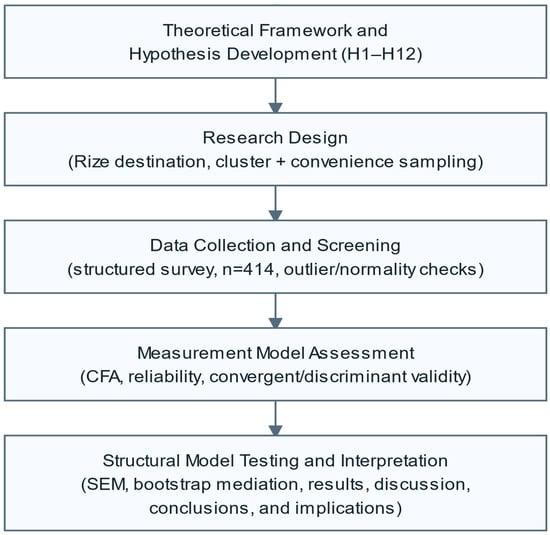
Figure 1.
Research flow diagram.
2. Theoretical Framework
2.1. Social Exchange Theory and Benefit–Cost Perception in Tourism
SET has been one of the primary frameworks used to explain local residents’ attitudes toward tourism development [3]. The core premise of this theory is that individuals evaluate tourism based on the balance between perceived benefits and costs, and that their level of support tends to increase when expected benefits outweigh anticipated costs [3,11,12]. In tourism research, this logic is widely used to explain why local residents support or oppose tourism development based on their perceptions of economic, sociocultural, and environmental outcomes. Within this perspective, support for tourism is generally viewed as the result of a rational evaluation process. Local residents who perceive tourism as a factor that provides employment, income, infrastructure improvements, or other social benefits tend to support further tourism development, while those who associate tourism with traffic congestion, social disruption, price increases, or environmental degradation tend to resist it. Therefore, SET has provided a useful foundation for understanding local residents’ attitudes in tourism planning and development.
However, SET does not fully explain why residents sometimes act cautiously even when tourism provides visible benefits, or why support may weaken despite positive economic expectations. Previous research indicates that support is typically shaped not only by change-based assessments but also by broader value orientations and issue-specific sensitivities [3,13,14,15]. Particularly in environmentally sensitive destinations, local residents may evaluate tourism not only in terms of net benefits but also in terms of whether those benefits are acceptable under environmental conditions. This limitation demonstrates that support for tourism cannot always be reduced to a simple cost–benefit calculation and that additional interpretive mechanisms are needed to explain how local residents translate the impacts they perceive into support.
Although previous studies have incorporated EC into models of residents’ STD, these approaches have predominantly treated EC within a linear causal framework, either as a direct predictor or as a mediating or moderating variable. In such models, EC functions as a transmission mechanism through which the effects of perceived tourism impacts are either amplified or attenuated, without fundamentally altering the underlying meaning of those impacts. In contrast, the present study conceptualizes EC not as a variable that merely transmits effects, but as a transformative cognitive mechanism that fundamentally reshapes how tourism impacts are interpreted. Rather than influencing the strength or direction of relationships, EC operates at a deeper level by redefining the meaning attributed to perceived impacts (particularly negative one) through value-based and normative filters. This implies a shift from a variable-centered explanation of “how much” effect is transmitted to a process-oriented explanation of “how” and “why” impacts are cognitively reconstructed.
Therefore, unlike existing integrative models that rely on additive or interaction-based logic, the proposed framework suggests that residents’ STD emerges through a process of cognitive reinterpretation. In this process, environmental values do not simply modify relationships between variables; they redefine the perceived acceptability and significance of tourism impacts themselves. This perspective provides a stronger theoretical explanation for why negative impacts do not consistently lead to opposition, thereby extending the explanatory boundaries of both Social Exchange Theory (SET) and sustainability-oriented approaches.
2.2. NEP and Environmental Concerns: Values That Transform Rationality
In the context of sustainable tourism, the local population’s sensitivity to environmental values and level of EC can significantly reshape the cost–benefit analysis of tourism [16]. In this regard, the New Environmental Paradigm (NEP) offers an important theoretical framework that explains individuals’ fundamental beliefs regarding the human—nature relationship [17]. The NEP defines individuals’ environmental worldview based on assumptions such as the finiteness of nature, the fragility of ecological balance, and the questioning of humanity’s absolute dominance over nature. Within this framework, it is natural for there to be differing value orientations among local communities regarding the priority of environmental protection versus economic development. Indeed, the literature demonstrates that these value differences significantly influence attitudes toward and levels of STD [5,6,18].
EC, on the other hand, refers to individuals’ sensitivity to environmental issues and the perceived risk levels associated with these issues [19]. Individuals with high EC consider not only the economic benefits but also the environmental acceptability of such benefits when evaluating development processes such as tourism. This suggests that even if tourism offers significant economic benefits, support may wane if environmental costs exceed certain thresholds [20]. Consequently, the simple cost–benefit balance predicted by Social Change Theory is reinterpreted through the lens of environmental values.
In this context, EC functions not merely as an additional variable directly determining support for tourism, but as an interpretive mechanism that shapes how perceived impacts are evaluated. In other words, individuals question not whether tourism is beneficial, but whether these benefits are environmentally acceptable. This situation forms the theoretical foundation of the approach conceptualized in the literature as “conditional support” [2]. According to this, local communities do not outright oppose tourism; rather, they condition their support on the fulfillment of sustainability criteria.
On the other hand, holding environmental values does not imply opposition to tourism. On the contrary, since the sustainable tourism approach aims to balance environmental protection with economic benefits, individuals with high EC may support such tourism developments more strongly [1,21]. In this context, integrated approaches (e.g., SUS-TAS) that address economic and social impacts alongside environmental attitudes highlight the transformative role of environmental values in local communities’ assessments of tourism [21].
Environmental values and ECs are not merely factors that strengthen or weaken local communities’ attitudes toward tourism; they provide a fundamental framework that determines under what conditions these attitudes emerge. Therefore, in sustainable tourism planning, taking local communities’ environmental values into account requires a more inclusive assessment that goes beyond approaches based solely on economic rationality [22,23,24].
2.3. Stakeholder Theory and the Multi-Stakeholder Perspective in Sustainable Tourism
Sustainable tourism, by its very nature, requires a multi-stakeholder planning and management process [25]. Stakeholder Theory emphasizes the need to jointly assess and balance the interests of the various actors affected by or influencing the tourism development process [26]. This approach highlights that tourism development should be addressed not solely through economic outcomes but within the framework of the values, expectations, and priorities of different stakeholder groups.
In this context, local communities are among the most critical stakeholder groups in tourism destinations because they directly experience the economic, social, and environmental impacts of tourism. From the perspective of Stakeholder Theory, involving local communities in tourism planning and management processes not only increases participation but also shapes the level of support for tourism [27]. Indeed, it is widely accepted in the literature that stakeholder participation is a fundamental element for the success of sustainable tourism [28,29].
One of the fundamental assumptions of the stakeholder approach is that different groups assess the impacts of tourism in various ways based on their own interests and values [30]. This indicates that perceptions of tourism are not homogeneous and that supportive behavior cannot be explained by a single-dimensional rationality. For example, while actors benefiting economically from tourism tend to emphasize positive impacts, stakeholders sensitive to environmental values may assess the same development through the lens of environmental risks [31]. This differentiation lays the groundwork for support for tourism to take shape depending on the circumstances.
From the perspective of this study, the fundamental contribution of Stakeholder Theory is that it demonstrates that local communities’ assessments of tourism are not based on a uniform cost–benefit logic but rather on value-based differences. In this context, stakeholder groups with high EC can link their support for tourism to sustainability conditions, thereby reinforcing the concept of “conditional support” [32,33]. Consequently, support for tourism emerges not solely based on the magnitude of perceived benefits, but on the conditions under which these benefits are deemed acceptable. Stakeholder Theory, within the theoretical framework proposed in this study, offers a complementary perspective that explains why local communities’ attitudes toward tourism are not homogeneous and why support behavior exhibits a conditional structure. This approach demonstrates that considering the values and expectations of different stakeholder groups in sustainable tourism planning is critical for achieving lasting and balanced tourism development.
2.4. The Concept of Conditional Support
When examining local residents’ attitudes toward tourism development, it becomes evident that their support often exhibits a conditional structure rather than a simple pro-tourism versus anti-tourism dichotomy [34,35,36]. Conditional support indicates that individuals are not fundamentally opposed to tourism, but that their support is contingent upon certain criteria being met. In this context, the local population’s attitudes of “I support tourism, but…” point to the contextual and situational nature of evaluations regarding tourism. These conditions typically revolve around elements such as the fair distribution of economic benefits, the mitigation of environmental impacts, and the preservation of quality of life [19,37,38].
There are significant empirical findings in the literature regarding the existence of conditional support [1,39]. For example, a study conducted by Raymond and Brown in Australia revealed that the vast majority of the local population supports tourism not unconditionally, but under specific conditions [10]. More importantly, it has been shown that this conditionality is related not only to structural factors such as spatial proximity but also to how individuals perceive the outcomes of tourism. This finding indicates that support is shaped by the nature of perceived impacts rather than geographical location. However, a significant portion of existing studies addresses conditional support indirectly and, in particular, models EC primarily as a mediating or moderating variable. This approach leads to the relationship between tourism impacts and support being treated as a linear, transmission-based process. In contrast, the phenomenon of conditional support goes beyond this linear framework and is related to how individuals reinterpret tourism impacts. Therefore, conditional support should be treated not merely as an outcome variable but as the output of a perceptual and value-based reevaluation process.
At this point, the cost–benefit balance, as examined within the framework SET, emerges not as a fixed evaluation mechanism but as a dynamic structure that reshapes itself depending on conditions. Even if local communities accept the potential economic benefits of tourism, they may withdraw their support when these benefits are not balanced by environmental or social costs. Indeed, some studies indicate that individuals who benefit economically from tourism perceive negative impacts less acutely, whereas those exposed to environmental costs are more sensitive to these effects [8,9]. This situation reveals that support is not a fixed attitude but rather a process that varies depending on the individual’s position and perceptions.
The role of EC in the formation of conditional support constitutes a particularly critical dimension. Individuals with high EC tend to accept tourism within certain normative boundaries rather than rejecting it entirely. This approach corresponds to an evaluation framework that can be summarized as “tourism is acceptable, provided the environment is protected” [19]. For example, in the context of Rize, individuals who place high value on the protection of natural areas may support eco-friendly tourism types while opposing mass tourism projects that could lead to ecological damage. This situation demonstrates that EC serves not merely as an effect variable but also as a cognitive framework that redefines the meaning and acceptability of tourism. Similarly, the level of local residents’ participation in decision-making processes is also a key determinant of conditional support. From the perspective of stakeholder theory, involving individuals in decision-making processes enhances a sense of ownership regarding tourism projects; conversely, a perception of exclusion can lead to a weakening of conditional support or its transformation into resistance. In this context, conditional support reflects not only individual assessments but also governance processes.
The phenomenon of conditional support demonstrates that local communities’ attitudes toward tourism development cannot be explained by a reductive dichotomy of support versus opposition. This study aims to theoretically ground the cognitive and value-based mechanisms underlying conditional support, rather than treating it merely as an empirical observation. In this vein, EC is treated not merely as a mediating variable but as a mechanism that transforms the way tourism impacts are interpreted; thus, a holistic explanation that goes beyond existing linear models is presented. This approach points toward more dynamic and context-sensitive policy development processes that take into account the expectations and sensitivities of local communities in the context of sustainable tourism management.
2.5. Hypothesis Development
SET is one of the most widely used theoretical frameworks for explaining residents’ attitudes toward tourism development, positing that individuals evaluate development processes by comparing perceived benefits against perceived costs [3]. Within the tourism context, this perspective suggests that residents are more likely to support tourism development when the economic, social, and infrastructural benefits outweigh the perceived negative impacts. A substantial body of empirical research consistently demonstrates that individuals who directly benefit from tourism exhibit more favorable attitudes toward tourism development and higher levels of support [14,40,41,42].
However, beyond this general proposition, SET also implies that benefit perception operates through multiple cognitive and evaluative pathways. In this regard, deriving personal benefits from tourism (e.g., income, employment, or improved living standards) plays a foundational role in shaping how individuals interpret tourism-related outcomes. First, individuals who benefit economically from tourism are more likely to evaluate tourism as improving their overall quality of life, which increases their level of satisfaction with tourism development [3,14]. Satisfaction, in turn, functions as an affective evaluation of tourism outcomes and reflects the extent to which tourism meets residents’ expectations.
Second, personal benefit is expected to influence the mechanisms of perception formation. Individuals who benefit from tourism tend to cognitively emphasize positive outcomes (e.g., economic growth, infrastructure development) while downplaying negative consequences, a pattern widely observed in SET-based tourism studies [11,14]. Accordingly, benefit-driven individuals are more likely to perceive tourism impacts as positive.
At the same time, SET does not assume that individuals completely ignore costs; rather, it suggests that perceived benefits may increase tolerance toward negative impacts. In other words, individuals who benefit from tourism may still recognize negative impacts (e.g., congestion, environmental degradation), but these impacts are interpreted as more acceptable or manageable [43,44]. This explains why personal benefit may also be positively associated with the perception of negative impacts, not because such impacts are denied, but because they are cognitively integrated into a tolerable cost framework.
Finally, since personal benefit enhances both satisfaction and positive perceptions of impacts (two key determinants of support in SET), it is expected to have a direct positive effect on STD as well [3,11,14].
Based on these theoretically grounded mechanisms, the following hypotheses are proposed:
H1.
Deriving personal benefit from tourism development positively affects local community satisfaction.
H2.
Deriving personal benefit from tourism development positively affects perceived negative tourism impacts.
H3.
Deriving personal benefit from tourism development positively affects perceived positive tourism impacts.
H4.
Deriving personal benefit from tourism development positively affects STD.
In the SET literature, local residents’ STD is explained not only through perceptions of direct benefits but also through how these benefits reflect on individuals’ overall life satisfaction. Indeed, the approach outlined by Ap [3] emphasizes that individuals’ tendency to support tourism is based on their assessments of whether tourism enhances their own quality of life. Within this framework, the economic, social, and infrastructural gains derived from tourism are considered a critical inter e mechanism in the emergence of supportive behavior, as they enhance individuals’ life satisfaction. Similarly, Nunkoo and Ramkissoon [14] empirically demonstrate that local residents’ STD is shaped not so much by direct perceptions of benefits but rather by the overall level of satisfaction these benefits generate.
On the other hand, perceptions of tourism’s positive effects are also a key determinant of supportive behavior. The perception of positive effects such as economic growth, increased employment, cultural revitalization, and infrastructure development leads individuals to view tourism as a more legitimate and desirable tool for development [45]. This situation demonstrates that the “perceived net benefit” in the rational evaluation process predicted by SET is shaped not only by individual gains but also by positive outcomes perceived at the societal level. Consequently, individuals’ high perception of tourism’s positive effects both increases their overall satisfaction levels and directly strengthens supportive behavior toward tourism development.
When this theoretical framework is considered together, it becomes evident that the local residents’ STD is shaped through two primary mechanisms: (i) general satisfaction arising from tourism’s contribution to quality of life, and (ii) the positive perception of tourism’s economic, social, and cultural outcomes. Accordingly, it is assumed that both satisfaction and the perceived positive effects play a decisive role in support behavior. Based on these theoretical grounds, the following hypotheses have been developed [3,14,45]:
H5.
Local community satisfaction positively affects STD.
H6.
Perceived positive tourism impacts positively influence STD.
The sustainable tourism literature demonstrates that local residents’ attitudes toward tourism development cannot be explained solely by a cost–benefit balance. Especially in destinations with high EC, individuals consider environmental values and long-term ecological risks beyond economic returns when evaluating tourism development [16,20,21]. This situation limits the linear rationality predicted by the classical Social Change Theory (SET) and necessitates the inclusion of normative factors in the model.
At this point, NEP offers a critical framework for explaining individuals’ fundamental worldviews regarding the human-nature relationship [17]. According to the NEP approach, individuals with high sensitivity to environmental values adopt more cautious attitudes toward development-oriented activities when an environmental threat is perceived, even if economic benefits are high [16,20,21]. Consequently, the impact of tourism’s perceived effects on individuals’ levels of EC plays a decisive role in shaping overall evaluations of tourism.
First, the perceived positive effects of tourism (e.g., economic development, infrastructure development, and improved quality of life), while generally reinforcing supportive attitudes, can also increase awareness of the pressure on natural resources within the context of sustainability. The literature emphasizes that the intensified use of environmental resources accompanying tourism development can trigger EC in individuals [13,20,41]. Therefore, it is anticipated that the positive effects of tourism may play a role in increasing environmental anxiety.
In this regard:
H7.
Perceived positive effects of tourism positively influence environmental concern.
Second, the perceived negative effects of tourism (e.g., environmental degradation, overcrowding, resource consumption, and social issues) are factors expected to directly reduce support levels according to the classical SET approach [3,14,42]. However, the sustainable tourism literature indicates that this relationship does not always occur directly and that how individuals interpret these negative effects is decisive [8,9,10]. In particular, negative effects perceived as environmental threats may influence support for tourism indirectly through EC rather than directly reducing it.
Therefore, it is important to test the direct effect of perceived negative impacts on support:
H8.
Perceived negative effects of tourism negatively influence STD.
Furthermore, the literature clearly demonstrates that the negative impacts of tourism increase individuals’ levels of EC. Factors such as environmental degradation, pollution, and the overexploitation of natural resources reinforce individuals’ perception of environmental threats and increase their sensitivity toward the environment [19,20,22,23,24]. Therefore, it is expected that negative impacts function as a mechanism that increases EC:
H9.
Perceived negative impacts of tourism positively influence environmental anxiety.
Finally, the effect of environmental anxiety levels on support for tourism is one of the central areas of discussion in NEP and sustainable tourism literature. Individuals with high EC evaluate tourism activities not only in terms of economic benefits but also based on environmental sustainability criteria, and shape their support accordingly [16,17,20]. In this context, EC emerges as a limiting or conditioning factor for support toward tourism development.
Therefore:
H10.
Environmental concern significantly influences STD.
It is increasingly accepted in the literature that local residents’ STD is not a linear or automatic process, but rather is shaped by specific conditions. This approach is particularly addressed within the framework of the concept of “conditional support” and argues that individuals’ attitudes toward tourism are determined not only by the perceived cost–benefit balance but also by how these effects are interpreted [8,9,10]. In this context, perceived negative impacts do not necessarily lead to a direct decrease in support in every situation; rather, support is limited when these impacts are perceived as an environmental threat. Consequently, the relationship between negative impacts and support is not direct but occurs indirectly through individuals’ level of EC [8,9].
Similarly, even when the positive effects of tourism are perceived, local community support does not emerge unconditionally if these effects are perceived as conflicting with environmental values. In particular, individuals sensitive to environmental values, while acknowledging economic and social benefits, argue that these benefits must align with sustainability principles [9,10]. This situation leads to the re-evaluation of even perceived positive impacts through the lens of EC and demonstrates that support behavior is shaped through this normative filter.
This theoretical framework reveals that EC is not merely an independent attitude variable but also a critical mediating mechanism that transforms the relationship between perceived tourism impacts and support. Consequently, it is expected that the influence of both perceived negative and positive impacts on local residents’ STD occurs not directly but indirectly through EC. In this context, the following mediation hypotheses have been developed:
H11.
Environmental concern mediates the relationship between perceived negative tourism impacts and STD.
H12.
Environmental concern mediates the relationship between perceived positive tourism impacts and STD.
These hypotheses will test an integrated framework that enriches the rational core assumptions of Social Change Theory with the transformative effect of environmental values and the decisive role of stakeholder participation. Thus, the perspective of the local community living in Rize on sustainable tourism can be understood by considering both individual cost–benefit calculations and the social and environmental context in which they live. This theoretical approach aims to make a significant contribution to the sustainable tourism literature by addressing existing gaps and combining established concepts in novel ways. In the following section, the research methodology and findings related to testing these hypotheses will be discussed.
3. Research Design
3.1. Research Area
In the current study, the local population living in the Rize destination has been defined as the population. Rize’s natural and geographical features, along with its rapidly growing tourism potential in recent years, have made it a noteworthy destination. For example, in 2023, the number of tourists visiting Rize reached 1,341,996; 1,196,054 of these visitors were domestic tourists, and 145,942 were foreign tourists [46]. Rize has a total of 3 five-star, 1 four-star, 11 three-star, 4 two-star, and 2 one-star hotels [47]. Additionally, bungalows and small-scale guesthouses located in districts closely associated with tourism, such as Çamlıhemşin, attract significant interest from tourists visiting the region [48]. There are a total of 122 tourism businesses licensed by the municipality and the ministry in Rize. These accommodation facilities have 2920 rooms and a capacity of 5986 beds. The aforementioned tourism facilities are expanding day by day to meet the needs and expectations of tourists visiting Rize. Infrastructure plays a crucial role in the choice of a destination and in satisfying the tourists who visit it [49].
In addition to its geography and natural beauty (meadows, valleys, forests, streams, and tea gardens), Rize’s local cuisine and cultural values attract both domestic and international tourists [48,50,51,52,53]. Rize offers its visitors unique experiences, particularly in the areas of highland tourism and nature-ecotourism; the local community plays a decisive and indispensable role in delivering these experiences and ensuring the sustainability of tourism [52]. It is well known that within the tourism sector, the local community holds a central position in social and economic life, not only through agriculture and tea production but also through tourism activities. The active involvement of the local community in areas such as tourism investments, accommodation services, guiding, food and beverage, transportation, and cultural services increases economic diversity and directly contributes to the sustainability of tourism [54]. Therefore, identifying the local community living in Rize as the study population provides an opportunity to observe the social impacts of tourist activities in a holistic manner.
3.2. Scales Used in the Research
A six-variable measurement model was developed for the study. The measurement model is presented in Figure 2. Scales found in the literature were used to measure the six variables specified in the measurement model. A questionnaire consisting of two sections was designed. The first section measures the research variables, while the second section collects demographic information regarding the participants’ gender, age, marital status, education level, and income level. All items were evaluated on a 5-point Likert scale (1 = strongly disagree → 5 = strongly agree).
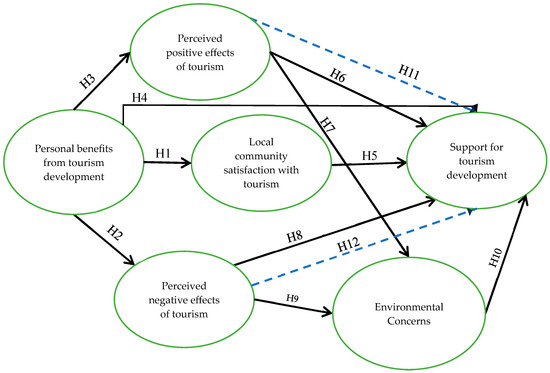
Figure 2.
Conceptual Model.
The Perceived Positive and Negative Effects of Tourism, Personal Benefits from Tourism Development, Local Community Satisfaction with Tourism Development, and Attitudes Toward Supporting Tourism Development were measured using a scale adapted by Ekici and Çizel [55]. Ekici and Çizel [55] developed this scale by drawing on studies conducted by Andereck and Vogt [56], Hong Long [57], Yoon et al. [58], Chen and Chen [59], Long and Kayat [60], Dyer et al. [61], Oviedo-Garcia et al. [62], Ritchie and Inkari [63], Altunel [64], Vargas Sánchez et al. [65], Wang et al. [66], and Çavuş and Tanrısevdi [67]. The scale has previously been applied in the same research region and validated within the local linguistic and cultural context. This supports contextual equivalence and strengthens the validity and reliability of the present study’s measurements [54].
The EC scale, which was treated as a mediating variable in the study, includes 8 statements (environment-focused) adapted from the NEP Scale by Dunlap and Van Liere [68] and revised by Dunlap et al. [17]. The scale has been used in Turkey by Furman [69], and its construct validity was tested by Aytaç and Öngen [70]. In this study, the adapted version of the EC scale, which has undergone construct validity testing, was used.
Google Forms were used to administer the surveys. This saved dozens of sheets of paper that would have been wasted as physical output. This indirectly contributes to sustainability by preventing the cutting of many trees, a factor considered in many studies. Furthermore, participant consent was obtained before creating the e-survey form. The questions in the study, which were distributed to the local community in Rize via e-survey, were designed so that they could not be submitted unless fully completed. This resulted in 416 usable surveys.
3.3. Data Collection
The population of this study consists of all local residents living in Rize Province. According to 2024 data, Rize’s total population is 346,977, of which 173,525 are male and 173,452 are female [71]. The population distribution by district in Rize is presented in Table 1. The questionnaire developed for this study was administered to the local population living in Rize in December 2025. During the sampling process, convenience sampling was used in conjunction with cluster sampling and non-probability sampling methods [72,73,74]. Since the data used in the study are primary data, the necessary ethical approval was obtained via Decision No. 2025/1738 of the Recep Tayyip Erdoğan University Ethics Committee.

Table 1.
Population Distribution of Rize by District (2024 data).
An online survey was chosen as the primary data collection method, and participants were reached through multiple communication channels. In this context, the survey link was distributed to relevant local groups via neighborhood representatives; additionally, participants’ access to the survey was encouraged through telephone calls, mobile messaging apps, and in-person outreach. Furthermore, to ensure that individuals with limited digital access or those who preferred not to complete the survey online could be included in the study, direct interviews were conducted with participants. Survey questions were posed verbally within a standardized framework, and the responses were simultaneously recorded as an e-survey in a digital format using tablet devices. This approach aims to ensure consistency in the data entry process and minimize measurement errors. Additionally, it contributed to increasing sample diversity by including individuals of different ages and socio-demographic characteristics in the study. However, conducting the data collection process in this manner does not completely eliminate the risks of potential mode effects and coverage bias. Therefore, these limitations must be taken into account when interpreting the findings.
In cluster sampling, the population is divided into sub-clusters based on natural and geographical characteristics [74]. Accordingly, all districts under the province of Rize, which constitute the study population, were accepted as natural clusters and included in the sampling process without any cluster selection. There are a total of 12 settlements in the province of Rize, including the central district [75]. Within this scope, the data collection process was conducted among individuals residing in Ardeşen, Pazar, Fındıklı, Hemşin, Çamlıhemşin, Çayeli, Güneysu, İkizdere, Kalkandere, İyidere, Derepazarı, and the provincial center. The target number of participants to be reached in each cluster was determined proportionally, taking into account the population sizes of the relevant districts. However, due to time and access constraints, convenience sampling was preferred when reaching participants within each cluster. In this context, the survey link was distributed to participants through neighborhood representatives via telephone, mobile applications, and face-to-face interviews.
The combined use of these two methods offers advantages in terms of time and cost, particularly in large and dispersed populations [76,77]. The cluster sampling method ensured that settlements with diverse geographic and sociodemographic characteristics were included in the sample, thereby enhancing the reliability of the findings [77]. However, the convenience sampling method applied within clusters increases the risk of selection bias compared to probability-based sampling techniques and may limit the statistical representativeness of the sample. Therefore, the generalizability of the findings should be interpreted by considering the structural characteristics of the sample and the nature of the data collection process.
A total of 416 questionnaires were collected for the study. The collected data were analyzed using the SPSS 24 software package, and outliers were identified by calculating Mahalanobis distances. Questionnaires numbered 240 and 250, which violated the normality assumption, were excluded from the dataset, and the analyses were continued based on 414 valid questionnaires [42]. The literature indicates that a minimum sample size of 384 is sufficient at a 95% confidence interval for populations in the 250,000–500,000 range. Considering Rize’s population of 346,977, the 414 observations obtained can be considered sufficient for the analyses [71,78,79].
Statistical information regarding the demographic characteristics of the study participants has been analyzed. According to the data, 49% of the participants were women and 51% were men. The majority of participants were married (59.2%). Looking at the age distribution, most participants were concentrated in the 21–30 (29%), 31–40 (29%), and 41–50 (29.2%) age groups, while 8% were aged 51 and older. In terms of educational background, a significant portion of participants were university graduates (60.4%), followed by high school graduates (20.8%), while those with master’s or doctoral degrees accounted for 10.4%. In terms of income, 26.3% of participants had an income of 50,001 TL or more, followed by 23.2% with an income of 22,104 TL or less. When evaluating the length of time participants had lived in Rize, it is noteworthy that the majority had lived in the region for 25 years or more (42.3%). Furthermore, 59.4% of participants answered “yes” to the question “Do you interact with tourists?”, while 40.6% answered “no.” This indicates that the majority of the local population living in Rize interacts directly with tourists.
Figure 3 shows the distribution statistics of the collected data by district. According to this information, the highest participation rate is from Rize Center (24.9%), followed by Ardeşen (15.9%) and Çayeli (15.5%). This information is consistent with the distribution in Table 1.
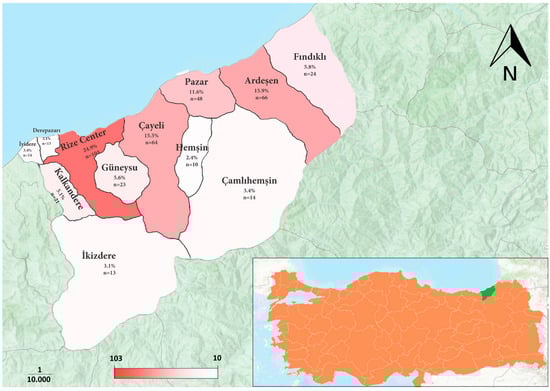
Figure 3.
Distribution Statistics by District. Source: Elaborated by the authors based on publicly available population statistics obtained from official sources [71].
3.4. Reliability and Validity Findings
To determine whether the distributions of the variables included in the study are statistically normal, it was examined whether each variable separately and all variables together conform to a normal distribution [73]. In this context, the values of kurtosis and skewness were used to evaluate the normality assumption. As stated by Hair, Black, Babin, and Anderson [42], values of ±2.58 at a 0.05 significance level and ±1.96 at a 0.01 significance level were accepted as reference limits. Accordingly, the kurtosis and skewness coefficients for the scales used in the study are presented in Table 2.
Table 2.
Kurtosis and Skewness Values.
It is observed that the kurtosis values for the Perceived Positive Impacts of Tourism scale range from −1.165 to 1.565, while the skewness coefficients range from −1.628 to 0.217. In the Perceived Negative Impacts of Tourism scale, the kurtosis values were found to be between −1.005 and 0.210, while the skewness values were between −1.104 and 0.578. In the Personal Benefit from Tourism Development scale, the kurtosis values ranged from −1.304 to −0.732, while the skewness values ranged from −0.017 to 0.671. In the Local People Satisfaction with Tourism Development scale, the kurtosis coefficients ranged from −0.948 to −0.308, while the skewness values ranged from −0.794 to −0.188. In the STD scale, the kurtosis values were found to be between −0.364 and 0.050, while the skewness values ranged from −0.977 to −0.820. For the EC scale, the kurtosis values ranged from −1.085 to 2.235, while the skewness values ranged from −1.829 to −0.172.
Overall, the kurtosis and skewness values fall within the acceptable thresholds suggested by Hair et al. [42], indicating that the normality assumption is satisfied (see Table 2). This suggests that the distributional properties of the data are compatible with the requirements of covariance-based SEM, thereby strengthening the robustness and credibility of the subsequent model estimations.
In this study, factor analysis was used to determine the construct validity of the variables. Factor analysis is generally categorized into two main types: exploratory factor analysis and confirmatory factor analysis. Exploratory factor analysis is a method used to identify the dimensions under which the items of a newly developed scale are grouped. Therefore, it is recommended that exploratory factor analysis be conducted first in the scale development process. In confirmatory factor analysis, which constitutes the second stage, structural validity is again evaluated; however, in this case, the dimensions of the scale and the structures to which the items belong have been determined beforehand, and the aim is to validate these structures [42,72].
In this context, confirmatory factor analysis was employed in the study. This choice was based on the fact that the scales measuring the six core variables (PPIT, PNIT, PBTD, LSTD, STD, and EC) are well-established and validated instruments in the literature.
Table 3 presents the statistical results related to the measurement model. The literature states that the lowest factor loading should be 0.50 or higher [42]. As a result of the confirmatory factor analysis performed using the AMOS 24 software package, the sixth item of the EC variable was excluded from the analyses because it remained below the 0.50 factor loading threshold. The factor loadings of the other variables are above the threshold value (0.50), as shown in Table 3. Upon examining the relevant table, it was determined that the lowest AVE value belonged to the EC dimension (0.512), while the highest AVE value was observed in the STD dimension (0.864). The fact that all AVE values obtained were above the minimum acceptable level of 0.50 specified by Hair et al. [42] indicates that the structures can be adequately explained. When examining the CR values, it was found that the lowest structural reliability value belonged to the PBTD variable (0.858), while the highest CR value was in the STD dimension (0.962). All of these values were above the recommended minimum CR level of 0.70 [42].
Table 3.
Confirmatory factor analysis and reliability analysis.
When examining Cronbach’s Alpha coefficients to determine the internal consistency of the scales, it was determined that the lowest value was in the PBTD scale (0.855) and the highest value was in the STD variable (0.962). All these values being above the minimum threshold of 0.70 indicates that the scales are sufficiently reliable [42,80].
Since the CR and AVE values obtained from the confirmatory factor analysis were at an acceptable level, it can be stated that the convergent validity of the variables included in the study was achieved. Furthermore, the fact that the squares of the correlations between the latent variables in the model were lower than the AVE values of the relevant variables indicates that discriminant validity was achieved.
The CFA fit indices for the overall model were calculated as follows: χ2/df = 2.951, AGFI = 0.807, CFI = 0.925, RMSEA = 0.069, GFI = 0.839, and TLI = 0.915. These results indicate that most fit indices fall within acceptable thresholds suggested in the literature. However, it should be noted that GFI and AGFI values are close to the lower acceptable limits. This suggests that the model demonstrates an acceptable, though not perfect, level of fit. The fact that the distribution characteristics of the dataset do not lead to any violations in subsequent analyses and satisfy the model assumptions indicates that the model is consistent with the observed data.
Given that the data in this study were collected from a single source using a self-reported questionnaire, the potential risk of common method bias was carefully considered. Several procedural remedies were applied to minimize this risk. First, respondents were assured of anonymity and confidentiality, reducing evaluation apprehension and social desirability bias. Second, items measuring different constructs were presented in a mixed and non-sequential order to create psychological separation between variables. Third, previously validated scales were used to reduce ambiguity and measurement error. However, as with all cross-sectional and self-reported data, the possibility of residual method bias cannot be entirely ruled out.
Table 4 presents the goodness-of-fit criteria used for evaluating the CFA and SEM models based on established thresholds in the literature.
Table 4.
SEM and CFA goodness-of-fit indices.
The correlation analysis presented in Table 5 indicates that there are generally positive and significant relationships among the variables; however, these relationships are shaped at different levels and through theoretical mechanisms. In particular, the strong relationships between PPIT and LSTD (r = 0.627, p < 0.01) and STD (r = 0.664, p < 0.01) support the notion that individuals make evaluations based on their perception of benefits within the framework of Social Change Theory (SET). Similarly, the moderate correlations between PBTD and both satisfaction (r = 0.472, p < 0.01) and support (r = 0.465, p < 0.01) highlight the decisive role of individual gains in shaping attitudes. The high correlation between LSTD and STD (r = 0.714, p < 0.01) indicates the conceptual proximity of these two variables and suggests that supportive behavior is largely shaped through satisfaction. In contrast, the absence of a significant relationship between PNIT and PBTD (p > 0.05) indicates that individuals do not directly consider negative effects in their benefit assessments.
Table 5.
Correlation coefficients.
Furthermore, the strong relationship between PNIT and EC (r = 0.519, p < 0.01) and the moderate association between EC and tourism support (r = 0.496, p < 0.01) highlight the transformative role of environmental values in shaping attitudes. These findings indicate that, within the NEP framework, EC conditions support for tourism.
Table 5 also presents the mean scores for the variables included in the study. Upon examining the mean values, it is observed that the lowest mean belongs to the PBTD variable (Mean = 2.735). In contrast, it was determined that the highest mean value belongs to the EC variable (Mean = 3.810). When the means of the other variables are evaluated, they can be ranked as PNIT (Mean = 3.122), LSTD (Mean = 3.256), PPIT (Mean = 3.508), and STD (Mean = 3.709). These results indicate that participants’ perceptions of the positive effects of tourism, support for tourism, and environmental awareness are relatively higher.
4. Hypothesis Testing
4.1. Direct Effect Analysis Results
SEM enables the simultaneous testing of direct and indirect effects between variables through models created within the scope of the research [81]. Accordingly, SPSS 26 and AMOS 24 programs were used to test the model developed for the current research [89]. Kline’s classification [90] was used to evaluate the effect levels of the hypotheses tested in the study. Accordingly, standardized coefficients (β) at the 0.10 level are interpreted as low, those at approximately the 0.30 level as medium, and those above 0.50 as high effect size.
Furthermore, the criteria proposed by Kline [90] were also considered in evaluating the R2 values that reveal the explanatory power of the variables included in the model. Accordingly, R2 values below 0.01 are considered low, around 0.10 are considered moderate, and above 0.30 are considered high levels of explanatory power. Within this scope, the SEM results related to the hypotheses developed in the study are presented in detail in Table 6.
Table 6.
SEM Results.
The structural model results presented in Table 6 indicate that PBTD has a significant and substantial positive effect on LSTD (β = 0.549, t = 8.888, p < 0.001), supporting H1. This finding suggests that residents who derive economic and functional gains from tourism tend to internalize these benefits as improvements in their overall well-being, thereby enhancing their satisfaction with tourism development. In line with Social Exchange Theory, this result confirms that perceived benefits are not only cognitively evaluated but also translated into affective responses. Additionally, PBTD has a positive and statistically significant, albeit relatively weaker, effect on PNIT (β = 0.112, t = 2.02, p < 0.05), supporting H2. This finding indicates that individuals who benefit from tourism do not necessarily ignore its negative consequences; rather, they may recognize such impacts but interpret them as tolerable within a broader framework of benefits.
Furthermore, personal benefit exerts a strong positive influence on PPIT (β = 0.453, t = 7.691, p < 0.001), supporting H3. This result suggests that individuals who benefit from tourism are more likely to cognitively emphasize and reinforce positive outcomes such as economic growth and infrastructure development, which aligns with the perception formation mechanisms proposed by SET.
Finally, PBTD has a positive and significant effect on STD (STD) (β = 0.158, t = 3.504, p < 0.001), supporting H4. However, the relatively lower magnitude of this effect compared to its influence on satisfaction and perception variables suggests that support is not shaped solely by direct benefit considerations but may also be influenced by additional mediating or normative factors.
The results of the structural model indicate that local residents’ tendencies to support tourism development exhibit a multidimensional structure. First, a positive and significant relationship was found between LSTD and STD (β = 0.459; p < 0.001). This finding indicates that satisfaction is one of the key determinants of support behavior and validates the benefit-based evaluation mechanism predicted within the SET framework (H5 is supported). PPIT has a strong effect on both tourism support (β = 0.296; p < 0.001) and EC (β = 0.577; p < 0.001), indicating that this variable plays a central role in the model. In particular, its high impact on EC indicates that positive effects are perceived not only through economic and social channels but also through environmental awareness (H6 and H7 are supported).
In contrast, the direct effect of PNIT on tourism support was not found to be statistically significant (β = −0.040; p > 0.05). This suggests that negative effects do not directly weaken support but may operate through indirect mechanisms (H8 is rejected). Indeed, the positive and significant effect of PNIT on EC (β = 0.415; p < 0.001) reveals that negative effects gain significance particularly through EC (H9 is supported). Finally, while the effect of EC on tourism support is positive and significant, it is relatively limited (β = 0.164; p < 0.01). This finding indicates that support for tourism is shaped not only by economic benefits but also by environmental values, though this effect plays a more indirect and complementary role (H10 is supported).
When examining the overall fit values of the model (χ2/df = 3.320; CFI = 0.909; TLI = 0.900; RMSEA = 0.075), it is seen that the model has acceptable levels of fit. When examining the explained variance values, R2 = 0.205 for PPIT, R2 = 0.012 for PNIT, R2 = 0.302 for LSTD, R2 = 0.631 for STD, and R2 = 0.529 for EC were found. These results indicate that the model explains the tourism development support variable to a high degree.
4.2. Indirect Effect Analysis Results
To examine the mediating role of the EC variable, the bootstrap confidence interval approach was employed in the study. As noted in the literature, this method is considered one of the most reliable and accurate techniques for evaluating the mediating effect under various research conditions [91]. In this context, a bootstrap confidence interval-based mediation test was applied to determine the indirect effects of the variables in the study. Among bootstrap methods, the bias-corrected (BC) bootstrap technique was preferred [91,92]. In the BC bootstrap approach, the number of resampling must first be determined. Accordingly, 1000 resampling trials and a 95% confidence interval were used, as widely accepted in the literature [93]. Within the SEM framework, the classification proposed by Zhao et al. [94] was employed to evaluate the mediating effect and interpret the results. The findings regarding the mediating effect of the EC variable in the current study are presented in Appendix A.
Appendix A shows that the EC variable plays a significant mediating role in the relationships examined. First, it was determined that EC plays a significant mediating role in the effect of PPIT on STD (Indirect effect = 0.149; p = 0.002). The lower limit of the bootstrap confidence interval is 0.057 and the upper limit is 0.263, and there is no zero value within this interval. This finding indicates that EC exerts a significant mediating effect in the relationship between PPIT and STD [91]. Furthermore, the significance of the direct effect (Direct effect = 0.554; p = 0.003) in the relevant model suggests that complementary mediation is valid according to the classification by Zhao et al. [94]. In other words, while the direct effect of PPIT on STD persists, EC provides an additional indirect contribution to this relationship.
Similarly, EC was found to have a significant mediating role in the effect of PNIT on STD (Indirect effect = 0.104; p = 0.002). According to the bootstrap results, the lower confidence limit is 0.039 and the upper limit is 0.195, and zero is not included in this range. Therefore, it can be stated that EC has an indirect and significant effect on the relationship between PNIT and STD. However, the direct effect is found to be negative and significant (Direct effect = −0.114; p = 0.048). According to Zhao et al. [94], this finding is also classified as complementary mediation. In other words, while the direct effect of PNIT on STD shifts from negative to positive, EC produces an additional indirect effect that strengthens this relationship. In line with these results, it can be said that EC acts as an important psychological mechanism in the relationships between the perceived positive and negative effects of tourism and STD; individuals’ levels of sensitivity toward the environment play a decisive role in shaping supportive behaviors.
5. Discussion
The findings of this study indicate that local residents’ support for sustainable tourism development cannot be explained solely by the perceived benefit–cost balance; rather, it possesses a multi-layered and conditional structure. In particular, it has been established that perceived personal benefits and the positive effects of tourism significantly increase both local satisfaction and STD; conversely, perceived negative effects do not directly reduce support. Instead, it was determined that negative effects create an indirect impact by increasing EC. These results reveal that local community support is not a linear or automatic response, but rather a more complex process shaped within the framework of environmental values and sustainability sensitivities. In this regard, the study indicates that classical approaches must be transcended when explaining local community support [1,4].
The findings of H1–H6 evaluated within the SET framework are largely consistent with the fundamental assumptions in the literature. The fact that perceived personal benefits increase local satisfaction (H1) and have a positive effect on direct support (H3) indicates that individuals evaluate tourism within a rational decision-making process [3,14]. Similarly, the strong effect of tourism’s perceived positive impacts on both satisfaction (H2) and support (H4) reveals that the local population prioritizes economic and social gains [4]. Furthermore, the significant effect of local satisfaction on support (H6) indicates that satisfaction acts as a mediating mechanism and that exchange relationships within the SET framework are reinforced through emotional outcomes [12]. However, while the reduction in satisfaction due to perceived negative impacts (H5) is an expected outcome, the fact that this effect does not directly translate into supportive behavior also highlights the limitations of the classical SET approach [8,20].
The findings regarding H7–H10, examined within the EC and NEP frameworks, constitute the study’s original contribution. The finding that tourism’s positive effects increase EC (H7) indicates that local communities evaluate tourism not merely as an economic opportunity but also within the context of environmental responsibility [16]. More strikingly, the finding that perceived negative impacts significantly increase EC (H9) reveals that individuals develop a higher level of EC as they perceive environmental threats. This suggests that EC is not merely a cognitive evaluation but also a normative response. Indeed, the finding that environmental anxiety significantly increases STD (H10) suggests that individuals with high EC do not completely reject tourism-supporting behavior but rather reframe it under sustainability conditions [16,21].
When the findings of this study are evaluated collectively, although the model generally exhibits an acceptable level of fit (χ2/df, CFI, TLI, and RMSEA values fall within the limits recommended in the literature), the fact that some fit indices (particularly GFI and AGFI) are close to cutoff values and the very low explanatory power regarding the PNIT variable (R2 = 0.012) require careful theoretical consideration. At first glance, this may appear as a limitation of the model; however, it can also be interpreted as a theoretically meaningful finding.
Within the framework of SET, it is generally assumed that individuals’ perceptions of tourism impacts are shaped by benefit–cost evaluations. Nevertheless, the findings suggest that perceived negative impacts cannot be sufficiently explained through individual benefit-based mechanisms. This indicates that PNIT represents a distinct cognitive domain that is not primarily driven by personal benefit considerations, but rather by broader environmental values, risk perceptions, and contextual sensitivities. Indeed, the fact that the perceived negative effects of tourism do not have a direct, significant impact on STD, as reflected in the rejection of Hypothesis H8, reveals that the linear cost–response relationship predicted by classical SET is not fully applicable in this context. Instead, negative effects do not directly translate into support behavior; rather, they are reinterpreted by individuals within the framework of EC and value-based evaluations, producing indirect effects through this interpretive process.
The low R2 value further supports this interpretation, indicating that perceived negative impacts are not evaluated by individuals as a standalone determinant, but rather as part of a more complex and multidimensional cognitive structure. Therefore, the low explanatory power of PNIT does not merely reflect a model weakness; instead, it provides empirical evidence that tourism-related negative perceptions are reconstructed through interpretive and value-based mechanisms that fall outside the direct explanatory scope of SET. In this context, the findings highlight that, in the transformation of tourism impacts into supportive behavior, an interpretation-based and conditional mechanism operates rather than linear causality, thereby indicating the need to expand existing theoretical approaches in the literature.
5.1. Theoretical Implications
The main theoretical contribution of this study is that it empirically reveals the limitations of the SET in the context of sustainability while addressing local community STD within the framework of this theory. In tourism literature, SET has mostly been used as a framework that assumes perceived benefits and costs linearly determine support behavior [3,11,14]. Without entirely rejecting this assumption, this study demonstrates its inadequacy in the context of sustainability and offers a unique, well-contribution to the literature by expanding SET with environmental values and stakeholder perspectives.
First, the study reveals that environmental values within the NEP framework act as a normative filter that transforms the rational benefit–cost assessment predicted by SET. The findings show that individuals with high EC do not unconditionally support tourism development when environmental risks are involved, even if the perceived economic and social benefits of tourism are high. This indicates that the proposition “net benefit increase = support increase,” often assumed in SET literature, is not always valid in the context of sustainability [16,17,20].
Second, this study positions the concept of conditional support as a central theoretical element in SET-based tourism literature. While the literature mostly addresses local communities’ attitudes toward tourism development through the dichotomy of support or opposition, this study shows that support is shaped by specific environmental, social, and governance conditions. The findings confirm that conditional support is a sustainability-focused rational position rather than an indecisive or temporary attitude [8,9,10]. In this regard, the study moves beyond reductive approaches in the literature by highlighting the dynamic and contextual nature of local community support.
Thirdly, this study extends Stakeholder Theory beyond its role as a normative framework and links it to empirical findings. The findings reveal that the local community is not a homogeneous stakeholder group; it exhibits varying levels of support depending on factors such as the extent of benefits derived from tourism, exposure to environmental costs, and participation in decision-making processes [27,45,95]. This situation indicates that stakeholder heterogeneity needs to be more strongly integrated into theoretical models in the sustainable tourism literature. In other words, it contributes to the literature by addressing the local community’s satisfaction with tourism development not only as a result of perceived benefits and costs but also as a normative assessment of tourism’s alignment with sustainability principles. This approach highlights the value-based dimension of the satisfaction concept, which is often neglected in SET literature [96,97]. In this context, the study offers strong theoretical insights into how SET can be reconceptualized in sustainable tourism research.
5.2. Policy and Managerial Implications
The findings of this study offer important managerial and policy-oriented implications for the design of sustainable tourism policies and destination management practices. First, the results clearly show that local community support cannot be achieved solely by increasing the economic benefits of tourism. Local community support is contingent upon the mitigation of environmental impacts, the conservation of natural resources, and the concrete implementation of sustainability principles. Therefore, when planning tourism development, policymakers must treat environmental protection measures not merely as complementary elements but as fundamental conditions for local support.
Second, since the findings reveal that STD is largely conditional, they indicate that, in destination management, the development of context-sensitive and flexible policy tools is necessary, rather than “one-size-fits-all” strategies. While ecotourism, low-density tourism, and environmentally friendly practices are prioritized for local community groups with high EC, strengthening local employment and income-sharing mechanisms is important for groups with high economic expectations. This approach requires tourism policies to be tailored in a context-sensitive manner [10].
Thirdly, findings derived from Stakeholder Theory demonstrate that more effectively involving local communities in tourism planning and decision-making processes is not only a democratic necessity but also a strategic imperative for sustainable tourism development. Increasing local community participation in decision-making processes reduces perceptions of environmental and social costs and enhances satisfaction with tourism development [27,45]. Therefore, it is crucial for destination management organizations to establish transparent, participatory, and accountable governance mechanisms.
The study findings reveal that the local community’s satisfaction with tourism development is a critical factor for sustainable support. Strengthening the perception that tourism improves quality of life appears possible only by demonstrating to the local community that this development is achieved in harmony with environmental values. In this context, policymakers and destination managers can increase the trust and satisfaction of the local community by establishing regular information, monitoring, and feedback mechanisms regarding the environmental and social impacts of tourism projects [96,97].
6. Conclusions
This study re-examines the local residents’ support for sustainable tourism development, revealing that this support cannot be explained solely by the perceived benefit–cost balance and exhibits a conditional structure shaped within the framework of environmental values. The findings indicate that while the rational evaluation mechanism predicted by Social Change Theory (SET) holds to a certain extent, it is not sufficient on its own and is clearly transformed by normative elements such as environmental concerns.
The study’s most fundamental finding is that local community support is not a linear or automatic process; rather, it is a conditional decision-making process in which perceived tourism impacts are re-evaluated by individuals through an environmental filter. In particular, the finding that perceived negative impacts do not directly reduce support for tourism but instead exert an indirect effect through EC presents a significant finding that challenges the linear relationship frequently assumed in the literature. This indicates that individuals do not base their evaluations of tourism solely on economic rationality but instead engage in a more complex evaluation process that takes environmental sustainability criteria into account.
However, findings indicating that perceived positive effects and personal benefits increase local residents’ satisfaction and STD support the core assumptions of SET. Yet, it is observed that this relationship takes on a different dimension when considered alongside environmental concerns. In particular, the emergence of EC as a mechanism that reshapes the impact of both positive and negative tourism effects on support indicates that local residents’ attitudes exhibit a value-based structure rather than being solely benefit-driven.
In this context, the study empirically supports the “conditional support” approach, which is gaining increasing importance in the sustainable tourism literature, and presents a comprehensive model that explains this concept through EC. The findings reveal that local residents’ attitudes toward tourism development are shaped not merely as a direct result of perceived impacts, but rather depend on how these impacts are interpreted and within which value frameworks they are evaluated.
By demonstrating that both rational and normative approaches must be considered together in understanding local community support, this study offers a more holistic perspective on sustainable tourism research. In this context, it concludes that STD is a multidimensional process shaped not only by economic benefits but also by conditions of EC and sustainability.
Limitations and Future Research
Although this study addresses local community support for sustainable tourism development within a comprehensive theoretical framework, it has some limitations. First, the research is based on a cross-sectional design. This requires caution in interpreting the causality of relationships between variables. In particular, this study did not track how the relationship between EC and support changed over time. Future research using longitudinal designs to examine these dynamics will provide stronger inferences in the context of sustainability.
Second, the research was conducted exclusively for the Rize region. The region’s abundant natural resources and high environmental carrying capacity may have contributed to the findings regarding the relationship between conditional support and environmental capacity. Therefore, the generalizability of the results to destinations with varying levels of tourism development is limited. Future studies are recommended to compare destinations at different stages of development.
Third, while an e-survey-based approach was adopted during the data collection process, data was also collected through face-to-face interviews to include individuals with limited digital access, and responses were transferred to a digital format via tablet devices. Although this multi-method data collection approach aims to increase sample diversity, the combined use of different data collection modes does not entirely eliminate potential mode effects and measurement equivalence issues. In particular, perceptual differences between online and face-to-face applications may lead to systematic biases in participant responses.
Additionally, due to the nature of the communication channels used in the data collection process, the study may still exhibit a certain degree of coverage bias favoring individuals with access to digital networks and communication channels. This situation may limit the representation of older age groups or rural and digitally underserved populations. Furthermore, the fact that questions were posed through a researcher during the face-to-face data collection process (even though conducted within a standardized framework) does not entirely eliminate the risk of social desirability bias.
Fourthly, environmental values were measured using the NEP framework. While NEP is a powerful tool, it may not fully reflect individuals’ concrete environmental behaviors. Future studies could include environmental behaviors and destination-specific risk perceptions in the model.
Although this study presents a comprehensive theoretical framework, it has some limitations that point to new directions for future research. First, since the current study is based on a cross-sectional design, the temporal changes in the relationships between variables could not be tracked; therefore, the use of longitudinal designs is recommended in future studies to capture shifts in attitudes. Second, to enhance the generalizability of the findings, comparative analyses should be conducted between regions with high EC, such as Rize, and destinations with intense mass tourism. Furthermore, given the heterogeneous nature of the local community, a comprehensive examination is needed of how the “conditional support” model varies across different stakeholder subgroups.
Finally, the local community was treated as a single stakeholder group. Future research could make important contributions to the literature by examining how conditional support differs across different stakeholder subgroups using multi-group SEM or comparative analyses.
Author Contributions
Conceptualization, Y.K., G.O. and E.E.; methodology, Y.K., G.O. and E.E.; software, G.O.; validation, Y.K., G.O. and E.E.; formal analysis, G.O.; investigation, E.E.; resources, Y.K. and G.O.; data curation, G.O.; writing—original draft preparation, Y.K., G.O. and E.E.; writing—review and editing, Y.K., G.O. and E.E.; visualization, Y.K., G.O. and E.E.; supervision, Y.K., G.O. and E.E.; project administration, Y.K., G.O. and E.E. All authors have read and agreed to the published version of the manuscript.
Funding
This research received no external funding.
Institutional Review Board Statement
The study was conducted in accordance with the Declaration of Helsinki, and the protocol was approved by the Ethics Committee of Recep Tayyip Erdogan University Social and Human Sciences Ethics Committee 2025/732; approval date: 24 December 2025.
Informed Consent Statement
Informed consent was obtained from all participants in the study. Since data were collected via a web-based survey, an informed consent form was presented to participants at the beginning of the questionnaire. Only those who voluntarily agreed to participate were permitted to continue with the survey.
Data Availability Statement
The dataset on which the research findings are based is available to the public via the Zenodo repository (https://doi.org/10.5281/zenodo.18670615). While the metadata is fully open, raw survey data can be requested via email to protect participants’ identities.
Acknowledgments
During the preparation of this manuscript, DeepL Translator was used solely for translation purposes. No generative artificial intelligence tools were used for content creation, data analysis, interpretation, or scientific decision-making. The authors reviewed and edited the translated text and take full responsibility for the content of this publication.
Conflicts of Interest
The authors declare that they have no known competing financial interests or personal relationships that could have appeared to influence the work reported in this paper.
Abbreviations
The following abbreviations are used in this manuscript:
| SET | Social Exchange Theory |
| NEP | New Ecological Paradigm |
| PPIT | Perceived Positive Impacts of Tourism |
| PNIT | Perceived Negative Impacts of Tourism |
| PBTD | Personal Benefit from Tourism Development |
| LSTD | Local Residents’ Satisfaction with Tourism Development |
| STD | Support for Tourism Development |
| EC | Environmental Concern |
| SEM | Structural Equation Modeling |
Appendix A
Table A1.
The Mediating Role of Environmental Concern.
Table A1.
The Mediating Role of Environmental Concern.
| FN | Relation | Specific Indirect Effect | p | Confidence Intervals | Confidence Intervals | Direct Effect | p | Type of Mediation | Support | |
|---|---|---|---|---|---|---|---|---|---|---|
| Lower | Upper | |||||||||
| H11 | PPIT → EC → STD | 0.149 | 0.002 | 0.057 | 0.263 | PPIT → STD | 0.554 | 0.003 | Complementary (mediation) | Yes |
| H12 | PNIT → EC → STD | 0.104 | 0.002 | 0.039 | 0.195 | PNIT → STD | −0.114 | 0.048 | Complementary (mediation) | Yes |
References
- Lee, T.H. Influence Analysis of Community Resident Support for Sustainable Tourism Development. Tour. Manag. 2013, 34, 37–46. [Google Scholar] [CrossRef]
- Wang, M.; Jiang, J.; Xu, S.; Guo, Y. Community Participation and Residents’ Support for Tourism Development in Ancient Villages: The Mediating Role of Perceptions of Conflicts in the Tourism Community. Sustainability 2021, 13, 2455. [Google Scholar] [CrossRef]
- Ap, J. Understanding Host Residents’ Perceptions of the Impacts of Tourism Through Social Exchange Theory; Texas A&M University: College Station, TX, USA, 1992; ISBN 979-8-207-97649-5. [Google Scholar]
- Stylidis, D.; Biran, A.; Sit, K.; Szivás, E.M. Residents’ Support for Tourism Development: The Role of Residents’ Place Image and Perceived Tourism Impacts. Tour. Manag. 2014, 45, 260–274. [Google Scholar] [CrossRef]
- Çelik, S.; Rasoolimanesh, S.M. Residents’ Attitudes towards Tourism, Cost–Benefit Attitudes, and Support for Tourism: A Pre-Development Perspective. Tour. Plan. Dev. 2023, 20, 522–540. [Google Scholar] [CrossRef]
- Orgaz-Agüera, F.; Castellanos-Verdugo, M.; Acosta Guzmán, J.A.; Cobeña, M.; Oviedo-García, M.d.l.Á. The Mediating Effects of Community Support for Sustainable Tourism, Community Attachment, Involvement, and Environmental Attitudes. J. Hosp. Tour. Res. 2022, 46, 1298–1321. [Google Scholar] [CrossRef]
- Karakuş, Y.; Onat, G.; Sarıgül Yılmaz, D. Modeling the Effect of Climate Change on Sustainable Food Consumption Behaviors: A Study on Artificial Meat and Edible Insects. Sustainability 2025, 17, 924. [Google Scholar] [CrossRef]
- Haralambopoulos, N.; Pizam, A. Perceived Impacts of Tourism: The Case of Samos. Ann. Tour. Res. 1996, 23, 503–526. [Google Scholar] [CrossRef]
- Kuvan, Y.; Akan, P. Residents’ Attitudes toward General and Forest-Related Impacts of Tourism: The Case of Belek, Antalya. Tour. Manag. 2005, 26, 691–706. [Google Scholar] [CrossRef]
- Raymond, C.; Brown, G. A Spatial Method for Assessing Resident and Visitor Attitudes Towards Tourism Growth and Development. J. Sustain. Tour. 2007, 15, 520–540. [Google Scholar] [CrossRef]
- Andersson, T.D.; Lundberg, E. Commensurability and Sustainability: Triple Impact Assessments of a Tourism Event. Tour. Manag. 2013, 37, 99–109. [Google Scholar] [CrossRef]
- Nunkoo, R.; Ramkissoon, H. Developing a Community Support Model for Tourism. Ann. Tour. Res. 2011, 38, 964–988. [Google Scholar] [CrossRef]
- Han, S.; Ramkissoon, H.; You, E.; Kim, M.J. Support of Residents for Sustainable Tourism Development in Nature-Based Destinations: Applying Theories of Social Exchange and Bottom-up Spillover. J. Outdoor Recreat. Tour. 2023, 43, 100643. [Google Scholar] [CrossRef]
- Nunkoo, R.; Ramkissoon, H. Power, Trust, Social Exchange and Community Support. Ann. Tour. Res. 2012, 39, 997–1023. [Google Scholar] [CrossRef]
- Rasoolimanesh, S.M.; Jaafar, M.; Kock, N.; Ramayah, T. A Revised Framework of Social Exchange Theory to Investigate the Factors Influencing Residents’ Perceptions. Tour. Manag. Perspect. 2015, 16, 335–345. [Google Scholar] [CrossRef]
- Cheng, T.-M.; Wu, H.C. How Do Environmental Knowledge, Environmental Sensitivity, and Place Attachment Affect Environmentally Responsible Behavior? An Integrated Approach for Sustainable Island Tourism. J. Sustain. Tour. 2015, 23, 557–576. [Google Scholar] [CrossRef]
- Dunlap, R.E.; Van Liere, K.D.; Mertig, A.G.; Jones, R.E. New Trends in Measuring Environmental Attitudes: Measuring Endorsement of the New Ecological Paradigm: A Revised NEP Scale. J. Soc. Issues 2000, 56, 425–442. [Google Scholar] [CrossRef]
- Park, C.; Lee, S.; Lee, C.-K.; Reisinger, Y. Volunteer Tourists’ Environmentally Friendly Behavior and Support for Sustainable Tourism Development Using Value-Belief-Norm Theory: Moderating Role of Altruism. J. Destin. Mark. Manag. 2022, 25, 100712. [Google Scholar] [CrossRef]
- Mariani, M.; Borghi, M. Exploring Environmental Concerns on Digital Platforms through Big Data: The Effect of Online Consumers’ Environmental Discourse on Online Review Ratings. J. Sustain. Tour. 2023, 31, 2592–2611. [Google Scholar] [CrossRef]
- Liu, J.C.; Sheldon, P.J.; Var, T. Resident Perception of the Environmental Impacts of Tourism. Ann. Tour. Res. 1987, 14, 17–37. [Google Scholar] [CrossRef]
- Choi, H.-S.C.; Sirakaya, E. Measuring Residents’ Attitude toward Sustainable Tourism: Development of Sustainable Tourism Attitude Scale. J. Travel Res. 2005, 43, 380–394. [Google Scholar] [CrossRef]
- Maccioni, S.; d’Angella, F.; De Carlo, M.; Sfogliarini, B. Stakeholder Engagement and Triggers for Sustainable Development in Complex Fragile Ecosystems: Evidence from Alpine Trentino Region. Sustainability 2024, 16, 9879. [Google Scholar] [CrossRef]
- Okumah, M.; Yeboah, A.S.; Amponsah, O. Stakeholders’ Willingness and Motivations to Support Sustainable Water Resources Management: Insights from a Ghanaian Study. Conserv. Sci. Pract. 2020, 2, e170. [Google Scholar] [CrossRef]
- Yamane, T.; Kaneko, S. Impact of Raising Awareness of Sustainable Development Goals: A Survey Experiment Eliciting Stakeholder Preferences for Corporate Behavior. J. Clean. Prod. 2021, 285, 125291. [Google Scholar] [CrossRef]
- Waligo, V.M.; Clarke, J.; Hawkins, R. Implementing Sustainable Tourism: A Multi-Stakeholder Involvement Management Framework. Tour. Manag. 2013, 36, 342–353. [Google Scholar] [CrossRef]
- d’Angella, F.; Go, F.M. Tale of Two Cities’ Collaborative Tourism Marketing: Towards a Theory of Destination Stakeholder Assessment. Tour. Manag. 2009, 30, 429–440. [Google Scholar] [CrossRef]
- Nicholas, L.N.; Thapa, B.; Ko, Y.J. RESIDENTS’ PERSPECTIVES OF A WORLD HERITAGE SITE: The Pitons Management Area, St. Lucia. Ann. Tour. Res. 2009, 36, 390–412. [Google Scholar] [CrossRef]
- Chase, L.C.; Phillips, R.G.; Amsden, B. Stakeholder Engagement in Tourism Planning and Development. In Handbook of Tourism and Quality-of-Life Research II: Enhancing the Lives of Tourists, Residents of Host Communities and Service Providers; Uysal, M., Sirgy, M.J., Eds.; Springer International Publishing: Cham, Switzerland, 2023; pp. 317–333. ISBN 978-3-031-31513-8. [Google Scholar]
- Pham, K.; Andereck, K.L.; Vogt, C.A. Stakeholders’ Involvement in an Evidence-Based Sustainable Tourism Plan. J. Sustain. Tour. 2025, 33, 673–696. [Google Scholar] [CrossRef]
- Davis, K. Different Stakeholder Groups and Their Perceptions of Project Success. Int. J. Proj. Manag. 2014, 32, 189–201. [Google Scholar] [CrossRef]
- Tosun, C.; Dedeoğlu, B.B.; Çalışkan, C.; Karakuş, Y. Role of Place Image in Support for Tourism Development: The Mediating Role of Multi-Dimensional Impacts. Int. J. Tour. Res. 2021, 23, 268–286. [Google Scholar] [CrossRef]
- Laurila-Pant, M.; Mäntyniemi, S.; Venesjärvi, R.; Lehikoinen, A. Incorporating Stakeholders’ Values into Environmental Decision Support: A Bayesian Belief Network Approach. Sci. Total Environ. 2019, 697, 134026. [Google Scholar] [CrossRef]
- van der Ven, H. Effects of Stakeholder Input on Voluntary Sustainability Standards. Glob. Environ. Change 2022, 75, 102554. [Google Scholar] [CrossRef]
- Brida, J.G.; Osti, L.; Barquet, A. Segmenting Resident Perceptions towards Tourism—A Cluster Analysis with a Multinomial Logit Model of a Mountain Community. Int. J. Tour. Res. 2010, 12, 591–602. [Google Scholar] [CrossRef]
- Fredline, E.; Faulkner, B. Host Community Reactions: A Cluster Analysis. Ann. Tour. Res. 2000, 27, 763–784. [Google Scholar] [CrossRef]
- Weaver, D.B.; Lawton, L.J. Resident Perceptions of a Contentious Tourism Event. Tour. Manag. 2013, 37, 165–175. [Google Scholar] [CrossRef]
- Kanwal, S.; Rasheed, M.I.; Pitafi, A.H.; Pitafi, A.; Ren, M. Road and Transport Infrastructure Development and Community Support for Tourism: The Role of Perceived Benefits, and Community Satisfaction. Tour. Manag. 2020, 77, 104014. [Google Scholar] [CrossRef]
- Su, L.; Swanson, S.R. The Effect of Personal Benefits from, and Support of, Tourism Development: The Role of Relational Quality and Quality-of-Life. J. Sustain. Tour. 2020, 28, 433–454. [Google Scholar] [CrossRef]
- Yayla, Ö.; Koç, B.; Dimanche, F. Residents’ Support for Tourism Development: Investigating Quality-of-Life, Community Commitment, and Communication. Eur. J. Tour. Res. 2023, 33, 3311. [Google Scholar] [CrossRef]
- Alim, M.A.; Jee, T.W.; Voon, M.L.; Ngui, K.S.; Kasuma, J. Tourism Development through Communities’ Support: Rural Communities’ Perspective. GeoJ. Tour. Geosites 2021, 39, 1473–1482. [Google Scholar] [CrossRef]
- Alsaloum, M.; Romagosa, F.; Alotaibi, S. Residents’ Perceptions of the Benefits and Costs of Tourism Development: A Case Study of Riyadh City (Saudi Arabia). Tour. Hosp. 2024, 5, 753–781. [Google Scholar] [CrossRef]
- Hair, J.F.; Black, W.C.; Babin, B.J.; Anderson, R.E. Multivariate Data Analysis (Pearson Ne); Pearson Higher Ed: Lonodon, UK, 2013. [Google Scholar]
- Robinson, D.; Newman, S.P.; Stead, S.M. Community Perceptions Link Environmental Decline to Reduced Support for Tourism Development in Small Island States: A Case Study in the Turks and Caicos Islands. Mar. Policy 2019, 108, 103671. [Google Scholar] [CrossRef]
- Tyrell, T.; Spaulding, I. A Survey of Attitudes toward Tourism Growth in Rhode Island. Hosp. Educ. Res. J. 1984, 8, 22–33. [Google Scholar] [CrossRef]
- Archer, B.; Cooper, C.; Ruhanen, L. The Positive and Negative Impacts of Tourism. In Global Tourism; Theobald, W.F., Ed.; Elsevier Butterworth-Heinemann: Burlington, MA, USA, 2005; p. 561. ISBN 978-0-7506-7789-9. [Google Scholar]
- Rize İl Kültür ve Turizm Müdürlüğü Turist İstatistikleri. 2024. Available online: https://rize.ktb.gov.tr/TR-341873/turist-istatistikleri.html (accessed on 9 February 2026).
- Rize İl Kültür ve Turizm Müdürlüğü Turizm İşletme Belgeli Konaklama Tesisleri. 2024. Available online: https://rize.ktb.gov.tr/TR-370355/turizm-isletme-belgeli-konaklama-tesisleri.html (accessed on 13 February 2026).
- Onat, G. Bungalov Turizmine Yönelik Davranışsal Niyetin İncelenmesi: Rize’de Bir Alan Araştırması. Kent Akad. 2025, 18, 922–942. [Google Scholar] [CrossRef]
- İpar, M.S.; Doğan, M. Destinasyonun turist açisindan önem-memnuniyet modeli ile değerlendirilmesi: Edremit üzerine bir uygulama. Adıyaman Üniversitesi Sos. Bilim. Enstitüsü Derg. 2013, 13, 129–154. [Google Scholar] [CrossRef][Green Version]
- Başaran, B. Yöre Halkının Geleneksel Gıda Tüketim Eğilimi: Rize Örneği. Türk Tur. Araştırmaları Derg. 2020, 4, 3411–3427. [Google Scholar] [CrossRef]
- Eröz, S.S.; Bozkurt, M. Kırsal Turizm Kapsamında Çiftlik Turizmi ve Rize İlinde Uygulanabilirliği. J. Recreat. Tour. Res. 2018, 2, 1–9. [Google Scholar]
- Karakuş, Y.; Onat, G.; Özdemir, G. Yerel Halkın Gastronomi Turizmi Çağrışımları ve Beklentileri: Göreme Kasabası Örneği. J. Tour. Gastron. Stud. 2020, 2020, 2179–2201. [Google Scholar] [CrossRef]
- Rize İl Kültür ve Turizm Müdürlüğü Coğrafi İşaretli Ürünler. 2022. Available online: https://ci.turkpatent.gov.tr/cografi-isaretler/liste?il=53 (accessed on 13 February 2026).
- Baum, T.; Cheung, C.; Kong, H.; Kralj, A.; Mooney, S.; Nguyễn Thị Thanh, H.; Ramachandran, S.; Dropulić Ružić, M.; Siow, M.L. Sustainability and the Tourism and Hospitality Workforce: A Thematic Analysis. Sustainability 2016, 8, 809. [Google Scholar] [CrossRef]
- Ekici, R.; Çizel, B. Yerel Halkın Turizm Gelişimi Desteğine İlişkin Tutumlarının Destinasyonların Gelişme Düzeylerine Göre Farklılıkları. Seyahat Otel İşletmeciliği Derg. 2015, 11, 73–87. [Google Scholar]
- Andereck, K.L.; Vogt, C.A. The Relationship between Residents’ Attitudes toward Tourism and Tourism Development Options. J. Travel Res. 2000, 39, 27–36. [Google Scholar] [CrossRef]
- Long, P.H. Tourism Impacts and Support for Tourism Development in Ha Long Bay, Vietnam: An Examination of Residents’ Perceptions. Asian Soc. Sci. 2012, 8, 28–39. [Google Scholar] [CrossRef]
- Yoon, Y.; Gursoy, D.; Chen, J.S. Validating a Tourism Development Theory with Structural Equation Modeling. Tour. Manag. 2001, 22, 363–372. [Google Scholar] [CrossRef]
- Chen, C.F.; Chen, F.S. Experience Quality, Perceived Value, Satisfaction and Behavioral Intentions for Heritage Tourists. Tour. Manag. 2010, 31, 29–35. [Google Scholar] [CrossRef]
- Long, P.H.; Kayat, K. Residents’ Perceptions of Tourism Impact and Their Support for Tourism Development: The Case Study of Cuc Phuong National Park, Ninh Binh Province, Vietnam. Eur. J. Tour. Res. 2011, 4, 123–146. [Google Scholar] [CrossRef]
- Dyer, P.; Gursoy, D.; Sharma, B.; Carter, J. Structural Modeling of Resident Perceptions of Tourism and Associated Development on the Sunshine Coast, Australia. Tour. Manag. 2007, 28, 409–422. [Google Scholar] [CrossRef]
- Oviedo-Garcia, M.A.; Castellanos-Verdugo, M.; Martin-Ruiz, D. Gaining Residents’ Support for Tourism and Planning. Int. J. Tour. Res. 2008, 10, 95–109. [Google Scholar] [CrossRef]
- Ritchie, B.W.; Inkari, M. Host Community Attitudes toward Tourism and Cultural Tourism Development: The Case of the Lewes District, Southern England. Int. J. Tour. Res. 2006, 8, 27–44. [Google Scholar] [CrossRef]
- Altunel, M.C. Yerel Halkın Turizmin Gelişmesine Verdiği Desteği Etkileyen Faktörlerin Sosyal Değişim Teorisi Açısından Incelenmesi: Alaçatı Örneği. Yayın. Üksek Lisans Tezi Sak. Üniversitesi Sos. Bilim. Enstitüsü Sak. 2009. Available online: https://tez.yok.gov.tr/UlusalTezMerkezi/giris.jsp (accessed on 15 January 2026).
- Vargas-Sánchez, A.; Porras-Bueno, N.; Plaza-Mejia, M. Residents’ Attitudes towards Tourism Development in the Spanish Province of Huelva. Narodnostopan. Arh. Int. Ed. 2009, 2009, 31–62. [Google Scholar]
- Wang, Y.; Pfister, R.E.; Morais, D.B. Residents’ Attitudes toward Tourism Development: A Case Study of Washington, NC. J. Travel Res. 2006, 14, 411–418. [Google Scholar]
- Cavus, S.; Tanrisevdi, A. Residents’ Attitudes Toward Tourism Development: A Case Study in Kusadasi, Turkey. Tour. Anal. 2003, 7, 259–269. [Google Scholar] [CrossRef]
- Dunlap, R.E.; Van Liere, K.D. The “New Environmental Paradigm”. J. Environ. Educ. 1978, 9, 10–19. [Google Scholar] [CrossRef]
- Furman, A. A Note on Environmental Concern in a Developing Country: Results from an Istanbul Survey. Environ. Behav. 1998, 30, 520–534. [Google Scholar] [CrossRef]
- Aytaç, M.; Öngen, B. Investigation of Construct Validity of New Environmental Paradigm Scale with Confirmatory Factor Analysis. J. Stat. 2012, 5, 14–22. Available online: https://izlik.org/JA38PX69YE (accessed on 9 February 2026).
- Rize İl Kültür ve Turizm Müdürlüğü Nüfüs ve Yerleşim. 2024. Available online: https://rize.ktb.gov.tr/TR-55304/nufus-ve-yerlesim.html (accessed on 9 February 2026).
- Çokluk, Ö.; Şekercioğlu, G.; Büyüköztürk, Ş. Sosyal Bilimler İçin Çok Değişkenli İstatistik SPSS ve LISREL Uygulamaları; PEGEM AKADEMİ: Kızılay/Ankara, Turkey, 2016; Volume 5, ISBN 978-605-5885-67-0. [Google Scholar]
- Sharma, G. Pros and Cons of Different Sampling Techniques. Int. J. Appl. Res. 2017, 3, 749–752. [Google Scholar]
- Thompson, S.K. Adaptive Cluster Sampling. J. Am. Stat. Assoc. 1990, 85, 1050–1059. [Google Scholar] [CrossRef]
- Rize Ticaret Borsası Rize İlçeleri. 2025. Available online: https://www.rtb.org.tr/tr/rize-ilceleri (accessed on 12 February 2026).
- Özen, Y.; Gül, A. Sosyal ve Eğitim Bilimleri Araştirmalarinda Evren-Örneklem Sorunu. Atatürk Üniversitesi Kazım Karabekir Eğitim Fakültesi Derg. 2007, 15, 394–422. Available online: https://izlik.org/JA67PG62BL (accessed on 9 February 2026).
- Taherdoost, H. Sampling Methods in Research Methodology; How to Choose a Sampling Technique for Research. Int. J. Acad. Res. Manag. 2016, 5, 18–27. [Google Scholar] [CrossRef]
- Baştürk, S.; Taştepe, M. Evren ve Örneklem. In Bilimsel Araştırma Yöntemleri; Baştürk, S., Ed.; Vize Yayıncılık: Ankara, Turkey, 2013; pp. 129–159. [Google Scholar]
- Byrne, B.M. Structural Equation Modeling with AMOS: Basic Concepts, Applications, and Programming, 2nd ed.; Taylor & Francis Group: New York, NY, USA, 2010; pp. 396–7384. [Google Scholar]
- Fornell, C.; Larcker, D.F. Evaluating Structural Equation Models with Unobservable Variables and Measurement Error. J. Mark. Res. 1981, 18, 39–50. [Google Scholar] [CrossRef]
- Schermelleh-Engel, K.; Moosbrugger, H.; Müller, H. Evaluating the Fit of Structural Equation Models: Tests of Significance and Descriptive Goodness-of-Fit Measures. Methods Psychol. Res. Online 2003, 8, 23–74. [Google Scholar]
- Marsh, H.W.; Hau, K.-T. Assessing Goodness of Fit: Is Parsimony Always Desirable? J. Exp. Educ. 1996, 64, 364–390. [Google Scholar] [CrossRef]
- Hair, J. Multivariate Data Analysis: A Global Perspective, 7th ed.; Faculty Publications; Prentice Hall: Saddle River, NJ, USA, 2009. [Google Scholar]
- Hu, L.-T.; Bentler, P.M. Structural Equation Modeling: A Multidisciplinary Journal Cutoff Criteria for Fit Indexes in Covariance Structure Analysis: Conventional Criteria versus New Alternatives. Multidiscip. J. 1999, 6, 1–55. [Google Scholar] [CrossRef]
- Mulaik, S.A.; James, L.R.; Van Alstine, J.; Bennett, N.; Lind, S.; Stilwell, C.D. Evaluation of Goodness-of-Fit Indices for Structural Equation Models. Psychol. Bull. 1989, 105, 430–445. [Google Scholar] [CrossRef]
- Marsh, H.W.; Balla, J.R.; McDonald, R.P. Goodness-of-Fit Indices in Confirmatory Factor Analysis: The Effect of Sample Size. Psychol. Bull. 1988, 103, 391–410. [Google Scholar] [CrossRef]
- Doll, W.J.; Xia, W.; Torkzadeh, G. A Confirmatory Factor Analysis of the End-User Computing Satisfaction Instrument. MIS Q. 1994, 18, 453–461. [Google Scholar] [CrossRef]
- Yılmaz, C.; Özgener, Ş. Competitive Intelligence and Competitiveness in Accommodation Businesses: The Role of Employee Training Effectiveness. Curr. Issues Tour. 2022, 25, 2905–2921. [Google Scholar] [CrossRef]
- Wang, Y.; Wen, Z.; Li, W.; Fang, J. Methodological Research and Model Development on Structural Equation Models in China’s Mainland from 2001 to 2020. Adv. Psychol. Sci. 2022, 30, 1715–1733. [Google Scholar] [CrossRef]
- Kline, R.B. Principles and Practice of Structural Equation Modeling; Guilford Press: New York, NY, USA, 2011; p. 534. ISBN 978-1-4625-2335-1. [Google Scholar]
- Preacher, K.J.; Hayes, A.F. Asymptotic and Resampling Strategies for Assessing and Comparing Indirect Effects in Multiple Mediator Models. Behav. Res. Methods 2008, 40, 879–891. [Google Scholar] [CrossRef] [PubMed]
- Hayes, A.F. Beyond Baron and Kenny: Statistical Mediation Analysis in the New Millennium. Commun. Monogr. 2009, 76, 408–420. [Google Scholar] [CrossRef]
- Cheung, G.W.; Lau, R.S. Testing Mediation and Suppression Effects of Latent Variables: Bootstrapping with Structural Equation Models. Organ. Res. Methods 2008, 11, 296–325. [Google Scholar] [CrossRef]
- Zhao, X.; Lynch, J.G.; Chen, Q. Reconsidering Baron and Kenny: Myths and Truths about Mediation Analysis. J. Consum. Res. 2010, 37, 197–206. [Google Scholar] [CrossRef]
- Byrd, E.T. Stakeholders in Sustainable Tourism Development and Their Roles: Applying Stakeholder Theory to Sustainable Tourism Development. Tour. Rev. 2007, 62, 6–13. [Google Scholar] [CrossRef]
- Ko, D.-W.; Stewart, W.P. A Structural Equation Model of Residents’ Attitudes for Tourism Development. Tour. Manag. 2002, 23, 521–530. [Google Scholar] [CrossRef]
- Vargas-Sánchez, A.; de los Ángeles Plaza-Mejía, M.; Porras-Bueno, N. Understanding Residents’ Attitudes toward the Development of Industrial Tourism in a Former Mining Community. J. Travel Res. 2009, 47, 373–387. [Google Scholar] [CrossRef]
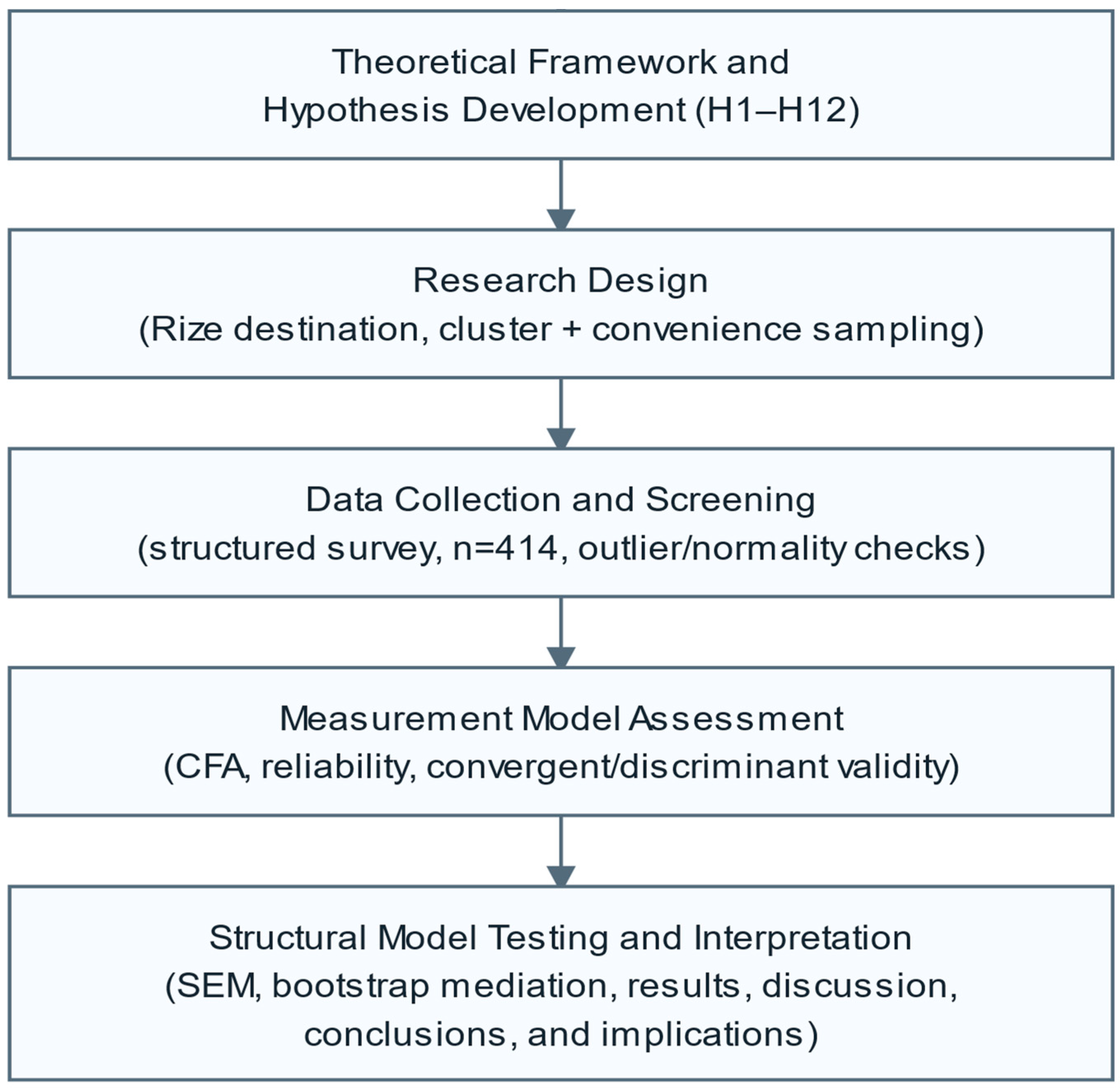
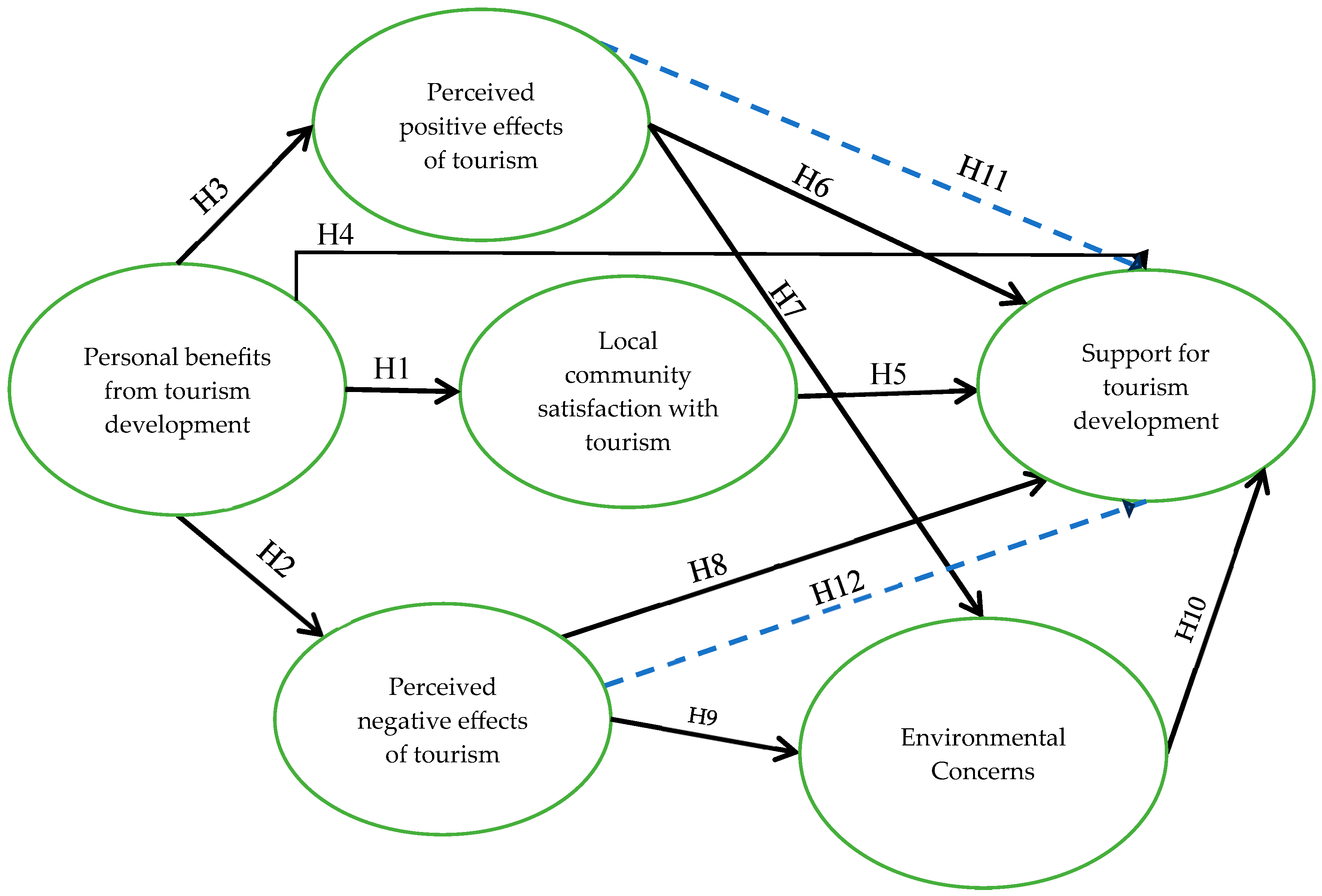
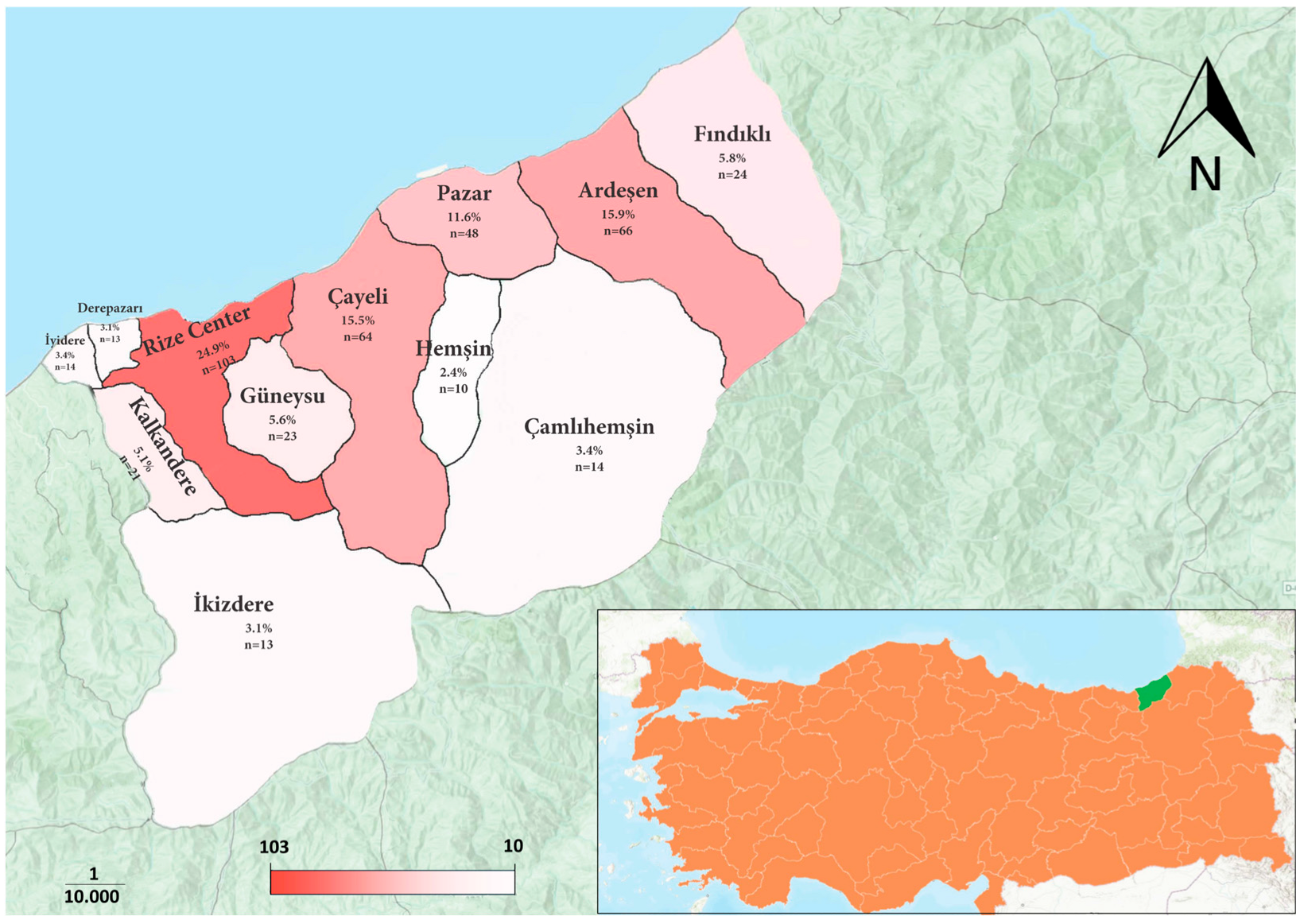
Disclaimer/Publisher’s Note: The statements, opinions and data contained in all publications are solely those of the individual author(s) and contributor(s) and not of MDPI and/or the editor(s). MDPI and/or the editor(s) disclaim responsibility for any injury to people or property resulting from any ideas, methods, instructions or products referred to in the content. |
© 2026 by the authors. Licensee MDPI, Basel, Switzerland. This article is an open access article distributed under the terms and conditions of the Creative Commons Attribution (CC BY) license.