



Rethinking Residents’ Support for Sustainable Tourism Development: Integrating Social Exchange Theory and Environmental Concern


Abstract
1. Introduction
2. Theoretical Framework
2.1. Social Exchange Theory and Benefit–Cost Perception in Tourism
2.2. NEP and Environmental Concerns: Values That Transform Rationality
2.3. Stakeholder Theory and the Multi-Stakeholder Perspective in Sustainable Tourism
2.4. The Concept of Conditional Support
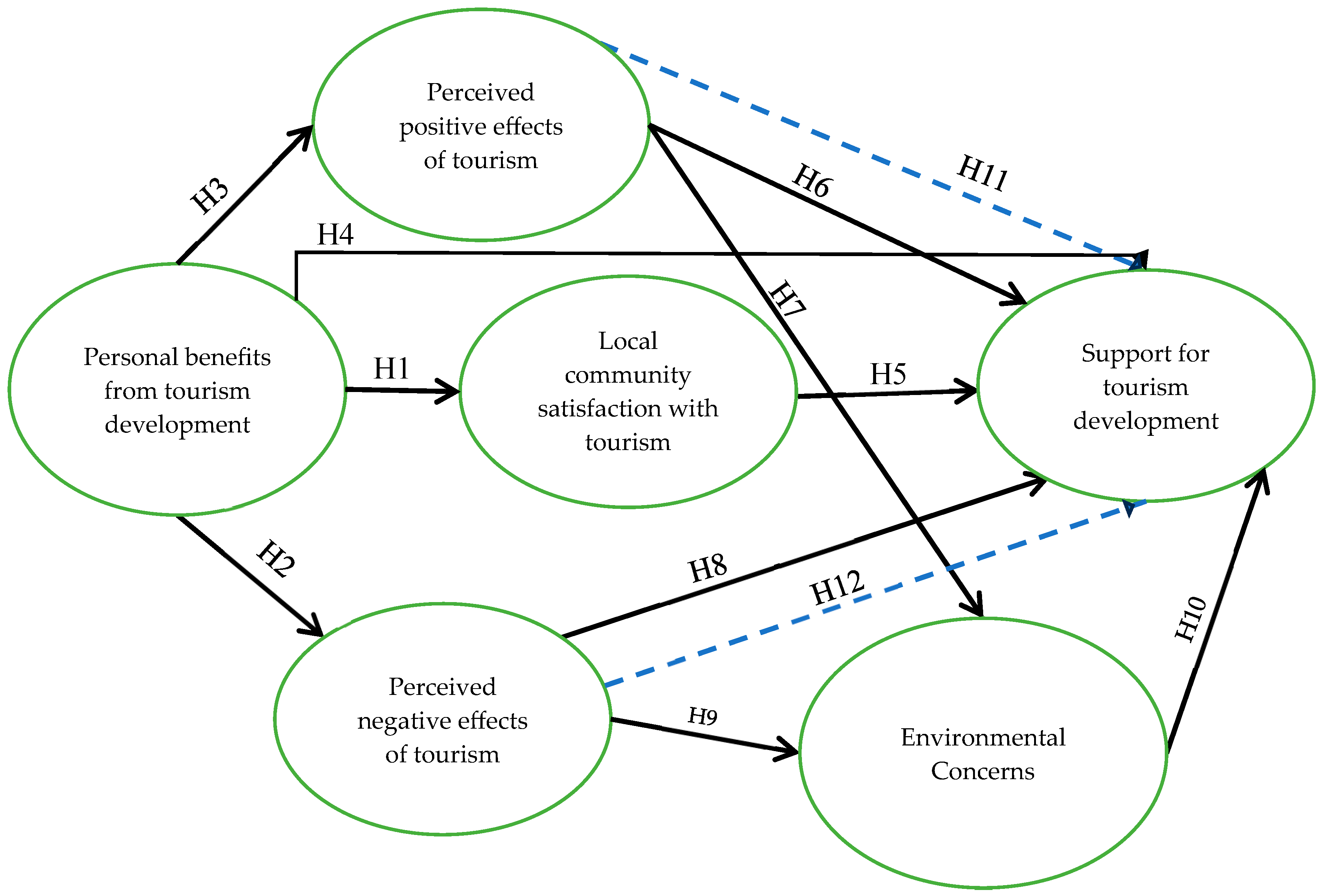
2.5. Hypothesis Development
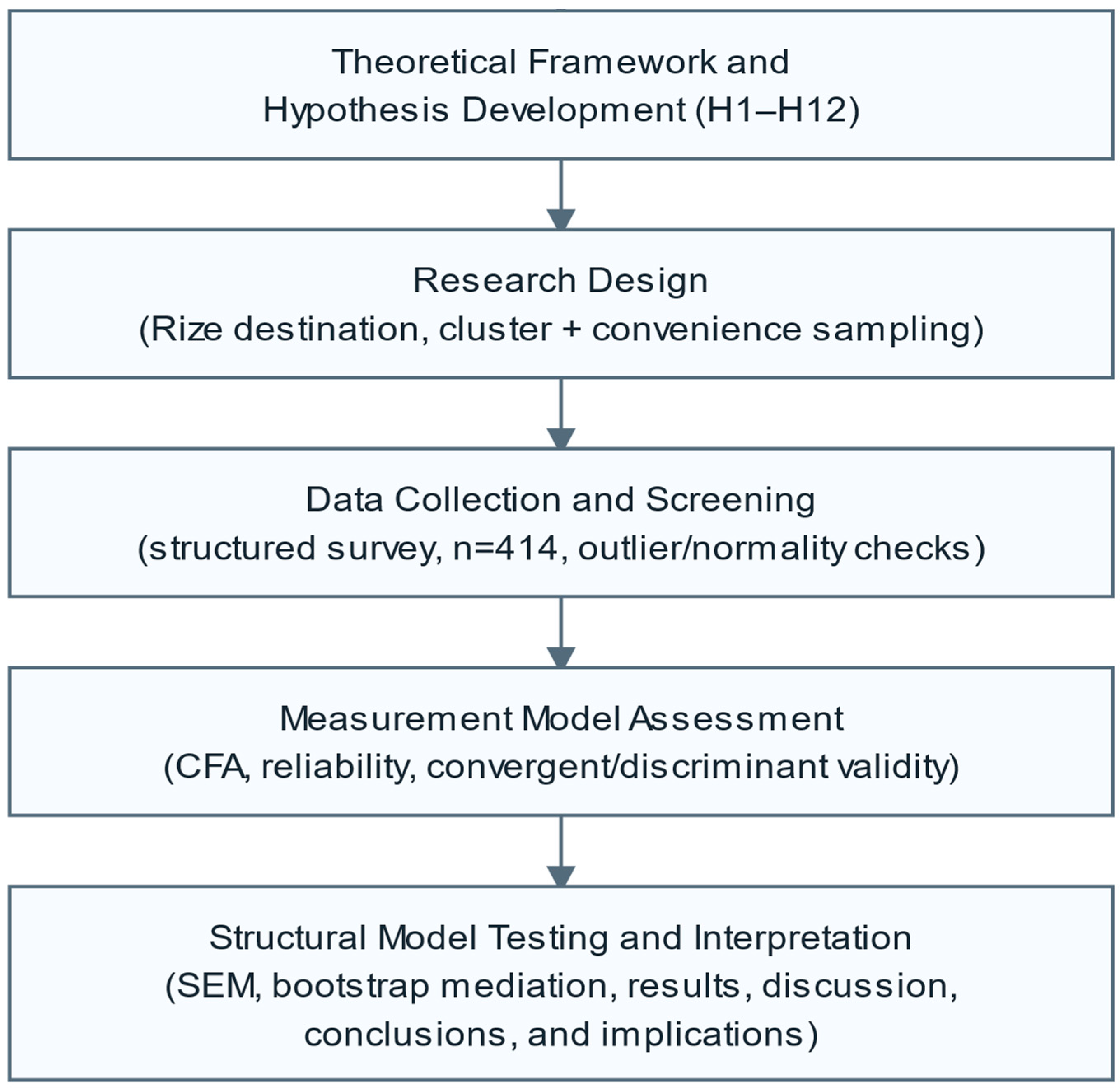
3. Research Design
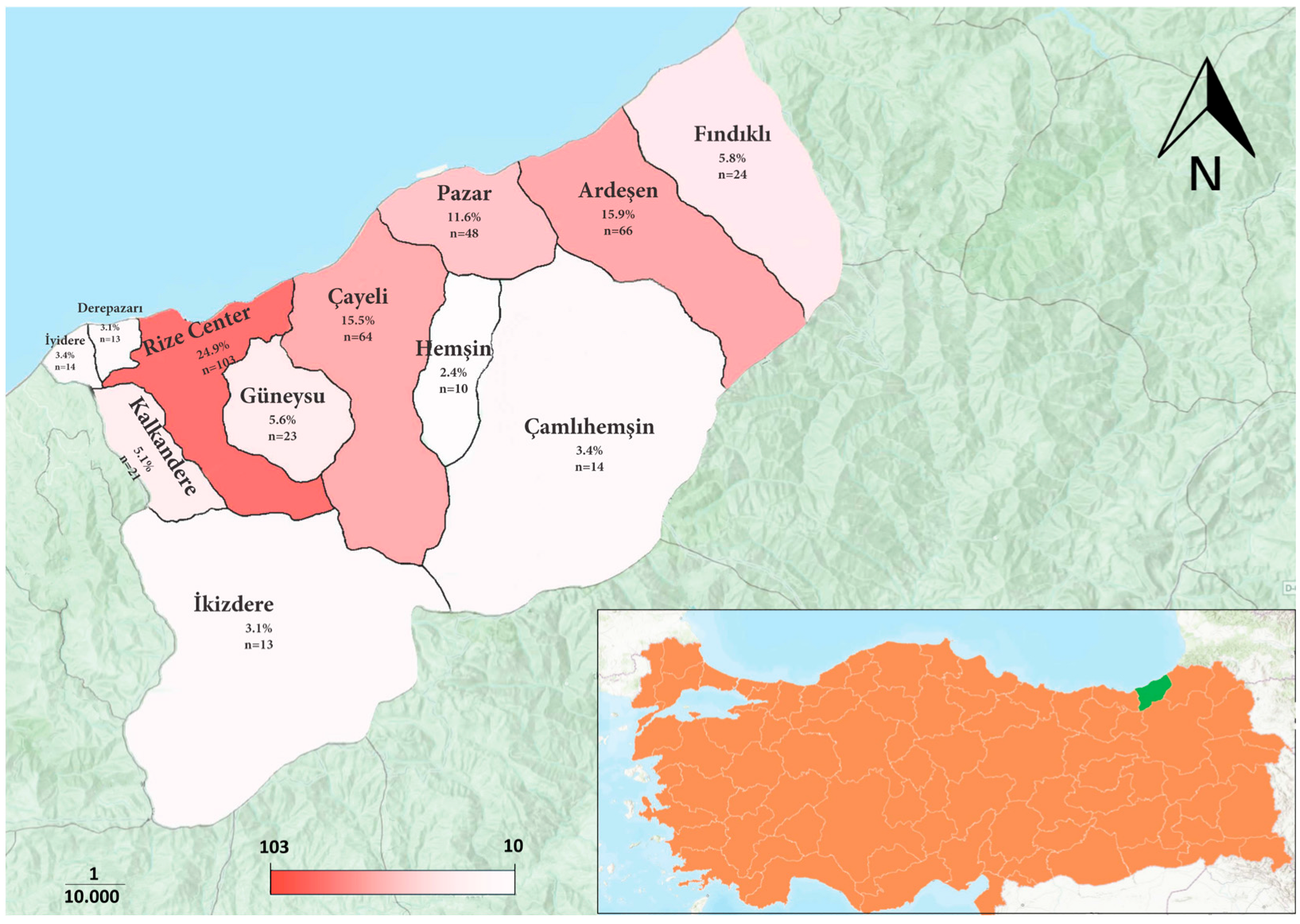
3.1. Research Area
3.2. Scales Used in the Research
3.3. Data Collection
3.4. Reliability and Validity Findings
4. Hypothesis Testing
4.1. Direct Effect Analysis Results
4.2. Indirect Effect Analysis Results
5. Discussion
5.1. Theoretical Implications
5.2. Policy and Managerial Implications
6. Conclusions
Limitations and Future Research
Author Contributions
Funding
Institutional Review Board Statement
Informed Consent Statement
Data Availability Statement
Acknowledgments
Conflicts of Interest
Abbreviations
| SET | Social Exchange Theory |
| NEP | New Ecological Paradigm |
| PPIT | Perceived Positive Impacts of Tourism |
| PNIT | Perceived Negative Impacts of Tourism |
| PBTD | Personal Benefit from Tourism Development |
| LSTD | Local Residents’ Satisfaction with Tourism Development |
| STD | Support for Tourism Development |
| EC | Environmental Concern |
| SEM | Structural Equation Modeling |
Appendix A

| FN | Relation | Specific Indirect Effect | p | Confidence Intervals | Confidence Intervals | Direct Effect | p | Type of Mediation | Support | |
|---|---|---|---|---|---|---|---|---|---|---|
| Lower | Upper | |||||||||
| H11 | PPIT → EC → STD | 0.149 | 0.002 | 0.057 | 0.263 | PPIT → STD | 0.554 | 0.003 | Complementary (mediation) | Yes |
| H12 | PNIT → EC → STD | 0.104 | 0.002 | 0.039 | 0.195 | PNIT → STD | −0.114 | 0.048 | Complementary (mediation) | Yes |
References
- Lee, T.H. Influence Analysis of Community Resident Support for Sustainable Tourism Development. Tour. Manag. 2013, 34, 37–46. [Google Scholar] [CrossRef]
- Wang, M.; Jiang, J.; Xu, S.; Guo, Y. Community Participation and Residents’ Support for Tourism Development in Ancient Villages: The Mediating Role of Perceptions of Conflicts in the Tourism Community. Sustainability 2021, 13, 2455. [Google Scholar] [CrossRef]
- Ap, J. Understanding Host Residents’ Perceptions of the Impacts of Tourism Through Social Exchange Theory; Texas A&M University: College Station, TX, USA, 1992; ISBN 979-8-207-97649-5. [Google Scholar]
- Stylidis, D.; Biran, A.; Sit, K.; Szivás, E.M. Residents’ Support for Tourism Development: The Role of Residents’ Place Image and Perceived Tourism Impacts. Tour. Manag. 2014, 45, 260–274. [Google Scholar] [CrossRef]
- Çelik, S.; Rasoolimanesh, S.M. Residents’ Attitudes towards Tourism, Cost–Benefit Attitudes, and Support for Tourism: A Pre-Development Perspective. Tour. Plan. Dev. 2023, 20, 522–540. [Google Scholar] [CrossRef]
- Orgaz-Agüera, F.; Castellanos-Verdugo, M.; Acosta Guzmán, J.A.; Cobeña, M.; Oviedo-García, M.d.l.Á. The Mediating Effects of Community Support for Sustainable Tourism, Community Attachment, Involvement, and Environmental Attitudes. J. Hosp. Tour. Res. 2022, 46, 1298–1321. [Google Scholar] [CrossRef]
- Karakuş, Y.; Onat, G.; Sarıgül Yılmaz, D. Modeling the Effect of Climate Change on Sustainable Food Consumption Behaviors: A Study on Artificial Meat and Edible Insects. Sustainability 2025, 17, 924. [Google Scholar] [CrossRef]
- Haralambopoulos, N.; Pizam, A. Perceived Impacts of Tourism: The Case of Samos. Ann. Tour. Res. 1996, 23, 503–526. [Google Scholar] [CrossRef]
- Kuvan, Y.; Akan, P. Residents’ Attitudes toward General and Forest-Related Impacts of Tourism: The Case of Belek, Antalya. Tour. Manag. 2005, 26, 691–706. [Google Scholar] [CrossRef]
- Raymond, C.; Brown, G. A Spatial Method for Assessing Resident and Visitor Attitudes Towards Tourism Growth and Development. J. Sustain. Tour. 2007, 15, 520–540. [Google Scholar] [CrossRef]
- Andersson, T.D.; Lundberg, E. Commensurability and Sustainability: Triple Impact Assessments of a Tourism Event. Tour. Manag. 2013, 37, 99–109. [Google Scholar] [CrossRef]
- Nunkoo, R.; Ramkissoon, H. Developing a Community Support Model for Tourism. Ann. Tour. Res. 2011, 38, 964–988. [Google Scholar] [CrossRef]
- Han, S.; Ramkissoon, H.; You, E.; Kim, M.J. Support of Residents for Sustainable Tourism Development in Nature-Based Destinations: Applying Theories of Social Exchange and Bottom-up Spillover. J. Outdoor Recreat. Tour. 2023, 43, 100643. [Google Scholar] [CrossRef]
- Nunkoo, R.; Ramkissoon, H. Power, Trust, Social Exchange and Community Support. Ann. Tour. Res. 2012, 39, 997–1023. [Google Scholar] [CrossRef]
- Rasoolimanesh, S.M.; Jaafar, M.; Kock, N.; Ramayah, T. A Revised Framework of Social Exchange Theory to Investigate the Factors Influencing Residents’ Perceptions. Tour. Manag. Perspect. 2015, 16, 335–345. [Google Scholar] [CrossRef]
- Cheng, T.-M.; Wu, H.C. How Do Environmental Knowledge, Environmental Sensitivity, and Place Attachment Affect Environmentally Responsible Behavior? An Integrated Approach for Sustainable Island Tourism. J. Sustain. Tour. 2015, 23, 557–576. [Google Scholar] [CrossRef]
- Dunlap, R.E.; Van Liere, K.D.; Mertig, A.G.; Jones, R.E. New Trends in Measuring Environmental Attitudes: Measuring Endorsement of the New Ecological Paradigm: A Revised NEP Scale. J. Soc. Issues 2000, 56, 425–442. [Google Scholar] [CrossRef]
- Park, C.; Lee, S.; Lee, C.-K.; Reisinger, Y. Volunteer Tourists’ Environmentally Friendly Behavior and Support for Sustainable Tourism Development Using Value-Belief-Norm Theory: Moderating Role of Altruism. J. Destin. Mark. Manag. 2022, 25, 100712. [Google Scholar] [CrossRef]
- Mariani, M.; Borghi, M. Exploring Environmental Concerns on Digital Platforms through Big Data: The Effect of Online Consumers’ Environmental Discourse on Online Review Ratings. J. Sustain. Tour. 2023, 31, 2592–2611. [Google Scholar] [CrossRef]
- Liu, J.C.; Sheldon, P.J.; Var, T. Resident Perception of the Environmental Impacts of Tourism. Ann. Tour. Res. 1987, 14, 17–37. [Google Scholar] [CrossRef]
- Choi, H.-S.C.; Sirakaya, E. Measuring Residents’ Attitude toward Sustainable Tourism: Development of Sustainable Tourism Attitude Scale. J. Travel Res. 2005, 43, 380–394. [Google Scholar] [CrossRef]
- Maccioni, S.; d’Angella, F.; De Carlo, M.; Sfogliarini, B. Stakeholder Engagement and Triggers for Sustainable Development in Complex Fragile Ecosystems: Evidence from Alpine Trentino Region. Sustainability 2024, 16, 9879. [Google Scholar] [CrossRef]
- Okumah, M.; Yeboah, A.S.; Amponsah, O. Stakeholders’ Willingness and Motivations to Support Sustainable Water Resources Management: Insights from a Ghanaian Study. Conserv. Sci. Pract. 2020, 2, e170. [Google Scholar] [CrossRef]
- Yamane, T.; Kaneko, S. Impact of Raising Awareness of Sustainable Development Goals: A Survey Experiment Eliciting Stakeholder Preferences for Corporate Behavior. J. Clean. Prod. 2021, 285, 125291. [Google Scholar] [CrossRef]
- Waligo, V.M.; Clarke, J.; Hawkins, R. Implementing Sustainable Tourism: A Multi-Stakeholder Involvement Management Framework. Tour. Manag. 2013, 36, 342–353. [Google Scholar] [CrossRef]
- d’Angella, F.; Go, F.M. Tale of Two Cities’ Collaborative Tourism Marketing: Towards a Theory of Destination Stakeholder Assessment. Tour. Manag. 2009, 30, 429–440. [Google Scholar] [CrossRef]
- Nicholas, L.N.; Thapa, B.; Ko, Y.J. RESIDENTS’ PERSPECTIVES OF A WORLD HERITAGE SITE: The Pitons Management Area, St. Lucia. Ann. Tour. Res. 2009, 36, 390–412. [Google Scholar] [CrossRef]
- Chase, L.C.; Phillips, R.G.; Amsden, B. Stakeholder Engagement in Tourism Planning and Development. In Handbook of Tourism and Quality-of-Life Research II: Enhancing the Lives of Tourists, Residents of Host Communities and Service Providers; Uysal, M., Sirgy, M.J., Eds.; Springer International Publishing: Cham, Switzerland, 2023; pp. 317–333. ISBN 978-3-031-31513-8. [Google Scholar]
- Pham, K.; Andereck, K.L.; Vogt, C.A. Stakeholders’ Involvement in an Evidence-Based Sustainable Tourism Plan. J. Sustain. Tour. 2025, 33, 673–696. [Google Scholar] [CrossRef]
- Davis, K. Different Stakeholder Groups and Their Perceptions of Project Success. Int. J. Proj. Manag. 2014, 32, 189–201. [Google Scholar] [CrossRef]
- Tosun, C.; Dedeoğlu, B.B.; Çalışkan, C.; Karakuş, Y. Role of Place Image in Support for Tourism Development: The Mediating Role of Multi-Dimensional Impacts. Int. J. Tour. Res. 2021, 23, 268–286. [Google Scholar] [CrossRef]
- Laurila-Pant, M.; Mäntyniemi, S.; Venesjärvi, R.; Lehikoinen, A. Incorporating Stakeholders’ Values into Environmental Decision Support: A Bayesian Belief Network Approach. Sci. Total Environ. 2019, 697, 134026. [Google Scholar] [CrossRef]
- van der Ven, H. Effects of Stakeholder Input on Voluntary Sustainability Standards. Glob. Environ. Change 2022, 75, 102554. [Google Scholar] [CrossRef]
- Brida, J.G.; Osti, L.; Barquet, A. Segmenting Resident Perceptions towards Tourism—A Cluster Analysis with a Multinomial Logit Model of a Mountain Community. Int. J. Tour. Res. 2010, 12, 591–602. [Google Scholar] [CrossRef]
- Fredline, E.; Faulkner, B. Host Community Reactions: A Cluster Analysis. Ann. Tour. Res. 2000, 27, 763–784. [Google Scholar] [CrossRef]
- Weaver, D.B.; Lawton, L.J. Resident Perceptions of a Contentious Tourism Event. Tour. Manag. 2013, 37, 165–175. [Google Scholar] [CrossRef]
- Kanwal, S.; Rasheed, M.I.; Pitafi, A.H.; Pitafi, A.; Ren, M. Road and Transport Infrastructure Development and Community Support for Tourism: The Role of Perceived Benefits, and Community Satisfaction. Tour. Manag. 2020, 77, 104014. [Google Scholar] [CrossRef]
- Su, L.; Swanson, S.R. The Effect of Personal Benefits from, and Support of, Tourism Development: The Role of Relational Quality and Quality-of-Life. J. Sustain. Tour. 2020, 28, 433–454. [Google Scholar] [CrossRef]
- Yayla, Ö.; Koç, B.; Dimanche, F. Residents’ Support for Tourism Development: Investigating Quality-of-Life, Community Commitment, and Communication. Eur. J. Tour. Res. 2023, 33, 3311. [Google Scholar] [CrossRef]
- Alim, M.A.; Jee, T.W.; Voon, M.L.; Ngui, K.S.; Kasuma, J. Tourism Development through Communities’ Support: Rural Communities’ Perspective. GeoJ. Tour. Geosites 2021, 39, 1473–1482. [Google Scholar] [CrossRef]
- Alsaloum, M.; Romagosa, F.; Alotaibi, S. Residents’ Perceptions of the Benefits and Costs of Tourism Development: A Case Study of Riyadh City (Saudi Arabia). Tour. Hosp. 2024, 5, 753–781. [Google Scholar] [CrossRef]
- Hair, J.F.; Black, W.C.; Babin, B.J.; Anderson, R.E. Multivariate Data Analysis (Pearson Ne); Pearson Higher Ed: Lonodon, UK, 2013. [Google Scholar]
- Robinson, D.; Newman, S.P.; Stead, S.M. Community Perceptions Link Environmental Decline to Reduced Support for Tourism Development in Small Island States: A Case Study in the Turks and Caicos Islands. Mar. Policy 2019, 108, 103671. [Google Scholar] [CrossRef]
- Tyrell, T.; Spaulding, I. A Survey of Attitudes toward Tourism Growth in Rhode Island. Hosp. Educ. Res. J. 1984, 8, 22–33. [Google Scholar] [CrossRef]
- Archer, B.; Cooper, C.; Ruhanen, L. The Positive and Negative Impacts of Tourism. In Global Tourism; Theobald, W.F., Ed.; Elsevier Butterworth-Heinemann: Burlington, MA, USA, 2005; p. 561. ISBN 978-0-7506-7789-9. [Google Scholar]
- Rize İl Kültür ve Turizm Müdürlüğü Turist İstatistikleri. 2024. Available online: https://rize.ktb.gov.tr/TR-341873/turist-istatistikleri.html (accessed on 9 February 2026).
- Rize İl Kültür ve Turizm Müdürlüğü Turizm İşletme Belgeli Konaklama Tesisleri. 2024. Available online: https://rize.ktb.gov.tr/TR-370355/turizm-isletme-belgeli-konaklama-tesisleri.html (accessed on 13 February 2026).
- Onat, G. Bungalov Turizmine Yönelik Davranışsal Niyetin İncelenmesi: Rize’de Bir Alan Araştırması. Kent Akad. 2025, 18, 922–942. [Google Scholar] [CrossRef]
- İpar, M.S.; Doğan, M. Destinasyonun turist açisindan önem-memnuniyet modeli ile değerlendirilmesi: Edremit üzerine bir uygulama. Adıyaman Üniversitesi Sos. Bilim. Enstitüsü Derg. 2013, 13, 129–154. [Google Scholar] [CrossRef][Green Version]
- Başaran, B. Yöre Halkının Geleneksel Gıda Tüketim Eğilimi: Rize Örneği. Türk Tur. Araştırmaları Derg. 2020, 4, 3411–3427. [Google Scholar] [CrossRef]
- Eröz, S.S.; Bozkurt, M. Kırsal Turizm Kapsamında Çiftlik Turizmi ve Rize İlinde Uygulanabilirliği. J. Recreat. Tour. Res. 2018, 2, 1–9. [Google Scholar]
- Karakuş, Y.; Onat, G.; Özdemir, G. Yerel Halkın Gastronomi Turizmi Çağrışımları ve Beklentileri: Göreme Kasabası Örneği. J. Tour. Gastron. Stud. 2020, 2020, 2179–2201. [Google Scholar] [CrossRef]
- Rize İl Kültür ve Turizm Müdürlüğü Coğrafi İşaretli Ürünler. 2022. Available online: https://ci.turkpatent.gov.tr/cografi-isaretler/liste?il=53 (accessed on 13 February 2026).
- Baum, T.; Cheung, C.; Kong, H.; Kralj, A.; Mooney, S.; Nguyễn Thị Thanh, H.; Ramachandran, S.; Dropulić Ružić, M.; Siow, M.L. Sustainability and the Tourism and Hospitality Workforce: A Thematic Analysis. Sustainability 2016, 8, 809. [Google Scholar] [CrossRef]
- Ekici, R.; Çizel, B. Yerel Halkın Turizm Gelişimi Desteğine İlişkin Tutumlarının Destinasyonların Gelişme Düzeylerine Göre Farklılıkları. Seyahat Otel İşletmeciliği Derg. 2015, 11, 73–87. [Google Scholar]
- Andereck, K.L.; Vogt, C.A. The Relationship between Residents’ Attitudes toward Tourism and Tourism Development Options. J. Travel Res. 2000, 39, 27–36. [Google Scholar] [CrossRef]
- Long, P.H. Tourism Impacts and Support for Tourism Development in Ha Long Bay, Vietnam: An Examination of Residents’ Perceptions. Asian Soc. Sci. 2012, 8, 28–39. [Google Scholar] [CrossRef]
- Yoon, Y.; Gursoy, D.; Chen, J.S. Validating a Tourism Development Theory with Structural Equation Modeling. Tour. Manag. 2001, 22, 363–372. [Google Scholar] [CrossRef]
- Chen, C.F.; Chen, F.S. Experience Quality, Perceived Value, Satisfaction and Behavioral Intentions for Heritage Tourists. Tour. Manag. 2010, 31, 29–35. [Google Scholar] [CrossRef]
- Long, P.H.; Kayat, K. Residents’ Perceptions of Tourism Impact and Their Support for Tourism Development: The Case Study of Cuc Phuong National Park, Ninh Binh Province, Vietnam. Eur. J. Tour. Res. 2011, 4, 123–146. [Google Scholar] [CrossRef]
- Dyer, P.; Gursoy, D.; Sharma, B.; Carter, J. Structural Modeling of Resident Perceptions of Tourism and Associated Development on the Sunshine Coast, Australia. Tour. Manag. 2007, 28, 409–422. [Google Scholar] [CrossRef]
- Oviedo-Garcia, M.A.; Castellanos-Verdugo, M.; Martin-Ruiz, D. Gaining Residents’ Support for Tourism and Planning. Int. J. Tour. Res. 2008, 10, 95–109. [Google Scholar] [CrossRef]
- Ritchie, B.W.; Inkari, M. Host Community Attitudes toward Tourism and Cultural Tourism Development: The Case of the Lewes District, Southern England. Int. J. Tour. Res. 2006, 8, 27–44. [Google Scholar] [CrossRef]
- Altunel, M.C. Yerel Halkın Turizmin Gelişmesine Verdiği Desteği Etkileyen Faktörlerin Sosyal Değişim Teorisi Açısından Incelenmesi: Alaçatı Örneği. Yayın. Üksek Lisans Tezi Sak. Üniversitesi Sos. Bilim. Enstitüsü Sak. 2009. Available online: https://tez.yok.gov.tr/UlusalTezMerkezi/giris.jsp (accessed on 15 January 2026).
- Vargas-Sánchez, A.; Porras-Bueno, N.; Plaza-Mejia, M. Residents’ Attitudes towards Tourism Development in the Spanish Province of Huelva. Narodnostopan. Arh. Int. Ed. 2009, 2009, 31–62. [Google Scholar]
- Wang, Y.; Pfister, R.E.; Morais, D.B. Residents’ Attitudes toward Tourism Development: A Case Study of Washington, NC. J. Travel Res. 2006, 14, 411–418. [Google Scholar]
- Cavus, S.; Tanrisevdi, A. Residents’ Attitudes Toward Tourism Development: A Case Study in Kusadasi, Turkey. Tour. Anal. 2003, 7, 259–269. [Google Scholar] [CrossRef]
- Dunlap, R.E.; Van Liere, K.D. The “New Environmental Paradigm”. J. Environ. Educ. 1978, 9, 10–19. [Google Scholar] [CrossRef]
- Furman, A. A Note on Environmental Concern in a Developing Country: Results from an Istanbul Survey. Environ. Behav. 1998, 30, 520–534. [Google Scholar] [CrossRef]
- Aytaç, M.; Öngen, B. Investigation of Construct Validity of New Environmental Paradigm Scale with Confirmatory Factor Analysis. J. Stat. 2012, 5, 14–22. Available online: https://izlik.org/JA38PX69YE (accessed on 9 February 2026).
- Rize İl Kültür ve Turizm Müdürlüğü Nüfüs ve Yerleşim. 2024. Available online: https://rize.ktb.gov.tr/TR-55304/nufus-ve-yerlesim.html (accessed on 9 February 2026).
- Çokluk, Ö.; Şekercioğlu, G.; Büyüköztürk, Ş. Sosyal Bilimler İçin Çok Değişkenli İstatistik SPSS ve LISREL Uygulamaları; PEGEM AKADEMİ: Kızılay/Ankara, Turkey, 2016; Volume 5, ISBN 978-605-5885-67-0. [Google Scholar]
- Sharma, G. Pros and Cons of Different Sampling Techniques. Int. J. Appl. Res. 2017, 3, 749–752. [Google Scholar]
- Thompson, S.K. Adaptive Cluster Sampling. J. Am. Stat. Assoc. 1990, 85, 1050–1059. [Google Scholar] [CrossRef]
- Rize Ticaret Borsası Rize İlçeleri. 2025. Available online: https://www.rtb.org.tr/tr/rize-ilceleri (accessed on 12 February 2026).
- Özen, Y.; Gül, A. Sosyal ve Eğitim Bilimleri Araştirmalarinda Evren-Örneklem Sorunu. Atatürk Üniversitesi Kazım Karabekir Eğitim Fakültesi Derg. 2007, 15, 394–422. Available online: https://izlik.org/JA67PG62BL (accessed on 9 February 2026).
- Taherdoost, H. Sampling Methods in Research Methodology; How to Choose a Sampling Technique for Research. Int. J. Acad. Res. Manag. 2016, 5, 18–27. [Google Scholar] [CrossRef]
- Baştürk, S.; Taştepe, M. Evren ve Örneklem. In Bilimsel Araştırma Yöntemleri; Baştürk, S., Ed.; Vize Yayıncılık: Ankara, Turkey, 2013; pp. 129–159. [Google Scholar]
- Byrne, B.M. Structural Equation Modeling with AMOS: Basic Concepts, Applications, and Programming, 2nd ed.; Taylor & Francis Group: New York, NY, USA, 2010; pp. 396–7384. [Google Scholar]
- Fornell, C.; Larcker, D.F. Evaluating Structural Equation Models with Unobservable Variables and Measurement Error. J. Mark. Res. 1981, 18, 39–50. [Google Scholar] [CrossRef]
- Schermelleh-Engel, K.; Moosbrugger, H.; Müller, H. Evaluating the Fit of Structural Equation Models: Tests of Significance and Descriptive Goodness-of-Fit Measures. Methods Psychol. Res. Online 2003, 8, 23–74. [Google Scholar]
- Marsh, H.W.; Hau, K.-T. Assessing Goodness of Fit: Is Parsimony Always Desirable? J. Exp. Educ. 1996, 64, 364–390. [Google Scholar] [CrossRef]
- Hair, J. Multivariate Data Analysis: A Global Perspective, 7th ed.; Faculty Publications; Prentice Hall: Saddle River, NJ, USA, 2009. [Google Scholar]
- Hu, L.-T.; Bentler, P.M. Structural Equation Modeling: A Multidisciplinary Journal Cutoff Criteria for Fit Indexes in Covariance Structure Analysis: Conventional Criteria versus New Alternatives. Multidiscip. J. 1999, 6, 1–55. [Google Scholar] [CrossRef]
- Mulaik, S.A.; James, L.R.; Van Alstine, J.; Bennett, N.; Lind, S.; Stilwell, C.D. Evaluation of Goodness-of-Fit Indices for Structural Equation Models. Psychol. Bull. 1989, 105, 430–445. [Google Scholar] [CrossRef]
- Marsh, H.W.; Balla, J.R.; McDonald, R.P. Goodness-of-Fit Indices in Confirmatory Factor Analysis: The Effect of Sample Size. Psychol. Bull. 1988, 103, 391–410. [Google Scholar] [CrossRef]
- Doll, W.J.; Xia, W.; Torkzadeh, G. A Confirmatory Factor Analysis of the End-User Computing Satisfaction Instrument. MIS Q. 1994, 18, 453–461. [Google Scholar] [CrossRef]
- Yılmaz, C.; Özgener, Ş. Competitive Intelligence and Competitiveness in Accommodation Businesses: The Role of Employee Training Effectiveness. Curr. Issues Tour. 2022, 25, 2905–2921. [Google Scholar] [CrossRef]
- Wang, Y.; Wen, Z.; Li, W.; Fang, J. Methodological Research and Model Development on Structural Equation Models in China’s Mainland from 2001 to 2020. Adv. Psychol. Sci. 2022, 30, 1715–1733. [Google Scholar] [CrossRef]
- Kline, R.B. Principles and Practice of Structural Equation Modeling; Guilford Press: New York, NY, USA, 2011; p. 534. ISBN 978-1-4625-2335-1. [Google Scholar]
- Preacher, K.J.; Hayes, A.F. Asymptotic and Resampling Strategies for Assessing and Comparing Indirect Effects in Multiple Mediator Models. Behav. Res. Methods 2008, 40, 879–891. [Google Scholar] [CrossRef] [PubMed]
- Hayes, A.F. Beyond Baron and Kenny: Statistical Mediation Analysis in the New Millennium. Commun. Monogr. 2009, 76, 408–420. [Google Scholar] [CrossRef]
- Cheung, G.W.; Lau, R.S. Testing Mediation and Suppression Effects of Latent Variables: Bootstrapping with Structural Equation Models. Organ. Res. Methods 2008, 11, 296–325. [Google Scholar] [CrossRef]
- Zhao, X.; Lynch, J.G.; Chen, Q. Reconsidering Baron and Kenny: Myths and Truths about Mediation Analysis. J. Consum. Res. 2010, 37, 197–206. [Google Scholar] [CrossRef]
- Byrd, E.T. Stakeholders in Sustainable Tourism Development and Their Roles: Applying Stakeholder Theory to Sustainable Tourism Development. Tour. Rev. 2007, 62, 6–13. [Google Scholar] [CrossRef]
- Ko, D.-W.; Stewart, W.P. A Structural Equation Model of Residents’ Attitudes for Tourism Development. Tour. Manag. 2002, 23, 521–530. [Google Scholar] [CrossRef]
- Vargas-Sánchez, A.; de los Ángeles Plaza-Mejía, M.; Porras-Bueno, N. Understanding Residents’ Attitudes toward the Development of Industrial Tourism in a Former Mining Community. J. Travel Res. 2009, 47, 373–387. [Google Scholar] [CrossRef]


| District | Total Population |
|---|---|
| Central | 151,617 |
| Ardeşen | 43,418 |
| Çayeli | 42,208 |
| Pazar | 31,776 |
| Fındıklı | 16,677 |
| Güneysu | 15,198 |
| Kalkandere | 13,788 |
| Iyidere | 8635 |
| Camlihemşin | 7361 |
| Ikizdere | 6939 |
| Derepazarı | 6938 |
| Hemşin | 2422 |
| Variables | Items | Kurtosis | Skewness |
|---|---|---|---|
| PPIT | 1. Tourism contributes to the cultural development of the local community. | −0.529 | −0.862 |
| 2. Tourism improves the quality of life for the local community. | −0.483 | −0.760 | |
| 3. Tourism provides economic benefits to the local community. | 1.565 | −1.628 | |
| 4. Tourism is one of the most important sectors supporting the local economy. | 0.094 | −1.089 | |
| 5. Tourism contributes to the protection and development of the natural environment. | −1.082 | 0.217 | |
| 6. Tourism improves environmental quality for future generations. | −1.165 | 0.037 | |
| PNIT | 1. Tourism negatively affects the attitudes and behaviors of the local population. | −0.567 | 0.515 |
| 2. Tourism leads to the loss of the local population’s cultural values. | −0.560 | 0.578 | |
| 3. Tourism leads to social problems (gambling, prostitution, etc.). | −0.718 | 0.489 | |
| 4. Tourism increases the prices of local products and services. | 0.210 | −1.104 | |
| 5. Tourism causes problems such as overcrowding, noise, and traffic. | −0.835 | −0.595 | |
| 6. Tourism development causes environmental pollution (garbage, waste, air, and water). | −1.005 | −0.513 | |
| 7. Tourism causes the cost of living in the region to rise. | −0.374 | −0.865 | |
| PBTD | 1. I also benefit from the overall tourism development in the region. | −1.274 | −0.017 |
| 2. Tourism development has a positive impact on my business. | −1.304 | 0.117 | |
| 3. If there were no tourism in the region, my business would decline significantly. | −0.732 | 0.671 | |
| LSTD | 1. I am satisfied with the public services that have developed alongside tourism. | −0.870 | −0.209 |
| 2. I am satisfied with the environmental changes and developments brought about by tourism. | −0.948 | −0.188 | |
| 3. I am satisfied with the economic developments that tourism has brought to our region. | −0.308 | −0.794 | |
| 4. I am satisfied with the social opportunities and possibilities that tourism has brought to our region. | −0.545 | −0.616 | |
| STD | 1. Tourism should continue to be an important part of our society. | 0.050 | −0.977 |
| 2. Tourism investments in the region should continue to increase. | −0.364 | −0.820 | |
| 3. Efforts should be made to further develop tourism in the region. | −0.204 | −0.923 | |
| 4. I support the development of tourism in the region. | −0.310 | −0.886 | |
| EC | 1. The population is growing at a rate that exceeds the Earth’s carrying capacity. | −0.735 | −0.594 |
| 2. When humans interfere with nature, it often leads to disastrous consequences. | −0.255 | −0.923 | |
| 3. Humans are overusing and consuming nature and natural resources. | 0.280 | −1.180 | |
| 4. Plants and animals have as much right to life as humans. | 2.235 | −1.829 | |
| 5. Despite our special abilities, humans are still subject to the laws of nature. | −0.044 | −0.892 | |
| 6. The world is like a spaceship with very limited space and resources. | −1.085 | −0.172 | |
| 7. The balance of nature is very delicate and easily disrupted. | −0.875 | −0.616 | |
| 8. If things continue as they are now, we will soon face a major ecological disaster. | −0.642 | −0.754 |
| Items | Mean | Std. Factor Load | t-Values | CR | AVE | Cronbach’s Alpha | Correlation (Correlation Coefficients) |
|---|---|---|---|---|---|---|---|
| PPIT1 | 3.69 | 0.802 | Fixed * | 0.888 | 0.582 | 0.903 | Perceived Negative Impacts of Tourism: 0.317 (0.100) |
| PPIT2 | 3.61 | 0.816 | 23.176 | Personal Benefit from Tourism Development: 0.392 (0.153) | |||
| PPIT3 | 4.15 | 0.913 | 21.863 | Local Residents’ Satisfaction with Tourism Development: 0.648 (0.419) | |||
| PPIT4 | 3.91 | 0.895 | 21.350 | Support for Tourism Development: 0.701 (0.491) | |||
| PPIT5 | 2.77 | 0.506 | 10.504 | Environmental Concern: 0.665 (0.442) | |||
| PPIT6 | 2.93 | 0.542 | 11.343 | ||||
| PNIT1 | 2.45 | 0.554 | Fixed * | 0.890 | 0.548 | 0.903 | Personal Benefit from Tourism Development: 0.075 (0.005) |
| PNIT2 | 2.48 | 0.620 | 15.151 | Local Residents’ Satisfaction with Tourism Development: 0.160 (0.025) | |||
| PNIT3 | 2.46 | 0.519 | 8.807 | Support for Tourism Development: 0.213 (0.045) | |||
| PNIT4 | 3.86 | 0.748 | 11.221 | Environmental Concern: 0.552 (0.272) | |||
| PNIT5 | 3.43 | 0.921 | 12.493 | ||||
| PNIT6 | 3.44 | 0.924 | 12.509 | ||||
| PNIT7 | 3.73 | 0.784 | 11,528 | ||||
| PBTD1 | 2.95 | 0.799 | 15,617 | 0.858 | 0.67 | 0.855 | Satisfaction with Tourism Development: 0.506 (0.256) |
| PBTD2 | 2.85 | 0.917 | 16.559 | Support for Tourism Development: 0.522 (0.272) | |||
| PBTD3 | 2.41 | 0.730 | Fixed * | Environmental Concern: 0.295 (0.087) | |||
| LSTD1 | 3.08 | 0.741 | Fixed * | 0.898 | 0.692 | 0.898 | Environmental Concern: 0.512 (0.262) |
| LSTD2 | 3.01 | 0.724 | 14.900 | ||||
| LSTD3 | 3.50 | 0.911 | 19,158 | ||||
| LSTD4 | 3.43 | 0.930 | 19,534 | ||||
| STD1 | 3.71 | 0.894 | Fixed * | 0.962 | 0.864 | 0.962 | Environmental Concern: 0.580 (0.336) |
| STD2 | 3.68 | 0.903 | 28.803 | Local Residents’ Satisfaction with Tourism Development: 0.757 (0.573) | |||
| STD3 | 3.73 | 0.966 | 34.784 | ||||
| STD4 | 3.72 | 0.953 | 33,453 | ||||
| EC1 | 3.54 | 0.591 | 11,581 | 0.878 | 0.512 | 0.882 | |
| EC2 | 3.79 | 0.630 | 12.321 | ||||
| EC3 | 3.97 | 0.769 | 15,161 | ||||
| EC4 | 4.32 | 0.887 | 17,434 | ||||
| EC5 | 3.74 | 0.733 | 14,440 | ||||
| EC7 | 3.64 | 0.629 | 12,341 | ||||
| EC8 | 3.67 | 0.726 | Fixed * |
| Fitness Criteria | Good Fit | Acceptable Fit | References |
|---|---|---|---|
| Overall Model Fit | |||
| χ2 | 0 ≤ χ2 ≤ 3df | - | [79] |
| χ2/df | 0 ≤ χ2/df ≤ 2 | 2 < χ2/df ≤ 5 | |
| p-value | 0.05 < p ≤ 1.00 | 0.01 ≤ p ≤ 0.05 | |
| Comparative Fit Indices | |||
| RMSEA | 0 ≤ RMSEA ≤ 0.05 | 0.05 < RMSEA ≤ 0.08 | [81] |
| RMSEA (<0.05) | 0.10 < p ≤ 1.00 | 0.05 ≤ p ≤ 0.10 | [82] |
| NFI | 0.95 ≤ NFI ≤ 1.00 | 0.90 ≤ NFI < 0.95 | [79,83] |
| NNFI | 0.95 ≤ NNFI ≤ 1.00 | 0.90 ≤ NNFI < 0.95 | [84,85] |
| CFI | 0.95 ≤ CFI ≤ 1.00 | 0.90 ≤ CFI < 0.95 | |
| Absolute Fit Indices | |||
| GFI | 0.90 ≤ GFI ≤ 1.00 | 0.80 ≤ GFI ≤ 0.89 | [86] |
| SRMR | 0 ≤ SRMR ≤ 0.05 | 0.05 < SRMR ≤ 0.08 | [87] |
| Mean | Standard Deviation | 1 | 2 | 3 | 4 | 5 | 6 | |
|---|---|---|---|---|---|---|---|---|
| 1. PPIT | 3.508 | 1.065 | ||||||
| 2. PNIT | 3.122 | 0.985 | 0.127 ** | |||||
| 3. PBTD | 2.735 | 1.177 | 0.364 ** | 0.067 NS | ||||
| 4. LSTD | 3.256 | 1.049 | 0.627 ** | 0.100 * | 0.472 ** | |||
| 5. STD | 3.709 | 1.176 | 0.664 ** | 0.186 ** | 0.465 ** | 0.714 ** | ||
| 6. EC | 3.810 | 0.965 | 0.506 ** | 0.519 ** | 0.227 ** | 0.402 ** | 0.496 ** |
| Hypotheses | Relationships | Std. Factor Load (β) | t-Values | p-Value | Results | Power of Influence (a1) |
|---|---|---|---|---|---|---|
| H1 | PBTD→LSTD | 0.549 ** | 8.888 | <0.001 | supported | High |
| H2 | PBTD→PNIT | 0.112 | 2.02 | 0.043 | supported | Near Low Medium |
| H3 | PBTD→PPIT | 0.453 ** | 7.691 | <0.001 | supported | Near High Medium |
| H4 | PBTD→STD | 0.158 ** | 3.504 | <0.001 | supported | Near Low Medium |
| H5 | LSTD→STD | 0.459 ** | 8.541 | <0.001 | supported | Near High Medium |
| H6 | PPIT→STD | 0.296 ** | 5.301 | <0.001 | supported | Medium |
| H7 | PPIT→EC | 0.577 ** | 10.7 | <0.001 | supported | High |
| H8 | PNIT→STD | −0.04 NS* | −0.932 | 0.351 | rejected | Low |
| H9 | PNIT→EC | 0.415 ** | 7.332 | <0.001 | supported | Near High Medium |
| H10 | EC→STD | 0.164 ** | 2.9 | 0.004 | supported | Near Low Medium |
Disclaimer/Publisher’s Note: The statements, opinions and data contained in all publications are solely those of the individual author(s) and contributor(s) and not of MDPI and/or the editor(s). MDPI and/or the editor(s) disclaim responsibility for any injury to people or property resulting from any ideas, methods, instructions or products referred to in the content. |
© 2026 by the authors. Licensee MDPI, Basel, Switzerland. This article is an open access article distributed under the terms and conditions of the Creative Commons Attribution (CC BY) license.
Share and Cite
Erkılıç, E.; Karakuş, Y.; Onat, G. Rethinking Residents’ Support for Sustainable Tourism Development: Integrating Social Exchange Theory and Environmental Concern. Sustainability 2026, 18, 3521. https://doi.org/10.3390/su18073521
Erkılıç E, Karakuş Y, Onat G. Rethinking Residents’ Support for Sustainable Tourism Development: Integrating Social Exchange Theory and Environmental Concern. Sustainability. 2026; 18(7):3521. https://doi.org/10.3390/su18073521
Chicago/Turabian StyleErkılıç, Eren, Yusuf Karakuş, and Gökhan Onat. 2026. "Rethinking Residents’ Support for Sustainable Tourism Development: Integrating Social Exchange Theory and Environmental Concern" Sustainability 18, no. 7: 3521. https://doi.org/10.3390/su18073521
APA StyleErkılıç, E., Karakuş, Y., & Onat, G. (2026). Rethinking Residents’ Support for Sustainable Tourism Development: Integrating Social Exchange Theory and Environmental Concern. Sustainability, 18(7), 3521. https://doi.org/10.3390/su18073521