1. Introduction
Industrial sustainability is usually assessed through environmental impact, energy use, and resource efficiency. These indicators matter, but they do not define system stability on their own. Industrial systems depend on human work. When work demands exceed human capacity, performance declines, injuries increase, and operations become unstable. Most sustainability frameworks do not treat this constraint as a physical limit of the system.
Research in occupational safety and health (OSH) identifies that human work capacity has measurable physiological boundaries and that OSH knowledge increasingly functions as a transversal competence in higher education and professional training. Physical work output decreases once heat exposure exceeds a Wet Bulb Globe Temperature (WBGT) of 26–30 °C [
1]. Aerobic and musculoskeletal capacity decreases by about 20% between the ages of 40 and 60, with effects on injury rates and task tolerance [
2]. Repeated or sustained physical work demands above individual capacity are associated with increased incidence of chronic disorders, work absence, and long-term productivity loss [
3]. These limits appear across sectors and working conditions.
Quantitative models of work ability, fatigue, and ergonomic load have been developed in occupational physiology and ergonomics. These models formalize the relationship between functional capacity, cumulative load, and performance degradation under sustained exposure [
4,
5]. Human-centered production and digital twin approaches integrate operator-related variables into system monitoring and simulation [
6]. These approaches provide quantitative representations of human performance but do not define human work capacity as a bounded system state with explicit stability conditions at the system level.
This limitation is reflected in current sustainability models. Sustainability models still treat human performance as a modifiable input, without treating it as a boundary condition. Production systems often adapt workers to technical demands instead of adapting system design to human limits. This approach transfers risk to the worker and delays operational instability. Current guidelines gradually evolved from productivity objectives toward fatigue reduction and health preservation, with system-level integration remaining limited [
3,
7].
Ongoing industrial transformation amplifies this gap. Digitalization, automation, and human-centered production narratives increase cognitive and physical demands while promising efficiency gains [
8]. Reviews of technology-intensive production systems report new forms of strain when system design ignores human capacity constraints [
9]. Current sustainability assessment frameworks rarely include variables that represent human work capacity as a limiting condition comparable to energy, materials, or emissions [
10,
11].
This study introduces a reformulation of industrial sustainability by defining human work capacity as a dynamic boundary condition. By synthesizing the evidence on heat stress, aging workforces, musculoskeletal load, and human-technology interaction, the study formulates a system-level representation in which exceeding capacity limits undermines system sustainability, while respecting these limits stabilizes long-term operation. Reframing capacity as a physical constraint addresses a structural gap in quantifiable, cross-sector sustainability assessment, beyond resource-based models.
Adjacent lines of research have addressed the human dimension of sustainability from different perspectives. Ergonomic sustainability studies examine the role of human factors in sustainable production design [
9]. Social sustainability and social life cycle assessment include workforce-related variables such as working conditions, injury rates, and exposure indicators within broader assessment structures [
10,
11]. Human-centered Industry 5.0 frameworks place the worker at the center of production system design and digital transformation [
12]. These approaches represent workforce conditions through indicators or descriptive constructs and do not define a system-level stability condition.
The proposed dynamic capacity-constrained sustainability model formalizes human work capacity as a bounded dynamic state governed by exceedance and recovery processes. Capacity is treated as a system constraint that determines operational stability. This formulation permits the analytical derivation of a critical exceedance threshold that separates stable and unstable operational regimes. The contribution of the study lies in introducing a stability boundary derived from system dynamics. This distinguishes the model from indicator-based and descriptive approaches by introducing a formal stability condition at the system level.
The model provides a quantitative stability criterion defined by the relationship between aggregated exceedance and steady-state capacity, identifying capacity-driven instability under otherwise identical environmental and resource conditions. This formulation distinguishes between production configurations with the same energy use and emissions but different effective output under different workload conditions.
2. Materials and Methods
2.1. Conceptualization of the Industrial System
This study presents a theory-driven approach that develops a conceptual system model of industrial sustainability based on documented physiological and ergonomic limits. The industrial system is modeled as a dynamic system characterized by four interacting state variables: environmental impact, resource consumption, operational resilience, and human work capacity. Environmental impact, resource consumption, and operational resilience are established components of sustainability assessment frameworks. Human work capacity is introduced as an additional system state.
Each state variable evolves under operational conditions. Environmental impact and resource consumption reflect cumulative outputs, while operational resilience describes the ability to maintain function under disturbances. Human work capacity represents the time-dependent ability to sustain required tasks within physiological and ergonomic limits. Capacity degradation occurs when demands exceed tolerance thresholds. Recovery requires time. This asymmetry justifies treating human work capacity as an independent state variable within the system model. The model formulation relies on explicitly defined input variables and bounded system behavior, with parameter definitions, boundary conditions, and modeling assumptions detailed in the subsequent section.
The model is applicable to industrial systems characterized by measurable physical and environmental exposures, including manufacturing, construction, mining, and agriculture. These systems involve sustained physical tasks and defined physiological load conditions that can be expressed relative to tolerance limits. The formulation is not intended for service-based or knowledge-intensive sectors where the workload is predominantly cognitive and where standardized physiological thresholds are not consistently defined.
2.2. Physiological and Ergonomic Capacity Limits
Human work capacity is constrained by identifiable physiological and ergonomic limits that affect sustained system operation [
9]. Four classes of limits are considered due to their documented impact on performance and system stability: thermal strain, sustained physical work demands, musculoskeletal capacity limits, and age-related capacity decline. Heat exposure exceeding 26–30 °C WBGT, depending on workload intensity, reduces sustainable physical work capacity and marks the onset of thermal strain [
13]. Sustained physical work demands generate cumulative musculoskeletal load that contributes to progressive functional decline over time, as documented in work-related musculoskeletal disorders across occupational environments [
14]. Musculoskeletal capacity limits constrain repetitive, forceful, or prolonged tasks and are associated with chronic functional impairment [
15]. Age-related decline affects aerobic and musculoskeletal capacity, resulting in measurable reductions across the working lifespan [
16,
17].
These limits define operational thresholds beyond which capacity degradation occurs. The selected limits are derived from documented physiological thresholds that define measurable constraints on sustained work capacity. They provide reference conditions for determining whether system demands remain within sustainable human tolerance limits. In the model, these limits act as reference values for defining exposure inputs and for evaluating exceedance relative to physiological tolerance.
Individual characteristics such as gender, health status, and training level may influence physiological tolerance and recovery capacity. In the present formulation, these factors are not treated as separate exposure classes but as modifiers of model parameters, particularly tolerance limits , maximal capacity , and recovery rate . This approach preserves model structure while allowing parameter adjustment to reflect population variability.
2.3. Human Work Capacity as a Dynamic State Variable
Human work capacity is formulated as a time-dependent state variable representing cumulative physiological and ergonomic strain [
14]. Its magnitude evolves as a function of exposure intensity, task demands, and exposure duration relative to defined tolerance limits [
13].
When operational demands exceed these limits, capacity declines through progressive strain accumulation. When demands remain within tolerable ranges, capacity stabilizes or increases through recovery processes constrained by biological adaptation rates. This dynamic introduces path dependence, as the current capacity state depends on prior exposure history rather than instantaneous load alone.
The state-variable representation defines the temporal evolution of human work capacity and its interaction with system demand variables, enabling formal analysis of degradation and recovery dynamics [
18]. The evolution of the state variable is constrained within a bounded domain and evaluated relative to a minimum functional threshold, which defines system stability conditions.
2.4. Sustainability Criterion
Sustainability is treated as a system-level condition determined by the joint behavior of environmental impact, resource consumption, operational resilience, and human work capacity [
19]. System performance is considered sustainable only while all four state variables remain within ranges that prevent irreversible degradation [
20].
Environmental and resource-related states constrain material and energetic performance. Operational resilience constrains the ability to maintain function under disturbance. Human work capacity constrains sustained task execution under physiological and ergonomic limits. Exceedance of any of these constraints alters system behavior and reduces long-term system stability.
This formulation defines sustainability as a bounded system condition governed by interacting constraints rather than isolated indicators [
21]. It provides a consistent basis for evaluating system stability under varying operational conditions.
2.5. Model Assumptions and Functional Structure
The functional structure of the model is derived from minimal dynamic assumptions consistent with physiological behavior and bounded system evolution [
22].
The model uses a defined set of input parameters. Exposure intensity is expressed in physical units specific to each exposure class. Tolerance limits represent documented physiological thresholds derived from ergonomic and occupational standards. Boundary conditions are defined by the bounded domain of human work capacity, , and by the functional threshold , which separates stable and unstable system operation. The coefficients are dimensionless and represent the relative contribution of each normalized exposure component. The recovery parameter has units of inverse time and represents the rate of capacity recovery under reduced load. The formulation is restricted to exposure classes with measurable physiological limits and assumes parameter consistency within the analyzed time horizon. This selection keeps input variables physically interpretable and comparable across exposure types and keeps the model analytically tractable.
The degradation term is formulated as X(t)H(t). The aggregated exceedance term combines heterogeneous exposure components, including thermal load (WBGT), physical workload, and musculoskeletal strain. For aggregation, each exposure is normalized relative to its corresponding tolerance limit , resulting in a dimensionless exceedance ratio . This normalization makes the components comparable despite differences in physical units. The aggregated exceedance is defined as , where are dimensionless weighting coefficients representing the relative contribution of each exposure component. Age-related decline is not treated as an exposure term but as a modifier of system parameters. It affects the maximum capacity and may influence the recovery rate , reflecting reduced physiological reserve and slower recovery dynamics.
Capacity loss is proportional to exceedance intensity
X(
t) and to the currently available capacity
H(
t). When exceedance is zero, no degradation occurs. When capacity approaches zero, further degradation becomes negligible. This multiplicative form reflects proportional strain accumulation and preserves boundedness of the state variable [
18,
23].
Recovery is modeled through the term
[
Hmax −
H(
t)]. The recovery rate is proportional to the distance from maximal sustainable capacity. This linear restoring structure ensures convergence toward
Hmax in the absence of exceedance and represents biological recovery processes under reduced load. The formulation guarantees invariance of the interval [0,
Hmax] [
24].
The sustainability function
S(
t) is expressed as a linear combination of state variables [
25]. Linearity is adopted as a first-order approximation that isolates structural interactions without introducing additional nonlinear coupling terms. The objective is to demonstrate boundary behavior rather than to optimize weighting schemes. Nonlinear extensions may be introduced in sector-specific applications.
The model assumes continuous-time dynamics and constant parameter values within the analyzed time horizon. Discrete shift transitions, abrupt shocks, and stochastic variability are not explicitly represented. These assumptions preserve analytical tractability while capturing essential boundary effects.
The formulation is restricted to exposure classes associated with measurable physiological and ergonomic limits, including thermal strain and sustained physical load. Cognitive workload and psychosocial stressors are not included in the present state equation. This restriction is methodological. The derivation of a bounded dynamic variable requires identifiable tolerance thresholds and quantifiable exceedance intensity. While cognitive factors influence performance, standardized operational limits comparable to thermal or musculoskeletal thresholds are not consistently defined across industrial sectors. The exclusion preserves analytical tractability and parameter identifiability within the current framework.
The main variables and parameters used in the model are listed in
Table 1.
3. Results
3.1. Formal Derivation of Human Work Capacity
Human work capacity H(t) is represented as a time-dependent state variable defined on the bounded interval H(t) ∊ [0, Hmax], where Hmax > 0 denotes maximal sustainable capacity under non-exceedance conditions. Time is defined as t ≥ 0, and all state variables are assumed continuous in time.
Capacity evolves in response to the exceedance of physiological and ergonomic tolerance limits. The index i ∈ {1, …, n} denotes exposure classes, including thermal strain, sustained physical work demands, musculoskeletal loading, and age-related decline. Ei(t) denotes the time-dependent operational demand for exposure class i, and Li > 0 denotes the corresponding physiological or ergonomic tolerance limit.
Exceedance is defined as
where
Xi(
t) ≥ 0 represents the magnitude of demand beyond acceptable limits. If
Ei(
t) ≤
Li, then
Xi(
t) = 0.
Aggregated exceedance load is defined as
where
ki > 0 are sensitivity coefficients reflecting the relative impact of each exposure class on capacity degradation. The term
X(
t) represents the total effective exceedance load acting on the capacity state.
In practical applications, exposure inputs can be obtained from measurable indicators specific to each exposure class. Thermal strain can be derived from WBGT measurements, while physical workload may be approximated using heart rate or heart rate variability. Musculoskeletal load can be estimated using ergonomic assessment metrics such as force, posture, or repetition indices. These measurements provide the basis for defining exceedance relative to tolerance limits and for constructing the aggregated load . These values are normalized relative to tolerance limits and combined to obtain the aggregated exceedance .
Capacity dynamics are governed by
where
is the instantaneous rate of change in capacity,
X(
t) ≥ 0 represents aggregated exceedance load,
> 0 is a recovery rate parameter representing biological recovery dynamics,
X(
t)
H(
t) models degradation proportional to both exceedance intensity and available capacity, and
Hmax −
H(
t)] represents the model’s bounded recovery toward maximal capacity [
22].
If H(t) = 0, then > 0. If H(t) = Hmax, then ≤ 0. The interval [0, Hmax] remains invariant under the dynamics.
For constant exceedance
X(
t) =
, the system admits a unique equilibrium:
This equilibrium decreases monotonically with increasing exceedance load. When = 0, the capacity converges to Hmax. When increases, steady-state capacity declines accordingly.
3.2. Sensitivity Analysis of Capacity Dynamics
The dynamic behavior of the model was evaluated under varying recovery rates and exceedance levels.
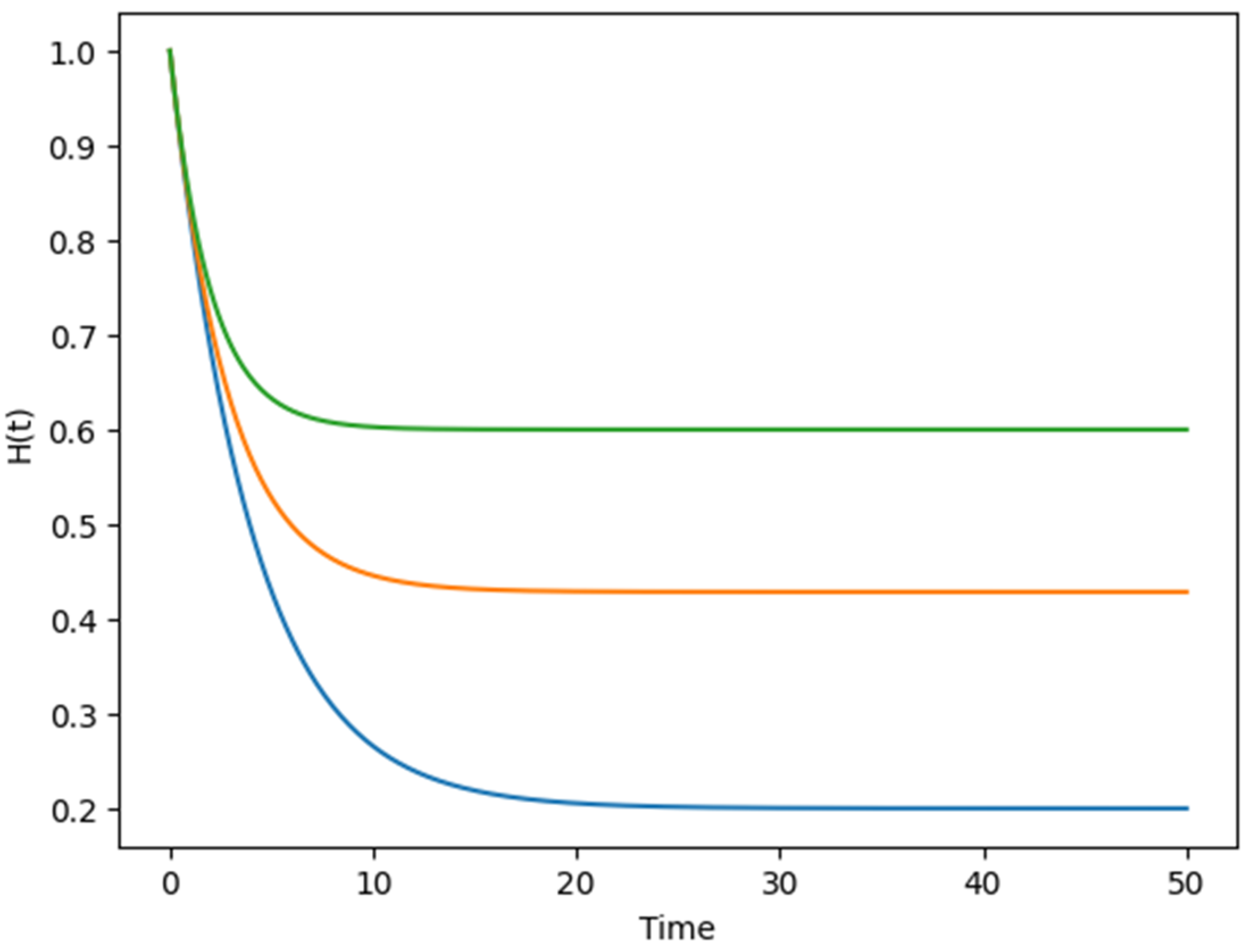
Figure 1 illustrates the time evolution of
H(
t) for constant exceedance
X = 0.2 and recovery parameters
= 0.05, 0.15, and 0.30. Higher recovery rates accelerate convergence toward equilibrium and increase steady-state capacity. Lower recovery rates produce prolonged degradation and lower equilibrium levels under identical exceedance.
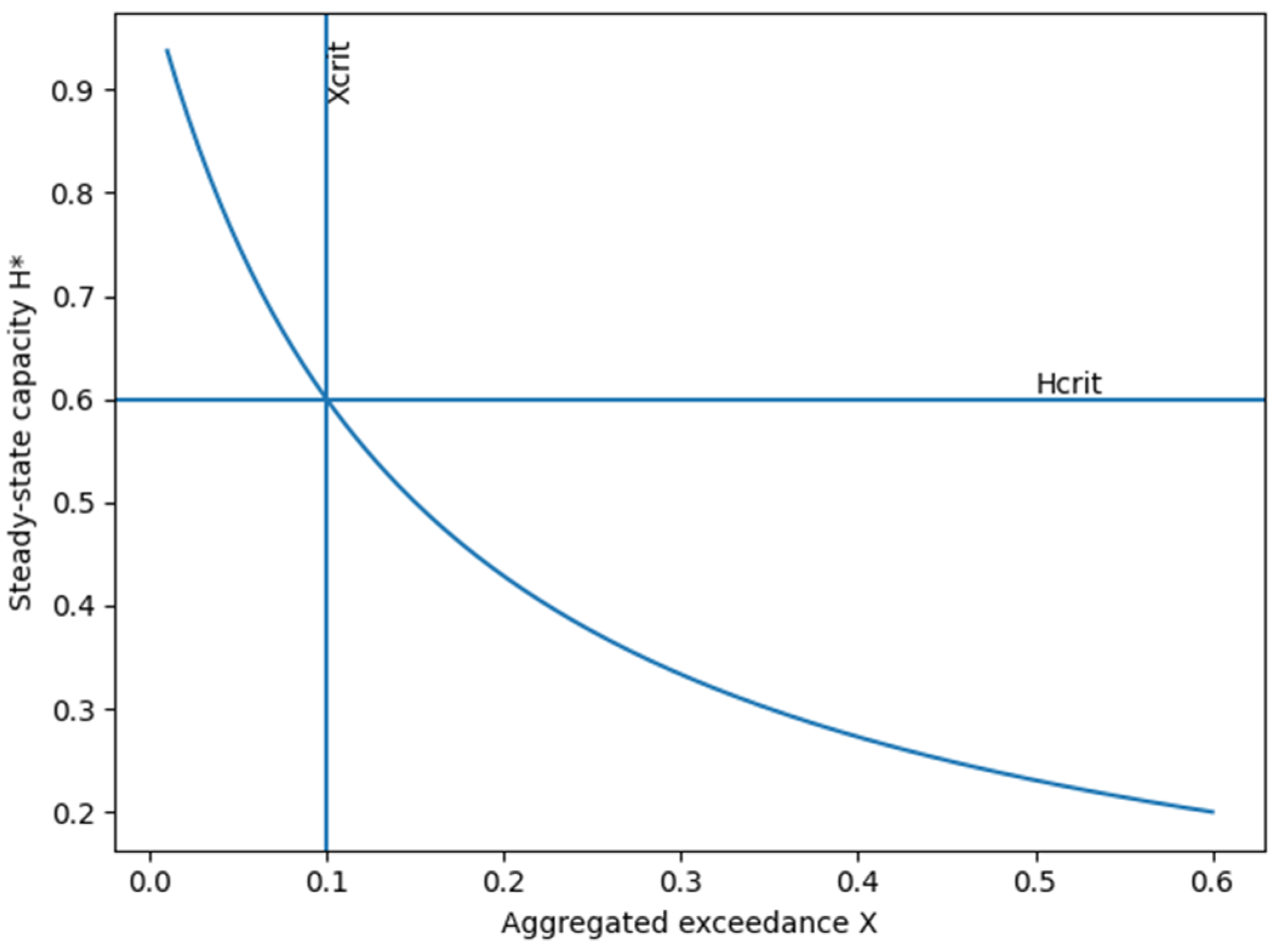
Figure 2 presents steady-state capacity
H* as a function of aggregated exceedance
X. The relationship is strictly decreasing and nonlinear. The critical exceedance level
is defined as the threshold value of
for which steady-state capacity equals the minimum functional requirement
, as derived from the steady-state condition of the model. The vertical line indicates the critical exceedance threshold
, while the horizontal line denotes the minimum functional capacity
. Their intersection defines the stability boundary, separating stable and unstable operational regimes. For
X <
Xcrit,
H* ≥
Hcrit. For
X >
Xcrit, steady-state capacity falls below the functional threshold.
The sensitivity analysis confirms that system stability depends jointly on exposure intensity and recovery dynamics. Variations in recovery capacity shift the stability boundary and modify sustainability classification under identical environmental conditions.
3.3. Sustainability Function
Industrial sustainability is represented as a composite state function
S(
t) defined as [
18]
where
E(
t) is environmental impact,
C(
t) is resource consumption,
R(
t) is operational resilience, and
H(
t) is human work capacity [
26]. The coefficients
α,
β,
γ,
δ satisfy
α < 0,
β < 0,
γ > 0,
> 0.
The sustainability function is defined as a first-order conceptual representation combining state variables with different physical dimensions. In this formulation, , , , and are not directly comparable in magnitude. In practical applications, each variable may be normalized relative to reference or baseline values and scaled through weighting coefficients , which reflect system-specific priorities and constraints. The present formulation is not intended as a calibrated metric but as a representation of interactions between system states.
Increasing environmental impact or resource consumption reduces sustainability, while increasing operational resilience or human work capacity increases sustainability.
Under otherwise unchanged environmental and resource conditions, variations in human work capacity directly modify sustainability. Capacity acts as a structural component of sustainability rather than an external adjustment factor [
20].
Sustainability depends on the aggregated exceedance load through the steady-state behavior of H(t). Even when environmental impact, resource consumption, and resilience remain unchanged, variations in exceedance load modify sustainability through the capacity term.
3.4. Existence of a Critical Stability Threshold
Sustainable operation requires that human work capacity remains above a minimum functional level
Hcrit [
27]. Under constant aggregated exceedance
, the critical exceedance level is defined as
where
denotes the maximal admissible aggregated exceedance load,
> 0 is the recovery rate parameter,
Hmax is the maximal sustainable capacity, and
Hcrit ∈ (0,
Hmax) is the minimum capacity required for stable operation. The variable
represents the constant aggregated exceedance load.
If > Xcrit, steady-state capacity converges below Hcrit, and the system operates below the stability threshold.
3.5. Capacity-Induced Sustainability Divergence
Two configurations of the same production system may operate under identical environmental impact, resource consumption, and operational resilience, while differing in aggregated exceedance load. denote the respective aggregated exceedance levels, with > .
Since steady-state capacity decreases with increasing aggregated exceedance, the configuration associated with attains a lower equilibrium capacity than that associated with . Given the positive dependence of sustainability on human work capacity, this difference in equilibrium capacity induces a corresponding difference in sustainability.
When
exceeds the critical exceedance level and
remains below it, the two configurations operate on opposite sides of the stability boundary [
28]. Under these conditions, sustainability diverges despite equivalent environmental and resource performance.
3.6. Operational Application Within a Fixed Production Setting
Within an industrial production line operating under fixed technical specifications, energy consumption, material input, and emission levels may remain stable over a defined reporting period. Under these conditions, adjustments in work organization, task allocation, shift structure, or the introduction of mechanical assistance modify aggregated exceedance load without changing environmental or resource indicators [
29].
When aggregated exceedance remains below the critical level, steady-state capacity remains above the operational threshold required for stable task execution. When exceedance exceeds this level, capacity converges below the threshold, even though energy efficiency, material use, and emissions remain unchanged.
Within such a setting, two technically equivalent production configurations may therefore report identical environmental performance while exhibiting different sustainability levels due to differences in human work capacity. This effect arises directly from the capacity constraint embedded in the system model and reflects the role of physiological and ergonomic limits within industrial sustainability assessment.
To illustrate the operational implications of the model, a simplified numerical example is considered within a fixed production setting. The production line operates under stable technical specifications, with constant energy use and emission levels during the reporting period. Human work capacity is evaluated under thermal exposure as the dominant exceedance class. The initial condition is defined as corresponding to a fully recovered state at the start of the exposure period.
Assume a Wet Bulb Globe Temperature of 31 °C during a summer shift. The physiological tolerance limit is set at Lthermal = 28 °C. Exceedance is Xthermal = 3 °C. For simplicity, a single exposure class is considered with the sensitivity coefficient k = 0.2. The aggregated exceedance load becomes X = 0.6. Let maximal sustainable capacity be Hmax = 1, recovery rate = 0.15, and minimum functional threshold Hcrit = 0.6.
Steady-state capacity becomes:
Since H* < Hcrit, the system operates below the stability threshold despite unchanged environmental and resource indicators. The configuration is therefore physiologically unstable.
Consider a second configuration introducing task rotation and scheduled cooling pauses that reduce effective exceedance to
X = 0.08. The reduction in exceedance results from intensity and duration effects. Task rotation redistributes physical workload across different muscle groups and reduces cumulative strain. Cooling pauses interrupt continuous exposure above the thermal limit and reduce effective exposure time. These interventions decrease the normalized exceedance ratio
, leading to a lower aggregated exceedance value. Steady-state capacity becomes
Since H* ≥ Hcrit, the system remains within the stability boundary. The production configuration becomes sustainable with respect to the capacity constraint, even though environmental indicators remain unchanged.
The critical exceedance level is
The first configuration exceeds this limit, while the second remains below it. The divergence in sustainability arises solely from differences in aggregated exceedance relative to the stability boundary, under otherwise identical environmental and resource performance. The numerical example is illustrative and is intended to demonstrate model behavior under simplified conditions. It does not represent a calibrated industrial case.
The formulation extends to combined exposure conditions. Simultaneous thermal strain and physical workload can be represented as separate exposure components, each defined relative to its tolerance limit. Aggregated exceedance reflects their combined contribution. Even when individual exposures remain close to their limits, their combined effect may exceed the critical threshold. System stability depends on the interaction between exposure classes. The current numerical example is limited to thermal exposure for clarity, while the formulation applies directly to combined exposure conditions.
4. Discussion
The results formalize human work capacity as a dynamic boundary condition within industrial sustainability assessment. The derivation of the critical exceedance level Xcrit introduces a formal stability condition that links workload intensity to sustainability classification. Capacity differs structurally from environmental impact and resource consumption because it is governed by physiological tolerance limits and recovery dynamics. When aggregated exceedance exceeds the critical level, steady-state capacity falls below the stability threshold, even if environmental indicators remain unchanged. A sustainability assessment that omits this state may misclassify system stability.
Current ESG frameworks report environmental metrics, governance structures, and selected social indicators [
30]. Social components are typically expressed through compliance rates, incident statistics, or workforce ratios aggregated over reporting periods. These indicators do not represent dynamic constraints. The present formulation introduces a state variable that evolves under operational exposure. When exceedance persists, capacity degrades as a function of load and recovery. A system may remain ESG-compliant while operating beyond physiological limits. Under such conditions, sustainability scoring reflects reporting compliance rather than dynamic stability.
Life cycle assessment quantifies environmental burdens across production stages [
31,
32]. LCA provides standardized metrics for emissions, resource depletion, and energy intensity. However, LCA does not capture time-dependent degradation of functional performance induced by sustained overload. Two production configurations with identical life cycle environmental profiles may differ in capacity state. When capacity crosses the critical threshold, the system enters an unstable regime that is not visible in environmental impact indicators. The results indicate a structural gap between environmental efficiency and operational sustainability.
Industry 5.0 places human-centric production systems [
33]. The present model operationalizes this principle by defining explicit physiological and ergonomic limits within the sustainability function. Human-centricity becomes a quantifiable constraint rather than a qualitative objective. Capacity is treated as a state variable with a critical boundary, and system stability becomes conditional on remaining within that boundary. This defines workforce health as a structural determinant of long-term industrial stability.
The integration of capacity dynamics into digital twins extends the model’s applicability [
34]. Real-time monitoring of exposure indicators permits estimation of aggregated exceedance and proximity to the critical boundary. Predictive simulation can identify operational regimes approaching instability before irreversible degradation occurs. In this context, digital twins incorporate physiological constraints alongside environmental and resource parameters to improve stability-oriented decision support.
The principal implication is structural. Models that optimize energy efficiency and material throughput while neglecting capacity dynamics may report favorable sustainability performance despite progressive instability. The boundary formulation demonstrates that sustainability depends on remaining within physiological tolerance limits. Without this integration, assessment frameworks may systematically overestimate system robustness.
Table 2 presents a comparison between conventional sustainability assessment approaches and the capacity-constrained model developed in this study. The comparison focuses on state variables, threshold definition, and implications for system stability evaluation.
The comparative analysis clarifies that conventional sustainability assessment treats workforce conditions as reporting attributes rather than system constraints [
11]. The capacity-constrained formulation embeds physiological tolerance limits directly into the system structure. Sustainability becomes conditional on maintaining operational demand within measurable human limits.
This shift alters the interpretation of performance optimization. Environmental efficiency and resource intensity remain necessary components of sustainability, but they are not sufficient. A production configuration that minimizes energy use but sustains aggregated exceedance above the critical level will converge toward reduced capacity and instability. In this framework, operational sustainability depends on simultaneous compliance with environmental, resource, resilience, and physiological boundaries.
The results also introduce a temporal dimension absent from static assessment schemes [
35]. Capacity degradation accumulates under persistent exceedance and recovers only under reduced load. Sustainability becomes path-dependent because capacity reflects cumulative exposure history. Two systems with identical environmental profiles at a given time point may differ in stability due to different exposure histories.
This temporal structure supports predictive monitoring [
34]. Real-time estimation of aggregated exceedance provides an early indication of proximity to the stability boundary. When integrated into digital monitoring architectures, capacity dynamics extend sustainability evaluation beyond retrospective reporting toward predictive operational adjustment.
The boundary formulation defines sustainability as a constrained dynamic condition rather than an aggregate indicator score. Stability requires that all state variables remain within admissible ranges. The inclusion of human work capacity introduces an explicit physiological constraint into sustainability assessment and aligns environmental accounting with operational system behavior.
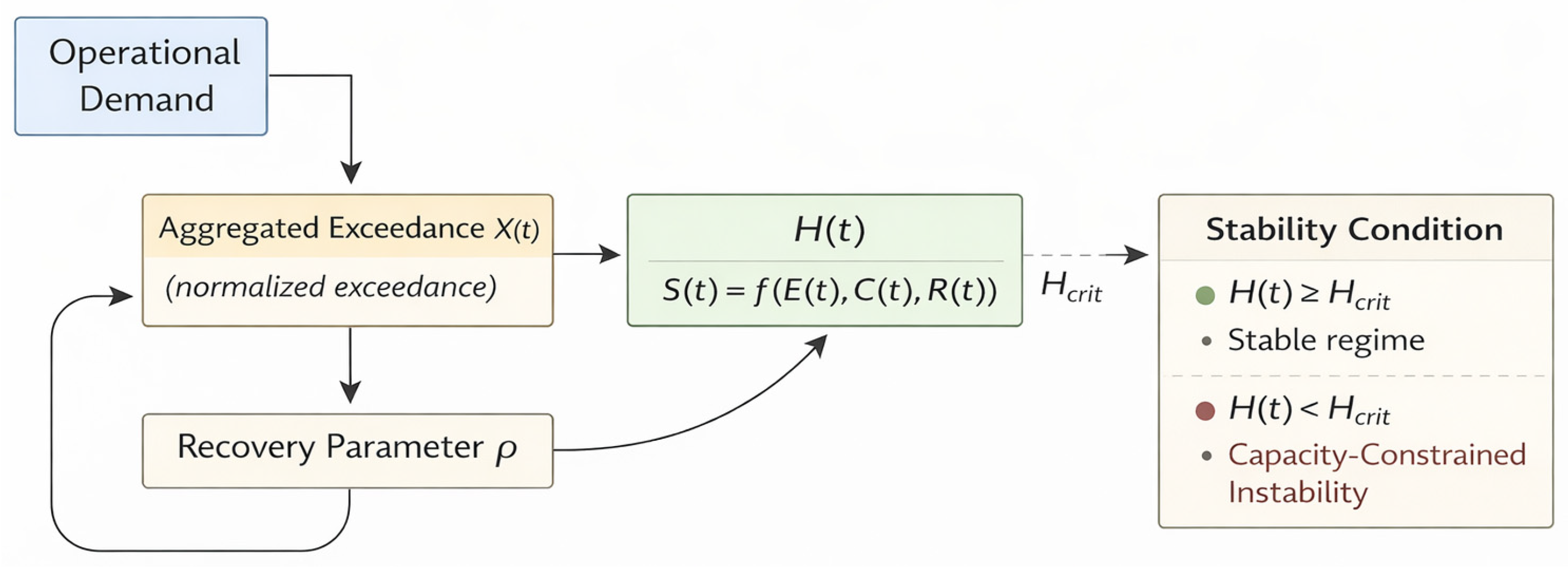
Figure 3 illustrates the structural position of human work capacity within the industrial sustainability system. Environmental impact, resource consumption, and operational resilience define conventional assessment space, while human work capacity introduces a stability boundary. The critical threshold
Hcrit separates stable and unstable operational regimes. Systems evaluated without the capacity state may remain within environmental limits while operating beyond the physiological boundary.
The formulation is not sector-specific. Any industrial system characterized by measurable environmental impact, resource consumption, operational resilience, and human workload can incorporate the capacity state variable. This includes manufacturing, process industries, construction, logistics, and energy production. The model requires exposure indicators and tolerance limits relevant to the operational context. The mathematical structure remains unchanged, while exposure classes and threshold values are sector-dependent. The framework is transferable across industrial domains where sustained physical or thermal demands influence workforce performance. Its implementation depends on the availability of exposure measurements and organizational data rather than on industry type.
The model can be applied at multiple decision levels. At the operational level, safety engineers and production managers can estimate aggregated exceedance and evaluate proximity to the stability boundary. At the strategic level, sustainability analysts can integrate the capacity term into composite sustainability indicators to prevent overestimation of system robustness. At the policy level, regulatory bodies may interpret physiological thresholds as quantitative constraints rather than qualitative social indicators. The formulation does not require replacement of existing ESG or LCA frameworks. It extends them by introducing an additional state variable governed by measurable limits.
Current sustainability models integrate environmental, economic, and social indicators but treat workforce factors primarily as reporting variables [
10]. Occupational safety and health studies quantify exposure-response relationships but do not embed them within system-level sustainability functions [
36]. This study differs in two respects. First, it formalizes human work capacity as a dynamic state variable with explicit recovery dynamics. Second, it derives a critical exceedance threshold that defines a stability boundary within the sustainability function. Previous approaches quantify risk or compliance. The present formulation introduces a physiological constraint into the sustainability function. The principal contribution lies in the transformation of human work capacity from a descriptive social indicator to a mathematically bounded system state. Sustainability becomes conditional on remaining within physiological tolerance limits. This shift introduces a quantifiable stability boundary into industrial sustainability assessment.
The model provides a unified structure connecting exposure intensity, capacity dynamics, and composite sustainability scoring. This integration connects occupational health modeling with system-level sustainability evaluation.
The formulation relies on measurable exposure indicators and defined tolerance limits. In practice, calibration of sensitivity coefficients and recovery parameters requires sector-specific data. The recovery parameter ρ reflects biological adaptation and rest conditions, which vary across industries and workforce profiles. The current model does not explicitly represent discrete shift transitions or acute events.
The exposure classes considered focus on physical and thermal load [
37]. Cognitive strain, psychosocial stressors, and organizational complexity are not explicitly modeled in the present formulation. Their integration would require additional state variables or coupling terms. The framework applies most directly to systems where sustained physical demand constitutes a measurable component of operational load.
In systems with measurable physical or thermal exposure, the model can be applied by production engineers and occupational safety specialists during work planning and shift design. They use existing exposure measurements and defined tolerance limits to verify whether the planned workload configuration remains within the admissible capacity region. If the configuration places operation near or beyond the stability boundary, they modify task allocation, shift duration, rotation frequency, or rest scheduling before implementation. This permits evaluation of alternative work organization scenarios under identical environmental and resource conditions. In practice, the model serves as a pre-operational screening tool. It helps distinguish between technically feasible configurations and those that embed structural overload into daily operation. The benefit lies in identifying unstable workload regimes at the planning stage, rather than after capacity decline becomes visible through absenteeism, injury records, or reduced productivity. The model can be applied both at the planning stage and during periodic operational review. Environmental indicators remain necessary, but approval of a production configuration requires verification that the workload remains within the admissible capacity region.
This research has several limitations. The validity of the formulation depends on the availability of measurable exposure indicators and clearly defined physiological thresholds. The model applies to industrial systems in which operational demands generate quantifiable physical or thermal load. It is not intended for activities dominated by cognitive workload in the absence of measurable physiological strain. Implementation requires operational data, including exposure intensity, duration, and reference tolerance limits. In the absence of these inputs, the capacity state cannot be estimated reliably, and the stability boundary cannot be evaluated.
Further research should discuss empirical calibration of exceedance coefficients across industrial sectors. Sector-specific investigations can estimate tolerance thresholds and recovery parameters under real production conditions. Integration of physiological monitoring data, including heart rate variability and metabolic workload indicators, would permit validation of capacity dynamics at the operational scale [
38]. Extension of the model toward cognitive and psychosocial dimensions constitutes a second research direction. Incorporating cognitive workload and stress-related exposure variables within the state formulation would broaden applicability to knowledge-intensive and semi-automated systems. Such integration requires measurable cognitive load indicators and defined tolerance thresholds comparable to those used for physical strain. Implementation within digital twin environments requires the development of real-time exceedance estimation algorithms and validation against observed performance data. Operational deployment depends on reliable exposure sensing, data integration protocols, and consistent parameter updating under varying production conditions.
The contribution of this study is structural. Previous approaches quantify occupational exposure or include workforce metrics within ESG reporting, but they do not integrate physiological tolerance limits into a dynamic sustainability function. The present formulation derives a capacity-dependent stability boundary that alters sustainability classification under otherwise identical environmental performance. This shift transforms human work capacity from a descriptive indicator into a system-level constraint.
Practical application of the model requires a limited set of measurable inputs. Minimum data include exposure intensity , corresponding tolerance limits , and estimates of recovery rate and maximal capacity . These parameters can be approximated using standard occupational thresholds and simplified recovery assumptions. Implementation follows a simple sequence. Exposure classes are defined and matched to tolerance limits. Normalized exceedance ratios are computed and aggregated using weighting coefficients . Steady-state capacity is then evaluated relative to the functional threshold to determine system stability. Applications involving ESG reporting or digital twin integration require additional data and system-specific calibration. In this current form, the model provides a structural method for identifying capacity-related stability limits and does not constitute a fully calibrated decision tool.
The results relate to existing quantitative models of work capacity and fatigue. Previous approaches quantify strain accumulation and performance decline but do not define a system-level stability condition [
5,
17]. The present formulation introduces a threshold behavior in which aggregated exceedance determines whether steady-state capacity remains above the functional requirement.
In the numerical scenario, steady-state capacity decreases from 0.65 to 0.20 when exceedance exceeds the critical level. This corresponds to a reduction of approximately 69% in available work capacity, calculated within the defined model conditions. The reduction reflects cumulative effects of sustained exceedance and limited recovery over time. Reported reductions in physical work capacity under heat stress above 30 °C WBGT increase with workload intensity and exposure duration [
1,
13]. These studies refer to short-term physiological responses under controlled or field conditions. The model describes steady-state behavior under continuous exposure, where capacity evolves with cumulative exceedance and recovery. This leads to lower equilibrium capacity levels than those observed in short-duration measurements.
A steady-state capacity of 0.20 indicates that the system cannot sustain the required workload over time. This level corresponds to reduced task execution capacity and increased likelihood of disruption. The magnitude of the reduction remains consistent with reported decreases under heat exposure, while the model captures cumulative effects over time [
1,
13]. Lower capacity reduces effective output per unit of resource consumption under the same energy use and emission levels. When capacity remains above the functional threshold, the system maintains stable performance under the same environmental and resource conditions. Steady-state capacity and the critical exceedance threshold define the boundary between stable and unstable system operation. They provide a direct criterion for identifying capacity-driven instability under otherwise identical environmental conditions.
The model can be used to define capacity-based exposure limits in occupational safety and health regulations. Instead of setting independent limits for each factor, regulators can evaluate aggregated exceedance in relation to a functional threshold. This approach captures cumulative effects across thermal load, physical effort, and musculoskeletal strain. At company level, the model can be applied in risk assessment and work design. Exposure values can be measured, normalized to tolerance limits, and aggregated to estimate total exceedance. This allows direct evaluation of whether current work conditions remain within the stability domain. The results can guide task rotation, shift duration, and recovery periods to maintain capacity above the functional threshold.
At the regulatory level, aggregated exceedance can be introduced as a complementary criterion within existing exposure assessment procedures. Implementation at the company level requires routine exposure measurement and simple aggregation within standard risk assessment workflows.