Toward High-Quality and Sustainable Employment: Spatial Evolution and Driving Factors of Precarious Labor Market in China



Abstract
1. Introduction
2. Materials and Methods
2.1. Study Area and Data Sources
2.2. Research Methods
2.2.1. Gini Coefficient
2.2.2. Spatial Autocorrelation Analysis
2.2.3. Kernel Density Analysis
2.2.4. Panel Negative Binomial Regression
3. Results and Analysis
3.1. The Development and Spatial Evolution of China’s PLM
3.1.1. The Development of China’s Labor Dispatch Industry and PLM
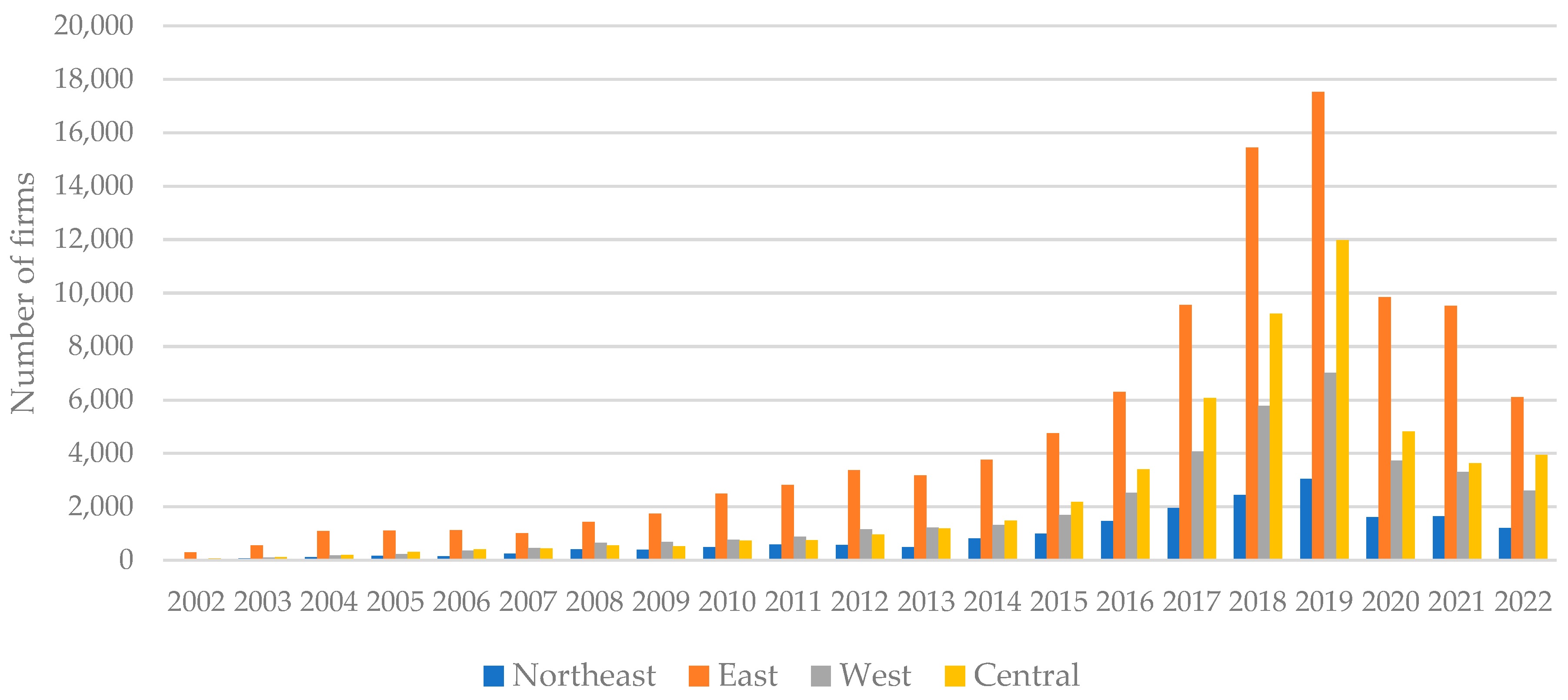
- Initiation (2002–2008): During this period, China’s PLM started to expand rapidly. Compared with the pre-2002 era, the flow of rural surplus labor to cities had slowed markedly [32]. The shrinking labor supply raised employers’ search costs and wage bills. To cut these expenses and sidestep social-security contributions, enterprises may increasingly turn to labor dispatch as a key staffing strategy [9].
- Acceleration (2009–2012): Growth of China’s PLM intensified, notably outpacing the previous phase. This growth was partly due to the implementation of the Labor Contract Law in 2008. While the statute strengthened workers’ rights protection, it also markedly raised the cost of formal employment. For the first time, however, it granted legal recognition to “labor dispatch”, limiting it to “a supplementary form of employment that may be used only in temporary, auxiliary or substitute posts” [33]. This provision legalized dispatched and other non-standard labor in China, allowing real users of labor to shift statutory employer liabilities onto dispatch agencies and thereby cut labor costs [33]. Against the backdrop of costlier formal hiring and newly legitimized dispatch, several enterprises reduced the proportion of formal employees and increasingly turned to dispatched workers. The lack of detailed criteria for the “three types” of positions—temporary, supportive, and substitute -in the Labor Contract Law further fueled the rampant expansion of PLM [9]. From this phase onward, regional disparities in the development of the PLM became increasingly evident. The growth of LDF was fastest in eastern China, while central and western regions showed moderate growth. The northeast experienced relatively slow growth, potentially linked to factors such as population outflow, undiversified industrial structure, and economic stagnation.
- High-Speed Expansion (2013–2019): Following the 2013 amendment of the Labor Contract Law, the number of new LDF declined substantially. This amendment significantly tightened market access for LDF: the minimum registered capital was raised from RMB 0.5 million to RMB 2 million, and financial penalties for violations were sharply increased [33]. Meanwhile, the amendment for the first time imposed clear-cut rules on “labor coordination” and the scope of the “three-position” clause, and capped dispatched workers at no more than 10% of the enterprise’s total workforce. These hard constraints reduced the profit margins of dispatch operations and resulted in a certain inhibitory effect on the development of the PLM [9]. However, growth soon rebounded after 2014, as the rise of the platform economy and gig work (e.g., food delivery and ride-hailing) generated strong demand for flexible employment [9,34]. Although the amendment of the Labor Contract Law restrained the growth of LDF over the short term, the huge market demand re-energized the industry. By this stage, central and western China overtook the east as the main growth zones for LDF. On the one hand, the east-to-west transfer of industries has created a surge of new jobs in central and western regions, while these cities’ own growth momentum has further amplified labor demand. On the other hand, tighter labor inspection in the east, coupled with lower enforcement density central and western China, means LDF face lighter compliance pressure and lower violation costs, fueling the rapid expansion of the PLM in inland China.
- Regulatory Adjustment (2020–2022): A sharp decline in the number of newly registered firms occurred in 2020, followed by a continued annual decline, though at a slower rate. The impact of the pandemic on China’s labor dispatch industry and the wider economy has attracted scholarly attention [35,36,37,38], yet the mechanisms remain convoluted and it is still unclear whether COVID-19 benefited the industry as a whole. Drawing on data for newly registered LDF from 2020–2022 and on existing studies, this paper argues that the pandemic profoundly reshaped the internal structure of China’s PLM: a handful of niche segments (e.g., mask production, same-day delivery) expanded against the trend, but this was insufficient to offset the sector-wide slowdown. On the demand side, the global trade slump forced firms to cut head-count, especially “blue-collar” posts in construction and manufacturing [31]—precisely the categories that account for roughly 36.2 per cent of China’s dispatched workforce [39]. Although the crisis created new flexible jobs such as express logistics and live-streaming sales [35], their scale was too small to offset the loss of other labor demand. On the supply side, city lockdowns triggered a return-migration wave of rural workers, temporarily reducing the urban labor supply; yet falling orders also pushed firms to lay off staff, forcing many workers back into the labor pool. At the same time, income losses and employment precarity increased workers’ willingness to accept short-term dispatch jobs [36,37], resulting in a simultaneous contraction of the total labor supply and intensified competition within the remaining pool. Overall, the pandemic hit both the demand and supply sides of the temporary staffing industry and accelerated the restructuring of its employment patterns, leading China’s labor dispatch industry into a “regulatory adjustment period” driven jointly by COVID shocks and tightened rules. Which effect dominates awaits further longitudinal and more evidence.
3.1.2. Spatial Distribution and Evolutionary Patterns of China’s PLM
3.2. Analysis of the Mechanisms Driving the Spatial Evolution of China’s PLM
3.2.1. Analytical Framework and Indicator System
3.2.2. Regression Model and Results
3.2.3. Analysis of the Mechanisms Driving the Spatial Evolution in the National Samples
3.2.4. Analysis of the Mechanisms Driving the Spatial Evolution in Regional Samples
3.2.5. Analysis of the Mechanisms Driving the Spatial Evolution in Samples by City Tier
4. Discussion
4.1. Local Embeddedness of China’s Labor Dispatch Industry Development
4.2. Policy Implications
4.3. Research Limitations and Future Directions
5. Conclusions
Author Contributions
Funding
Institutional Review Board Statement
Informed Consent Statement
Data Availability Statement
Acknowledgments
Conflicts of Interest
Abbreviations
| Kernel Density Estimation | KDE |
| LDF | Labor Dispatch Firms |
| NBR | Negative Binomial Regression |
| PLM | Precarious Labor Market |
| POI | Point of Interest |
| SDG | Sustainable Development Goals |
| SOE | State-owned Enterprise |
References
- Kalleberg, A.; Vallas, S. Probing Precarious Work: Theory, Research, and Politics. In Research in the Sociology of Work; Kalleberg, A.L., Vallas, S.P., Eds.; Emerald Publishing Limited: Leeds, UK, 2017; Volume 31, pp. 1–30. ISBN 978-1-78743-288-8. [Google Scholar]
- Goal 8: Economic Growth—United Nations Sustainable Development. Available online: https://www.un.org/sustainabledevelopment/economic-growth/ (accessed on 21 November 2025).
- Goal 10: Reduce Inequality Within and Among Countries. Available online: https://www.un.org/sustainabledevelopment/inequality/ (accessed on 21 November 2025).
- Kreshpaj, B.; Orellana, C.; Burström, B.; Davis, L.; Hemmingsson, T.; Johansson, G.; Kjellberg, K.; Jonsson, J.; Wegman, D.H.; Bodin, T. What Is Precarious Employment? A Systematic Review of Definitions and Operationalizations from Quantitative and Qualitative Studies. Scand. J. Work Environ. Health 2020, 46, 235–247. [Google Scholar] [CrossRef] [Scilit]
- Smith, J. The Political Economy of Outsourcing. In Vulnerability, Exploitation and Migrants; Waite, L., Craig, G., Lewis, H., Skrivankova, K., Eds.; Palgrave Macmillan: London, UK, 2015; pp. 28–43. ISBN 978-1-137-46040-0. [Google Scholar]
- Crotty, S. The Social Geography of Day Labor: Informal Responses to the Economic Downturn. Yearb. Assoc. Pac. Coast Geogr. 2014, 76, 22–48. [Google Scholar] [CrossRef] [Scilit]
- Hinterseer, T. Part-Time Work: Atypical? Precarious? Normal? Eur. J. Futures Res. 2013, 1, 18. [Google Scholar] [CrossRef] [Scilit]
- International Labour Office. Private Employment Agencies, Temporary Agency Workers and Their Contribution to the Labour Market; International Labour Office: Geneva, Switzerland, 2009. [Google Scholar]
- Yan, W. The Evolution and Driving Mechanisms of Labor Dispatch in China. World Econ. 2023, 46, 128–154. (In Chinese) [Google Scholar] [CrossRef]
- Kalleberg, A.L. Nonstandard Employment Relations: Part-Time, Temporary and Contract Work. Annu. Rev. Sociol. 2000, 26, 341–365. [Google Scholar] [CrossRef] [Scilit]
- Crotty, S.M. Locating Day-Labor Employment: Toward a Geographic Understanding of Day-Labor Hiring Site Locations in the San Diego Metropolitan Area. Urban Geogr. 2015, 36, 993–1017. [Google Scholar] [CrossRef] [Scilit]
- Peck, J.; Theodore, N. Contingent Chicago: Restructuring the Spaces of Temporary Labor. Int. J. Urban Reg. Res. 2001, 25, 471–496. [Google Scholar] [CrossRef] [Scilit]
- Coe, N.M.; Jones, K.; Ward, K. The Business of Temporary Staffing: A Developing Research Agenda. Geogr. Compass 2010, 4, 1055–1068. [Google Scholar] [CrossRef] [Scilit]
- McDowell, L.; Batnitzky, A.; Dyer, S. Division, Segmentation, and Interpellation: The Embodied Labors of Migrant Workers in a Greater London Hotel. Econ. Geogr. 2007, 83, 1–25. [Google Scholar] [CrossRef] [Scilit]
- Zhang, L. Contextualizing Precarious Work: Labor Dispatch, Boundary-Drawing, and the Politics of Labor Regulation in Post-Socialist China. Labor. Hist. 2021, 62, 556–574. [Google Scholar] [CrossRef] [Scilit]
- Lo, V.I. Labour Dispatch in China: Flexibility and Security in Employment. Peking Univ. Law J. 2023, 11, 161–183. [Google Scholar] [CrossRef] [Scilit]
- Kalleberg, A.L.; Marsden, P.V. Externalizing Organizational Activities: Where and How US Establishments Use Employment Intermediaries. Socio-Econ. Rev. 2005, 3, 389–416. [Google Scholar] [CrossRef] [Scilit]
- Håkansson, K.; Isidorsson, T. Temporary Agency Workers—Precarious Workers? Perceived Job Security and Employability for Temporary Agency Workers and Client Organization Employees at a Swedish Manufacturing Plant. Old Site Nord. J. Work. Life Stud. 2015, 5, 3–22. [Google Scholar] [CrossRef] [Scilit]
- Coe, N.M.; Johns, J.; Ward, K. Mapping the Globalization of the Temporary Staffing Industry. Prof. Geogr. 2007, 59, 503–520. [Google Scholar] [CrossRef] [Scilit]
- Enright, B. (Re)Considering New Agents: A Review of Labour Market Intermediaries within Labour Geography. Geogr. Compass 2013, 7, 287–299. [Google Scholar] [CrossRef] [Scilit]
- Hess, M. ‘Spatial’ Relationships? Towards a Reconceptualization of Embedded Ness. Prog. Hum. Geogr. 2004, 28, 165–186. [Google Scholar] [CrossRef] [Scilit]
- Peck, J.; Theodore, N.; Ward, K. Constructing Markets for Temporary Labour: Employment Liberalization and the Internationalization of the Staffing Industry. Glob. Netw. 2005, 5, 3–26. [Google Scholar] [CrossRef] [Scilit]
- GB/T 4754-2011; Industrial Classification of the National Economy. China Statistics Press: Beijing, China, 2011.
- Zhang, C.; Jin, J.; Qiu, X.; Li, L.; He, R. Regional Social Relationships Evaluation Using the AHP and Entropy Weight Method: A Case Study of the Qinghai–Tibet Plateau, China. Sustainability 2022, 14, 5321. [Google Scholar] [CrossRef] [Scilit]
- Chen, Y. An Analytical Process of Spatial Autocorrelation Functions Based on Moran’s Index. PLoS ONE 2021, 16, e0249589. [Google Scholar] [CrossRef] [Scilit]
- Mao, H.; Yang, N.; Qi, C. Spatial Evolution Characteristics and Influencing Factors of China’s Citrus Industry. Econ. Geogr. 2024, 44, 146–153. (In Chinese) [Google Scholar] [CrossRef]
- Zhang, Y.; Kong, J.; Zhang, Y.; Wang, H.; Deng, S. Case Study of Stratification, Spatial Agglomeration, and Unequal Logistics Industry Development on Western Cities in China. J. Urban Plann. Dev. 2022, 148, 05022009. [Google Scholar] [CrossRef] [Scilit]
- Zhang, D.; Lin, Y.; Zhang, J.; Han, R.; Li, L. The Spatial Distribution Patterns and Influencing Factors of China’s Newborn Digital Enterprises. J. Clean. Prod. 2023, 423, 138893. [Google Scholar] [CrossRef] [Scilit]
- Gu, H.; Rowe, F.; Liu, Y.; Shen, T. Geography of Talent in China During 2000–2015: An Eigenvector Spatial Filtering Negative Binomial Approach. Chin. Geogr. Sci. 2021, 31, 297–312. [Google Scholar] [CrossRef] [Scilit]
- Xu, F. The Emergence of Temporary Staffing Agencies in China. Comp. Lab. L. Pol’y J. 2008, 30, 431. [Google Scholar]
- Li, G.; Si, W. Alienation of the Labor Dispatch Employment Market: Origin, Analysis, and Path Evolution. J. Theory 2018, 66–72. (In Chinese) [Google Scholar] [CrossRef]
- Cai, F. Has the Potential for Agricultural Labor Transfer Been Exhausted? China Rural. Econ. 2018, 2–13. (In Chinese) [Google Scholar] [CrossRef]
- Huang, Z. Rethinking China’s Informal Economy: An Introduction from the Perspective of Socio-Economic and Legal History. Open Times 2017, 36, 153–163. (In Chinese) [Google Scholar]
- Yang, W.; Wu, Q.; Zhang, J. Zhongguo Linghuo Yonggong Fazhan Baogao; Social Sciences Academic Press: Beijing, China, 2021; p. 252. (In Chinese) [Google Scholar]
- Lu, X. Impact of COVID-19 on the Gig Economy in China: Challenges and Coping Strategies: Impact of COVID-19 on the Gig Economy in China. In Proceedings of the 2023 7th International Conference on E-Commerce, E-Business and E-Government, Plymouth, UK, 27–29 April 2023; ACM: Plymouth, UK, 2023; pp. 123–128. [Google Scholar]
- Liang, X.; Rozelle, S.; Yi, H. The Impact of COVID-19 on Employment and Income of Vocational Graduates in China: Evidence from Surveys in January and July 2020. China Econ. Rev. 2022, 75, 101832. [Google Scholar] [CrossRef] [Scilit]
- Mao, Y.; Zhang, Y.; Bai, J.; Zhang, L.; Hu, W. The Impact of COVID-19 on the Employment Status and Psychological Expectations of College Graduates: Empirical Evidence from the Survey Data of Chinese Recruitment Websites. Front. Psychol. 2022, 13, 1039945. [Google Scholar] [CrossRef] [Scilit]
- Sun, Y.; Zhu, H.; Xiong, H. Large-Scale Assessment of Labour Market Dynamics in China during the COVID-19 Pandemic. arXiv 2023, arXiv:2305.00199. [Google Scholar] [CrossRef] [Scilit]
- China Research and Consulting Institute. Analysis of the Current Situation and Distribution Pattern of China’s Labor Dispatch Industry, 2023. ChinaIRN Research Report. Available online: https://www.chinairn.com/news/20230128/140137464.shtml (accessed on 10 October 2025). (In Chinese)
- Mortensen, D.T.; Pissarides, C.A. Job Creation and Job Destruction in the Theory of Unemployment. Rev. Econ. Stud. 1994, 61, 397–415. [Google Scholar] [CrossRef] [Scilit]
- Albrecht, J. Search Theory: The 2010 Nobel Memorial Prize in Economic Sciences. Scand. J. Econ. 2011, 113, 237–259. [Google Scholar] [CrossRef] [Scilit]
- Yang, F. Progress in Research on the Driving Mechanisms and Spatial Effects of Producer Services Development. Prog. Geogr. 2018, 37, 750–760. (In Chinese) [Google Scholar]
- Wood, P. Business Services, the Management of Change and Regional Development in the UK: A Corporate Client Perspective. Trans. Inst. Br. Geogr. 1996, 21, 649–665. [Google Scholar] [CrossRef] [Scilit]
- Keeble, D.; Nachum, L. Why Do Business Service Firms Cluster? Small Consultancies, Clustering and Decentralization in London and Southern England. Trans. Inst. Br. Geogr. 2002, 27, 67–90. [Google Scholar] [CrossRef] [Scilit]
- Jiang, H.; Zhang, W.; Yu, J.; Shang, S.; Zou, L. Mechanisms of Accessibility’s Impact on the Spatial Evolution of Producer Services under the Drive of Transport Integration: A Case Study of the Yangtze River Delta. Prog. Geogr. 2024, 43, 657–673. (In Chinese) [Google Scholar]
- Jiang, Y.; Liao, F.; Jin, L. Effects of Locational Accessibility on Firm Diffusion Characteristics: The Case of Sino-Europe Economic Corridor. Transp. Policy 2021, 105, 80–93. [Google Scholar] [CrossRef] [Scilit]
- Tang, Z.; Wu, W.; Liu, W.; Li, X. The Impact of High-Speed Railways on the Spatial Agglomeration of Producer Services: A Case Study of the Yangtze River Delta Urban Agglomeration. Prog. Geogr. 2021, 40, 746–758. (In Chinese) [Google Scholar] [CrossRef] [Scilit]
- Song, Y.; Lee, K.; Anderson, W.P.; Lakshmanan, T.R. Industrial Agglomeration and Transport Accessibility in Metropolitan Seoul. J. Geogr. Syst. 2012, 14, 299–318. [Google Scholar] [CrossRef] [Scilit]
- Chen, H. Evolution of the Spatial Distribution and Agglomeration Characteristics of Producer Services in Beijing. Econ. Geogr. 2018, 38, 108–116. (In Chinese) [Google Scholar] [CrossRef]
- Ingrassia, R. Labor Market Imbalances and Personnel Recruitment. Am. J. Ind. Bus. Manag. 2019, 9, 1376–1394. [Google Scholar] [CrossRef]
- Zhang, H. Agglomeration of Producer Services and Urban Economic Performance: An Analysis from the Perspective of Industrial and Regional Heterogeneity. J. Financ. Econ. 2015, 41, 67–77. (In Chinese) [Google Scholar] [CrossRef]
- Coe, N.M.; Townsend, A.R. Debunking the Myth of Localized Agglomerations: The Development of a Regionalized Service Economy in South-East England. Trans. Inst. Br. Geogr. 1998, 23, 1–20. [Google Scholar] [CrossRef] [Scilit]
- MacPherson, A. The Role of Producer Service Outsourcing in the Innovation Performance of New York State Manufacturing Firms. Ann. Assoc. Am. Geogr. 1997, 87, 52–71. [Google Scholar] [CrossRef] [Scilit]
- Lin, L.; Zhu, Y. Types and Determinants of Migrants’ Settlement Intention in China’s New Phase of Urbanization: A Multi-Dimensional Perspective. Cities 2022, 124, 103622. [Google Scholar] [CrossRef] [Scilit]
- Liang, Z.; Appleton, S.; Song, L. Informal Employment in China: Trends, Patterns and Determinants of Entry; IZA Discussion Papers: Bonn, Germany, 2016. [Google Scholar]
- Huang, G.; Xue, D.; Guo, Y.; Wag, C. Constrained Voluntary Informalisation: Analysing Motivations of Self-Employed Migrant Workers in an Urban Village, Guangzhou. Cities 2020, 105, 102760. [Google Scholar] [CrossRef] [Scilit]
- Monnoyer, M.-C.; Zuliani, J.-M. The Decentralisation of Airbus Production and Services. Serv. Ind. J. 2007, 27, 251–262. [Google Scholar] [CrossRef] [Scilit]
- Lin, L.; Zhu, Y.; Ke, W.; Wang, J. Effects of Basic Public Services on the Settlement Intentions of the Floating Population in Cities of Different Sizes. Acta Geogr. Sin. 2019, 74, 737–752. (In Chinese) [Google Scholar]
- Imbs, J.; Wacziarg, R. Stages of Diversification. Am. Econ. Rev. 2003, 93, 63–86. [Google Scholar] [CrossRef] [Scilit]
- Redding, S.J.; Turner, M.A. Transportation Costs and the Spatial Organization of Economic Activity. In Handbook of Regional and Urban Economics; Elsevier: Amsterdam, The Netherlands, 2015; Volume 5, pp. 1339–1398. ISBN 978-0-444-59533-1. [Google Scholar]
- Moyart, L. The Role of Producer Services in Regional Development: What Opportunities for Medium-Sized Cities in Belgium? Serv. Ind. J. 2005, 25, 213–228. [Google Scholar] [CrossRef] [Scilit]
- Gong, H. A Hierarchical Change Model of Business and Professional Services in the United States. Urban Geogr. 2001, 22, 340–359. [Google Scholar] [CrossRef] [Scilit]
- Hermelin, B. The Urbanization and Suburbanization of the Service Economy: Producer Services and Specialization in Stockholm. Geogr. Ann. Ser. B Human. Geogr. 2007, 89, 59–74. [Google Scholar] [CrossRef] [Scilit]
- Wills, J. Subcontracted Employment and Its Challenge to Labor. Labor. Stud. J. 2009, 34, 441–460. [Google Scholar] [CrossRef] [Scilit]
- Lier, D.C. Places of Work, Scales of Organising: A Review of Labour Geography. Geogr. Compass 2007, 1, 814–833. [Google Scholar] [CrossRef] [Scilit]
- Shin, K.; Kalleberg, A.L.; Hewison, K. Precarious Work: A Global Perspective. Sociol. Compass 2023, 17, e13136. [Google Scholar] [CrossRef] [Scilit]
- Han, S.S.; Qin, B. The Spatial Distribution of Producer Services in Shanghai. Urban Stud. 2009, 46, 877–896. [Google Scholar] [CrossRef] [Scilit]
- Coe, N.M.; Jordhus-Lier, D.C. The Multiple Geographies of Constrained Labour Agency. Prog. Hum. Geogr. 2023, 47, 533–554. [Google Scholar] [CrossRef] [Scilit]
- López, T. Labour Control and Union Agency in Global Production Networks: A Case Study of the Bangalore Export-Garment Cluster; Springer Nature: Berlin/Heidelberg, Germany, 2023. [Google Scholar]
- Gough, J. Workers’ Strategies to Secure Jobs, Their Uses of Scale, and Competing Economic Moralities: Rethinking the ‘Geography of Justice’. Political Geogr. 2010, 29, 130–139. [Google Scholar] [CrossRef] [Scilit]



| Year | Moran’s I | p-Value | Z-Value | Gini Coefficient |
|---|---|---|---|---|
| 2002 | 0.0417 | 0 | 5.3695 | 0.7963 |
| 2007 | 0.0610 | 0 | 7.5731 | 0.7643 |
| 2012 | 0.0793 | 0 | 8.7999 | 0.7152 |
| 2017 | 0.0982 | 0 | 10.3188 | 0.6542 |
| 2022 | 0.1168 | 0 | 12.1504 | 0.6390 |
| Region | 2002 | 2007 | 2012 | 2017 | 2022 |
|---|---|---|---|---|---|
| Northeast | 15.25% | 9.85% | 10.76% | 10.14% | 8.90% |
| East | 60.30% | 58.49% | 55.39% | 50.07% | 48.29% |
| West | 11.07% | 14.92% | 17.60% | 18.19% | 18.10% |
| Central | 13.38% | 16.73% | 16.26% | 21.59% | 24.72% |
| Dimension | Primary Variables | Index Layer | Secondary Variables | Measurement Indicator |
|---|---|---|---|---|
| Spatial location | Comprehensive accessibility | + | Transportation accessibility | Ratio of highway mileage to land area in the administrative unit |
| Economic accessibility | Economic gravity accessibility of core cities , where Mj denotes the GDP of city j, dij represents the geographic distance between city i and city j, and β is the distance decay index) | |||
| Market environment | Labor market vitality | + | Labor supply | Ratio of employed population to registered population |
| Human capital | Share of college students in the registered population | |||
| Urban industrial structure | + | Industrial structure upgrading | Ratio of tertiary to secondary industry output | |
| Intensity of corporate competition | − | Exit rate of urban enterprises | Ratio of business exits to the city’s GDP in the current year | |
| Social environment | Urban development | + | Urbanization rate | Share of urban population in registered population |
| Economic level | Log of city GDP | |||
| Basic public service provision | + | Higher education | Log of education expenditure | |
| Healthcare services | Ratio of hospital beds to registered population | |||
| Social innovation capacity | + | Social innovation capacity | Share of science expenditure in the local fiscal budget | |
| Proportion of migrant population | + | Proportion of migrant population | End-of-year residential population–registered population/End-of-year residential population | |
| Control variables | Impact of the COVID-19 Pandemic | Impact of the COVID-19 Pandemic | 2003–2019: 0, 2020–2022: 1 | |
| Temporal trend control variable | Year sequence | 2003 serves as the baseline, 2003 = 1, 2004 = 2, …, 2022 = 21 |
| Full Sample | Regional Sample | City Tier Sample | |||||||
|---|---|---|---|---|---|---|---|---|---|
| Model 1 | Model 2 | Model 3 | Model 4 | Model 5 | Model 6 | Model 7 | Model 8 | ||
| All Prefecture-Level Cities | East | Central | West | Northeast | (First-Tier Cities and New First-Tier Cities) | (Second-Tier Cities) | (Third-Tier Cities and Below) | ||
| Spatial location | Comprehensive accessibility | −0.108 ** (0.046) [0.898] | −0.213 *** (0.079) [0.808] | 0.072 (0.068) [1.075] | −0.139 * (0.076) [0.870] | 0.379 * (0.198) [1.461] | −0.444 *** (0.166) [0.641] | −0.107 (0.136) [0.899] | −0.066 (0.052) [0.936] |
| Market environment | Urban industrial structure | 0.632 *** (0.209) [1.881] | −0.901 ** (0.405) [0.406] | 1.807 (1.876) [6.092] | 1.685 *** (0.368) [5.392] | −0.222 (0.473) [0.801] | −1.801 *** (0.669) [0.165] | −0.862 (0.757) [0.422] | 1.378 *** (0.234) [3.967] |
| Intensity of corporate competition | 0.085 *** (0.012) [1.089] | 0.207 *** (0.025) [1.230] | −0.018 (0.048) [0.982] | 0.061 ** (0.026) [1.063] | 0.064 *** (0.024) [1.066] | 0.426 *** (0.066) [1.531] | 0.15 *** (0.053) [1.162] | 0.059 *** (0.012) [1.061] | |
| Vitality of labor market | −0.055 (0.036) [0.946] | −0.037 (0.043) [0.964] | 0.311 ** (0.152) [1.365] | −0.198 ** (0.095) [0.820] | −0.195 (0.286) [0.823] | −0.001 (0.049) [0.999] | 0.002 (0.117) [1.002] | −0.208 *** (0.076) [0.812] | |
| Social environment | Urban development | 0.300 *** (0.057) [1.350] | 0.235 ** (0.093) [1.265] | 0.943 *** (0.224) [2.568] | 0.429 *** (0.114) [1.536] | −0.029 (0.203) [0.971] | 0.693 *** (0.149) [2.000] | −0.113 (0.166) [0.893] | 0.307 *** (0.067) [1.359] |
| Social innovation capacity | 0.023 (0.015) [1.023] | −0.068 *** (0.025) [0.934] | 0.068 ** (0.032) [1.070] | 0.027 (0.039) [1.027] | 0.08 (0.092) [1.083] | 0.003 (0.029) [1.003] | 0.006 (0.057) [1.006] | 0.074 *** (0.020) [1.077] | |
| Basic public service provision | −0.446 *** (0.052) [0.640] | −0.469 *** (0.099) [0.626] | −0.025 (0.221) [0.975] | −0.212 ** (0.089) [0.809] | −0.064 (0.178) [0.938] | 0.338 ** (0.157) [1.402] | −0.562 *** (0.170) [0.570] | −0.492 *** (0.059) [0.611] | |
| Proportion of migrant population | −0.080 *** (0.025) [0.923] | 0.323 *** (0.067) [1.381] | −0.229 * (0.132) [0.795] | −0.132 *** (0.036) [0.876] | −0.363 *** (0.078) [0.696] | −0.093 (0.117) [0.911] | 0.121 (0.129) [1.129] | −0.05 * (0.027) [0.007] | |
| Control variables | Impact of the COVID-19 pandemic | −1.227 *** (0.032) [0.293] | −1.276 *** (0.058) [0.279] | −1.14 *** (0.100) [0.320] | −1.097 *** (0.061) [0.334] | −1.082 *** (0.106) [0.339] | −0.949 *** (0.106) [0.387] | −1.171 *** (0.106) [0.310] | −1.285 *** (0.035) [0.277] |
| Temporal trend control variable | 0.268 *** (0.007) [1.307] | 0.294 *** (0.013) [1.342] | 0.137 *** (0.024) [1.147] | 0.211 *** (0.014) [1.235] | 0.216*** (0.022) [1.241] | 0.151 *** (0.024) [1.163] | 0.316 *** (0.026) [1.372] | 0.272 *** (0.008) [1.313] | |
| Constant | −2.412 *** (0.240) [0.090] | −1.608 *** (0.326) [0.200] | 1.099 *** (0.334) [3.001] | −1.091 *** (0.286) [0.336] | −1.005 ** (0.46) [0.366] | 3.419 *** (0.284) [30.539] | 0.867 *** (0.291) [2.380] | −2.555 *** (0.242) [0.078] | |
| City fixed effects | Yes | Yes | No | Yes | Yes | Yes | Yes | Yes | |
| Log likelihood | −17,699.138 | −6220.372 | −5492.445 | −4460.804 | −1973.821 | −1995.875 | −2586.144 | −13,018.683 | |
| AIC | 35,966.276 | 12,630.743 | 11,008.890 | 9103.608 | 4033.642 | 4051.751 | 5254.288 | 26,507.366 | |
| Sample size | 5364 | 1657 | 1526 | 1568 | 613 | 377.0 | 590 | 4397 | |
Disclaimer/Publisher’s Note: The statements, opinions and data contained in all publications are solely those of the individual author(s) and contributor(s) and not of MDPI and/or the editor(s). MDPI and/or the editor(s) disclaim responsibility for any injury to people or property resulting from any ideas, methods, instructions or products referred to in the content. |
© 2026 by the authors. Licensee MDPI, Basel, Switzerland. This article is an open access article distributed under the terms and conditions of the Creative Commons Attribution (CC BY) license.
Share and Cite
Huang, H.; Chai, L.; Huang, G. Toward High-Quality and Sustainable Employment: Spatial Evolution and Driving Factors of Precarious Labor Market in China. Sustainability 2026, 18, 976. https://doi.org/10.3390/su18020976
Huang H, Chai L, Huang G. Toward High-Quality and Sustainable Employment: Spatial Evolution and Driving Factors of Precarious Labor Market in China. Sustainability. 2026; 18(2):976. https://doi.org/10.3390/su18020976
Chicago/Turabian StyleHuang, Hongbin, Lixing Chai, and Gengzhi Huang. 2026. "Toward High-Quality and Sustainable Employment: Spatial Evolution and Driving Factors of Precarious Labor Market in China" Sustainability 18, no. 2: 976. https://doi.org/10.3390/su18020976
APA StyleHuang, H., Chai, L., & Huang, G. (2026). Toward High-Quality and Sustainable Employment: Spatial Evolution and Driving Factors of Precarious Labor Market in China. Sustainability, 18(2), 976. https://doi.org/10.3390/su18020976