


Abstract
Physical Education (PE) is envisioned differently across generations, yet these perspectives can be aligned with contemporary curriculum reform. Guided by Strauss–Howe generational theory and Turkey’s 2025 Türkiye Century Education Model, this qualitative study examines lesson design preferences among teachers (Generations X and Y) and students (Generation Z). Thirty-two purposively selected participants from provinces identified by Ministry success indicators completed semi-structured interviews. Data were analysed through directed content analysis alongside thematic analysis. Findings indicate convergence on gamified, technology-supported, and individualized PE with process-oriented, fair assessment. Teachers endorse this vision while foregrounding constraints associated with infrastructure, time, space, and class size. The emergent profile mirrors the 2025 curriculum’s virtue–value–action orientation and its literacy and socio-emotional competencies. Four priorities translate the framework into implementable design: (i) multi-evidence assessment that captures performance and growth, (ii) systematic differentiation via station-based and modular activity designs, (iii) short feedback cycles coupled with structured student-voice mechanisms, and (iv) strengthened school digital infrastructure with targeted professional learning to build digital pedagogical competence. Overall, the study articulates a generationally informed, feasible architecture for PE that bears implications for curriculum development, teacher education, and school improvement.
1. Introduction
The rapid transformation in student profiles within the contemporary education system necessitates a re-evaluation of instructional processes. Generation Z individuals, born and raised in the digital age, differ significantly from previous generations in terms of their learning habits, motivation sources, and communication styles. The distinct characteristics of this generation are shaped by factors such as high digital literacy, rapid information consumption, a critical stance towards authority, an expectation for immediate feedback, and an orientation towards meaningful experiences [1,2]. This divergence compels educators to reconsider traditional teaching methods and adopt flexible, student-centered, and technology-enhanced designs [3,4]. In this context, physical education and sports classes, with their inherently multidimensional and socially interactive nature based on direct experience, present a critical domain of practice for Generation Z. Physical education provides a multidimensional curriculum structure that systematically supports not only physical activity but also social skills, teamwork, emotional development, and self-management [5].
The physical education and sports curriculum in Turkey has undergone a series of revisions throughout the 21st century. The reforms in 2006 (secondary school), 2009 (high school), 2012, 2017, and 2018 progressively strengthened principles such as the constructivist approach, differentiated instruction, and active participation. “The 2025 Türkiye Century Education Model (Türkiye Yüzyılı Maarif Modeli; TYMM), Türkiye’s national education framework, has further developed this orientation into a more systematic approach, emphasizing a ‘virtue–value–behaviour’ profile, along with literacy and social–emotional skills [6,7]. However, the extent to which the normatively emphasized goals in the curriculum documents are realized in practice, particularly for Generation Z, remains debatable. Variables such as infrastructural and time constraints, large class sizes, the culture of assessment, and teachers’ digital pedagogical competencies can widen the gap between intent and implementation [8]. While student attitudes and teacher opinions regarding physical education and sports courses hold a significant place in the national literature, most studies have not directly centered on generational differences. Research exists indicating that physical education and play/sports lessons at primary and secondary levels should be more play-based, enjoyable, and inclusive [9,10,11,12,13,14,15], alongside emphases on the importance of digital pedagogy in teacher professional development [16]. Nevertheless, studies that systematically correlate these findings with the distinctive learning profile of Generation Z and the generational affiliation of teachers remain limited. Parallel trends can be observed internationally. Countries such as Finland, New Zealand, and South Korea have implemented curriculum reforms emphasising student agency, social–emotional competencies, and adaptable learning pathways, while the OECD’s Learning Compass framework positions learner well-being, autonomy, and competency development as core strategic priorities for future schooling [16,17]. These developments indicate that Türkiye’s shift toward process-oriented assessment, social–emotional literacy, and participatory instructional approaches is not isolated but aligns with a wider global movement toward sustainable and generationally responsive education. Furthermore, recent publications focusing on instructional strategy and model selection [18] often treat generational parameters as secondary concerns.
Conversely, the international literature robustly documents Generation Z’s visual-digital orientation, expectation for immediate feedback, and increased engagement through gamified tasks [19,20,21]. This landscape underscores the need for in-depth studies investigating how intergenerational differences influence the design, implementation, and assessment dimensions of physical education and sports courses. The theoretical framework of this study is grounded in the Strauss–Howe Generational Theory. According to this theory, social history progresses through approximately 80–100 year cycles (saecula), each consisting of four “turnings” lasting about 20–25 years; generations are shaped within this cyclical context by specific archetypal patterns [22,23]. Within this framework, teachers have been operationalized as belonging to Generations X and Y (Millennials), while students are operationalized as Generation Z. Although it is acknowledged that the boundaries defining generations can vary slightly across different sources [24], the objective here is to systematically elucidate the points of alignment and misalignment—in terms of classroom interaction and instructional design—between teacher generations and Generation Z.
While Strauss–Howe’s cyclical generational formulation has been influential in educational and sociological debates, it has also been critiqued for deterministic tendencies, Western-centric sampling, and the risk of overgeneralising intra-cohort variability [25]. In this study, the framework is therefore not treated as a predictive model but as a sensitising lens that enables structured comparison between generational expectations in instructional design. Its utility lies in framing alignment–misalignment dynamics between teacher cohorts and students; however, explanatory claims were grounded in inductive patterns emerging from the data rather than imposed theoretical inference.
Within this perspective, the contrasts identified between student and teacher priorities suggest that perceived generational tensions may be shaped less by attitudinal resistance and more by structural constraints embedded in school ecologies. This reframes teacher pragmatism as systemic rather than individual, implying that divergence reflects competing feasibility interpretations rather than opposition to innovation [26,27]. Accordingly, instructional change should be analysed not only as a matter of preference misalignment but also as organisational mediation, where curriculum ideals interact with institutional capacity. From a Generation Z standpoint, technology integration, gamification, differentiated tasks, and process-oriented fair assessment constitute core motivational conditions [3,20,28], whereas teachers emphasise practical constraints related to planning, resource adequacy, time management, and assessment infrastructure [8]. TYMM (2025) functions as an institutional bridge between these spheres by normatively supporting technology-enhanced, inclusive, and process-based evaluation [6,7,29].
This study aims to provide a theoretically grounded contribution to the design of an effective physical education instruction process suitable for Generation Z by comparatively analysing the perceptions and expectations of Generation Z students and Generation X/Y physical education teachers. It seeks to reveal how intergenerational differences are reflected in the design (activity architecture, gamification, differentiation), implementation (technology integration, communication/student interaction, classroom climate), and assessment (process–performance balance, fairness, student voice) dimensions of the course; to identify alignment and conflict points in relation to Türkiye’s curriculum trajectory (2006–2009–2012–2017–2018–2025); and to propose practical design principles informed by Strauss–Howe generational theory and the Turkey’s 2025 Türkiye Century Education Model. In doing so, the study provides a comparative and theoretically informed contribution to the limited body of research that simultaneously addresses Generation Z expectations and teacher generational dynamics in physical education [9,10,16,18].
From a sustainability perspective, instructional alignment between teacher generations and learners is not merely a pedagogical concern but a systemic condition for durable educational change. Sustainable education requires institutional capacity to adapt across learner cohorts, sustain motivation trajectories, and ensure equitable and meaningful engagement over time [26]. Accordingly, intergenerational compatibility in physical education design functions as a sustainability mechanism that strengthens participation continuity, psychosocial wellbeing, and school climate quality. By bridging the expectations of Generation Z with the practical constraints faced by Generation X/Y teachers, this research contributes to discussions on how educational ecosystems maintain adaptive capacity across reform cycles. In this respect, the study not only theorises generational and curriculum dynamics but also generates findings that can inform teacher education, curriculum development, and school-based decision-making processes.
Table 1 provides the demographic framework that underpins the study’s generation-based analysis, clearly delineating the boundaries within which intergenerational comparisons are conducted. This study aims to conduct a comparative analysis of the perspectives of Generation Z students and Generation X/Y teachers regarding the quality of physical education instruction, grounded in generational theory. Given Generation Z’s distinctive learning styles, interests, and relationship with technology, the efficacy of traditional teaching methods in engaging this generation is called into question [3,4,19,24,26]. Accordingly, the study examines the points of convergence and divergence between the parameters of the “ideal physical education class” as envisioned by Generation Z and the approaches adopted by their teachers, contextualized within the virtue–value–behaviour and social–emotional competency axes of the 2025 Physical Education–Türkiye Century Education Model [7]. Furthermore, this introductory section frames the question of the extent to which the curriculum’s “expectations from humanity and the future” align with students’ own desires; a detailed analysis will be expanded upon in the Discussion Section [3,4,7]. In conclusion, the primary objective of this research is to generate theoretical and practical indicators for designing an effective instructional process suitable for Generation Z, derived from the viewpoints of individuals from different generations regarding the physical education class. The insights obtained are expected to offer concrete recommendations for curriculum development, teacher training, and school-based practices, informed by the perspective of the 2025 PE-TYMM [6,7].

Table 1.
Generational Classification Used in the Research (Prepared by authors).
2. Materials and Methods
This section describes the methodological design of the study. It outlines the research design, the characteristics of the study group, the data collection tools and implementation procedures, and the stages followed in the analysis of the data; the methodological process was structured in alignment with the research questions.
Research Model
The present study is structured as a theoretically grounded inquiry. It employs a conceptual framework informed by the Strauss–Howe Generational Theory (teachers: Generations X and Y/Millennials; students: Generation Z) and the major curricular transformations in Türkiye’s physical education programs during the 21st century (2006, 2009, 2012, 2017, 2018, and the Turkey’s 2025 Türkiye Century Education Model [6,7,22,23]. Semi-structured interviews were retained as the primary empirical data source; however, the analysis was conducted through thematic analysis supported by theory-driven content analysis (deductive coding). This integrated analytic strategy enables a bidirectional alignment between theoretical constructs (generational and curricular frames) and empirical findings (teacher and student perspectives).
Study Group
The study group consists of 16 physical education and sports teachers working in various regions of Türkiye during the 2024–2025 academic year (with attention paid to balancing metropolitan and rural contexts) and 16 students enrolled in different public and private secondary schools, yielding a total of 32 participants. The teacher cohort represents members of Generations X and Y (Millennials) with varying levels of professional experience, while the student cohort consists of individuals from Generation Z. The original descriptor “born in 2000 or later” was operationally revised to “born in 2006 or later” to align with the sample’s age range (16–18) and contemporary definitions of Generation Z [22,24].
The generational classification was operationally determined based on age–birth year conversion (using 2025 as the reference year): X ≈ 1965–1980; Y/Millennials ≈ 1981–1996; Z ≈ 1997–2012. This framework aligns with the Strauss–Howe theoretical positioning specified in the methodology section of the article. While boundary years may show minor variations across sources, consistency with the sample age range has been prioritized in this study. The qualitative sample size (16 teachers and 16 students) was determined in line with the principle of information power rather than a purely numerical rule. In this study, “saturation” was conceptualized at two levels: code saturation (the point at which no substantively new codes emerge) and meaning saturation (the point at which additional interviews no longer expand the conceptual depth of and variation in existing themes) [29,30]. Empirical work in the qualitative methods literature suggests that, for relatively focused research questions and relatively homogeneous samples, code saturation is often reached within approximately 9–12 interviews, whereas meaning saturation tends to stabilize around 16 interviews [29,30]. In the present study, the research question was narrowly defined, the interview guides were theory-informed and highly focused, and participants were selected purposively for their direct and intensive experience with the phenomenon, conditions that, together, increase information power and thus reduce the required sample size [31]. On this basis, the study was designed a priori with a stopping rule at the point where no new codes were observed across three consecutive interviews, and this threshold was empirically reached by the 16th interview in each group (teachers and students), at which point saturation indicators were deemed sufficient [29,30]. The Ministry of National Education’s teacher performance indicators served as eligibility criteria within the purposive sampling strategy. These indicators are operationalised locally via annual institutional evaluation forms, documented by school administrations, which assess domains such as classroom management, student engagement, instructional planning, professional development participation, and collaboration. For the purposes of this study, “high-performing teachers” were defined as those who, for at least three consecutive years, had institutional performance scores above their school-level mean (≥85/100). These records were verified through administrative documentation and cross-confirmation with school principals. This procedure ensured that participants possessed demonstrable pedagogical competence rather than merely perceived excellence, enhancing both information power of the sample and its analytic transferability [31].
Selection Criteria and Definition of “Success”
Maximum variation sampling, a purposive sampling method, was employed to select participants [32]. Diversity criteria included gender, school type (public/private), years of professional experience and seniority for teachers, age, and regional distribution. In line with the research focus, the sample was constructed based on documented success indicators recognized by the Ministry of National Education (MoNE), including individual/school sports achievements approved by provincial/district directorates, project/performance awards reported to the MoNE, and records of outstanding participation/representation verified by school administrations. This purposive selection strategy is expected to enhance the validity and reliability of the qualitative data obtained. The approach aims to collect field data from high-quality practice environments and strengthen the transferability of findings [6,7].
Data Collection Tools
Data were collected using semi-structured interview forms separately designed for teacher and student groups. The items were developed based on a theoretical sensitivity matrix constructed around generational theory and curriculum transformations, with content validity ensured through input from two field experts. A pilot study was conducted with a small sample to refine clarity and time management, and necessary revisions were made [32]. The interview form was structured to cover themes such as technology integration, gamification and differentiation, process-oriented assessment, communication interaction, classroom climate, and alignment with curriculum objectives [6,7].
To enhance transparency, illustrative items from both teacher and student interview guides are presented below:
Teacher interview examples: “In your view, what does an effective PE lesson look like for today’s learners?”
“In what ways do you observe generational differences influencing motivation, engagement, or behaviour in your classes?”
“What challenges or constraints most affect your ability to respond to student expectations?”
Student interview examples: “What makes a PE lesson enjoyable, meaningful, or motivating for you?”
“How do you think your teacher’s approach matches or mismatches your preferred ways of learning and interacting?”
“What would you change in PE lessons to make them more engaging or fair?” These items reflect the design, implementation, and assessment dimensions explored in the study.
Data Collection Process
Data collection was carried out after obtaining permissions from relevant provincial/district directorates of national education and school administrations. Interviews were conducted either face-to-face or via secure online platforms (Zoom/Meet), based on participant preference, with each session lasting approximately 25–35 min. All interviews were audio-recorded with participant consent and transcribed verbatim. Participant identities were anonymized using codes (e.g., TCH-5; STU-3) to ensure confidentiality.
Data Analysis
The analysis followed a two-layered approach, combining directed content analysis and thematic analysis in a complementary manner. This design systematically reveals the alignment between the study’s theoretical framework (Strauss & Howe Generational Theory and the 2006–2009–2012–2017–2018–2025 curriculum transformations) and the field data. To enhance analytic transparency, a cross-matrix table was added in the Findings Section to illustrate the emergence of inductive codes and their relationship with theoretically informed deductive categories.
Analytical Framework and Code Development:
- Deductive (theory/design-derived) codes: Derived from generational indicators such as learning preferences, communication/feedback expectations, and technology orientation [3,4], and curriculum indicators such as virtue–value–action, literacy, and social–emotional competencies [6,7,33,34].
- Inductive (data-derived) codes: Emergent themes from participant statements, including lesson pacing, gamification preferences, assessment transparency, safe-inclusive climate, student voice/autonomy, and accessibility of instructional materials [20,21]. The deductive framework served as a placement grid rather than a constraint, with the codebook iteratively updated as needed [32].
Coding Process and Software
Transcripts were coded using MaxQDA 2020 (VERBI Software, Berlin, Germany). Separate coding systems were established for student and teacher data, and a matching matrix was prepared for comparative analysis. Code saturation was monitored, and the thematic framework was considered stable when repetitions no longer generated new themes. Findings were supported by direct quotations, annotated with participant codes (STU-/TCH-) [8,32].
Although the analytic logic drew on directed content analysis and theoretically informed categories derived from the Strauss–Howe generational framework and the Turkish Lifelong Learning Vision Model, several safeguards were incorporated to minimise the risk of confirmation bias. First, a full round of open, inductive coding was conducted prior to applying any deductive templates, allowing data-driven meanings to emerge independently. Second, deductive codes were introduced only in a secondary analytic cycle, functioning as analytical propositions to be compared against, contradicted by, or expanded through the inductive code set rather than as fixed classification rules. Third, negative case analysis was deliberately used to retain and examine segments that did not align with theoretical expectations, preventing the collapse of disconfirming evidence. Finally, two independent coders carried out the analysis, and discrepancies were reconciled through structured adjudication meetings, strengthening reflexivity and analytic transparency [26,35].
Given that Strauss–Howe generational propositions and TYMM curriculum indicators informed the analytical scaffolding of the study, explicit procedures were implemented to prevent theoretical over-imposition on field data. First, during the initial coding cycle, theoretical categories were bracketed and held in abeyance, allowing inductive, data-driven codes to take precedence. Second, theoretical concepts were reintroduced only after inductive saturation had stabilised, functioning as analytic probes rather than classification filters. Third, cases that diverged from theoretical expectations were intentionally retained through negative case analysis, enabling the dataset to revise, contradict, or nuance deductive propositions instead of being forced into them [26,36]. Finally, reflexive memoing and dual-coder adjudication meetings were used to document analytic decision points and challenge premature theoretical closure, supporting transparency and analytic credibility.
Reliability and Validity
Inter-coder reliability was ensured through independent dual coding, with Cohen’s Kappa (κ) calculated at 85%, indicating strong agreement. Coding discrepancies were first addressed through structured consensus meetings in which analysts compared interpretive justifications and negotiated category alignment. In cases where disagreement persisted, a third researcher independently reviewed the relevant excerpts and acted as an adjudicator, contributing to analytic neutrality. This iterative arbitration process strengthened dependability and interpretive credibility [26,37]. Member checking was conducted with selected participants to validate thematic summaries. Contextual descriptions, methodological transparency, and traceable chains of evidence were maintained to enhance transferability [32]. Reflexive memoing and negative-case retention served as safeguards against theoretical over-imposition.
Ethical Considerations
The study adhered to scientific research and publication ethics at all stages. Participants were informed about the purpose of the research and confidentiality procedures, and written or verbal informed consent was obtained prior to participation. Ethical approval processes were completed in accordance with Ministry of National Education regulations and institutional university guidelines [6,32]. All anonymised interview data were stored in encrypted digital formats on secure institutional servers accessible only to the research team. In line with institutional policy and data protection standards, these data will be retained for five years following publication and subsequently destroyed [36].
3. Results
To ensure analytical depth, the Results Section has been expanded to elaborate sub-themes, juxtapose generational interpretations, and illustrate interpretations through extended direct quotations from participants. This section presents the perspectives of students (Z) and teachers (X–Y/Millennials) on physical education and sports courses, integrating deductive codes (generational and curriculum axes) identified through directed content analysis and inductive codes derived from the data. The findings are reported based on Figure 1 and Figure 2 (Figure 1 presents the theme–category–code maps related to student perspectives, while Figure 2 illustrates the theme–category–code maps related to teacher perspectives) and Table 1, Table 2 and Table 3 (student/teacher themes and comparative summaries). In-text interpretations highlight the aspects of the findings that align with Strauss & Howe Generational Theory and the Turkey’s 2025 Türkiye Century Education Model (TYMM, 2025) [6,7,22,23].
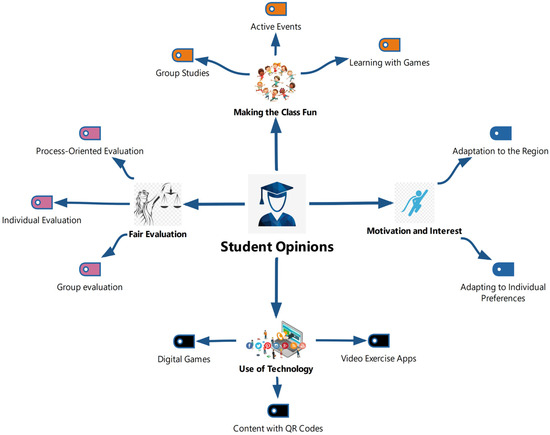
Figure 1.
Thematic map of student perspectives on physical education: Generation Z expectations. (Original figure, created by the authors).
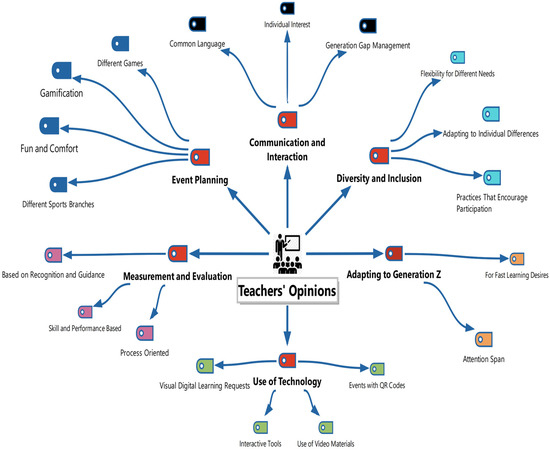
Figure 2.
Thematic map of teacher perspectives: instructional orientations of Generations X/Y. (Original figure, created by the authors).
Table 2.
Participant Demographics, Generational Classification, and Institution Type (Prepared by authors).
Table 3.
Mapping of Inductive and Deductive Coding Processes.
This mapping clarifies how inductive meaning-making preceded the application of theory-informed categories, and illustrates the analytical dialogue between data-driven codes and deductive propositions. The subsequent figures and theme presentations build on this structure by elaborating how these inductive clusters formed the basis of the thematic framework.
1. Student Perspectives (Generation Z)
Theme 1: Enjoyment–Gamification and Activity Pace. Generation Z students expressed a demand for lessons to be sustained with game-based, dynamic, and varied activities. Gamification emerged as a dominant factor enhancing participation and persistence in the class [20,21]. Participant statements confirm this orientation: “We get bored when it’s just warm-ups and plain exercises; we like the classes more when there are games.” (STU-5); “I never miss classes that are filled with games and competitions.” (STU-7). Subtheme differentiation became salient within this category. While some students emphasised competition-based game structures as motivating, others linked sustained engagement to collaborative peer-oriented play. A minority explicitly resisted playful formats, signalling that gamification was not uniformly desirable a finding that nuances common assumptions about Generation Z homogeneity and aligns with negative case analysis principles [26].
Theme 2: Technology Integration and Visual–Digital Learning. Students reported that the use of smart boards, mobile applications, QR codes, and video-exercise supports made the lessons more engaging, accessible, and provided faster feedback [3,4]. Example statement: “When phones or smart boards are used, the class becomes more interesting.” (STU-9); “When exercise videos are shown, I both learn and have fun.” (STU-10).
Theme 3: Motivation, Interest, and Differentiation. Students find activities differentiated according to their individual interests more motivating. This demand aligns with the autonomy and competence dimensions of Self-Determination Theory [38,39]: “It would be better if there were activities that capture my interest in the class. I would participate more if my preferred sports were covered.” (STU-12).
Theme 4: Process-Oriented and Fair Assessment. Students expressed a need for a fair assessment system that makes effort and developmental processes visible, not just final performance outcomes [28]: “A system that scores improvement, not just evaluating everyone the same way, would be fairer.” (STU-2); “My effort should matter too, not just being the fastest.” (STU-3).
Interim Conclusion–Alignment with TYMM: Student expectations appear directly consistent with the 2025 TYMM approach in terms of literacy (particularly digital and physical), social–emotional skills, and the action dimension. It is assessed that gamification and differentiation support the action dimension, while procedural fairness and participation support the virtue–value profile [6,7].
Students foregrounded fairness as a precondition for meaningful participation and stated that assessment should consider not only end results but also effort and developmental progress. Participant remarks illustrated this expectation: “Rather than scoring everyone by a single yardstick, a system that grades growth is more just” (STU-5) and “Being the fastest alone is not sufficient; effort should also be recognized” (STU-8). This emphasis signals a demand for performance assessment to reflect individual trajectories of development rather than uniform criteria [28]. This differentiation also makes visible how generations position their educational priorities.
2. Teacher Perspectives (X–Y/Millennials)
Theme 1: Adaptation to Generation Z and Pedagogical Design. Physical education and sports teachers stated that short attention spans, rapid learning tendencies, and an emphasis on visual elements must be considered in lesson design [3,4]. “Teaching with a single method is boring for this generation. We must keep interest alive with constantly updated activities.” (TCH-11).
Theme 2: Technology Use and Interaction. Video materials, QR code activities, interactive tools, and visual elements enhance student active participation and learning retention: “Visuals and digital tools add dynamism to the lesson. When the student is active, learning becomes permanent.” (TCH-6).
Theme 3: Activity Planning, Diversity, and Inclusivity. Multiple activity architectures, gamification, and thematic modules are pedagogical elements that support participation [20,21]: “Different sports branches, game-based activities, and a relaxed atmosphere increase student participation.” (TCH-8).
Theme 4: Process-Oriented Assessment. Teachers deem it necessary to consider the process as much as the outcome [28]: “An assessment approach focused not only on the result but also on the process is essential. We must also measure development and effort.” (TCH-3).
Theme 5: Instructional Environment Conditions and Practical Limitations. Physical space, equipment, and time constraints complicate the scaling of proposed innovative practices: “No gym, inadequate materials. It’s hard to have productive lessons under these conditions.” (TCH-9). When contrasted with student viewpoints, teachers’ interpretations appear more conditional and contingency oriented. Whereas students treat technology, gamification, and variety as intrinsic motivational drivers, teachers emphasise feasibility, organisational support, and instructional constraints. This divergence forms the empirical basis of an intergenerational asymmetry students articulate desires whereas teachers articulate conditions, reinforcing the generational positioning claims articulated in Strauss–Howe theory.
Interim Conclusion—Alignment with TYMM. Teachers’ emphasis on technology, gamification, and process-orientation aligns with the main axes that will carry the TYMM’s virtue–value–action profile into classroom design [7]. However, environmental and equipment inadequacies stand out as critical determinants of practical applicability in the field [33,34,40,41].
3. Comparative Analysis: Points of Convergence and Divergence
Convergences: Both groups agree on technology integration, gamification and activity diversity, and process-oriented fair assessment. These three axes form a pragmatic bridge between the needs of the Generation Z profile and the pedagogical goals of teachers [3,4,28]. Divergences, however, were more structurally layered than initially anticipated. Students interpreted gamification and technology as normative expectations, whereas teachers framed them as resource-dependent privileges. Students foregrounded autonomy, immediacy, and recognition of individual effort, while teachers foregrounded fairness, practicality, and institutional constraints. These tension lines illustrate how shared concepts embody different ontological meanings across generations, strengthening the explanatory potential of the dual-axis framework proposed in the study [35].
Divergences: Students position technology more as a focus of motivation/enjoyment, while teachers view it as a tool to enhance learning. Students’ demand for individualization clashes, from the teachers’ perspective, with challenges of differentiated instruction and manageable planning. Furthermore, teachers reported space, equipment, and time as the primary structural barriers to transformation [8,33,40].
Synthesis: The findings reveal that a lesson structure based on gamification, technology support, and process-oriented principles shows high alignment with TYMM in its dimensions of justice and responsibility (virtue), participation and respect (value), and active practice (action) [7]. This model meets Generation Z’s needs for speed, visuals, and feedback, while also aligning with teachers’ expectations of pedagogical suitability and assessment principles
4. Discussion
This study provides a theoretically anchored and empirically substantiated interpretation of how Generation Z learners and Generation X/Y physical education teachers conceptualise effective lesson design within the dual frameworks of Strauss–Howe generational theory and the Turkey’s 2025 Türkiye Century Education Model (TYMM); [6,7,22,23]. While both groups converge on core instructional priorities such as technology integration, gamification, differentiated learning, and process-oriented fair assessment [3,20,28], their perspectives diverge in the sequencing of these priorities and in their interpretations of feasibility and implementation conditions. These contrasts indicate that perceived generational tensions may be shaped less by attitudinal resistance and more by systemic constraints embedded in school ecologies, reframing teacher pragmatism as structurally mediated rather than individually driven [28,31]. Viewed through the lens of educational sustainability, this generational alignment problem is not merely pedagogical but systemic: if left unaddressed, it risks undermining the long-term viability of curriculum reform by diminishing participation quality, learner agency, and teacher motivation. Conversely, bridging these gaps through technology-enhanced, process-oriented, and inclusive instructional practices strengthens institutional adaptability, positioning intergenerational compatibility as a sustainability mechanism that contributes to continuity in engagement, wellbeing, and school climate quality [19,42]. Accordingly, the implications of this research extend beyond classroom praxis toward broader conversations on how educational ecosystems maintain adaptive capacity and resilience across reform cycles.
1. Examination of Generation Z Learning Profile and Digital Native Thesis
Students’ demand for technology is concretised in direct quotes from the study: “The lesson becomes more interesting when phones or smart boards are used.” (STU-12); “When exercise videos are shown, I both learn and have fun.” (STU-10). This pattern aligns with the expectations predicted by the digital native discourse regarding attention economy, audio-visual preferences, and instant feedback [3,4,19]. Findings indicate that Generation Z’s needs for autonomy, competence, and relatedness—supporting intrinsic motivation within Self-Determination Theory (SDT)—are more readily met through interactive digital activities [42,43]. Teachers, however, interpret the same findings through the lens of pedagogical benefit and conditional constraints, noting barriers such as hardware, time, large class sizes, and professional competency [36,44]. This dual reading aligns with Strauss and Howe’s propositions regarding intergenerational role distribution: whereas experience-speed expectations dominate in Generation Z, applicability and sustainability conditions are foregrounded by Generations X/Y [22,23].
2. Process-Oriented Fair Assessment: Establishing the Performance–Development Balance
Student and teacher opinions converge on the inadequacy of outcome-centred measurement alone: “A system that scores improvement would be fairer.” (STU-2); “An assessment approach focused on the process, not just the result, is essential.” (TCH-3). This aligns with multiple-evidence approaches suggested in sociocultural assessment literature (observation, portfolio, self/peer assessment, rubrics) [28]. Within SDT, process-oriented feedback enhances persistence by nurturing perceived competence [38,45] and Guthrie (2009) emphasise that intergenerational expectation differences can be balanced by systems that make effort and progress visible.
3. Gamification, Activity Diversity, and Lesson Pace
Student statements such as “We get bored when it’s just warm-ups…” (STU-5) and “I never miss classes filled with games…” (STU-7) clarify the motivational need for gamification. Gamification should not be reduced to badges or points; it must integrate meaningful challenge levels, flow calibration, and immediate feedback [20,21,46]. Teachers’ concerns around time, equipment, and space suggest the need for modular lesson flows and station-based architectures [7].
4. Communication, Empathy, and Generational Difference Management
Generation Z is highly sensitive to respect, inclusivity, and emotional safety; “They should try to understand how we feel” (STU-7) illustrates this need. Teachers highlight difficulties establishing a common communication language—signalling that feedback tone, emotional literacy, and classroom climate competence matter [47,48]. TYMM’s value and social–emotional pillars provide a structural basis to embed these mechanisms [6,7].
5. Alignment of Program Vision with Student Desires and Implementation Gaps
The reform trajectory from 2006 to 2025 reflects a student-centred continuity [6,7,36]. This study finds strong alignment between Generation Z expectations and curricular intent; however, implementation gaps cluster around resource constraints and teacher competence in digital pedagogy, gamification, and assessment design [3,4,8].
6. Theoretical Contribution: Generational Theory × Curriculum Theory
This research offers a dual-axis articulation linking generational positioning to lesson design. Generational personas materialise in classroom rhythm, communication preferences, and assessment priorities, and TYMM’s virtue–value–action and literacy dimensions institutionalise these conditions [6,7,22,23]. The sample’s public–private imbalance suggests that institutional ecology may mediate interpretive tendencies; future work should explore comparative sampling to examine transferability [44].
The sample included a higher proportion of teachers from public-sector schools than from private institutions. This contextual imbalance may have shaped the discursive patterns observed in the findings: teachers situated in public schools tended to frame their interpretations around systemic constraints, resource scarcity, and feasibility dilemmas, whereas private-sector teachers described comparatively greater access to facilities and organisational support. Consequently, the intergenerational contrasts and thematic emphases reported in this study may partly reflect institutional affordances and constraints embedded in school type. This does not undermine the analytical value of the findings, but it suggests that institutional ecology interacts with generational positioning, and therefore future research would benefit from comparative sampling designs that balance school sectors or intentionally explore institutional stratification [28].
Limitations and Future Research
- Context: Data are limited to the secondary education context in specific provinces; comparative research in different socioeconomic and cultural environments is needed.
- Time: Longitudinal and mixed-methods (qualitative + quantitative) designs are recommended.
- Measurement Depth: Quantitative testing of themes like procedural justice and gamification using motivation, self-regulation, and course enjoyment scales would be beneficial [38,49].
- Generational Boundaries: Timeframes may show slight variations across sources; the operational definition in the study aligns with sample age ranges [19,24].
Conclusion and Concrete Recommendation Set
The demands of Generation Z students and the pedagogical orientations of Generations X/Y converge on technology gamification differentiation and process-oriented fairness. The 2025 TYMM PE framework provides a basis to address this convergence through virtue–value–action literacy and socio-emotional components and these elements are detailed in the manuscript. To avoid introducing new material at this stage, the recommendations are limited to lesson- and assessment-level actions that directly synthesize the findings.
Assessment ecosystem (lesson level): Use of rubrics self/peer assessment portfolios and observation forms with short feedback cycles [28].
Lesson architecture: Station-based organization modular activity banks and micro-cycles adapted to large classes and space constraints [6].
Digital integration (classroom use): In-class device sharing and curated QR/video libraries supported by targeted micro-learning for teachers; this approach is discussed in the manuscript [8,42].
Communication and climate: Student participation contracts, structured student voice mechanisms, empathy-based feedback and clear conflict-resolution routines [24].
Author Contributions
Conceptualization, Conceptualization, R.Y.; methodology, R.Y. and O.Ç.; software, R.Y.; validation, R.Y. and O.Ç.; formal analysis, R.Y. and O.Ç.; investigation, R.Y. and O.Ç.; resources, R.Y.; data curation, R.Y.; writing—original draft preparation, R.Y.; writing—review and editing, O.Ç. and R.Y.; visualization, R.Y. All authors have read and agreed to the published version of the manuscript.
Funding
This research received no external funding.
Institutional Review Board Statement
The study was conducted in accordance with the Declaration of Helsinki and approved by the Institutional Review Board/Ethics Committee of Sivas Cumhuriyet University, Education Sciences Research Proposal Ethics Review Board (application code 25_02_24; approval document date and number: 28.02.2025–536042).
Informed Consent Statement
Informed consent was obtained from all participants involved in the study.
Data Availability Statement
The data presented in this study are not publicly available due to ethical restrictions and the need to protect participant confidentiality.
Acknowledgments
The authors thank the participating teachers and students, as well as local Ministry of National Education officials, for their facilitation. Where applicable, Turkish and English language instructors provided support to improve linguistic clarity; the authors reviewed and edited all text and take full responsibility for the content.
Conflicts of Interest
The authors declare no conflicts of interest.
References
- Bayraktar, S. Z kuşağının eğitimdeki yeri ve önemi [The Place and Importance of Generation Z in Education]. Uluslararası Eğitim Bilim. Dergisi. 2017, 4, 50–62. [Google Scholar] [CrossRef]
- Erden, N.S. Yeni Nesillere Yeni Öğretim Yöntemleri: Z Kuşağının Öğrenme Stilleri ve Yükseköğrenim İçin Öneriler [New Teaching Methods for New Generations: Learning Styles of Generation Z and Suggestions for Higher Education]. J. Acad. Value Stud. 2017, 3, 249–257. [Google Scholar] [CrossRef]
- Prensky, M. Teaching Digital Natives: Partnering for Real Learning; Corwin Press: Thousand Oaks, CA, USA, 2010. [Google Scholar]
- Tapscott, D. Grown Up Digital: How the Net Generation Is Changing Your World; McGraw-Hill: New York, NY, USA, 2009. [Google Scholar]
- Altay, F.; Mirzeoğlu, A.D. Beden Eğitimi ve Spor Dersi Öğretim Programı: 5–8. Sınıflar Etkinlik Kılavuzu [Physical Education and Sports Course Curriculum: Grades 5–8 Activity Guide]; Millî Eğitim Bakanlığı Yayınları: Ankara, Turkey, 2018. Available online: https://tegm.meb.gov.tr/meb_iys_dosyalar/2018_04/05145719_beden.pdf (accessed on 1 July 2025).
- Ministry of National Education (MoNE). Ortaöğretim Beden Eğitimi ve Spor Dersi Öğretim Programı [Upper Secondary Physical Education and Sports Curriculum]; MoNE Publishing: Ankara, Turkey, 2018. Available online: https://mufredat.meb.gov.tr/Dosyalar/2018120201950145-BEDEN%20EGITIMI%20VE%20SPOR%20OGRETIM%20PROGRAM%202018.pdf (accessed on 6 September 2025).
- Ministry of National Education (MoNE). Türkiye Yüzyılı Maarif Modeli: Beden Eğitimi ve Spor Dersi Öğretim Programı [Century of Türkiye Education Model: PE Curriculum]; MoNE Publishing: Ankara, Turkey, 2025. Available online: https://tymm.meb.gov.tr/ogretim-programlari/ders/beden-egitimi-ve-spor-dersi (accessed on 1 October 2025).
- Çebi, A.; Reisoğlu, İ. Öğretmen adaylarının dijital yeterliklerinin geliştirilmesine yönelik bir eğitim etkinliği… [A Training Activity for Developing Pre-Service Teachers’ Digital Competencies…]. Eğitim Teknol. Kuram Ve Uygulama. 2019, 9, 539–565. [Google Scholar] [CrossRef]
- Filiz, B. İlköğretim okullarında “Nasıl bir beden eğitimi dersi istiyorum?” üzerine nitel bir araştırma [A Qualitative Study on “What Kind of PE Lesson Do I Want?”]. Millî Eğitim Derg. 2012, 195, 194–198. Available online: https://dergipark.org.tr/en/download/article-file/442253 (accessed on 6 September 2025).
- Serhatlıoğlu, B.; Kalo, F. İlkokul öğrencilerinin beden eğitimi ve oyun dersine ilişkin görüşleri [Primary School Students’ Views on the Physical Education and Game Course]. Turk. J. Educ. Stud. 2022, 9, 1–20. Available online: https://dergipark.org.tr/tr/download/article-file/1647360 (accessed on 10 September 2025).
- Küçükibiş, H.F.; Özkurt, B.; Sirkeci, H.; Öztürk, O. Geleneksel oyun ve geleneksel çocuk oyunlarının eğitim-öğretim programlarındaki yeri [The Place of Traditional Games and Traditional Children’s Games in the Curriculum]. Elektron. Sos. Bilim. Dergisi. 2022, 21, 1422–1436. [Google Scholar] [CrossRef]
- Yıldız, R.; Koçak, Ç.V. Geleneksel çocuk oyunlarının ilkokul öğrencilerinin karar verme becerilerine etkisi… [The Effect of Traditional Children’s Games on Decision-Making Skills of Primary School Students]. Sivas Cumhur. Üniversitesi Spor Bilim. Dergisi. 2022, 3, 38–44. Available online: https://dergipark.org.tr/tr/download/article-file/2560801 (accessed on 21 June 2025).
- Çalı, O.; Yıldız, R. Geleneksel çocuk oyunlarının bedensel zekâya etkisi [The Effect of Traditional Children’s Games on Bodily Intelligence]. Sivas Cumhur. Üniversitesi Spor Bilim. Dergisi. 2023, 4, 94–101. Available online: https://dergipark.org.tr/tr/download/article-file/3616390 (accessed on 14 September 2025).
- Yazıcıoğlu Çalışan, H.; Yıldız, R. Geleneksel çocuk oyunlarının ortaokul öğrencilerinin yaşam kalitesine etkisi… [The Effect of Traditional Children’s Games on the Quality of Life of Secondary School Students]. Beden Eğitimi Ve Spor Bilim. Dergisi. 2024, 18, 456–465. Available online: https://dergipark.org.tr/tr/download/article-file/4271950 (accessed on 14 September 2025).
- Yıldız, R.; Çalı, O.; Temel, A. Geleneksel çocuk oyunları oynayan ortaokul öğrencilerinin keyif alma düzeylerinin incelenmesi… [Examining Enjoyment Levels of Secondary School Students Playing Traditional Children’s Games]. Motif Akad. Halkbilimi Derg. 2025, 18, 917–933. [Google Scholar] [CrossRef]
- Dervent, F.; Ward, P.; Xie, X.; Tsuda, E.; Santiago, J.A.; Ko, B.; Kim, I. Implementing Practice-Based Physical Education Teacher Education Pedagogies. J. Phys. Educ. Recreat. Dance. 2025, 96, 27–34. [Google Scholar] [CrossRef]
- OECD. The Future of Education and Skills 2030: OECD Learning Compass Conceptual Framework; OECD Publishing: Paris, France, 2020; Available online: https://www.oecd.org/content/dam/oecd/en/about/projects/edu/education-2040/1-1-learning-compass/OECD_Learning_Compass_2030_Concept_Note_Series.pdf (accessed on 1 July 2025).
- İnce, M.L.; Altunsöz, İ.H.; Hünük, D. Öğretim Stratejileri, Modelleri ve Yöntemleri: Beden Eğitimi ve Spor Bağlamında [Teaching Strategies, Models and Methods in the Context of Physical Education and Sport]; Gençlik ve Spor Bakanlığı Yayınları: Ankara, Turkey, 2023. Available online: https://yayinlar.gsb.gov.tr/Public/Files/ogrenim-stratejileri-1207.pdf (accessed on 1 July 2025).
- Jones, C.; Shao, B. The Net Generation and Digital Natives: Implications for Higher Education; Higher Education Academy: York, UK, 2011; Available online: https://oro.open.ac.uk/30014/1/Jones_and_Shao-Final.pdf%20 (accessed on 12 July 2025).
- Buckley, P.; Doyle, E. Gamification and Student Motivation. Interact. Learn. Environ. 2014, 24, 1162–1175. [Google Scholar] [CrossRef]
- Deterding, S.; Dixon, D.; Khaled, R.; Nacke, L.E. From Game Design Elements to Gamefulness: Defining “Gamification”. In Proceedings of the 15th International Academic MindTrek Conference, Tampere, Finland, 28–30 September 2011; pp. 9–15. [Google Scholar] [CrossRef]
- Howe, N.; William, S. The Fourth Turning: What the Cycles of History Tell Us About America’s Next Rendezvous with Destiny; Broadway Books: New York, NY, USA, 1997. [Google Scholar]
- Howe, N. The Fourth Turning Is Here: What the Seasons of History Tell Us about How and When This Crisis Will End; Simon & Schuster: New York, NY, USA, 2023. [Google Scholar]
- Şahin, C.T.; Turan, S.; Karadeniz, O. X, Y ve Z kuşaklarının eğitim, öğretmen, öğrenci algıları [Education, Teacher and Student Perceptions of X, Y and Z Generations]. OPUS Int. J. Soc. Res. 2021, 18, 6295–6327. [Google Scholar] [CrossRef]
- Featherstone, M. Postmodernism and Consumer Culture; Sage: London, UK, 2005. [Google Scholar]
- Braun, V.; Clarke, V. One Size Fits All? What Counts as Quality Practice in (Reflexive) Thematic Analysis? Qual. Res. Psychol. 2021, 18, 328–352. [Google Scholar] [CrossRef]
- Maxwell, J.A. Qualitative Research Design: An Interactive Approach, 3rd ed.; Sage: Thousand Oaks, CA, USA, 2013. [Google Scholar]
- Hay, P.; Penney, D. Proposing Conditions for Assessment Efficacy in Physical Education. Eur. Phys. Educ. Rev. 2009, 15, 389–408. [Google Scholar] [CrossRef]
- Guest, G.; Bunce, A.; Johnson, L. How Many Interviews Are Enough? An Experiment with Data Saturation and Variability. Field Methods. 2006, 18, 59–82. [Google Scholar] [CrossRef]
- Hennink, M.M.; Kaiser, B.N.; Marconi, V.C. Code Saturation versus Meaning Saturation: How Many Interviews Are Enough? Qual. Health Res. 2017, 27, 591–608. [Google Scholar] [CrossRef]
- Malterud, K.; Siersma, V.D.; Guassora, A.D. Sample Size in Qualitative Interview Studies: Guided by Information Power. Qual. Health Res. 2016, 26, 1753–1760. [Google Scholar] [CrossRef]
- Yıldırım, A.; Şimşek, H. Sosyal Bilimlerde Nitel Araştırma Yöntemleri, 12. bs.; Seçkin Yayıncılık: Ankara, Turkey, 2021. [Google Scholar]
- Yıldız, R.; Kangalgil, M. Beden eğitimi ve spor öğretmenlerinin ilköğretim ikinci kademe beden eğitimi ve spor dersi kazanımlarının gerçekleştirilmesine ilişkin görüşleri… [Physical Education Teachers’ Views on Achievement of Outcomes in Upper Primary PE]. OPUS Int. J. Soc. Res. 2021, 18, 2146–2167. [Google Scholar] [CrossRef]
- Küçükibiş, H.F.; Özkurt, B. Beden eğitimi ve spor dersi öğretim programlarına ilişkin öğretmen görüşlerinin incelenmesi… [Teachers’ Views on Physical Education and Sports Curriculum]. ROL Spor Bilim. Dergisi. 2024, 5, 463–485. [Google Scholar] [CrossRef]
- Tracy, S.J. Qualitative Quality: Eight “Big-Tent” Criteria for Excellent Qualitative Research. Qual. Inq. 2010, 16, 837–851. [Google Scholar] [CrossRef]
- Mayring, P. Qualitative Content Analysis: Theoretical Foundation, Basic Procedures and Software Solution; Open Access Publication: Klagenfurt, Austria, 2014. [Google Scholar]
- Creswell, J.W.; Poth, C.N. Qualitative Inquiry and Research Design: Choosing Among Five Approaches, 4th ed.; Sage: Thousand Oaks, CA, USA, 2018. [Google Scholar]
- Ryan, R.M.; Deci, E.L. Intrinsic and Extrinsic Motivation from a Self-Determination Theory Perspective. Contemp. Educ. Psychol. 2020, 61, 101860. [Google Scholar] [CrossRef]
- Deci, E.L.; Ryan, R.M. The “What” and “Why” of Goal Pursuits: Human Needs and the Self-Determination of Behavior. Psychol. Inquiry. 2000, 11, 227–268. [Google Scholar] [CrossRef]
- Temel, A.; Kangalgil, M. Oyun ve fiziki etkinlikler dersi öğretim programı kazanımlarının gerçekleşmesine ilişkin sınıf öğretmenlerinin görüşleri [Classroom Teachers’ Views on Attainment of Outcomes in the “Games and Physical Activities” Curriculum]. Millî Eğitim Derg. 2021, 50, 445–462. Available online: https://dergipark.org.tr/tr/download/article-file/1557545 (accessed on 5 July 2025).
- Temel, A.; Kangalgil, M.; Çalı, O. Teachers’ Views on the Role of Traditional Children’s Games in Education. J. Educ. Recreat. Patterns. 2024, 5, 52–65. [Google Scholar] [CrossRef]
- İçme, T.; Yıldırım, T.; Büyük, U. Z kuşağı öğrencilerinin uzaktan eğitim algıları… [Perceptions of Generation Z Students about Distance Education]. Erciyes Akad. 2022, 36, 82–102. [Google Scholar] [CrossRef]
- Başkan, A.H.; Başkan, A.H. Z kuşağında yer alan öğrencilerin spora yönelik tutumları ve buna etki eden faktörler [Attitudes of Generation Z Students towards Sports and Factors Affecting Them]. Avrasya Sos. Ve Ekon. Araştırmaları Derg. 2022, 9, 365–386. Available online: https://dergipark.org.tr/tr/download/article-file/2687451 (accessed on 5 July 2025).
- Doğan, S.; Şahin, S.N. Z kuşağı bağlamında kariyer yönetimi, iş-yaşam dengesi ve role tutulma [Career Management, Work–Life Balance and Role Engagement in the Context of Generation Z]. Ömer Halisdemir Üniversitesi İİbf Derg. 2022, 15, 439–459. [Google Scholar] [CrossRef]
- McQueen, M. Ready or Not, Here Come Generation Z; (Publisher not specified), 2011. Available online: https://pdacademy.net.au/wp-content/uploads/2022/10/Ready-or-not-here-come-Gen-Z.pdf (accessed on 1 September 2025).
- Paine Schofield, C.; Honoré, S. Generation Y and learning. The Ashridge Journal, Winter 2009–2010. Available online: https://www.ashridge.org.uk/360 (accessed on 1 September 2025).
- Demirkaya, H.; Akdemir, A.; Karaman, E.; Atan, Ö. Kuşakların yönetim politikası beklentilerinin araştırılması [An investigation of generations’ expectations regarding management policies]. İşletme Araştırmaları Derg. 2021, 7, 186–204. Available online: https://isarder.org/index.php/isarder/article/view/216.
- Çetin, M.; Halisdemir, M. School administrators and Generation Z students’ perspectives for a better educational setting. J. Educ. Train. Stud. 2019, 7, 84–92. [Google Scholar] [CrossRef]
- Özkurt, B.; Küçükibiş, H.F.; Altın, Y. Lise ve üniversite öğrencilerinin fiziksel aktivitelerden keyif alma düzeylerinin incelenmesi [Examining Enjoyment Levels from Physical Activities among High School and University Students]. Sivas Cumhur. Üniversitesi Spor Bilim. Derg. 2022, 3, 91–98. Available online: https://dergipark.org.tr/tr/download/article-file/2816741.
Disclaimer/Publisher’s Note: The statements, opinions and data contained in all publications are solely those of the individual author(s) and contributor(s) and not of MDPI and/or the editor(s). MDPI and/or the editor(s) disclaim responsibility for any injury to people or property resulting from any ideas, methods, instructions or products referred to in the content. |
© 2026 by the authors. Licensee MDPI, Basel, Switzerland. This article is an open access article distributed under the terms and conditions of the Creative Commons Attribution (CC BY) license.