Abstract
Beekeeping is highly valuable socially, economically, and environmentally in Mexico, especially in rural areas. It builds social capital through networks of trust, reciprocity, and cooperation that support sustainable development. This study examines the relationship between social capital, a fundamental form of capital for beekeepers, and other forms of capital—natural, human, economic, physical, and cultural—and how these, collectively, contribute to sustainable development in San Gabriel Mixtepec, Oaxaca. We used a quantitative, cross-sectional, and explanatory design, surveying 95 beekeepers. Results indicate that beekeepers’ social capital has a direct and positive influence on sustainable development. From a social network perspective, social capital consists of the network’s structure, dynamics, and meaning. Development, viewed from a capital perspective, includes natural, human, economic, physical, and cultural capital. Building community social capital must be central to sustainable development strategies, as it fosters more cohesive, adaptable, and resilient communities that can sustainably renew local economies by utilizing resources effectively. This research underscores the importance of public policies that foster and enhance social capital in sustainable development projects, tailored to each specific context and local needs.
1. Introduction
Globally, beekeeping generates economic opportunities for local communities. It also contributes to environmental conservation by promoting biodiversity and ecosystem restoration [1,2]. Thus, beekeeping is important for ecosystem balance. Bees pollinate plants, producing the oxygen that sustains life on the planet [3].
Beekeeping directly supports 11 of the 17 Sustainable Development Goals (SDGs). For example, it contributes to SDG 1 (No Poverty) by providing income opportunities, SDG 2 (Zero Hunger) through crop pollination, SDG 3 (Good Health and Well-being) with bee products, SDG 4 (Quality Education) via beekeeping training, SDG 8 (Decent Work and Economic Growth) by creating jobs, SDG 9 (Industrial Innovation and Infrastructure) through advances in apiculture, SDG 11 (Sustainable Cities and Communities) by enhancing urban agriculture, SDG 12 (Responsible Consumption and Production) by promoting sustainable practices, SDG 13 (Climate Action) with ecosystem support, SDG 15 (Life on Land) via biodiversity, and SDG 17 (Partnerships for the Goals) through cooperative initiatives [4]. Beekeeping represents a strategic approach to achieving both SDG 2 (Zero Hunger) and SDG 15 (Life on Land). Honeybees enhance the productivity and quality of numerous food crops, thereby increasing yields and promoting greater food availability and diversity. Consequently, food security and the livelihoods of small-scale rural producers are improved. Additionally, beekeeping depends on healthy, functional ecosystems that encourage the conservation of native vegetation, the reforestation with nectar-producing species, and the protection of essential pollinator habitats. These practices directly contribute to biodiversity conservation and the restoration of terrestrial ecosystems, as specified in SDG 15. Promoting sustainable beekeeping provides rural communities with supplementary income and supports productive practices aligned with ecosystem conservation, thereby linking food security with environmental objectives.
In Mexico, beekeeping is highly valuable both socioeconomically and environmentally [5]. Each year, the country produces over 58,000 tons of honey, making it the seventh largest producer worldwide [3]. More than 48,000 beekeepers rely on beekeeping as a significant source of income, especially in rural communities [6].
The state of Oaxaca, located in southern Mexico, ranks fifth in national honey production, yielding nearly 5000 tons annually. San Gabriel Mixtepec, located in the Costa region and with a population of 4910 inhabitants [6], is the second-largest producer at the state level. It produces more than 338 tons annually (approximately 1 million dollars), making beekeeping the primary agricultural activity that generates income for the community’s inhabitants [3].
Through the production and marketing of honey and its derivatives, beekeepers in San Gabriel Mixtepec have strengthened their social capital by establishing a social network comprising ties that contribute to enhancing their productive and commercial activities [7]. Numerous studies have established a connection between social capital and sustainable development [8,9]. Existing research focuses on the macro level or on other regions.
One study, conducted by Peiró et al. [10], examined the impact of social capital on sustainable development across 230 regions of the European Union, using environmental performance indicators. Their findings revealed that the positive effects of social capital are channeled through the quality of governance and more rigorous environmental policy; they suggest that the endowment of social capital can be a determining factor for an equitable environmental transition.
Another study, by Arachchi & Managi [11], analyzed social capital at the household level, income, and disaggregated CO2 emissions, based on cross-sectional satellite monitoring data and a large-scale survey of 86,764 participants in 30 countries, including both developing and developed nations. Their findings showed that greater community attachment and higher social trust are associated with greater concern about global warming. Their results suggest that increasing social capital can be an effective approach to reducing emissions at the household level.
Another study, by Eriksson et al. [12], examined social capital at the neighborhood level in 46 neighborhoods in Sweden. Through a longitudinal study spanning 14 years, they analyzed the sociodemographic and socioeconomic factors of the neighborhood residents. Their findings indicated that sociodemographic factors were most strongly associated with the existing social capital in the neighborhoods. Therefore, they suggest that local policies aimed at strengthening social capital for sustainable development should include interventions that increase social cohesion and trust.
Some research on social capital and sustainable development at the community level was also found. Broska [13] conducted six case studies in different sustainable community projects in Germany to understand why and how the transformation toward sustainability occurs in these environments. The results suggest that the successful implementation of far-reaching sustainability measures and behavioral changes in community settings is driven by motivations stemming from social capital, which encourages people with low environmental awareness to participate in sustainable initiatives.
Another study, by Pooyan & Hokugo [14], analyzes community resilience and the dynamics of social capital in the Tohoku region of Japan following natural disasters. The study identified the elements that weaken and strengthen social capital and how these factors influence community resilience, a key component of sustainable development. The results showed that difficulties in making ends meet, top-down procedures, a lack of information, limited resources, and the low power of communities hindered social capital during recovery, creating barriers to community resilience that prolonged the process and increased costs. Opportunities for collaboration, the promotion of preparedness, spontaneity, creativity, and community revitalization fostered social capital and strengthened community resilience.
In Mexico, several studies address the importance of social capital in sustainable development. One such study is that of Cohen et al. [15], who conducted a case study in two semi-coastal communities affected by hurricanes. The results showed that social capital (cohesive and interconnected relationships) is relevant for coping with natural disasters and contributing to the environmental dimension of sustainable development. Another study, conducted by Hernández et al. [16] in the Mixteca Alta region of Oaxaca, Mexico, found that the factors driving local forest transformation included migration, forestry policies, community social capital, local institutional efforts, and socio-ecological awareness.
Social capital plays a critical role in the sustainability of resource-dependent communities. Communities with robust social capital tend to exhibit greater sustainability [17].
However, an empirical study at the community level is needed that addresses the importance of and contribution of social capital to sustainable development in local contexts [18].
Therefore, this study examines the relationship between social capital, a fundamental form of capital for beekeepers, and other forms of capital—natural, human, economic, physical, and cultural—and how these, collectively, contribute to sustainable development in San Gabriel Mixtepec, Oaxaca. The hypothesis is that beekeepers’ social capital has a positive relationship with the municipality’s sustainable development.
The results of this study have a dual contribution. On the one hand, they provide academics with a suitable measurement framework for empirical studies that aim to quantify social capital from a social network perspective. On the other hand, they contribute to the understanding of social capital as a fundamental form of capital and its role in sustainable development, considering all other forms of capital—natural, human, economic, physical, and cultural.
1.1. Social Capital Through a Social Network Perspective
The concept of social capital was coined by Hanifan [19] in his pioneering research conducted in rural community centers. Hanifan used the term social capital to refer to the intangible resources of communities—namely, goodwill, fellowship, sympathy, and social interaction. These ties, when accumulated, satisfy social needs and can substantially improve the lives of communities [19]. Decades later, the idea of social capital was further developed with the theoretical contributions of Bourdieu [20], Putnam [21], and Portes [22]. Building on these foundations, these authors emphasize the importance of the ties and relationships that comprise social capital, which enable the formation of social networks that generate collective benefits.
Expanding on these perspectives, social capital is understood as the set of social relationships founded on trust, cooperation, and reciprocity [12,23]. It emphasizes community cohesion through networks of community organizations, stakeholder participation, solidarity, and a sense of belonging [24].
Existing research has identified social capital as a key concept in sustainable development. However, a deeper understanding of its relationship to sustainable development is lacking [18]. The spatial patterns of different types of social capital and their relationship to specific sustainable development indicators are not well understood. Social capital is multidimensional and can be broken down into its various dimensions, typologies, and levels. The three dimensions are cognitive, relational, and structural [25].
Cognitive social capital refers to how people perceive and think about each other, as well as their shared values, whereas the relational dimension focuses on trust and norms. The relational dimension provides a solid foundation for transfer and exchange, preventing opportunistic actions, motivating cooperation, and facilitating close and frequent interaction [26].
Structural social capital refers to the connections and networks between people and groups that are governed by norms. Structural social capital is more objective, amenable to quantitative measurement, and recognizes the importance of social networks and connections. In the field of sustainable development, structural social capital is generally accepted as the most useful [27].
Structural social capital encompasses resources embedded in relationships, such as food or money, and is therefore more closely linked to improvements in development outcomes. Within the structural dimension of social capital, there are three typologies: bonding, bridging, and connecting [28]. Bonding social capital refers to the relationships between people who share a common origin, culture, and identity, such as family and friends. Bonding social capital refers to dense and relatively homogeneous networks that foster solidarity, shared norms, and mutual support [22,29]. Bridging social capital refers to the horizontal connections between different groups that facilitate respect, reciprocity, and access to new information and resources [30]. Social bridging capital refers to the relationships between individuals or groups that work together for mutual benefit and can include agricultural cooperatives. These ties, also called social bonds, can be of three types: bonding, vertical, and bridging [28].
Bonding ties are present in groups with similar identities, close relationships, and similar interests and places of residence, that is, very similar groups such as families [31]. Vertical ties connect individuals or groups with other actors in a different social position, whether lower or higher [32]. Bridging ties connect individuals and groups of different types; they are helpful for those who wish to obtain economic and social benefits outside their communities or groups, that is, through external actors or agents [33].
Beyond definitions, social capital is studied from structuralist, communitarian, or culturalist perspectives [29]. The first addresses assets in social networks [29,34,35,36]; the last connects community development to civil society and social capital [37].
Social capital is integral to development, enabling societal transformation by fostering participation among development actors [37]. As Mattessich [38] observes, social capital underpins community development, and Dale and Newman [28] emphasize its critical role in achieving sustainable development.
Building on this line of thought, social capital is drawn from Putnam [37] and Durston [39], who link social capital to the community sphere. Putnam [37] argues that community organizations foster the socioeconomic goals of populations, while Durston [39] defines social capital as the cooperative social structures and institutions supporting these efforts.
The multidimensional nature of social capital, as well as its diversity in terms of interaction and benefit generation, has contributed to the remarkable variety of measurement methods found in the literature [40]. While there has been extensive debate about how to measure social capital using different metrics, there is no universally accepted way to measure its characteristics in social networks from a network perspective [41].
Social capital provides a framework for analyzing community integration, where social networks build solidarity, trust, reciprocity, and cooperation—key factors [42] that deliver collective benefits. It describes the relationships connecting individuals in a community [43].
To analyze the social capital as a social network, assess its structure, dynamics, and meaning [33,44]. Here, ‘structure’ refers to measurable features such as size, density, diversity, frequency and intensity of contact, spatial proximity, and types of ties [28,32].
Network ‘dynamics’ describes how the network operates over time, including its mobilization and relational aspects like coexistence, decision-making, problem-solving, trust, cooperation, reciprocity, solidarity, and social norms [37,45,46]. ‘Network meaning’ encompasses the motivations for joining the network, members’ expectations, the services and resources exchanged, and the processes by which knowledge is generated and shared [47,48].
In summary, social capital refers to a set of social relationships grounded in trust, cooperation, and reciprocity that generate networks and collective benefits essential to community cohesion and sustainable development. It is a multidimensional concept encompassing cognitive, relational, and structural dimensions, with the latter often regarded as the most relevant for sustainable development. Social capital is fundamental for social transformation, as it supports community development and socioeconomic objectives through cooperative organizations and institutions. Despite numerous measurement methods and ongoing debate on evaluating social capital from a network perspective, no consensus has been reached. Consequently, analyzing social capital as a social network, with attention to its structure, dynamics, and significance, is recommended.
1.2. Sustainable Development Through a Capital Perspective
In the literature, sustainable development at the community level is generally defined by three pillars: economic, social, and environmental [49]. However, to capture the complexity of sustainable development, it can also be defined in terms of capital. Here, ‘capital’ encompasses assets or resources—such as social relationships, natural resources, skills, or infrastructure—that support long-term community well-being [50]. Some studies have attempted to quantify the types of capital that impact sustainable development in community contexts [51,52].
Roseland and Spiliotopoulou [49] argue that sustainable development in community contexts can be examined through six forms of capital: social, natural, human, economic, physical, and cultural. Specifically, ‘social capital’ refers to networks and relationships among people, whereas ‘natural capital’ encompasses the environment and ecosystems. In turn, ‘human capital’ represents education and skills, ‘economic capital’ relates to financial resources, ‘physical capital’ includes infrastructure, and ‘cultural capital’ refers to shared values and heritage. Building on these definitions, Roseland and Spiliotopoulou [49] note that sustainable development becomes a balanced development process among the six forms of capital, with a special emphasis on social capital, which they describe as the engine that guides the gearing of the other forms of capital [28].
Based on this sustainable development approach, a sustainable community conducts its economic and social activities in collaboration with the government and civil society, achieving a better quality of life for its inhabitants and using local resources without harming the environment [53]. To achieve sustainability in a community, it is necessary to properly integrate the forms of capital—natural, human, and economic—into sustainable development so that social, environmental, and financial objectives are addressed in a coordinated manner [54,55].
Natural capital encompasses all the natural resources available for a community’s productive activities, such as land, water, and solar energy [56,57]. Human capital includes the set of skills, knowledge, and educational background that individuals possess and apply to carry out their productive activities within the community [57,58,59]. Economic capital encompasses the resources that individuals have and utilize to generate profits or monetary benefits from the productive activities they engage in within the community; these can be legacy, income, and employment [60,61].
Physical capital encompasses tangible assets that individuals inherit and utilize in their productive work within the community, like infrastructure and their own transportation [49,62]. Cultural capital includes the values, heritage, and traditions that have been preserved over time, shaping how people in a community live [63,64].
2. Materials and Methods
To explore these forms of capital and the particular influence of social capital, a quantitative, cross-sectional methodology with a correlational-explanatory scope was employed [65,66]. The unit of analysis was the municipality of San Gabriel Mixtepec. There is no official registry of beekeepers. However, according to a study by Valadez et al. [7], the community is organized into a single beekeeping network, comprising 126 beekeepers. Therefore, a convenience sample was selected [67]. Inclusion criteria were beekeepers who are community members, have more than five years of experience, and are part of the network. In the field research, it was necessary to conduct two preliminary visits before administering the questionnaire in order to establish contact with the beekeepers in the community. During these visits, rapport was built through conversations with beekeepers and leaders. These talks clarified the beekeeping network’s context, methods, and structure. This process enabled a direct comparison between theory and reality, guiding the selection of relevant items and operational variables for San Gabriel Mixtepec. For the surveys, three in-person meetings were held, inviting beekeepers who met the criteria; 95 beekeepers attended. The first meeting included 39 beekeepers, the second 42, and the third 14. At the meetings, the purpose of the surveys was explained to the beekeepers, and they were given instructions on how to complete them. It is worth noting that the participants’ native language is Spanish, so it was not necessary to translate the survey. The sample had 95 beekeepers. A 5-point Likert scale questionnaire was designed, with 5 for “Strongly Agree” and 1 for “Strongly Disagree.” The instrument included five sociodemographic items, 38 for social capital, and 35 for sustainable development. The dimensions of each variable were adjusted to the theoretical expectations analyzed. Social capital encompasses structure, dynamics, and network meaning; the operationalization of these dimensions was carried out in accordance with the studies of [28,32,37,45,46,47,48]. Sustainable development was assessed in terms of natural, human, economic, physical, and cultural capital; these dimensions were operationalized according to the research of [49,56,57,59,60,61,62,63,64]. The questionnaire was administered in person from February to May 2025. All respondents were informed of the research purposes for data collection.
Once the information was obtained, the Kolmogorov–Smirnov normality test (a statistical test that determines if a dataset follows a normal distribution) was performed, obtaining favorable results. To verify the validity of the instrument and the explained variance, a factor analysis was performed using the principal components technique with varimax rotation. This analysis was followed by Bartlett’s sphericity test (which checks if the variables are related and suitable for structure detection) and the Kaiser-Meyer-Olkin (KMO) test (which measures the adequacy of sampling for factor analysis). Cronbach’s alpha coefficient (which assesses the internal consistency or reliability of a set of scale or test items) was used to verify the reliability of the instrument. A factor analysis of the rotated component matrix was then performed, revealing the items that contributed to the final composition of the variables.
Consequently, the social capital variable comprised three dimensions, 22 indicators, and 30 items, with a KMO value of 0.785, total explained variance of 79.81%, and a Cronbach’s alpha of 0.835, representing statistically reliable measurements. Table 1 presents the operationalization of social capital.
Table 1.
Operationalization of the social capital variable.
The sustainable development variable consisted of five dimensions, 13 indicators, and 25 items, with a KMO value of 0.767, a total explained variance of 77.87%, and a Cronbach’s alpha of 0.726, indicating that the measurements are reliable. Table 2 presents the operationalization of sustainable development.
Table 2.
Operationalization of the sustainable development variable.
Then, a correlation analysis measured the strength and direction of the association between variables, while a regression analysis modeled the relationship between them [68]. Additionally, robustness tests and heterogeneity analysis were performed [69,70,71,72].
3. Results
3.1. Sample Characterization
Table 3 presents the sociodemographic profile of beekeepers. Among the 95 beekeepers surveyed, 90.5% were men and 9.5% women. The ages ranged from 18 to 78, with 52.6% of participants falling between 18 and 40 years old. Primary education was most common (47.4%). About 49.5% had 4–10 years of beekeeper experience, and 34.7% had 11–20 years. Regarding other activities, 25.2% focused solely on beekeeping, 15.8% were also farmers, and 13.6% worked in a private company.
Table 3.
Sociodemographic characteristics of beekeepers.
3.2. Correlation Analysis
Using Pearson’s bivariate correlation, the relationship between the social capital variable and the sustainable development variable was determined with a coefficient (r = 0.539; p ≤ 0.001), as shown in Table 4.
Table 4.
Pearson Bivariate Correlation between the study variables.
These results are statistically significant, indicating a positive correlation between beekeepers’ social capital and sustainable development. In other words, the correlation between the factors we are using to assess the social capital of beekeepers and the factors we are identifying as indicative of sustainable development. This analysis enables us to test the research hypothesis that beekeepers’ social capital has a positive and significant relationship with sustainable development in the municipality of San Gabriel Mixtepec. While social capital may enhance ties and resource access, it is essential to note that sustaining or developing initiatives also requires maximizing additional forms of capital—such as financial, human, or physical capital—beyond social capital alone.
To corroborate the relationship between the dimensions that comprise the variables, a Pearson bivariate correlation was also performed, yielding the results presented in Table 5.
Table 5.
Pearson Bivariate Correlation between dimensions of the study variables.
The network structure is positively and significantly related to human capital (r = 0.424, p ≤ 0.001), as beekeepers utilize their knowledge, skills, and educational background to create advantages, which in turn foster ties within the networks to which they belong. Likewise, network structure is positively and significantly associated with economic capital (r = 0.369, p ≤ 0.001), since membership in a network enables beekeepers to generate income and form a substantial part of their assets.
The network structure also demonstrates a positive and significant relationship with physical capital (r = 0.391, p ≤ 0.001), indicating that it enhances beekeepers’ access to the infrastructure and transportation necessary for efficient work. Cultural capital and network structure are likewise positively and significantly linked (r = 0.341, p ≤ 0.001), suggesting that the network supports the preservation of community values, heritage, and traditions in beekeeping. Natural capital displays a positive but nonsignificant relationship with network structure (r = 0.082), possibly because some sustainable practices beekeepers use daily are not directly connected to the network structure.
Network dynamics, in contrast, demonstrated a strong, positive relationship with human capital (r = 0.358, p ≤ 0.001), indicating that beekeepers engage actively in collaborative decision-making and joint problem-solving. Economic capital also exhibited a significant positive correlation with network dynamics (r = 0.227, p ≤ 0.001), as network mobilization helps beekeepers access government support, boosting productivity and often creating employment within the community.
Network dynamics are positively related to physical capital (r = 0.331, p ≤ 0.001) because beekeepers often share facilities and machinery, making processes easier and increasing productivity. Furthermore, cultural capital is positively associated with network dynamics (r = 0.190, p ≤ 0.001), as social norms and practices, such as cooperation and reciprocity within the network, align with community values. In contrast, natural capital is positively related but not significantly to network dynamics (r = 0.056), suggesting that the network’s activities may not fully consider factors that support environmental preservation.
A positive and significant relationship was identified between network meaning and human capital (r = 0.424, p ≤ 0.001), indicating that beekeepers’ knowledge and skills might facilitate enhancements in the network’s production and administrative functions. Economic capital and network meaning likewise exhibit a positive and significant correlation (r = 0.404, p ≤ 0.001), suggesting that an important motivation for beekeepers joining networks is the pursuit of greater financial returns.
Likewise, network meaning is strongly and significantly associated with physical capital (r = 0.494, p ≤ 0.001), indicating a result that is consistent with beekeepers exchanging knowledge not only with family and friends but also with fellow beekeepers within their network. Similarly, cultural capital has a positive and significant association with network meaning (r = 0.264, p ≤ 0.001), as most beekeepers inherit the trade from relatives, thereby aiding knowledge creation, transfer, and sharing. Natural capital shows a weak, non-significant positive association with network meaning (r = 0.012), possibly due to a lack of specific environmental care or conservation practices in the community.
Human capital in sustainable development is most connected to the dynamics and network structure of social capital. Physical capital in sustainable development is most closely related to network meaning in social capital. Natural capital in sustainable development shows the most positive associations, but these links are weak across all social capital and sustainable development dimensions.
3.3. Regression Analysis
To determine the degree of influence of the social capital on sustainable development, a simple regression analysis was performed; the results are shown in Table 6.
Table 6.
Simple regression between the study variables.
The results show a positive and significant relationship between social capital and sustainable development (β = 0.539, F = 38.181, p ≤ 0.001, Durbin-Watson = 1.888). A beta coefficient (β) of 0.539 suggests that social capital is a significant predictor of sustainable development, and that their relationship is direct (both increase or decrease together), with an effect of moderate magnitude. A change in F of 38.181 indicates that the simple linear regression model is significant and that social capital included in the model is a valuable predictor of sustainable development. A Durbin-Watson value of 1.888 indicates that the model reasonably meets the assumption of independence of errors.
The adjusted R-squared value is 0.283, indicating that the model explains 28.3% of the variance in sustainable development and confirms the significant contribution of social capital. A coefficient of determination (R2) of 0.283 means that only 28.3% of the variation in sustainable development (the dependent variable) can be explained by the independent variables (predictors) included in the model. This suggests that other factors or variables were not considered and that significantly influence sustainable development. However, given the complexity and breadth of sustainable development and its measurement, this value is considered acceptable or good, as it reflects the influence of multiple unpredictable factors [73].
The research model is Y = β0 + β1 × 1 ± e, where Y: SD; β0: Constant; βX1: SC; e = error. Specifically, SD = 1.891 + 0.495 SC ± 0.509.
3.4. Robustness Tests
Table 7 presents the results of ordinary least squares regression analysis using standardized variables, which reveal that social capital is positively correlated with sustainable development. The standardized coefficient was (SE , ), implying that an increase of one standard deviation in social capital is related, on average, to an increase of 0.70 standard deviations in sustainable development. The model explains a substantial fraction of the variation in the dependent variable (; ), consistent with a large effect size.
Table 7.
OLS regression of sustainable development on social capital (SE = HC3).
Table 8 presents the model validity, with heteroscedasticity tests revealing no significant violations (Breusch–Pagan: p = 0.503; White: p = 0.787). Ramsey’s RESET specification test also did not suggest any systematic functional omissions (p = 0.738). An explicit nonlinearity test incorporating the quadratic term was not significant (β = 0.014; p = 0.777), supporting the suitability of the linear specification. The influence test using Cook’s distances showed no dominant observations that substantially altered the estimated slope. Taken together, these elements support the internal validity of the linear model with robust standard errors (HC3).
Table 8.
Model diagnostics.
As a structural test, Table 9 presents the model that was re-estimated after excluding each dimension of the social capital index (“leave-one-dimension-out”). In all cases, the main effect remained positive, significant, and of similar magnitude (e.g., β = 0.685, 0.669, 0.669; between 0.441 and 0.463). This stability indicates that the result does not depend on a specific dimension of social capital, reinforcing the substantive interpretation of the link found.
Table 9.
Robustness: exclusion of a social capital dimension (leave-one-out).
3.5. Heterogeneity Analysis
Table 10 presents the heterogeneity analysis, which shows that the slope of the social capital effect did not differ significantly between subgroups. Interactions with gender were not significant (p = 0.849). Similarly, education level (none, elementary school, middle school, high school, bachelor’s degree) did not moderate the effect (all p-values between 0.406 and 0.752), nor did additional occupation to beekeping (interactions not significant overall; the contrast for “trader” was marginal, p ≈ 0.096, insufficient under conventional thresholds and even less so with adjustment for multiplicity). For continuous moderators, age (p = 0.879) and years of beekeeper experience (p = 0.164) also showed no evidence of moderation. In summary, the association between social capital and sustainable development appears homogeneous in the analyzed sample.
Table 10.
Interactions (heterogeneity of effects).
In summary, the findings suggest that strengthening social capital—in its structural, dynamic, and network components—is associated with improved levels of sustainable development (encompassing natural, human, economic, physical, and cultural capital) among beekeepers. The consistency of the effect across alternative specifications, the absence of nonlinearity, and its stability in the face of potentially influential observations increase confidence in the main conclusion. The homogeneity of slopes among subgroups suggests that these potential benefits would be broad and not limited to specific sociodemographic or occupational profiles. However, the lack of heterogeneity should be interpreted with caution, given the limited sample sizes in some categories. These results offer preliminary insights that may guide future studies with larger samples.
3.6. Theoretical Explanatory Model
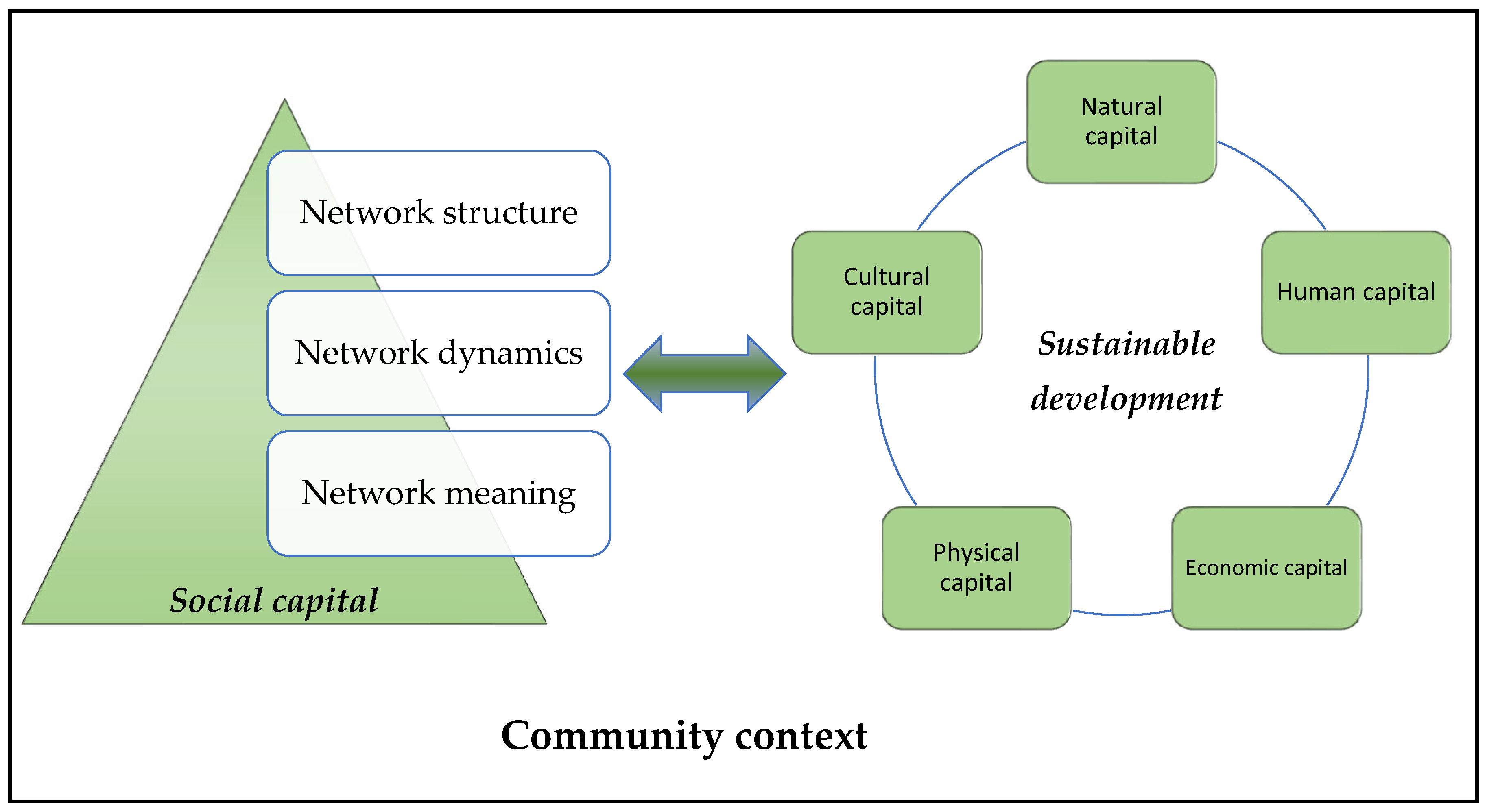
Figure 1 presents a theoretical model that illustrates the relationship between the social capital, viewed from a social network perspective, and the sustainable development, examined from a capital perspective, within a community context. Specifically, the social capital is measured by network structure, dynamics, and meaning, while the sustainable development is assessed based on natural, human, economic, physical, and cultural capital.
Figure 1.
Theoretical explanatory model of social capital and sustainable development variables. Source: Own elaboration.
4. Discussion
The sociodemographic analysis of the sample indicated that most beekeepers are men. This observation aligns with Kashumba’s [74] research, which reviewed 17 studies from Africa and found that women participate less than men in honey production, harvesting, and primary processing. Kashumba [74] identified sociocultural beliefs and stereotypes, technological barriers, apiary location, education, and limited access to beekeeping resources as the primary factors contributing to women’s low participation in beekeeping.
Men’s involvement in honey production typically centers on technically and physically demanding activities, including constructing and maintaining hives, harvesting honey from tall trees and challenging terrain, and selling honey in bulk [75,76]. In contrast, established gender roles in domestic labor and family responsibilities, along with the persistent use of traditional beekeeping technology, contribute to the limited participation of women in beekeeping [77].
The relationship between social capital and sustainable development varies according to the type of social capital and the specific area of study. Therefore, understanding the relevant context is essential [18]. The relationship between social capital and sustainable development has gained significance in community contexts, as both concepts are essential for building sustainable, resilient, and self-sufficient communities [49].
These findings support those of Pawlewicz & Cieślak [78], who showed that social capital is central to sustainable development; trust, openness, and cooperative behavior foster high levels of social capital, which are essential for advancing the common good and preventing the misuse of shared resources.
This connection is particularly evident for the beekeepers of San Gabriel Mixtepec, where these two elements are crucial to their territorial transformation. Specifically, from a social network perspective, social capital is the result of people’s ability to associate and achieve common goals [79]. Meanwhile, community capital—encompassing natural, human, economic, physical, and cultural resources—generates greater well-being for residents [80]. Here, we differentiate between social capital as a characteristic associated with network membership from the broader notion of community capital, encompassed by natural, human, economic, physical, and cultural resources.
In a community context, social networks are fundamental to building social capital. These assertions support the findings of Ari et al. [8], which argues that both networks between equals (horizontal) and networks with institutions or authorities (vertical) are essential elements of social capital.
Social networks are formed by ties that foster cultural beliefs and practices [43]. Cultural capital, which precedes the mobilization of social capital [81], in the San Gabriel Mixtepec beekeeper network consists specifically of values such as reciprocity, solidarity, and cooperation. According to the survey results, these values directly support the tradition of preserving beekeeping as a productive activity central to community heritage.
For beekeepers, social capital consists of open and diverse networks that foster cooperation and reciprocity. The survey results showed that this network has enhanced beekeeping activities, improved productivity, expanded infrastructure and transportation, and created job opportunities. More broadly, social capital acts as a catalyst for sustainable development by facilitating trust, cooperation, and information exchange, which in turn generate economic benefits and social stability [23,82,83,84].
Furthermore, the social capital fosters social cohesion and community member participation in decision-making, enabling the mobilization of resources—both human and financial—to address common problems and generate practical solutions [45]. These results coincide with those presented by Roseland & Spiliotopoulou [49] who state that a sustainable community resembles a living system in which human, natural and economic elements are interdependent and mutually reinforcing.
The purpose of the social capital is to build social networks with other groups, government actors, and business ties for mutual benefit [43]. The results showed that the San Gabriel Mixtepec beekeeper network is characterized by a dynamic in which its members actively participate in decision-making and problem-solving. Furthermore, the survey results illustrate that the bridging links, services, and resources available to the beekeepers’ network have facilitated connections with external agents, enabling them to access government support and ultimately derive greater economic benefits.
In a community, people integrate when the social capital is valued through tangible practices such as customs, daily habits, and shared expertise [85]. For the San Gabriel Mixtepec beekeeper network, survey responses indicate that members report that their beekeeping knowledge and skills—in hive management, honey production, and product marketing—are actively shared with family, friends, and fellow beekeepers, strengthening knowledge transmission and reinforcing network cohesion. Additionally, this human capital enhances the network’s productive and administrative performance.
Social capital enables communities to adapt to changes and challenges, including those resulting from climate change or human activities. Social networks strengthen community resilience. Communities with substantial social capital are more likely to implement sustainable practices, such as managing natural resources efficiently, which benefits both the environment and their residents [51,52]. These results are consistent with the claims of Barnes et al. [86] who point out that, in a community, social networks can facilitate the capacity for action in environmental decision-making to address the challenges of climate change.
The results showed that San Gabriel Mixtepec beekeepers practice sustainability through crop pollination, utilize solar panels for electricity, and harness sunlight for beekeeping purposes. However, these practices remain inadequate for effectively enhancing the community’s natural capital. To enhance these efforts, this study recommends that authorities support local practices through reforestation, the planting of nectar-producing trees, and environmental campaigns against harmful farming practices such as slash-and-burn [87,88].
5. Limitations and Implications
This study contributes to the literature on social capital and sustainable development by empirically establishing a strong association between them. It illustrates how social capital can be measured through network structure, dynamics, and the meaning attributed to it. Sustainable development is understood through natural, human, economic, physical, and cultural capital. These results support the relevance of social capital as a lever for sustainable development in local production contexts.
This study has several limitations. The analysis considered only three dimensions of social capital and five dimensions of sustainable development, excluding other factors. The sample was small and limited to beekeepers in a single community, which may limit its external validity and the generalizability of the findings. Future research should expand the sample and include diverse sectors in urban and rural communities.
The findings offer insights into developing public policies that strengthen community social capital and promote sustainable development tailored to each territory. In practical terms, interventions aimed at expanding and densifying networks (structure), improving coordination and exchange (dynamics), and strengthening the identity/cohesion (meaning) of the social fabric of beekeepers would be promising strategies to promote sustainable development outcomes in the territory.
6. Conclusions
This research demonstrated that beekeepers’ social capital appears to have a positive and significant relationship with sustainable development in the municipality of San Gabriel Mixtepec, Oaxaca. The social capital of beekeepers illustrates the role of cooperative relationships in promoting a sustainable model. This model integrates food production, community well-being, and environmental conservation, aligning with Sustainable Development Goals 2 (Zero Hunger) and 15 (Life on Land).
Social capital is explained by the structure, dynamics, and meaning of the beekeepers’ social network. It is also shaped by the concepts of natural, human, economic, physical, and cultural capital.
For beekeepers in San Gabriel Mixtepec, the importance of social capital is shaped by their open and diverse social network, characterized by the trust, solidarity, and cooperation that exists among its members. It is through the ties generated by the network that beekeepers have been able to access external resources to obtain collective benefits. Furthermore, social capital evident in the network can be understood to have enabled beekeepers to achieve higher levels of productivity, access to infrastructure and transportation resources, and often generate employment opportunities.
Likewise, social capital has strengthened beekeeping, making this activity a core part of their cultural capital, with heritage and tradition being representative elements. Sharing knowledge with family, friends, and community beekeepers strengthens knowledge transmission and reinforces their network. This human capital improves the network’s productive and administrative processes.
Building on these efforts, the beekeepers of San Gabriel Mixtepec carry out various practices aligned with sustainability. Government authorities could specifically support these practices by initiating reforestation programs, planting nectar-producing trees, and conducting environmental awareness campaigns to reduce harmful agricultural practices, such as slash-and-burn farming.
Communities that demonstrate substantial social capital foster sustainable development, which in turn leads to job creation, infrastructure improvements, and increased access to external resources. However, it is essential to recognize that social capital is not a homogeneous resource. Its effectiveness can vary depending on factors such as the social, economic, and cultural dynamics of the territory. Therefore, it is crucial to adopt a critical approach to sustainable development that considers the specificities of each context.
Fostering social capital must be central to sustainable development strategies, as adequate social capital produces communities that are cohesive, adaptable, and resilient, using local resources sustainably to restore their economies.
The research findings underscore the need to formulate public policies that foster social capital, defined as the networks and relationships within a community, by implementing sustainable development projects tailored to specific local contexts and needs.
Qualitative studies should complement future research to verify causal relationships. Furthermore, subsequent studies could identify proven approaches for fostering social capital in varied communities and assess their effects on sustainable development more broadly.
Author Contributions
Conceptualization, P.R.M.-M. and B.D.V.-S.; methodology, A.L.R.-S.; software, F.P.-P.; validation, E.C.-D.; formal analysis, P.R.M.-M.; investigation, E.C.-D.; resources, F.P.-P.; data curation, A.L.R.-S.; writing—original draft preparation, P.R.M.-M.; writing—review and editing, B.D.V.-S. and E.C.-D.; visualization, F.P.-P.; supervision, B.D.V.-S.; project administration, P.R.M.-M. and A.L.R.-S. All authors have read and agreed to the published version of the manuscript.
Funding
This research received no external funding.
Institutional Review Board Statement
In this study, ethical review and approval were waived by the Research and Postgraduate Division of the Faculty of Accounting and Administration at the Universidad Autónoma “Benito Juárez” de Oaxaca, as the use of anonymized, non-sensitive data collected through voluntary participation, with informed consent, was deemed to be exempt from review.
Informed Consent Statement
Informed consent was obtained from all subjects involved in the study.
Data Availability Statement
The data presented in this study are available on request from the corresponding author. The data are not publicly available due to privacy restrictions.
Acknowledgments
The authors thank the beekeepers of the municipality of San Gabriel Mixtepec, Oaxaca, Mexico, for their valuable collaboration in the development of this research.
Conflicts of Interest
The authors declare that they have no conflicts of interest.
Abbreviations
The following abbreviations are used in this manuscript:
| SDGs | Sustainable Development Goals |
References
- Laynes, M.C.; Cetzal, I.W.; López, C.H.; Tamayo, C.I.; Martínez, P.J.; Noguera, S.E.; Dzib, C.B.; Basu, S.K. Honey production, an economic alternative for coastal areas with mangrove ecosystems: A case study in Sabancuy, Campeche, southeastern Mexico. J. Ethnobiol. Ethnomed. 2025, 21, 42. [Google Scholar] [CrossRef]
- Narang, A.; Kumar, G.; Gupta, G. Political, economical, social, technological and SWOT analysis of beekeeping as a successful enterprise in India: An overview. J. Appl. Nat. Sci. 2022, 14, 194–202. [Google Scholar] [CrossRef]
- Agri-Food and Fisheries Information Service. Statistical Yearbook of Livestock Production. 2024. Available online: https://nube.agricultura.gob.mx/cierre_pecuario/ (accessed on 17 July 2025).
- Dimitrov, D. Urban Beekeepers and Local Councils in Aotearoa, New Zealand: Honeybees Are Valuable Allies in Achieving the Sustainable Development Goals. Urban Plan. 2025, 10, 9166. [Google Scholar] [CrossRef]
- Becerril, G.J.; Hernández, C.F. Beekeeping: Its Contribution to Rural Household Income in Southern Yucatán. Península 2020, 15, 9–29. [Google Scholar]
- National Institute of Statistics and Geography. National Atlas of Bees and Beekeeping Products. 2024. Available online: https://atlas-abejas.agricultura.gob.mx/cap5.html (accessed on 19 July 2025).
- Valadez, S.B.; Venegas, R.I.; Cruz, C.B.; Gaytán, B.L. Social capital among beekeepers in Oaxaca, Mexico. A study from a Social and Solidarity Economy perspective. In Social and Solidarity Economy and Fair Trade in Mexico: Experiences, Challenges, and Opportunities; Seal of the American University Corporation: Medellin, Colombia, 2024; pp. 79–101. [Google Scholar]
- Ari, I.R.D.; Prayitno, G.; Fikriyah, F.; Dinanti, D.; Usman, F.; Prasetyo, N.E.; Nugraha, A.T.; Onishi, M. Reciprocity and Social Capital for Sustainable Rural Development. Societies 2024, 14, 14. [Google Scholar] [CrossRef]
- Seferiadis, A.A.; Cummings, S.; Zweekhorst, M.B.M.; Bunders, J.F.G. Producing social capital as a development strategy: Implications at the micro-level. Prog. Dev. Stud. 2015, 15, 170–185. [Google Scholar] [CrossRef]
- Peiró, P.J.; Gianmoena, L.; Picazo, T.A.; Ríos, V. Is social capital a driver of the Green Transition in European Regions? Ecol. Econ. 2025, 230, 108500. [Google Scholar] [CrossRef]
- Arachchi, J.I.; Managi, S. Social capital, household income and carbon dioxide emissions: A multicountry analysis. Environ. Impact Assess. Rev. 2022, 96, 106838. [Google Scholar] [CrossRef]
- Eriksson, M.; Santosa, A.; Zetterberg, L.; Kawachi, I.; Ng, N. Social Capital and Sustainable Social Development—How Are Changes in Neighbourhood Social Capital Associated with Neighbourhood Sociodemographic and Socioeconomic Characteristics? Sustainability 2021, 13, 13161. [Google Scholar] [CrossRef]
- Broska, L.H. It’s all about community: On the interplay of social capital, social needs, and environmental concern in sustainable community action. Energy Res. Soc. Sci. 2021, 79, 102165. [Google Scholar] [CrossRef]
- Pooyan, Z.; Hokugo, A. Community resilience and social capital: Hindering vs fostering factors. Int. J. Disaster Risk Reduct. 2025, 118, 105213. [Google Scholar] [CrossRef]
- Cohen, S.D.; García, F.E.; Mora, F.; Crick, F. How does social capital shape the response to environmental disturbances at the local level? Evidence from case studies in Mexico. Int. J. Disaster Risk Reduct. 2021, 52, 101951. [Google Scholar] [CrossRef]
- Hernández, A.J.; Durán, E.; De Jong, W.; Velázquez, A.; Pérez, V.G. Understanding drivers of local forest transition in community forests in Mixteca Alta, Oaxaca, Mexico. For. Policy Econ. 2021, 131, 102542. [Google Scholar] [CrossRef]
- Pretty, J. Social capital and the collective management of resources. Science 2003, 302, 1912–1914. [Google Scholar] [CrossRef] [PubMed]
- Craig, A.; Hutton, C.W.; Sheffield, J. Social Capital Typologies and Sustainable Development: Spatial Patterns in the Central and Southern Regions of Malawi. Sustainability 2022, 14, 9374. [Google Scholar] [CrossRef]
- Hanifan, L.J. The Community Center; Silver, Burdett & Company: New York, NY, USA, 1920. [Google Scholar]
- Bourdieu, P. The forms of capital. In Handbook of Theory and Research for the Sociology of Education; Richardson, J.G., Ed.; Greenwood Press: New York, NY, USA, 1986; pp. 241–258. [Google Scholar]
- Putnam, R. The Prosperous Community: Social Capital and Public Life. Am. Prospect 1993, 4, 35–42. [Google Scholar]
- Portes, A. Social Capital: Its Origins and Applications in Modern Sociology. Annu. Rev. Sociol. 1998, 24, 1–24. [Google Scholar] [CrossRef]
- González, R.A.; Maldonado, M.J. Community social capital: A strategy against poverty in the indigenous communities of the state of Guerrero. Ra Ximhai 2014, 10, 119–139. [Google Scholar]
- Gil, L.M.; Gil, L.A. From human capital to social capital: Strategies for preventing alcohol consumption. Orig. J. 2006, 31, 79–92. [Google Scholar]
- Claridge, T. Dimensions of Social Capital-Structural, Cognitive and Relational; Social Capital Research: Dunedin, New Zealand, 2018. [Google Scholar]
- Lin, N. Building a Network Theory of Social Capital. In Social Capital; Lin, N., Cook, K., Burt, R.S., Eds.; Routledge: New York, NY, USA, 2001; pp. 3–28. [Google Scholar]
- Burt, R.S. Structural Holes. The Social Structure of Competition; Harvard University Press: Cambridge, MA, USA; London, UK, 1995. [Google Scholar]
- Dale, A.; Newman, L. Social Capital: A Necessary and Sufficient Condition for Sustainable Community Development? Community Dev. J. 2008, 45, 5–21. [Google Scholar] [CrossRef]
- Coleman, J.S. Social Capital in the Creation of Human Capital. Am. J. Sociol. 2011, 94, 95–120. [Google Scholar] [CrossRef]
- Granovetter, M. The Strength of Weak Ties. Am. J. Sociol. 1973, 78, 1360–1380. Available online: http://www.jstor.org/stable/2776392 (accessed on 18 May 2025). [CrossRef]
- Newman, L.; Dale, A. The role of agency in sustainable local community development. Local Environ. 2005, 10, 477–486. [Google Scholar] [CrossRef]
- Stevenson, N. Local festivals, social capital and sustainable destination development: Experiences in East London. J. Sustain. Tour. 2016, 24, 990–1006. [Google Scholar] [CrossRef]
- Woldhanna, T.; Tafere, Y.; Yonis, M.B. Social capital as a double-edged sword for sustained poverty escapes in Ethiopia. World Dev. 2022, 158, 105969. [Google Scholar] [CrossRef]
- Ballester, L.; Pascual, B.; Vecina, C. Social networks, public policies and social capital. Aposta Soc. Sci. J. 2014, 61, 28–43. [Google Scholar]
- Bourdieu, P. The forms of capital: Economic capital, cultural capital and social capital. In Power, Law and Social Classes; Center for Sociological Research: Madrid, Spain, 1988; pp. 131–165. [Google Scholar]
- Bourdieu, P. The Social Structures of the Economy; Manantial: Buenos Aires, Argentina, 2001. [Google Scholar]
- Putnam, R.D. Bowling Alone: The Collapse and Rebirth of the American Community; Simon Schuster: New York, NY, USA, 2001. [Google Scholar]
- Mattessich, P.W. Social capital and community building. In Introduction to Community Development; Phillips, R., Pitman, R.H., Eds.; Routledge: London, UK, 2009; pp. 49–57. [Google Scholar]
- Durston, J. What Is Community Social Capital? CEPAL: Santiago, Chile, 2000. [Google Scholar]
- Woolcock, M.; Narayan, D. Social Capital: Implications for Development Theory, Research and Policy. World Bank Res. Obs. 2000, 15, 225–249. [Google Scholar] [CrossRef]
- Williams, D. On and Off the ’Net: Scales for Social Capital in an Online Era. J. Comput. Commun. 2006, 11, 593–628. [Google Scholar] [CrossRef]
- Chang, H.H.; Chuang, S.S. Social Capital and Individual Motivations on Knowledge Sharing: Participant Involvement as a Moderator. Inf. Manag. 2011, 48, 9–18. [Google Scholar] [CrossRef]
- Márquez, Z.M. The state of the art of community social capital. Encruc. Electron. J. Cent. Public Adm. Stud. Fac. Political Soc. Sci. UNAM 2009, 3, 1–15. [Google Scholar]
- Termeer, E.E.; Soma, K.; Motovska, N.; Ayuya, O.I.; Kunz, M.; Koster, T. Sustainable Development Ensued by Social Capital Impacts on Food Insecurity: The Case of Kibera, Nairobi. Sustainability 2022, 14, 5504. [Google Scholar] [CrossRef]
- Covarrubias, F.A. Social norms and power dynamics in the home: Women’s mobility and extra-domestic work in San Felipe del Progreso. Ibero Am. J. Soc. Hum. Sci. 2016, 5, 1–23. [Google Scholar]
- Dale, A. Agency: Individual ‘Fit’ and sustainable community development. Community Dev. J. 2014, 49, 426–440. [Google Scholar] [CrossRef]
- Dale, A.; Onyx, J. A Dynamic Balance. Social Capital and Sustainable Community Development; UBC Press: Vancouver, BC, Canada, 2005. [Google Scholar]
- Fisher, R. “A gentleman’s handshake”: The role of social capital and trust in transforming information into usable knowledge. J. Rural Stud. 2013, 31, 13–22. [Google Scholar] [CrossRef]
- Roseland, M.; Spiliotopoulou, M. Sustainable Community Planning and Development. Encycl. Sustain. Technol. 2017, 2, 53–61. [Google Scholar] [CrossRef]
- Roseland, M. Towards Sustainable Communities: Solutions for Citizens and Their Governments; New Society Publishers: Gabriola, BC, Canada, 2012. [Google Scholar]
- Feofilovs, M.; Romagnoli, F. Measuring community disaster resilience in the Latvian context: An applied case using a composite indicator approach. Energy Procedia 2017, 113, 43–50. [Google Scholar] [CrossRef]
- Shabrina, F.Z.; Meilano, I.; Windupranata, W.; Nuraini, R. Measure coastal disaster resilience using the community disaster resilience index (CDRI) in Mentawai Island, Indonesia. In Proceedings of International Symposium on Earth Hazard and Disaster Mitigation (ISEDM) 2017: The 7th Annual Symposium on Earthquake and Related Geohazard Research for Disaster Risk Reduction, Bandung, Indonesia, 18 July 2018. [Google Scholar]
- Dale, A.; Sparkes, J. The ‘agency’ of sustainable community development. Community Dev. J. 2011, 46, 476–492. [Google Scholar] [CrossRef]
- Kusakabe, E. Renascent Social Capital in Japanese Communities—Networks for Building a Sustainable Society; University College London: London, UK, 2011. [Google Scholar]
- Sabet, N.S.; Khaksar, S. The performance of local government, social capital and participation of villagers in sustainable rural development. Soc. Sci. J. 2020, 61, 1–29. [Google Scholar] [CrossRef]
- Correa, A.P.; González, G.D.; Pacheco, A.J. Renewable energy and the environment: Their legal regulation in Ecuador. Univ. Soc. J. 2016, 8, 179–183. [Google Scholar]
- Radulescu, M.; Simionescu, M.; Kartal, M.T.; Mohammed, K.S.; Balsalobre-Lorente, D. The Impact of Human Capital, Natural Resources, and Renewable Energy on Achieving Sustainable Cities and Communities in European Union Countries. Sustainability 2025, 17, 2237. [Google Scholar] [CrossRef]
- Boisier, S. Social Conversations and Regional Development; University of Talca Press: Talca, Chile, 2002. [Google Scholar]
- Payab, A.H.; Kautish, P.; Sharma, R.; Siddiqui, A.; Mehta, A.; Siddiqui, M. Does human capital complement sustainable development goals? Evidence from leading carbon emitter countries. Util. Policy 2023, 81, 101509. [Google Scholar] [CrossRef]
- Galaso, R.P. Social Capital and Economic Development: The Cases of Silicon Valley and Villa El Salvador. Nóesis J. Soc. Sci. Humanit. 2005, 15, 161–188. [Google Scholar]
- Gao, C.; Yao, D.; Fang, J.; He, Z. Analysis of the Relationships between Financial Development and Sustainable Economic Growth: Evidence from Chinese Cities. Sustainability 2022, 14, 9348. [Google Scholar] [CrossRef]
- Ding, X.; Huang, Y.; Gao, W.; Min, W. A Comparative Study of the Impacts of Human Capital and Physical Capital on Building Sustainable Economies at Different Stages of Economic Development. Energies 2021, 14, 6259. [Google Scholar] [CrossRef]
- Madrazo, M. Some considerations on the meaning of tradition. Contrib. Coatepec 2005, 9, 115–132. [Google Scholar]
- Watene, K.; Yap, M. Culture and sustainable development: Indigenous contributions. J. Glob. Ethics 2015, 11, 51–55. [Google Scholar] [CrossRef]
- Bobko, P. Correlation and Regression; SAGE Publications: Thousand Oaks, CA, USA, 2001. [Google Scholar] [CrossRef]
- Hernández, S.R.; Mendoza, C. Research Methodology. Quantitative, Qualitative, and Mixed Methods; McGraw-Hill Education: Mexico City, Mexico, 2018. [Google Scholar]
- Memon, M.A.; Thurasamy, R.; Ting, H.; Cheah, J.H. Convenience sampling: A review and guidelines for quantitative research. J. Appl. Struct. Equ. Model. 2025, 9, 1–15. [Google Scholar] [CrossRef] [PubMed]
- Leal, C.F.; López, G.R.; Martínez, M.M.; Tapia, C.D.; De León, V.I. Linear Regression and Correlation Analysis. XIKUA Sci. Bull. Tlahuelilpa High. Sch. 2019, 7, 62–64. [Google Scholar] [CrossRef]
- Breusch, T.S.; Pagan, A.R. A simple test for heteroscedasticity and random coefficient variation. Econometrica 1979, 47, 1287–1294. [Google Scholar] [CrossRef]
- Long, J.S.; Ervin, L.H. Using heteroscedasticity-consistent standard errors in the linear regression model. Am. Stat. 2000, 54, 217–224. [Google Scholar] [CrossRef]
- Ramsey, J.B. Tests for specification errors in classical linear least-squares regression analysis. J. R. Stat. Soc. Ser. B Methodol. 1969, 31, 350–371. [Google Scholar] [CrossRef]
- White, H. A heteroskedasticity-consistent covariance matrix estimator and a direct test for heteroskedasticity. Econometrica 1980, 48, 817–838. [Google Scholar] [CrossRef]
- Hair, J.; Hult, G.; Ringle, C.; Sarstedt, M.; Danks, N.; Ray, S. Evaluation of the Structural Model. In Partial Least Squares Structural Equation Modeling (PLS-SEM) Using R; Classroom Companion: Business; Springer: Cham, Switzerland, 2021. [Google Scholar]
- Kashumba, F.M. Unveiling factors influencing women’s inclusivity in the beekeeping sector in the African Great Lakes Region: A systematic review and synthesis. Cogent Food Agric. 2025, 11, 2578327. [Google Scholar] [CrossRef]
- Adler, M.; Escóbar, M.L.; Solis, S.M.; Pinto, C.F. Stingless bees: Uses and management by meliponiculturist women in the Chaco region of Bolivia. J. Ethnobiol. Ethnomed. 2023, 19, 5. [Google Scholar] [CrossRef] [PubMed]
- Mwangi, J.; Njuguna, K.; Wambugu, S. Women in Beekeeping: Economic and Social Impacts in Kenya. Afr. J. Agric. Res. 2021, 56, 78–92. [Google Scholar]
- Martínez, P.J.; Magaña, M.M.; Cetzal, I.W.; Mendoza, A.G.; Sierra, V.A.; Basu, S.K. Sociodemographic characteristics and participation of women in meliponiculture from the Yucatán Peninsula, Mexico. J. Ethnobiol. Ethnomed. 2024, 20, 104. [Google Scholar] [CrossRef] [PubMed]
- Pawlewicz, K.; Cieślak, I. An Analysis of the Relationships between Social Capital Levels and Selected Green Economy Indicators on the Example of Polish Voivodeships. Sustainability 2024, 16, 1459. [Google Scholar] [CrossRef]
- Ostrom, E.; Ahn, T.K. A perspective on social capital from the social sciences: Social capital and collective action. Mex. J. Sociol. 2003, 65, 155–233. [Google Scholar] [CrossRef]
- Emery, M.; y Flora, C. Spiraling-up: Mapping community transformation with community capitals framework. J. Community Dev. Soc. 2006, 37, 19–35. [Google Scholar] [CrossRef]
- Stofferahn, C.W. Community capitals and disaster recovery: Northwood, ND recovers from an EF-4 tornado. Community Dev. 2012, 43, 581–598. [Google Scholar] [CrossRef]
- Halstead, J.M.; Deller, S.C.; Leyden, K.M. Social capital and community development: Where do we go from here? Community Dev. 2022, 53, 92–108. [Google Scholar] [CrossRef]
- Putnam, R.D. Bowling Alone: America’s Declining Social Capital. J. Democr. 1995, 6, 65–78. [Google Scholar] [CrossRef]
- Ayaviri, N.D.; Quispe, F.G.; Borja, L.M. Social capital in local community development. A study in rural communities in Bolivia. Galician J. Econ. 2017, 26, 77–88. [Google Scholar]
- Cook, P.; Moore, M. Environment and persistence in youthful drinking patterns. In Risky Behaviour Among Youths: An Economic Analysis; En Gruber, J., Ed.; Chicago Press: Chicago, IL, USA, 2001. [Google Scholar]
- Barnes, M.L.; Sutcliffe, S.; Muly, I.; Muthiga, N.; Wanyonyi, S.; Matous, P.; Murunga, M. Agency, social networks, and adaptation to environmental change. Glob. Environ. Change 2025, 92, 102983. [Google Scholar] [CrossRef]
- Bieluczyk, W.; Duarte, M.P.; Martins, G.L.; Camargo, P.B.; Noronha, N.C.; Piccolo, M.d.C.; Tsai, S.M. Slash-and-burn agriculture disrupts the carbon storage potential and ecosystem multifunctionality of Amazon’s secondary forests. Agric. Ecosyst. Environ. 2024, 381, 109413. [Google Scholar] [CrossRef]
- Mudrak, O.; Morozova, T.; Mudrak, H.; Semeniv, V.; Symochko, L. Nectar-producing plants and crop rotation: Impacts on pollinators and yield in Hadyach UTC, Ukraine. Environ. Probl. 2025, 10, 4. [Google Scholar]
Disclaimer/Publisher’s Note: The statements, opinions and data contained in all publications are solely those of the individual author(s) and contributor(s) and not of MDPI and/or the editor(s). MDPI and/or the editor(s) disclaim responsibility for any injury to people or property resulting from any ideas, methods, instructions or products referred to in the content. |
© 2025 by the authors. Licensee MDPI, Basel, Switzerland. This article is an open access article distributed under the terms and conditions of the Creative Commons Attribution (CC BY) license (https://creativecommons.org/licenses/by/4.0/).