A reader has raised questions about the originality of the article. After being checked by the Editor-in-Chief and the Academic Editors, the authors would like to make the following corrections to the published paper [
1]. The changes are as follows:
1. The authors wish to change several words in the Abstract.
The following is the updated version:
“The impact of natural disasters on rural areas has recently increased; the question of how to effectively improve the livelihood resilience of rural residents has therefore become an essential issue to solve. In this context, a livelihood resilience evaluation index system for rural residents was constructed from the three dimensions of pressure, state, and response. The PSR model was used to analyze the changing characteristics of the livelihood resilience of rural residents in China between the years 1980 and 2020, and a livelihood resilience trend from 2021 to 2030 was predicted based on the ARIMA model. The main factors influencing livelihood resilience were explored using ridge regression analysis. The results show the following: (1) livelihood resilience of rural residents in China fluctuated significantly between 1980 and 2020, tending to generally increase; (2) livelihood resilience is positively correlated with state and response, while it is negatively correlated with pressure; (3) livelihood resilience, state, and response show an upward trend; and (4) seven variables have a significant positive impact on livelihood resilience and provide a basis for the subsequent enhancement of livelihood resilience.”
2. The authors wish to change the word “structural dynamics” to “PSR model” in the Keywords.
3. The authors replaced the original four-dimensional (livelihood quality, promotion, provision, disaster stress) system with the widely accepted pressure–state–response (PSR) model. Therefore, they wish to change several words in “1. Introduction” in Paragraph 4:
The original version was as follows:
“coupled with the dynamic and complex nature of livelihood resilience, we proposed to construct a mass, damping, stiffness, and pressure matrix by referring to the structural dynamics principle of Fang Yiping et al. [36] to consider”
The following is the updated version:
“based on the PSR theoretical framework [36], this study constructs a “stress-state response” evaluation system, regards the”
4. The authors wish to change “a structural dynamics” to “PSR” in “1. Introduction” in Paragraph 5.
5. The authors wish to change several words and formulas in “2.3.1. Structural Dynamics Model”.
The following is the updated version:
The “pressure–state–response” model, abbreviated as the PSR model, is mainly used for evaluation and research in the ecological environment field. From the perspective of system theory, the PSR model divides the complex process into three subsystems [36], which have obvious causal relationships with each other. The main characteristic is that the external natural environment causes “pressure” on the system, the system changes its ‘state’, and the result of the change “responds” in some form, which is able to characterize the resilience of the system. Livelihood resilience is dynamic, and the dynamic process of livelihood resilience under the impact of climate change is in line with the “pressure–state–response” model; therefore, the PSR model can be introduced to evaluate the livelihood resilience of rural residents and analyze the characteristics of these three dynamic processes.
Usually, the PSR model uses the entropy method [39] to determine the indicator weights. To ensure the comprehensive evaluation of the livelihood resilience level of rural residents, this paper determines the weights of the three criteria layers of pressure, state, and response into 1/3s, respectively, and then applies the entropy method to assign weights to the 19 indicators.
Zij constitutes the evaluation matrix, and the entropy value of each indicator (
Ej) is obtained by calculating the uncertainty
Pij. K is the normalization coefficient:
The entropy value redundancy
Dj, and the weights
Wj are calculated using Equations (4) and (5):
The final value of the livelihood resilience level (
Rk) is obtained through Equation (6)
”
6. The authors wish to change several words and the table in “2.4. Construction of Evaluation Index System”.
The following is the updated version:
“According to the theoretical framework of the PSR model, the level of resilience of rural residents’ livelihoods is a comprehensive reflection of pressure, state, and response. This paper draws on relevant research results [43–45], combined with a resilience analysis framework and the livelihood characteristics of rural residents in China. Pressure, state, and response are used as criterion layers to construct the rural residents’ livelihood resilience evaluation index system (Table 1).
“Pressure” refers to disturbances and threats to social systems from the external environment, explaining the reasons for changes in the system, and is a negative effect process. The daily livelihoods of rural residents are extremely vulnerable to multiple shocks and disturbances caused by climate change, and these disturbances have adversely affected their livelihood systems. Natural disasters have also become important factors hindering the sustainable livelihoods of rural residents. According to the actual situation of China’s rural areas, the proportion of rainstorm and flood-affected area in total planting area, the proportion of drought-affected area in total planting area, the proportion of wind and hail disaster-affected area in total planting area, and the proportion of low-temperature disaster-affected area in total planting area were selected as indicators of pressure.
“State” means the condition of the livelihood system under the interference of external pressures, and is the object of feedback from “response”. It can reflect the livelihood status and well-being level of rural residents, emphasize the quality and development level of the livelihood system, and reflect the resources and quality of rural residents’ livelihood. Engel’s coefficient, rural per capita disposable income, rural per capita education, culture and entertainment consumption expenditures, rural residents’ per capita medical consumption expenditures, per capita arable land area, rural per capita grain output, rural per capita agricultural machinery total power, rural per capita housing construction area, and rural per capita electricity consumption are selected as state indicators.
“Response” is the system’s response to the state presented under the stress, which is the feedback of the mechanism made by the system. In the livelihood system, it can be understood as the potential for livelihood restoration of rural residents under pressure disturbances. Therefore, the beds in medical and health institutions for 10,000 people, the proportion of local government’s per capita financial income and expenditure, rural per capita investment in fixed assets, rural per capita investment in fixed assets, rural per capita minimum living security, and per capita agricultural, forestry and water fiscal expenditure are selected as the response indexes.
Table 1.
The livelihood resilience evaluation index system of rural residents.
Table 1.
The livelihood resilience evaluation index system of rural residents.
| Dimension | Indicator | Unit | Quality | Weight |
|---|
| Pressure | The proportion of rainstorm and flood-affected area in total planting area | % | Negative | 0.009 |
| The proportion of drought-affected area in total planting area | % | Negative | 0.017 |
| The proportion of wind and hail disaster-affected area in total planting area | % | Negative | 0.017 |
| The proportion of low-temperature disaster-affected area in total planting area | % | Negative | 0.004 |
| State | Engel’s coefficient | % | Negative | 0.034 |
| Rural per capita disposable income | CNY | Positive | 0.071 |
| Rural per capita education, culture and entertainment consumption expenditures | CNY | Positive | 0.078 |
| Rural residents’ per capita medical consumption expenditures | CNY | Positive | 0.099 |
| Per capita arable land area | Mu | Positive | 0.017 |
| Rural per capita grain output | Ton | Positive | 0.041 |
| Rural per capita agricultural machinery total power | Watt | Positive | 0.048 |
| Rural per capita housing construction area | m2 | Positive | 0.027 |
| Rural per capita electricity consumption | KWH | Positive | 0.066 |
| Response | Beds in medical and health institutions for 10,000 people | - | Positive | 0.073 |
| The proportion of local government’s per capita financial income and expenditure | % | Negative | 0.031 |
| Rural per capita investment in fixed assets | CNY | Positive | 0.039 |
| Rural per capita minimum living security | CNY | Positive | 0.139 |
| Per capita agricultural, forestry and water fiscal expenditure | CNY | Positive | 0.099 |
| Per capita natural science and technology research expenditure | CNY | Positive | 0.091 |
”
7. The authors wish to change several words in “2.6. Data Processing”.
The following is the updated version:
“The key steps in data processing consist of the following:
Step 1: Data normalization. The extreme value method was used to standardize the original data of each index to eliminate the influence of the dimension difference between variables. As one of the most accurate free scaling techniques, the current index standardization method has been widely used in previous studies [46,47]. Equation (10) and Equation (11) were applied for the normalization of positive and negative indicators, respectively. In the formula, and are the maximum and minimum values of the i-th index, respectively.
Step 2: Calculate the livelihood resilience level of rural residents. Based on the weights obtained from Equations (4) and (5), the level of livelihood resilience of rural residents is determined by Equation (6), along with the values for each year of the three dimensions.
Step 3: Predict the changing trend of rural residents’ livelihood resilience. Using the results obtained above, the appropriate parameters p, d, q in the ARIMA (p, d, q) model were determined through the time series scatter plot, ADF test, and partial autocorrelation plot, and the model was used to predict.
Step 4: Analyze the impact of factors at different levels on the level of livelihood resilience. Taking the level of livelihood resilience as the dependent variable and selecting eight indicators from the four levels of economic foundation, science and education level, social characteristics, and disaster resistance as independent variables, a ridge regression analysis was carried out.
”
8. The authors wish to change several words in “3. Results”.
The following is the updated version:
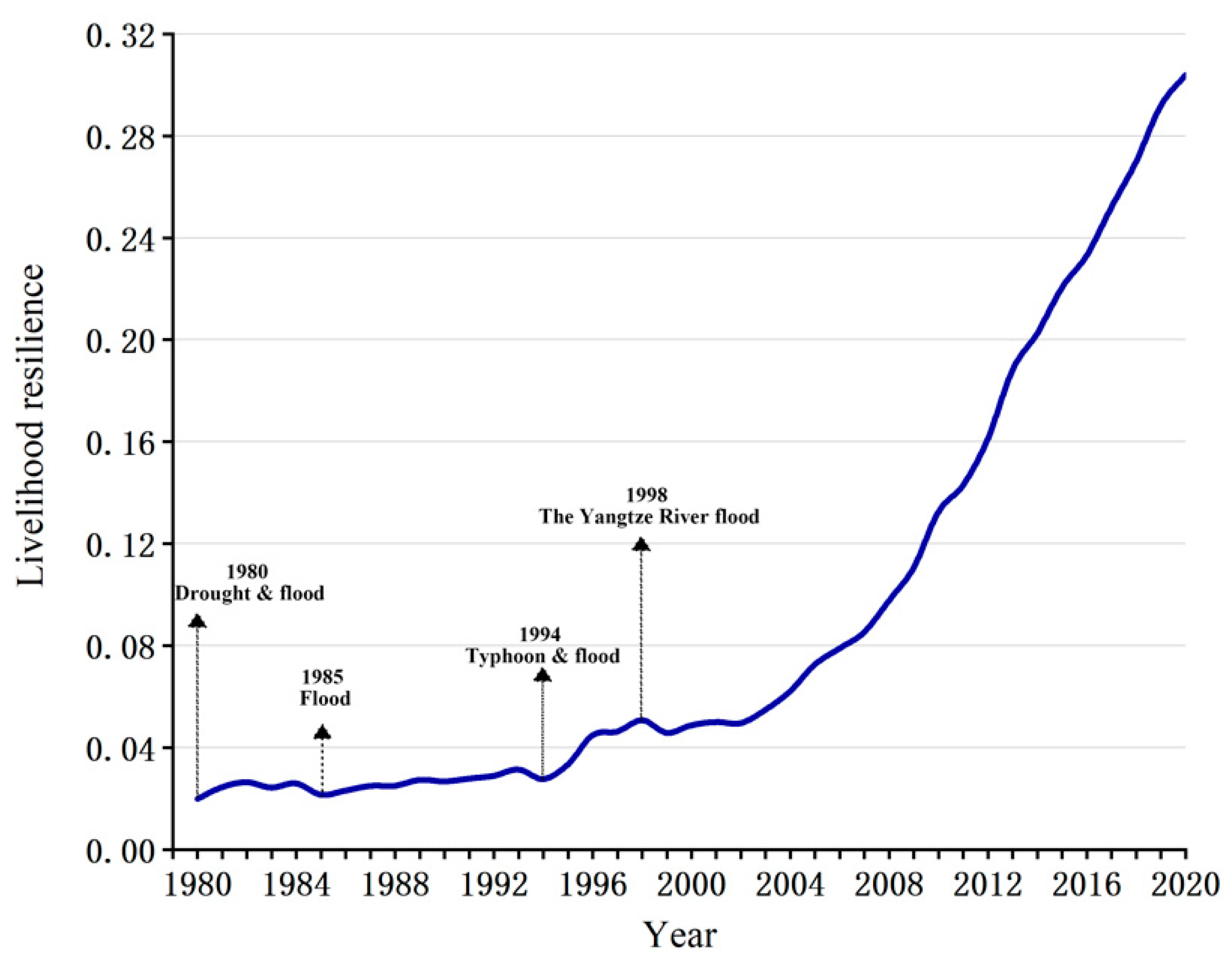
Since 1980, the livelihood resilience of rural residents in China has been on an overall increasing trend, with the year 2003 as the boundary, before which the level of livelihood resilience was low and fluctuated slightly, and after which it showed rapid growth (Figure 1). During the period between 1980 and 1985, there was a large-scale drought across the country, and social and economic construction was still in the initial stage of reform and opening up. The infrastructure construction in rural areas was still incomplete, resulting in major losses due to disaster. Therefore, the livelihood resilience index of rural residents showed a fluctuating downward trend. From 1986 to 1993, the rural livelihood resilience index showed a steady upward trend, but the curve increased slowly. From 1994 to 2002, the rural livelihood resilience index showed an upward and downward fluctuating trend, with an insignificant increase in the curve, and a valley appeared in 1994 and 1999. This was mainly attributed to the occurrence of global climatic anomalies during this period, and the frequent occurrence of meteorological disasters in China, especially the widespread occurrence of heavy rainfall and flooding, which particularly affected rural areas. Since 2003, when China’s rural reform officially entered a new phase of urban–rural integration, the livelihood resilience of rural residents as a whole has shown rapid growth. Although there were still extreme weather and climate impacts during this period, a series of policies by the Chinese Government to strengthen and benefit the agricultural sector helped to increase the resilience of rural residents to risks and disasters to a large extent, further improving their livelihood resilience.
Figure 1.
Changes in livelihood resilience of rural residents in China.
Figure 1.
Changes in livelihood resilience of rural residents in China.
Using Pearson correlation analysis, this study explored the relationship between rural residents’ livelihood resilience and the three-dimensional structure of pressure, state, and response. From Table 3, it can be seen that the livelihood resilience of rural residents is significantly and positively correlated with state and response, and significantly and negatively correlated with pressure, indicating that the level of the three is highly relevant to the level of livelihood resilience of rural residents in China.
Table 3.
Correlation analysis of livelihood resilience structure dimensions.
Table 3.
Correlation analysis of livelihood resilience structure dimensions.
| Dimension | Livelihood Resilience |
|---|
| Correlation Coefficient | p-Value |
|---|
| Pressure | −0.897 *** | 0.000 |
| State | 0.995 *** | 0.000 |
| Response | 0.993 *** | 0.000 |
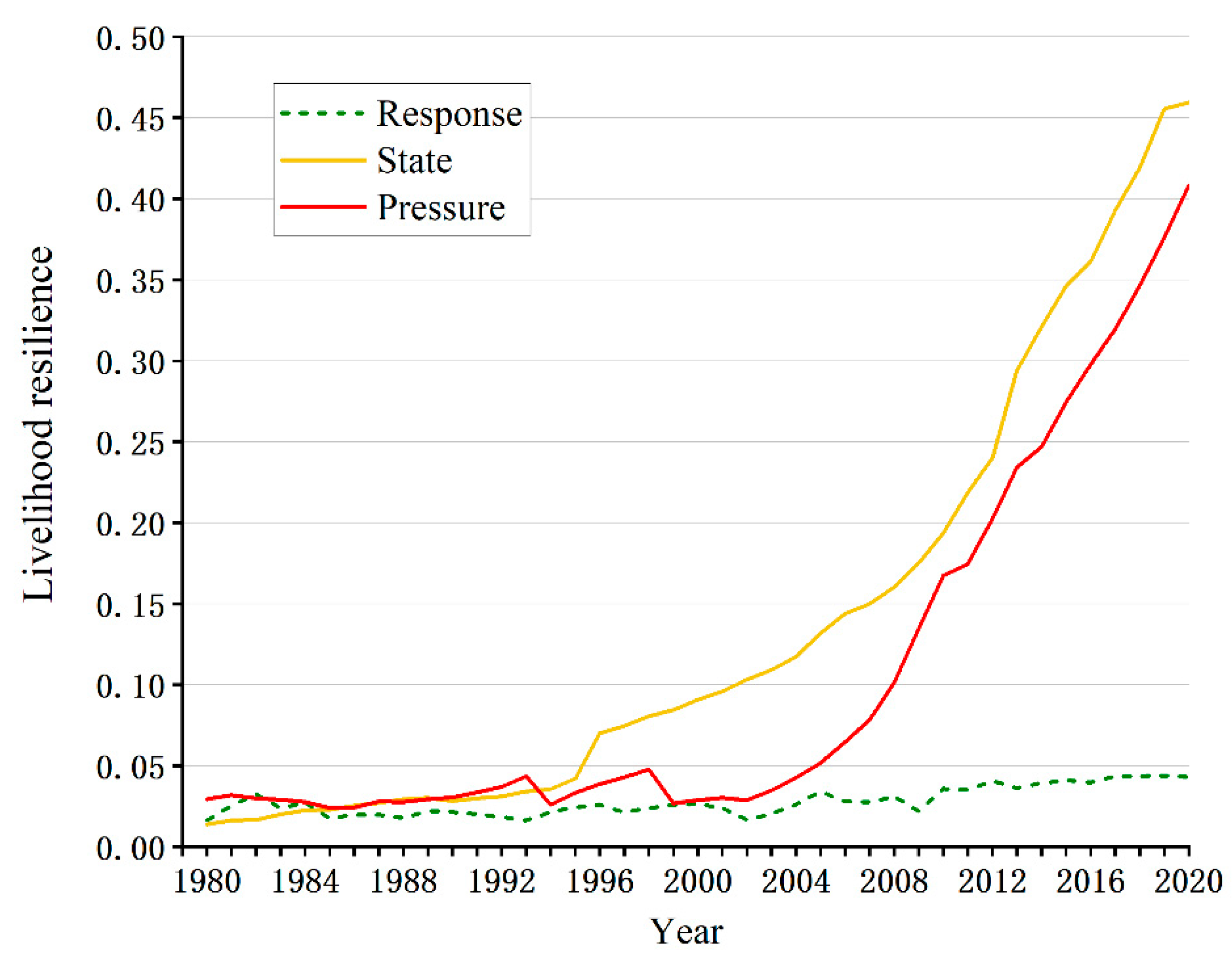
The trend in the three-dimensional structure of livelihood resilience shows that the state and response have an overall increasing upward trend (Figure 2), especially after 2000, when a rapid growth trend occurred, reflecting the rapid increase in China’s rural socio-economic development and infrastructure level in the 21st century.
The trend in the three-dimensional structure of livelihood resilience shows an overall increasing trend in the curves of state and response (Figure 2). In particular, there was a rapid growth trend after 2000, reflecting the level of social–economic development and infrastructure construction of rural China in the 21st century. In addition, pressure also shows a fluctuating growth trend, especially at the time point when the livelihood resilience declined and then increased rapidly. This shows that the level of livelihood resilience in China was significantly affected by natural disasters, and the disaster stress did not change significantly due to the improvement of livelihood quality, livelihood promotion, and livelihood supply.
Figure 2.
The change trend of the four-dimensional structure of livelihood resilience.
Figure 2.
The change trend of the four-dimensional structure of livelihood resilience.
From 1980 to 2020, the pressure index generally showed fluctuating changes. Since 1980, extreme weather has become frequent in China, resulting in a frequency of natural disasters, especially meteorological disasters. The peaks and troughs of the disaster stress index curve for rural residents appeared alternately, and each rapid increase in disaster stress represented a major natural disaster. From 1980 to 1983, a rare major drought occurred in China, followed by major floods in 1991 and 1998, and a large-scale drought in 2000, the affected area of which reached a magnitude not seen in 41 years, accounting for 25% of the total planting area. Since 2010, disaster stress has shown a fluctuating and rising trend, and has remained at a relatively high level. This was mainly due to the increased frequency of extreme disastrous weather in the context of climate change. In addition to the direct economic losses caused by natural disasters, rural residents have had to invest more money in disaster response, and this additional investment indirectly affected their income, which in turn has caused significant social–economic losses to rural China.
From 1980 to 2020, the overall state index showed a steady upward trend. At the indicator level, the improvement of state was mainly due to the decline of the Engel coefficient, the increase in access to medical care, the improvement of rural per capita education level, and the increase in rural per capita disposable income. From 1980 to 1995, the growth of the state index was relatively slow. According to the Government Work Report, during this period, due to agricultural restructuring, ecological fallowing, and construction occupation, the per capita area of arable land declined from 1.51 mu in 1980 to 1.17 mu in 1995, with a certain negative impact on the state of livelihoods. Meanwhile, rural per capita food production has also shown fluctuations due to uncertainties such as natural disasters and the constant adjustment of cultivated land area, further affecting the livelihood state. In terms of long-term development, the state index grows significantly in the 1980–2020 period. China’s Engel coefficient declined from 61.8 in 1980 at the beginning of China’s reform and opening up to 32.7 in 2020, while the number of beds per 10,000 people in medical and health institutions increased from 22.1 to 64.5, and rural per capita medical consumption expenditure also increased significantly. Since the 1980s, China has implemented the household contract responsibility system, and rural production has been significantly improved. At the same time, the recovery of sideline businesses, diversification of operations, and the transfer of labor to the secondary and tertiary industries has improved the livelihoods of rural residents. The per capita disposable income in rural areas increased from 1980; in increased from CNY 191.3 to CNY 17,131.5 in 2020. In addition, rural residents have gradually emphasized their own and their children’s education, and per capita education expenditures for rural households have risen markedly, resulting in more opportunities for rural residents to acquire knowledge and skills, thereby improving their ability to prevent and withstand livelihood risks, and keeping their livelihoods growing steadily. Rural per capita agricultural machinery total power continued to grow between 1980 and 2020, which helped to improve agricultural production conditions, while reducing, to an extent, the losses caused to agricultural production by natural disasters and contributing to the growth of rural residents’ income. Rural per capita housing construction area and per capita electricity consumption in rural areas also increased year on year, reflecting improvements in the rural productivity and living standards of rural residents, thus creating a virtuous circle. This provided greater development impetus for production and the life of rural residents and has had a positive impact on the livelihood state of rural residents.
Between 1980 and 2020, the response index generally showed a fluctuating upward trend. In particular, during the period from 1980 to 2002, the response index fluctuated and did not change significantly. The response index stagnated or even declined between 1981 and 1986, mainly due to the reduction in the number of beds in medical and health institutions and the per capita minimum living security. In addition, the frequent occurrence of major natural disasters led to a blockage of rural economic development and a slowdown in the growth of fixed-asset investment by rural residents, which caused a valley in the fluctuation curve of the response index in 1994 and 1999. However, since 2003, the rising speed of the state index increased significantly. During this period, the facilities of medical and health institutions were gradually improved, the proportion of local governments’ per capita financial income and expenditure gradually increased, the local government’s financial supply capacity steadily improved, and the intensity of rural residents’ investment in fixed assets further strengthened. Rural per capita minimum living security increased from CNY 1.21 in 2003 to CNY 279.78 in 2020. In years of serious disasters, the government’s financial assistance can enable rural residents to return to normal production and life as soon as possible. With investment in technology, the large amount of rural capital promoted the renewal and improvement of agricultural production technology and the significant improvement of rural production efficiency, especially after the Ministry of Agriculture and Rural Development released the Technical Guidelines for Green Development of Agriculture (2018–2030) in 2018. The construction of rural and agricultural modernization has since received wider attention. It has brought about the effective use of rural labor resources, gradually balancing the relationship between capital and labor resources, providing more security for the livelihood of rural residents, while driving the development of secondary and tertiary industries and providing more employment opportunities. It has also prompted society to invest more in rural areas and promote rural economic development, which plays an important role in promoting the stability of the livelihood system of rural residents.
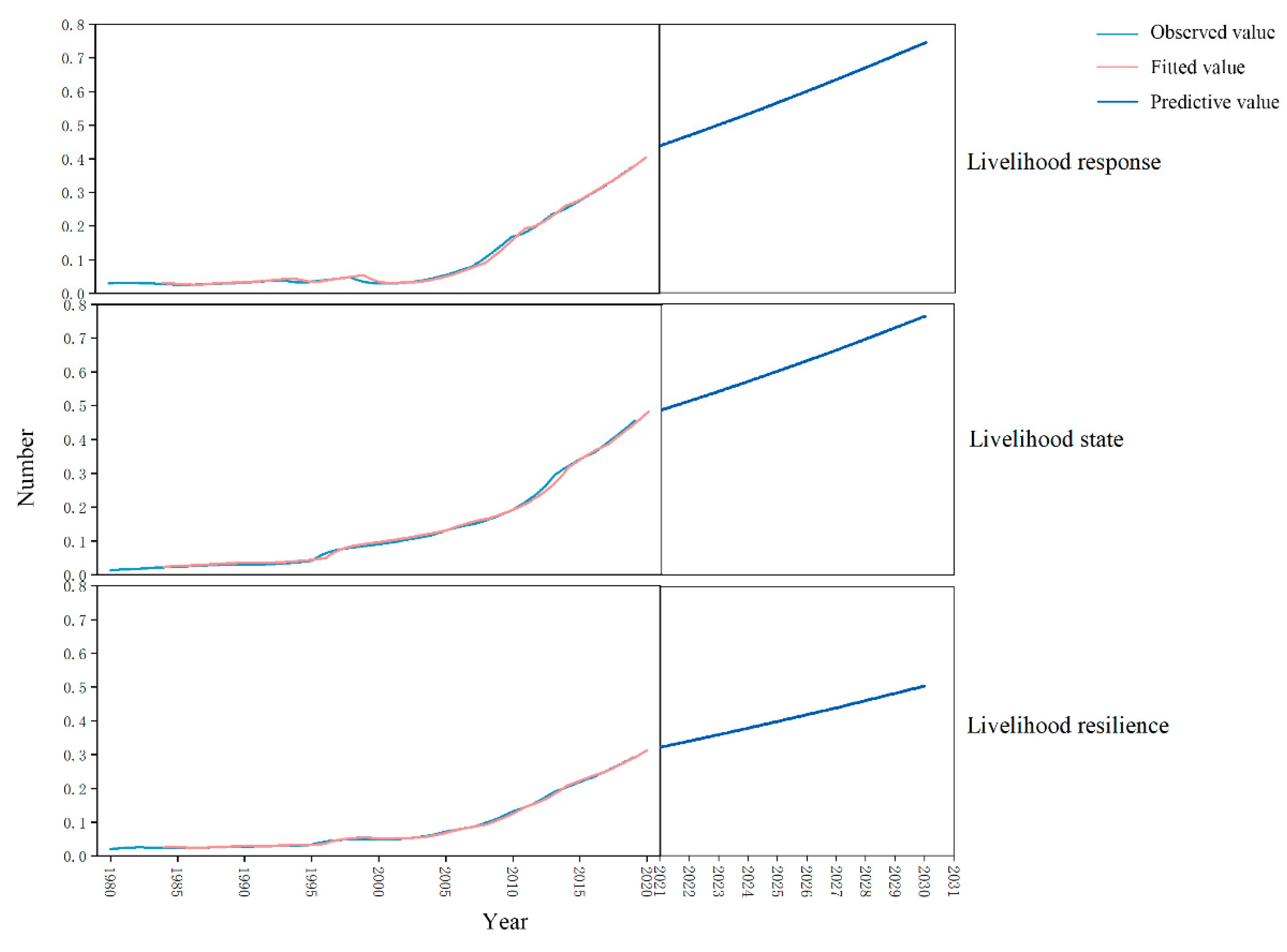
Based on PSR model, the ARIMA model was established according to the constructed livelihood resilience evaluation model. Due to the uncertainty and unpredictability of livelihood pressure, only livelihood state, livelihood response, and livelihood resilience were selected for trend prediction.
The results of the forecast in Figure 3 show a slow increasing trend of livelihood resilience for rural residents in China from 2021 to 2030. By 2030, the livelihood resilience index will have increased from 0.304 in 2020 to 0.504, with an insignificant overall trend. It can be seen that with the improvement of their production and living conditions and the support and assistance of the government, the volatility of the livelihood system of rural residents will be reduced, and the livelihood of rural residents will enter a stage of stable development in the future. However, no matter how the external conditions are improved, uncertain factors such as natural disasters will always exist and impact the overall livelihood resilience level, so that rural residents’ livelihood resilience will still fluctuate slightly. Therefore, in the future, it is necessary to pay attention to the stability and sustainability of rural residents’ livelihood resilience.
The livelihood state forecast from 2021 to 2030 shows a steady upward trend, which is in line with the 14th Five-Year Plan (2021–2025) for China’s national economic and social development. The 14th Five-Year Plan will further improve people’s livelihood and well-being, consolidate and expand the achievements of poverty alleviation, comprehensively promote the rural revitalization strategy, and promote the construction of public health emergency support and rural education support. The improvement of livelihood state can lead to a more robust development of livelihood resilience among rural residents. It can be expected that as rural society develops, basic livelihood security such as food, clothing, shelter, and transport will gradually stabilize, productive living space will be optimized, the human living environment will be improved, and when basic livelihood needs are met, the focus will shift to other priority areas in the future.
It is predicted that livelihood response will grow rapidly from 2021 to 2030, with the highest growth rate level since the 21st century, indicating that the future strategic development of rural areas in China will remain a key focus of national construction and development. The national government will continue to increase investment in rural construction, improve the multi-level social security system, and speed up the filling of shortcomings in areas such as infrastructure, agriculture, and rural areas, disaster prevention and mitigation, and industrial structure. It can be seen that strengthening the guarantee of rural development factors can promote livelihoods, and the improvement of livelihood response can effectively prevent the shock to rural residents caused by unexpected events. Therefore, livelihood response will be important in the implementation of the rural revitalization strategy in the coming decade, which will also help to incorporate the fundamental role of rural economic formats in social development.
Figure 3.
Prediction of rural residents’ livelihood resilience from 2021 to 2030.
Figure 3.
Prediction of rural residents’ livelihood resilience from 2021 to 2030.
According to the regression results (Table 4), the R2 of the model is 0.971, indicating that eight variables could explain 97.1% of the changes in livelihood resilience. Furthermore, the model passed the F test (F = 132.272, p < 0.05), indicating that at least one variable would have an impact on livelihood resilience.
Table 4.
Ridge regression results of influencing factors of livelihood resilience.
Table 4.
Ridge regression results of influencing factors of livelihood resilience.
| Dimension | Variable | Unstandardized Coefficient | Standardized Coefficient | t-Value | p-Value | R2 | F-Value |
|---|
| B | SE |
|---|
| Constant | C | 0.013 | 0.004 | - | 3.446 | 0.002 *** | 0.971 | 132.272 (0.000 ***) |
| Economic foundation | X1 | 0.048 | 0.002 | 0.16 | 21.951 | 0.000 *** |
| X2 | 0.048 | 0.002 | 0.155 | 21.516 | 0.000 *** |
| Science and education level | X3 | 0.054 | 0.003 | 0.164 | 20.48 | 0.000 *** |
| X4 | 0.025 | 0.002 | 0.103 | 15.334 | 0.000 *** |
| Social characteristics | X5 | 0.027 | 0.002 | 0.097 | 11.626 | 0.000 *** |
| X6 | 0.018 | 0.001 | 0.114 | 18.274 | 0.000 *** |
| Disaster resistance | X7 | 0.028 | 0.002 | 0.107 | 15.449 | 0.000 *** |
| X8 | 0.001 | 0.004 | 0.004 | 0.322 | 0.75 |
In the economic foundation dimension, the coefficient of rural per capita consumption level (X1) and rural per capita GDP (X2) are 0.048 (p < 0.05), indicating that rural per capita consumption level and rural per capita GDP have a significant positive impact on livelihood resilience.
In the dimension of education level, the regression coefficients of the number of health technicians per thousand population (X3) and higher education penetration level (X4) are 0.054 (p < 0.05) and 0.025 (p < 0.05), respectively, indicating that the higher the value of these two variables, the stronger the sustainable development ability of rural residents’ livelihood system.
In terms of the social characteristics dimension, the proportion of people employed in primary industries (X5) and the mobile phone penetration rate (X6) are 0.027 (p < 0.05) and 0.018 (p < 0.05), respectively, indicating that the proportion of people employed in primary industries and mobile phone penetration have a significant positive impact on livelihood resilience.
In terms of the disaster resistance dimension, the regression coefficient of area of embankment-protected arable land (X8) does not pass the significance test (p > 0.1), while effective irrigated area (X7) is 0.028 (p < 0.05), indicating that the increase in effective irrigated area has a significant positive impact on livelihood resilience.”
9. The authors wish to change several words in “4.1. Evaluation and Prediction of Livelihood Resilience”.
The following is the updated version:
“The comprehensive evaluation results show that the livelihood resilience of rural residents in China fluctuated between 1980 and 2020, but generally showed an upward trend. During this period, meteorological disasters occurred frequently in China due to the abnormal global climate [48]. The four major fluctuations of livelihood resilience were all caused by natural disasters, such as droughts or floods in 1983, 1991, and 1998, and Typhoon Rammasun in 2014 [49,50], which made livelihood resilience turn down to the local ‘bottom’. From 2016 to 2020, the livelihoods resilience index showed a rapid upward trend with no major disasters and an improvement in rural socio-economic conditions.
By examining the evaluation value of the three dimensions of resilience, it can be found that the livelihood resilience of rural residents is significantly positively related to livelihood state and livelihood response, and significantly negatively correlated with pressure. According to the trend of the four dimensions between 1980 and 2020, the livelihood state and livelihood response curves showed relatively stable upward trends, while the pressure curve had the characteristic of cyclical fluctuation but still showed an upward trend. Livelihood state, specifically, showed a rapid upward trend. This is mainly due to the implementation of the household contract responsibility system in 1980s and the transfer of rural labor to non-agricultural industry [51], which has greatly improved the quality of life of rural residents. In addition, the increasing emphasis on education among rural residents has greatly improved their ability to withstand life risks [52]. Modernization of agriculture and improvement of rural housing have provided a strong impetus for development in rural areas, which has had a positive impact on improving the state of livelihoods. The response index shows a fluctuating upward trend, in which the government has played a powerful role as a driving force. During the study period, the government’s financial supply capacity has steadily improved, and the expenditure on rural residents’ livelihood security and disaster resistance has also been greatly increased, as well as the investment in agricultural science and technology [53], which has provided a solid guarantee for livelihood resilience. In the context of climate change, natural disasters occur periodically, causing huge economic losses to rural societies in China [54].
Based on the prediction of livelihood resilience from 2021 to 2030, it can be seen that as livelihood state will steadily increase, livelihood response will grow rapidly. Further, the overall livelihood resilience will grow slower than livelihood state and livelihood response. It can be seen that, with the improvement of rural production and living conditions and the role of government assistance [55], the volatility of rural residents’ livelihood system will decrease in the next ten years, and livelihood resilience will enter a stage of stable development.”
10. The authors wish to change several words in the first paragraph of “4.4. Research Deficiencies and Prospects”.
The following is the updated version:
“Most existing studies evaluate livelihood resilience based on the framework of livelihood resilience analysis, while this study introduces the PSR model, which is a model structure that includes pressure, state, and response. It realizes the study of dynamic changes in livelihood resilience in the context of natural disasters, and also provides a new perspective on the adjustment of rural livelihood systems and response to external disturbances, which is important for reducing disaster losses and scientifically promoting sustainable rural development.”
11. The authors wish to delete the following sentences in “4.4. Research Deficiencies and Prospects” in Paragraph 2:
“There is still a need for further research on whether the research method of building a system of resilience indicators through structural dynamics will become a common comprehensive assessment model in the future.”
12. The authors wish to change several words in “5. Conclusions”.
The following is the updated version:
“This study used the PSR model to measure the livelihood resilience of Chinese rural residents between 1980 and 2020. The results show that although there are fluctuations in the livelihood resilience of Chinese rural residents, the overall trend is upward. The livelihood resilience of rural residents is significantly and positively correlated with state and response, while it is significantly and negatively correlated with pressure. In addition, the livelihood resilience forecast for 2021–2030 shows that livelihood resilience, state, and response are generally on an increasing trend; however, the improvement will slow down in the future. Finally, the seven variables of rural per capita consumption level, rural per capita GDP, number of health technicians per thousand people, higher education penetration level, proportion of people employed in primary industries, mobile phone penetration rate, and effective irrigation area all have a significant positive impact on livelihood resilience, providing a basis for the subsequent enhancement of livelihood resilience.”
13. The authors wish to add the following references:
- 36.
Jieer, R.; Yingbiao, C.; Zhiwei, Y. Assessment of temporal and spatial progress of urban resilience in Guangzhou under rainstorm scenarios. Int. J. Disaster Risk Reduct. 2021, 66, 102578.
- 39.
You, H.; Zhang, X. Sustainable Livelihoods and Rural Sustainability in China: Ecologically Secure, Economically Efficient or Socially Equitable?
Resour. Conserv. Recycl. 2017,
120, 1–13.
https://doi.org/10.1016/j.resconrec.2016.12.010.
14. The authors wish to deleted the following references:
- 39.
Zou, J.Y.K. Structural Dynamics, 2nd ed.; Harbin Institute of Technology Press: Harbin, China, 2009.
- 53.
Deng, H.; Jin, Y.; Pray, C.; Hu, R.; Xia, E.; Meng, H. Impact of Public Research and Development and Extension on Agricultural Productivity in China from 1990 to 2013. China Econ. Rev. 2021, 70, 101699.
- 54.
Yu, Z.; Jin, X.; Miao, L.; Yang, X. A Historical Reconstruction of Cropland in China from 1900 to 2016. Earth Syst. Sci. Data 2021, 13, 3203–3218.
- 55.
Gu, J.; Xu, J.; Lu, K. Progresses and Challenges of the Rural Housing in China. China Popul. Resour. Environ. 2013, 23, 62–68.
15. The authors wish to change the number of the following reference from 36 to 45:
- 45.
Fang, Y.; Zhu, F.; Qiu, X.; Zhao, S. Effects of Natural Disasters on Livelihood Resilience of Rural Residents in Sichuan. Habitat Int. 2018, 76, 19–28.
With this correction, the order of some references has been adjusted accordingly. The authors state that the scientific conclusions are unaffected. This correction was approved by the Academic Editor. The original publication has also been updated.



 ,
,