


Abstract
Blockchain technology is increasingly adopted in supply chains to record product carbon footprints and environmental attributes on tamper-resistant ledgers. By improving the transparency and verifiability of emission-related information for governments, firms and consumers, blockchain reshapes the incentive effects of environmental taxes and subsidies that target emission abatement. This paper presents a government-manufacturer-consumer tripartite game model to analyze the abatement effects of tax and subsidy policies and their differences under heterogeneous consumer demand in a blockchain-driven framework. The results indicate that: (1) Both subsidy and tax policies can facilitate environmental improvement. When consumers’ green preference exceeds a specific threshold , the greenness of the tax policy is superior to that of the subsidy policy, and vice versa. (2) Under blockchain technology, tax and subsidy instruments differentially affect the profits of conventional and green manufacturers, shifting profits from high-emission sectors to green sectors. (3) The improvement of consumers’ environmental awareness can gradually reduce the implementation of the policy, urge enterprises to reduce emissions, and improve their profits. Nevertheless, the privacy concerns associated with blockchain technology present a significant obstacle to the effective implementation of carbon emission reduction strategies.
1. Introduction
The COP28 has once again highlighted the necessity for humanity to unite and collaborate in order to mitigate the effects of global warming. “Now all governments must give their negotiators clear marching orders: we need highest ambition, not point-scoring or lowest common denominator politics.” UN Climate Change Executive Secretary Simon Stiell said at the halfway point of COP28 on 6 December. The replacement of coal, oil and natural gas production with global renewable energy sources, such as wind, solar, hydro and geothermal energy, has become an unstoppable trend across the globe. It is evident that governments play a pivotal role in this endeavor. The implementation and enforcement of government policies are of paramount importance in order to ensure the effectiveness of emission reduction results. Nevertheless, a number of issues remain. For instance, the rate of carbon emission reduction varies considerably between countries, and the same policy may have different effects in different regions. Consequently, the investigation of the mechanisms by which carbon emissions can be reduced through policy is a priority for the resolution of the climate crisis.
Taxes and subsidies are two key market-based instruments through which governments regulate carbon emissions [1,2,3]. Environmental and carbon taxes internalize emission externalities into the decisions of firms and households by increasing the cost of fossil energy use. Evidence from various countries shows that a well-designed carbon tax can help curb high-carbon energy consumption and create fiscal space for green transitions [4]. In contrast, subsidies focus on lowering the adoption threshold for clean energy and low-carbon technologies—such as feed-in tariffs and production or investment tax incentives—and are widely used to increase the installed capacity of renewable energy and the market share of green products [5]. Overall, taxes and subsidies jointly constitute a “hard constraint–soft incentive” policy mix that both restricts high-carbon behavior and stimulates low-carbon investment, and they are central instruments in the current carbon mitigation policy toolkit.
However, emission reduction policies based on taxes and subsidies have long been subject to considerable controversy. On the one hand, increasing the tax burden on fossil fuels is easily perceived as disproportionately weighing on low- and middle-income groups and, in the absence of accompanying transfer schemes and effective communication, may trigger social protests and even force policy reversal. On the other hand, large-scale subsidies for fossil fuels and biofuels have been criticized for distorting price signals, weakening incentives for emission reduction, and even inducing environmental and social problems such as deforestation, food–fuel competition, and community displacement. Therefore, taxes and subsidies are not inherently effective; their mitigation performance critically depends on whether policy design can reconcile efficiency, equity, and long-term sustainability.
Building on this, whether taxes and subsidies can genuinely promote emission reductions depends not only on the statutory tax rate or the strength of the subsidy, but also critically on the availability and credibility of information about emissions abatement. On the one hand, if governments and consumers cannot accurately observe firms’ true abatement efforts, taxes and subsidies can hardly be targeted precisely at genuinely green behavior and may even have their effectiveness undermined by practices such as greenwashing and overstated emission reductions. On the other hand, in the absence of reliable environmental information, consumers’ willingness to pay for so-called “green products” remains limited, making it difficult for the demand side to exert sustained and stable pressure for emission reduction. Information opacity and a lack of trust thus become key constraints that weaken the effectiveness of traditional incentive instruments.
Against this backdrop, blockchain technology reshapes information recording and trust mechanisms, thereby indirectly influencing the structure of emission reduction incentives [6,7,8]. In the supply chain context examined in this study, the core function of blockchain lies in recording environmental information—such as product carbon footprints and abatement efforts—together with transaction data in an immutable distributed ledger, thus forming a traceable information chain that runs through production, circulation, and consumption. On the one hand, this helps enhance the observability of firms’ abatement behavior for governments, allowing taxes and subsidies to be more closely linked to actual emission reduction performance and leaving less room for policy evasion or “creative accounting” [1]. On the other hand, and more importantly, consumers can directly access blockchain-verified abatement information, which strengthens their trust in green products and firms’ environmental commitments and increases their willingness to pay for emission reductions. It is through this demand-side transmission mechanism—“information transparency → consumer trust → green demand → corporate abatement”—that specific applications of blockchain become substantively connected to emission reduction outcomes.
However, the application of blockchain is also accompanied by privacy risks. When consumers use traceability or certification services on blockchain platforms such as AntChain, they are typically required to register and submit personal information, and their transaction records may be stored and analyzed over the long term. Existing surveys show that more than 90% of consumers express concern about online privacy and data security, and a considerable share accordingly reduce their online activities or even avoid transactions altogether when they have doubts about privacy protection [9]. This implies that when blockchain is perceived as a “high-traceability, high-trace retention” infrastructure, its transparency benefits may be partially offset by privacy anxiety in the absence of robust privacy protection and institutional safeguards, and may even generate negative perceptions on the demand side, thereby dampening consumers’ willingness to use green products and related platforms.
In practice, most blockchain-enabled initiatives for carbon footprint tracking and green supply chain traceability are still at the pilot or proof-of-concept stage, with relatively short implementation periods and data that are fragmented and heterogeneous, making it difficult to satisfy stringent requirements for causal identification [8]. Under such circumstances, drawing general conclusions directly from case-based data is risky, and it becomes more necessary to employ formal theoretical analysis to clarify underlying mechanisms, identify threshold conditions, and delineate the scope of applicability. An analytically tractable game-theoretic model can, on the one hand, cleanly disentangle the channels of the “information transparency effect,” the “privacy cost effect,” and the “instrumental differences between taxes and subsidies” while holding other confounding factors constant; on the other hand, it can yield threshold conditions and comparative statics with respect to key parameters—such as consumers’ green preferences, privacy costs, and blockchain deployment costs—thus providing a structured theoretical benchmark for subsequent empirical tests and policy evaluation. Therefore, at a stage when blockchain applications have not yet generated stable and mature practical evidence, investigating the causal chain “blockchain → information → trust → policy incentives → mitigation performance” from a theoretical perspective is both practically justified and methodologically necessary.
Against this backdrop, this study focuses on the context of blockchain-enabled supply chain decarbonization and compares the two traditional policy instruments of taxation and subsidies, with the aim of addressing the following three interrelated research questions:
- (1)
- Is tax or subsidy policy more effective in encouraging enterprises to reduce emissions and achieve better environmental performance?
- (2)
- What are the economic benefits of traditional and green production enterprises in the perspective of reducing carbon emissions using blockchain technology?
- (3)
- Examine how external factors, such as consumer preferences and blockchain-induced privacy costs, affect environmental performance and corporate decision-making.
In order to respond to these queries, a three-party game-theoretic model has been developed. The government bears the responsibility for implementing policies, while green and conventional manufacturers determine the production and reduction in emissions, as well as the sale of green products to consumers with heterogeneous demand, within a given policy and blockchain environment. The following three scenarios are compared: (1) A baseline scenario where no policy is implemented; (2) subsidy policy; and (3) tax policy. It was found that both subsidy and tax policies can play a positive role in environmental improvement. When consumers’ green preference exceeds a specific threshold, the greenness of a tax policy is superior to that of a subsidy policy, and vice versa. Secondly, government environmental regulation is detrimental to the profitability of traditional manufacturers, but expands the profitability of green manufacturers. In comparison to tax policy, subsidy policy is more effective in creating a significant discrepancy in profit margins between the two types of manufacturers and enhancing social welfare. Furthermore, as consumers’ environmental awareness increases, the necessity for policy implementation is reduced, prompting enterprises to reduce emissions and consequently improving their profits. Nevertheless, the privacy concerns raised by blockchain technology present a significant obstacle to the reduction of carbon emissions.
The remainder of the article is organized as follows. Section 2 reviews the relevant research. The materials and methods, including the basic assumptions and dynamics of the game, are described in Section 3. Section 4 shows the model solving process and related analyses. Section 5 shows the comparative analysis of the results and data simulations of key findings. Finally, Section 6 summarizes the paper.
2. Literature Review
A comprehensive literature review is provided from both the policies and blockchain perspectives.
2.1. Taxation and Subsidy Policies for Carbon Mitigation
Research on fiscal policies for carbon mitigation primarily centers on two instruments: taxation and subsidies. The carbon tax literature focuses on firms’ and supply chains’ behavioral responses, macroeconomic impacts, and the coordination of taxes with other policy tools, thereby revealing the incentive structures and heterogeneous effects of carbon taxation. In contrast, the subsidy literature examines optimal subsidy mechanisms under carbon-quota constraints, capital and technology investment needs, supply chain configurations, information asymmetry, and behavioral preferences. Together, these two strands provide the essential conceptual foundation for understanding the incentive logic of low-carbon policy design.
2.1.1. Literature Review on Carbon Tax Policies
- (1)
- Theoretical Perspectives on Carbon Tax Policy Research
In the theoretical literature on tax policy and carbon mitigation, existing studies can be broadly categorized into three thematic strands: (i) firm- or supply chain-level decision responses, (ii) macroeconomic impacts and tax redistribution effects, and (iii) multi-objective and multi-instrument policy coordination.
The first strand centers on firm or supply chain decision responses. Under differentiated oligopolistic competition, existing studies show that a uniform carbon tax raises retail prices and amplifies profit losses and abatement pressure for low-efficiency firms, whereas imposing a higher marginal carbon tax on high-efficiency firms can be more efficient under a given abatement target [10]. In the refining industry, evolutionary game results indicate that when firm heterogeneity is small, emissions trading outperforms carbon taxation; when heterogeneity is large, a carbon tax fails to induce backward refineries to reduce emissions, while emissions trading can still effectively promote sector-wide mitigation [11]. From the perspective of supply chains and product life cycles, a new-energy-vehicle supply chain model shows that a carbon-footprint-based carbon tax can reduce both unit and life-cycle emissions when firms exhibit strong abatement capability and energy prices are low; however, when capability is weak or energy prices are high, emission reduction mainly relies on demand contraction, thereby eroding profits and social welfare [1]. An evolutionary game involving green-building stakeholders further suggests that carbon taxation enhances green investment by governments, suppliers, and developers, but requires complementary subsidies, tax incentives, green finance instruments, and penalty mechanisms to stabilize mitigation behavior [3]. From the perspective of remanufacturing and technological pathway selection, a two-period production model demonstrates that carbon taxation motivates manufacturers to choose an optimal remanufacturing ratio between new and remanufactured products, and that an appropriately set tax rate can jointly stimulate low-carbon technological investment and remanufacturing, thereby alleviating cannibalization effects while enhancing abatement efficiency [2].
The second strand highlights macroeconomic impacts and tax revenue redistribution. Studies based on dynamic CGE models show that industry-differentiated carbon taxes help achieve a fair allocation of abatement responsibilities, although they may incur certain macroeconomic and sectoral output losses. When carbon tax revenues are recycled to reduce corporate income taxes or subsidize clean-energy industries, both mitigation performance and economic outcomes improve, and a “double dividend” may arise under specific conditions [12]. Comparative CGE simulations of resource taxes and carbon taxes further demonstrate that, for comparable GDP losses, carbon taxation is substantially more effective in curbing energy consumption and reducing CO2 and multiple air pollutants, underscoring its superiority in environmental efficiency [13]. Extending general equilibrium models to incorporate embodied carbon emissions and production networks, recent work shows that a carbon tax raises fossil-energy costs and alters the relative prices of intermediate and final products, transmitting along the production network and inducing adjustments in firms’ input composition and households’ consumption structure. As a result, emission reductions stem primarily from the decline in embodied-carbon intensity of consumption goods rather than mere demand contraction, revealing a structural mechanism through which carbon taxation achieves mitigation on the demand side [4].
The third strand focuses on multi-objective and multi-instrument coordination, emphasizing the joint design of carbon taxes with other environmental policy tools and regulatory goals. Within an extended producer responsibility (EPR) framework, a Stackelberg game between the government and firms, combined with Cournot competition among enterprises, shows that when an emissions tax and a solid-waste tax are levied simultaneously, a jointly optimal tax pair exists. This combination enhances emissions reduction and waste-recycling rates while improving social welfare, and higher environmental taxes do not necessarily erode oligopoly profits, thereby weakening the traditional “environment–efficiency” trade-off [14]. In sectors such as green buildings and new-energy vehicles, carbon taxes are typically implemented alongside subsidies, tax incentives, green finance instruments, and penalty mechanisms. Evidence shows that a stand-alone carbon tax cannot guarantee both substantial emissions reduction and low economic costs across all scenarios. In contrast, coordinated designs involving a “carbon tax + multiple instruments” are more conducive to balancing environmental objectives, industrial upgrading, and social welfare [1,3,15].
Synthesizing these three strands yields an integrated analytical framework of “carbon taxation—micro-level behavior—macroeconomic performance—policy portfolios.” This framework demonstrates that the mitigation effectiveness of carbon taxation is highly sensitive to firm heterogeneity, market structure, production networks, and supply chain linkages, and is substantially shaped by tax-recycling schemes and joint fiscal arrangements. It thus provides a systematic theoretical foundation for exploring the optimal design of tax–subsidy–digital technology incentives in blockchain-enabled carbon reduction settings.
- (2)
- Empirical Perspectives on Carbon Tax Policy Research
Empirical research on the mitigation effects of tax policies has primarily developed along three dimensions: firm and supply chain behavioral responses, macro-level abatement performance, and cross-regime differences in tax system design.
Using listed-firm data, micro- and network-based analyses show that imposing environmental taxes on upstream and downstream supply chain partners significantly promotes emission reduction by core firms, with the spillover effect from taxing upstream suppliers being particularly pronounced. Moreover, supply chain dependence and technological collaboration amplify this effect, whereas industry competition weakens it [7]. Regarding firms’ abatement pathway choices, a quasi-natural experiment based on China’s value-added tax reform demonstrates that tax reductions lower firms’ SO2 emission intensity by approximately 16.6% on average. When combined with binding emission-reduction targets, firms simultaneously adopt process-based abatement and end-of-pipe treatment, yielding stronger mitigation effects. Firms facing tighter financing constraints exhibit more pronounced responses to this policy mix [9].
At the macro level, country-specific evidence shows that, for Chile’s industrial sector, carbon taxes set at moderate levels of 10–30 USD per ton of CO2 generate the strongest abatement incentives, whereas excessively low or high tax rates raise fiscal revenues but fail to further curb emissions [16]. For China’s Environmental Protection Tax, a provincial difference-in-differences analysis indicates that its implementation significantly reduces SO2 and CO2 emissions and enhances the “pollution reduction–carbon reduction” synergy by promoting industrial upgrading and optimizing the energy consumption structure. These effects are more pronounced in inland regions and provinces with larger government size [8]. From a cross-country perspective, panel ARDL analyses using OECD countries and Chinese provinces show that environmental taxes robustly reduce pollution in both advanced economies and China. However, the magnitude of the effect varies with tax scale, industrial value added, and economic development level: regions with medium-to-low tax burdens, more advanced economies, or higher industrial value added exhibit stronger emission-reduction effects [17].
Overall, the empirical literature consistently indicates that environmental and carbon taxes significantly curb pollution and carbon emissions across diverse institutional contexts and stages of development. However, their effectiveness exhibits substantial heterogeneity across dimensions such as tax-rate ranges, taxed entities, industrial structure, firm-level constraints, and supply chain relationships. These findings provide both empirical foundations and parameter guidance for designing carbon-mitigation mechanisms in blockchain-enabled settings—mechanisms that jointly account for on-chain information transparency, supply chain interactions, and the efficiency of tax-based incentives.
2.1.2. Literature Review on Carbon Subsidy Policies
- (1)
- Theoretical Perspectives on Carbon Subsidy Research
Existing theoretical modeling studies on subsidy policies can be broadly categorized into three themes: how to use subsidies and financial instruments to incentivize emission reduction under carbon constraints, how to design optimal subsidy mechanisms within supply chain structures, and how to optimize subsidy policies under conditions of information asymmetry and behavioral preferences.
Under carbon-trading schemes or emissions-cap constraints, compares four Stackelberg structures—no subsidy, single subsidy, single abatement investment, and subsidy plus abatement investment—and finds that while both subsidies and abatement investments can raise profits, they may increase emissions in some cases [18,19]. The study thus proposes differentiated combinations of subsidies and abatement constraints tailored to manufacturers with varying abatement efficiencies. Cong et al. (2020) [20] incorporates green-finance subsidies, low-carbon subsidies, emissions trading, and output uncertainty into a capital-constrained supply chain, showing that green-finance and low-carbon subsidies exert markedly different incentive effects depending on firms’ initial emissions levels and interact with uncertainty in complex ways. In a monopoly context, Hussain et al. (2022) [21] embeds green bonds and government investment subsidies into firms’ abatement decisions and derives the joint optimum for green-technology investment and subsidy intensity. Bai et al. (2023) [22] compares green credit subsidies and price-based incentives, finding that under relatively loose emissions constraints, green credit enhances social welfare while price incentives benefit supply chain profits, whereas overly stringent constraints can “crowd out” both types of incentives. Focusing on electricity and energy-structure adjustment, Li et al. (2025) [23] employs a DSGE framework, showing that shifting from an intensity-based ETS to a cap-based pricing system substantially reduces emissions but suppresses power generation. Increasing clean-energy subsidies alone cannot change the cost disadvantage of coal power; only the combination of both policies can jointly achieve mitigation and supply security. In the photovoltaic sector, He et al. (2019) [17] constructs a dynamic subsidy model by incorporating learning curves and shows that as the levelized cost of electricity falls, emission-based subsidies should gradually phase out. Resource endowments and the share of self-consumption substantially influence project internal rates of return. Regarding industrial policy for carbon neutrality, Zhang et al. (2023) [24] compares cost-based and innovation-based subsidies within a “government–low-carbon manufacturer–retailer” game and matches them with revenue-sharing or cost-sharing contracts. The results indicate that subsidy types and rates must be aligned with supply chain collaborative innovation models to jointly maximize emission reduction and economic returns. For the automotive industry, Ding et al. (2023) [25] incorporates the dual-credit scheme and subsidy withdrawal into a supply chain game, characterizing the threshold effects of credit-stringency levels and subsidy removal on production decisions for conventional and new-energy vehicles, as well as the conditions for smooth policy transitions.
At the level of information structures and behavioral mechanisms, a growing body of literature examines how subsidy policies are transmitted and distorted under information asymmetry, corporate social responsibility (CSR), bargaining, and behavioral preferences. Ma et al. (2021) [26] employs a signaling game to analyze low-carbon consumption subsidies under asymmetric information regarding firms’ emission reductions. The study shows that high-abatement firms distort prices to differentiate themselves from low-abatement firms; the government’s subsidy decision hinges on consumers’ sensitivity to subsidies; and only when subsidies strongly stimulate demand do firms have incentives to share truthful abatement information, enabling a “subsidy + information disclosure” dual incentive. Under private information about manufacturers’ and retailers’ investment coefficients, He et al. (2024) [27] compares various subsidy schemes and finds that under a fixed total subsidy budget, a “dual-subsidy” scheme (simultaneously subsidizing manufacturers’ abatement investments and retailers’ low-carbon promotion) is optimal. Manufacturers have no incentive to misreport, whereas retailers strategically overstate investment coefficients, requiring screening mechanisms to mitigate distortions. Bian et al. (2020) [28] contrasts consumer-side and producer-side subsidies. The results show that consumer subsidies induce firms to adopt a “high-price + high-output” strategy to capture subsidies, leading to lower abatement and higher net emissions than producer subsidies. However, due to higher output and greater firm profits, social welfare is paradoxically higher—highlighting the inherent tension between environmental and welfare objectives. Incorporating CSR, He et al. (2023) [11] shows that when subsidies and CSR jointly operate, high cross-price elasticity in dual-channel competition enhances both mitigation and profits, and Pareto improvements can be achieved through cost-sharing contracts. For platform-based supply chains, Xu and Yang (2025) [29], within a “manufacturer abatement + platform CSR” framework, compares cost-based and output-based subsidies. The study finds that under the agency model, emission reduction, supply chain profit, and social welfare all exceed those under the wholesale model; cost-based subsidies more strongly enhance platform profits and social welfare, whereas output-based subsidies benefit manufacturers more. Considering dynamic consumer preferences, Zhang et al. (2025) [30] introduces evolving consumer green perception into a differential game under carbon trading. The results show that consumer subsidies exert stronger effects on decisions and social welfare than manufacturer subsidies. In the long run, consumer subsidies lead to a higher welfare steady-state, although during the product-introduction phase they may perform worse than no subsidy or manufacturer subsidies. From a contract and bargaining perspective, Zhang et al. (2023) [24] compares no contract, cost-sharing, and revenue-sharing contracts, identifying the dominance of revenue-sharing in achieving carbon neutrality under government subsidies. The study further shows that revenue-sharing remains superior even under asymmetric bargaining power, and consumer sensitivity to carbon neutrality positively influences profits and social welfare. Incorporating behavioral preferences, Wang et al. (2023) [31] develops multiple differential-game settings and finds that reciprocity preferences increase profits and abatement efforts for both manufacturers and suppliers. Government subsidies further enhance abatement and profits but attenuate the marginal contribution of reciprocity itself.
Overall, the theoretical modeling literature shows that under carbon-trading or emissions-cap frameworks, subsidies and green financial instruments provide strong incentives for firms’ abatement efforts, technological investments, and supply chain coordination, yet their effectiveness is highly contingent on emission levels, capital constraints, and industry- and technology-specific characteristics. Under conditions of information asymmetry, CSR engagement, reciprocity preferences, and dynamic green perceptions, subsidy policies and contract designs substantially shape information disclosure, price distortions, and welfare distribution.
- (2)
- Empirical Perspectives on Carbon Subsidy Policy Research
Overall, empirical research on subsidy-induced emission reduction has primarily followed two paths—“supporting the new” (subsidies for new-energy vehicles) and “restricting the old” (reforms of fossil-fuel subsidies) [32]. The findings indicate that the mitigation performance of subsidy instruments exhibits pronounced stage-specific, structural, and sectoral heterogeneity, thereby providing important empirical evidence and boundary conditions for designing targeted and prudent green-subsidy policy systems.
In the transportation and new-energy vehicle (NEV) sector, city-level studies consistently demonstrate that subsidies generate significant but stage-dependent emission-reduction effects. Using a quasi-natural experiment based on 110 cities from 2005 to 2019, Tang and Wang (2026) [33] shows that central NEV subsidies substantially reduced urban carbon emissions during the stimulus period, primarily by increasing the stock of electric vehicles in public-service sectors, optimizing the energy structure, and improving energy efficiency. After the subsidy rollback, the mitigation effect weakened markedly; however, continued local subsidies for NEVs and charging infrastructure, along with digital-economy development, partially offset this decline. Using Yangtze River Delta cities as a sample, an extended STIRPAT model combined with a time-varying DID approach demonstrates that NEV subsidies significantly reduce carbon emissions in the transport sector by shifting vehicle purchases from fuel vehicles to NEVs. Nevertheless, subsidy fraud undermines policy effectiveness; central subsidies exhibit stronger governance effects than local subsidies, and overlapping central–local subsidies display diminishing marginal returns [6]. In Beijing, scenario simulations incorporating a “comprehensive subsidy efficiency” indicator show that under fiscal constraints, prioritizing subsidies toward vehicle categories with higher abatement contributions (e.g., new-energy taxis and special-purpose vehicles) yields substantially larger reductions in air pollutants and carbon emissions under a fixed subsidy budget [5].
From an international perspective and under fuel-price mechanisms, attention shifts to the mitigation distortions caused by “misdirected subsidies” for fossil fuels. Using a STIRPAT model for 139 countries from 1998 to 2015, Arzaghi and Squalli (2023) [34] shows that large fossil-fuel subsidies significantly increase greenhouse gas emissions, with high-subsidy countries emitting approximately 11.4% more than high fuel-tax countries. Under high oil-price scenarios, if all high-subsidy countries were to uniformly adopt high fuel taxes, global greenhouse gas emissions would fall by about 1.28%. Although subsidy reform alone cannot support deep global decarbonization, it provides a non-negligible marginal contribution by improving fuel-use efficiency and suppressing emissions.
In sector-level energy-subsidy reforms, evidence from the metallurgical industry underscores the limited yet tangible emission-reduction potential of subsidy removal. Using data from China’s metallurgical sector for 2003–2015 and accounting for both energy and factor substitution effects, Li et al. (2024) [6] estimates that fully eliminating fossil-fuel subsidies would cumulatively reduce CO2 emissions by approximately 487 million tons. Although this represents a modest share of total sectoral emissions, it is equivalent to Norway’s nationwide emissions over the same period, indicating that sector-specific subsidy reforms can meaningfully contribute to global mitigation. However, the metallurgical sector responds sluggishly to energy-price adjustments; thus, subsidy removal alone is insufficient for deep decarbonization and must be complemented by carbon constraints, technological regulation, and industrial-structure upgrading.
Overall, empirical evidence from the dual paths of “supporting the new” (NEV subsidies) and “restricting the old” (fossil-fuel and energy-subsidy reforms) shows that the emission-reduction effects of subsidy instruments depend strongly on the policy target, implementation quality, and technological context. These insights provide essential empirical foundations for designing more refined and effective green-subsidy mechanisms.
2.1.3. Literature Review on Carbon Tax and Subsidy Policies
Research on joint tax–subsidy policy can be broadly categorized into three levels: macroeconomic policy portfolios and energy-structure adjustment, micro-level firm or supply chain decision responses, and dynamic optimal policy design.
At the macro level, studies based on general equilibrium and DSGE models emphasize the importance of structurally coordinated carbon taxes and subsidies in achieving “dual objectives.” Song et al. (2025) [35] shows that, compared with a uniform carbon tax, a sector-differentiated carbon tax yields lower marginal abatement costs. Carbon taxation primarily suppresses fossil-energy output and improves industrial structure, whereas recycling carbon-tax revenues into non-fossil-energy subsidies not only raises the share of non-fossil energy but can also offset the negative GDP impact of a standalone carbon tax and even generate positive growth, thereby jointly achieving “carbon control + non-fossil expansion.” Similarly, Liu et al. (2024) [36] finds within a textile-industry framework that medium-intensity carbon taxes help curb emissions, while excessively high taxes significantly depress sectoral output. Subsidies exhibit the opposite economic effects: high-tax–low-subsidy structures favor short-term environmental improvement, whereas low-tax–high-subsidy structures better support economic growth. Dynamically adjusting the tax–subsidy mix is thus crucial for achieving a “joint optimum” of environmental quality and economic performance. Addressing unilateral national climate policies and carbon-leakage risks, Kruse-Andersen et al. (2022) [37] shows that in an open economy with electricity trade and industrial competition, the optimal tax–subsidy package requires lowering taxes on sectors exposed to international competition, subsidizing renewable electricity, and taxing electricity consumption on the demand side—thereby containing carbon leakage while maintaining cost effectiveness.
At the micro level, a large body of research embeds carbon taxes and subsidies into firm, oligopoly, and supply chain game models to examine their impacts on emission reduction, pricing, and coordination. Yu et al. (2018) [38] develops a manufacturer–retailer supply chain model and shows that energy-saving product subsidies generally help reduce both production-stage and usage-stage emissions and energy consumption, whereas carbon taxes are not always effective and should be differentiated by manufacturers’ pollution levels. When initial emissions are low, both carbon taxes and subsidies promote abatement but differ in incentive mechanisms and profit effects. Within a “third-party recycling + manufacturer remanufacturing” framework, Li et al. (2025) [39] compares three scenarios—carbon tax only, recycling subsidy, and abatement subsidy—and finds that although carbon taxes suppress emissions, they raise prices and contract demand. In contrast, subsidies—whether applied to recycling or manufacturing—are more effective than a standalone carbon tax in improving recycling rates, lowering emissions, and enhancing firm profits and governance performance. Under a cap-and-trade regime, Li et al. (2021) [40] distinguishes between fixed-cost subsidies (FC) and emission-reduction subsidies (ER), showing that larger subsidies promote adoption of more expensive and cleaner technologies. Given a fixed budget, FC subsidies better support manufacturers’ profits and emission control, while ER subsidies benefit retailers’ returns, green output, and green-marketing efforts. Therefore, mature high-emission industries and emerging green industries should adopt differentiated subsidy schemes. Through scenario simulations of construction-equipment upgrades, Xie et al. (2023) [41] finds that a combined “fee + subsidy” policy requires only about half the fiscal expenditure of a standalone subsidy to achieve the same emission reduction, outperforming either single instrument in cost–effectiveness terms. In a differential game between a regulator and oligopolistic firms, Yi et al. (2021) [42] demonstrates that a joint tax–subsidy policy induces higher green-innovation investment and greater social welfare than either instrument alone. Learning effects in green innovation can partially substitute for investment under the joint policy while simultaneously improving environmental quality. Addressing upstream competition and consumer preferences, Zhou et al. (2020) [43] shows that both carbon taxes and low-carbon subsidies benefit low-carbon products, though through distinct mechanisms. Consumer environmental awareness and low-carbon subsidies exhibit complementarity: moderately enhancing consumers’ green preferences can achieve greater emission reductions with lower fiscal cost.
From a dynamic and uncertainty perspective, the literature further characterizes the time dimension of optimal tax–subsidy pathways. Li et al. (2024) [6] introduces capital uncertainty into policy design and derives optimal carbon-tax and low-carbon-subsidy trajectories using stochastic optimal control. The results show that when the government adopts a dynamic tax–subsidy mix aligned with firms’ optimal closed-loop abatement strategies, it can substantially accelerate emission reduction during the policy’s effective period and induce firms with different abatement efficiencies to gradually transition toward cleaner production.
Overall, these studies jointly form an integrated analytical framework of “carbon tax–subsidy–firm/supply chain responses–macroeconomic performance–dynamic policy.” On one hand, uniform or differentiated carbon taxes play a foundational role in suppressing high-carbon output and optimizing industrial and energy structures. On the other hand, subsidies directed toward green technologies, recycling, and non-fossil energy act as essential complements by offsetting the economic costs of taxation, correcting positive externalities, and amplifying abatement incentives. The evidence shows that joint tax–subsidy schemes, dynamic adjustments, and heterogeneity-based customization for sectors and firms constitute the core strategy for achieving a “coordinated optimum” of environmental quality and economic performance. This line of research provides an important theoretical basis and directly comparable policy benchmarks for further examining the design of “tax versus subsidy” and optimal incentive mechanisms in blockchain-enabled settings.
2.2. Blockchain and Carbon Mitigation
Based on existing studies, the literature on blockchain and carbon mitigation can be broadly categorized into three groups: firm-level decision-making under low-carbon financing and emissions-quota policies, information governance and coordination mechanisms in remanufacturing and closed-loop supply chains, and empirical evaluations of blockchain adoption and its mitigation performance.
The first category focuses on blockchain adoption decisions under carbon constraints combined with financing or tax–subsidy mechanisms. Qin et al. (2025) [9], within a cap-and-trade framework, compares bank financing and hybrid financing, showing that when blockchain costs are moderate, improved transparency of emission-reduction data can alleviate capital constraints and enhance supply chain profits. Li et al. (2025) [44] and Wang et al. (2023) [45] demonstrate that under quota trading, blockchain—within a reasonable cost range—not only increases the optimal abatement rate but also alters the incentive effects of grandfathering versus benchmarking allocation mechanisms. Zhang et al. (2023) [24] jointly analyzes government-led blockchain platform construction and “technology subsidies/output subsidies,” identifying optimal subsidy combinations under varying consumer preferences and trust levels. In contrast, Zhu et al. (2024) [46] examines “strong-brand vs. weak-brand” firms and shows that whether blockchain improves CER performance and profitability depends on R&D difficulty, consumer trust and low-carbon preferences, brand strength, and blockchain costs, underscoring the importance of alignment between policy environment, firm characteristics, and blockchain strategies.
The second category centers on information transparency, incentive contracts, and cooperation mechanisms in remanufacturing and closed-loop supply chains. Gong et al. (2025) [47] use manufacturer–retailer–third-party remanufacturer/recycler Stackelberg models to show that blockchain, by strengthening trust in remanufactured-product quality and recycling provenance, can increase wholesale prices, sales volumes, and emission-reduction levels. When transaction costs are high, blockchain can also reduce retail prices and raise consumer surplus. Liu et al. (2024) [36] compares models with and without blockchain and finds that when blockchain costs fall below a threshold, carbon abatement, manufacturer and retailer profits, and consumer surplus all improve, with higher carbon prices magnifying these gains. Xiao et al. (2025) [48] takes information asymmetry as the core mechanism and shows that when demand is weakly sensitive to emission reductions, retailers have incentives to use blockchain combined with moderate penalties to constrain manufacturers’ misreporting of abatement efforts. Further, Lin et al. (2024) [49] and Liang et al. (2025) [50] integrate blockchain with cost-sharing contracts, revenue-sharing contracts, and CSR investments, deriving optimal contracts and abatement levels under varying consumer trust and cost parameters. Finally, Nan et al. (2025) [51] analyzes simultaneous output competition and abatement-technology cooperation under blockchain-enabled information sharing. Using max–min optimization and Shapley values, the study identifies optimal emission-reduction levels, cost-sharing ratios, and profit allocations, and examines how carbon prices and blockchain operating costs affect the cooperation region and abatement efficiency.
The third category consists of empirical studies evaluating blockchain adoption and its mitigation performance. Yang (2025) [52] uses data from listed firms between 2010 and 2023 and finds that adopting blockchain-based smart contracts significantly enhances the operational efficiency of green supply chain emission-reduction technologies, with larger firms and those with better-educated management teams benefiting more. Deng et al. (2024) [53] employs survey data from 395 firms and shows that cost–benefit considerations, competitive pressure, and environmental legitimacy significantly promote blockchain adoption in low-carbon management. Both basic and auxiliary blockchain applications contribute not only to emission reduction but also to simultaneous improvements in operational, economic, and social performance.
Overall, these three strands of research—spanning theoretical game models and empirical assessments—demonstrate that blockchain, by enhancing carbon-information transparency and reshaping incentive contracts and financing conditions, is becoming an essential technological variable in low-carbon supply chains and the design of carbon-mitigation policies.
2.3. Contribution
A synthesis and study of the existing literature has enabled us to identify the following contributions to be made by our paper:
- (1)
- In the context of blockchain technology, this study provides a unified characterization of how tax and subsidy instruments affect supply chain carbon mitigation and how their relative effectiveness is reshaped. Existing research, on one hand, is mostly conducted under a conventional information environment (e.g., Song et al., 2025 [35]; Liu et al., 2024 [36]), without considering how endogenous changes in information transparency alter the marginal incentives of taxes and subsidies. On the other hand, blockchain-related studies primarily focus on its applications in carbon trading, remanufacturing, and closed-loop supply chains, typically treating carbon prices or subsidies as exogenously given; only limited work systematically compares the relative advantages and applicability boundaries of “tax versus subsidy” under blockchain conditions (e.g., Qin et al., 2025 [9]; Wang et al., 2025 [54]; He et al., 2023 [55]). In contrast, this paper incorporates taxes and subsidies endogenously into a unified game-theoretic framework under blockchain-enabled verifiability of emission-reduction information. It compares optimal abatement levels, firm profits, and social welfare across different tax–subsidy regimes and identifies how blockchain reshapes the marginal incentive structure of traditional fiscal instruments. In doing so, the study provides an integrated theoretical and policy-comparison framework for understanding the effects of taxation and subsidies on carbon mitigation in blockchain-enabled settings.
- (2)
- This study incorporates heterogeneity in consumer demand, rather than treating consumers as passive and homogeneous “market takers.” A substantial portion of the existing literature either abstracts consumers into a representative agent who passively absorbs price and policy changes or represents the entire market’s preference for low-carbon products using a single “green-preference” parameter (e.g., Zhou et al., 2020 [43]; Bian et al., 2020 [28]; Miao et al. [56]). Such approaches struggle to capture heterogeneous consumer responses to green premiums, information transparency, and policy instruments. In contrast, this study introduces multiple consumer groups with different levels of environmental awareness into the model, allowing consumers—as utility-maximizing decision makers—to actively choose among product options when simultaneously affected by taxation, subsidies, and blockchain-enhanced information transparency. This framework more accurately reflects real-world market diversity, where some consumers are willing to pay a green premium while others remain primarily price-sensitive.
- (3)
- This study demonstrates that the introduction of blockchain technology reshapes the relative incentive structure of taxes and subsidies, making the effectiveness of these two policy instruments in carbon mitigation far less stable than commonly assumed in the existing literature. Their impacts become differentiated as a function of firms’ abatement pathways, consumer preference heterogeneity, and the internal benefit-transmission mechanisms of the supply chain.
3. Problem Description and Assumptions
To describe the model more clearly and conveniently, we summarize the symbols and definitions of the variables and parameters used in the model in Table 1 below.
Table 1.
Definition and notation of parameters and variables.
3.1. Theoretical Foundations and Model Extensions
- (1)
- Standard components
The basic structure of the model follows the standard framework commonly used in the low-carbon supply chain and environmental economics literature. The utility functions of consumers, the profit definitions of firms, and the backward-induction solution method in the three-stage Stackelberg game all rely on well-established economic theory. The representation of production costs, emission costs, market demand, and policy instruments (taxes and subsidies) follows the canonical formulation in microeconomic modeling and thus requires no additional derivation. These elements are not modified in this study, as they are widely applied and accepted in prior research on low-carbon production and policy evaluation.
- (2)
- Components adopted from previous studies
Several components of the model directly inherit the theoretical structures used in the existing literature, without further structural modification. First, the specification of heterogeneous consumer demand—distinguishing between green-preference consumers and regular consumers—follows the standard setup in the literature on green product markets and low-carbon supply chains (e.g., Bian et al., 2020 [28]; Yi et al., 2022 [57]). Second, the way in which taxes and subsidies enter firms’ profit functions is also consistent with existing theory: carbon taxes are modeled as marginal emission-related costs, whereas subsidies are assumed to lower firms’ green production or abatement input costs, which aligns with mainstream theoretical treatments of environmental policy instruments (e.g., Conrad, 1993 [58]; Zhou et al., 2021 [59]; Wang et al., 2025 [54]). Third, the basic representation of blockchain is adapted from existing models of blockchain-enabled low-carbon supply chains, in which blockchain adoption is treated as an exogenously given technological choice that entails additional operating costs on the one hand, but enhances the credibility of product attributes on the other (e.g., Wang et al., 2023 [45]; Gong et al., 2025 [47]). Keeping these structures unchanged helps ensure the comparability of our results with those of previous studies.
- (3)
- Model extensions and innovations introduced by this study
This study incorporates several key extensions into the model that distinguish it from the existing literature. First, unlike most prior studies that examine either taxes or subsidies in isolation (e.g., Bian et al., 2020 [28]; Yi et al., 2022 [57]), this paper introduces both policy instruments—taxation and subsidies—within a unified supply chain framework embedded with blockchain technology. This allows for a systematic comparison of their relative mitigation effectiveness under the same decision environment.
Second, blockchain is incorporated into the model through two channels: as an additional operating cost borne by firms, and as a mechanism that enhances the credibility and visibility of products’ green attributes. From an economic perspective, the inclusion of blockchain-related cost terms captures the real-world constraints faced by firms when implementing blockchain-based traceability systems, which require investments in infrastructure, data management, and privacy protection. At the same time, by assuming that blockchain improves consumers’ effective assessment of products’ green attributes and alleviates concerns about greenwashing, the model reflects a widely documented empirical regularity: more reliable environmental information increases consumers’ willingness to pay a premium for genuinely green products. In this paper, this mechanism is formalized by assuming that blockchain adoption raises the utility consumers derive from green attributes, while simultaneously entailing a certain privacy cost.
Third, we introduce two types of consumers: one group with a stronger preference for green products and another that primarily values conventional products. This assumption is crucial for the research questions addressed in this study. If a homogeneous representative consumer were maintained, tax and subsidy policies would affect the entire market in an identical manner, and the improvement in green information brought by blockchain would merely “shift” a single aggregate demand curve. By contrast, explicitly distinguishing between green-oriented and conventional consumers enables the model to capture how, under improved credibility of green attributes due to blockchain, taxes and subsidies reallocate demand between green and conventional products. This, in turn, affects firms’ optimal abatement and pricing decisions and may alter the relative performance of taxes versus subsidies in terms of environmental outcomes and social welfare.
Taken together, these extensions constitute the core incremental value of the model and highlight this paper’s theoretical contribution to the design of low-carbon policies in the context of blockchain technology.
3.2. Problem Description
This section presents a three-stage game model involving the government, manufacturers, and consumers. The objective is to study the environmental and economic performance impacts of emissions tax and subsidy policies on supply chains using blockchain technology. The government is responsible for determining whether to implement controls and, if so, which controls to implement. Manufacturers are categorized as either green-producing or conventional, with green-producing firms adopting technological measures to reduce emissions and conventional firms maintaining their original production environments. Both groups then decide on the level of emissions reduction investments and outputs under the given policy. In the context of environmental consciousness and the limited range of products available on the market, consumers are able to optimize their utility by selecting either green or conventional products in accordance with the prevailing policy environment.
Business production represents a significant source of pollutant generation. It is of the utmost importance to encourage enterprises to innovate and invest in green emission reduction technologies with the aim of reducing carbon emissions through technological means. The implementation of reward-based subsidies and penalty-based emission taxes can serve to incentivise firms to reduce emissions and produce an increasing quantity of green products. Consequently, a game of leadership and following emerges between the government and manufacturers. In this context, the government, as the leader of the game, initiates the game by formulating environmental regulatory policies. Subsequently, manufacturers, as followers, implement the government’s policy decisions in order to make production and emission reduction decisions.
In particular, we assume that the government has three alternative strategies, namely no regulation, a green innovation subsidy and an emissions tax. Moreover, we will analyze each of the three scenarios and denote them by “N”, “S” and “T”, respectively, for notational convenience.
3.3. Model Assumptions
It is first necessary to examine the utility expressions of the consumers. The price of purchasing traditional and green products, respectively, denoted by and , will be considered in this context. Consumers’ basic demand valuations for traditional and green products are and respectively, obeys a uniform distribution on [0,1] [47], and is the multiplicative factor for consumers’ valuation of green product. implies that the valuation of basic consumer demand for green products is greater than for conventional products. This implies that consumers prefer green products. Furthermore, green products are rated as on the greenness scale, which is the difference in the level of environmental damage between different types of products. An increase in greenness is beneficial to consumers in terms of utility. The consumer’s willingness to pay for the green rating is represented by , while the consumer’s perceived value of the product’s green attributes is represented by [28,57]. In the context of blockchain, the consumer is willing to pay for the green attributes of the product , but the use of blockchain also entails a privacy cost CB [45]. To summarize, the utility gained by the consumer from purchasing conventional and green products is, respectively: .
The output levels of conventional and green products are designated as and , respectively. It is assumed that the base manufacturing cost for a manufacturer to build both types of vehicles is . However, in comparison to a conventional manufacturer, the production cost for a green manufacturer comprises two components: the cost of manufacturing and the cost of green investment. Even in the absence of regulatory measures imposed by the government, consumers are compelled to invest in emission reduction to meet the demand, as they are environmentally conscious and have preferences for environmentally friendly products. It is assumed that the investment cost of greenness is a quadratic function of greenness, which is consistent with the findings of Yi et al. Consequently, the profit functions of manufacturers producing different types of products in lack of government regulation are as follows:
The social welfare function includes consumer surplus, manufacturers profits, and environmental damage from pollutant emissions:
where is the consumer surplus and is the environmental pollution damage factor. Following the standard externality-setting, the pollution damage coefficient affects social welfare only and is not included in firms’ profit functions; firms internalize the externality only via policy parameters.
The decision-making process is as follows: firstly, the government determines whether or not to implement regulatory measures and the specific measures to be implemented, in an effort to maximize the level of social welfare. Secondly, manufacturers of different types decide on the quantity of traditional and green products to be demanded, aiming to maximize their respective revenues under a given promotional policy. Thirdly, consumers decide on whether to buy and the types of goods to be purchased.
4. Equilibrium Analysis
4.1. Game Equilibrium Under No Environmental Regulations (N)
In the absence of governmental enforcement of environmental regulations on manufacturers’ emissions, manufacturers will only consider consumers’ green requirements as a means of informing their decisions regarding the reduction in emissions. Blockchain technology offers consumers a means of identifying the environmental credentials of a product. The type of product a consumer purchases is dependent on the amount of utility that different types of products bring. When , there is no difference in the consumer’s purchase of any of the goods; when and , the consumer purchases a green product; and when and , the consumer chooses to purchase a traditional product.
It is assumed that consumers have a preference for green products. Consequently, the valuation of basic consumer demand for green products is greater than that for conventional products, i.e., . Let , the no-difference boundary between purchasing a green product and purchasing a traditional product is . Similarly, let , the no-difference boundary between purchasing a non-green product and not purchasing a product is . When , the consumer will buy . When , the consumer will buy . Thus, the consumer’s demand for and can be expressed as, respectively:
Further collation gives the inverse demand function as:
In the second stage, based on the given demand function, the traditional producers decide on the quantity of output to be produced, while the green producers determine the optimal level of output and green investment in order to maximize their respective returns. The objective function of the firms is expressed as follows:
The following Lemma 1 can be derived by solving the optimization problem presented above:
Lemma 1.
The demand for the different products (assuming that the manufacturer has no inventory, so production and demand are the same), the price level and the greenness of the green product are:
Proposition 1.
The extent of a product’s greenness is determined directly by consumers’ preferences for greenness.
Proof.
See Appendix A.1. □
From , the degree of greenness is proportional to consumer demand for the green product. the greater the demand, the greater the level of greenness, and the level of greenness improves by units for each unit increase in output. The percentage of improvement is proportional to the blockchain improvement that consumers are willing to pay for the green attributes of the product, and consumers’ willingness to pay for the green level, and is inversely proportional to the difference in the valuation of the basic consumer demand for the two products.
From the perspective of , it can be observed that the greenness of the product is inversely proportional to the consumer demand for the traditional product. Consequently, the greater the demand, the lower the greenness. In this instance, for each additional unit of demand for traditional products, the greenness of the product in units is reduced. The change in the environmental impact of a product resulting from consumer demand preferences for that product is referred to as the consumer preference effect. When the difference in the valuation of the basic needs of consumers for the two products , there is no difference in the preference effect of consumers for traditional products and green products. However, when the difference , the preference effect of consumers for traditional products is greater, and when , the preference effect of consumers for green products is greater. This implies that, in comparison to the reduction in consumer demand for traditional products, the increase in consumer demand for green products is more able to enhance the product green level. Where . Therefore, as consumer demand for environmentally friendly products grows, it will be inevitable that companies will be compelled to increase the level of greening of their products.
4.2. Game Equilibrium Under Green Innovation Subsidy (S)
The implementation of a subsidy policy by the government to encourage manufacturers to reduce emissions is influenced by two key factors: the pressure exerted by consumers and the availability of government subsidies. In the game, the government first determines the rate of green innovation subsidy, and then manufacturers determine the level of green innovation investment.
Given the fact that the government’s subsidy policy targets manufacturers, it can be concluded that the utility composition of consumers would have remained unchanged had the policy not been implemented. Consequently, the inverse demand function would also have remained unchanged, as illustrated by Equation (4). In this case, the objective functions of different types of manufacturers are as follows:
The solution to the optimization problem presented above leads to the following lemma.
Lemma 2.
The optimal demand, market price, and product green level for different types of manufacturers under the subsidy policy are:
Proposition 2.
Product greenness rises with increasing government subsidies. In addition, when the difference in the valuation of basic consumer demand for the two products is small, both the output and price of the traditional product increase with the subsidy rate, but when a specific threshold is exceeded, the output and price of the traditional product are negatively correlated with the subsidy rate. For green products, subsidies increase the output of the product, but the effect on prices is not clear, i.e., ; when , , ; when , , ; .
Proof.
See Appendix A.2. □
Proposition 2 posits that subsidy policies are efficacious in motivating manufacturers to advance emission reductions and enhance the environmental friendliness of their products. This, in turn, stimulates consumer purchases of green products. However, the impact of such policies on the price of green products remains uncertain. The impact of the subsidy policy on traditional products depends on the difference in relative consumer preferences for the two products. When the difference between consumer preferences for traditional and green products is small, the implementation of the subsidy policy induces traditional manufacturers to increase production and raise prices. However, when the relative consumer preference for green products is greater than a specific value, the implementation of the subsidy policy is unfavorable to the production of traditional manufacturers. The specific value in question depends on the cost of the blockchain and the cost of the underlying production. Consequently, the smaller the cost, the smaller the threshold value, and the less favorable it is to the production of traditional manufacturers.
4.3. Game Equilibrium Under Emission Tax (T)
When governments implement tax policies with the objective of compelling manufacturers to reduce emissions, manufacturers are placed under considerable pressure from both consumers and the government. In the game, the government first determines the emissions tax rate, and then the manufacturer decides on the level of investment in green innovation.
In accordance with the prevailing tax policy, the inverse demand function remains identical to that specified in Equation (4). In this instance, the objective functions for the various types of manufacturers are as follows:
Solving the above optimization problem leads to the following Lemma 3.
Lemma 3.
The optimal demand, market price, and product green level for different types of manufacturers under the tax policy are:
5. Results Discussion
This section draws some of its main conclusions by comparing the relevant properties of firm decisions, profits and social welfare under three scenarios by means of derivation and numerical simulation.
5.1. Analysis of Computational Results
Proposition 3.
As the cost of privacy imposed by blockchain increases, the production and price of traditional products will continue to rise, while the production and price of green products will continue to decrease, and the environmental impact will decrease.
Proof.
See Appendix A.3. □
Proposition 3 gives the effect of the privacy cost from blockchain on the demand and market price of different types of products and the level of greenness of the products. Proposition 3 shows that the demand and market price of traditional products increase with the increase in blockchain privacy cost, but the demand and market price of green products decrease with the increase in blockchain privacy cost. It can be seen that the impact of blockchain privacy cost is different for the demand and price of different types of products. The rationale for this phenomenon can be attributed to the cost imposed by blockchain technology, which has resulted in a decline in consumer demand for environmentally conscious products in favor of traditional, conventional alternatives that do not utilize blockchain technology. This, in turn, has led to an increase in the price of conventional products and a decrease in the price of green products. Furthermore, this undermines the confidence of manufacturers to reduce emissions, which is not conducive to the greenness of products. The manner in which the privacy costs triggered by blockchain under the subsidy and tax policy affect traditional and green products remains unchanged. Consequently, the policy will not alleviate consumer concerns about blockchain privacy issues. To mitigate the adverse effects arising from privacy costs, we propose aligning environmental instruments with enforceable privacy safeguards. Under the tax regime, grant targeted tax credits to green transactions that meet a baseline privacy-compliance standard (e.g., certified data minimization, auditable selective disclosure). Under the subsidy regime, earmark a dedicated privacy-compliance tranche to provide additional subsidies for blockchain retrofits that pass third-party privacy compliance audits. Complement these incentives with punitive sanctions for data leakage or unauthorized use (including monetary fines, industry blacklists, and joint disciplinary actions) to raise expected violation costs and restore trust. Finally, designate “privacy–compliance–verifiable disclosure” as a necessary condition for government procurement and green-finance eligibility, thereby establishing coherent, positive incentives that reduce effective privacy frictions and amplify the environmental efficacy of tax/subsidy policies.
Proposition 4.
The structure of demand for traditional products when the subsidy policy is implemented is identical to that observed when the policy is not in place. However, the structure of demand for traditional products under the tax policy is distinct.
Proof.
See Appendix A.4. □
It can be demonstrated that subsidy policy do not alter the structure of consumer demand for traditional products. However, it can be shown that tax rates imposed by tax policies do directly alter the structure of demand for traditional products. The implementation of tax policy by the government has been found to have a negative correlation with the demand for traditional products, in addition to a negative correlation with the number of green products and production costs. Furthermore, the tax rate has also been found to have a negative correlation with the demand for traditional products. An increase in the tax rate results in a reduction in the demand for traditional products. Furthermore, when the demand for green products is equal under tax and subsidy policies, the demand for traditional products will be greater under the tax policy. Finally, in all cases, an increase in the demand for green products will result in a reduction in consumer purchases of traditional products.
Proposition 5.
Government regulation is an effective means of increasing the greenness of products. Both tax and subsidy policies can encourage manufacturers to enhance their capacity to reduce emissions, i.e., , . Moreover, when consumers’ green preference exceeds a specific threshold , the greenness of the tax policy is superior to that of the subsidy policy, and vice versa, i.e., ; ; When , , when , .
Proof.
See Appendix A.5. □
In both cases, the greenness of products is greater than it would be in the absence of regulatory policies. The implementation of either incentive-based subsidy policies or penalty-based tax policies by the government can have a positive effect on environmental improvement. The implementation of this set of policies has been demonstrated to be effective in practice, and is also consistent with the theoretical framework of economics, which posits that government regulation can effectively steer the market in a more sustainable direction. Consequently, government intervention is not only a means of demonstrating the theory in practice, but also provides evidence of the effectiveness of government regulation in increasing the greenness of products. Given the inherent complexity of optimal subsidy and tax rates, a numerical simulation will be employed to illustrate the comparative greenness of products under subsidy and tax policies.
There exists a threshold such that subsidy and tax exhibit superior policy performance in different regimes. When , subsidy reduce the marginal cost of green production, amplify firms’ abatement incentives, and thus raise the equilibrium greenness more rapidly, outperforming taxes. When , the two policies are equivalent in terms of improving greenness. When , consumers’ strong green preferences are sufficient to sustain the market advantage of green products, and taxation exerts a stronger crowding-out and substitution effect on traditional products, thereby achieving higher equilibrium greenness. This result accords with the intuition of externality correction: in the low-preference regime, “subsidy pull” is needed, whereas in the high-preference regime, “tax discipline” is more appropriate. Therefore, serves as an operational boundary for policy choice, indicating whether subsidies or taxes should be adopted to achieve higher greenness under different levels of consumer preference.
Proposition 6.
When consumers exhibit a low level of preference for green products under the subsidy policy, both the price and the demand for conventional products are higher than in the absence of the policy, and vice versa. Nevertheless, the demand for green products is consistently higher under subsidies than in the absence of such policies, i.e., when , , ; when , , .
Proof.
See Appendix A.6. □
The subsidy policy exerts a dual influence on consumers’ purchasing decisions, affecting both the price of the product and the consumer’s preference for environmentally friendly products. When consumers exhibit a low level of environmental concern, they are more willing to accept products that are not environmentally friendly. At this juncture, government subsidies directed towards green manufacturers serve to reduce the production costs of green products. However, these subsidies are insufficient to render green products the dominant option in terms of price. Consequently, the prices of conventional products may remain elevated in comparison to their pre-policy levels, as there persists a market segment where consumers are willing to pay a premium for non-green products. Conversely, the demand for green products would increase as a consequence of the reduction in the price of green products.
Nevertheless, when consumers exhibit a greater inclination towards environmentally conscious products, their demand for such products increases considerably. Furthermore, government subsidy policies serve to reduce the prices of green products, thereby rendering them more competitive in the market. Consequently, the prices of traditional products may decline as a consequence of the substitution effect of green products, which results in a reduction in demand for traditional products. In response, manufacturers are compelled to lower their prices in order to maintain their market share. As a result, the price of traditional products is lower than it would have been in the absence of the policy, leading to a decrease in demand. Conversely, the demand for green products is greater than it would have been in the absence of the policy, due to the price advantage and increased consumer preference.
Proposition 7.
Under the tax policy, when the tax rate is greater than a specific value, the price of the traditional product is greater than it would have been in the absence of the policy, and the quantity demanded is less than it would have been in the absence of the policy, and vice versa. The demand for green products under the tax policy is always greater than when the policy is not implemented. That is, when , , ; when , , .
Proof.
See Appendix A.7. □
In the context of tax policy, government have the authority to encourage emissions reductions by imposing taxes on manufacturers. When the tax rate exceeds a specific threshold, it indicates a greater level of incentives for green manufacturers, while placing greater cost pressure on traditional manufacturers. Consequently, the production costs of green products may increase, yet their market attractiveness remains elevated due to the utilization of blockchain technology to provide accurate green information, thereby stimulating a greater demand for green products than would have been the case in the absence of the aforementioned policy.
In the case of traditional products, which do not benefit from tax incentives and have to bear higher production costs (due to higher tax rates), the price of traditional products are greater than they would have been in the absence of the policy. This results in a decline in the competitiveness of traditional products in the market, prompting consumers to shift their preferences towards green products. Consequently, the demand for traditional products is reduced relative to what it would have been in the absence of the policy.
However, when the tax rate is less than a specific value, the costs for both green and traditional manufacturers increase, although to a lesser extent. At this point, green products remain attractive due to their environmental characteristics and the information transparency of blockchain technology. Consequently, the demand for green products is greater than it would have been in the absence of the policy. Concurrently, the prices of traditional products may be only slightly higher or lower than they would have been in the absence of the policy due to smaller cost increases, contingent on market competition and consumer demand. Should the tax rate not be sufficiently elevated to significantly impact the market demand for traditional products, the demand for traditional products may still be greater than it would have been in the absence of the policy. Nevertheless, demand for green products is expected to increase more than for traditional products due to their competitive advantages.
5.2. Numerical Simulation
Some of the conclusions have already been reached through mathematical derivation. In this section, we have reached more meaningful conclusions by verifying the aforementioned conclusions.
For this purpose, we first refer to Yi et al. (2022) [57], Liu et al. (2023) [26] and other related studies for preliminary parameter assignment. Then, the assigned parameters and calculations were used to perform experimental simulation analyses, and the parameter values were fine-tuned according to the results of the experimental analyses until the results were economically meaningful. The parameter values determined by the previous step are , , , , , , . Finally, the MATLAB R2025a (in Supplementary Material) was used to analyze the following data examples.
Figure 1 depicts how the optimal greenness of the product changes with increasing consumer green preferences under the three scenarios. Overall, when consumers’ green preferences are relatively weak, the optimal greenness is highest under the subsidy policy, followed by the tax policy, and lowest in the no-policy benchmark. Once consumers exhibit strong green preferences; however, this ranking is reversed, with the optimal greenness under the emission tax exceeding that under the subsidy. The underlying mechanism is as follows. At low preference levels, consumers have insufficient willingness to pay a premium for green attributes, and market demand for green products is relatively weak. A direct subsidy to green products reduces the effective cost of green production and, reinforced by the enhanced information transparency brought by blockchain, magnifies its demand-stimulating effect, thereby providing green firms with sufficient incentives to increase product greenness. In contrast, an emission tax mainly operates by raising the price of conventional products and thus indirectly shifting demand toward green products; yet when consumers are intrinsically uninterested in green attributes, this indirect incentive effect is limited and may be accompanied by an overall contraction in demand, so that at a given preference level the tax-induced greenness is lower than that under the subsidy. When consumers’ green preferences are already strong, the market itself provides high returns to green investment. In this case, maintaining generous subsidies yields rapidly diminishing marginal social benefits while increasing the fiscal burden; accordingly, the optimal subsidy level in the model is substantially reduced, which limits further increases in greenness under the subsidy scenario. By contrast, a moderate emission tax can still effectively compress the residual consumption of high-emission conventional products and, on the basis of already strong green preferences, further stimulate green output. Consequently, at higher preference levels, the enhancement of greenness induced by the tax policy exceeds that under the subsidy policy. These findings imply that when green consumption preferences are still in the nurturing stage, subsidies are the more suitable instrument for rapidly boosting product greenness, whereas at later stages, when preferences are already high, tax instruments are better suited to consolidate and further strengthen emission reduction outcomes.
Figure 1.
Variation in greenness and tax/subsidy rates with green preferences.
Figure 2 depicts the evolution of the welfare-maximizing subsidy level and tax rate chosen by the government as consumer green preferences increase. The optimal intensity of both policy instruments declines monotonically with the rising importance consumers attach to green products, but at different rates. When green preferences are relatively weak, the optimal subsidy level is markedly higher than the optimal tax rate. As preferences strengthen, the two curves intersect at a certain critical preference threshold. Once consumers exhibit strong green preferences, the optimal subsidy level approaches zero, whereas the optimal tax rate remains positive. This result indicates that, within the framework of this model, a welfare-maximizing government will dynamically adjust the strength of a single policy instrument in response to changes in green preferences. When consumers are not very sensitive to green attributes, merely raising the tax burden on conventional products is likely to suppress overall demand excessively while curbing emissions, thereby eroding consumer surplus. Under such circumstances, a stronger fiscal subsidy is needed to directly raise the return to green investment and compensate for insufficient private incentives. As green preferences increase, however, the market itself generates strong demand for green products. Maintaining high subsidy levels in this context would impose substantial fiscal pressure while yielding limited additional abatement benefits. Consequently, the optimal subsidy level falls rapidly, whereas the tax instrument continues to operate by increasing the use-cost of high-emission products and reducing residual emissions, so its optimal intensity declines more moderately. The corresponding policy implication is that, at an early stage when green consumption norms have not yet taken shape, governments choosing between subsidy and tax instruments should place greater emphasis on subsidies to correct underinvestment in green technologies. As households’ green preferences gradually strengthen, subsidies should be scaled down and eventually phased out, with a greater reliance placed on moderate emission taxes to constrain high-emission behavior, thereby achieving a smooth transition from “fiscally driven mitigation” to “mitigation jointly driven by consumer preferences and price signals.”
Figure 2.
Variation in profit with consumer preference for green and traditional manufacturers.
Figure 2 illustrates how the profits of the conventional product manufacturer evolve with increasing consumer green preferences under different policy regimes. It can be seen that in all three cases the conventional manufacturer’s profit declines as consumers’ green preferences strengthen: in the absence of any policy intervention, the conventional manufacturer always earns the highest profit; under the green subsidy policy, its profit is significantly lower than in the no-policy benchmark; under the emission tax policy, the conventional manufacturer is pushed to the margin of profitability and is almost on the verge of exit, with its profit level far below that in the other two cases. This result is driven by two mechanisms embedded in the model. On the one hand, as consumers place greater value on the green attributes of products, demand naturally shifts from conventional to green products; even without government intervention, the conventional manufacturer’s profit declines as its market share is squeezed. On the other hand, the subsidy policy indirectly crowds out conventional products by increasing the relative attractiveness of green products, whereas the tax policy directly raises the production or sales costs of conventional products, thereby exerting a much stronger compressing effect on the profit margin of the conventional manufacturer. These findings suggest that government regulation—whether through subsidies or taxes—weakens the profitability of conventional high-emission manufacturers, with the crowding-out effect of taxation being particularly pronounced. This implies that in designing emission reduction policies, policymakers must strike a balance between accelerating the phase-out of traditional industries and ensuring a smooth industrial transition.
Figure 2 also shows how the profits of the green manufacturer evolve with increasing consumer green preferences under the three policy regimes. In contrast to the conventional manufacturer, the green manufacturer’s profit rises steadily with stronger green preferences in all three cases: when consumers pay little attention to green attributes, its profit remains relatively limited, but as green preferences strengthen, both willingness to pay for green products and their demand scale increase, leading to a rapid growth in profit. Comparing across policies, one can see that, over most of the preference range, the green manufacturer earns the highest profit under the subsidy policy, followed by the no-policy benchmark, while its profit under the emission tax is slightly lower; however, the gap among the three narrows gradually as green preferences become stronger. This pattern reflects the fact that, in our model, subsidies directly raise the return to green production, allowing the green manufacturer to obtain relatively high profits even when demand is still insufficient. By contrast, the emission tax improves the market position of green products only indirectly, by weakening the competitiveness of conventional products, while at the same time inducing a certain contraction in aggregate demand; as a result, its positive effect on green manufacturers’ profits is less pronounced than that of subsidies. From a policy perspective, these results indicate that government regulation generally improves the profitability of green manufacturers. In particular, at an early stage when the green market is not yet fully developed, subsidies provide greener firms with more stable profit expectations. As consumer green preferences gradually increase, however, the market itself becomes sufficient to sustain the profitability of green manufacturers, and the marginal impact of policy interventions on their profits correspondingly diminishes.
The left part of Figure 3 shows illustrates how consumer surplus evolves with increasing consumer green preferences under the three policy scenarios. The horizontal axis measures the importance consumers attach to the green attributes of products, and the vertical axis represents the equilibrium consumer surplus. All three curves rise monotonically with stronger green preferences, indicating that, regardless of whether and how regulation is implemented, consumers obtain higher overall welfare from market transactions—as long as they care more about green attributes—given the enhanced information transparency provided by blockchain. Comparing across policies, the consumer surplus curve under the subsidy regime always lies at the top, followed by the no-policy benchmark, while the curve under the tax regime is the lowest. This pattern is consistent with the mechanisms embedded in the model. When the government subsidizes green products, it directly increases consumers’ net utility from green consumption by lowering the effective price of green products, and indirectly raises their environmental benefits by inducing higher greenness and lower pollution damages. As a result, consumer surplus is maximized at any given level of green preferences. In the absence of policy intervention, consumers can only rely on their own preferences to choose between conventional and green products; although stronger green preferences will drive some consumers to switch to green products, environmental externalities remain only partially internalized. Under the emission tax regime, taxes guide consumption toward green products by raising the price of conventional ones, but they also increase the purchasing cost of part of the product bundle, thereby exerting a compressing effect on consumer surplus. This explains why the consumer surplus curve under taxation lies below those of the other two regimes. Accordingly, from the perspective of consumer welfare, when the green market is still in its developmental stage, subsidy policies are better able than stand-alone emission taxes to promote emission reductions while safeguarding consumer interests. At the same time, the design of tax policies should be accompanied by appropriate complementary measures to avoid imposing excessive welfare losses on consumers.
Figure 3.
Variation in consumer surplus and social welfare with consumer preferences.
The right part of Figure 3 shows depicts how social welfare changes with increasing consumer green preferences under the three scenarios of no policy, a green subsidy policy, and an emission tax policy. All three welfare curves rise as green preferences strengthen, indicating that when consumers are more willing to pay for green attributes, the market—under the information transparency guaranteed by blockchain—can more easily sustain higher greenness and lower environmental damage, thereby enhancing overall welfare. Comparing across policies, social welfare is consistently highest under the subsidy regime, followed by the emission tax regime, and lowest in the no-policy benchmark. This result reflects the welfare decomposition mechanism in the model. On the one hand, the subsidy policy alleviates underinvestment arising from the relatively high cost of green production, substantially increasing the supply of green products and the level of emission reduction, and thus reducing environmental damage. On the other hand, it raises social welfare by simultaneously boosting green firms’ profits and consumer surplus, which explains its dominance throughout the simulated preference range. The emission tax policy, although superior to no intervention in that it curbs the use of conventional high-emission products and thereby lowers pollution damages, also compresses the profits of conventional firms and partially erodes consumer surplus, so that the resulting welfare level lies between those under the subsidy and no-policy scenarios. Taken together, these findings suggest that in the presence of environmental externalities and when blockchain enhances the transparency of emission reductions, introducing a moderate environmental policy is always preferable to laissez-faire. Moreover, within the confines of this model, subsidies generate higher overall social welfare than emission taxes, but at the cost of greater fiscal expenditure. In practice, policymakers must therefore balance the objective of welfare maximization against the constraint of fiscal sustainability.
6. Discussion
This paper develops its analysis around three interrelated research questions. First, in a setting where blockchain technology participates in the recording and verification of emission reduction information, which of the two policy instruments—taxation or subsidies—is more effective in incentivizing firms to abate emissions and improving environmental performance? Second, from the perspective of conventional and green producers, how do their economic outcomes in terms of profit, output, and price evolve under blockchain-enabled decarbonization? Third, how do external factors such as consumer green preferences and the privacy costs induced by blockchain affect demand structure and strategic space, and thereby shape environmental performance and firms’ decisions? To address these questions, this paper embeds taxes and subsidies as endogenous policy instruments within a unified game-theoretic framework, incorporates blockchain technology, and explicitly accounts for heterogeneity in consumers’ green awareness and privacy sensitivity. We then combine analytical derivations with numerical simulations to conduct a systematic investigation.
Taken as a whole, the set of results obtained in this paper is broadly consistent in direction with the existing literature on tax–subsidy instruments and green supply chains. The numerical analysis shows that, relative to complete laissez-faire, government regulation—whether implemented through taxes or subsidies—generally raises the greenness of products, compresses the profits of high-emission conventional firms, improves the performance of green firms, and enhances consumer surplus and social welfare. This is consistent with the traditional environmental regulation literature, which concludes that “moderate regulation is preferable to pure laissez-faire” (e.g., Wang et al., 2018 [2]; Liu et al., 2023 [12]; Ma et al., 2025 [1]; Song et al., 2025 [35]). Taken together with the propositions, we also find that, under different policy regimes, stronger consumer green preferences continually reinforce the market position of green products, while the profits of conventional firms keep declining and those of green firms, along with consumer surplus and social welfare, all exhibit an improving trend. This closely echoes the finding in the green supply chain literature that “consumer environmental concerns tilt the market toward green products” (e.g., Bian et al., 2020 [28]; Yi et al., 2021 [57]; Zhang et al., 2020 [5]). Moreover, in most cases, consumer surplus and social welfare under the subsidy policy exceed those under the tax policy and the no-policy benchmark, which is also in line with previous theoretical results suggesting that “appropriately designed fiscal instruments help internalize the externalities of carbon emissions” (Hu et al., 2021 [13]; Liu et al., 2024 [36]; Zhao et al., 2024 [3]).
Building on its points of convergence with the existing literature, this paper also generates several novel findings. The most important among them is that when consumer green preferences are weak, the greenness of products is higher under the subsidy regime than under the tax regime, whereas this ordering is reversed once green preferences become strong, with the tax regime outperforming subsidies in terms of greenness. This “threshold-type” ranking does not hinge on any particular parameter restriction; rather, it arises from the structural features of the model—namely, consumer heterogeneity and the coexistence of green and non-green products—and thus complements prior studies that examine different tax–subsidy instruments but typically report a more stable ordering of policy performance (Cong et al., 2020 [20]; Bian et al., 2020 [28]; He et al., 2018 [17]; Xie et al., 2023 [41]; Yi et al., 2021 [42]). In our setting, we distinguish between green-oriented consumers, who are willing to pay a premium for greenness and for the transparency afforded by blockchain, and price-sensitive consumers, who are largely indifferent to green attributes. These two types choose between conventional and green products so that demand is endogenously allocated across the two. When aggregate green preferences are low, taxing conventional products alone tends to shrink total demand, and a substantial share of price-sensitive consumers still remain with conventional products. In this case, subsidies directly reduce the effective price of green products and, reinforced by the higher credibility of information under blockchain, amplify the selection tendency of green-oriented consumers, thereby exerting a stronger pull on the equilibrium level of greenness. As aggregate green preferences strengthen, both the share and willingness to pay of green-oriented consumers increase. Even with a substantial reduction in subsidies, green products can then maintain an advantage on the basis of robust endogenous demand. At this stage, a moderate emission tax further crowds out the remaining price-sensitive consumers who still rely on conventional products, and in a dual-product structure this generates a more powerful demand reallocation effect, leading to a higher equilibrium greenness under the tax regime than under the subsidy regime.
Another noteworthy result is that as the privacy costs induced by blockchain rise, the output and price of conventional products keep increasing, while those of green products keep decreasing, with environmental performance and welfare being significantly eroded. In the model, this occurs because privacy costs enter directly into the consumer utility function, offsetting part of the net benefits from information transparency. Mechanistically, it manifests as some consumers who would otherwise switch to green products when credible information is available choosing instead to revert to conventional products out of privacy concerns, thereby generating a “reverse-greening” shift in demand. This finding offers a useful correction to the intuitive view that blockchain is a one-sided “unqualified positive” for emission reduction (Qin et al. [9], 2025; Gong et al. [47], 2025; Liang et al., 2025 [50]; Xiao et al., 2025 [48]).
Nevertheless, this study has several limitations in terms of research design and methodology, which should be addressed in future work. First, the model is static and deterministic, and thus cannot capture the dynamic processes of adoption and diffusion of green technologies and blockchain applications, nor can it reflect firms’ intertemporal trade-offs between emission abatement and digitalization investments in a multi-period setting. Second, although we introduce consumers with different levels of green preference, the overall demand structure remains relatively simplified and does not fully reflect the richer heterogeneity observed in reality in terms of income constraints, preference intensity, and privacy sensitivity. Third, to obtain closed-form solutions and facilitate comparative statics, the analysis relies on normalized specifications such as linear demand and quadratic costs, which may attenuate certain threshold effects that would be more pronounced under nonlinear conditions. Finally, the study mainly relies on theoretical calibration and numerical simulations, and lacks systematic empirical testing based on firm- or industry-level data; as a result, the external validity of the findings and their generalizability across industries and technological contexts remain to be further assessed.
Building on these limitations, the analysis also points to several directions for future research and policy evaluation. On the theoretical side, subsequent work could extend the model to a dynamic framework in which emission abatement, blockchain deployment, and privacy governance are treated as long-term, path-dependent decisions, and examine the optimal transition path and adjustment rules for shifting smoothly from subsidies to taxes over time. It is also important to incorporate richer forms of consumer heterogeneity by distinguishing groups with different green preferences, income levels, and privacy sensitivities, in order to test the robustness of the “preference threshold–policy ranking” pattern identified in this paper under more complex structures. In addition, more general demand and cost specifications could be explored—while preserving tractability—to assess, through sensitivity analysis, how strongly the key conclusions depend on functional-form assumptions. On the empirical side, future studies should combine industry-level data from sectors that have already adopted blockchain-based traceability and low-carbon labeling to test the core parameters and mechanisms of the model, particularly the proposition that subsidies are more effective at low levels of green preference, whereas taxes become more effective once preferences are sufficiently strong. Only after such work has been gradually advanced can the conclusions of this paper regarding the relative effectiveness of taxes and subsidies in a blockchain context provide a more solid theoretical and evidential basis for targeted policy design.
7. Conclusions and Policy Implications
This paper examines the impact of tax and subsidy policies on carbon emission reduction in the context of the blockchain environment. A three-party government-enterprise-consumer game model is constructed in order to examine the effects of tax and subsidy policies and their differences under the scenario of heterogeneity of consumer demand. By comparing the results of the benchmark model with those of the model under investigation, we are able to identify the effects of the two measures on carbon emission reduction, corporate decision-making, consumer surplus and social welfare. The following conclusions can be drawn from this analysis:
- (1)
- Both taxes and subsidies can significantly improve environmental performance in a blockchain context, but their relative effectiveness exhibits a “threshold-type” pattern. The efficiency of taxes and subsidies is contingent upon consumer preferences for greener products. When consumer preferences for greenness are below a given threshold, subsidies are more effective than taxes in promoting green consumption. Conversely, when consumer preferences for greenness are above the threshold, taxes are more effective than subsidies in promoting green consumption. This indicates that the discretionary use of policies should be based on consumers’ awareness of environmental issues.
- (2)
- The profit effects of the two policy instruments diverge markedly between conventional and green firms. Across all three scenarios, the profit of the conventional firm declines monotonically as consumer green preferences strengthen, with the steepest decline observed under the emission tax, a more moderate decline under the subsidy, and the smallest decline in the no-regulation benchmark, indicating that taxation exerts the strongest crowding-out pressure on conventional production. By contrast, the green firm’s profit increases steadily with stronger green preferences; over most of the preference range, its profit is highest under the subsidy regime, followed by the no-regulation case, and slightly lower under the tax regime, with the gaps among the three narrowing as green preferences rise. These patterns suggest that, given the authenticity of information ensured by blockchain, government regulation generally improves the profit prospects of green firms, while taxes and subsidies accelerate the reallocation of profits from traditional to green industries through different transmission channels.
- (3)
- Consumer green preferences and blockchain-related privacy costs exert a critical influence on demand structure and environmental performance. On the one hand, as consumer green preferences strengthen, both the share and willingness to pay of green-oriented consumers increase; within the dual-product setting, this leads to a pronounced improvement in the demand for green products, the profits of green firms, consumer surplus, and social welfare, in line with the direction documented in the existing green supply chain literature. On the other hand, as the privacy costs induced by blockchain rise, the output and price of conventional products continue to increase, while those of green products continue to decrease, and overall environmental performance and social welfare are substantially eroded. The underlying mechanism is that privacy costs enter directly into consumer utility and offset part of the net benefits from information transparency, causing some consumers who would otherwise switch to green products under credible information to revert to conventional products out of privacy concerns, thereby generating a “reverse-greening” shift in demand.
- (4)
- The optimal tax rate and subsidy intensity both decline as green preferences increase, but their adjustment paths differ. As consumer green preferences strengthen, the welfare-maximizing subsidy and tax levels both exhibit a downward trend, yet the subsidy decreases more rapidly: when green preferences are weak, the optimal subsidy level is substantially higher than the tax rate; as preferences approach a certain threshold, the two become roughly comparable; once preferences are high, the optimal subsidy gradually converges toward zero, whereas the optimal tax rate remains in a positive range. This implies that when market-based green preferences are sufficient to sustain high returns to green investment, the government should progressively scale back subsidies while maintaining a moderate tax burden, shifting from a “subsidy-dominated” to a “tax-dominated” policy regime so as to balance emission reduction targets with fiscal sustainability.
In light of the aforementioned findings, this paper presents the following policy insights:
- (1)
- Given that both tax and subsidy policies can act as incentives for green innovation, it is recommended that relevant government departments take the initiative to conduct surveys in order to determine appropriate tax or subsidy rates and actively pursue regulatory policies. It is recommended that specific policy adoption be combined with local consumer environmental awareness. In instances where consumer preference for green products is below a specified threshold, subsidies should be augmented to reduce the price of green products and enhance consumers’ willingness to purchase. When consumer green preferences exceed a specific threshold, market competitiveness of non-green products can be diminished by increasing their taxes, thereby maintaining market equilibrium.
- (2)
- It is recommended that efforts be made to encourage cooperation and exchanges between traditional and green manufacturers, with a view to promoting the industrial transformation and upgrading of traditional manufacturers. Through collaboration, the sharing of resources and the identification of complementary advantages, the mutual advancement of both parties can be facilitated.
- (3)
- It is necessary to strengthen environmental protection publicity and education, and to establish a mechanism for surveying consumers’ green preferences. It is the responsibility of the government to disseminate information about environmental protection through a variety of channels, including the media, community activities and school education. This is necessary in order to raise consumers’ awareness of environmental issues. It is recommended that regular surveys be conducted on consumers’ green preferences in order to gain insight into their current environmental awareness, knowledge of green products and willingness to purchase. This information can then be used to adjust the optimal tax or subsidy rate in a dynamic manner.
Supplementary Materials
The following supporting information can be downloaded at: https://www.mdpi.com/article/10.3390/su172310883/s1, File S1: Codes for Numerical Simulations.
Author Contributions
Conceptualization, Y.W. and D.L.; Methodology, Y.W.; Software, Y.W.; Validation, Y.W. and D.L.; Writing—Original Draft Preparation, Y.W.; Writing—Review and Editing, Y.W. All authors have read and agreed to the published version of the manuscript.
Funding
This research received no external funding.
Institutional Review Board Statement
Not applicable.
Informed Consent Statement
Not applicable.
Data Availability Statement
The original contributions presented in this study are included in the Supplementary Material. Further inquiries can be directed to the corresponding author.
Conflicts of Interest
The authors declare no conflicts of interest.
Appendix A
Appendix A.1
Proof of Proposition 1.
Compare and . When , . And because of , when , ; when , ; when , . □
Appendix A.2
Proof of Proposition 2.
When , , ; When , , ; . ; When , . is necessarily greater than , so . □
Appendix A.3
Proof of Proposition 3.
□
Appendix A.4
Proof of Proposition 4.
The structure of demand for traditional products as follow:
□
Appendix A.5
Proof of Proposition 5.
Because of , ; And , . In order to compare and , Let . Then . Because , and then . For and , Let , . The equilibrium greenness under subsidy and tax is
Define as the (economically admissible) positive root of
The corresponding threshold in green preference is . is a cubic polynomial in ; within the feasible set and , it admits a unique positive root . In practice we solve numerically under the paper’s calibration. □
Appendix A.6
Proof of Proposition 6.
When , ; , . □
Appendix A.7
Proof of Proposition 7.
□
References
- Ma, M.; Li, Y.; Huang, B.; Ruan, M. Should the carbon tax under carbon footprint management be implemented? The case of new energy vehicles. Energy Strategy Rev. 2025, 62, 101902. [Google Scholar] [CrossRef] [Scilit]
- Wang, X.; Zhu, Y.; Sun, H.; Jia, F. Production decisions of new and remanufactured products: Implications for low carbon emission economy. J. Clean. Prod. 2018, 171, 1225–1243. [Google Scholar] [CrossRef] [Scilit]
- Zhao, Y.; Gao, G.; Zhang, J.; Yu, M. Impact of carbon tax on green building development: An evolutionary game analysis. Energy Policy 2024, 195, 114401. [Google Scholar] [CrossRef] [Scilit]
- Chen, Z.M.; Chen, Z.; Song, B. Emission reduction effect and transmission mechanism of carbon tax from the perspective of embodied carbon emissions. J. Environ. Manag. 2025, 394, 127550. [Google Scholar] [CrossRef] [Scilit] [PubMed]
- Zhang, L.; Wang, L.; Chai, J. Influence of new energy vehicle subsidy policy on emission reduction of atmospheric pollutants: A case study of Beijing, China. J. Clean. Prod. 2020, 275, 124069. [Google Scholar] [CrossRef] [Scilit]
- Li, Y.; Su, X.; Bai, M. A stochastic dynamic programming model for the optimal policy mix of the carbon tax and decarbonization subsidy. J. Environ. Manag. 2024, 353, 120242. [Google Scholar] [CrossRef] [Scilit]
- Xia, X.; Sun, H.; Yang, Z.; Zhang, X.; Zhu, S.; Xu, L.; Lu, Y. Supply chain spillover effects of environmental taxes on emission reduction. J. Environ. Manag. 2025, 378, 124756. [Google Scholar] [CrossRef] [Scilit]
- Yang, Y.; Zhang, Y.; Zhang, Y.; Liu, T.; Xu, H. Environmental taxes promote the synergy between pollution and carbon reduction: Provincial evidence from China. J. Environ. Manag. 2024, 372, 123378. [Google Scholar] [CrossRef] [Scilit]
- Qin, J.; Fu, H.; Wang, Z.; Lyu, X. Financing decisions in capital-constrained supply chains considering uncertain emission reduction outputs and blockchain technology applications. Int. J. Prod. Res. 2025, 63, 8371–8392. [Google Scholar] [CrossRef] [Scilit]
- Chen, X.; Hao, G. Sustainable pricing and production policies for two competing firms with carbon emissions tax. Int. J. Prod. Res. 2015, 53, 6408–6420. [Google Scholar] [CrossRef] [Scilit]
- He, T.; Guo, J. The effects of carbon pricing instruments on carbon emission reduction in China’s refining industry: An evolutionary game between heterogeneous refineries. Environ. Sci. Pollut. Res. 2023, 30, 69599–69615. [Google Scholar] [CrossRef] [Scilit]
- Liu, N.; Yao, X.; Wan, F.; Han, Y. Are tax revenue recycling schemes based on industry-differentiated carbon tax conducive to realizing the “double dividend”? Energy Econ. 2023, 124, 106814. [Google Scholar] [CrossRef] [Scilit]
- Hu, H.; Dong, W.; Zhou, Q. A comparative study on the environmental and economic effects of a resource tax and carbon tax in China: Analysis based on the computable general equilibrium model. Energy Policy 2021, 156, 112460. [Google Scholar] [CrossRef] [Scilit]
- Yi, Y.; Wei, Z.; Fu, C. An optimal combination of emissions tax and green innovation subsidies for polluting oligopolies. J. Clean. Prod. 2021, 284, 124693. [Google Scholar] [CrossRef] [Scilit]
- Zhang, P.; Jin, L.; Wang, Y. Optimizing mechanisms for promoting low-carbon manufacturing industries towards carbon neutrality. Renew. Sustain. Energy Rev. 2023, 183, 113516. [Google Scholar] [CrossRef] [Scilit]
- Mardones, C.; Flores, B. Effectiveness of a CO2 tax on industrial emissions. Energy Econ. 2018, 71, 370–382. [Google Scholar] [CrossRef] [Scilit]
- He, P.; Ning, J.; Yu, Z.; Xiong, H.; Shen, H.; Jin, H. Can environmental tax policy really help to reduce pollutant emissions? An empirical study of a panel ARDL model based on OECD countries and China. Sustainability 2019, 11, 4384. [Google Scholar] [CrossRef] [Scilit]
- Yuan, K.; Wu, G. Game-Theoretic Analysis of Pricing and Quality Decisions in Remanufacturing Supply Chain: Impacts of Government Subsidies and Emission Reduction Investments under Cap-and-Trade Regulation. Sustainability 2025, 17, 7844. [Google Scholar] [CrossRef] [Scilit]
- Zheng, Y.; Zhang, L.; Bai, C. Supply-chain carbon-neutral contracts under government subsidies and bargaining: A game-theoretic perspective. China Popul. Resour. Environ. 2023, 1, 171–185. [Google Scholar]
- Cong, J.; Pang, T.; Peng, H. Optimal strategies for capital constrained low-carbon supply chains under yield uncertainty. J. Clean. Prod. 2020, 256, 120339. [Google Scholar] [CrossRef] [Scilit]
- Hussain, J.; Lee, C.C.; Chen, Y. Optimal green technology investment and emission reduction in emissions generating companies under the support of green bond and subsidy. Technol. Forecast. Soc. Change 2022, 183, 121952. [Google Scholar] [CrossRef] [Scilit]
- Bai, S.; Wu, D.; Yan, Z. Operational decisions of green supply chain under financial incentives with emission constraints. J. Clean. Prod. 2023, 389, 136025. [Google Scholar] [CrossRef] [Scilit]
- Li, B.; Chen, R.; Du, Y. Can ETS pricing policies and clean subsidy policies lead to a cleaner power generation sector. Energy Policy 2025, 206, 114736. [Google Scholar] [CrossRef] [Scilit]
- Zhang, L.; Peng, B.; Cheng, C. Government subsidy strategies for low-carbon supply chains based on blockchain technology. Chin. J. Manag. Sci. 2023, 31, 49–60. [Google Scholar]
- Ding, L.; Zhu, X.; Qiu, Y. Effects of dual-credit policy and subsidy cancellation on decisions in an automotive supply chain. J. Clean. Prod. 2023, 427, 139143. [Google Scholar] [CrossRef] [Scilit]
- Ma, C.; Yang, H.; Zhang, W.; Huang, S. Low-carbon consumption with government subsidy under asymmetric carbon emission information. J. Clean. Prod. 2021, 318, 128423. [Google Scholar] [CrossRef] [Scilit]
- He, L.; Wang, H.; Liu, F. Emission abatement in low-carbon supply chains with government subsidy and information asymmetry. Int. J. Prod. Res. 2024, 62, 6598–6626. [Google Scholar] [CrossRef] [Scilit]
- Bian, J.; Zhang, G.; Zhou, G. Manufacturer vs. consumer subsidy with green technology investment and environmental concern. Eur. J. Oper. Res. 2020, 287, 832–843. [Google Scholar] [CrossRef] [Scilit]
- Xu, B.; Yang, S. Pricing and emission-reduction decisions in platform supply chains under government subsidies and corporate social responsibility. J. Shandong Univ. Sci. Ed. 2025, 60, 1–17. [Google Scholar]
- Zhang, D.; Li, F.; Liang, L.; Kou, G. Emission-reduction decision-making under carbon trading considering dynamic consumer green perception. Chin. J. Manag. Sci. 2025, 33, 269–281. [Google Scholar]
- Wang, D.; Yin, Y.; Dong, H. Carbon-reduction strategies considering government subsidies and manufacturers’ reciprocity preferences. Syst. Sci. Math. 2023, 43, 2064–2085. [Google Scholar]
- Lin, B.; Xu, M. Good subsidies or bad subsidies? Evidence from low-carbon transition in China’s metallurgical industry. Energy Econ. 2019, 83, 52–60. [Google Scholar] [CrossRef] [Scilit]
- Tang, J.; Wang, L. More green subsidies, less carbon emissions? Evidence from China’s NEVs subsidy stimulus and rollback. Resour. Conserv. Recycl. 2026, 225, 108639. [Google Scholar] [CrossRef] [Scilit]
- Arzaghi, M.; Squalli, J. The environmental impact of fossil fuel subsidy policies. Energy Econ. 2023, 126, 106980. [Google Scholar] [CrossRef] [Scilit]
- Song, P.; Huang, W.; Mao, X.; Li, Z. Policy effects of coordinated carbon reduction and non-fossil energy development goals: Carbon taxation and subsidies. J. Manag. Sci. China 2025, 174–190. [Google Scholar]
- Liu, Y.; Zhao, H.; Li, X. Environmental policy effects of the carbon tax, subsidy, and policy combinations of China’s textile industry: Evidence from the DSGE model. J. Clean. Prod. 2024, 439, 140791. [Google Scholar] [CrossRef] [Scilit]
- Kruse-Andersen, P.K.; Sørensen, P.B. Optimal energy taxes and subsidies under a cost-effective unilateral climate policy: Addressing carbon leakage. Energy Econ. 2022, 109, 105928. [Google Scholar] [CrossRef] [Scilit]
- Yuyin, Y.; Jinxi, L. The effect of governmental policies of carbon taxes and energy-saving subsidies on enterprise decisions in a two-echelon supply chain. J. Clean. Prod. 2018, 181, 675–691. [Google Scholar] [CrossRef] [Scilit]
- Li, Y.; Jia, Z.; Qin, C.; Li, Z.; Ying, J. Analysis of recycling and emission reduction models under carbon taxes and government subsidies. Int. Rev. Econ. Financ. 2025, 99, 104052. [Google Scholar] [CrossRef] [Scilit]
- Li, Z.; Pan, Y.; Yang, W.; Ma, J.; Zhou, M. Effects of government subsidies on green technology investment and green marketing coordination of supply chain under the cap-and-trade mechanism. Energy Econ. 2021, 101, 105426. [Google Scholar] [CrossRef] [Scilit]
- Xie, Y.; Fan, H.; Huang, Z. Comparative analysis of subsidy and fee policies for construction equipment emissions reduction. J. Clean. Prod. 2023, 406, 137011. [Google Scholar] [CrossRef] [Scilit]
- Yi, Y.; Liu, S.; Fu, C.; Li, Y. A joint optimal emissions tax and solid waste tax for extended producer responsibility. J. Clean. Prod. 2021, 314, 128007. [Google Scholar] [CrossRef] [Scilit]
- Zhou, Z.; Hu, F.; Xiao, D. Optimal pricing strategy of competing manufacturers under carbon policy and consumer environmental awareness. Comput. Ind. Eng. 2020, 150, 106918. [Google Scholar] [CrossRef] [Scilit]
- Li, X.; Jiang, B.; Bai, Y. Manufacturers’ decision making on emission reduction based on blockchain technology-analysis under the government’s carbon cap-and-trade policy. J. Clean. Prod. 2025, 499, 145224. [Google Scholar] [CrossRef] [Scilit]
- Wang, M.; Wu, J.; Chen, X.; Zhu, X. Grandfathering or benchmarking? The performance of implementing blockchain technology in a low-carbon supply chain. Energy 2023, 284, 128691. [Google Scholar] [CrossRef] [Scilit]
- Zhu, J.; Feng, T.; Lu, Y.; Jiang, W. Using blockchain or not? A focal firm’s blockchain strategy in the context of carbon emission reduction technology innovation. Bus. Strategy Environ. 2024, 33, 3505–3531. [Google Scholar] [CrossRef] [Scilit]
- Gong, B.; Tang, W.; Liu, Z.; Tang, J.; Zhang, Z. Impact of blockchain technology on pricing and emission-reduction decisions in remanufacturing supply chains under carbon-trading policies. J. Syst. Manag. 2025, 34, 363–376. [Google Scholar]
- Xiao, D.; Zhang, Y.; Ji, X.; Zhou, Y. Carbon-reduction strategies of supply-chain members based on blockchain technology under carbon-trading policies. J. Syst. Manag. 2025, 1–26. [Google Scholar]
- Lin, Q.; Liu, M.; Zou, Z. Carbon-reduction and pricing decisions in supply chains embedded with blockchain under different incentive contracts. Comput. Integr. Manuf. Syst. 2024, 30, 1506–1517. [Google Scholar]
- Liang, X.; Wei, G.; Yang, C. Pricing and emission-reduction decisions in closed-loop supply chains considering blockchain adoption and CSR investment. J. Ind. Eng. Eng. Manag. 2025, 39, 251–268. [Google Scholar]
- Nan, J.; Wu, X.; Zhang, M. Output competition and carbon-reduction technology cooperation among manufacturers in blockchain-enabled low-carbon markets. Chin. J. Manag. Sci. 2025, 33, 360–368. [Google Scholar]
- Yang, H. Can Blockchain Smart Contracts Improve the Operational Efficiency of Green Supply Chain Emission Reduction Technologies? Financ. Res. Lett. 2025, 85, 108163. [Google Scholar] [CrossRef] [Scilit]
- Deng, N.; Gong, Y.; Wang, J. Promoting blockchain technology in low-carbon management to achieve firm performance from a socio-economic perspective: Empirical evidence from China. J. Clean. Prod. 2024, 448, 141686. [Google Scholar] [CrossRef] [Scilit]
- Wang, D.Y.; Li, Y.; Hong, J. Tax or subsidy? The impact assessment of environmental policies on carbon allocation and emissions abatement of prefabricated construction supply chain. J. Environ. Manag. 2025, 373, 123451. [Google Scholar] [CrossRef] [Scilit]
- He, X.; Jiang, J.; Hu, W. Cross effects of government subsidies and corporate social responsibility on carbon emissions reductions in an omnichannel supply chain system. Comput. Ind. Eng. 2023, 175, 108872. [Google Scholar] [CrossRef] [Scilit]
- Miao, W.; Shen, B.; Shao, Y.; Zhang, Y. The impact of blockchain applications on carbon reduction and product pricing in remanufacturing supply chains: An analysis based on blockchain information transmission and consumer low-carbon preference. Price Theory Pract. 2025, 233–238+263. [Google Scholar]
- Yi, Y.; Wang, Y.; Fu, C.; Li, Y. Taxes or subsidies to promote investment in green technologies for a supply chain considering consumer preferences for green products. Comput. Ind. Eng. 2022, 171, 108371. [Google Scholar] [CrossRef] [Scilit]
- Conrad, K. Taxes and subsidies for pollution-intensive industries as trade policy. J. Environ. Econ. Manag. 1993, 25, 121–135. [Google Scholar] [CrossRef] [Scilit]
- Zhou, Z.; Yu, H.; Shao, Q.; Sun, H.; Zhang, R.; Wei, Y.M. Tax and subsidy policy for domestic air pollution with asymmetric local and global spillover effects. J. Clean. Prod. 2021, 318, 128504. [Google Scholar] [CrossRef] [Scilit]
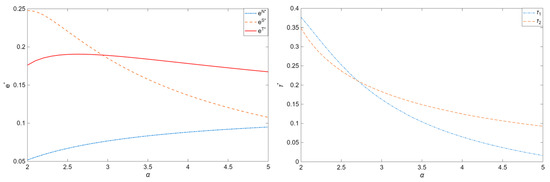
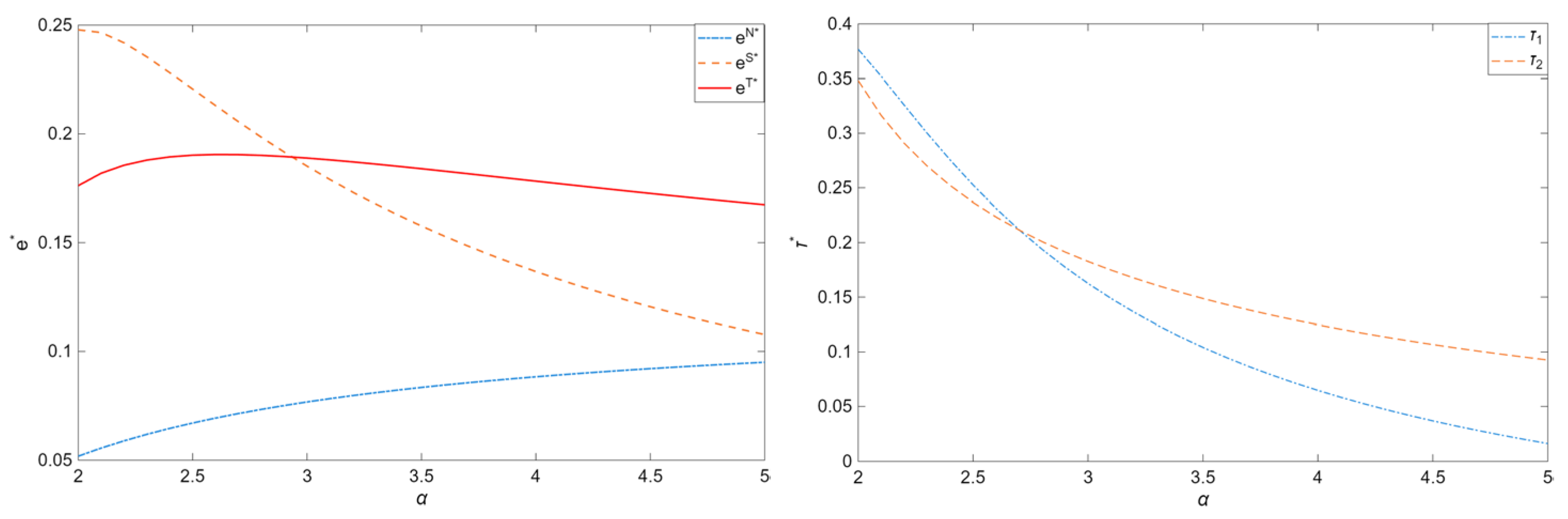
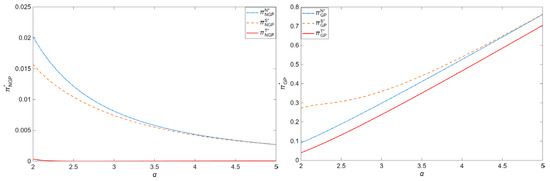
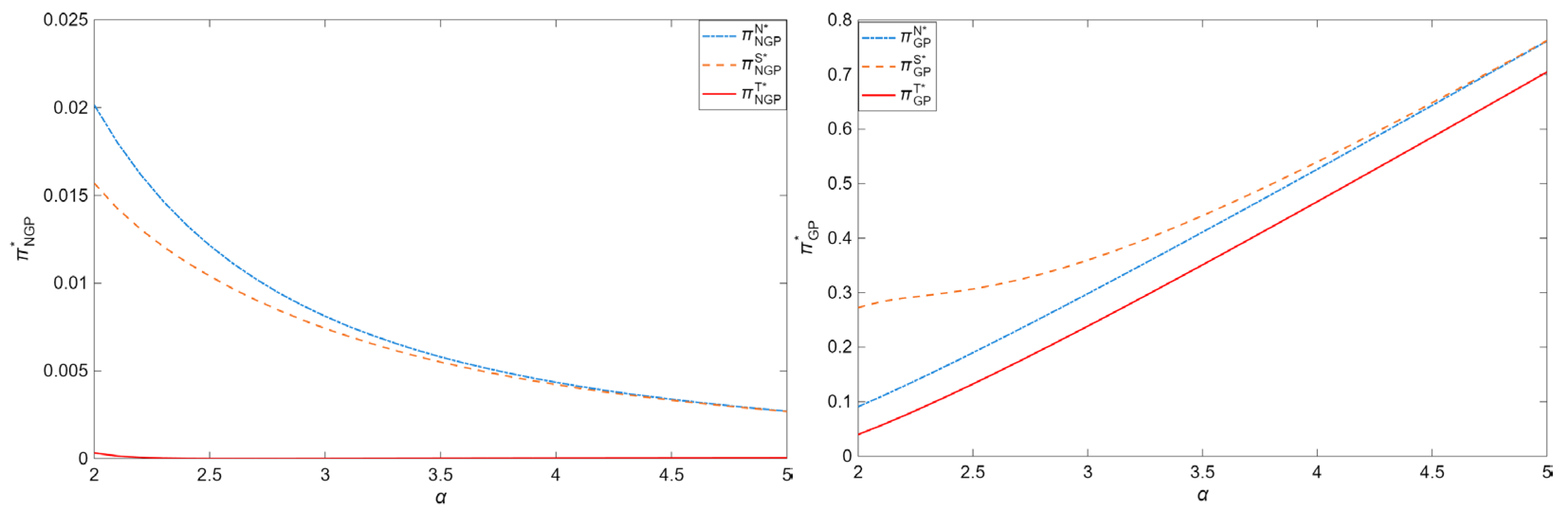
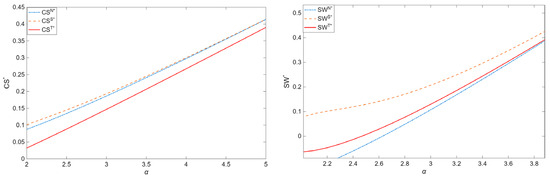
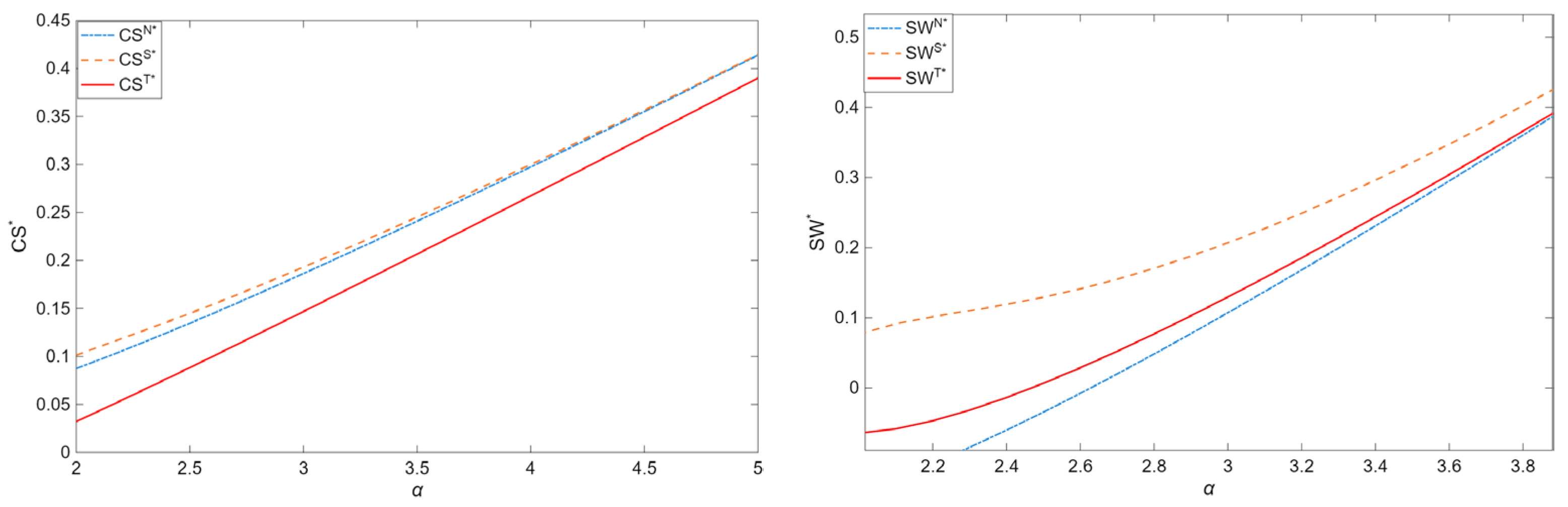

Disclaimer/Publisher’s Note: The statements, opinions and data contained in all publications are solely those of the individual author(s) and contributor(s) and not of MDPI and/or the editor(s). MDPI and/or the editor(s) disclaim responsibility for any injury to people or property resulting from any ideas, methods, instructions or products referred to in the content. |
© 2025 by the authors. Licensee MDPI, Basel, Switzerland. This article is an open access article distributed under the terms and conditions of the Creative Commons Attribution (CC BY) license (https://creativecommons.org/licenses/by/4.0/).