Article

Contracted Land Assets and Rural Labor Transfer: Unlocking the Potential for Sustainable Urbanization Through Total Income of Agricultural Products


1
School of Population and Health, Renmin University of China, Beijing 100872, China
2
College of Business, Shanghai University of Finance and Economics, Shanghai 200433, China
3
CIB Research Company Limited, Shanghai 200120, China
*
Author to whom correspondence should be addressed.
Sustainability 2025, 17(23), 10884; https://doi.org/10.3390/su172310884
Submission received: 21 August 2025 / Revised: 17 November 2025 / Accepted: 1 December 2025 / Published: 4 December 2025
(This article belongs to the Section Sustainable Agriculture)

Abstract

Rural labor transfer is crucial for China’s urbanization and agricultural modernization, yet the role of contracted land assets in this process remains underexplored. Understanding how land tenure arrangements affect labor mobility decisions has significant implications for rural development policy. This paper investigates the impact of rural contracted land assets on rural labor transfer and its underlying mechanisms, with particular attention to the moderated mediating effect of total income from agricultural products. Using data from the 2015 China Household Finance Survey (CHFS) and employing mediation and moderated mediation analyses, we examine rural households across China’s eastern, central, and western regions. The following conclusions are drawn: (1) Whether at the household or individual level, contracted land assets significantly reduce the transfer of rural labor, and this conclusion still holds true after robustness testing and overcoming endogeneity issues. (2) The impact of contracted land assets on rural households in the eastern region is greater than that on rural households in the central and western regions, and the impact on rural households closer to cities is greater than that on rural households far away from cities. (3) The area of contracted land transferred in and the total income of agricultural products play a mediating role, while whether the contracted land is transferred out and whether it is close to the city plays a moderating role. These findings offer important insights for developing countries, suggesting that facilitating land transfer mechanisms and improving agricultural income are essential for sustainable rural development and labor mobility.

1. Introduction

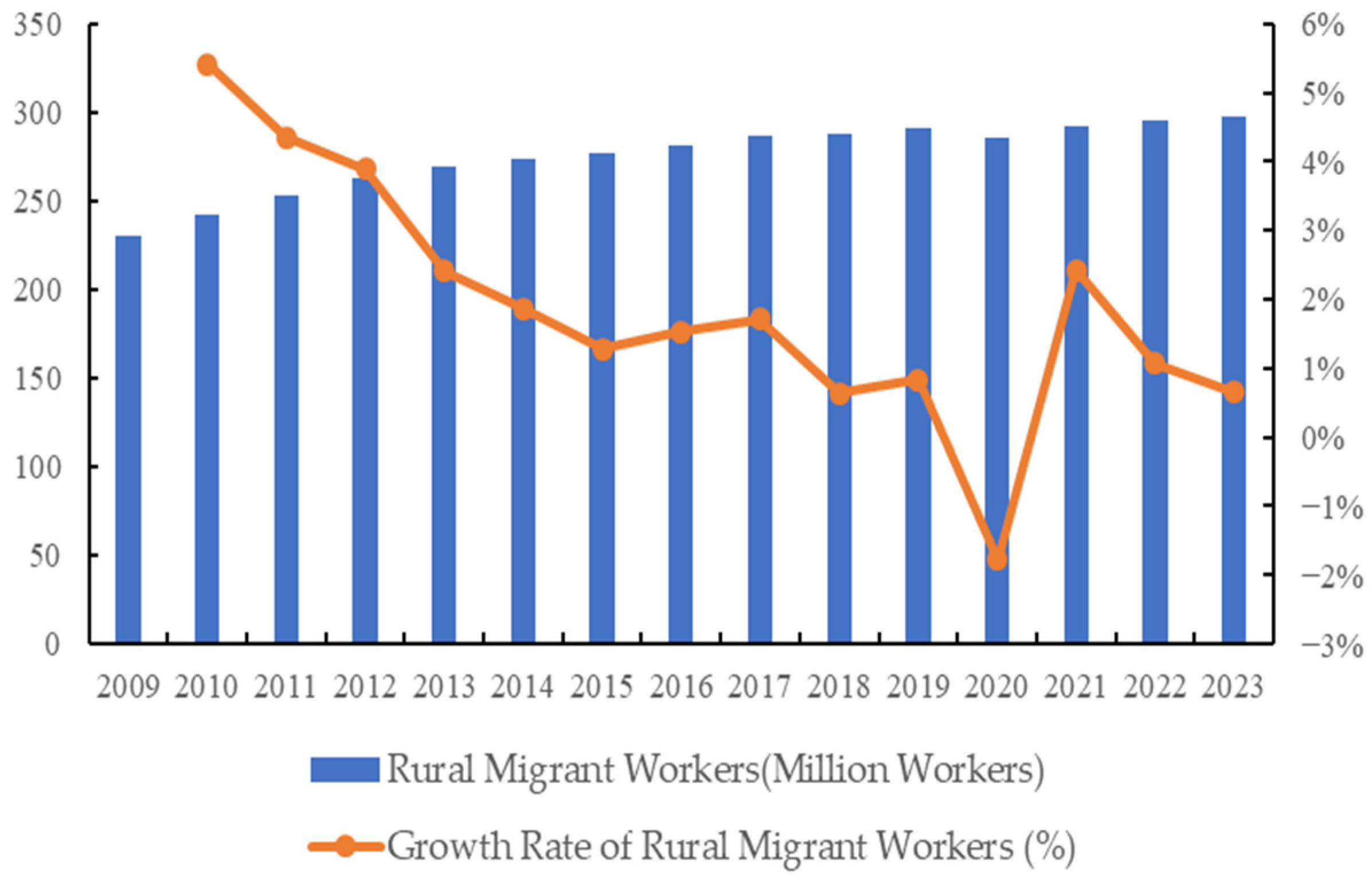
Since 1978, China has gradually relaxed restrictions on labor transfer through continuous economic reforms, enabling surplus rural labor to exit low-productivity agricultural sectors and migrate across urban-rural, regional, industrial, and sectoral boundaries into non-agricultural industries in urban and coastal areas, giving rise to a large-scale rural migrant labor group [1,2]. The number of rural migrant labor has long been a focal point of attention for government departments and the academic community [3,4]. The National Bureau of Statistics established a statistical monitoring and survey system for rural migrant workers at the end of 2008, and has published the “Rural Migrant Worker Monitoring and Survey Report” annually since 2009, using the number of rural migrant workers as a rough measure of the scale of rural migrant labor. Figure 1 shows the number of migrant workers published in the annual “Migrant Worker Monitoring and Survey Reports”. As shown in the figure, between 2009 and 2023, the number of rural migrant workers grew by nearly 68 million, averaging 4.8 million per year. Rural labor transfer has effectively reduced poverty in rural households [5,6], promoted land transfer and large-scale farming operations [7,8], helped narrow the urban-rural and regional gaps [9,10,11], optimised the allocation of labor resources, enhanced the multidimensional welfare of both urban and rural residents, ultimately contributing to the achievement of sustainable urbanization.
According to the classic push-pull theory [12,13], the factors influencing rural labor transfer stem from two sources: factors from the destination, i.e., urban areas, and factors from the origin, i.e., rural areas. Among rural factors, as the most primary rural land asset, contracted land plays a crucial role in rural labor transfer [14,15]. In the existing literature, research on the relationship between contracted land and rural labor transfer mainly focuses on four aspects: First, the relationship between contracted land transfer and rural labor transfer [16,17]. Most studies suggested that the higher the proportion of rural labor transfer, the higher the probability of households transferring out their contracted land, while the probability of transferring in contracted land decreased [18,19,20]. A small number of studies have found a threshold effect between the two [21]. Second, the relationship between contracted land rights confirmation and rural labor transfer. Most studies have found that confirmation of contracted land rights plays an important role in promoting labor market integration and rural labor transfer [22,23,24]. A small number of studies have found that confirmation of contracted land rights had no significant impact on labor transfer [25] or exhibited significant heterogeneity [26]. Third, the relationship between contracted land use and rural labor transfer. Existing research has primarily examined three dimensions: land use conversion, land use efficiency, and land use patterns. Zhong et al. found that labor transfer driven by different employment patterns had varying effects on the probability of land use conversion [27]. Luo et al. concluded that whether rural labor transfer could improve land use efficiency was related to topography [28]. Xie and Jiang found that 69.89% of migrant laborers chose to cultivate their contracted land themselves, 23.12% transferred their contracted land to others, and 6.99% abandoned their contracted land [29]. Fourth, the relationship between contracted land area and rural labor transfer. Some studies suggested that there was a significant linear relationship between the two [30,31,32]. However, other literature has found that the relationship between the two was non-linear, taking the form of a “U” [33] or inverted “U” shape [34]. Although the existing literature has discussed the relationship between contracted land and rural labor transfer in a relatively comprehensive and rich manner, most studies remain superficial and have not deeply analyzed how contracted land affects rural labor transfer. In particular, they have neglected the role of total agricultural product revenue as a key mediating variable, not to mention that total agricultural product revenue may also be subject to moderation by various factors.
However, this study not only examines the mediating role of total income from agricultural products in the impact of contracted land on rural labor transfer, filling the gap in the previous literature that overlooked this key mediating variable, but also fully utilizes a moderated mediation model to further analyze the moderating effects of factors such as whether the farmland is suitable for mechanized cultivation on total income from agricultural products, thereby addressing the gap in the previous literature that ignored the moderating effects on total income from agricultural products. In practice, this study provides practical experience for promoting rural labor transfer, optimising the allocation of labor resources, accelerating contracted land circulation, enhancing the multidimensional welfare of both urban and rural residents, and advancing sustainable urbanization. Therefore, based on a theoretical framework of the impact of rural contracted land on rural labor transfer, this study examines how rural contracted land assets affect labor transfer in China, with special attention to the mediating role of agricultural income and moderating role of land and regional characteristics. The following conclusions are drawn: (1) Whether at the household or individual level, contracted land assets significantly reduce the transfer of rural labor, and this conclusion still holds true after robustness testing and overcoming endogeneity issues. (2) The area of contracted land transferred in and the total income of agricultural products play a mediating role, while whether the contracted land is transferred out and whether it is close to the city play a moderating role. (3) The mediating effect of the total income of agricultural products is moderated by whether the cultivated land is suitable for mechanized farming, whether the cultivated land is fragmented, and the quality of the cultivated land.
Regarding the hypotheses, rural households with larger contracted land assets are more likely to obtain greater economic income through operating their rural contracted land assets, and consequently, the motivation for household labor to transfer becomes weaker. Therefore, we propose the first hypothesis: contracted land assets reduce rural labor transfer. Households with more contracted land assets may tend to transfer in contracted land, so that with more contracted land, they can engage in large-scale and intensive agricultural production activities to improve agricultural production efficiency and reduce agricultural production costs. In addition, households with more contracted land assets, particularly in mountainous and hilly areas where large-scale mechanized operations cannot be implemented, may tend to keep household labor in rural areas in order to obtain higher agricultural product income. Therefore, we propose the second hypothesis: contracted land assets may affect rural labor transfer through total income from agricultural products and contracted land transfer-in. Contracted land assets may influence rural labor transfer through mechanisms such as total income from agricultural products, but this influence may exhibit certain individual differences, that is, the magnitude of the mediating effect may vary across different individuals. Existing literature indicates that factors such as the degree of agricultural mechanization, land fragmentation, and land quality have significant impacts on farmers’ total income from agricultural products, which in turn affects rural labor transfer [35]. Therefore, this paper proposes the third hypothesis: the mediating effect of total income from agricultural products is moderated by whether the cultivated land is suitable for mechanized farming, land fragmentation, and land quality.

2. Theoretical Framework

2.1. Conceptual Definition of Rural Contracted Land Assets and Rural Labor Transfer

Regarding the definition of rural labor, this paper follows the approach adopted in existing literature [36], defining individuals with an agricultural household registration who are employed as rural labor. There are two dimensions to this definition: first, individuals with a non-agricultural household registration, a unified resident household registration, or other types of household registration are not included; second, individuals who are unemployed, such as the elderly and children, or those who have withdrawn from the labor market for various reasons are also excluded. Regarding the concept of rural labor transfer, this paper draws on existing literature [37] and the data used to argue that rural labor transfer primarily manifests as the shift of rural labor employment from the agricultural sector to the non-agricultural sector, regardless of whether this non-agricultural sector is located in rural or urban areas. In summary, this paper defines the concept of rural labor transfer as individuals with an agricultural household registration who are employed and work in the non-agricultural sector.
To conduct in-depth research on rural contracted land assets, it is necessary to clarify the conceptual scope of rural contracted land assets. The Civil Code of the People’s Republic of China granted farmers three important rights: “land contracting and operating rights, homestead use rights, collective income distribution rights”. Among these, the rural land assets corresponding to “land contracting and operating rights” were referred to as contracted land assets. Existing research also held that farmers’ property rights primarily included rights such as land contracting and operating rights [38,39]. Additionally, the reason why the contracted land owned by farmers is referred to as “assets” is that after obtaining land contracting and operating rights, farmers can either operate the contracted land themselves to generate income or transfer the contracted land to others to generate income. Regardless of the method chosen, it can bring economic benefits to farmers. Therefore, this paper defines the concept of rural contracted land assets as land contracting and operating rights controlled or owned by farmers, which are expected to bring economic benefits to farmers, primarily manifested in land resources such as arable land, forestland, and grassland that farmers contract and operate.

2.2. Theoretical Framework for the Impact of Rural Contracted Land Assets on Rural Labor Transfer and Its Mechanism

According to the resolution of the Third Plenary Session of the 18th Central Committee, farmers have the rights to occupy, use, derive income from, and transfer their contracted land, and the right to mortgage, pledge, and contribute their contracted land use rights as equity. Therefore, farmers’ contracted land may have two effects on the transfer of rural labor: it may either promote or inhibit the transfer of rural labor. In fact, whether it enhances or hinders the transfer of rural labor depends on how farmers manage their contracted land and the resulting net income. On the one hand, farmers’ contracted land may promote the transfer of rural labor. This is because farmers can obtain income by transferring their land to other farmers, or by contributing their operating rights of contracted land as equity in agricultural companies. The income generated from contracted land can provide rural labor with some money to cover the necessary transportation and urban living expenses for transfer. Related literature studies also indicate that land transfers directly or indirectly promote the transfer of rural labor [40]. On the other hand, farmers’ contracted land may hinder the transfer of rural labor. This is because if farmers choose to operate their contracted land themselves, especially in mountainous or hilly areas unsuitable for large-scale agricultural mechanisation, they need to put more labor in operating the contracted land, which hinders the transfer of rural labor. Additionally, if farmers have a large area of contracted land or if the economic returns from managing the land are high, this may encourage farmers to put more labor in agricultural production, further hindering the transfer of rural labor. Existing literature has also found that the higher the land endowment, the less likely the rural labor is to transfer [30].
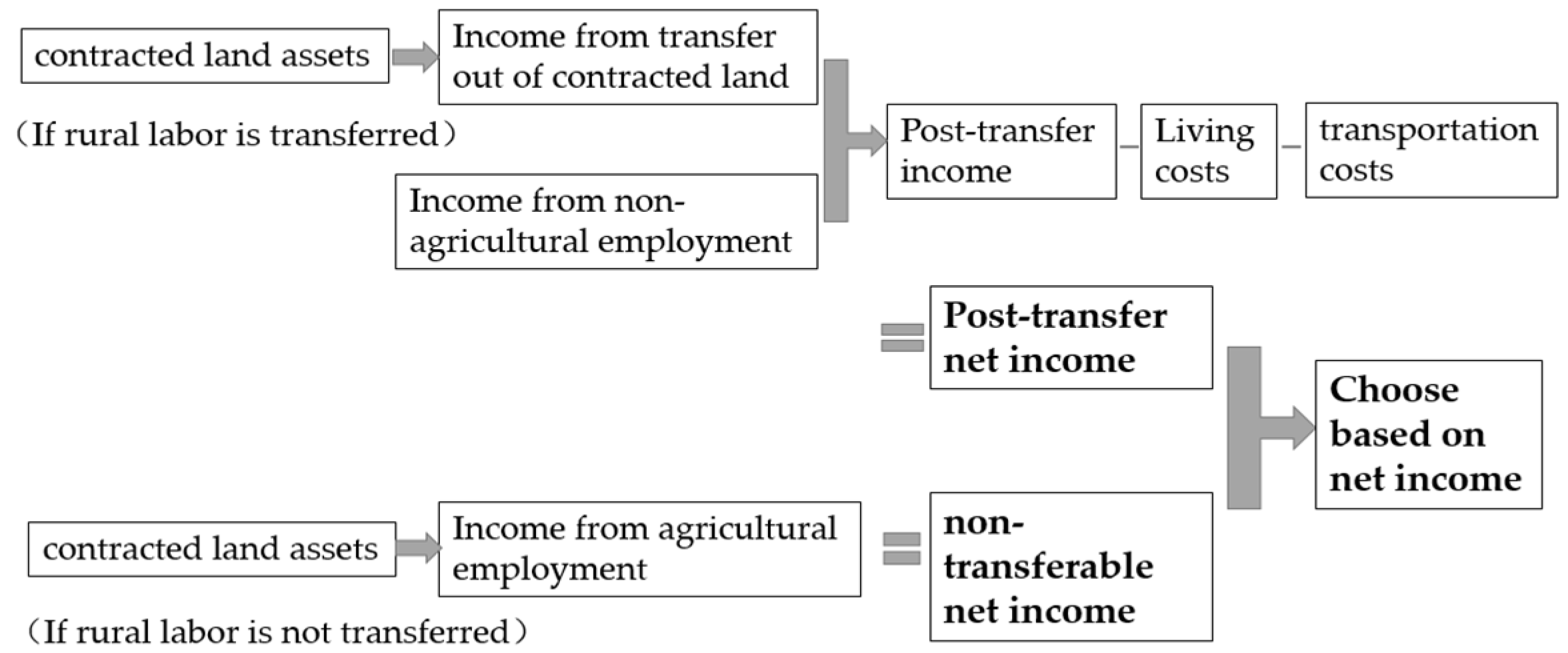
After clarifying the positive and negative impacts of contracted land assets on rural labor transfer, we can further explore the mechanisms underlying rural labor transfer. Numerous studies have pointed out that the primary motivation for rural labor transfer is to achieve higher income [41,42]. Therefore, when a rural household makes a decision regarding whether to migrate or not, the primary consideration is the comparison between the net income before transfer and the net income after transfer. On the one hand, if a rural labor does not migrate and instead engages in agricultural production locally, his primary source of income is through operating contracted land, such as growing crops or raising livestock. Furthermore, the amount of income a household earns from operating contracted land is significantly influenced by the quantity and quality of the contracted land. The more contracted land a household has, the more rural labor is required to manage it, and the higher the income from managing the contracted land, which reduces the likelihood of transferring rural labor. Additionally, the better the quality of the contracted land—for example, if it is relatively flat, less fragmented, and has a flat terrain and fertile soil—the lower the agricultural production costs and the higher the income from managing the contracted land. The higher the income generated from operating contracted land, the lower the likelihood of rural labor transfer within the household. On the other hand, if rural labor transfers to work in non-agricultural sectors, they have two sources of income: wage income or operational income from non-agricultural sectors, and property income from transferring idle contracted land at home. The former far exceeds the latter in quantity. It is important to note that rural labor entering urban areas for employment must bear certain living and transportation costs. Therefore, the net income of rural labor transfer is calculated by subtracting these costs from their total post-transfer income. In summary, when a rural household makes a decision on whether to transfer a labor force, they compare the net income of the rural labor force before transfer with the net income after transfer. If the former is higher than the latter, they choose not to transfer; if the latter is higher than the former, they choose to transfer. This is the theoretical framework for the impact of rural contracted land assets on the transfer of rural labor and its mechanism, as shown in Figure 2.

3. Research Design

3.1. Data Sources

The data sources used in this paper are primarily twofold: first, the China Household Finance Survey (CHFS) data. Since 2011, the CHFS has conducted surveys every two years, with the latest data available for external application being from 2019. This paper uses the 2015 CHFS data. The reason for not using the 2017–2019 data is that the 2017–2019 CHFS data lacks systematic questions regarding rural land issues, such as rural contracted land, making it impossible to accurately measure the area of contracted land assets. Secondly, data from the “China Statistical Yearbook 2015” is used, including provincial-level per capita GDP, the proportion of secondary industry output, the proportion of tertiary industry output, the number of employed individuals in private enterprises and individual businesses, and the average wage of employed personnel in urban private units. These regional macroeconomic variables are incorporated into the model as control variables to better identify the impact of rural contracted land assets on the transfer of rural labor. In terms of statistical software used, this paper utilises Stata 15.1 for econometric analysis.

3.2. Variable Description

3.2.1. Selection and Measurement of Dependent Variables

The dependent variable in this paper is rural labor transfer, so we will measure rural labor transfer from two dimensions: the individual level and the household level. At the individual level, we select observations with an agricultural household registration and employment as the sample of rural labor, and then determine whether this rural labor has migrated based on whether the nature of the work is farming. At the individual level, this paper defines rural labor transfer as a binary dummy variable. When respondent does not choose farming, it is assigned a value of 1, indicating that rural labor has migrated. When respondent chooses farming, it is assigned a value of 0, indicating that rural labor has not migrated. At the household level, this paper uses the proportion of rural labor engaged in non-agricultural employment within a household to indicate the degree of rural labor transfer, which is also the common practice in existing literature [37,43]. The specific method involves first selecting the rural labor sample and then matching it to the corresponding household. Next, the number of rural labor engaged in non-agricultural employment in each household and the total number of rural labor in each household are calculated. The ratio of the former to the latter represents the household’s rural labor non-agricultural employment ratio, with a higher ratio indicating a higher degree of rural labor transfer. Since urban household may also include labor with rural household registrations, the final step involves screening out rural household samples at the household level.

3.2.2. Selection of Independent Variables

The independent variable in this paper is rural contracted land assets, so the area of contracted land is used to represent the corresponding contracted land assets of rural households. This paper adds up the areas of arable land, forest land, grassland, orchard land, and other types of land owned by rural households to obtain the total area of rural households’ contracted land, which is used as a proxy variable for rural households’ contracted land assets.

3.2.3. Selection of Control Variables

Demographic factors, family factors, and regional factors are all important determinants influencing the transfer of rural labor. Therefore, to minimise estimation bias, this paper controls for these factors. In terms of demographic factors, this paper controls for gender, age, educational attainment, marital status, and political affiliation. Regarding family factors, this paper controls for the dependency ratio, the ratio of healthy individuals, the proportion of individuals with pension insurance, and per capita household income. In terms of regional factors, this study includes per capita GDP, the proportion of secondary industry output, the proportion of tertiary industry output, the number of employed individuals in private enterprises and self-employed individuals, the average wage of employed individuals in urban private units, and the region of residence as control variables in the model. In terms of region of residence, rural households are divided into eastern, central, and western regions, with the western region serving as the reference group.

3.2.4. Explanation of Mediating Variables and Moderating Variables

Existing theoretical foundations suggest that contracted land assets may influence the transfer of rural labor through mechanisms such as land transfer and total agricultural product revenues. Additionally, the relationship between contracted land assets and rural labor transfer is influenced by factors such as land transfer and land location. The impact of contracted land assets on rural labor transfer may exhibit distinct characteristics depending on these factors, with these variables playing a moderating role. Furthermore, as mentioned earlier, contracted land assets may influence the transfer of rural labor through land inflows and total agricultural income, but it cannot be denied that such influence may exhibit individual differences, meaning that the mediating effects may vary among different individuals. The existing literature indicates that factors such as agricultural mechanization levels [44,45], land fragmentation [46,47,48], and land quality [49,50] significantly impact farmers’ agricultural income, thereby influencing the transfer of rural labor. In summary, this paper selects the area of contracted land transferred in and total agricultural product revenues as mediating variables for the impact of contracted land assets on rural labor transfer. Whether contracted land is transferred out and whether it is close to the city are used as moderating variables for the independent variable. Whether arable land is suitable for mechanical cultivation, land fragmentation, and land quality are used as moderating variables for total agricultural product revenues.

3.3. Model Setting

(1) Linear regression model. The specific model is as follows:
n o n f a r m _ r a t i o = α 0 + α 1 × l n c o n t r a c t e d _ l a n d + i = 2 n α i × X i + ε i
Among them, n o n f a r m _ r a t i o is the proportion of rural labor non-agricultural employment of the family, which is the explained variable; l n c o n t r a c t e d _ l a n d is the number of contracted land assets at the household level and is the core explanatory variable. In order to eliminate heteroscedasticity, the core explanatory variable is treated as logarithms. X i represents other control variables, α i is the correlation coefficient of other control variables, α i is the intercept term, and ε i is the random error term.
(2) Binary selection model. At the individual level, the explained variable rural labor transfer is a binary discrete variable. At the same time, the number of rural contracted land assets at the individual level is obtained by dividing the total contracted land assets at the household level by the total number of rural labor, so the core explanatory variable is a continuous variable. Such variable characteristics are suitable for binary selection model. The available models include probit model, logit model and LPM model. Here, probit model is taken as an example:
Pr t r a n s _ l a b o r = 1 = Φ ( γ 0 + γ 1 × l n c o n t r a c t e d _ l a n d + i = 2 n γ i × X i + η i )
Among them, t r a n s _ l a b o r is the binary dummy variable of whether the rural labor has been transferred, t r a n s _ l a b o r = 1 indicates that the rural labor has been transferred, and t r a n s _ l a b o r = 0 represents that the rural labor has not been transferred.   l n c o n t r a c t e d _ l a n d is the number of contracted land assets at the individual level, and γ 1 is the influence coefficient of contracted land assets on the transfer of rural labor.
(3) Instrumental variable model. In order to solve the endogenous problem that may exist in model (1), the common practice is to find the instrumental variable of contracted land assets, and use the instrumental variable method to carry out two-stage regression estimation, so as to obtain unbiased and consistent estimation results. The specific model is as follows:
l n c o n t r a c t e d _ l a n d i = ε 0 + ε 1 × Z i + i = 2 n ε i × X i + θ i
n o n f a r m _ r a t i o = δ 0 + δ 1 × l n c o n t r a c t e d _ l a n d i + i = 2 n δ i ^ × Y i + φ i
In model (3), l n c o n t r a c t e d _ l a n d i is the logarithm of the number of contracted land assets of the farmer, and Z i is the instrumental variable. The two-stage regression method is as follows: first, model (3) is regressed to obtain the fitted value l n c o n t r a c t e d _ l a n d ^ i of l n c o n t r a c t e d _ l a n d i , and then l n c o n t r a c t e d _ l a n d ^ i is substituted into model (4) to obtain unbiased and consistent regression results.
(4) Moderated mediating effect model. Following the approach of Fang et al. [51], We consider the influence of the independent variable X on the dependent variable Y , W is the mediating variable, and U is the moderating variable. The specific steps are as follows: (1) make the regression model of Y to X and U to judge whether the coefficient of X is significant; (2) Make the regression model of W to X and U to judge whether the coefficient of X is significant; (3) Make the regression model of Y to X , W and U to judge whether the coefficient of W is significant; (4) Make the regression model of Y to X , W , U and U W to judge whether the coefficient of U W is significant. If the coefficients of the above four steps are significant, it means that the moderated mediating effect is significant.

4. Empirical Analysis

4.1. Descriptive Statistical Results

Table 1 presents the descriptive statistics for dependent variable, independent variable and control variables in the 2015 CHFS data. Regarding the dependent variable, the proportion of rural labor engaged in non-agricultural employment at the household level is 0.43, indicating that nearly half of the rural labor in each rural household have transitioned to non-agricultural employment. Regarding the independent variable, the mean value of rural contracted land assets is 11.41 mu (0.76 ha), with the highest mean value for arable land area, followed by forest land area, while grassland, orchard land, and other agricultural land areas are relatively smaller. The descriptive statistics for other control variables are shown in Table 1.
Table 2 presents the descriptive statistics for mediating variables and moderating variables in the 2015 CHFS data. It should be noted that moderating variables fall into two categories: those moderating the independent variable, and those moderating the mediating variable.

4.2. Basic Analysis of the Impact of Contracted Land Assets on the Rural Labor Transfer

Table 3 presents the results of the impact of rural household contracted land assets on the transfer of rural labor, where the degree of rural labor transfer is measured by the proportion of rural household labor engaged in non-agricultural employment. Control variables for demographic characteristics, household characteristics, and regional characteristics are added in model (1), (2), and (3), respectively. Regardless of which model is used, contracted land assets significantly reduce the transfer of rural labor. When all control variables are included in the model, for every 1% increase in rural household contracted land assets, the average non-agricultural employment ratio of rural labor in households decreases significantly by 0.11 units. There are two possible reasons for this: first, rural households with more contracted land assets require more rural labor to operate these assets, especially in mountainous or hilly areas where large-scale mechanised operations are not feasible, thus reducing the transfer of rural labor; second, rural households with more contracted land assets are more likely to generate higher income through operating these assets, thereby weakening the household’s motivation to transfer labor. In terms of control variables, nearly all the control variables have a significant impact on the proportion of rural households engaged in non-agricultural employment, which generally aligns with expectations.

4.3. Robustness Test of the Impact of Contracted Land Assets on Rural Labor Transfer

4.3.1. Robustness Test at the Individual Level

Table 4 shows the impact of per capita contracted land assets at the individual level on rural labor transfer, which can serve as a robustness test for the impact of contracted land assets at the household level on the proportion of non-agricultural employment in households. As shown in Table 4, regardless of whether the Probit model, Logit model, or LPM model is used, per capita contracted land assets at the individual level significantly reduce the probability of rural labor transfer. This conclusion is consistent with the finding that contracted land assets at the household level significantly reduce the non-agricultural employment ratio of rural households, indicating that the conclusion is robust. Specifically, in the Probit model, a 1% increase in per capita contracted land assets significantly reduces the probability of transfer by 8.7%; in the Logit model, a 1% increase in per capita contracted land assets significantly reduces the probability of transfer by 9%; and in the LPM model, a 1% increase in per capita contracted land assets significantly reduces the probability of transfer by 9.3%. The coefficients of the three models have the same sign and similar values, further indicating that the result showing a significant reduction in the non-agricultural employment ratio of households due to household contracted land assets is robust. The results of other control variables in the three models at the individual level are also generally consistent with those at the household level.

4.3.2. Robustness Test Using Data from 2020 to 2022

Table 5 presents the impact of contracted land assets on rural labor transfer using China Family Panel Survey (CFPS) data from 2020 to 2022, which can serve as a robustness test for the impact of contracted land assets on rural labor transfer using data from 2015. As shown in Table 5, whether using 2020 data, 2022 data, or the combined data from 2020 and 2022, contracted land assets still significantly reduce the transfer of rural labor. Specifically, the coefficients for the impact of farmers’ contracted land assets on rural labor transfer are −0.052 (p < 0.01), −0.054 (p < 0.01) and −0.053 (p < 0.01), respectively. The direction, significance, and effect size of these coefficients remain consistent with the findings from the 2015 data. This indicates that the causal relationship revealed in this study exhibits strong temporal stability and is not confined to the specific period of 2015.

4.4. Heterogeneous Analysis of the Impact of Contracted Land Assets on the Transfer of Rural Labor

4.4.1. Analysis of Regional Heterogeneity

Table 6 presents the regional heterogeneity results of the impact of contracted land assets on the transfer of rural labor at the household and individual levels. As shown in Table 6, regardless of whether at the household or individual level, contracted land assets significantly reduce the transfer of rural labor across all regions—eastern, central, and western. Specifically, at the household level, a 1% increase in contracted land assets, the non-agricultural employment ratio of households in the eastern region decreases significantly by 0.122 units, the non-agricultural employment ratio of households in the central region decreases significantly by 0.086 units, and the non-agricultural employment ratio of households in the western region decreases significantly by 0.095 units. The impact of changes in contracted land assets on households is greatest in the eastern region, followed by the western region, and least in the central region. At the individual level, for every 1% increase in per capita contracted land assets among rural labor, the probability of labor transfer in eastern regions decreases significantly by 9.8%, the probability of rural labor transfer in central regions decreases significantly by 6.5%, and the probability of rural labor transfer in western regions decreases significantly by 7.4%. Similar to the conclusions at the household level, changes in per capita contracted land assets at the individual level have the greatest impact on the probability of rural labor transfer in eastern regions, followed by western regions, with the smallest impact on central regions.

4.4.2. Heterogeneity Analysis Based on Distance from Cities

Table 7 presents the heterogeneous results of the impact of contracted land assets on the transfer of rural labor at the household and individual levels, depending on the distance from the city. As shown in Table 7, regardless of whether it is at the household or individual level, and regardless of whether the households are close to or far from the city, contracted land assets significantly reduce the transfer of rural labor. Specifically, at the household level, a 1% increase in contracted land assets results in a significant decrease of 0.086 units in the non-agricultural employment ratio for rural households near cities, while a significant decrease of 0.06 units for rural households far from cities. The impact of changes in contracted land assets on rural households near cities is greater than that on rural households far from cities at the household level. At the individual level, for every 1% increase in per capita contracted land assets, the probability of rural labor transfer decreases significantly by 7% for rural households near cities and by 5% for those far from cities. Similar to the findings at the household level, changes in per capita contracted land assets have a greater impact on rural labor transfer for those near cities than for those far from cities.

4.5. Addressing the Endogeneity Issue of the Impact of Contracted Land Assets on Rural Labor Transfer

To address potential endogeneity issues, this paper combines the data characteristics of CHFS with practices from existing literature, adopting the “mean value of the logarithm of contracted land assets of other sample farmers in the community, excluding the sample farmer’s own household” as the instrumental variable for the sample farmer’s contracted land asset status. Table 8 presents the instrumental variable regression results for the impact of contracted land assets on rural labor transfer, using a two-stage least squares method. It can be seen from the table that in the first-stage regression results, the coefficient of the mean value of contracted land assets excluding the sample farmer’s own within the community is positive and significant at the 1% level, indicating a high correlation with the sample farmer’s own contracted land asset status. Meanwhile, the F-value of the first-stage regression is 391.89, significantly higher than the critical value of 16.38 at the 10% level [52], indicating that the selection of instrumental variables is reasonable and there is no issue of weak instrumental variables. According to the Wald test, the p-value is significant at the 1% level, implying the presence of endogeneity issues, thus justifying the use of instrumental variable methods for correction. From the second-stage results, the coefficient of contracted land assets remains negative and significant at the 1% level, indicating that after addressing potential endogeneity issues, contracted land assets still significantly inhibit rural labor transfer. The vaule and significance of the regression coefficients for other control variables are basically consistent with the baseline regression.

5. Further Analysis

5.1. Mediating Effect Analysis

5.1.1. Analysis of the Mediating Effect of the Transfer in of Contracted Land Area

Table 9 presents the results of the mediation effect test for the transfer in of contracted land area. As can be seen from the table, rural households’ contracted land assets have a significant impact on the transfer of rural labor. At the same time, the amount of contracted land assets held by rural households has a significant impact on the transfer in of contracted land area. Furthermore, when both rural households’ contracted land assets and the inflow area of contracted land are included in the model, it can be observed that both have a significant impact on the transfer of rural labor. Therefore, it can be concluded that the inflow area of contracted land plays a partial mediating role in the impact of rural household’s contracted land assets on the transfer of rural labor.

5.1.2. Analysis of the Mediating Effect of Total Income of Agricultural Products

Table 10 presents the results of the mediating effect test for total income of agricultural products. As shown in the table, rural households’ contracted land assets have a significant impact on the transfer of rural labor. At the same time, contracted land assets have a significant impact on total income of agricultural products. Furthermore, when both contracted land assets and total income of agricultural products are included in the model, it can be observed that both have a significant impact on rural labor transfer. Therefore, it can be concluded that total income of agricultural products plays a partial mediating role in the impact of contracted land assets on rural labor transfer.

5.1.3. Analysis of the Mediating Effect of Income from Transfer out of Contracted Land

Table 11 presents the results of the mediation effect test for income from transfer out of contracted land. As can be seen from the table, rural households’ contracted land assets have a significant impact on the transfer of rural labor. At the same time, the amount of contracted land assets held by rural households has a significant impact on the income from transfer out of contracted land. Furthermore, when both rural households’ contracted land assets and the income from transfer out of contracted land are included in the model, it can be observed that both have a significant impact on the transfer of rural labor. Therefore, it can be concluded that the income from transfer out of contracted land plays a partial mediating role in the impact of rural household’s contracted land assets on the transfer of rural labor.

5.1.4. Analysis of the Mediating Effect of Income from Non-Agricultural Employment

Table 12 presents the results of the mediation effect test for income from non-agricultural employment. As shown in the table, rural households’ contracted land assets have a significant impact on the transfer of rural labor. At the same time, the amount of contracted land assets held by rural households has a significant impact on the income from non-agricultural employment. Furthermore, when both rural households’ contracted land assets and the income from non-agricultural employment are included in the model, it can be observed that both have a significant impact on the transfer of rural labor. Therefore, it can be concluded that income from non-agricultural employment plays a partial mediating role in the impact of rural household’s contracted land assets on the transfer of rural labor.

5.2. Moderating Effect Analysis

5.2.1. Moderating Effects of Whether Contracted Land Is Transferred out

Table 13 presents the results of the moderating effect of whether contracted land has been transferred out. As shown in Model (2) in the table, the coefficient of the interaction term between contracted land assets and transfer out of contracted land is significant at the 10% level. Therefore, the impact of contracted land assets on rural labor transfer is moderated by whether contracted land has been transferred out. Specifically, in terms of the direction of moderation, whether in Model (1) or Model (2), contracted land assets significantly reduce rural labor transfer. However, the coefficient of the interaction term between contracted land assets and the transfer out of contracted land is positive. Therefore, it can be said that the transfer out of contracted land plays a positive moderating role in the negative impact of contracted land assets on rural labor transfer, meaning that the transfer out of contracted land assets effectively suppresses the reducing effect of contracted land assets on the transfer of rural labor.

5.2.2. The Moderating Effect of Whether the Contracted Land Is Close to the City

Table 14 presents the results of the moderating effect of whether contracted land is located near the city. As shown in Model (2) in the table, the coefficient of the interaction term between contracted land assets and whether contracted land is located near the city is significant at the 5% level. Therefore, it can be concluded that the impact of contracted land assets on rural labor transfer is moderated by whether contracted land is located near the city. Specifically, in terms of the direction of moderation, whether it is Model (1) or Model (2), contracted land assets significantly reduce rural labor transfer. Additionally, the coefficient of the interaction term between contracted land assets and whether contracted land is near the city is negative. Therefore, it can be concluded that proximity to a city plays a negative moderating role in the negative impact of contracted land assets on rural labor transfer, meaning that compared to rural households far from cities, the impact of contracted land assets on rural labor transfer is more significantly reduced in rural households near cities.

5.3. Moderated Mediation Analysis

5.3.1. Suitability for Mechanical Farming

Table 15 presents the moderated mediation effect results for the suitability of mechanical farming. It can be seen from the table that in Model (1), contracted land assets have a significant reducing effect on the transfer of rural labor; in Model (2), contracted land assets significantly increase the total income of agricultural products; in Model (3), the total income of agricultural products significantly reduces the transfer of rural labor. The above three models further verify that the total income of agricultural products plays a mediating role in the impact of contracted land assets on rural labor transfer. After incorporating the interaction term between the suitability of mechanical farming and the total income of agricultural products into the model, it was found that the coefficient of this variable is still significant at the 5% level, indicating that the mediating effect of the total income of agricultural products is indeed influenced by whether the farmland is suitable for mechanical farming, and the moderated mediation effect is significant. The sign of the interaction term coefficient is significantly positive, indicating that relative to farmers whose own farmland is not suitable for mechanical farming, the suitability of the farmer’s farmland for mechanical farming plays a positive moderating role in the mediating effect of the total income of agricultural products, that is, the suitability of farmland for mechanical farming mitigates the inhibitory effect of the total income of agricultural products on rural labor transfer.

5.3.2. Whether the Farmland Is Fragmented

Table 16 presents the results of the moderated mediation effect of whether farmland is fragmented. Similar to the results in Table 10, models (1), (2), and (3) in Table 12 further verify that the total income of agricultural products plays a mediating role in the impact of contracted land assets on rural labor transfer. After incorporating the interaction term between whether farmland is fragmented and the total income of agricultural products into the model, it was found that the coefficient of this variable remains significant at the 5% level, indicating that the mediating effect of the total income of agricultural products is indeed influenced by whether farmland is fragmented, and the moderated mediation effect is significant. The sign of the interaction term coefficient is significantly negative, indicating that relative to farmers with fragmented farmland, farmers with relatively intact farmland play a negative moderating role in the mediating effect of the total income of agricultural products, that is, having relatively intact farmland amplifies the inhibitory effect of the total income of agricultural products on rural labor transfer.

5.3.3. Quality of Arable Land

Table 17 shows the results of the moderated mediation effect of arable land quality. Similar to the results in Table 10, model (1), model (2) and model (3) in Table 13 further verify that the total income of agricultural products plays a mediating role in the impact of contracted land assets on the transfer of rural labor. After the interaction between the quality of arable land and the total income of agricultural products is incorporated into the model, it was found that the coefficient of this variable is still significant at the level of 5%, indicating that the mediating effect of the total income of agricultural products is indeed affected by the quality of cultivated land, and the moderated mediating effect is significant. The sign of the interaction coefficient is significantly negative, indicating that compared with farmers with lower quality of cultivated land, farmers with higher quality of cultivated land play a negative moderating role in the mediating effect of the total income of agricultural products, that is, farmers with higher quality of cultivated land expand the inhibitory effect of the total income of agricultural products on the transfer of rural labor.

6. Discussion

The transfer of rural labor has greatly increased the income of rural labor, promoted land transfer and large-scale operation of rural land, and is conducive to narrowing the gap between urban and rural areas, and ultimately achieving common prosperity. According to the classic push-pull theory, the factors that affect the transfer of rural labor come from the inflow area, that is, the urban side, and the outflow area, that is, the rural side. Among the rural side factors, as the most important rural land asset, contracted land has an important impact on the transfer of rural labor. However, the existing research on the relationship between contracted land and rural labor transfer mainly focuses on the relationship between contracted land transfer [18,19] and the relationship between contracted land ownership [22,24] and rural labor transfer. The research on the relationship between the scale of contracted land and rural labor transfer is relatively less, and the literature on the impact mechanism of contracted land scale on rural labor transfer is even more less. Based on the theoretical framework of the impact of rural contracted land assets on the transfer of rural labor, this paper uses the CHFS data in 2015, selects the cultivated land area, forest land area, grassland area, garden area and other agricultural land area of rural households, and calculates the total rural contracted land assets of rural labor by summation. It uses a variety of econometric models to quantitatively analyze the impact of rural contracted land assets on the transfer of rural labor and its mechanism, and draws the following main conclusions:
First, the average total contracted land asset of rural households is 11.41 mu (0.76 ha), which is significantly higher than the result of 5.39 mu (0.36 ha) in Chen et al. [34] and 4.66 mu (0.31 ha) in Xiao and Zhao [31]. The main reason for the difference is that the sample of this paper covers 29 provincial administrative units in China, while the sample of existing literature mainly includes eastern and central provinces. As China’s population is mainly distributed in the eastern and central plains, the average contracted land area of farmers in the western provinces is much higher than that in the eastern and central provinces, which leads to the result of this paper is significantly higher than that in the existing literature. From the perspective of contracted land types, the average area of cultivated land is 7.77 mu (0.52 ha), accounting for the highest proportion of all types of contracted land assets. The second is the forest land area, with an average of 2.64 mu (0.18 ha), accounting for 23.14% of the total contracted land area. The average area of grassland, garden land and other agricultural land is less than 0.5 mu (0.03 ha).
Second, whether at the household level or the individual level, contracted land assets significantly reduce the transfer ratio (probability) of rural labor, which is still true after passing the robustness test and overcoming the endogenous problem. Specifically, at the household level, for every 1% increase in contracted land assets of rural households, on average, the proportion of rural labor non-agricultural employment of households will significantly decrease by 0.11 units; At the individual level, taking probit model as an example, for every 1% increase in the per capita contracted land assets of rural labor, the probability of transfer will be significantly reduced by 0.6%. This result means that the number of contracted land and the proportion of rural labor transfer show a linear characteristic, which is consistent with the conclusions of Bhandari [30], Xiao and Zhao [31], Brewer et al. [32], but inconsistent with the non-linear conclusions of Vanwey [33], and Chen et al. [34].
Third, from the perspective of regional heterogeneity, for every 1% increase in contracted land assets, the proportion of non-agricultural employment of households in the eastern region will significantly decrease by 0.122 units, the proportion of non-agricultural employment of rural households in the central region will significantly decrease by 0.086 units, and the proportion of non-agricultural employment of rural households in the western region will significantly decrease by 0.095 units. At the household level, the change in contracted land assets has the greatest impact on households in the eastern region. The possible reason is that the eastern region is more developed compared to the central and western regions; therefore, the value of contracted land assets in the eastern region is higher, and rural households in the eastern region obtain greater benefits from operating contracted land. Consequently, when contracted land assets increase, the motivation for rural labor transfer in the eastern region will be significantly weakened. From the perspective of the heterogeneity of distance from the city, every 1% increase in contracted land assets will significantly reduce the proportion of non-agricultural employment of rural households close to the city by 0.086 units, and the proportion of non-agricultural employment of rural households away from the city will significantly decrease by 0.06 units. At the household level, the impact of changes in contracted land assets on rural households close to the city is greater than that on rural households away from the city. The heterogeneity analysis fully shows that the change in contracted land assets has a greater impact on the transfer of rural labor in areas with relatively superior geographical location. The possible reason is that in areas with relatively superior geographical location, the value of contracted land assets is higher, and the rural labor can obtain more benefits from operating contracted land, so when the contracted land assets increase, the driving force of rural labor transfer will be much weakened. Existing literature has also found significant regional heterogeneity in the relationship between rural land and rural labor transfer. For example, the heterogeneity analysis by Huang et al. indicates that the impact of labor transfer employment on land transfer-in is stronger for suburban farmers than for non-suburban farmers [16]. The study by Gao et al. demonstrates that the impact of the scale of labor transfer on rural land circulation exhibits different thresholds across different regions [21]. Luo et al. argue that rural labor transfer can improve land use efficiency in plain areas, but has no significant effect in hilly areas [28]. Zhang et al. found that labor transfer accelerated farmland circulation in plain areas, increased household contracted farmland area, and enhanced farmland production efficiency [53]; whereas in hilly areas, the decline in the quantity and quality of labor force led to serious land abandonment, large-scale farmland idleness, and reduced farmland production efficiency.
Fourth, in terms of the impact mechanism of contracted land assets on rural labor transfer, the area of contracted land transferred in and the total income of agricultural products play a mediating role, and whether the contracted land is transferred out and close to the city play a moderating role, that is, the transfer out of contracted land can effectively inhibit the reduction in contracted land assets on rural labor transfer; Compared with rural households far away from the city, the impact of contracted land assets on the transfer of rural labor has a greater reduction in rural households close to the city. Further, the mediating effect of the total income of agricultural products is moderated by factors such as whether the cultivated land is suitable for mechanized farming, whether the cultivated land is fragmented, and the quality of cultivated land. That is, the farmland suitable for mechanized farming reduces the inhibitory effect of the total income of agricultural products on the transfer of rural labor; Having relatively complete cultivated land expands the inhibitory effect of the total income of agricultural products on the transfer of rural labor; The higher quality of cultivated land expands the inhibitory effect of the total income of agricultural products on the transfer of rural labor. The possible reasons for these phenomena are as follows: farmland suitable for mechanized cultivation makes it possible to promote mechanized farming, thereby reducing the demand for rural labor in agriculture and enabling surplus rural labor to transfer to urban areas. Therefore, farmland suitable for mechanized cultivation can reduce the inhibitory effect of total income from agricultural products on rural labor transfer. On the other hand, when households possess relatively complete and high-quality contracted land, they can increase the total income from agricultural products obtained through operating contracted land, thereby reducing the motivation for rural labor transfer. Therefore, households possessing relatively complete and high-quality contracted land will expand the inhibitory effect of total income from agricultural products on rural labor transfer. By using the mediation effect model, the moderation effect model and the moderated mediation effect model, this study explores the impact mechanism of contracted land assets on rural labor transfer, and expands the current research framework of the impact of contracted land on rural labor transfer. It should be noted that the conclusions drawn in this paper are based on data from 2015, while the use of 2015 baseline data may introduce temporal lag issues. It is recommended that future research, upon obtaining the most recent data, further validate the applicability of this study’s conclusions within the current socio-economic context.

7. Conclusions

This article uses the CHFS data to analyze the impact and mechanism of rural contracted land assets on rural labor transfer, particularly considering the moderated mediating effect of total income of agricultural products. The following conclusions are drawn: (1) Whether at the household or individual level, contracted land assets significantly reduce the transfer of rural labor, and this conclusion still holds true after robustness testing and overcoming endogeneity issues. (2) The impact of contracted land assets on rural households in the eastern region is greater than that on rural households in the central and western regions, and the impact on rural households closer to cities is greater than that on rural households far away from cities. (3) The area of contracted land transferred in and the total income of agricultural products play a mediating role, while whether the contracted land is transferred out and whether it is close to the city play a moderating role. (4) The mediating effect of the total income of agricultural products is moderated by whether the cultivated land is suitable for mechanized farming, whether the cultivated land is fragmented, and the quality of the cultivated land. These findings offer important insights for promoting rural labor transfer, optimising the allocation of labor resources, accelerating contracted land circulation, enhancing the multidimensional welfare of both urban and rural residents, and advancing sustainable urbanization.
Rural contracted land assets can affect the transfer of rural labor through the transfer of contracted land. In addition, the transfer out of contracted land can effectively suppress the reducing effect of contracted land on the transfer of rural labor. Therefore, when establishing a sound system for the transfer of contracted land, the will of farmers should be fully respected. Whether to transfer land, how many lands to transfer, and how to transfer land should be decided independently by farmers. The government should establish and improve the land transfer market, use digital technology to establish a land transfer management service system, unify the release of land transfer information, standardize the land transfer process, provide standardized contracts and legal services, attract more ordinary farmers, large-scale grain growers, agricultural enterprises, and farmer professional cooperatives to participate in the land transfer process, so that land transferors and land transferees can freely inquire and trade.
In addition, in areas with relatively advantageous geographical locations, changes in contracted land assets have a greater impact on the transfer of rural labor. Therefore, in regions with relatively advantageous geographical locations, such as eastern regions and areas near cities, efforts should be made to vigorously develop suburban agriculture, agritourism, and ecological agriculture, fully leveraging geographical advantages to integrate agriculture with modern services. In central and western regions and areas distant from cities, land consolidation projects such as land levelling and farmland water conservancy projects should be carried out to consolidate parcels into larger units, improve land quality, and promote mechanized farming, thus allowing agricultural workers to achieve more returns. It should be noted that the policy recommendations in this paper are based on data from 2015, while the use of 2015 baseline data may introduce temporal lag issues. Consequently, the applicability of these policy recommendations requires comprehensive assessment in light of the latest trends in rural socio-economic development.
However, this paper has some limitations. Due to the availability and applicability of data, this article can only use cross-sectional data for research, which makes it impossible to analyze the time effect of the impact of contracted land assets on rural labor transfer by controlling for time trends. With the continuous deepening of large-scale micro investigations, it is believed that panel data can be provided for future research on related topics. In addition, land ownership registration is crucial for the transfer of contracted land, which in turn affects the transfer of rural labor. Future research should consider how the impact of contracted land on the transfer of rural labor will change under the institutional background of land ownership registration. Finally, the impact of contracted land on rural labor transfer may involve multiple mechanisms, while this study only examines one of these mechanisms. Future research could explore from other perspectives how contracted land affects rural labor transfer in greater depth.

Author Contributions

Conceptualization, Y.D.; Methodology, Y.D.; Software, Y.D.; Validation, C.Z.; Formal analysis, Y.D.; Investigation, C.Z.; Data curation, C.Z.; Writing—original draft, Y.D.; Writing—review & editing, C.Z.; Supervision, C.Z. All authors have read and agreed to the published version of the manuscript.

Funding

This research was funded by the Major Program of National Social Science Fund (Program Number: 21ZDA067), the Program of Shanghai Municipal Education Commission (Program Number: 2021-01-07-00-07-E00125).

Institutional Review Board Statement

Not applicable.

Informed Consent Statement

Not applicable.

Data Availability Statement

The original contributions presented in this study are included in the article. Further inquiries can be directed to the corresponding author.

Conflicts of Interest

Author Yuyang Deng is employed by CIB Research Company Limited. The remaining authors declare that the research was conducted in the absence of any commercial or financial relationships that could be construed as a potential conflict of interest.

References

  1. Freeman, R.B. People flows in globalization. J. Econ. Perspect. 2006, 20, 145–170. [Google Scholar] [CrossRef]
  2. Xu, D.; Deng, X.; Guo, S.; Liu, S. Labor migration and farmland abandonment in rural China: Empirical results and policy implications. J. Environ. Manag. 2019, 232, 738–750. [Google Scholar] [CrossRef]
  3. Liu, D.; Li, H.; Wang, W.; Zhou, C. Scenario forecast model of long term trends in rural labor transfer based on evolutionary games. J. Evol. Econ. 2015, 25, 649–670. [Google Scholar] [CrossRef]
  4. Wang, X.; Huang, J.; Zhang, L.; Rozelle, S. The rise of migration and the fall of self employment in rural China’s labor market. China Econ. Rev. 2011, 22, 573–584. [Google Scholar] [CrossRef]
  5. Sunam, R. In search of pathways out of poverty: Mapping the role of international labour migration, agriculture and rural labour. J. Agrar. Change 2017, 17, 67–80. [Google Scholar] [CrossRef]
  6. Jia, P.; Du, Y.; Wang, M. Rural labor migration and poverty reduction in China. China World Econ. 2017, 25, 45–64. [Google Scholar] [CrossRef]
  7. Xu, D.; Guo, S.; Xie, F.; Liu, S.; Cao, S. The impact of rural laborer migration and household structure on household land use arrangements in mountainous areas of Sichuan province, China. Habitat Int. 2017, 70, 72–80. [Google Scholar] [CrossRef]
  8. Xu, M.; Chen, C.; Xie, J. Off-farm employment, farmland transfer and agricultural investment behavior: A study of joint decision-making among north China plain farmers. J. Asian Econ. 2024, 95, 101839. [Google Scholar] [CrossRef]
  9. Yu, G.; Lu, Z. Rural credit input, labor transfer and urban–rural income gap: Evidence from China. China Agric. Econ. Rev. 2021, 13, 872–893. [Google Scholar] [CrossRef]
  10. Niebuhr, A.; Granato, N.; Haas, A.; Hamann, S. Does labour mobility reduce disparities between regional labour markets in Germany? Reg. Stud. 2012, 46, 841–858. [Google Scholar] [CrossRef]
  11. Wang, S.X.; Benjamin, F.Y. Labor mobility barriers and rural-urban migration in transitional China. China Econ. Rev. 2019, 53, 211–224. [Google Scholar] [CrossRef]
  12. Heberle, R. The causes of rural-urban migration a survey of German theories. Am. J. Sociol. 1938, 43, 932–950. [Google Scholar] [CrossRef]
  13. Hauser, P.M.; Duncan, O.D. The Study of Population: An Inventory and Appraisal; The University of Chicago Press: Chicago, IL, USA, 1959. [Google Scholar]
  14. Xingang, W. How can rural digital development activate agricultural land mobility?—Based on the dual perspectives of resource mismatch and labor mobility. Front. Environ. Sci. 2025, 13, 1645180. [Google Scholar]
  15. Lu, Y.; Zhuang, J.; Chen, J.; Yang, C.; Kong, M. The impact of farmland transfer on urban–rural integration: Causal inference based on double machine learning. Land 2025, 14, 148. [Google Scholar] [CrossRef]
  16. Huang, K.; Cao, S.; Qing, C.; Xu, D.; Liu, S. Does labour migration necessarily promote farmers’ land transfer-in?—Empirical evidence from China’s rural panel data. J. Rural. Stud. 2023, 97, 534–549. [Google Scholar] [CrossRef]
  17. Liu, Z.; Rodríguez, S.E. Research on the interaction mechanism between land system reform and rural population flow: Europe (taking Spain as an example) and China. Land 2024, 13, 1162. [Google Scholar] [CrossRef]
  18. Ji, X.; Qian, Z.; Zhang, L.; Zhang, T. Rural labor migration and households’ land rental behavior: Evidence from China. China World Econ. 2018, 26, 66–85. [Google Scholar] [CrossRef]
  19. Xu, D.; Yong, Z.; Deng, X.; Zhuang, L.; Qing, C. Rural-urban migration and its effect on land transfer in rural China. Land 2020, 9, 81. [Google Scholar] [CrossRef]
  20. Xu, D.-D.; Cao, S.; Wang, X.-X.; Liu, S.-Q. Influences of labor migration on rural household land transfer: A case study of Sichuan province, China. J. Mt. Sci. 2018, 15, 2055–2067. [Google Scholar] [CrossRef]
  21. Gao, J.; Song, G.; Sun, X. Does labor migration affect rural land transfer? Evidence from China. Land Use Policy 2020, 99, 105096. [Google Scholar] [CrossRef]
  22. Giles, J.; Mu, R. Village political economy, land tenure insecurity, and the rural to urban migration decision: Evidence from China. Am. J. Agric. Econ. 2018, 100, 521–544. [Google Scholar] [CrossRef]
  23. Xie, D.; Bai, C.; Yan, H.; Song, W. Legal land transfer rights, labor migration and urban–rural income disparity: Evidence from the implementation of China’s rural land contracting law in 2003. Growth Change 2022, 53, 1457–1482. [Google Scholar] [CrossRef]
  24. Huangfu, B.; Gao, X.; Shi, X.; Jin, S. Move out of the land: Certification and migration in China. Eur. Rev. Agric. Econ. 2024, 51, 927–966. [Google Scholar] [CrossRef]
  25. Li, J.; Zhang, C.; Mi, Y. Land titling and internal migration: Evidence from China. Land Use Policy 2021, 111, 105763. [Google Scholar] [CrossRef]
  26. Ma, X.; Heerink, N.; Shi, X. Land tenure insecurity and rural-urban migration in rural China. Pap. Reg. Sci. 2016, 95, 383–407. [Google Scholar] [CrossRef]
  27. Zhong, T.; Zhang, X.; Huang, X. Impact of labor transfer on agricultural land use conversion at rural household level based on logit model. Chin. Geogr. Sci. 2008, 18, 300–307. [Google Scholar] [CrossRef]
  28. Luo, X.; Zhang, Z.; Lu, X.; Zhang, L. Topographic heterogeneity, rural labour transfer and cultivated land use: An empirical study of plain and low-hill areas in China. Pap. Reg. Sci. 2019, 98, 2157–2179. [Google Scholar] [CrossRef]
  29. Xie, Y.; Jiang, Q. Land arrangements for rural–urban migrant workers in China: Findings from Jiangsu province. Land Use Policy 2016, 50, 262–267. [Google Scholar] [CrossRef]
  30. Bhandari, P. Relative deprivation and migration in an agricultural setting of Nepal. Popul. Environ. 2004, 25, 475–499. [Google Scholar] [CrossRef]
  31. Xiao, W.; Zhao, G. Agricultural land and rural-urban migration in China: A new pattern. Land Use Policy 2018, 74, 142–150. [Google Scholar] [CrossRef]
  32. Brewer, J.; Larsen, A.; Noack, F. The land use consequences of rural to urban migration. Am. J. Agric. Econ. 2024, 106, 177–205. [Google Scholar] [CrossRef]
  33. Vanwey, L.K. Land ownership as a determinant of temporary migration in Nang Rong, Thailand. Eur. J. Popul./Rev. Eur. Démographie 2003, 19, 121–145. [Google Scholar] [CrossRef]
  34. Chen, H.; Florkowski, W.J.; Liu, Z. Rural migrant workers in urban China: Does rural land still matter? Land 2025, 14, 901. [Google Scholar] [CrossRef]
  35. Rahman, S.; Rahman, M. Impact of land fragmentation and resource ownership on productivity and efficiency: The case of rice producers in Bangladesh. Land Use Policy 2009, 26, 95–103. [Google Scholar] [CrossRef]
  36. Cao, S.; Xu, D.; Liu, Y.; Liu, S. The impact of rural labor migration on elderly health from the perspective of gender structure: A case study in western China. Sustainability 2019, 11, 5763. [Google Scholar] [CrossRef]
  37. Qin, X.; Guan, Y. Does rural labor transfer contribute to the reduction in chemical fertilizer use? evidence from China’s household finance survey data in China. Agriculture 2024, 14, 1680. [Google Scholar] [CrossRef]
  38. Xu, J.; He, W.; Liu, Z.J.; Zhang, H. How do property rights affect credit restrictions? evidence from China’s forest right mortgages. Small-Scale For. 2021, 20, 235–262. [Google Scholar] [CrossRef]
  39. Wei, Z.; Peng, J.; Zhao, Y.; Li, X.; Wang, C. Reform of agricultural land property rights system and grain production resilience: Empirical evidence based on China’s “three rights separation” reform. PLoS ONE 2025, 20, e0319387. [Google Scholar] [CrossRef]
  40. Liu, Z.; Rommel, J.; Feng, S.; Hanisch, M. Can land transfer through land cooperatives foster off-farm employment in China? China Econ. Rev. 2017, 45, 35–44. [Google Scholar] [CrossRef]
  41. Xu, N.; Li, C. Migration and rural sustainability: Relative poverty alleviation by geographical mobility in China. Sustainability 2023, 15, 6248. [Google Scholar] [CrossRef]
  42. Zhu, N.; Luo, X. The impact of migration on rural poverty and inequality: A case study in China. Agric. Econ. 2010, 41, 191–204. [Google Scholar] [CrossRef]
  43. Ju, Q.; Ni, J.; Ni, D.; Wu, Y. Land acquisition, labor allocation, and income growth of farm households. Emerg. Mark. Financ. Trade 2016, 52, 1744–1761. [Google Scholar] [CrossRef]
  44. Zheng, H.; Ma, W.; Guo, Y.; Zhou, X. Interactive relationship between non-farm employment and mechanization service expenditure in rural China. China Agric. Econ. Rev. 2022, 14, 84–105. [Google Scholar] [CrossRef]
  45. Meng, M.; Zhang, W.; Zhu, X.; Shi, Q. Agricultural mechanization and rural worker mobility: Evidence from the agricultural machinery purchase subsidies programme in China. Econ. Model. 2024, 139, 106784. [Google Scholar] [CrossRef]
  46. Lu, H.; Xie, H.; Yao, G. Impact of land fragmentation on marginal productivity of agricultural labor and non-agricultural labor supply: A case study of Jiangsu, China. Habitat Int. 2019, 83, 65–72. [Google Scholar] [CrossRef]
  47. Tran, T.Q.; Van Vu, H. Land fragmentation and household income: First evidence from rural Vietnam. Land Use Policy 2019, 89, 104247. [Google Scholar] [CrossRef]
  48. Xie, H.; Lu, H. Impact of land fragmentation and non-agricultural labor supply on circulation of agricultural land management rights. Land Use Policy 2017, 68, 355–364. [Google Scholar] [CrossRef]
  49. Liu, Y.; Wang, Y. Rural land engineering and poverty alleviation: Lessons from typical regions in China. J. Geogr. Sci. 2019, 29, 643–657. [Google Scholar] [CrossRef]
  50. Witcover, J.; Vosti, S.A.; Carpentier, C.L.; De Araújo Gomes, T.C. Impacts of soil quality differences on deforestation, use of cleared land, and farm income. Environ. Dev. Econ. 2006, 11, 343–370. [Google Scholar] [CrossRef]
  51. Fang, J.; Wang, W.; Gao, L.; Yang, J.; Wang, X.; Wang, P.; Wen, Z. Childhood maltreatment and adolescent cyberbullying perpetration: A moderated mediation model of callous—Unemotional traits and perceived social support. J. Interpers. Violence 2022, 37, NP5026–NP5049. [Google Scholar] [CrossRef] [PubMed]
  52. Stock, J.H.; Yogo, M. Testing for Weak Instruments in Linear IV Regression; National Bureau of Economic Research: Cambridge, MA, USA, 2002. [Google Scholar]
  53. Zhang, L.; Tan, S.; Liu, C.; Wang, S. Influence of labor transfer on farmland sustainable development: A regional comparison of plain and hilly areas. Qual. Quant. 2018, 52, 431–443. [Google Scholar] [CrossRef]
Figure 1. Number of rural migrant workers (million workers) and growth rate of rural migrant workers (%) over the years (2009–2023).
Sustainability 17 10884 g001
Figure 2. Analytical framework for the impact of contracted land assets on the transfer of rural labor and its mechanisms.
Sustainability 17 10884 g002
Table 1. Descriptive statistics of dependent, independent, and control variables from the 2015 CHFS (N = 9918).
ObservationMeanStd. Dev.MinMax
Dependent variable
Rural Nonfarm Employment99180.4250.40601
Independent variable
Contracted Land991811.40866.19103750
Control variables
Gender (Male = 1)99180.9020.29801
Age991854.17211.5551796
Education99187.1273.309016
Political status (party member = 1)99180.1060.30701
Marital status (have spouse = 1)99180.9150.27901
Dependency ratio99180.2730.26601
Healthy population ratio99180.6400.28601
Pension Ratio99180.6730.39401
Household Income99188.4182.073014.039
Eastern Region99180.3600.48001
Central Region99180.3460.47601
GDP PC991810.7070.32510.18211.564
Secondary Industry99180.4770.0560.2130.541
Tertiary Industry99180.4210.0520.3540.780
Private Wage991810.4050.14910.17110.876
Private Employment99186.6380.7274.2787.869
Table 2. Descriptive statistics for mediating variables and moderating variables from the 2015 CHFS (N = 9918).
ObservationMeanStd. Dev.MinMax
Mediating Variables:
Area of land transferred in99182.25613.3180400
Total income from
agricultural products99188980.20453,986.22003,000,000
Moderating Variables (for
independent variable):
Land Transfer (transferred out = 1)99180.1000.30101
Moderating Variables (for mediating variable):
mechanization (arable land is suitable for mechanization = 1)87261.4710.49912
Number of cultivated plots12075.3145.360180
quality of arable land (1 = very good)87242.7100.99215
Table 3. The results of the impact of rural household contracted land assets on the transfer of rural labor from the 2015 CHFS and China Statistical Yearbook 2015 (N = 9918).
Rural Labor TransferRural Labor TransferRural Labor Transfer
Model (1)Model (2)Model (3)
Contracted land assets (ln)−0.128 ***−0.125 ***−0.110 ***
(0.004)(0.004)(0.004)
gender−0.047 ***−0.049 ***−0.045 ***
(0.014)(0.013)(0.013)
age−0.005 **−0.015 ***−0.015 ***
(0.003)(0.003)(0.003)
age_squ00.000 ***0.000 ***
000
edu0.009 ***0.006 ***0.006 ***
(0.001)(0.001)(0.001)
Political status0.049 ***0.047 ***0.044 ***
(0.013)(0.013)(0.012)
Marital status−0.0070.0020.003
(0.015)(0.015)(0.015)
Dependency ratio −0.138 ***−0.135 ***
(0.017)(0.017)
Healthy ratio 0.086 ***0.080 ***
(0.013)(0.014)
Insurance ratio −0.088 ***−0.092 ***
(0.009)(0.010)
Income
Per capita (ln)
0.045 ***0.045 ***
(0.002)(0.002)
east 0.008
(0.013)
middle 0.028 ***
(0.011)
GDP
per capita (ln)
−0.093 ***
(0.021)
Second industry ratio 0.920 ***
(0.134)
Third
Industry ratio
1.176 ***
(0.156)
Wage (ln) 0.281 ***
(0.044)
Employ (ln) −0.019 ***
(0.007)
N991899189918
R20.1360.2140.228
Note: Robust standard errors in parentheses. *** p < 0.01, ** p < 0.05.
Table 4. The Impact of Per Capita Contracted Land Assets on Rural Labor Transfer from the 2015 CHFS and China Statistical Yearbook 2015 (N = 23,487).
Rural Labor Transfer
ProbitLogitLPM
Contracted Land Assets−0.087 ***−0.090 ***−0.093 ***
(0.003)(0.003)(0.003)
Demographic factorsYESYESYES
Household factorsYESYESYES
Regional factorsYESYESYES
Observation23,48723,48723,487
Pseudo R20.3370.3410.390
Note: (1) The probit model and logit model in the table estimate the average marginal effect results. (2) Robust standard errors in parentheses. *** p < 0.01.
Table 5. The results of the impact of rural household contracted land assets on the transfer of rurallabor from the 2020–2022 CFPS and China Statistical Yearbook (2020–2022).
Rural Labor Transfer
CFPS 2020CFPS 2022CFPS 2020–2022
Contracted land assets−0.052 ***−0.054 ***−0.053 ***
(0.001)(0.001)(0.001)
Constant0.419 ***0.459 ***0.440 ***
(0.047)(0.049)(0.034)
Control VariableYesYesYes
N491945039422
R20.4860.5140.500
Note: Robust standard errors in parentheses. *** p < 0.01.
Table 6. Regional Heterogeneity Results of the Impact of Contracted Land Assets on Rural Labor Transfer from the 2015 CHFS and China Statistical Yearbook 2015 (household-level and Individual-level sample).
Rural Labor Transfer
Household-LevelIndividual-Level
EastCenterWestEastCenterWest
Contracted Land Assets−0.122 ***−0.086 ***−0.095 ***−0.098 ***−0.065 ***−0.074 ***
(0.007)(0.007)(0.007)(0.006)(0.006)(0.006)
Demographic factorsYESYESYESYESYESYES
Household factorsYESYESYESYESYESYES
Observation356834342916821782427031
Pseudo R20.2760.1900.2090.3460.3430.344
Note: (1) The individual level estimation in the table uses the probit model, which estimates the average marginal effect. (2) Robust standard errors in parentheses. *** p < 0.01.
Table 7. Heterogeneity Results of the Impact of Contracted Land Assets on Rural Labor Transfer in Distance from Cities from the 2015 CHFS and China Statistical Yearbook 2015 (household-level and Individual-level sample).
Rural Labor Transfer
Household-LevelIndividual-Level
Near the CityFar from the CityNear the CityFar from the City
Contracted Land Assets−0.086 ***−0.060 ***−0.070 ***−0.050 ***
(0.007)(0.006)(0.006)(0.005)
Demographic factorsYESYESYESYES
Household factorsYESYESYESYES
Regional factorsYESYESYESYES
Observation4569456910,99310,993
Pseudo R20.1810.1590.326 0.339
Note: (1) The individual level estimation in the table uses the probit model, which estimates the average marginal effect. (2) Robust standard errors in parentheses. *** p < 0.01.
Table 8. Instrumental variable regression results on the impact of contracted land assets on rural labor transfer from the 2015 CHFS and China Statistical Yearbook 2015 (N = 9918).
Contracted Land AssetsRural Labor Transfer
First StageSecond Stage
average value of contracted land assets of community excluding one’s own0.890 ***
(0.014)
contracted land assets −0.198 ***
(0.007)
Demographic factorsYESYES
Household factorsYESYES
Regional factorsYESYES
Intercept term0.807−0.299
(0.871)(0.445)
Observation99189918
R20.439
F value on the first stage391.89
Wald Test3033.64 ***
Note: Robust standard errors in parentheses. *** p < 0.01.
Table 9. Mediating effect of contracted land transfer-in area on rural labour transfer from the 2015 CHFS and China Statistical Yearbook 2015 (household-level sample).
Rural Labor
Transfer
Area of Contracted Land Transferred inRural Labor Transfer
contracted land assets−0.110 ***1.832 ***−0.108 ***
(0.004)(0.142)(0.004)
area of contracted land transferred in −0.001 **
(0.000)
Demographic factorsYESYESYES
Household factorsYESYESYES
Regional factorsYESYESYES
Observation991899189918
R20.226 0.045 0.228
Note: Robust standard errors in parentheses. *** p < 0.01, ** p < 0.05.
Table 10. Mediating effect of total income of agricultural products on rural labour transfer from the 2015 CHFS and China Statistical Yearbook 2015 (household-level sample).
Rural Labor
Transfer
Total Income of
Agricultural Products
Rural Labor
Transfer
contracted land assets−0.110 ***1.250 ***−0.091 ***
(0.004)(0.046)(0.004)
total income of
agricultural products
−0.015 ***
(0.001)
Demographic factorsYESYESYES
Household factorsYESYESYES
Regional factorsYESYESYES
Observation991899189918
R20.226 0.124 0.251
Note: Robust standard errors in parentheses. *** p < 0.01.
Table 11. Mediating effect of income from transfer out of contracted land on rural labour transfer from the 2015 CHFS and China Statistical Yearbook 2015 (household-level sample).
Rural Labor
Transfer
Income from Transfer out of
Contracted Land
Rural Labor
Transfer
contracted land assets−0.110 ***0.131 ***−0.114 ***
(0.004)(0.018)(0.004)
income from transfer out of contracted land 0.029 ***
(0.002)
Demographic factorsYESYESYES
Household factorsYESYESYES
Regional factorsYESYESYES
Observation991899189918
R20.226 0.016 0.245
Note: Robust standard errors in parentheses. *** p < 0.01.
Table 12. Mediating effect of income from non-agricultural employment on rural labour transfer from the 2015 CHFS and China Statistical Yearbook 2015 (household-level sample).
Rural Labor
Transfer
Income from Non-
Agricultural Employment
Rural Labor
Transfer
contracted land assets−0.110 ***0.153 ***−0.111 ***
(0.004)(0.048)(0.004)
income from non-
agricultural employment
0.005 ***
(0.001)
Demographic factorsYESYESYES
Household factorsYESYESYES
Regional factorsYESYESYES
Observation991898229822
R20.226 0.0910.231
Note: Robust standard errors in parentheses. *** p < 0.01.
Table 13. Moderating effect of whether the contracted land is transferred out on rural labour transfer from the 2015 CHFS and China Statistical Yearbook 2015 (household-level sample).
Rural Labor Transfer
Model (1)Model (2)
contracted land assets−0.114 ***−0.116 ***
(0.004)(0.004)
transfer out of contracted land0.228 ***0.182 ***
(0.012)(0.028)
Interaction between contracted land assets
and transfer out of contracted land
0.024 *
(0.013)
Demographic factorsYESYES
Household factorsYESYES
Regional factorsYESYES
Observation99189918
R20.2540.254
Note: Robust standard errors in parentheses. *** p < 0.01, * p < 0.1.
Table 14. Moderating effect of whether the contracted land is close to cities on rural labour transfer from the 2015 CHFS and China Statistical Yearbook 2015 (household-level sample).
Rural Labor Transfer
Model (1)Model (2)
contracted land assets−0.073 ***−0.064 ***
(0.005)(0.006)
contract land close to the cities0.020 ***0.058 ***
(0.008)(0.018)
interaction between contracted land assets and contracted land close to cities −0.020 **
(0.008)
Demographic factorsYESYES
Household factorsYESYES
Regional factorsYESYES
Observation91389138
R20.175 0.176
Note: Robust standard errors in parentheses. *** p < 0.01, ** p < 0.05.
Table 15. Moderated mediation effect of suitability for mechanical farming on total income of agricultural products from the 2015 CHFS and China Statistical Yearbook 2015 (household-level sample).
Rural Labor
Transfer
Total Income of
Agricultural Products
Rural Labor
Transfer
Rural Labor
Transfer
Model (1)Model (2)Model (3)Model (4)
contracted land assets−0.075 ***1.039 ***−0.061 ***−0.061 ***
(0.005)(0.058)(0.005)(0.005)
suitability for
mechanical farming
−0.0110.757 ***−0.001−0.014
(0.008)(0.096)(0.008)(0.010)
total income of
agricultural products
−0.014 ***−0.016 ***
(0.001)(0.001)
Interaction bewteen suitable for mechanical farming and total income of agricultural products 0.004 **
(0.002)
Demographic factorsYESYESYESYES
Household factorsYESYESYESYES
Regional factorsYESYESYESYES
Observation8726872687268726
R20.173 0.1010.1960.196
Note: Robust standard errors in parentheses. *** p < 0.01, ** p < 0.05.
Table 16. Moderated mediation effect of whether farmland is fragmented on total income of agricultural products from the 2015 CHFS and China Statistical Yearbook 2015 (household-level sample).
Rural Labor
Transfer
Total Income of
Agricultural Products
Rural Labor
Transfer
Rural Labor
Transfer
Model (1)Model (2)Model (3)Model (4)
contracted land assets−0.054 ***0.942 ***−0.040 ***−0.037 ***
(0.013)(0.147)(0.013)(0.013)
whether farmland
is fragmented
0.001−0.302−0.0030.027
(0.023)(0.257)(0.023)(0.027)
Total income of
agricultural products
−0.015 ***−0.010 ***
(0.003)(0.003)
The interaction between fragmentation of arable land and total income of agricultural products −0.011 **
(0.005)
Demographic factorsYESYESYESYES
Household factorsYESYESYESYES
Regional factorsYESYESYESYES
Observation1207120712071207
R20.223 0.0870.2420.245
Note: Robust standard errors in parentheses. *** p < 0.01, ** p < 0.05.
Table 17. Moderated mediation effect of quality of arable land on total income of agricultural products from the 2015 CHFS and China Statistical Yearbook 2015 (household-level sample).
Rural Labor
Transfer
Total Income of
Agricultural Products
Rural Labor
Transfer
Rural Labor
Transfer
Model (1)Model (2)Model (3)Model (4)
contracted land assets−0.076 ***1.095 ***−0.061 ***−0.061 ***
(0.005)(0.058)(0.005)(0.005)
quality of arable land0.0070.1420.0100.022 **
(0.008)(0.097)(0.008)(0.010)
total income of
agricultural products
−0.014 ***−0.012 ***
(0.001)(0.001)
Interaction between quality of arable land and total income of agricultural products −0.003 **
(0.002)
Demographic factorsYESYESYESYES
Household factorsYESYESYESYES
Regional factorsYESYESYESYES
Observation8724872487248724
R20.173 0.094 0.196 0.196
Note: Robust standard errors in parentheses. *** p < 0.01, ** p < 0.05.
Disclaimer/Publisher’s Note: The statements, opinions and data contained in all publications are solely those of the individual author(s) and contributor(s) and not of MDPI and/or the editor(s). MDPI and/or the editor(s) disclaim responsibility for any injury to people or property resulting from any ideas, methods, instructions or products referred to in the content.