You are currently viewing a new version of our website. To view the old version click .
Sustainability
  • Article
  • Open Access

14 November 2025

Developing a Research Ontology of the Digital Servitization of Industry Within the Sustainable Economic Development Context


,
and
Faculty of Economics, Southern Federal University, 105/42 Bolshaya Sadovaya Str., Rostov-on-Don 344006, Russia
*
Author to whom correspondence should be addressed.

Abstract

Digital servitization represents a relatively nascent field of research, whose conceptual and terminological apparatus is still under development. This necessitates its systematization and organization to facilitate a clear understanding of the processes inherent to digital servitization and the underlying patterns in achieving the objectives of sustainable economic development. The purpose of this study is to formulate and structure the conceptual framework for research in the field of digital industrial servitization within the context of addressing sustainable economic development challenges. The research methodology is based on the application of scientometric analysis using VOSviewer software to identify and map the interrelationships of keywords. The selection of scientific publications for analysis was conducted following the PRISMA methodology. The results of the study demonstrate that the domain of digital servitization has emerged from the integration of concepts from servitization, digitalization, circularization, and sustainable development, thereby incorporating their fundamental terms and concepts. The paper presents a structured overview of the research field concerning digital industrial servitization in the context of sustainable development, organized along distinct research avenues. This structured approach enables the development of strategies and business models for digital industrial servitization that are aligned with the overarching logic of sustainable development. These models are founded on integrated solutions that combine the principles of digitalization and circularization.

1. Introduction

The formation and evolution of scholarly understanding of digital servitization of industry and its role in enhancing economic sustainability are inextricably linked to the development of an ontology for this domain. Herein, ontology is understood as the conceptualization of perceptions concerning the terms and concepts used to describe a subject area, as well as the interrelationships between them. As noted by Mugizi, the establishment of an ontological foundation enables the formation of epistemological and methodological constructs for the subject area, creating a conceptual canvas for further research [1]. The existence of an ontological framework allows for the alignment of research questions with methodology, ensures clarity and consistency in the understanding of the terminology used, and, collectively, facilitates the development of a structured guiding foundation for subsequent scientific inquiry [2,3,4].
Digital servitization represents a relatively nascent field of scientific inquiry that has increasingly been considered through the lenses of circularization and sustainable development in recent years [5,6,7]. Although sporadic publications on integrating digital solutions into the business models of industrial enterprises have existed since the late 20th century, significant academic interest in this topic—specifically, in exploring the role, place, and significance of digital servitization for the sustainable development of economic systems—has only surged in the last decade. As noted by Peña and López, this surge constitutes a strategic response to intensifying global competition and technological progress [8]. Consequently, the ontology of this research domain remains in its formative stages. The terminological constructs of digital servitization are continuously expanding and being refined alongside the evolution of its core constituent trends: “digitalization,” “servitization,” “circularization,” and “sustainable development”. However, as Burton et al. highlight, the lack of consensus regarding the terminology used in studying digital servitization hinders the understanding of the factors that shape the barriers to and opportunities for implementing digital servitization business models, as well as its role in achieving the objectives of sustainable economic development [9]. Moreover, the aforementioned trends are often examined as isolated thematic domains, which does not align with the realities of the modern economy or the logic of industrial development. This approach, however, is limited in its ability to adequately address the systemic embeddedness of digital servitization within the overarching scholarly discourse on industrial sustainable development, representing a significant gap in the current research landscape.
In developing the ontological foundation for research in the field of “digital servitization,” scholars employ various methods of terminological analysis. These methods examine the origin and scope of application of various definitions across different contexts through a comprehensive review of scientific literature [10,11,12]. Typically, authors focus on individual concepts within digital servitization without aiming to form a unified terminological field for research. For instance, Zarco proposes a taxonomy of technologies used for value creation by companies implementing a digital servitization strategy [13]. Georgievsky, in his research, analyzes the essence of the concepts “servitization” [14] and “solution” (understood as a solution that addresses a customer’s problem) [15]. Based on a literature review, Sharko and Rebiazina put forward an interpretation of the term “servitization” [16]. Consequently, a substantial proportion of the extant literature deconstructs servitization principally through the lens of its discrete constituent elements, whether strategic or technological in nature.
In recent years, bibliometric analysis with scientometric mapping has been increasingly employed by scholars to shape the understanding of the “digital servitization” research domain. This approach enables researchers to identify key terms (concepts) and the interrelationships between them. For instance, in conducting a bibliometric review of sources in the field of digital servitization, Ciasullo et al. identify keywords associated with four research directions: knowledge-based management; technology-based management; drivers and barriers of digital servitization; and outcomes of digital servitization [17]. As a result of a bibliometric analysis of publications on digital servitization using HistCite and VOSviewer, Shen et al. conclude that digital servitization manifests through the integration of servitization and digitalization, and further identify smart servitization as its next evolutionary stage [18]. A review of literature in the field of digital servitization conducted by Minaya et al. enabled them to propose the DASOBI framework (Drivers, Actors, Strategies, Obstacles, Benefits, and Impacts) for managing the transition to digital servitization [19].
However, while acknowledging the significance of these scientific contributions for advancing the understanding of digital servitization, it can be noted that their primary aim is to identify thematic research directions and assess the scientific productivity of individual authors, research teams, journals, etc. Despite advances in bibliometrics and conceptual mapping, there is still no structured ontological framework that unifies digitalization, servitization, and the circular economy in industry. The research objective of forming a structured representation of the key concepts in this domain—one that would enable precise definition of the meaning of objects, processes, and patterns in achieving sustainable economic development goals—has not been addressed. At the same time, bibliometric analysis and scientometric mapping not only allow researchers to identify “hot research areas and scientific frontiers,” but also help to form and structure the terminological apparatus of the research field under investigation.
The development of a research ontology for digital servitization within the context of addressing sustainable economic development challenges carries significant theoretical and practical importance. It enables the formation of a unified understanding of the essence of this process, its determining factors, and underlying mechanisms. Such a understanding is crucial for the effective strategic management of digital and sustainable development processes in national economies and specific industries. Given the insufficient elaboration of this issue in existing scientific literature, the aim of this article is to formulate and structure the conceptual framework for research in the field of digital servitization of industry within the context of sustainable economic development objectives. The main research question addressed by this study is: “How are the concepts of digital servitization structured and interrelated within the context of economic sustainability?” This will be achieved through the application of scientometric and content analysis.

2. Materials and Methods

The methodological framework of this study is structured as follows.
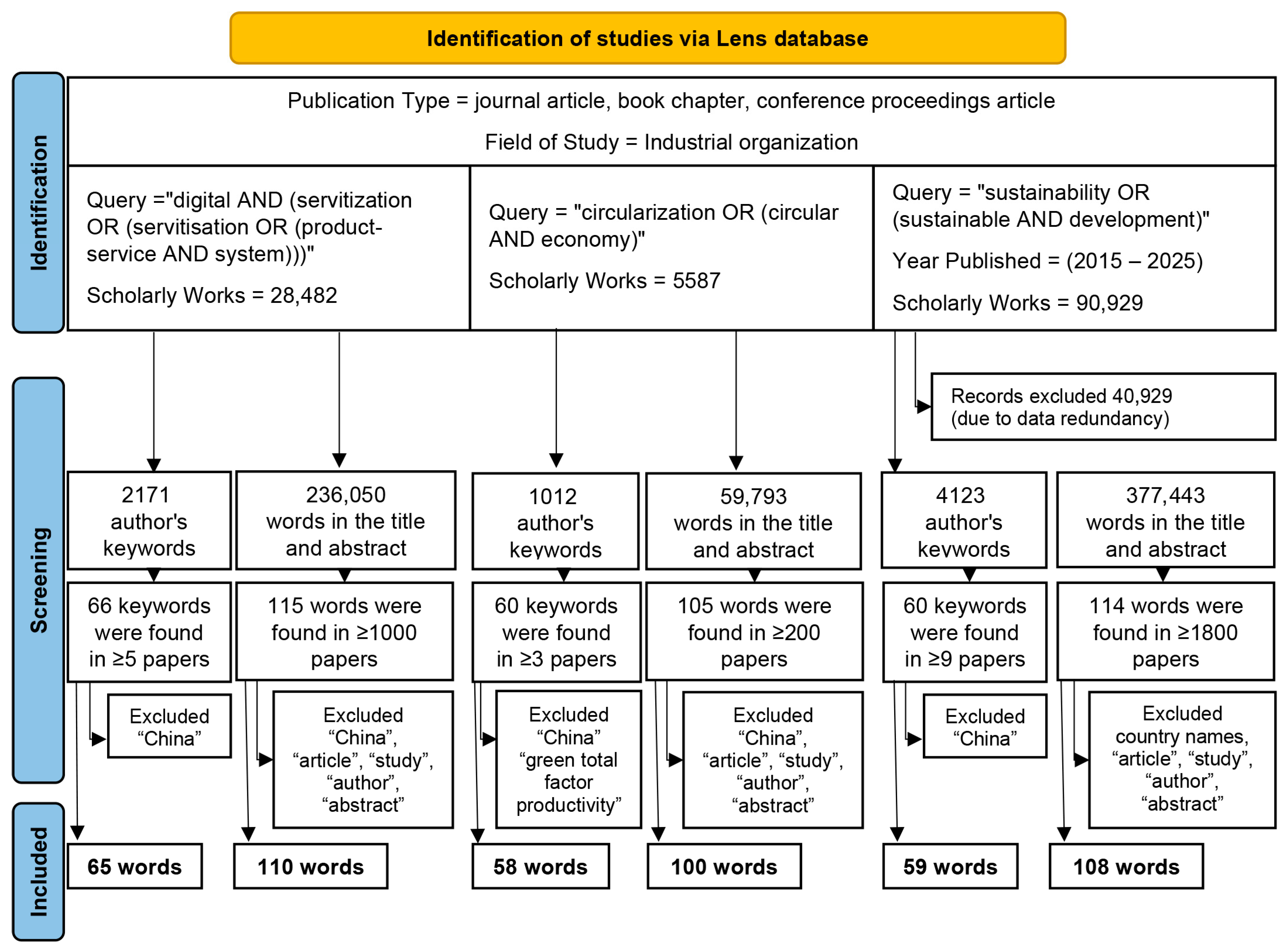
At the initial stage of the research, a selection of scientific publications in the field of “digital servitization” was conducted. The search was performed using the bibliographic database The Lens, which provides coverage of a significantly larger number of sources than, for example, Scopus and Web of Science databases, where publications by non-English-speaking scholars from Eastern and Southern Europe, as well as the Global South, are underrepresented [20].
The selection of articles for analysis was conducted in accordance with the PRISMA methodology [21] (Figure 1).
Figure 1. The methodological framework of research.
The search for scientific publications was conducted using three distinct queries.
The first query, “digital AND (servitization OR servitisation OR (product-service AND system))”, incorporated two spelling variants of the term—“servitization” and “servitisation”—which were treated as synonymous. The inclusion of the keyword “product-service system” (PSS) is justified by the fact that PSS represents a business model for the practical implementation of digital servitization.
The second query was performed using the keywords “circularization OR (circular AND economy)”.
The third query was conducted with the keywords “sustainability OR (sustainable AND development)”.
The timespan for the scientific publications covered the period from 2015 to July 2025. The choice of the starting year, 2015, is motivated by the fact that the contemporary consensus view of sustainable development as a tripartite process integrating economic, environmental, and social dimensions was formally established in that year with the United Nations’ adoption of the “2030 Agenda for Sustainable Development” and its Sustainable Development Goals (SDGs).
Given that the object of this study is industry, represented by enterprises from various sectors and fields of activity, the scientific field for publication selection was defined as “Industrial Organization”. The scientific publications were limited to the following types: journal article, book chapter, and conference proceedings article.
To ensure data comparability, the threshold for word occurrence frequency was set to achieve the maximum possible sample size uniformity while maintaining necessary representativeness. Accordingly, the query yielding the smallest number of articles—“circularization OR (circular AND economy)”—served as the quantitative benchmark for determining the sample size.
In the subsequent analysis, these three queries will be conventionally referred to as: servitization, circularization, and sustainability.
At the second stage, a bibliometric analysis of publications in the field of digital servitization was conducted using VOSviewer software (version 1.6.20). The choice of VOSviewer is justified by its function as a powerful tool for identifying the conceptual apparatus of a research field through the analysis of keyword co-occurrence networks, which accounts for its widespread use by scholars across various scientific fields [22]. Furthermore, this study expands the application scope of VOSviewer beyond its conventional use for visualizing, clustering, and analyzing diverse networks built on scientific publication metadata. It is also employed as an instrument for developing and structuring the conceptual framework of a specific research domain.
During the analysis, author keywords were utilized, with the exclusion of those that did not reflect the authors’ scientific perspective on the processes under investigation (e.g., country names) or words that were unconnected to other keywords. This approach is grounded in the research objective to examine precisely the interrelationships of keywords that structure the research field.
The third stage involved the interpretation of the bibliometric analysis results and an examination of the science maps generated in VOSviewer. During the analysis of the network maps, concepts that served as cores were identified. These were the nodal points of the considered clusters and had a sufficient number of connections with other terms (including those from other clusters). This approach made it possible to avoid characterizing each research area separately and instead to reveal the semantic connections between them. Subsequently, a content analysis of the publications and the full spectrum of terms from all network map clusters allowed for the merging of some terms (those that were close in meaning) and the elimination of duplicate terms (for example, the full name and its abbreviation, or meaning duplication). This process led to the formation and structuring of the study’s terminological field, presented in a systematized format that reflects the interconnections and hierarchy of the concepts used.

3. Results

3.1. Characteristics of Publications in the Research Domain

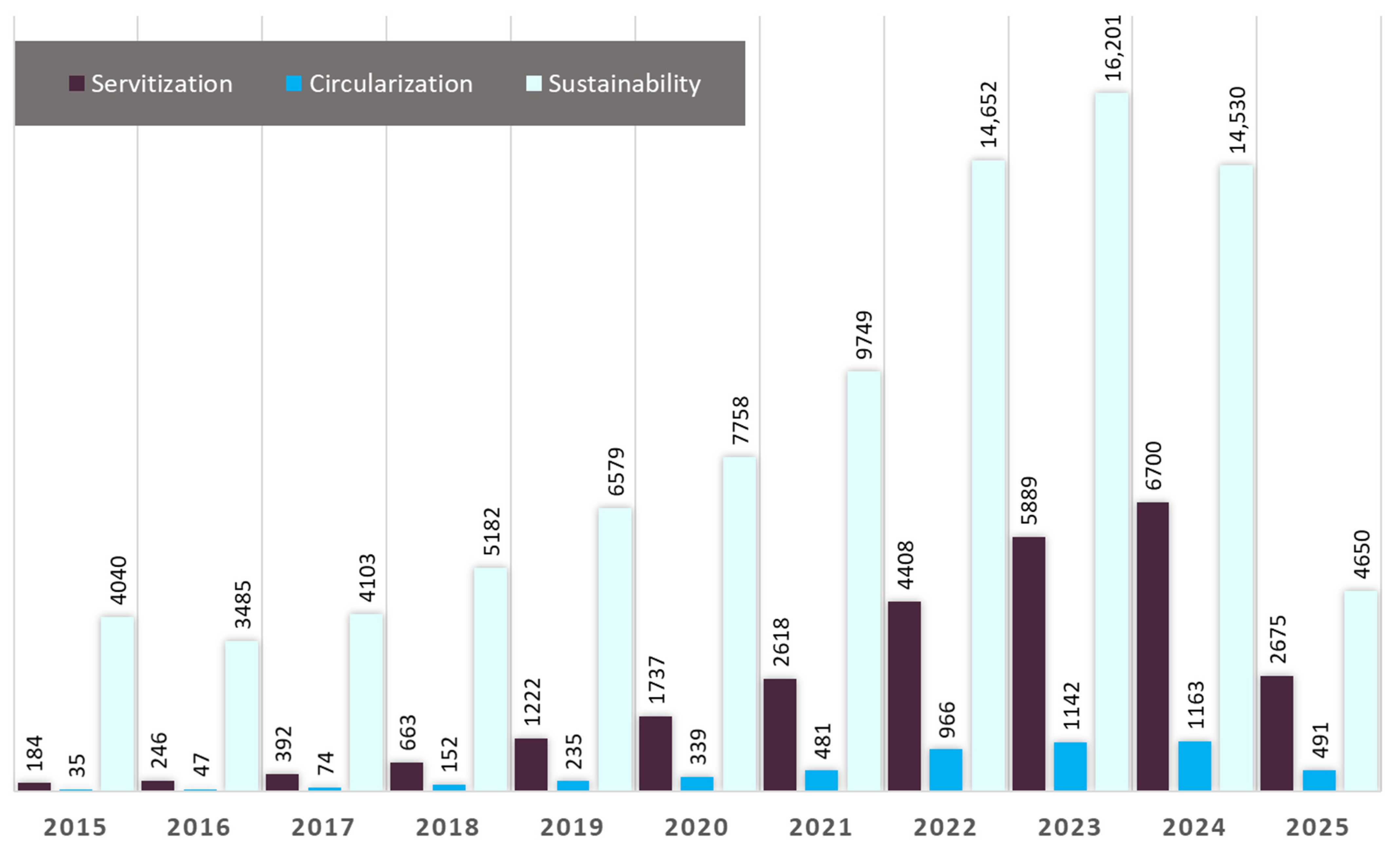
The publication dynamics concerning various aspects of digital servitization, circularization, and sustainability are presented in Figure 2.
Figure 2. The dynamics of scientific publications in the fields of digital servitization in industry, circularization and sustainability (source: https://www.lens.org/ (accessed on 10 July 2025)).
As evident from the figure, a significant surge in the number of publications has been observed since 2017, reflecting the growing interest of researchers in this subject area. The distribution of publications across the different search queries was relatively homogeneous, with a clear predominance of journal articles (81–86%) over conference proceedings and book publications.
Regarding author geography (Figure 3), it can be noted that China is the leader in the number of publications across all search domains. This reflects a growing interest in linking digital servitization with sustainability in emerging markets. The United States ranks second, with an output more than two times lower than the leader. It is noteworthy that despite a significant number of publications with the keyword “sustainability” from researchers in Russia, Ukraine, and Indonesia, these countries are not represented in publications on the circular economy. Simultaneously, the Top 10 countries in this thematic area include the Netherlands, Spain, and Sweden, which are not leaders in other research directions.
Figure 3. Top 10 Countries by Analyzed Research Domains (source: https://www.lens.org/ (accessed on 10 July 2025)).
The analysis of Fields of Study revealed a high similarity of scientific disciplines across publications comprising the sample for all three search queries (Table 1). At the same time, publications containing the keyword “digital servitization” show a distinct emphasis on the topic of “digital services in internet space.”
Table 1. The most popular scientific fields in the studied publications.
An interesting finding is that the thematic areas of “sustainability” and “ecology” are more prominently represented in publications with the keyword “circular economy” rather than “sustainable development.”
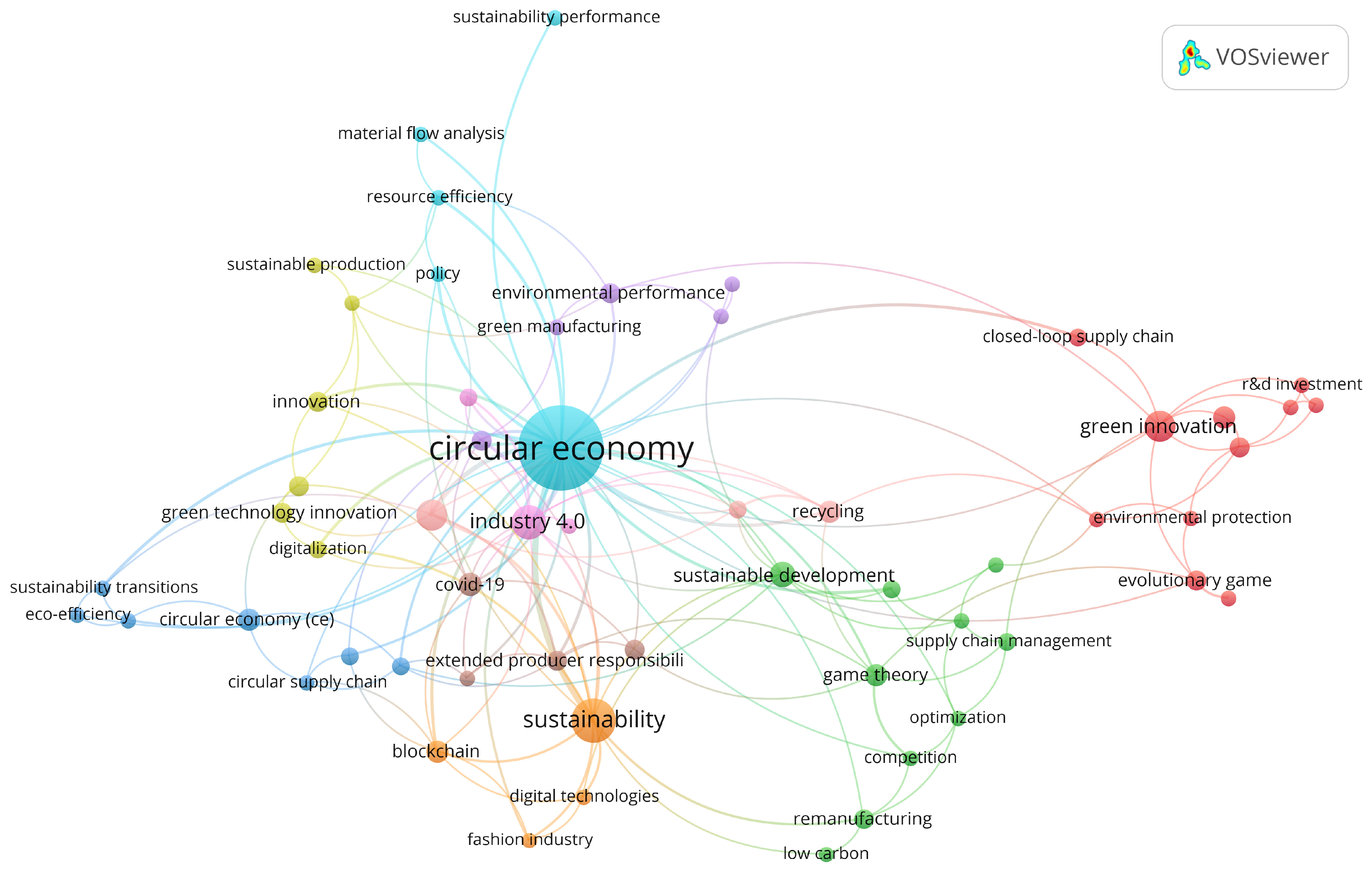
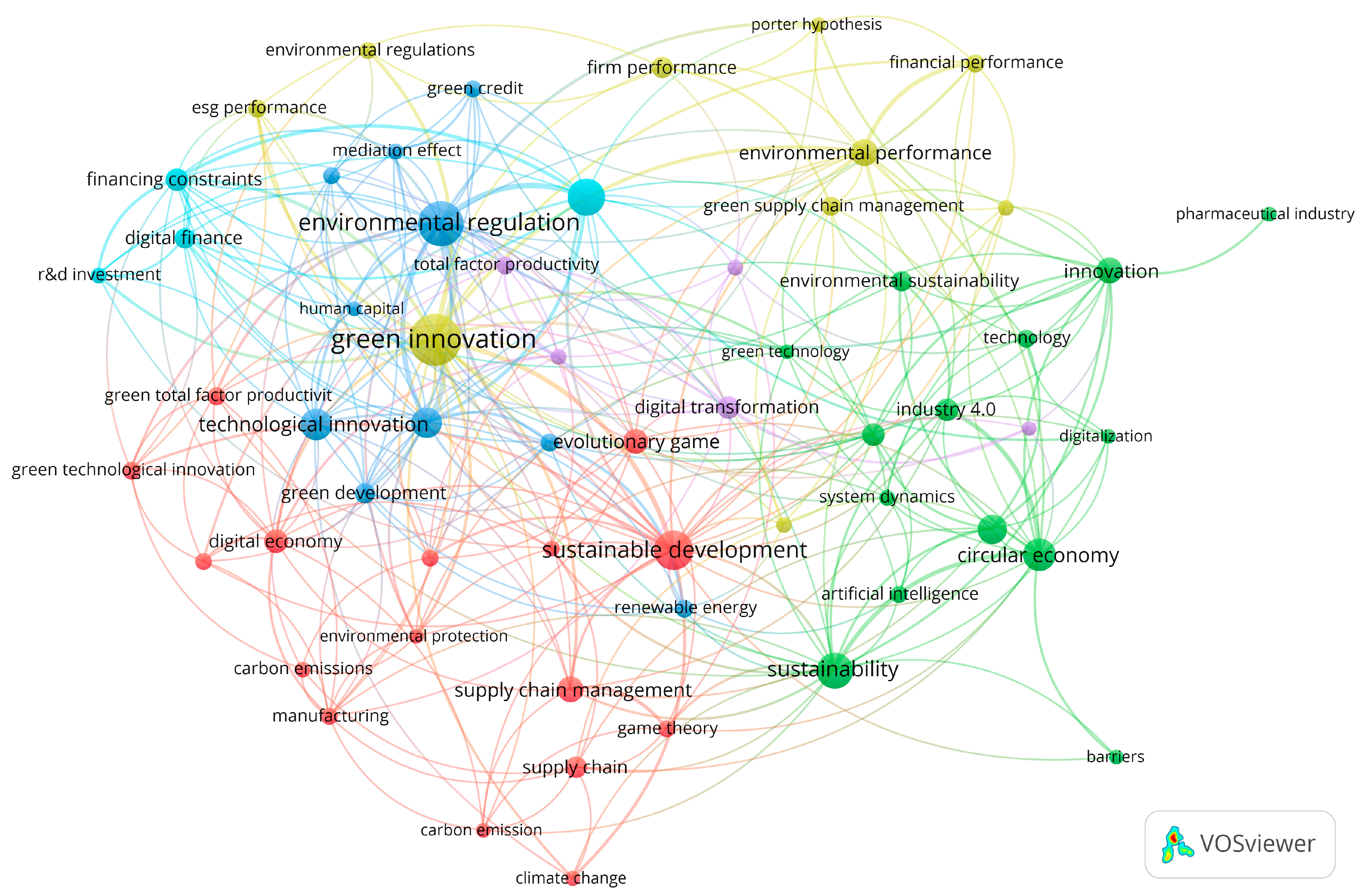
The conducted analysis of keyword co-occurrence in the studied samples (Figure 4, Figure 5 and Figure 6) has enabled the identification of main thematic research directions, as well as the terms used to characterize the subject domain. As depicted in Figure 4, the key structural elements of the network map are Digital Transformation, Innovation, Sustainability, Technological Innovation, Green Innovation, Circular Economy, and Industry 4.0, as evidenced by their prominent node size and high degree of connectivity.
Figure 4. Keyword clusters for the query “digital AND (servitization OR servitisation OR (product-service AND system))”.
Figure 5. Keyword clusters for the query “circularization OR (circular AND economy)”.
Figure 6. Keyword clusters for the query “sustainability OR (sustainable AND development)”.
As evident from the data presented in Figure 4, Figure 5 and Figure 6, research in the field of digital servitization (Figure 4) is directly linked to sustainable development issues through the concepts of the circular economy, examined through the lens of Industry 4.0. Another pronounced relationship is observed between digital servitization and innovations, which mediate opportunities for enhancing the resilience of economic systems in the face of external challenges (particularly COVID-19), as well as innovations in green development, finance, organizational innovations, etc.
In studies with the keyword “circularization OR (circular AND economy)” (Figure 5), the keyword themes reflect connections with green innovations and sustainable development. Evidently, the potential applications of digital servitization business models remain insufficiently explored by circular economy researchers. Nevertheless, the presence of keywords such as digitalization, blockchain, and digital technologies suggests that this research direction will develop, including towards examining the possibilities of implementing closed-loop digital servitization business models.
Publications with the keyword “sustainability OR (sustainable AND development)” (Figure 6) cover the broadest spectrum of thematic areas, with emphasis on concepts of circular economy and digital economy. Although the keyword “digital servitization” does not appear frequently enough in scientific publications of this thematic direction to be reflected in this network, it nevertheless includes terms such as “artificial intelligence,” “digital transformations,” and “digitalization,” suggesting that digital services are also considered by researchers as one of the tools for achieving sustainability.
Undoubtedly, a more comprehensive understanding of the extent to which the research domains of “digital servitization”, “circularization”, and “sustainable development” intersect can be achieved through content analysis of publications. Nevertheless, the constructed network maps allow for the identification of key interconnected research directions in digital servitization, circularization, and sustainable development, which can be grouped into the following broad categories: (1) investigating the essence of digital servitization in industry and its characterizing parameters; (2) developing digital servitization business models with an emphasis on the specificity of the value proposition created, as well as implementation strategies; (3) examining factors determining the opportunities and prospects of digital servitization; and (4) researching the impact of industrial digital servitization on sustainable development.

3.2. Content Analysis

3.2.1. The Essence of Digital Servitization in Industry

The essence of digital servitization, along with its role and significance for the economic development of industry, has been actively studied by researchers worldwide in recent years. Scholars note that the primary impetus for digital servitization has been the drive of industrial companies to adapt to new economic realities by enhancing the efficiency of their business processes through the active application of digital technologies and improving customer service quality [23,24].
Concurrently researchers approach digital servitization with varying emphases. Some scholars focus on the technological component of business model modification, stressing that this process is closely linked to innovation [16,25,26]. For instance, by synthesizing theoretical knowledge in the field of digital servitization, Shen et al. conclude that digital servitization is inherently closer to the concept of digital transformation than to mere digitalization, as it entails not the incremental changes characteristic of the latter, but rather more radical, innovative changes [18]. Vilkas et al. argue that product innovations exert a significant indirect influence on servitization through the opportunities created by digitalization [27].
Other scholars examine digital servitization through the lens of organizational change, seeking to understand the extent to which company managers are prepared to implement new digital business models and how aware they are of the opportunities presented by digital transformation [28]. This perspective facilitates a focus not only on the drivers of digital transformation but also on the methods of its implementation. For example, Shahzad et al. analyze the structural aspects of digital transformation in industrial companies, arguing for the necessity to minimize bureaucracy and reduce hierarchical layers to enhance organizational agility and create prerequisites for co-creating value with customers [29].
The research focus of some authors lies on digital servitization processes in the business-to-business (B2B) sector, while others concentrate on the business-to-consumer (B2C) sector, which differ significantly in terms of target audience and the nature of interaction. Initially, value co-creation within digital servitization was examined by researchers in the context of (B2C) interaction [30,31]. However, in recent years, scholars have increasingly focused on companies operating in the B2B segment. Here, digital servitization alters a company’s position in the supply chain due to the emergence of new business-to-partner interaction models, enabling firms to expand their capabilities by providing digital services that encompass subsequent stages of the chain [32]. Kamalaldin et al. note that digital servitization represents a transition from a transactional, product-oriented model to a relational, service-oriented interaction. They emphasize that the key opportunities of digital servitization in the B2B segment are associated with leveraging digital assets and digital technologies tailored to specific partnership relations [33].
The value creation process within digital servitization is increasingly examined by scholars through an ecosystem approach. Sklyar et al. emphasize the ecosystem nature of digital servitization, noting that as business processes undergo digital transformation, companies form spatially distributed networks of potentially diverse actors that enable the co-creation of value for customers [34]. According to Kolagar et al., the critical importance of continuously nurturing and developing partnership relations creates the preconditions for an ecosystem perspective on the essence of digital servitization in industrial companies [35].
Summarizing the diverse perspectives on the essence of digital industrial servitization, it can be stated that despite ongoing debates stemming from different research foci, there is a general consensus that digital servitization constitutes a new strategic approach to company development. This approach entails a transformation of their business models through the integration of digital solutions, thereby enabling the creation of new value propositions for customers [36,37].

3.2.2. Business Models of Digital Servitization

Digital servitization manifests in practice through the transformation of a company’s business models. This transformation is driven by the shift from selling products to selling products-as-a-service, utilizing various digital tools to create value propositions. Comprehensive solutions associated with this transformation are implemented by industrial enterprises within the Product–Service System (PSS) framework. This concept posits that products and services should be considered as interconnected elements that jointly create value for the customer [38].
Given that different types of PSS business models focus on distinct aspects of value creation, researchers in this field address the following questions: how do digital service capabilities enable value creation for the company, and how does the effectiveness of various business models and the digital solutions employed within them differ? In examining business model typologies, scholars typically rely on Tukker’s classification, which distinguishes models based on their value proposition orientation: product-oriented or service-oriented; process-oriented or result-oriented [39].
Recognizing that different business models are associated with distinct value creation mechanisms and yield varying outcomes, scholars conclude that the selection of a value creation and revenue generation model should be based on individual preferences and unique client business cases [40], as well as accounting for the digital maturity level of participants in the value chain [41]. Concurrently, Soellner et al. argue that an effective digital servitization strategy should integrate both product-supporting and customer-supporting services. Moreover, for companies with low efficiency, the initial focus should be on implementing product-supporting services, which establishes a foundation for their subsequent development [23].
An important conclusion for the subsequent examination of digital servitization’s role in achieving sustainable development goals is that the shift in emphasis within digital servitization business models towards service provision creates prerequisites for closing material and energy cycles. This enables the implementation of closed-loop (circular) models that generate value throughout the entire product lifecycle [5,42,43].
When characterizing digital servitization business models, scholars describe the features of their key value proposition components differently. For instance, the research results of Ruffoni and Reichert demonstrate four value creation avenues through digital servitization: integration (support for product-integrated services), provision (digitization of service delivery processes), organization (digitization and administration of partner interaction networks for service delivery), and production (digitization of manufacturing operations) [44]. In the studies by Adrodegari and Saccani, as well as Rajala et al., the opportunities of digital servitization are considered within the following broad categories: service development, service delivery, establishing partner interactions, business process optimization, and product development [45,46]. All researchers note, in one way or another, that the best results can be achieved by combining various digitalization-related components of business models [47,48,49].
Digital servitization business models can be implemented at various levels (basic, intermediate, and advanced), contingent upon the firm’s existing technological potential. This potential is predominantly examined in research through the lens of the dynamic capabilities framework, utilizing Teece’s theoretical model [50,51]. According to this model, three types of dynamic capabilities are distinguished: sensing (perception), seizing (exploitation), and reconfiguring. Building upon these, Arioli et al. define corresponding types of strategic behavior for companies in the realm of digital servitization: experimenters, pioneers, and newcomers [52]. In the study by Sjödin et al., the types of dynamic capabilities from Teece’s model are linked to identifying the potential for using artificial intelligence in digital servitization business models [53].
Scholars devote particular attention to investigating the potential of various types of ICT in digital servitization business models. Noting that digital servitization can be implemented using relatively simple technologies (e.g., the Internet, mobile communications, mobile applications), those of medium complexity (e.g., sensors, digital platforms, global positioning system (GPS)), or complex technologies (e.g., embedded electronics, telemetry), and can be based on proprietary or acquired (domestic or imported) ICT, researchers emphasize that different digital solutions yield distinct outcomes. These outcomes may manifest differently across specific types of PSS business models [54,55]. Furthermore, researchers associate the greatest prospects for digital servitization development with the integration of artificial intelligence technologies into PSS. In their view, AI holds the highest potential for building a service ecosystem and achieving sustainable development goals.
To understand how specific digital solutions can be integrated into a company’s business models, researchers propose using digital servitization maps. These tools help elucidate the strategic changes within companies and how these changes contribute to the creation of new value. For instance, the study by Ardolino et al. presents a business model framework for companies utilizing digital multi-sided platforms, demonstrating how the specific nature of interactions among various participants shapes a new value proposition [56]. Wirth et al., using the mechanical engineering industry as an example, show how a servitization ecosystem map enables the structured development of a business model most suitable for specific conditions [57]. Similarly, by identifying challenges and opportunities in the digital servitization of B2B companies, Paiola and Gebauer propose a digital servitization roadmap that aids in better understanding the strategic changes driven by the adoption of digital solutions [58].
In summary, it can be stated that research on digital servitization business models in the existing scientific literature clearly demonstrates a connection between the digital technologies employed and the methods of value creation. This body of work systematically examines how different types of digital solutions enable new possibilities for delivering service offerings across various business model typologies.

3.2.3. Factors of Digital Servitization in Industrial Companies

Research on the factors influencing digital servitization in industry can be divided into two main directions.
The first research direction involves testing the applicability of factors traditionally considered drivers of innovative development—such as investments, institutional conditions, level of digitalization, and management leadership qualities—to the industrial and regional specificities of digital servitization processes. In doing so, researchers employ various methods and approaches to identify factor interdependencies, depending on the focus and object of the study.
In quantitative studies, correlation-regression analysis is most frequently employed method. For instance, using hierarchical regression, Coreynen et al. analyzed the influence of external environmental factors (technological turbulence and competitive intensity) on a company’s digital servitization [24]. The study by Kosolapova et al. examines the role of investments in fixed capital, companies’ innovation activity, and the digital technologies used in implementing circular digital servitization models [59]. The role of the development level of service systems in stimulating digital servitization processes in agricultural engineering is reflected in the research by Chernova and Dolgova [60]. Zemlyak et al. investigate the impact of labor productivity, costs associated with the acquisition and implementation of ICT, and personnel training on enterprise digitalization and its efficiency [61].
Qualitative studies typically analyze the influence of organizational culture on the success of digital transformations, examined through the lenses of organizational change theories and the dynamic capabilities framework [62]. For example, based on in-depth interviews with managers of the company Navarch, Tronvoll et al. investigate the impact of “understanding the opportunities offered by digital technology” on digital servitization processes and the achievement of its objectives [41]. A similar study was conducted by Paiola et al., who, through structured surveys and semi-structured interviews with Italian manufacturers, identified the following as key factors enabling digital servitization: company size, its digital readiness, and management’s commitment to digital transformation [25]. Chirumalla et al. link the factors of digital servitization to a company’s dynamic capabilities, identifying as fundamental prerequisites for digital transformation: employee competencies that enable them to understand the essence and necessity of organizational changes and to engage in various interactions; the company’s digital maturity; and its corporate culture [63].
The second research direction focuses on factors of a company’s digital maturity, which characterize its transformational capabilities and organizational readiness for such changes [64,65,66]. The development of digital servitization implies that a company possesses a certain level of technological maturity (readiness), determined by its implemented strategy, the nature of its business processes, existing customer experience, and a specific organizational culture [67]. The importance of studying digital maturity as a fundamental factor shaping the prospects of digital servitization lies in the fact that if the industry’s readiness level for digital transformation is not accounted for in managing this process, it can lead to the selection of inappropriate digital solutions and an erroneous structuring of the entire logic of the implemented PSS business models [68]. In this regard, as noted by Tagscherer and Carbon, to sustain digital servitization models, companies should cultivate transformational leadership. This leadership manifests as management’s focus on change management and creating an innovative environment for interactions aimed at enhancing the level of technological maturity [69].

3.2.4. The Interrelationship Between Digital Servitization, Circularization, and Sustainable Development

As noted earlier in this study, the essence of digital servitization and the specific nature of its implemented business models endow it with significant potential for adopting sustainable economic practices, including through the implementation of circular business models.
In examining the opportunities and impact of digital servitization on sustainable development, scholars focus on various dimensions of sustainability.
The first group of studies examines the relationship between digital servitization and economic (financial, organizational) sustainability. As noted by Ginting et al. in their literature review, this relationship is most frequently described using the terms: competitiveness, efficiency, profitability, and sustainability [70]. Researchers highlight various economic effects of digitalization. For instance, Marjanovic et al. demonstrate the impact of digital service sector development on the turnover ratio of manufacturing companies [71]. Kohtamäki et al. [72] and Behl et al. [73] argue that digital servitization enhances company profitability, which is directly linked to improved financial sustainability by ensuring a stable revenue stream through the establishment of long-term customer relationships. The study by Zhou et al. provides empirical evidence of positive economic effects from digital transformation, indicating that digitalization increases business process transparency and enhances control [74]. Some research focuses on the opportunities digital servitization creates for improving organizational stability under stressful conditions [75,76].
It is important to note that despite numerous studies demonstrating the positive impact of digital servitization on a company’s economic performance, some scholars posit that it does not always yield positive economic outcomes. Specifically, Gebauer et al. note that in B2B companies, digital servitization often fails to deliver the expected revenue growth, as these firms face significant challenges in modifying their business models, which involve a large number of external partners [77].
The second group of studies focuses on the environmental effects of digitalization, fostering a debate regarding the extent to which digital servitization can contribute to achieving environmental sustainability. Given that the product–service system is a prevalent model of the circular economy, researchers propose the implementation of PSS business models as a tool for enhancing sustainability by extending the lifecycle of manufactured products [78,79]. Simultaneously, while acknowledging the significant potential for synergy between digitalization, servitization, and the circular economy, Mitake et al. note the insufficient elaboration of this interrelationship in terms of precise definitions and operational principles [80].
The impact of digital servitization on environmental sustainability is also examined by researchers through the lens of carbon emission reduction and energy conservation. For example, based on endogenous tests conducted for Chinese manufacturing companies, Zhou and Shao conclude that digital servitization reduces carbon emissions through the transition to outsourcing [81]. From the perspective of the enterprise, digital servitization optimizes factors of production and facilitates the adoption of green technologies that enable energy savings [82].
In summary, it can be noted that in recent years a growing number of researchers have begun questioning whether digital transformation can contribute to sustainable development. However, the research focus remains predominantly on economic and environmental sustainability effects. A significantly smaller number of publications address the social effects of industrial digital servitization. According to Beducci et al., the social aspects of digital servitization are manifested in the potential to create high-wage jobs [83]. Researchers also note that digital servitization helps expand community access to products and services, thereby fostering inclusive economic development [60,84,85].
Simultaneously, it should be emphasized that scientific literature pays scant attention to the interaction of all three sustainability dimensions. Only a few scholars examine the comprehensive effects of digital servitization for sustainable development, largely focusing on the level of individual enterprises or specific industries where these effects manifest. This leads to an underutilization of the potential of industrial digital servitization for addressing numerous regional development challenges associated with achieving the UN Sustainable Development Goals (SDGs) at the level of the entire national system.

4. Discussion

The results of the conducted analysis demonstrate that the research domain of “digital industrial servitization” within the context of sustainable development is constituted by terms: (a) borrowed from other fields of knowledge, and (b) new terms specific to this research domain, including phrases formed through the synthesis of concepts from other disciplines. The majority of key terms characterizing digital servitization are borrowed from adjacent scientific fields related to the study of the digital economy, circular economy, and product–service systems. This is attributed to the fact that the domain of digital servitization has emerged through the integration of these concepts, consequently incorporating their fundamental terms and notions: product–service business models, digital services, value creation, etc. Simultaneously, during the formation and evolution of digital servitization as an independent research field, its own conceptual apparatus has begun to develop. This apparatus is typically formed through the synthesis of concepts from its constituent domains, yielding terms such as smart servitization, Servgoods, Digital Servitization Technologies, among others.
The evolution of digital servitization does not depend solely on conceptual frameworks or business model typologies, but also on how actors perceive and adopt technology. Noroño shows that entrepreneurs’ perceptions of new digital tools vary according to industrial sector, organizational culture, and economic environment, which can either accelerate or slow down the transition toward servitized models [86]. Similarly, Espina demonstrates that, even in strategic sectors such as Latin American public health, structural gaps persist that limit digital integration, which reinforces the need for flexible ontologies capable of adapting to diverse institutional and regional realities [87].
The hierarchy of interrelationships among concepts and terms used in digital servitization research is determined by whether they are substantive–constitutive or mediating–implementing in nature. Substantive–constitutive concepts characterize the phenomenon of digital servitization by analyzing its properties, constituent components, and the connections between them. For example, when describing the essence of digital servitization, researchers most frequently use terms such as innovative business process, product–service systems, customization, digitalization, and service offerings.
Mediating–implementing concepts reflect the mechanisms and tools through which digital servitization interconnects with other economic processes and phenomena. These include terms such as sustainable consumption, closed loop, resource efficiency, and eco-efficiency.
The structured research domain of digital servitization in the context of sustainable development, organized by research directions, is presented in Table 2.
Table 2. Conceptual and Terminological Framework for Research in the Domain of “Digital Servitization” within the Context of Sustainable Development.
Analysis of the terminological framework used in the research domain of industrial digital servitization indicates that the scientific community perceives digital servitization and circularization as two complementary components of sustainable development, formed in response to contemporary challenges.
Digital servitization is the transformation of a company’s business models towards providing a “product-as-a-service,” driven by Industry 4.0 technologies and the pursuit of creating new value and enhancing business sustainability.
Circularization is the transformation of material flows and production systems towards achieving closed-loop cycles, driven by ecological necessity, regulatory pressure, and the quest for resource efficiency. In this context, digital servitization serves as a significant tool for achieving this goal.
Sustainable development integrates servitization and circularization through the tripartite model of “Environment–Economy–Society”. Within this triad, servitization enables increased profitability by creating value innovations through the transition from selling a product to selling a product-as-a-service; circularization contributes to cost reduction by ensuring resource efficiency through closed loops; and sustainable development establishes the systemic framework for integrating digital servitization and circularization to optimize long-term efficiency.
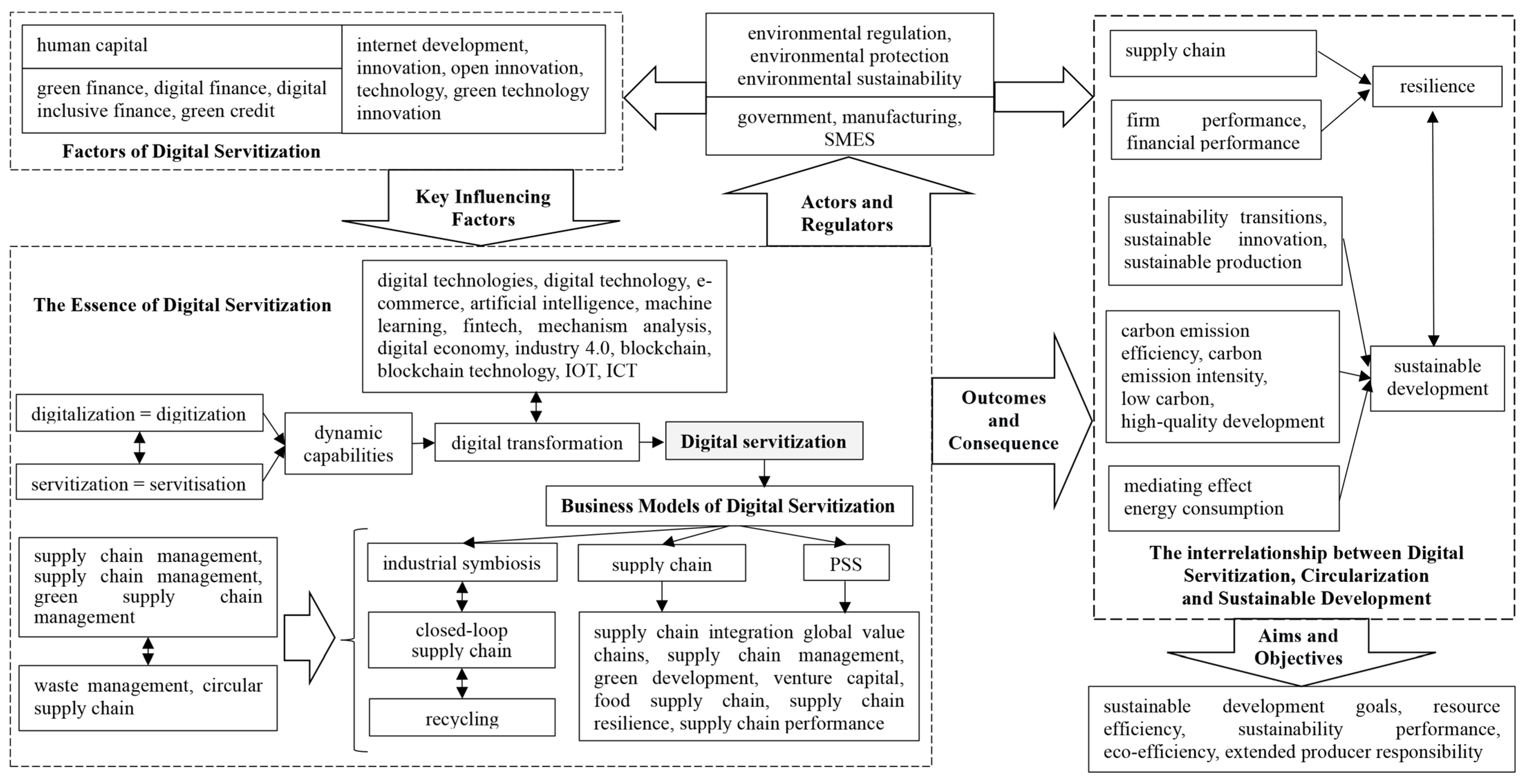
A visual representation of the ontology, illustrating the functional domains and their interconnections derived from the research findings, was developed and is presented in Figure 7.
Figure 7. The ontological framework for digital servitization research within the sustainable economic development context.
Research conclusions are directly supported by existing literature. Ciano et al. [88] detail the mechanisms through which Industry 4.0 technologies enable circular economy strategies at both operational and managerial levels. Corroborating this, the work of Bressanelli et al. [79] employs simulation modeling to provide empirical evidence for the economic and environmental viability of synergies between digital servitization and the circular economy.
The primary points of convergence for digital servitization, circularization, and sustainable development processes are as follows:
  • Servitized PSS business models, where the manufacturer retains responsibility for the product throughout its entire lifecycle, thereby incentivizing design for durability, repairability, and recyclability.
  • Digital platforms and digital services for closed-loop value chains, which facilitate collaboration among chain participants.
  • Green innovations and finance, acting as catalysts for the digital transformation of industry.
It is also noteworthy that across all search queries, the keyword “supply chains” is present in the identified publications. Supply chains serve as the object of servitization, a tool for circularization, and a fundamental component of sustainable development.
The conceptualization of integrating digital servitization, circularization, and sustainable development through PSS business models is emphasized in the research by Pirola et al., who note that “Digitalization and Servitization trends go hand in hand with each other and even mutually reinforce themselves” [38] (p. 12). Furthermore, as highlighted by Mitake et al., the development of Industry 4.0 has significantly influenced the evolution of PSS, leading to the emergence of smart PSS that enable substantial reduction in environmental impact while enhancing corporate sustainability [80].
In summary, it can be concluded that achieving sustainable industrial development in the contemporary economic landscape requires a synergy between digital servitization and circularization. Digital technologies and service models are becoming powerful catalysts and tools for implementing circular economy principles. Simultaneously, the circular economy’s focus on resource efficiency and closed loops provides direction and imparts environmental rationale to the digital transformation of industry.
The understanding of digitalization-servitization synergy mechanisms is also reflected in the study by Sjödin et al., which demonstrates how artificial intelligence—a key Industry 4.0 technology—not merely supports but innovatively transforms circular business models within digital servitization contexts [53]. This finding aligns with the thesis of “new value” creation and confirms that this synergy leads to qualitative transformation of business models.
Importantly, the present study’s findings resonate not only with established conclusions regarding the relationship between digital servitization, circularization, and sustainable development, but also substantially address the practical challenges noted by several scholars concerning the lack of precise definitions and understanding of interconnections within emerging complex concepts such as Smart Circular Systems [80,83,89].
Consequently, the obtained results align significantly with current scholarly debates concerning the role of digital servitization in achieving sustainable development goals.

5. Conclusions

This study has presented a structured conceptual and terminological framework for research in the field of digital industrial servitization within the context of addressing sustainable economic development challenges. The conducted scientometric analysis reveals that the scientific community investigates digital servitization and circularization as distinct yet closely interrelated research domains, which are critically important for the sustainable, competitive, and responsible development of future industry. The results of this study indicate that the terminological core of the “digital industrial servitization” research domain has been formed through the integration of conceptual and terminological apparatus from the digital economy, the circular economy, and the product–service system (PSS) concept.
The main limitations of the study are associated with the analysis being based on author keywords. Due to the subjectivity of perception, author keywords are often heterogeneous; for instance, one author might use the keyword “4rs” while another uses “4rs approach”—grammatically, these are different keywords, but semantically they are identical. Nevertheless, recurring keywords across different publications indicate the existence of commonly accepted formulations and established research directions, which allows us to derive reliable conclusions about the conceptual and terminological framework used in the research.
In summary, it can be concluded that this study provides an ontological framework for understanding digital servitization as a sustainability strategy. Its limitation is the reliance on keywords, which opens the door for empirical research to test this ontology in real cases
The primary theoretical contribution of this study lies in its ability to systematize the terms and concepts used to investigate digital servitization within the context of sustainable development. This outcome holds significant methodological importance, as it fosters the advancement of this research domain and facilitates the creation of new conceptual frameworks. The developed ontology of the selected research domain enables the conduction of more structured and focused studies on digital industrial servitization, while preserving a systemic perspective and maintaining connections with adjacent concepts and their corresponding research fields (in this study, specifically, the circular economy and sustainable development).
The practical significance of the research is demonstrated by the fact that a systematic understanding of the content and structure of the conceptual–terminological apparatus enables the development of digital servitization strategies and business models for industry. These models align with the overarching logic of sustainable development through integrated solutions that combine the principles of digitalization and circularization.
The authors’ future research will focus on developing approaches for the practical implementation of regional sustainable development strategies. This work will center on integrating digital solutions into the business models of industrial enterprises.

Author Contributions

Conceptualization, O.A.C. and A.Y.N.; theoretical analysis O.A.C. and A.Y.N.; methodology, O.I.D.; scientometric analysis, O.I.D. data curation, O.I.D.; visualization, O.I.D.; conclusion O.A.C.; writing—original draft preparation, O.A.C. and A.Y.N., writing—review and editing, A.Y.N. and O.A.C. All authors have read and agreed to the published version of the manuscript.

Funding

This work was supported by the grant of Russian Science Foundation No. 25-28-00161 https://rscf.ru/project/25-28-00161/ (accessed on 10 July 2025) “Methods and tools for forming a digital easement strategy in agricultural machinery” at Southern Federal University.

Institutional Review Board Statement

Not applicable.

Data Availability Statement

The original contributions presented in this study are included in the article. Further inquiries can be directed to the corresponding author.

Conflicts of Interest

The authors declare no conflicts of interest.

References

  1. Mugizi, W. Constructing a Conceptual Framework for Quantitative Data Analysis in Social Science Research. Interdiscip. J. Educ. 2019, 2, 75–88. [Google Scholar] [CrossRef]
  2. Pasque, P.; Gilbert, C. Theoretical and Conceptual Frameworks. Understanding the Role of Theory in Congruent Research Designs. In A Practical Guide to Teaching Research Methods in Education; Routledge: London, UK, 2023. [Google Scholar] [CrossRef]
  3. Adom, D.; Hussein, E.K.; Agyem, J.A. A Theoretical and Conceptual Framework: Mandatory Ingredients of a Quality Research. Int. J. Sci. Res. 2018, 7, 6–9. Available online: https://www.worldwidejournals.com/international-journal-of-scientific-research-(IJSR)/recent_issues_pdf/2018/January/January_2018_1514812002__202.pdf (accessed on 11 July 2025).
  4. William, F. Unveiling the Significance and Influence of Theoretical and Conceptual Frameworks in Social Science Research. Int. J. Res. Publ. 2024, 142, 137–142. [Google Scholar] [CrossRef]
  5. Dolgova, O.I.; Nikitaeva, A.Y. Evaluation of the potential for the development of the circular industry in the region: A new approach. Recycling 2025, 10, 38. [Google Scholar] [CrossRef]
  6. Han, Y.; Shevchenko, T.; Yannou, B.; Ranjbari, M.; Shams, E.; Saidani, M.; Bouillass, G.; Bliumska-Danko, K.; Li, G. Exploring How Digital Technologies Enable a Circular Economy of Products. Sustainability 2023, 15, 2067. [Google Scholar] [CrossRef]
  7. Chauhan, C.; Parida, V.; Dhir, A. Linking circular economy and digitalisation technologies: A systematic literature review of past achievements and future promises. Technol. Forecast. Soc. Change 2022, 177, 121508. [Google Scholar] [CrossRef]
  8. Martín-Peña, M.L.; Sánchez-López, J.M. Servitization in Manufacturing. Int. Encycl. Bus. Manag. 2026, 3, 915–920. [Google Scholar] [CrossRef]
  9. Burton, J.; Story, V.; Zolkiewski, J.; Nisha, N. Digital service innovation challenges faced during servitization: A multi-level perspective. J. Serv. Manag. 2024, 35, 202–226. [Google Scholar] [CrossRef]
  10. Ochoa, W.; Cuenca, J.; Larrinaga, F.; Pérez, A. I40GO: A global ontology for industry 4.0. Expert Syst. Appl. 2025, 294, 128792. [Google Scholar] [CrossRef]
  11. Marín-Miranda, M.J.; Fra Paleo, U.; Redweik, P.; Gómez-Gutiérrez, Á. An ontology to describe the damage process to built cultural heritage triggered by earthquakes: The CHEDO model. J. Cult. Herit. 2025, 71, 114–126. [Google Scholar] [CrossRef]
  12. Amara, O.; De Nicola, A.; Kamissoko, D.; Bénaben, F.; Fijalkow, Y. Ontological framework for horizon scanning of business continuity of essential services. Int. J. Disaster Risk Reduct. 2025, 124, 105526. [Google Scholar] [CrossRef]
  13. Zarco, C.G. Towards a New Conception of Value Creation: Servitization and Digitalization in Project Based Firms. Ph.D. Thesis, Universidad de Granada, Granada, Spain, 2016. Available online: https://dialnet.unirioja.es/servlet/tesis?codigo=56569 (accessed on 15 July 2025).
  14. Georgievsky, A.B. Servitization of the company: Prerequisites and advantages. Vestn. St. Petersbg. Univ. Manag. 2022, 21, 74–104. [Google Scholar] [CrossRef]
  15. Georgievsky, A.B. The company’s transition from selling goods to selling solutions. Vestn. St. Petersbg. Univ. Manag. 2021, 20, 216–241. [Google Scholar] [CrossRef]
  16. Sharko, E.R.; Rebiazina, V.A. Servitization in the digital age: A systematic review. Vestn. St. Petersbg. Univ. Manag. 2023, 22, 476–493. [Google Scholar] [CrossRef]
  17. Ciasullo, M.; Douglas, A.; Romeo, E.; Ferrara, M. What about digital servitization? Insights from a bibliometric-interpretative review. In Proceedings of the 26th Excellence in Services International Conference EISIC, Paisley, UK, 31 August–1 September 2023; Available online: https://sites.les.univr.it/eisic/wp-content/uploads/2023/11/CIASULLO-DOUGLAS-ROMEO-FERRARA.pdf (accessed on 17 July 2025).
  18. Shen, L.; Sun, W.; Parida, V. Consolidating digital servitization research: A systematic review, integrative framework, and future research directions. Technol. Forecast. Soc. Change 2023, 191, 122478. [Google Scholar] [CrossRef]
  19. Minaya, P.; Avella, L.; Trespalacios, J. Synthesizing three decades of digital servitization: A systematic literature review and conceptual framework proposal. Serv. Bus. 2024, 18, 193–222. [Google Scholar] [CrossRef]
  20. Turgel, I.D.; Chernova, O.A. Open Science Alternatives to Scopus and the Web of Science: A Case Study in Regional Resilience. Publications 2024, 12, 43. [Google Scholar] [CrossRef]
  21. Page, M.; Mckenzie, J.E.; Bossuyt, P.M.; Boutron, I.; Hoffmann, T.C.; Mulrow, C.D.; Shamseer, L.; Tetzlaff, J.M.; Akl, E.A.; Brennan, S.E.; et al. The PRISMA 2020 statement: An updated guideline for reporting systematic reviews. BMJ 2021, 372, 71. [Google Scholar] [CrossRef]
  22. Altay, E.; Balım, A.G. VOSviewer application within the scope of bibliometric analysis: Literature review on the use of virtual laboratories in education. Educ. Mind 2024, 3, 214–228. [Google Scholar] [CrossRef]
  23. Soellner, S.; Helm, R.; Klee, P.; Endres, H. Industrial service innovation: Exploring the transformation process to digital servitization in industrial goods companies. Ind. Mark. Manag. 2024, 117, 288–303. [Google Scholar] [CrossRef]
  24. Coreynen, W.; Matthyssens, P.; Vanderstraeten, J.; Witteloostuijn, A.V. Unravelling the internal and external drivers of digital servitization: A dynamic capabilities and contingency perspective on firm strategy. Ind. Mark. Manag. 2020, 89, 265–277. [Google Scholar] [CrossRef]
  25. Paiola, M.; Grandinetti, R.; Kowalkowski, C.; Rapaccini, M. Digital servitization strategies and business model innovation: The role of knowledge-intensive business services. J. Eng. Technol. Manag. 2024, 74, 101846. [Google Scholar] [CrossRef]
  26. Minaya, P.E.; Avella, L.; Trespalacios, J.A. The effects of digital servitization on business competitiveness: A case study of Spanish manufacturers. J. Int. Entrep. 2023, 21, 180–213. [Google Scholar] [CrossRef]
  27. Vilkas, M.; Bikfalvi, A.; Rauleckas, R.; Marcinkevicius, G. The interplay between product innovation and servitization: The mediating role of digitalization. J. Bus. Ind. Mark. 2021, 37, 2169–2184. [Google Scholar] [CrossRef]
  28. Baines, T.; Ziaee Bigdeli, A.; Rabetino, R.; Shi, V.G.; Baldwin, J.; Ridgway, K. Servitization: Revisiting the state-of-the-art and research priorities. Int. J. Oper. Prod. Manag. 2017, 37, 256–278. [Google Scholar] [CrossRef]
  29. Shahzad, K.; Imran, F.; Butt, A. Digital Transformation and Changes in Organizational Structure. Res.-Technol. Manag. 2025, 68, 25–40. [Google Scholar] [CrossRef]
  30. Peltier, J.W.; Dahl, A.J.; Swan, E.L. Digital information flows across a B2C/C2C continuum and technological innovations in service ecosystems: A service-dominant logic perspective. J. Bus. Res. 2020, 121, 724–734. [Google Scholar] [CrossRef]
  31. Savytska, N.; Babenko, V.; Chmil, H.; Priadko, O.; Bubenets, I. Digitalization of Business Development Marketing Tools in the B2C Market. J. Inf. Technol. Manag. 2023, 15, 124–134. [Google Scholar] [CrossRef]
  32. Herrero, F.V.; Rabetino, R.; Parry, G.; Georgantzis, N. Servitization, digitization and supply chain interdependency. Ind. Mark. Manag. 2017, 60, 69–81. [Google Scholar] [CrossRef]
  33. Kamalaldin, A.; Linde, L.; Sjödin, D.R.; Parida, V. Transforming provider-customer relationships in digital servitization: A relational view on digitalization. Ind. Mark. Manag. 2020, 89, 306–325. [Google Scholar] [CrossRef]
  34. Sklyar, A.; Kowalkowski, C.; Tronvoll, B.; Sörhammar, D. Organizing for digital servitization: A service ecosystem perspective. J. Bus. Res. 2019, 104, 450–460. [Google Scholar] [CrossRef]
  35. Kolagar, M.; Parida, V.; Sjödin, D. Ecosystem transformation for digital servitization: A systematic review, integrative framework, and future research agenda. J. Bus. Res. 2022, 146, 176–200. [Google Scholar] [CrossRef]
  36. Gebauer, H.; Paiola, M.; Saccani, N.; Rapaccini, M. Digital servitization: Crossing the perspectives of digitization and servitization. Ind. Mark. Manag. 2021, 93, 382–388. [Google Scholar] [CrossRef]
  37. Paschou, T.; Rapaccini, M.; Adrodegari, F.; Saccani, N. Digital servitization in manufacturing: A systematic literature review and research agenda. Ind. Mark. Manag. 2020, 89, 278–292. [Google Scholar] [CrossRef]
  38. Pirola, F.; Boucher, X.; Wiesner, S.; Pezzotta, G. Digital technologies in product-service systems: A literature review and a research agenda. Comput. Ind. 2020, 123, 103301. [Google Scholar] [CrossRef]
  39. Tukker, A. Eight types of product-service system: Eight ways to sustainability? Experiences from SusProNet. Bus. Strategy Environ. 2004, 13, 246–260. [Google Scholar] [CrossRef]
  40. Kuipers, M.; Stoll, O. Monetization Roadmap for Digital Services in Product-Service Systems: Insights and Challenges from a Case Study. In Smart Services Summit, Proceedings of the SMSESU 2023, Zürich, Switzerland, 27 October 2023; West, S., Meierhofer, J., Buecheler, T., Eds.; Progress in IS; Springer: Cham, Switzerland, 2024; pp. 179–191. [Google Scholar] [CrossRef]
  41. Tronvoll, B.; Sklyar, A.; Sörhammar, D.; Kowalkowski, C. Transformational shifts through digital servitization. Ind. Mark. Manag. 2020, 89, 293–305. [Google Scholar] [CrossRef]
  42. Zhang, H.; Ma, L.; Sun, J.; Lin, H.; Thürer, M. Digital Twin in Services and Industrial Product Service Systems. Procedia CIRP 2019, 83, 57–60. [Google Scholar] [CrossRef]
  43. Langley, D.J. Digital Product-Service Systems: The Role of Data in the Transition to Servitization Business Models. Sustainability 2022, 14, 1303. [Google Scholar] [CrossRef]
  44. Ruffoni, E.P.; Reichert, F.M. Exploring configurations of digital servitization capabilities for value creation: An fsQCA approach. Ind. Mark. Manag. 2024, 122, 131–144. [Google Scholar] [CrossRef]
  45. Adrodegari, F.; Saccani, N. A maturity model for the servitization of product-centric companies. J. Manuf. Technol. Manag. 2020, 31, 775–797. [Google Scholar] [CrossRef]
  46. Rajala, R.; Brax, S.; Virtanem, A.; Salonen, A. The next phase in servitization: Transforming integrated solutions into modular solutions. Int. J. Oper. Prod. Manag. 2019, 39, 630–657. [Google Scholar] [CrossRef]
  47. Opazo-Basáez, M.; Vendrell-Herrero, F.; Bustinza, O. Digital service innovation: A paradigm shift in technological innovation. J. Serv. Manag. 2021, 33, 97–120. [Google Scholar] [CrossRef]
  48. Zhan, J.; Zhang, Z.; Zhang, S.; Zhao, J.; Wang, F. Manufacturing servitization in the digital economy: A configurational analysis from dynamic capabilities and lifecycle perspective. Ind. Manag. Data Syst. 2023, 123, 79–111. [Google Scholar] [CrossRef]
  49. Meng, T.; Li, Q.; He, C.; Dong, Z. Research on the configuration path of manufacturing enterprises’ digital servitization transformation. Int. Rev. Econ. Financ. 2025, 98, 103952. [Google Scholar] [CrossRef]
  50. Teece, D. Explicating dynamic capabilities: The nature and micro foundations of sustainable enterprise performance. Strateg. Manag. J. 2007, 28, 1319–1350. [Google Scholar] [CrossRef]
  51. Shen, L.; Sun, C.; Ali, M. Role of Servitization, Digitalization, and Innovation Performance in Manufacturing Enterprises. Sustainability 2021, 13, 9878. [Google Scholar] [CrossRef]
  52. Arioli, V.; Pezzotta, G.; Romero, D.; Adrodegari, F.; Sala, R.; Rapaccini, M.; Saccani, N.; Marjanovic, U.; Rakic, S.; West, S.; et al. Digital Servitization Business Typologies in the Manufacturing Sector. Int. J. Ind. Eng. Manag. 2025, 16, 1–23. [Google Scholar] [CrossRef]
  53. Sjödin, D.; Parida, V.; Kohtamäki, M. Artificial intelligence enabling circular business model innovation in digital servitization: Conceptualizing dynamic capabilities, AI capacities, business models and effects. Technol. Forecast. Soc. Change 2023, 197, 122903. [Google Scholar] [CrossRef]
  54. Ayala, N.F.; da Silva, J.R.; Tinoco, M.A.C.; Saccani, N.; Frank, A.G. Artificial Intelligence capabilities in Digital Servitization: Identifying digital opportunities for different service types. Int. J. Prod. Econ. 2025, 284, 109604. [Google Scholar] [CrossRef]
  55. Hanski, J.; Kortelainen, H.; Uusitalo, T. The Impact of Digitalization on Product-Service System Development in the Manufacturing Industry. In Engineering Assets and Public Infrastructures in the Age of Digitalization; Liyanage, J., Amadi-Echendu, J., Mathew, J., Eds.; Lecture Notes in Mechanical Engineering; Springer: Cham, Switzerland, 2020. [Google Scholar] [CrossRef]
  56. Ardolino, M.; Saccani, N.; Adrodegari, F.; Perona, M. A Business Model Framework to Characterize Digital Multisided Platforms. J. Open Innov. Technol. Mark. Complex. 2020, 6, 10. [Google Scholar] [CrossRef]
  57. Wirth, J.; Neller, D.; Bauernhansl, T. The Servitization Ecosystem Canvas (SEC): Towards a framework for developing service-oriented and data-driven business models in ecosystems. Procedia CIRP 2025, 134, 360–365. [Google Scholar] [CrossRef]
  58. Paiola, M.; Gebauer, H. Internet of things technologies, digital servitization and business model innovation in BtoB manufacturing firms. Ind. Mark. Manag. 2020, 89, 245–264. [Google Scholar] [CrossRef]
  59. Kosolapova, N.; Matveeva, L.; Nikitaeva, A.; Chernova, O. The drivers of the circular economy: Theory vs practice. Terra Econ. 2023, 21, 68–83. [Google Scholar] [CrossRef]
  60. Chernova, O.A.; Dolgova, O.I. Digital servitization for innovative agricultural development in northern regions. North Mark. Form. Econ. Order 2025, 3, 179–194. [Google Scholar] [CrossRef]
  61. Zemlyak, S.; Gusarova, O.; Khromenkova, G. Tools for Correlation and Regression Analyses in Estimating a Functional Relationship of Digitalization Factors. Mathematics 2022, 10, 429. [Google Scholar] [CrossRef]
  62. Naik, P.; Schroeder, A.C.; Kapoor, K.K.; Bigdeli, A.Z.; Baines, T. Behind the scenes of digital servitization: Actualising IoT-enabled affordances. Ind. Mark. Manag. 2020, 89, 232–244. [Google Scholar] [CrossRef]
  63. Chirumalla, K.; Leoni, L.; Oghazi, P. Moving from servitization to digital servitization: Identifying the required dynamic capabilities and related microfoundations to facilitate the transition. J. Bus. Res. 2023, 158, 113668. [Google Scholar] [CrossRef]
  64. Haryanti, T.; Rakhmawati, N.; Subriadi, A. Assessing the Digital Transformation Landscapes of Organization: The Digital Transformation Self-Assessment Maturity Model (DX-SAMM). Procedia Comput. Sci. 2024, 234, 1561–1569. [Google Scholar] [CrossRef]
  65. Hamidi, S.; Hoseini, S.; Gholami, H.; Kananizadeh-Bahmani, M. A three-stage digital maturity model to assess readiness for blockchain implementation in the maritime logistics industry. J. Ind. Inf. Integr. 2024, 41, 100643. [Google Scholar] [CrossRef]
  66. Tagscherer, F.; Carbon, C.-C. Digital servitization and leadership: A holistic view on required leadership traits and skill. J. Entrep. Manag. Innov. 2024, 20, 104–129. [Google Scholar] [CrossRef]
  67. Paschou, T.; Rapaccini, M.; Peters, C.; Adrodegari, F.; Saccani, N. Developing a Maturity Model for Digital Servitization in Manufacturing Firms. In Proceedings of the 25th International Joint Conference on Industrial Engineering and Operations Management—IJCIEOM, IJCIEOM 2019, Vienna, Austria, 23–25 July 2019; Anisic, Z., Lalic, B., Gracanin, D., Eds.; Lecture Notes on Multidisciplinary Industrial Engineering. Springer: Cham, Switzerland, 2020. [Google Scholar] [CrossRef]
  68. Chernova, O.A.; Knyazev, V.R. Application of the concept of technological maturity in regional industrial development strategy-making. R-Economics 2024, 10, 444–454. [Google Scholar] [CrossRef]
  69. Tagscherer, F.; Carbon, C.-C. The role of transformational leadership in navigating digital servitization. Sustain. Technol. Entrep. 2025, 4, 100098. [Google Scholar] [CrossRef]
  70. Ginting, H.; Nayati Utami, H.; Riyadi, R.; Hutahayan, B. Exploring the landscape of digital servitization: A systematic review. F1000Research 2024, 13, 813. [Google Scholar] [CrossRef]
  71. Marjanovic, U.; Rakić, S.; Lalic, B. Digital Servitization: The Next “Big Thing” in Manufacturing Industries. In Advances in Production Management Systems. Production Management for the Factory of the Future, Proceedings of the IFIP WG 5.7 International Conference, APMS 2019, Austin, TX, USA, 1–5 September 2019; IFIP Advances in Information and Communication Technology; Springer: Cham, Switzerland, 2019. [Google Scholar] [CrossRef]
  72. Kohtamäki, M.; Parida, V.; Patel, P.C.; Gebauer, H. The relationship between digitalization and servitization: The role of servitization in capturing the financial potential of digitalization. Technol. Forecast. Soc. Change 2020, 151, 119804. [Google Scholar] [CrossRef]
  73. Behl, A.; Sampat, B.; Gaur, J.; Pereira, V.; Laker, B.; Shankar, A.; Shi, Y.; Roohanifar, M. Can gamification help green supply chain management firms achieve sustainable results in servitized ecosystem? An empirical investigation. Technovation 2024, 129, 102915. [Google Scholar] [CrossRef]
  74. Zhou, Z.; Yuan, Z.; He, C. Can digital transformation promote firms’ sustainable development? Evidence based on ESG performance. Int. Rev. Financ. Anal. 2025, 105, 104434. [Google Scholar] [CrossRef]
  75. Li, G.; Du, K.; Liu, L.; Su, F. Digital transformation and organizational resilience: Unveiling the path to sustainable performance in adversity and crisis. Int. J. Inf. Manag. 2025, 84, 102934. [Google Scholar] [CrossRef]
  76. Sun, Y.; Mou, S.; Zhu, M.; Jeyaraj, A. Impact of digital technology affordance on organizational resilience: An ambidextrous innovation perspective using a mixed-methods approach. J. Bus. Res. 2025, 197, 115450. [Google Scholar] [CrossRef]
  77. Gebauer, H.; Fleisch, E.; Lamprecht, C.; Wortmann, F. Growth paths for overcoming the digitalization paradox. Bus. Horiz. 2020, 63, 313–323. [Google Scholar] [CrossRef]
  78. Wu, D.; Pi, Y. Digital technologies and product-service systems: A synergistic approach for manufacturing firms under a circular economy. J. Digit. Econ. 2023, 2, 37–49. [Google Scholar] [CrossRef]
  79. Bressanelli, G.; Saccani, N.; Perona, M. Are digital servitization-based Circular Economy business models sustainable? A systemic what-if simulation model. J. Clean. Prod. 2024, 458, 142512. [Google Scholar] [CrossRef]
  80. Mitake, Y.; Kishita, Y.; Umeda, Y. Exploring Smart Circular Systems: Intersection of Servitization, Digitalization, and Circularity. Procedia CIRP 2025, 135, 738–743. [Google Scholar] [CrossRef]
  81. Zhou, D.; Shao, Z. Digital transformation, manufacturing servitization and enterprises’ Carbon emissions. J. Clean. Prod. 2025, 520, 146026. [Google Scholar] [CrossRef]
  82. Wang, J.; Wang, W.; Wu, H.; Liu, Y. Exploring the effects of manufacturing servitization on enterprise energy conservation and emissions reduction moderated by digital transformation. Energy Econ. 2023, 122, 106706. [Google Scholar] [CrossRef]
  83. Beducci, E.; Acerbi, F.; De Carolis, A.; Taisch, M. Exploring the role of digital servitization for sustainability: A framework for environmental and social impact. Clean. Environ. Syst. 2025, 17, 100269. [Google Scholar] [CrossRef]
  84. Nguyen, A. Digital Inclusion. In Handbook of Social Inclusion; Liamputtong, P., Ed.; Springer: Cham, Switzerland, 2021. [Google Scholar]
  85. Nikitaeva, A.Y.; Chernova, O.A.; Molapisi, L. Smart territories as a driver for the transition to sustainable regional development and green economy. R-Economics 2022, 8, 120–134. [Google Scholar] [CrossRef]
  86. Noroño, S.J.G. How Entrepreneurs Perceive Technology in the Digital Era: From Aversion to Adoption. Ceniiac 2025, 1, e0002. [Google Scholar] [CrossRef]
  87. Espina, E.M. Gaps in the Digital Transformation of Public Health in Latin America. Ceniiac 2025, 1, e0004. [Google Scholar] [CrossRef]
  88. Ciano, M.P.; Peron, M.; Panza, L.; Pozzi, R. Industry 4.0 technologies in support of circular Economy: A 10R-based integration framework. Comput. Ind. Eng. 2025, 201, 110867. [Google Scholar] [CrossRef]
  89. Gróf, C.; Kamtsiuris, A. Ontology-based Process Reengineering to Support Digitalization of MRO Operations: Application to an Aviation Industry Case. Procedia CIRP 2021, 104, 1322–1327. [Google Scholar] [CrossRef]
Disclaimer/Publisher’s Note: The statements, opinions and data contained in all publications are solely those of the individual author(s) and contributor(s) and not of MDPI and/or the editor(s). MDPI and/or the editor(s) disclaim responsibility for any injury to people or property resulting from any ideas, methods, instructions or products referred to in the content.

Article Metrics

Citations

Article Access Statistics

Multiple requests from the same IP address are counted as one view.