Abstract
Symbiosis and synergy among urban uses are key determinants of spatial quality, liveability, and resilience. While symbiosis denotes the coexistence of users and functions within specific places, synergy refers to the collective benefits emerging from their interaction. These dynamics are especially relevant in city centres and main streets, which serve as structural and social backbones of urban life. This article applies the SyM_SyN Method to Zwycięstwa Street in Gliwice, Poland, to assess the intensity and distribution of symbiotic and synergistic relations. The analysis identified significant spatial deficiencies that weaken the coherence and attractiveness of the street. The results demonstrate how a systematic, data-driven evaluation can expose hidden weaknesses in urban structures. Importantly, from the perspective of the smart city paradigm, liveability and responsiveness of urban spaces cannot be reduced to technology-driven systems of sensors and devices. They must also be understood in terms of human-scale interactions and the ability of urban form to support them. Beyond its methodological contribution, the study emphasises the practical implications for urban renewal: reinforcing positive interactions between adjacent uses enhances street vitality, improves social inclusiveness, and supports more sustainable development strategies. The SyM_SyN Method thus provides both an analytical framework and a decision-support tool for designing user-oriented, high-quality urban spaces within the broader smart and sustainable city paradigm.
1. Introduction
1.1. Symbiosis and Synergy
There is a well-established consensus in the social sciences and economics that cities represent the most advanced form and environment of human life. A key reason for the durability and resilience of urban structures across successive civilisational stages—particularly evident in Europe—appears to be the phenomenon of synergy generated under conditions of symbiosis within urban systems. Those systems cannot be reduced to technology-driven systems of sensors and devices [1].
If symbiosis in an urban system is understood as a form of coexistence among its constituent elements, then it is best described through the relationships established between these “symbionts.” In the urban context, symbiosis refers to the interrelations between different categories of users and the processes generated by their activities. These activities are embedded in specific places within the urban subsystem, spatially arranged to provide optimal conditions for their occurrence. From the perspective of urban planning and design, symbiosis manifests itself as a relationship between individual urban places (such as plots or premises), yet it derives its substance exclusively from the activities that occur within them.
In this framework, synergy emerges as the added value of well-organised systems, where participation in symbiotic relationships yields greater collective benefits than isolated individual actions. Crucially, synergy presupposes the existence of symbiosis, and thus the two phenomena are inseparably linked. This observation applies fully to urban systems, which are simultaneously social systems, deeply integrated with the physical and spatial fabric of the city [2,3].
Given the central role of symbiosis and synergy in shaping the vitality and quality of urban life, it becomes essential to develop methods for assessing their levels in existing urban structures and for designing or retrofitting urban environments to enhance these dynamics for the benefit of city users. Since the city centre and its public spaces are constitutive of urban identity, particular emphasis should be placed on the study of main streets, which play a critical role in sustaining high-quality central spaces.
If urban planning is to be regarded, at least in part, as an engineering discipline, it requires methodological tools grounded in objective and measurable indicators. Such tools form the basis for describing and evaluating existing structures and for designing and verifying proposed interventions. Given the inherent complexity of urban reality, urban planning practice must therefore rely on multifaceted analytical frameworks capable of capturing this complexity in systematic ways.
1.2. Structure of Use and Designation of Urban Places
Among the most fundamental issues for urban planning is the structure of use and designation of urban places, often described in modernist terms as the functional-spatial structure. This explains the continued prominence of studies devoted to the construction of urban structures and the formulation of theoretical models of the city as a networked system.
In contemporary urban planning doctrine, the main street constitutes the most significant component of the city, functioning as its symbolic and functional core (or at least as a crucial part thereof). Theoretically, as the principal locus of encounters, flows, and exchanges, it represents an organised urban space that provides the structural backbone for development and habitation.
1.3. Main Street as a Determinant of Urban System Quality
The role of the main street is thus constitutive—at least in part—for the overall quality of the city as a socio-urban system [1,4,5]. Moreover, owing to its inherently social dimension, it also acts as a driver of smart city development, which—according to Gracias et al.—requires spaces and mechanisms of collaboration and partnership [1].
In practice, urban structures often demonstrate a capacity for adaptation and the creation of collateral arrangements, thereby compensating, to some extent, for dysfunctional or inadequate configurations of the main city street. Nonetheless, such compensatory states are not conducive to establishing the conditions necessary for sustainable urban development. Addressing this deficiency requires both diagnostic and planning activities aimed at envisioning and proposing an improved future condition. To ensure that these activities are conducted effectively, authoritative and objective research tools are indispensable. Their focus—particularly in relation to spatial usage structures—should be directed towards identifying and assessing the symbiosis and synergy of urban space utilisation. Where present, these relationships generate the usefulness and attractiveness of the city’s main street for its users [2].
2. Research on the Structures of the Urban Places
2.1. City as a Complex Socio-Spatial System
The conceptualisation of the city as a socio-urban system offers a compelling and increasingly significant direction for contemporary urban research. At this point, it is necessary to highlight the connection between this approach and the assumptions of the space syntax movement, which originated in the 1970s [4]. Here, the city is understood as a socio-urban entity with internal feedback loops, where the influence of spatial forms on human behaviour—and, conversely, the shaping of space by users according to their needs and expectations—is investigated in a more “engineering and technical” than “humanistic” manner.
Analytical studies constitute a fundamental component of the urban planning discipline, encompassing both the examination of existing conditions and the design of new urban layouts. Owing to the prevailing mode of professional practice, the methods employed in such studies are often highly individualised: each urban design team typically develops its own working approach, grounded in general principles but shaped by a distinctive design method, frequently intuitive and experience-based, and only rarely subjected to systematic scientific (i.e., objectified) scrutiny. As a result of these in-depth investigations, numerous original and stimulating publications emerge, reflecting a wide range of approaches and practices which, however, often lack a more unified methodological framework. Increasing awareness of the need to address this deficiency has been gaining ground within the urban planning community, particularly in the sphere of scholarly reflection on urban design methodologies [6,7]. The literature on city-making is marked by a wide variety of theoretical approaches, which naturally result in differing detailed conclusions. As in any other field, the analysis of urban reality requires a methodological framework that is both efficient and suited to the context. The systemic approach has gained broad popularity, as it offers a holistic perspective on urban issues. General systems theory has long provided the philosophical foundation for studying reality, and for at least the past five decades, its achievements have been extensively applied to understanding the city as a system [8].
Within this context, a particularly significant reference point is Martin Heidegger’s essay Building Dwelling Thinking. In a concise, comprehensive, and profoundly inspiring manner, it addresses the fundamental relationship between human beings and space, offering a valuable theoretical and methodological foundation for more detailed inquiry. In principle, it should be mentioned and critically discussed at the outset of any study of cities, that is, of the act of dwelling itself [9].
Recently, research on the record, description, interpretation and forecast of urban structures has been significantly expanded in a more engineering-based way—with the use of developed, objective (to some extent) measures of urban data and parameters. This is probably due to the intensive development of systems theory and the related progress in the presentation and processing of the results obtained. It is important to significantly disseminate and develop computer data processing techniques, including large data sets, both text (descriptive) and graphical (map).
2.2. City as an Interwoven Network of Networks
In recent years, a growing body of research has emerged that interprets urban reality simultaneously as a system and as a network, that is, as a complex of interconnections. Within this perspective, urban space is often represented and analysed through graph-based models, a direction of inquiry that deserves further exploration and application [4,10].
Here, the city is conceptualised as a socio-urban system with internal feedback loops, in which spatial forms shape human behaviour, while at the same time being shaped by users in accordance with their needs and expectations. This relationship is studied in a manner that is more engineering- and technically oriented than humanistic.
2.3. Space Syntax and the New Science of Cities
As noted earlier, the origins of research on the syntax of space—or, more precisely, on the rules governing the construction of complex urban spatial forms from basic elements—date back to the 1970s at University College London (UCL), where Bill Hillier’s team at the Unit for Architectural Studies laid the foundations of this approach [4,11]. This tradition has consistently framed the city as a network: a system of multifaceted and multi-level relations among urban elements. Key contributions were also made by Nikos Salingaros, a member of Christopher Alexander’s research group [12,13], and later by Michael Batty, who consolidated UCL’s leading position through the establishment of the Bartlett Centre for Advanced Spatial Analysis and to advance the New Science of Cities [14,15,16].
2.4. Multiple Centrality Assessment
More recently, the University of Strathclyde has become another major hub of research in this area, led by Sergio Porta, whose team has produced a substantial number of publications [17,18,19]. Particularly relevant from the standpoint of urban design practice is the book Masterplanning for Change: Designing the Resilient City, which synthesises theoretical work with practical experience gained from implementation [20]. A substantial part of Sergio Porta’s research team’s work has been focused on the study of urban centrality structures, referred to by the team as Multiple Centrality Assessment [21].
2.5. Urban Street Networks as Graphs
Similar research directions are pursued at other academic centres and by individual scholars, with several studies devoted to the complexity of urban street networks [22,23,24,25,26,27,28,29,30,31,32,33,34,35,36,37,38,39,40]. However, in general, these studies focus on examining urban street systems primarily in geometric terms, by representing them as graphs. Taken together, this body of work strongly supports the view that the systemic approach to the city as a network of networks offers considerable explanatory and methodological potential.
A review of the literature indicates that two centres play a leading role in research on urban structures: the UCL team in London (Space Syntax) [4,14,15,16,41,42,43] and Strathclyde University in Glasgow (Urban Morphometrics) [7,17,18,19,21,31,32,33].
From the perspective of urban planning practice, the functional aspect related to the potential uses of urban places is just as important as the extensively studied morphological aspect of urban structures. These two approaches complement one another in viewing the city as both a system and a network.
2.6. SyM_SyN Method
Research aimed at developing a method for examining symbiosis and synergy within urban structures—as a complement to approaches such as Space Syntax and Multiple Centrality Assessment—has been undertaken by the co-author of this article.
An overview of the methodological approach to detail research is presented in the work “Measuring symbiosis and synergy in the urban structure of main street of the city as an element of the urban design method” [34], which is an extension of the overall concept from 2021 [35]. The SyM_SyN Method complements these approaches by focusing on the functional relationships between the uses of urban places and on the impact of symbiosis and synergy resulting from their spatial neighbourhood on the quality and attractiveness of main city streets for residents, and consequently, on the overall vitality of the city. An extended and comprehensive selection of literature related to the study of urban structures was presented by the co-author in 2025 [34].
The urban context encompasses the comprehensive set of factors that shape the identity and character of urban environments. These include the physical and natural setting, alongside social, cultural, human, and economic dimensions, all of which contribute to the material articulation of urban form. Achieving a balanced urban context through effective planning is therefore essential to fostering a healthy, resilient, and sustainable living environment for all inhabitants. However, contemporary smart city (SC) approaches frequently reveal a lack of meaningful integration between technological innovation and conventional urban components, such as physical infrastructure, social dynamics, human experiences, and environmental systems [35].
The SyM_SyN method was developed for the valorisation of the attractiveness and mutual complementarity of retail and service uses located along a city’s main street. This valorisation is based on a comparative assessment of the level of symbiosis and synergy between the functions and land uses of the urban places situated along that street.
The assessment is relative and grounded in the recognition of residents’ preferences within the city under study—that is, the city forming the subject of analytical and planning work. The set of relations between urban places, assessed both positively and negatively on a five-point scale, presented in Section 4.4. constructed according to the rules described in step 3. This figure is developed individually for the city under study, based on local experience and research findings. Within this approach, the SyM_SyN method can serve as a component of a broader Town Centre Management framework.
3. SyM_SyN Method—A Research and Analysis Tool for Investigating Symbiosis and Synergy of Urban Spaces
3.1. Intended Application of the SyM_SyN Method
The SyM_SyN Method extends and refines existing urban analytical frameworks such as Space Syntax—which predominantly examines the geometric configuration of street networks—and land use diversity indices that quantify functional heterogeneity. Distinct from these approaches, the SyM_SyN Method centres on evaluating the degrees of symbiosis and synergy among urban environments. This orientation renders it particularly effective for the assessment of main streets, where functional diversity alone does not guarantee spatial or social quality; rather, it is the strategic composition and interaction of uses that cultivate elevated levels of symbiotic and synergistic relationships. Consequently, the SyM_SyN Method constitutes a specialised and essential component within an integrated urban planning and design paradigm. Accordingly, the method adopted was one developed with specific reference to symbiosis and synergy in the city-centre space, first introduced in 2021 and subsequently expanded and refined in 2024 [34]. For the sake of clarity, it will hereafter be referred to as the SyM_SyN Method. The solutions discussed later in this text constitute direct references to the proposals contained in that framework. The application of this method to the study of the actual situation along the city’s main street serves both as a practical test of the approach and as a proposal for its concrete implementation in a city whose administration has undertaken efforts to improve the spatial form of the city centre and its principal street. The study of urban structures presented below was developed based on employing graphs as a method of representation, enabling a formalised examination of the relationships between system elements. This approach is particularly advantageous as it allows for the processing and analysis of large data sets. Drawing upon systems theory, in which symbiotic and synergistic relationships within network structures are well articulated, a concept was devised to measure the degree of synergy and symbiosis between the types of use and functional designations of urban spaces adjacent to the structural segments of the city’s main street [36,37,38].
Recording relationships through the graph method makes it possible to assign weights to them, thereby differentiating and valorising these relations. An aggregate assessment of these weights, conducted for individual adjacent sections of public space, enables comparative evaluation of the system’s quality. This, in turn, facilitates an assessment of how effectively urban places and plots adjoining these spaces—through their functions and uses—enter mutual relationships. Such an approach is particularly valuable in the case of main city streets, where the spatial distribution of the quality of functional structures should not be random, nor should excessive disparities occur between neighbouring sections. Certain general concepts were derived from the works of Michael Batty [14].
3.2. Phases of Implementing and Applying the SyM_SyN Method
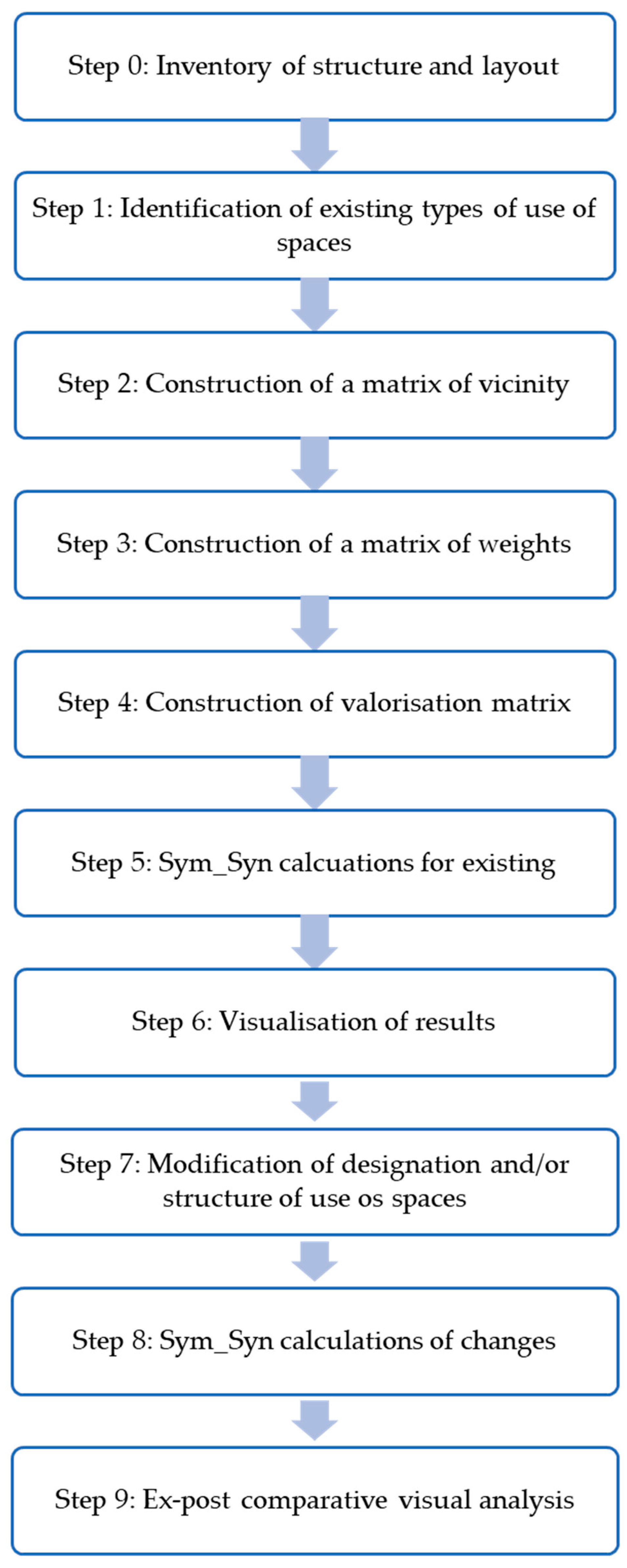
The principal assumptions and methodological details of the SyM_SyN Method are presented in the referenced article [41]. Conducting a study of the existing conditions of the street according to this method, and then forecasting changes, if the existing state is not suitable for its role in the structure of the city centre, should be carried out according to the steps described below (Figure 1).
Figure 1.
SyM_SyN process—order of activities. Source: own elaboration.
Step 0: An inventory of the uses of all urban (non-public) spaces adjacent to the public realm of the studied street was undertaken, followed by the systematic recording of the inventoried use structure within the sectional layout of the street under examination.
Step 1: The construction of a table to categorise the types of use and functional purpose of all non-public urban spaces adjacent to the public realm of the studied street, employing the necessary generalisation and classification of these uses. For the sake of comparable results, a unified table of recorded uses was developed for the entire length of the studied street. This standardisation was essential for the automated processing of the collected inventory data.
Step 2. The construction of a table (matrix) of the vicinity relations of inventoried urban spaces within the individual sections of the studied street was undertaken based on the recorded inventory structure of urban space use and the collective classification table of urban space use types. The representation of neighbourhood relations in the form of a graph was applied solely as an auxiliary tool.
Step 3: The construction of an assessment matrix (weights) for the neighbourhood relations, functional designations, and uses of urban spaces located along the studied street was undertaken based on two sources: (i) the table of neighbourhood relation levels with their assigned weights and (ii) the table of adjacency of the inventoried urban spaces within the respective street sections. A construction of an assessment matrix (weights) of the vicinity relations concerning the functional designations and uses of urban spaces located along the studied street was carried out on the basis of two reference sources: the table of neighbourhood relation levels with their assigned weights (see Table 1) and the table of adjacency of the inventoried urban places within the respective street sections.
Table 1.
Array (matrix) of types (levels) of neighbourhood relationships with respective weights.
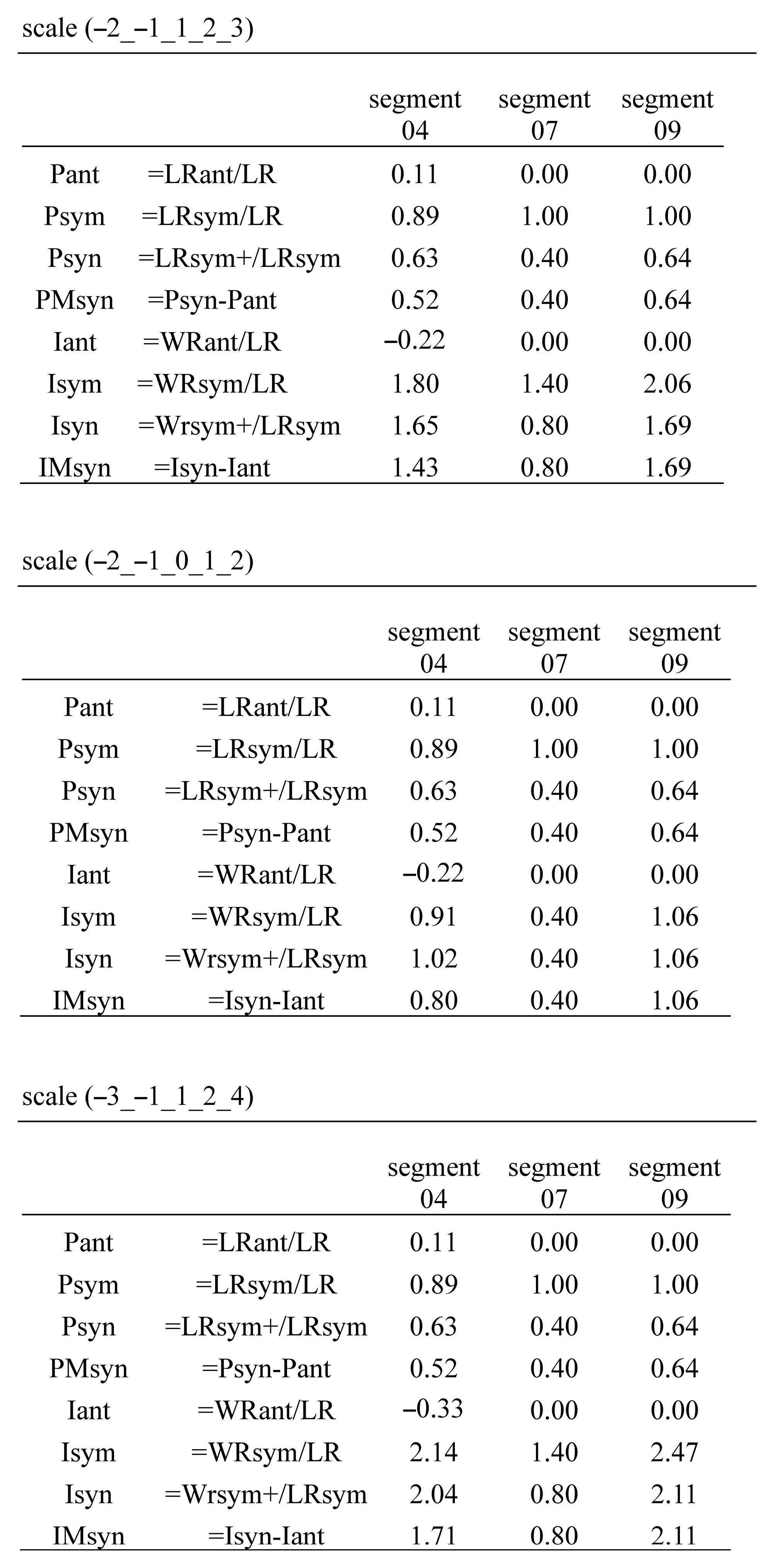
Neighbourhood relations arising from the differing functions of adjacent urban spaces can assume the values described above. A neutral (non-antagonistic) relation (0/0) is one in which neighbouring uses coexist in an indifferent manner: they neither impede each other’s functioning nor generate additional benefits (e.g., an industrial store and a notary’s office). At the other extreme, such a relation may be hypersymbiotic (++/++) (hypersymbiotic relation is that with synergy effect), whereby the uses complement one another in an exceptional way, forming an attractive functional complex (e.g., a theatre and a restaurant), or conversely, mutually antagonistic (−/−), where the uses are extremely detrimental to each other (e.g., a restaurant adjacent to an abandoned ruin). A symbiotic relation (+/+), in turn, arises when neighbouring uses create mutually advantageous conditions for functioning (e.g., the proximity of specialised industrial stores). A parasitic relation (−/+) occurs when one use benefits from the conditions generated by the neighbouring use, while offering no added value in return (e.g., an industrial store and a currency exchange office). Inevitably, such a detailed matrix of neighbourhood relations is specific and context-dependent for each city and its main street; however, as noted, general urban-planning principles characteristic of a given socio-cultural region remain applicable. The weights presented above are assigned in the simplest manner: a neutral relation is given a weight of (1); extreme relations receive weights of (−2) and (3); while intermediate relations are assigned absolute values of (−1) and (2). These values may, however, be modified—if necessary to enhance the clarity of results—for the purposes of a specific case. It is essential, of course, that within a single project a unified classification and weighting table is applied consistently. The purpose of defining the weights in this way is to facilitate comparative assessments of the degree of symbiosis and synergy across individual segments of the main street. Consequently, the weights are dimensionless and assigned by the research team in accordance with the principles described. Importantly, the substitution of other absolute values does not alter the validity of the comparative evaluation of measurement results between individual segments. The weighting scale of neighbourhood relations presented above and applied in this study was selected empirically, as it provided sufficient differentiation of the examined features across individual segments while avoiding the generation of excessively wide value ranges. Figure 2 below presents a comparison of the applied scale (−2, −1, 1, 2, 3) with two alternatives: one with a narrower weighting range (−2, −1, 0, 1, 2) and one with a wider range (−3, −1, 1, 2, 4), in the assessment of levels of symbiosis and synergy for the segments of Zwycięstwa Street analysed in detail in this paper.
Figure 2.
Comparative results of measuring the levels of symbiosis and synergy for selected segments of Zwycięstwa Street in Gliwice.
The above comparison confirms that the objective of analysing a main urban street with the SyM_SyN Method—that is, assessing the levels of symbiosis and synergy of urban space uses and their variation across individual street segments—is achieved irrespective of the adopted weighting scale, provided that the chosen scale is applied consistently throughout the study. The selected features (parameters) of symbiosis and synergy are constructed as relative and dimensionless; in this sense, the results remain valid regardless of the weighting scale used. Likewise, the comparative differentiation of symbiosis and synergy levels across the street segments is independent of the adopted scale, which ensures the reliability of the identified levels of imperfections. All proposed indicators were formulated to facilitate multidimensional comparisons of the levels of symbiosis and synergy across individual segments of the main street. In this regard, the interpretive validity of the results remains independent of the specific weighting system employed. Nevertheless, from a practical standpoint, the application of relatively low weighting values is recommended to prevent the generation of disproportionately large numerical outcomes.
Step 4: The construction of a valorisation matrix (assessment) of the neighbourhood relations of urban spaces within the studied section of the main street’s public space, based on the table of assessment (weights) of neighbourhood relations. This matrix serves as the starting point for evaluating both the neighbourhood patterns and the diversity of the analysed street sections.
Step 5: The calculation of the required measures according to the adopted SyM_SyN Method for the individual sections of the public space of the studied street.
A set of calculation formulas is presented below, in accordance with the principles of the SyM_SyN Method [41]. The specific measures of symbiosis and synergy are provided in the Section 4.4.
The number of recorded neighbourhood relations (LR) within a unit of public space, in comparison with its adjacent units, may serve as an indicator of that unit’s complexity. In graph-theoretical terms, this corresponds to the degree of the vertex, where the vertex represents the urban place.
The level of symbiosis in the study area (PsyM) can be measured as a fraction, defined as the ratio of the sum of neutral, symbiotic, and hypersymbiotic relations (LRsyM) to the total number of neighbourhood relations (LR).
when
PsyM = LRsyM/LR
LRsyM = LR (0/0) + LR (+/+) + LR (++/++),
Synergy may be regarded as a measure of the advancement of symbiotic relations within a public space unit. The level of synergy (PsyN) can be defined as the ratio of the number of symbiotic and hypersymbiotic relations (LRsym+) to the total number of positive relations (LRsyM).
when
and
PsyN = (LRsym+)/LRsym
LRsym+ = LR (+/+) + LR (++/++)
LRsyM = LR (0/0) + LR (+/+) + LR (++/++).
The above measurement seems to be particularly significant for individuals with a very high level of symbiosis, i.e., a PsyM value close to 1.00.
A measure of the level of conflicting neighbourhoods in the study area (Pant) can be expressed as a fraction, defined as the ratio of the sum of antagonistic and parasitic relations (LRant) to the total number of neighbourhood relations (LR).
when
Pant = LRant/LR
Pant = LRant/LR
A score of 1.00 indicates the maximum level of antagonism, that is, the complete absence of neutral or symbiotic relations. Conversely, a score approaching 0 reflects a high level of symbiosis between the uses of urban spaces.
For cases in which a significant number of strong antagonistic relations are present (with PsyM substantially lower than 1.00), it appears reasonable to account for the negative impact of these relations on the overall level of synergy. Accordingly, it has been proposed to measure the moderate level of synergy (PMsyN) as the difference between the level of synergy (PsyN) and the level of antagonism (Pant).
PMsyN = PsyN − Pant
The proposed measurement is formulated to quantify the detrimental influence of antagonistic and parasitic interactions on the performance and quality of discrete public space units. Within this framework, urban structural transformation is operationalized as a process aimed at amplifying synergistic effects through the systematic reconfiguration of spatial utilisation patterns and functional allocations. Consequently, the development of a diagnostic instrument capable of estimating the potential magnitude of symbiosis is required. This instrument serves as a quantitative basis for both modelling the emergence of synergy and evaluating the extent to which synergistic conditions are achieved within the urban system. Thus, two measures were proposed, referred to as the intensity of symbiosis (IsyM) and the intensity of synergy (IsyN). Their calculation is based not only on the number of relations (LR), but also on the assigned weights of relations (WR) for individual groups of interactions. This assumption derives directly from the premise that symbiotic and hypersymbiotic relations are of primary importance for determining both the level and intensity of symbiosis and synergy within the studied unit of public space: the greater the number of hypersymbiotic relations, the higher the quality of the public space unit.
The measure of symbiosis intensity within the studied unit (IsyM) is expressed as a fraction, defined as the ratio of the sum of the weights of neutral, symbiotic, and hypersymbiotic relations (WRsym) to the sum of all positive neighbourhood relations (LRsym).
IsyM = WRsym/LR
The measure of the intensity of synergy within the studied unit (IsyN) is expressed as a fraction, defined as the ratio of the sum of the weights of symbiotic and hypersymbiotic relations (WRsym+) to the total number of symbiotic, hypersymbiotic, and neutral neighbourhood relations (LRsym+).
IsyN = WRsym+/LRsym
In cases where a high level of antagonistic relationships (Pant) is observed, it is advisable to examine the moderate intensity of synergy (IMsyN), analogous to the previously introduced measure of the moderate level of synergy (PMsyN). Accordingly, it is proposed to define IMsyN as the difference between the level of synergy (IsyN) and the level of antagonism (Iant), expressed as the absolute value of the resulting calculation.
or alternatively, IMsyN may be defined as the sum of the level of synergy (IsyN) and the level of antagonism (Iant), with the outcome expressed directly as the numerical result of the calculation (a negative value in cases where negative weights are applied).
IMsyN = IsyN − [Iant]
IMsyN = IsyN + Iant
It should be noted that all the measures presented are relative and are intended for use exclusively in comparative analyses within a specific project, where the basic assumptions embedded in the tables are applied consistently and without alteration. These measures are inherently relative, and the results obtained are valid only within the scope of a single project, in which a uniform matrix of neighbourhood weights is employed consistently across all calculations. The proposed weights assigned to individual relationships are likewise relative. In projects yielding highly similar outcomes, it is possible to adjust them systematically by applying scaling procedures and by introducing a non-zero value for the neutral relationship.
Step 6: Collective visualisation of the results of the calculated measures, obtained in accordance with the adopted SyM_SyN Method, for the individual sections of the public space of the analysed street in its existing state. The method of visualisation should be selected to facilitate the assessment of the quality of each street section.
In cases where certain sections—or the entire street—receive low ratings, it is advisable to redesign the use of spaces generating negative (antagonistic or parasitic) relations, redirecting them towards the creation of symbiotic and synergistic, or at the very least neutral, relations. Following such transformations, the state of street development should be reassessed, this time reflecting the modified (corrected) configuration
Step 7: The recording of the modified (corrected) structure of use (reflecting the existing state) and functional purpose (reflecting the redesigned state) of non-public urban spaces adjacent to the public space of the studied street. This is carried out for individual sections, using the generalised classification of uses, after replacing incompatible functions with those consistent with the character of the street.
Step 8: Calculation of the measures under study in accordance with the adopted SyM_SyN Method, applied to the individual sections of the public space of the studied street.
Step 9: Collective visualisation of the results of the calculated measures, obtained in accordance with the adopted SyM_SyN Method, for the individual sections of the public space of the analysed street in its existing state. The method of visualisation should be the same as for step 6 to facilitate the collective comparative visualisations and validation.
Step 10: Collective comparative visualisation of the results of the calculated measures, obtained according to the adopted SyM_SyN Method, for the individual sections of the public space of the studied street following the introduction of corrective changes. The method of visualisation should be chosen to facilitate the evaluation of the quality of each section of the street.
4. Application of SyM_SyN Method—A Case of Zwycięstwa Street in Gliwice, Poland
4.1. History of Zwycięstwa Street in Gliwice
Historically structured European city centres have been organised around public spaces comprising a market square and/or a principal urban street. From a historical perspective, this spatial arrangement reflects the legacy of towns and cities founded under the Magdeburg Law and its derivative legal frameworks, and, where located within the limes imperio, the Roman castrum with its cardo and decumanus, reinterpreted during subsequent historical development.
The central space of Gliwice—a city situated in the western part of the Upper Silesian Metropolis (close to the limes metropoliae)—exemplifies such a structure, consisting of a modest medieval market square integrated with the city’s main street. The latter extends from the square to its terminus at the railway station, which may be regarded as an industrial-era counterpart to the medieval market square.
Zwycięstwa Street in Gliwice was laid out in the 1880s. Structurally, it constitutes both a pedestrian and vehicular link between the Old Town and the railway station, opened in October 1845. The form and character of Zwycięstwa Street are significantly shaped by its intersections with transverse streets, which together define the basic street network of Gliwice’s city centre. Its public space is framed by consistently preserved perimetral development, composed predominantly of nineteenth-century tenement houses with commercial and service premises on the ground floors. In this study, these premises are referred to as urban sites. They determine the character of the public space of Zwycięstwa Street and, most importantly, constitute the subject of analyses concerning the formation of this street in terms of the use and functional designation of urban sites [39].
Over the past four decades, seemingly chaotic transformations of this space have resulted in a condition whereby the Old Town—intra muros (bounded by Lower Embankments [Dolne Wały] and Upper Embankments [Górne Wały] Streets)—revitalised in many respects, has become an attractive area primarily oriented towards social gatherings. By contrast, Zwycięstwa Street has lost much of its identity, once remembered from the 1960s and 1970s.
- Considering this situation, it is both justified and necessary to investigate the formative condition of this street in terms of the structure of urban space use, with a view to addressing the following research questions: ‘why did Zwycięstwa Street cease to function as a significant meeting place?’,
- What actions, particularly concerning the structure of urban space use, should be undertaken to restore Zwycięstwa Street as an attractive and desirable place for meetings and exchanges for the users of Gliwice? This question is also relevant from the perspective of balancing the use of urban spaces and enhancing their sustainability, as reflected in the requirements of the smart city paradigm.
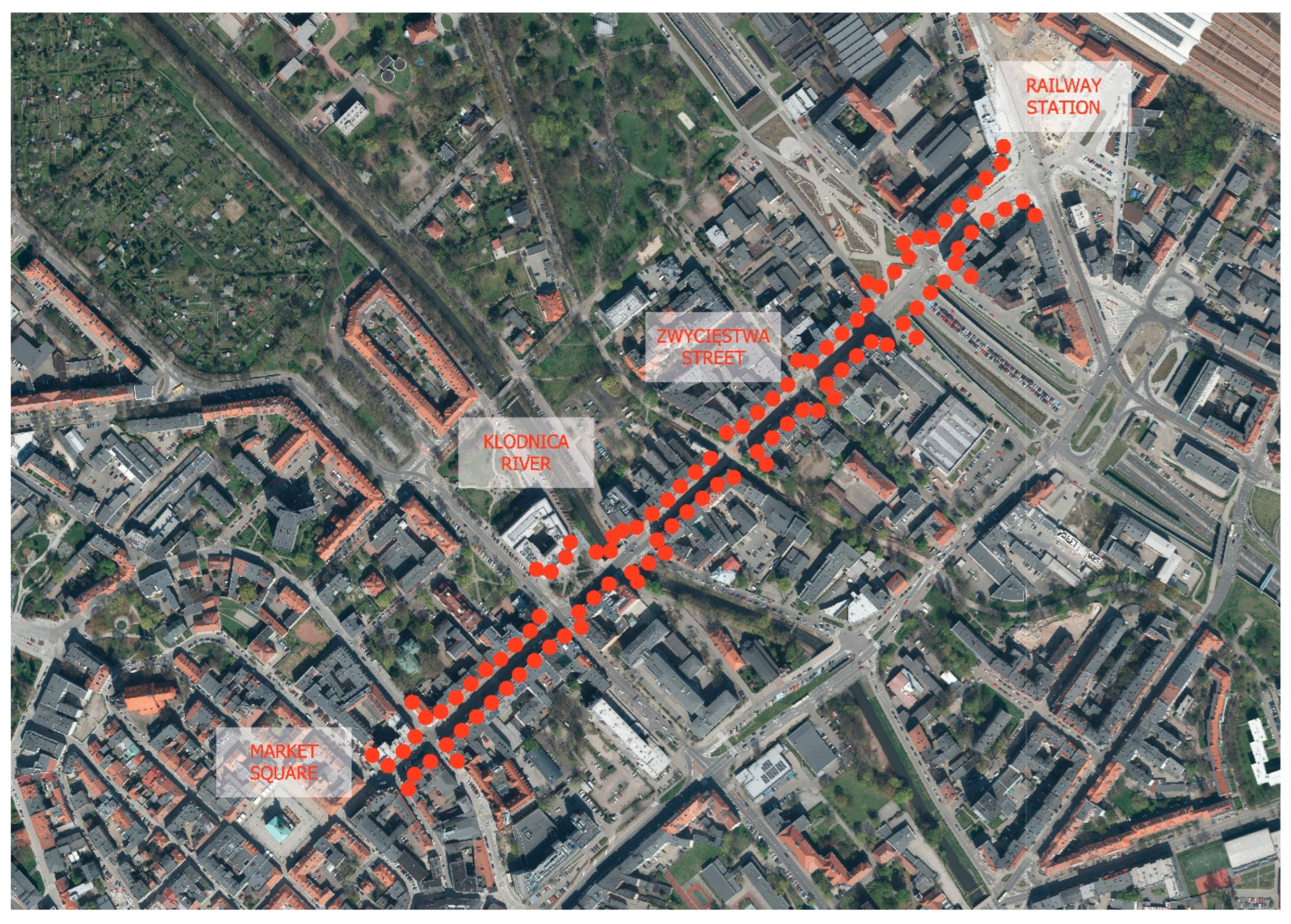
As noted above, this street extends over a considerable length (approximately 900 m) and is divided by intersections into ten sections of comparable size. The research assumes that the structure of urban space use within individual sections is not fully consistent with the intended function of the street, and that the degree of inconsistency varies significantly between sections. Consequently, Zwycięstwa Street fails to achieve a coherent character along its entire length, one that would be aligned with its role within the urban structure of public space. The location of Zwycięstwa Street in the centre of Gliwice is shown in Figure 3.
Figure 3.
Location of Zwycięstwa Street in the city centre of Gliwice.
Based on a clarification of the concepts of symbiosis and synergy as applied to the context of Zwycięstwa Street, studies and forecasts concerning the structure of space use were prepared. These analyses employed comparative measures appropriate to the respective phases—namely, the existing state and the modernised (corrected) state—as well as to the specific spatial and temporal framework of Zwycięstwa Street in Gliwice.
This research concentrates on the structure of urban places use along Zwycięstwa Street in the city centre of Gliwice. Its primary focus is the identification and assessment of symbiosis and synergy among diverse uses within this area, with the aim of fostering greater integration, cohesion, and the restoration of the street’s historical role as a meeting place. This issue is particularly significant considering the street’s function as the city’s principal thoroughfare.
Where there is reason to suspect that the street lacks a uniform character, it becomes essential to examine this heterogeneity by comparing the levels of symbiosis and synergy across its various sections.
4.2. Inventory of the Layout of Zwycięstwa Street in Gliwice
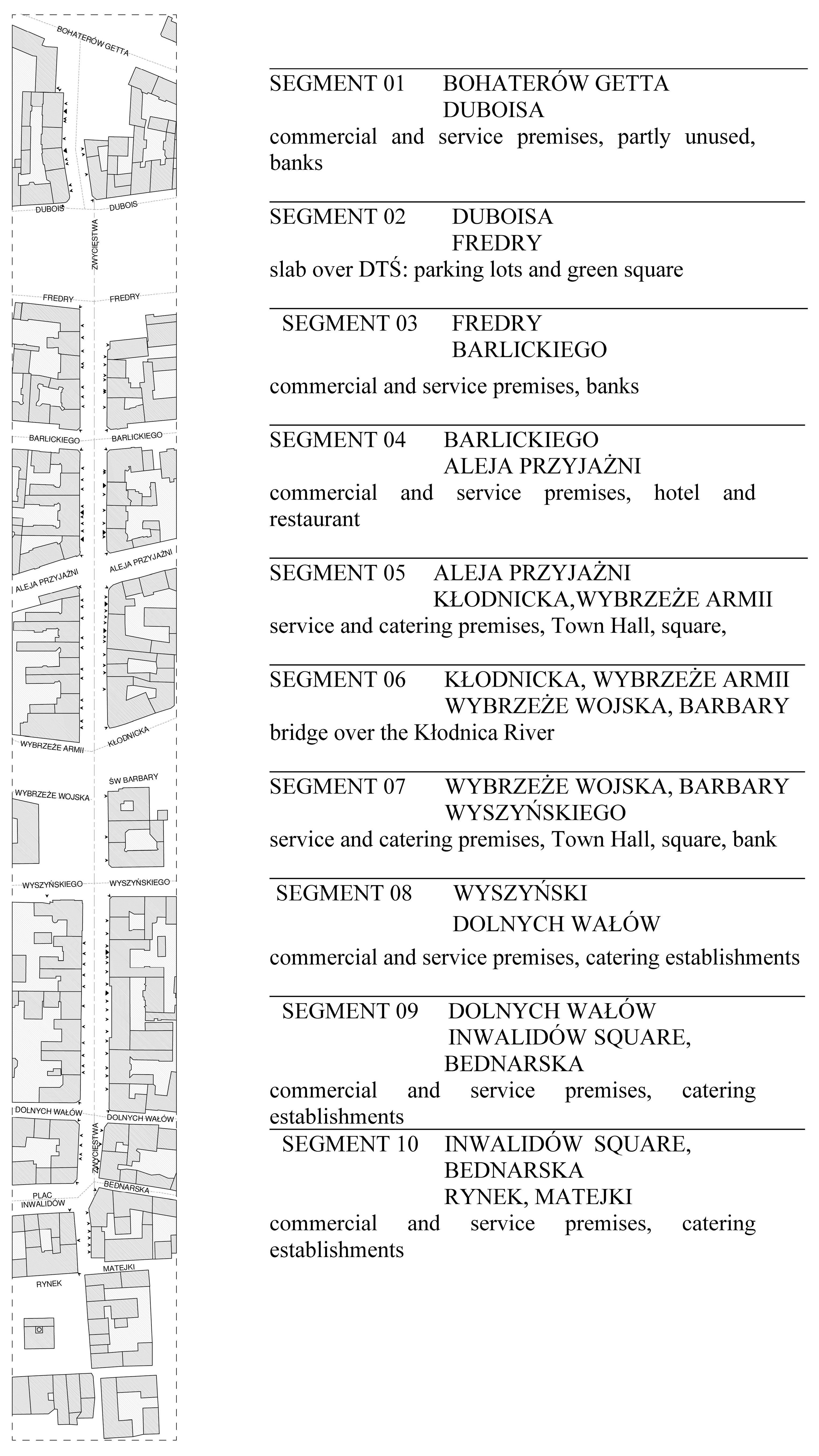
According to the method outlined in Section 3 of the paper, the street was divided into segments based on their location in relation to the intersecting streets. The layout of these segments is presented in the accompanying Figure 4. At the same time, the dominant functions present within each section were identified.
Figure 4.
Segmentation of Zwycięstwa Street in the city centre of Gliwice.
The starting point for the analytical work was a standard inventory of the existing uses of urban areas; specifically commercial and broadly defined service premises located on the ground floors of tenement houses along Zwycięstwa Street. Owing to their lesser significance for the character of the street, commercial premises situated on the upper floors of certain tenement houses were excluded from the analysis. Together with residential apartments, these constitute an urban background typical of inner-city areas, but one of secondary importance to the street’s role as a place of exchange and social interaction.
As part of the urban inventory, a general review of the technical condition of buildings along Zwycięstwa Street was also conducted, providing material for assessing the usefulness of the existing development and its susceptibility to revitalisation.
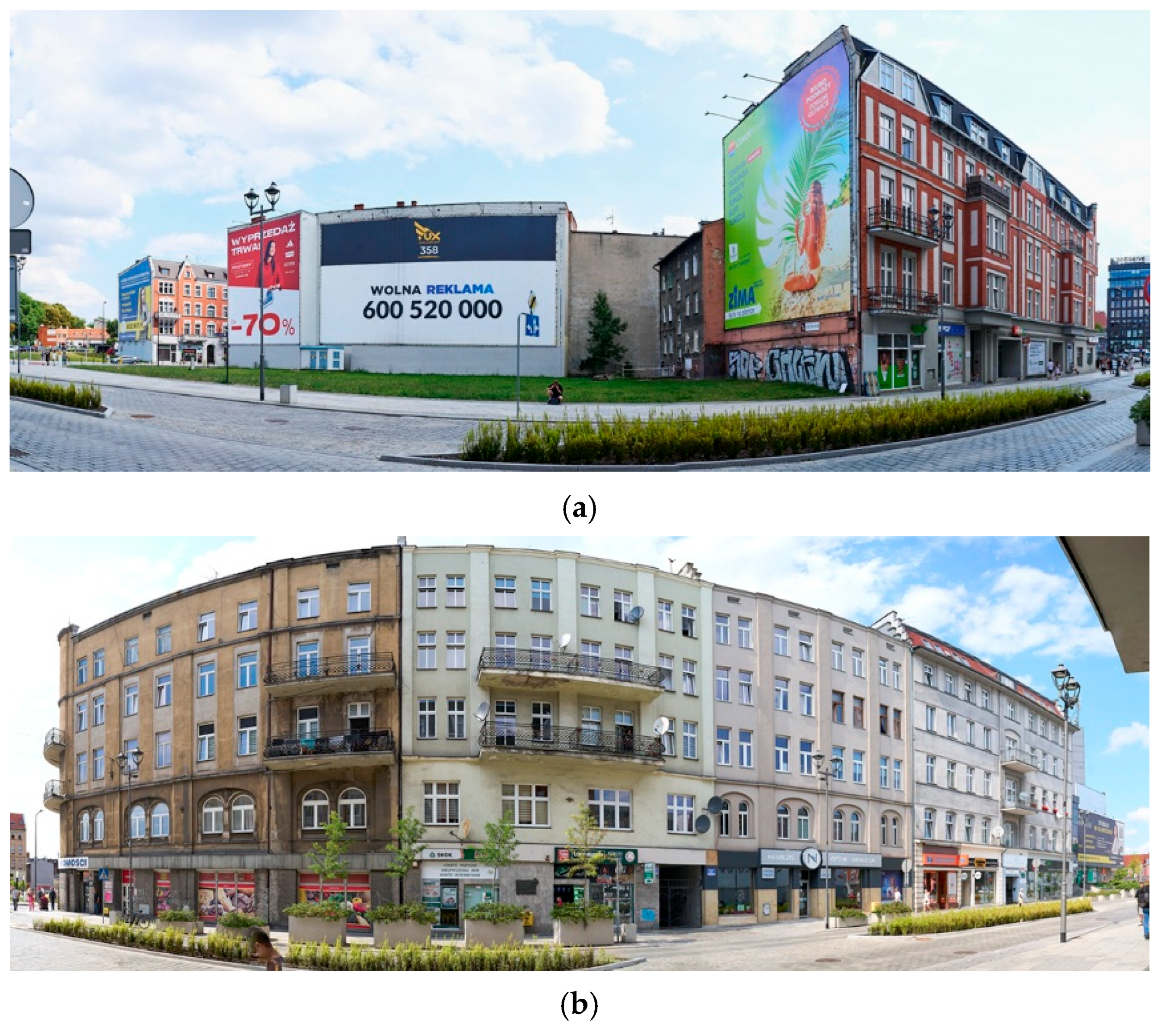
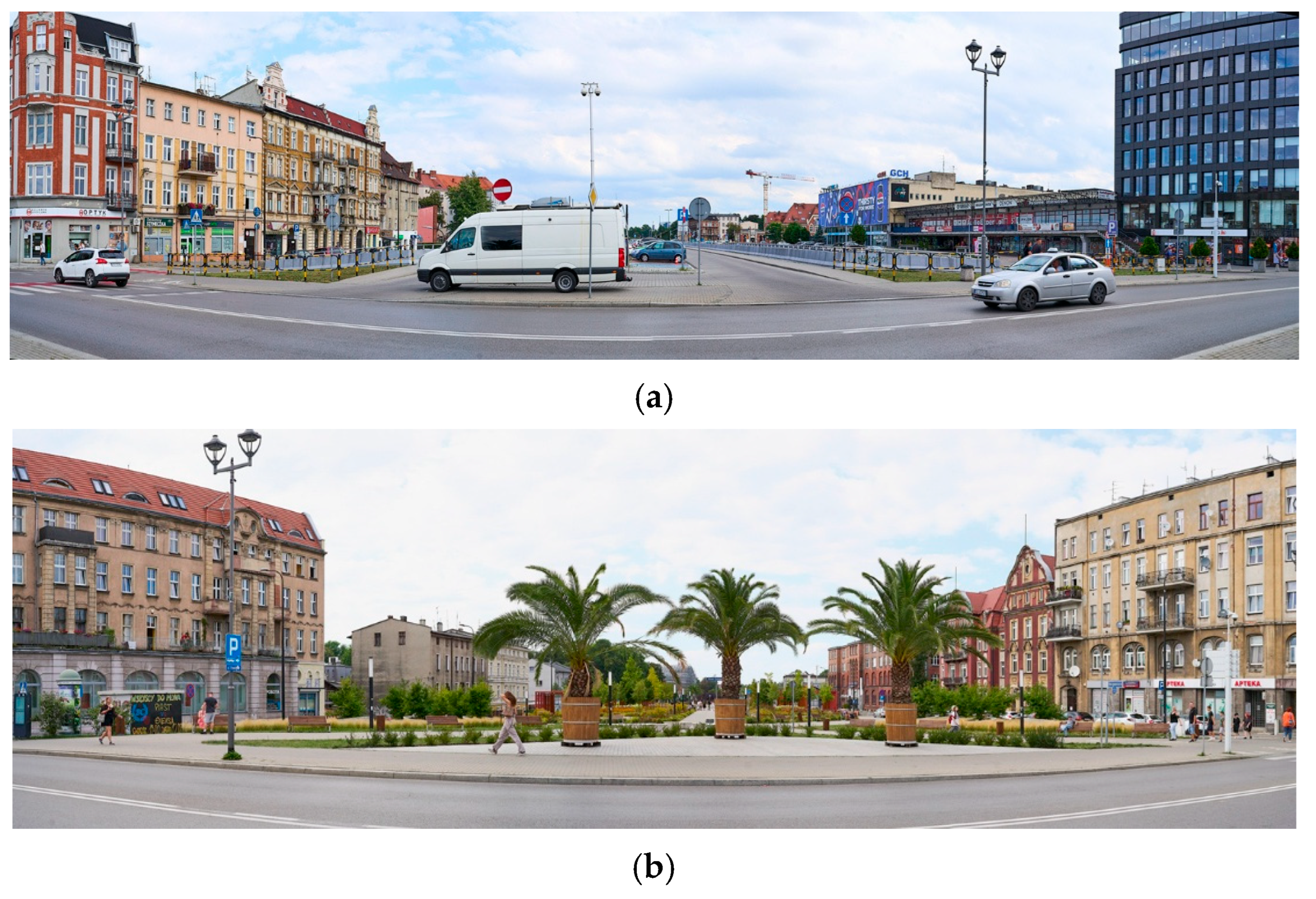
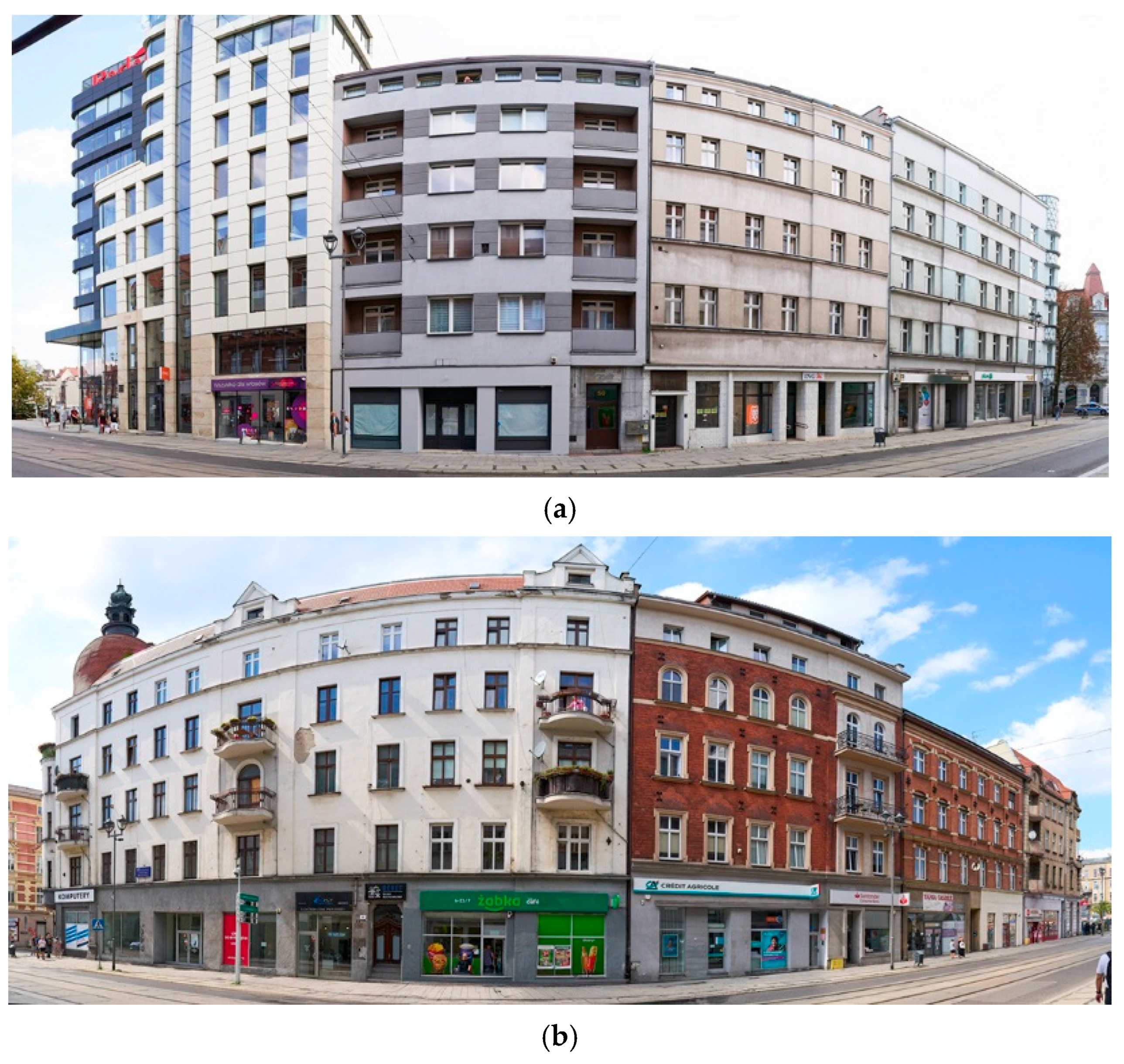
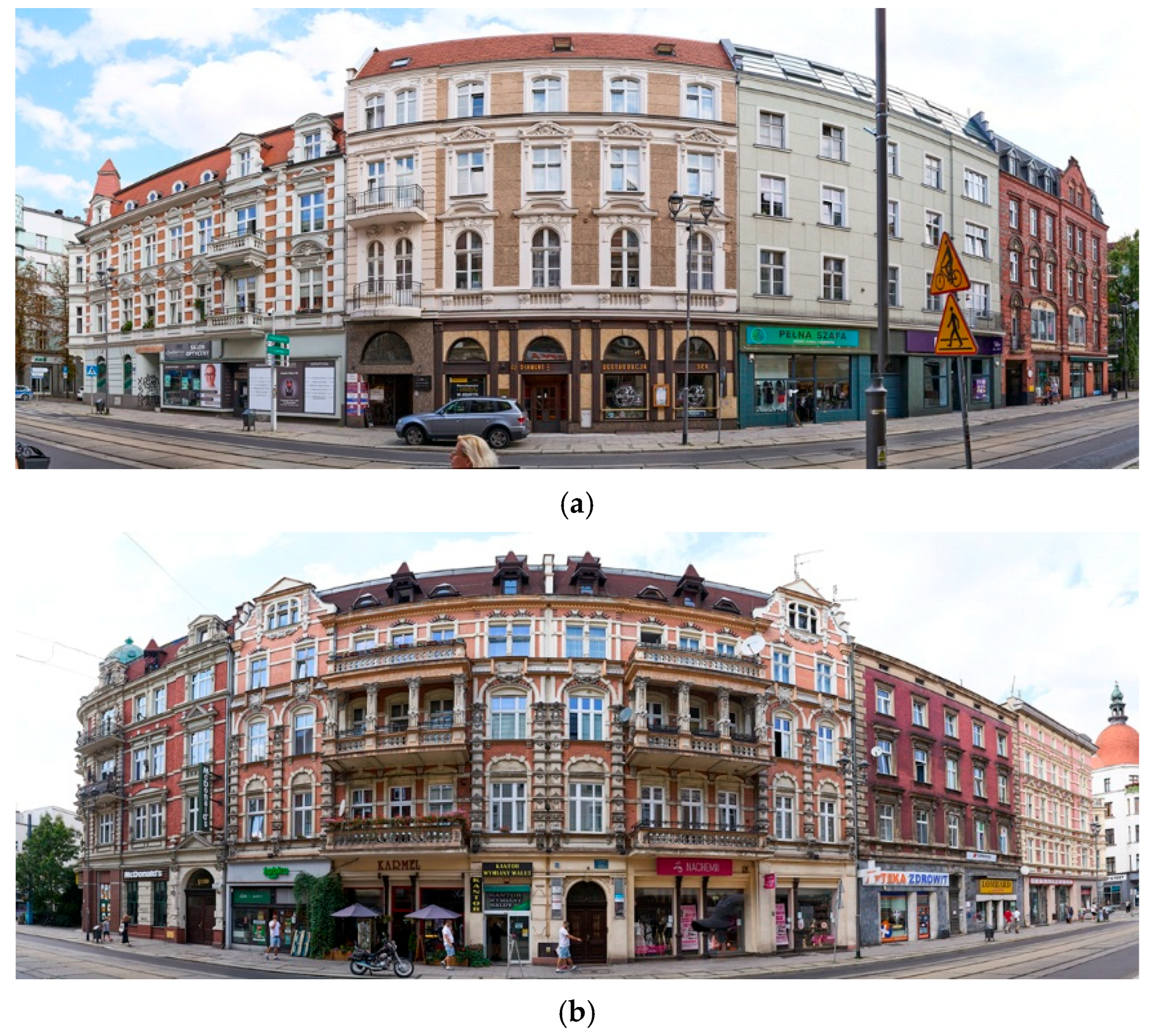
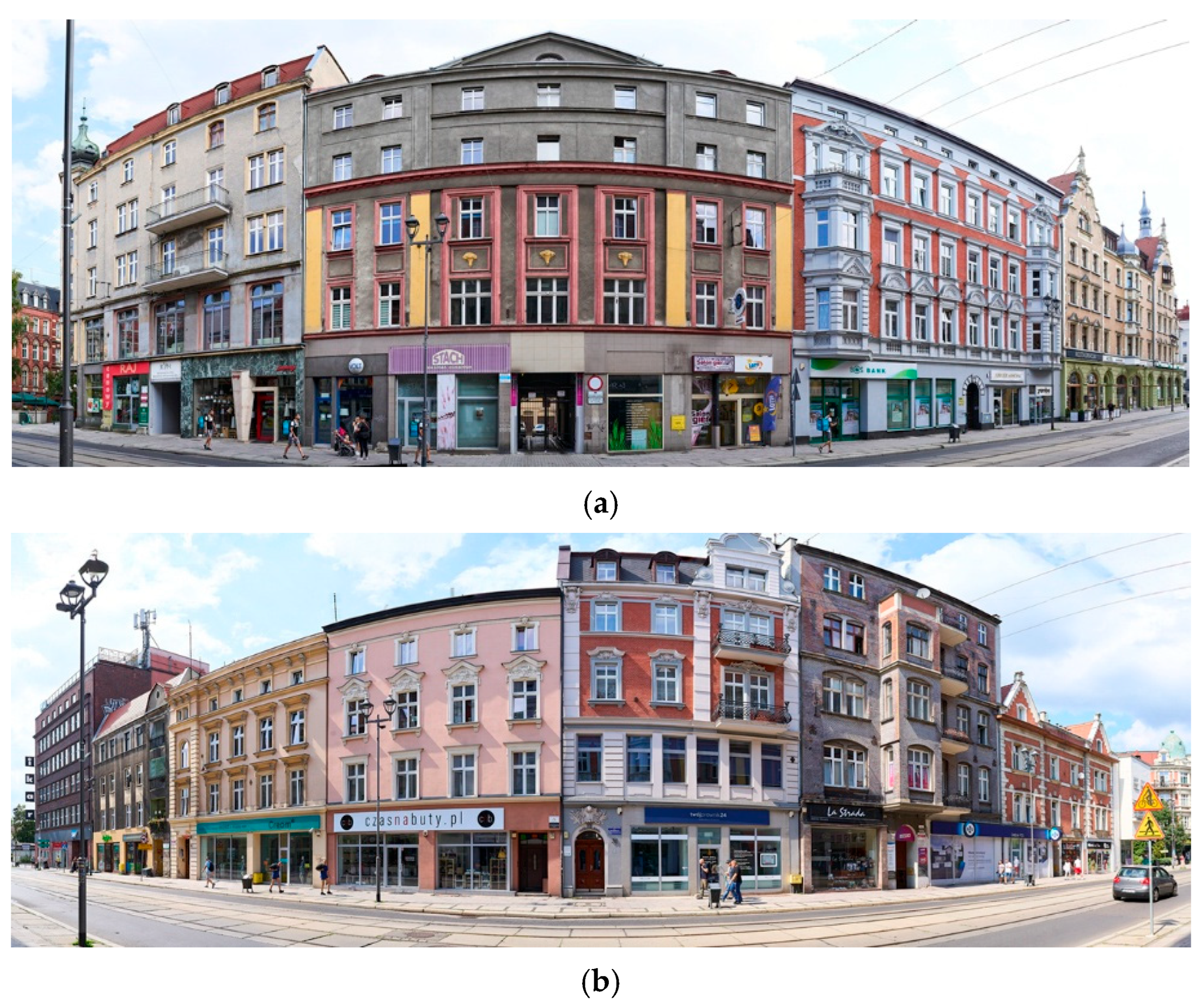
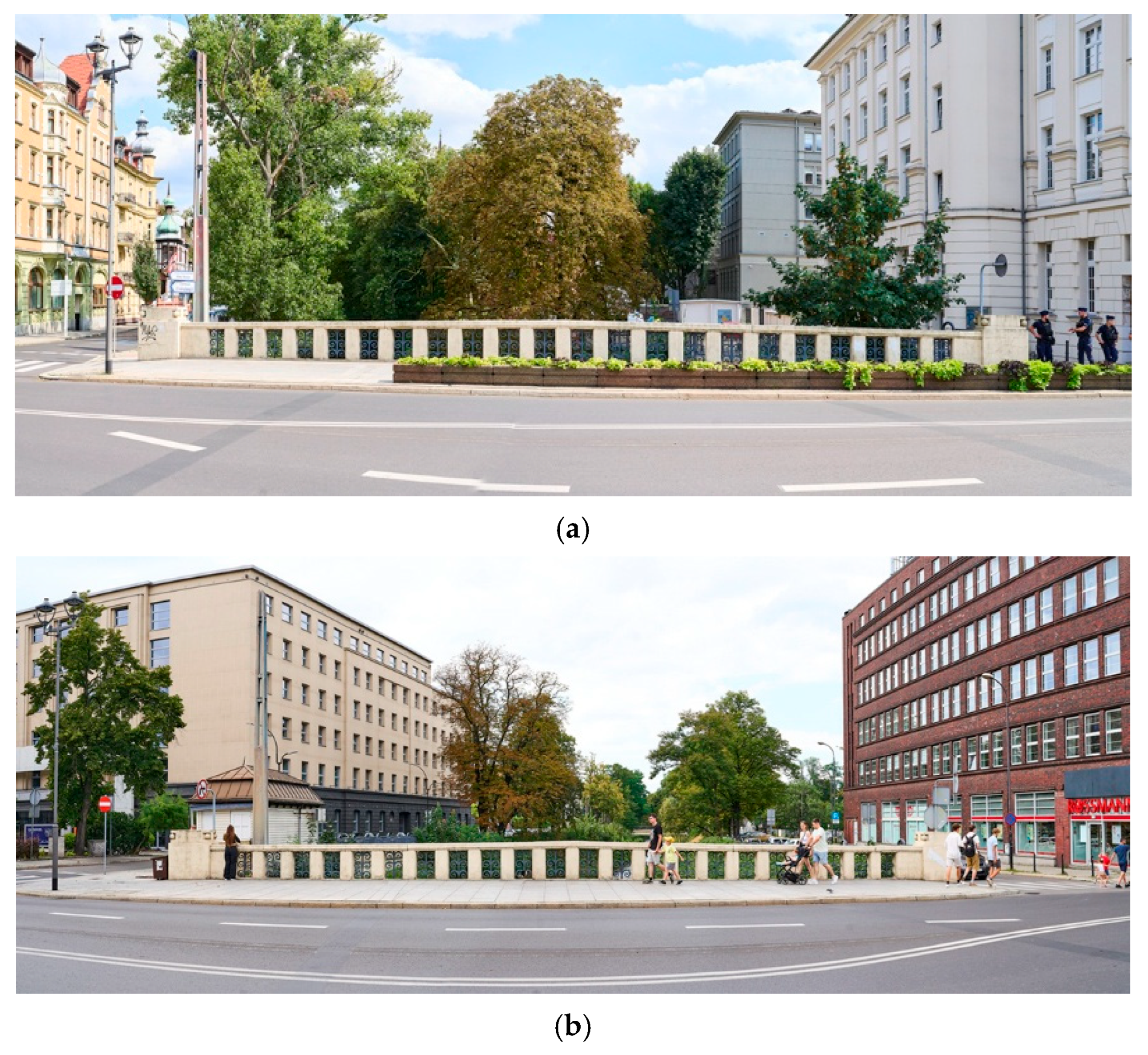
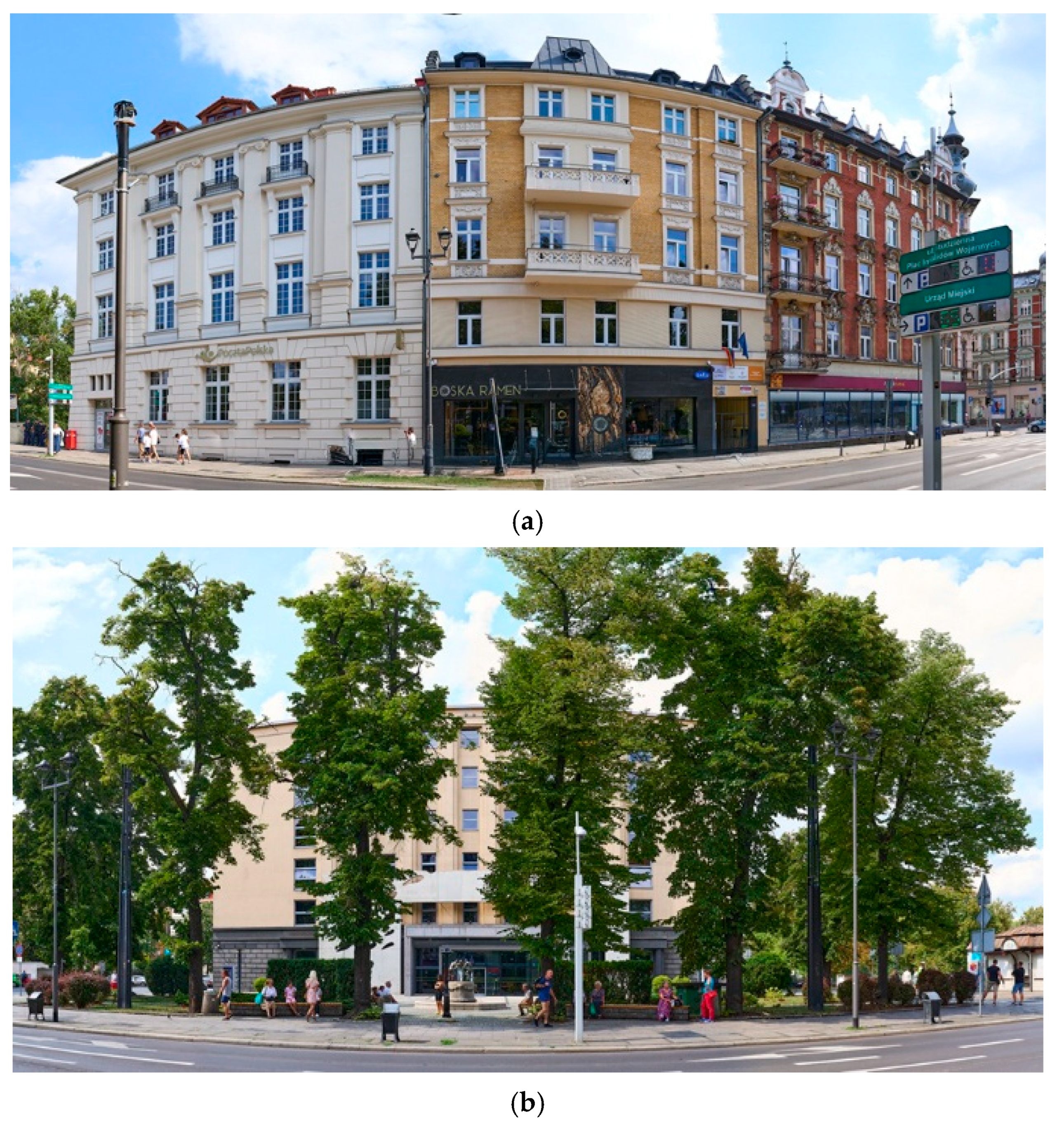
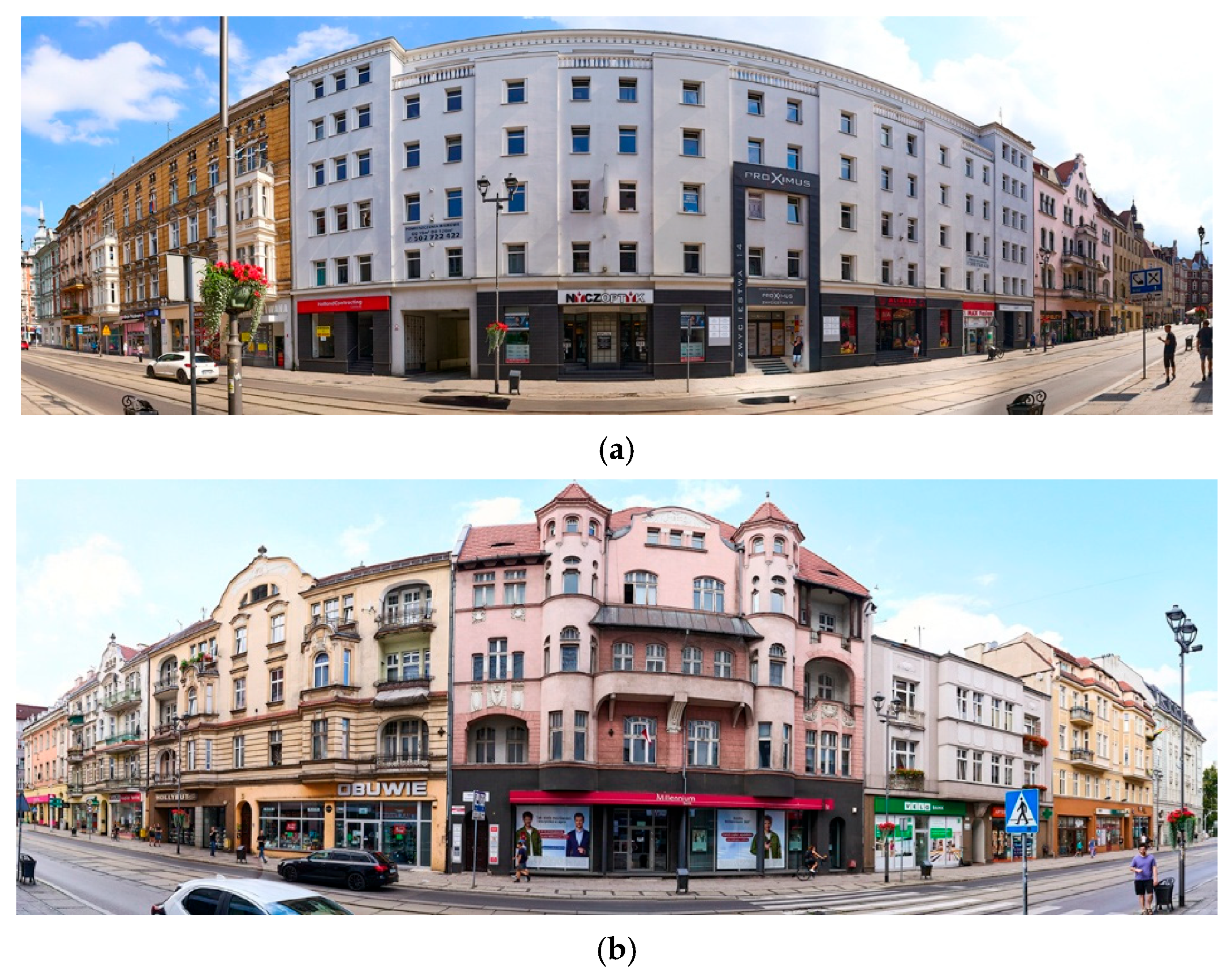
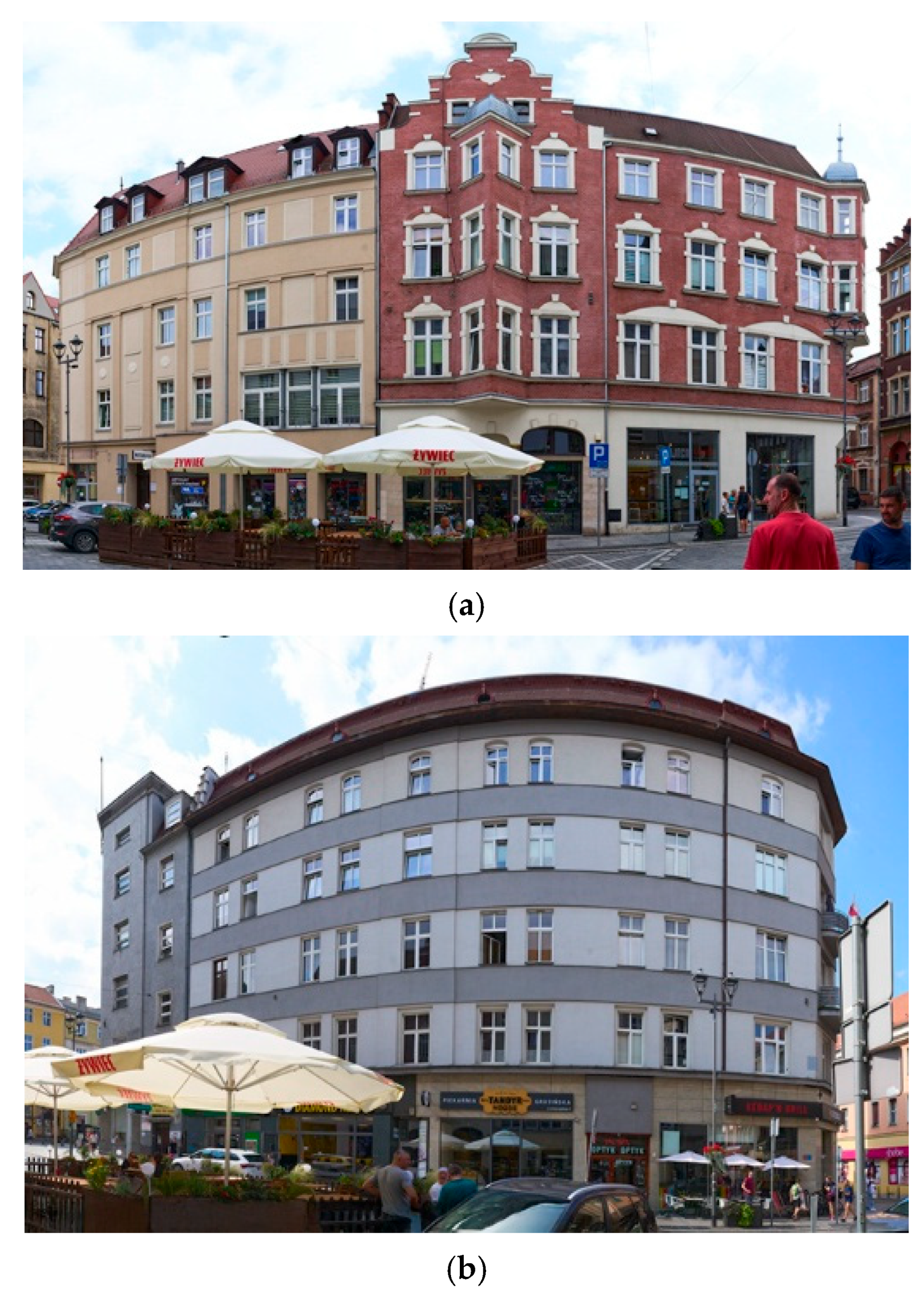
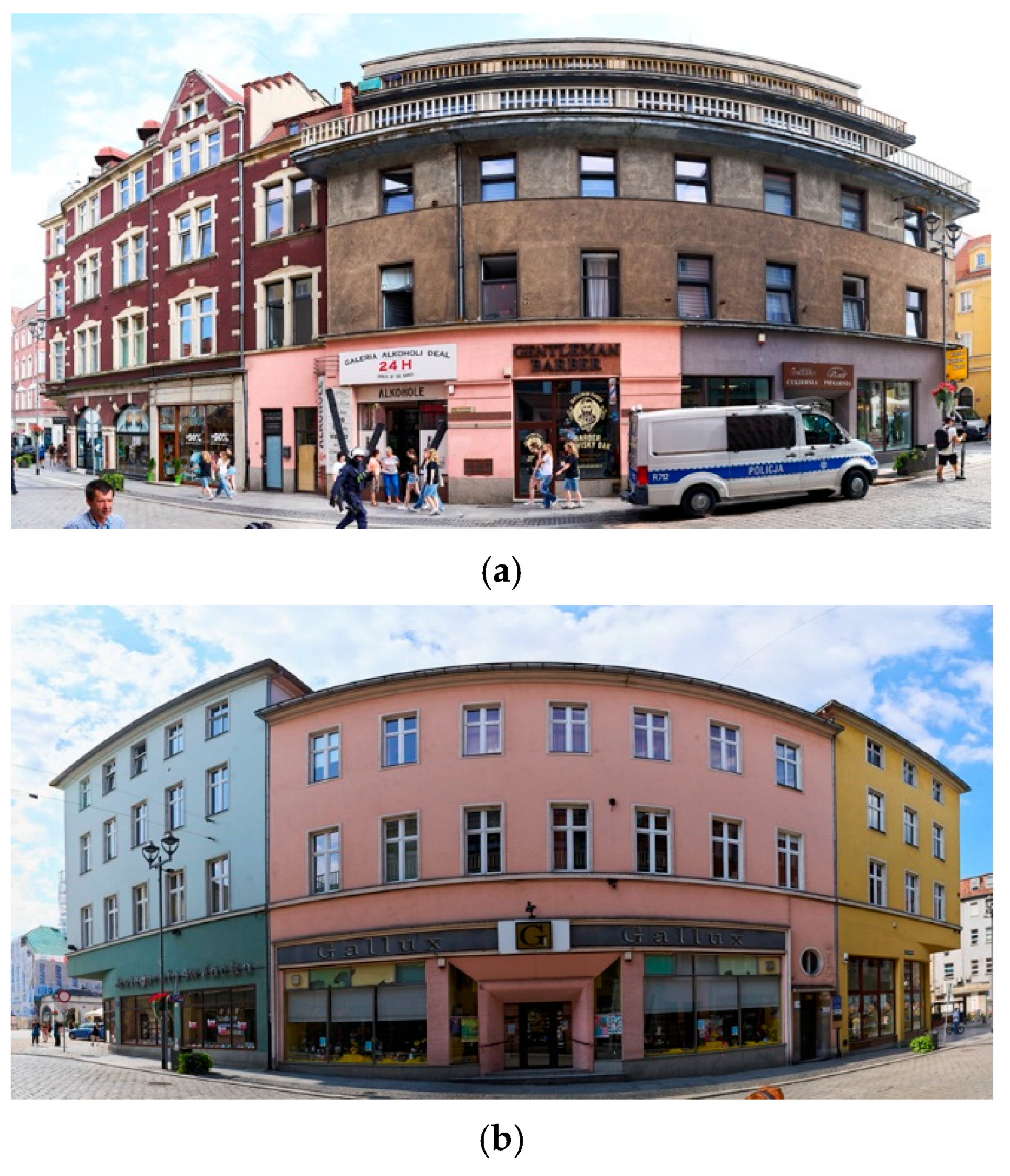
The inventory of urban places use along Zwycięstwa Street is presented in the following panoramic photographs (see Figure 5, Figure 6, Figure 7, Figure 8, Figure 9, Figure 10, Figure 11, Figure 12, Figure 13 and Figure 14 below).
Figure 5.
Segment 01 of Zwycięstwa Street in the city centre of Gliwice, (a) left (north)-side view, (b) right (south)-side view.
Figure 6.
Segment 02 of Zwycięstwa Street in the city centre of Gliwice, (a) left (north)-side view, (b) right (south)-side view.
Figure 7.
Segment 03 of Zwycięstwa Street in the city centre of Gliwice, (a) left (north)-side view, (b) right (south)-side view.
Figure 8.
Segment 04 of Zwycięstwa Street in the city centre of Gliwice, (a) left (north)-side view, (b) right (south)-side view.
Figure 9.
Segment 05 of Zwycięstwa Street in the city centre of Gliwice, (a) left (north)-side view, (b) right (south)-side view.
Figure 10.
Segment 06 of Zwycięstwa Street in the city centre of Gliwice, (a) left (north)-side view, (b) right (south)-side view.
Figure 11.
Segment 07 of Zwycięstwa Street in the city centre of Gliwice, (a) left (north)-side view, (b) right (south)-side view.
Figure 12.
Segment 08 of Zwycięstwa Street in the city centre of Gliwice, (a) left (north)-side view, (b) right (south)-side view.
Figure 13.
Segment 09 of Zwycięstwa Street in the city centre of Gliwice, (a) left (north)-side view, (b) right (south)-side view.
Figure 14.
Segment 10 of Zwycięstwa Street in the city centre of Gliwice, (a) left (north)-side view, (b) right (south)-side view.
4.3. Inventory of Current Uses of Urban Places of Zwycięstwa Street in Gliwice
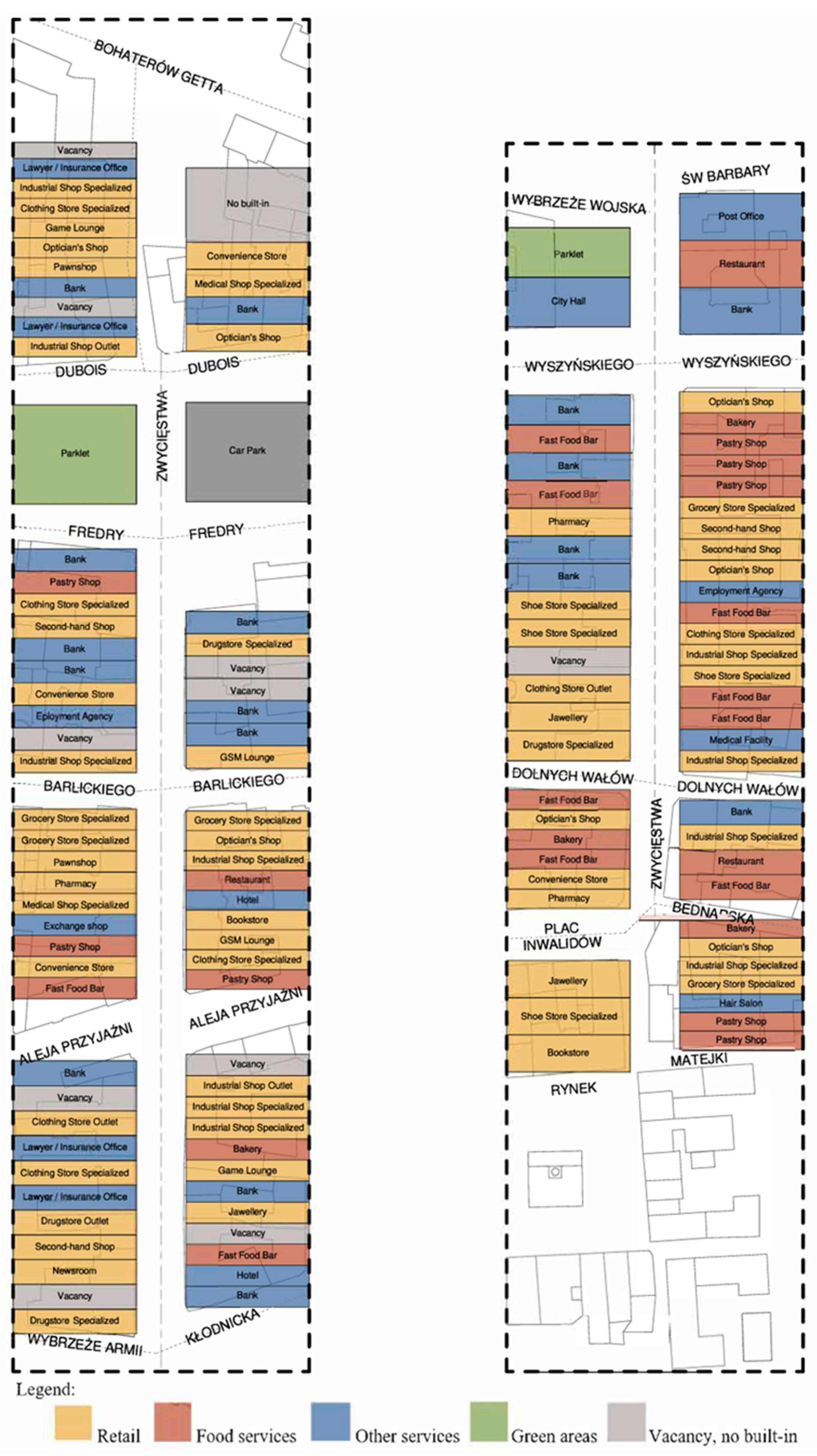
According to the method outlined in Section 3 of the paper, the current uses of urban places distributed along Zwycięstwa Street are presented in the following figure (Figure 15).
Figure 15.
Inventory of current uses of the urban places along Zwycięstwa Street.
Due to the block-based character of the urban structure in this part of the city, the public space of Zwycięstwa Street was divided into sections naturally delineated by its intersections with transverse streets. These sections are hereafter referred to as segments. In accordance with the methodological principles adopted for this analysis, the designated segments of Zwycięstwa Street’s public space constitute the units of detailed assessment.
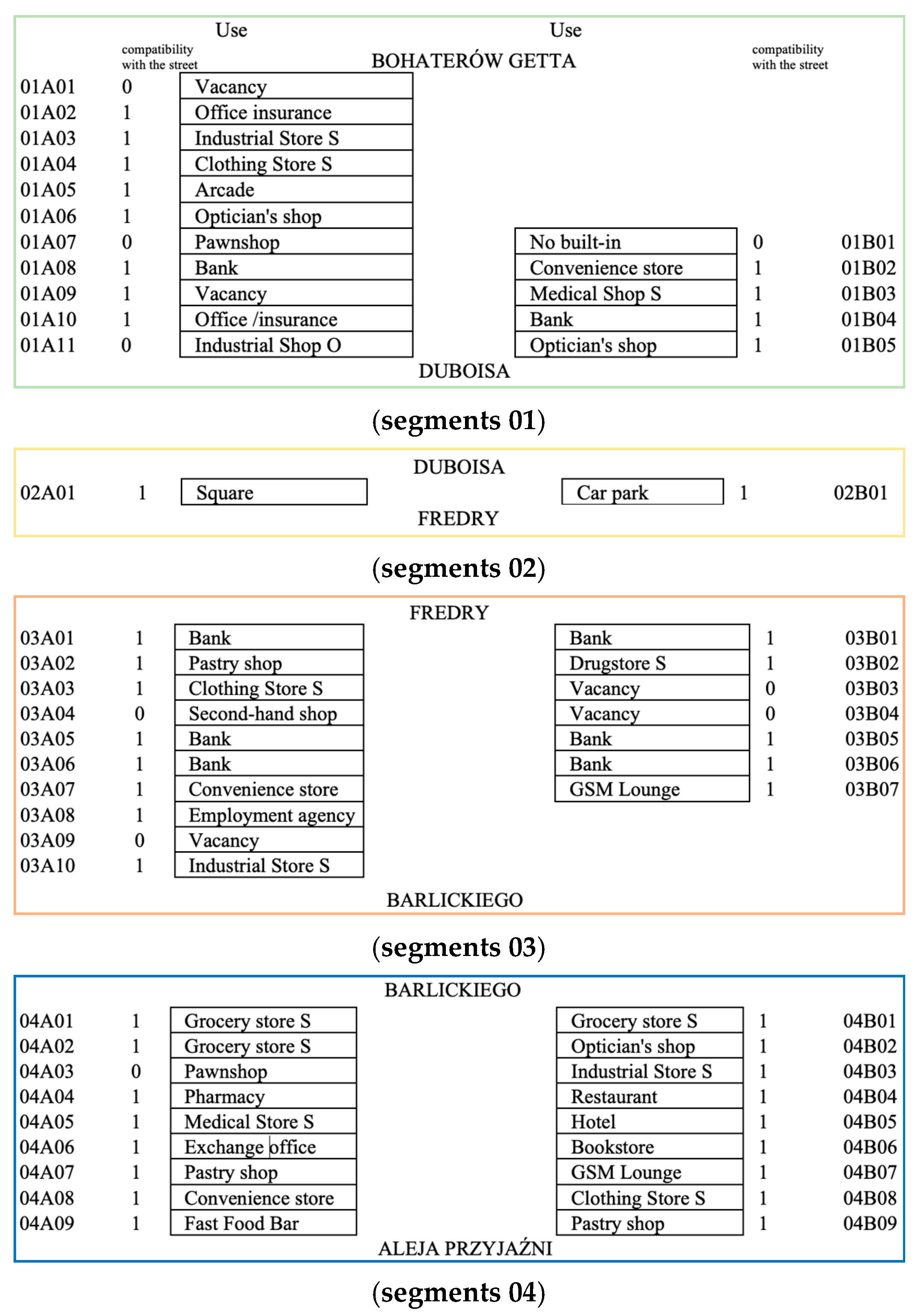
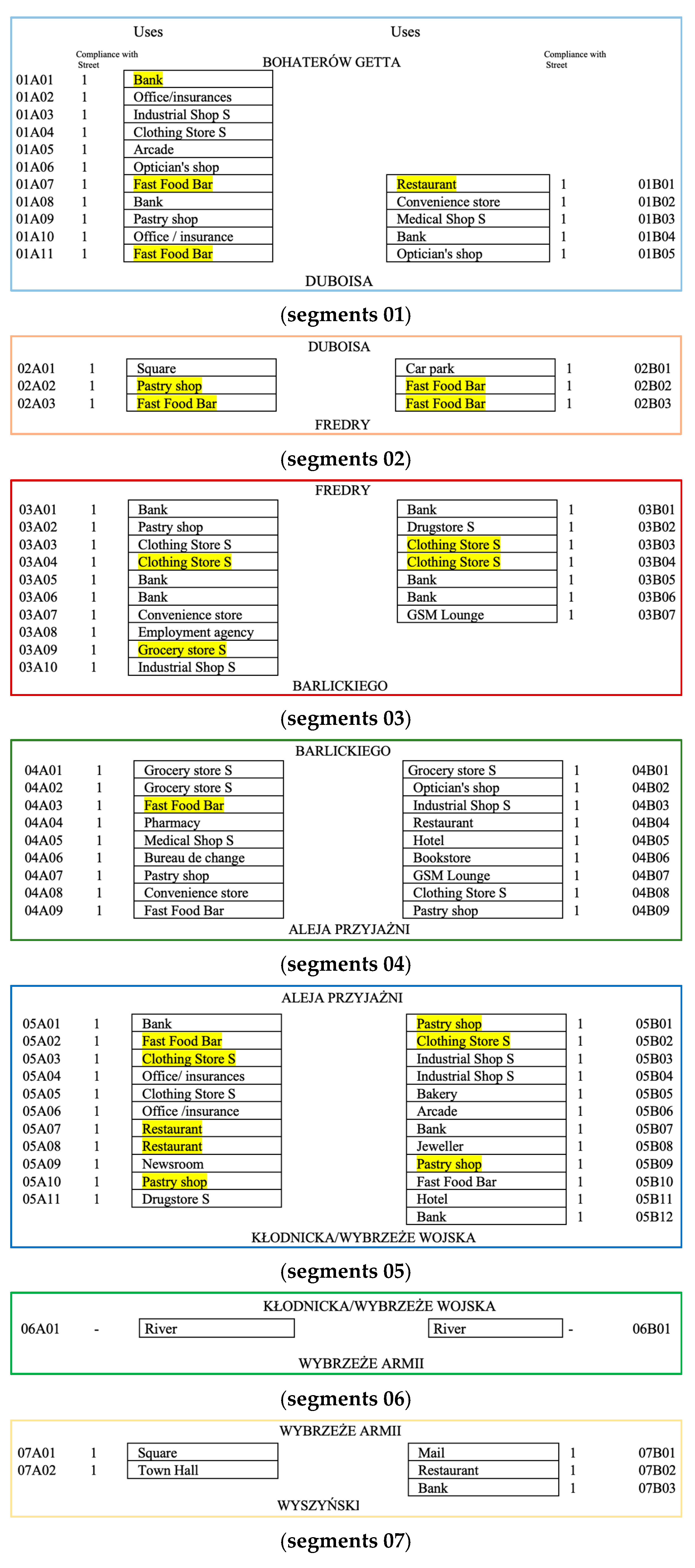
To enable the analyses to be conducted efficiently and objectively, a simplified classification of urban areas by use was introduced, allowing the assessment to be based on generalised categories of use. For each segment, every individual urban place was assigned a unique identification number (label) and assessed in terms of its compatibility with the character of the street. The results of this procedure are presented in the Figure 16.

Figure 16.
Evaluation of consistency of urban places along Zwycięstwa Street with its character (segments 01–10).
The analysis of the inventory results made it possible to formulate the following assessments:
- The ground-floor premises of the tenement houses along Zwycięstwa Street accommodate uses that are consistent with its character as the city’s main street but also uses that are entirely contradictory to this character, thereby degrading its role as the principal urban space.
- A significant proportion of the premises remain vacant, which appears both as a consequence and as a manifestation of the declining importance of the main street within the structure of the city centre under current socio-economic conditions, relative to the needs and expectations of its users.
- The considerable number of bank branches, post offices, and second-hand retail outlets dominating the structure of urban places use along Zwycięstwa Street should be interpreted in a similar manner.
Nevertheless, the above assessment remains largely subjective and imprecise. An evaluation grounded in the methodological framework of the referenced method offers the potential for a significantly more reliable outcome.
4.4. Analysis of Neighbourhood of Urban Places of Zwycięstwa Street in Gliwice
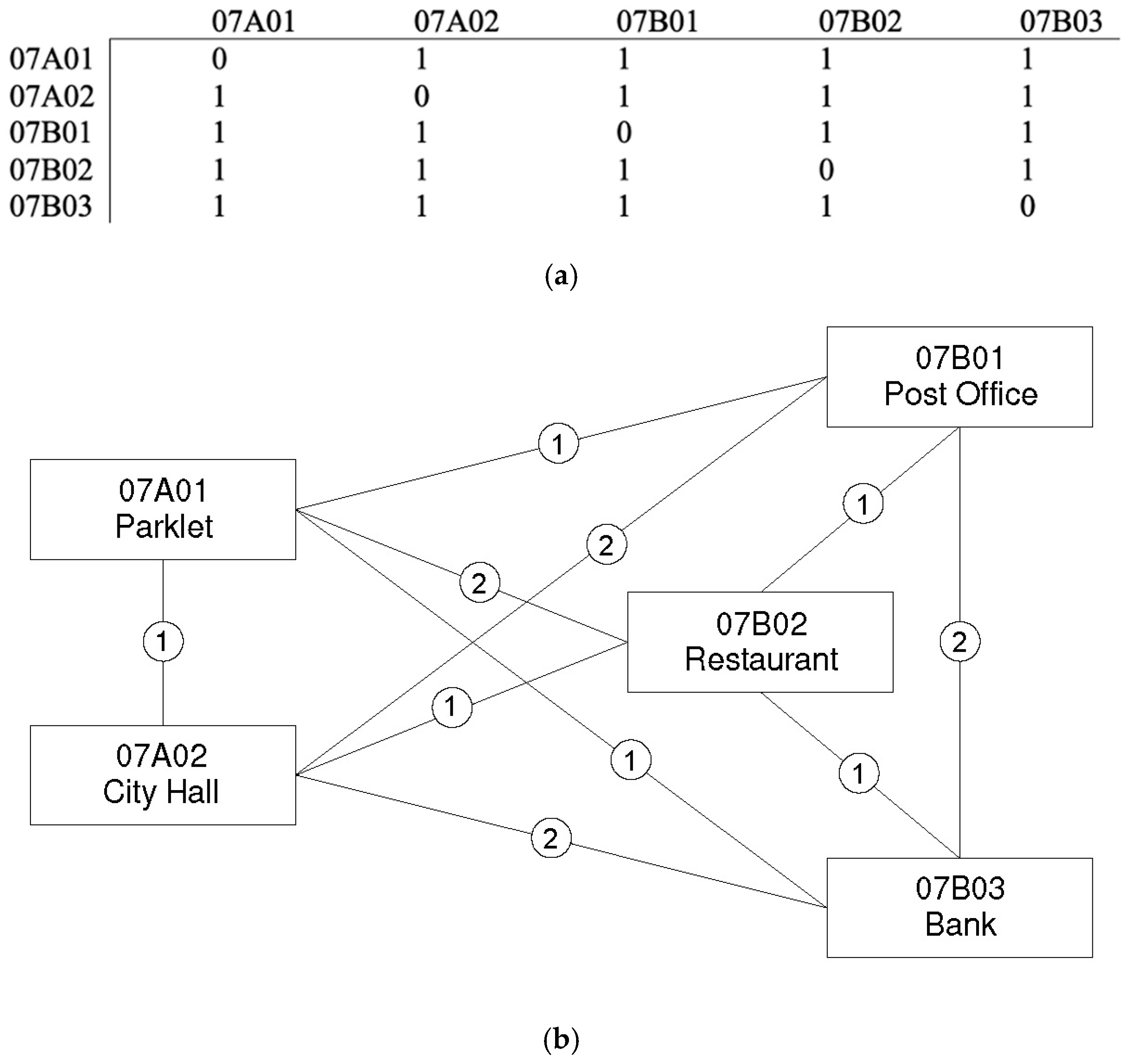
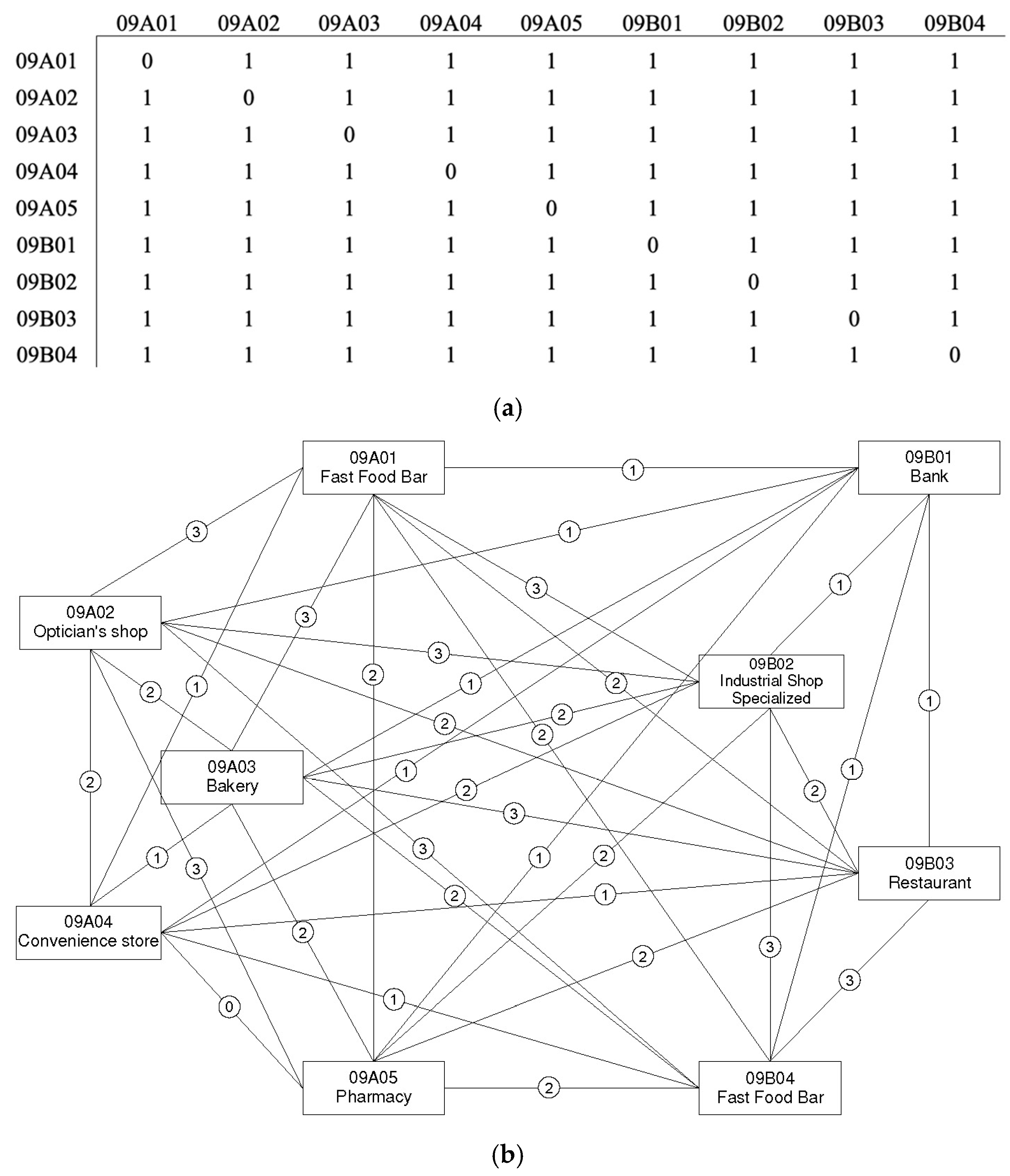
According to the method outlined in Section 3 of the paper, the next step of the analysis focuses on the evaluation of the neighbourhood relations of urban places within each segment. This is presented in the form of a matrix, although it may also be represented as a graph. Both approaches are illustrated for Segments 07 and 09 as examples of this stage of the analysis. Each segment comprises urban places located on both sides of the street. In the graph-based version, weights representing the levels of neighbourhood relations—as defined in Table 1 of the paper—are also included (Figure 17).
Figure 17.
Sample analysis of segment 07 of Zwycięstwa Street in the city centre of Gliwice, (a) matrix view, (b) graph view.
It is also purposeful to show the rate of increase in the number of relations as the number of urban places adjacent to the studied section of public space increases. On segment 07, with 5 urban sites, the number of neighbourhood relations is 10.
To compare, similar data is shown for segment 09 (Figure 18).
Figure 18.
Sample analysis of segment 09 of Zwycięstwa Street in the centre of Gliwice, (a) matrix view, (b) graph view.
In segment 09, with 9 urban sites, the number of neighbourhood relations to be examined is 36.
In contrast, in Segment 08, which comprises 31 inventoried urban places, the number of neighbourhood relations increases to 465. From the above comparison, it becomes evident that graphs should be represented in the form of arrays (matrices) in order to enable data processing through automated digital techniques. As the number of urban places adjacent to the analysed section of public space increases, the number of relationships included in the overall assessment rises substantially.
4.5. Analysis of General Relationship Among Urban Places of Zwycięstwa Street in Gliwice
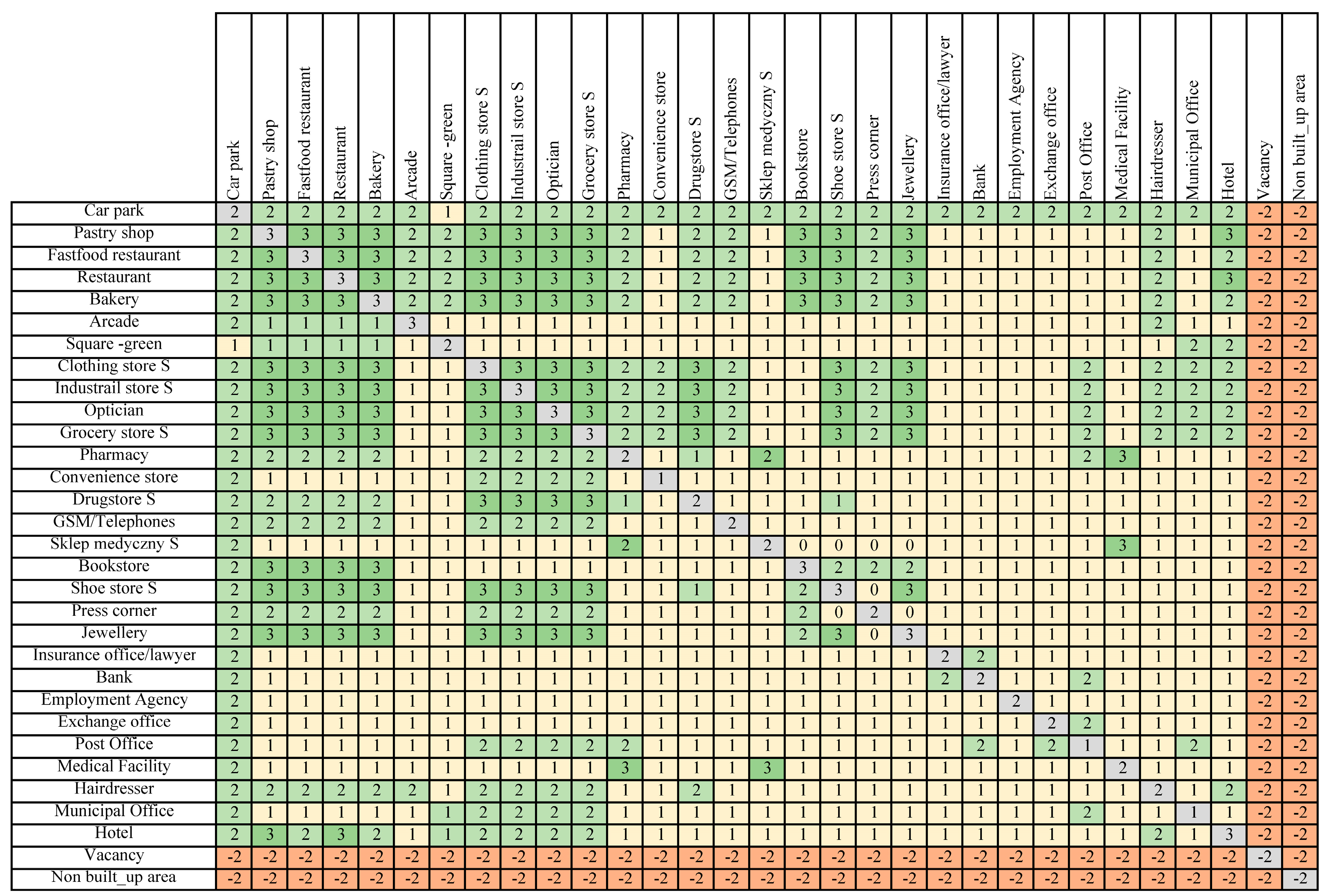
According to the method outlined in Section 3 of the paper, the next step of the analysis focuses on the evaluation of the relationships among urban places. As noted in Section 3, it is proposed to apply a weighting scale of (−2, −1, 1, 2, 3), representing the different types of relationships in the main array (Figure 19).
Figure 19.
Main array of mutual weights of relation between types of neighbourhood uses of urban places identified in given area.
The main street of a city constitutes a specific and unique form of public space. Its character is shaped primarily by the carefully selected uses of the adjacent urban places. On this basis, the uses that are consistent with the defined character of the main street and that enter into highly symbiotic relationships with one another have been identified [40,44]. The weights of these relationships have been assigned in accordance with Table 1 in Section 3.2. Analysis of the relationship of urban places along Zwycięstwa Street in Gliwice by individual segments.
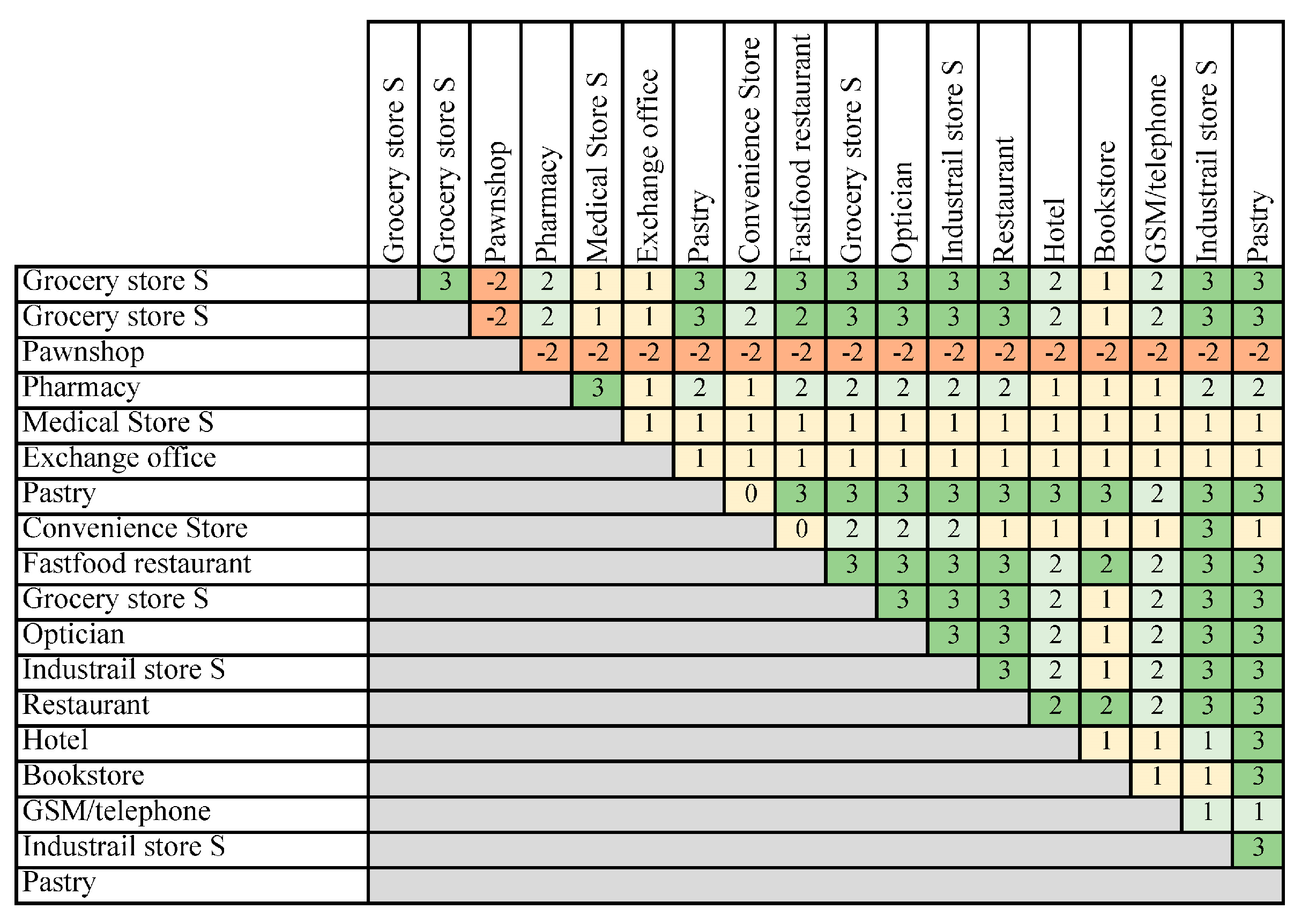
Construction of a table (matrix) of weights of neighbourhood relations in the studied segment of public space (Figure 20 below) based on the table weights of neighbourhood relations (Figure 19), which will be the starting point for the assessment of both neighbourhood and differentiation of segments of the analysed main street. That array could be presented as semi array, also called triangular array.
Figure 20.
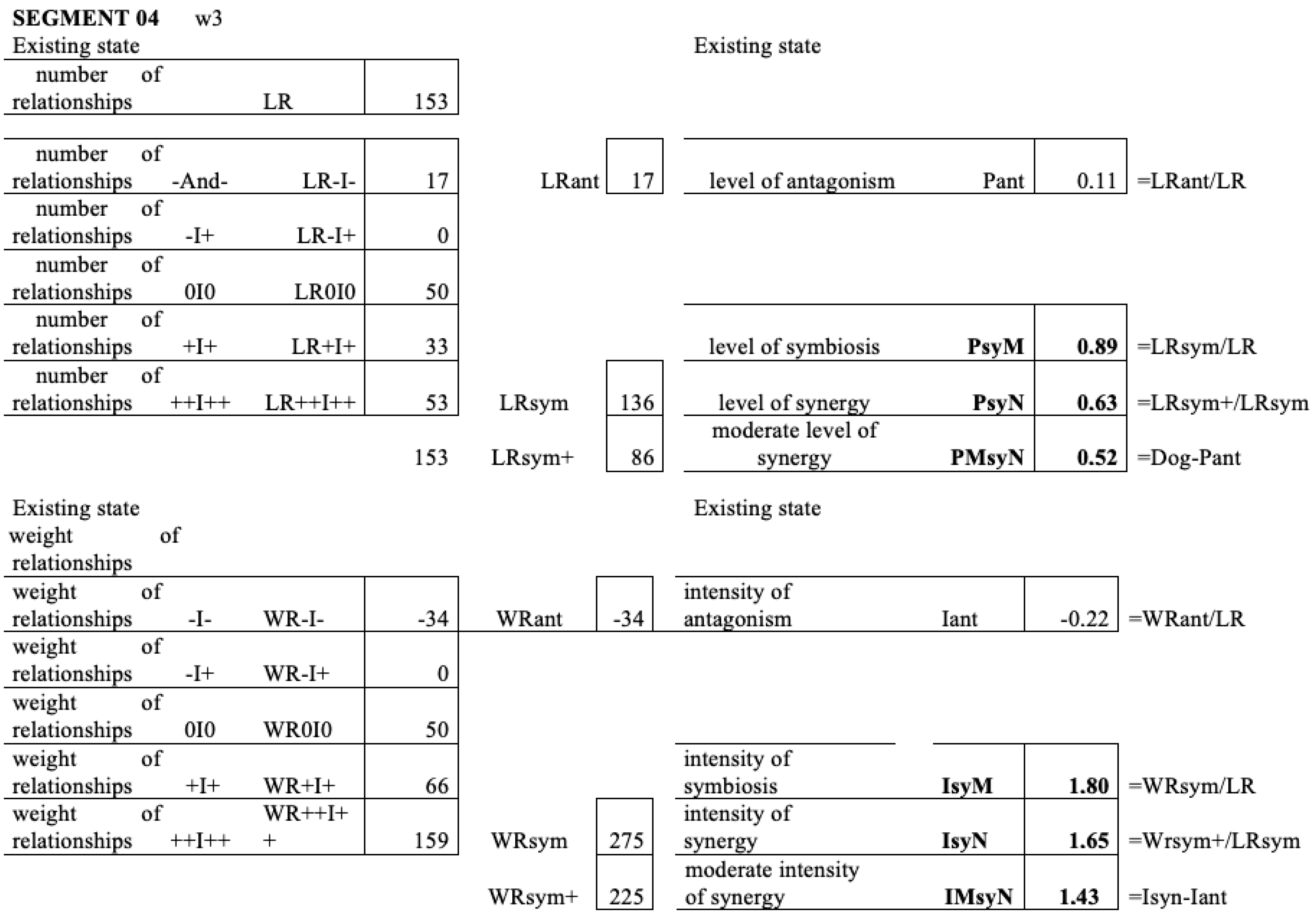
Triangular matrix of weights of neighbourhood relations in the analysed segment 04 of public space.
This is a key assumption that the measures described above are inherently relative, and the results obtained are valid only within the scope of a single project, where a uniform matrix of neighbourhood weights is applied consistently across all calculations. The proposed weights for individual relationships are likewise relative. In projects yielding highly similar outcomes, they may be systematically adjusted through scaling procedures and by introducing a non-zero value for the neutral relationship. Final calculations are presented below (Figure 21).
Figure 21.
Sample calculations of synergy, symbiosis and antagonism of urban places in segment 04—existing state.
4.6. Analysis of the Relationship of Urban Places Along Zwycięstwa Street in Gliwice by Individual Segments
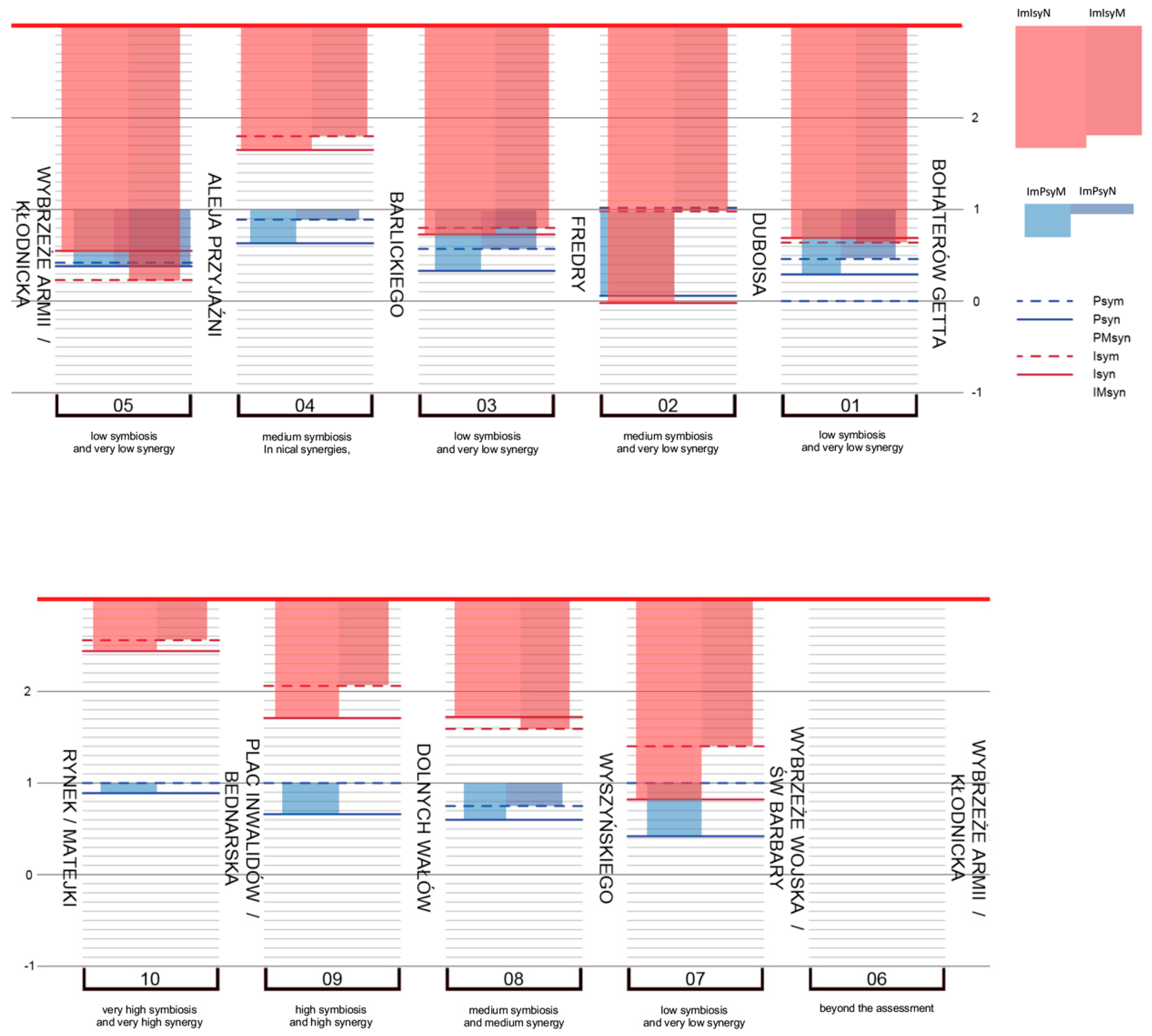
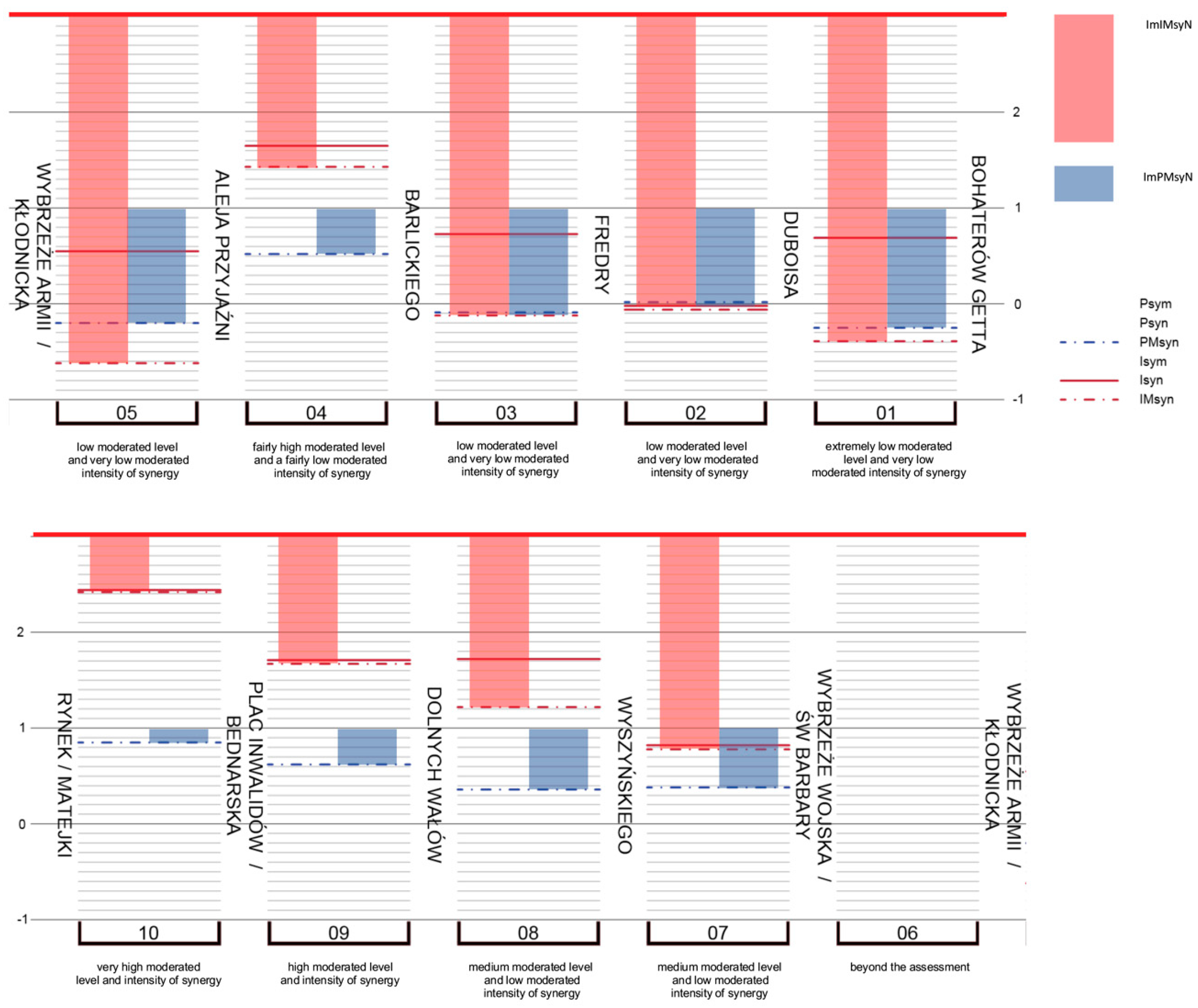
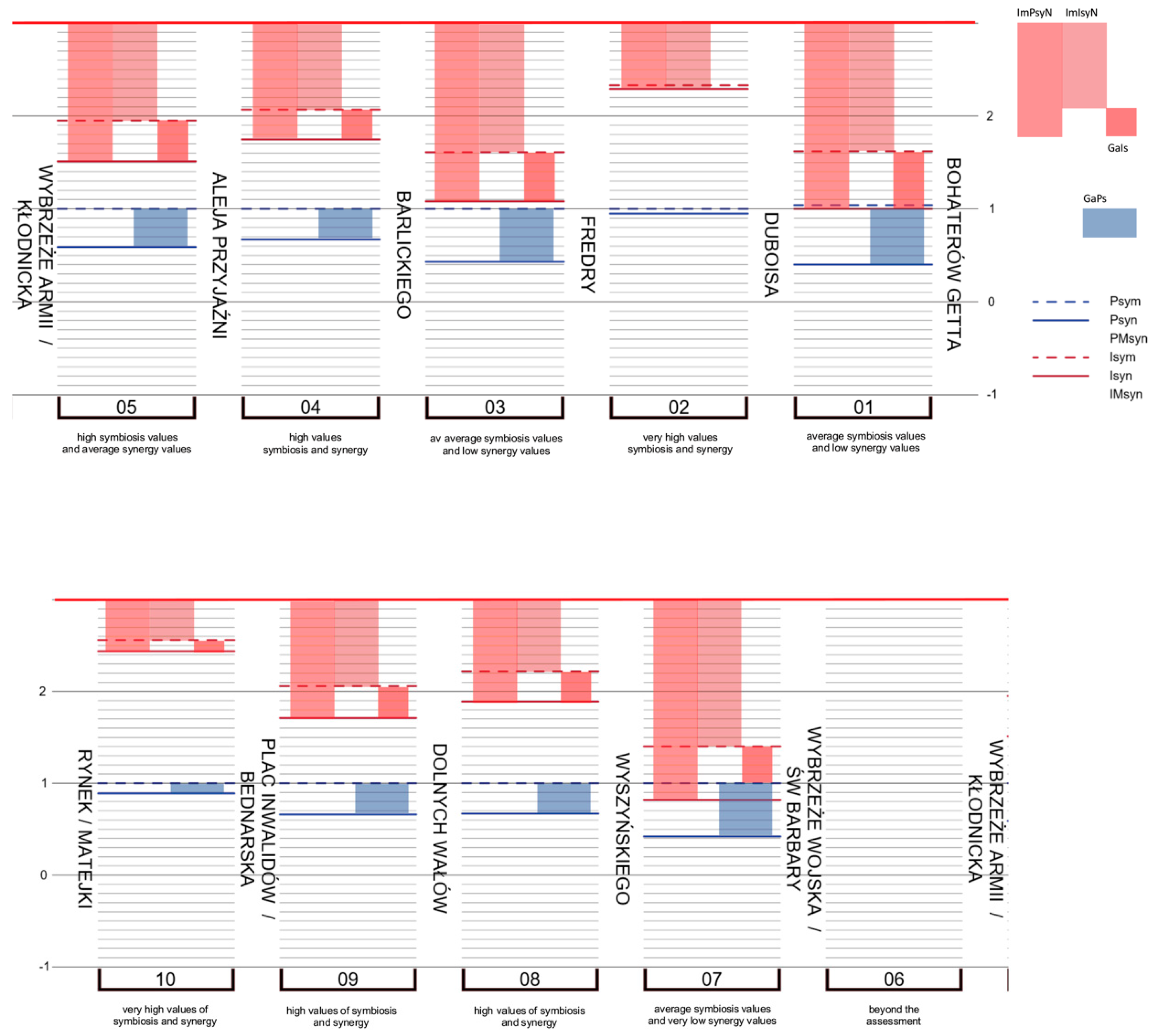
A collective comparative visualisation of the calculated measures of symbiosis and synergy, obtained in accordance with the adopted SyM_SyN Method, for the individual segments of the public space of Zwycięstwa Street in their existing state is presented in the figures below (Figure 22 and Figure 23). The first figure shows the general individual values, while the second illustrates the average values. In both cases, the bars represent imperfections in the levels and intensities of symbiosis and synergy, the dashed lines indicate the levels of symbiosis and synergy, and the continuous lines represent their intensities.
Figure 22.
Average levels and average intensities of synergy, symbiosis, and antagonism of urban places in the segments of Zwycięstwa Street—existing state.
Figure 23.
Values of the average levels and average intensities of synergy, symbiosis, and antagonism of urban places in the segments of Zwycięstwa Street—existing state.
The deficiencies (imperfections) of the analysed measures for individual segments of Zwycięstwa Street were visualised using bar charts. These provide a synthetic representation of the quality of the existing use of urban places within each segment of the public space of Zwycięstwa Street.
As the SyM_SyN Method was developed with the explicit aim of evaluating proposed interventions in degraded public space of city centres, the next logical step was to examine the improved, potential future state of development of Zwycięstwa Street in terms of its functional use.
The proposed changes in the use of urban places assumed that improvement could be achieved by replacing functions deemed unsuitable for a main city street with future, desirable uses that positively “matched” the existing functions considered appropriate for the city centre. This was envisaged without significant modification of the urban fabric (except for a single case involving the development of a vacant plot in Segment 01), thereby avoiding excessive demolitions, radical alterations to traffic organisation, or comparable disruptive interventions.
4.7. Future Design and Modification of Urban Places Along Zwycięstwa Street in Gliwice
Given the aforementioned values, it becomes possible to propose modifications to the uses of urban places along the studied street within the designated area. The introduction or adjustment of functions necessarily requires corresponding modifications to the weight matrices, as the mutual impacts of functions may vary in terms of antagonism, symbiosis, or synergy. Since the effects of individual functions on the area are to a considerable extent predictable, it is feasible to introduce changes that maximise overall outcomes while maintaining symbiotic or synergistic relations with the existing uses.
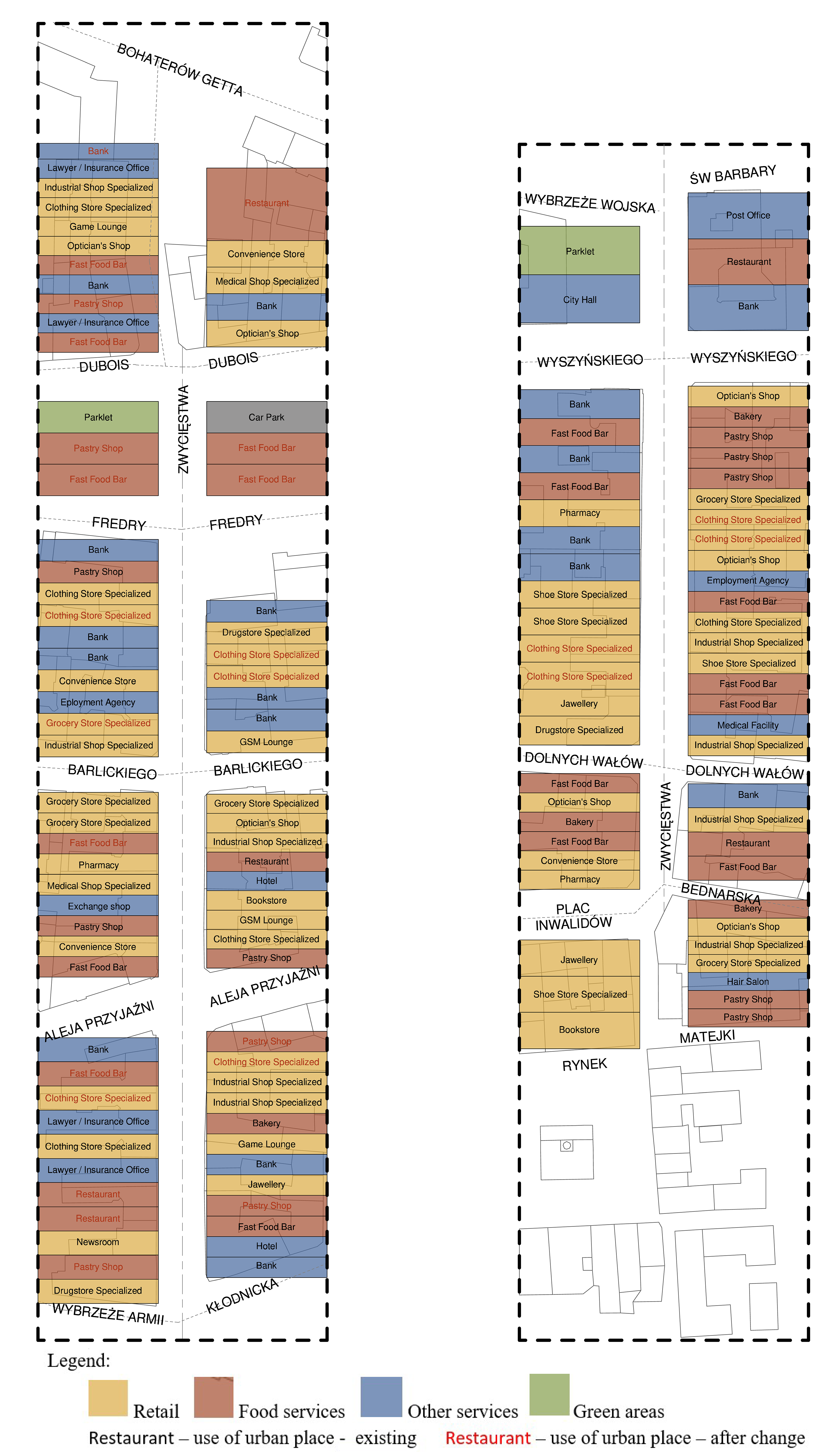
As an example, a new and improved structure of urban places uses along Zwycięstwa Street has been proposed. The modifications are highlighted in red, as illustrated in the accompanying figure (Figure 24).
Figure 24.
Proposal for modification of urban places in the segments of Zwycięstwa Street.
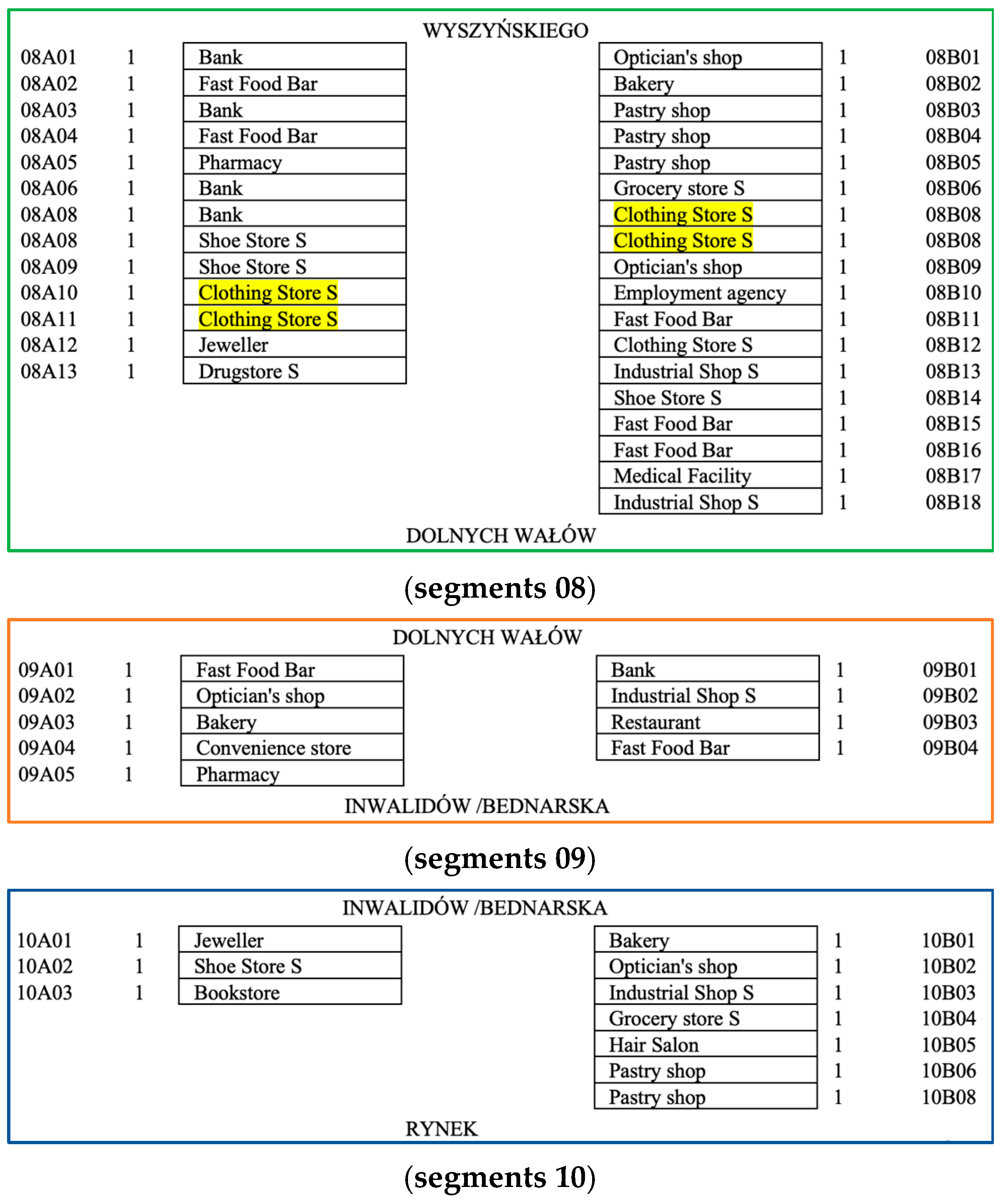
The design of new urban places within the segments of Zwycięstwa Street is also reflected in the evaluation of their compliance and internal cohesion. The newly proposed functions for each segment are presented in the figures below and are highlighted in yellow (Figure 25).

Figure 25.
Evaluation of proposed consistency of urban places along Zwycięstwa Street with its character (segments 01–10).
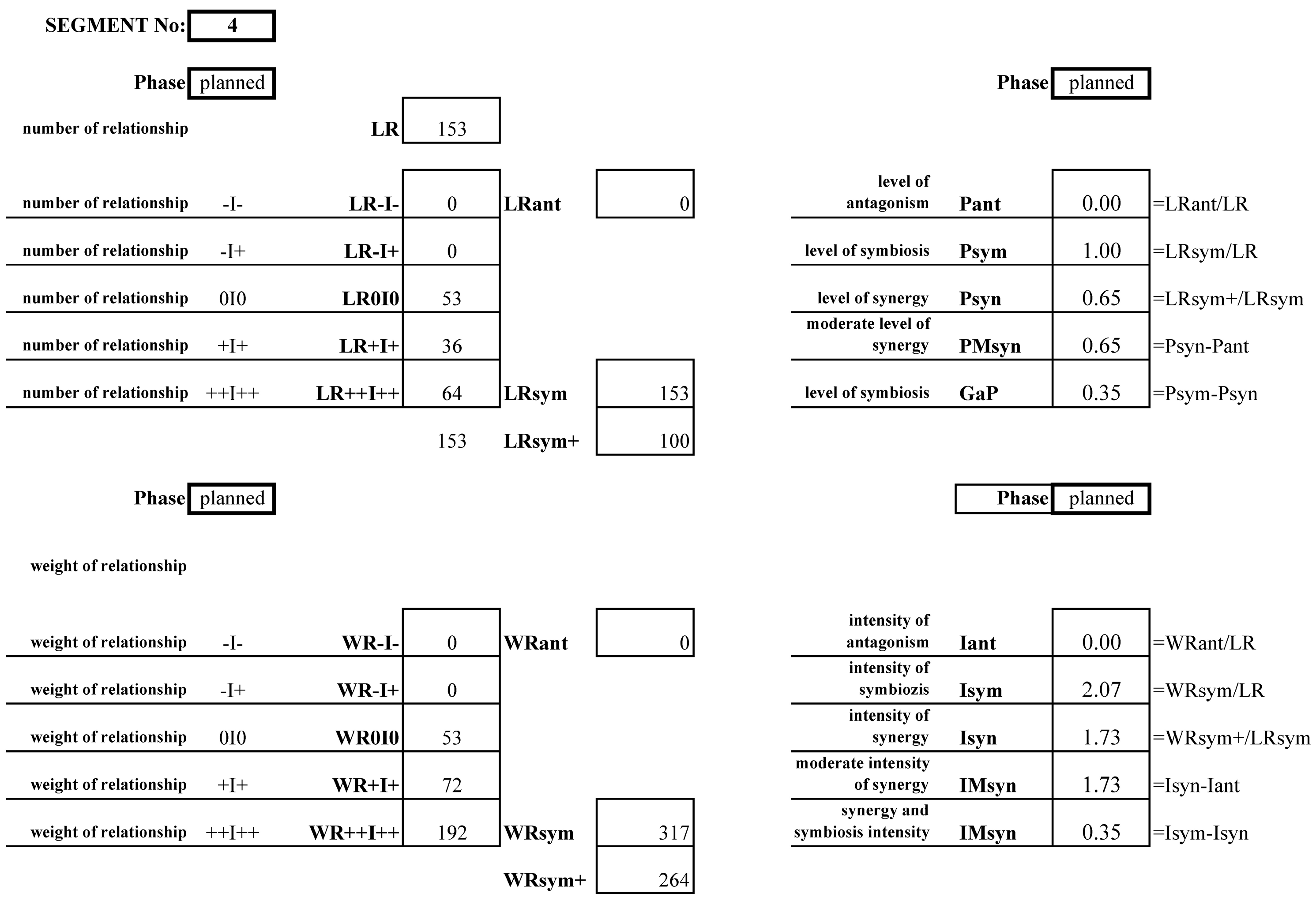
Given the number and weights of relations for each segment (which may differ from the original values), it is necessary to reconstruct the neighbourhood weight arrays (see Figure 19 and Figure 20) and to adjust the calculations, accordingly, as presented below (Figure 26). These recalculations also apply to Segment 04.
Figure 26.
Sample calculations of synergy, symbiosis and antagonism of urban places in segment 04—planned state.
A collective comparative visualisation of the results of the calculated measures, obtained in accordance with the adopted SyM_SyN Method, for the individual sections of the public space of Zwycięstwa Street after the introduction of corrective changes is presented below (Figure 27).
Figure 27.
Values of average levels and average intensities of synergy, symbiosis and antagonism of urban places in the segments of Zwycięstwa Street, future state.
This visualisation of the results illustrates the gap between the “ideal” state of urban planning and the state achieved after the improvement and modernization.
5. Discussion of Results
The results of the research presented above give rise to a twofold discussion:
- concerning the evaluation of the effectiveness of the method, and
- concerning the improvement of the urban situation along Zwycięstwa Street.
5.1. Methodological Considerations
Regarding the method itself, the assessments conducted for the existing uses of urban places along Zwycięstwa Street made it possible to differentiate the quality of use and design across individual segments.
For the existing state, characterised by a noticeable level of antagonistic and parasitic relations, the most important measures are as follows:
Imperfection of the average level of synergy:
ImPMsyN = PMsyNmax − PMsyN
Imperfection of the average synergy intensity:
illustrating the development of hypersymbiotic relations in the area of the segment relativized by the state of negative neighbourhood relations.
ImIMsyN = IMsyNmax − IMsyN
These imperfections are understood as differences between the measured state and the maximum attainable level in the study, as determined by the applied weighting system for neighbourhood relations.
The measures supplementing the depiction of the existing situation are: Imperfection of the level of symbiosis:
ImPsyM = PsyMmax − PsyM
Imperfection of symbiosis intensity:
illustrating the situation in terms of positive neighbourhood relations.
ImIsyM = IsyMmax − IsyM
Imperfection of the level of synergy:
ImPsyN = PsyNmax − PsyN
Imperfection of synergy intensity:
illustrating the situation in terms of synergistic neighbourhood relations.
ImIsyN = IsyNmax − IsyN
These imperfections are defined as the differences between the measured state and the maximum attainable level within the study, as determined by the weighting system applied to neighbourhood relationships. The higher the absolute values of these measures, the greater the share of negative and non-hypersymbiotic relations within a given section. To determine the levels of imperfection, it is necessary to conduct the analyses (calculations) described above.
For design solutions (correct according to the assumptions outlined here), in which no antagonistic or parasitic relations occur, PsyM will always equal 1.00. In such cases, the information on the quality of section development will be provided by the measures PsyN, IsyM, and IsyN, respectively. A value of PsyN = 1.00 indicates the absence of neutral relations, whereas any value below 1.00 denotes their presence.
The greater the value of IsyM above 1.00, the larger the number of symbiotic and hypersymbiotic relations, up to a maximum of 3.00, which signifies the exclusive presence of symbiotic relations. By considering the combination of these four measures, it becomes possible to assess the quality of use within a section of public space, and, above all, its relational consistency with neighbouring sections.
The higher the quality of this structure (i.e., the greater the number of symbiotic and hypersymbiotic relations), the closer the values of the pairs PsyM and PsyN, as well as IsyM and IsyN, will be. The ideal values are 1.00 for PsyM and PsyN, and 3.00 for IsyM and IsyN, given the applied neighbourhood weights.
In the case of examining states following the implementation of corrective actions—where, by definition, no negative relationships should occur—the following measures should be regarded as relevant: Imperfection of the level of synergy:
ImPsyN = PsyNmax − PsyN
Imperfection of synergy intensity:
where the higher these values, the greater the scope for corrective actions in relation to existing uses, and, in the case of comparing alternative remedial solutions, the greater the capacity to select the more advantageous option. For this reason, it is useful to introduce key indicators that enable a rapid graphical illustration and differentiation of public space sections following the implementation of planned corrective measures.
ImIsyN = IsyNmax − IsyN
Symbiosis and Synergy Level Range:
GaP = PsyM − PsyN
Symbiosis and Synergy Intensity Range:
where the higher they are, the greater the level of mismatch of uses in the area of the section with the improved structure. It should be noted that in the absence of negative relations (as assumed for the corrected state), the measures of these ranges will be identical.
GaI = IsyM − IsyN
The key measures of symbiosis and synergy levels are presented in Table 2.
Table 2.
Measures of symbiosis and synergy.
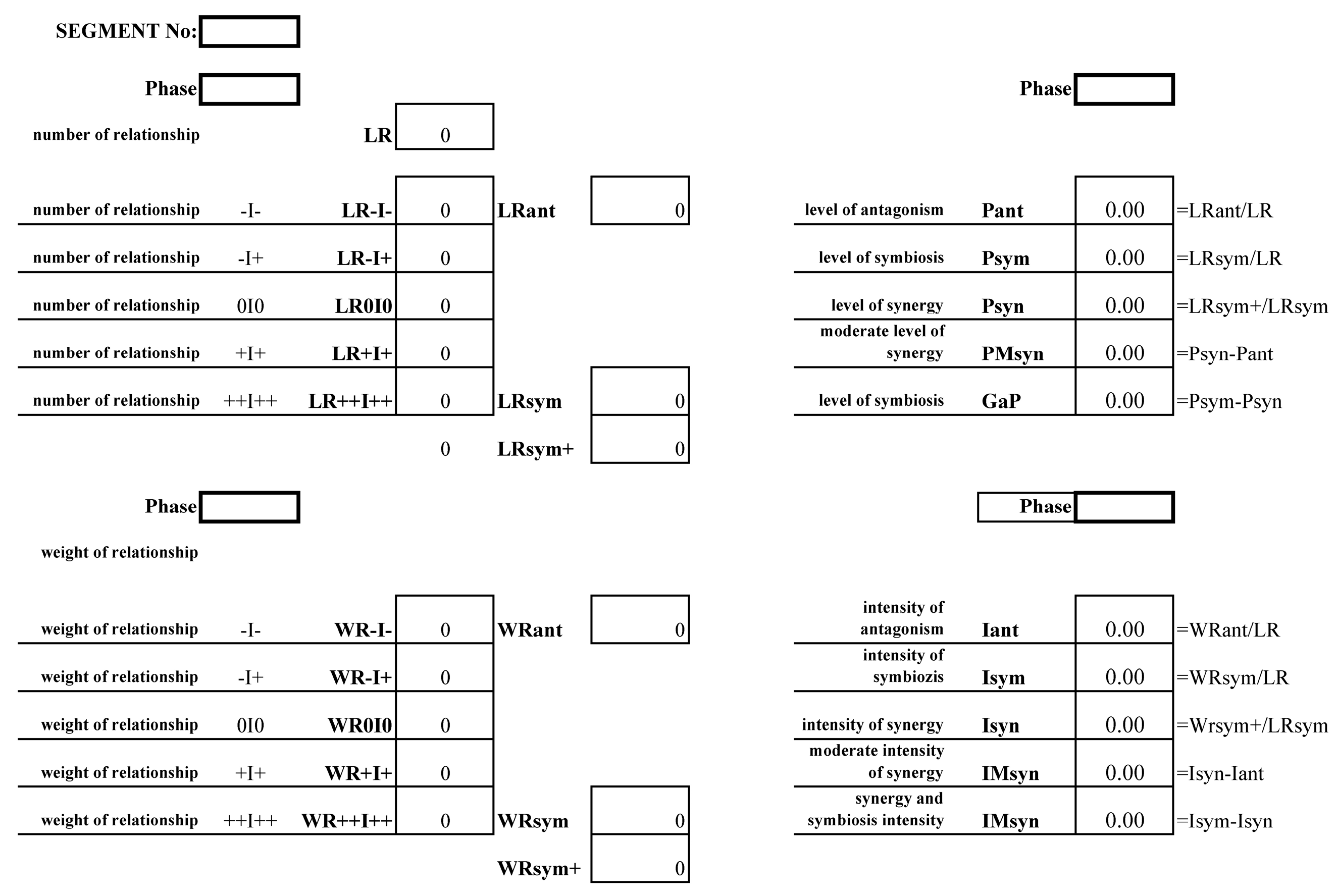
The layout and content of the metric sheets for individual segments shown in Figure 21 (existing state) and Figure 26 (proposed state) were designed to provide the most essential characteristic measures, along with the principles of calculation, to facilitate interpretation.
The metrics sheet for each individual segment serves as the basis for evaluation and comparison; therefore, the selection of the presented measures is of key importance. The examined measures—indicators were intentionally selected to provide researchers with a comprehensive and integrated assessment of the use of urban places. For this purpose, a reference metrics sheet including the calculation formulas for the indicators was designed. A reference sheet is presented in Figure 28.
Figure 28.
Reference metrics sheet for each individual segment.
Furthermore, the selection and mode of presenting the results in the diagrams shown in Figure 22 and Figure 27 were planned to enable:
- -
- the assessment of deficiencies in the levels of symbiosis and synergy in individual segments by indicating the magnitude of the gap to the ideal level,
- -
- the assessment of differences in symbiosis and synergy levels between adjacent segments of the main street.
The SyM_SyN Method is conceived as a complement to urban analytical approaches based on the rules of Space Syntax, which are to a significant extent focused on the examination of the geometric properties of street networks (axial lines maps) in order to describe centrality measures. In contrast, the SyM_SyN Method addresses essential functional aspects [41]. At the same time, the SyM_SyN Method supplements and extends research employing land use diversity indices. While such indices concentrate on measuring the degree of functional diversity within urban areas [45,46], the SyM_SyN Method evaluates the levels of symbiotic and synergistic relations between urban places, arising from the specific nature of that diversity. This is of particular importance, since functional diversity along a main street does not in itself guarantee urban quality. Only an appropriate composition of uses of urban places can create the conditions for high levels of symbiosis and synergy, which are decisive for the functional quality of the main street.
5.2. Practical Considerations for Potential Improvements of Zwycięstwa Street in Gliwice
Over the past quarter of a century, Zwycięstwa Street has undergone numerous transformations, the majority of which have had negative impacts. Despite the privatisation of most ground-floor premises in the tenement houses immediately following the political transformation of the 1990s, the street failed to maintain its former commercial and representative character, which it had enjoyed in the 1960s and 1970s. At present, the street is dominated by vacant premises and low-quality retail and service outlets (such as discount and second-hand stores), alongside a considerable number of bank premises, several of which have already been closed at the time of writing.
The results of the study indicate that the quality of urban space, in terms of the structure of use along Zwycięstwa Street, declines with increasing distance from the Market Square. The first two sections closest to the square exhibit the highest quality. The application of the SyM_SyN Method revealed clear differentiation in the condition (quality) of individual sections while simultaneously confirming a general trend of decreasing attractiveness as one moves away from the Market Square.
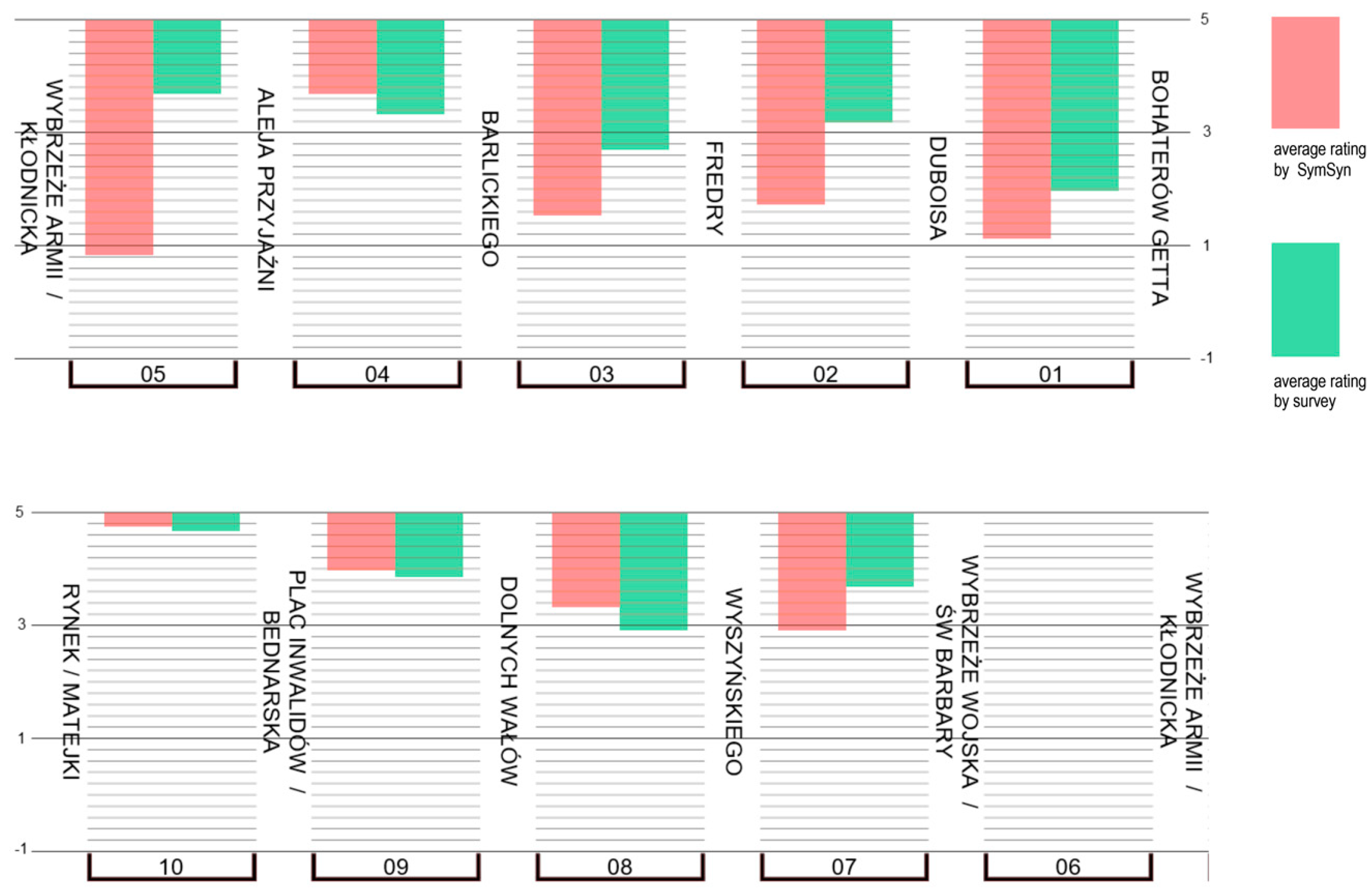
Thus, the desired level of quality is not sustained, and its variation along the street appears largely random. To verify these findings, an alternative method was applied. A survey was conducted among a group of seven architects residing and working in Gliwice, who were not connected with this project but were professionally familiar with the situation on Zwycięstwa Street. They were asked to evaluate the individual segments on a five-point scale (1–5). The average ratings obtained were generally consistent with the results of the SyM_SyN Method, as illustrated in the graph presented in the Figure 29.
Figure 29.
Comparison of the assessments of public places segments along Zwycięstwa Street: the SyM_SyN method versus architects’ evaluations.
Despite the application of different measures in the SyM_SyN Method and in the survey, the gradation of assessments and the trend of declining attractiveness of Zwycięstwa Street in terms of its use structure proved to be very similar. The only significant discrepancy in ratings was observed for Segment 04, where the survey results were considerably higher. This section contains numerous outlet and second-hand shops, as well as vacant buildings, yet its tenement house architecture is relatively interesting. The difference can be explained by the incomplete objectivity of the architects’ assessment, in which architectural qualities appear to have been subconsciously taken into account. This case further underscores the necessity of applying methods of objective evaluation in assessing the structure of urban places use.
It should also be noted that, in the optional comments submitted during the surveys, respondents repeatedly highlighted the low quality of commercial premises along Zwycięstwa Street. At the same time, positive evaluations were influenced by the recent proliferation of gastronomic establishments (confectioneries, fast-food outlets, bakeries, bars), which have significantly improved the condition of many segments. Most of these premises are located in the first two sections near the Market Square, reflecting a kind of “spillover” of gastronomy from the Market Square area into Zwycięstwa Street. This phenomenon demonstrates the significance of the symbiosis and synergy effect, evidently considered when new restaurants are located in close proximity to existing ones.
Changes in the functional use of urban premises are justified and feasible only when the buildings are in good technical condition and amenable to revitalisation [47]. Along Zwycięstwa Street, technical conditions vary: some buildings have been renovated, while others require modernisation or remain in poor condition. Where a change in the functional use of premises is planned, an assessment of the impact of the new function on the building’s structure must be carried out. This may necessitate the design of structural or foundation reinforcements, including the execution of traditional or injection-based underpinning [11]. Adaptation of commercial premises may further involve the demolition of partition walls, the creation of new door and window openings, and the upgrading of installations (air conditioning, electricity, lighting). Adequate acoustic and thermal insulation must also be ensured. Functional modifications may affect the façade (e.g., enlargement or relocation of entrances, installation of ramps for persons with disabilities, or the introduction of small architectural elements). In the case of buildings under conservation protection, approval from the relevant heritage authority is required.
The proposed changes to the development of Zwycięstwa Street have the potential to significantly enhance residents’ quality of life. However, their successful implementation requires an individualised design approach and the involvement of experts from multiple disciplines.
The results of the analysis of the levels of synergy and symbiosis for the main street of Gliwice, conducted using the SyM_SyN Method, should be confronted with analogous results obtained for other main urban streets, particularly in cities of comparable character. Such research has already been initiated for several cities within the Upper Silesian part of the Upper Silesian–Zagłębie Metropolis, namely Zabrze, Chorzów, Bytom, and Katowice. In the urban structure of each of these city centres, an identifiable main street can be distinguished, and each is being investigated using the SyM_SyN Method. The collection of comparative material for the five main urban streets will provide the basis for planning further developments and refinements of the SyM_SyN Method.
As symbiosis and synergy are particularly important for the uses of urban places along main streets, the SyM_SyN method has been primarily designed for areas where a mix of functions is crucial. Consequently, its application to other parts of the city, beyond the city centre and district centres, has so far remained limited. At present, however, the method is being extended to encompass main city squares.
6. Conclusions
The results presented above provide grounds for concluding that a standardised method of examining the quality of the structure of use and functional purpose of urban places along main city streets is necessary in order to objectify assessments of both the existing development and proposed design interventions. Assessments based solely on the impressions and beliefs of designers or urban planners are often inaccurate, as they are inevitably burdened with a degree of subjectivity that is difficult to measure. Given the complexity of urban planning issues, the measures proposed here should be applied primarily for comparative assessments, since at the current stage of urban planning knowledge, it remains impossible to formulate absolute measures.
The results and conclusions derived from the study of the existing development of Zwycięstwa Street, together with the proposed revitalisation measures, confirm the applicability of the SyM_SyN Method to research aimed at improving the spatial organisation of main city streets. The SyM_SyN Method should be regarded as one of the components of a comprehensive set of urban analytical approaches designed for the study of city centre structures and, in particular, of main urban streets. It is specifically constructed to investigate the symbiosis and synergy between urban uses. In this capacity, it may serve as a tool for formulating strategies of main street revitalisation and for evaluating planned revitalisation scenarios.
The residents’ assessment of the attractiveness and quality of a city’s main street space is determined primarily by the perceived appeal and adequacy of the services offered within the urban places located along that street. The better this assessment, the greater the degree of mutual reinforcement and complementarity among adjacent services. At the same time, these services are expected to display a desirable level of distinctiveness and uniqueness, corresponding to users’ expectations.
As the main street constitutes both the showcase of the city and a reflection of its inhabitants, its capacity to meet their expectations fosters a positive identification with the city as coherent entity. The SyM_SyN method provides a tool for selecting such services and arranging them into an appropriate mix and for optimising this mix through comparative variant analysis. Obtaining reliable results depends crucially on the proper construction of the array of mutual weights representing the relations between types of neighbouring urban uses identified within the study area, as illustrated in Figure 19.
The method, however, should not be applied in isolation, since it is highly specialised and does not encompass aspects such as urban composition, relations with the wider urban context, or economic and demographic conditions.
The ongoing computerisation and digitisation of urban studies and design processes require the implementation of standardised methods at the level of individual projects. This enables not only the automated processing of data but also their digital presentation and the spatial visualisation of results. A significant acceleration in the processing of urban data—progressively transforming into big data repositories—will facilitate the development of multi-variant design proposals. This, in turn, allows final decisions to be based on a broad spectrum of possible solutions, grounded in comparative and less subjective assessments of alternatives.
The construction of models of urban structure—focused on the structure of use and purpose of urban places, with the urban layout represented as a graph—provides a unified reference system. Such a system enables the exchange of data between different design teams addressing diverse urban issues, as the reference framework is harmonised and descriptive data standardised.
The application of the SyM_SyN Method supports, as an element of a complex method, the processes of modernisation and reconstruction of urban places, aligning them more closely with the actual needs of city users. In this sense, the delivery of high-quality urban places contributes directly to fulfilling the requirements of the smart city paradigm, in which the form and quality of an urban place are understood as derivatives of the expressed needs of its inhabitants.
At present, a systematic study of main urban streets is planned in four other cities of the GZM Metropolis. The purpose of this extended research is to compile a broader and more comparable body of analytical material, which will allow for cross-case evaluation and the identification of recurrent patterns and differences. On this basis, it will be possible to verify the robustness of the SyM_SyN Method and to introduce potential refinements that may enhance its applicability and reliability in diverse urban contexts. It is planned to develop analogous methods for assessing other socio-spatial aspects of the main urban street, employing graphs to record complex urban structures and drawing on the experience gained from the application of the SyM_SyN Method.
Author Contributions
Conceptualization, M.G.; methodology, M.G. and Ł.W.; software, Ł.W.; validation, M.G., M.B. and T.S.; formal analysis, M.G.; investigation, M.G. and L.W.; resources, M.G.; writing—original draft preparation, M.G., Ł.W., L.W., M.B. and T.S.; writing—review and editing, M.G., L.W. and T.S.; visualisation, Ł.W.; supervision, M.G. All authors have read and agreed to the published version of the manuscript.
Funding
This research received no external funding.
Institutional Review Board Statement
Not applicable.
Informed Consent Statement
Not applicable.
Data Availability Statement
Data may be requested from the correspondence author.
Conflicts of Interest
The authors declare no conflicts of interest.
References
- Gracias, J.S.; Parnell, G.S.; Specking, E.; Pohl, E.A.; Buchanan, R. Smart Cities—A Structured Literature Review. Smart Cities 2023, 6, 1719–1743. [Google Scholar] [CrossRef]
- Fuller, R.B. Synergetics: Explorations in the Geometry of Thinking; Macmillan Press: New York, NY, USA, 1975. [Google Scholar]
- Kangas, K.; Karhu, J.; Brown, G.; Kivinen, M.; Markovaara-Koivisto, M.; Tolvanen, A.; Pasi, E.; Tuulentie, S.; Tarvainen, O.; Simil, J.; et al. Land use synergies and conflicts identification in the framework of compatibility analyses and spatial assessment of ecological, socio-cultural and economic values. J. Environ. Manag. 2022, 316, 115174. [Google Scholar] [CrossRef]
- Lian, H.; Li, G. Correlation Analysis of Retail Space and Shopping Behavior in a Commercial Street Based on Space Syntax: A Case of Shijiazhuang, China. Buildings 2023, 13, 2674. [Google Scholar] [CrossRef]
- Wallis, A. Informacja i Gwar. O Miejskim Centrum. (Information and the Buzz of the City: On the Urban Centre); PIW: Warszawa, Poland, 1979. [Google Scholar]
- Oswald, F.; Baccini, P.; Michaeli, M. Netzstadt; Birkaueser: Bern, Switzerland; Zurich, Switzerland, 2003. [Google Scholar]
- Massengale, J.; Victor Dover, V. Street Design: The Secret to Great Cities and Towns; Wiley: New York, NY, USA, 2013. [Google Scholar]
- von Bertalanffy, L. Ogólna Teoria Systemów. Podstawy, Rozwój (General Systems Theory); PWN: Warszawa, Poland, 1984. [Google Scholar]
- Heidegger, M. Budować, Mieszkać, Myśleć (Building Dwelling, Thinking); Czytelnik: Warszawa, Poland, 1977. [Google Scholar]
- Wilson, R.J. Introduction to Graph Theory (Wprowadzenie do Teorii Grafów); PWN: Warszawa, Poland, 2012. [Google Scholar]
- Wanik, K. Use of jet grouting technique to realize substructures of historic buildings: The example of an apartment building in Warsaw. In Proceedings of the 2nd International Symposium on Geotechnical Engineering for the Preservation of Monuments and Historic Sites, Napoli, Italy, 29–31 May 2013; pp. 769–777. [Google Scholar]
- Salingaros, N.A. Towards a New Urban Philosophy: The Case of Athens. In Shifting Sense—Looking Back to the Future in Spatial Planning; Hulsbergen, E., Klaasen, I., Kriens, I., Eds.; Techne Press: Amsterdam, The Netherlands, 2005; pp. 235–250. [Google Scholar]
- Salingaros, N.A. Principles of Urban Structure; Techne: Delft, The Netherlands, 2005. [Google Scholar]
- Batty, M. The new Science of Cities; MIT Press: Cambridge, UK, 2013. [Google Scholar]
- Batty, M. Cities and Complexity; MIT Press: Cambridge, UK, 2007. [Google Scholar]
- Batty, M.; March, L. Urban Models based on Information-Minimising. Pion 1978, 127–155. [Google Scholar]
- Porta, S.; Latora, V.; Strano, E. Networks in Urban Design. Six Years of Research in Multiple Centrality Assessment. In Network Science; Springer: London, UK, 2010; pp. 107–129. [Google Scholar] [CrossRef]
- Porta, S.; Crucitti, P.; Latora, V. The network analysis of urban streets: A dual approach. Phys. A Stat. Mech. Its Appl. 2006, 369, 853–866. [Google Scholar] [CrossRef]
- Porta, S.; Crucitti, P.; Latora, V. The Network Analysis of Urban Streets: A Primal Approach. Environ. Plan. B Plan. Des. 2006, 33, 705–725. [Google Scholar] [CrossRef]
- Porta, S.; Romice, O.; Feliciotti, A. Masterplanning for Change: Designing the Resilient City; RIBA Publishing: London, UK, 2020. [Google Scholar]
- Porta, S.; Pasino, P.; Romice, O.; Strano, E. Multiple Centrality Assessment. Sergio Porta and his colleagues apply a computer based methodology to mixed use street. Urban Des. Group J. 2013, 125, 12–14. [Google Scholar]
- Vaughan, L. The spatial syntax of urban segregation. Prog. Plan. 2007, 67, 205–294. [Google Scholar] [CrossRef]
- Volchenkov, D.; Blanchard, P. City Space Syntax as a Complex Network. Phys. Soc. 2007. [Google Scholar]
- Volchenkov, D. Perplexity of Complexity. In Grammar of Complexity; World Scientific Publishing Company: Singapore, 2018; pp. 1–21. [Google Scholar] [CrossRef]
- Barthelemy, M. The Structure and Dynamics of Cities; Cambridge University Press: Cambridge, UK, 2016. [Google Scholar] [CrossRef]
- Brandão, A.L.; Brandão, P. Public Space, Infrastructure, Landscape: An interdisciplinary matrix for urban spatial continuity. J. Public Space 2017, 2, 123. [Google Scholar] [CrossRef]
- Dong, L.; Duarte, F.; Duranton, G.; Santi, P.; Barthelemy, M.; Batty, M.; Bettencourt, L.; Goodchild, M.; Hack, G.; Liu, Y.; et al. Defining a city—Delineating urban areas using cell-phone data. Nat. Cities 2024, 1, 117–125. [Google Scholar] [CrossRef]
- Krüger, M.J.T. An approach to built-form connectivity at an urban scale: Modelling the distribution of partitions and built-form arrays. Environ. Plan. B Plan. Des. 1981, 8, 41–56. [Google Scholar] [CrossRef]
- Krüger, M.J.T. An approach to built-form connectivity at an urban scale: Relationships between built-form connectivity, adjacency measures, and urban spatial structure. Environ. Plan. B Plan. Des. 1980, 7, 163–194. [Google Scholar] [CrossRef]
- Krüger, M.J.T. An approach to built-form connectivity at an urban scale: System description and its representation. Environ. Plan. B Plan. Des. 1979, 6, 67–88. [Google Scholar] [CrossRef]
- Wang, J.; Fleischmann, M.; Venerandi, A.; Romice, O.; Kuffer, M.; Porta, S. EO + Morphometrics: Understanding cities through urban morphology at large scale. Landsc. Urban Plan. 2023, 233, 104691. [Google Scholar] [CrossRef]
- Dibble, J.; Prelorendjos, A.; Romice, O.; Zanella, M.; Strano, E.; Pagel, M.; Porta, S. On the origin of spaces: Morphometric foundations of urban form evolution. Environ. Plan. B Urban Anal. City Sci. 2019, 46, 707–730. [Google Scholar] [CrossRef]
- Porta, S.; Venerandi, A.; Feliciotti, A.; Raman, S.; Romice, O.; Wang, J.; Kuffer, M. Urban MorphoMetrics + Earth Observation: An integrated approach to rich/extra-large-scale taxonomies of urban form. Projections 2022. Available online: https://projections.pubpub.org/pub/vfwe0fdj (accessed on 4 February 2025).
- Gachowski, M. Measuring Symbiosis and Synergy in the Urban Structure of Main Streets in Central Areas of the City as an Element of the Urban Design Method, Katowice. Archit. Civ. Eng. Environ. 2025, 18, 117–135. [Google Scholar] [CrossRef]
- Gachowski, M. Synergia jako wytyczna do budowania struktury centrum miasta (Synergy as a Guiding Principle for Shaping the Structure of the City Centre). Builder 2021, 291, 34–39. [Google Scholar] [CrossRef]
- Fredericks, J. From Smart City to Smart Engagement: Exploring Digital and Physical Interactions for Playful City-Making. In Making Smart Cities More Playable. Gaming Media and Social Effects; Springer: Singapore, 2020. [Google Scholar] [CrossRef]
- Wood, J. Synergy city; planning for a high density, super-symbiotic society. Landsc. Urban Plan. 2007, 83, 77–83. [Google Scholar] [CrossRef]
- Vaughan, L. Suburban Urbanities; UCL, London Press: London, UK, 2015. [Google Scholar] [CrossRef]
- Wikipedia. Ulica Zwycięstwa w Gliwicach. Wikipedia. Available online: https://pl.wikipedia.org/wiki/Ulica_Zwyci%C4%99stwa_w_Gliwicach (accessed on 4 February 2025).
- Filip, J. ‘Power to’ for High Street Sustainable Development: Emerging Efforts in Warsaw, Poland. Sustainability 2024, 16, 1577. [Google Scholar] [CrossRef]
- Hillier, B.; Hanson, J. The Social Logic of Space; Cambridge University Press: Cambridge, UK, 1984. [Google Scholar] [CrossRef]
- Hillier, B.; Leaman, A.; Stansall, P.; Bedford, M. Space Syntax. Environ. Plan. B Plan. Des. 1976, 3, 147–185. [Google Scholar] [CrossRef]
- Hillier, B.; Penn, A.; Hanson, J.; Grajewski, T.; Xu, J. Natural movement: Or, configuration and attraction in urban pedestrian movement. Environ. Plan. B Plan. Des. 1993, 20, 29–66. [Google Scholar] [CrossRef]
- Cushman & Wakefield, Main Streets Across the World 2024. 2024. Available online: https://cushwake.cld.bz/mainstreets-11-2024-global-central-en-content-retail/18/ (accessed on 4 February 2025).
- Song, Y.; Merlin, L.; Rodriguez, D. Comparing measures of urban land use mix. Comput. Environ. Urban Syst. 2013, 42, 1–13. [Google Scholar] [CrossRef]
- Shi, H.; Zhao, M.; Simth, D.A.; Chi, B. Behind the Land Use Mix: Measuring the Functional Compatibility in Urban and Sub-Urban Areas of China. Land 2022, 11, 2. [Google Scholar] [CrossRef]
- Nowogońska, B. Diagnosis of the Technical Condition of Historic Tenement Houses as the First Stage of Revitalisation of the City. Civ. Environ. Eng. Rep. 2020, 30, 90–101. [Google Scholar] [CrossRef]
Disclaimer/Publisher’s Note: The statements, opinions and data contained in all publications are solely those of the individual author(s) and contributor(s) and not of MDPI and/or the editor(s). MDPI and/or the editor(s) disclaim responsibility for any injury to people or property resulting from any ideas, methods, instructions or products referred to in the content. |
© 2025 by the authors. Licensee MDPI, Basel, Switzerland. This article is an open access article distributed under the terms and conditions of the Creative Commons Attribution (CC BY) license (https://creativecommons.org/licenses/by/4.0/).