


Abstract
The estimated increase in urban solid waste generation in the near future worldwide may negatively impact the environment and public health, and produce a significant economic impact on solid waste management. Recycling is crucial in mitigating this solid waste generation growth by diverting materials from landfills, reducing greenhouse gas emissions and pollution, conserving resources, and extending end-of-life strategies. In this study, we address the bin location–allocation problem for the collection of recyclable household waste, a key challenge in the context of the circular economy and efforts to mitigate the sustained growth of household waste generation. To tackle this problem, this study generalizes a previous mixed-integer linear programming (MILP) model to address different types of waste, particularly recyclable household waste, while minimizing total bin costs and ensuring that each generation point is assigned to the nearest collection site within a given threshold travel distance. Additionally, the model compares single and multi-stream collection strategies. For each case, we evaluate the options of locating recycling bins at road intersections and in open public spaces. Real-world data from the commune of Quinta Normal in Santiago, Chile is used to test our approach. This study also reports results of a sensitivity analysis of key parameters, including the generated household recyclable waste and the maximum distances users are willing to travel to dispose of their recyclable waste. Finally, managerial implications that emerge from this study are discussed, which may help authorities improve recyclable household waste collection, and outline future research directions.
1. Introduction
Increased urbanization, population growth, and economic development have produced an increase in solid waste generation over time. The estimated amount of urban solid waste generated worldwide was 2.01 billion tons in 2016 and is expected to reach between 3.4 and 3.8 billion tons by 2050 [1]. World Bank studies project that the municipal solid waste generated in Latin America and the Caribbean will increase from 131 million tons in 2005 to approximately 179 million tons by 2030 [2]. These alarming rates will not only negatively impact the environment and public health due to the increase in greenhouse gas emissions and pollution, but also will produce a significant economic impact with the rising costs of solid waste management. Circular economy becomes critical in helping to mitigate solid waste generation growth by encouraging reuse, recycling, and regeneration of natural systems. Although recycling is relevant in generating a positive impact on sustainability and waste generation reduction by conserving resources and extending end-of-life strategies, average recycling rates still remain low. While on average 19% of the municipal solid waste is being recycled worldwide, solely 4.5% of the solid waste is recycled in Latin America [3,4].
Chile has consistently ranked high in economic development metrics (e.g., Human Development Index and competitiveness) among other Latin American countries [5]. However, Chile presents the highest average annual municipal solid waste generation rate in Latin America with 456.3 kg/person/year. Of the more than 9 million tons of household waste generated every year nationwide, less than 10% of this waste is recycled [6,7]. This percentage is low compared to the top waste recyclers among OECD country members such as Germany, South Korea, and Slovenia with 65%, 59%, and 58%, respectively [8].
Given the increased environmental awareness and the sustainable needs of the current society, new Chilean public policies related to recycling have been introduced in the past few years to move towards a circular economy. For example, the Extended Producer Responsibility Law promotes recycling by compelling producers to be responsible for the processing and valorization of their produces; Law 21100 prohibits the use of plastic shopping bags; and the Circular Economy Roadmap has the vision of reaching an increase of 65% in the recycling rate of municipal solid waste by 2040 [9,10]. These policies are aligned with the 12th Sustainable Development Goal proposed by the United Nations that promotes practices for reusing, refurbishing, and recycling products to minimize waste and resource depletion [11].
In this study, we focus on the commune of Quinta Normal in Chile’s capital city, Santiago. This commune has a recycling rate of less than 1%, which is below the average recycling rate of Santiago with 11.3% [12]. In the last few years, Quinta Normal has implemented recycling programs and initiatives to promote recycling practices among its inhabitants [13]. For example, the municipality has implemented a recyclable household waste collection plan in a couple of neighborhoods of the commune [14,15]. This plan includes seven public collection sites (one recycling station and six green points) that have been installed throughout the commune to encourage inhabitants to recycle their waste. Although there has been a 55% increase in the recycling rate in the last three years in Quinta Normal due to the community recycling programs implemented in residential and municipal facilities, improvements are still required to determine the optimal locations of collection sites for satisfying the required recyclable waste collection services, and the adequate number and size of bins at each of these collection sites for storing the generated recyclable waste. This is the so-called bin location–allocation problem. This problem represents the initial stage of the recycling waste collection system and affects the efficiency in collecting all the generated recyclable waste. Through this stage, users are engaged to dispose of their recyclable waste in bins for later collection, processing, and remanufacturing into new materials [16].
This study addresses the bin location–allocation problem for recyclable household waste generated in Quinta Normal in Santiago, Chile using a mixed-integer linear programming (MILP) model with single-stream (SS) and multiple-stream (MS) collection strategies. In the SS strategy, all recyclable waste is stored in a single bin, and subsequently, this waste is sorted or separated at recycling centers after collection. In the MS strategy, the source separation is achieved at each collection point using multiple bins for specific recyclables prior to collection and transportation to the recycling centers. In addition, in this study, two alternatives for collection site options are analyzed separately for optimally locating recyclable waste bins: road intersections and open public sites.
The proposed model minimizes bin costs while inhabitants are assigned to the nearest collection sites at road intersections or public spaces. In addition, a sensitivity analysis is performed by varying parameters to explore their impact on the results of the models. The results of this study will help local authorities in the decision-making process to locate and allocate recyclable household waste bins in Quinta Normal and other communes with similar characteristics in Chile while considering the social and economic perspectives of citizens and local authorities, respectively.
The following main contributions of this study are
- We generalize a prior MILP formulation to represent the generation and assignment of four types of recyclable waste separately (plastic, glass, paper, and metal) to collection sites.
- We perform a comparative analysis of SS and MS collection strategies along with two alternative location options and three bin sizes for collecting the recyclable household waste.
- We use real-world data from the commune of Quinta Normal in Santiago, Chile for solving the recyclable household waste bin location–allocation problem.
The remainder of this manuscript is organized as follows. Section 2 summarizes the related literature used to solve the recyclable waste bin location–allocation problem. Section 3 describes the proposed mathematical model. Section 4 provides the case study, and Section 5 presents the results of the study. Managerial implications and limitations are discussed in Section 6. Finally, in Section 7, conclusions and future research are summarized.
2. Literature Review
This section presents a summary of the most relevant studies found in the literature associated to the household waste bin location–allocation problem. Several studies have focused on solving the problem of collecting mixed waste (i.e., single commodity), in which all types of waste are combined in the same bins. Refs. [17,18,19,20,21] are some of these studies that propose different methods to address this problem for a unique stream of mixed waste without separating and sorting recyclable material.
Other studies have addressed the solid waste bin location–allocation problem using mathematical models for both non-recyclable and recyclable waste separately. For example, ref. [22] presented a mathematical optimization model to determine the optimal locations of waste collection sites, and the number of bins to dispose of non-recyclable and recyclable waste in Lima, Perú. Although the recyclable waste is segregated at the source, the users combine all waste types into a single bin type. Ref. [23] presented a multi-objective integer linear programming model for determining the optimal location of bins for organic waste, plastic, and other types of waste in an urban area. This model minimizes the investment cost and the average distance from the dwellings to the bins. Ref. [24] used MILP models to decide on recyclable waste bin locations in Boudjlida, Argelia while ensuring a maximum travel distance and minimizing investment costs. The authors mainly focused on the locations of organic waste bins, at which recycling bins are located, and used a rectangular grid of possible bin locations instead of real potential locations. In another study, ref. [25] presented a mathematical model for identifying bin locations for organic and inorganic waste in Bilaspur, India from an economical approach. Ref. [26] presented a model that minimizes the total number of allocated bins for recyclable and non-recyclable waste in the city of Sousse, Tunisia. This model determines the type and number of bins at locations that were previously determined by operating companies. Ref. [27] introduced a model for finding the optimal site locations for collecting paper, organic, and plastic along with the allocation of customers and bins to sites using real-world data from Lagos, Nigeria. Note that all bin types are located at each selected collection site, and thus, the authors only need to determine the number for each bin type. Ref. [28] applied an optimization model that minimizes investment costs for locating bins of humid and dry fractions of municipal solid waste generated in Bahía Blanca, Argentina. Later, ref. [29] proposed an optimization model for determining location and storage capacities of non-recyclable and recyclable waste in Bahía Blanca, Argentina while minimizing costs related to selected site opening and bin selection.
In the last decade, studies have introduced models for solving the bin location–allocation problem with an emphasis solely on recyclable waste. For example, ref. [30] used a fuzzy linear programming approach for determining the location of recyclable waste bins in a pilot district. This approach maximizes the number of served dwellings and minimizes the distance between bins without considering setup and transportation costs in the model. Ref. [31] determined recycling bin locations in residential areas of Johor Bahur, Malaysia using a mathematical model. This model maximizes the coverage of the generated recyclable waste by allocated bins. In the future, the authors plan to include different types of bins, as in our study. Ref. [32] solved the maximal covering tour problem, which maximizes the covering level of recycling drop-off stations while minimizing the total traveled distance of a vehicle. The authors solved the problem for a real-world case study in urban and rural areas of Denmark considering the household locations and potential drop-off station locations. Ref. [33] used GIS to solve the maximal covering location problem, in order to select collection sites that maximize the population coverage. Points of interests in public spaces of a commune in Santiago, Chile were used as collections sites using a SS strategy. Ref. [34] solved the location–allocation model for determining recycling bins in an urban area of Malaysia using a set-covering facility location model with a small instance with six household areas and five public spaces.
Some studies focus on solving the bin location–allocation problem for only one type of recyclable waste. For example, ref. [35] presented an MILP model for designing a network of bins, collections routes, and transfer stations of a single type of recyclable household waste. The authors demonstrate their approach in a case study for plastic waste collection. Ref. [36] presented an MIP model for the periodic location-routing problem to collect recyclable paper waste from non-profit organizations in a collaborative manner and transport this waste to recycling centers. In the study by [37], the authors developed an integrated approach for solving bin locations and vehicle routing for collecting plastic waste with an economical perspective. Ref. [38] formulated mathematical models with different criteria for allocating waste collection points in the municipality of Tábor in the Czech Republic. Ref. [39] addressed the waste collection bin location and allocation problem using a hierarchical clustering-based framework that was tested on an artificial instance and large-scale urban environments. Recently, a study by [40] proposed a model to address the maximum covering location problem to optimize cooking oil bin locations. The authors enhance user accessibility while reducing operational costs and environmental impact.
Table 1 presents the main aspects and limitations of the reviewed studies. Most of these studies present similar objectives and employ optimization models to address the waste bin location–allocation problem, but do not perform a comparative analysis of different collection strategies and collection site alternatives. Additionally, some of these studies have the limitations of testing their models on synthetic or simulated data, or not considering costs in the models. We are not aware of any study that performs a comparative analysis of SS and MS strategies combined with alternative collection site options, such as road intersections and open public spaces, regarding costs and travel distances of users when solving the recyclable waste bin location–allocation problem for a real-world instance, as in our study.
Table 1.
Summary of the reviewed studies.
3. Mathematical Model
This section describes the elements of the proposed MILP model for the bin location–allocation problem, considering four types of recyclable household waste (plastic, glass, metal, and paper). This model generalizes the formulation previously proposed by [17] for the bin location–allocation problem, which involves undifferentiated or mixed waste using an SS strategy. For MS, the model has been modified to introduce index t to represent the generation and assignment of each recyclable waste type separately.
In this context, the problem under study can be defined as follows. Let J be the set of candidate sites that can be selected for waste collection, and I the set of waste generation points. Let T denote the set of recyclable waste types to be collected, and K the set of available bin types, each with a different storage capacity. Each waste generation point produces a volume of recyclable waste of type over a given time horizon, represented by the parameter . For waste collection, there are types of bins, each with storage capacity and unit acquisition cost . Due to urban planning constraints and limited available space, a maximum of b bins can be installed at each selected collection site, regardless of waste type or bin size. The Euclidean distance between waste generation point i and candidate site j is denoted by , while the distance between two potential collection sites j and l () is . To reflect the user’s perspective, it is assumed that users are willing to travel a maximum distance to dispose of their recyclable waste. Finally, the minimum allowable distance between any two collection sites is represented by the parameter . The objective of the problem is to determine the lowest-cost location–allocation strategy; that is, to decide the selected waste collection sites, the number and capacity of bins for each waste type that should be placed at each site, and the assignment of each waste generation point to a selected site.
Next, we proceed to define our mathematical model.
3.1. Sets and Indices
J: Set of candidate collection sites
I: Set of waste generation points
K: Set of bin types
T: Set of recyclable waste types
i: Waste generation point i,
: Collection site
k: Type of bin (small, medium, and large capacities),
t: Type of recyclable waste,
3.2. Parameters
: Volume of recyclable waste type t generated at waste generation point i
: Capacity of bin type k
: Unitary cost of bin type k in US dollars
b: Maximum number of bins per collection site
: Minimum distance between generation point i and collection site j
: Maximum travel distance of users to a collection site
: Minimum distance between collection site j and collection site l
: Minimum distance between two collection sites
3.3. Decision Variables
: Number of collection bin type k assigned to site j for waste type t.
3.4. Mathematical Formulation
The objective function (1) minimizes the bin costs at the selected sites to collect all types of recyclable waste. Constraints (2) ensure that each generation point i is assigned to a single collection site j within a threshold distance . Constraints (3) impose capacity limits at each collection site j for different waste types t. Constraints (4) guarantee that if a set of bins is assigned to a site, then the corresponding collection site j must be enabled. In addition, these constraints specify the maximum allowed number of bins b per collection site j, regardless of the type of waste t for which it is intended. Constraints (5), also known as closest assignment constraints, ensure that each generation point i is assigned to its closest enabled collection site j within a threshold distance , thus taking into consideration the user’s perspective during the assignment. Constraints (6) prevent the selection of two collection sites that are too close to each other; therefore, any two selected collection sites must be separated by at least a minimum threshold distance . In practice, this constraint limits the alternatives for selecting collection sites, which a priori contributes to the increased use of bins at these sites. Finally, constraints (7) and (8) define the domains of the decision variables. Note that constraints (2)–(5) correspond to the actual operational or policy constraints, while constraint (6) corresponds to the modeling assumptions.
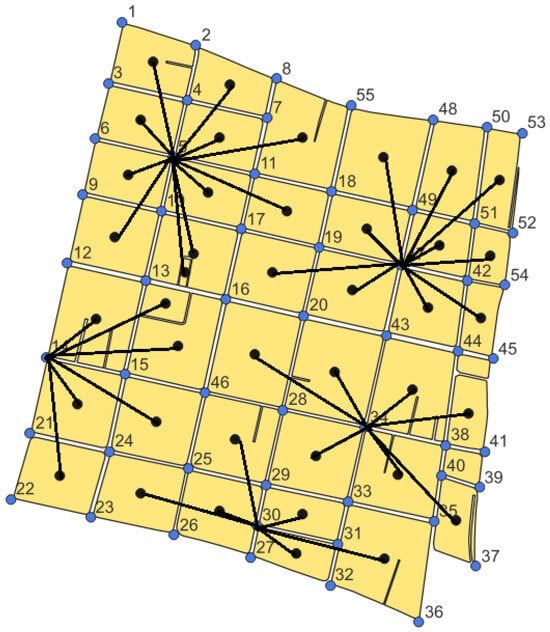
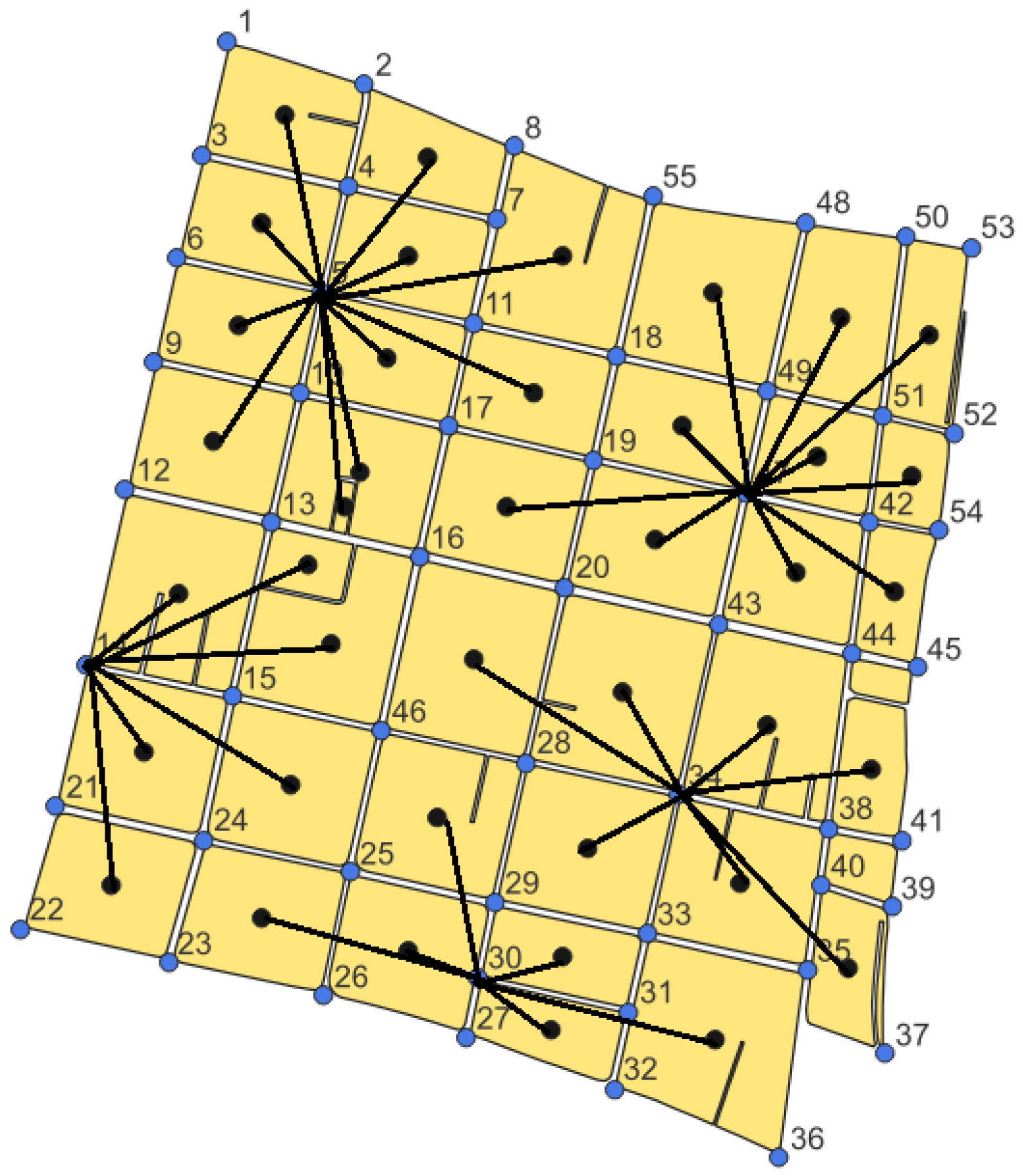
For illustrative purposes, Figure 1 presents a graphical representation of a feasible solution to the proposed problem for a small, arbitrary instance involving bin allocation at road intersections (blue dots or set J). The black dots represent the centroids of the waste generation points (set I). In the example, collection sites are activated, and the waste generation points are assigned to their nearest site. For simplicity, the details regarding the number of assigned bins and their capacities and the quantity of waste stored in these bins for different waste types are omitted.
Figure 1.
An illustrative example of a feasible solution for the bin location–allocation problem.
4. Case Study
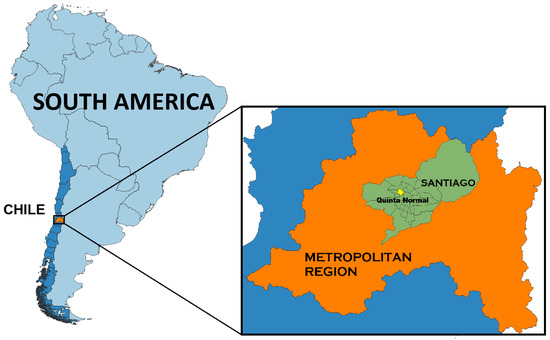
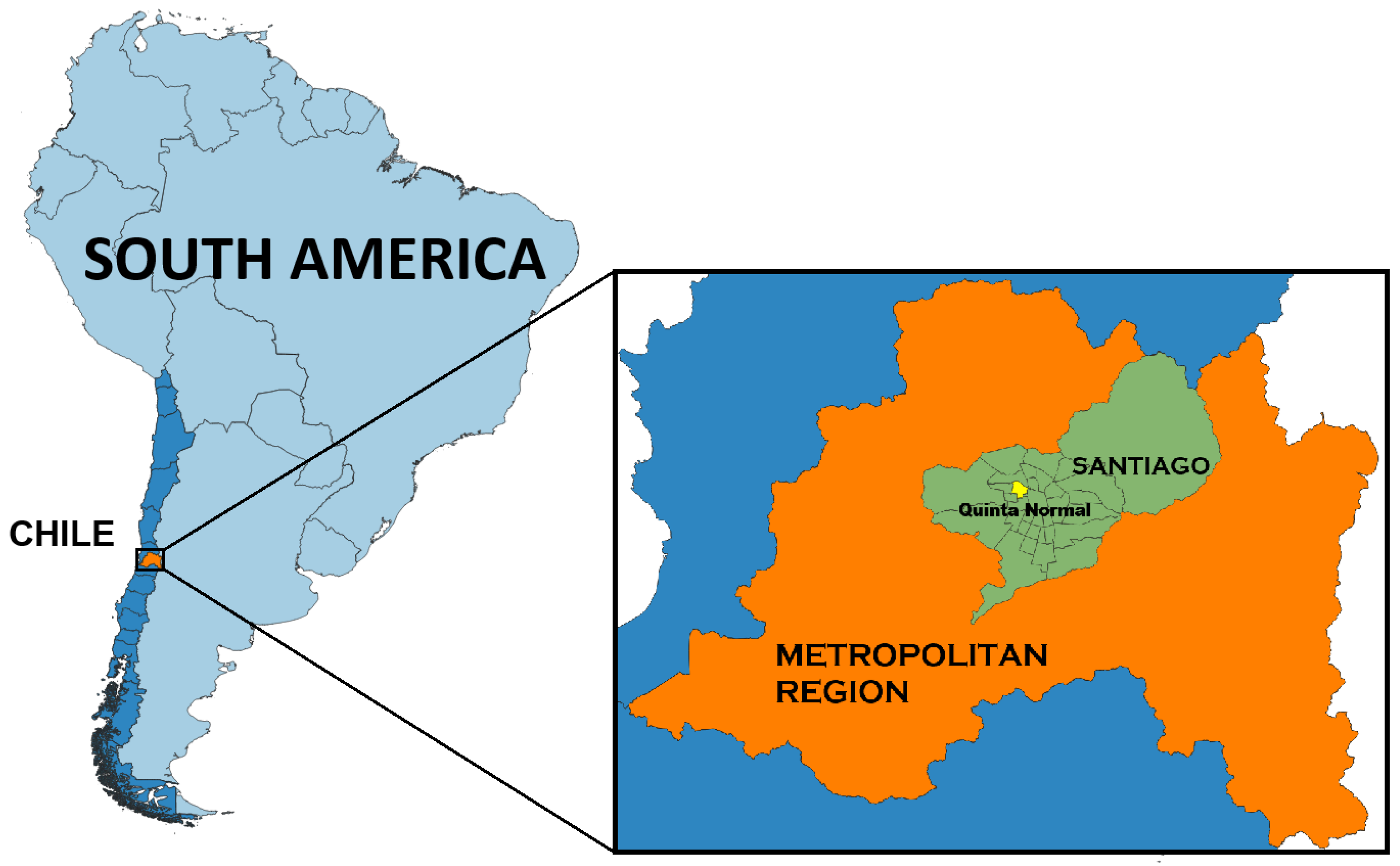
Quinta Normal is located on the north side of Santiago within the Metropolitan Region (See Figure 2), has a population of 140,055 inhabitants, and an area of 12.4 km2 [41]. In 2022, Quinta Normal generated 46,720 tons of municipal solid waste, of which 58% corresponds to organic waste, 29% is recycling waste, and 13% represents other waste types. Note that although organic waste represents a large component of municipal solid waste, this type of waste requires a biological process for recycling [42], which is not considered in this study. Approximately 16%, 6%, 4%, and 3% of the municipal solid waste corresponds to plastic, paper, glass, and metal, respectively [43]. The estimated density for plastic is 1.37 kg/L, for paper is 0.60 kg/L, for glass is 2.33 kg/L, and for metal is 2.70 kg/L. The daily production for each of these four recyclable waste types () was estimated using Equation (9), where represent the percentages for each recyclable waste type t, is density for each recyclable waste type t, is the projected population from the 2017 Census [44], and W is the total daily waste generation rate (kg/person/day) obtained from real-world data obtained from the research project described in [45].
Figure 2.
Map of study area.
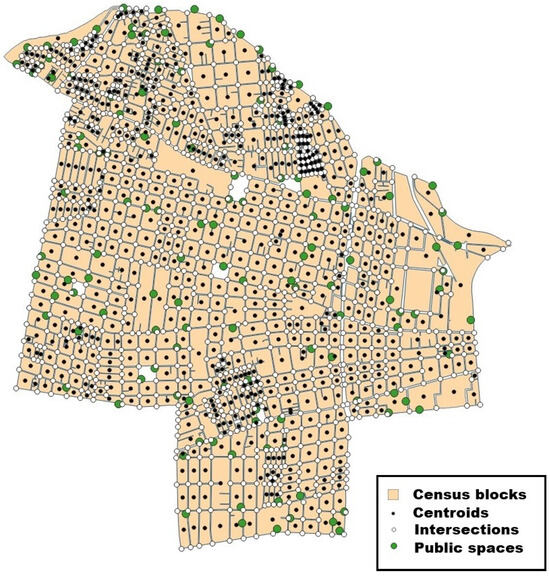
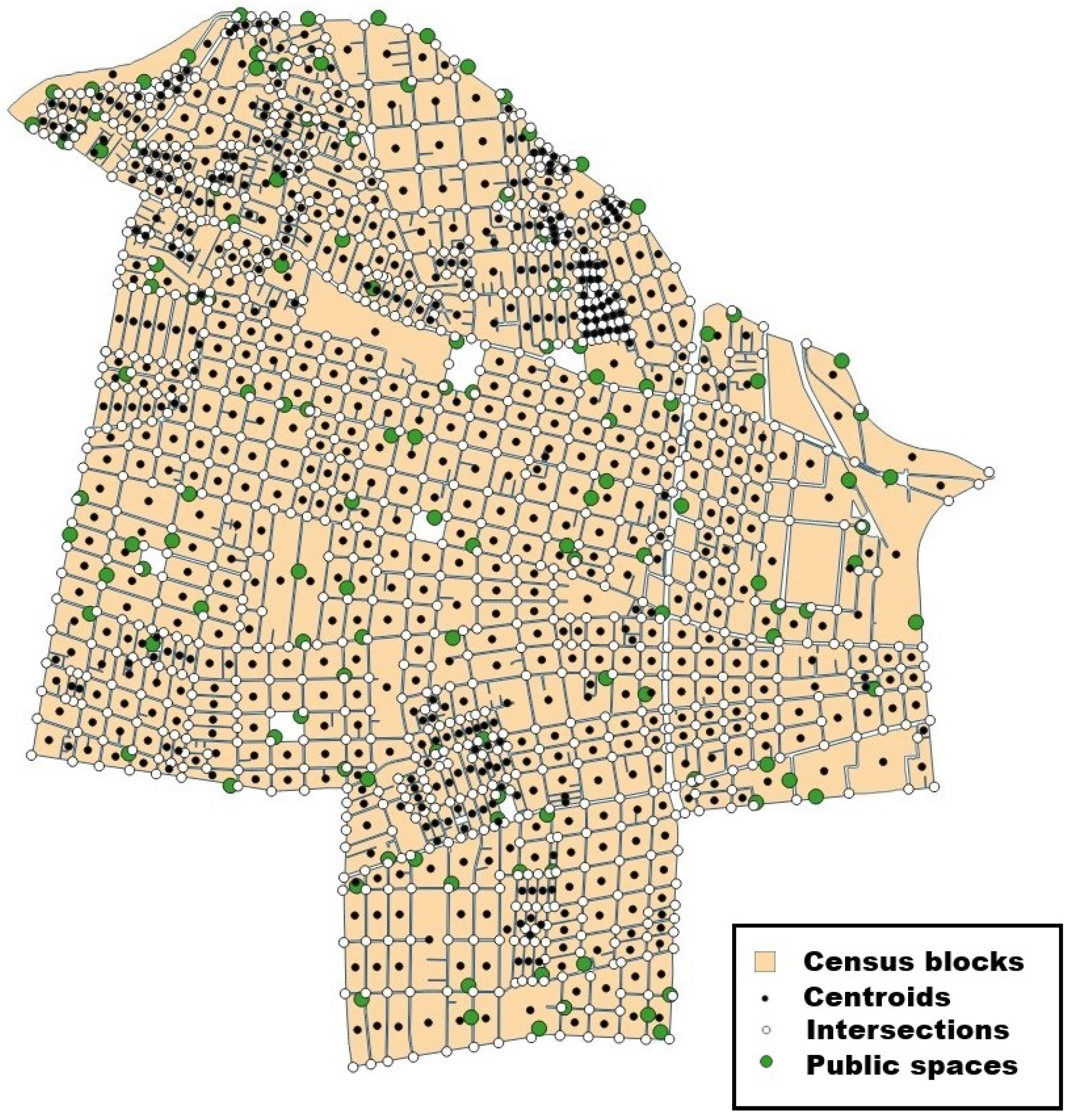
This study considers only recyclable household solid waste since the waste generated by commerce or other activities in Quinta Normal are either negligible or privately disposed of. Recyclable waste is assumed to be generated at the centroid of each census block because the census data is provided at this level for privacy and anonymity reasons. Figure 3 shows 759 centroids representing waste generation points, 1000 candidate collection site locations at road intersections, and 130 possible locations in open public spaces (e.g., parks, schools, supermarkets, etc.) in Quinta Normal. Euclidean distances were computed between centroids and candidate site locations to represent the travel distances that users walk or drive to a collection site. In this study, three threshold travel distances between the centroids and the collection sites (250, 350, and 450 [m]) are evaluated. We did not consider higher threshold distances, given the sociodemographic characteristics of the commune, where most users are expected to walk to the collection sites. In addition, the recyclable waste is assumed to be collected biweekly.
Figure 3.
Centroids and candidate collection points in Quinta Normal.
Bins with a storage capacity of 360, 660, and 1100 [L], and unit costs of US$110, US$190, and US$269, respectively, are used in this case study. The capacity of the bins and their market prices (converted to US dollars at the time of writing) correspond to frequently used alternatives for collecting recyclable waste in the local context. Any number of bins with different capacities may be located at each collection site. The minimum distance between collection sites is set to 100 [m] (see the description of constraints (6)). We assume that there is sufficient space at each collection site (road intersections and open public spaces) to install up to six bins of different sizes. Note that separation costs of recyclable waste are not included in the problem. Additionally, in the MS strategy, we assume that the recyclable waste is adequately separated and disposing of in the correct bins.
5. Results
This section provides the results of the computational experiments conducted in this study for the base case scenario and for the sensitivity analysis. All experiments were executed on an AMD Ryzen 7-7730U CPU @2.0 GHz with eight cores and 16 GB of RAM running at 3200 MHz. The mathematical model was implemented in AMPL, and the MILP formulation presented in Section 3 was solved using CPLEX 22.1.2. A time limit of 43,200 s was established to solve each instance.
Table 2 presents the results for the base case scenario with the current waste generation rate and the results of the sensitivity analysis with a waste generation increase of 10% and 20% for both SS and MS using road intersections as candidate collection sites. Additionally, the results are shown for three threshold travel distances ( = 250 [m], = 350 [m], and = 450 [m]) between centroids and candidate collection sites at road intersections. For each parameter combination, we report the lower bound LB (cost of the best lower bound of the optimal solution), upper bound UB (cost of the best feasible solution), percentage of the optimality gap GAP (calculated over UB), the average travel distance , and the average utilization of bin capacity .
Table 2.
Summary of results for different parameter combinations and collection strategies using road intersections.
When comparing collection strategies for the base case scenario, UB and GAP for MS are higher than SS, and the average bin utilization for MS is lower than SS. In MS, users dispose of their recyclable waste in separate bins according to the recyclable waste type, and thus, more bins are required, generating higher costs (UB), and the overall bin utilization diminishes as the waste is distributed among different bins. As a result of this inferior bin utilization, users are required to travel larger distances to discard their waste with MS using a lower number of collection sites that are allocated to centroids (e.g., 105 selected sites for SS and 81 selected sites for MS with = 250 [m]).
When the threshold travel distance increases for the base case scenario in Table 2, UB tends to decrease for MS. This effect is partially explained by the increase in feasible location–allocation possibilities as increases. Indeed, for [m], there are 14,782 feasible allocations between centroids and collection sites. For [m] and [m], the number of feasible allocations increases to 26,913 and 41,860, respectively. Therefore, two opposing effects are observed as the value of increases. On one hand, there are more allocation possibilities, which contribute to achieving lower UB values, and on the other hand, the instances grow significantly in size and become more complex to solve. For SS, we encounter situations that a priori seem counterintuitive considering that increasing the values of to 350 and 450 [m] yields solutions with higher UB values than those for [m]. This outcome is likely due to the aforementioned reasons. Thus, all scenarios were executed again for [m] and [m], warm-starting CPLEX with the solution obtained with [m]. The new results are reported in parentheses for each scenario for SS in Table 2. In this regard, the effectiveness of the warm-starting approach can be observed for both values (350 [m] and 450 [m]) as UB is reduced while the average travel distances and bin utilization present minor variations for the base case scenario and for the increased waste generation scenario when compared to the results with [m].
Results of the sensitivity analysis suggest that if the waste generation is increased by 10% and 20%, then UB also increases for both strategies. In these scenarios, there is a higher number of sites selected and a greater number of bins required at each collection site, and thus, the average travel distance of users is diminished. The results in Table 2 suggest that municipalities would require, on average, an additional budget of approximately US$3518 (11.4%) and US$5559 (18.0%) when the waste generation increases by 10% and 20%, respectively, for SS and [m]. However, average travel distances to selected collection sites are decreased by 5.2 [m] (4.0%) with a 10% increase in the waste generation, and 6.6 [m] (5.1%) with a 20% increase in the waste production. Whereas, for MS, both UB and average travel distances present inferior variations as the waste generation increases with respect to the base case scenario when compared to the SS strategy. Regarding UB for MS, there is an increase of US$2833 (7.0%) with a 10% additional waste generation and US$7110 (17.7%) with a 20% increase in the waste generation with [m]. When increasing the waste generation to 10% and 20%, users would travel very similar distances to the base case scenario (only −1.5% and −1.3% variation, respectively) to dispose of their waste at road intersections for MS.
Table 3 shows the results with both SS and MS for the base case scenario and the sensitivity analysis using collection sites in public spaces. Results for cases with [m] and [m] are infeasible, and thus, they were excluded from the table. In these cases, 100% coverage is not fulfilled since at least one centroid has no collection site allocated within the defined threshold distance . Similarly to the results reported in Table 2 with road intersections, this table indicates that SS is more economical than MS since an inferior number of bins is required with mixed recyclable waste, and additionally, lower average distances from centroids to public spaces are observed for SS. Table 3 also shows that the average bin utilization for MS is less than for SS. Notice that this utilization increases significantly, reaching near 100% for collection sites in public spaces. Thus, the scenario for MS strategy and with [m] becomes infeasible when the waste generation increases by 20% relative to the base case scenario.
Table 3.
Summary of results for different parameter combinations and collection strategies using open public spaces.
When comparing Table 2 and Table 3 with the results for road intersections and public spaces, respectively, for the same threshold distance ( = 450 [m]), the latter reports lower UB values for the base case scenario with both SS and MS. However, the average travel distances to the assigned public space collection site are larger for SS and MS, when compared to the road intersections (e.g., travel distances in the base case scenario are approximately 66% and 12% higher for SS and MS with [m], respectively). There are less options for allocating centroids to collection sites in public spaces than intersections (130 versus 1000 candidate collection sites in the case study, respectively), and thus, inferior number of sites are selected, and users need to travel larger distances to public spaces to discard their waste.
Sensitivity results in Table 3 also reveal that UB increases with the waste generation for SS and MS strategies since additional bins are required to satisfy the increased waste generation. There is a 8.8% and 18.7% increase in UB when the waste generation increases by 10% and 20% with SS, while the average travel distances are reduced by 4.0% and 9.2% for 10% and 20% increase in the waste generation. For MS, UB increases by 8.3% if the waste generation presents a 10% increase. As opposed to the results with the collection sites at road intersections, the travel distances to the allocated collection sites increase as more recyclable waste is produced in public spaces. As aforementioned, there is a smaller number of selected sites and a higher usage of large bins in public spaces to accommodate the increased amount of recyclable waste. Thus, there are fewer options for allocating centroids to collection sites in public spaces than at road intersections.
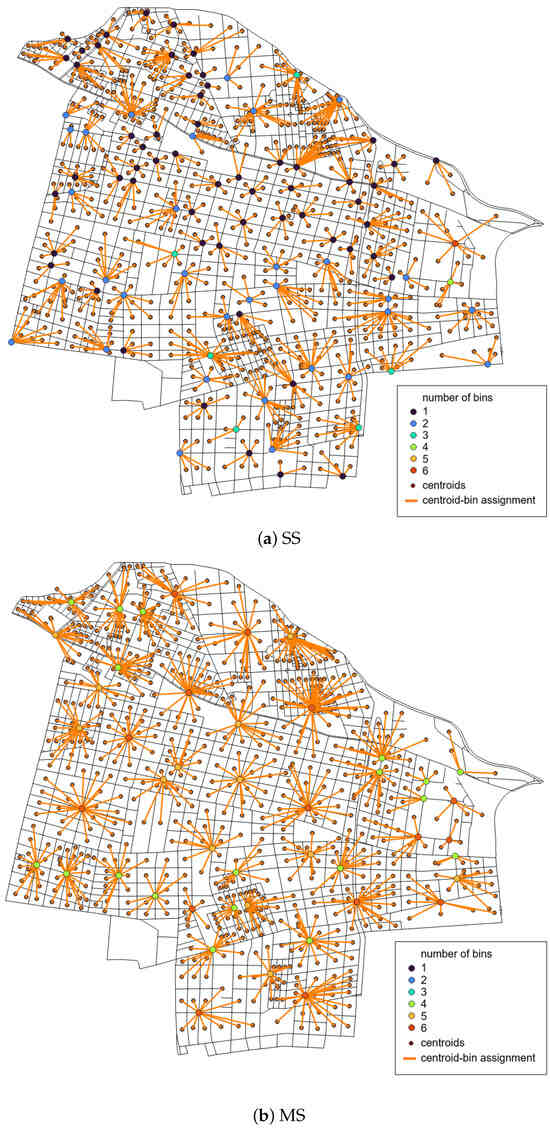
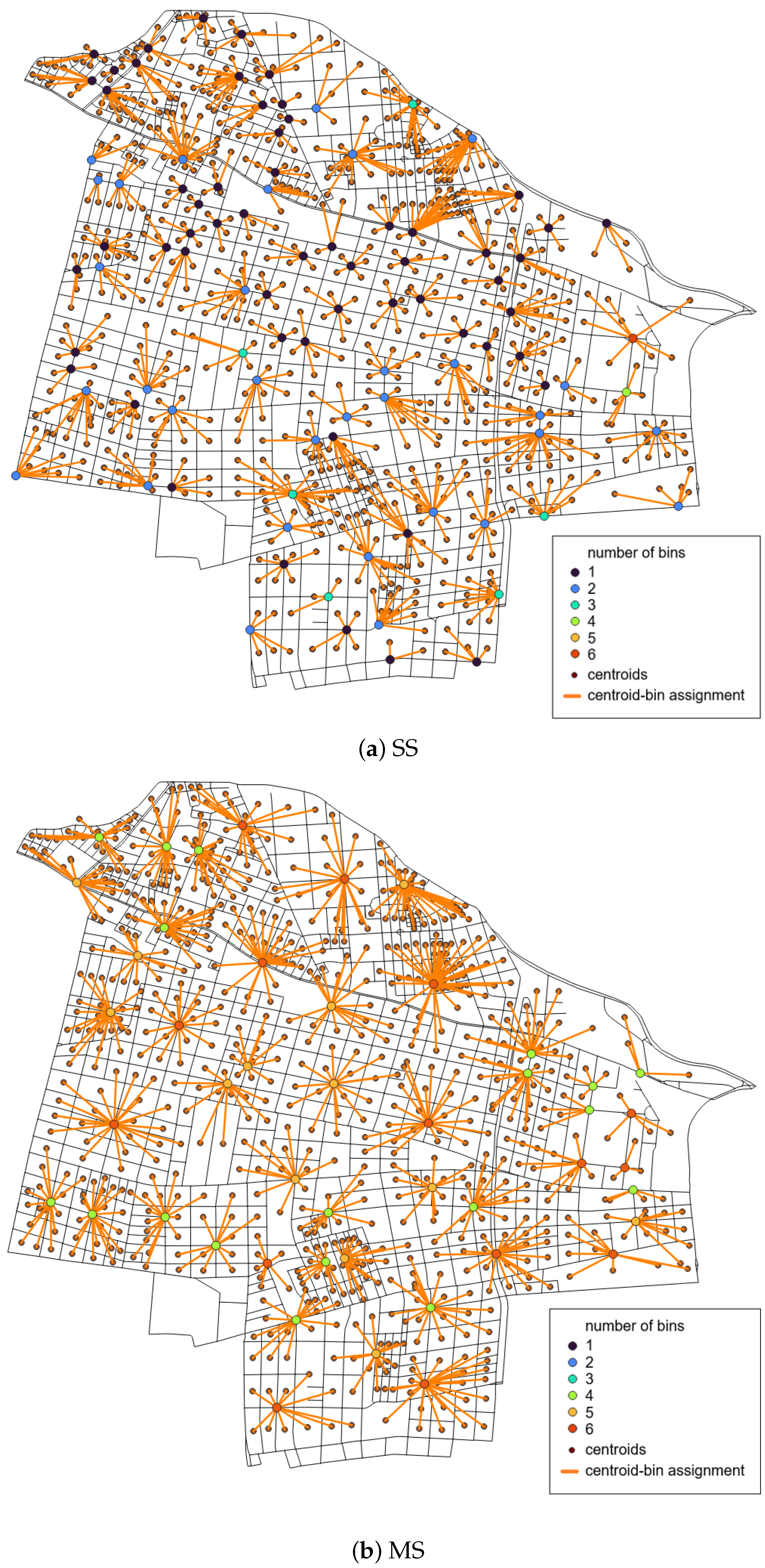
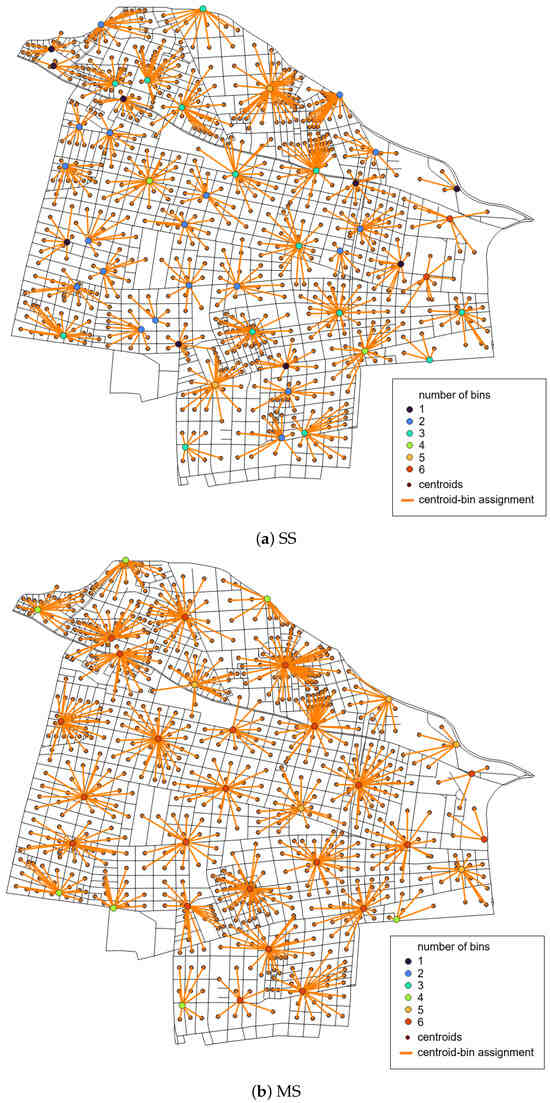
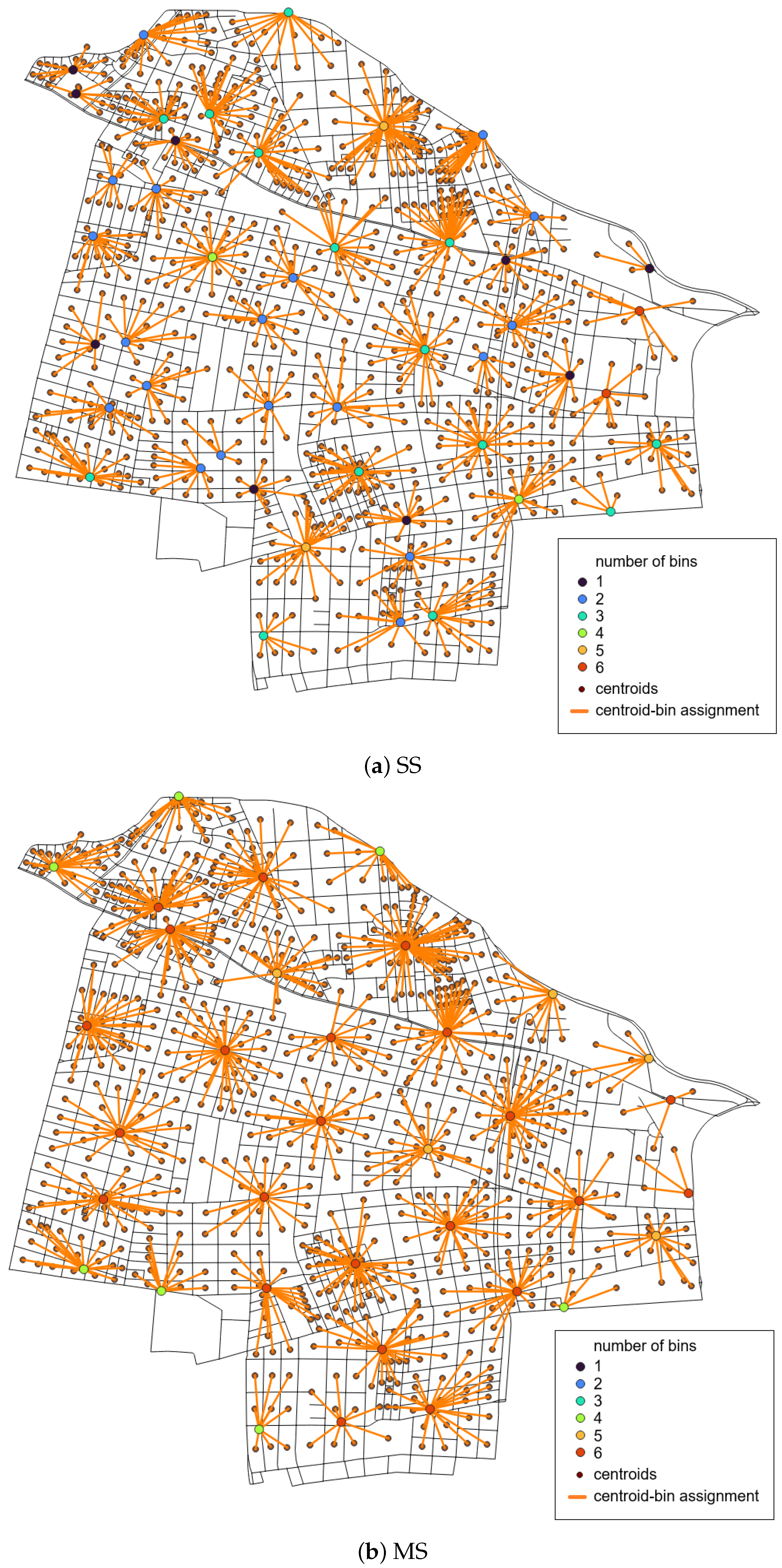
Figure 4 and Figure 5 depict the results of the bin location–allocation at road intersections and in public spaces for the base case scenario, respectively. For comparison purposes, both figures present the results with [m]. These figures reveal that MS requires an inferior number of sites to receive the disposed recyclable waste than SS. However, a larger number of bins are needed at each site to accommodate the separated waste by recyclable type for MS. For example, Figure 4a indicates that most selected sites at road intersections require one or two bins for SS, whereas Figure 4b shows that most sites need between four and six bins for MS. Similar results are depicted in Figure 5, in which one, two, and three bins are used at each public space for SS (Figure 5a), and most of the selected sites require the maximum number of six bins for MS (Figure 5b).
Figure 4.
Results of recyclable waste bin location–allocation at road intersections.
Figure 5.
Results of recyclable waste bin location–allocation in public spaces.
To complement the information presented in Figure 4 and Figure 5, Table 4 presents the number and type of bins required for each strategy for the base case scenario at road intersections and public spaces. This table shows that large bins with a capacity of 1100 [L] are mostly required for SS at both road intersections and public spaces since all the recyclable waste is disposed of together in the same bins. For MS, small bins with 360 [L] are needed for glass and metal, and large bins are used for plastic and paper, which reflect their respective percentage in the recyclable waste composition mentioned in Section 4.
Table 4.
Number of bins per size and recyclable waste type for the base case scenario using [m].
In Table 5, we present the disaggregated bin utilization by recyclable waste type for MS with different values, the two collection site options (road intersections and public spaces), and the base case and increased waste generation scenarios. This table shows that the average bin utilization of plastic and paper is relatively high, always exceeding 80%. In contrast, the average bin utilization of glass and metal is significantly lower than plastic and paper. In this table, the sensitivity results indicate that the bin utilization tends to increase with the waste generation for all waste types. Note that the bin utilization of metal is relatively low for all waste generation rates and threshold distances. These results suggest that future work should evaluate the use of smaller bins for this type of recyclable waste.
Table 5.
Average bin utilization per recyclable waste type for the MS recycling strategy.
6. Discussion and Managerial Implications
Different managerial insights are observed in this study that may help local authorities improve the recyclable household waste collection. These insights are organized in the three dimensions discussed below.
6.1. Economic Implications
From an economic point of view, the results of this study reveal that SS is cheaper than MS since a lower number of bins are used to collect mixed waste, as concluded in [46]. However, the recyclable waste has to be separated later at the recycling plant incurring in significantly higher material management costs (e.g., sorting and labor costs) than MS [47]. For MS, the recycling plants employ more economical and inferior technological operations due to clean and presorted waste. Additionally, when recyclable waste is separated at the source, it yields higher quality recyclable materials after processing at the plants. However, a higher number of bins (i.e., higher bin costs) are required with MS, and therefore, multi-compartment vehicles are required to collect the sorted waste in one trip or single-compartment trucks in multiple trips [48]. Note that the economic analysis of recycling and recovery material phases at the processing plants is out of the scope of our study.
As the waste generation increases in the sensitivity analysis, a higher impact is observed on the bin costs than on the average travel distances to collection sites for SS and MS. Thus, these results will affect the municipalities budget more than the willingness of the users to dispose of their recyclable waste measured, which is measured by the closeness to the collection sites. Another interesting conclusion from the sensitivity analysis is that there is a slight variation in the bin costs as the threshold distance is increased, particularly for the road intersection collection sites. Thus, there is no significant impact on the average travel distances and bin costs when this parameter is varied.
6.2. Public Participation
This study compares the scenarios of users disposing of their recyclable waste at road intersections versus in open public spaces. Collection sites at road intersections lead to a higher participation due to shorter distances providing accessibility and convenience to users. According to [49], these are important factors that influence participation rates in Chile. Additionally, MS requires more effort and willingness on the part of users to separate their recyclable waste. Whereas, a higher public participation is anticipated and increased recycling rates may be observed for SS, as all recyclable waste is accumulated together, and users travel shorter distances between their households and the collection sites. However, the disadvantage of SS is that the average bin utilization is high, reaching almost their full capacity. This high bin utilization may result in overflowing bins if there are increases in waste generation during certain events (e.g., holidays, tourist seasons, and festivals), which could lead to significant health and environmental risks. Additionally, higher pollution levels may be observed due to commingled recyclable waste, particularly when mixing broken glass with other recyclable waste types, which can result in lower-quality recycled materials.
6.3. Spatial Planning
Since a larger number of collection sites are available throughout the commune at different road intersections, the bin utilization at these locations is less than in public places. Nevertheless, bins situated at busy road intersections may obstruct sidewalks causing safety hazards to the pedestrians, especially for MS that bins are needed for different recyclable waste types. The location of the recycling bins in public places is cheaper for both SS and MS because a lower number of bins are required to store the generated recyclable waste, but more bins are aggregated in a specific public place such as supermarkets or schools. Therefore, caution must be taken with these bins since they may tend to overflow, particularly with SS.
This study presents some limitations. For example, we only focus on addressing the bin location–allocation problem, and the computation of optimal routes for collecting the recyclable waste are not taken into account. Additionally, this study assumes a static recyclable waste generation per person and a constant spatial distribution of the population in time within the commune in the case study. This study does not consider daily urban mobility and different waste generation patterns of the citizens. Another limitation includes a behavioral simplification of the users, which assumes that their waste should be disposed of to the nearest assigned collection site. Finally, Euclidian distances are employed between waste generation points and collection sites. These distances may be underestimating real distances that the users must travel to the collection sites. These limitations will be addressed in future research.
7. Conclusions
This study employs an MILP model to solve the bin location–allocation problem. This model assigns waste generation centroids to the nearest collection sites and determines the optimal number and locations of bins at these sites, while minimizing costs, and ensuring that users must travel a maximum distance from their households to the recycling bins. The model was employed to solve a real-world instance in the commune of Quinta Normal in Santiago, Chile, considering road intersections and open public spaces as collection sites. In addition, two different collection strategies, SS and MS, are compared regarding costs and travel distances of users to collection sites.
The bin location–allocation results are obtained for a base case scenario and a sensitivity analysis that increase the threshold travel distance to collection sites and increments the waste generation by 10% and 20%. The results for the base case scenario indicate that the lowest costs are obtained with SS since all waste is mixed in the same bins, and users need to travel shorter distances to collection sites to dispose of their recyclable waste. Increases in the waste generation yield higher bin utilization mainly for SS, which may require increasing collection frequencies or installing additional bins at the collection sites. The costs are decreased if recycling bins are located in public places when compared to road intersections, but users are required to travel larger distances. The results from this study suggest an inferior number of bins are needed in public places, yielding higher percentages of bin utilization.
This study discussed managerial implications related to the variation of total bin costs and average travel distances depending on the type of collection strategy and the collection site options. The results suggest that variations in the waste generation present a higher impact on the bin costs than on the average travel distances for both SS and MS. For example, if the waste generation is increased by 10% and 20% for SS with collection sites at road intersections, then the municipalities will need to face an increase in their budget between 10.2% and 11.4%, and between 17.3% and 18.1%, respectively, depending on the defined threshold travel distance. Whereas, for MS, the budget increase ranges between 4.7% and 7.3%, and between 9.2% and 17.7% when the waste generation increases by 10% and 20%, respectively, with collection sites at road intersections. Similar fluctuation values are observed for both SS and MS when public spaces are employed as collection sites. On the other hand, the average travel distances are decreased by less than 5% for collection sites at road intersections, and less than approximately 9% for collection sites in public spaces if the waste generation increases.
Given the aforementioned practical implications, local authorities, waste management teams, managers, and other professionals may make informed decisions with respect to recyclable household waste collection systems. The results of this study provide alternatives regarding collection strategies and collection site alternatives with different costs and travel distances that are required for encouraging recycling tasks among inhabitants of Quinta Normal and other communes with similar sociodemographic characteristics.
Future research should include the integration of location and routing models, and multi-objective optimization models that minimize costs, travel distances, or consider the environmental impact on both collection strategies and collection sites. The models should include differentiated collection frequencies for each type of recyclable waste given that there are different generation rates depending on the recyclable waste type. Different collection frequencies may also depend on the recycling strategy, for instance, recycling waste may be collected more frequently with SS than MS due to the higher bin utilization rate. Finally, future work should consider seasonal fluctuations in the generation of recyclable waste during holidays or other relevant events.
Author Contributions
Conceptualization, C.B.; methodology, C.B., F.Y., F.G. and N.B.; software, F.Y., F.G. and N.B.; validation, C.B. and F.Y.; formal analysis, C.B. and F.Y.; investigation, C.B., F.Y., F.G. and N.B.; data curation, C.B., F.G. and N.B.; writing—original draft preparation, C.B. and F.Y.; writing—review and editing, C.B. and F.Y.; visualization, C.B.; supervision, C.B. and F.Y.; project administration, C.B.; funding acquisition, C.B. All authors have read and agreed to the published version of the manuscript.
Funding
This research was funded by research grants ANID-FONDEF ID22I10107 and ANID-FONDECYT 1241471.
Institutional Review Board Statement
Not applicable.
Informed Consent Statement
Not applicable.
Data Availability Statement
The data presented in this study are available on request from the corresponding author.
Acknowledgments
The authors would like to thank Chilean National Agency of Research and Development for the support of this research.
Conflicts of Interest
The authors declare no conflicts of interest.
Abbreviations
The following abbreviations are used in this manuscript:
| MILP | Mixed-Integer Linear Programming |
| SS | Single-Stream |
| MS | Multi-Stream |
| UB | Upper Bound |
| LB | Lower Bound |
| GAP | Optimality gap |
References
- Kaza, S.; Yao, L.; Bhada-Tata, P.; Van Woerden, F. What a Waste 2.0: A Global Snapshot of Solid Waste Management to 2050. Available online: https://openknowledge.worldbank.org/entities/publication/d3f9d45e-115f-559b-b14f-28552410e90a (accessed on 5 October 2024).
- Rojas, A.; Yabar, H.; Mizunoya, T.; Higano, Y. The potential benefits of introducing informal recyclers and organic waste recovery to a current waste management system: The case study of Santiago de Chile. Resources 2018, 7, 18. [Google Scholar] [CrossRef] [Scilit]
- D’Adamo, I.; Mazzanti, M.; Morone, P.; Rosa, P. Assessing the relation between waste management policies and circular economy goals. Waste Manag. 2022, 154, 27–35. [Google Scholar] [CrossRef] [Scilit]
- United Nations Environment Programme. Global Waste Management Outlook 2024. Available online: https://www.unep.org/resources/global-waste-management-outlook-2024 (accessed on 23 June 2025).
- InvestChile. Ranking 2023: Chile Lidera América Latina en Competitividad Global. Available online: https://blog.investchile.gob.cl/bloges/rankings-chile-lidera-america-latina-en-competitividad (accessed on 23 June 2025).
- Cifelli, R. Conoce Las Cifras de Reciclaje en Chile por Tipo de Residuo. Available online: https://codexverde.cl/conoce-las-cifras-de-reciclaje-en-chile-por-tipo-de-residuo/ (accessed on 13 January 2025).
- Valenzuela-Levi, N. Poor performance in municipal recycling: The case of Chile. Waste Manag. 2021, 133, 49–58. [Google Scholar] [CrossRef] [Scilit]
- Pariona, A. OECD Recycling Statistics. Available online: https://www.worldatlas.com/articles/oecd-leading-countries-in-recycling.html (accessed on 13 January 2025).
- Ministerio Medio Ambiente. Hoja de Ruta Economía Circular. Available online: https://economiacircular.mma.gob.cl/wp-content/uploads/2022/01/HOJA-DE-RUTA-PARA-UN-CHILE-CIRCULAR-AL-2040-EN.pdf (accessed on 13 January 2025).
- Valenzuela-Levi, N. Factors influencing municipal recycling in the Global South: The case of Chile. Resour. Conserv. Recycl. 2019, 150, 104441. [Google Scholar] [CrossRef] [Scilit]
- United Nations. The Sustainable Development Goals Report. Available online: https://unstats.un.org/sdgs/report/2022/The-Sustainable-Development-Goals-Report-2022.pdf (accessed on 23 June 2025).
- Corporación Ciudades. Estudio Reciclaje y Residuos en Grandes Ciudades de Chile. Available online: https://corporacionciudades.cl/wp-content/uploads/2024/07/Estudio-reciclaje-2024.pdf (accessed on 23 June 2025).
- Ilustre Municipalidad de Quinta Normal. Plan de Desarrollo Comunal. Resumen Ejecutivo. Available online: https://ligup-v2.s3.amazonaws.com/quintanormal/multimedia/62758_resumen_pladeco_2022_2025_vf_febrero_2024_1_.pdf (accessed on 13 January 2025).
- Manríquez, J. Conoce los Puntos Limpios de Reciclaje en Quinta Normal. Available online: https://www.cualestuhuella.cl/noticia/puntos-limpios/2021/01/puntos-limpios-reciclaje-quinta-normal (accessed on 13 January 2025).
- Ilustre Municipalidad de Quinta Normal. Reciclaje Domiciliario: Quinta Normal. Available online: https://www.quintanormal.cl/secciones/6224 (accessed on 13 January 2025).
- Shaban, A.; Zaki, F.E.; Afefy, I.H.; Di Gravio, G.; Falegnami, A.; Patriarca, R. An optimization model for the design of a sustainable municipal solid waste management system. Sustainability 2022, 14, 6345. [Google Scholar] [CrossRef] [Scilit]
- Blazquez, C.; Paredes-Belmar, G. Network design of a household waste collection system: A case study of the commune of Renca in Santiago, Chile. Waste Manag. 2020, 116, 179–189. [Google Scholar] [CrossRef] [Scilit] [PubMed]
- Carlos-Alberola, M.; Gallardo Izquierdo, A.; Colomer-Mendoza, F.J.; Barreda-Albert, E. Design of a municipal solid waste collection system in situations with a lack of resources: Nikki (Benin), a case in Africa. Sustainability 2021, 13, 1785. [Google Scholar] [CrossRef] [Scilit]
- Herrera-Granda, I.D.; Imbaquingo-Usiña, W.G.; Lorente-Leyva, L.L.; Herrera-Granda, E.P.; Peluffo-Ordóñez, D.H.; Rossit, D.G. Optimization of the network of urban solid waste containers: A case study. In Proceedings of the International Conference on Technology Trends, Babahoyo, Ecuador, 29–31 August 2018; Springer: Berlin/Hamburg, Germany, 2018; pp. 578–589. [Google Scholar]
- Toutouh, J.; Rossit, D.; Nesmachnow, S. Computational intelligence for locating garbage accumulation points in urban scenarios. In Proceedings of the International Conference on Learning and Intelligent Optimization, Kalamata, Greece, 10–15 June 2018; Springer: Berlin/Hamburg, Germany, 2018; pp. 411–426. [Google Scholar]
- Yaakoubi, O.E.; Benabdouallah, M.; Bojji, C. Heuristic approaches for waste containers location problem and waste collection routes optimisation in an urban area. Int. J. Environ. Waste Manag. 2018, 21, 269–286. [Google Scholar] [CrossRef] [Scilit]
- Gilardino, A.; Rojas, J.; Mattos, H.; Larrea-Gallegos, G.; Vázquez-Rowe, I. Combining operational research and Life Cycle Assessment to optimize municipal solid waste collection in a district in Lima (Peru). J. Clean. Prod. 2017, 156, 589–603. [Google Scholar] [CrossRef] [Scilit]
- Rossit, D.G.; Tohmé, F.A.; Frutos, M.; Broz, D.R. An application of the augmented ε-constraint method to design a municipal sorted waste collection system. Decis. Sci. Lett. 2017, 6, 323–336. [Google Scholar] [CrossRef] [Scilit]
- Bennekrouf, M.; Aggoune-Mtalaa, W.; Benladghem, K.; Cherif, H.O. A strategic approach for the optimal location of recycling bins in the city of Boudjlida in Algeria. In Proceedings of the 2020 IEEE 13th International Colloquium of Logistics and Supply Chain Management (LOGISTIQUA), Fez, Morocco, 2–4 December 2020; IEEE: Piscataway, NJ, USA, 2020; pp. 1–6. [Google Scholar]
- Rathore, P.; Sarmah, S.P.; Singh, A. Location–allocation of bins in urban solid waste management: A case study of Bilaspur city, India. Environ. Dev. Sustain. 2020, 22, 3309–3331. [Google Scholar] [CrossRef] [Scilit]
- Jammeli, H.; Argoubi, M.; Masri, H. A Bi-objective stochastic programming model for the household waste collection and transportation problem: Case of the city of Sousse. Oper. Res. 2021, 21, 1613–1639. [Google Scholar] [CrossRef] [Scilit]
- Adeleke, O.J.; Ali, M.M. An efficient model for locating solid waste collection sites in urban residential areas. Int. J. Prod. Res. 2021, 59, 798–812. [Google Scholar] [CrossRef] [Scilit]
- Cavallin, A.; Rossit, D.G.; Herran Symonds, V.; Rossit, D.A.; Frutos, M. Application of a methodology to design a municipal waste pre-collection network in real scenarios. Waste Manag. Res. 2020, 38, 117–129. [Google Scholar] [CrossRef] [Scilit]
- Rossit, D.; Bard, J. Solving the waste bin location problem with uncertain waste generation rate: A bi-objective robust optimization approach. Waste Manag. Res. 2025, 43, 421–437. [Google Scholar] [CrossRef] [Scilit] [PubMed]
- Aka, S.; Akyüz, G. Fuzzy goal programming approach on location-routing model for waste containers. Int. J. Ind. Syst. Eng. 2018, 29, 413–427. [Google Scholar]
- Jamiro, N.F.H.; Sarif, N.A.S.; Rahman, N.S.A.; Zaharudin, Z.A. Establishing recycling bins location and allocation for sustainable urban municipalities of Johor Bahru in Malaysia. Int. J. Acad. Res. Econ. Manag. Sci. 2021, 10. [Google Scholar] [CrossRef] [Scilit] [PubMed]
- Cubillos, M.; Wøhlk, S. Solution of the maximal covering tour problem for locating recycling drop-off stations. J. Oper. Res. Soc. 2021, 72, 1898–1913. [Google Scholar] [CrossRef] [Scilit]
- Letelier, C.; Blazquez, C.; Paredes-Belmar, G. Solving the bin location–allocation problem for household and recycle waste generated in the commune of Renca in Santiago, Chile. Waste Manag. Res. 2022, 40, 154–164. [Google Scholar] [CrossRef] [Scilit] [PubMed]
- Rosni, M.Z.; Ishak, M.I.; Zawawi, A.S.M.; Zaharudin, Z.A. Location-Allocation Model of Recycling Facilities—A Case Study of Seremban, Malaysia. Int. J. Acad. Res. Econ. Manag. Sci. 2022, 11. [Google Scholar]
- Vidović, M.; Ratković, B.; Bjelić, N.; Popović, D. A two-echelon location-routing model for designing recycling logistics networks with profit: MILP and heuristic approach. Expert Syst. Appl. 2016, 51, 34–48. [Google Scholar] [CrossRef] [Scilit]
- Hemmelmayr, V.; Smilowitz, K.; de la Torre, L. A periodic location routing problem for collaborative recycling. IISE Trans. 2017, 49, 414–428. [Google Scholar] [CrossRef] [Scilit]
- Sheriff, K.M.; Subramanian, N.; Rahman, S.; Jayaram, J. Integrated optimization model and methodology for plastics recycling: Indian empirical evidence. J. Clean. Prod. 2017, 153, 707–717. [Google Scholar] [CrossRef] [Scilit]
- Nevrlỳ, V.; Šomplák, R.; Smejkalová, V.; Lipovskỳ, T.; Jadrnỳ, J. Location of municipal waste containers: Trade-off between criteria. J. Clean. Prod. 2021, 278, 123445. [Google Scholar] [CrossRef] [Scilit]
- Viktorin, A.; Hrabec, D.; Nevrlỳ, V.; Šomplák, R.; Šenkeřík, R. Hierarchical clustering-based algorithms for optimal waste collection point locations in large-scale problems: A framework development and case study. Comput. Ind. Eng. 2023, 178, 109142. [Google Scholar] [CrossRef] [Scilit]
- Moreno, J.C.; Alberola, J.M.; Sanchez-Anguix, V.; Jordán, J.; Julián, V.; Botti, V. Optimizing UCO Container Placement in Urban Environments: A Genetic Algorithm Approach. In Proceedings of the International Conference on Intelligent Data Engineering and Automated Learning, Valencia, Spain, 20–22 November 2024; Springer: Berlin/Hamburg, Germany, 2024; pp. 208–219. [Google Scholar]
- Biblioteca del Congreso Nacional de Chile. Quinta Normal. Reporte Comunal. Available online: https://www.bcn.cl/siit/reportescomunales/comunas_v.html?anno=2021&idcom=13126 (accessed on 13 January 2025).
- Dronia, W.; Kostecki, J.; Połomka, J.; Jędrczak, A. Composition and selected properties of bio-waste collected in towns from single-and multi-family housing and in rural areas. Waste Manag. 2023, 172, 140–150. [Google Scholar] [CrossRef] [Scilit]
- Kyklos. Estudio de Recuperación, Reciclaje y Valorización Comunal. Datos 2021. Available online: https://chilesinbasura.cl/estudio-de-recuperacion-y-valorizacion-comunal/ (accessed on 13 January 2025).
- Instituto Nacional de Estadística. Censo 2017. Available online: https://www.censo2017.cl (accessed on 13 January 2025).
- Blazquez, C. Development of the technological tool RESCOL for designing the collaborative collection of solid household waste in urban zones. ID22I10107. Research Project, 2024.
- Berardocco, C.; Delawter, H.; Putzu, T.; Wolfe, L.C.; Zhang, H. Life cycle sustainability assessment of single stream and multi-stream waste recycling systems. Sustainability 2022, 14, 16747. [Google Scholar] [CrossRef] [Scilit]
- Lakhan, C. A Comparison of Single and Multi-Stream Recycling Systems in Ontario, Canada. Resources 2015, 4, 384–397. [Google Scholar] [CrossRef] [Scilit]
- Shang, C.; Ma, L.; Liu, Y. Green location routing problem with flexible multi-compartment for source-separated waste: A Q-learning and multi-strategy-based hyper-heuristic algorithm. Eng. Appl. Artif. Intell. 2023, 121, 105954. [Google Scholar] [CrossRef] [Scilit]
- Trujillo, F.; Chávez, C.; Jaime, M.; Salazar, C. Households’ preferences for door-to-door recycling service: A choice experiment in southern Chile. Ecol. Econ. 2025, 235, 108605. [Google Scholar] [CrossRef] [Scilit]

Disclaimer/Publisher’s Note: The statements, opinions and data contained in all publications are solely those of the individual author(s) and contributor(s) and not of MDPI and/or the editor(s). MDPI and/or the editor(s) disclaim responsibility for any injury to people or property resulting from any ideas, methods, instructions or products referred to in the content. |
© 2025 by the authors. Licensee MDPI, Basel, Switzerland. This article is an open access article distributed under the terms and conditions of the Creative Commons Attribution (CC BY) license (https://creativecommons.org/licenses/by/4.0/).