1. Introduction
In recent decades, the transportation industry has attracted a lot of attention as one of the basic foundations of economic and social development at the global level [
1]. Due to the increasing population and the growing needs of cities, the development of transportation infrastructure in countries has been considered as a critical issue [
2,
3]. The railway network design problem is one of the critical issues in the transportation sector due to its significance and variety of necessary applications [
4]. Many extensive projects are often potentially defined by the limitations of various financial, human, and resource constraints, which do not allow all projects to be implemented at the same time. In this regard, one of the concerns in organizations is the evaluation and selection of worthy projects among a large number of projects [
5,
6].
Projects should be evaluated according to various criteria, and paying attention to specific financial, time, human, and other aspects increases the error of choosing the optimal project [
7]. In different studies, various criteria are considered in the evaluation of projects, but in today’s world, the concept of sustainability is considered as a vital and key factor in many fields and industries [
4,
8]. Sustainability means the ability to maintain balance and continuity in the face of environmental, economic and social challenges, needs, and limitations [
9,
10]. In the transportation industry as well, the importance of sustainability has been given much attention [
11,
12].
One of the main reasons why sustainability is important in evaluating projects is that transportation plays an important role in all aspects of our lives. From public transportation to the transportation of personal belongings, any deficiency and inefficiency in the transportation system can have a direct impact on our daily life as well as on the economy, environment, and social issues [
13,
14]. As a result, choosing transportation projects with an emphasis on sustainability can improve the performance of the transportation system and improve the quality of life of the community. In addition, it is important to pay attention to sustainability in the evaluation of projects from an economic point of view since sustainable transportation projects can lead to reduced costs and improved productivity [
15,
16]. For example, the use of sustainable public transportation systems can reduce traffic and air pollution and, thus, reduce traffic-related costs [
17,
18]. Also, the use of sustainable technologies in vehicles can lead to fuel and energy savings and prevent the loss of natural resources [
11]. Therefore, in the assessment of transportation projects, the importance of sustainability is very important because of the wide-ranging effects on various aspects of our lives and society. The use of sustainability criteria in the selection process of transportation projects can lead to better and more optimal decisions in the structure and development of the transportation system and ultimately lead to improvements in the quality of life of society and the preservation of natural resources.
Numerous studies evaluated different projects in various industries, most of which were based on multi-criteria decision-making methods and expert opinions [
19]. One of the important issues in project evaluation is uncertainty; uncertainty shows itself in various financial, time, and operational aspects and project results. In the field of transportation, factors, such as changes in cost, time, and demand, can have a significant impact on the performance of projects, which should be included in the selection of projects. Price changes in raw materials, market fluctuations, and structural changes can increase costs and delay implementation. These issues can have a serious negative impact on the financial constraints of the projects and, as a result, lead to the failure of the successful completion of the projects or a reduction in their quality and performance [
20]. Also, the uncertainty in the demand for projects can have a significant effect on the evaluation of transportation projects and cause fundamental changes in the amount of revenue generation of projects [
9,
21]. For this reason, by involving uncertainty in the evaluation of projects, a more accurate choice can be made. In this regard, according to the notes mentioned before, the present study motivations are as follows:
Designing a new stochastic multi-criteria decision-making approach to include uncertainty in the evaluation of projects; such an approach has not been observed in other studies. By presenting this method, it is possible to define any number of scenarios for the evaluation of projects without limitation, which can include uncertainty in the evaluation of projects by considering different scenarios.
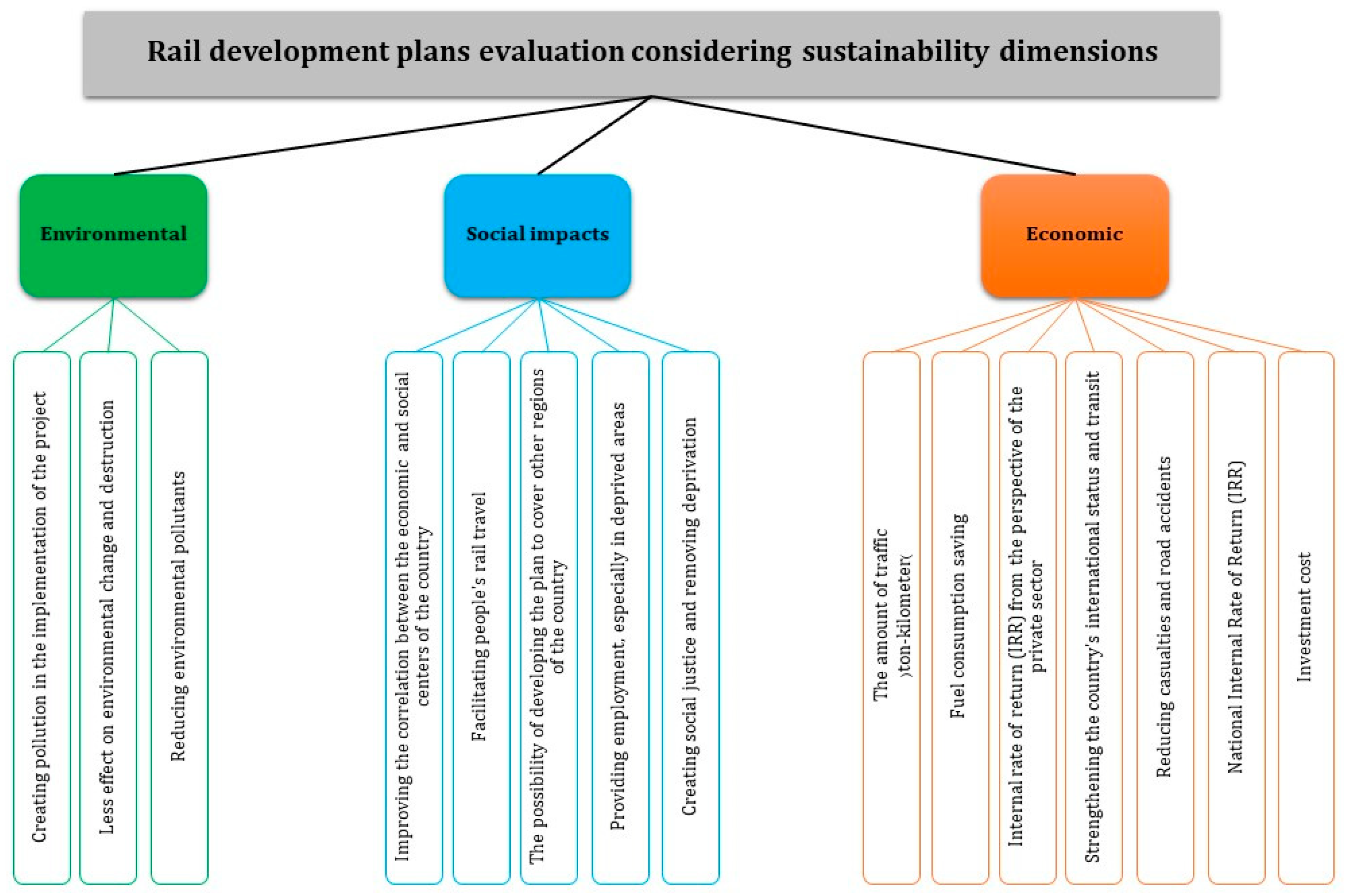
Providing comprehensive sustainability indicators to evaluate transportation industry projects; this study is the first study that evaluates large-scale rail transport projects by considering all sustainability criteria in economic, social, and environmental categories.
Designing a model to evaluate transportation projects considering sustainability indicators and involving uncertainty. This study is the first research that deals with the evaluation of rail transportation projects considering uncertainty. So, considering uncertainty at the same time along with involving sustainability criteria in the evaluation of projects is a new contribution, which is addressed in this study.
In general, the proposed study is innovative from the aspect of the solution method due to providing a new multi-criteria decision-making approach and also considering uncertainty and sustainability criteria in the evaluation of rail transportation projects. In this regard, in
Section 2, an overview of the research articles is presented; then, in
Section 3, the solution method is presented; and in
Section 4, the case study and the evaluation indicators are presented. In
Section 5, the findings are explained, and, finally, in
Section 6, conclusions and management insights are presented.
2. Literature Review
In the domain of project evaluation and project selection, various studies have been conducted that focused on various industries. For instance, Hamurcu et al. [
22] presented a study on the selection of rail transport projects with the process of hierarchical analysis and ideal planning. In their study, it is stated that the Istanbul Municipality intends to develop the rail transportation system of the city according to different goals. In this regard, taking into account various indicators that were weighted with multi-criteria decision-making approaches, various goals were considered as the ideal goals of the project. The important evaluation indicators of railway projects in their study include security, capacity, speed, cost, and credit. According to the mentioned criteria and different scenarios, the target projects were evaluated. In their study, a Financial Computable General Equilibrium (FCGE) model was presented, which simultaneously considered macroeconomic indicators with financial flows. The model was designed to analyze the economic effects of fiscal policies, such as transportation investment expenditure and alternative procurement approaches, on economic growth and distribution across socioeconomic classes, and it relates investment expenditure to specific financial resources. Hamurcu and Eren [
23] presented a framework to evaluate and select rail system projects according to the fuzzy network analysis process. In their study, 15 indicators were presented in four categories: technology, environment, economy, and transportation. According to the results obtained from their study, it can be seen that the cost required for the implementation of railway projects, the rate of return on investment, the comfort of passengers, the ability to implement and help employment, and the response to transportation demand were the most important indicators. According to these indicators and the ANP approach, the studied projects were weighted and prioritized. Yücel and Taşabat [
24] presented a study on the selection of railway system projects with multi-criteria decision-making methods in the city of Istanbul. In their study, it is stated that transportation projects are usually evaluated and selected based on indicators, such as net present value analysis (NPVA), benefit–cost analysis (BCA), and internal efficiency analysis (IEA); but, there is a point that various indicators and components are effective in the evaluation of projects. In this regard, multi-criteria decision-making (MCDM) methods were used in their study. This method, along with financial indicators, such as the stated methods, considers various indicators, such as environmental compatibility management, historical context, how to integrate with other transportation networks, etc. Project evaluation indicators were identified in four categories: passenger services, environment, economy, and urban architecture. The solution method used in this study is the use of two approaches, AHP and BWM, comparing their findings, as a result of which, the projects were weighted according to the identified indicators.
Çoban [
25] explored the assessment and decision-making processes for selecting a solar power plant project using multi-criteria evaluation methods. Since the selection of projects is very difficult from the point of view of experts, the hesitant fuzzy linguistic approach was used in their study, which can assign weight to the options in a spectral manner in the uncertainty of the experts’ opinion. The methodology used in their study was AHP, with its hierarchical approach, and according to hesitant fuzzy linguistics, experts expressed their desired score to the indicators and projects. The most important project evaluation criteria were system technology, energy policies, and energy price changes. The noteworthy point in the findings of the project was the closeness of the final weight of the projects, which indicated the attention of how decision makers consider the criteria that influence project selection. Mahmoudi et al. [
26] presented a large-scale multiple criteria decision-making approach for project selection. The model presented in their study was a refinery equipment manufacturing company with a project-oriented structure, implementing a comprehensive approach for project selection, combining the TOPSIS-OPA method and the K-means clustering algorithm. The study involved clustering projects based on their characteristics using the K-means algorithm. Each cluster was then assessed using eight criteria, including project duration, project delay, number of project items, project manager’s score, physical weight, number of modifications, and project code and level. The TOPSIS approach was employed to prioritize project difficulty. The criteria were weighted based on expert surveys and the OPA approach.
Haseli et al. [
27] presented a new group decision-making approach based on the best–worst method (G-BWM). Due to the complexity of real-world multi-criteria decision-making problems, the analysis of different opinions from a decision-making group is required to ensure appropriate decision making. Group decision-making methods collect the opinions of decision makers and provide the best opinions using mathematical equations. So, they developed an innovative approach to group decision-making problems based on the BWM method, called G-BWM, which helps to examine the opinions of decision makers and make democratic decisions using the BWM structure. In order to evaluate the feasibility of the proposed method and its innovation, two numerical examples from the literature with applications in supply chain management (SCM) (i.e., green supplier selection and supplier development/segmentation) were reviewed and discussed. Their results showed that the proposed G-BWM method performs well in group decision making due to the large number of decision makers, ease of use, and achieving democratic decisions in the decision-making process. Tirkolaee et al. [
17] presented an integrated decision-making approach to evaluate suppliers in a supply chain context. They proposed a multi-criteria decision-making (MCDM) technique that used the Analytic Hierarchy Process (AHP) and the fuzzy Technique for Order of Preference by Similarity to Ideal Solution (TOPSIS) to evaluate and rank suppliers. Then, taking into account resource constraints, criteria weights, and suppliers’ ranking, in a multi-objective mixed linear programming with constraints (MOMILP) method, the optimal order quantity of each supplier was determined under unknown conditions. To deal with the unknown multi-objectives of the proposed model, the roust goal programming (RGP) approach based on Shannon entropy was used. Their proposed method was applied in a real case study of a green food production company in Iran in order to check its applicability with the help of sensitivity analysis at different levels of uncertainty. Furthermore, the reliability of the proposed method was studied using different uncertainty budgets for a green food manufacturing company.
Wan et al. [
28] introduced a generalized trapezoidal fuzzy number-based best–worst method for multi-criteria decision making. They proposed a fuzzy best–worst method called GITrF BWM, which utilizes generalized trapezoidal fuzzy numbers for multi-criteria decision making. The comparisons among criteria are presented using GITrFNs, and the criterion weights are also modeled as GITrFNs. The concept of criterion weight vector is presented in the normalized GITrF form, and a novel representation, Generalized Mean of Interval-valued Trapezoidal Fuzzy Data (GMIR), is provided for GITrFNs. A goal programming model is constructed to obtain the optimized criterion weights in normalized GITrF form. Furthermore, the GITrF similarity index and GITrF similarity ratio are introduced. GMIR is calculated to measure the acceptable similarity of all pairwise comparisons among criteria. For unacceptable similarity in pairwise comparisons, an approach to improve the similarity of these comparisons is presented. Finally, GITrF BWM is proposed for multi-criteria decision making. Three real examples are analyzed to demonstrate the performance of the proposed GITrF BWM. Comparative analyses show that the proposed GITrF BWM outperforms existing methods for multi-criteria decision making in GITrF environments. Dong et al. [
29] developed a fuzzy best–worst method based on triangular fuzzy numbers. They proposed a novel fuzzy best–worst method (BWM) based on triangular fuzzy numbers for multi-criteria decision making. In this method, fuzzy similarity equations are considered as fuzzy equations to obtain the best vector to others and the worst vector to others in the form of triangular fuzzy numbers. To obtain the optimal weights of criteria, the fuzzy decision-making problem is formulated, and using a mathematical programming model, the optimal fuzzy weights of criteria are derived to create a normalized triangular fuzzy weight vector. Then, four linear programming models are presented for optimistic decision making, pessimistic decision making, and neutral decision making. By selecting appropriate tolerance parameters, each of the linear programming models has a unique optimal global solution. Additionally, this article introduces the concepts of fuzzy similarity index and fuzzy similarity ratio. Several application examples are used to validate the proposed fuzzy BWM, demonstrating that the proposed fuzzy BWM provides a highly useful approach for multi-criteria decision making in fuzzy environments.
Wan and Dong, [
30] extended the best–worst method with fuzzy referentiality. In this paper, a novel recognized fuzzy interval-based best–worst method (IFBWM) was proposed for multi-criteria decision making. When a decision maker (DM) makes comparisons, they may have uncertainties. Therefore, referential comparisons are represented as recognized fuzzy interval values (IFVs), and the best-to-others and worst-to-others vectors are also presented as recognized fuzzy vectors. Based on the combined similarity of recognized fuzzy preference relations, the similarity equations are formulated as recognized fuzzy equations. In this regard, deriving the optimal recognized fuzzy weights of criteria is introduced as a fuzzy decision-making problem. The article ensures that the optimal recognized fuzzy weights of criteria form a normalized recognized fuzzy weight vector by constructing a mathematical programming model. To accommodate the decision maker’s risk preferences, four linear programming models are provided to obtain the optimal recognized fuzzy weights based on the mathematical programming model for optimistic DM, pessimistic DM, and neutral DM. Additionally, the article examines the process of improving the similarity. Several application examples are presented to demonstrate the effectiveness of the proposed IFBWM method. Bai et al. [
31] focused on a study with the aim of evaluating the factors affecting the selection of the project portfolio. In this study, a list of financial and non-financial influencing factors on project selection in the investment portfolio were created by using a theoretical literature review. Then, using the combined system and complex networks, the relationships between factors and network links were evaluated and analyzed. The evidence obtained in their study was very interesting. Four factors, namely project managers, buyers, development capacity, and tangible resources, were the most important factors affecting the selection of projects. They provided a quantitative model for weighting and analyzing the relationships between factors and identifying the most important factors affecting the selection of projects in each investment portfolio. Mohammed [
32] introduced a fuzzy-based multi-criteria approach for project selection, focusing on investment projects in Iraq’s oil industry. The study employed the Fuzzy Analytic Hierarchy Process (AHP) to assign weights to five selection criteria, namely time, cost, quality, safety, and environmental sustainability, with time and cost being the most significant criteria, accounting for over 70% of the overall weight. Subsequently, the projects were prioritized using the fuzzy Technique for Order of Preference by Similarity to Ideal Solution (TOPSIS) method.
Koohathongsumrit and Luangpaiboon [
33] presented a new hybrid FAHP-ZODP approach for the software project selection problem. The FAHP process was used to reflect the preferences of decision makers and zero-one desire planning (ZODP) to maximize the total utility value calculated from the individual utility values of quantitative and qualitative objectives. Their proposed approach was for selecting startup projects during the COVID-19 pandemic, and based on their findings, it could be seen that the presented model had appropriate accuracy. Important criteria in the evaluation of projects in their study were strategic criteria. The evaluation of projects was carried out in two stages; first, it was measured using financial and economic criteria to see if the project had the ability to be implemented in this respect, and then the projects were evaluated using strategic criteria. In the strategic criteria, the profitability and strategic efficiency of the organization were also examined. The approach used was a new multi-criteria method with the THOR method. Tirkolaee and Torkayesh [
34] presented a hybrid decision-making model based on clustering under uncertainty. They presented an innovative decision support model based on the K-means algorithm and its combination with the best–worst method, which used MARCOS-CoCoSo to integrate interval fuzzy subsets. Their proposed decision support system took into account the rate of waste generation in medical centers, unpredictable but potential future events, and uncertainty in expert opinions, optimizing the location required for the safe and economical disposal of hazardous health waste. The efficiency of their presented method was compared to several well-known methods to show its high efficiency. A. ForouzeshNejad [
9] proposed a data-driven model to evaluate and select projects in the telecoms industry. In the first step, after identifying the project evaluation indicators, he calculated the weight of each indicator with the fuzzy best–worst approach, and then the efficiency label of the projects was identified using the data envelopment analysis (DEA) method. Then, using random forest algorithms and historical data, a prospective model was presented to evaluate and select projects. The results showed that profitability indicators were always important, and along with these indicators, the time of both production and entering the market was also very important. Singh et al. [
35] presented a new method for project evaluation and selection based on lean six sigma. In their proposed method, intuitive fuzzy sets based on weighted average were used to aggregate the individual suggestions of decision makers. The weights of the selected criteria were calculated using entropy criteria, and the existing projects were modified using the TOPSIS approach and prioritized with VIKOR. The effectiveness of the proposed method was confirmed through a case study in the Indian manufacturing industry. The most important criterion for evaluating projects in their study was environmental waste and destruction.
Goli et al. [
36] provided a comprehensive approach based on the MCDM hybrid method to evaluate the effective factors in the implementation of the cyclical supply chain. Circular economy is one of the most important issues in the optimal use of resources worldwide. The combination of the circular economy and the supply chain created a new concept called the circular supply chain, which aimed to increase the efficiency of the supply chain through the optimal use of resources. At first, they identified the effective factors in the cyclical supply chain and determined the weights of these factors using the Analytical Hierarchy Process (AHP) method. Then, the impact intensity of each factor was calculated. In addition, by using the laboratory method of decision making and evaluation (DEMATEL), the correlation between the effective factors in the cyclical supply chain and their effectiveness was analyzed. Finally, using the simple additive weighting (SAW), the most important factors in implementing a cyclical supply chain were identified. The main results of their research showed that the quality of final products was the most important factor in the implementation of the cyclical supply chain. In addition, adopting a circular economy approach contributed to the goal of zero waste production and could increase the efficiency of supply chains. Chen et al. [
37] proposed an intuitive fuzzy approach for assessing the risk of epidemic resurgence in the COViD-19 prevention period. In their paper, the objective was to provide an integrated Interval-Valued Intuitionistic Fuzzy (IVIF) method for intelligent risk assessment based on DEMATEL (Decision-Making Trial and Evaluation Laboratory), BWM (best–worst Method), and SPA (Set Pair Analysis). This integrated technique is named IVIF-DBWM-SPA, where IVIF-DEMATEL and IVIF-BWM are used to determine the overall weights of dimensions and criterion weights in each dimension. In the IVIF-BWM method, two bi-objective programming models are developed considering the perspectives of both pessimistic and optimistic experts. By simultaneously considering the intrapersonal and interpersonal uncertainties of experts, a bi-objective programming model is proposed to determine the dynamic weights of experts. Using the determined weights for experts and criteria, an IVIF-SPA is developed to assess the risk levels of all alternatives. The validity of the proposed method is demonstrated with a real case of risk assessment for the resurgence of a university during the COVID-19 period. Additionally, sensitivity and comparative analyses are presented to illustrate the advantages of the proposed approach. A summary of the literature review is shown in
Table 1.
According to the studies carried out in the research literature, a summary of which is shown in
Table 1, it is observed that there is a study that evaluates the national macro projects in the field of rail transportation, taking into account the three economic, social, and environmental dimensions, which are the dimensions of sustainability. Therefore, simultaneous consideration of these dimensions in the evaluation of projects has innovation. On the other hand, considering that the amount of demand of projects in the completion stage and also the costs of implementing projects have uncertainty and are different under different scenarios, considering this uncertainty has not been found in any study. Therefore, considering uncertainty in the evaluation of projects is also innovative, which is addressed in this study, and a new method is presented. In general, the contributions of the current research can be summarized as follow:
Simultaneously considering the dimensions of sustainability, including economic, social, and environmental aspects in the evaluation of projects: in studies related to the evaluation of projects related to rail transportation, financial and environmental indicators are often considered, but social indicators are also important, especially in national macro-projects that examine the amount of job creation and contribution to the local economy.
Considering the uncertainty of demand and cost in the evaluation of project: in the evaluation of projects, due to the existence of various conditions and various uncertainties, the amount of spending and income generation of projects varies, which can greatly affect the evaluation of projects that has been addressed in this study.
Providing a new stochastic multi-criteria decision-making approach to deal with uncertainty.
3. Methods
The present study consists of several steps, which are explained in this section. First, using the fuzzy best–worst method (FBWM), the weight of project evaluation indicators is identified. Then, using the stochastic VIKOR approach, the projects will be evaluated and analyzed in different scenarios, and, finally, the final prioritization of the projects will be presented. It should be noted that the stochastic VIKOR method is presented for the first time in this study.
3.1. Fuzzy Best–Worst Method (FBWM)
The fuzzy best–worst method (FBWM) is a fuzzy decision-making method, in which alternatives are evaluated based on the opinions of users or experts [
39]. This method is useful for analyzing and prioritizing elements when detailed information is not available or the elements are fuzzy and ambiguous [
39,
40]. FBWM is a practical and suitable method for analysis and decision making when the elements are fuzzy and ambiguous and users’ opinions about the importance and performance of the elements are needed [
29]. In this research, we employ the FBWM proposed [
29] that has the following steps.
- Step 1:
Determining a set of decision criteria ().
- Step 2:
Determining the best criterion (CB) and the worst criterion (Cw).
- Step 3:
Forming the fuzzy comparison vectors between best criterion and other criteria that is denoted by where and .
- Step 4:
Forming the fuzzy comparison vectors between worst criterion and other criteria that is denoted by where and .
- Step 5:
Determining the tolerance parameters () based on preference of the decision maker (DM) and characteristics of the problem.
- Step 6:
Based on the risk attitude of the DM, solve one of the optimistic, pessimistic, or mixed approaches. The mathematical model of each model presented in [
29].
- Step 7:
Calculating the fuzzy deviation denoted by
(see [
29] to understand the calculation process).
- Step 8:
Obtaining the fuzzy consistency index (FCI) based on procedure explained in [
29].
- Step 9:
Computing the GMIR (graded mean integration representation) based on procedure explained in [
12].
- Step 10:
Check the consistency. In this step, there are several principles provided in [
29] that should be examined.
3.2. Stochastic VIKOR
The VIKOR method is a consensus solution and multi-criteria optimization. VIKOR was first introduced by Aprikovich in 1998 to solve multi-criteria decision problems and achieve the best possible solution. This method is used to rank and select options according to a set of different indicators. The main goal of the VIKOR method is to bring most of the options closer to the ideal answer in each index so that the options are ranked based on this goal [
41].
Various approaches have been presented for the VIKOR method, for example, the fuzzy VIKOR approach, gray VIKOR, and various other examples of these cases. In this study, the stochastic VIKOR approach is presented for the first time. In this method, different scenarios are designed, each scenario has a specific weight, and based on different scenarios, the final weight of the options is determined. In other words, choosing the optimal option is based on different conditions and scenarios ahead, and this way, we will be closer to the optimal solution in the real world. The steps of the stochastic VIKOR method are as follows:
Forming the decision matrix: At this stage, the decision matrix of the stochastic VIKOR method is formed. In this regard, it should be noted that the nature of the stochastic VIKOR method is based on the evaluation of options in different scenarios. Therefore, the decision matrix is also formed based on the scenario. Suppose
represents the set of scenarios of the desired problem, where
is the probability of the occurrence of scenario s. On the other hand, suppose
is the set of criteria of the desired problem and
is also the set of studied options. Considering
as the score of option
in criterion
under scenario
, the decision matrix of the stochastic VIKOR method can be defined as follows. It should be noted that if there are several decision makers, the decision matrices can be averaged considering
Table 2.
- 2.
Normalize the decision matrix
In the second step, the formed decision matrix is normalized or unscaled. Normalizing the decision matrix can be performed in different ways; the present research used the following method.
- 3.
Forming the weighted normalized decision matrix: At this stage, in order to calculate the weighted normalized matrix, each column of the scenario is multiplied by the probability of its similar occurrence (
) and by the weight of the corresponding criterion. Assuming
as the set of criteria weights, the weighted normalized decision matrix is calculated as follows.
- 4.
Determining the positive and negative ideal point: In the fourth step, positive ideal and negative ideal points are identified. For this purpose, if the criterion is a positive criterion (the more the better), the positive ideal value for each scenario is equal to the largest value in the column of that scenario. On the other hand, if the criterion is a negative criterion (the lower the better), the positive ideal value for each scenario is equal to the smallest value in the column for that scenario. This process is opposite for the negative ideal answer. For example, if the criterion is positive, the ideal positive and negative answers can be calculated as follows.
- 5.
Calculation of utility (
) and regret (
) values for each indicator: In this step, the values of usefulness and regret are calculated using the following relationships.
- 6.
Calculation of VIKOR index values (
): In this step, the value of the
index is calculated according to the following relationship. It should be noted that
is collective utility.
The important thing is to calculate the index in summing up all the scenarios, the value of the index is multiplied by the probability of occurrence of each scenario, and the final value is calculated by their sum.
- 7.
Sort options by
,
, and
values: The alternatives are sorted in descending order based on their
,
, and
values. Alternative
is proposed as a compromise solution, ranked as the best according to the value of
(minimum) and considering the following two conditions. The first condition is an acceptable advantage according to the following formula.
alternative with the second position in the ranking list.
The second condition is acceptance of acceptable stability in decision making. Alternative must also have the highest rank in the ranking list S and R or both. Such an agreement remains constant in the decision-making process.
If one of the two conditions is not met, a set of agreed solutions is proposed:
Alternatives and if only the second condition is not fulfilled.
Alternatives if the first condition is not met.
is determined using the following equation for the maximum value of m.
3.3. Hybrid Method
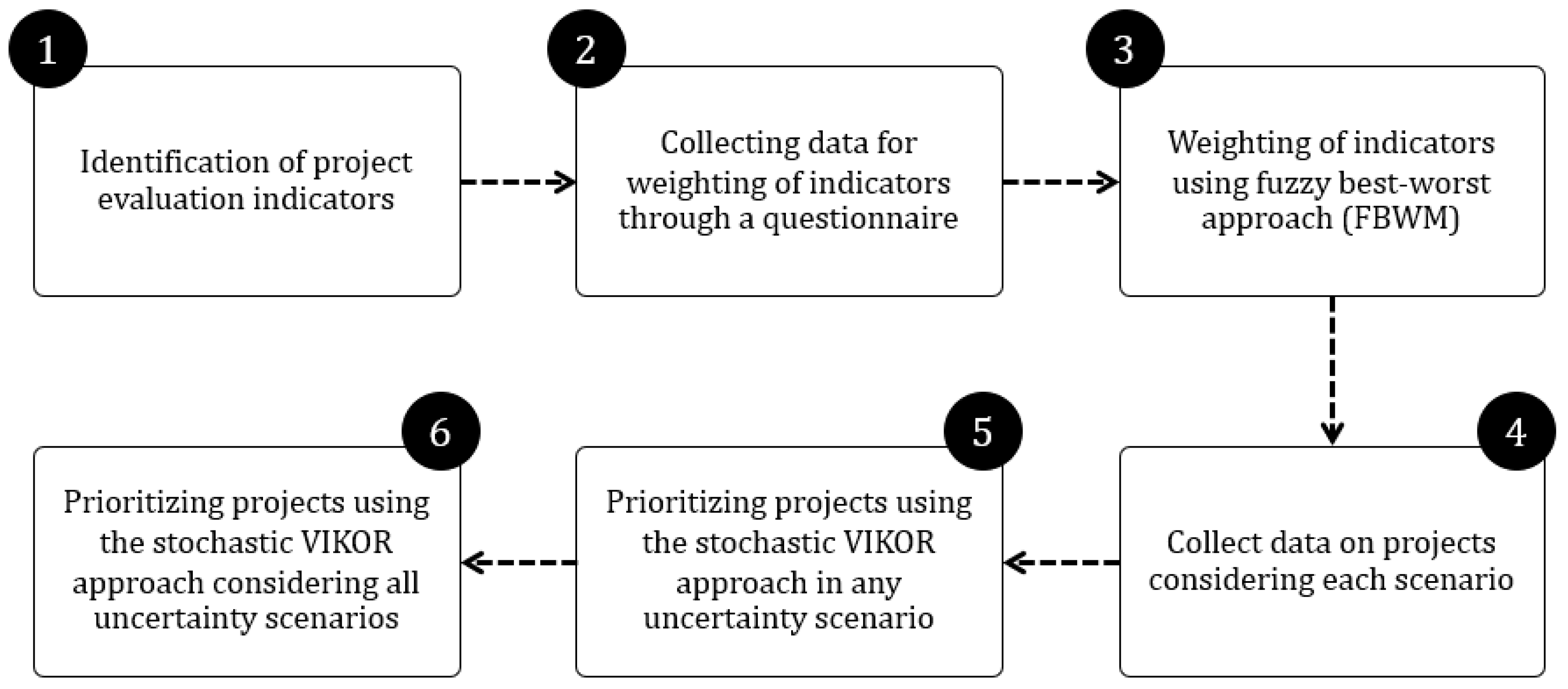
In order to specify the method used in this study, the steps of the research are shown in
Figure 1.
The main advantages of the proposed combined method include the following:
Considering the uncertainty in the evaluation process, which causes things, like cost changes, demand changes, and time changes, to be involved in evaluating.
No limitation of scenario definition in the proposed method is one of its advantages. In the defined method, it is possible to define scenarios and evaluate projects based on them.
Combining this method with Fuzzy BWM makes the weight of the indicators more accurately identified to be used in the evaluation of projects in each scenario.
6. Conclusions and Managerial Implications
This study presented a new approach to the evaluation and selection of rail transportation projects considering uncertainty. In various reviewed studies, multi-criteria decision-making approaches were used in project evaluation, but these approaches are based on expert opinions and sometimes fuzzy data [
9,
43]. In this study, the stochastic VIKOR approach is presented for the first time, so that uncertainty can be taken into account by considering different scenarios in the evaluation of projects. In this regard, due to the uncertainty in the implementation costs and also in the demand for the use of different selected projects, the scenarios of demand changes and cost changes are involved in the evaluation of the projects. The approach means that, by taking into account the changes in demand and the cost of the projects, the evaluations were carried out, and, finally, the ranking of the projects was presented. The presented stochastic VIKOR approach has an advantage over other methods in that it has the ability to define unlimited scenarios in the evaluation of projects. For this reason, it is more efficient than VIKOR, fuzzy VIKOR, and gray VIKOR approaches.
In terms of thematic aspects and evaluation criteria, economic, environmental, and social dimensions were integrated in the evaluation of projects, which were generally evaluated within the paradigm of project sustainability. Studies were conducted in the field of the evaluation of transportation projects that considered the economic and environmental components in an integrated manner [
22,
24], but a study that also examined the social dimension in the evaluation of transportation projects was not found in studies. Also, it is essential to consider uncertainty along with these dimensions in the evaluation of projects in today’s world, which is not considered in this study.
According to the findings of the article, it was observed that the most important indicators in the evaluation of rail transport projects are financial indicators. The main reason for this problem is the challenging economic conditions in Iran, in which, of course, the importance of financial indicators in the evaluation of projects in most developing countries has a stronger role than other dimensions [
9]. For this reason, managers of organizations in developing countries should always emphasize the financial components of selected projects, through which they can provide more economic income for the country and organizations. After the economic dimension, the social dimension is important in developing countries. Since the problem of employment is abundant in these countries, large projects that have the power to generate employment for many groups are placed at higher priority. After the economic and social indicators, it is the turn of the environmental indicators to choose projects with minimum environmental destruction or having a better perspective of helping the environment as much as possible. In addition to the aspects of sustainability in the evaluation of projects, in today’s world, due to the extensive changes in the business environment, there are many uncertainties and risks in the context of projects [
44]. These uncertainties are caused by economic changes, including inflation and exchange rates, political changes, changes in laws and regulations, and also the amount of demand for projects. For this reason, it is important to be able to identify the uncertainties in the evaluation of the projects before selecting them, and considering them, proceeding to examine the projects. In this regard, managers of organizations can use the approach developed in this study to evaluate projects by defining different scenarios. Since the presented random VIKOR method has no limit in defining the number of scenarios, managers can define different numbers of scenarios according to the conditions of the organization and evaluate projects based on them. Finally, it should be mentioned that evaluating rail transport projects using sustainability criteria and considering uncertainty in it help us to make better decisions in the field of project implementation. Considering that rail transport has significant effects on the environment, economy, and society, these assessments can provide a path for the sustainable development of rail transport.
In summarizing the findings of this study, it is suggested that due to the existence of wide uncertainties, especially in the field of project implementation costs, scenario-based approaches should always be used to choose a better project [
45]. From the findings and the approach presented in this study, the managers of different organizations, especially project-oriented organizations, can use them well in evaluating potential projects. Multidimensionally evaluate your projects by defining multiple scenarios and also estimating the values of indicators in each scenario, as well as by determining the probability of the occurrence of each scenario. In the continuation of this research, it is suggested that this structure should be combined with data-oriented algorithms and approaches, and scenario-oriented models based on inference systems and machine learning algorithms will be presented with the aim of prospective evaluation.