Polyhydroxyalkanoates Production by Mixed Microbial Culture under High Salinity



Abstract
1. Introduction
2. Materials and Methods
2.1. Culture Selection
2.2. PHAs Accumulation
2.3. Analytical Procedures
2.4. Calculations
3. Results and Discussion
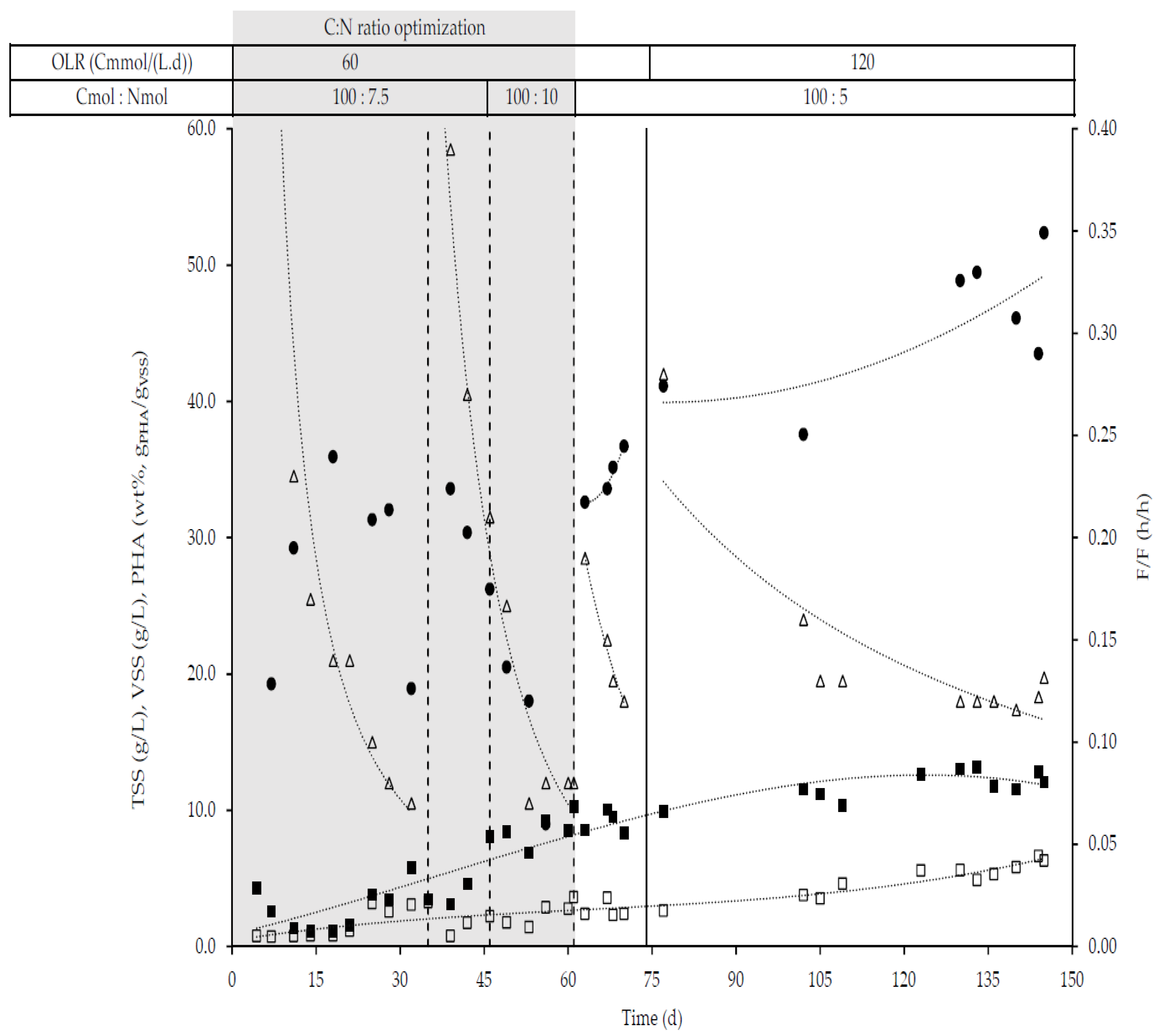
3.1. Culture Selection: PHA-Accumulating MMC
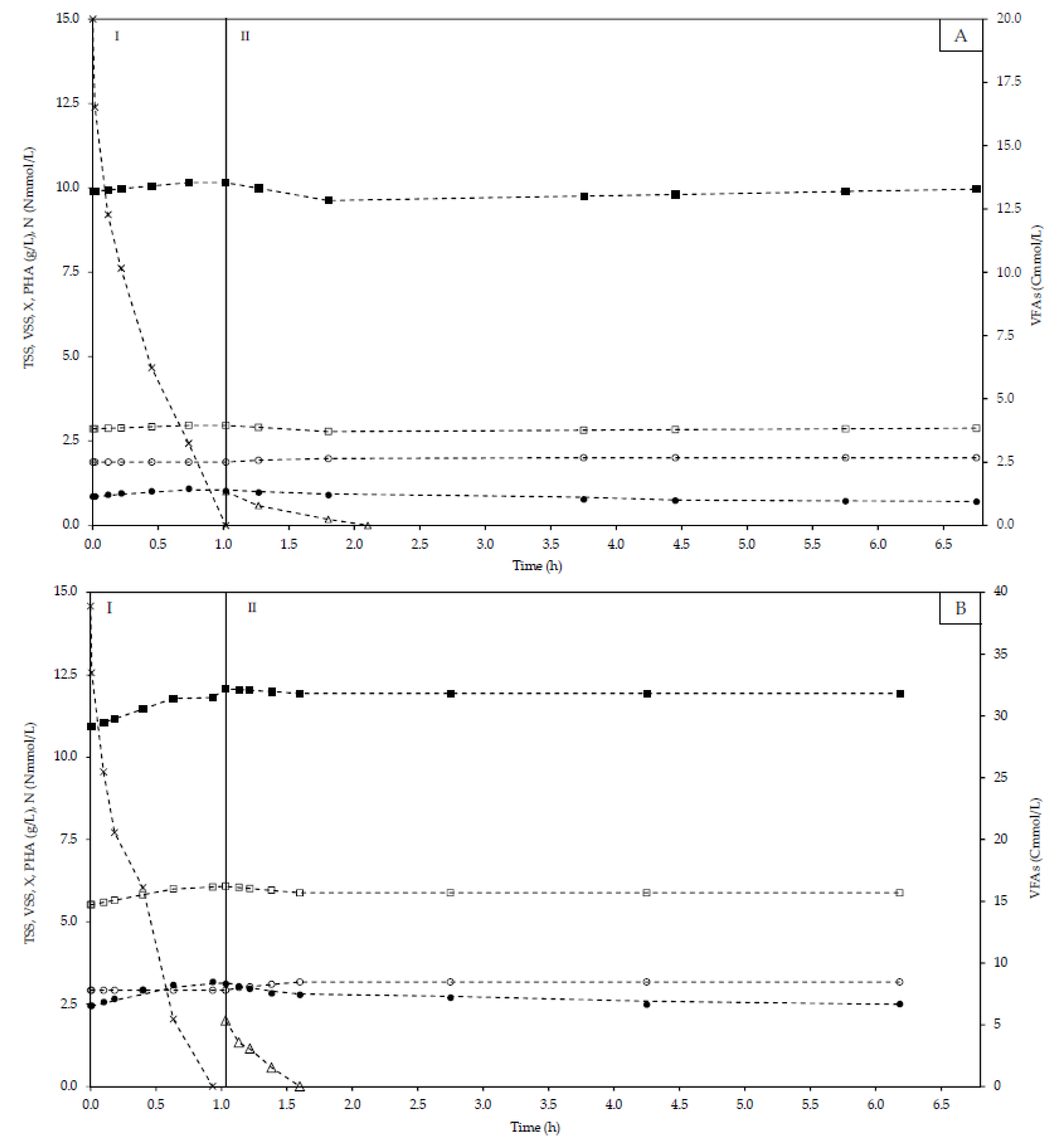
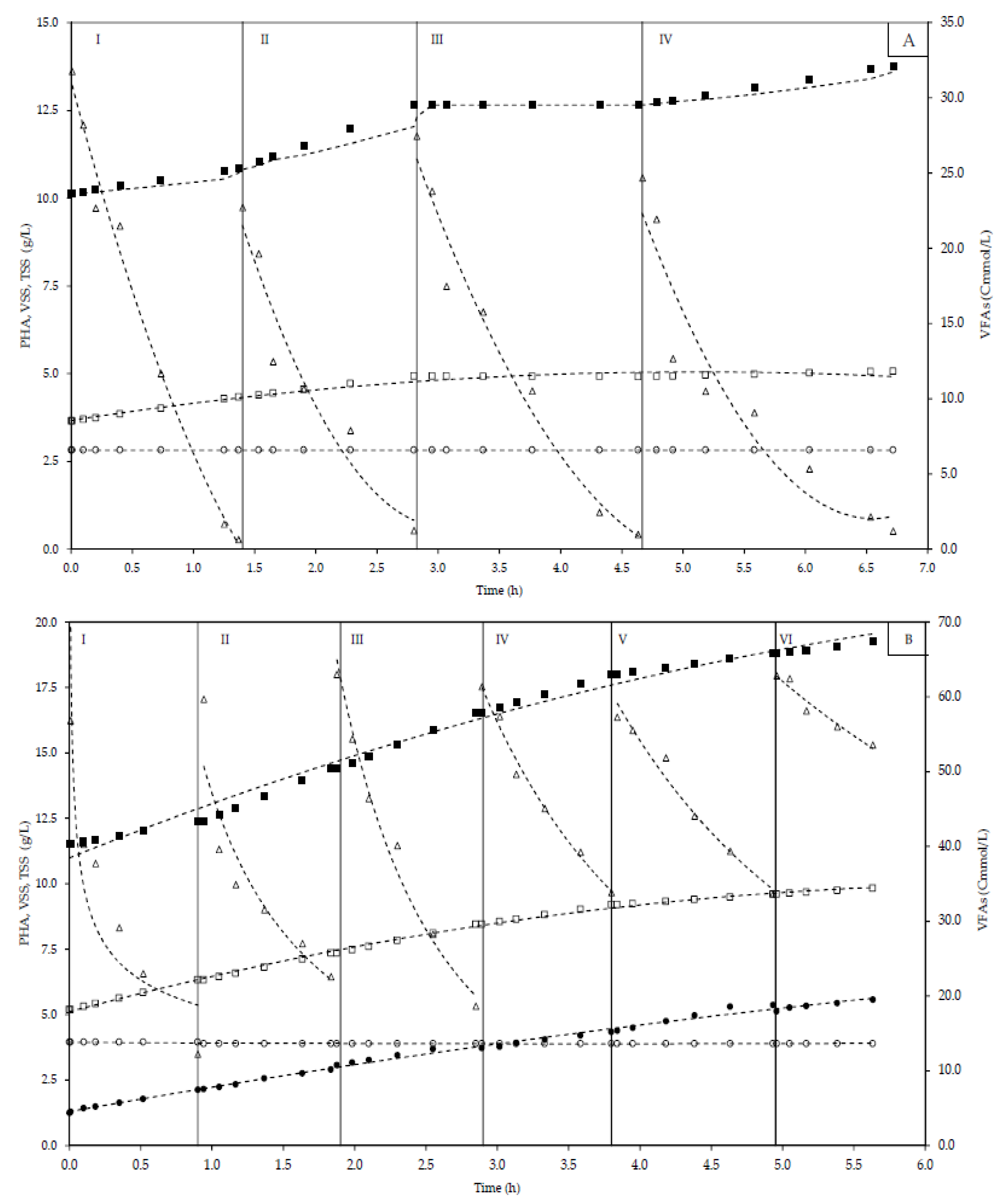
3.2. PHAs Accumulation Assays
4. Conclusions
Supplementary Materials
Author Contributions
Funding
Institutional Review Board Statement
Informed Consent Statement
Data Availability Statement
Acknowledgments
Conflicts of Interest
References
- Fish & Seafood—Worldwide|Statista Market Forecast. Available online: https://www.statista.com/outlook/cmo/food/fish-seafood/worldwide (accessed on 29 November 2021).
- Ching, Y.C.; Redzwan, G. Biological treatment of fish processing saline wastewater for reuse as liquid fertilizer. Sustainability 2017, 9, 1062. [Google Scholar] [CrossRef] [Scilit]
- Cleaner Production Assessment in Fish Processing. Available online: https://digitallibrary.un.org/record/441680 (accessed on 21 May 2021).
- Anh, H.T.H.; Shahsavari, E.; Bott, N.J.; Ball, A.S. Options for Improved Treatment of Saline Wastewater from Fish and Shellfish Processing. Front. Environ. Sci. 2021, 9, 236. [Google Scholar] [CrossRef] [Scilit]
- Lefebvre, O.; Moletta, R. Treatment of organic pollution in industrial saline wastewater: A literature review. Water Res. 2006, 40, 3671–3682. [Google Scholar] [CrossRef] [Scilit] [PubMed]
- Dan, N.P.; Visvanathan, C.; Basu, B. Comparative evaluation of yeast and bacterial treatment of high salinity wastewater based on biokinetic coefficients. Bioresour. Technol. 2003, 87, 51–56. [Google Scholar] [CrossRef] [Scilit]
- Srivastava, A.; Parida, V.K.; Majumder, A.; Gupta, B.; Gupta, A.K. Treatment of saline wastewater using physicochemical, biological, and hybrid processes: Insights into inhibition mechanisms, treatment efficiencies and performance enhancement. J. Environ. Chem. Eng. 2021, 9, 105775. [Google Scholar] [CrossRef] [Scilit]
- Kourmentza, C.; Plácido, J.; Venetsaneas, N.; Burniol-Figols, A.; Varrone, C.; Gavala, H.N.; Reis, M.A.M. Recent advances and challenges towards sustainable polyhydroxyalkanoate (PHA) production. Bioengineering 2017, 4, 55. [Google Scholar] [CrossRef] [Scilit]
- Polyhydroxyalkanoate (PHA) Market Global Forecast to 2025|MarketsandMarkets. Available online: https://www.marketsandmarkets.com/Market-Reports/pha-market-395.html?gclid=CjwKCAjw9MuCBhBUEiwAbDZ-7tH0vuR1VsKfgUvzT6jPuDry18A_H8vWVihQJFN_iN7OotkL2PVH7xoCDykQAvD_BwE (accessed on 29 November 2021).
- Oliveira, C.S.S.; Silva, C.E.; Carvalho, G.; Reis, M.A. Strategies for efficiently selecting PHA producing mixed microbial cultures using complex feedstocks: Feast and famine regime and uncoupled carbon and nitrogen availabilities. New Biotechnol. 2017, 37, 69–79. [Google Scholar] [CrossRef] [Scilit]
- Oliveira, C.S.S.; Silva, M.O.D.; Silva, C.E.; Carvalho, G.; Reis, M.A.M. Assessment of protein-rich cheese whey waste stream as a nutrients source for low-cost mixed microbial PHA production. Appl. Sci. 2018, 8, 1817. [Google Scholar] [CrossRef] [Scilit]
- Silva, F.; Campanari, S.; Matteo, S.; Valentino, F.; Majone, M.; Villano, M. Impact of nitrogen feeding regulation on polyhydroxyalkanoates production by mixed microbial cultures. New Biotechnol. 2017, 37, 90–98. [Google Scholar] [CrossRef] [Scilit]
- Ecoefficient Biodegradable Composite Advanced Packaging|ECOBIOCAP Project|FP7|CORDIS|European Commission. Available online: https://cordis.europa.eu/project/id/265669 (accessed on 20 November 2020).
- Koller, M.; Niebelschütz, H.; Braunegg, G. Strategies for recovery and purification of poly[(R)-3-hydroxyalkanoates] (PHA) biopolyesters from surrounding biomass. Eng. Life Sci. 2013, 13, 549–562. [Google Scholar] [CrossRef] [Scilit]
- Xiao, Y.; Roberts, D.J. A review of anaerobic treatment of saline wastewater. Environ. Technol. 2010, 31, 1025–1043. [Google Scholar] [CrossRef] [Scilit] [PubMed]
- He, X.; Yin, J.; Liu, J.; Chen, T.; Shen, D. Characteristics of acidogenic fermentation for volatile fatty acid production from food waste at high concentrations of NaCl. Bioresour. Technol. 2019, 271, 244–250. [Google Scholar] [CrossRef] [Scilit] [PubMed]
- Duarte, M.S.; Oliveira, J.V.; Pereira, C.; Carvalho, M.; Mesquita, D.P.; Alves, M.M. Volatile Fatty Acids (VFA) Production from Wastewaters with High Salinity—Influence of pH, Salinity and Reactor Configuration. Fermentation 2021, 7, 303. [Google Scholar] [CrossRef] [Scilit]
- Fra-Vázquez, A.; Pedrouso, A.; Val del Rio, A.; Mosquera-Corral, A. Volatile fatty acid production from saline cooked mussel processing wastewater at low pH. Sci. Total Environ. 2020, 732, 139337. [Google Scholar] [CrossRef] [Scilit]
- Palmeiro-Sánchez, T.; Oliveira, C.S.S.; Gouveia, A.R.; Noronha, J.P.; Ramos, A.M.; Mosquera-Corral, A.; Reis, M.A.M. NaCl presence and purification affect the properties of mixed culture PHAs. Eur. Polym. J. 2016, 85, 256–265. [Google Scholar] [CrossRef] [Scilit]
- Wen, Q.; Ji, Y.; Hao, Y.; Huang, L.; Chen, Z.; Sposob, M. Effect of sodium chloride on polyhydroxyalkanoate production from food waste fermentation leachate under different organic loading rate. Bioresour. Technol. 2018, 267, 133–140. [Google Scholar] [CrossRef] [Scilit]
- Pedrouso, A.; Fra-Vazquez, A.; Del Rio, A.V.; Mosquera-Corral, A. Recovery of Polyhydroxyalkanoates from Cooked Mussel Processing Wastewater at High Salinity and Acidic Conditions. Sustainability 2020, 12, 10386. [Google Scholar] [CrossRef] [Scilit]
- Argiz, L.; Fra-Vázquez, A.; del Río, Á.V.; Mosquera-Corral, A. Optimization of an enriched mixed culture to increase PHA accumulation using industrial saline complex wastewater as a substrate. Chemosphere 2020, 247, 125873. [Google Scholar] [CrossRef] [Scilit]
- Roibás-Rozas, A.; Val del Rio, A.; Hospido, A.; Mosquera-Corral, A. Strategies for the valorisation of a protein-rich saline waste stream into polyhydroxyalkanoates (PHA). Bioresour. Technol. 2021, 334, 124964. [Google Scholar] [CrossRef] [Scilit]
- APHA/AWWA. Standard Methods for the Examination of Water and Wastewater, 20th ed.; APHA American Public Health Association: Washington, DC, USA, 1998. [Google Scholar]
- Wang, X.; Oehmen, A.; Freitas, E.B.; Carvalho, G.; Reis, M.A.M. The link of feast-phase dissolved oxygen (DO) with substrate competition and microbial selection in PHA production. Water Res. 2017, 112, 269–278. [Google Scholar] [CrossRef] [Scilit]
- Heinzle, E.; Biwer, A.P.; Cooney, C.L. Development of Sustainable Bioprocesses; John Wiley & Sons, Ltd: Chichester, UK, 2006. [Google Scholar]
- Obruca, S.; Sedlacek, P.; Koller, M.; Kucera, D.; Pernicova, I. Involvement of polyhydroxyalkanoates in stress resistance of microbial cells: Biotechnological consequences and applications. Biotechnol. Adv. 2018, 36, 856–870. [Google Scholar] [CrossRef] [Scilit] [PubMed]
- Prados, E.; Maicas, S. Bacterial Production of Hydroxyalkanoates (PHA). Univers. J. Microbiol. Res. 2016, 4, 23–30. [Google Scholar] [CrossRef] [Scilit]
- Soto, G.; Setten, L.; Lisi, C.; Maurelis, C.; Mozzicafreddo, M.; Cuccioloni, M.; Angeletti, M.; Ayub, N.D. Hydroxybutyrate prevents protein aggregation in the halotolerant bacterium Pseudomonas sp. CT13 under abiotic stress. Extremophiles 2012, 16, 455–462. [Google Scholar] [CrossRef] [Scilit] [PubMed]
- Pujalte, M.J.; Lucena, T.; Ruvira, M.A.; Arahal, D.R.; Macián, M.C. The family Rhodobacteraceae. In The Prokaryotes; Springer: Berlin/Heidelberg, Germany, 2014; pp. 439–512. [Google Scholar] [CrossRef] [Scilit]
- Mezzolla, V.; D’Urso, O.F.; Poltronieri, P. Role of PhaC type I and type II enzymes during PHA biosynthesis. Polymers 2018, 10, 910. [Google Scholar] [CrossRef] [Scilit]
- Perez-Zabaleta, M.; Atasoy, M.; Khatami, K.; Eriksson, E.; Cetecioglu, Z. Bio-based conversion of volatile fatty acids from waste streams to polyhydroxyalkanoates using mixed microbial cultures. Bioresour. Technol. 2021, 323, 124604. [Google Scholar] [CrossRef] [Scilit]
- Van-Thuoc, D.; Huu-Phong, T.; Minh-Khuong, D.; Hatti-Kaul, R. Poly(3-Hydroxybutyrate-co-3-Hydroxyvalerate) Production by a Moderate Halophile Yangia sp. ND199 Using Glycerol as a Carbon Source. Appl. Biochem. Biotechnol. 2015, 175, 3120–3132. [Google Scholar] [CrossRef] [Scilit]
- Chan, C.M.; Vandi, L.J.; Pratt, S.; Halley, P.; Ma, Y.; Chen, G.Q.; Richardson, D.; Werker, A.; Laycock, B. Understanding the effect of copolymer content on the processability and mechanical properties of polyhydroxyalkanoate (PHA)/wood composites. Compos. Part A Appl. Sci. Manuf. 2019, 124, 105437. [Google Scholar] [CrossRef] [Scilit]



| Parameter (Unit) | Average ± Standard Deviation | |
|---|---|---|
| OLR (CmmolVFA/(L.d)) | 60 | 120 |
| FP profile (HAc/HPro/HBut/HVal,% Cmol basis) | 25:25:25:25 | 25:25:25:25 |
| Feast/famine (h/h) | 14.0 ± 0.00 | 0.13 ± 0.01 |
| X @cycle start (gX/L/CmolX/L) | 1.92 ± 0.04/75.8 ± 1.70 | 3.26 ± 0.34/129 ± 13.6 |
| PHAmax (% wt., VSS basis) | 35.1 ± 1.56 | 49.2 ± 3.13 |
| ΔPHAs ((% wt., VSS basis) | 5.70 ± 0.93 | 9.6 ± 1.76 |
| HB/HV ratio (% wt. basis/Cmol basis) | 48:52/46:54 | 35:65/33:67 |
| -qVFA (CmmolVFA/(C-mmolX.h)) | 0.40 ± 0.03 | 0.60 ± 0.04 |
| -qHAc (CmmolHAc/(CmmolX.h)) | 0.08 ± 0.00 | 0.10 ± 0.01 |
| -qHPro (CmmolHPro/(CmmolX.h)) | 0.10 ± 0.02 | 0.11 ± 0.03 |
| -qHBut (CmmolHBut/(CmmolX.h)) | 0.09 ± 0.01 | 0.16 ± 0.03 |
| -qHVal (CmmolHVal/(CmmolX.h)) | 0.13 ± 0.02 | 0.23 ± 0.03 |
| qPHAs (CmmolPHA/(CmmolX.h)) | 0.20 ± 0.01 | 0.46 ± 0.01 |
| qHB (CmmolHB/(CmmolX.h)) | 0.09 ± 0.00 | 0.12 ± 0.01 |
| qHV (CmmolHV/(CmmolX.h)) | 0.11 ± 0.01 | 0.33 ± 0.04 |
| qXfamine (CmmolX/(CmmolX.h)) | 0.06 ± 0.00 | 0.15 ± 0.02 |
| -qPHAs (CmmolPHA/(CmmolX.h)) | 0.10 ± 0.03 | 0.36 ± 0.01 |
| -qHB (CmmolHB/(CmmolX.h)) | 0.08 ± 0.02 | 0.13 ± 0.02 |
| -qHV (CmmolHV/(CmmolX.h)) | 0.09 ± 0.03 | 0.23 ± 0.03 |
| YPHA/VFA (CmmolPHA/CmmolVFA) | 0.60 ± 0.01 | 0.75 ± 0.04 |
| YX/PHAs (CmmolX/CmmolPHA) | 0.70 ± 0.18 | 0.44 ± 0.03 |
| Parameter (Unit) | Average ± Standard Deviation | |
|---|---|---|
| OLR (CmmolVFA/(L.d)) | 60 | 120 |
| FP profile (HAc/HPro/HBut/HVal,% Cmol basis) | 25:25:25:25 | 25:25:25:25 |
| X @inoculum (gX/L/CmolX/L) | 2.73/108 | 3.72/147 |
| PHAs @inoculum (% wt., VSS basis) | 22.3 | 35.4 |
| PHAmax (% wt., VSS basis) | 55.3 | 84.1 |
| HB/HV ratio (% wt. basis/Cmol basis) | 49:51/47:53 | 37:63/35:65 |
| -qVFAb (CmmolVFA/(C-mmolX.h)) | 0.41 ± 0.02 | 0.45 ± 0.04 |
| qPHAb (CmmolPHA/(CmmolX.h)) | 0.24 ± 0.01 | 0.30 ± 0.01 |
| YPHA/VFA (CmmolPHA/CmmolVFA) | 0.60 ± 0.05 | 0.67 ± 0.05 |
| Volumetric PHA productivity (gPHA/(L.h)) | 0.30 a (0.32 b) | 0.77 a (0.84 b) |
| Specific PHA productivity(gPHA/(gX.h)) | 0.11 a (0.12 b) | 0.21 a (0.28 b) |
Publisher’s Note: MDPI stays neutral with regard to jurisdictional claims in published maps and institutional affiliations. |
© 2022 by the authors. Licensee MDPI, Basel, Switzerland. This article is an open access article distributed under the terms and conditions of the Creative Commons Attribution (CC BY) license (https://creativecommons.org/licenses/by/4.0/).
Share and Cite
Carvalho, J.M.; Marreiros, B.C.; Reis, M.A.M. Polyhydroxyalkanoates Production by Mixed Microbial Culture under High Salinity. Sustainability 2022, 14, 1346. https://doi.org/10.3390/su14031346
Carvalho JM, Marreiros BC, Reis MAM. Polyhydroxyalkanoates Production by Mixed Microbial Culture under High Salinity. Sustainability. 2022; 14(3):1346. https://doi.org/10.3390/su14031346
Chicago/Turabian StyleCarvalho, João M., Bruno C. Marreiros, and Maria A. M. Reis. 2022. "Polyhydroxyalkanoates Production by Mixed Microbial Culture under High Salinity" Sustainability 14, no. 3: 1346. https://doi.org/10.3390/su14031346
APA StyleCarvalho, J. M., Marreiros, B. C., & Reis, M. A. M. (2022). Polyhydroxyalkanoates Production by Mixed Microbial Culture under High Salinity. Sustainability, 14(3), 1346. https://doi.org/10.3390/su14031346