Article

Exploring the Energy Saving Potential in Private, Public and Non-Motorized Transport for Ten Swedish Cities

by
Jeffrey R. Kenworthy
1,2,* and
Helena Svensson
3,4,*
1
Fachbereich 1, Architektur, Bauingenieurwesen and Geomatik, Frankfurt University of Applied Sciences, Nibelungenplatz 1, 60318 Frankfurt am Main, Germany
2
Curtin University Sustainability Policy Institute, Curtin University, Kent Street, Bentley, WA 6102, Australia
3
Department of Technology and Society, Lund University, 221 00 Lund, Sweden
4
K2—The Swedish Knowledge Centre for Public Transport, Bruksgatan 8, 222 36 Lund, Sweden
*
Authors to whom correspondence should be addressed.
Sustainability 2022, 14(2), 954; https://doi.org/10.3390/su14020954
Submission received: 30 November 2021 / Revised: 31 December 2021 / Accepted: 4 January 2022 / Published: 14 January 2022
(This article belongs to the Special Issue Transition towards Sustainable Urban Settlements)

Abstract

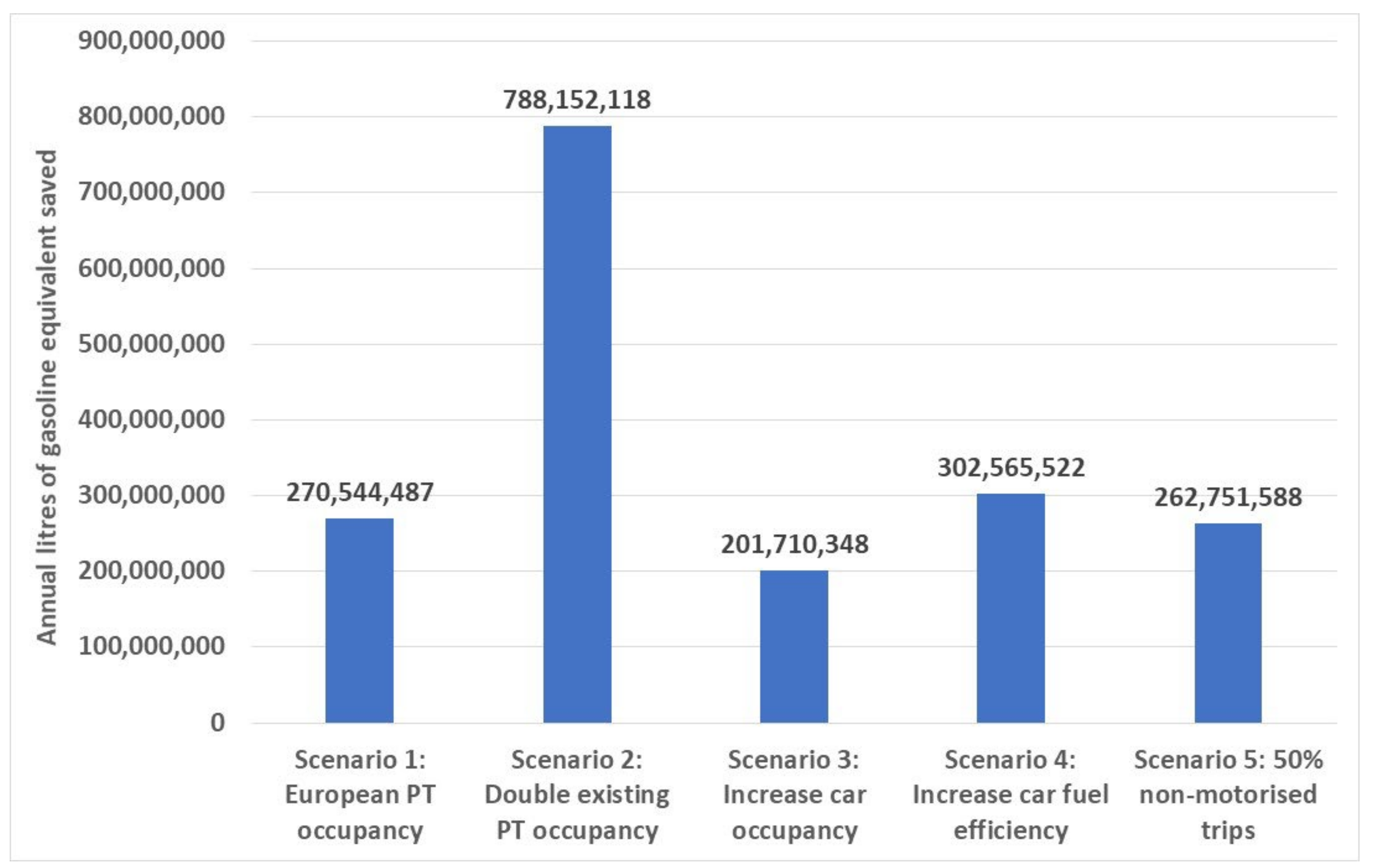
Transport energy conservation research in urban transport systems dates back principally to the Organization of the Petroleum Exporting Countries’ (OPEC) “Arab Oil Embargo” (1973–1974) and the Iranian revolution (1979), when global oil supplies became threatened and costs rose steeply. Two subsequent Gulf Wars (1991 and 2003) highlighted the dangerous geo-political dimensions of Middle-Eastern oil. In latter times, the urgency to reduce global CO2 output to avoid catastrophic climate change has achieved great prominence. How to reduce passenger transport energy use therefore remains an important goal, which this paper pursues in ten Swedish cities, based on five scenarios: (1) increasing the relatively low public transport (PT) seat occupancy in each Swedish city to average European levels (buses 35%, light rail 48%, metro 60% and suburban rail 35%); (2) doubling existing PT seat occupancy in each Swedish city; (3) increasing existing car occupancy in each Swedish city by 10%; (4) decreasing existing energy use per car vehicle kilometer by 15%; (5) increasing existing modal split for daily trips by non-motorized modes to 50% in each city. A sixth “best-case scenario” is also explored by simultaneously combining scenarios 2 to 5. The data used in the paper come from systematic empirical research on each of the ten Swedish cities. When applied individually, scenario 2 is the most successful for reducing passenger transport energy use, scenarios 1 and 4 are next in magnitude and produce approximately equal energy savings, followed by scenario 5, with scenario 3 being the least successful. The best-case, combined scenario could save 1183 million liters of gasoline equivalent in the ten cities, representing almost a 60% saving over their existing 2015 total private passenger transport energy use and equivalent to the combined 2015 total annual private transport energy use of Stockholm, Malmö and Jönköping. Such findings also have important positive implications for the de-carbonization of cities. The policy implications of these findings and the strategies for increasing public transport, walking and cycling, boosting car occupancy and decreasing vehicular fuel consumption in Swedish cities are discussed.
Keywords: Swedish cities; passenger transport energy use; mobility patterns; energy conservation scenarios; de-carbonization; public transport strategies; non-motorized mode strategies; climate change; transport policy Swedish cities; passenger transport energy use; mobility patterns; energy conservation scenarios; de-carbonization; public transport strategies; non-motorized mode strategies; climate change; transport policy