


Abstract
The concept of resilience gained increased attention in sustainability science, with a notable spike from 2014 onwards. However, resilience is a multifaceted concept with no unanimous definition, making applications in the context of sustainability, a similarly multifarious term, a challenge. Here, we examine the use of resilience in well-cited sustainability literature in the period from 2014 to 2018. Based on our analysis, resilience as a concept proves its analytical strength through a diverse set of frameworks, indicators, and models, while its usefulness as boundary object is less clear. Most of the examined publications do not cite one of the well-established resilience definitions as a conceptual basis. The normativity of resilience is often implicit and rarely critically questioned, and strong participatory approaches are lacking. A multivariate statistical full-text bibliographic analysis of 112 publications reveals four distinct research clusters with partial conceptual proximity but hardly any overlap. While the majority of publications consider human well-being as an integral factor in their research, some research marginalizes this concept. Resilience to climate change dominates the discourse in the literature investigated, which signifies a need to broaden research efforts to other equally pressing—but in terms of the concept, widely neglected—sustainability challenges.
1. Introduction
In recent years, building resilience has increasingly become an aim for various scientific and societal actors, often in the context of contributing to sustainability science and practice. Taking the UN Agenda 2030 as an example, the claim of enhancing resilience appears in six of the 17 Sustainable Development Goals [1]. In early November 2020, scientific literature database Scopus returned almost 13,000 peer-reviewed documents when queried for resilience and sustainability (we used the search string TITLE-ABS-KEY (“resilien*” AND “sustainab*”). Strikingly, the majority of these publications, almost 10,000, were published after 2013, marking a pronounced increase in recent years. Early contributions that explicitly defined sustainability science as its own research arena have emphasized the relevance of resilience as a key concept [2,3,4]. Among other approaches, resilience thinking was thought to have the potential to bridge conceptual divides between natural and social sciences and thereby help fulfill the primary function of sustainability science, which is to link the knowledge of human-environment systems with societal actions for addressing sustainability challenges such as the UN Sustainable Development Goals [3,5]. Yet, there are a variety of definitions, meanings, and implementations of the term “resilience”, often leading to conceptual ambiguity. Concerns about the consequences of conceptual ambiguity of resilience and how resilience should be assessed and applied have been expressed in various reviews and bibliographic analyses [2,6,7,8,9]. For example, in their 2007 paper, Brand and Jax [7] argued that with ever more scientific disciplines using resilience as a concept, conceptual clarity and practical relevance were at stake. Xu et al. [9] observed an over-emphasis of the ecological understanding of resilience in the scientific literature using the term, and identified resilience measurement as a major research gap in the context of sustainability science. It has also been found, based on a citation network analysis, that resilience research is highly clustered, so that resilience might be a useful boundary object (“Boundary objects are objects that are both plastic enough to adapt to local needs and constraints of the several parties employing them, yet robust enough to maintain a common identity across sites” [10], p. 251) rather than a successful bridging concept between single scientific disciplines [6], even though the bridging concept use still seems to be entertained as a working hypothesis [7]. The distinction between boundary object and bridging concept is important. Boundary objects have a flexibility of interpretation [11] that help establish communication [12] and shared understanding across differing epistemological communities. This, in turn, can be related to transdisciplinary research practices that focus on bringing together disparate academic and non-academic stakeholders, with the aim of mutual learning, shared problem definitions, and the generation of socially robust knowledge [13]. Whereas bridging concepts primarily provide means to connect disparate concepts, or fields of science, and therefore enable interdisciplinary research, for example, by bridging existing understandings of ecological and social dynamics in complex social-ecological systems [12].
There is also some criticism regarding the application of resilience to social systems [14] and its normative notion [15], with some authors arguing for a cautious and restricted use of resilience as a clear descriptive ecological concept. However, it is unclear to what extent the recent literature in sustainability science related to the resilience concept has taken these findings, recommendations, and criticisms into account. In addition, the degree of practitioner and stakeholder participation (i.e., the employment of transdisciplinary methodology in sustainability science studies that use the resilience concept) has not been addressed specifically before.
Here, we investigate how the concept of resilience has been used in peer-reviewed empirical sustainability science articles that were published during the recent surge of work in the field relating to resilience from 2014 to 2018. Specifically, we use a mixed-methods approach that combines inductive text analysis with a multivariate statistical full-text analysis. We aim to identify the current major strands within the literature by utilizing a cluster analysis, to identify principal gradients in the literature using an ordination approach, and to investigate whether there is a convergence towards a common notion of resilience, or a continuation of the patterns that had been identified in earlier analyses. We thus analyze the development in the recent literature, mapping the “research landscape” of empirical resilience research in sustainability science, and derive groups and gradients within that landscape. One particular focus of our study is the degree of stakeholder participation used in single studies dealing with resilience in a sustainability context. Therefore, a further contribution of our work is an analysis of the abundancy of transdisciplinary research practices in sustainability research that uses the resilience concept. In doing so, we contribute to the discussion on the usefulness of resilience as a research concept and its potential as a boundary object or even as a transformative tool in sustainability science. Furthermore, we aim at synthesizing some implications that might be useful for resilience thinkers in sustainability science to explore future research avenues.
The paper proceeds as follows: Section 2 describes how we obtained our database, how we designed the coding process, and how we performed the statistical full-text analysis. Section 3 lists and describes the results before we discuss, interpret, and synthesize them against the background of our research objective. Section 5 provides conclusions.
2. Materials and Methods
2.1. Database and Coding Procedure
We extracted our literature database from the Scopus database using the following criteria: (i) the term “resilience” occurred in the article title and the term “sustain*” occurred in the article title, abstract, or keywords; (ii) the study was published in the English language; (iii) published as a scientific article; (iv) published between 2014 and 2018; and (v) was cited at least 10 times. Therefore, the search string was as follows:
( TITLE ( resilience ) AND TITLE-ABS-KEY ( sustain* ) ) AND PUBYEAR > 2013 AND ( EXCLUDE ( PUBYEAR , 2020 ) OR EXCLUDE ( PUBYEAR , 2019 ) ) AND ( LIMIT-TO ( DOCTYPE , “ar” ) ) AND ( LIMIT-TO ( LANGUAGE , “English” ) )
This led to an initial database of 957 scientific articles in English-language journals with peer review. We chose to focus on “well-cited” publications (10 or more citations), because we deemed such publications as the most likely to influence the development of the resilience concept in the field of sustainability. The search yielded 272 scientific articles, which were subsequently scanned for the following inclusion criteria. The first criterion for inclusion in the sample was the use of empirical research methods. To get a clear picture of the understandings and usages of the resilience concepts in current research, purely conceptual articles and 26 literature reviews focusing on the resilience discourse itself were excluded. The second criterion for inclusion was the presence of an integrative understanding of sustainability (cf. [16]: 28–31). Accordingly, our second criterion implied that only articles dealing with more than one sustainability dimension—hence, dealing with the interconnection of social and natural systems [3]—were included in the sample as a final step. This led to the exclusion of strictly disciplinary articles that dealt with ecological processes, business processes (like supply chain or retail resilience), or psychological and medical articles about mental resilience which all used the search term “sustain*” as well.
The screening process resulted in the exclusion of 160 articles, yielding a final database of n = 112 journal articles for further analysis. Hence, our final database contained roughly 12% of the papers from the initial database. The final list of papers included can be found in Appendix A.
The coding guideline for qualitative evaluation was developed exploratively using open coding and comparative analysis based on the principles of grounded theory by Glaser and Strauß and the qualitative content analysis by Mayring [17,18]. For this reason, the categories, their definitions, and the abstraction level were built inductively, based on the first seven scientific articles in an iterative process including feedback from all authors in MAXQDA 2018. In the next step, the inductively developed coding guideline was revised (by VN, DJA, and JOE) after 17 coded articles and finally applied for the evaluation of all other scientific articles. Hence, this revision took place after 15% of articles in our database had been coded, which follows the recommendation in the literature [17]. The first revision after just seven articles (i.e., after coding just over 6% of all articles) was thus an additional step to secure quality and rigor of the coding process. One author (VN) coded all the papers, before the last author (JOE) checked some of the codes randomly for replicability. As a part of our revision process, we subordinated the categories under the following auxiliary questions:
- Question 1: How is the resilience concept used?
- Question 2: Which contribution does the article mainly aim for?
- Question 3: How does the article contribute to sustainable development?
In addition, the investigated study area and scale, system, and stressor, as well as the resilience understanding and degree of participation used in the study were coded. For the latter, the distinction of participation by Krütli et al. [19] served as reference and coding basis. (According to [19], participation can take the following forms, in ascending order from a low to a high degree of participation: information, consultation, collaboration, and empowerment. More detailed explanations can be found in the original source [19] and in [20].)
The evaluation unit included all 112 scientific articles, the final list of which can be found in Table A1 in the Appendix A. Determined coding units for extracting data were sections with the explicit mentioning of the resilience concept in the abstract, introduction, terminology (if present), method (if needed), and conclusion.
2.2. Quantitative Content Analysis
To complement our qualitative analysis of the notions of resilience that were entertained in the peer-reviewed literature from 2014 to 2018, we performed a bibliographic, full-text, multivariate statistical analysis of word co-abundancies based on all 112 research papers in our database. The analysis is based on the hypothesis that publications from the same research strand would use a similar conceptual vocabulary (i.e. semantically substantive words [21]). The analytical procedure consists of five steps, which we detail in the following. We performed all statistical analyses in the R programming language, version 3.6.3, by the R Foundation for Statistical Computing, based in Vienna, Austria [22].
- (1)
- PDFs and metadata: We imported the metadata of all 112 PDF files to the working directory and created a matrix (packages: “snowballC”, “tm”, function: “readPDF”) for further processing. Within the matrix of the metadata, each row corresponded to one publication in our database. The matrix columns contained general and bibliometric metadata of each publication (e.g., Title, Year, Journal, Citation per Year, DOI, etc.) obtained from the Scopus database. One column contained the full text of the respective publication PDF.
- (2)
- Wordlist generation: To identify the list of conceptual vocabulary, we first generated a complete list of abundant words from the 112 publications analyzed (42.930 words). Abundant words are words that appeared in more than 5% of publications. All abstract nouns, pronouns, articles, numbers, authors’ and geographical names, compass directions, units of time, length, and mass, or words from which no clear meaning could be inferred (the “no clear meaning” list consisted of the six following words (in alphabetical order): berkes, british, ciency, keywords, routledge, tem) were removed from that list by an algorithm developed by one of the authors (HvW). In this way, we retained a list of abundant conceptual vocabulary of 6449 words (15% from the abundant word list, i.e., 85% of words were deleted) that we used for further analysis.
- (3)
- Publication clustering: Based on the co-abundancy of the list of conceptual vocabulary, we performed an agglomerative hierarchical cluster analysis using Ward’s method (R package: “mclust”, function: “hclust”).
- (4)
- Finding representative vocabulary for each publication cluster: To identify words that characterize the differences between the clusters, we used the Indicator Species Analysis [23] from ecology, which identifies species characteristic for each particular habitat in an ecosystem. In our context, the analysis resulted in representative words for each publication cluster, which one could refer to as “indicator words”.
- (5)
- Mapping the publication landscape: In the final step, we used a de-trended correspondence analysis (DCA) to locate the indicator words, their distribution in the respective clusters, and the interrelations between clusters.
Based on the cluster affiliation of the scientific articles, we examined qualitative characteristics in the full-text analysis to complement the insights gained from the qualitative analysis.
3. Results
3.1. Qualitative Content Analysis
Table 1 shows the definitions coded in this review. Generally, engineering resilience is the narrowest and most precise definition for measurement or assessment, whereas social-ecological resilience represents the most encompassing and broad understanding [2]. Table 1 shows that one-third of the articles used a social-ecological resilience understanding, followed by roughly 18% of the articles that referred to an ecosystem resilience understanding, and 4.5% that used a definition of social resilience by Adger [24]. Approximately 5% of the articles clearly defined resilience in the engineering sense (i.e., as return time after disturbance). Other extended or more specific definitions—mostly definitions by multilateral institutions and NGOs—were utilized by 18.8% of publications. Examples of such definitions were an understanding of resilience as “life-cycle traits in relation to population multiplication” [25] or as “the ability of people, households, communities, countries, and systems to mitigate, adapt to, and recover from shocks and stresses in a manner that reduces chronic vulnerability and facilitates inclusive growth” [26]. The remaining 20.5% of publications did not specify clearly what understanding of resilience they were using (i.e., they neither cited a specific definition, nor explained their understanding of resilience).

Table 1.
Resilience definitions used for coding the resilience understanding of the different articles.
Our final database contained studies from all continents (the Americas 23%, Asia 20%, Europe 21%, Africa 10%, Australasia 5%, multiple locations 6%, global scale 6%, no location 9%). There was almost a balance between studies located in the Global North (n= 46) and the Global South (n = 42). The majority of research has been taking place at finer scales, with 43% at the local scale and 34% at the regional scale. In accordance with this scale preference, the majority of studies dealt with the system challenges of urban resilience, livelihood resilience, and community resilience (45.5%, cf. Table 2). Regarding system stressors, a clear research focus is on climate change and climate-related hazards (43%, cf. Table 2). Only a small group focused on resilience to socioeconomic change and solely on societal stressors (6%).
Table 2.
Distribution of research subjects (resilience of what?) and objects (resilience to what?) in our database.
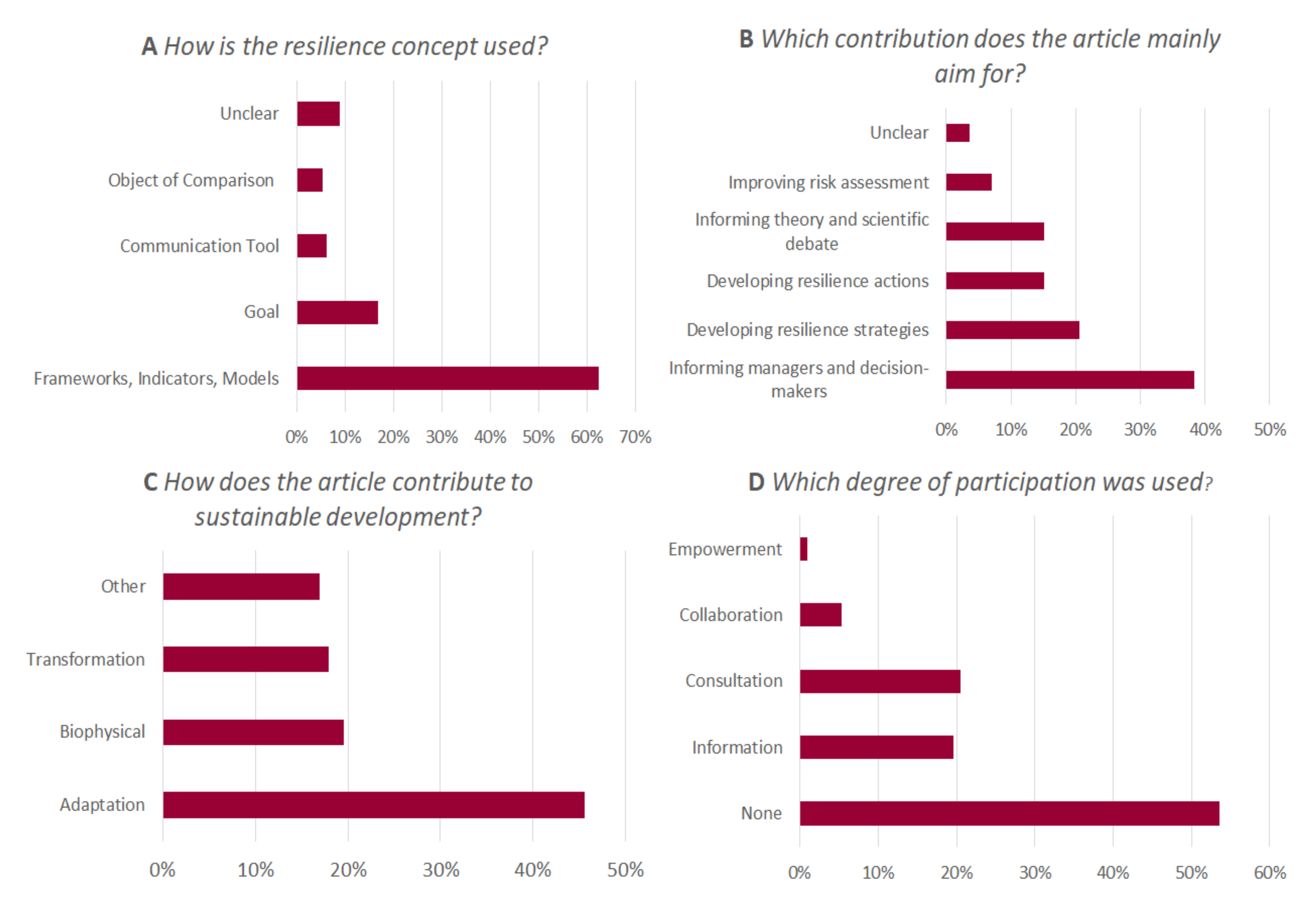
Regarding the use of the concept in the literature, the results in panel A of Figure 1 illustrate the conceptual and analytical strength of resilience, with the primary uses of framework, indicator, and model development and application being the clear majority among all use cases (62.5%). About one-third of the papers that fell into this category were devoted to developing new frameworks (according to the Oxford Dictionary, a framework is “a set of beliefs, ideas or rules that are used as the basis for making judgements, decisions, etc.”). We understand a framework as a structured guide to completing a process or procedure via scientific enquiry; the relevant variables and their interactions that may be studied; and the ontological, epistemological, and methodological concepts related to scientific enquiries of the phenomena the framework is oriented towards [31,32]. We found that 17% of well-cited publications on resilience alluded to the importance of resilience enhancement. The examined research objects for resilience enhancement range from natural-scientific to socio-scientific focuses. Only a few articles dealt with tools for resilience comparison (5.4%) or highlighted the use of resilience as a communication tool (6.3%). In 9% of the cases, the role of the concept for the article remained unclear.
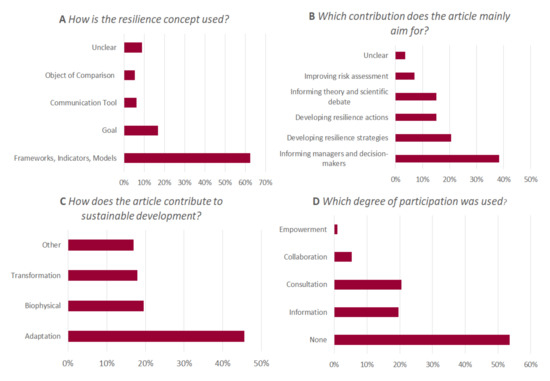
Figure 1.
Distribution of articles to the qualitative categories according to the following questions: (A) How is the resilience concept used? (B) Which suggestion does the article mainly aim for? (C) How does the article contribute to sustainable development? and (D) Which degree of participation was used?
Regarding the contribution to resilience thinking in science and society (panel B), the three main categories “developing resilience strategies” (20.5%), “developing resilience actions” (15.2%), and “informing managers and decision-makers” (38.4%) point to a strong focus on developing practical knowledge within the literature we examined. However, this practical knowledge creation happened largely with little or no participation of practitioners and stakeholders (panel D). About 54% of all articles did not include a participatory approach in their methodology, whereas roughly 20% included information by stakeholders and 20% consulted stakeholders. Only 6% of publications either collaborated or empowered practitioners and stakeholders.
In terms of contribution to sustainability, about half (45.5%) of the articles focused on contributing to adaptation and different kinds of adaptive capacity (panel C). About 18% of the articles put additional emphasis on aspects of system transformation, and 19% aimed at contributing to “biophysical resilience” (i.e., the resilient provision of ecosystem services or resilience as a supporting ecosystem service in its own right). We could not assign about 17% of articles in our sample to any of these categories, or their contribution to sustainability remained unclear.
3.2. Multivariate Full-Text Statistical Analysis
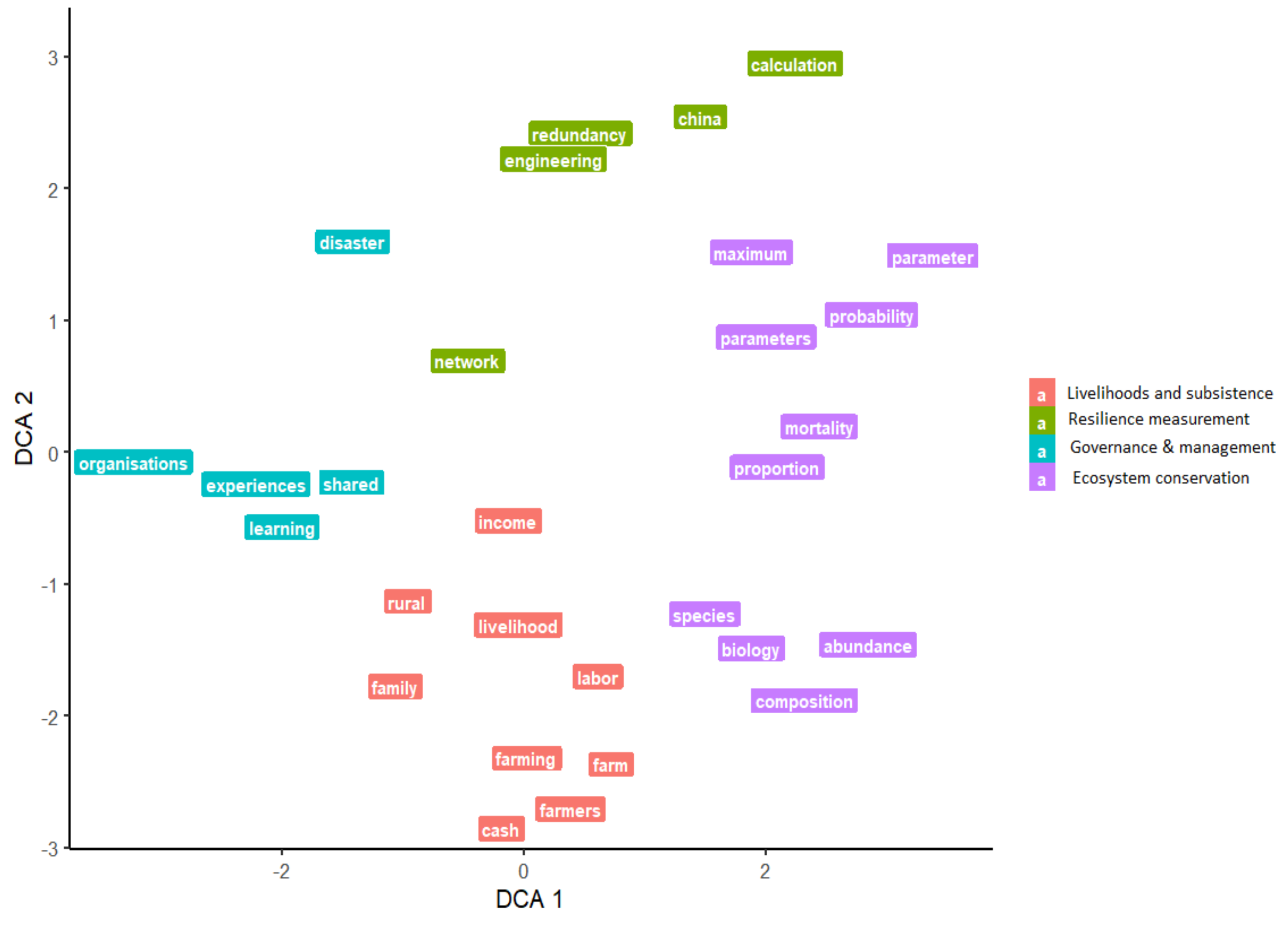
Our analysis identified four distinct clusters, with an agglomerative coefficient of 0.83 (Figure 2). For ease of interpretation, we restricted the DCA plot to the most significant indicator words of each cluster. In the following, we describe the clusters identified by our analysis.
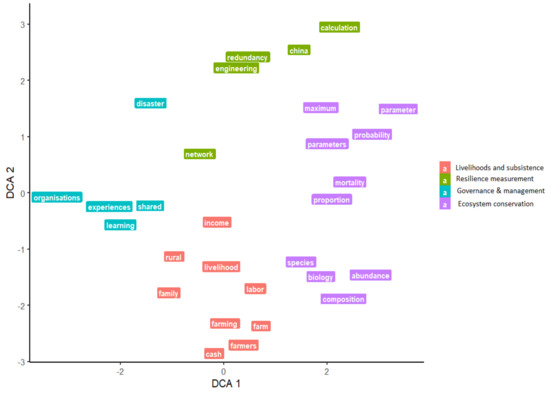
Figure 2.
De-trended correspondence analysis of indicator words of each cluster.
Livelihoods and subsistence (cluster 1, 24 papers): This cluster emphasizes the role of resilience and its enhancement for livelihoods that strongly depend on ecosystems and their services, predominantly in the Global South. The papers in this cluster tend to focus on specific case studies rather than general frameworks, models, or concepts. The majority of the case studies have a strong social science focus, highlighting the interactions between the environment and humans as ecosystem users. There is relatively little focus on ecological processes and functions in particular and natural science in general.
Resilience measurement (cluster 2, 18 papers): Studies in this cluster are concerned with the development and quantification of indicators for resilience, ranging from the city level to the global level. While the focus of these papers is largely conceptual, empirical case studies to illustrate the concepts developed or used have been included. Studies dealing with measurement of resilience on the city level tend to be motivated by or aimed at resilience to natural disasters.
Governance and management (cluster 3, 54 papers): This research cluster deals with resilience on the community or societal level and often focuses on particular communities within a geographic region or city (social and social-ecological resilience, cf. Table 2). There is a strong focus on actors, such as individuals and organizations or initiatives, and how they self-organize and make decisions, either in the face of some potential disruption or catastrophe or in the immediate aftermath of such a disruptive event. This partial thematic overlap in terms of disasters and emergencies between clusters 2 and 3 can be seen in the DCA plot in Figure 2 where the indicator word ‘disaster’ of cluster 2 is close to cluster 3. Studies in this cluster tend to come from sustainable development literature.
Ecosystem conservation (cluster 4, 16 papers): This research cluster deals with resilience as a means to conserve aquatic and land ecosystems. There are some papers with a pronounced interest in the theoretical aspects of conservation, but the majority of the research featured consists of empirical approaches focusing on one or a few specific study sites that represent particular ecosystems such as forests or rivers. Most of the papers in this cluster deal with the ecological or ecosystem resilience understanding (cf. Table 2). There is a focus on natural science perspectives, but some aspects of human use of ecosystems and well-being are considered and are an integral part of analyses and discussions, albeit often with a decisively lesser focus.
The strength of the clustering, as measured by the agglomerative coefficient, suggested that each cluster was relatively self-contained in terms of the conceptual vocabulary predominantly used. Exceptions could be found to the left of the center of the ordination plot (Figure 2), where there is some proximity of indicator words of clusters 1 (livelihoods and subsistence) and 3 (governance and management), as well as clusters 3 and 2 (resilience measurement). In general, these clusters were more inter- or multidisciplinary in nature than cluster 4 (conservation) (i.e., they either used a greater mixture of natural and social sciences or they were inter-disciplinary and more problem-oriented or systems-focused).
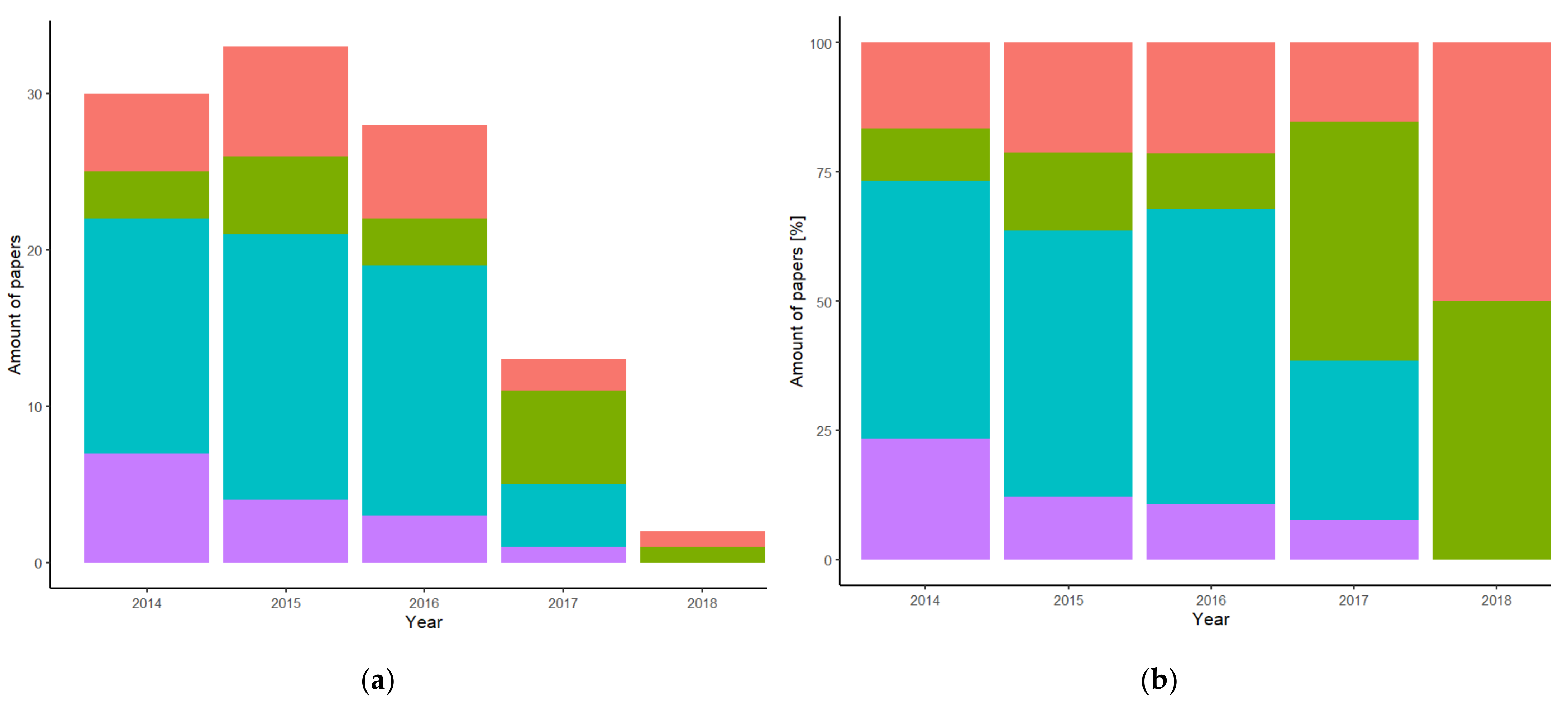
In the period analyzed, we found an increase over time in the proportion of studies dealing with resilience measurement (cluster 2), whereas we observed a decrease in the relative share of ecosystem conservation publications (cluster 4) (Figure 3b). The annual shares of clusters 1 (livelihoods and subsistence) and 3 (governance and management) remained roughly constant over the period investigated. We found a corresponding pattern when looking at absolute (Figure 3a) and relative (Figure 3b) shares of citations per cluster and year.
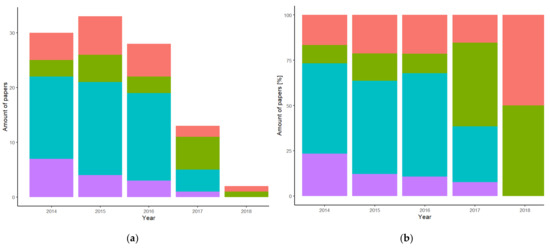
Figure 3.
Absolute number of papers (a) and percentage (b) per cluster identified. Colors are the same as in Figure 2.
3.3. Journal Analysis
In terms of publication outlets, we found that the well-cited research on resilience in empirical sustainability science in our database was spread over 77 peer-reviewed scientific journals. Table 3 shows the 23 journals with more than one entry in our database. Fifty-nine out of 112 papers (52.7%) in our database were published in one of these 23 journals. The journals which occurred most often in our database were Sustainability (six entries), the International Journal of Disaster Risk Reduction, Ecology and Society, and Environmental Science & Policy (four entries each). Fifty-four different journals each published just one well-cited publication dealing with the notion of resilience between 2014 and 2018.
Table 3.
The 23 journals with more than one entry in our database.
Sixty-three journals out of 77 (81.8%) in our sample published in just one of the research clusters identified by our analysis (cf. Section 3.2), and none published in all four research clusters. The Switzerland-based journal Sustainability was the only journal to publish in three out of four research clusters, and 13 journals (16.9%) published in two research clusters.
We extracted annual citation rates per document for each research cluster. Average annual citation rates were highest in the conservation cluster (9.5 citations per year and document), followed by the research clusters governance and management (8.5), resilience measurement (8.4), and livelihood and subsistence (6.7).
4. Discussion
We discuss and synthesize our results in the following. We start by discussing the robustness and limitations of our study (Section 4.1), before presenting our insights into how the resilience concept is used in the well-cited sustainability science literature based on our review (Section 4.2). We then synthesize some implications for resilience thinkers in sustainability science for the future work to come (Section 4.3).
4.1. Robustness of Results
Our approach features some limitations that should not be left in the dark when assessing our results and conclusions. As one reviewer of this article pointed out, the literature that is relevant for the resilience discourse is a different set than the literature that explicitly uses the term in paper titles, abstracts, or key words. In some cases, other terms like “resilient” or “resiliency” might have been used instead of the more common noun resilience. Second, what constitutes “well-cited” is obviously open for discussion, and so is our choice of ten citations as a cutoff, with some disciplines, typically the social sciences, having slower publication and citation rates than, for example, the natural sciences. Much like the 5% cutoff for the p-value that separates the “significant” from the “insignificant” in frequentist statistical testing, any such choice is arbitrary in some sense. However, just as in statistics, there is arguably also some value in doing so. Third, there is some empirical evidence of a gender bias in citations, such that papers with women as first or last authors attract fewer citations, e.g., [33,34], but the size of this effect has been challenged by a recent meta-analysis of over 1.2 million papers published between 2008 and 2014 in the field of medicine [35]. If there indeed were a gender bias of considerable effect, this would cause papers with females as first or last authors to be systematically under-represented in our database, which could lead to a misrepresentation of the research landscape (cf. Figure 2), because, in expectation, female researchers tend to work on different issues with a different focus.
4.2. The Resilience Concept in the Well-Cited Sustainability Science Literature
4.2.1. Research Clusters and Their Temporal Dynamics
Our multivariate full-text statistical analysis identified four distinct research clusters among the well-cited publications on resilience in sustainability research between 2014 and 2018. Our analysis suggests some conceptual proximity between research clusters 1 (livelihoods and subsistence) and 3 (governance and management) and research clusters 2 (resilience measurement) and 3, albeit with no significant overlap of clusters. Research cluster 4 (ecosystem conservation) was clearly separate from all other clusters in that it featured less focus on aspects of human wellbeing than all other clusters. Hence, there is little evidence that resilience serves as a boundary object across the disciplinary trenches between publications in research cluster 4 and all others. On the other hand, it is thus likely that resilience could fulfil this boundary object function in publications contained in research clusters 1, 2, and 3, because research in these research clusters related resilience to human well-being, in turn providing some conceptual common ground. On this interpretation, the vast majority (85 out of 112) of the well-cited publications on resilience in the sustainability context could be placed in this common ground, and the majority of publications (63 out of 112) dealt with livelihoods and subsistence (research cluster 1) or governance and management (research cluster 3), which are interdisciplinary social science endeavors. Nevertheless, we believe the existence of distinct clusters with their own language suggests that the notion of resilience is acting as a bridging concept between the natural and social sciences, but not necessarily a boundary object between broad sets of sustainability concerns (e.g., livelihoods, governance, and ecology). In part, this may be related to the lack of transdisciplinary approaches within sustainability-focused resilience research (see Section 4.3.2). The constant share of these research clusters among both publications and citations suggests an ongoing interest in the topics addressed by these clusters with relatively little temporal variability.
4.2.2. Publication Outlets
In terms of publication outlets, the prominent position of Ecology and Society with regard to the number of publications in our database came as no surprise, because the journal is published by the Resilience Alliance, an interdisciplinary network with a focus on social-ecological system dynamics (www.resalliance.org). However, the journal that published in most research clusters, hence the most interdisciplinary journal in that particular sense, with publications in three research clusters, was Sustainability. The fact that among the 23 journals that published more than one well-cited paper on resilience between 2014 and 2018, there are nine journals that published in just one of the research clusters identified by our analysis suggests a relatively high degree of specialization among these journals. Indeed, publication outlets such as Water Research, Journal of Sustainable Tourism, or Journal of Ecology suggest a high degree of specialization. However, it is surprising to find journals such as Global Environmental Change or Science of the Total Environment that nominally serve a broad readership from a larger variety of disciplinary backgrounds on that list. The latter finding might be due to the relatively small sample size investigated here.
4.2.3. Heterogeneity of Resilience Definitions
We found no evidence for any one definition of resilience dominating the scientific discourse in the well-cited sustainability research from 2014 to 2018 (cf. Table 1). While the most common definition employed in our sample was social-ecological resilience, which is also the most encompassing definition, we did find that various other definitions were in abundant use, in line with [14]. Based on our analysis, resilience is more of an umbrella term, rather than a precisely defined notion. The fact that one-fifth of the papers in our sample use the resilience concept without even stating what they understand by the term or what definition they are using signifies that a significant part of the literature uses the term as a buzzword.
4.2.4. Analytical Strength, Operationalization, and Measurement of Resilience
The resilience concept has been both praised for its analytical strength [36] and condemned as a scientific concept for its ambiguity [7]. Indeed, we found that many of the well-cited publications on resilience in sustainability science developed new frameworks, indicators, or models that were based on some notion of resilience (62.5%), with roughly half of these applying some kind of resilience framework. While the relatively large share of new frameworks in comparison to actual framework application among the well-cited publications from 2014 to 2018 is indeed an indicator of the intellectual fruitfulness of the resilience concept, it also shows that its concrete operationalization and measurement is challenging and often requires case-by-case considerations, in agreement with earlier criticisms of the concept [9,37].
4.3. Implications for Resilience Thinkers in Sustainability Science
4.3.1. Resilience as Boundary Object or Scientific Concept?
The problems that come with the normativity of the resilience concept have been pointed out before [7,38,39,40]. However, the discussion does not seem to have had an immediate effect as far as the well-cited publications in sustainability science are concerned. In particular, Brand and Jax have made the argument that resilience would serve as a boundary object rather than a scientific concept [7]. Resilience, just like the notion of sustainability, has a “malleable” use [7], fosters communication, and bridges scientific disciplines and the divide between scientific and societal discourse [6]. A scientific concept, on the other hand, requires a clear and specific meaning, the use of which does not change over time [7]. In the present review, we find that resilience is used in many different contexts, and on many scales, spanning a vast field of applications, however, with no prevailing definition. Indeed, this seems to corroborate Brand and Jax’s point of view of resilience as a potential boundary object. This conclusion seems to fit the increasing use and application of resilience in policy and practice [41]. As Redman [42] reasons, resilience might be such a popular normative concept in the policy world because it has tended to favor adaptation practices before transformation practices. Our findings underpin this argument (cf. Figure 1, panel C). On the other hand, as Olsson et al. [14] have observed, it has yet to be seen whether resilience as a boundary object will, in practice, be able to bridge the currently somewhat siloed sustainability interests in livelihoods, governance, ecology, and resilience assessment identified in our multivariate statistical full-text analysis (cf. Figure 2). In part, we suggest this may be related to the lack of transdisciplinarity in sustainability-focused, empirical resilience research.
4.3.2. Lack of Transdisciplinary Methodology and Approaches
We found that the majority of studies lack transdisciplinary methodology, in that no participation of stakeholders took place in the research process (cf. Figure 1, panel D). The majority of cases where participatory approaches were employed were what [19] have called “weak” forms of participation, such as information and consultation. These forms of participation are characterized by one-way communication and no commitment of the actors, who are not given the option to influence the research process and outcome actively. In contrast, collaboration requires a binding commitment of stakeholders, and therefore, they equally influence process and outcome [19]. Our findings suggest a need for employment of more transdisciplinary methodology in sustainability research on resilience. Transdisciplinary approaches may provide more opportunities, through problem framing, team building, and co-creation [38] for the concept of resilience to act as a genuine boundary object by providing opportunities for cooperation across the distinct interests in sustainability interests in livelihoods, governance, ecology, and resilience assessment identified in this research.
4.3.3. Resilience as a Transformative Tool in Transdisciplinary Research
Managing resilience can be a way to enhance the likelihood of reaching sustainable trajectories in the face of uncertainty [2,28,43]. The importance of including local forms of knowledge and practice in this process has been pointed out before e.g., [38]. However, our analysis does not show a large fraction of transdisciplinary approaches in the publications in our database (cf. Figure 1, panel C). This can be seen as evidence against the idea of resilience being understood as a boundary object that can bridge divides within science and between scientific disciplines, society, and policy. However, well-cited sustainability research on resilience does not seem to live up to this expectation (Figure 1). Even though the knowledge created is often primarily intended for practitioners, it seems to be rarely created with them. Notably, this is a finding that does not support resilience as a boundary object, as opposed to the evidence discussed in Section 4.3.1. We emphasize that process-oriented research becomes essential for operationalizing resilience due to the need for “participatory procedures” [3] in sustainability science and ethical justification of implemented actions and strategies in management and policy. We are aware that participation is not automatically a panacea, but given the lack of transdisciplinary resilience research, using broader or stronger participatory and transdisciplinary research designs would add a democratic aspect to research that could foster its transformative power.
4.3.4. The Dominant Role of Climate Change
By large margins, resilience to climate change and resilience of urban systems, livelihoods, or communities are the most frequent research subjects and objects. Our finding reflects the dominant role of climate change as a sustainability challenge of interest in current sustainability science, even though it is arguably not the most pressing such issue [44,45,46]. Resilience to climate change was high on the agenda in all of the four research clusters, while resilience of biogeochemical cycles was only addressed in the ecosystem conservation cluster (cluster 4). Lastly, while some publications addressed the notion of population resilience, none were dealing with resilience of systems to overpopulation, in agreement with overpopulation not being addressed in any of the 17 Sustainable Development Goals. These findings further corroborate the view that sustainability issues other than climate change deserve more attention among sustainability science scholars, and among those that provide the funds for the research [45,47].
4.3.5. Resilience as a Desirable System Property
Resilience seems to be widely regarded as a positive system property, and the research that we studied for this review was a case in point. Certainly, this has something to do with resilience being able to serve as an insurance against perturbations or disturbances, which can be framed as risks. However, it is important to notice that this economic insurance value of resilience need not necessarily be positive, and depends on human preferences, ecosystems properties, and economic context [48]. Moreover, related to the aforementioned observation, resilience itself or its increase may not always be desirable. For example, high resilience, connectedness, and potential can trap a system in rigidity, which is undesirable for maladaptive systems or unsustainable states [49,50]. We find that resilience research in sustainability science is still focused largely on resilience as a desirable system property and lacks more critical research on the use of adaptation projects. As one exceptional case of our sample, Ajibade investigates maladaptation and unsustainability of the Eko Atlantic City project in Nigeria [51]. Therefore, we suggest this topic for further investigation and identify undesirable resilience and rigidity traps as a research gap.
5. Conclusions
We have examined and analyzed the use of the resilience concept in the well-cited literature on resilience in sustainability research in the period from 2014 to 2018. Overall, in spite of some progress, it seems unclear whether there has been significant progress with respect to the questions raised in earlier reviews of the use of the concept in scientific literature. With regard to its particular use in sustainability science, we find that the resilience concept proves its analytical strength through a variety of developed frameworks, indicators, and models, while its actual usefulness as a boundary object still remains unclear. Moreover, there is a considerable conceptual variety of definitions used, and a large share of publications do not make explicit their resilience understanding or use none of the well-established resilience definitions. The normative desirability of resilience is often implicit and hardly critically questioned, while strong participatory approaches are lacking. We suggest that (more) transdisciplinary research designs can be a fruitful contribution to further integrate the social and political dimensions into resilience thinking. Quantitatively, we find four distinct research clusters with partial conceptual proximity but no overlap, suggesting a still fragmented body of research. Most research on resilience in sustainability science considers human wellbeing as an integral factor, with the natural-science-based research as a notable exception. Based on our findings, we renew the demand of Xu et al. [9] to prioritize research on resilience measurement and operationalization over research on theoretical frameworks that are based on the resilience concept. Resilience might be a strong metaphor inspiring many research endeavors, but it is questionable whether it offers enough common ground to bridge between natural and social sciences, and between science and society.
Author Contributions
V.N., with the help of J.-O.E. and D.J.A., conceived the idea, worked out the research design, performed the qualitative analysis, and drafted the manuscript. J.-O.E. performed the quantitative analysis and led all manuscript revisions J.-O.E., D.J.A., and H.v.W. edited the manuscript for important intellectual content. All authors materially participated in the research reported here. All authors have read and agreed to the published version of the manuscript.
Funding
This research received no external funding.
Data Availability Statement
The data presented in this study are available on request from the corresponding author.
Acknowledgments
The authors would like to thank Lisa Gotzian for her valuable contributions to the R software package that was used for producing parts of the results reported here.
Conflicts of Interest
The authors declare no conflict of interest.
Appendix A
Table A1.
List of peer-reviewed journal articles included in the review.
Table A1.
List of peer-reviewed journal articles included in the review.
| Authors | Title | Year |
|---|---|---|
| Quandt A. | Measuring livelihood resilience: The Household Livelihood Resilience Approach (HLRA) | 2018 |
| Schlör H., Venghaus S., Hake J.-F. | The FEW-Nexus city index—Measuring urban resilience | 2018 |
| Fedele G., Locatelli B., Djoudi H. | Mechanisms mediating the contribution of ecosystem services to human well-being and resilience | 2017 |
| Ajibade I. | Can a future city enhance urban resilience and sustainability? A political ecology analysis of Eko Atlantic city, Nigeria | 2017 |
| Sterling E., Ticktin T., Morgan T.K.K., Cullman G., Alvira D., Andrade P., Bergamini N., Betley E., Burrows K., Caillon S., Claudet J., Dacks R., Eyzaguirre P., Filardi C., Gazit N., Giardina C., Jupiter S., Kinney K., McCarter J., Mejia M., Morishige K., Newell J., Noori L., Parks J., Pascua P., Ravikumar A., Tanguay J., Sigouin A., Stege T., Stege M., Wali A. | Culturally grounded indicators of resilience in social-ecological systems | 2017 |
| Hazbavi Z., Sadeghi S.H.R. | Watershed Health Characterization Using Reliability–Resilience–Vulnerability Conceptual Framework Based on Hydrological Responses | 2017 |
| Sadeghi S.H., Hazbavi Z. | Spatiotemporal variation of watershed health propensity through reliability-resilience-vulnerability based drought index (case study: Shazand Watershed in Iran) | 2017 |
| Mugume S.N., Gomez D., Melville-Shreeve P., Butler D. | Multifunctional urban flood resilience enhancement strategies | 2017 |
| McEwen L., Garde-Hansen J., Holmes A., Jones O., Krause F. | Sustainable flood memories, lay knowledges and the development of community resilience to future flood risk | 2017 |
| Cheung W.W.L., Jones M.C., Lam V.W.Y., D Miller D., Ota Y., Teh L., Sumaila U.R. | Transform high seas management to build climate resilience in marine seafood supply | 2017 |
| Seekell D., Carr J., Dell’Angelo J., D’Odorico P., Fader M., Gephart J., Kummu M., Magliocca N., Porkka M., Puma M., Ratajczak Z., Rulli M.C., Suweis S., Tavoni A. | Resilience in the global food system | 2017 |
| Ciftcioglu G.C. | Assessment of the resilience of socio-ecological production landscapes and seascapes: A case study from Lefke Region of North Cyprus | 2017 |
| Dong X., Guo H., Zeng S. | Enhancing future resilience in urban drainage system: Green versus grey infrastructure | 2017 |
| Joyce J., Chang N.-B., Harji R., Ruppert T., Imen S. | Developing a multi-scale modeling system for resilience assessment of green-grey drainage infrastructures under climate change and sea level rise impact | 2017 |
| Spaans M., Waterhout B. | Building up resilience in cities worldwide—Rotterdam as participant in the 100 Resilient Cities Programme | 2017 |
| Priest S.J., Suykens C., van Rijswick H.F.M.W., Schellenberger T., Goytia S., Kundzewicz Z.W., van Doorn-Hoekveld W.J., Beyers J.-C., Homewood S. | The European union approach to flood risk management and improving societal resilience: Lessons from the implementation of the Floods Directive in six European countries | 2016 |
| Kharrazi A., Akiyama T., Yu Y., Li J. | Evaluating the evolution of the Heihe River basin using the ecological network analysis: Efficiency, resilience, and implications for water resource management policy | 2016 |
| Diao K., Sweetapple C., Farmani R., Fu G., Ward S., Butler D. | Global resilience analysis of water distribution systems | 2016 |
| Chelleri L., Minucci G., Skrimizea E. | Does community resilience decrease social–ecological vulnerability? Adaptation pathways trade-off in the Bolivian Altiplano | 2016 |
| Brunner S.H., Grêt-Regamey A. | Policy strategies to foster the resilience of mountain social-ecological systems under uncertain global change | 2016 |
| Kosmas C., Karamesouti M., Kounalaki K., Detsis V., Vassiliou P., Salvati L. | Land degradation and long-term changes in agro-pastoral systems: An empirical analysis of ecological resilience in Asteroussia—Crete (Greece) | 2016 |
| Imperiale A.J., Vanclay F. | Experiencing local community resilience in action: Learning from post-disaster communities | 2016 |
| Barkaoui K., Roumet C., Volaire F. | Mean root trait more than root trait diversity determines drought resilience in native and cultivated Mediterranean grass mixtures | 2016 |
| Allen C.R., Birge H.E., Bartelt-Hunt S., Bevans R.A., Burnett J.L., Cosens B.A., Cai X., Garmestani A.S., Linkov I., Scott E.A., Solomon M.D., Uden D.R. | Avoiding decline: Fostering resilience and sustainability in midsize cities | 2016 |
| Ahmed B., Kelman I., Fehr H.K., Saha M. | Community resilience to cyclone disasters in coastal Bangladesh | 2016 |
| Suárez M., Gómez-Baggethun E., Benayas J., Tilbury D. | Towards an urban resilience index: A case study in 50 Spanish cities | 2016 |
| Ayeb-Karlsson S., van der Geest K., Ahmed I., Huq S., Warner K. | A people-centred perspective on climate change, environmental stress, and livelihood resilience in Bangladesh | 2016 |
| Dumas S.E., Lungu L., Mulambya N., Daka W., McDonald E., Steubing E., Lewis T., Backel K., Jange J., Lucio-Martinez B., Lewis D., Travis A.J. | Sustainable smallholder poultry interventions to promote food security and social, agricultural, and ecological resilience in the Luangwa Valley, Zambia | 2016 |
| Bailey I., Buck L.E. | Managing for resilience: a landscape framework for food and livelihood security and ecosystem services | 2016 |
| Giovas C.M. | Though She Be But Little: Resource Resilience, Amerindian Foraging, and Long-Term Adaptive Strategies in the Grenadines, West Indies | 2016 |
| Bozec Y.-M., O’Farrell S., Bruggemann J.H., Luckhurst B.E., Mumby P.J. | Tradeoffs between fisheries harvest and the resilience of coral reefs | 2016 |
| Mukul S.A., Rashid A.Z.M.M., Uddin M.B., Khan N.A. | Role of non-timber forest products in sustaining forest-based livelihoods and rural households’ resilience capacity in and around protected area: a Bangladesh study† | 2016 |
| Olazabal M., Pascual U. | Use of fuzzy cognitive maps to study urban resilience and transformation | 2016 |
| Stoll J.S., Beitl C.M., Wilson J.A. | How access to Maine’s fisheries has changed over a quarter century: The cumulative effects of licensing on resilience | 2016 |
| Smith K., Lawrence G., MacMahon A., Muller J., Brady M. | The resilience of long and short food chains: a case study of flooding in Queensland, Australia | 2016 |
| Lam N.S.N., Reams M., Li K., Li C., Mata L.P. | Measuring Community Resilience to Coastal Hazards along the Northern Gulf of Mexico | 2016 |
| Scott D., Hall C.M., Gössling S. | A review of the IPCC Fifth Assessment and implications for tourism sector climate resilience and decarbonization | 2016 |
| Simonovic S.P. | From risk management to quantitative disaster resilience—A paradigm shift | 2016 |
| Janif S.Z., Nunn P.D., Geraghty P., Aalbersberg W., Thomas F.R., Camailakeba M. | Value of traditional oral narratives in building climate-change resilience: Insights from rural communities in Fiji | 2016 |
| Cai H., Lam N.S.-N., Zou L., Qiang Y., Li K. | Assessing community resilience to coastal hazards in the Lower Mississippi River Basin | 2016 |
| Tilt B., Gerkey D. | Dams and population displacement on China’s Upper Mekong River: Implications for social capital and social-ecological resilience | 2016 |
| Lew A.A., Ng P.T., Ni C.-C., Wu T.-C. | Community sustainability and resilience: similarities, differences and indicators | 2016 |
| Saunders W.S.A., Becker J.S. | A discussion of resilience and sustainability: Land use planning recovery from the Canterbury earthquake sequence, New Zealand | 2015 |
| Mamula-Seadon L., McLean I. | Response and early recovery following 4 September 2010 and 22 February 2011 Canterbury earthquakes: Societal resilience and the role of governance | 2015 |
| Parkhill K.A., Shirani F., Butler C., Henwood K.L., Groves C., Pidgeon N.F. | We are a community [but] that takes a certain amount of energy’: Exploring shared visions, social action, and resilience in place-based community-led energy initiatives | 2015 |
| Sieber S., Jha S., Tharayil Shereef A.-B., Bringe F., Crewett W., Uckert G., Polreich S., Ndah T.H., Graef F., Mueller K. | Integrated assessment of sustainable agricultural practices to enhance climate resilience in Morogoro, Tanzania | 2015 |
| Bozza A., Asprone D., Manfredi G. | Developing an integrated framework to quantify resilience of urban systems against disasters | 2015 |
| Hodbod J., Eakin H. | Adapting a social-ecological resilience framework for food systems | 2015 |
| Hipsey M.R., Hamilton D.P., Hanson P.C., Carey C.C., Coletti J.Z., Read J.S., Ibelings B.W., Valesini F.J., Brookes J.D. | Predicting the resilience and recovery of aquatic systems: A framework for model evolution within environmental observatories | 2015 |
| Prado D.S., Seixas C.S., Berkes F. | Looking back and looking forward: Exploring livelihood change and resilience building in a Brazilian coastal community | 2015 |
| Chelleri L., Schuetze T., Salvati L. | Integrating resilience with urban sustainability in neglected neighborhoods: Challenges and opportunities of transitioning to decentralized water management in Mexico City | 2015 |
| Angeon V., Bates S. | Reviewing composite vulnerability and resilience indexes: A sustainable approach and application | 2015 |
| Oktari R.S., Shiwaku K., Munadi K., Syamsidik, Shaw R. | A conceptual model of a school-community collaborative network in enhancing coastal community resilience in Banda Aceh, Indonesia | 2015 |
| Marnay C., Aki H., Hirose K., Kwasinski A., Ogura S., Shinji T. | Japan’s pivot to resilience: How two microgrids fared after the 2011 earthquake | 2015 |
| Crowe P.R., Foley K., Collier M.J. | Operationalizing urban resilience through a framework for adaptive co-management and design: Five experiments in urban planning practice and policy | 2015 |
| Jacobi J., Schneider M., Bottazzi P., Pillco M., Calizaya P., Rist S. | Agroecosystem resilience and farmers’ perceptions of climate change impacts on cocoa farms in Alto Beni, Bolivia | 2015 |
| Akamani K., Wilson P.I., Hall T.E. | Barriers to collaborative forest management and implications for building the resilience of forest-dependent communities in the Ashanti region of Ghana | 2015 |
| Cumming G.S., Allen C.R., Ban N.C., Biggs D., Biggs H.C., Cumming D.H.M., De Vos A., Epstein G., Etienne M., Maciejewski K., Mathevet R.L., Moore C., Nenadovic M., Schoon M. | Understanding protected area resilience: A multi-scale, social-ecological approach | 2015 |
| Fernald A., Guldan S., Boykin K., Cibils A., Gonzales M., Hurd B., Lopez S., Ochoa C., Ortiz M., Rivera J., Rodriguez S., Steele C. | Linked hydrologic and social systems that support resilience of traditional irrigation communities | 2015 |
| Toubin M., Laganier R., Diab Y., Serre D. | Improving the conditions for urban resilience through collaborative learning of Parisian urban services | 2015 |
| Drolet J., Dominelli L., Alston M., Ersing R., Mathbor G., Wu H. | Women rebuilding lives post-disaster: Innovative community practices for building resilience and promoting sustainable development | 2015 |
| Thiessen Martens J.R., Entz M.H., Wonneck M.D. | Review: Redesigning canadian prairie cropping systems for profitability, sustainability, and resilience | 2015 |
| Kharrazi A., Sato M., Yarime M., Nakayama H., Yu Y., Kraines S. | Examining the resilience of national energy systems: Measurements of diversity in production-based and consumption-based electricity in the globalization of trade networks | 2015 |
| Marston J.M. | Modeling Resilience and Sustainability in Ancient Agricultural Systems | 2015 |
| Miller W. | What does built environment research have to do with risk mitigation, resilience and disaster recovery? | 2015 |
| Bronen R. | Climate-induced community relocations: Using integrated social-ecological assessments to foster adaptation and resilience | 2015 |
| Blythe J.L. | Resilience and social thresholds in small-scale fishing communities | 2015 |
| O’Brien G., O’Keefe P., Jayawickrama J., Jigyasu R. | Developing a model for building resilience to climate risks for cultural heritage | 2015 |
| Sellberg M.M., Wilkinson C., Peterson G.D. | Resilience assessment: A useful approach to navigate urban sustainability challenges | 2015 |
| Childers D.L., Cadenasso M.L., Morgan Grove J., Marshall V., McGrath B., Pickett S.T.A. | An ecology for cities: A transformational nexus of design and ecology to advance climate change resilience and urban sustainability | 2015 |
| Rubio-Bellido C., Pulido-Arcas J.A., Cabeza-Lainez J.M. | Adaptation strategies and resilience to climate change of historic dwellings | 2015 |
| Chelleri L., Waters J.J., Olazabal M., Minucci G. | Resilience trade-offs: addressing multiple scales and temporal aspects of urban resilience | 2015 |
| Barthel S., Parker J., Ernstson H. | Food and Green Space in Cities: A Resilience Lens on Gardens and Urban Environmental Movements | 2015 |
| Goldstein B.E., Wessells A.T., Lejano R., Butler W. | Narrating Resilience: Transforming Urban Systems Through Collaborative Storytelling | 2015 |
| Lizarralde G., Chmutina K., Bosher L., Dainty A. | Sustainability and resilience in the built environment: The challenges of establishing a turquoise agenda in the UK | 2015 |
| Maciejewski K., De Vos A., Cumming G.S., Moore C., Biggs D. | Cross-scale feedbacks and scale mismatches as influences on cultural services and the resilience of protected areas | 2015 |
| Reyer C.P.O., Brouwers N., Rammig A., Brook B.W., Epila J., Grant R.F., Holmgren M., Langerwisch F., Leuzinger S., Lucht W., Medlyn B., Pfeifer M., Steinkamp J., Vanderwel M.C., Verbeeck H., Villela D.M. | Forest resilience and tipping points at different spatio-temporal scales: Approaches and challenges | 2015 |
| Cole L.E.S., Bhagwat S.A., Willis K.J. | Long-term disturbance dynamics and resilience of tropical peat swamp forests | 2015 |
| Jakovac C.C., Peña-Claros M., Kuyper T.W., Bongers F. | Loss of secondary-forest resilience by land-use intensification in the Amazon | 2015 |
| Lamine C. | Sustainability and resilience in agrifood systems: Reconnecting agriculture, food and the environment | 2015 |
| Halofsky J.S., Halofsky J.E., Burcsu T., Hemstrom M.A. | Dry forest resilience varies under simulated climate-management scenarios in a central Oregon, USA landscape | 2014 |
| Xu J., Grumbine R.E. | Building ecosystem resilience for climate change adaptation in the Asian highlands | 2014 |
| Chopra S.S., Khanna V. | Understanding resilience in industrial symbiosis networks: Insights from network analysis | 2014 |
| Ibrahim L., Preuss T.G., Schaeffer A., Hommen U. | A contribution to the identification of representative vulnerable fish species for pesticide risk assessment in Europe-A comparison of population resilience using matrix models | 2014 |
| Tittonell P. | Livelihood strategies, resilience and transformability in African agroecosystems | 2014 |
| Calgaro E., Dominey-Howes D., Lloyd K. | Application of the Destination Sustainability Framework to explore the drivers of vulnerability and resilience in Thailand following the 2004 Indian Ocean Tsunami | 2014 |
| Worku A., Pretzsch J., Kassa H., Auch E. | The significance of dry forest income for livelihood resilience: The case of the pastoralists and agro-pastoralists in the drylands of southeastern Ethiopia | 2014 |
| Mitchell M., Griffith R., Ryan P., Walkerden G., Walker B., Brown V.A., Robinson S. | Applying Resilience Thinking to Natural Resource Management through a “Planning-By-Doing” Framework | 2014 |
| Lafond V., Lagarrigues G., Cordonnier T., Courbaud B. | Uneven-aged management options to promote forest resilience for climate change adaptation: Effects of group selection and harvesting intensity | 2014 |
| Forster J., Lake I.R., Watkinson A.R., Gill J.A. | Marine dependent livelihoods and resilience to environmental change: A case study of Anguilla | 2014 |
| Chou J.-S., Wu J.-H. | Success factors of enhanced disaster resilience in urban community | 2014 |
| Lambert G.I., Jennings S., Kaiser M.J., Davies T.W., Hiddink J.G. | Quantifying recovery rates and resilience of seabed habitats impacted by bottom fishing | 2014 |
| Shumsky S.A., Hickey G.M., Pelletier B., Johns T. | Understanding the contribution of wild edible plants to rural social-ecological resilience in semi-arid Kenya | 2014 |
| Biron P.M., Buffin-Bélanger T., Larocque M., Choné G., Cloutier C.-A., Ouellet M.-A., Demers S., Olsen T., Desjarlais C., Eyquem J. | Freedom Space for Rivers: A Sustainable Management Approach to Enhance River Resilience | 2014 |
| Dabbert T.A., Gore M.A. | Challenges and perspectives on improving heat and drought stress resilience in cotton | 2014 |
| Fois F., Forino G. | The self-built ecovillage in L’Aquila, Italy: Community resilience as a grassroots response to environmental shock | 2014 |
| Bates S., Angeon V., Ainouche A. | The pentagon of vulnerability and resilience: A methodological proposal in development economics by using graph theory | 2014 |
| Hill Clarvis M., Allan A., Hannah D.M. | Water, resilience and the law: From general concepts and governance design principles to actionable mechanisms | 2014 |
| Eason T., Garmestani A.S., Cabezas H. | Managing for resilience: Early detection of regime shifts in complex systems | 2014 |
| Karanth A., Archer D. | Institutionalising mechanisms for building urban climate resilience: Experiences from India | 2014 |
| Matthews E.C., Sattler M., Friedland C.J. | A critical analysis of hazard resilience measures within sustainability assessment frameworks | 2014 |
| Raulier F., Dhital N., Racine P., Tittler R., Fall A. | Increasing resilience of timber supply: How a variable buffer stock of timber can efficiently reduce exposure to shortfalls caused by wildfires | 2014 |
| von Maltitz G., Gasparatos A., Fabricius C. | The rise, fall and potential resilience benefits of Jatropha in Southern Africa | 2014 |
| Schewenius M., McPhearson T., Elmqvist T. | Opportunities for increasing resilience and sustainability of urban social-ecological systems: Insights from the URBES and the cities and biodiversity outlook projects | 2014 |
| McPhearson T., Hamstead Z.A., Kremer P. | Urban ecosystem services for resilience planning and management in New York City | 2014 |
| Jun H.-J., Conroy M.M. | Linking resilience and sustainability in Ohio township planning | 2014 |
| Wasylycia-Leis J., Fitzpatrick P., Fonseca A. | Mining communities from a resilience perspective: Managing disturbance and vulnerability in Itabira, Brazil | 2014 |
| Kernaghan S., da Silva J. | Initiating and sustaining action: Experiences building resilience to climate change in Asian cities | 2014 |
| Espiner S., Becken S. | Tourist towns on the edge: Conceptualising vulnerability and resilience in a protected area tourism system | 2014 |
| Chan S.-L., Wey W.-M., Chang P.-H. | Establishing Disaster Resilience Indicators for Tan-sui River Basin in Taiwan | 2014 |
| Sudmeier-Rieux K.I. | Resilience—an emerging paradigm of danger or of hope? | 2014 |
| Hartmann M., Niklaus P.A., Zimmermann S., Schmutz S., Kremer J., Abarenkov K., Lüscher P., Widmer F., Frey B. | Resistance and resilience of the forest soil microbiome to logging-associated compaction | 2014 |
References
- UN General Assembly, Transforming Our World: The 2030 Agenda for Sustainable Development. 2015. Available online: https://www.un.org/ga/search/view_doc.asp?symbol=A/RES/70/1&Lang=E (accessed on 1 October 2019).
- Folke, C. Resilience: The emergence of a perspective for social—ecological systems analyses. Glob. Environ. Chang. 2006, 16, 253–267. [Google Scholar] [CrossRef]
- Kates, R.; Clark, W.C.; Al, E.; Hall, J.M.; Jaeger, C.; Lowe, I.; McCarthy, J.; Schellnhuber, H.J.; Bolin, B.; Dickson, N.M.; et al. Sustainability Science. Science 2001, 292, 641–642. [Google Scholar] [CrossRef] [PubMed]
- Kates, R.W. What kind of a science is sustainability science? Proc. Natl. Acad. Sci. USA 2011, 108, 19449–19450. [Google Scholar] [CrossRef]
- Clark, W.C.; Harley, A.G. Sustainability Science: Toward a synthesis. Annu. Rev. 2020, 45, 331–386. [Google Scholar] [CrossRef]
- Baggio, J.A.; Brown, K.; Hellebrandt, D. Boundary object or bridging concept? A citation network analysis of resilience. Ecol. Soc. 2015, 20, 2. [Google Scholar] [CrossRef]
- Brand, F.S.; Jax, K. Focusing the Meaning(s) of Resilience: Resilience as a Descriptive Concept and a Boundary Object. Ecol. Soc. 2007, 12, 1. [Google Scholar] [CrossRef]
- Xu, L.; Marinova, D. Resilience thinking: A bibliometric analysis of socio-ecological research. Scientometrics 2013, 96, 911–927. [Google Scholar] [CrossRef]
- Xu, L.; Marinova, D.; Guo, X. Resilience thinking: A renewed system approach for sustainability science. Sustain. Sci. 2015, 10, 123–138. [Google Scholar] [CrossRef]
- Star, S.L. The structure of Ill-Structured Solutions: Boundary Objects and Heterogeneous Distributed Problem Solving. In Boundary Objects and Beyond; Bowker, G.C., Timmermans, S., Clarke, A.E., Balka, E., Eds.; MIT Press: Cambridge, UK; London, UK, 2015; pp. 243–259. [Google Scholar]
- Star, S.L.; Griesemer, J.R. Institutional ecology, translations’ and boundary objects: Amateurs and professionals in Berkeley’s Museum of Vertebrate Zoology, 1907-39. Soc. Stud. Sci. 1989, 19, 387–420. [Google Scholar] [CrossRef]
- Thorén, H. Resilience as a unifying concept. Int. Stud. Philos. Sci. 2014, 28, 303–324. [Google Scholar] [CrossRef]
- Lang, D.J.; Wiek, A.; Bergmann, M.; Stauffacher, M.; Martens, P.; Moll, P.; Swilling, M.; Thomas, C.J. Transdisciplinary research in sustainability science: Practice, principles, and challenges. Sustain. Sci. 2012, 7 (Suppl. 1), 25–43. [Google Scholar] [CrossRef]
- Olsson, L.; Jerneck, A.; Thorén, H.; Persson, J.; O’Byrne, D. Why resilience is unappealing to social science: Theoretical and empirical investigations of the scientific use of resilience. Sci. Adv. 2015, 1, 1–12. [Google Scholar] [CrossRef]
- Thorén, H.; Olsson, L. Is resilience a normative concept? Resilience 2018, 6, 112–128. [Google Scholar] [CrossRef]
- Michelsen, G.; Adomßent, M. Nachhaltige Entwicklung: Hintergründe und Zusammenhänge. In Nachhaltigkeitswissenschaften; Heinrichs, H., Michelsen, G., Eds.; Springer: Berlin/Heidelberg, Germany, 2014. [Google Scholar]
- Mayring, P. Qualitative Inhaltsanalyse. Grundlagen und Techniken, Weinheim; Beltz Verlag: Basel, Switzerland, 2015. [Google Scholar]
- Strauss, A.; Corbin, J. Grounded Theory: Grundlagen Qualitativer Sozialforschung; Beltz Verlag: Weinheim, Germany, 1996. [Google Scholar]
- Krütli, P.; Stauffacher, M.; Flüeler, T.; Scholz, R.W. Functional-dynamic public participation in technological decision- making: Site selection processes of nuclear waste repositories. J. Risk Res. 2010, 13, 861–875. [Google Scholar] [CrossRef]
- Engler, J.O.; Zimmermann, H.; Lang, D.J.; Feller, R.L.; von Wehrden, H. Towards more effective and transferable transition experiments: Learning through stratification. Sustain. Sci. 2019, 14, 1503–1514. [Google Scholar] [CrossRef]
- Abson, D.J.; Von Wehrden, H.; Baumgartner, S.; Fischer, J.; Hanspach, J.; Hardtle, W.; Heinrichs, H.; Klein, A.M.; Lang, D.J.; Martens, P.; et al. Ecosystem services as a boundary object for sustainability. Ecol. Econ. 2014, 103, 29–37. [Google Scholar] [CrossRef]
- R Core Team. R: A Language and Environment for Statistical Computing; R Foundation for Statistical Computing: Vienna, Austria, 2019. [Google Scholar]
- Dufrêne, M.; Legendre, P. Species assemblages and indicator species: The need for a flexible asymmetrical approach. Ecol. Monogr. 1997, 67, 345–366. [Google Scholar] [CrossRef]
- Adger, N.W. Social and ecological resilience: Are they related? Prog. Hum. Geogr. 2000, 24, 347–364. [Google Scholar] [CrossRef]
- Ibrahim, L.; Preuss, T.G.; Schaeffer, A.; Hommen, U. A contribution to the identification of representative vulnerable fish species for pesticide risk assessment in Europe-A comparison of population resilience using matrix models. Ecol. Model. 2014, 280, 65–75. [Google Scholar] [CrossRef]
- Dumas, S.E.; Lungu, L.; Mulambya, N.; Daka, W.; McDonald, E.; Steubing, E.; Lewis, T.; Backel, K.; Jange, J.; Lucio-Martinez, B.; et al. Sustainable smallholder poultry interventions to promote food security and social, agricultural, and ecological resilience in the Luangwa Valley, Zambia. Food Security 2016, 8, 507–520. [Google Scholar] [CrossRef] [PubMed]
- Pimm, S.L. The Balance of Nature? Ecological Issues in the Conservation of Species and Communities; University of Chicago Press: Chicago, UK, 1991. [Google Scholar]
- Walker, B.; Holling, C.S.; Carpenter, S.R.; Kinzig, A. Resilience, adaptability and transformability in social-ecological systems. Ecol. Soc. 2004, 9, 2. [Google Scholar] [CrossRef]
- Holling, C.S. Resilience and stability of ecological systems. Annu. Rev. Ecol. Syst. 1973, 4, 1–23. [Google Scholar] [CrossRef]
- Berkes, F.; Colding, J.; Folke, C. Introduction. In Navigating Social-Ecological Systems. Building Resilience for Complexity and Change; Cambridge University Press: Cambridge, UK, 2008; pp. 1–29. [Google Scholar]
- Jabareen, Y. Building a conceptual framework: Philosophy, definitions, and procedure. Int. J. Qual. Methods 2009, 8, 49–62. [Google Scholar] [CrossRef]
- McMeekin, N.; Wu, O.; Germeni, E.; Briggs, A. How methodological frameworks are being developed: Evidence from a scoping review. BMC Med. Res. Meth. 2020, 20, 173. [Google Scholar] [CrossRef] [PubMed]
- Caplar, N.; Tacchella, S.; Birrer, S. Quantitative evaluation of gender bias in astronomical publications from citation counts. Nat. Astron. 2017, 1, 0141. [Google Scholar] [CrossRef]
- Maliniak, D.; Powers, R.; Walter, B.F. The gender citation gap in international relations. Int. Organ. 2013, 67, 889–922. [Google Scholar] [CrossRef]
- Andersen, J.P.; Schneider, J.W.; Jagsi, R.; Nielsen, N.W. Gender variations in citation distributions in medicine are very small and due to self-citation and journal prestige. eLife 2019, 8, e45374. [Google Scholar] [CrossRef]
- Mitchell, M.; Griffith, R.; Ryan, P.; Walkerden, G.; Walker, B.; Brown, V.A.; Robinson, S. Applying Resilience Thinking to Natural Resource Management through a ‘Planning-By-Doing’ Framework. Soc. Nat. Resour. 2014, 27, 299–314. [Google Scholar] [CrossRef]
- Jerneck, A.; Olsson, L.; Ness, B.; Anderberg, S.; Baier, M.; Clark, E.; Hickler, T.; Hornborg, A.; Kronsell, A.; Lövbrand, E.; et al. Structuring sustainability science. Sustain. Sci. 2011, 6, 69–82. [Google Scholar] [CrossRef]
- Alexander, D.E. Resilience and disaster risk reduction: An etymological journey. Nat. Hazards Earth Syst. Sci. 2013, 13, 2707–2716. [Google Scholar] [CrossRef]
- Klein, R.J.T.; Nicholls, R.; Thomalla, F. Resilience to natural hazards: How useful is this concept? Environ. Hazards 2003, 5, 35–45. [Google Scholar] [CrossRef]
- Lizarralde, G.; Chmutina, K.; Bosher, L.; Dainty, A. Sustainability and resilience in the built environment: The challenges of establishing a turquoise agenda in the UK. Sustain. Cities Soc. 2015, 15, 96–104. [Google Scholar] [CrossRef]
- Brown, K. Global environmental change I: A social turn for resilience? Prog. Hum. Geogr. 2014, 38, 107–117. [Google Scholar] [CrossRef]
- Redman, C.L. Should sustainability and resilience be combined or remain distinct pursuits? Ecol. Soc. 2014, 19, 2. [Google Scholar] [CrossRef]
- Adger, W.N.; Hughes, T.P.; Folke, C.; Carpenter, S.R.; Rockström, J. Social-ecological resilience to coastal disasters. Science 2005, 309, 151–159. [Google Scholar] [CrossRef]
- Rockström, J.; Steffen, W.; Noone, K.; Persson, Å.; Chapin, F.S.; Lambin, E.F.; Lenton, T.M.; Scheffer, M.; Folke, C.; Schellnhuber, H.J.; et al. A safe operating space for humanity. Nature 2009, 461, 472–475. [Google Scholar] [CrossRef] [PubMed]
- Steffen, W.; Richardson, K.; Rockström, J.; Cornell, S.E.; Fetzer, I.; Bennett, E.M.; Biggs, R.; Carpenter, S.R.; De Vries, W.; De Wit, C.A.; et al. Planetary boundaries: Guiding human development on a changing planet. Science 2015, 347, 6223. [Google Scholar] [CrossRef] [PubMed]
- Engler, J.O.; Abson, D.J.; von Wehrden, H. Navigating cognition biases in the search of sustainability. Ambio 2019, 48, 605–618. [Google Scholar] [CrossRef] [PubMed]
- Bostrom, N. Existential risk prevention as a global priority. Glob. Policy 2013, 4, 15–31. [Google Scholar] [CrossRef]
- Baumgärtner, S.; Strunz, S. The economic insurance value of ecosystem resilience. Ecol. Econ. 2014, 101, 21–32. [Google Scholar] [CrossRef]
- Carpenter, S.; Walker, B.; Anderies, M.J.; Abel, N. From Metaphor to Measurement: Resilience of What to What? Ecosystems 2001, 4, 765–781. [Google Scholar] [CrossRef]
- Holling, C.S. Understanding the Complexity of Economic, Ecological, and Social Systems. Ecosystems 2001, 4, 390–405. [Google Scholar] [CrossRef]
- Ajibade, I. Can a future city enhance urban resilience and sustainability? A political ecology analysis of Eko Atlantic city, Nigeria. Int. J. Disaster Risk Reduct. 2017, 26, 85–92. [Google Scholar] [CrossRef]
Publisher’s Note: MDPI stays neutral with regard to jurisdictional claims in published maps and institutional affiliations. |
© 2021 by the authors. Licensee MDPI, Basel, Switzerland. This article is an open access article distributed under the terms and conditions of the Creative Commons Attribution (CC BY) license (http://creativecommons.org/licenses/by/4.0/).