


Spatial Connectivity and Regional Economic Resilience in Turbulent Times

Abstract
1. Introduction
2. Materials and Methods
2.1. Measuring Regional Economic Resilience and Spatial Connectivity
2.2. Empirical Model
2.3. Control Variables
2.3.1. Migration
2.3.2. Population Density
2.3.3. Age Structure
2.3.4. Regional Economic Development
2.3.5. Labor Market Performance
2.3.6. Urbanization
3. Results
4. Discussion and Conclusions
Author Contributions
Funding
Institutional Review Board Statement
Informed Consent Statement
Data Availability Statement
Acknowledgments
Conflicts of Interest
References
- Hudson, R. Resilient regions in an uncertain world: Wishful thinking or a practical reality? Camb. J. Reg. Econ. Soc. 2010, 3, 11–25. [Google Scholar] [CrossRef] [Scilit]
- Martin, R. Regional economic resilience, hysteresis and recessionary shocks. J. Econ. Geogr. 2012, 12, 1–32. [Google Scholar] [CrossRef] [Scilit]
- Martin, R.; Sunley, P. On the notion of regional economic resilience: Conceptualization and explanation. J. Econ. Geogr. 2015, 15, 1–42. [Google Scholar] [CrossRef] [Scilit]
- Pendall, R.; Foster, K.A.; Cowell, M. Resilience and regions: Building understanding of the metaphor. Camb. J. Reg. Econ. Soc. 2009, 3, 71–84. [Google Scholar] [CrossRef] [Scilit]
- Pike, A.; Dawley, S.; Tomaney, J. Resilience, adaptation and adaptability. Camb. J. Reg. Econ. Soc. 2010, 3, 59–70. [Google Scholar] [CrossRef] [Scilit]
- Scott, M. Resilience: A Conceptual Lens for Rural Studies? Geogr. Compass 2013, 7, 597–610. [Google Scholar] [CrossRef] [Scilit]
- Doran, J.; Fingleton, B. US Metropolitan Area Resilience: Insights from dynamic spatial panel estimation. Environ. Plan. A Econ. Space 2018, 50, 111–132. [Google Scholar] [CrossRef] [Scilit]
- Wang, Z.; Wei, W. Regional economic resilience in China: Measurement and determinants. Reg. Stud. 2021, 55, 1–12. [Google Scholar] [CrossRef] [Scilit]
- Courvisanos, J.; Jain, A.; Mardaneh, K.K. Economic Resilience of Regions under Crises: A Study of the Australian Economy. Reg. Stud. 2016, 50, 629–643. [Google Scholar] [CrossRef] [Scilit]
- Martin, R.; Sunley, P.; Gardiner, B.; Tyler, P. How regions react to recessions: Resilience and the role of economic structure. Reg. Stud. 2016, 50, 561–585. [Google Scholar] [CrossRef] [Scilit]
- Faggian, A.; Gemmiti, R.; Jaquet, T.; Santini, I. Regional economic resilience: The experience of the Italian local labor systems. Ann. Reg. Sci. 2018, 60, 393–410. [Google Scholar] [CrossRef] [Scilit]
- Holl, A. Local employment growth patterns and the Great Recession: The case of Spain. J. Reg. Sci. 2018, 58, 837–863. [Google Scholar] [CrossRef] [Scilit]
- Giannakis, E.; Bruggeman, A. Economic crisis and regional resilience: Evidence from Greece. Pap. Reg. Sci. 2017, 96, 451–476. [Google Scholar] [CrossRef] [Scilit]
- Alessi, L.; Benczur, P.; Campolongo, F.; Cariboni, J.; Manca, A.R.; Menyhert, B.; Pagano, A. The Resilience of EU Member States to the Financial and Economic Crisis. Soc. Indic. Res. 2020, 148, 569–598. [Google Scholar] [CrossRef] [Scilit]
- Pontarollo, N.; Serpieri, C. Towards regional renewal: A multilevel perspective for the EU. Reg. Stud. 2020, 54, 754–764. [Google Scholar] [CrossRef] [Scilit]
- Webber, D.J.; Healy, A.; Bristow, G. Regional Growth Paths and Resilience: A European Analysis. Econ. Geogr. 2018, 94, 355–375. [Google Scholar] [CrossRef] [Scilit]
- Giannakis, E.; Bruggeman, A. Determinants of regional resilience to economic crisis: A European perspective. Eur. Plan. Stud. 2017, 25, 1394–1415. [Google Scholar] [CrossRef] [Scilit]
- Eurostat. Nomenclature of Territorial Units for Statistics. 2020. Available online: https://ec.europa.eu/eurostat/web/nuts/background (accessed on 8 July 2021).
- Fingleton, B.; Garretsen, H.; Martin, R. RECESSIONARY SHOCKS AND REGIONAL EMPLOYMENT: EVIDENCE ON THE RESILIENCE OF U.K. REGIONS*. J. Reg. Sci. 2012, 52, 109–133. [Google Scholar] [CrossRef] [Scilit]
- Ezcurra, R.; Rios, V. Quality of government and regional resilience in the European Union. Evidence from the Great Recession. Pap. Reg. Sci. 2019, 98, 1267–1290. [Google Scholar] [CrossRef] [Scilit]
- Di Pietro, F.; Lecca, P.; Salotti, S. Regional economic resilience in the European Union: A numerical general equilibrium analysis. Spat. Econ. Anal. 2021, 16, 287–312. [Google Scholar] [CrossRef] [Scilit]
- Christofakis, M.; Gaki, E.; Lagos, D. The impact of economic crisis on regional disparities and the allocation of economic branches in Greek regions. Bull. Geogr. Socio-Econ. Ser. 2019, 44, 7–21. [Google Scholar] [CrossRef] [Scilit]
- Di Caro, P. Testing and explaining economic resilience with an application to Italian regions. Pap. Reg. Sci. 2017, 96, 93–113. [Google Scholar] [CrossRef] [Scilit]
- Giannakis, E.; Bruggeman, A. Regional disparities in economic resilience in the European Union across the urban–rural divide. Reg. Stud. 2020, 54, 1200–1213. [Google Scholar] [CrossRef] [Scilit]
- Rocchetta, S.; Mina, A. Technological coherence and the adaptive resilience of regional economies. Reg. Stud. 2019, 53, 1421–1434. [Google Scholar] [CrossRef] [Scilit]
- Fratesi, U.; Perucca, G. Territorial capital and the resilience of European regions. Ann. Reg. Sci. 2018, 60, 241–264. [Google Scholar] [CrossRef] [Scilit]
- Boschma, R.; Minondo, A.; Navarro, M. Related variety and regional growth in Spain*. Pap. Reg. Sci. 2012, 91, 241–256. [Google Scholar] [CrossRef] [Scilit]
- Cainelli, G.; Ganau, R.; Modica, M. Does related variety affect regional resilience? New evidence from Italy. Ann. Reg. Sci. 2019, 62, 657–680. [Google Scholar] [CrossRef] [Scilit]
- Östh, J.; Reggiani, A.; Galiazzo, G. Spatial economic resilience and accessibility: A joint perspective. Comput. Environ. Urban Syst. 2015, 49, 148–159. [Google Scholar] [CrossRef] [Scilit]
- Kompil, M.; Jacobs-Crisioni, C.; Dijkstra, L.; Lavalle, C. Mapping accessibility to generic services in Europe: A market-potential based approach. Sustain. Cities Soc. 2019, 47, 101372. [Google Scholar] [CrossRef] [Scilit]
- Castanho, R.A.; Vulevic, A.; Fernández, J.C.; Fernández-Pozo, L.; Gómez, J.M.; Loures, L.C. Accessibility and connectivity—Movement between cities, as a critical factor to achieve success on cross-border cooperation (CBC) projects. A European analysis. Sustain. Cities Soc. 2017, 32, 181–190. [Google Scholar] [CrossRef] [Scilit]
- Reggiani, A.; Bucci, P.; Russo, G.; Haas, A.; Nijkamp, P. Regional labour markets and job accessibility in City Network systems in Germany. J. Transp. Geogr. 2011, 19, 528–536. [Google Scholar] [CrossRef] [Scilit]
- Vulevic, A.; Castanho, R.A.; Naranjo Gomez, J.M.; Loures, L.; Cabezas, J.; Fernández-Pozo, L.; Gallardo, M.J. Accessibility dynamics and regional cross-border cooperation (CBC) perspectives in the Portuguese—Spanish borderland. Sustainability 2020, 12, 1978. [Google Scholar] [CrossRef] [Scilit]
- Östh, J.; Reggiani, A.; Nijkamp, P. Resilience and accessibility of Swedish and Dutch municipalities. Transportation 2018, 45, 1051–1073. [Google Scholar] [CrossRef] [Scilit]
- Hundt, C.; Holtermann, L. The role of national settings in the economic resilience of regions—Evidence from recessionary shocks in Europe from 1990 to 2014. Growth Chang. 2020, 51, 180–206. [Google Scholar] [CrossRef] [Scilit]
- Doran, J.; Fingleton, B. Employment Resilience in Europe and the 2008 Economic Crisis: Insights from Micro-Level Data. Reg. Stud. 2016, 50, 644–656. [Google Scholar] [CrossRef] [Scilit]
- LaGravinese, R. Economic crisis and rising gaps North-South: Evidence from the Italian regions. Camb. J. Reg. Econ. Soc. 2015, 8, 331–342. [Google Scholar] [CrossRef] [Scilit]
- Fratesi, U.; Rodríguez-Pose, A. The crisis and regional employment in Europe: What role for sheltered economies? Camb. J. Reg. Econ. Soc. 2016, 9, 33–57. [Google Scholar] [CrossRef] [Scilit]
- ESPON. Territorial Dynamics in Europe—Trends in Accessibility. Territorial Observation No. 2; European Observation Network for Territorial Development and Cohesion: Luxembourg, 2009. [Google Scholar]
- Anselin, L.; Rey, S. Properties of tests for spatial dependence in linear regression models. Geogr. Anal. 1991, 23, 112–131. [Google Scholar] [CrossRef] [Scilit]
- Drukker, D.M.; Egger, P.; Prucha, I.R. On two-step estimation of a spatial autoregressive model with autoregressive disturbances and endogenous regressors. Econom. Rev. 2013, 32, 686–733. [Google Scholar] [CrossRef] [Scilit]
- Leckie, G. Module 11: Three-level multilevel models Stata practical. LEMMA VLE Modul. 2013, 11, 1–52. [Google Scholar]
- Eurostat. Population Change—Demographic Balance and Crude Rates at Regional Level (NUTS 3). 2021. Available online: https://appsso.eurostat.ec.europa.eu/nui/show.do?dataset=demo_r_gind3&lang=en (accessed on 9 July 2021).
- Eurostat. Population Aged 25–64 by Educational Attainment Level, Sex and NUTS 2 Regions (%) [edat_lfse_04]. 2021. Available online: https://appsso.eurostat.ec.europa.eu/nui/show.do?dataset=edat_lfse_04&lang=en (accessed on 9 July 2021).
- Eurostat. Area by NUTS 3 Region [reg_area3]. 2021. Available online: https://appsso.eurostat.ec.europa.eu/nui/show.do?dataset=reg_area3&lang=en (accessed on 9 July 2021).
- Lindh, T.; Malmberg, B. Age structure effects and growth in the OECD, 1950–1990. J. Popul. Econ. 1999, 12, 431–449. [Google Scholar] [CrossRef] [Scilit]
- Lovász, A.; Rigó, M. Vintage effects, aging and productivity. Labour Econ. 2013, 22, 47–60. [Google Scholar] [CrossRef] [Scilit]
- Eurostat. Population on 1 January by Broad Age Group, Sex and NUTS 3 Region [demo_r_pjanaggr3]. 2021. Available online: http://appsso.eurostat.ec.europa.eu/nui/show.do?dataset=demo_r_pjanaggr3 (accessed on 8 July 2021).
- Petrakos, G.; Psycharis, Y. The spatial aspects of economic crisis in Greece. Camb. J. Reg. Econ. Soc. 2016, 9, 137–152. [Google Scholar] [CrossRef] [Scilit]
- Eurostat. Gross Domestic Product (GDP) per Inhabitant at Current Market Prices by NUTS 3 Regions [nama_10r_3gdp]. 2021. Available online: http://appsso.eurostat.ec.europa.eu/nui/show.do?dataset=nama_10r_3gdp (accessed on 8 July 2021).
- Marelli, E.P.; Patuelli, R.; Signorelli, M. Regional Unemployment in the EU before and after the Global Crisis. Post-Communist Econ. 2012, 24, 155–175. [Google Scholar] [CrossRef] [Scilit]
- Palaskas, T.; Psycharis, Y.; Rovolis, A.; Stoforos, C. The asymmetrical impact of the economic crisis on unemployment and welfare in Greek urban economies. J. Econ. Geogr. 2015, 15, 973–1007. [Google Scholar] [CrossRef] [Scilit]
- Eurostat. Employment (Thousand Persons) by NUTS 3 Regions [nama_10r_3empers]. 2021. Available online: https://appsso.eurostat.ec.europa.eu/nui/show.do?dataset=nama_10r_3empers&lang=en (accessed on 8 July 2021).
- Capello, R.; Caragliu, A.; Fratesi, U. Spatial heterogeneity in the costs of the economic crisis in Europe: Are cities sources of regional resilience? J. Econ. Geogr. 2015, 15, 951–972. [Google Scholar] [CrossRef] [Scilit]
- Eurostat. Urban–Rural Typology Methodology. 2018. Available online: http://ec.europa.eu/eurostat/web/rural-development/methodology (accessed on 8 July 2021).
- Fingleton, B. Introduction. In European Regional Growth. Advances in Spatial Science; Springer: Berlin, Germany, 2003; pp. 1–9. [Google Scholar]
- Capello, R.; Cerisola, S. Catching-up and regional disparities: A resource-allocation approach. Eur. Plan. Stud. 2021, 29, 94–116. [Google Scholar] [CrossRef] [Scilit]
- Chacon-Hurtado, D.; Kumar, I.; Gkritza, K.; Fricker, J.D.; Beaulieu, L.J. The role of transportation accessibility in regional economic resilience. J. Transp. Geogr. 2020, 84, 102695. [Google Scholar] [CrossRef] [Scilit]
- Ghosh, S.; Mastromarco, C. Exports, immigration and human capital in US states. Reg. Stud. 2018, 52, 840–852. [Google Scholar] [CrossRef] [Scilit]
- Huang, X. Immigration and economic resilience in the Great Recession. Urban Stud. 2021, 58, 1885–1905. [Google Scholar] [CrossRef] [Scilit]
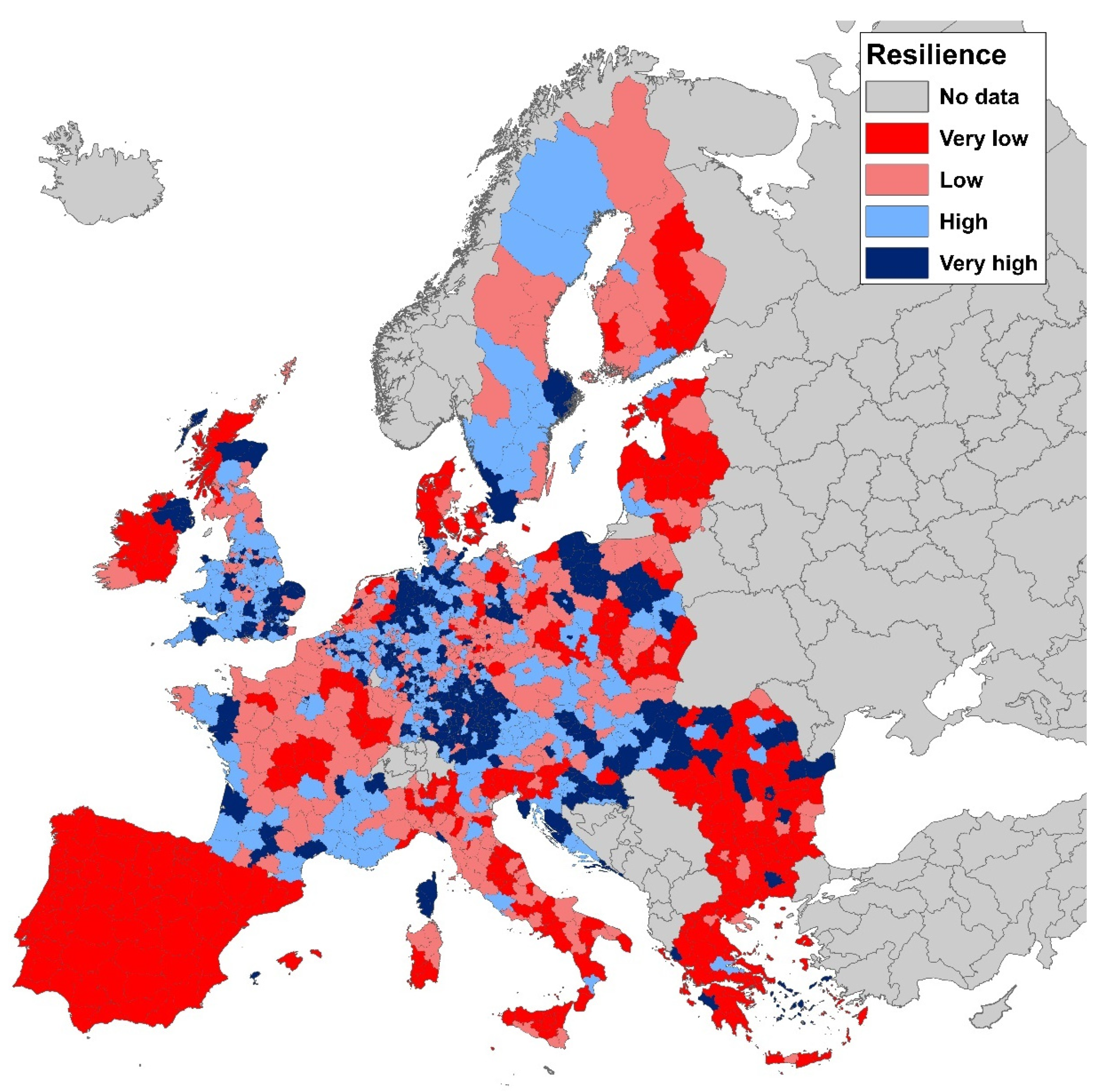
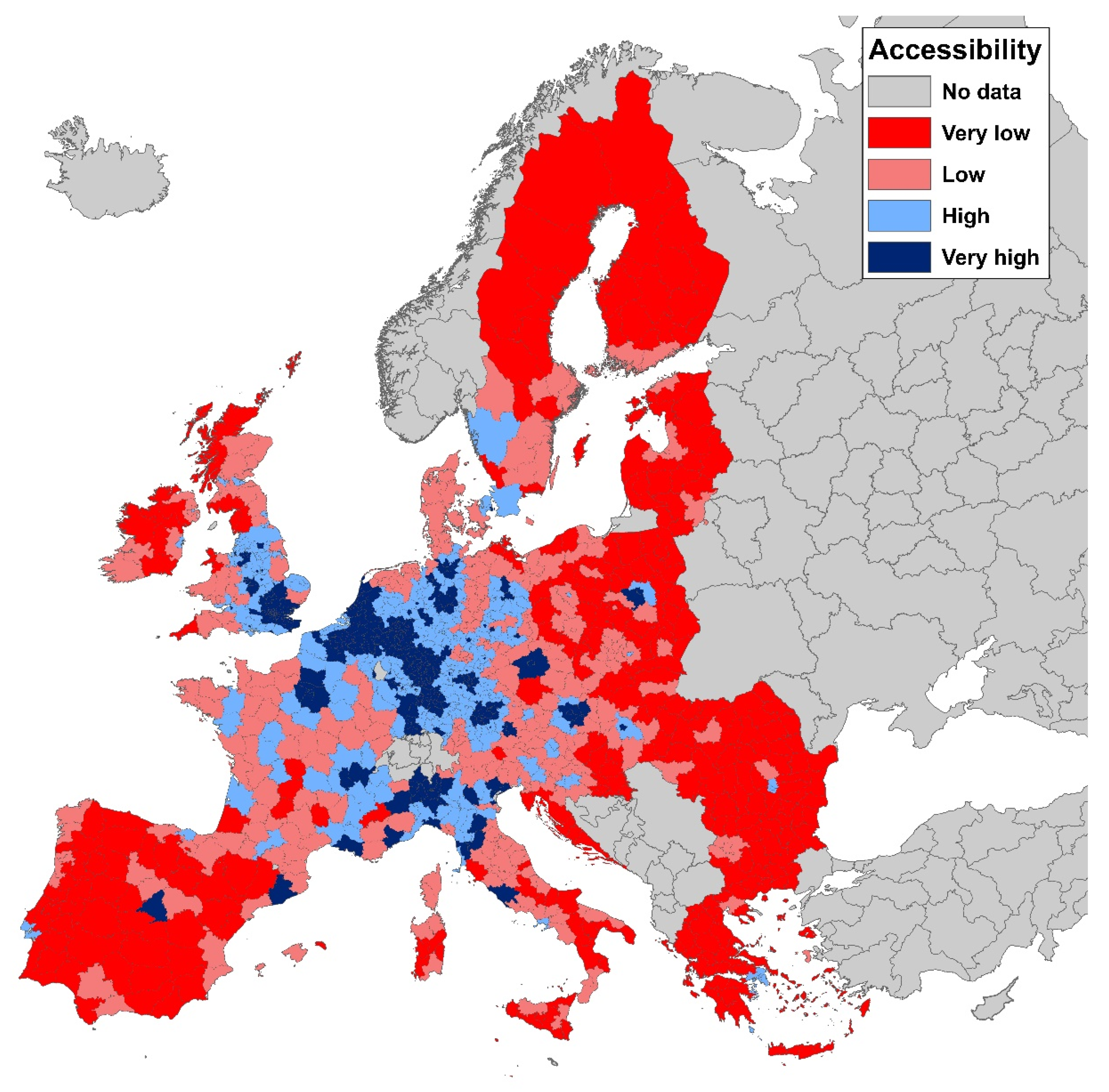

| Mean | Std. Dev. | Min | Max | |
|---|---|---|---|---|
| Resilience | 1.090 | 6.765 | −20.280 | 145.932 |
| Accessibility | 102.753 | 38.588 | 21.530 | 212.940 |
| Migration | 26.285 | 68.950 | −165.990 | 511.896 |
| Population density | 0.573 | 1.389 | 0.003 | 20.893 |
| Age structure | 27.645 | 6.225 | 10.289 | 52.666 |
| GDP per capita | 25.021 | 17.668 | 2.300 | 378.500 |
| Labor market performance | 4.258 | 7.310 | −31.584 | 40.602 |
| (1a) OLS | (1b) SEM | (1c) SLM | (2a) OLS | (2b) SEM | (2c) SLM | (3) HLM | |
|---|---|---|---|---|---|---|---|
| Accessibility | 0.066 *** (0.005) | 0.051 *** (0.008) | 0.040 *** (0.006) | 0.012 * (0.007) | 0.012 * (0.007) | 0.012 * (0.007) | 0.020 ** (0.009) |
| Migration | 0.005 (0.007) | 0.014 *** (0.004) | 0.008 *** (0.003) | 0.025 ** (0.010) | 0.025 *** (0.010) | 0.026 *** (0.010) | 0.021 *** (0.003) |
| Population density | −0.075 (0.203) | −0.182 (0.168) | −0.078 (0.150) | 0.202 (0.187) | 0.214 (0.184) | 0.175 (0.177) | −0.187 (0.155) |
| Age structure | −0.171 *** (0.034) | −0.096 *** (0.036) | −0.116 *** (0.029) | −0.159 *** (0.026) | −0.160 *** (0.025) | −0.158 *** (0.025) | −0.135 *** (0.038) |
| GDP per capita | 0.020 (0.017) | 0.014 (0.012) | 0.011 (0.012) | 0.011 (0.012) | 0.012 (0.012) | 0.011 (0.012) | 0.020 * (0.012) |
| Labor market performance | −0.114 *** (0.042) | −0.076 *** (0.028) | −0.077 *** (0.026) | −0.016 (0.026) | −0.016 (0.026) | −0.016 (0.026) | −0.037 (0.028) |
| Urban areas | −1.091 * (0.644) | −0.021 (0.543) | −0.405 (0.478) | 0.257 (0.697) | 0.252 (0.694) | 0.309 (0.687) | 0.779 (0.507) |
| Constant | −0.771 (1.382) | −1.850 (1.337) | −0.420 (0.941) | 3.387 * (1.853) | 3.390 * (1.808) | 3.177 * (1.819) | 0.332 (1.594) |
| Moran’s I | 12.950 *** | 0.184 | |||||
| LM error | 152.230 *** | 1.905 | |||||
| Robust LM error | 0.517 | 0.246 | |||||
| LM lag | 187.012 *** | 1.672 | |||||
| Robust LM lag | 35.299 *** | 0.014 | |||||
| λ | 0.511 *** (0.048) | −0.191 (0.378) | |||||
| ρ | 0.448 *** (0.043) | 0.297 (0.206) | |||||
| Adjusted R-squared | 0.177 | 0.357 | |||||
| Pseudo R-squared | 0.155 | 0.247 | 0.357 | 0.356 | |||
| Country dummies | No | No | No | Yes | Yes | Yes | |
| Country-level variance component | 12.847 (4.710) | ||||||
| NUTS-2 regional-level component | 9.896 (1.901) | ||||||
| NUTS-3 regional-level component | 23.782 (1.092) |
Publisher’s Note: MDPI stays neutral with regard to jurisdictional claims in published maps and institutional affiliations. |
© 2021 by the authors. Licensee MDPI, Basel, Switzerland. This article is an open access article distributed under the terms and conditions of the Creative Commons Attribution (CC BY) license (https://creativecommons.org/licenses/by/4.0/).
Share and Cite
Giannakis, E.; Papadas, C.T. Spatial Connectivity and Regional Economic Resilience in Turbulent Times. Sustainability 2021, 13, 11289. https://doi.org/10.3390/su132011289
Giannakis E, Papadas CT. Spatial Connectivity and Regional Economic Resilience in Turbulent Times. Sustainability. 2021; 13(20):11289. https://doi.org/10.3390/su132011289
Chicago/Turabian StyleGiannakis, Elias, and Christos T. Papadas. 2021. "Spatial Connectivity and Regional Economic Resilience in Turbulent Times" Sustainability 13, no. 20: 11289. https://doi.org/10.3390/su132011289
APA StyleGiannakis, E., & Papadas, C. T. (2021). Spatial Connectivity and Regional Economic Resilience in Turbulent Times. Sustainability, 13(20), 11289. https://doi.org/10.3390/su132011289

