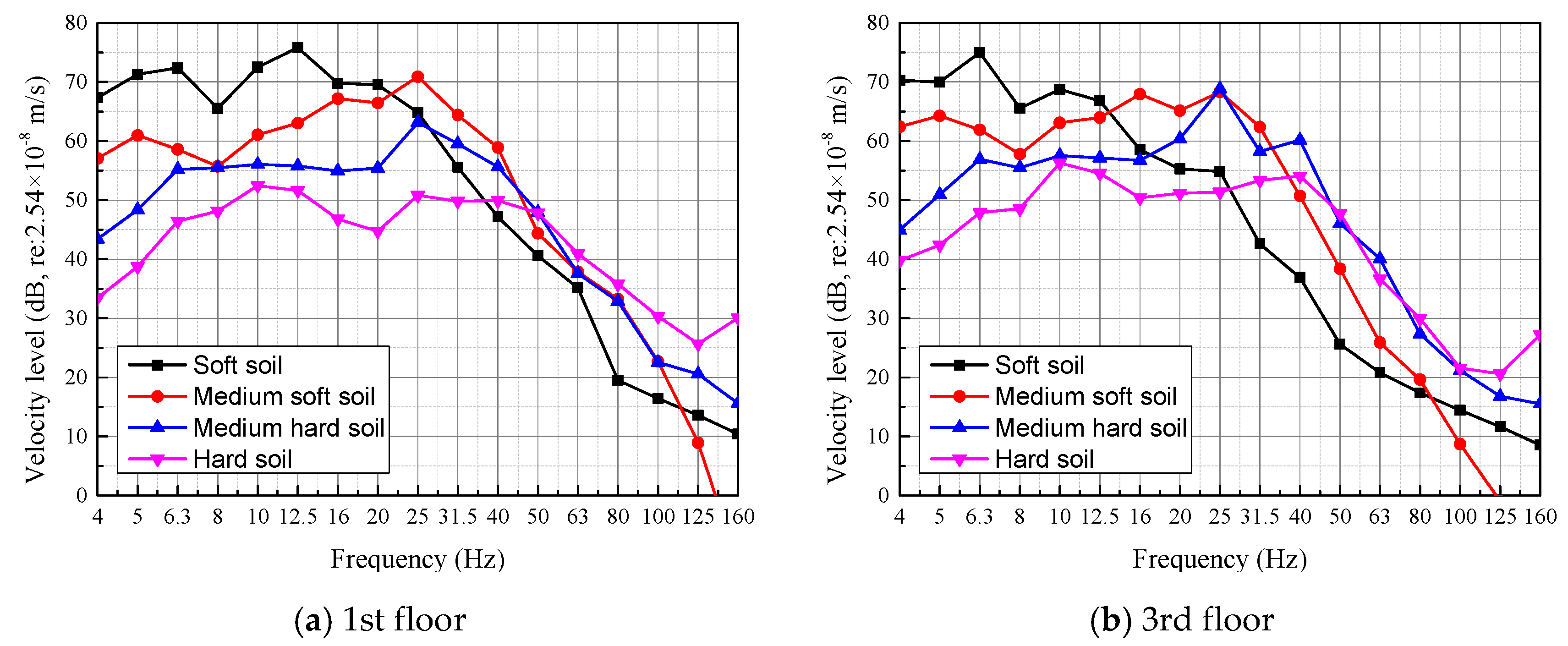
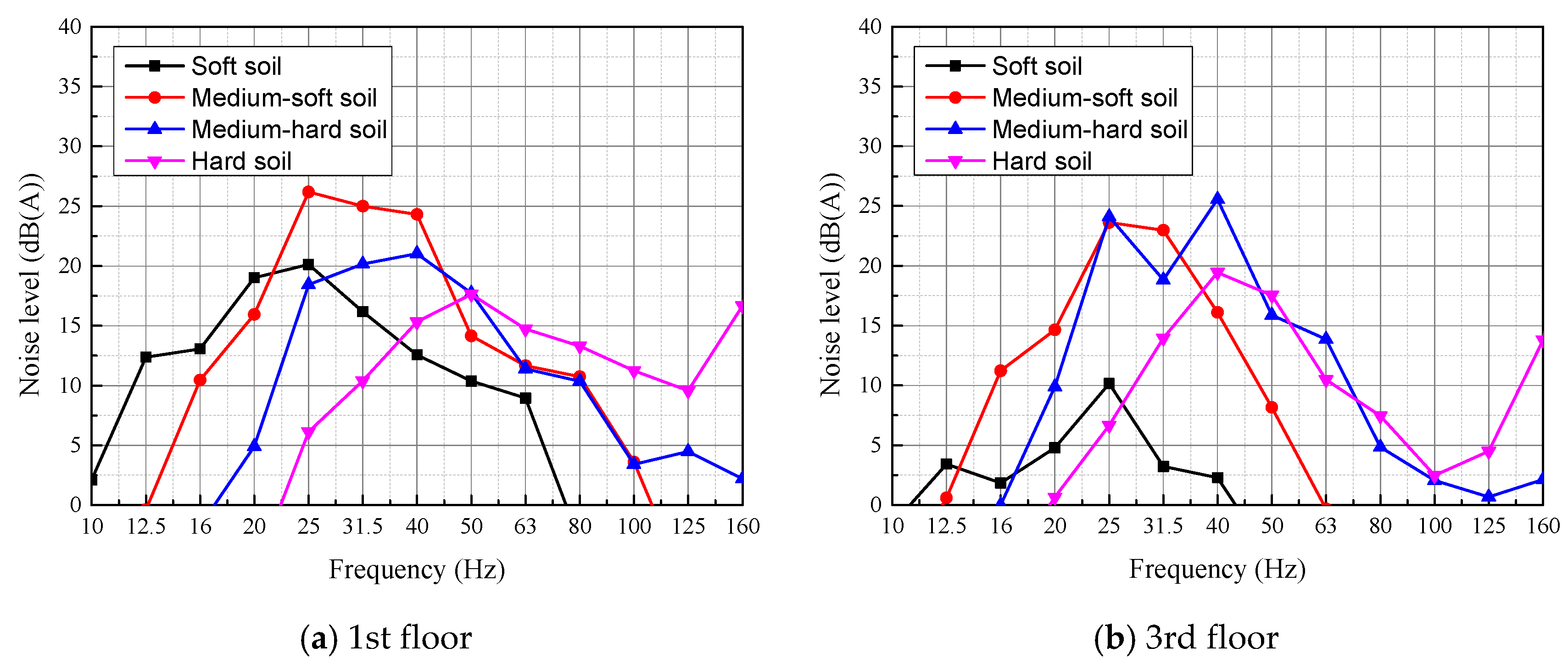
1. Introduction
In the process of urban development and expansion, a city should adopt efficient, energy-saving, and environmentally friendly urban transportation systems and intensive development strategies against traffic congestion, environmental deterioration, and encroachment on arable land. With the continuous urban development, the contradiction between population increase and land shortage will become more serious [
1]. Therefore, the three-dimensional overlapping development of urban space gains its importance. The construction of buildings above subway tracks is a mode of three-dimensional overlapping development of urban space [
2]. This mode not only provides the subway system’s operation with the financial support from property development, but also makes comprehensive utilization of urban land [
3], improving both the social and economic benefits.
However, train-induced vibrations will transmit into the buildings and cause radiated noise from indoor structures or furniture [
4,
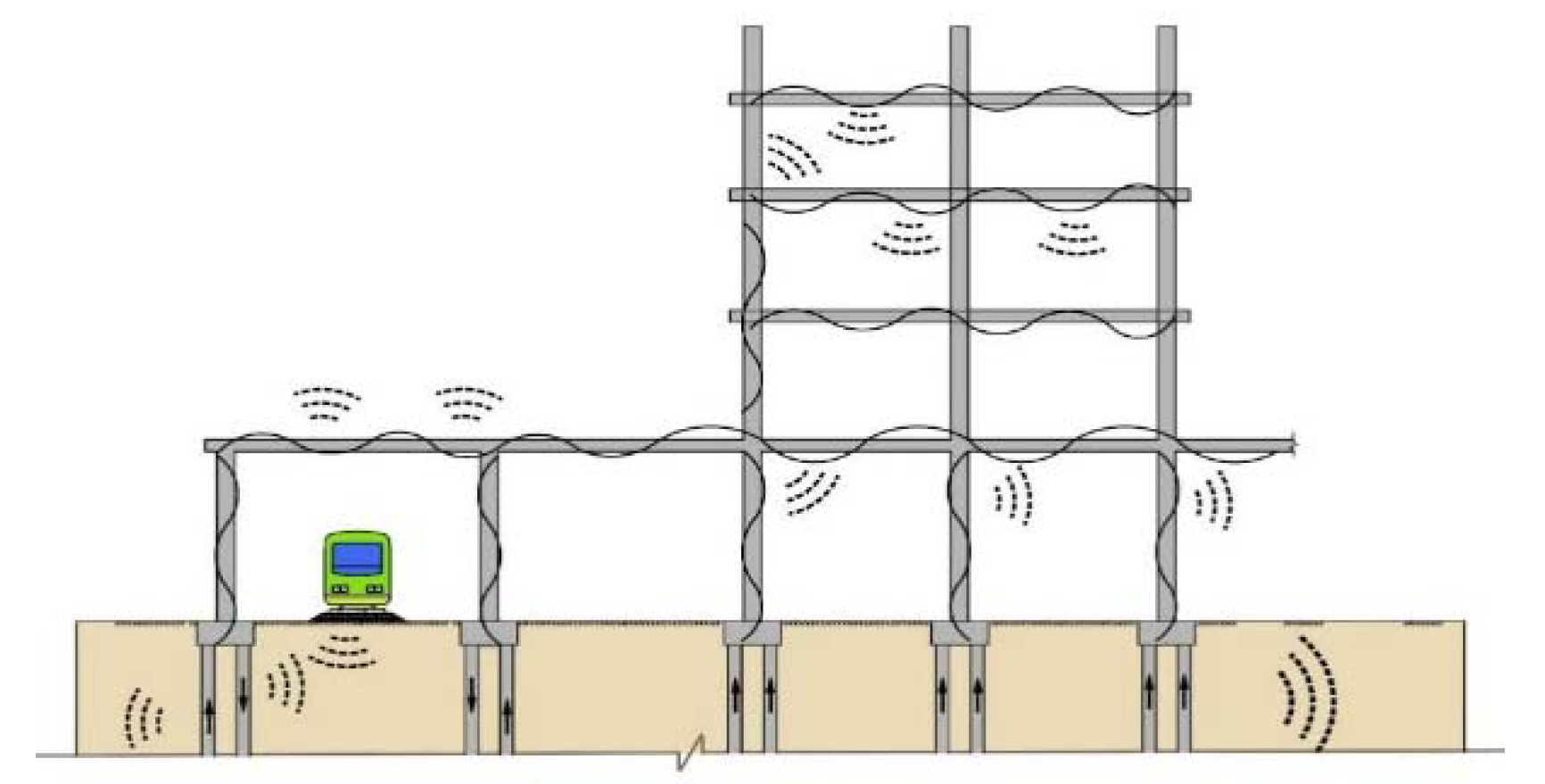
5]. The energy, in the form of vibration waves, transmits from the ground soil to the foundation of the building through the interaction between them and results in building vibrations and structure-radiated noise, which may affect people’s normal lives and work within the building [
6], as shown in
Figure 1. Therefore, effectively estimating and reducing the environmental problems caused by vibration and radiated noise has become a key factor in the three-dimensional overlapping development of urban space.
At present, the impact evaluation of environmental vibration caused by train operations was primarily based on empirical methods, experimental methods, numerical methods, or the combination of comprehensive methods during the preliminary design and the construction stage, as well as the operation stage [
7,
8,
9,
10,
11]. The empirical methods are based on theoretical researches and a large number of field test data. The impact factors accounting for the distance between the vibration receiver and the vibration source, wheel-rail contact force, train speed, and vibration attenuation are taken into consideration, and then empirical formulas are formed to guide vibration assessment [
12,
13]. The experimental methods usually use transfer functions to predict the vibration responses in a building. By applying excitation to the track, the excitation force and the vibration response of the surrounding buildings can be recorded in the frequency domain, from which the transfer function between the vibration source and the receiver can be calculated [
14]. Although the experimental methods result in good accuracy, they need a large number of field measurements to find out the vibration wave transmission characteristics of a specific site, thus requiring a long prediction period and high cost.
The numerical method is a relatively mature method, including the finite difference method, finite element method, infinite element method, and boundary element method [
15,
16,
17,
18,
19]. The finite element method is most commonly used, and its main advantage is that objects with complex geometries and boundary conditions can be simulated [
20,
21,
22]. To reduce calculation time and eliminate the impact of artificial boundaries, the finite and infinite element methods can be combined, forming a 2.5-dimensional (2.5D) finite element model to simulate the ground vibration responses induced by moving loads [
23]. Lopes et al. [
24] used the 2.5D finite element model to simulate train-track-foundation soil, and used the 3D finite element model to simulate the building structure and predict the vibration caused by train operation. Nagy et al. [
25] and Fiala et al. [
26] used finite element and boundary element models to predict the vibration propagation and structure-radiated noise in the buildings.
For the structure-radiated noise, it is generally believed that the influencing factors include the vibration velocity of the building structure, the geometric size of the room, the setting of doors and windows, and the sound-absorbing properties of the room surface [
27,
28]. Urban areas affected by noise typically include schools, residence, office buildings, markets, airports, and subway stations [
29,
30,
31,
32,
33]. To predict the structure-radiated noise, methods such as numerical methods, empirical formulas, or experimental methods can be adopted [
34,
35]. The empirical formula method is widely used because of its convenience and low cost [
36].
However, there is little research on the impact of ground soil properties on train-induced building vibrations and structure-radiated noise. The engineering environment of subway construction is complex, and it is often referred to as a geologically sensitive area which has many geological engineering problems. For example, the water-rich soft silt stratum has a high natural water content, larger pore ratio and compressibility, and low bearing capacity, which makes it easy to cause the settlement of the track and building structures. The water-rich sand layer has large pores and a loose structure, which also makes it easy to cause ground and building settlement. However, the influences of these geological problems on the propagation of vibration and structure-radiated noise within the buildings are not clear. Hence, it is necessary to study the train-induced building vibration and radiated noise under different geological conditions.
The purpose of this study is to explore the train-induced vibration transmission from the ground up into the building and the structure-radiated noise within the building. A method which consists of a train-track model, track-soil-building model, and structure-radiated noise simulation is presented and verified by measurements. The impact of soil properties on the building vibration and structure-radiated noise is analyzed and ground improvement is proposed as a measure to mitigate vibration and structure-radiated noise within buildings.
2. Methods
2.1. Overview
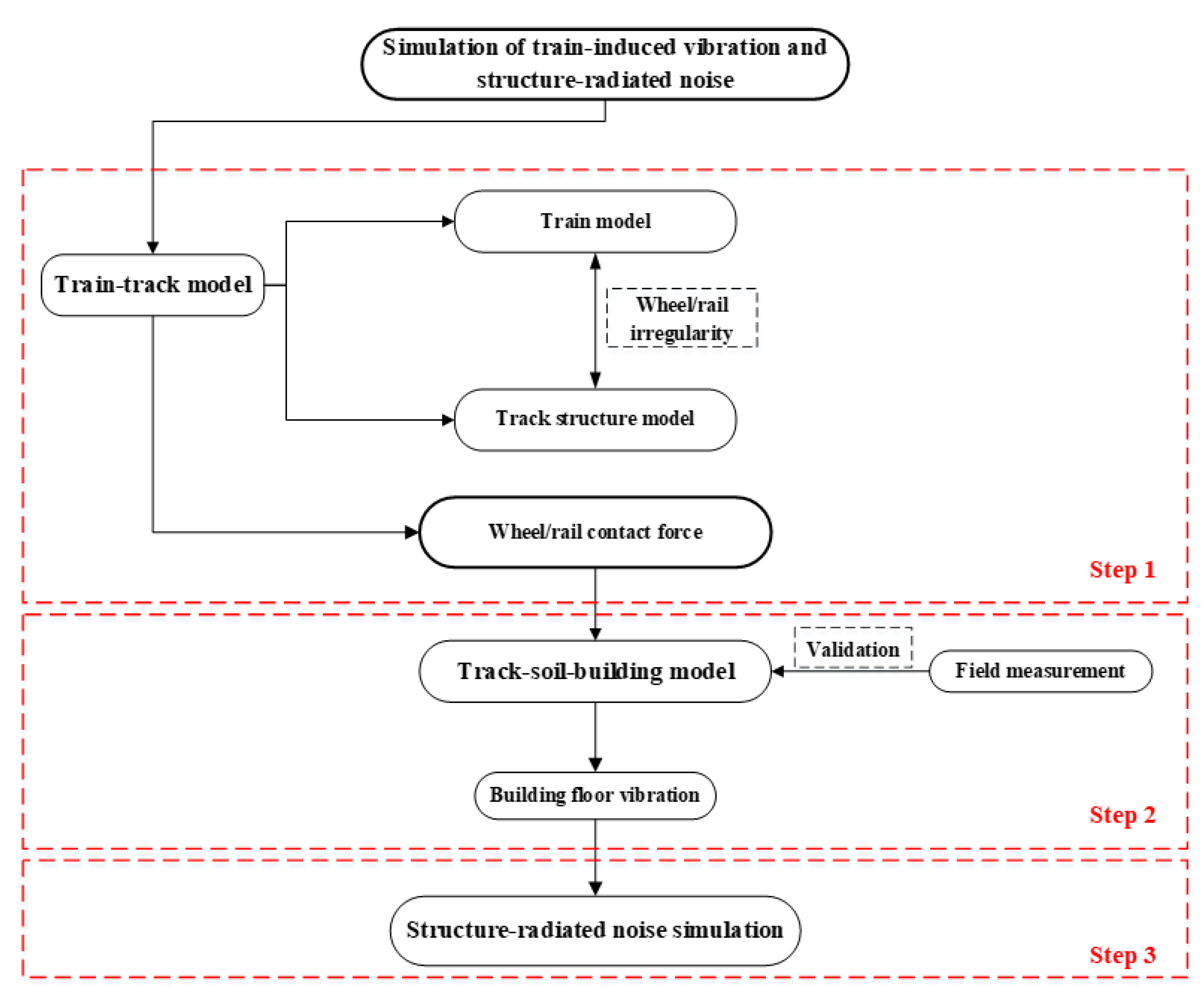
As shown in the
Figure 2, the simulation of train-induced vibration and structure-radiated noise within buildings can be divided into three steps, which are the train-track vibration generation simulation, track-soil-building vibration transmission simulation, and structure-radiated noise calculation.
The simulating procedure can be described as:
Train-track coupling dynamic model is established, including a train model and track structure model. Based on the displacement compatibility and force balance coordination between the wheel and rail, the train and track structure dynamics equations are solved using the simple and fast explicit integration method developed by Zhai [
37]. Considering wheel and rail irregularity, the time-variant contact force between the wheel and rail can be obtained.
The track-soil-building finite element model is established using the ABAQUS package. By compiling the moving load subroutine and using the wheel and rail contact force as the moving load for the model, the ground and building floor vibrations can be obtained and then verified by field measurements.
Based on the calculated vibration level, the structure-radiated noise level is deduced according to the FTA standard.
2.2. Train-Track Model
In a subway system, the dynamic interaction between the train and track structure generates vibrations which are transmitted to the surrounding soil and then to the surrounding buildings, resulting in building vibrations and structure-radiated noise. Given this, the vibration source model usually includes two parts, namely the train model and the track structure model.
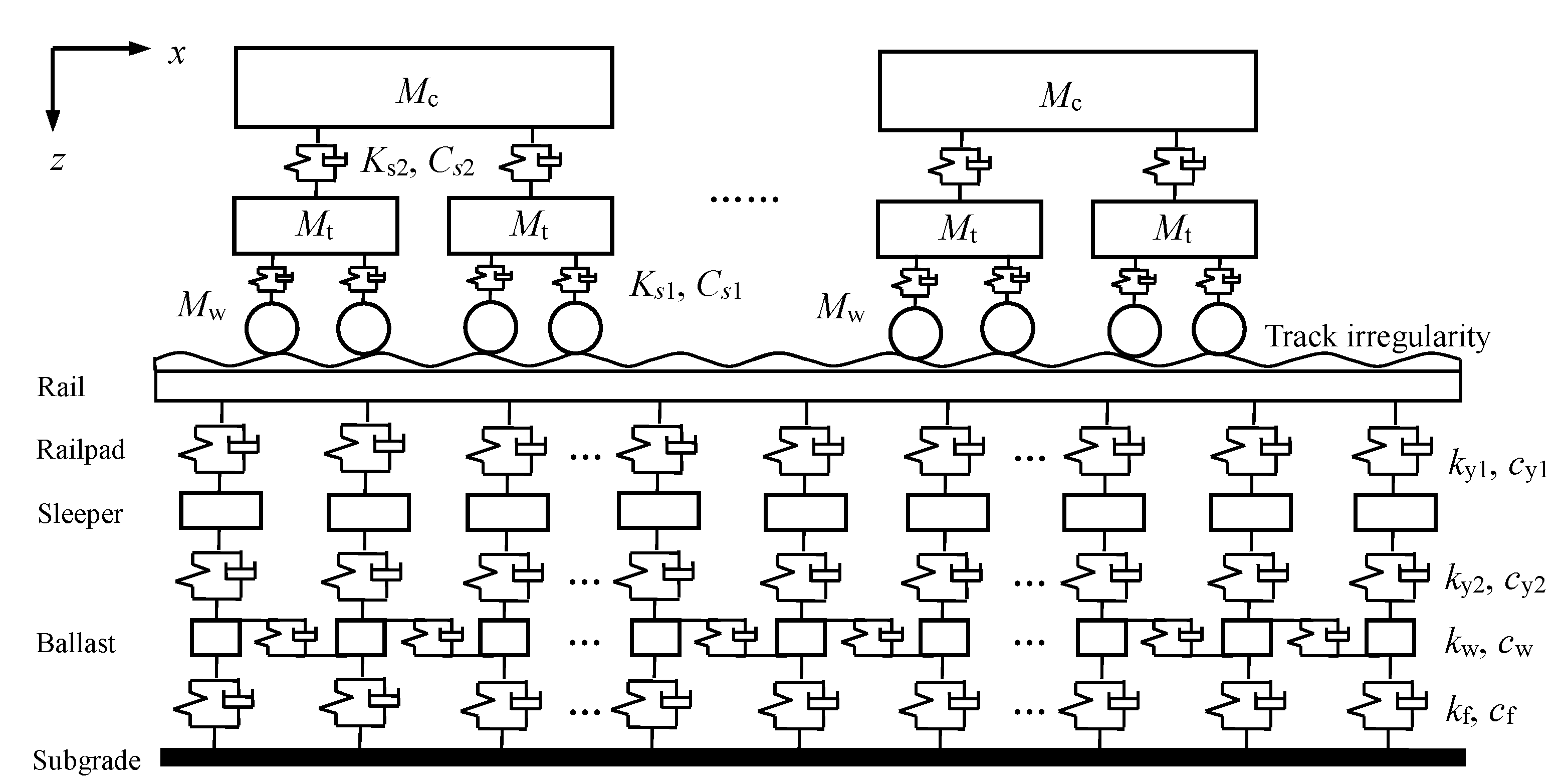
The train model is a vibration system with 10 degrees of freedom, which is composed of the vehicle body, bogies, and wheelsets. The vehicle body, bogies, and wheelsets are all considered as rigid bodies, connected to each other by the primary and secondary suspensions, which are both modeled using spring-dampers, as shown in
Figure 3.
The train is assumed to be traveling along the track at a constant speed, so the relative displacement between cars can be ignored. The dynamic equation of the train model is [
38]:
where
,
and
represent the acceleration, velocity and displacement vectors of the train, respectively.
,
and
are the mass, damping and stiffness matrices of the train.
is the vertical wheel/rail contact force vector deduced from the displacement and track irregularity of the train and track. The dynamic parameters of a metro train with 6 cars are listed in
Table 1.
The simulated track structure in this research is a ballast track, which is modeled as a three-layer structure, including the rail, sleepers, and ballast [
38]. The degrees of freedom of the track system are set in the same plane as the degrees of freedom of the train model. The rail is modeled as an Euler beam, ignoring the influence of shear force and moment of inertia. The elastic and damping characteristics of the rail fasteners, ballast, and foundation are expressed by equivalent stiffness coefficients (
,
,
) and damping coefficient (
,
,
), respectively.
The dynamic equation of the track model is [
39]:
where
,
and
represent the acceleration, velocity and displacement vectors of the track, respectively.
,
and
are the mass, damping and stiffness matrices of the track. The dynamic parameters of track model are listed in
Table 2.
The selection of the rail length and elements’ sizes should take the computing efficiency and accuracy of the model into consideration, which has been studied by many scholars. Popp et al. [
40] proposed that at least 10 sleepers should be modeled in the model, and the number of sleepers should increase with the increase of train speed. In fact, when the calculated length of the rail is long enough, the influence of the boundary conditions at both ends of the rail can be ignored. To consider the situation where all six of the vehicles are running on the rail, the rail length is set to be more than 2.5 times the total length of the train.
The wheel-rail contact force
Frain/wheel is calculated based on the nonlinear Hertz contact theory:
where
and
are vertical displacements of the wheelset and the rail at wheel–rail contact points, respectively, and
is the amplitude of the track irregularity.
is a geometric and material parameter which is defined as:
where R is the wheel radius of 0.4575 m. The simulation of rail irregularity is based on the railway track of line grade six in the American Railway Standard [
41]. The simple and fast explicit integration method developed by Zhai [
37] is used to solve the system dynamic equations.
The train-track model is closely related to the train vibration properties, rail smoothness and condition, train speed, and load combination, which reflects: (1) The influence factors of the vehicle itself, including axle weight and suspensions; (2) the influence of track irregularity, which is considered as the main factor that causes the dynamic load of vehicles and rails; (3) the influence of train speed; (4) the moving train load and the transfer and dispersion effects of the rail and sleeper on load are considered.
2.3. Track-Soil-Building Model
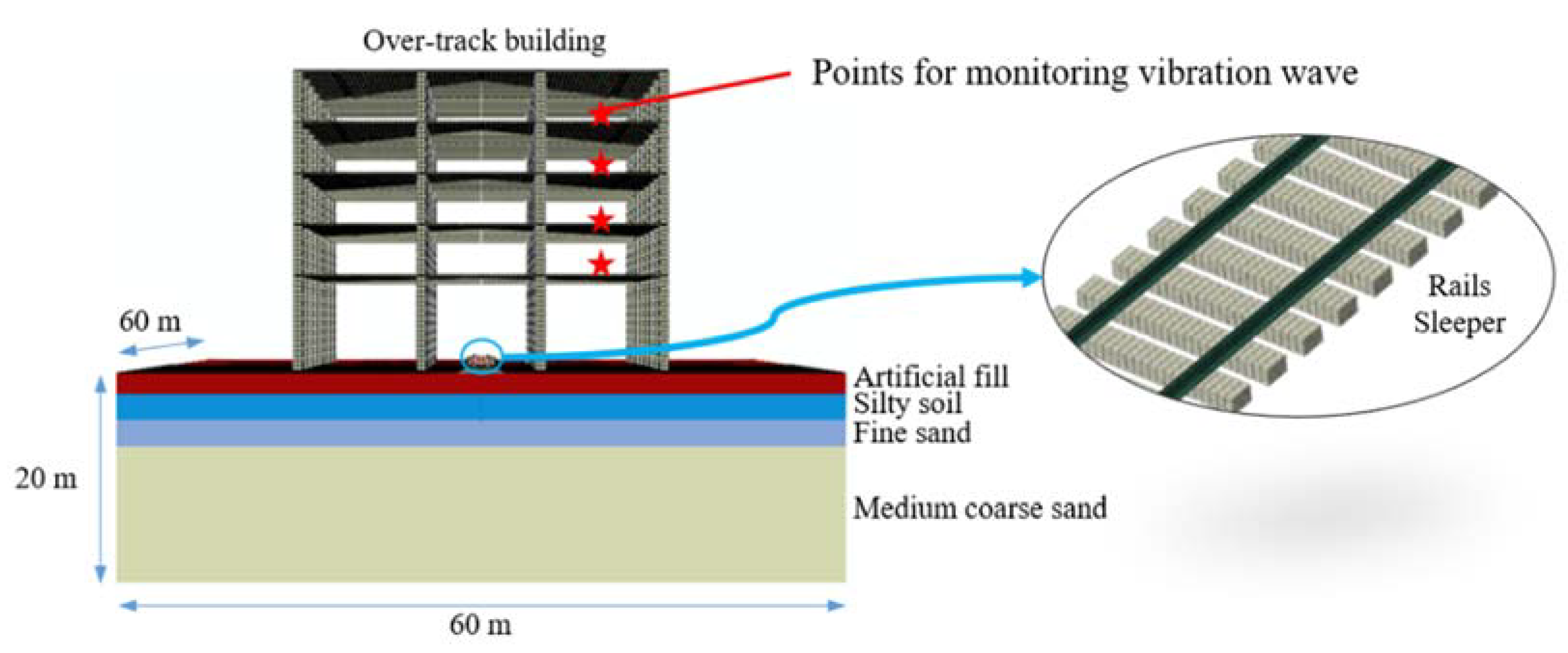
The track-soil-building model consists of the track structure, soil, and building structure, and is constructed with the finite element method, as shown in
Figure 4.
The finite element model of the track structure is composed of rails, sleepers, and the ballast. The seamless rail is 60 kg/m, U75V hot-rolled with 1435 mm gauge. The number of sleepers is 1680/km. The ballast has a gravel structure with a thickness of 0.45 m, and the thickness of its surface layer and subballast are 0.25 m and 0.20 m, respectively. The top width of the ballast is 3.3 m, and the slope ratio is 1:1.75. The mechanical properties of the track structure are shown in
Table 3.
Since the train-induced vibration mainly propagates through the ground surface and its impact on the soil is mainly within the elastic range, the soil model can be simplified as homogeneous and linearly elastic. The soil model is discretized to obtain a number of eight-node solid elements in the local coordinate system. After the mass matrix, stiffness matrix, damping matrix, and equivalent nodal force matrix of each element are established, the system matrix can be constructed, and then the displacement, velocity, and acceleration of the structure can be obtained based on the explicit central difference method.
According to geological drilling data, the soil under the track is simplified into four layers. From the soil surface to the bottom, they are artificial fill, silty soil, fine sand, and medium coarse sand. The mechanical properties of the soil are shown in
Table 4. The dimensions of the soil are 60 × 60 × 20 m (length × width × height). The element size is set to be less than one sixth of the minimum shear wavelength, which is selected as 0.3 m.
When a finite size model is used to simulate infinite ground, the biggest problem is the artificially truncated boundary, which will cause the wave reflections and the vibration energy to transmit back to the analysis area from the boundary, resulting in distortion of the simulation. One solution is to use infinite elements [
42,
43] at the boundaries of the soil. The vibration energy is attenuated outward by introducing the attenuation formula of the infinite element at the boundary.
A five-story building model is generated to study the vibration transmission within it and the structure-radiated noise. The building is built over the track using a load-bearing concrete frame structure. The bottoms of the ground columns are located 1.5 m below the ground surface, and the interactions between the soil and the columns are simulated by spring and damper elements. The height of the first floor is 9.5 m, which leaves enough space for the train’s operation. To meet the height needs of the relevant equipment, other floors are set to 5.0 m. The cross-sectional dimensions of the building beams and columns are 0.5 × 0.5 m2 and 1.0 × 1.0 m2, respectively. The floor thickness is 0.2 m. The elastic modulus of the concrete material for beams, columns, and floors is 30 GPa, and its density is 2500 kg/m3. The structural damping is assumed as 0.02 for reinforced concrete structures.
In the ABAQUS finite element package, the application of moving loads requires the establishment of subroutine VDLOAD, which can simulate the train moving on the rail at a certain speed by defining the relationship between wheel-rail contact forces and positions, as shown in
Figure 5. The wheel-track contact forces can be obtained through the train-track model as described in
Section 2.2, and the acting locations of the forces on the rail change as the train runs.
2.4. Structure-Radiated Noise Simulation
The structure-radiated noise caused by train operation affects people in the frequency range of 16–250 Hz, which is generated because the vibration excites the floor slabs, walls, columns, or other household devices in the room [
44]. Structure-radiated noise can be derived from the velocity level of structural vibrations. In general, the A-weighted sound pressure level of structure-radiated noise is related to room volume, surface area, and reverberation time, whose relationship can be expressed as [
45]:
where L
v is the velocity level (dB, re 2.54 × 10
−8 m/s); A is the coefficient related to room volume, surface area, air density, and wave speed; K
A−wt is the A-weighted network value in the 1/3 frequency octave band.
For a typical residential room, the value of coefficient A is assumed to be equal to −5 dB when the decibel reference value for L
v is 2.54 × 10
−8 m/s. The value of K
A−wt can be found in the Federal Transit Administration (FTA) standard [
45].
3. Validation of the Methods
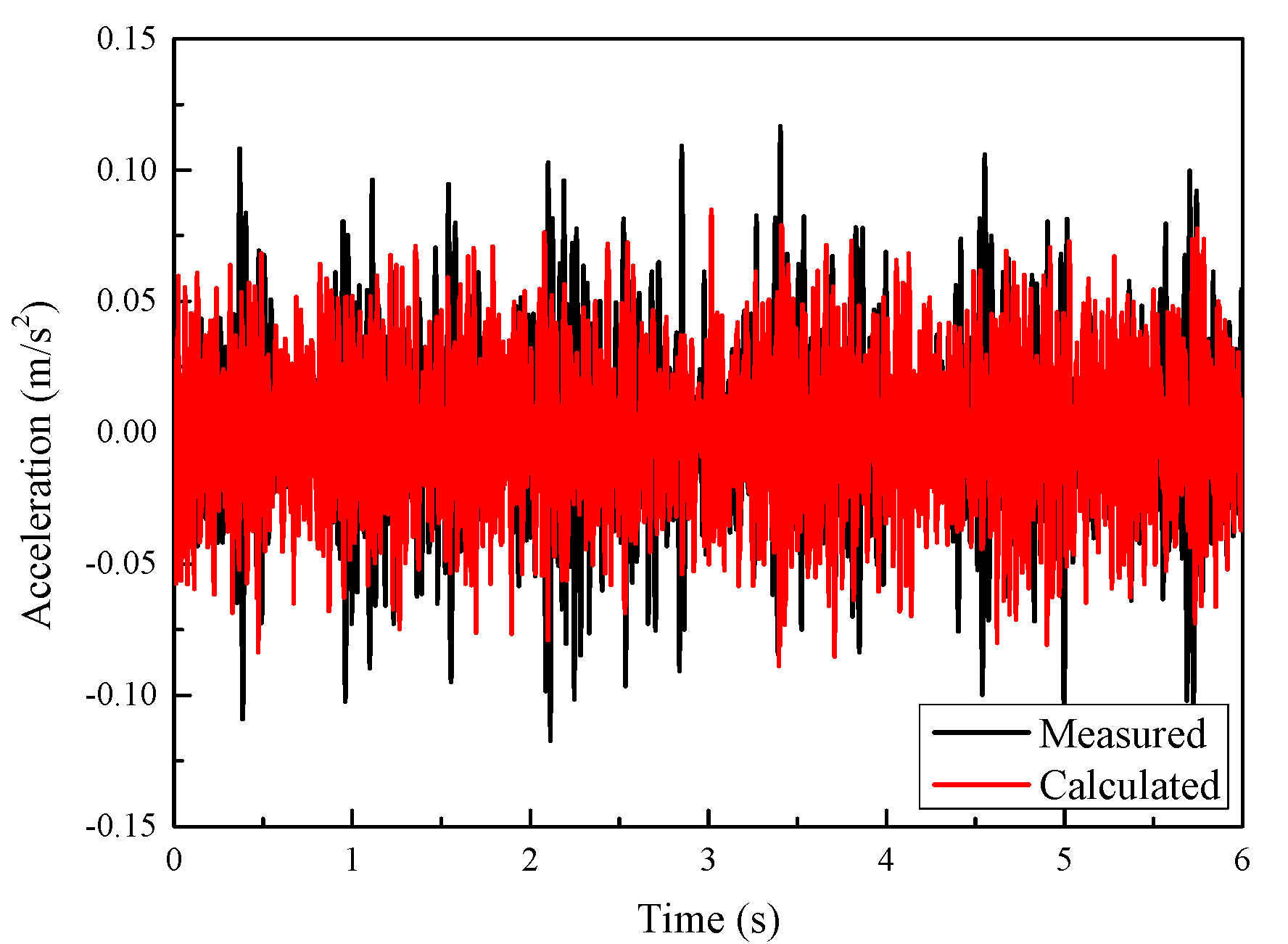
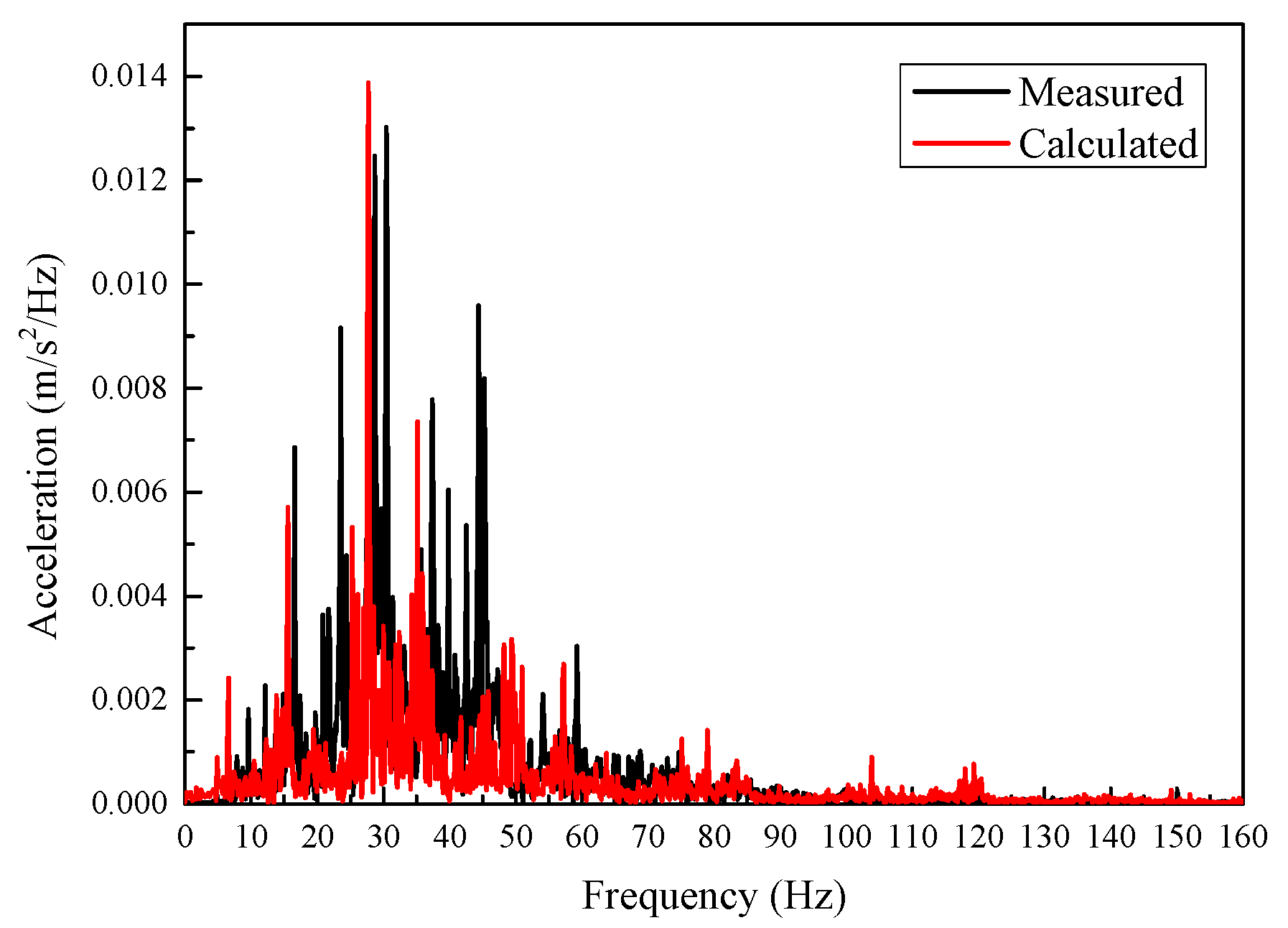
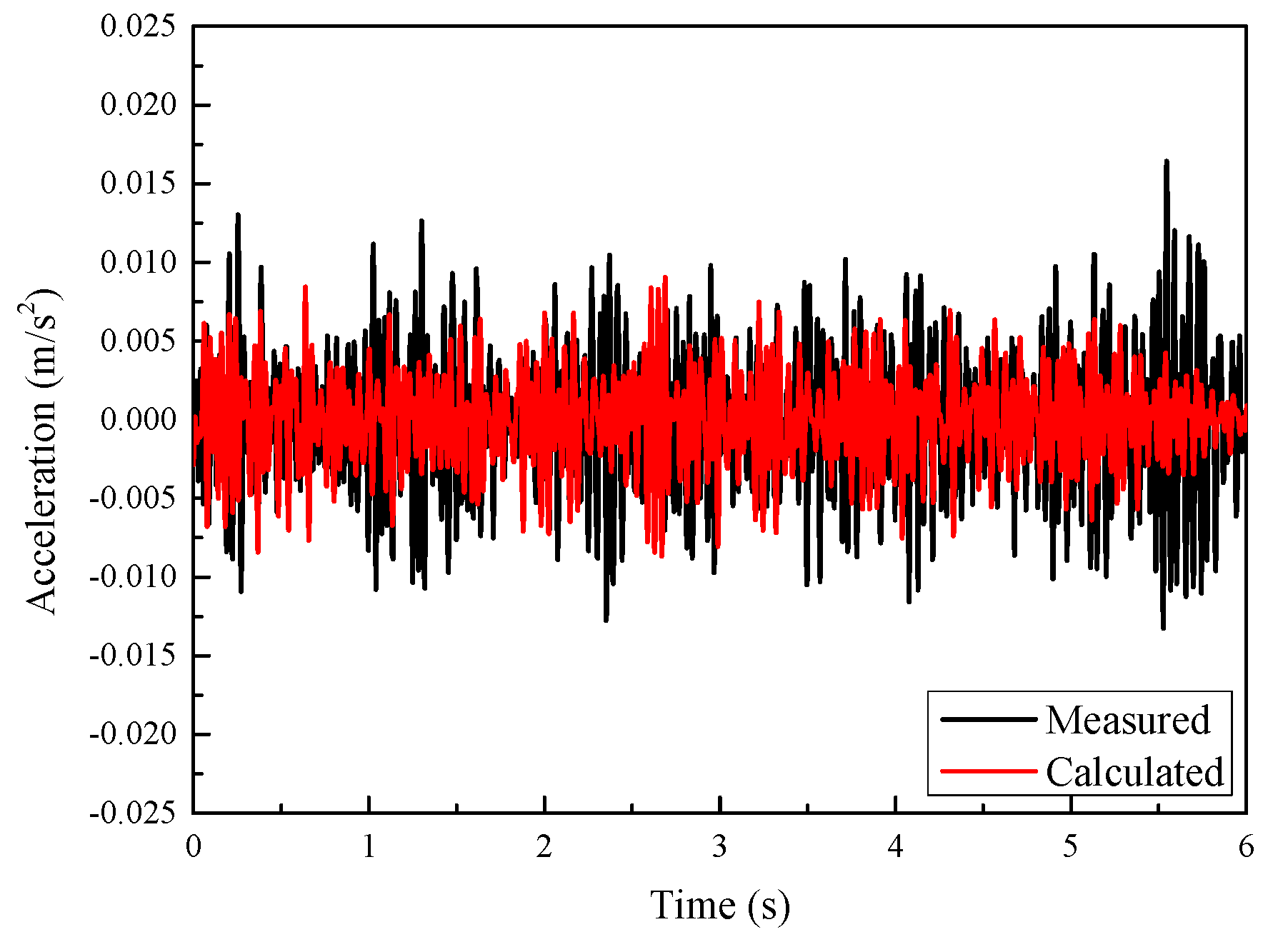
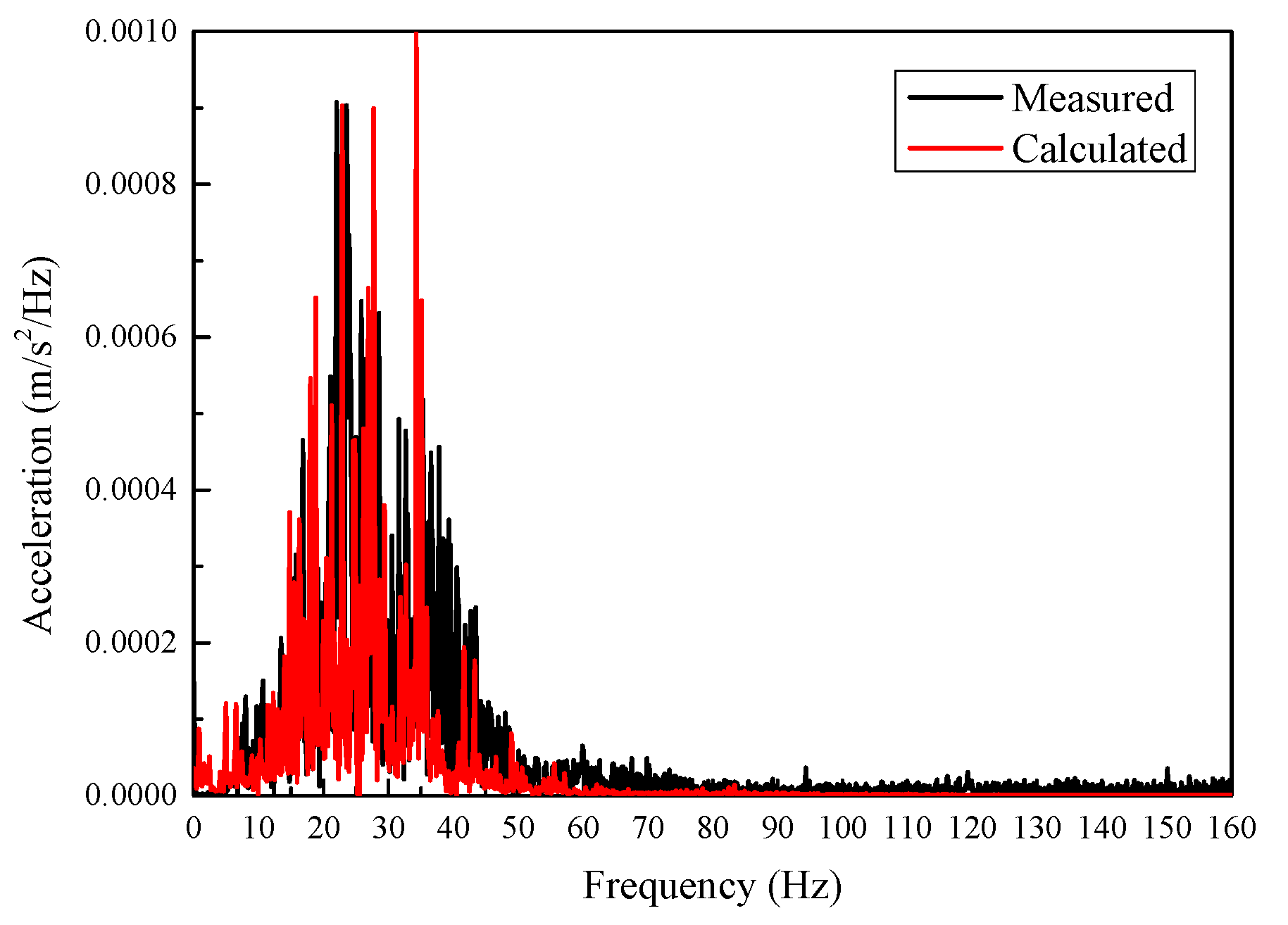
To verify the correctness of the proposed method, the track-soil-building finite element model is calculated using moving train loads as inputs, which are obtained from the train-track model. The soil parameters are selected based on the field geological drilling data. Through the repeated comparison between the calculated data and the measured data, the optimal value of each material parameter is determined within the field geological drilling data range. Both the time and frequency domain of the ground and building floor vibration are obtained. At the ground and on the 3rd floor, the calculated vibrations are compared with the measurements obtained by Zou et al. [
5]. The compared results are shown in
Figure 6,
Figure 7,
Figure 8 and
Figure 9.
Figure 6 shows the calculated and measured vibrations in the time domain on the ground 12 m away from the track centerline. The calculated acceleration is close to the measured in terms of waveform and overall trend, both of which can reflect the train passing process. In addition, the calculated acceleration amplitude is also close to the measured. By converting the time histories into spectra using the Fast Fourier transform algorithm (FFT), the acceleration amplitudes in the frequency domain are obtained, as shown in
Figure 7. As seen in the measured vibrations, the dominant frequency range of soil vibration is below 50 Hz, and the peak frequency is around 30 Hz. The frequency range is only shown up to 160 Hz because train-induced building vibration components above 160 Hz are almost negligible. The dominant frequency range and peak frequency of the calculated vibration are close to the measured. On the whole, the established method can simulate the train-induced vibration on the ground near the track structure.
Figure 8 and
Figure 9 compare the calculated and measured acceleration on the 3rd floor of a nearby three-story building in time history and frequency domain, respectively [
5]. The changing tendency of the calculated acceleration is in good agreement with the measured. The measured and calculated spectra consistently show that the dominant frequency range of building vibrations caused by train operation is below 50 Hz. The calculated and measured peak frequencies are also close. Hence, the established method can simulate the vibration transmission either from the ground into the building or within the building.
5. Ground Improvement for Reducing Vibration Transmission and Structure-Radiated Noise
It is shown that the dynamic interaction between soil and building foundations has a great impact on the vibration transmission from the ground to the building and that the maximum acceleration decreases with the soil shear wave velocity increase [
47].
Therefore, increasing the stiffness of the soil surrounding the building foundation may help to reduce the vibration transmission into the building and result in lower structure-radiated noise. One practical method is mixing binder (such as cement, lime, slag, fly ash, etc.) into the soil to improve its stiffness. This method is widely used in road engineering. It can reduce the settlement of the embankment and pavement by increasing the subgrade stiffness. By mixing the soil and the binder, the elastic modulus of the mixture can be effectively improved, and thus, the stiffness of the mixture is increased.
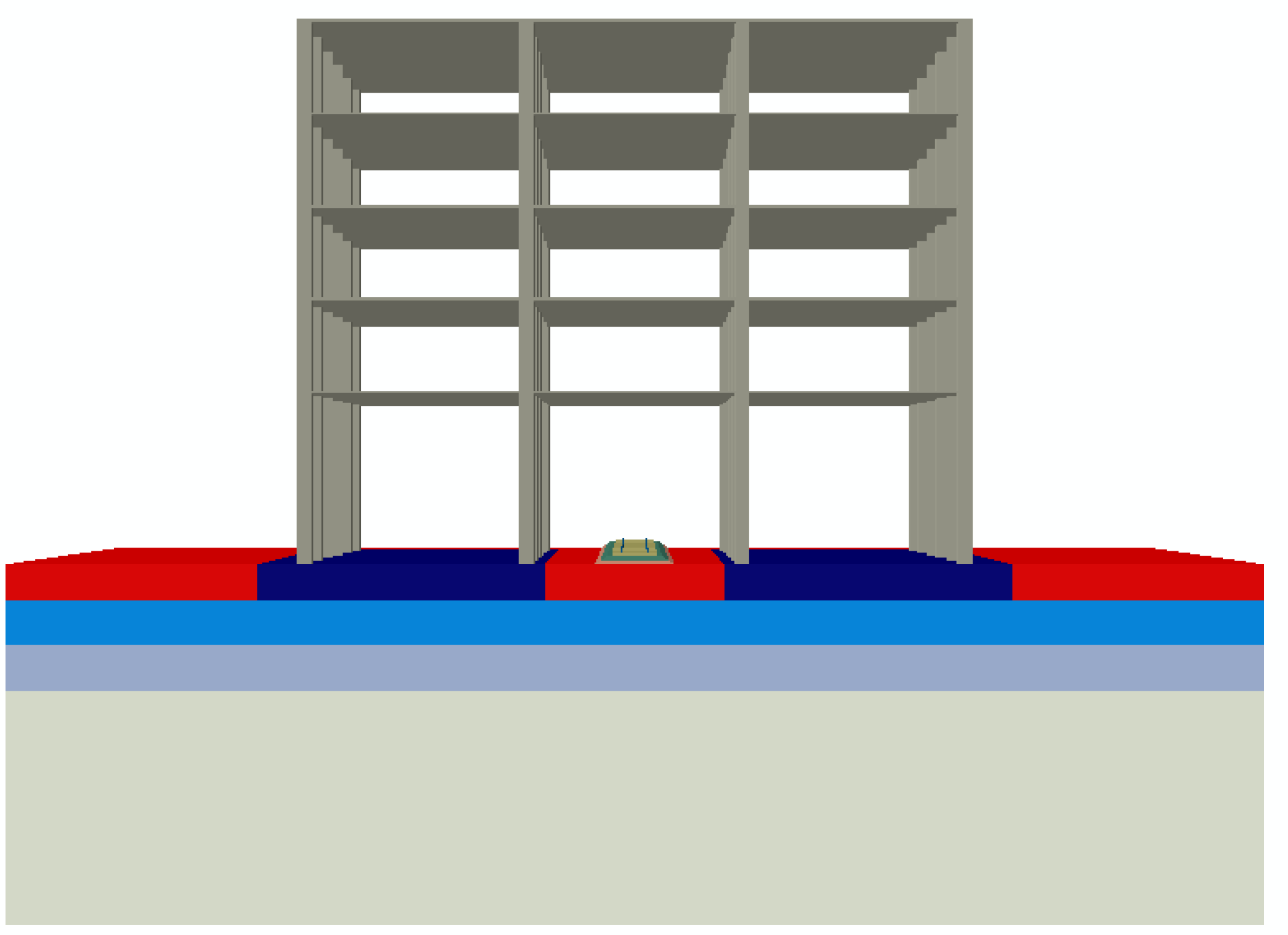
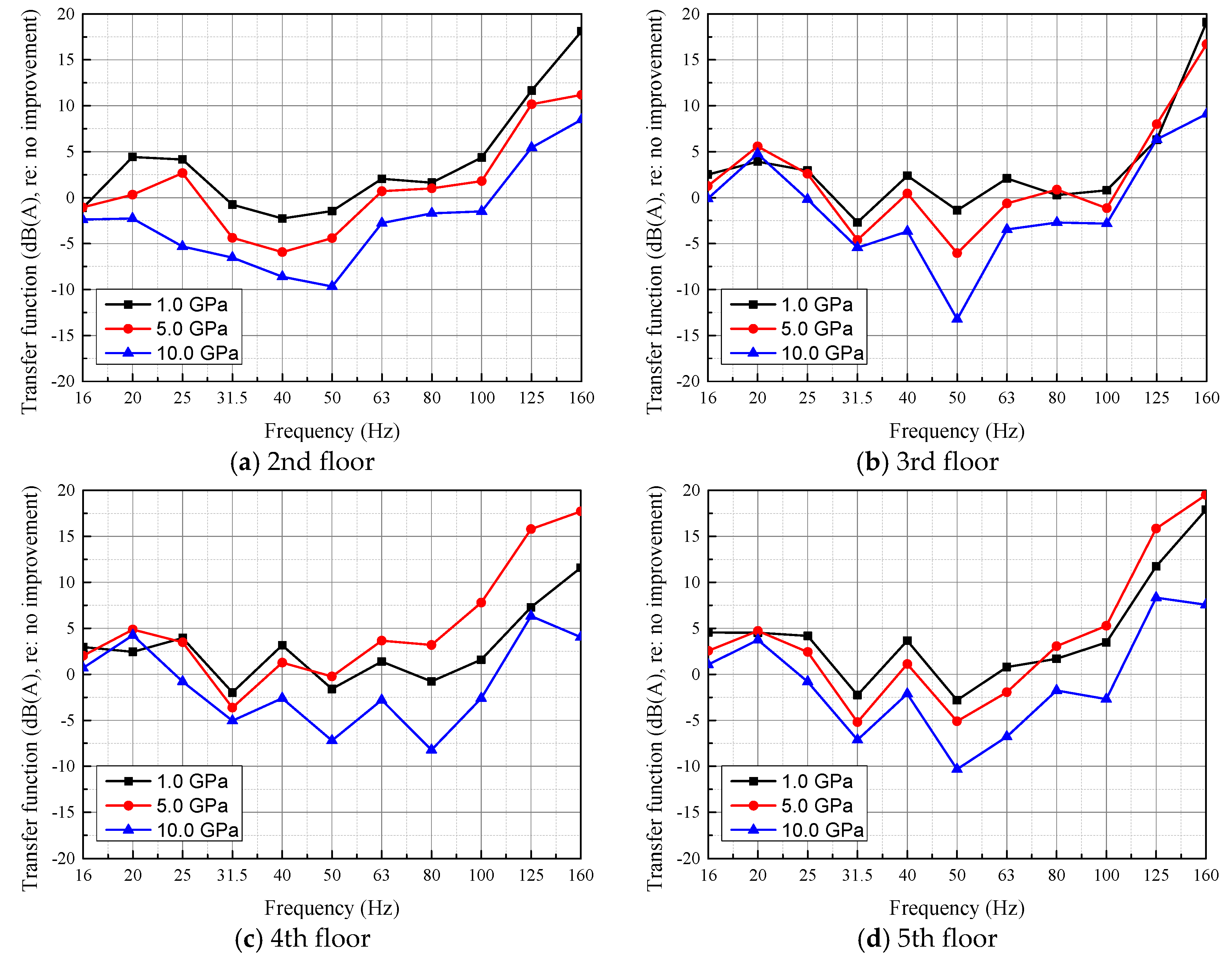
This research studied the effect of ground improvement on reducing train-induced vibrations and structure-radiated noise by increasing the soil stiffness surrounding the building foundations within a depth of 2 m. Three cases with reinforced soil mixtures with elastic moduli of 1.0, 5.0, and 10.0 Gpa are presented; other parameters are kept unchanged. The finite element model after ground improvement is shown in
Figure 12, where the ground improvement area is depicted in dark blue.
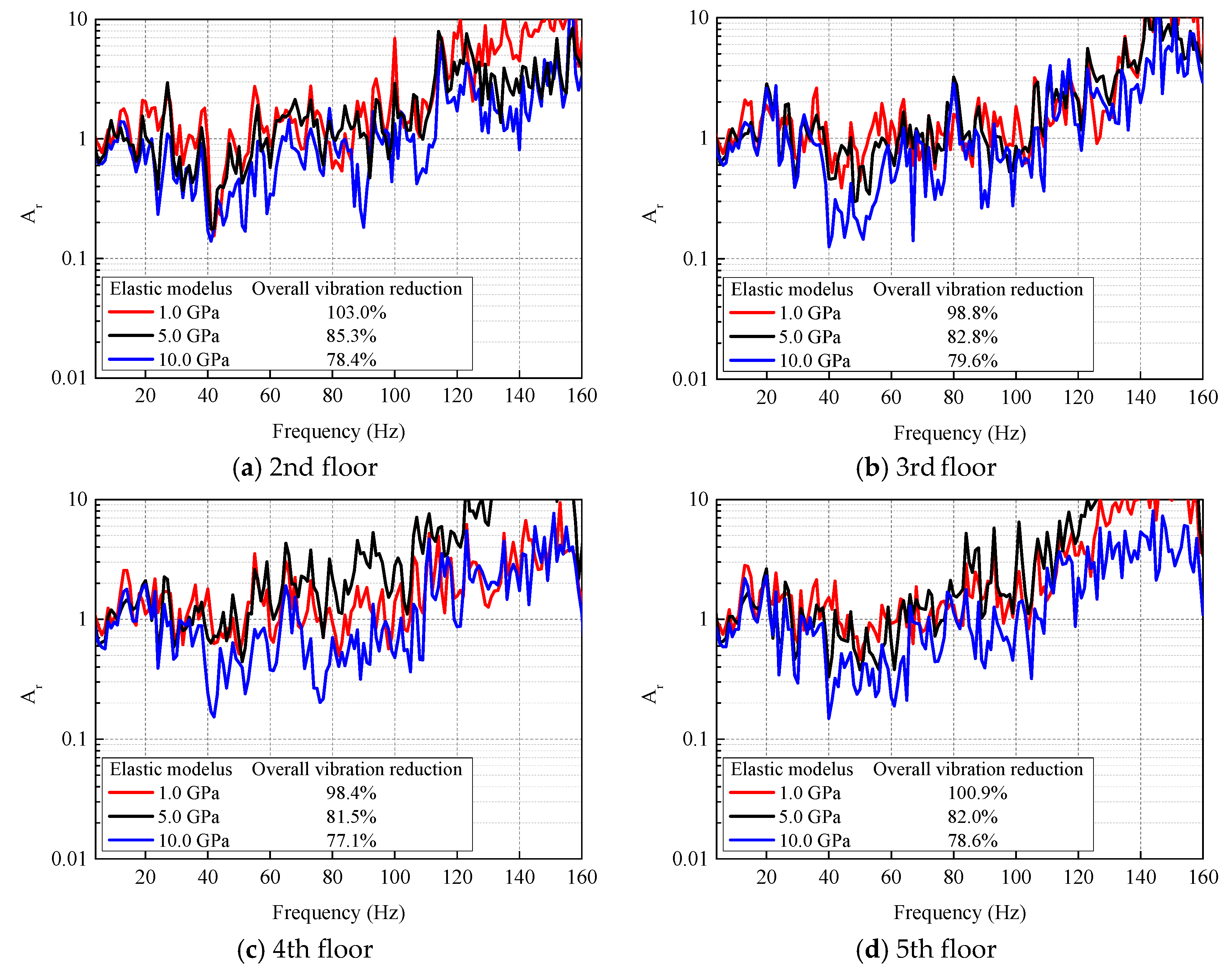
Figure 13 shows the vibration attenuation coefficients (A
r) of the 2nd to 5th building floors after ground improvement. The vibration attenuation coefficient is the velocity level ratio between the after- and before-improvement configurations. When A
r is zero, the vibration energy is completely isolated. When A
r is 1, it implies that the ground improvement has no effect on vibration isolation.
The overall vibration reduction is described by the ratio of the root-mean-square velocity with ground improvement to that without ground improvement. When the soil elastic modulus is 1 GPa, the vibration isolation effect is barely shown. However, with the increase of elastic modulus, the vibration isolation effect of ground improvement becomes more obvious. The averaged overall vibration reduction of mixing binder into the soil is around 78%, which does not look very effective when compared to other more expensive ground improvement measures. As shown in
Figure 13, the increase of the soil elastic modulus has a significant effect on the building vibration attenuation on each floor, especially in the range of 40–80 Hz. The reason is that with the increase of the soil elastic modulus, the soil impedance increased, also making the impedance differences increase between the improved and original soil. When the vibrations transmit from the original soil to the improved, vibration waves will partly reflect at the mutual edge due to the soil impedance mismatches, thus also weakening vibration transmission into the building. However, when the soil elastic modulus is 1 or 5 GPa, the vibrations of each floor are amplified to a certain extent above 60 Hz. This is possibly attributed to resonances. Therefore, in order to obtain a good vibration attenuation effect, it is necessary to ensure that the soil elastic modulus after improvement is greater than 5 GPa. This soil improvement can be conducted along with the construction of the building foundation or the construction of the basement. In addition, this specific conclusion is only valid for the example case used in this research. In future work, researches of other cases need to be done to determine their specific values.
It can be concluded that the ground improvement is helpful for reducing the vibration transmission into the building, and increasing the soil impedance difference has a significant effect on the building’s vibration isolation.
Figure 14 shows the structure-radiated noise transfer function at each floor between after- and before-improvement configurations. On the whole, the increase of the soil elastic modulus is conducive to the reduction of structure-radiated noise within 100 Hz. The reduction effect arrives best at around 50 Hz. However, when the improved soil elastic modulus is 1.0 or 5.0 Gpa, the transfer function is greater than 0 for most frequencies, which means that the ground improvement will lead to the amplification of structure-radiated noise. For the improved soil elastic modulus of 10.0 Gpa, the structure-radiated noise levels between 25 and 100 Hz are reduced. For the frequencies above 100 Hz, ground improvement will lead to structure-radiated noise amplification. Since the sensitive frequency range of the human ear to the structure-radiated noise is 16–250 Hz, the elastic modulus of strengthened soil should be guaranteed to be higher than 5.0 Gpa to achieve an acceptable structure-radiated noise reduction effect.
6. Conclusions
A prediction method for building vibration and structure-radiated noise caused by train operation is proposed in this paper. The method consists of three steps: (1) Building the train-track model; (2) building the track-soil-building model; (3) structure-radiated noise simulation. By comparing the calculated results with the field measurements, it is confirmed that the established method has the ability to predict the train-induced building vibrations and structure-radiated noise.
The impact of different soil properties on train-induced vibration transmission from the ground up into the building and structure-radiated noise generation within the building were analyzed by the established method. The results show that the interaction between soil and structure has a great influence on vibration transmission from the ground into the building. With the increase of shear wave velocity, the maximum acceleration of structural vibration decreases. However, for some soil Rayleigh wavelengths, a higher shear wave velocity may result in vibration amplification due to resonances of the stabilized soil. The amplification may lead to vibration and noise levels that exceed the standard limit and cause people to be uncomfortable from the perspective of public health, especially with such high frequencies. In conclusion, buildings constructed on good foundations help to reduce vibration transmission from ground soil up into the building and lead to lower structure-radiated noise.
The attenuation law of building vibration and structure-radiated noise by ground improvement was also discussed. Ground improvement is helpful for increasing the impedance of the strengthened soil so as to weaken the propagation of vibration into the building and reduce the structure-radiated noise. The greater the elastic modulus of strengthened soil, the more obvious the attenuation effect of building vibration and structure-radiated noise. However, the impact of ground improvement on the seismic resistance and settlement characteristics of buildings is not considered, as it is not within the scope of this paper. The seismic performance of the building after ground improvement should be done during the design stage to maintain safety, and the foundation settlement issues should be considered to avoid cracks. Moreover, the ground improvement can be combined with the construction of the building foundation and the basement.