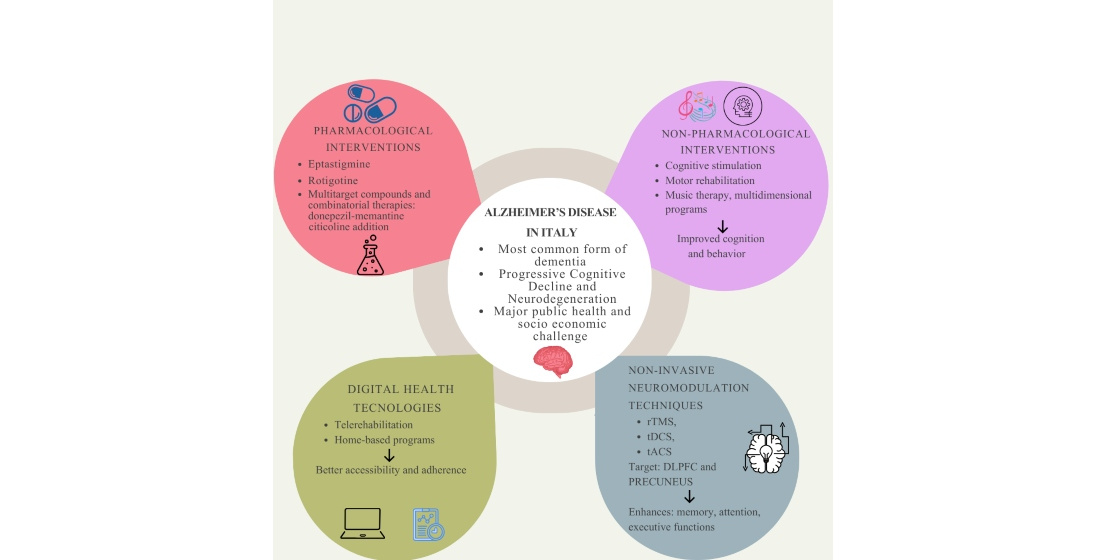

Research on Alzheimer Disease in Italy: A Narrative Review of Pharmacological and Non-Pharmacological Interventions


Abstract
1. Introduction
2. Pharmacological Treatments for Alzheimer Disease
2.1. Innovative Molecules and Multi-Target Strategies: Preclinical Studies
2.1.1. In Vitro Studies
2.1.2. In Vivo Studies
2.2. Clinical Studies
2.3. Pharmacological Treatments in Clinical Practice: Observational and Real-World Evidence
3. Non-Pharmacological Interventions in Alzheimer’s Disease
3.1. Cognitive Training and Cognitive Stimulation
3.2. Physical Interventions
3.3. Combined Therapies
4. Non-Invasive Neuromodulation Techniques
4.1. Transcranial Magnetic Stimulation/Repetitive Transcranial Magnetic Stimulation
4.1.1. rTMS on the Dorsolateral Prefrontal Cortex
4.1.2. rTMS on the Precuneus
4.1.3. rTMS Combined with Cognitive Training
4.1.4. rTMS Using H-Coil
4.2. Transcranial Alternating Current Stimulation
4.3. Transcranial Direct Current Stimulation
5. From Early Diagnosis to Neuromodulation: Ongoing and Planned Research in Italy
6. Discussion and Conclusions
Author Contributions
Funding
Institutional Review Board Statement
Informed Consent Statement
Data Availability Statement
Conflicts of Interest
Abbreviations
| AChE | Acetylcholinesterase |
| AChEI | Acetylcholinesterase Inhibitor |
| AD | Alzheimer’s Disease |
| ADAS-Cog | Alzheimer’s Disease Assessment Scale Cognitive |
| ADI | Alzheimer’s Disease International |
| AGs | Adapted Games |
| AMT | Active Music Therapy |
| AP2238 | 3-{4-[(benzylmethylamino)methyl]phenyl}-6,7-dimethoxy-2H-2-chromenone |
| ApoE ε4 | Apolipoprotein E epsilon 4 allele |
| Aβ | Beta-amyloid peptide |
| BChE | Butyrylcholinesterase |
| BDI II | Beck Depression Inventory Scale-II |
| BPSD | Behavioral and Psychological Symptoms of Dementia |
| CG | Control Group |
| CT | Cognitive Training |
| D2/D3 | Dopamine receptor subtypes 2 and 3 |
| DLPFC | Dorsolateral Prefrontal Cortex |
| DMN | Default Mode Network |
| DMTs | Disease-Modifying Therapies |
| EEG | Electroencephalography |
| FAAH | Fatty Acid Amide Hydrolase |
| HCs | Healthy Controls |
| Hz | Hertz |
| IFNβ1a | Interferon beta-1a |
| IL | Interleukin |
| IL-10 | Interleukin-10 |
| IL-1β | Interleukin-1 beta |
| IL-6 | Interleukin-6 |
| LTP | Long-term potentiation |
| MCI | Mild Cognitive Impairment |
| MMSE | Mini-Mental State Examination |
| MRI | Magnetic Resonance Imaging |
| MST | Multidimensional Stimulation Group Therapy |
| NIBS | Non-Invasive Brain Stimulation |
| NMDA | N-methyl-D-aspartate |
| ntMST | No treated with Multidimensional Stimulation group Therapy |
| PC | Precuneus |
| PL | Placebo |
| PT | Physiotherapy |
| RCT | Randomized Controlled Trial |
| rTMS | Repetitive Transcranial Magnetic Stimulation |
| SAI | Short-latency Afferent Inhibition |
| tACS | Transcranial Alternating Current Stimulation |
| TBS | Theta Burst Stimulation |
| tDCS | Transcranial Direct Current Stimulation |
| TMS | Transcranial Magnetic Stimulation |
| tMST | Treated with Multidimensional Stimulation group Therapy |
| WG | Walking Group |
| WHO | World Health Organization |
| γ-tACS | Gamma-frequency Transcranial Alternating Current Stimulation |
References
- De-Paula, V.J.; Radanovic, M.; Diniz, B.S.; Forlenza, O.V. Alzheimer’s disease. Subcell. Biochem. 2012, 65, 329–352. [Google Scholar] [CrossRef]
- Hillen, H. The Beta Amyloid Dysfunction (BAD) Hypothesis for Alzheimer’s Disease. Front. Neurosci. 2019, 13, 1154. [Google Scholar] [CrossRef]
- Blennow, K.; de Leon, M.J.; Zetterberg, H. Alzheimer’s disease. Lancet 2006, 368, 387–403. [Google Scholar] [CrossRef] [PubMed]
- Yaari, R.; Corey-Bloom, J. Alzheimer’s disease. In Seminars in Neurology; Thieme Medical Publishers, Inc.: New York, NY, USA, 2007; Volume 27, pp. 32–41. [Google Scholar] [CrossRef]
- Zvěřová, M. Clinical aspects of Alzheimer’s disease. Clin. Biochem. 2019, 72, 3–6. [Google Scholar] [CrossRef] [PubMed]
- Burns, A.; Iliffe, S. Alzheimer’s disease. BMJ 2009, 338, b158. [Google Scholar] [CrossRef] [PubMed]
- Guerriero, R.; Bras, J. The age factor in Alzheimer’s disease. Genome Med. 2015, 7, 106. [Google Scholar] [CrossRef]
- Chatterjee, S.; Mudher, A. Alzheimer’s Disease and Type 2 Diabetes: A Critical Assessment of the Shared Pathological Traits. Front. Neurosci. 2018, 12, 383. [Google Scholar] [CrossRef]
- de Bruijn, R.F.; Ikram, M.A. Cardiovascular risk factors and future risk of Alzheimer’s disease. BMC Med. 2014, 12, 130. [Google Scholar] [CrossRef]
- Ownby, R.L.; Crocco, E.; Acevedo, A.; John, V.; Loewenstein, D. Depression and risk for Alzheimer disease: Systematic review, meta-analysis, and metaregression analysis. Arch. Gen. Psychiatry 2006, 63, 530–538. [Google Scholar] [CrossRef]
- Fu, P.; Gao, M.; Yung, K.K.L. Association of Intestinal Disorders with Parkinson’s Disease and Alzheimer’s Disease: A Systematic Review and Meta-Analysis. ACS Chem. Neurosci. 2020, 11, 395–405. [Google Scholar] [CrossRef]
- Santiago, J.A.; Potashkin, J.A. The Impact of Disease Comorbidities in Alzheimer’s Disease. Front. Aging Neurosci. 2021, 13, 631770. [Google Scholar] [CrossRef]
- Briggs, R.; Kennelly, S.P.; O’Neill, D. Drug treatments in Alzheimer’s disease. Clin. Med. 2016, 16, 247–253. [Google Scholar] [CrossRef]
- Breijyeh, Z.; Karaman, R. Comprehensive review on Alzheimer’s disease: Causes and treatment. Molecules 2020, 25, 5789. [Google Scholar] [CrossRef] [PubMed]
- Sharma, K. Cholinesterase inhibitors as Alzheimer’s therapeutics (Review). Mol. Med. Rep. 2019, 20, 1479–1487. [Google Scholar] [CrossRef] [PubMed]
- Anand, P.; Singh, B. A review on cholinesterase inhibitors for Alzheimer’s disease. Arch. Pharm. Res. 2013, 36, 375–399. [Google Scholar] [CrossRef] [PubMed]
- Ferreira-Vieira, T.H.; Guimaraes, I.M.; Silva, F.R.; Ribeiro, F.M. Alzheimer’s disease: Targeting the cholinergic system. Curr. Neuropharmacol. 2016, 14, 101–115. [Google Scholar] [CrossRef]
- Wang, R.; Reddy, P.H. Role of glutamate and NMDA receptors in Alzheimer’s disease. J. Alzheimer’s Dis. 2017, 57, 1041–1048. [Google Scholar] [CrossRef]
- Liu, J.; Chang, L.; Song, Y.; Li, H.; Wu, Y. The role of NMDA receptors in Alzheimer’s disease. Front. Neurosci. 2019, 13, 43. [Google Scholar] [CrossRef]
- Huang, Y.J.; Lin, C.H.; Lane, H.Y.; Tsai, G.E. NMDA neurotransmission dysfunction in behavioral and psychological symptoms of Alzheimer’s disease. Curr. Neuropharmacol. 2012, 10, 272–285. [Google Scholar] [CrossRef]
- Cummings, J.; Fox, N. Defining disease modifying therapy for Alzheimer’s disease. J. Prev. Alzheimer’s Dis. 2017, 4, 109–115. [Google Scholar] [CrossRef]
- Yiannopoulou, K.G.; Papageorgiou, S.G. Current and future treatments in Alzheimer disease: An update. J. Cent. Nerv. Syst. Dis. 2020, 12, 1179573520907397. [Google Scholar] [CrossRef]
- Salomone, S.; Caraci, F.; Leggio, G.M.; Fedotova, G.; Drago, F. New pharmacological strategies for treatment of Alzheimer’s disease: Focus on disease modifying drugs. Br. J. Clin. Pharmacol. 2012, 73, 504–517. [Google Scholar] [CrossRef] [PubMed]
- Wang, L.Y.; Pei, J.; Zhan, Y.J.; Cai, Y.W. Overview of meta-analyses of five non-pharmacological interventions for Alzheimer’s disease. Front. Aging Neurosci. 2020, 12, 594432. [Google Scholar] [CrossRef] [PubMed]
- Olazarán, J.; Reisberg, B.; Clare, L.; Cruz, I.; Peña-Casanova, J.; Del Ser, T.; Woods, B.; Beck, C.; Auer, S.; Lai, C.; et al. Nonpharmacological therapies in Alzheimer’s disease: A systematic review of efficacy. Dement. Geriatr. Cogn. Disord. 2010, 30, 161–178. [Google Scholar] [CrossRef] [PubMed]
- World Health Organization (WHO). Dementia. Available online: https://www.who.int/news-room/fact-sheets/detail/dementia (accessed on 9 October 2025).
- Alzheimer’s Disease International. Dementia Statistics. Available online: https://www.alzint.org/about/dementia-facts-figures/dementia-statistics (accessed on 9 October 2025).
- Istituto Superiore di Sanità. Informazioni Generali. Available online: https://www.epicentro.iss.it/alzheimer (accessed on 9 October 2025).
- Ministero Della Salute. Dati Epidemiologici. Available online: https://www.salute.gov.it/new/it/tema/demenze/dati-epidemiologici (accessed on 9 October 2025).
- ISTAT. Rapporto Annuale 2025. Available online: https://www.istat.it/wp-content/uploads/2025/05/Rapporto-Annuale-2025-integrale.pdf (accessed on 9 October 2025).
- Istituto Superiore di Sanità. Archivio 2020–2024. Available online: https://www.epicentro.iss.it/demenza/2020-2024 (accessed on 9 October 2025).
- Ministero Della Salute. Giornata Mondiale dell’Alzheimer 2024. Available online: https://www.salute.gov.it/new/it/news-e-media/notizie/giornata-mondiale-dellalzheimer-2024 (accessed on 9 October 2025).
- Montanari, S.; Bartolini, M.; Neviani, P.; Belluti, F.; Gobbi, S.; Pruccoli, L.; Tarozzi, A.; Falchi, F.; Andrisano, V.; Miszta, P.; et al. Multitarget strategy to address Alzheimer’s disease: Design, synthesis, biological evaluation, and computational studies of coumarin-based derivatives. ChemMedChem. 2016, 11, 1296–1308. [Google Scholar] [CrossRef]
- Carocci, A.; Barbarossa, A.; Leuci, R.; Carrieri, A.; Brunetti, L.; Laghezza, A.; Catto, M.; Limongelli, F.; Chaves, S.; Tortorella, P.; et al. Novel phenothiazine/donepezil-like hybrids endowed with antioxidant activity for a multi-target approach to the therapy of Alzheimer’s disease. Antioxidants 2022, 11, 1631. [Google Scholar] [CrossRef]
- Mudò, G.; Frinchi, M.; Nuzzo, D.; Scaduto, P.; Plescia, F.; Massenti, M.F.; Di Carlo, M.; Cannizzaro, C.; Cassata, G.; Cicero, L.; et al. Anti-inflammatory and cognitive effects of interferon-β1a (IFNβ1a) in a rat model of Alzheimer’s disease. J. Neuroinflamm. 2019, 16, 44. [Google Scholar] [CrossRef]
- Imbimbo, B.P.; Troetel, W.M.; Martelli, P.; Lucchelli, F. A 6-month, double-blind, placebo-controlled trial of eptastigmine in Alzheimer’s disease. Dement. Geriatr. Cogn. Disord. 2000, 11, 17–24. [Google Scholar] [CrossRef]
- Martorana, A.; Di Lorenzo, F.; Esposito, Z.; Lo Giudice, T.; Bernardi, G.; Caltagirone, C.; Koch, G. Dopamine D2-agonist rotigotine effects on cortical excitability and central cholinergic transmission in Alzheimer’s disease patients. Neuropharmacology 2013, 64, 108–113. [Google Scholar] [CrossRef]
- Koch, G.; Di Lorenzo, F.; Bonnì, S.; Giacobbe, V.; Bozzali, M.; Caltagirone, C.; Martorana, A. Dopaminergic modulation of cortical plasticity in Alzheimer’s disease patients. Neuropsychopharmacology 2014, 39, 2654–2661. [Google Scholar] [CrossRef]
- Koch, G.; Motta, C.; Bonnì, S.; Pellicciari, M.C.; Picazio, S.; Casula, E.P.; Maiella, M.; Di Lorenzo, F.; Ponzo, V.; Ferrari, C.; et al. Effect of rotigotine vs placebo on cognitive functions among patients with mild to moderate Alzheimer disease. JAMA Netw. Open 2020, 3, e2010372. [Google Scholar] [CrossRef] [PubMed]
- Grimaldi, L.M.E.; Zappalà, G.; Iemolo, F.; Castellano, A.E.; Ruggieri, S.; Bruno, G.; Paolillo, A. A pilot study on the use of interferon beta-1a in early Alzheimer’s disease subjects. J. Neuroinflamm. 2014, 11, 30. [Google Scholar] [CrossRef] [PubMed]
- Baldereschi, M.; Di Carlo, A.; Lepore, V.; Bracco, L.; Maggi, S.; Grigoletto, F.; Scarlato, G.; Amaducci, L. Estrogen-replacement therapy and Alzheimer’s disease in the Italian Longitudinal Study on Aging. Neurology 1998, 50, 996–1002. [Google Scholar] [CrossRef]
- Castagna, A.; Fabbo, A.; Manzo, C.; Lacava, R.; Ruberto, C.; Ruotolo, G. A retrospective study on the benefits of combined citicoline, memantine, and acetylcholinesterase inhibitor treatments in older patients affected with Alzheimer’s disease. J. Alzheimer’s Dis. 2021, 79, 1509–1515. [Google Scholar] [CrossRef]
- Padovani, A.; Falato, S.; Pegoraro, V. Extemporaneous combination of donepezil and memantine to treat dementia in Alzheimer disease: Evidence from Italian real-world data. Curr. Med. Res. Opin. 2023, 39, 567–577. [Google Scholar] [CrossRef]
- Farina, E.; Fioravanti, R.; Chiavari, L.; Imbornone, E.; Alberoni, M.; Pomati, S.; Pinardi, G.; Pignatti, R.; Mariani, C. Comparing two programs of cognitive training in Alzheimer’s disease: A pilot study. Acta Neurol. Scand. 2002, 105, 365–371. [Google Scholar] [CrossRef]
- Farina, E.; Mantovani, F.; Fioravanti, R.; Pignatti, R.; Chiavari, L.; Imbornone, E.; Olivotto, F.; Alberoni, M.; Mariani, C.; Nemni, R. Evaluating two group programmes of cognitive training in mild-to-moderate AD: Is there any difference between a ‘global’ stimulation and a ‘cognitive-specific’ one? Aging Ment. Health 2006, 10, 211–218. [Google Scholar] [CrossRef]
- Baglio, F.; Griffanti, L.; Saibene, F.L.; Ricci, C.; Alberoni, M.; Critelli, R.; Villanelli, F.; Fioravanti, R.; Mantovani, F.; D’Amico, A.; et al. Multistimulation group therapy in Alzheimer’s disease promotes changes in brain functioning. Neurorehabil. Neural Repair 2015, 29, 13–24. [Google Scholar] [CrossRef]
- Venturelli, M.; Scarsini, R.; Schena, F. Six-month walking program changes cognitive and ADL performance in patients with Alzheimer. Am. J. Alzheimer’s Dis. Other Dement. 2011, 26, 381–388. [Google Scholar] [CrossRef]
- Venturelli, M.; Magalini, A.; Scarsini, R.; Schena, F. From Alzheimer’s disease retrogenesis: A new care strategy for patients with advanced dementia. Am. J. Alzheimer’s Dis. Other Dement. 2012, 27, 483–489. [Google Scholar] [CrossRef]
- Giovagnoli, A.R.; Manfredi, V.; Schifano, L.; Paterlini, C.; Parente, A.; Tagliavini, F. Combining drug and music therapy in patients with moderate Alzheimer’s disease: A randomized study. Neurol. Sci. 2018, 39, 1021–1028. [Google Scholar] [CrossRef]
- Fonte, C.; Smania, N.; Pedrinolla, A.; Munari, D.; Gandolfi, M.; Picelli, A.; Varalta, V.; Benetti, M.V.; Brugnera, A.; Federico, A.; et al. Comparison between physical and cognitive treatment in patients with MCI and Alzheimer’s disease. Aging 2019, 11, 3138–3155. [Google Scholar] [CrossRef]
- Millet, B.; Mouchabac, S.; Robert, G.; Maatoug, R.; Dondaine, T.; Ferreri, F.; Bourla, A. Transcranial magnetic stimulation (rTMS) on the precuneus in Alzheimer’s disease: A literature review. Brain Sci. 2023, 13, 1332. [Google Scholar] [CrossRef]
- Hou, Y.; Liu, F.; Su, G.; Tu, S.; Lyu, Z. Systematic review and meta-analysis of transcranial direct current stimulation (tDCS) for global cognition in mild cognitive impairment and Alzheimer’s disease. Geriatr. Nurs. 2024, 59, 261–270. [Google Scholar] [CrossRef]
- De Paolis, M.L.; Paoletti, I.; Zaccone, C.; Capone, F.; D’Amelio, M.; Krashia, P. Transcranial alternating current stimulation (tACS) at gamma frequency: An up-and-coming tool to modify the progression of Alzheimer’s disease. Transl. Neurodegener. 2024, 13, 33. [Google Scholar] [CrossRef] [PubMed]
- Klomjai, W.; Katz, R.; Lackmy-Vallée, A. Basic principles of transcranial magnetic stimulation (TMS) and repetitive TMS (rTMS). Ann. Phys. Rehabil. Med. 2015, 58, 208–213. [Google Scholar] [CrossRef] [PubMed]
- Maeda, F.; Keenan, J.P.; Tormos, J.M.; Topka, H.; Pascual-Leone, A. Interindividual variability of the modulatory effects of repetitive transcranial magnetic stimulation on cortical excitability. Exp. Brain Res. 2000, 133, 425–430. [Google Scholar] [CrossRef] [PubMed]
- Di Lazzaro, V.; Bella, R.; Benussi, A.; Bologna, M.; Borroni, B.; Capone, F.; Chen, K.H.; Chen, R.; Chistyakov, A.V.; Classen, J.; et al. Diagnostic contribution and therapeutic perspectives of transcranial magnetic stimulation in dementia. Clin. Neurophysiol. 2021, 132, 2568–2607. [Google Scholar] [CrossRef]
- Benussi, A.; Alberici, A.; Ferrari, C.; Cantoni, V.; Dell’Era, V.; Turrone, R.; Cotelli, M.S.; Binetti, G.; Paghera, B.; Koch, G.; et al. The impact of transcranial magnetic stimulation on diagnostic confidence in patients with Alzheimer disease. Alzheimer’s Res. Ther. 2018, 10, 94. [Google Scholar] [CrossRef]
- Chou, Y.-H.; Ton That, V.; Sundman, M. A systematic review and meta-analysis of rTMS effects on cognitive enhancement in mild cognitive impairment and Alzheimer’s disease. Neurobiol. Aging 2020, 86, 1–10. [Google Scholar] [CrossRef]
- Cotelli, M.; Calabria, M.; Manenti, R.; Rosini, S.; Zanetti, O.; Cappa, S.F.; Miniussi, C. Improved language performance in Alzheimer disease following brain stimulation. J. Neurol. Neurosurg. Psychiatry 2011, 82, 794–797. [Google Scholar] [CrossRef] [PubMed]
- Turriziani, P.; Smirni, D.; Mangano, G.R.; Zappalà, G.; Giustiniani, A.; Cipolotti, L.; Oliveri, M. Low-frequency repetitive transcranial magnetic stimulation of the right dorsolateral prefrontal cortex enhances recognition memory in Alzheimer’s disease. J. Alzheimer’s Dis. 2019, 72, 613–622. [Google Scholar] [CrossRef] [PubMed]
- Lin, Y.; Jiang, W.J.; Shan, P.Y.; Lu, M.; Wang, T.; Li, R.H.; Zhang, N.; Ma, L. The role of repetitive transcranial magnetic stimulation (rTMS) in the treatment of cognitive impairment in patients with Alzheimer’s disease: A systematic review and meta-analysis. J. Neurol. Sci. 2019, 398, 184–191. [Google Scholar] [CrossRef]
- Koch, G.; Bonnì, S.; Pellicciari, M.C.; Casula, E.P.; Mancini, M.; Esposito, R.; Ponzo, V.; Picazio, S.; Di Lorenzo, F.; Serra, L.; et al. Transcranial magnetic stimulation of the precuneus enhances memory and neural activity in prodromal Alzheimer’s disease. Neuroimage 2018, 169, 302–311. [Google Scholar] [CrossRef]
- Koch, G.; Casula, E.P.; Bonnì, S.; Borghi, I.; Assogna, M.; Minei, M.; Pellicciari, M.C.; Motta, C.; D’Acunto, A.; Porrazzini, F.; et al. Precuneus magnetic stimulation for Alzheimer’s disease: A randomized, sham-controlled trial. Brain 2022, 145, 3776–3786. [Google Scholar] [CrossRef]
- Koch, G.; Casula, E.P.; Bonnì, S.; Borghi, I.; Assogna, M.; Di Lorenzo, F.; Esposito, R.; Maiella, M.; D’Acunto, A.; Ferraresi, M.; et al. Effects of 52 weeks of precuneus rTMS in Alzheimer’s disease patients: A randomized trial. Alzheimer’s Res. Ther. 2025, 17, 69. [Google Scholar] [CrossRef]
- Bagattini, C.; Zanni, M.; Barocco, F.; Caffarra, P.; Brignani, D.; Miniussi, C.; Defanti, C.A. Enhancing cognitive training effects in Alzheimer’s disease: rTMS as an add-on treatment. Brain Stimul. 2020, 13, 1655–1664. [Google Scholar] [CrossRef]
- Vecchio, F.; Quaranta, D.; Miraglia, F.; Pappalettera, C.; Di Iorio, R.; L’Abbate, F.; Cotelli, M.; Marra, C.; Rossini, P.M. Neuronavigated magnetic stimulation combined with cognitive training for Alzheimer’s patients: An EEG graph study. Geroscience 2022, 44, 159–172. [Google Scholar] [CrossRef]
- Roth, Y.; Amir, A.; Levkovitz, Y.; Zangen, A. Three-dimensional distribution of the electric field induced in the brain by transcranial magnetic stimulation using figure-8 and deep H-coils. J. Clin. Neurophysiol. 2007, 24, 31–38. [Google Scholar] [CrossRef]
- Leocani, L.; Dalla Costa, G.; Coppi, E.; Santangelo, R.; Pisa, M.; Ferrari, L.; Bernasconi, M.P.; Falautano, M.; Zangen, A.; Magnani, G.; et al. Repetitive transcranial magnetic stimulation with H-coil in Alzheimer’s disease: A double-blind, placebo-controlled pilot study. Front. Neurol. 2021, 11, 614351. [Google Scholar] [CrossRef]
- Nissim, N.R.; Pham, D.V.H.; Poddar, T.; Blutt, E.; Hamilton, R.H. The impact of gamma transcranial alternating current stimulation (tACS) on cognitive and memory processes in patients with mild cognitive impairment or Alzheimer’s disease: A literature review. Brain Stimul. 2023, 16, 748–755. [Google Scholar] [CrossRef] [PubMed]
- Benussi, A.; Cantoni, V.; Cotelli, M.S.; Cotelli, M.; Brattini, C.; Datta, A.; Thomas, C.; Santarnecchi, E.; Pascual-Leone, A.; Borroni, B. Exposure to gamma tACS in Alzheimer’s disease: A randomized, double-blind, sham-controlled, crossover, pilot study. Brain Stimul. 2021, 14, 531–540. [Google Scholar] [CrossRef]
- Benussi, A.; Cantoni, V.; Grassi, M.; Brechet, L.; Michel, M.C.; Datta, A.; Thomas, C.; Cotelli, M.S.; Bianchi, M.; Premi, E.; et al. Increasing brain gamma activity improves episodic memory and restores cholinergic dysfunction in Alzheimer’s disease. Ann. Neurol. 2022, 92, 322–334. [Google Scholar] [CrossRef] [PubMed]
- Priori, A.; Ciocca, M.; Parazzini, M.; Vergari, M.; Ferrucci, R. Transcranial cerebellar direct current stimulation and transcutaneous spinal cord direct current stimulation as innovative tools for neuroscientists. J. Physiol. 2014, 592, 3345–3369. [Google Scholar] [CrossRef] [PubMed]
- Ferrucci, R.; Mameli, F.; Guidi, I.; Mrakic-Sposta, S.; Vergari, M.; Marceglia, S.; Cogiamanian, F.; Barbieri, S.; Scarpini, E.; Priori, A. Transcranial direct current stimulation improves recognition memory in Alzheimer disease. Neurology 2008, 71, 493–498. [Google Scholar] [CrossRef]
- Boggio, P.S.; Ferrucci, R.; Mameli, F.; Martins, D.; Martins, O.; Vergari, M.; Tadini, L.; Scarpini, E.; Fregni, F.; Priori, A. Prolonged visual memory enhancement after direct current stimulation in Alzheimer’s disease. Brain Stimul. 2012, 5, 223–230. [Google Scholar] [CrossRef]
- Cotelli, M.; Manenti, R.; Brambilla, M.; Petesi, M.; Rosini, S.; Ferrari, C.; Zanetti, O.; Miniussi, C. Anodal tDCS during face-name associations memory training in Alzheimer’s patients. Front. Aging Neurosci. 2014, 6, 38. [Google Scholar] [CrossRef]
- Fonte, C.; Rotundo, G.; Varalta, V.; Filosa, A.; Muti, E.; Barletta, C.; Evangelista, E.; Venturelli, M.; Picelli, A.; Smania, N. Combined effect of tDCS and motor or cognitive activity in patients with Alzheimer’s disease: A proof-of-concept pilot study. Brain Sci. 2024, 14, 1099. [Google Scholar] [CrossRef]
- Fondazione Policlinico Universitario Agostino Gemelli. Clinicaltrials.gov. Available online: https://clinicaltrials.gov/study/NCT06372587 (accessed on 9 October 2025).
- I.R.C.C.S. Fondazione Santa Lucia. Clinicaltrials.gov. A Phase 3 Study of Rotigotine in Combination with Rivastigmine in Mild to Moderate Alzheimer’s Disease (DOPAD-3). Available online: https://clinicaltrials.gov/study/NCT06702124 (accessed on 9 October 2025).
- I.R.C.C.S. Fondazione Santa Lucia. Clinicaltrials.gov. Fundus Camera Module for Early Detection of Alzheimer’s Disease. Available online: https://clinicaltrials.gov/study/NCT06841848 (accessed on 9 October 2025).
- Alemanno, F. Ospedale San Raffaele. Clinicaltrials.gov. New Virtual Reality Technologies and Telemedicine for Cognitive Rehabilitation in Alzheimer’s Disease (TaskCog-IVN). Available online: https://clinicaltrials.gov/study/NCT05697354 (accessed on 9 October 2025).
- Venturelli, M. Università di Verona. Clinicaltrials.gov. New Approach for Treatment of Behavioral Disorders in Alzheimer’s Disease (Alzheimer’s Behavioral and Cognitive Disorders) (ABCD). Available online: https://clinicaltrials.gov/study/NCT02462291 (accessed on 9 October 2025).
- De Lena, C. Università di Roma La Sapienza. Clinicaltrials.gov. Neuropsychological and Neurophysiological Effects of Cognitive Stimulation in Patients with Alzheimer’s Disease and Mild Cognitive Impairment. Available online: https://clinicaltrials.gov/study/NCT03784183 (accessed on 9 October 2025).
- Koch, G.; I.R.C.C.S. Fondazione Santa Lucia. Clinicaltrials.gov. Digital Twins for Model-Driven Non-Invasive Electrical Brain Stimulation (NEUROTWIN). Available online: https://clinicaltrials.gov/study/NCT06826261 (accessed on 9 October 2025).
- Borroni, B. Clinicaltrials.gov. At Home Gamma tACS in Alzheimer’s Disease (tACS@Home) (tACS@Home). Available online: https://clinicaltrials.gov/study/NCT05643326 (accessed on 9 October 2025).
- Università Degli Studi di Trento. Clinicaltrials.gov. Noninvasive Brain Stimulation for pAD (pADmemory). Available online: https://clinicaltrials.gov/study/NCT05468268 (accessed on 9 October 2025).
- Università Degli Studi di Trento. Clinicaltrials.gov. Applying Non-invasive Brain Stimulation in Alzheimer’s Rehabilitation (StimoLaMente). Available online: https://clinicaltrials.gov/study/NCT04866979 (accessed on 9 October 2025).
- Brignani, D. IRCCS Centro San Giovanni di Dio Fatebenefratelli. Clinicaltrials.gov. Network-based rTMS in Alzheimer’s Disease. Available online: https://clinicaltrials.gov/study/NCT04263194 (accessed on 9 October 2025).
- Pievani, M.; Mega, A.; Quattrini, G.; Guidali, G.; Ferrari, C.; Cattaneo, A.; D’Aprile, I.; Mascaro, L.; Gasparotti, R.; Corbo, D.; et al. Targeting Default Mode Network Dysfunction in Persons at Risk of Alzheimer’s Disease with Transcranial Magnetic Stimulation (NEST4AD): Rationale and Study Design. J. Alzheimer’s Dis. 2021, 83, 1877–1889. [Google Scholar] [CrossRef]
- Altomare, D.; Benussi, A.; Cantoni, V.; Premi, E.; Rivolta, J.; Cupidi, C.; Martorana, A.; Santarnecchi, E.; Padovani, A.; Koch, G.; et al. Home-based transcranial alternating current stimulation (tACS) in Alzheimer’s disease: Rationale and study design. Alzheimer’s Res. Ther. 2023, 15, 155. [Google Scholar] [CrossRef]
- Alzheimer Europe. European Dementia Monitor 2023. Available online: https://www.alzheimer-europe.org/sites/default/files/2023-12/307767_ALZHEIMER%20EUROPE%20_European%20Dementia%20Monitor_2023_V7.pdf (accessed on 17 November 2025).
- Snyder, H.M.; del Carmen Cardenas-Aguayo, M.; Alonso, A.; Bain, L.; Iqbal, K.; Carrillo, M.C. Alzheimer’s disease research in Ibero America. Alzheimer’s Dement. 2016, 12, 749–754. [Google Scholar] [CrossRef]
- Ramos, C.; Aguillon, D.; Cordano, C.; Lopera, F. Genetics of dementia: Insights from Latin America. Dement. Neuropsychol. 2020, 14, 223–236. [Google Scholar] [CrossRef] [PubMed]
- Lopera, F.; Custodio, N.; Rico-Restrepo, M.; Allegri, R.F.; Barrientos, J.D.; Garcia Batres, E.; Calandri, I.L.; Calero Moscoso, C.; Caramelli, P.; Duran Quiroz, J.C.; et al. A task force for diagnosis and treatment of people with Alzheimer’s disease in Latin America. Front. Neurol. 2023, 14, 1198869. [Google Scholar] [CrossRef] [PubMed]
- Gómez-Virgilio, L.; Reyes-Gutiérrez, G.S.; Silva-Lucero, M.D.; López-Toledo, G.; Cárdenas-Aguayo, M.D. Etiology, risk factors, treatments and current status of Alzheimer’s disease in Mexico. Gac. Med. Mex. 2022, 158, 235–241. [Google Scholar] [CrossRef] [PubMed]
- Kosaka, K.; Iseki, E.; Arai, H. Recent advances in dementia research in Japan: Alzheimer-type dementia. Psychiatry Clin. Neurosci. 1999, 53, 1–10. [Google Scholar] [CrossRef]
- Sexton, C.E.; Anstey, K.J.; Baldacci, F.; Barnum, C.J.; Barron, A.M.; Blennow, K.; Brodaty, H.; Burnham, S.; Elahi, F.M.; Götz, J.; et al. Alzheimer’s disease research progress in Australia: The Alzheimer’s Association International Conference Satellite Symposium in Sydney. Alzheimer’s Dement. 2022, 18, 178–190. [Google Scholar] [CrossRef]
- Zhang, Y.; Li, Y.; Ma, L. Recent advances in research on Alzheimer’s disease in China. J. Clin. Neurosci. 2020, 81, 43–46. [Google Scholar] [CrossRef]
- Marizzoni, M.; Cattaneo, A.; Mirabelli, P.; Festari, C.; Lopizzo, N.; Nicolosi, V.; Mombelli, E.; Mazzelli, M.; Luongo, D.; Naviglio, D.; et al. Short-Chain Fatty Acids and Lipopolysaccharide as Mediators Between Gut Dysbiosis and Amyloid Pathology in Alzheimer’s Disease. J Alzheimer’s Dis. 2020, 78, 683–697. [Google Scholar] [CrossRef]
- Nilsson, P.; Iwata, N.; Muramatsu, S.; Tjernberg, L.O.; Winblad, B.; Saido, T.C. Gene therapy in Alzheimer’s disease—Potential for disease modification. J. Cell. Mol. Med. 2010, 14, 741–757. [Google Scholar] [CrossRef]
- Liu, X.Y.; Yang, L.P.; Zhao, L. Stem cell therapy for Alzheimer’s disease. World J. Stem. Cells. 2020, 12, 787–802. [Google Scholar] [CrossRef]
- Zhang, T.; Gao, G.; Kwok, L.A.; Sun, Z. Gut microbiome-targeted therapies for Alzheimer’s disease. Gut Microbes 2023, 15, 2271613. [Google Scholar] [CrossRef]
- Ministero Della Salute. 21 Settembre, Giornata Mondiale Dell’Alzheimer: L’impegno Del Ministero Per Pazienti e Famiglie. Available online: https://www.salute.gov.it/new/it/news-e-media/notizie/21-settembre-giornata-mondiale-dellalzheimer-limpegno-del-ministero-pazienti-e/ (accessed on 13 November 2025).
- Osservatorio Demenze. Fondo Per L’Alzheimer e Le Demenze 2024–2026. Available online: https://www.demenze.it/it-schede-10069-fondo_per_l_alzheimer_e_le_demenze_2024_2026 (accessed on 13 November 2025).

| Study | Study Design | Drug | Population | Treatment Duration | Main Findings |
|---|---|---|---|---|---|
| Imbimbo et al. [36] | Randomized, double-blind, placebo-controlled clinical trial | Eptastigmine (AChEI) | 349 patients with mild-to-moderate AD | 25 weeks | Significant improvements were observed in cognition and global performance following treatment. |
| Martorana et al. [37] | Controlled Clinical Trial | Rotigotine (D2/D3 dopaminergic agonist) | 17 AD patients; 8 HCs | 4 days (Exp. 1); 4 days × 3 doses (Exp. 2) | Rotigotine increased cortical excitability and restored cholinergic transmission. |
| Koch et al. [38] | RCT | Rotigotine, rivastigmine, or placebo | 30 patients with mild AD + HCs | 4 weeks | Rotigotine normalized LTP-like plasticity, while rivastigmine and placebo had no impact; cholinergic activity was enhanced by both rotigotine and rivastigmine. |
| Koch et al. [39] | Phase IIa, randomized, double-blind, placebo-controlled clinical trial | Rotigotine + rivastigmine vs. placebo + standard therapy | 94 patients with mild-to-moderate AD | 24 weeks | Rotigotine had no impact on global cognitive functions but improved executive and frontal abilities as well as independence in daily activities. |
| Grimaldi et al. [40] | Phase II, multicenter, randomized, double-blind, placebo-controlled trial | Subcutaneous IFNβ1a (immunomodulator) or placebo | 42 patients with mild AD | 28 weeks + 24 weeks follow-up | No significant effect on primary cognitive outcomes; slowed cognitive decline during follow-up and enhanced daily function. |
| Study | Study Design | Type of Intervention | Population | Duration | Main Findings |
|---|---|---|---|---|---|
| Farina et al. [44] | Pilot study | CT (procedural memory vs. residual cognitive functions) | 22 patients with mild-to-moderate AD | 5 weeks + 3 months follow-up | Both groups demonstrated progress in daily living abilities, while the procedural memory group additionally showed improvements in attention and verbal fluency; these effects decreased after 3 months. |
| Farina et al. [45] | Comparative clinical trial | Group CT: ‘global’ stimulation vs. ‘cognitive-specific’ approach | 32 patients with mild-to-moderate AD | 6 weeks + 6 months follow-up | Global stimulation improved behavioral symptoms, daily functioning, and verbal fluency, and reduced caregiver burden; cognitive-specific training showed limited benefits, mainly in functional abilities. |
| Baglio et al. [46] | RCT | MST | 60 patients with mild-to-moderate AD | 10 weeks + 22 weeks follow-up (tMST group only) | MST resulted in significant improvements in BPSD, memory and language abilities, and increased neural activity in temporal areas, right insular cortex, and thalamus. |
| Venturelli et al. [47] | RCT | Walking program | 21 patients with advanced AD: 11 WG + 10 CG | 6 months | Improvements in motor function, daily activities, and a slowing of cognitive decline. |
| Venturelli et al. [48] | RCT | AGs vs. Placebo | 20 patients with advanced dementia | Single 30-min session | Lower levels of agitation and higher cognitive performance. |
| Giovagnoli et al. [49] | RCT | AMT + memantine | 45 patients with moderate AD | 24 weeks | No language improvement; reduced depression and appetite disturbances, mitigating psycho-behavioral deterioration. |
| Fonte et al. [50] | RCT | CT vs. PT | 87 MCI or AD patients | 6 months + 3 months follow-up | CT and PT slowed cognitive decline (stable MMSE scores); memory improved in MCI; PT improved cardiovascular factors. |
| Study | Technique | Population | Target Area | Duration | Main Findings |
|---|---|---|---|---|---|
| Cotelli et al. [59] | rTMS (high-frequency) | 10 AD patients | DLPFC | 4 weeks | Improved language comprehension, with effects lasting up to 8 weeks. |
| Turriziani et al. [60] | rTMS (1 Hz) | 24 + 14 patients with mild AD | Left/right DLPFC | First experiment: single-session; Second experiment: 2 weeks + 1 month follow-up | Right DLPFC stimulation improved recognition memory; effects persisted at 1-month follow-up. |
| Koch et al. [62] | rTMS (high-frequency) | 14 patients with early-stage AD | PC | 2 weeks | Improved episodic memory, increased neural activity, enhanced beta oscillations, and strengthened connectivity with medial frontal DMN areas. |
| Koch et al. [63] | rTMS | 50 patients with mild-to-moderate AD | PC | 24 weeks | Slowed cognitive and functional decline, improved daily autonomy, and reduced behavioral disturbances. |
| Koch et al. [64] | rTMS | 48 patients with mild-to-moderate AD | PC | 52 weeks | Slowed cognitive and functional decline, improved daily autonomy, and reduced behavioral disturbances. |
| Bagattini et al. [65] | rTMS (high frequency) + CT | 50 patients with mild-to-moderate AD | Left DLPFC | 4 weeks + 12 weeks follow-up | Improved associative memory and untrained cognitive functions; effects lasted ≥ 12 weeks. |
| Vecchio et al. [66] | rTMS + CT | 72 patients with mild-to-moderate AD | Six cortical regions (MRI-guided) | 6 weeks + 40 weeks follow-up | Immediate cognitive improvements and long-term modulation of brain connectivity. |
| Leocani et al. [68] | rTMS using H2-coil (10 Hz) | 30 AD patients | Bilateral fronto-temporo-parietal areas | 4 weeks + 4 weeks with maintenance treatment | Transient improvement in ADAS-Cog scores; no effects on MMSE or BDI-II scores. |
| Benussi et al. [70] | γ-tACS | 20 patients with MCI-AD | PC/medial parietal cortex | Single 60-min session | Significantly improved episodic memory and long-term recall, with restored cholinergic transmission. |
| Benussi et al. [71] | γ-tACS | 60 patients with early AD | PC | Single 60-min session | Significantly improved episodic memory and long-term recall, with restored cholinergic transmission. |
| Ferrucci et al. [73] | tDCS (anodal vs. cathodal vs. sham) | 10 patients with AD | Temporoparietal areas | 3 separate sessions with ≥1-week interval | Anodal stimulation improved word recognition memory task and cathodal stimulation worsened it while sham stimulation had no effect. |
| Boggio et al. [74] | tDCS (anodal) | 15 AD patients | Temporal cortex | 5 days + 4 weeks follow-up | Significant improvement in visual recognition memory, which persisted for at least 4 weeks after the end of the treatment. |
| Cotelli et al. [75] | Anodal tDCS during face-name associations memory training | 36 AD patients | Left DLPFC | 2 weeks + 6 months follow-up | Significant improvement in face-name association performance in all patients, with effects lasting up to 3 months. |
| Fonte et al. [76] | Anodal tDCS + motor or cognitive activity. | 23 patients with mild-to-moderate AD | DLPFC | 2 weeks + 1 week follow-up | Global cognitive status and attention were significantly enhanced, with greater effects observed when combined with motor activity at the 1-week follow-up. |
Disclaimer/Publisher’s Note: The statements, opinions and data contained in all publications are solely those of the individual author(s) and contributor(s) and not of MDPI and/or the editor(s). MDPI and/or the editor(s) disclaim responsibility for any injury to people or property resulting from any ideas, methods, instructions or products referred to in the content. |
© 2025 by the authors. Licensee MDPI, Basel, Switzerland. This article is an open access article distributed under the terms and conditions of the Creative Commons Attribution (CC BY) license (https://creativecommons.org/licenses/by/4.0/).
Share and Cite
Caporlingua, M.; Castellano, J.; Quartarone, A.; Ciurleo, R. Research on Alzheimer Disease in Italy: A Narrative Review of Pharmacological and Non-Pharmacological Interventions. Neurol. Int. 2025, 17, 196. https://doi.org/10.3390/neurolint17120196
Caporlingua M, Castellano J, Quartarone A, Ciurleo R. Research on Alzheimer Disease in Italy: A Narrative Review of Pharmacological and Non-Pharmacological Interventions. Neurology International. 2025; 17(12):196. https://doi.org/10.3390/neurolint17120196
Chicago/Turabian StyleCaporlingua, Miriana, Jole Castellano, Angelo Quartarone, and Rosella Ciurleo. 2025. "Research on Alzheimer Disease in Italy: A Narrative Review of Pharmacological and Non-Pharmacological Interventions" Neurology International 17, no. 12: 196. https://doi.org/10.3390/neurolint17120196
APA StyleCaporlingua, M., Castellano, J., Quartarone, A., & Ciurleo, R. (2025). Research on Alzheimer Disease in Italy: A Narrative Review of Pharmacological and Non-Pharmacological Interventions. Neurology International, 17(12), 196. https://doi.org/10.3390/neurolint17120196