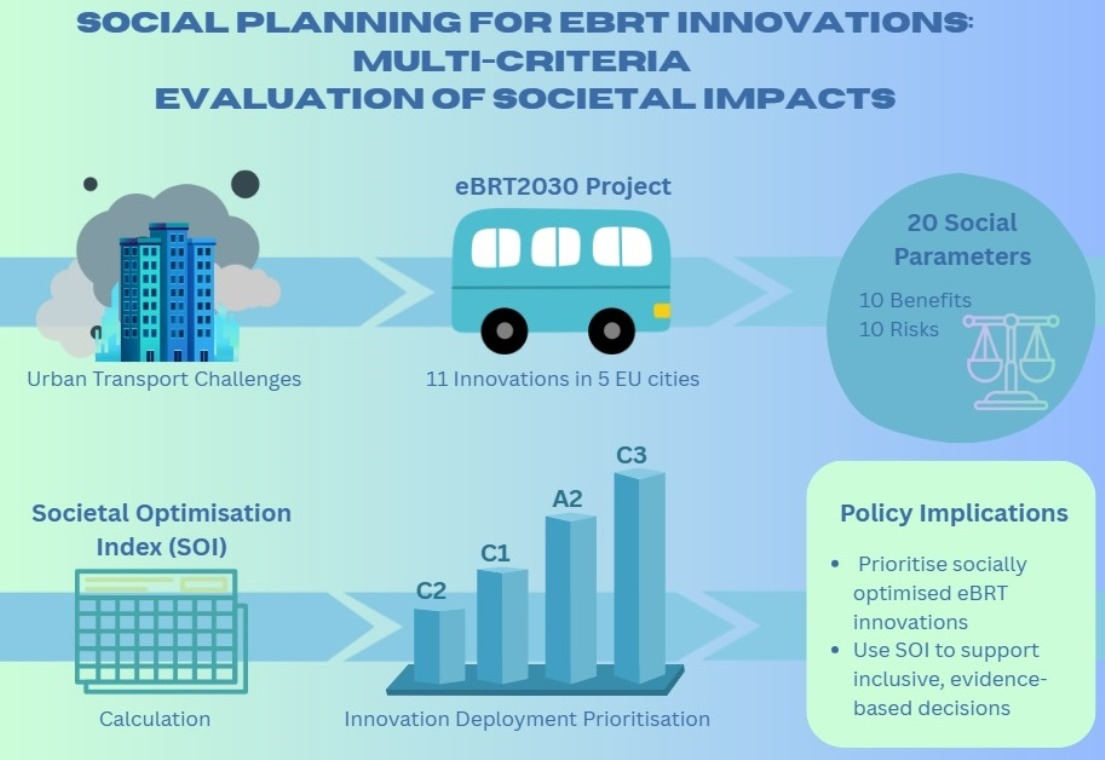



Social Planning for eBRT Innovations: Multi-Criteria Evaluation of Societal Impacts

Abstract
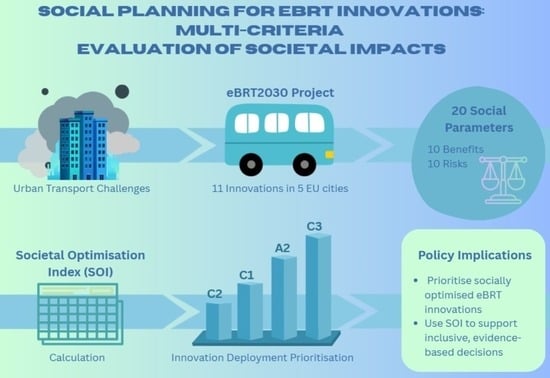
1. Introduction
1.1. Objectives
1.2. Societal Considerations in Public Transport Appraisal
- the inclusion of multiple, and often conflicting, objectives and stakeholders’ perspectives, thus enabling more comprehensive, transparent and defensible decisions;
- the organisation, management and simplification of the substantial amount of technical data typically encountered in transport-related analysis; and
- the full control and adjustment of the process: scores and weights are assigned according to established methodologies and values can be validated against alternative information sources, thus allowing for revisions.
2. Materials and Methods
- Retains criterion-level meaning without monetisation;
- Reflects stakeholder preferences through weights and thresholds; and
- Produces decision-ready rankings and trade-off views.
- Compares alternatives pairwise on each criterion;
- Translates performance differences into preference degrees;
- Aggregates these preferences by stakeholder weights into an overall index; and
- Produces positive (Phi+), negative (Phi−) and net (Phi) preference flows that yield a complete ranking (PROMETHEE II), with GAIA visualisations to support trade-off interpretation [65].
3. Results
- Step 1. Criteria Selection: Development of a preliminary list of social risks and benefits related to the eBRT2030 project innovations and validation/finalisation of the list through the project-partner engagement.
- Step 2. Parameters Weighting: Assignment of weights to each parameter, i.e., risks and benefits, through experts’ engagement.
- Step 3. Parameters Scoring: Rating of the risks and benefits through a multi-stakeholder engagement approach.
- Step 4. MCDA Ranking Innovations according to their SOI: Running the MCDA for ranking the different innovations according to their SOI.
3.1. Criteria Selection
3.2. Parameters Weighting
3.3. Parameters Scoring
3.4. MCDA Ranking Innovations According to SOI
3.5. Quadrant Analysis of the Innovations
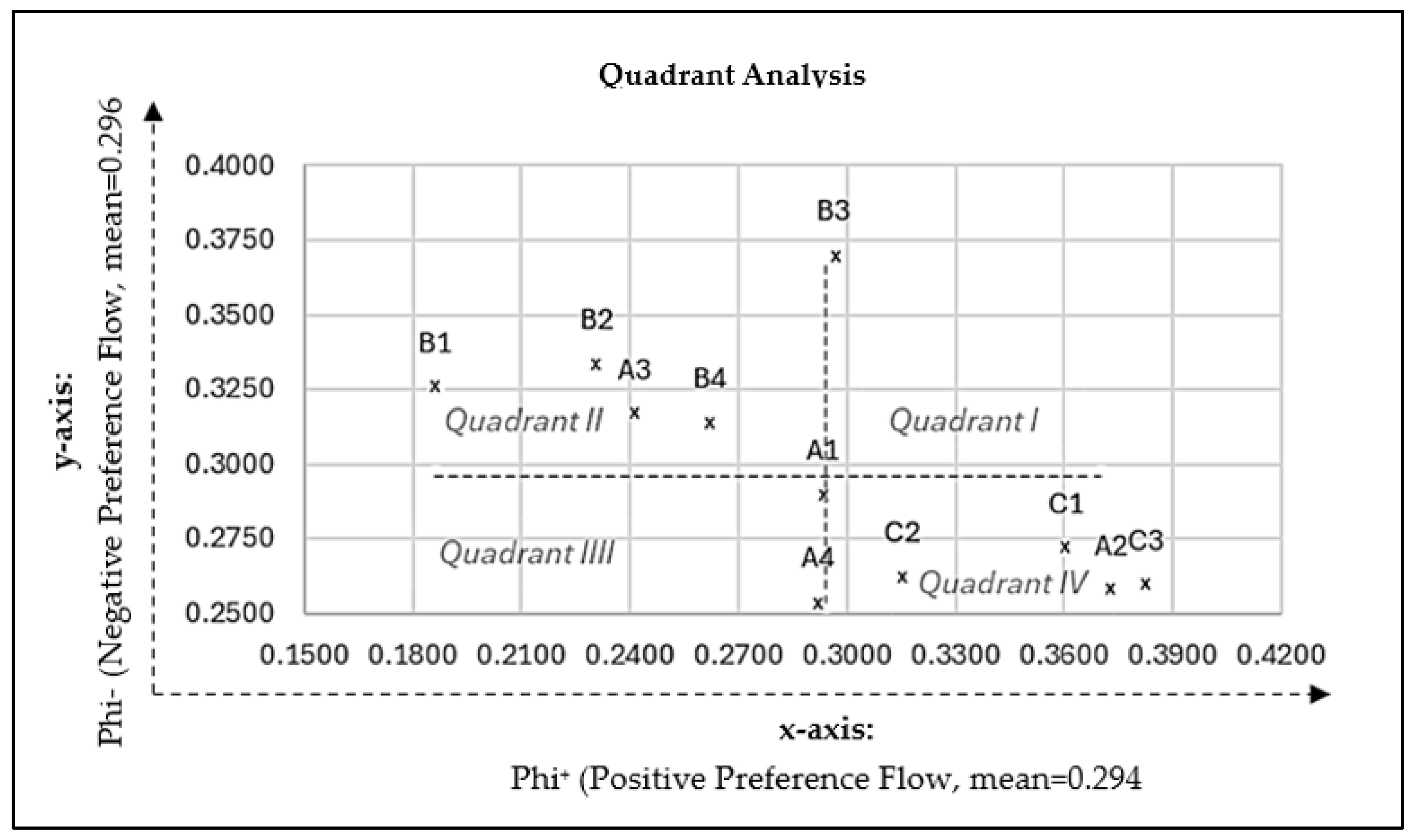
- Quadrant I (high benefits, high risks): B3 (Mobility Hub Charging System) combines above-average benefits (Phi+ = 0.296) with comparatively high risks (Phi− = 0.370), yielding a negative net flow (Phi = −0.074). Despite its lower overall rank, its position indicates optimisation potential, as targeted mitigation of the dominant risks could shift B3 towards Quadrant IV.
- Quadrant II (low benefits, high risks): B1, B2, A3 and B4 exhibit below-average benefits and above-average risks, consistent with their negative SOI values. For example, B1 (Bi-directional Modular Charging/B2G) records the lowest net flow (Phi = −0.140) due to safety, standards-alignment and integration concerns, while B2 (Hybrid Charging with Stationary Buffer) is penalised by environmental burdens (e.g., added components/waste) despite grid-management advantages. Innovations in this quadrant are the least favourable for near-term deployment and require substantial redesign or risk mitigation measures.
- Quadrant III (low benefits, low risks): A4 and A1 lie below both means, indicating modest societal salience and comparatively limited risks. A1 (Predictive Maintenance & SoH) sits close to the Phi+ threshold (Phi+ = 0.293), while A4 (Advanced Energy & Thermal Management) is similarly near the boundary (Phi+ = 0.292). These are secondary priorities unless strategic dependencies justify earlier implementation.
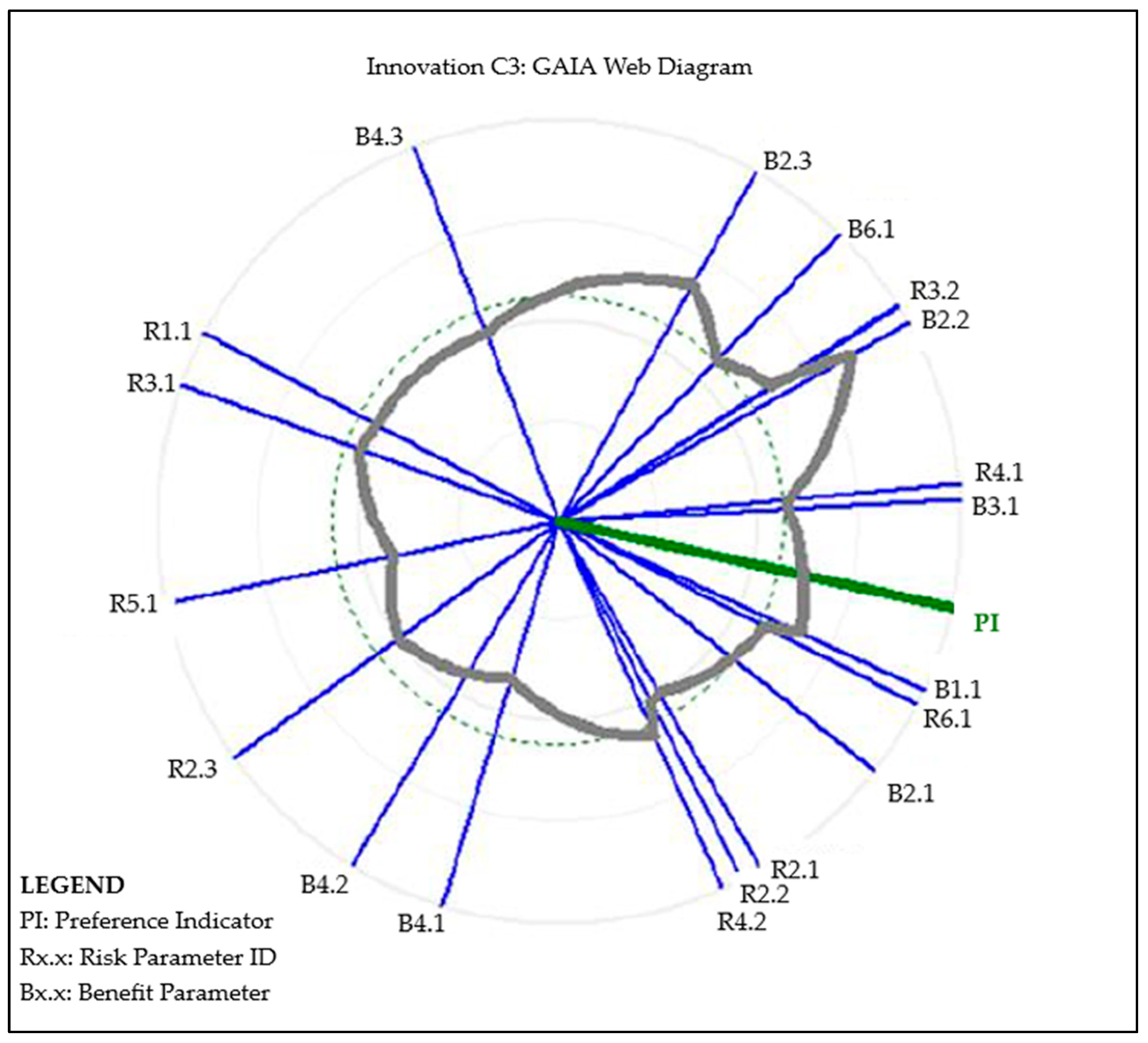
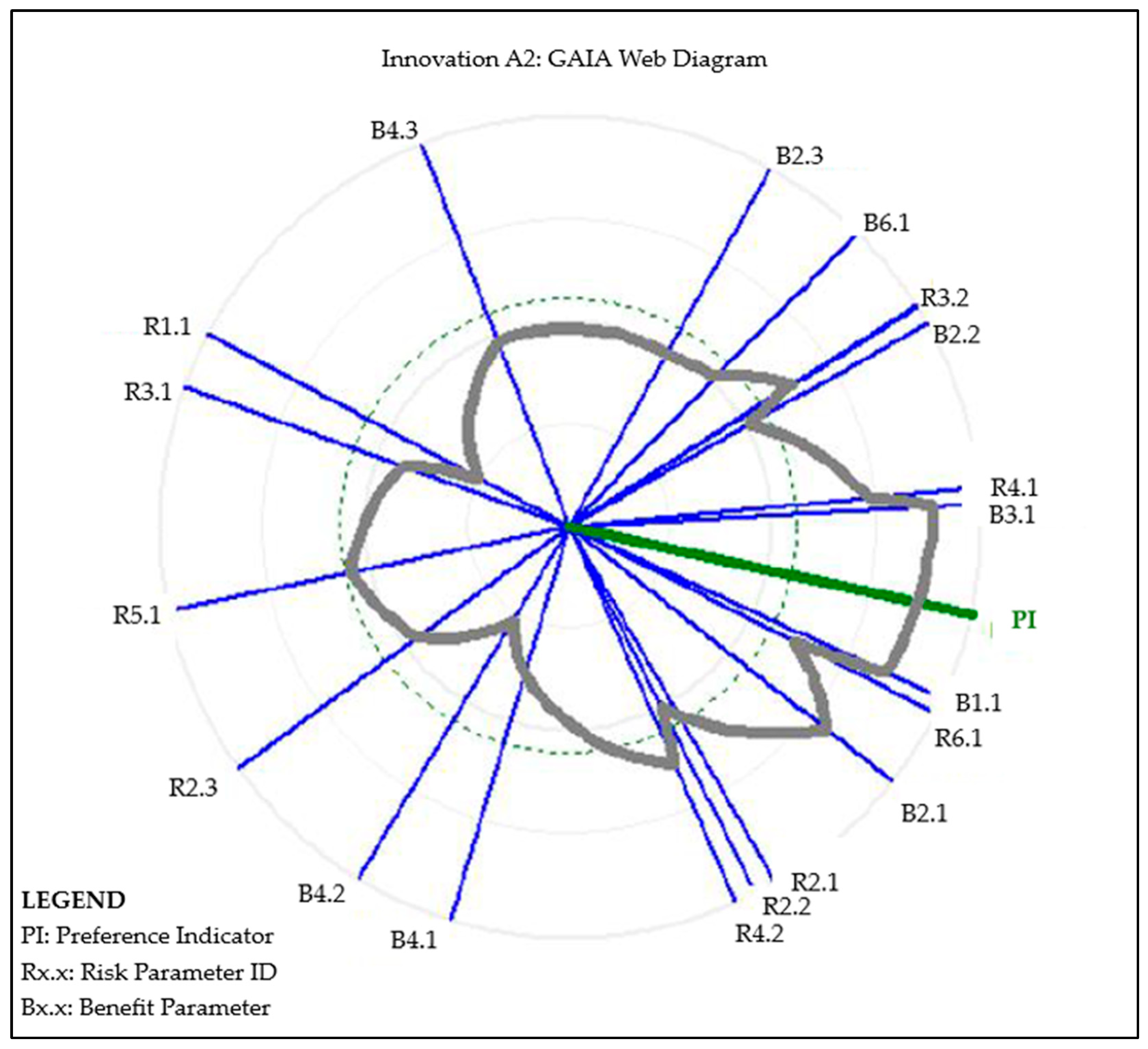
- Quadrant IV (high benefits, low risks): C3, A2, C1 and C2 combine above-average benefits with below-average risks and represent the most socially optimised set. C3 (Adaptive Fleet Scheduling & Planning) anchors this group with the highest Phi+ (=0.383) and low Phi− (=0.260), followed by A2 (Driver Support & Safety) and C1 (IoT/Connected ITS). These are near-term deployment candidates given their favourable benefit–risk profiles.
3.6. PROMETHEE GAIA Web Diagram
3.7. Sensitivity Analysis
4. Discussion
Limitations and Further Research
Author Contributions
Funding
Data Availability Statement
Acknowledgments
Conflicts of Interest
Abbreviations
| GHG | Greenhouse Gas |
| EU | European Union |
| PT | Public Transport |
| BRT | Bus Rapid Transit |
| ITS | Intelligent Transport System |
| GPS | Global Positioning System |
| eBRT | electrified-Bus Rapid Transit |
| LoS | Level of Service |
| MCA | Multi-Criteria Analysis |
| MCDA | Multi- Criteria Decision Analysis |
| SOI | Societal Optimisation Index |
| CBA | Cost–Benefit Analysis |
| CEA | Cost–Effectiveness Analysis |
| PROMETHEE | Preference Ranking Organisation Method |
| AB | Advisory Board |
| SSH | Social Sciences and Humanities |
| GAIA | Geometrical Analysis for Interactive Aid |
| PI | Preference Indicator |
| WSI | Visual Stability Interval |
References
- Anupriya, P.; Bansal, D.J.; Graham, D.J. Congestion in cities: Can road capacity expansions provide a solution? Transp. Res. Part A Policy Pract. 2023, 174, 103109. [Google Scholar] [CrossRef]
- Bucsky, P.; Juhász, M. Long-term evidence on induced traffic: A case study on the relationship between road traffic and capacity of Budapest bridges. Transp. Res. Part A Policy Pract. 2022, 157, 244–257. [Google Scholar] [CrossRef]
- European Environment Agency (EEA). Greenhouse Gas Emissions from Transport in Europe. Available online: https://www.eea.europa.eu/en/analysis/indicators/greenhouse-gas-emissions-from-transport?activeAccordion= (accessed on 27 October 2025).
- European Environment Agency (EEA). Transport and Mobility—In-Depth Topics. Available online: https://www.eea.europa.eu/en/topics/in-depth/transport-and-mobility (accessed on 27 October 2025).
- Khurshid, A.; Khan, K.; Chen, Y.; Cifuentes-Faura, J. Do green transport and mitigation technologies drive OECD countries to sustainable path? Transp. Res. Part D Transp. Environ. 2023, 118, 103611. [Google Scholar] [CrossRef]
- European Commission. The European Green Deal: Communication from the Commission; European Commission: Brussels, Belgium, 2019.
- European Commission. The Transport and Mobility Sector—Factsheet. Available online: https://ec.europa.eu/commission/presscorner/api/files/attachment/867229/Factsheet%20-%20The%20Transport%20and%20Mobility%20Sector.pdf (accessed on 27 October 2025).
- European Commission. Sustainable and Smart Mobility Strategy—Putting European Transport on Track for the Future: Communication from the commission; European Commission: Brussels, Belgium, 2020.
- European Commission. The New EU Urban Mobility Framework. Communication from the Commission; European Commission: Brussels, Belgium, 2021.
- Loder, A.; Cantner, F.; Adenaw, L.; Nachtigall, N.; Ziegler, D.; Ziegler, F.; Siewert, M.B.; Wurster, S.; Goerg, S.; Lienkamp, M. Observing Germany’s nationwide public transport fare policy experiment “9-Euro-Ticket”—Empirical findings from a panel study. Case Stud. Transp. Policy 2024, 15, 100987. [Google Scholar] [CrossRef]
- Cervero, R. The Transit Metropolis—A Global Inquiry; Island Press: Washington, DC, USA, 1998; pp. 1–300. [Google Scholar]
- Lajunen, A.; Lipman, T. Lifecycle cost assessment and carbon dioxide emissions of diesel, natural gas, hybrid electric, fuel cell hybrid and electric transit buses. Energy 2016, 106, 329–342. [Google Scholar] [CrossRef]
- Jarzab, J.T.; Lightbody, J.; Maeda, E. Characteristics of Bus Rapid Transit Projects: An Overview. J. Public Transp. 2002, 5, 31–46. [Google Scholar] [CrossRef]
- Volvo Research and Education Foundations (VREF); International Association of Public Transport (UITP); BRT+ Centre of Excellence. Transforming Cities with Bus Rapid Transit (BRT) Systems—How to Integrate BRT? UITP: Brussels, Belgium, 2019; Available online: https://www.uitp.org/wp-content/uploads/sites/7/2025/04/BRT_ENG_Web.pdf (accessed on 27 October 2025).
- BRTdata.org. Panorama per Country. Available online: https://brtdata.org (accessed on 15 September 2025).
- Deng, T.; Nelson, J.D. Bus Rapid Transit implementation in Beijing: An evaluation of performance and impacts. Res. Transp. Econ. 2013, 39, 108–113. [Google Scholar] [CrossRef]
- Wright, L.; Hook, W. Bus Rapid Transit Planning Guide; Institute for Transportation & Development Policy (ITDP): New York, NY, USA, 2007; pp. 1–350. [Google Scholar]
- Hensher, D.A.; Golob, T.F. Bus rapid transit systems: A comparative assessment. Transport 2008, 35, 501–518. [Google Scholar] [CrossRef]
- Du, H.; Kommalapati, R.R. Environmental sustainability of public transportation fleet replacement with electric buses in Houston, a megacity in the USA. Int. J. Sustain. Eng. 2021, 14, 1858–1870. [Google Scholar] [CrossRef]
- Chatman, D.; Rayle, L.; Palacios, M.S.; Cervero, R. Sustainable and Equitable Transportation in Latin America, Asia and Africa: The Challenges of Integrating BRT and Private Transit Services; UC Berkeley Center for Future Urban Transport, Institute of Transportation Studies, University of California: Berkeley, CA, USA, 2019; pp. 1–75. [Google Scholar]
- Hrelja, R.; Levin, L.; Camporeale, R. Handling social considerations and the needs of different groups in public transport planning: A review of definitions, methods, and knowledge gaps. Eur. Transp. Res. Rev. 2024, 16, 5. [Google Scholar] [CrossRef]
- Jones, P.; Lucas, K. The social consequences of transport decision-making: Clarifying concepts, synthesizing knowledge and assessing implications. J. Transp. Geogr. 2012, 21, 4–16. [Google Scholar] [CrossRef]
- Mottee, L.K.; Arts, J.; Vanclay, F.; Howitt, R.; Miller, F. Limitations of technical approaches to transport planning practice in two cases: Social issues as a critical component of urban project. Plan. Theory Pract. 2019, 21, 39–57. [Google Scholar] [CrossRef]
- Naranjo, W.; Camargo, L.E.M.; Pereda, J.E.; Cortes, C. Design of electric buses of rapid transit using hybrid energy storage and local traffic parameters. IEEE Trans. Veh. Technol. 2016, 66, 5551–5563. [Google Scholar] [CrossRef]
- Rios, M.A.; Ramos, G.A.; Zambrano, S. Simulation of the power supply for a flash charging eBRT system. In Proceedings of the 2015 IEEE Workshop on Power Electronics and Power Quality Applications (PEPQA), Bogota, CO, USA, 25–26 June 2015; pp. 1–6. [Google Scholar] [CrossRef]
- International Association of Public Transport (UITP). Local Public Transport in the EU—Public Transport Sector Priorities for the Legislative Term 2024–2029; UITP: Brussels, Belgium, 2024. [Google Scholar]
- Miller, P.; de Barros, A.G.; Kattan, L.; Wirasinghe, S.C. Public transportation and sustainability: A review. Sustain. Urban Transp. Syst. 2006, 20, 1076–1083. [Google Scholar] [CrossRef]
- Tiwari, G.; Phillip, C. Development of public transport systems in small cities: A roadmap for achieving sustainable development goal indicator 11.2. IATSS Res. 2021, 45, 31–38. [Google Scholar] [CrossRef]
- van Burgsteden, M.; Grigolon, M.; Geurs, K. Improving community wellbeing through transport policy: A literature review and theoretical framework, based on the Capability Approach. Transp. Rev. 2024, 44, 1161–1186. [Google Scholar] [CrossRef]
- Niehaus, M.; Galilea, P.; Hurtubia, R. Accessibility and Equity: An Approach for Wider Transport Project Assessment in Chile. Res. Transp. Econ. 2016, 59, 412–422. [Google Scholar] [CrossRef]
- Lucas, K. A new evolution for transport related social exclusion research? J. Transp. Geogr. 2019, 81, 102529. [Google Scholar] [CrossRef]
- Dupuit, J. On the measurement of the utility of public works. Ann. Ponts Chaussées 1844, 2, 83–110. [Google Scholar]
- Eliasson, J.; Lundberg, M. Do cost–benefit analyses influence transport investment decisions? Experiences from the Swedish Transport Investment Plan 2010–21. Transp. Rev. 2012, 32, 29–48. [Google Scholar] [CrossRef]
- Povellato, A.; Bosello, F.; Giupponi, C. Cost-effectiveness of greenhouse gases mitigation measures in the European agro-forestry sector: A literature survey. Environ. Sci. Policy 2007, 10, 474–490. [Google Scholar] [CrossRef]
- Hickman, R.; Dean, M. Incomplete Cost—Incomplete Benefit Analysis in Transport Appraisal. Transp. Rev. 2018, 38, 689–709. [Google Scholar] [CrossRef]
- Mackie, P.; Worsley, T.; Eliasson, J. Transport Appraisal Revisited. Res. Transp. Econ. 2014, 47, 3–18. [Google Scholar] [CrossRef]
- Fearnley, N.; Veisten, K. Cost-Benefit Appraisal of Universal Design in Public Transport and Walking/Cycling Infrastructure. In Studies in Health Technology and Informatics; IOS Press: Amsterdam, The Netherlands, 2024; ISBN 978-1-64368-552-6. [Google Scholar] [CrossRef]
- Song, Y.; Whitney, W.; Zhang, W.C.B.; Caulfield, B.; Martinez-Covarrubias, J. Sustainable transport appraisal: A literature review and implications for policy makers. In Transport Transitions: Advancing Sustainable and Inclusive Mobility, Proceedings of the 10th TRA Conference, Dublin, Ireland, 15–18 April 2024; Springer Nature: Cham, Switzerland, 2025; Volume 2: Sustainable Transport Development, pp. 627–632. [Google Scholar]
- Barfod, M.B.; Salling, K.B. A new composite decision support framework for strategic and sustainable transport appraisals. Transp. Res. Part A Policy Pract. 2015, 72, 1–15. [Google Scholar] [CrossRef]
- Browne, D.; Ryan, L. Comparative analysis of evaluation techniques for transport policies. Environ. Impact Assess. Rev. 2011, 31, 226–233. [Google Scholar] [CrossRef]
- Mulley, C.; Weisbrod, G. Workshop 8 Report: The Wider Economic, Social and Environmental Impacts of Public Transport Investment. Res. Transp. Econ. 2016, 59, 397–400. [Google Scholar] [CrossRef]
- Annema, J.A.; Koopmans, C.; Van Wee, B. Evaluating Transport Infrastructure Investments: The Dutch Experience with a Standardized Approach. Transp. Rev. 2007, 27, 125–150. [Google Scholar] [CrossRef]
- Venter, C. Assessing the potential of bus rapid transit-led network restructuring for enhancing affordable access to employment —The case of Johannesburg’s Corridors of Freedom. Res. Transp. Econ. 2016, 59, 441–449. [Google Scholar] [CrossRef]
- Bocarejo, J.P.S.; Oviedo, D.R.H. Transport accessibility and social inequities: A tool for identification of mobility needs and evaluation of transport investments. J. Transp. Geogr. 2012, 24, 142–154. [Google Scholar] [CrossRef]
- Utsunomiya, K. Social Capital and Local Public Transportation in Japan. Res. Transp. Econ. 2016, 59, 434–440. [Google Scholar] [CrossRef]
- Stanley, J.; Stanley, J. Improving Appraisal Methodology for Land Use Transport Measures to Reduce Risk of Social Exclusion. Sustainability 2023, 15, 11902. [Google Scholar] [CrossRef]
- Carse, A. Assessment of Transport Quality of Life as an Alternative Transport Appraisal Technique. J. Transp. Geogr. 2011, 19, 1037–1045. [Google Scholar] [CrossRef]
- Tricker, R.C. Assessing Cumulative Environmental Effects from Major Public Transport Projects. Transp. Policy 2007, 14, 293–305. [Google Scholar] [CrossRef]
- van Oort, N.; Yap, M. Chapter Six—Innovations in the appraisal of public transport projects. In Advances in Transport Policy and Planning; Mouter, N., Ed.; Academic Press: Cambridge, MA, USA, 2021; Volume 7, pp. 127–164. [Google Scholar] [CrossRef]
- Mouter, N.; Cabral, M.O.; Dekker, T.; Van Cranenburgh, S. The value of travel time, noise pollution, recreation and biodiversity: A social choice valuation perspective. Res. Transp. Econ. 2019, 76, 100733. [Google Scholar] [CrossRef]
- Tiwari, G.; Jain, D. Accessibility and safety indicators for all road users: Case study Delhi BRT. J. Transp. Geogr. 2012, 22, 87–97. [Google Scholar] [CrossRef]
- Geurs, K.T.; Boon, W.; van Wee, B. Social impacts of transport: Literature review and the state of practice of transport appraisal in the Netherlands and the United Kingdom. Transp. Rev. 2009, 29, 69–90. [Google Scholar] [CrossRef]
- Cao, X.; Chen, H.; Liang, F.; Wang, W. Measurement and spatial differentiation characteristics of transit equity: A case study of Guangzhou, China. Sustainability 2018, 10, 1069. [Google Scholar] [CrossRef]
- Asgharpour, S.; Allahyari, A.; Mohammadi, M.; Mohammadian, R.; Mohammadian, A.; Abraham, C. Investigating equity of public transit accessibility: Comparison of accessibility among disadvantaged groups in Cook County, IL. In Proceedings of the International Conference on Transportation and Development 2023: Transportation Planning, Operations, and Transit, Austin, TX, USA, 14–17 June 2023; ASCE: Reston, VA, USA, 2023. [Google Scholar] [CrossRef]
- Verlinghieri, E.; Schwanen, T. Transport and mobility justice: Evolving discussions. J. Transp. Geogr. 2020, 87, 102798. [Google Scholar] [CrossRef]
- Hay, A.; Meredith, K.; Vickerman, R. The Impact of the Channel Tunnel on Kent and Relationships with Nord-Pas de Calais; Centre for European, Regional and Transport Economics: Canterbury, UK, 2004. [Google Scholar]
- Dean, M.; Hickman, R.; Chen, C.-L. Testing the Application of Participatory MCA: The Case of the South Fylde Line. Transp. Policy 2019, 73, 62–70. [Google Scholar] [CrossRef]
- Morfoulaki, M.; Papathanasiou, J. Use of PROMETHEE MCDA Method for Ranking Alternative Measures of Sustainable Urban Mobility Planning. Mathematics 2021, 9, 602. [Google Scholar] [CrossRef]
- Basbas, S.; Makridakis, C.M. A Review of the Contribution of Multi-Criteria Analysis to the Evaluation Process of Transportation Projects. Int. J. SDP 2007, 2, 387–407. [Google Scholar] [CrossRef]
- Ishizaka, A.; Nemery, P. Multi-Criteria Decision Analysis: Methods and Software; Wiley: Chichester, UK, 2013. [Google Scholar] [CrossRef]
- Camargo Perez, J.; Carrillo, M.H.; Montoya-Torres, J.R. Multi-criteria approaches for urban passenger transport systems: A literature review. Ann. Oper. Res. 2015, 226, 69–87. [Google Scholar] [CrossRef]
- Singh, M.; Pant, M. A review of selected weighting methods in MCDM with a case study. Int. J. Syst. Assur. Eng. Manag. 2021, 12, 126–144. [Google Scholar] [CrossRef]
- Brans, J.P.; Mareschal, B.; Vincke, P. PROMETHEE: A new family of outranking methods in MCDM. In Operational Research84 (IFORS’84); Brans, J.P., Ed.; Springer: Berlin/Heidelberg, Germany, 1984; pp. 477–490. [Google Scholar]
- Brans, J.P.; Vincke, P.; Mareschal, B. How to select and how to rank projects: The PROMETHEE method. Eur. J. Oper. Res. 1986, 14, 228–238. [Google Scholar] [CrossRef]
- Papathanasiou, J.; Ploskas, N. PROMETHEE. In Multiple Criteria Decision Aid; Springer: Cham, Switzerland, 2018; pp. 115–134. [Google Scholar] [CrossRef]
- Blouchoutzi, A.; Manou, D.; Papathanasiou, J. A PROMETHEE MCDM application in social inclusion: The case of foreign-born population in the EU. Syst. Pract. Soc. Sci. 2021, 9, 45. [Google Scholar] [CrossRef]
- Mahmud, M.; Abedin, T.; Rahman, M.M.; Shoishob, S.A.; Kiong, T.S.; Nur-E-Alam, M. Integrating demand forecasting and deep reinforcement learning for real-time electric vehicle charging price optimization. Util. Policy 2025, 96, 102038. [Google Scholar] [CrossRef]
- Doan, N.A.V.; De Smet, Y. An Alternative Weight Sensitivity Analysis for PROMETHEE II Rankings. Omega 2018, 80, 166–174. [Google Scholar] [CrossRef]
- Marttunen, M.; Belton, V.; Lienert, J. Are objectives hierarchy related biases observed in practice? A meta-analysis of environmental and energy applications of Multi-Criteria Decision Analysis. Eur. J. Oper. Res. 2018, 265, 178–194. [Google Scholar] [CrossRef]
- Barfod, M.B. Supporting sustainable transport appraisals using stakeholder involvement and MCDA. Transport 2018, 33, 1052–1066. [Google Scholar] [CrossRef]
- Dean, M. Multi-criteria analysis. In Advances in Transport Policy and Planning; Academic Press: Cambridge, MA, USA, 2020; Volume 6, pp. 165–224. [Google Scholar] [CrossRef]
- Hobbs, B.; Meier, P. Energy Decisions and the Environment: A Guide to the Use of Multicriteria Methods; Kluwer Academic Publishers: Massachusetts, MA, USA, 2020. [Google Scholar] [CrossRef]
- Jensen, A.V.; Barfod, M.B.; Leleur, S. Estimating the robustness of composite CBA and MCA assessments by variation of criteria importance order. In New State of MCDM in the 21st Century; Springer: Berlin/Heidelberg, Germany, 2009; pp. 59–66. [Google Scholar] [CrossRef]
- Mousseau, V.; Figueira, J.; Dias, L.; Gomes da Silva, C.; Climaco, J. Resolving inconsistencies among constraints on the parameters of an MCDA model. Eur. J. Oper. Res. 2003, 147, 72–93. [Google Scholar] [CrossRef]
- Dorini, G.; Kapelan, Z.; Azapagic, A. Managing uncertainty in multiple-criteria decision making related to sustainability assessment. Clean Technol. Environ. Policy 2011, 13, 133–139. [Google Scholar] [CrossRef]



| ID | Innovation Name | Description | Pilot City |
|---|---|---|---|
| Category A: Vehicle systems | |||
| A1 | Predictive Maintenance Strategies & Battery State-of-Health Estimation | Forecasting electric bus component health (i.e., the battery), through big data analysis. | Barcelona, Rimini |
| A2 | Intelligent Driver Support and Safety Systems | Enhances driver safety using cameras and radar systems to provide real-time data on road conditions, including features such as docking assistance, assisted braking, blind spot monitoring, narrow navigation assistance, automated traffic signal control and zone management. | Barcelona, Rimini |
| A3 | Optimised Connected Vehicle Digital Twin and Monitoring System | Digital twin replicating both transport and power supply operations (aids intelligent operator assistance, autonomous navigation and lifetime testing). | Athens |
| A4 | Advanced Energy and Thermal Management | Optimises battery usage and vehicle energy consumption, including heating, ventilation and air conditioning management under all conditions. | Amsterdam, Prague |
| Category B: eBRT charging infrastructure and depot | |||
| B1 | Bi-directional Modular Charging Systems for Bus-to-Grid Services | Enables buses to supply energy back to the grid, stabilising energy supply and reducing peak loads. | Barcelona |
| B2 | Hybrid Charging System with Stationary Battery Buffer | Combines grid connection with energy storage, enabling charging from stationary buffer or grid, managing grid limitations and optimising operations. | Amsterdam |
| B3 | Mobility Hub Charging System | Integrates charging infrastructure into mobility hubs, facilitating shared use among various electric modes. | Rimini |
| B4 | In-Motion (Hybrid) Charging Systems | Utilises overhead contact lines for charging, reducing the need for depot chargers. | Athens, Prague Rimini |
| Category C: Automation, management and IoT connectivity systems | |||
| C1 | IoT Monitoring Platform with Connected ITS Systems | 5G-based IoT platform for monitoring vehicles and charging infrastructure, enabling condition monitoring, predictive maintenance and optimised energy consumption. | Barcelona, Amsterdam, Athens, Prague, Rimini |
| C2 | Efficient, Integrated, and Smart Charging Management Systems | Smart charging strategies to reduce costs, battery wear and grid utilisation while considering passenger demand variations and weather conditions. | Barcelona, Amsterdam, Prague |
| C3 | Adaptive Fleet Scheduling and Planning Tool | AI-based adaptive scheduling using real-time parameters to optimise fleet operations, reduce costs and minimise emissions. Provides real-time updates to users about service changes, delays and disturbances. | Athens, Rimini |
| ID | Risk Parameter Description | Related INNO | Weight (%) |
|---|---|---|---|
| Cluster R1: Skill gaps, job uncertainty and labour disputes | |||
| R1.1 | Skill gaps that should be addressed in a short time period. | A2, A3 | 10.00 |
| Cluster R2: Reduced access, complexity and inequality | |||
| R2.1 | Limited individual access to charging infrastructure in stations/hubs due to increased demand. | B3 | 4.65 |
| R2.2 | Unequal access to charging payment options, potentially excluding individuals unfamiliar with digital payment systems. | B3 | 6.66 |
| R2.3 | Inequitable access to real-time eBRT information if reliant on smartphone apps. | C3 | 10.11 |
| Cluster R3: Safety, security and data privacy risks | |||
| R3.1 | Data privacy vulnerabilities from cyber threats targeting the eBRT system. | A2, C1, C3 | 8.73 |
| R3.2 | Safety risks due to non-compliance with electrical safety standards (i.e., insulation and grounding, fire prevention). | B1, B3, B4 | 7.27 |
| Cluster R4: Environmental and urban landscape impacts | |||
| R4.1 | Increased waste production due to frequent replacement of bus components, such as batteries. | A2, B2 | 5.27 |
| R4.2 | Negative impacts on public space due to eBRT charging infrastructure (i.e., conflicts for land use or aesthetic issues when installing charging infrastructures and pantographs). | B4 | 11.97 |
| Cluster R5: Service reliability challenges | |||
| R5.1 | Reduced service availability and reliability due to IoT failures or cyber threats. | C1, C2, C3 | 18.40 |
| Cluster R6: Power supply instability | |||
| R6.1 | Limitations of the local electricity distribution network due to the high-power demand of eBRT operations, especially in areas where grid capacity has not been upgraded or coordinated with the distribution system operator. | B3, B4 | 17.00 |
| Risks Weight Total = | 100 | ||
| ID | Benefit Parameter Description | Related INNO | Weight (%) |
| Cluster B1: Enhanced efficiency and comfort of professionals | |||
| B1.1 | Improved working conditions for drivers, operators and maintenance staff through optimised monitoring, intelligent driver support, safety systems and advanced battery maintenance strategies. | A1, A2, A3 C1, C2, C3 | 11.00 |
| Cluster B.2 Improved user access and experience | |||
| B2.1 | Increased passenger comfort with reduced vibrations, quieter journeys and better in-vehicle temperature control. | A4 | 16.33 |
| B2.2 | Enhanced real-time information for passengers, both pre-trip and during travel. | C3 | 4.67 |
| B2.3 | Improved access to multimodal interchanges integrating shared and active mobility options. | A2 | 7.00 |
| Cluster B3: Enhanced safety for all road users | |||
| B3.1 | Enhanced safety for passengers and road users (in-vehicle, embarkation/disembarkation) | A2 | 10.00 |
| Cluster B4: Positive impacts on environment/city landscape/land use | |||
| B4.1 | Reduced waste production from the eBRT bus and its components (i.e., batteries). | A1, Β4, C2 | 5.74 |
| B4.2 | Improved energy efficiency/energy savings during eBRT operation. | B1, B2 | 7.17 |
| B4.3 | Optimised public space usage for charging infrastructure and system operations. | B3, B4 | 5.50 |
| Cluster B5: Improved service reliability | |||
| B5.1 | Improved eBRT service punctuality and reliability. | C3 | 20.00 |
| Cluster B6: Increased eBRT system resilience | |||
| B6.1 | Increased eBRT resilience in unpredictive situations. | A3 | 12.60 |
| Benefits Weight Total = | 100 | ||
| Rank | ID | Innovation Name | Phi | Phi+ | Phi− |
|---|---|---|---|---|---|
| 1 | C3 | Adaptive Fleet Scheduling and Planning Tool | 0.1229 | 0.3826 | 0.2597 |
| 2 | A2 | Intelligent Driver Support and Safety Systems | 0.1149 | 0.3730 | 0.2581 |
| 3 | C1 | IoT Monitoring Platform with Connected ITS Systems | 0.0888 | 0.3606 | 0.2718 |
| 4 | C2 | Efficient, Integrated, and Smart Charging Management Systems | 0.0529 | 0.3153 | 0.2624 |
| 5 | A4 | Advanced Energy and Thermal Management | 0.0381 | 0.2920 | 0.2538 |
| 6 | A1 | Predictive Maintenance Strategies & Battery State-of-Health Estimation | 0.0036 | 0.2934 | 0.2899 |
| 7 | B4 | In-Motion (Hybrid) Charging Systems | −0.0518 | 0.2621 | 0.3139 |
| 8 | B3 | Mobility Hub Charging System | −0.0742 | 0.2962 | 0.3703 |
| 9 | A3 | Optimised Connected Vehicle Digital Twin and Monitoring System | −0.0756 | 0.2413 | 0.3170 |
| 10 | B2 | Hybrid Charging System with Stationary Battery Buffer | −0.1027 | 0.2308 | 0.3336 |
| 11 | B1 | Bi-directional Modular Charging Systems for Bus-to-Grid Services | −0.1398 | 0.1862 | 0.3260 |
| ID | Parameter Description | Expert Weight (%) | Normalised Weight (%) | WSI (%) | Range |
|---|---|---|---|---|---|
| Risks | |||||
| R5.1 | Reduced service availability and reliability due to IoT failures or cyber threats. | 18.40 | 6 | [5.39, 8.37] | 2.98 |
| R6.1 | Limitations of the local electricity distribution network due to the high-power demand of eBRT operations, especially in areas where grid capacity has not been upgraded or coordinated with the distribution system operator. | 17.00 | 5 | [0.34, 5.88] | 5.54 |
| R4.2 | Negative impacts on public space due to charging infrastructure (i.e., conflicts for land use or aesthetic issues when installing charging infrastructures and pantographs). | 11.97 | 6 | [3.51, 6.10] | 2.59 |
| R2.3 | Inequitable access to real-time information if reliant on smartphone apps. | 10.11 | 5 | [4.30, 10.73] | 6.43 |
| Benefits | |||||
| B5.1 | Improved service punctuality and reliability. | 20.00 | 5 | [2.63, 5.40] | 2.77 |
| B2.1 | Increased passenger comfort with reduced vibrations, more quiet journeys and better in-vehicle temperature control. | 16.33 | 7 | [5.08, 7.44] | 2.36 |
| B6.1 | Increased resilience in unpredictive situations. | 12.60 | 4 | [1.43, 4.81] | 3.38 |
| B1.1 | Improved working conditions for drivers, operators and maintenance staff through optimised monitoring, intelligent driver support, safety systems and advanced battery maintenance strategies. | 11.00 | 4 | [0.04, 4.74] | 4.43 |
| B3.1 | Enhanced safety for passengers and road users (in-vehicle, embarkation/disembarkation) | 10.00 | 3 | [0.00, 3.69] | 3.69 |
| ID | Innovation Name | Priority Level | Enabling Action |
|---|---|---|---|
| Quadrant IV | |||
| C3 | Adaptive Fleet Scheduling and Planning Tool | High | Integration with existing ITS; data governance; staff training in real-time operations |
| A2 | Advanced Energy and Thermal Management | High | Driver training; validation with safety authorities; alignment with road safety protocols |
| C1 | IoT Monitoring Platform with Connected ITS Systems | High | Cybersecurity hardening; resilient communication network; data protection compliance |
| C2 | Efficient, Integrated, and Smart Charging Management Systems | High | Coordination with distribution system operators; real-time load balancing; integration with depot operations |
| Quadrant III | |||
| A4 | Advanced Energy and Thermal Management | Medium | Battery system monitoring; compatibility checks with vehicle platforms |
| A1 | Predictive Maintenance Strategies & Battery State-of-Health Estimation | Medium | Sensor data quality; operator training; integration with existing maintenance cycles |
| Quadrant I | |||
| B3 | Mobility Hub Charging System | Medium | Land-use planning; user accessibility design; mitigation of public space impact |
| Quadrant II | |||
| B1 | Bi-directional Modular Charging Systems for Bus-to-Grid Services | Low | Electrical safety standards compliance; infrastructure alignment with distribution system operator; visual/aesthetic impact mitigation |
| B2 | Hybrid Charging System with Stationary Battery Buffer | Low | Validation with system operators; data models standardisation; cybersecurity certification |
| A3 | Optimised Connected Vehicle Digital Twin and Monitoring System | Low | Waste management strategy; battery lifecycle planning; fire-safety assessments |
| B4 | In-Motion (Hybrid) Charging Systems | Low | Safety certification; grid impact investigation; coordination with distribution system operator for bidirectional flow |
Disclaimer/Publisher’s Note: The statements, opinions and data contained in all publications are solely those of the individual author(s) and contributor(s) and not of MDPI and/or the editor(s). MDPI and/or the editor(s) disclaim responsibility for any injury to people or property resulting from any ideas, methods, instructions or products referred to in the content. |
© 2025 by the authors. Published by MDPI on behalf of the World Electric Vehicle Association. Licensee MDPI, Basel, Switzerland. This article is an open access article distributed under the terms and conditions of the Creative Commons Attribution (CC BY) license (https://creativecommons.org/licenses/by/4.0/).
Share and Cite
Morfoulaki, M.; Chatziathanasiou, M.; Anapali, I.S. Social Planning for eBRT Innovations: Multi-Criteria Evaluation of Societal Impacts. World Electr. Veh. J. 2025, 16, 661. https://doi.org/10.3390/wevj16120661
Morfoulaki M, Chatziathanasiou M, Anapali IS. Social Planning for eBRT Innovations: Multi-Criteria Evaluation of Societal Impacts. World Electric Vehicle Journal. 2025; 16(12):661. https://doi.org/10.3390/wevj16120661
Chicago/Turabian StyleMorfoulaki, Maria, Maria Chatziathanasiou, and Iliani Styliani Anapali. 2025. "Social Planning for eBRT Innovations: Multi-Criteria Evaluation of Societal Impacts" World Electric Vehicle Journal 16, no. 12: 661. https://doi.org/10.3390/wevj16120661
APA StyleMorfoulaki, M., Chatziathanasiou, M., & Anapali, I. S. (2025). Social Planning for eBRT Innovations: Multi-Criteria Evaluation of Societal Impacts. World Electric Vehicle Journal, 16(12), 661. https://doi.org/10.3390/wevj16120661