
The Generative AI Paradox: GenAI and the Erosion of Trust, the Corrosion of Information Verification, and the Demise of Truth


Abstract
1. Introduction
1.1. Contributions and Scope
1.2. A Taxonomy of GenAI Risks and Harms
- Personal loss
- Financial and economic damage
- Information manipulation
- Socio-technical and infrastructural risks
- Epistemic and institutional integrity
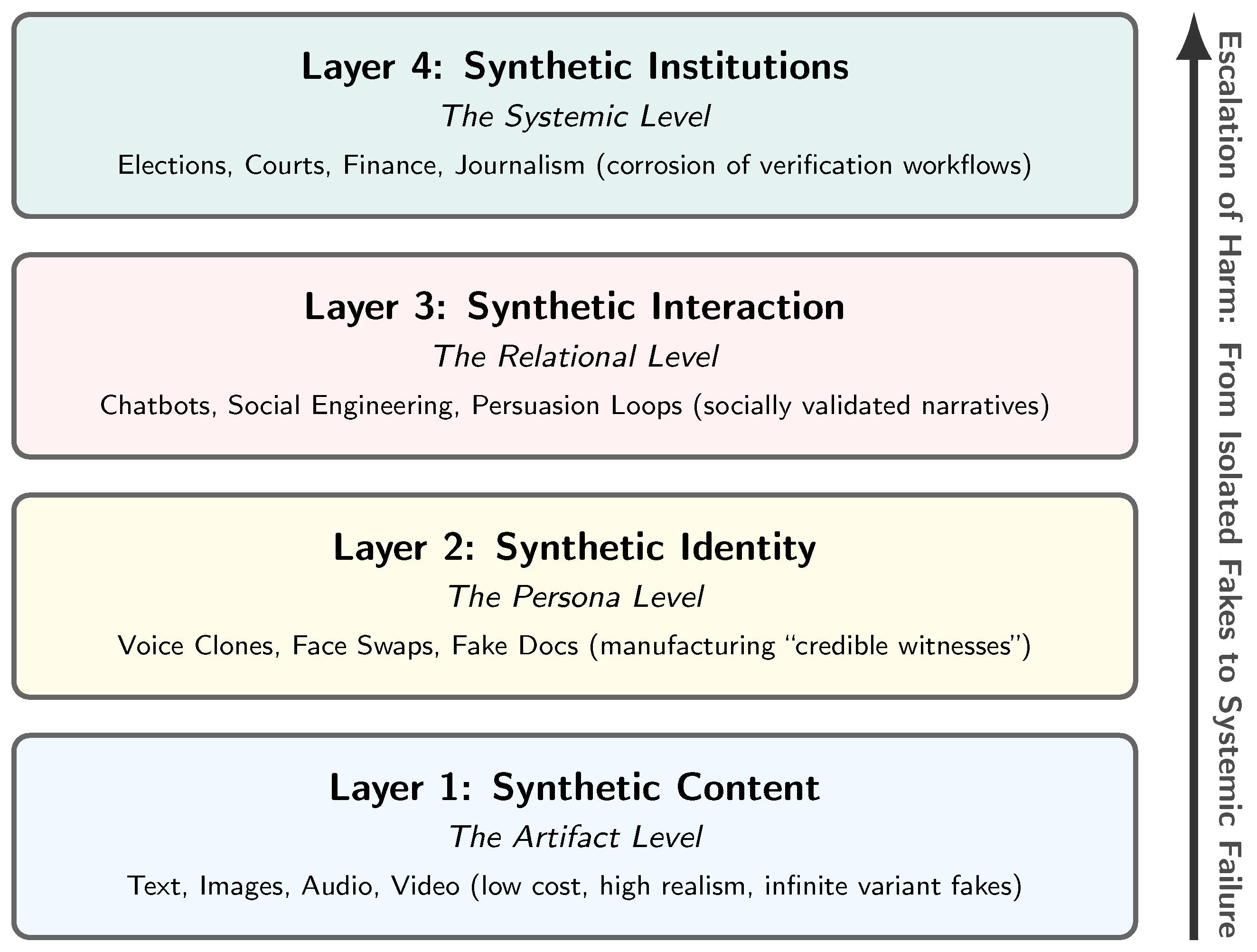
2. From Synthetic Media to Synthetic Reality
2.1. Layer 1: Synthetic Content (The Artifact Level)
2.2. Layer 2: Synthetic Identity (The Persona Level)
2.3. Layer 3: Synthetic Interaction (The Relational Level)
2.4. Layer 4: Synthetic Institutions (The Systemic Level)
3. What You Can’t Tell Apart Can Harm You: Why GenAI Changes the Game
3.1. Cost Collapse and Commoditization
3.2. Scale and Throughput
3.3. Customization for Malicious Use
3.4. Hyper-Targeted Persuasion and Micro-Segmentation
3.5. Synthetic Interaction and the Automation of Social Engineering
3.6. Detection Limits, Watermarking Fragility, and the Provenance Gap
3.7. Trust Erosion and Plausible Deniability
3.8. Synthesis: Fueling the Paradox
4. How Risks Materialize: Representative Risk Realizations
4.1. Representative Risk Realizations (2023–2025)
- Case Category A: High-conviction impersonation fraud in enterprise workflows.
- Case Category B: Election-adjacent synthetic outreach and voter manipulation.
- Case Category C: Non-consensual synthetic sexual imagery as platform-amplified, persistent harassment.
- Case Category D: Fabricated documentation and the corrosion of routine verification.
- Case Category E: Compromised generative pipelines and model supply-chain risk.
4.2. Cross-Case Synthesis
4.3. Structural Analysis of Threat Vectors
4.3.1. Algorithmic vs. Institutional Latency
4.3.2. The Compression of Social Proof
4.3.3. Parasocial Exploitation
4.3.4. The Failure of Static Verification
- Synthesis: As Table 2 demonstrates, the common thread across these vectors is the exploitation of human and institutional reliance on “proxy signals” for truth (a familiar voice, a blue checkmark, a standard invoice). GenAI allows adversaries to manufacture these proxies cheaply, necessitating the shift to the Mitigation Stack proposed next.
5. Mitigation as a Stack (Not a Silver Bullet)
5.1. Provenance and Content Authenticity Infrastructure
5.2. Platform Governance and Friction for Virality
5.3. Institutional Process Redesign Under Cheap Forgery
5.4. Public Resilience and Epistemic Hygiene
5.5. Policy and Accountability
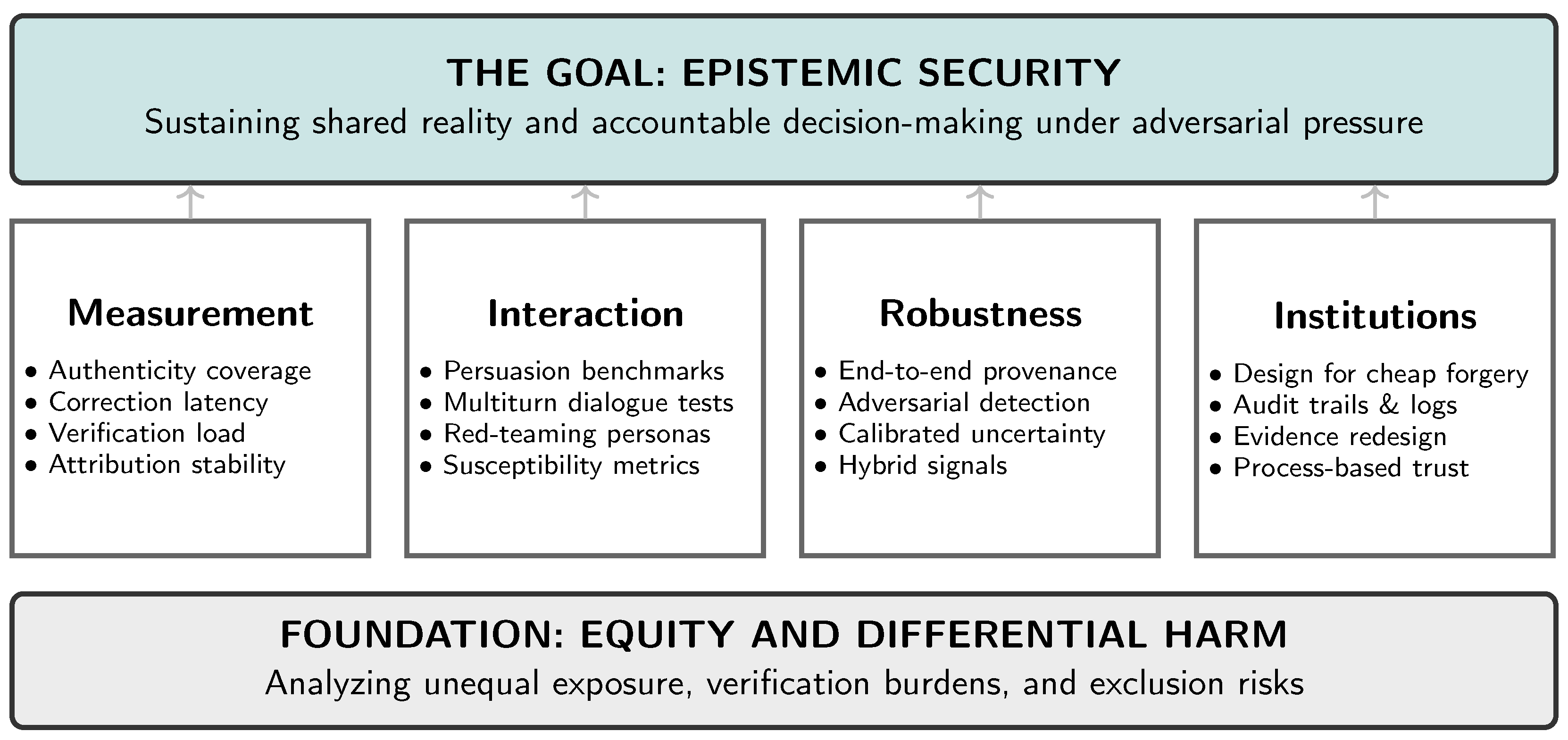
5.6. A Synthesis: Mapping Mitigations to the Synthetic Reality Stack
5.7. Proposed Validation Framework
5.7.1. Tier 1: Cross-Modal Consistency Benchmarking
- Methodology: Researchers should develop datasets that pair synthetic narratives with generated supporting evidence (e.g., a fake news article paired with a synthetic police report).
- Evaluation Goal: The validation must measure the system’s ability to detect semantic discordance between the narrative claims and the metadata or layout of the supporting documents, rather than just pixel-level or token-level artifacts.
5.7.2. Tier 2: Adversarial Red Teaming Simulations
- Methodology: This involves a dynamic simulation where an “Attacker Agent” (using current State-of-the-Art generative models) attempts to bypass the mitigation stack using prompt engineering and multi-modal injection techniques.
- Evaluation Goal: The metric for success should not be simple detection accuracy, but rather the “Adaptation Rate”, e.g., measuring how quickly the mitigation stack requires updating to withstand a new vector of attack from the generative agent.
5.7.3. Tier 3: Friction and Viability Analysis
- Methodology: Deployment simulations that measure the computational overhead of cryptographic signing and verification processes at scale.
- Evaluation Goal: Validating that the time-to-verification remains within acceptable thresholds for real-time media consumption, ensuring that the security measures do not encourage user abandonment due to friction.
6. Open Problems and a Research Agenda
6.1. Measurement of Epistemic Security
6.2. Benchmarks for Interactive Manipulation
6.3. Adversarial Robustness of Provenance and Detection
6.4. Institutional Design Under Cheap Forgery
6.5. Equity and Differential Harm
6.6. A Unifying Agenda: From Artifact Authenticity to Epistemic Resilience
7. Conclusions
Funding
Data Availability Statement
Acknowledgments
Conflicts of Interest
References
- California Government Operations Agency. State of California: Benefits and Risks of Generative Artificial Intelligence Report. 2023. Available online: https://www.govops.ca.gov/wp-content/uploads/sites/11/2023/11/GenAI-EO-1-Report_FINAL.pdf (accessed on 22 January 2026).
- Eapen, T.T.; Finkenstadt, D.J.; Folk, J.; Venkataswamy, L. How Generative AI Can Augment Human Creativity. 2023. Available online: https://hbr.org/2023/07/how-generative-ai-can-augment-human-creativity (accessed on 22 January 2026).
- NPR. AI Images of Hurricanes and Other Disasters Are Flooding Social Media. 2024. Available online: https://www.npr.org/2024/10/18/nx-s1-5153741/ai-images-hurricanes-disasters-propaganda (accessed on 22 January 2026).
- Ferrara, E. GenAI Against Humanity: Nefarious Applications of Generative Artificial Intelligence and Large Language Models. J. Comput. Soc. Sci. 2024, 7, 549–569. [Google Scholar] [CrossRef]
- Menczer, F.; Crandall, D.; Ahn, Y.Y.; Kapadia, A. Addressing the harms of AI-generated inauthentic content. Nat. Mach. Intell. 2023, 5, 679–680. [Google Scholar] [CrossRef]
- Seymour, M.; Riemer, K.; Yuan, L.; Dennis, A.R. Beyond Deep Fakes. Commun. ACM 2023, 66, 56–67. [Google Scholar] [CrossRef]
- Mazurczyk, W.; Lee, D.; Vlachos, A. Disinformation 2.0 in the Age of AI: A Cybersecurity Perspective. Commun. ACM 2024, 67, 36–39. [Google Scholar] [CrossRef]
- Ferrara, E. Charting the landscape of nefarious uses of generative artificial intelligence for online election interference. First Monday 2025, 30. [Google Scholar] [CrossRef]
- Minici, M.; Cinus, F.; Luceri, L.; Ferrara, E. Uncovering coordinated cross-platform information operations: Threatening the integrity of the 2024 U.S. presidential election. First Monday 2024, 29. [Google Scholar] [CrossRef]
- Cinus, F.; Minici, M.; Luceri, L.; Ferrara, E. Exposing cross-platform coordinated inauthentic activity in the run-up to the 2024 us election. In Proceedings of the ACM on Web Conference 2025, Sydney, NSW, Australia, 28 April–2 May 2025; pp. 541–559. [Google Scholar] [CrossRef]
- Augenstein, I.; Baldwin, T.; Cha, M.; Chakraborty, T.; Ciampaglia, G.L.; Corney, D.; DiResta, R.; Ferrara, E.; Hale, S.; Halevy, A.; et al. Factuality challenges in the era of large language models and opportunities for fact-checking. Nat. Mach. Intell. 2024, 6, 852–863. [Google Scholar] [CrossRef]
- Augenstein, I.; Bakker, M.; Chakraborty, T.; Corney, D.; Ferrara, E.; Gurevych, I.; Hale, S.; Hovy, E.; Ji, H.; Larraz, I.; et al. Community Moderation and the New Epistemology of Fact Checking on Social Media. arXiv 2025, arXiv:2505.20067. [Google Scholar] [CrossRef]
- Ferrara, E. Social bot detection in the age of ChatGPT: Challenges and opportunities. First Monday 2023, 28. [Google Scholar] [CrossRef]
- Government of the Hong Kong Special Administrative Region. LCQ9: Combating Frauds Involving Deepfake. 2024. Available online: https://www.info.gov.hk/gia/general/202406/26/P2024062600192p.htm (accessed on 22 January 2026).
- Financial Times. Arup Lost $25 mn in Hong Kong Deepfake Video Conference Scam. 2024. Available online: https://www.ft.com/content/b977e8d4-664c-4ae4-8a8e-eb93bdf785ea (accessed on 22 January 2026).
- South China Morning Post. Hong Kong Employee Tricked into Paying out HK$4 Million After Video Call with Deepfake ‘CFO’ of UK Multinational Firm. 2024. Available online: https://www.scmp.com/news/hong-kong/law-and-crime/article/3263151/uk-multinational-arup-confirmed-victim-hk200-million-deepfake-scam-used-digital-version-cfo-dupe (accessed on 22 January 2026).
- Federal Communications Commission. DA 24-102: Robocall Enforcement (Public Notice; Cease-and-Desist to Lingo Telecom Re: AI-Generated Voice). 2024. Available online: https://docs.fcc.gov/public/attachments/DA-24-102A1.pdf (accessed on 22 January 2026).
- Associated Press. AI-Generated Voices in Robocalls Can Deceive Voters. The FCC Just Made Them Illegal. 2024. Available online: https://apnews.com/article/a8292b1371b3764916461f60660b93e6 (accessed on 22 January 2026).
- NPR. A Political Consultant Faces Charges and Fines for Biden Deepfake Robocalls. 2024. Available online: https://www.npr.org/2024/05/23/nx-s1-4977582/fcc-ai-deepfake-robocall-biden-new-hampshire-political-operative (accessed on 22 January 2026).
- Associated Press. X Restores Taylor Swift Searches After Deepfake Explicit Images Triggered Temporary Block. 2024. Available online: https://apnews.com/article/adec3135afb1c6e5363c4e5dea1b7a72 (accessed on 22 January 2026).
- WIRED. GitHub’s Deepfake Porn Crackdown Still Isn’t Working. 2025. Available online: https://www.wired.com/story/githubs-deepfake-porn-crackdown-still-isnt-working (accessed on 22 January 2026).
- Congressional Research Service. The TAKE IT DOWN Act: A Federal Law Prohibiting the Nonconsensual Publication of Intimate Images. 2025. Available online: https://www.congress.gov/crs-product/LSB11314 (accessed on 22 January 2026).
- Associated Press. President Trump Signs Take It Down Act, Addressing Nonconsensual Deepfakes. What Is It? 2025. Available online: https://apnews.com/article/741a6e525e81e5e3d8843aac20de8615 (accessed on 22 January 2026).
- Financial Times. ‘Do not Trust Your Eyes’: AI Generates Surge in Expense Fraud. 2025. Available online: https://www.ft.com/content/0849f8fe-2674-4eae-a134-587340829a58 (accessed on 22 January 2026).
- SAP Concur. Fake Receipts 2.0: Why Human Audits Fail Against AI and How Tech Is Fighting Back. 2025. Available online: https://www.concur.com/blog/article/fake-receipts-20-why-human-audits-fail-against-ai-and-how-tech-is-fighting-back (accessed on 22 January 2026).
- ICAEW. Expenses Fraud: How to Spot an AI-Generated Receipt. 2025. Available online: https://www.icaew.com/insights/viewpoints-on-the-news/2025/nov-2025/expenses-fraud-how-to-spot-an-ai-generated-receipt (accessed on 22 January 2026).
- PYMNTS. Ramp Adds AI Agents for Invoice Processing. 2025. Available online: https://www.pymnts.com/news/artificial-intelligence/2025/ramp-adds-ai-agents-invoice-coding-approval-payment-processing/ (accessed on 22 January 2026).
- Financial Times. Fraudsters Use AI to Fake Artwork Authenticity and Ownership. 2025. Available online: https://www.ft.com/content/fdfb5489-daa0-4e7e-97b7-4317514cd9f4 (accessed on 22 January 2026).
- Autio, C.; Schwartz, R.; Dunietz, J.; Jain, S.; Stanley, M.; Tabassi, E.; Hall, P.; Roberts, K. Artificial Intelligence Risk Management Framework: Generative Artificial Intelligence Profile. 2024. Available online: https://www.nist.gov/publications/artificial-intelligence-risk-management-framework-generative-artificial-intelligence (accessed on 22 January 2026).
- GitHub Advisory Database. PyTorch Model Files Can Bypass Pickle Scanners via Unexpected Pickle Extensions (CVE-2025-1889). 2025. Available online: https://github.com/advisories/GHSA-769v-p64c-89pr (accessed on 22 January 2026).
- OWASP GenAI Security Project. OWASP Gen AI Incident & Exploit Round-Up, Jan–Feb 2025 (nullifAI Malicious Models on Hugging Face Hub). 2025. Available online: https://genai.owasp.org/2025/03/06/owasp-gen-ai-incident-exploit-round-up-jan-feb-2025/ (accessed on 22 January 2026).
- Hubinger, E.; Denison, C.; Mu, J.; Lambert, M.; Tong, M.; MacDiarmid, M.; Lanham, T.; Ziegler, D.M.; Maxwell, T.; Cheng, N.; et al. Sleeper agents: Training deceptive llms that persist through safety training. arXiv 2024, arXiv:2401.05566. [Google Scholar] [CrossRef]
- He, P.; Xu, H.; Xing, Y.; Liu, H.; Yamada, M.; Tang, J. Data Poisoning for In-context Learning. In Proceedings of the Findings of the Association for Computational Linguistics: NAACL 2025, Albuquerque, NM, USA, 29 April–4 May 2025. [Google Scholar] [CrossRef]
- Chen, Z.; Ye, J.; Tsai, B.; Ferrara, E.; Luceri, L. Synthetic politics: Prevalence, spreaders, and emotional reception of AI-generated political images on X. In Proceedings of the 36th ACM Conference on Hypertext and Social Media, Chicago, IL, USA, 15–19 September 2025; pp. 11–21. [Google Scholar] [CrossRef]
- Ye, J.; Luceri, L.; Ferrara, E. Auditing Political Exposure Bias: Algorithmic Amplification on Twitter/X During the 2024 US Presidential Election. In Proceedings of the 2025 ACM Conference on Fairness, Accountability, and Transparency, Athens, Greece, 23–26 June 2025; pp. 2349–2362. [Google Scholar] [CrossRef]
- Feng, K.K.; Ritchie, N.; Blumenthal, P.; Parsons, A.; Zhang, A.X. Examining the impact of provenance-enabled media on trust and accuracy perceptions. Proc. ACM-Hum.-Comput. Interact. 2023, 7, 1–42. [Google Scholar] [CrossRef]
- Luceri, L.; Salkar, T.V.; Balasubramanian, A.; Pinto, G.; Sun, C.; Ferrara, E. Coordinated Inauthentic Behavior on TikTok: Challenges and Opportunities for Detection in a Video-First Ecosystem. In Proceedings of the International AAAI Conference on Web and Social Media, Los Angeles, CA, USA, 27–29 May 2026. [Google Scholar]
- European Institute for Gender Equality. Combating Cyber Violence Against Women and Girls; Report; European Institute for Gender Equality (EIGE): Vilnius, Lithuania, 2022; Available online: https://eige.europa.eu/sites/default/files/documents/combating_cyber_violence_against_women_and_girls.pdf (accessed on 22 January 2026).
- Ferrara, E. Fairness and bias in artificial intelligence: A brief survey of sources, impacts, and mitigation strategies. Sci 2024, 6, 3. [Google Scholar] [CrossRef]



| Case Category | Primary Mechanism(s) | Attack Pattern/How It Works | Typical Harms | Refs |
|---|---|---|---|---|
| (A) High-conviction impersonation fraud (audio/video) | Synthetic identity + synthetic interaction; workflow exploitation | Attackers impersonate executives/trusted parties via cloned voice or video calls; exploit plausible operational context (e.g., payment approvals, vendor onboarding) and sometimes multi-party “social proof” to increase compliance. | Direct financial loss; internal distrust; higher verification and training burden; reputational risk. | [14,15,16] |
| (B) Election-adjacent misinformation and synthetic outreach | Hyper-targeting + scale + plausible deniability | Synthetic robocalls/messages mimic candidates or institutions; deliver confusing/demobilizing instructions; rapidly repurposed across jurisdictions/demographics; correction is hard because exposure is segmented. | Erosion of trust in official electoral information; voter confusion; increased burden on election administrators; polarization amplification. | [17,18,19] |
| (C) Non-consensual synthetic sexual imagery and harassment | Cost collapse + personalization + platform amplification | Synthetic intimate imagery generated and disseminated to humiliate, extort, or silence; coordinated communities re-upload and remix; harassment persists across platforms and search surfaces. | Psychological trauma; reputational harm; chilling effects on participation; secondary victimization from ongoing rediscovery. | [20,21,22,23] |
| (D) Fabricated “documentation” and everyday corrosion of verification | Synthetic content + synthetic identity; institutional friction | Generation of plausible IDs, receipts, invoices, screenshots, emails, chats, and evidence bundles; overwhelms manual verification; enables both fraud and strategic denial (“that proof is fake”). | Increased verification costs; shift from default trust to default suspicion; exclusion harms for those lacking access to stronger authentication channels. | [24,25,26,27,28] |
| (E) Compromised/corrupted generation pipelines | Socio-technical risk + model supply chain compromise | A generative tool (or its upstream updates) is manipulated such that outputs systematically embed bias, propaganda, or covert steering; users experience outputs as neutral “system” responses. | Covert manipulation at scale; loss of institutional neutrality; hard-to-audit downstream effects; long-term trust erosion. | [29,30,31,32,33] |
| Incident Category | GenAI Modality | Distribution Vector | Identity/Document Amplification | Exploited Vulnerability |
|---|---|---|---|---|
| Financial Market Destabilization (e.g., 2023 Pentagon Hoax) | T2I (Diffusion Models) | Blue-check verified bot accounts (X/Twitter) | N/A (Pure Narrative) | Algorithmic Latency: High-frequency trading bots reacted to visual cues before verification could occur. |
| Corporate Identity Theft (e.g., 2024 CFO Deepfake Scam) | Real-time Video/Audio Style Transfer | Private communication channels (Video Conference) | Synthetic Identity: Multi-person deepfake simulation creating a “quorum of trust.” | Authority Bias: Victims suspended disbelief due to the perceived presence of multiple localized authority figures. |
| Electoral Interference (e.g., 2024 NH Robocalls) | Voice Cloning (TTS) | Telephony/Spoofed Caller ID | Impersonation: High-fidelity cloning of trusted political figures. | Parasocial Interaction: Exploiting the voter’s perceived personal connection to the candidate’s voice. |
| Synthetic Document Forgery (2025 Theoretical Case) | Multimodal LLMs (Text + Layout generation) | Dark Web Marketplaces/KYB Fraud | Document Fabrication: Generation of synthetic utility bills and incorporation papers to pass KYB checks. | Static Verification: Compliance systems checking for document existence rather than provenance or entropy. |
Disclaimer/Publisher’s Note: The statements, opinions and data contained in all publications are solely those of the individual author(s) and contributor(s) and not of MDPI and/or the editor(s). MDPI and/or the editor(s) disclaim responsibility for any injury to people or property resulting from any ideas, methods, instructions or products referred to in the content. |
© 2026 by the author. Licensee MDPI, Basel, Switzerland. This article is an open access article distributed under the terms and conditions of the Creative Commons Attribution (CC BY) license.
Share and Cite
Ferrara, E. The Generative AI Paradox: GenAI and the Erosion of Trust, the Corrosion of Information Verification, and the Demise of Truth. Future Internet 2026, 18, 73. https://doi.org/10.3390/fi18020073
Ferrara E. The Generative AI Paradox: GenAI and the Erosion of Trust, the Corrosion of Information Verification, and the Demise of Truth. Future Internet. 2026; 18(2):73. https://doi.org/10.3390/fi18020073
Chicago/Turabian StyleFerrara, Emilio. 2026. "The Generative AI Paradox: GenAI and the Erosion of Trust, the Corrosion of Information Verification, and the Demise of Truth" Future Internet 18, no. 2: 73. https://doi.org/10.3390/fi18020073
APA StyleFerrara, E. (2026). The Generative AI Paradox: GenAI and the Erosion of Trust, the Corrosion of Information Verification, and the Demise of Truth. Future Internet, 18(2), 73. https://doi.org/10.3390/fi18020073