


Abstract
Tree bark is a chemically rich but underexploited forest byproduct that can support circular bioeconomy strategies. This study investigates how provenance and drying temperature influence the structural and chemical composition of Larix decidua Mill. bark, aiming to support genotype selection and biomass valorization. The experimental design included bark collected from seven distinct provenances and subjected exclusively to controlled drying at three temperatures (60 °C, 80 °C, and 100 °C), enabling a focused assessment of thermally induced chemostructural variation. Bark samples from seven Romanian provenances were exposed to four drying treatments (control, 60 °C, 80 °C, 100 °C) and examined using FT-IR and GC–MS. FT-IR spectra revealed temperature-dependent shifts in O–H, C–H, and C=O regions, indicating subtle rearrangements in lignin, cellulose, and hemicellulose structures. GC–MS profiling identified major terpenoid, ester, amide, and diterpenoid/triterpenoid derivatives whose concentrations varied significantly across both thermal regimes and genetic origins. Moderate heating (60–80 °C) enhanced the release or stabilization of α-pinene, larixol, and several esterified or diterpenoid compounds, whereas 100 °C promoted oxidative transformations, increasing lipid-derived amides and resin-oxidation products such as caryophyllene oxide. Provenances from cooler, mid-altitude regions showed higher terpenoid abundance and greater thermochemical stability, while southern provenances accumulated more oxidative derivatives under high-temperature exposure. The strong provenance × temperature interactions highlight genetically driven variation in thermochemical plasticity. These findings provide a basis for identifying elite genotypes suitable for resin-oriented breeding and for optimizing temperature-controlled bark processing within sustainable biomass valorization frameworks.
1. Introduction
Tree bark is one of the most abundant byproducts generated by forest industries worldwide, originating from logging operations, wood processing lines, and pulp and paper manufacturing. Annual global bark production is estimated at 300–400 million cubic meters [1,2], accounting for 5%–20% of harvested wood volume. Despite its abundance, bark is frequently treated as a low-value residue because of its heterogeneous structure and limited applications in conventional industrial processing. Nevertheless, bark is recognized as a highly complex biological matrix enriched in phenolics, tannins, terpenoids, lipids, lignans, and polysaccharides [3,4,5]. These compounds play central functional roles—protecting trees from biotic and abiotic stresses—and possess significant potential for pharmaceutical, technological, and biorefinery applications.
Beyond their biochemical richness, forests themselves underpin essential economic sectors, support key ecological and regulatory functions, contribute to landscape stability and aesthetic value, and provide substantial social and cultural benefits, while also representing critical reservoirs of genetic diversity for long-term breeding and improvement programs [6,7,8,9].
Chemically, bark differs substantially from wood. It typically contains lower cellulose levels but a higher proportion of lignin, extractives, and phenolic compounds [5]. Extractives such as flavonoids, tannins, and resin acids exhibit documented antioxidant, antibacterial, anti-inflammatory, and antitumor effects [10,11,12], while volatile terpenoids—including α- and β-pinene—possess antimicrobial, aromatic, and ecological signaling properties [13,14]. Consequently, bark’s chemical richness renders it highly suitable for biotechnological exploitation, including production of adhesives, functional coatings, biopolymers, natural antioxidants, and bio-based solvents [15,16]. Within this context, the systematic characterization of bark chemistry supports sustainable forest-resource utilization and aligns with circular bioeconomy initiatives aiming to convert residues into value-added materials.
Larix decidua Mill. (European larch) holds particular relevance in this regard due to its exceptionally diverse extractive profile. Native to central Europe and distributed across a wide altitudinal range, from lowland zones in Poland to subalpine elevations in the Alps [17,18], the species is both ecologically plastic and economically important. Apart from widespread utilization of its durable wood for construction and outdoor applications [19,20,21], significant quantities of bark are discarded annually during industrial processing. Existing studies have documented that larch bark contains substantial amounts of water-soluble sugars (primarily glucose), lignin, tannic acids, methoxyl compounds, resins, arabinogalactan, lignans, and essential oils [22]. These compounds support a diversity of potential uses, from resin extraction and pharmaceutical formulations to wood adhesives, natural antioxidants, and pyrolysis-derived bio-oils [23,24,25].
Given this chemical diversity, analytical approaches capable of capturing both structural and compositional variations in bark are essential. Fourier Transform Infrared Spectroscopy (FT-IR) is widely employed for the rapid and non-destructive chemical examination of lignocellulosic materials. FT-IR detects functional groups tied to cellulose, hemicellulose, lignin, lipids, and aromatic extractives, and has proven valuable in species discrimination, chemotaxonomic studies, evaluation of environmental effects, and monitoring thermal and chemical degradation [26,27,28,29]. Innovations such as ATR-FTIR and multivariate spectral analysis have expanded the method’s resolution, enabling characterization of bark microstructure, oxidative processes, and species-specific chemical markers [30,31,32].
Complementarily, Gas Chromatography–Mass Spectrometry (GC-MS) facilitates precise identification and quantification of volatile and semi-volatile organic compounds, including monoterpenes, sesquiterpenes, diterpenoid derivatives, esters, fatty acid amides, and lipid oxidation products [33]. GC-MS has been extensively applied to characterize bark extractives and oleoresins, elucidate thermal behavior of VOCs, and evaluate chemotaxonomic or physiological differences between tree species and provenances [34,35,36]. Together, FT-IR and GC-MS offer a comprehensive toolbox for understanding structural, metabolic, and ecological aspects of bark chemistry.
Thermal treatment represents a key factor influencing bark composition. Drying temperature can alter the stability, volatilization, oxidation, and degradation of both structural polymers and extractive compounds. Moderate heating (60–80 °C) may promote the release or formation of specific terpenoids, esters, and lipid derivatives, while higher temperatures (100 °C and above) often accelerate oxidative breakdown and depolymerization of sensitive components [37,38]. Understanding temperature-dependent changes is essential for optimizing extraction conditions, designing resource-efficient processing workflows, and identifying genotypes with intrinsically high chemical resilience or enhanced metabolite stability.
Genetic factors also exert strong influence on bark chemistry. In Romania, L. decidua has been subject to a long-term breeding program aimed at improving traits such as resin production, growth performance, and resistance to environmental stress [39,40]. Provenance-based chemical variability reflects both inherited genetic differences and adaptive responses to local environmental gradients [41]. Studies have shown that temperature, altitude, and climatic conditions shape the distribution of terpenoids, phenolics, and lipid-derived secondary metabolites in larch bark, potentially conferring ecological advantages such as pest deterrence, ultraviolet protection, or enhanced oxidative resistance [42,43]. Identifying genotypes with valuable bark chemistry has implications for both the breeding program and industrial applications seeking high-quality resin or extractive-rich biomass.
Given these considerations, this study aims to elucidate how thermal exposure and genetic origin jointly influence the chemical composition of L. decidua bark. Specifically, we investigate bark samples from seven Romanian provenances subjected to four drying treatments (control, 60 °C, 80 °C, 100 °C), using FT-IR for structural characterization and GC-MS for detailed profiling of volatile and semi-volatile compounds. The study seeks to: (1) characterize temperature-induced modifications in functional groups associated with cellulose, hemicellulose, lignin, and extractives; (2) quantify provenance-dependent differences in major terpenoids, lipid derivatives, and ester compounds; and (3) identify genotypes exhibiting favorable thermochemical stability and bioactive compound profiles suitable for industrial valorization and genetic improvement programs.
By integrating structural, compositional, and provenance-level analyses, this research provides a comprehensive assessment of both thermal and genetic drivers of larch bark chemistry. The findings contribute to a deeper understanding of secondary metabolism in L. decidua, support the development of refined selection strategies in breeding programs, and highlight the potential of bark as a high-value resource for sustainable industry.
2. Materials and Methods
2.1. Field Sites, Genetic Material, and Sampling Procedure
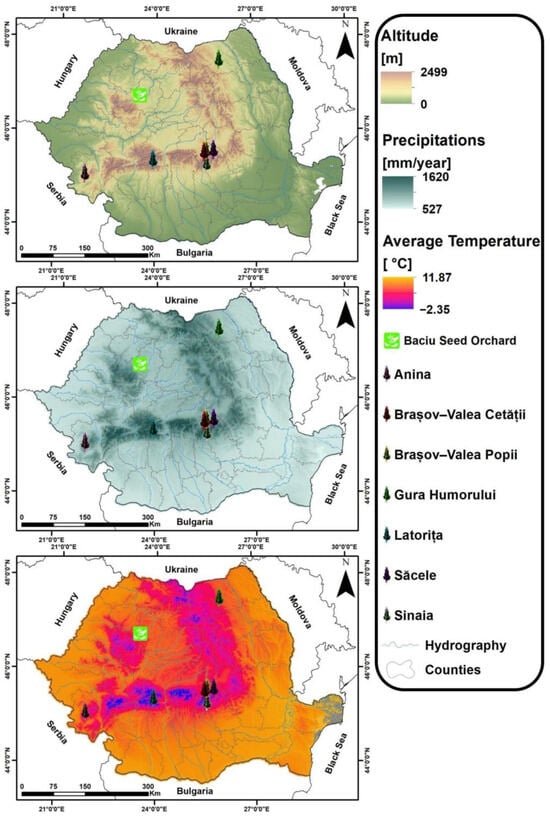
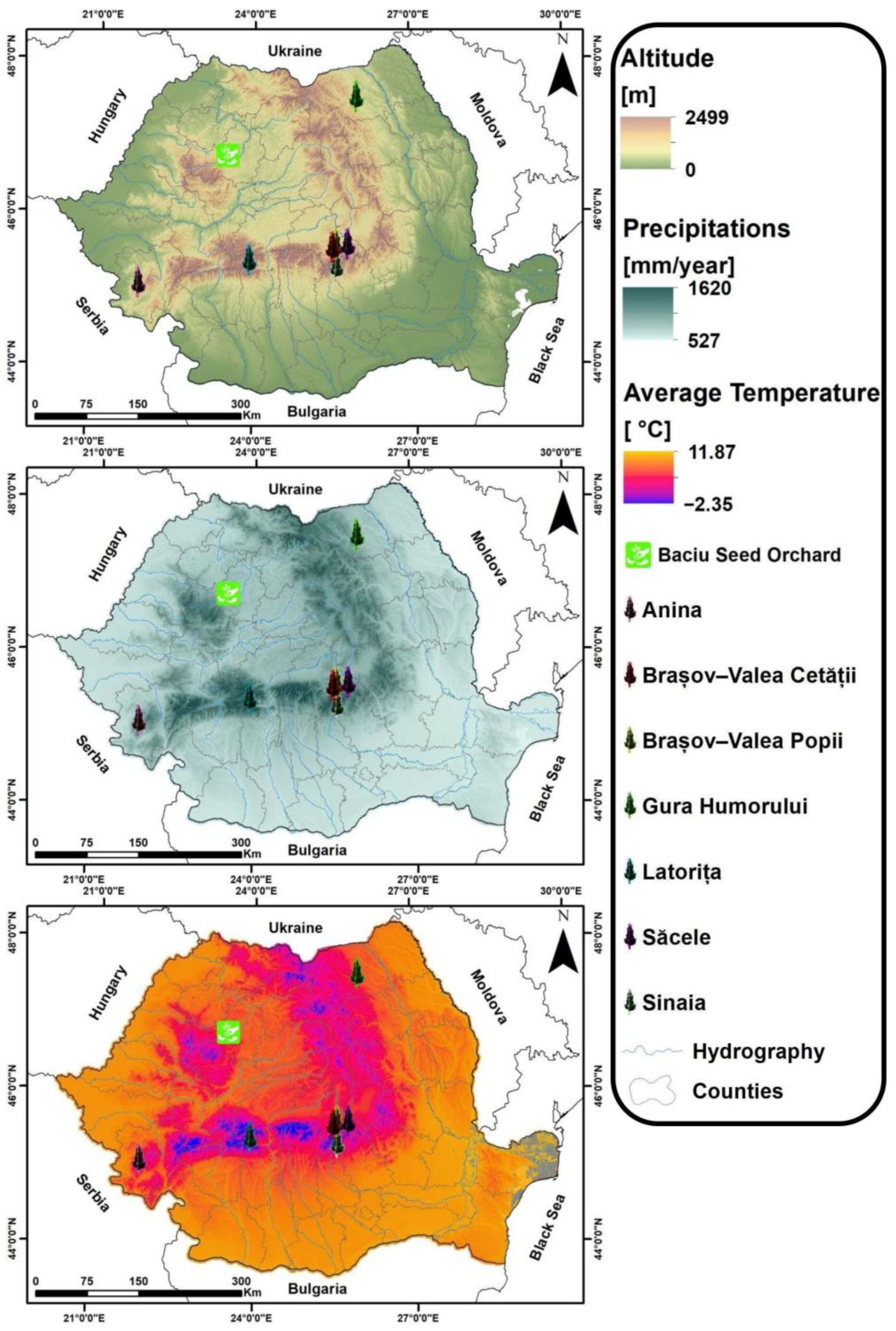
The biological material used in this study consisted of seven Larix decidua Mill. clones originating from distinct Romanian provenances: Gura Humorului, Brașov–Valea Cetății, Săcele, Brașov–Valea Popii, Sinaia, Anina, and Latorița (Figure 1). These clones originate from plus trees identified within natural or cultivated populations, selected based on superior phenotypic traits within a long-term breeding program. Scions collected from each plus tree were grafted onto uniform larch seedling rootstocks, and the resulting clones were planted in the Baciu seed orchard, near Cluj-Napoca, in 1975.
Figure 1.
Geographic origin of Larix decidua clones from seven Romanian provenances.
Thus, the reproductive material originates from seven provenances distributed across major sectors of the Romanian Carpathians. Gura Humorului lies in southern Bukovina, at the eastern flank of the Eastern Carpathians, in a montane depression. Anina is situated in the Banat Mountains of Caraș-Severin County, in a karstic depression of the south-western Carpathians. Sinaia is a well-known mountain locality on the Prahova Valley in the Southern Carpathians, while Săcele and the Brașov–Valea Cetății and Brașov–Valea Popii sites are positioned in Brașov County, at the foothills of major mountain massifs in south-eastern Transylvania. The Latorița provenance originates from the Latorița–Lotru mountain area of Vâlcea County, a rugged sector of the Southern Carpathians characterized by steep relief and extensive forest cover. Together, these locations form a coherent ecological gradient from lower-elevation, warmer regions to cooler and wetter montane environments, providing a strong environmental framework for interpreting the spatial patterns summarized in Figure 1 and Table 1.
Table 1.
Site characteristics and climatic conditions of the tested clones’ provenance.
For each provenance, bark samples were collected from 10 healthy, undamaged trees, selected randomly to ensure representative genetic and environmental variability. Sampling was conducted at breast height (1.3 m) by removing external and internal bark layers to obtain a sufficient mass of tissue for subsequent analyses. Immediately after sampling, the bark fragments were stored in paper containers, transported to the laboratory, and kept under controlled conditions until processing. The bark samples were collected during the active growing season, when secondary metabolite production is physiologically stable and representative for bark chemical characterization.
To minimize intra-provenance variability, bark from the trees belonging to the same clone group was homogenized to produce a composite sample per provenance. This approach ensured adequate material for the analytical procedures while reflecting the averaged biochemical characteristics of each genetic origin.
2.2. Thermal Treatments
Prior to chemical analyses, the composite bark samples were subjected to four drying regimes: Control (unheated; ambient laboratory conditions), 60 °C, 80 °C, and 100 °C, each applied for 2 h in a calibrated drying oven. The selected temperature range follows previous research on conifer bark thermochemical behavior, where similar conditions were shown to induce structural rearrangements, volatilization, and partial oxidation of extractives without causing extensive thermal degradation [38,44]. After treatment, the dried bark was manually fragmented and subsequently ground to a fine powder suitable for FT-IR and GC–MS evaluation.
2.3. Sample Preparation for FT-IR Spectroscopy
Bark samples were processed following established lignocellulosic spectroscopic protocols. After drying, each composite sample was chopped, milled, and sieved to obtain a uniform powder (<300 µm). A Retsch Grindomix GM 200 system (Retsch GmbH, Haan, Germany) was used to ensure consistent particle size and homogeneous blending.
For pellet preparation, 3 mg of bark powder were intimately mixed with 200 mg of spectroscopic-grade KBr previously calcined to eliminate moisture. The mixture was finely reground to achieve complete homogenization and then compressed into transparent pellets using a hydraulic press equipped with a stainless-steel pellet die (Specac Ltd., Orpington, UK).
FT-IR spectra were recorded with a Jasco FT/IR 4100 spectrometer (JASCO Corporation, Tokyo, Japan), operating at: Resolution: 4.0 cm−1, Spectral range: 4000–350 cm−1, Number of scans: 256 per sample.
Spectra Manager software (Jasco, Tokyo, Japan) was used to apply baseline corrections (including CO2 and H2O compensation) prior to peak identification and interpretation. Wavenumber assignments and band attributions were performed with reference to established literature on wood and bark chemistry [27,31,45], and spectral data were processed in OriginLab Origin (OriginLab Corporation, Northampton, MA, USA) for peak fitting and comparative analysis.
2.4. Preparation and GC–MS Analysis of Volatile Compounds
Chemical profiling of volatile and semi-volatile compounds was conducted via Gas Chromatography–Mass Spectrometry (GC–MS). Dried bark samples were milled using an electric grinder and sieved to retain powder < 400 µm. Approximately 3 g of powdered bark were extracted by Ultrasound-Assisted Extraction (UAE) in 5 mL dichloromethane, using an ultrasonic bath (USC-1400A; 40 kHz; 135 W). DCM acts as a bridge between highly non-polar solvents (like hexane) and polar ones (like ethanol). It typically extracts: terpenoids, lipids and fatty acids. Dichloromethane was selected as the extraction solvent to specifically profile the lipophilic fraction and low-polarity secondary metabolites (such as diterpenes and free phytosterols). This choice ensures that the GC-MS system remains free from non-volatile polar interferents like condensed tannins and sugars, which are characteristic of L. decidua bark but not suitable for direct GC-MS analysis. To minimize analyte loss, sonication was performed at 0–5 °C in an ice bath. After extraction, samples were centrifuged, and the supernatant was transferred to autosampler vials for analysis. The extracts were centrifuged at 10,000 rpm for 10 min, at room temperature to remove any insoluble botanical matrix before analysis.
GC–MS analyses were performed on a Shimadzu QP 2010 PLUS system (Shimadzu, Kyoto, Japan) equipped with an AOC-20i+s autosampler (Shimadzu). Separation of volatile compounds was achieved using a ZB-5MS Plus column (30 m × 250 µm × 0.25 µm; Phenomenex, Torrance, CA, USA). Chromatographic conditions included: Initial temperature: 40 °C for 2 min, Ramp: 20 °C min−1 to 300 °C, Final hold: 5 min.
Injection was performed in splitless mode at 250 °C, with helium as the carrier gas (0.8 mL min−1). The MS operated in EI mode at 70 eV, with the ion source set at 220 °C and spectra recorded over m/z 35–800. Compound identification was carried out by comparison of mass spectra with NIST 27 and Wiley libraries.
2.5. Data Processing and Statistical Analyses
The concentrations of FT-IR and GC–MS variables were expressed as mean values derived from replicate measurements. Statistical analyses were performed to evaluate the effects of provenance, drying temperature, and their interaction. A multifactorial ANOVA model was applied to detect statistically significant differences among provenances and treatments. Prior to ANOVA, datasets were checked for normality and homoscedasticity; whenever assumptions were violated, transformations were applied. Post hoc comparisons were conducted using Duncan’s Multiple Range Test (α < 0.05) to identify pairwise differences. To evaluate similarity patterns and chemical clustering among provenances, Principal Component Analysis (PCA) and Hierarchical Cluster Analysis (HCA, single-linkage) were performed using PAST v.4.17 [46]. Heatmaps and dendrograms were generated to visualize grouping tendencies and co-occurrence patterns among volatile constituents.
3. Results
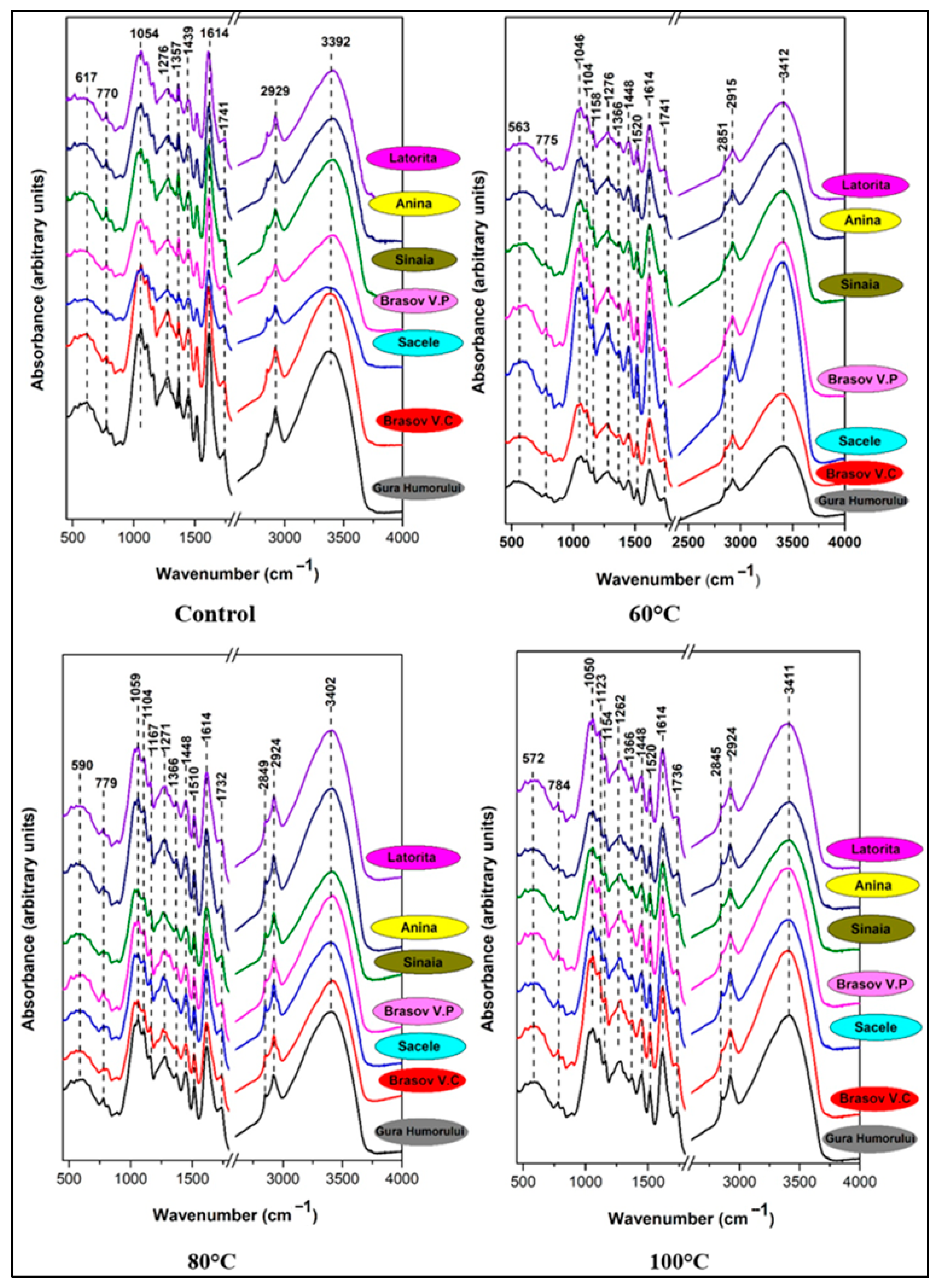
The analyses performed in this study revealed clear differences in the chemical composition of L. decidua bark as influenced by both drying temperature and clone provenance. The FT-IR spectra provided a consistent overview of the structural features associated with cellulose, hemicellulose, lignin, and extractive components. Across all samples, the major absorption bands characteristic of lignocellulosic tissues were present, including the O–H stretching region around 3390–3412 cm−1, the aliphatic C–H stretching between 2915 and 2851 cm−1, the carbonyl bands near 1732–1741 cm−1, and several aromatic and polysaccharide-related peaks between 1600 and 1000 cm−1. The complete assignment of these bands is presented in Table 2.
Table 2.
Characteristic FT-IR absorption bands (4000–350 cm−1) of L. decidua bark under different drying treatments.
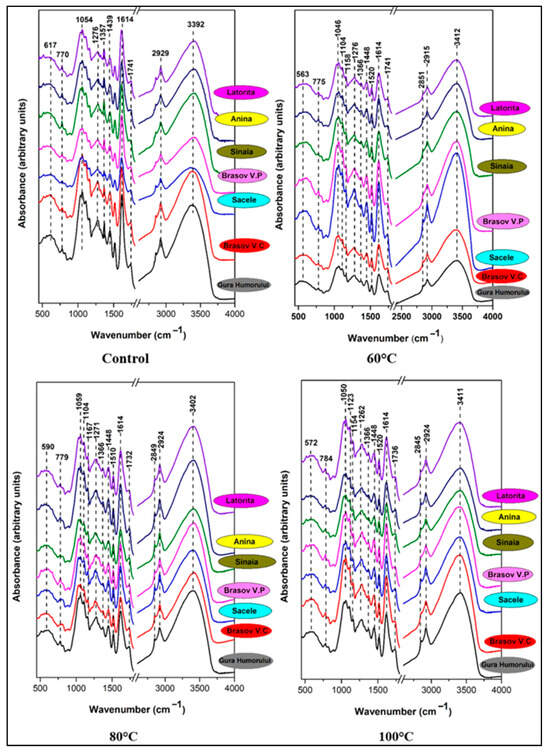
Although all provenances shared the same general spectral structure, drying temperature produced subtle but systematic shifts in several regions. These included slight upward movements of the O–H stretching maxima in heat-treated samples compared to the untreated control and small positional changes in the aliphatic C–H deformation region around 770–784 cm−1. Variations in the definition and relative intensity of the carbonyl region were also observed. These differences, visible in Figure 2, indicate measurable modifications in the vibrational environment of functional groups following exposure to increasing temperatures, although the overall spectral profile remained intact in all samples.
Figure 2.
FT-IR spectra of L. decidua bark samples from seven provenances subjected to four drying temperatures (control, 60, 80, and 100 °C).
The GC–MS analysis provided a detailed chemical fingerprint of volatile and semi-volatile compounds present in the bark powder subjected to the four drying regimes, targeting primarily lipophilic and low-polarity secondary metabolites such as terpenoids, esterified diterpenes, lipid-derived amides, and resin-related compounds. A consistent group of compounds was identified across all provenances, including α-pinene (>95%), larixol (>85%), tributyl acetylcitrate (>90%), 9-octadecenamide (>85%), cycloartanol acetate (>90), kauren-18-ol acetate (>87%), caryophyllene oxide (>85%), retinol acetate (>83) several bicyclic alcohols, and a series of higher-molecular-weight terpenoid and lipid-derived metabolites. The complete dataset for each provenance × temperature combination appears in Table A1 and Table A2. These tables show that the concentrations of most compounds varied markedly not only in response to thermal exposure but also between provenances originating from different geographic regions.
The interaction between provenance and drying temperature was evident in almost all quantified metabolites. For several compounds, such as α-pinene and larixol, the response to heating differed strongly between provenances, with some showing increased abundance at moderate temperatures and others showing either minimal change or pronounced reductions. Esters such as tributyl acetylcitrate and lipid-derived amides such as 9-octadecenamide displayed distinct patterns among provenances, with marked increases at higher temperatures in some clones, while remaining low or undetectable in others. Diterpenoid and triterpenoid acetates exhibited similarly divergent responses, indicating that each provenance expressed a characteristic thermochemical behavior across the four drying treatments.
When the influence of provenance was evaluated independently of temperature, significant differences emerged among the seven geographic origins. As shown in Table 3, the average concentrations of α-pinene, larixol, esters, amides, and triterpenoid acetates varied widely across provenances, with some clones exhibiting consistently higher values across all treatments. Table 4 further demonstrates that provenance influenced the abundance of bicyclic alcohols, diterpenoid acetates, aromatic oxidation products, sesquiterpenoid oxides such as caryophyllene oxide, and retinol acetate. These results show that each provenance possesses a distinct chemical profile, reflecting underlying genetic differentiation in bark extractives.
Table 3.
Provenance-dependent variation in volatile and semi-volatile compounds of L. decidua bark.
Table 4.
Differences in higher-molecular-weight and oxidative compounds among L. decidua provenances.
Drying temperature on its own also exerted a strong influence on the abundance of most compounds. According to Table 5, α-pinene reached its highest mean concentration at 60 °C and decreased progressively at higher temperatures, while esters such as tributyl acetylcitrate and lipid-derived compounds such as 9-octadecenamide increased steadily from the control to 100 °C. Cycloartanol acetate exhibited a different temperature response, with the highest mean concentration recorded at 60 °C. Table 6 shows that kauren-18-ol acetate reached maximal levels at 80 °C, whereas caryophyllene oxide exhibited its highest concentrations at 100 °C. Retinol acetate increased at intermediate temperatures and declined slightly at the highest one. These patterns show that compound classes differed in their thermal behavior, producing consistent temperature-dependent profiles across provenances.
Table 5.
Effect of drying temperature on major volatile and semi-volatile compounds of L. decidua bark.
Table 6.
Temperature-dependent variation in diterpenoid acetates, oxidized sesquiterpenoids, and lipid-derived compounds.
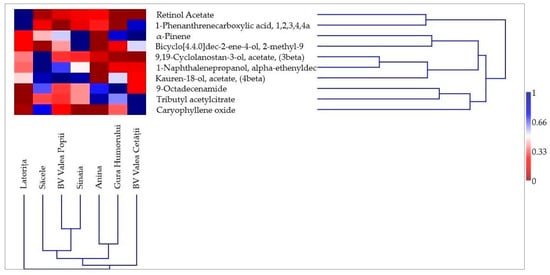
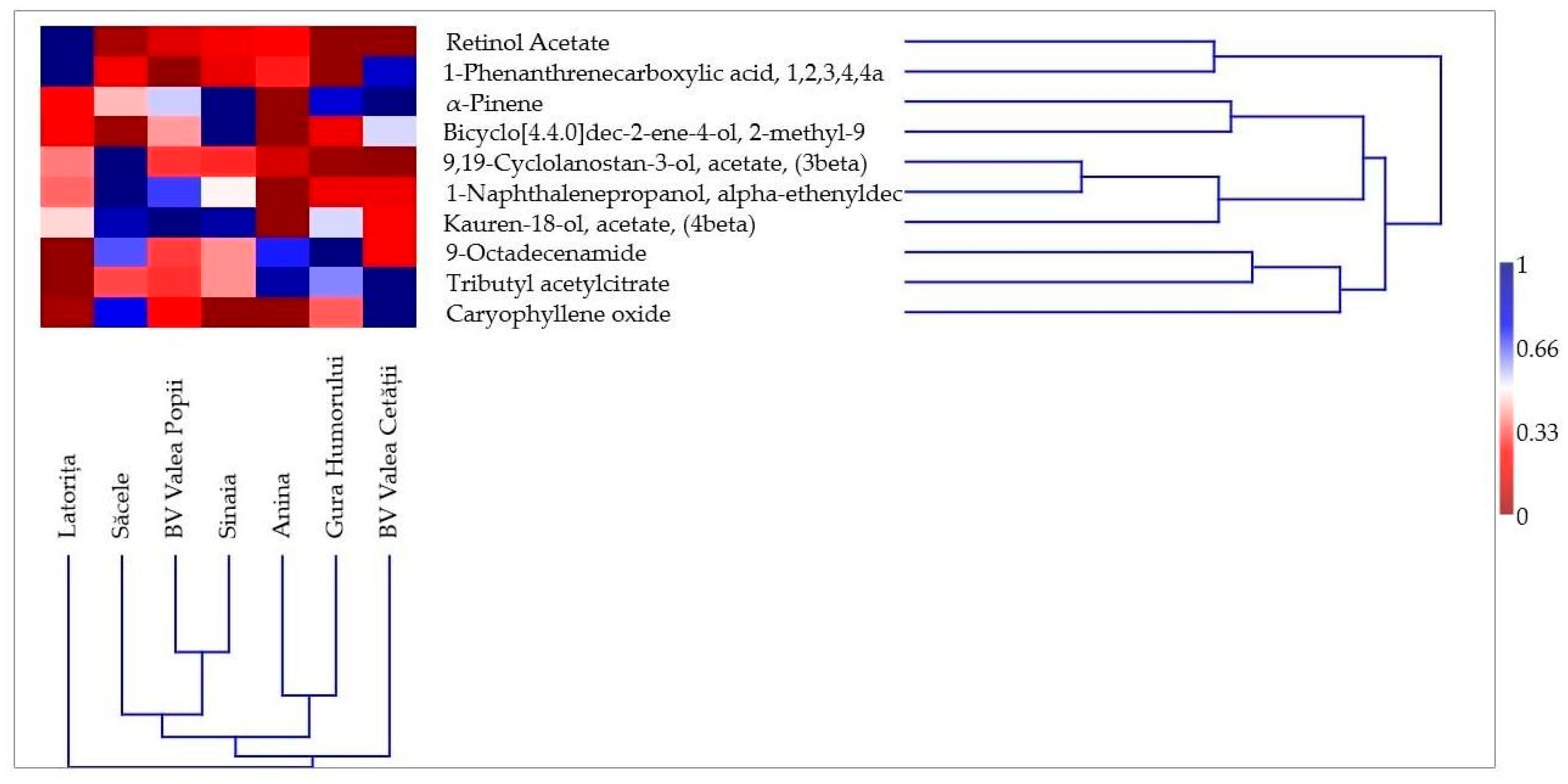
Finally, hierarchical clustering of volatile compounds revealed structured chemical differences among the seven provenances, as illustrated in Figure 3. The heatmap highlighted consistent variation in metabolite intensities, while the dendrogram grouped provenances according to similarity in their chemical profiles. Compounds also clustered into coherent groups based on co-occurrence patterns, indicating shared biosynthetic origins or similar responses to drying conditions.
Figure 3.
Heatmap and UPGMA hierarchical clustering of volatile compounds identified in bark of seven L. decidua provenances.
Together, these multivariate patterns confirm the chemical differentiation observed in the univariate analyses and demonstrate that both provenance and drying temperature play substantial roles in shaping the bark metabolite landscape.
4. Discussion
4.1. Structural Modifications Revealed by FT-IR
FT-IR spectroscopy captured consistent temperature-dependent shifts in functional group regions associated with the major lignocellulosic components of bark. The progressive displacement of the O–H stretching band and alterations in the C–H deformation and C=O stretching regions indicate modifications in hydrogen-bonding networks and partial rearrangements within cellulose, hemicellulose, and lignin matrices. Several bark extractives, particularly phenolic compounds, lignans, and terpenoid alcohols containing hydroxyl groups, contribute to the O–H stretching features observed in the FT-IR spectra and are known to play an important role in antioxidant activity, thermal responsiveness, and chemical interactions during bark processing.
Similar spectral behavior has been reported in studies on conifer bark and wood subjected to moderate heating, where bound water removal and polymer mobility contribute to subtle peak shifts without complete degradation of biopolymers [26,29,51].
The observed spectral changes are consistent with polymer relaxation phenomena and the mobilization of extractives, which can modify vibrational intensities by reorienting aromatic and aliphatic groups. The provenance-specific variability in peak displacement further suggests intrinsic differences in lignin composition, polysaccharide crystallinity, and extractive abundance among clones. Such differences have been associated with adaptive responses to local environmental conditions in other larch populations [27,54].
4.2. Temperature-Driven Adjustments in Volatile and Semi-Volatile Compounds
Thermal treatment had a pronounced impact on the chemical profile of bark, supporting earlier findings that temperature modulates volatilization, oxidation, esterification, and decomposition pathways in conifer tissues [34,37].
The present results show that moderate heating (60–80 °C) tends to enhance the release and stabilization of monoterpenes, esters, terpenoid alcohols, and certain triterpenoid acetates. Several compounds, including α-pinene and kauren-18-ol acetate, peaked at intermediate temperatures, consistent with partial resin mobility and increased extractive availability. High-temperature exposure (100 °C) favored the formation of oxidized sesquiterpenoids, fatty-acid-derived amides, and aromatic acids, reflecting thermally induced oxidative transformations. These patterns align with known volatilization thresholds for monoterpenes and oxidation sensitivities of resin acids, where temperatures above 90–100 °C shift the balance from release to degradation or structural rearrangement [25,43]. The marked increases in 9-octadecenamide and caryophyllene oxide at higher temperatures align with lipid oxidation processes typically triggered during thermal stress.
4.3. Provenance-Dependent Biochemical Differentiation
Provenance exerted a strong influence on chemical composition, reflecting genetic divergence and ecophysiological adaptation across geographic and climatic gradients. Consistent with previous research on larch variation [40,41,42], the seven provenances displayed distinct metabolite fingerprints. Thus, provenances from cooler or mid-altitude regions (e.g., Săcele, Sinaia) generally exhibited higher levels of terpenoids and diterpenoid acetates, compounds frequently associated with enhanced defensive capacity and resin biosynthesis. Southern or warmer provenances (e.g., Anina, Latorița) showed increased abundance of oxidative derivatives and lipid-derived esters, potentially linked to long-term exposure to higher temperatures and metabolic turnover rates.
Biochemical distinctions observed may have ecological relevance, as secondary metabolites in bark contribute to protection against pathogens, herbivores, and abiotic stress [10,43]. From a breeding perspective, such differences support the existence of stable genetic variation for chemical traits relevant to resin quality and bioactive compound production.
4.4. Interaction Between Ecological Conditions and Provenance
In contrast to the Baciu area, the native provenances are located in cooler and wetter environments, with precipitation values frequently exceeding 850–940 mm/year and lower average annual temperatures. These climatic differences suggest that trees growing in the orchard were exposed to relatively warmer and drier growth conditions compared to those of their regions of origin. Such environmental divergence between the planting site and the seed source regions likely influenced physiological acclimation processes, including the synthesis of secondary metabolites in bark tissues. Trees cultivated under warmer and drier conditions may experience moderate water and thermal stress, which is known to stimulate the production of resinous compounds, terpenoids, and phenolic fractions as protective mechanisms. Conversely, provenances originating from cooler and more humid mountainous regions may retain genetic and biochemical traits adapted to cold and moisture-rich environments. The observed thermochemical variability of L. decidua bark among provenances can therefore be interpreted as the combined effect of genetic heredity, ecological conditions in the areas of origin, and environmental imprinting at the orchard site.
The mismatch between the ecological conditions of origin and the plantation reinforced the expression of adaptive biochemical traits, highlighting the relevance of integrating geospatial and climatic information into the interpretation of wood and bark quality. These spatially explicit environmental datasets provide valuable context for understanding provenance-specific performance and the adaptive capacity of forest reproductive material under changing climatic regimes [9,67,68].
The strong provenance × temperature interactions revealed by GC–MS underscore the complexity of bark biochemical responses. Provenances differed not only in baseline metabolite levels but also in thermal plasticity, the degree to which compound concentrations increased, decreased, or remained stable under heating. This pattern suggests that the chemical behavior of larch bark under thermal exposure is influenced by genotype-specific metabolic pathways, the composition of resin ducts, and the relative abundance of heat-sensitive versus heat-stable metabolites.
Genotype × environment interactions are directly relevant for breeding under climate change because they reveal differences in thermochemical plasticity and stability among provenances. In this study, provenances differed not only in baseline bark chemistry but also in their response to thermal stress, indicating genetically controlled variation in metabolic resilience. Such information supports the selection of genotypes with stable or desirable chemical profiles under increased temperature regimes, which is essential for breeding programs targeting climate resilience and consistent biomass quality.
Such interactions have been observed in other conifer species, where genetic origin shapes the temperature responsiveness of terpene synthases, lipid oxidation cascades, and phenolic biosynthesis [13,35]. The multivariate clustering patterns in this study further demonstrate that provenance-specific chemical signatures remain detectable even after thermal processing.
4.5. Implications for Bark Valorization and Breeding Programs
The combined FT-IR and GC–MS findings highlight the potential of L. decidua bark as a high-value source of extractives with applications in pharmaceuticals, bio-based materials, fragrances, coatings, adhesives, and antioxidants. The identification of genotypes with superior concentrations of terpenoids, diterpenoid acetates, and lipid-derived compounds supports the feasibility of selecting elite provenances for: resin-oriented breeding programs; optimizing drying protocols to maximize extractive recovery while minimizing compound degradation; provenance-tailored extraction strategies matched to chemical profiles. Moreover, the clear thermochemical stability patterns observed in Săcele and Sinaia provenances suggest promising candidates for resin-quality improvement and industrial exploitation.
From an applied perspective, the identified bark compounds have direct relevance for industrial valorization pathways. Phenolic-rich and lignin-derived fractions from larch bark may serve as functional components in bio-based adhesive systems, where aromatic structures contribute to bonding performance and thermal stability. In addition, terpenoid and phenolic containing extracts represent promising sources of natural antioxidants that can be integrated into polymer additives, coatings or biorefinery streams. Such applications benefit from provenance-dependent chemical variability, allowing the selection of genotypes tailored to specific industrial end uses.
4.6. Methodological Considerations
The integration of FT-IR and GC–MS provided complementary insights into bark chemistry. FT-IR captured structural modifications and functional group distributions, whereas GC–MS resolved individual metabolites with high sensitivity.
The use of composite samples per provenance minimized tree-level variability but may have reduced the resolution of within-clone biochemical diversity. Nonetheless, the strong statistical signals and consistent multivariate clustering confirm the robustness of the approach.
Overall, the study demonstrates that bark chemistry in L. decidua is shaped by both genetic background and thermal environment, with significant implications for bark valorization, ecophysiology, and breeding. The clear provenance differentiation and temperature-dependent patterns provide a foundation for selecting improved genotypes and optimizing processing methods for industrial applications.
5. Conclusions
This study demonstrates that both provenance and drying temperature significantly influence the structural and chemical composition of Larix decidua bark. FT-IR analysis revealed temperature-dependent shifts in functional groups associated with cellulose, hemicellulose, lignin, and extractives, indicating subtle rearrangements of polymeric structures and hydrogen-bonding networks. Complementary GC–MS profiling identified distinct quantitative patterns across provenances and treatments, confirming that the abundance of monoterpenes, terpenoid alcohols, diterpenoid acetates, lipid-derived amides, esters, and oxidative derivatives is shaped by both genetic origin and thermal exposure.
Moderate drying (60–80 °C) favored the release and stabilization of several terpenoid and ester compounds, whereas exposure to 100 °C enhanced oxidation and the formation of lipid- and resin-derived derivatives. Provenances from cooler or mid-altitude regions exhibited higher terpenoid concentrations and greater thermochemical resilience, while warmer-climate provenances tended to accumulate more oxidative and lipid-derived products.
The integration of FT-IR and GC–MS provides a robust framework for characterizing thermally induced and genetic variation in bark chemistry. These findings highlight the potential of certain provenances, i.e., particularly Săcele, Sinaia, and Brașov-Valea Popii, as promising candidates for breeding programs targeting improved resin yield and bioactive compound profiles. Additionally, understanding temperature-dependent behavior offers valuable guidance for optimizing drying and extraction protocols, supporting the efficient valorization of larch bark within sustainable, circular bioeconomy strategies. Future research should focus on in-depth metabolomic profiling to resolve genotype-specific biosynthetic pathways and on field-based validation of elite provenances to assess the stability of bark chemical traits under variable environmental conditions.
Author Contributions
Conceptualization, P.T., A.M.T. and L.D.; methodology, I.M.M., R.S., E.G. and P.S.; software, E.G., P.S. and A.F.S.; validation, P.S., A.F.S. and L.D.; formal analysis, P.T., I.M.M., E.G., C.D. and A.M.T.; investigation, P.T., I.M.M., R.S., E.G. and A.M.T.; resources, P.T., C.D. and L.D.; data curation, P.T., I.M.M., and A.M.T.; writing—original draft preparation, P.T., I.M.M., C.D. and A.M.T.; writing—review and editing, A.F.S. and L.D.; visualization, R.S., E.G. and P.S.; supervision, R.S., A.F.S. and L.D.; project administration, P.T. and L.D.; funding acquisition, C.D., P.S. and A.M.T. All authors have read and agreed to the published version of the manuscript.
Funding
This research was conducted with partial support for P.T. from the Doctoral School of the Babeș-Bolyai University, Faculty of Physics, Cluj-Napoca, Romania.
Data Availability Statement
The original contributions presented in this study are included in the article. Further inquiries can be directed to the corresponding author.
Acknowledgments
The authors acknowledge and thank the University of Babeș-Bolyai (UBB) and the University of Agricultural Sciences and Veterinary Medicine (USAMV) in Cluj-Napoca for providing the infrastructure and laboratory facilities necessary for this research.
Conflicts of Interest
The authors declare no conflicts of interest.
Appendix A
Table A1.
Interaction between provenance and drying temperature for major monoterpenes, terpenoid alcohols, esters, and fatty acid derivatives of L. decidua bark.
Table A2.
Interaction between provenance and drying temperature for diterpenoid acetates, aromatic acids, sesquiterpenoid oxides, and lipid-derived compounds in L. decidua bark.
References
- Agarwal, C.; Hofmann, T.; Vršanská, M.; Schlosserová, N.; Visi-Rajczi, E.; Voběrková, S.; Pásztory, Z. In vitro antioxidant and antibacterial activities with polyphenolic profiling of wild cherry, the European larch and sweet chestnut tree bark. Eur. Food Res. Technol. 2021, 247, 2355–2370. [Google Scholar] [CrossRef] [Scilit]
- Pasztory, Z.; Mohácsiné, I.R.; Gorbacheva, G.; Börcsök, Z. The utilization of tree bark. BioResources 2016, 11, 7859–7888. [Google Scholar] [CrossRef] [Scilit]
- Kain, G.; Barbu, M.-C.; Teischinger, A.; Musso, M.; Petutschnigg, A. Substantial Bark Use as Insulation Material. For. Prod. J. 2012, 62, 480–487. [Google Scholar] [CrossRef] [Scilit]
- Arosio, T.; Ziehmer-Wenz, M.M.; Nicolussi, K.; Schlüchter, C.; Leuenberger, M. Larch Cellulose Shows Significantly Depleted Hydrogen Isotope Values With Respect to Evergreen Conifers in Contrast to Oxygen and Carbon Isotopes. Front. Earth Sci. 2020, 8, 523073. [Google Scholar] [CrossRef] [Scilit]
- Nosek, R.; Holubcik, M.; Jandacka, J. The impact of bark content of wood biomass on biofuel properties. BioResources 2016, 11, 44–53. [Google Scholar] [CrossRef] [Scilit]
- Muys, B.; Angelstam, P.; Bauhus, J.; Bouriaud, L.; Jactel, H.; Kraigher, H.; Müller, J.; Pettorelli, N.; Pötzelsberger, E.; Primmer, E. Forest Biodiversity in Europe; European Forest Institute: Joensuu, Finland, 2022. [Google Scholar]
- Sestras, P.; Bondrea, M.V.; Cetean, H.; Sălăgean, T.; Bilașco, Ş.; Naș, S.; Spalevic, V.; Fountas, S.; Cîmpeanu, S.M. Ameliorative, ecological and landscape roles of Făget Forest, Cluj-Napoca, Romania, and possibilities of avoiding risks based on GIS landslide susceptibility map. Not. Bot. Horti Agrobot. 2018, 46, 292–300. [Google Scholar] [CrossRef] [Scilit]
- Curovic, M.; Spalevic, V.; Sestras, P.; Motta, R.; Dan, C.; Garbarino, M.; Vitali, A.; Urbinati, C. Structural and ecological characteristics of mixed broadleaved old-growth forest (Biogradska Gora-Montenegro). Turk. J. Agric. For. 2020, 44, 428–438. [Google Scholar] [CrossRef] [Scilit]
- Sestras, A.F.; Sălăgean, T.; Roman, A.M.; Morar, I.M.; Dan, C.; Truta, A.M.; Sestras, R.E.; Dudescu, M.C.; Spalevic, V.; Kader, S.; et al. Growth and resistance to mechanical stress in the young phase of black locust (Robinia pseudoacacia L.) trees based on geographical provenances. J. Environ. Manag. 2025, 384, 125465. [Google Scholar] [CrossRef] [Scilit]
- Ferreres, F.; Gomes, N.G.M.; Valentão, P.; Pereira, D.M.; Gil-Izquierdo, A.; Araújo, L.; Silva, T.C.; Andrade, P.B. Leaves and stem bark from Allophylus africanus P. Beauv.: An approach to anti-inflammatory properties and characterization of their flavonoid profile. Food Chem. Toxicol. 2018, 118, 430–438. [Google Scholar] [CrossRef] [Scilit]
- Tanase, C.; Coșarcă, S.; Muntean, D.-L. A Critical Review of Phenolic Compounds Extracted from the Bark of Woody Vascular Plants and Their Potential Biological Activity. Molecules 2019, 24, 1182. [Google Scholar] [CrossRef] [Scilit]
- Sharmeen, J.B.; Mahomoodally, F.M.; Zengin, G.; Maggi, F. Essential Oils as Natural Sources of Fragrance Compounds for Cosmetics and Cosmeceuticals. Molecules 2021, 26, 666. [Google Scholar] [CrossRef] [Scilit] [PubMed]
- Ul’yanovskii, N.V.; Onuchina, A.A.; Faleva, A.V.; Gorbova, N.S.; Kosyakov, D.S. Comprehensive Characterization of Chemical Composition and Antioxidant Activity of Lignan-Rich Coniferous Knotwood Extractives. Antioxidants 2022, 11, 2338. [Google Scholar] [CrossRef] [Scilit]
- Falev, D.I.; Voronov, I.S.; Onuchina, A.A.; Faleva, A.V.; Ul’yanovskii, N.V.; Kosyakov, D.S. Analysis of Softwood Lignans by Comprehensive Two-Dimensional Liquid Chromatography. Molecules 2023, 28, 8114. [Google Scholar] [CrossRef] [Scilit]
- Tudor, E.M.; Scheriau, C.; Barbu, M.C.; Réh, R.; Krišťák, Ľ.; Schnabel, T. Enhanced Resistance to Fire of the Bark-Based Panels Bonded with Clay. Appl. Sci. 2020, 10, 5594. [Google Scholar] [CrossRef] [Scilit]
- Vangeel, T.; Neiva, D.M.; Quilhó, T.; Costa, R.A.; Sousa, V.; Sels, B.F.; Pereira, H. Tree bark characterization envisioning an integrated use in a biorefinery. Biomass Convers. Biorefin. 2023, 13, 2029–2043. [Google Scholar] [CrossRef] [Scilit]
- Truta, A.; Crisan, L.M.; Sestras, A.F.; Holonec, L.; Sestras, R.E. Genetic variation and potential genetic resources of several Romanian larch populations. Turk. J. Agric. For. 2017, 41, 82–91. [Google Scholar] [CrossRef] [Scilit]
- Da Ronch, F.; Caudullo, G.; Tinner, W.; De Rigo, D. Larix decidua and other larches in Europe: Distribution, habitat, usage and threats. In European Atlas of Forest Tree Species; Publication Office of the European Union: Luxembourg, 2016; pp. 108–110. [Google Scholar]
- Danek, M.; Chuchro, M.; Walanus, A. Variability in Larch (Larix decidua Mill.) Tree-Ring Growth Response to Climate in the Polish Carpathian Mountains. Forests 2017, 8, 354. [Google Scholar] [CrossRef] [Scilit]
- Dietemann, P.; Miller, K.V.; Höpker, C.; Baumer, U. On the Use and Differentiation of Resins from Pinaceae Species in European Artworks Based on Written Sources, Reconstructions and Analysis. Stud. Conserv. 2019, 64, S62–S73. [Google Scholar] [CrossRef] [Scilit]
- Hillebrand, L.; Marzini, S.; Crespi, A.; Hiltner, U.; Mina, M. Contrasting impacts of climate change on protection forests of the Italian Alps. Front. For. Glob. Change 2023, 6, 1240235. [Google Scholar] [CrossRef] [Scilit]
- Jankovský, M.; Dvořák, J.; Löwe, R.; Natov, P.; Nuhlíček, O. Double bark thickness estimation models of common European broadleaved species for harvester timber volume estimation in Czechia. Croat. J. For. Eng. J. Theory Appl. For. Eng. 2023, 44, 95–102. [Google Scholar] [CrossRef] [Scilit]
- Ba, T.; Chaala, A.; Garcia-Perez, M.; Rodrigue, D.; Roy, C. Colloidal Properties of Bio-oils Obtained by Vacuum Pyrolysis of Softwood Bark. Characterization of Water-Soluble and Water-Insoluble Fractions. Energy Fuels 2004, 18, 704–712. [Google Scholar] [CrossRef] [Scilit]
- Boucher, M.E.; Chaala, A.; Roy, C. Bio-oils obtained by vacuum pyrolysis of softwood bark as a liquid fuel for gas turbines. Part I: Properties of bio-oil and its blends with methanol and a pyrolytic aqueous phase. Biomass Bioenergy 2000, 19, 337–350. [Google Scholar] [CrossRef] [Scilit]
- Shao, Q.; Wang, C.; Liu, H.; Wang, Y.; Guo, J. Reaction mechanism and evolved gases of larch bark pyrolysis by TG-FTIR analysis. Wood Sci. Technol. 2019, 53, 101–118. [Google Scholar] [CrossRef] [Scilit]
- Pandey, K.K.; Pitman, A.J. FTIR studies of the changes in wood chemistry following decay by brown-rot and white-rot fungi. Int. Biodeterior. Biodegrad. 2003, 52, 151–160. [Google Scholar] [CrossRef] [Scilit]
- Rana, R.; Müller, G.; Naumann, A.; Polle, A. FTIR spectroscopy in combination with principal component analysis or cluster analysis as a tool to distinguish beech (Fagus sylvatica L.) trees grown at different sites. Holzforschung 2008, 62, 530–538. [Google Scholar] [CrossRef] [Scilit]
- Gandolfo, D.S.; Mortimer, H.; Woodhall, J.W.; Boonham, N. Fourier transform infra-red spectroscopy using an attenuated total reflection probe to distinguish between Japanese larch, pine and citrus plants in healthy and diseased states. Spectrochim. Acta Part A Mol. Biomol. Spectrosc. 2016, 163, 181–188. [Google Scholar] [CrossRef] [Scilit]
- Traoré, M.; Kaal, J.; Martínez Cortizas, A. Differentiation between pine woods according to species and growing location using FTIR-ATR. Wood Sci. Technol. 2018, 52, 487–504. [Google Scholar] [CrossRef] [Scilit]
- Chen, H.; Ferrari, C.; Angiuli, M.; Yao, J.; Raspi, C.; Bramanti, E. Qualitative and quantitative analysis of wood samples by Fourier transform infrared spectroscopy and multivariate analysis. Carbohydr. Polym. 2010, 82, 772–778. [Google Scholar] [CrossRef] [Scilit]
- Popescu, C.-M.; Popescu, M.-C.; Singurel, G.; Vasile, C.; Argyropoulos, D.S.; Willfor, S. Spectral Characterization of Eucalyptus Wood. Appl. Spectrosc. 2007, 61, 1168–1177. [Google Scholar] [CrossRef] [Scilit]
- Cuello, C.; Marchand, P.; Laurans, F.; Grand-Perret, C.; Lainé-Prade, V.; Pilate, G.; Déjardin, A. ATR-FTIR microspectroscopy brings a novel insight into the study of cell wall chemistry at the cellular level. Front. Plant Sci. 2020, 11, 105. [Google Scholar] [CrossRef] [Scilit]
- Ribechini, E.; Mangani, F.; Colombini, M.P. Chemical investigation of barks from broad-leaved tree species using EGA-MS and GC/MS. J. Anal. Appl. Pyrolysis 2015, 114, 235–242. [Google Scholar] [CrossRef] [Scilit]
- Czajka, M.; Fabisiak, B.; Fabisiak, E. Emission of Volatile Organic Compounds from Heartwood and Sapwood of Selected Coniferous Species. Forests 2020, 11, 92. [Google Scholar] [CrossRef] [Scilit]
- Garcia, G.; Garcia, A.; Gibernau, M.; Bighelli, A.; Tomi, F. Chemical compositions of essential oils of five introduced conifers in Corsica. Nat. Prod. Res. 2017, 31, 1697–1703. [Google Scholar] [CrossRef] [Scilit]
- Batista, J.V.; Melo, M.N.d.O.; Holandino, C.; Maier, J.; Huwyler, J.; Baumgartner, S.; Boylan, F. Characterization of Larix decidua Mill. (Pinaceae) oleoresin’s essential oils composition using GC-MS. Front. Plant Sci. 2024, 14, 1331894. [Google Scholar] [CrossRef] [Scilit]
- Kain, G.; Stratev, D.; Tudor, E.; Lienbacher, B.; Weigl, M.; Barbu, M.-C.; Petutschnigg, A. Qualitative investigation on VOC-emissions from spruce (Picea abies) and larch (Larix decidua) loose bark and bark panels. Eur. J. Wood Wood Prod. 2020, 78, 403–412. [Google Scholar] [CrossRef] [Scilit]
- Ruiz-Aquino, F.; Feria-Reyes, R.; Rutiaga-Quiñones, J.G.; Robledo-Taboada, L.H.; Gabriel-Parra, R. Characterization of tannin extracts derived from the bark of four tree species by HPLC and FTIR. For. Sci. Technol. 2023, 19, 38–46. [Google Scholar] [CrossRef] [Scilit]
- Mihai, G.; Teodosiu, M. Genetic diversity and breeding of larch (Larix decidua Mill.) in Romania. Ann. For. Res. 2018, 62, 97–108. [Google Scholar] [CrossRef] [Scilit]
- Teodosiu, M.; Mihai, G.; Ciocîrlan, E.; Curtu, A.L. Genetic Characterisation and Core Collection Construction of European Larch (Larix decidua Mill.) from Seed Orchards in Romania. Forests 2023, 14, 1575. [Google Scholar] [CrossRef] [Scilit]
- Vîlcan, A.; Tăut, I.; Holonec, L.; Mihalte, L.; Sestras, R.E. The variability of different larch clone provenances on the response to the attack by its main pests and fungal diseases. Trees 2013, 27, 697–705. [Google Scholar] [CrossRef] [Scilit]
- Seki, K.; Orihashi, K.; Saito, N.; Kita, K.; Nakata, K. Relationship between the composition and distribution of nutritional substances, secondary metabolites, and internal secretory structures in the bark tissues of Larix gmelinii var. japonica, L. kaempferi, and their F1 hybrid and susceptibility to vole herbivory. J. For. Res. 2019, 24, 292–302. [Google Scholar] [CrossRef] [Scilit]
- Jiang, H.; Yan, S.; Meng, Z.; Zhao, S.; Jiang, D.; Li, P. Effects of the Larch–Ashtree Mixed Forest on Contents of Secondary Metabolites in Larix olgensis. Forests 2023, 14, 871. [Google Scholar] [CrossRef] [Scilit]
- Morar, I.M.; Stefan, R.; Dan, C.; Sestras, R.E.; Truta, P.; Medeleanu, M.; Ranga, F.; Sestras, P.; Truta, A.M.; Sestras, A.F. FT-IR and HPLC analysis of silver fir (Abies alba Mill.) bark compounds from different geographical provenances. Heliyon 2024, 10, e26820. [Google Scholar] [CrossRef] [Scilit]
- Faix, O. Classification of Lignins from Different Botanical Origins by FT-IR Spectroscopy. Holzforschung 1991, 45, 21–28. [Google Scholar] [CrossRef] [Scilit]
- Hammer, Ø.; Harper, D.A.T.; Ryan, P.D. PAST: Paleontological statistics software package for education and data analysis. Palaeontol. Electron. 2001, 4, 4–9. [Google Scholar]
- Tsaousis, P.C.; Sarafidou, M.; Soto Beobide, A.; Mathioudakis, G.N.; Filippi, K.; Bartzialis, D.; Andrikopoulos, K.S.; Giannoulis, K.D.; Danalatos, N.G.; Koutinas, A.A.; et al. Quantification of plant biomass composition via a single FTIR absorption spectrum supported by reference component extraction/isolation protocols. Biomass Conv. Bioref. 2025, 15, 25273–25288. [Google Scholar] [CrossRef] [Scilit]
- Santos, J.; Pereira, J.; Ferreira, N.; Paiva, N.; Ferra, J.; Magalhães, F.D.; Martins, J.M.; Dulyanska, Y.; Carvalho, L.H. Valorisation of non-timber by-products from maritime pine (Pinus pinaster, Ait) for particleboard production. Ind. Crops Prod. 2021, 168, 113581. [Google Scholar] [CrossRef] [Scilit]
- Evans, P.; Michell, A.; Schmalzl, K. Studies of the degradation and protection of wood surfaces. Wood Sci. Technol. 1992, 26, 151–163. [Google Scholar] [CrossRef] [Scilit]
- Yue, X.; Chen, X.; Li, H.; Ge, S.; Yang, Y.; Peng, W. Nano Ag/Co3O4 Catalyzed Rapid Decomposition of Robinia pseudoacacia Bark for Production Biofuels and Biochemicals. Polymers 2023, 15, 114. [Google Scholar] [CrossRef] [Scilit]
- Schwanninger, M.; Rodrigues, J.C.; Pereira, H.; Hinterstoisser, B. Effects of short-time vibratory ball milling on the shape of FT-IR spectra of wood and cellulose. Vib. Spectrosc. 2004, 36, 23–40. [Google Scholar] [CrossRef] [Scilit]
- He, L.; Hu, W.; Wei, Y. Lignocellulose Determination and Categorization Analysis for Biofuel Pellets Based on FT-IR Spectra. Adv. Infrared Spectrosc. 2022, 37, 14–22. [Google Scholar] [CrossRef] [Scilit]
- Popescu, C.-M.; Popescu, M.-C.; Vasile, C. Characterization of fungal degraded lime wood by FT-IR and 2D IR correlation spectroscopy. Microchem. J. 2010, 95, 377–387. [Google Scholar] [CrossRef] [Scilit]
- Piqueras, S.; Füchtner, S.; Rocha de Oliveira, R.; Gomez-Sanchez, A.; Jelavić, S.; Keplinger, T.; de Juan, A.; Thygesen, L.G. Understanding the formation of heartwood in larch using synchrotron infrared imaging combined with multivariate analysis and atomic force microscope infrared spectroscopy. Front. Plant Sci. 2020, 10, 1701. [Google Scholar] [CrossRef] [Scilit]
- McCann, M.C.; Chen, L.; Roberts, K.; Kemsley, E.K.; Sene, C.; Carpita, N.C.; Stacey, N.J.; Wilson, R.H. Infrared microspectroscopy: Sampling heterogeneity in plant cell wall composition and architecture. Physiol. Plant. 1997, 100, 729–738. [Google Scholar] [CrossRef] [Scilit] [PubMed]
- Zhang, Y.-L.; Chen, J.-B.; Lei, Y.; Zhou, Q.; Sun, S.-Q.; Noda, I. Discrimination of different red wine by Fourier-transform infrared and two-dimensional infrared correlation spectroscopy. J. Mol. Struct. 2010, 974, 144–150. [Google Scholar] [CrossRef] [Scilit]
- Faix, O.; Böttcher, J.H. The influence of particle size and concentration in transmission and diffuse reflectance spectroscopy of wood. Holz Als Roh-Werkst. 1992, 50, 221–226. [Google Scholar] [CrossRef] [Scilit]
- Colom, X.; Carrillo, F. Comparative Study of Wood Samples of the Northern Area of Catalonia by FTIR. J. Wood Chem. Technol. 2005, 25, 1–11. [Google Scholar] [CrossRef] [Scilit]
- Mohebby, B.; Ilbeighi, F.; Kazemi-Najafi, S. Influence of hydrothermal modification of fibers on some physical and mechanical properties of medium densityfiberboard (MDF). Holz Als Roh-Werkst. 2008, 66, 213–218. [Google Scholar] [CrossRef] [Scilit]
- Zhou, C.; Jiang, W.; Cheng, Q.; Via, B.K. Multivariate Calibration and Model Integrity for Wood Chemistry Using Fourier Transform Infrared Spectroscopy. J. Anal. Methods Chem. 2015, 2015, 429846. [Google Scholar] [CrossRef] [Scilit]
- Faix, O.; Bremer, J.; Schmidt, O.; Tatjana, S.J. Monitoring of chemical changes in white-rot degraded beech wood by pyrolysis—Gas chromatography and Fourier-transform infrared spectroscopy. J. Anal. Appl. Pyrolysis 1991, 21, 147–162. [Google Scholar] [CrossRef] [Scilit]
- Zhao, J.; Wang, X.; Hu, J.; Liu, Q.; Shen, D.; Xiao, R. Thermal degradation of softwood lignin and hardwood lignin by TG-FTIR and Py-GC/MS. Polym. Degrad. Stab. 2014, 108, 133–138. [Google Scholar] [CrossRef] [Scilit]
- Bodirlau, R.; Teaca, C. Fourier transform infrared spectroscopy and thermal analysis of lignocellulose fillers treated with organic anhydrides. Rom. J. Phys. 2009, 54, 93–104. [Google Scholar]
- Fackler, K.; Stevanic, J.S.; Ters, T.; Hinterstoisser, B.; Schwanninger, M.; Salmén, L. Localisation and characterisation of incipient brown-rot decay within spruce wood cell walls using FT-IR imaging microscopy. Enzym. Microb. Technol. 2010, 47, 257–267. [Google Scholar] [CrossRef] [Scilit] [PubMed]
- Longo, S.; Capuani, S.; Corsaro, C.; Fazio, E. Silver fir characterized by micro-imaging NMR and FTIR spectroscopy. IOP Conf. Ser. Mater. Sci. Eng. 2020, 777, 012004. [Google Scholar] [CrossRef] [Scilit]
- Longo, S.; Corsaro, C.; Granata, F.; Fazio, E. Clinical CT densitometry for wooden cultural heritage analysis validated by FTIR and Raman spectroscopies. Radiat. Phys. Chem. 2022, 199, 110376. [Google Scholar] [CrossRef] [Scilit]
- Unterholzner, L.; Stolz, J.; van der Maaten-Theunissen, M.; Liepe, K.; van der Maaten, E. Site conditions rather than provenance drive tree growth, climate sensitivity and drought responses in European beech in Germany. For. Ecol. Manag. 2024, 572, 122308. [Google Scholar] [CrossRef] [Scilit]
- Matisons, R.; Jansone, D.; Bāders, E.; Dubra, S.; Zeltiņš, P.; Schneck, V.; Jansons, Ā. Weather–Growth Responses Show Differing Adaptability of Scots Pine Provenances in the South-Eastern Parts of Baltic Sea Region. Forests 2021, 12, 1641. [Google Scholar] [CrossRef] [Scilit]

Disclaimer/Publisher’s Note: The statements, opinions and data contained in all publications are solely those of the individual author(s) and contributor(s) and not of MDPI and/or the editor(s). MDPI and/or the editor(s) disclaim responsibility for any injury to people or property resulting from any ideas, methods, instructions or products referred to in the content. |
© 2025 by the authors. Licensee MDPI, Basel, Switzerland. This article is an open access article distributed under the terms and conditions of the Creative Commons Attribution (CC BY) license.