


Abstract
Northeast British Columbia (54–60° N latitude, 120–123° W longitude) has 10+ M ha of complex conifer–broadleaf forest, which is a unique forest type in the province. Current management practice is to remove competing broadleaf species to promote the growth of more commercially valued conifers. This approach ignores the species silvics and results in forest simplification, thus reducing species and structural diversity, habitat value, and overall stand resilience to future events such as climate change and wildfires. These practices also negatively impact traditional First Nation treaty rights. Three trials were established across the region in 5-to-18-year-old post-logging mixed species stands where broadleaves had not been removed. Competition-free radii of 0, 1, 2, and 4 m were established around white spruce (Picea glauca (Moench) Voss) crop trees. The objective was to investigate the impact of broadleaf (aspen Populus tremuloides Michx. or paper birch Betula papyrifera Marsh.) competition on crop tree growth with respect to the free-to-grow (FTG) standard. Except at extreme broadleaf densities (>10,000 SPH), crop tree DBH growth was not impacted when trials were established. After at least 11 growing seasons, except at the competition-free 4 m radius, DBH was not impacted by competition. Spruce DBH in the mixed stand at all radii was greater than the expected BC model projections for a pure spruce stand on these sites. Our findings suggest that the current FTG management approach in northeast BC only has a positive result if taken to an extreme. It has a low return on investment and reduces stand resilience and total productivity. An alternative forest management approach for the region is presented.
1. Introduction
Resource extraction, wildfires, and climate change are the main drivers transforming boreal landscapes [1]. Much of the 10+ M ha of the northeast British Columbia (BC) boreal forest is a productive conifer–broadleaf mosaic [2]. Economics (maximum return to companies and government) and legislation generally dictate pure conifer management in reforested stands in the region. A conifer bias is also reflected in BC’s timber supply analysis and the free-to-grow (FTG) standards (a BC legal requirement). FTG measures a regenerating stand’s performance within a determined time against the projected growth of a pure conifer stand [3,4,5]. To meet FTG standards, at a minimum, there must be no competition taller than two-thirds of the crop tree height within a 1 m radius of the crop tree.
Given the observed and anticipated changes such as Indigenous rights, old growth, and climate change, sustainable forest management is key for social licensing going forward. Regeneration standards are a critical first step in dealing with the continuum. Current regeneration standards (FTG) fail at predicting the interactions between growth determinants and environmental conditions in mixedwood stands [6]. In fact, current BC regeneration standards are not regeneration standards; they are stocking standards [7]. The BC approach ignores competitive interactions in mixedwoods, which differ from those of pure stands [8]. BC FTG regeneration (stocking) standards result in relatively pure spruce (conifer) stands early in development when under past natural ecological conditions, spruce, a mid-seral species [9], generally establishes under broadleaf canopies in BC’s boreal forest [10].
BC’s FTG standards were originally developed for even-aged pure conifer stands [3,5], where broadleaf species were ecologically less dominant and economic compared to the boreal forest of northeast BC. The FTG assumption is that there is a link between sampling outcomes (stocking) and management objectives, particularly yield; however, the link is, at best, tenuous [11,12,13]. Furthermore, FTG standards are poorly suited to the sustainable management of boreal mixedwoods [14]. Harper [15] recommended developing performance-based standards for BC mixedwood stands. There are limited interim reforestation performance standards for mixedwood stands, but those available still have a conifer bias [14]. The solution is to treat broadleaves as undesirable and remove them unless they are in pure broadleaf stands. Removing broadleaves early in the rotation provides more growing space for crop trees but reduces stand biodiversity. However, this approach does ensure a legally free-growing conifer stand [3,5] but leads to forest simplification [4,10], negatively impacting biodiversity [16].
This paradigm can cause forest managers to unnecessarily remove (brushing) broadleaves with broadcast chemical or manual treatments to avoid administrative penalties [4]. Little room is left for retaining lower commercially valued broadleaf trees (BC stumpage for broadleaf species is a low flat rate, while conifer stumpage is market-driven), and the practice ignores the many ecological benefits of broadleaves.
Regardless of the current situation, forest managers require confidence that managing mixedwood stands will not significantly compromise the expected growth of conifers. Diameter is an easily measurable integrative index of tree physiological responses to environmental variation [17]. In addition, it is the first energy sink to be abandoned (before height or reproduction) when tree growth is challenged [18]. Managers require easy-to-measure, relatively inexpensive, and reliable analytical metrics. Two such measures are the DBH relative growth rate (RGR) [19,20] and the height-to-diameter ratio (HDR), both of which indicate the effect of competition on crop tree diameter growth [21]. Height is less predictive than diameter because, except at stocking extremes, it is not negatively impacted by stocking levels [22].
In part, the above management regime may be reinforced by older, often contradictory reports of broadleaves negatively impacting conifer growth [23,24,25,26]. However, mixedwood productivity is now generally accepted to be greater than either species grown alone [14,27,28,29].
Compared to single-species stands, mixedwoods result in (i) greater biodiversity [30,31] and habitat values [32,33], (ii) increased stand resilience with respect to climate change [34], and (iii) generally enhanced ecological services [35]. As noted, the drivers of change on the boreal landscape are resource extraction, wildfire, and climate change [1], which erode the goods and services expected by First Nations [36] and society in general. Mixedwood attributes support First Nations’ traditional world view of the four realms of the medicine wheel, which involves a continuous interaction of the physical, mental, spiritual, and emotional, representing alignment and aspects of human nature that must be used in decision making [37]; however, current management practice is incongruent with traditional First Nations’ values and treaty rights [38]. Moreover, it may be inconsistent with the UNDRIP (United Nations Declaration on the Rights of Indigenous Peoples), which the BC Government has endorsed [39]. First Nations’ values are likely to be a prominent consideration in future BC forest management decisions and legislation.
In northeast BC, the future climate is projected to change, with a warmer and longer growing season and a small increase in precipitation [40]. Broadleaves (mixedwoods) should be more capable than conifers at successfully responding to changed climate regimes [41,42], making them more resilient. Managing for mixedwoods is further supported by observations that climate change will impact conifers more than broadleaf species in the region: the suitable conifer habitat will shift, while the broadleaf habitat will be relatively unaffected [43]. Additionally, the southern boundary (i.e., northeast BC) of boreal forests will be subjected to greater climate stress than other forests [44].
Our objectives were to (1) investigate the impact of broadleaf (trembling aspen, Populus tremuloides Michx. or paper birch, Betula papyrifera Marsh.) competition on white spruce (Picea glauca (Moench) Voss) tree growth at three geographically separated mesic sites in the Boreal White and Black Spruce (BWBS) Biogeoclimatic Zone of northeast BC, (2) determine whether current regeneration (stocking) standards (FTG) are appropriate to determine reforestation success, and (3) suggest approaches to optimize mixedwood benefits and minimize ecological and economic costs.
2. Methods
The three, even-aged mixed conifer–broadleaf (mixedwood) study sites are located east of the Rocky Mountains in the Boreal Black and White Spruce (BWBS) Biogeoclimatic Zone [45] of BC, Canada (Table 1). All sites were mesic and relatively uniform in species distribution, with the northern site being in the moist cool (mk) subzone and the other sites being in the moist warm (mw) subzone [45]. Soils at all three sites were dominated by lacustrine clays. This area of the boreal forest is projected to be the most vulnerable to climate change [44]. For the region, Picketts [40] suggests a future with increased mean annual temperature (MAT, 1.9–4.7 °C); precipitation (MAP, 11%–19%); and frost-free (FF) days (25–40 days). Currently, the regional MAT ranges from +3 °C in the south to about 0 °C in the north, with extremes from −52 °C to +36 °C. The current MAP is about 450 mm across the region with half falling as snow, and the FF period varies independent of latitude from 90 to 125 days.
Table 1.
Study site locales in northeast British Columbia, year established, area, calculated SI, and number of plots installed.
Trials were initiated in 5-to-18-year-old post-logging stands reforested with white spruce seedlings, an intermediate shade-tolerant [9] mid-to-late successional dominant species. Trembling aspen or paper birch were co-established with the planted spruce seedlings.
Single-tree sample plots were established using the nearest individual method [2,47]. Samplers proceeded along a randomly selected bearing for a fixed distance (usually 25 m), and the nearest spruce to this point was the crop tree and plot center. The crop tree location was marked using GPS. Sample (crop) trees were taller than 1.3 m (diameter at breast height, DBH) and free of defects. Reduced crop tree growth would then be due to competition (stand density, species) rather than poor forest health. If a crop tree defect was encountered, the sampler moved another 25 m along the bearing. No plots were excluded in the analysis except for those removed by seismic activity or severe snow press. Sampling proceeded on the bearing until the line was no closer than 100 m to the block boundary. The next sample line was parallel to the first but at least 30 m from it. A 4.0 m radius (50.27 m2) plot was established around each crop tree. The height and DBH of all broadleaves and conifers within the plot taller than 1.3 m were measured. After the initial measurements, brushing radii of 0, 1, 2, or 4 m were generated randomly from tables and assigned to the plots to determine the optimal competition-free radius. A 1 m radius plot was installed as this is the standard for FTG in BC, the 2 and 4 radii plots were used to generate a response surface, and 0 m was for comparison with any brushing effect. Remeasurements were performed during the winter of 2019–2020 when the trials were 30 (One Island Lake), 16 (Mile 88), and 26 (Prophet River) years old.
In addition to determining the plot density (stems∙ha−1 or SPH) and mean heights and DBHs, the basal area, height-to-diameter ratio (HDR), and the DBH relative growth rate (RGR) were calculated.
The relative DBH growth rate (RGR) was calculated (Equation (1)). This is a good indicator of the plant’s total growing environment [19].
where DBH1 is the DBH at time 1 (T1), namely the trial establishment, and DBH2 is the DBH at T2, namely the measurement after the 2019 growing season.
RGR = (LN DBH2 − LN DBH1)/(T2 − T1),
Stand site indices (SIs) for spruce were calculated (Table 1) using Nigh’s [46] growth intercept methodology for young stands https://www2.gov.bc.ca/assets/gov/environment/plants-animals-and-ecosystems/ecosystems/sibec-documents/sisubyregion2013.pdf (accessed 2 April 2025). The SIs calculated for each site were used as benchmarks to project the growth of a pure spruce stand for the site using the BC government-developed model, TIPSY Version 4.5 (https://www2.gov.bc.ca/gov/content/industry/forestry/managing-our-forest-resources/forest-inventory/field-forms-and-software/software-download#tipsy (downloaded 3 April 2025). This model retrieves and interpolates yield tables from its database, customizes the information, and displays summaries and graphics for a specific site, species, and management regime. Outputs include mean spruce height, DBH, basal area, SPH, and volume. Input attributes used in the TIPSY projection were the site index, 1400 SPH of reforested white spruce, and model default forest health growth net downs, as there were no atypical forest health issues for the sites (operational adjustment factors), with OAF 1 for nonproductive areas = 0.85 and OAF 2 for decay, waste, and breakage = 0.95. The stocking used was typical of plantations established during this period, as were the OAFs. The liberal pure spruce stand output, because of the minimum OAF values, was used to evaluate spruce DBH and basal area growth in the mixed stands against TIPSY projections for a pure spruce stand specific to each site’s productivity, age, and stocking. This was the benchmark for comparison.
Sites were analyzed individually using a one-way ANOVA. Brushing radius was the fixed factor and treatment means were compared using Tukey’s HSD. Assumptions for normality and equality of variance were verified.
3. Results
The main spruce crop tree competitor at One Island Lake and Mile 88 was trembling aspen with minor components of balsam poplar (Populus balsamifera L.), lodgepole pine (Pinus contorta Dougl. Ex Loud. Var. latifolia Engelm.), black cottonwood (Populus trichocarpa Torr. & A. Gray), white spruce, and paper birch. At Prophet River, paper birch was the main competitor, with minor amounts of aspen and white spruce.
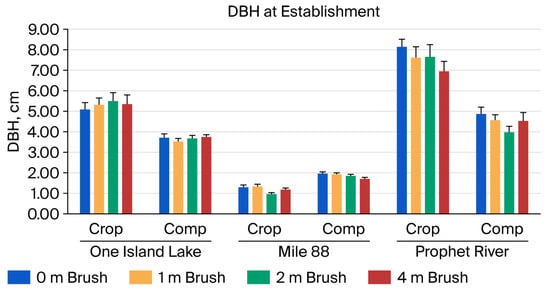
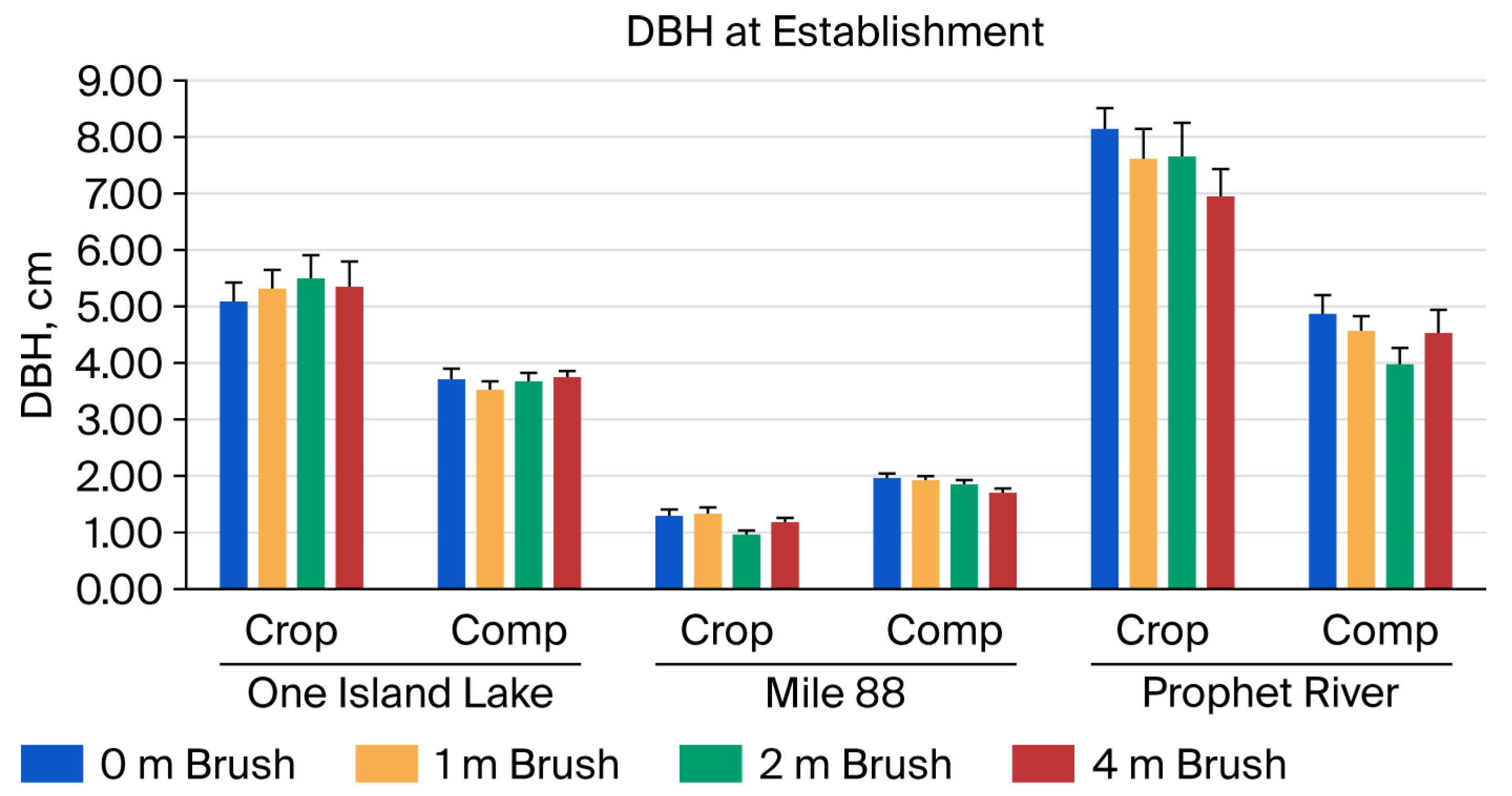
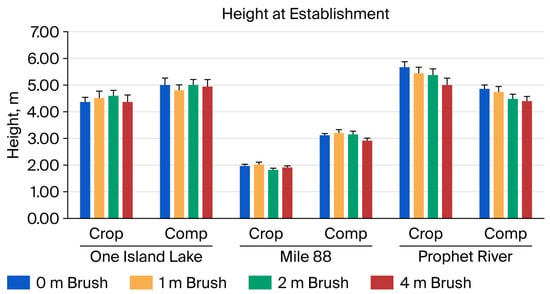
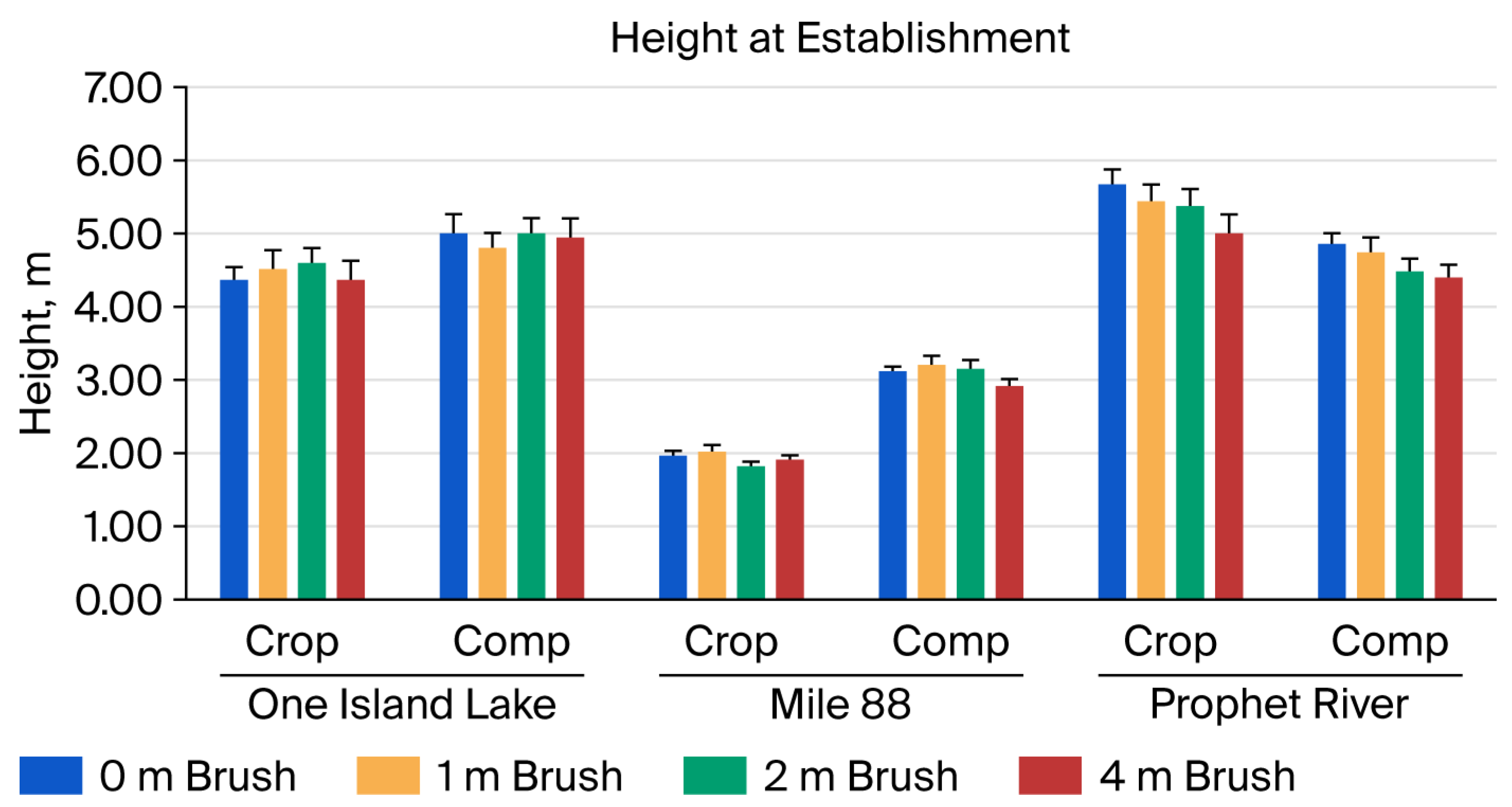
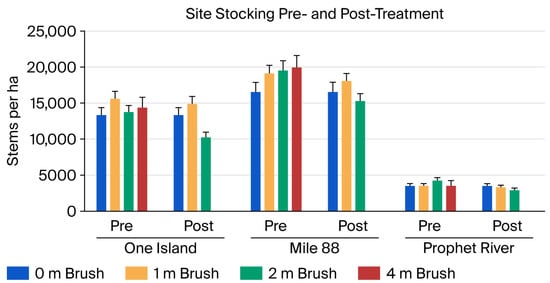
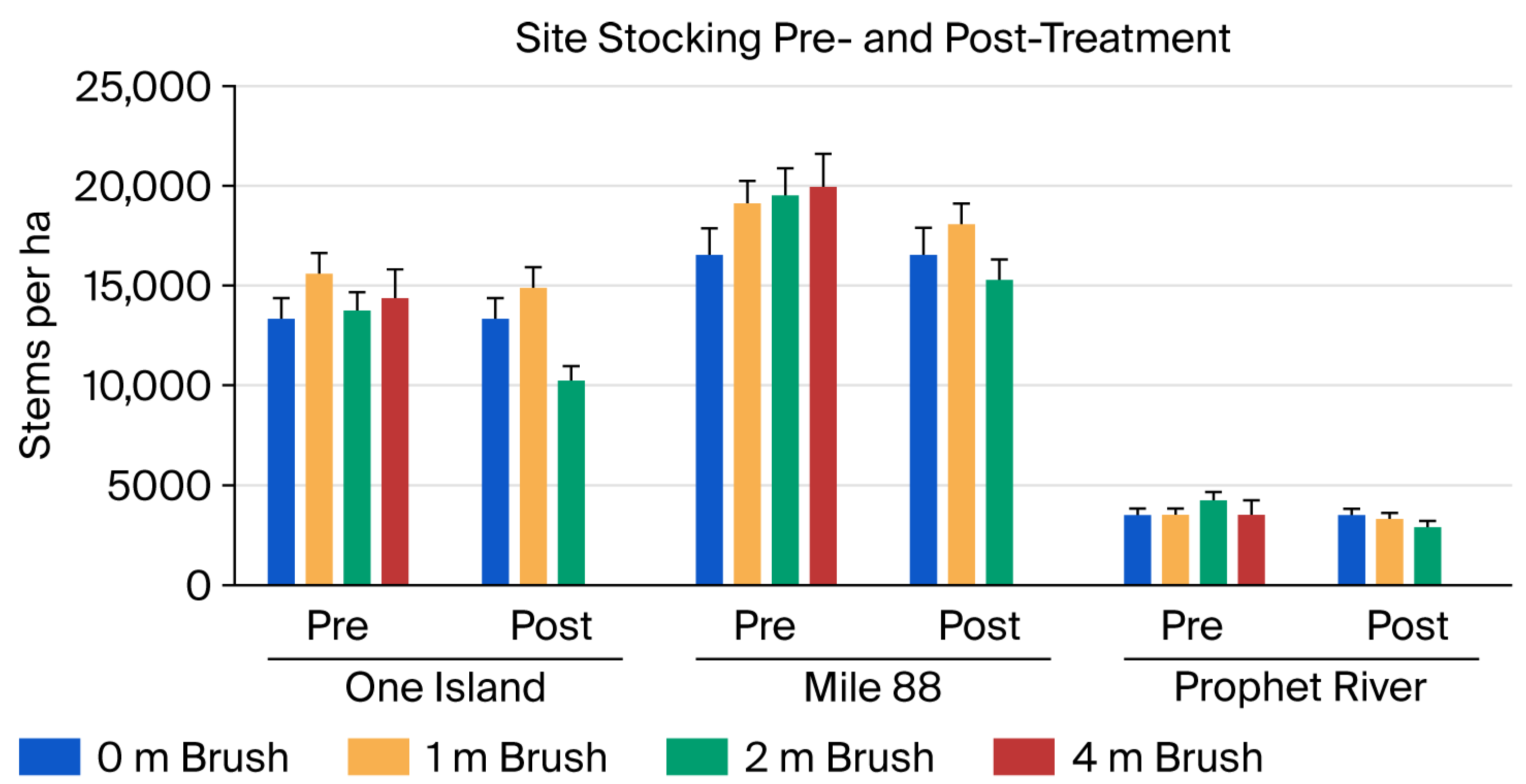
Prior to density reduction treatments, there was no difference at any of the sites by randomly assigned competition reduction treatments for mean crop tree DBH, height, and mean competitor DBH or height (Figure 1 and Figure 2, Table 2). At One Island Lake and Prophet River, crop tree DBH was greater than competitor DBH, while competitor mean height was greater at One Island Lake and Mile 88. Total stocking was variable among sites (Figure 3) but was not different among the randomly assigned brushing treatments on a site. Basal area was not different at establishment among treatments on a site (Table 3). After the brushing treatments were applied, stocking was only different in the 2 and 4 m (no stems) treatments (Figure 3), while basal area was significantly reduced in the 2 and 4 m treatments but only slightly for the 1 m treatment (Table 3).
Figure 1.
Stand mean DBH at trial establishment with SEM for crop and competition (Comp) trees by brushing (Brush) radius at each of the three sites.
Figure 2.
Stand mean height at trial establishment with SEM for crop and competition (Comp) trees by brushing (Brush) radius at each of the three sites.
Table 2.
ANOVA for DBH at establishment and after the last measurement and Tukey’s HSD result for each brushing radius mean at each site.
Figure 3.
Stand mean competition tree stocking (stems per ha, SPH) at trial establishment (Pre) and after the 2019 season (Post) with SEM by brushing (Brush) radius at each of the three sites. Note that there are no competition trees at the Post 4 m radius treatment.
Table 3.
Mean treatment competition basal area (m2 ha−1) ± SEM at trial establishment before brushing and after brushing treatment.
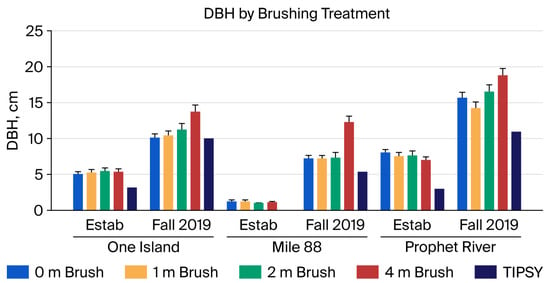
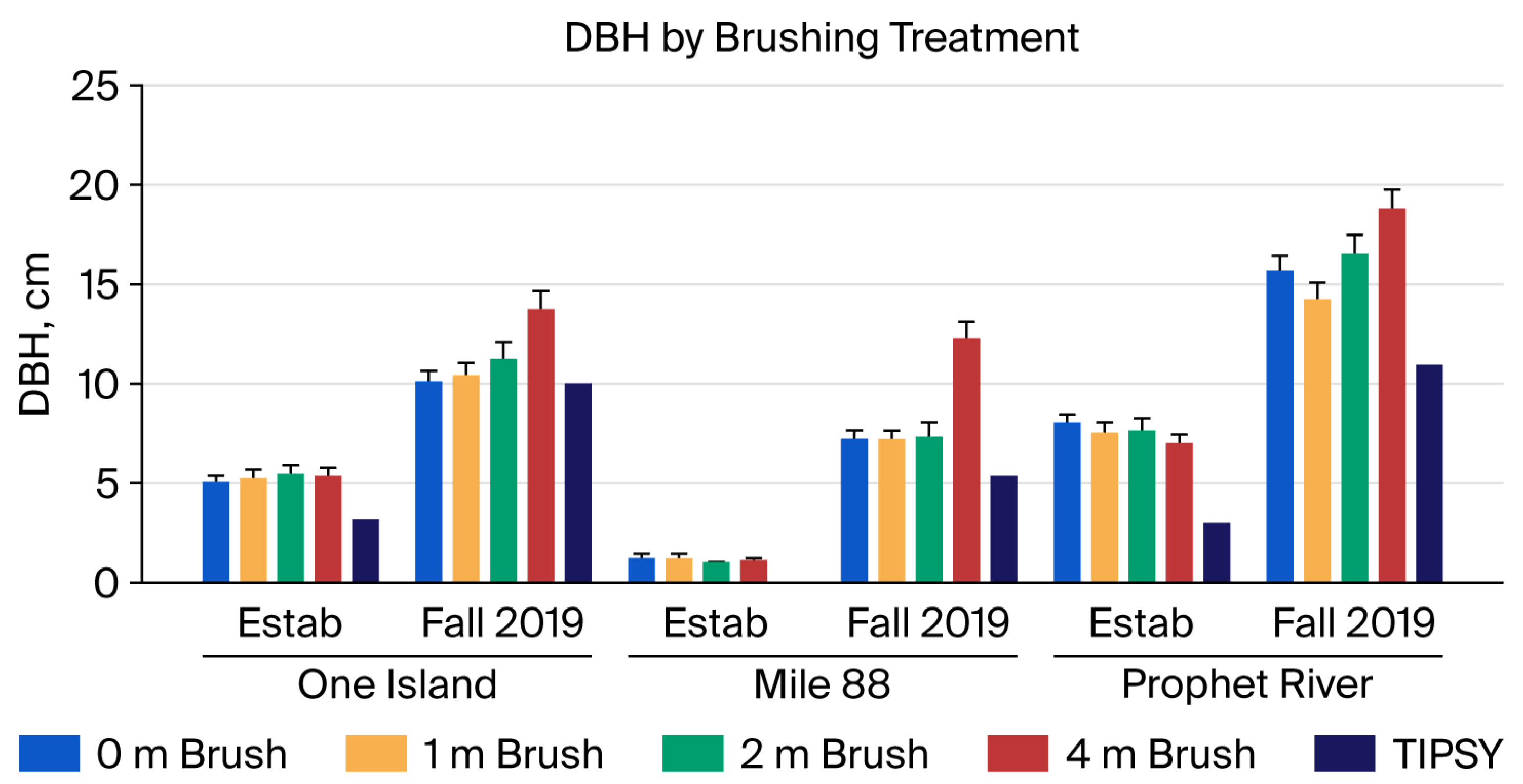
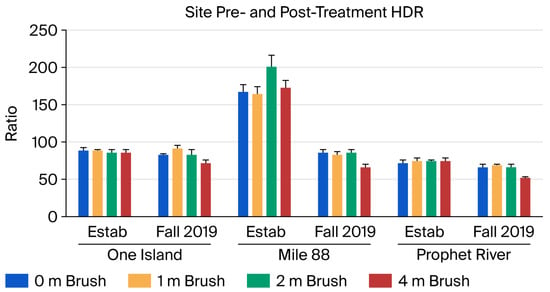
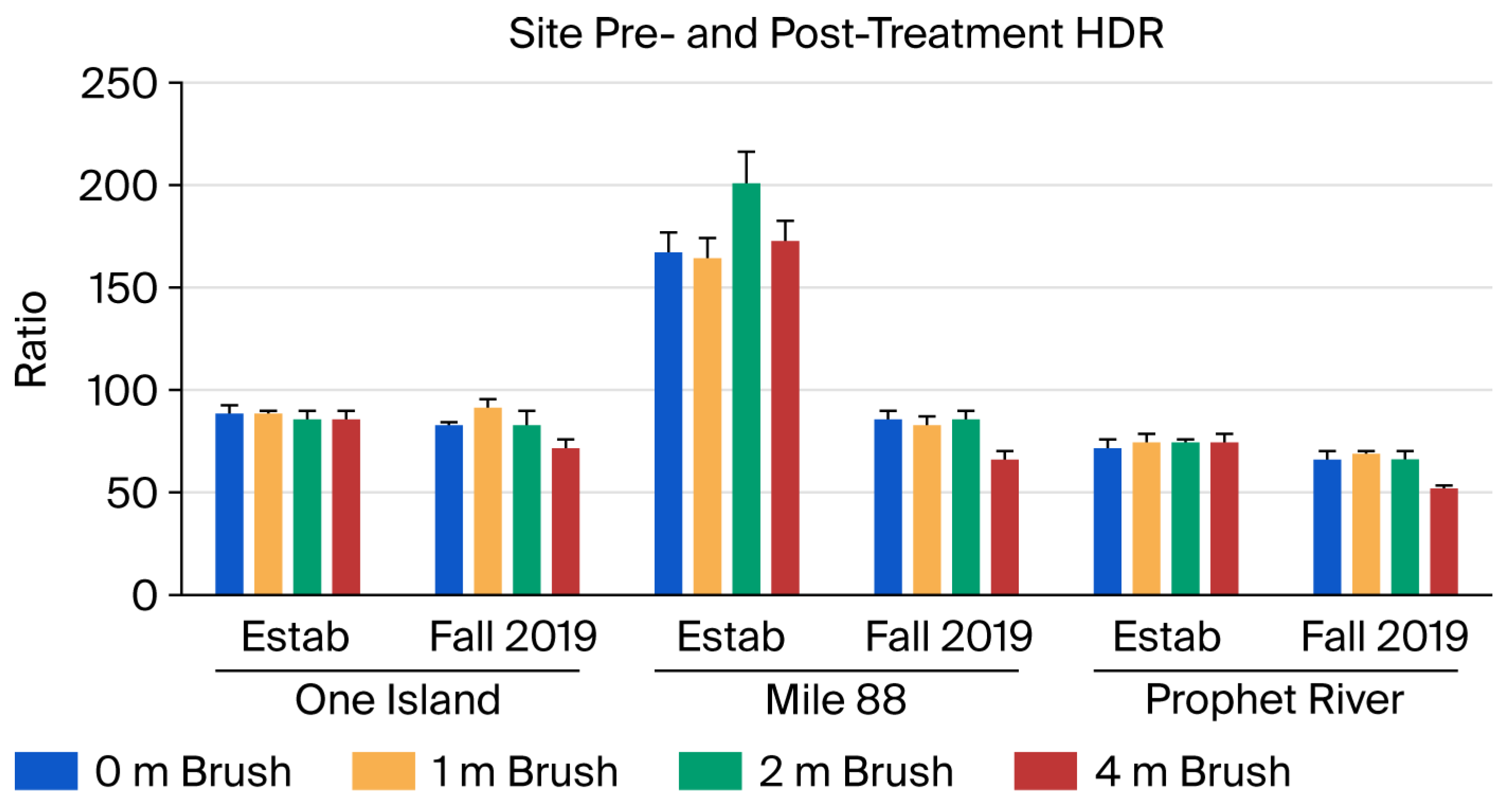
After the 2019 growing season (winter 2019–2020), there was no difference in DBH at 0, 1, or 2 m at the sites, and the 4 m DBH was always greater (Figure 4 and Table 2). However, at both establishment and Fall 2019 measures, mean crop tree DBH was greater than the TIPSY projection for all treatments at each site. HDR was not different among treatments at any site at establishment and was reduced slightly between the establishment and Fall 2019 measures at One Island Lake and Prophet River and was reduced significantly at Mile 88 (Figure 5). After the last measure, at all sites, only the 4 m radius treatment had significantly reduced (better) HDR, i.e., treatment 0 = 1 = 2 ≠ 4 (not presented).
Figure 4.
Stand crop tree mean DBH at trial establishment and after the 2019 season with SEM by brushing (Brush) radius at each of the three sites. The TIPSY benchmark value is the right bar in each set. Note that the Mile 88 site was too young to have a TIPSY value at establishment.
Figure 5.
Stand crop tree mean HDR at trial establishment and after the 2019 season with SEM by brushing (Brush) radius at each of the three sites.
The RGR between establishment and Fall 2019 increased for the 4 m treatment, and the regression decreased significantly for the combined 0, 1, and 2 m treatments at all three sites (Table 4), indicating that small trees are not being disproportionately suppressed [20,21].
Table 4.
Mean RGR with SEM for crop tree DBH growth from establishment to Fall 2019 by site and treatment and RGR regression equation for treatments 0, 1, and 2 m at each site.
4. Discussion
Prior to competition reduction (brushing) treatments (Figure 3), stocking was extreme (>10,000 SPH) at two sites where no plots could be considered FTG and high (>4000 SPH). This occurred at Prophet River, where about one in five plots may be FTG. After brushing, the 1, 2, and 4 m removal radii could be considered FTG. However, except at the 4 m removal radius, competition numbers far exceeded the BC FTG standard [3,5]. The establishment competition metrics suggest that future spruce growth should have been compromised if the FTG standards [3,5] were suitable for mixedwood stands.
Mean crop tree DBH (Figure 1) was not different at establishment among any of the randomly allocated brushing treatments at any of the sites, suggesting competition was not extreme [22] or had minimal impact on the spruce. After the 2019 season, all brushing radii DBH at all sites exceeded the TIPSY projection (Figure 4 and Table 2). As actual SI values were input into the model, the results could be due to spruce’s silvics or improved nursery/early silviculture practices [48]. The 4 m treatment DBH was the greatest, as it had more than 50 m2 competitor-free growing space around the crop tree. However, regardless of tree age or DBH, trees in the 4 m plot were subjected to varying degrees of snow press. Based on the BC FTG standard [3,5], spruce DBH should have been negatively impacted when grown in greater density mixedwoods, i.e., 0 brushing radius, but there was no difference in DBH among treatments up to the 2 m brush-free radius (0 = 1 = 2 m radius plots).
The BC FTG regeneration standards fail to recognize that mixedwoods may support higher stocking levels and maximum densities [49] than pure stands [50]. Hence, their carrying capacity and productivity are greater [49]. As noted, BC FTG standards appear to be poorly or not linked to mixedwood ecology [13,28,51] and forest management planning [13,14,15] and ignore the likelihood of greater productivity in mixedwoods and the associated benefits.
HDR is expected to decrease in response to increased growing space [23] or increase in response to decreased growing space [52]. HDR decreased over time for all treatments and only decreased significantly in the 4 m treatment, suggesting that crop trees were not responding to the increased growing space that the other brushing treatments provided (Figure 5). HDR was uniform among these treatments, which may indicate a target HDR range that forest managers should be trying to attain. Other than the noted snow press in the sturdiest trees, the observed HDR did not appear to have any negative impacts on tree performance, as no windthrow was observed.
The significant negative slope for DBH RGR at bushing treatments 0, 1, and 2 m at all sites (Table 3) suggests that DBH growth was not impacted by broadleaf competition [19,20]. In general, the RGR can assess the impact of competition [53]. Larocque [54] indicated that DBH RGR was a better competition metric than the absolute growth rate. If competition is severe, the DBH RGR should increase with increasing tree size (have positive slope), but if it is not, the DBH RGR should decrease with increasing tree size [20,55], as observed in this study (Table 3). This indicates that smaller trees are not disproportionately suppressed or more efficient in stem wood production and are not impacted by competition [42]. Unfortunately, the DBH RGR is a growth result and not a predictor of growth, nor is HDR. Groot et al. [56] reported a lack of functionality using competition indices in their study, similar to the results of our study. This should not be surprising, as Burton [57] indicated static indices alone have a limited ability to predict tree growth. However, they are good assessors of growth.
Measured DBH being greater than the TIPSY-projected DBH indicates increased conifer productivity in these mixedwood stands (Figure 4) without accounting for broadleaf contribution. Greater mixedwood productivity has been reported in many studies and reviews [25,58] but not all [24,56]. Contradictory mixedwood productivity findings are not uncommon, particularly in older studies. Productivity increases are due to facilitation or complementarity between species [25]. Specific to the western Canadian boreal forest, spruce may benefit from the more rapid broadleaf litter decomposition [59,60] and access to quality nutrients. Tham [58] reported similar conifer growth in pure and mixed stands, as we also observed. These observations also argue against the practice of broadcast removal of potential competing broadleaf species [4] at sites like those in this study. Broadcast removal results in the loss of ecological goods and services associated with mixedwoods [38,61] and has the added input cost of removing the broadleaves for limited benefits except at extreme competition densities. This possibly illustrates the lack of a linkage between FTG regeneration (stocking) standards, actual stand stocking, and mixedwood stand growth, as has been previously reported [14,62].
Besides the ecological cost, there is an economic cost to removing broadleaves [2]. In Scandinavia, Dudelis [63] found that land expectation values (LEVs) were better with mixed species than with single species in terms of stand management. Retaining broadleaves reduces regeneration costs for the forest manager [2] and may also reduce long-term risk. There will be timber to harvest in the future [61] because of the species’ asynchronous response to their environment [34]. Some suggest there is a negative economic benefit in retaining low-commercial-value broadleaf species [64], but this assumption is primarily based on expected reduced conifer productivity and the fact that profit is greatest for conifer stands [65]. Our results suggest that brushing will not increase conifer growth at these site types. Often, increased profits are accompanied by a reduction in ecological goods and services [65]. To maximize ecological goods and services, rotation ages will likely need to be beyond the culmination age. Moreover, provincial policies may require amendments to allow for silviculture systems that better reflect natural regeneration pathways in BC’s boreal forest. The observed increase in mixedwood total productivity may enhance economic value when stored carbon has commercial worth [66]. Furthermore, mixedwoods’ ability to mitigate abiotic and biotic risks [35,42] enhances their economic value.
Climate change is projected to have the most significant impact on the western Canadian boreal forest, particularly where it borders the prairies [44]. It has been suggested that climate change will have a minimum impact on BC’s broadleaf species compared to conifers [43]. Conifer distribution will change (relocate), while broadleaf distribution will expand [43]. Therefore, it would be prudent to manage for mixedwoods in northeast BC until climate change shifts are better described [41]. Additionally, the relationship between climate change and growth is poorly understood and depends in part on stand composition and structure [42]. Enhanced carbon storage mitigates climate change impacts [65] and possibly encourages changes in forest management practices [67]. Mixedwood management is a beneficial option to promote resilience and mitigate climate change and is possibly a future additional revenue stream for landowners [67].
Current forest management practices, in addition to the above concerns, also erode the goods and services for First Nations [36], as documented in their treaties. Mixedwood attributes and management would better support First Nations’ traditional world view, while current management practice is incongruent with traditional First Nations’ values and treaty rights [38]. Current practices may also be inconsistent with the UNDRIP (United Nations Declaration on the Rights of Indigenous Peoples), which the BC government has endorsed [39]. First Nations’ values are likely to be a prominent consideration in future BC forest management decisions and practices. Mixedwood management may facilitate a new management paradigm. However, a note of caution is warranted. Only three sites are in this study, but they are typical of significant portions of BC’s boreal forest and are widely separated geographically. As we have noted, this approach will not be applicable everywhere, but it will apply to large portions of the region.
Finally, there may be different ways to assess regeneration success in mixedwoods and better link it to management objectives. The first requisite step is an understanding of mixedwoods’ ecological complexity [66] and utilizing the professional knowledge of managers [12,64]. Next, survey results must be directly linked to a productivity metric. The easiest to measure and link to a growth and yield model specifically for a site is the crop tree DBH, as shown in Figure 4. With a minimum of two DBH measurements more than 8 years apart, decisions can be made with respect to stand regeneration success and future stand management actions, such as thinning or competition removal. A minimum of three surveys would be required with this approach as follows: (i) assessing regeneration two or three years post-planting to ensure conifer stocking and whether target stocking is met, with no treatment required; (ii) measuring DBH two or three years after the height-to-DBH (1.3 m) is reached; and (iii) 8 to 10 years later. Additionally, a range of HDRs that indicate regeneration success could be developed for the suite of site indices encountered. If accepted, the method would vary by site and region. However, to be accepted, more data need to be generated in pilot programs before it can be incorporated into regeneration standards.
5. Conclusions
The sites in this study all indicated that retaining broadleaf species in excess to BC’s FTG regeneration (stocking) standard had not impacted spruce DBH growth. This raises the question as to whether the FTG standards are suitable for similar mixedwood stands. In addition, broadleaf retention has other benefits compared to a pure conifer stand, including overall increased stand productivity (volume), stand resilience, better ability to acclimate to future climates, enhanced habitat values and biodiversity, and greater carbon storage. Furthermore, broadleaf retention provides the goods and services needed to ensure traditional First Nations’ treaty rights. At sites like ours, broadcast broadleaf removal appears to be unnecessary, even for conifer-focused forest management.
Author Contributions
Conceptualization, C.H. and C.M.; methodology, C.H.; formal analysis, C.H. and C.M.; resources, C.M.; data collection, C.M. and C.H.; data curation, C.H.; writing—original draft preparation, C.H. and C.M.; writing—review and editing, C.H. and C.M.; supervision, C.H.; project administration, C.M.; funding acquisition, C.H. and C.M. All authors have read and agreed to the published version of the manuscript.
Funding
Trial establishment was performed while the lead author held the FRBC–Slocan Mixedwood Chair at the University of Northern British Columbia and was funded by the BC Forest Science Program. The 2019–2020 trial measurements were funded by the BC Wood Products Development Council (DBA Woodlots BC).
Data Availability Statement
The lead author should be contacted for data requests.
Acknowledgments
The efforts of those who established these sites under trying conditions are recognized—Nicole Balliet, Kyle Runzer, Cindy Baker and Eduardo Bittencourt. The reviewer’s comments contributed to improving the manuscript.
Conflicts of Interest
The authors declare no conflicts of interest.
References
- Belisle, A.C.; Asselin, H. A collaborative typology of boreal Indigenous landscapes. Can. J. For. Res. 2021, 51, 1253–1262. [Google Scholar] [CrossRef] [Scilit]
- Hawkins, C.D.B.; Dhar, A.; Rogers, B.J. How much birch (Betula papyrifera) is too much for maximizing spruce (Picea glauca) growth: A case study in boreal spruce plantation forests. J. For. Sci. 2012, 58, 314–327. [Google Scholar] [CrossRef] [Scilit]
- British Columbia (BC) Ministry of Forests. Reference Guide for Forest Development Stocking Standards. 2021. Available online: https://www2.gov.bc.ca/gov/content/industry/forestry/managing-our-forest-resources/silviculture/stocking-standards?keyword=2021 (accessed on 3 November 2025).
- Simard, S.W.; Vyse, A. Trade-offs between competition and facilitation: A case study of vegetation management in the interior cedar-hemlock forests of southern British Columbia. Can. J. For. Res. 2006, 36, 2486–2496. [Google Scholar] [CrossRef] [Scilit]
- BC Ministry of Forests. Establishment to Free Growing Guidebook, Prince George Forest Region; Version 2.3; BC Ministries of Forests and Environment: Victoria, BC, Canada, 2000; pp. 24–39. Available online: https://www2.gov.bc.ca/assets/gov/farming-natural-resources-and-industry/forestry/silviculture/stocking-standards/efgg/efg-pg-print.pdf (accessed on 3 November 2025).
- Green, D.S. Describing condition-specific determinants of competition in boreal and sub-boreal mixedwood stands. For. Chron. 2004, 80, 736–742. [Google Scholar] [CrossRef] [Scilit]
- Farnden, C. An analysis framework for linking regeneration standards to desired future forest conditions. For. Chron. 2009, 85, 285–292. [Google Scholar] [CrossRef] [Scilit]
- Thrum, E.A.; Pretzsch, H. Growth–density relationship in mixed stands—Results from long-term experimental plots. For. Ecol. Manage. 2021, 483, 118909. [Google Scholar] [CrossRef] [Scilit]
- Nienstaedt, H.; Zasada, J.C. Picea glauca (Moench) Voss—White spruce. In Silvics of North America, Volume 1: Conifers; Burns, R.M., Hankala, B.H., Eds.; USDA Forest Service Agriculture Handbook 654; USDA: Washington, DC, USA, 1990; pp. 204–226. [Google Scholar]
- Lieffers, V.J.; Armstrong, G.W.; Stadt, K.J.; Marenholtz, E.H. Forest regeneration standards: Are they limiting management options for Alberta’s boreal mixedwoods? For. Chron. 2008, 84, 76–82. [Google Scholar] [CrossRef] [Scilit]
- Armson, K.A. Regeneration standards: What has the past to show us? For. Chron. 2005, 81, 781–784. [Google Scholar] [CrossRef] [Scilit]
- Lieffers, V.J.; Stadt, K.J.; Feng, Z. Free-to-grow regeneration standards are poorly linked to growth of spruce in boreal mixedwoods. For. Chron. 2007, 83, 818–824. [Google Scholar] [CrossRef] [Scilit]
- Farnden, C. Development of Regeneration Standards for Sustainable Forest Management. Ph.D. Thesis, University of British Columbia, Vancouver, BC, Canada, 2010. Available online: https://open.library.ubc.ca/media/stream/pdf/24/1.0069759/1 (accessed on 20 December 2025).
- Martin, P.J. Design of regeneration standards to sustain boreal mixedwoods in western Canada. Int. For. Rev. 2005, 7, 135–146. [Google Scholar] [CrossRef] [Scilit]
- Harper, G. Lodgepole pine and trembling aspen competition: Neighbourhood studies within 22 to 39-year-old pine plantations of northern British Columbia. For. Chron. 2017, 93, 226–240. [Google Scholar] [CrossRef] [Scilit]
- Eggers, J.; Lundström, J.; Snäll, T.; Öhman, K. Balancing wood production and biodiversity in intensively managed boreal forest. Scand. J. For. Res. 2022, 37, 213–225. [Google Scholar] [CrossRef] [Scilit]
- Mission, L.; Vincke, C.; Devillez, F. Frequency responses of radial growth series after different thinning intensities in Norway spruce (Picea abies (L.) Karst.) stand. For. Ecol. Manage. 2003, 177, 51–63. [Google Scholar] [CrossRef] [Scilit]
- Oliver, C.D.; Larson, B.C. Forest Stand Dynamics; John Wiley and Sons: New York, NY, USA, 1996; pp. 41–88. ISBN 9780471138334. [Google Scholar]
- Hunt, R. Plant Growth Analysis, 2nd ed.; Natural Environment Research Council: London, UK, 1982; pp. 5–41. ISBN 090428266X. [Google Scholar]
- Larocque, G.R.; Marshall, P.L. Crown development in red pine stands. II. Relationships with stem growth. Can. J. For. Res. 1994, 24, 775–784. [Google Scholar] [CrossRef] [Scilit]
- Wonn, H.T.; O’Hara, K.L. Height: Diameter ratios and stability relationships for four northern Rocky Mountain tree species. West. J. Appl. For. 2001, 16, 87–94. [Google Scholar] [CrossRef] [Scilit]
- Lanner, R.M. On the insensitivity of height growth to spacing. For. Ecol. Manage. 1985, 13, 143–148. [Google Scholar] [CrossRef] [Scilit]
- Frivold, L.; Mielikainen, K. The effects of hardwoods on softwood growth in mixed stands in Fennoscandia. In The Silvics and Ecology of Boreal Spruces; Titus, B.D., Lavigne, M.B., Newton, P.F., Meades, W.J., Eds.; IUFRO Working Party SI.05-12 Symposium Proceedings, 12–17 August 1989; Information Report Number N-X-271; Forestry Canada Newfoundland Forestry Centre: Corner Brook, NL, Canada, 1990; pp. 75–82. ISBN 0-662-17584-0. [Google Scholar]
- Binkley, D. Mixtures of nitrogen fixing tree species. In The Ecology of Mixed Species Stands of Trees; Cannell, M.G.R., Malcolm, D.C., Robertson, P.A., Eds.; British Ecological Society Special Publication 11; Blackwell Scientific Publications: Oxford, UK, 1992; pp. 99–123. [Google Scholar]
- Kelty, M.J. Comparative productivity of monocultures and mixed-species stands. In The Ecology and Silviculture of Mixed Species Forests; Kelty, M.J., Larson, B.C., Oliver, C.D., Eds.; Kluwer Academic Publishers: Dordrecht, The Netherlands, 1992; pp. 125–141. [Google Scholar]
- Mårda, H. The influence of a birch shelter (Betula spp.) on the growth of young stands of Picea abies. Scand. J. For. Res. 1996, 11, 343–350. [Google Scholar] [CrossRef] [Scilit]
- Man, R.; Lieffers, V.J. Are Mixtures of Aspen and White Spruce More Productive than Single Species Stands? For. Chron. 1999, 75, 505–513. [Google Scholar] [CrossRef] [Scilit]
- Kelty, M.J. The role of species mixtures in plantation forestry. For. Ecol. Manage. 2006, 233, 195–204. [Google Scholar] [CrossRef] [Scilit]
- Pretzsch, H.; Schutze, G. Effect of tree species mixing on the size structure, density, and yield of forest stands. Eur. J. For. Res. 2016, 135, 1–22. [Google Scholar] [CrossRef] [Scilit]
- Ruiz-Benito, P.; Gómez-Aparicio, L.; Paquette, A.; Messier, C.; Kattge, J.; Zavala, M.A. Diversity increases carbon storage and tree productivity in Spanish forests. Global Ecol. Biogeogr. 2014, 23, 311–322. [Google Scholar] [CrossRef] [Scilit]
- Jactel, H.; Gritti, E.S.; Drössler, L.; Forrester, D.I.; Mason, W.L.; Morin, X.; Pretzsch, H.; Castagneyrol, B. Positive biodiversity–productivity relationships in forests: Climate matters. Biol. Lett. 2018, 14, 20170747. [Google Scholar] [CrossRef] [Scilit] [PubMed]
- Eastman, D.S. Habitat Selection and Use in Winter by Moose in Sub-Boreal Forests of North-Central British Columbia, and Relationships to Forestry. Ph.D. Thesis, University of British Columbia, Vancouver, BC, Canada, 1977; p. 554. Available online: http://hdl.handle.net/2429/21531 (accessed on 15 September 2025).
- Cavard, X.; Macdonald, S.E.; Bergeron, Y.; Chen, H.Y.H. Importance of mixedwoods for biodiversity conservation: Evidence for understory plants, songbirds, soil fauna, and ectomycorrhiza in northern forests. Environ. Rev. 2011, 19, 142–161. [Google Scholar] [CrossRef] [Scilit]
- Drobyshev, I.; Gewehr, S.; Berninger, F.; Bergeron, Y. Species specific growth responses of black spruce and trembling aspen may enhance resilience of boreal forest to climate change. J. Ecol. 2013, 101, 231–242. [Google Scholar] [CrossRef] [Scilit]
- Felton, A.; Nilsson, U.; Sonesson, J.; Felton, A.M.; Roberge, J.-M.; Ranius, T.; Ahlström, M.; Bergh, J.; Björkman, C.; Boberg, J.; et al. Replacing monocultures with mixed-species stands: Ecosystem service implications of two production forest alternatives in Sweden. Ambio 2016, 45, S124–S139. [Google Scholar] [CrossRef] [Scilit]
- Bull, G.; Pledger, S.; Splittgerber, M.; Stephen, J.; Pribowo, A.; Baker, K.; Singh, D.; Pootlass, D.; Macleod, N. Culturally driven forest management, utilization and values: A Nuxalk First Nations case study. For. Chron. 2014, 90, 620–627. [Google Scholar] [CrossRef] [Scilit]
- Kayahara, G.J. First Nation Herbicide. (Ont.) Prof. For. 2018, 229, 7–9. Available online: https://opfa.ca/wp-content/uploads/2018/04/OPFA-Newsletter_march2018.pdf (accessed on 17 August 2025).
- Kayahara, G.J.; Armstrong, C.L. Understanding First Nations rights and perspectives on the use of herbicides in forestry: A case study from northeastern Ontario. For. Chron. 2015, 91, 126–140. [Google Scholar] [CrossRef] [Scilit]
- BCFNGC and PBC (British Columbia First Nations Forestry Council and Province of British Columbia). Draft BC First Nations Forestry Strategy. 2019. 22p. Available online: https://bcruralcentre.org/wp-content/uploads/2019/11/BC-First-Nations-Forest-Strategy-May-2019-1.pdf (accessed on 20 December 2025).
- Fraser Basin Council. Climate Projections for the BC Northeast Region. Fraser Basin Council. Vancouver. p. 45. 2019. Available online: https://www.fraserbasin.bc.ca/_Library/CCAQ/fbc_ne_climatereport_web.pdf (accessed on 20 December 2025).
- Millar, C.I.; Stephenson, N.L.; Stephens, S.L. Climate change and forests of the future: Managing in the face of uncertainty. Ecol. Appl. 2007, 17, 2145–2151. Available online: https://www.jstor.org/stable/40061917 (accessed on 20 December 2025). [CrossRef] [Scilit] [PubMed]
- Oboite, F.O.; Comeau, P.G. The interactive effect of competition and climate on growth of boreal tree species in western Canada and Alaska. Can. J. For. Res. 2020, 50, 457–464. [Google Scholar] [CrossRef] [Scilit]
- Hamann, A.; Wang, T. Potential effects of climate change on ecosystem and tree species distribution in British Columbia. Ecology 2006, 87, 2772–2786. [Google Scholar] [CrossRef] [Scilit]
- Boulanger, Y.; Taylor, A.R.; Price, D.T.; Cyr, D.; McGarrigle, E.; Rammer, W.; Sainte-Marie, G.; Beaudoin, A.; Guindon, L.; Mansuy, N. Climate change impacts on forest landscapes along the Canadian southern boreal forest transition zone. Landsc. Ecol. 2017, 32, 1415–1431. [Google Scholar] [CrossRef] [Scilit]
- DeLong, S.C.; Banner, A.; MacKenzie, W.H.; Rogers, B.J.; Kaytor, B. A Field Guide to Ecosystem Identification for the Boreal White and Black Spruce Zone of British Columbia; Land Management Handbook 65; BC Ministry of Forests and Range: Victoria, BC, Canada, 2011. Available online: www.for.gov.bc.ca/hfd/pubs/Docs/Lmh/Lmh65.htm (accessed on 27 April 2025).
- Nigh, G.D. Growth Intercept Models and Tables for British Columbia: Interior Species, 3rd ed.; Land Management Handbook Field Guide Insert 10; BC Ministry of Forests, Research Branch: Victoria, BC, Canada, 1999. Available online: https://www.for.gov.bc.ca/hfd/pubs/Docs/Fgi/Fgi10-files/fgi10-r3.pdf (accessed on 3 November 2025).
- Kent, M.; Coker, P. Vegetation Description and Analysis: A Practical Approach; CRC Press: Boca Raton, FL, USA, 1992. [Google Scholar]
- Hawkins, C.D.B.; Dhar, A.; Bittencourt, E. Improving site index estimates for pine and spruce plantations: A case study in the sub-boreal spruce zone in British Columbia. For. Sci. Tech. 2013, 9, 51–58. [Google Scholar] [CrossRef] [Scilit]
- Pretzsch, H.; Biber, P. Tree species mixing can increase maximum stand density. Can. J. For. Res. 2016, 46, 1179–1193. [Google Scholar] [CrossRef] [Scilit]
- Kweon, D.; Comeau, P.G. Factors influencing overyielding in young boreal mixedwood stands in western Canada. For. Ecol. Manage. 2019, 432, 546–557. [Google Scholar] [CrossRef] [Scilit]
- Martin, P.J.; Browne-Clayton, S.; Day, K.; Taylor, G. Improving regeneration performance standards: Comments based on early experience with three new approaches In British Columbia. In Thin Green Line Proceedings. A Symposium on the State-of-the-Art in Reforestation, Thunder Bay, ON; Colombo, S.J., Ed.; Ontario Forest Research Institute: Sault Ste Marie, ON, Canada, 2005; pp. 59–65. Available online: https://rngr.net/publications/tgl/improving-regeneration-performance-standards-comments-based-on-early-experience-with-three-new-approaches-in-british-columbia (accessed on 20 December 2025).
- Opio, C.; Jacob, N.; Coopersmith, D. Height to diameter ratio as a competition index for young conifer plantations in northern British Columbia, Canada. For. Ecol. Manage. 2000, 137, 245–252. [Google Scholar] [CrossRef] [Scilit]
- Carr, S.; Larocque, G.R.; Luckai, N.; Bell, F.W. Effect of competition on individual white spruce production in young boreal mixedwood forests. Can. J. For. Res. 2020, 50, 726–735. [Google Scholar] [CrossRef] [Scilit]
- Larocque, G.R. Functional growth analysis of red pine trees under variable intensities of competition. For. Chron. 1998, 74, 728–735. [Google Scholar] [CrossRef] [Scilit]
- Larocque, G.R.; Marshall, P.L. Evaluating the impact of competition using relative growth rate in red pine (Pinus resinosa Ait.) stands. For. Ecol. Manage. 1993, 58, 65–83. [Google Scholar] [CrossRef] [Scilit]
- Groot, A.; Adhikary, S.; Sharma, M.; Luckai, N.; Bell, F.W.; Larocque, G.R. Effect of species composition on the production rate and efficiency of young Picea glauca–Populus tremuloides forests. For. Ecol. Manage. 2014, 315, 1–11. [Google Scholar] [CrossRef] [Scilit]
- Burton, P.J. Some limitations inherent to static indices of plant competition. Can. J. For. Res. 1993, 23, 2141–2152. [Google Scholar] [CrossRef] [Scilit]
- Tham, A. Crop plans and yield predictions for Norway spruce (Picea abies (L.) Karst.) and birch (Betula pendula Roth & Betula pubescens Ehrh.) mixtures. Stud. For. Suec. 1994, 195, 1–21. [Google Scholar]
- van Cleve, K.O.; Heal, W.; Roberts, D. Biomass of forest floor nitrogen supply for plant growth. Can. J. For. Res. 1986, 16, 1320–1326. [Google Scholar] [CrossRef] [Scilit]
- Maundrell, C.P. Effect of Aspen (Populus tremuloides (Michx.)) Overstory Removal on Productivity of an Aspen and White Spruce (Picea glauca (Moench) Voss) Mixedwood Stand. Master’s Thesis, University of Northern British Columbia, Prince George, BC, Canada, 2002. [Google Scholar] [CrossRef] [Scilit]
- Knoke, T.; Ammer, C.; Stimm, B.; Mosandl, R. Admixing broadleaved to coniferous tree species: A review on yield, ecological stability and economics. Eur. J. For. Res. 2008, 127, 89–101. [Google Scholar] [CrossRef] [Scilit]
- Lieffers, V.J.; Pinno, D.B.; Stadt, K.J. Light dynamics and free-to-grow standards in aspen dominated mixedwood forests. For. Chron. 2002, 78, 137–145. [Google Scholar] [CrossRef] [Scilit]
- Dudelis, J. Development of Stratified Spruce-Birch Stands in Latvia. Master’s Thesis, Swedish University of Agricultural Sciences, Umea, Sweden, 2013; p. 64. Available online: https://stud.epsilon.slu.se/5846/7/dudelis_j_130704.pdf (accessed on 3 November 2025).
- Armstrong, G.W. Considerations for boreal mixedwood silviculture: A view from the dismal science. For. Chron. 2014, 90, 44–49. [Google Scholar] [CrossRef] [Scilit]
- Knoke, T.; Stimm, B.; Ammer, C.; Moog, M. Mixed forests reconsidered: A forest economics contribution on an ecological concept. For. Ecol. Manage. 2005, 213, 102–116. [Google Scholar] [CrossRef] [Scilit]
- Del Rio, M.; Lof, M.; Bravo-Oviedo, A.; Jactel, H. Understanding the complexity of mixed forest functioning and management: Advances and perspectives. For. Ecol. Manage. 2021, 489, 119138. [Google Scholar] [CrossRef] [Scilit]
- Elgie, S.; McCarney, G.R.; Adamowicz, W.L. Assessing the implications of a carbon market for boreal forest management. For. Chron. 2011, 87, 367–381. [Google Scholar] [CrossRef] [Scilit]

Disclaimer/Publisher’s Note: The statements, opinions and data contained in all publications are solely those of the individual author(s) and contributor(s) and not of MDPI and/or the editor(s). MDPI and/or the editor(s) disclaim responsibility for any injury to people or property resulting from any ideas, methods, instructions or products referred to in the content. |
© 2025 by the authors. Licensee MDPI, Basel, Switzerland. This article is an open access article distributed under the terms and conditions of the Creative Commons Attribution (CC BY) license.