Corrosion-Induced Degradation Mechanisms and Bond–Slip Relationship of CFRP–Steel-Bonded Interfaces




Abstract
1. Introduction
2. Experimental Program
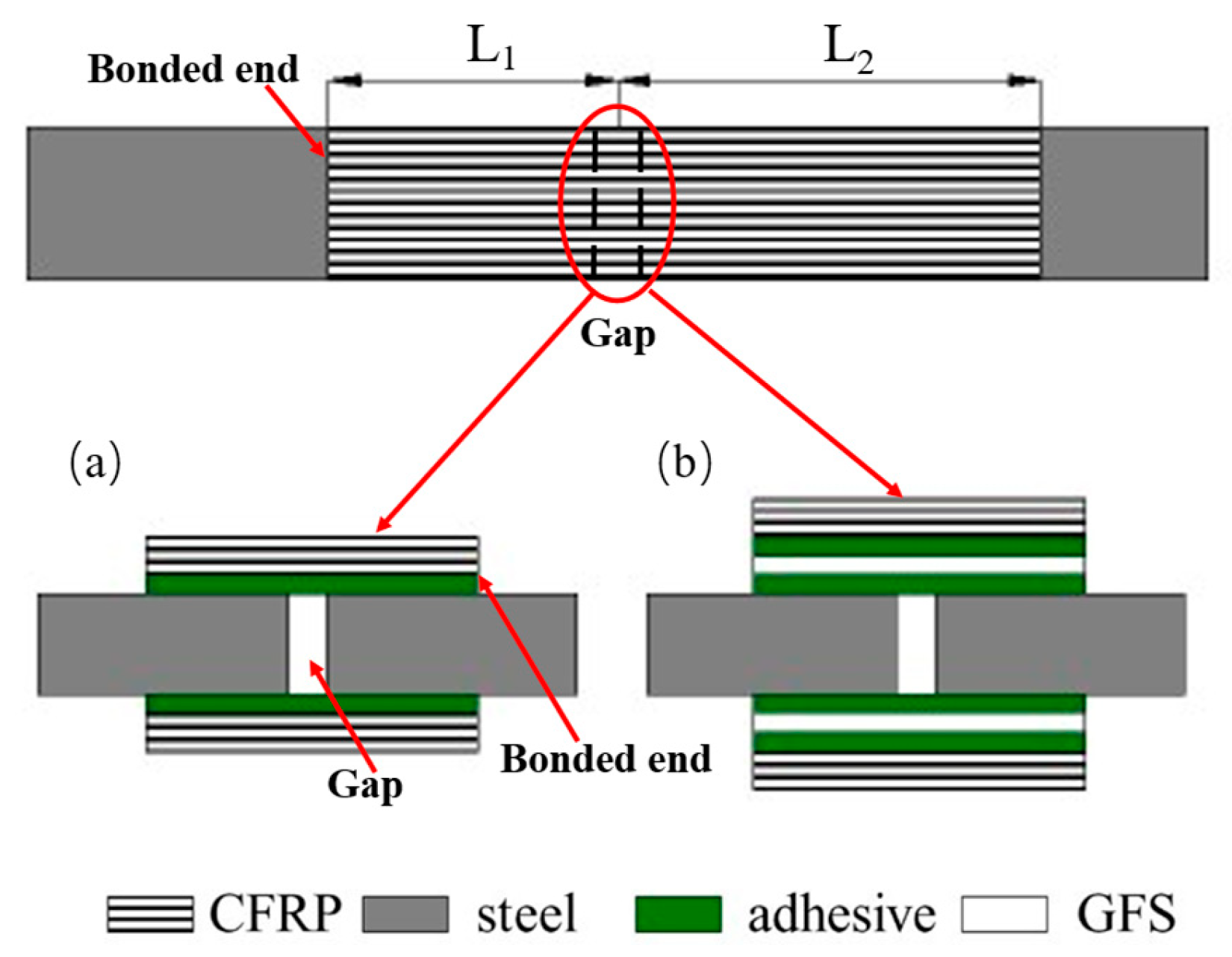
2.1. Materials and Specimens
2.2. Specimen Grouping and Experimental Variables
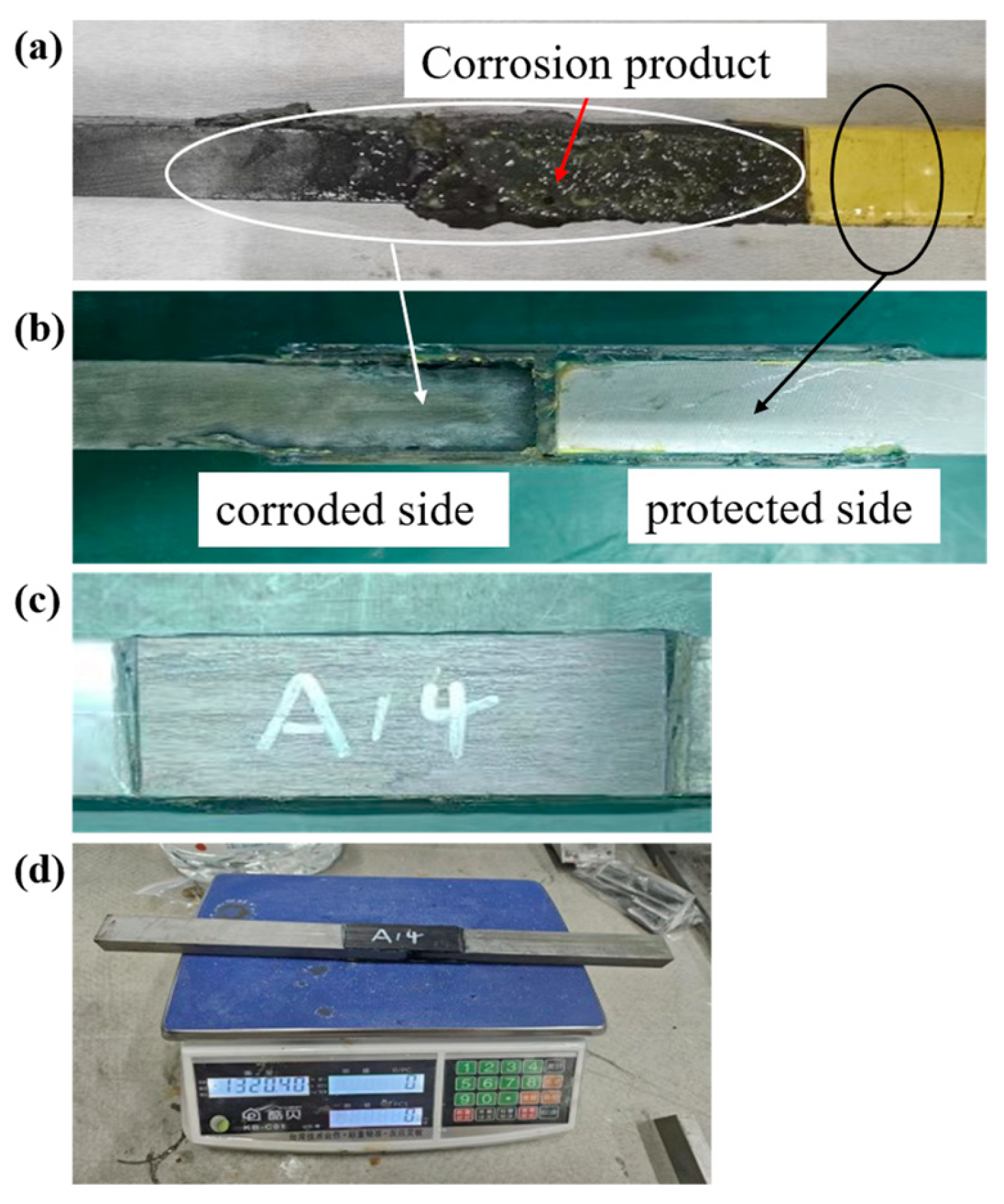
2.3. Accelerated Procedure to Generate Corrosion Damage
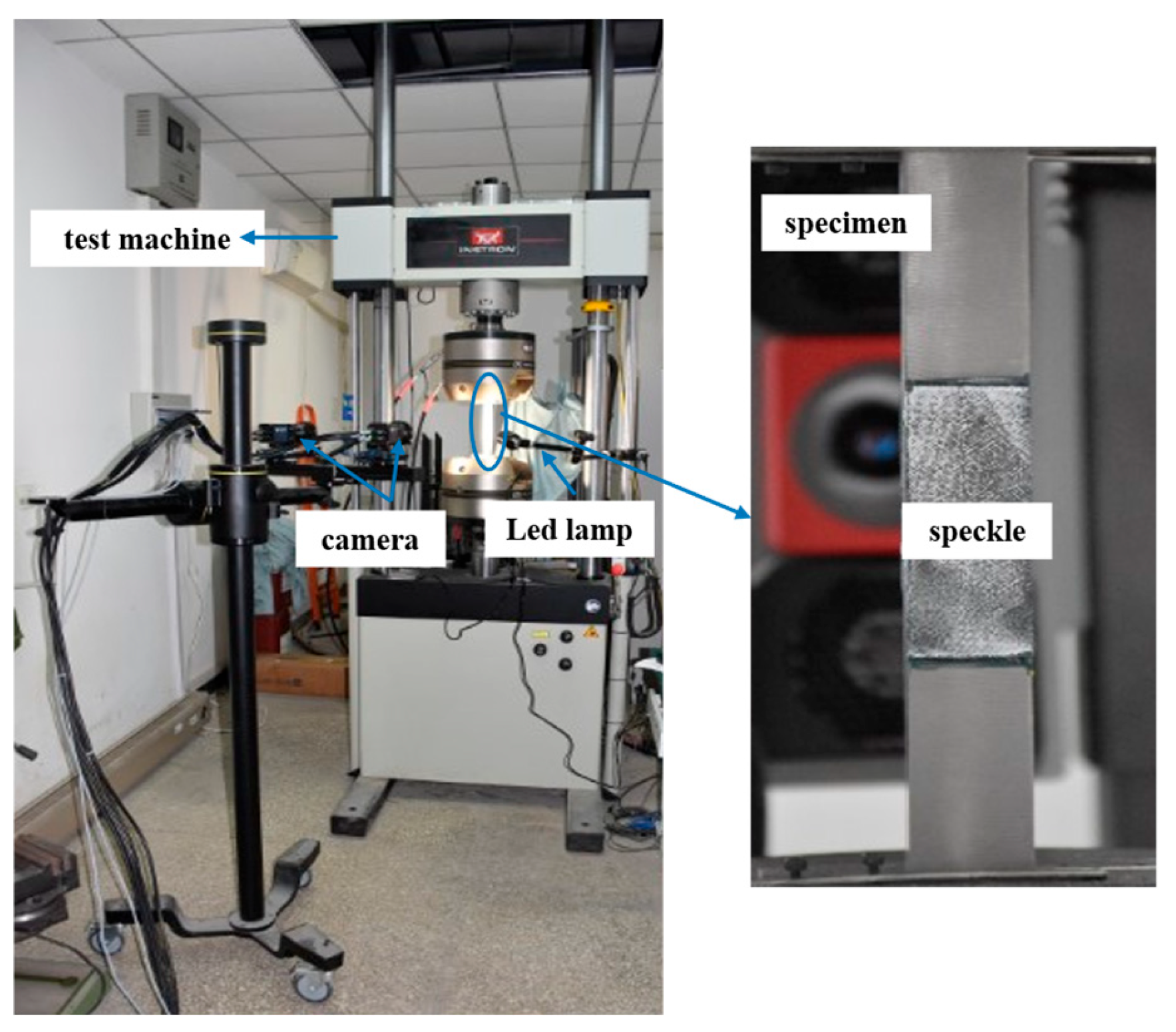
2.4. Instrumentation and Loading Procedure
3. Results and Discussion
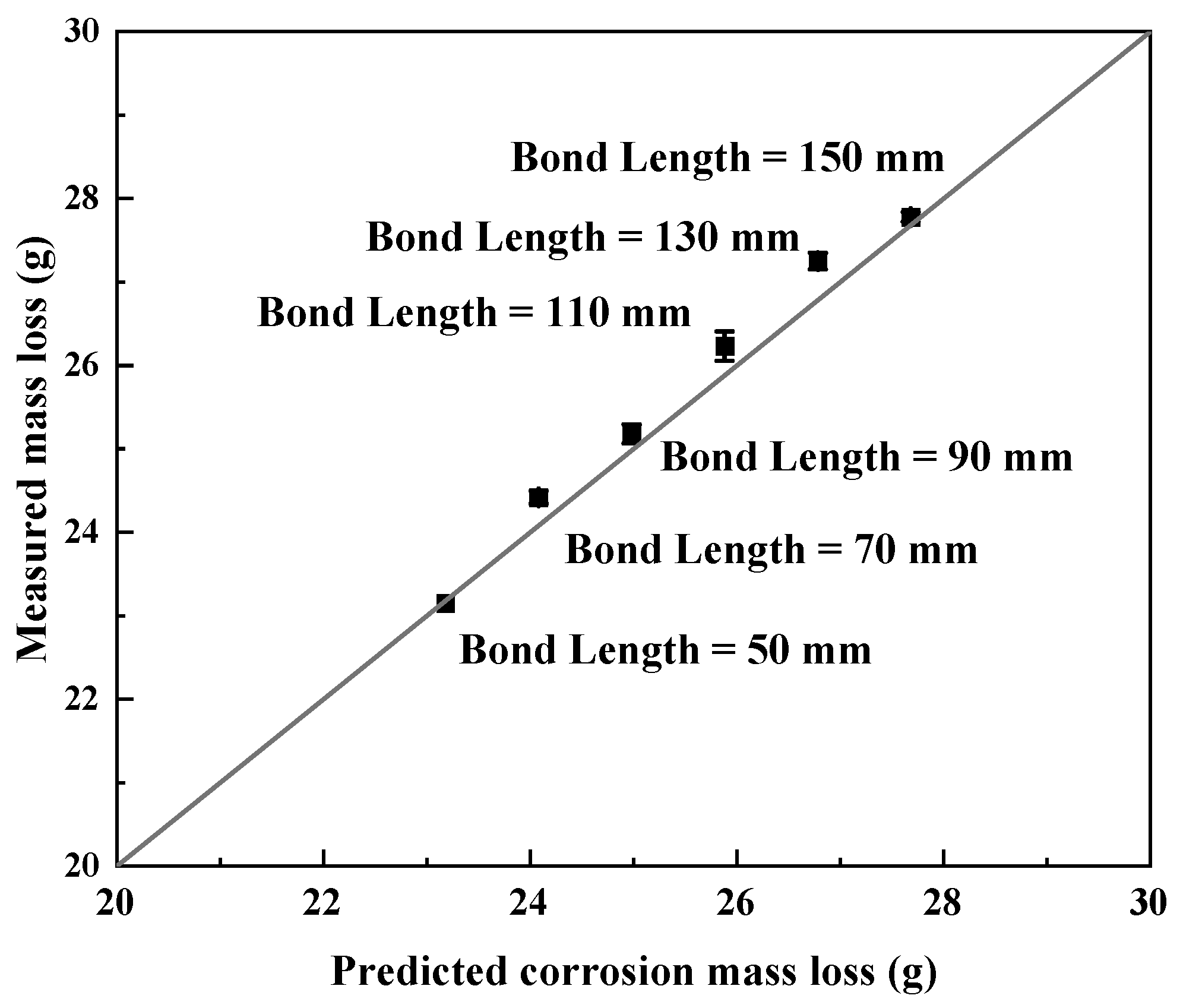
3.1. Corrosion Morphology and Mass Loss
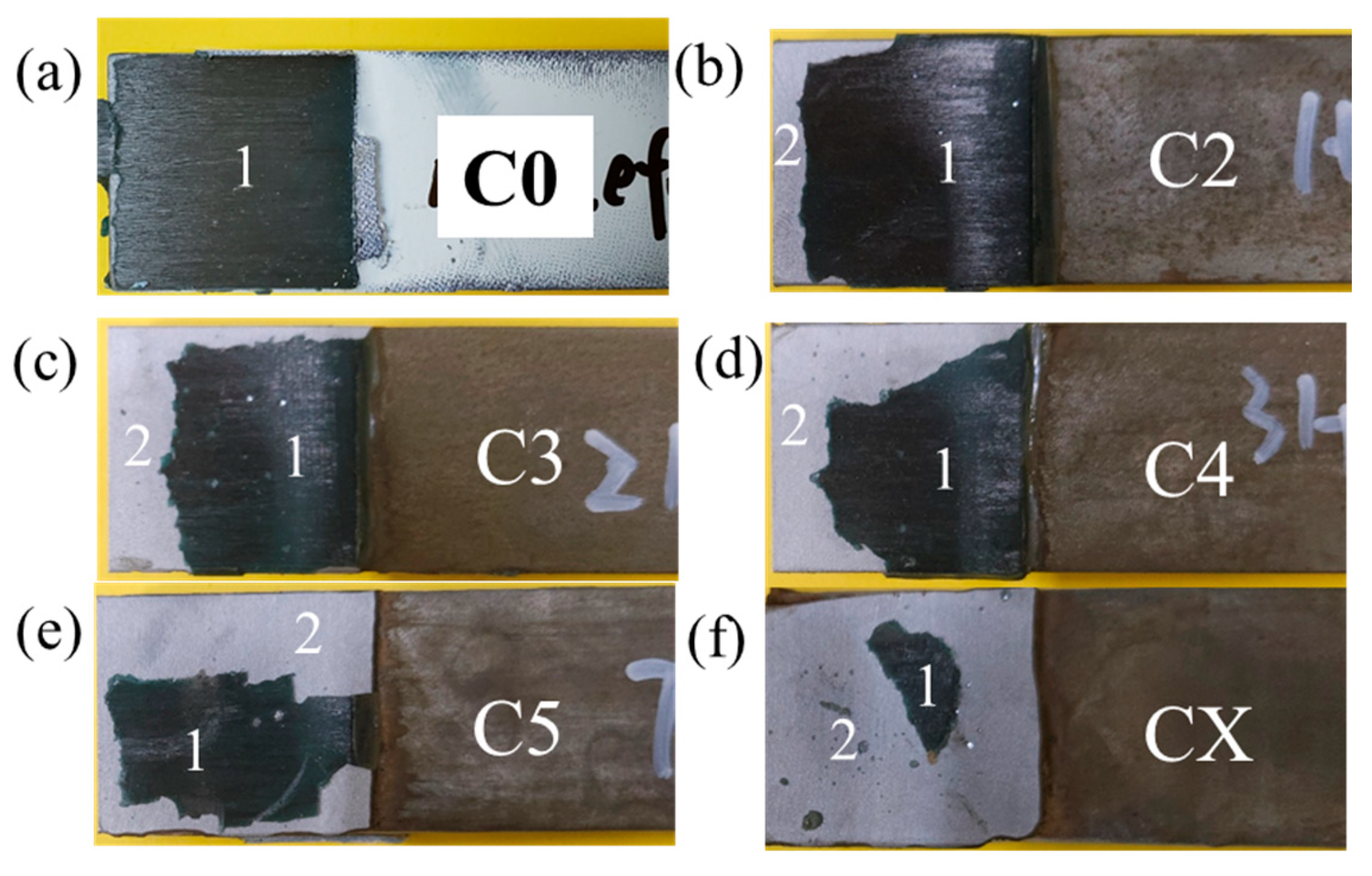
3.2. Effect of Corrosion Damage
3.3. Effect of GFS in the Adhesive Layer
3.4. Effect of CFRP Bond Length
4. Bond–Slip Behaviour
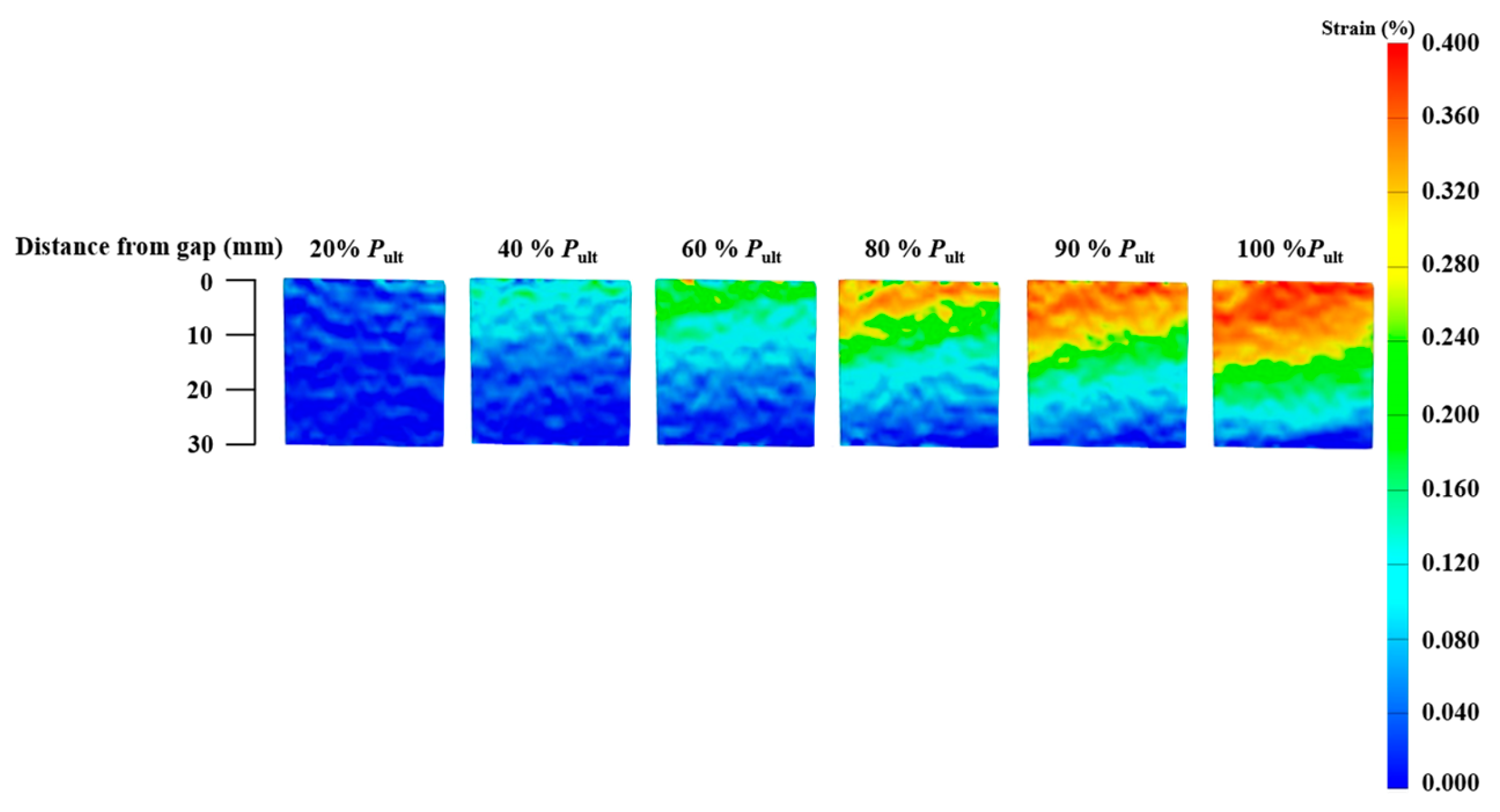
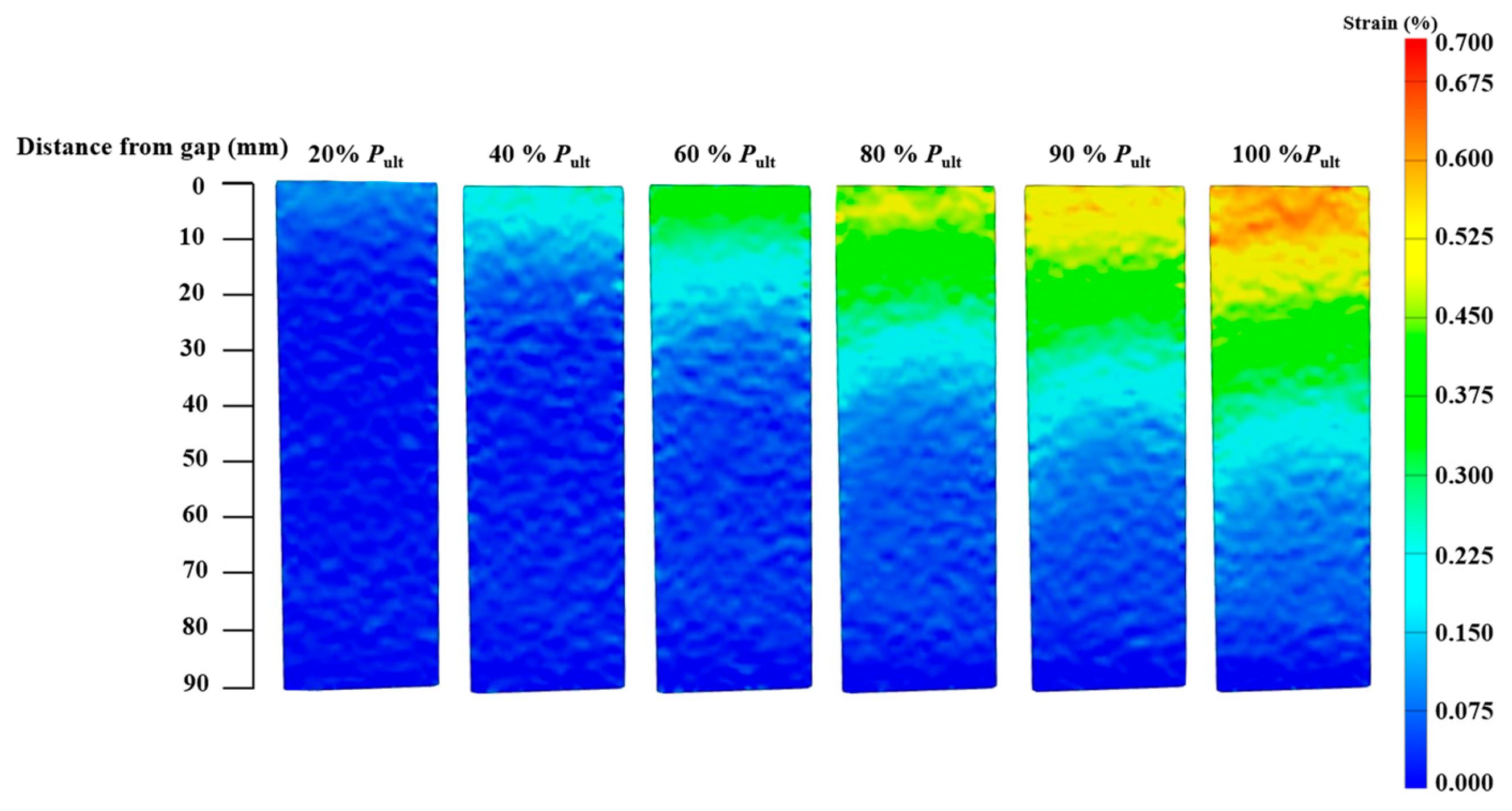
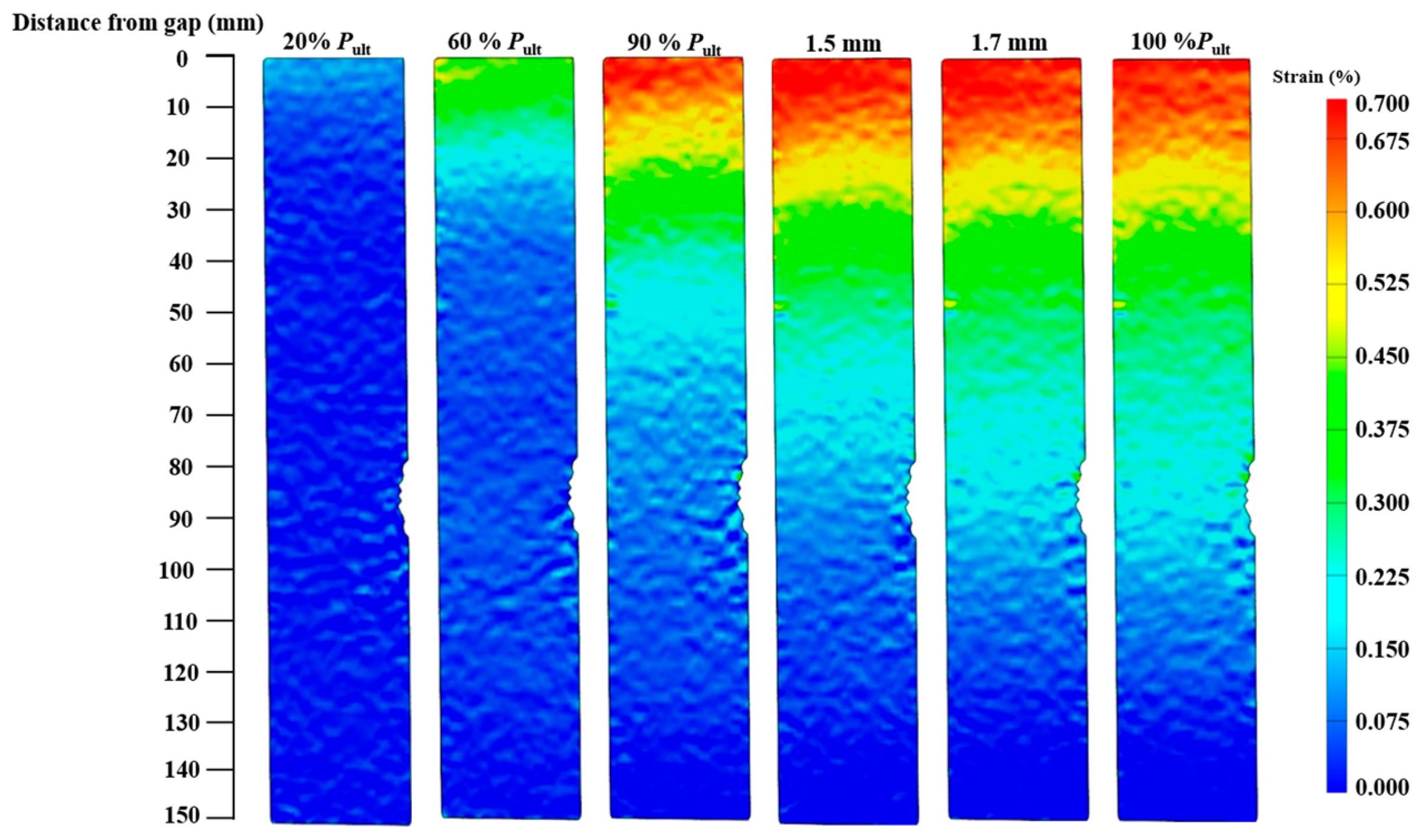
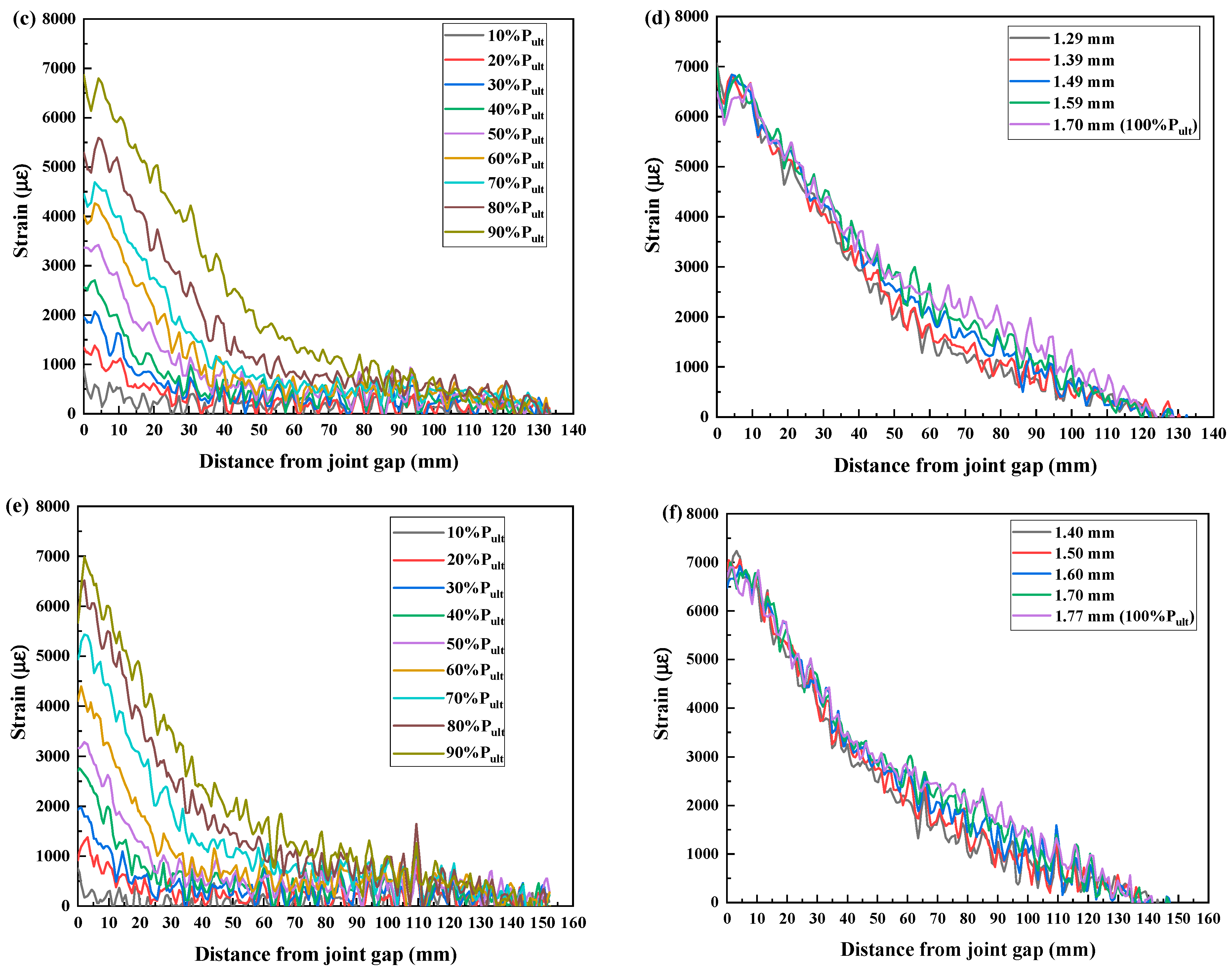
4.1. Longitudinal Axial Strain Along the CFRP Plate
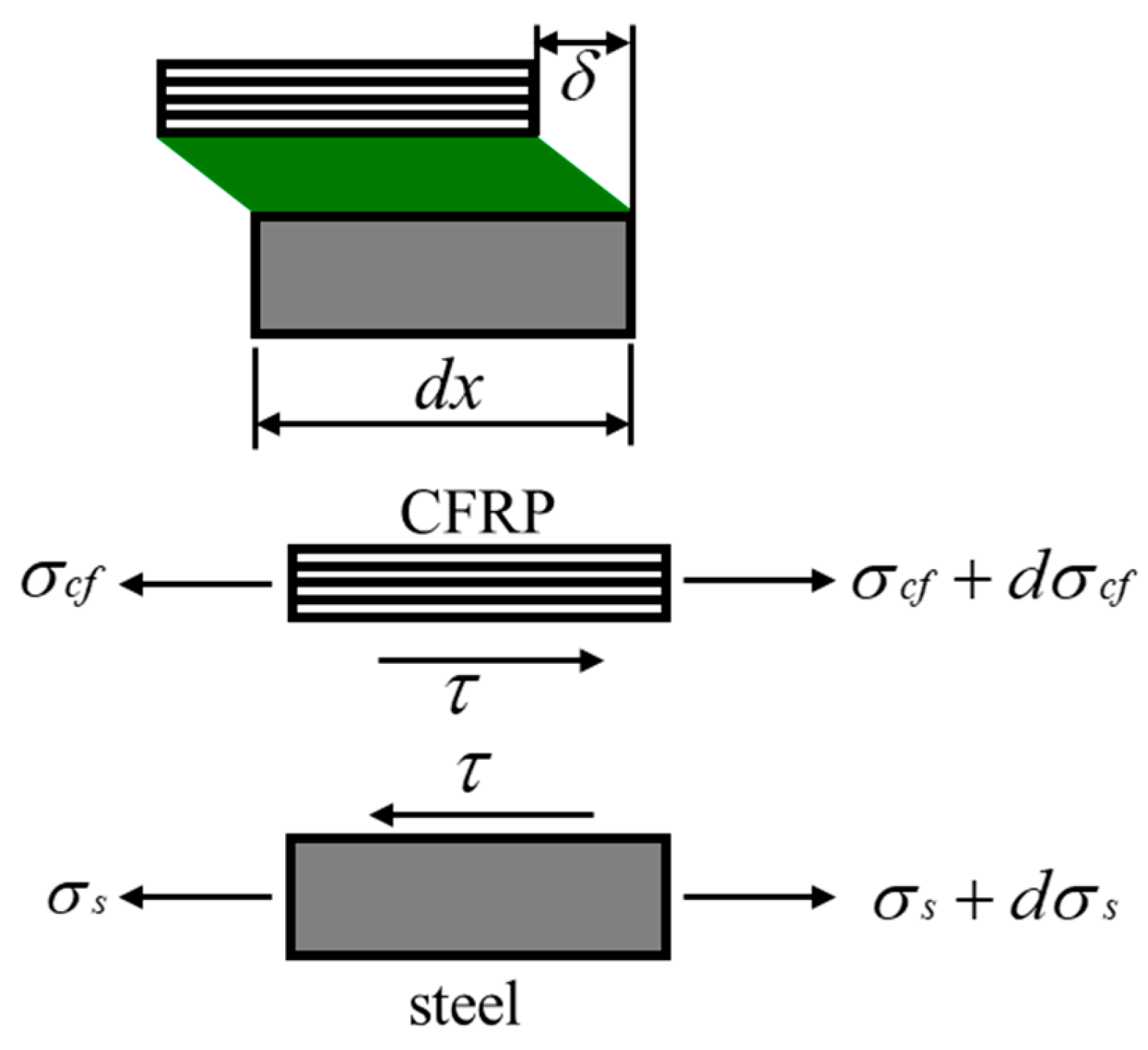
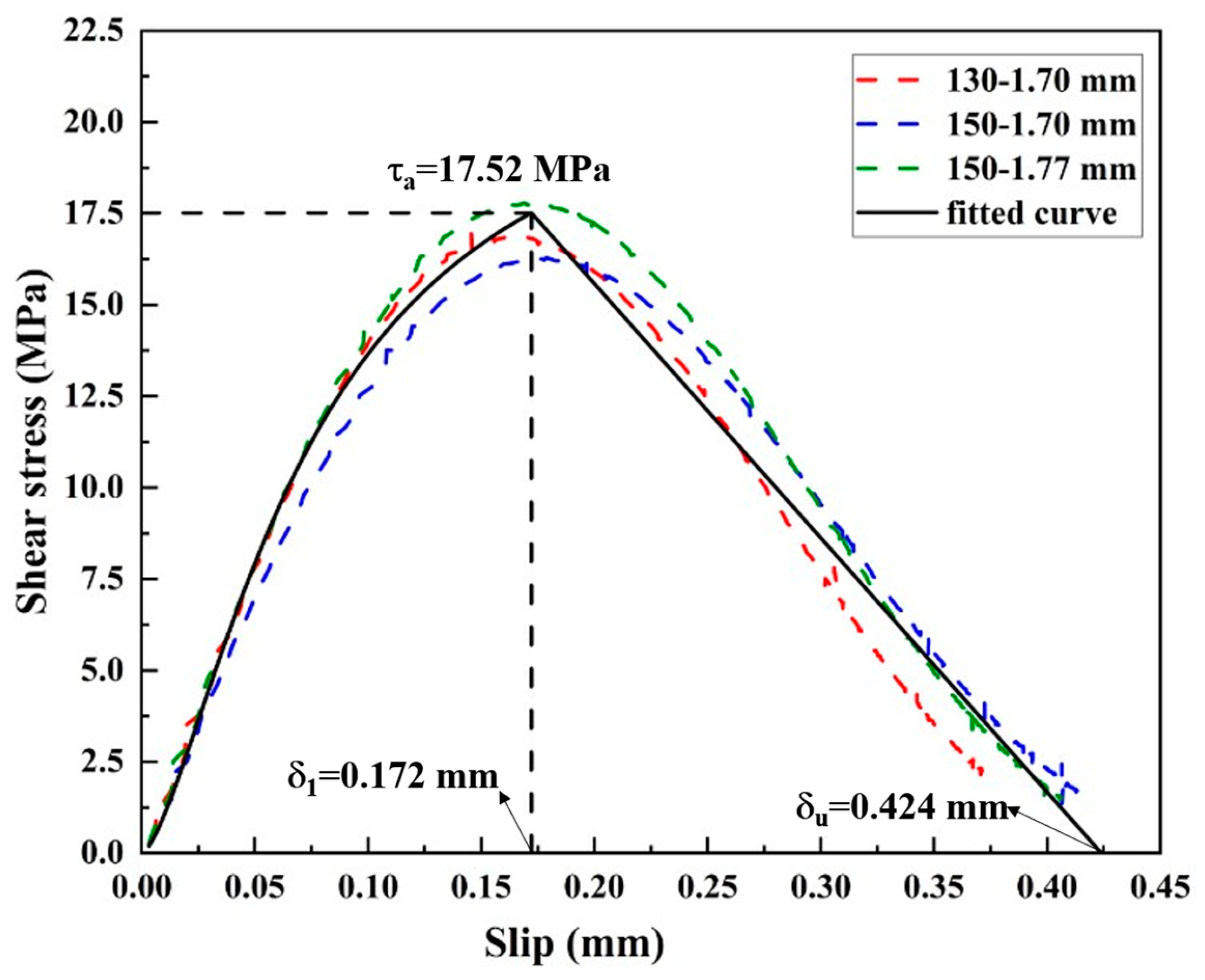
4.2. Establishment of the Bond–Slip Model
5. Conclusions
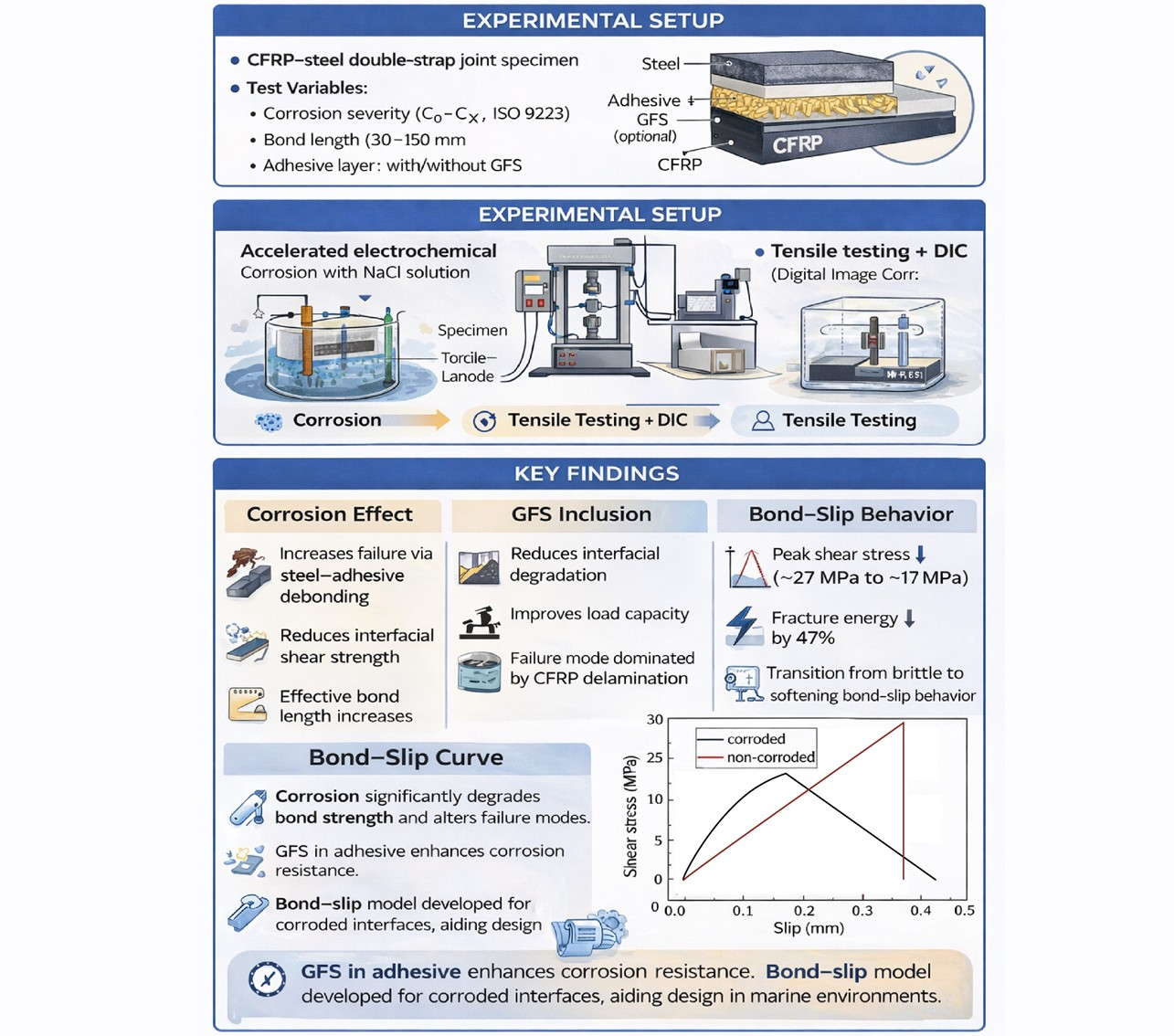
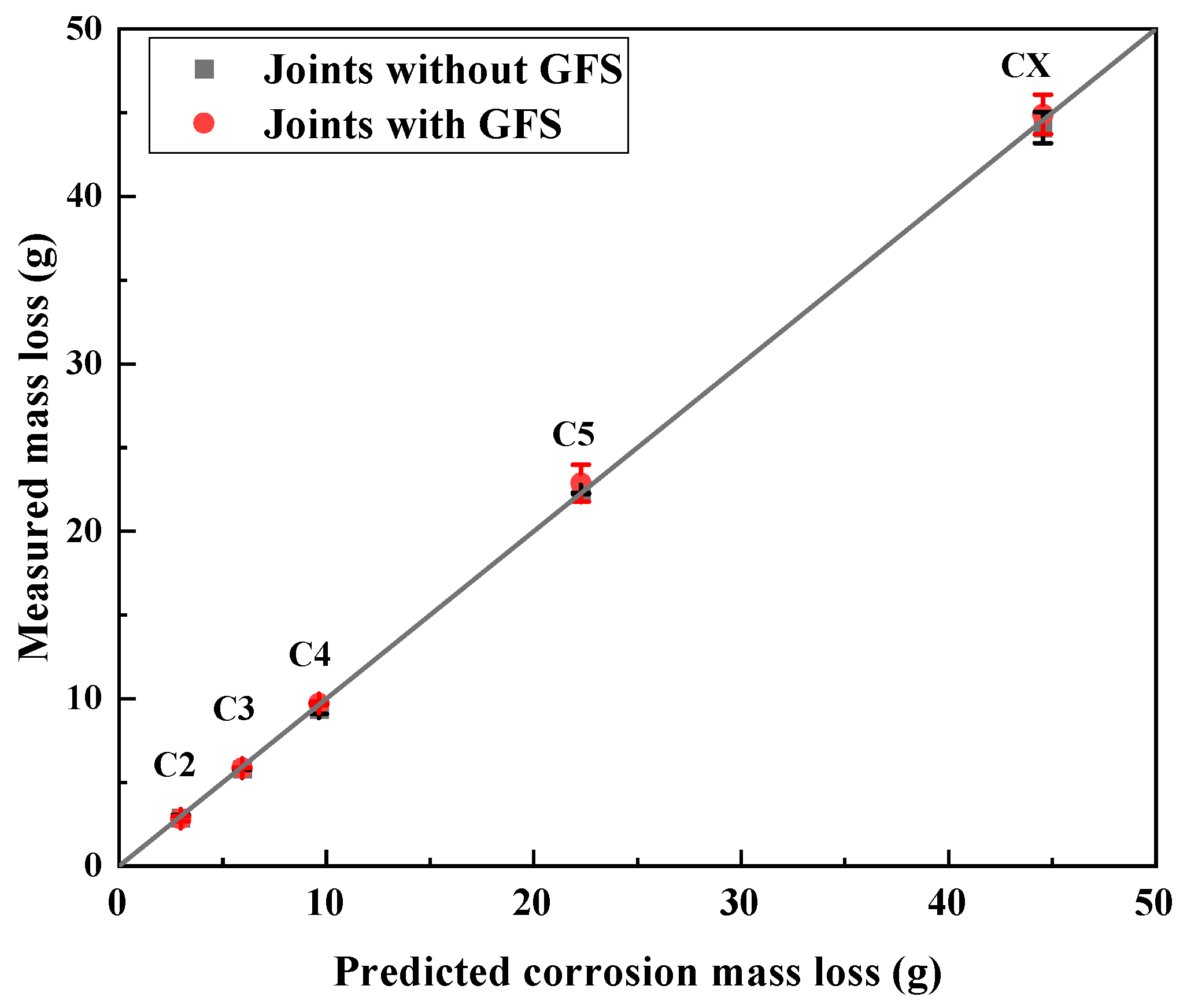
- The electrochemical corrosion method adopted in this study enables the controlled and efficient generation of different corrosion damage levels calibrated to ISO 9223 [21], providing a practical basis for investigating corrosion-induced degradation of CFRP–steel-bonded joints. The measured steel plate mass loss is almost consistent with the predicted mass loss. It is observed that the obvious corrosion only occurs on the steel plates, and there are corrosion pits on the steel surfaces. The morphology of the CFRP plate does not change significantly.
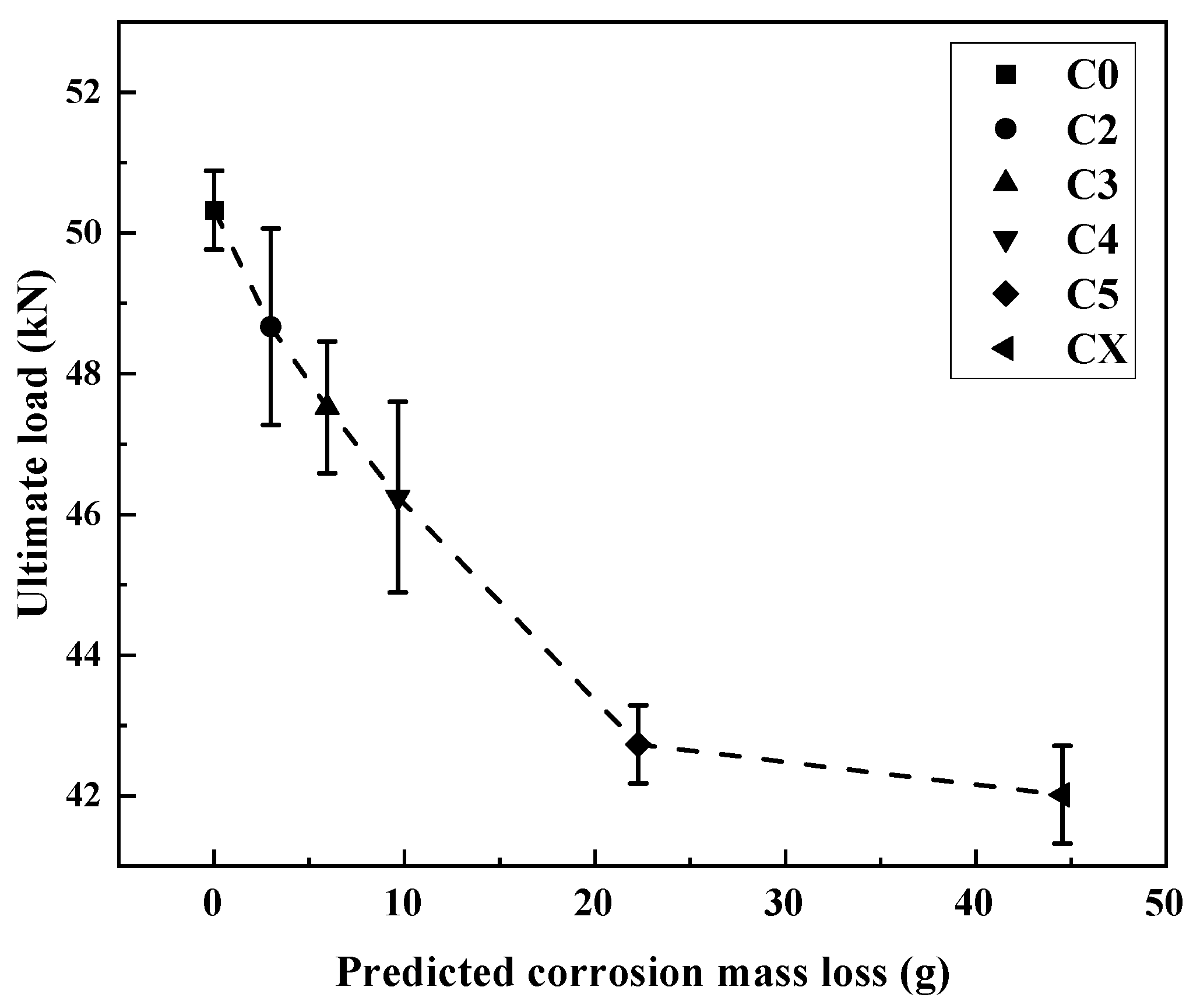
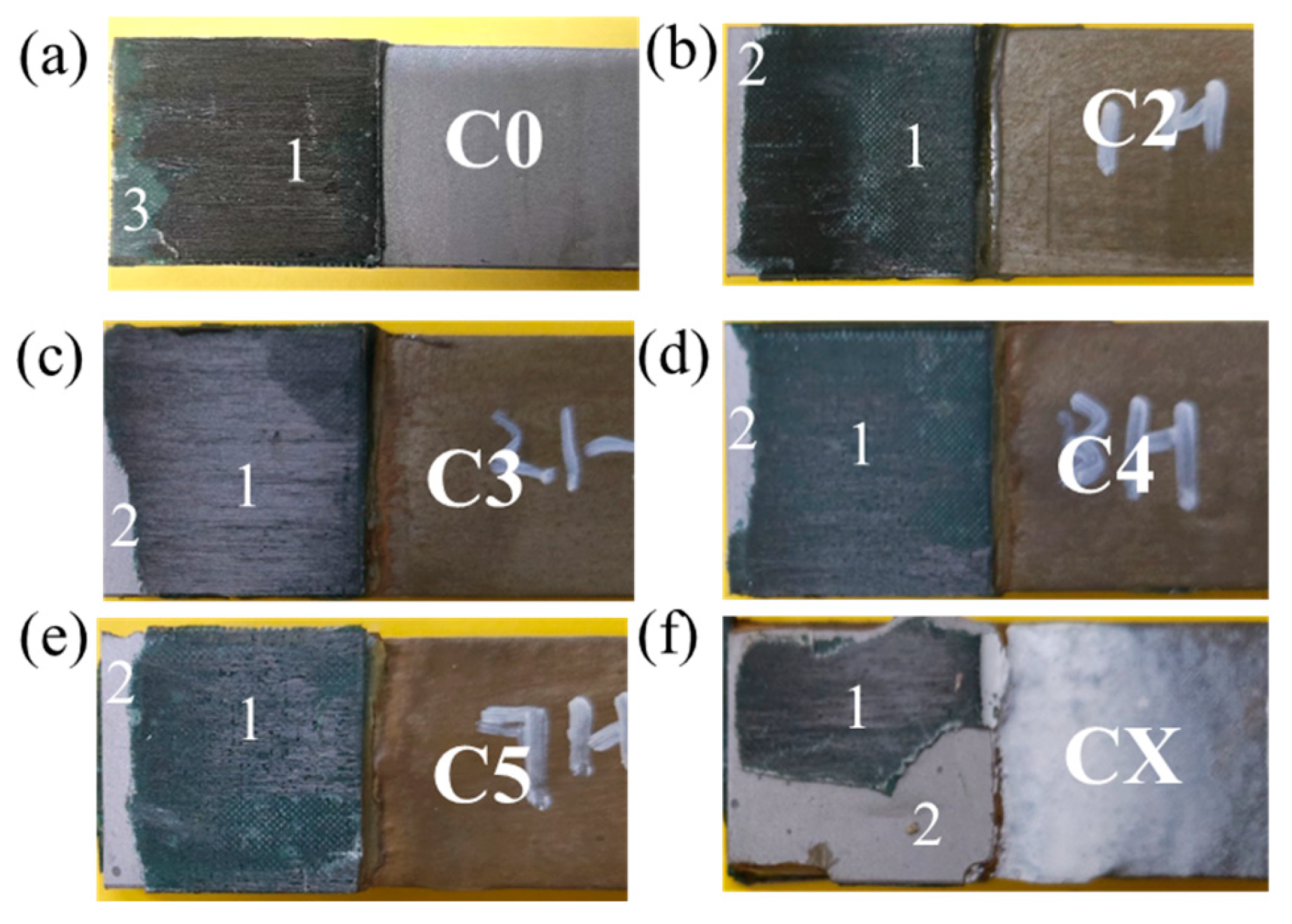
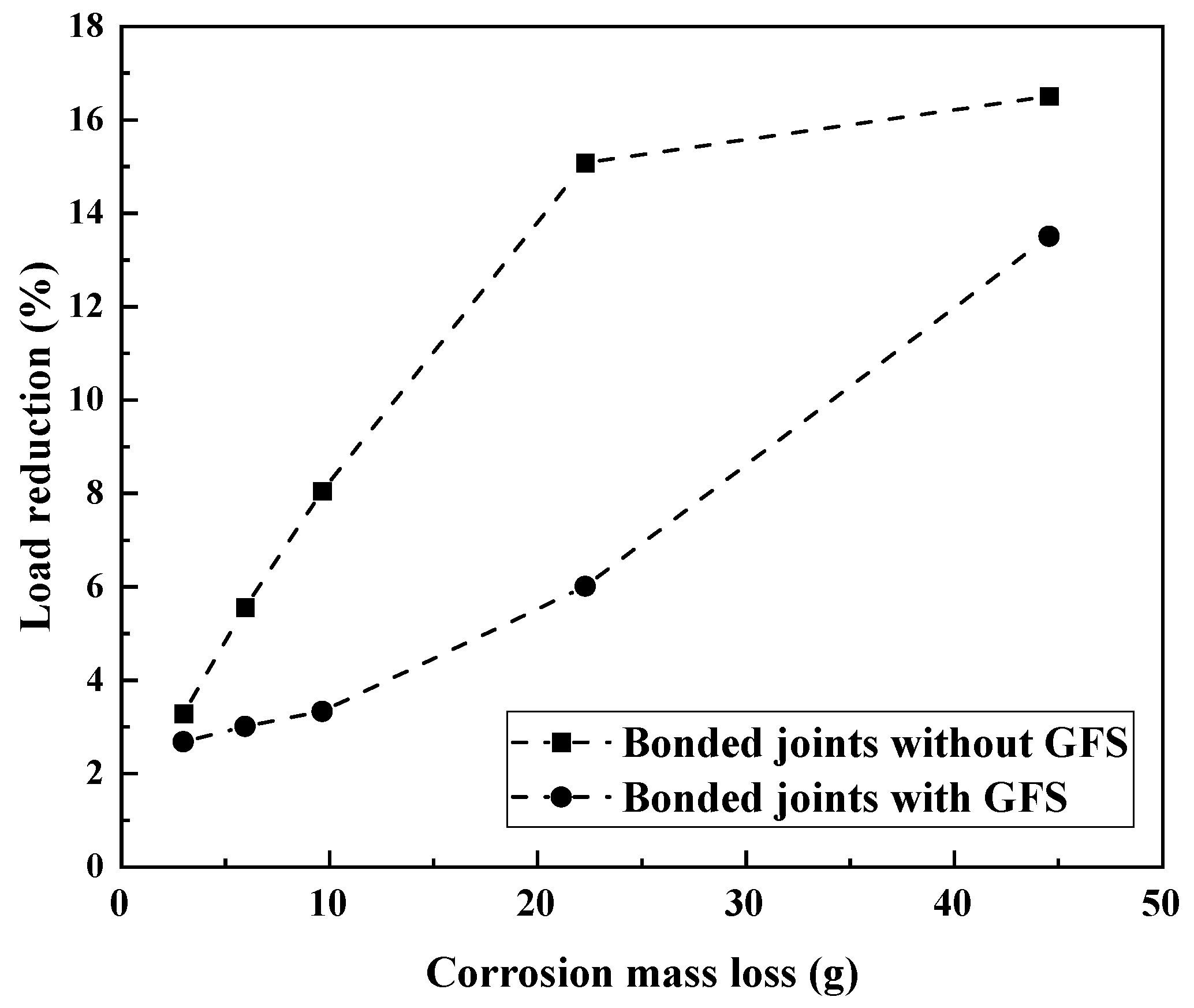
- As the degree of corrosion damage increases, the ultimate load of CFRP–steel-bonded joints without GFS with the same bond length (30 mm) declines up to 16.51%, but the reduction rate slows down. The failure mode changes from CFRP delamination to steel–adhesive interface debonding with an increase in damage degree.
- The failure mode of joints with GFS is CFRP delamination for all corrosion damage categories except for CX, which exhibits steel–adhesive interface debonding. GFS in the adhesive layer can enhance the bond performance of the joints under corrosion conditions. Given a specific corrosion damage and bond length, the ultimate load of joints with GFS is greater than that of joints without GFS, with an increase of 8.26% for a very high corrosion damage level (C5).
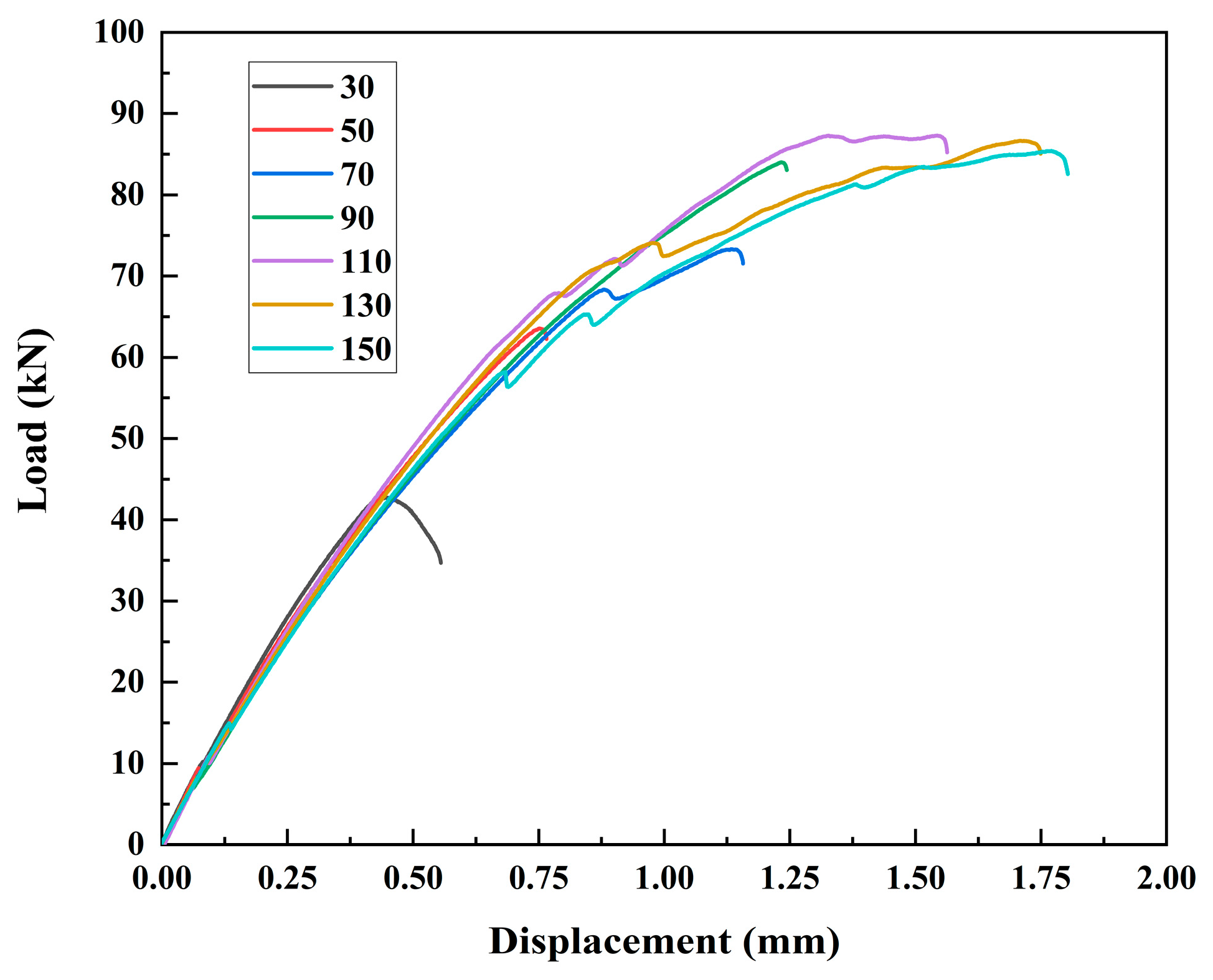
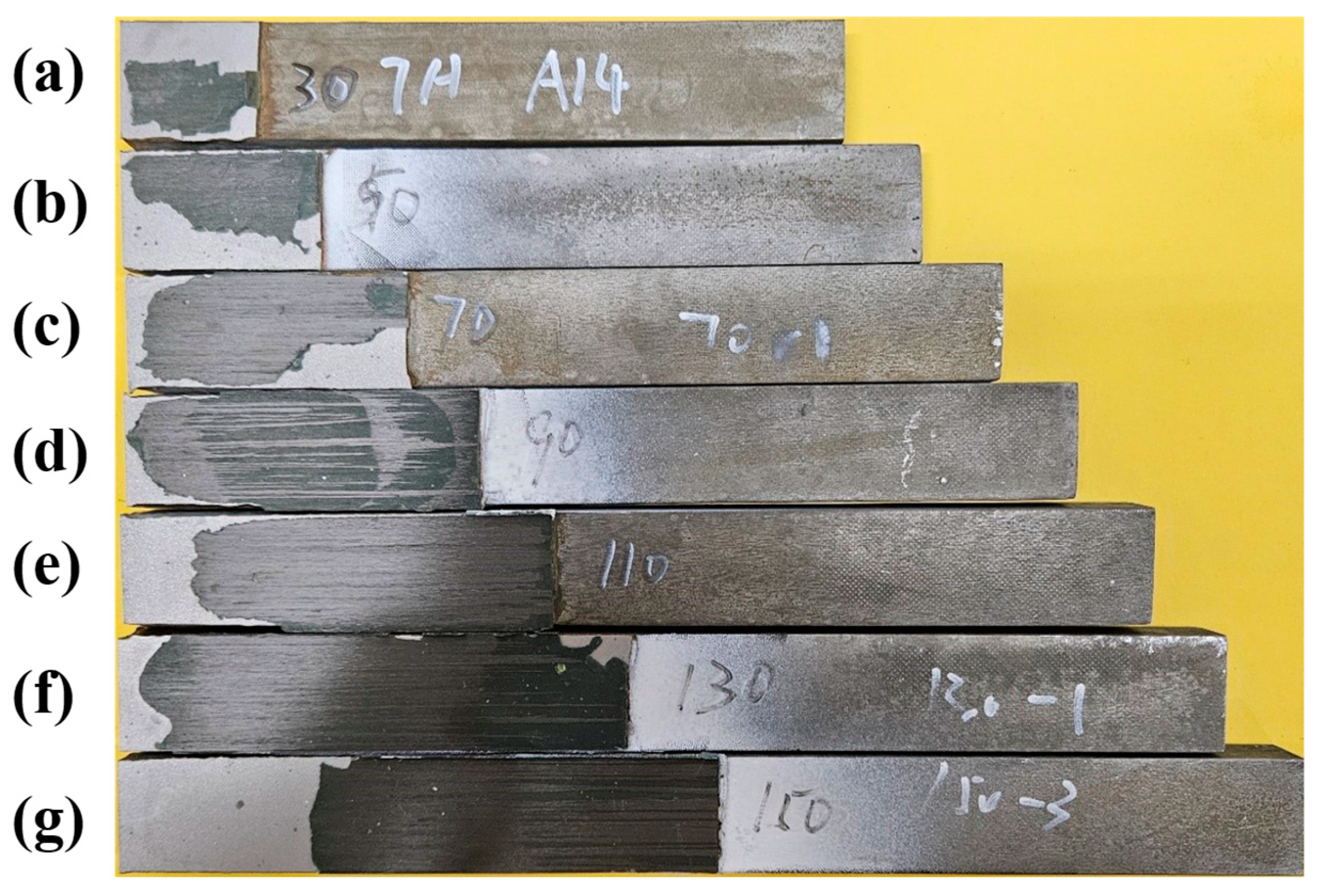
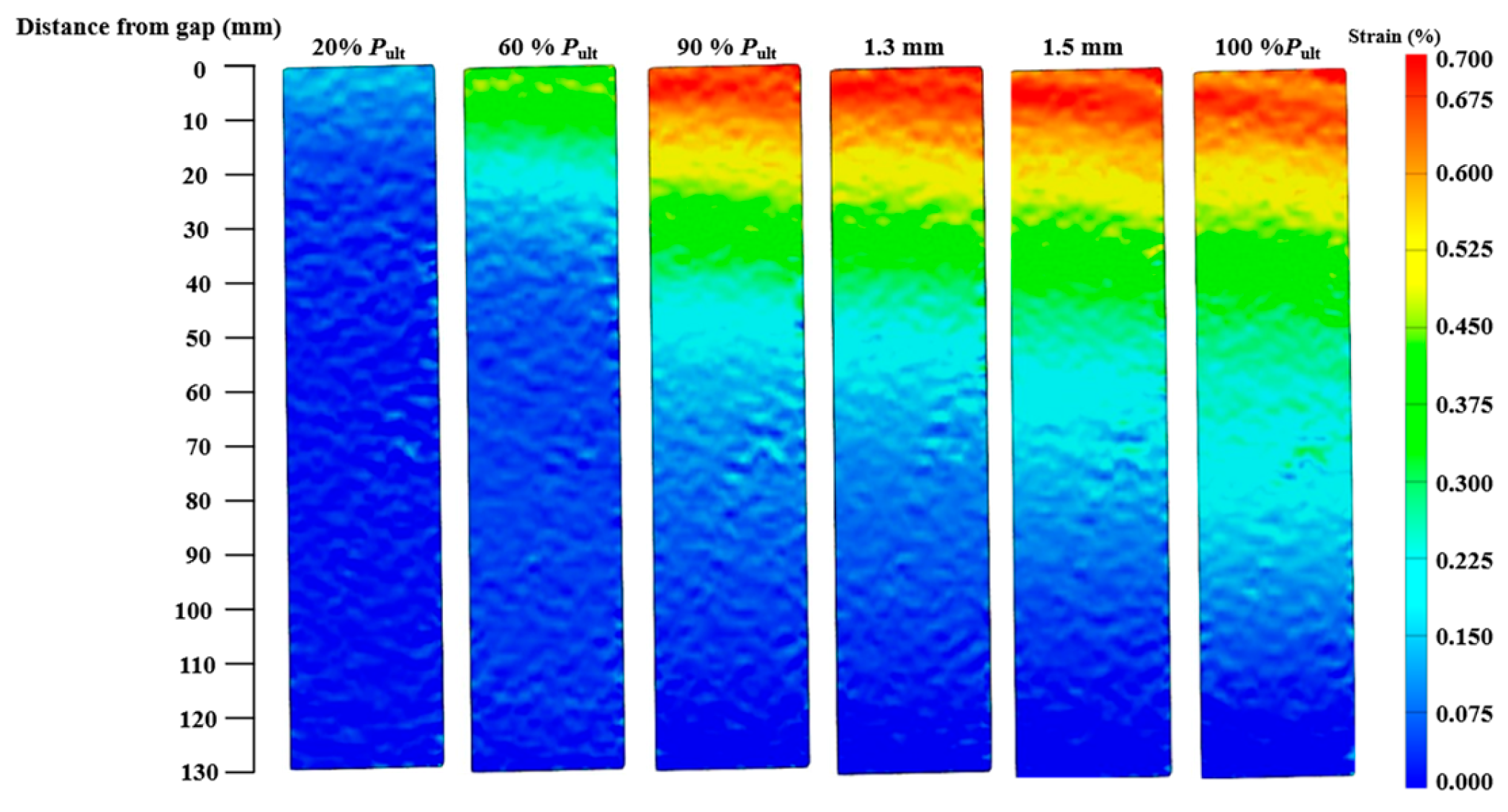
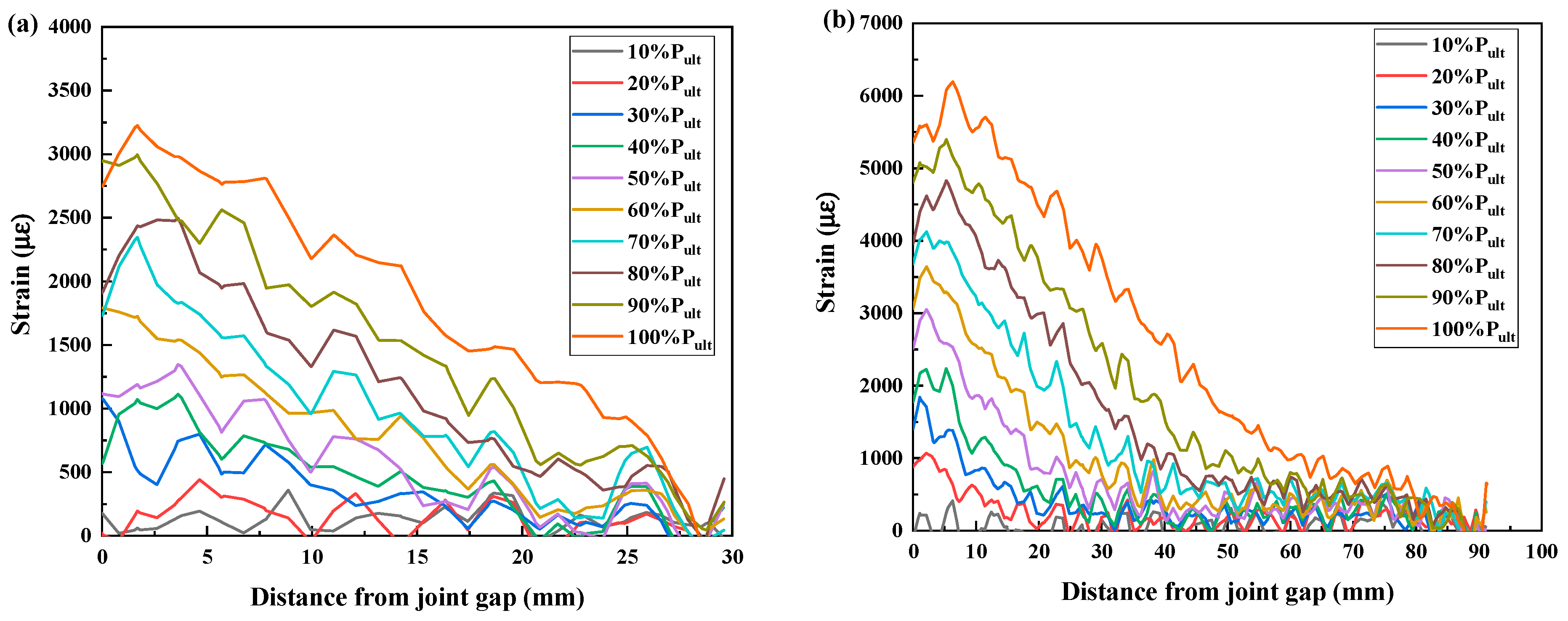
- For joints with a very high level of corrosion damage (category C5), the ultimate load of the joints without GFS first increases and then remains constant (around 86 kN) as the bond length increases. The effective bond length of the corroded joint is about 130 mm, which is a little larger than the non-corroded joint. The failure mode is a mixture of CFRP delamination and steel–adhesive interface debonding, which is independent of the bond length.
- A bond–slip model is established for corroded CFRP–steel-bonded joints. The relationship is greatly affected by the corrosion damage, which has a much lower maximum interfacial shear stress (17.52 MPa), a smaller fracture energy (5.49 N/mm), and a progressive softening failing process.
Author Contributions
Funding
Data Availability Statement
Acknowledgments
Conflicts of Interest
References
- Global Wind Energy Council. Global Offshore Wind Report 2024 EB/OL; Global Wind Energy Council: Lisbon, Portugal, 2024; Available online: https://www.gwec.net/reports/globaloffshorewindreport/2024 (accessed on 12 December 2025).
- Delzendeh Moghadam, M.; Fathi, A.; Chaallal, O. Retrofitting of steel structures with CFRP: Literature review and research needs. Appl. Sci. 2024, 14, 5958. [Google Scholar] [CrossRef]
- Borrie, D.; Al-Saadi, S.; Zhao, X.-L.; Raman, R.S.; Bai, Y. Bonded CFRP/steel systems, remedies of bond degradation and behaviour of CFRP repaired steel: An overview. Polymers 2021, 13, 1533. [Google Scholar] [CrossRef] [PubMed]
- Kupski, J.; De Freitas, S.T. Design of adhesively bonded lap joints with laminated CFRP adherends: Review, challenges and new opportunities for aerospace structures. Compos. Struct. 2021, 268, 113923. [Google Scholar] [CrossRef]
- Karthikeyan, N.; Naveen, J. Progress in adhesive-bonded composite joints: A comprehensive review. J. Reinf. Plast. Compos. 2025, 44, 1844–1890. [Google Scholar] [CrossRef]
- Li, C.; Ke, L.; He, J.; Chen, Z.; Jiao, Y. Effects of mechanical properties of adhesive and CFRP on the bond behavior in CFRP-strengthened steel structures. Compos. Struct. 2019, 211, 163–174. [Google Scholar] [CrossRef]
- Wu, C.; Zhao, X.; Duan, W.H.; Al-Mahaidi, R. Bond characteristics between ultra high modulus CFRP laminates and steel. Thin-Walled Struct. 2012, 51, 147–157. [Google Scholar] [CrossRef]
- Fernando, D.; Yu, T.; Teng, J.G. Behavior of CFRP laminates bonded to a steel substrate using a ductile adhesive. J. Compos. Constr. 2014, 18, 04013040. [Google Scholar] [CrossRef]
- Al-Mosawe, A.; Al-Mahaidi, R.; Zhao, X.L. Bond behaviour between CFRP laminates and steel members under different loading rates. Compos. Struct. 2016, 148, 236–251. [Google Scholar] [CrossRef]
- Al-Zubaidy, H.; Al-Mahaidi, R.; Zhao, X.L. Experimental investigation of bond characteristics between CFRP fabrics and steel plate joints under impact tensile loads. Compos. Struct. 2012, 94, 510–518. [Google Scholar] [CrossRef]
- Doroudi, Y.; Fernando, D.; Zhou, H.; Nguyen, V.T.; Ghafoori, E. Fatigue behavior of FRP-to-steel bonded interface: An experimental study with a damage plasticity model. Int. J. Fatigue 2020, 139, 105785. [Google Scholar] [CrossRef]
- Yu, Q.Q.; Gao, R.X.; Gu, X.L.; Zhao, X.L.; Chen, T. Bond behavior of CFRP-steel double-lap joints exposed to marine atmosphere and fatigue loading. Eng. Struct. 2018, 175, 76–85. [Google Scholar] [CrossRef]
- Borrie, D.; Liu, H.B.; Zhao, X.L.; Raman, R.S.; Bai, Y. Bond durability of fatigued CFRP-steel double-lap joints pre-exposed to marine environment. Compos. Struct. 2015, 131, 799–809. [Google Scholar] [CrossRef]
- Galvez, P.; Abenojar, J.; Martinez, M.A. Effect of moisture and temperature on the thermal and mechanical properties of a ductile epoxy adhesive for use in steel structures reinforced with CFRP. Compos. Part B Eng. 2019, 176, 107194. [Google Scholar] [CrossRef]
- Heshmati, M.; Haghani, R.; Al-Emrani, M. Durability of CFRP/steel joints under cyclic wet-dry and freeze-thaw conditions. Compos. Part B Eng. 2017, 126, 211–226. [Google Scholar] [CrossRef]
- Li, A.; Xu, S.; Wang, H.; Zhang, H.; Wang, Y. Bond behaviour between CFRP plates and corroded steel plates. Compos. Struct. 2019, 220, 221–235. [Google Scholar] [CrossRef]
- Zhang, P.; Li, H.; Liu, Y.; Tao, X.; Qi, Y.; Sheikh, S.A. Interfacial bonding performance of CFRP sheet reinforced corroded steel plates under fatigue loading. Constr. Build. Mater. 2025, 468, 140450. [Google Scholar] [CrossRef]
- Xie, J.; Yang, M.; Kainuma, S. estigation on irreversible deterioration mechanism of CFRP–steel adhesive joint based on the hydrothermal aging behaviour of resin matrix. Structures 2023, 58, 105581. [Google Scholar] [CrossRef]
- Viana, G.M.; Costa, M.; Banea, M.D.; da Silva, L.F. A review on the temperature and moisture degradation of adhesive joints. Proc. Inst. Mech. Eng. Part L J. Mater. Des. Appl. 2017, 231, 488–501. [Google Scholar] [CrossRef]
- Torres-Acosta, A.A. Galvanic corrosion of steel in contact with carbon-polymer composites. I: Experiments in mortar. J. Compos. Constr. 2002, 6, 112–115. [Google Scholar] [CrossRef]
- ISO 9223: 2012; Corrosion of Metals and Alloys—Corrosivity of Atmospheres—Classification, Determination and Estimation. International Organization for Standardization: Geneva, Switzerland, 2012.
- Wu, C.; Yu, Y.Z.; Tam, L.H.; Orr, J.; He, L. Effect of glass fiber sheet in adhesive on the bond and galvanic corrosion behaviours of CFRP-Steel bonded system. Compos. Struct. 2021, 259, 113218. [Google Scholar] [CrossRef]
- ASTM D3039/D3039M; Standard Test Method for Tensile Properties of Polymer Matrix Composite Materials. ASTM International: West Conshohocken, PA, USA, 2008.
- ASTM E8/E8M-16a; Standard Test Methods for Tension Testing of Metallic Materials. ASTM International: West Conshohocken, PA, USA, 2016.
- ASTM D638-14; Standard Test Method for Tensile Properties of Plastics. ASTM International: West Conshohocken, PA, USA, 2014.
- Zhao, X.L.; Zhang, L. State-of-the-art review on FRP strengthened steel structures. Eng. Struct. 2007, 29, 1808–1823. [Google Scholar] [CrossRef]
- Ren, X.; Sherif, M.M.; Wei, Y.; Lyu, Y.; Sun, Y.; Ozbulut, O.E. Effect of corrosion on the tensile and fatigue performance of CFRP strand Sheet/Steel double strap joints. Eng. Struct. 2022, 260, 114240. [Google Scholar] [CrossRef]
- Batuwitage, C.; Fawzia, S.; Thambiratnam, D.; Al-Mahaidi, R. Durability of CFRP strengthened steel plate double-strap joints in accelerated corrosion environments. Compos. Struct. 2017, 160, 1287–1298. [Google Scholar] [CrossRef]
- Kim, Y.J.; Bumadian, I.; Park, J.S. Galvanic current influencing interface deterioration of CFRP bonded to a steel substrate. J. Mater. Civ. Eng. 2016, 28, 04015129. [Google Scholar] [CrossRef]
- Kim, Y.J.; Bumadian, I. Electrochemical reactions for steel beams strengthened with CFRP sheets. Eng. Struct. 2016, 125, 471–480. [Google Scholar] [CrossRef]
- Batuwitage, C.; Fawzia, S.; Thambiratnam, D.; Al-Mahaidi, R. Evaluation of bond properties of degraded CFRP-strengthened double strap joints. Compos. Struct. 2017, 173, 144–155. [Google Scholar] [CrossRef]
- Peng, F. Research on the Interfacial Performance of Metallic Structures Strengthened with Fibre Reinforced Polymers. Ph.D. Thesis, Xi’an University of Architecture and Technology, Xi’an, China, 2005. [Google Scholar]
- Mariam, M.; Afendi, M.; Majid, M.A.; Ridzuan, M.J.; Azmi, A.I.; Sultan, M.T. Influence of hydrothermal ageing on the mechanical properties of an adhesively bonded joint with different adherends. Compos. Part B Eng. 2019, 165, 572–585. [Google Scholar] [CrossRef]
- Yu, Y.Z.; Tam, L.H.; Wu, C. A universal solution of the bond behaviour between CFRP-steel double strap joints considering steel yielding. Compos. Struct. 2023, 304, 116377. [Google Scholar] [CrossRef]
- Pang, Y.Y.; Wu, G.; Wang, H.T.; Su, Z.L.; He, X.Y. Experimental study on the bond behavior of the CFRP-steel interface under the freeze–thaw cycles. J. Compos. Mater. 2020, 54, 13–29. [Google Scholar] [CrossRef]
- Pang, Y.; Wu, G.; Wang, H.; Gao, D.; Zhang, P. Bond-slip model of the CFRP-steel interface with the CFRP delamination failure. Compos. Struct. 2021, 256, 113015. [Google Scholar] [CrossRef]
- Bocciarelli, M.; Colombi, P.; Fava, G.; Poggi, C. Prediction of debonding strength of tensile steel/CFRP joints using fracture mechanics and stress based criteria. Eng. Fract. Mech. 2009, 76, 299–313. [Google Scholar] [CrossRef]











| Properties | CFRP | Steel | Adhesive (Araldite 420) |
|---|---|---|---|
| Tensile strength (MPa) | 2659 | 539 | 30 |
| Yield strength (MPa) | N/A | 381 | N/A |
| Tensile modulus (GPa) | 155.9 | 219.6 | 1.744 |
| Group | Specimen Label | Bond Length (mm) | Corrosion Rate of Steel rcorr g/(m2·a) | Calculated Exposure Duration (s) |
|---|---|---|---|---|
| 1 | CF30-C0-1,2,3 | 30 | 0 | 0 |
| CF30-C2-1,2,3 | 200 | 3418.07 | ||
| CF30-C3-1,2,3 | 400 | 6836.14 | ||
| CF30-C4-1,2,3 | 650 | 11,108.72 | ||
| CF30-C5-1,2,3 | 1500 | 25,635.51 | ||
| CF30-CX-1,2,3 | 3000 | 51,271.02 | ||
| 2 | GF30-C0-1,2,3 | 30 | 0 | 0 |
| GF30-C2-1,2,3 | 200 | 3418.07 | ||
| GF30-C3-1,2,3 | 400 | 6836.14 | ||
| GF30-C4-1,2,3 | 650 | 11,108.72 | ||
| GF30-C5-1,2,3 | 1500 | 25,635.51 | ||
| GF30-CX-1,2,3 | 3000 | 51,271.02 | ||
| 3 | CF50-C5-1,2,3 | 50 | 1500 | 26,671.29 |
| CF70-C5-1,2,3 | 70 | 1500 | 27,707.07 | |
| CF90-C5-1,2,3 | 90 | 1500 | 28,742.84 | |
| CF110-C5-1,2,3 | 110 | 1500 | 29,778.62 | |
| CF130-C5-1,2,3 | 130 | 1500 | 30,814.40 | |
| CF150-C5-1,2,3 | 150 | 1500 | 31,850.18 |
| Category | Corrosivity | Corrosion Rate of Steel rcorr g/(m2·a) |
|---|---|---|
| C1 | Very Low | rcorr ≤ 10 |
| C2 | Low | 10 < rcorr ≤ 200 |
| C3 | Medium | 200 < rcorr ≤ 400 |
| C4 | High | 400 < rcor ≤ 650 |
| C5 | Very High | 650 < rcor ≤ 1500 |
| CX | Extreme | 1500 < rcorr ≤ 5500 |
| Group | Specimen Label | Measured Adhesive Thickness ta (mm) | Predicted Corrosion Mass Loss (g) | Measured Corrosion Mass Loss (g) | Ultimate Load Pult (kN) | Averaged Ultimate Load Pult.ave (kN) | Load Reduction (%) | Failure Mode |
|---|---|---|---|---|---|---|---|---|
| 1 | CF30-C0-1 | 0.39 | 0 | 0 | 50.87 | 50.32 | 0 | DL |
| CF30-C0-2 | 0.44 | 0 | 49.75 | DL | ||||
| CF30-C0-3 | 0.48 | 0 | 50.35 | DL | ||||
| CF30-C2-1 | 0.43 | 2.97 | 3.05 | 48.09 | 48.67 | 3.28 | DL + ID 1 | |
| CF30-C2-2 | 0.48 | 2.90 | 50.26 | DL + ID | ||||
| CF30-C2-3 | 0.41 | 2.65 | 47.65 | DL + ID | ||||
| CF30-C3-1 | 0.45 | 5.94 | 5.75 | 46.44 | 47.52 | 5.56 | DL + ID | |
| CF30-C3-2 | 0.42 | 5.8 | 48.09 | DL + ID | ||||
| CF30-C3-3 | 0.44 | 5.85 | 48.03 | DL + ID | ||||
| CF30-C4-1 | 0.41 | 9.65 | 9.45 | 47.63 | 46.27 | 8.05 | DL + ID | |
| CF30-C4-2 | 0.45 | 9.05 | 44.92 | DL + ID | ||||
| CF30-C4-3 | 0.40 | 9.65 | 46.19 | DL + ID | ||||
| CF30-C5-1 | 0.42 | 22.28 | 22.30 | 43.31 | 42.73 | 15.08 | ID + DL 2 | |
| CF30-C5-2 | 0.42 | 22.25 | 42.68 | ID + DL | ||||
| CF30-C5-3 | 0.39 | 22.25 | 42.20 | ID + DL | ||||
| CF30-CX-1 | 0.42 | 44.55 | 43.05 | 42.03 | 42.01 | 16.51 | ID + DL | |
| CF30-CX-2 | 0.48 | 44.75 | 41.31 | ID + DL | ||||
| CF30-CX-3 | 0.50 | 44.55 | 42.70 | ID + DL | ||||
| 2 | GF30-C0-1 | 0.43 | 0 | 0 | 49.23 | 49.22 | 0 | DL + GFS fragments |
| GF30-C0-2 | 0.42 | 0 | 50.28 | DL + GFS fragments | ||||
| GF30-C0-3 | 0.45 | 0 | 48.16 | DL + GFS fragments | ||||
| GF30-C2-1 | 0.48 | 2.97 | 2.90 | 48.11 | 47.90 | 2.68 | DL + ID | |
| GF30-C2-2 | 0.42 | 2.65 | 48.75 | DL + ID | ||||
| GF30-C2-3 | 0.50 | 2.95 | 46.85 | DL+ID | ||||
| GF30-C3-1 | 0.42 | 5.94 | 5.85 | 48.21 | 47.74 | 3.01 | DL + ID | |
| GF30-C3-2 | 0.47 | 5.85 | 47.55 | DL + ID | ||||
| GF30-C3-3 | 0.39 | 5.90 | 47.47 | DL + ID | ||||
| GF30-C4-1 | 0.41 | 9.65 | 9.75 | 46.37 | 47.58 | 3.33 | DL + ID | |
| GF30-C4-2 | 0.48 | 9.80 | 48.54 | DL + ID | ||||
| GF30-C4-3 | 0.46 | 9.60 | 47.83 | DL + ID | ||||
| GF30-C5-1 | 0.41 | 22.28 | 24.15 | 45.47 | 46.26 | 6.01 | DL + ID | |
| GF30-C5-2 | 0.49 | 22.15 | 46.17 | DL + ID | ||||
| GF30-C5-3 | 0.46 | 22.35 | 47.13 | DL + ID | ||||
| GF30-CX-1 | 0.42 | 44.55 | 44.10 | 43.12 | 42.57 | 13.51 | ID + DL | |
| GF30-CX-2 | 0.39 | 46.25 | 42.23 | ID + DL | ||||
| GF30-CX-3 | 0.46 | 44.35 | 42.35 | ID + DL | ||||
| 3 | CF50-C5-1 | 0.49 | 23.18 | 23.15 | 64.01 | 63.15 | 13.86 | DL + ID |
| CF50-C5-2 | 0.48 | 23.15 | 63.55 | DL + ID | ||||
| CF50-C5-3 | 0.42 | 23.15 | 61.88 | DL + ID | ||||
| CF70-C5-1 | 0.45 | 24.08 | 24.35 | 75.65 | 73.13 | 20.91 | DL + ID | |
| CF70-C5-2 | 0.46 | 24.50 | 73.31 | DL + ID | ||||
| CF70-C5-3 | 0.35 | 24.40 | 70.44 | DL + ID | ||||
| CF90-C5-1 | 0.50 | 24.98 | 25.25 | 80.96 | 83.67 | 20.89 | DL + ID | |
| CF90-C5-2 | 0.48 | 25.25 | 86.02 | DL + ID | ||||
| CF90-C5-3 | 0.39 | 25.05 | 84.02 | DL + ID | ||||
| CF110-C5-1 | 0.45 | 25.88 | 26.40 | 90.08 | 86.52 | 24.48 | DL + ID | |
| CF110-C5-2 | 0.40 | 26.25 | 82.17 | DL + ID | ||||
| CF110-C5-3 | 0.44 | 26.05 | 87.30 | DL + ID | ||||
| CF130-C5-1 | 0.46 | 26.78 | 27.15 | 86.65 | 87.46 | 27.27 | DL + ID | |
| CF130-C5-2 | 0.41 | 27.25 | 87.50 | DL + ID | ||||
| CF130-C5-3 | 0.48 | 27.35 | 88.23 | DL + ID | ||||
| CF150-C5-1 | 0.44 | 27.68 | 27.85 | 87.19 | 84.73 | 31.38 | DL + ID | |
| CF150-C5-2 | 0.48 | 27.75 | 81.62 | DL + ID | ||||
| CF150-C5-3 | 0.43 | 27.75 | 85.39 | DL + ID |
Disclaimer/Publisher’s Note: The statements, opinions and data contained in all publications are solely those of the individual author(s) and contributor(s) and not of MDPI and/or the editor(s). MDPI and/or the editor(s) disclaim responsibility for any injury to people or property resulting from any ideas, methods, instructions or products referred to in the content. |
© 2026 by the authors. Licensee MDPI, Basel, Switzerland. This article is an open access article distributed under the terms and conditions of the Creative Commons Attribution (CC BY) license.
Share and Cite
Yu, Y.; Li, D.; He, L.; Tam, L.-H.; Wang, Z.; Wu, C. Corrosion-Induced Degradation Mechanisms and Bond–Slip Relationship of CFRP–Steel-Bonded Interfaces. Materials 2026, 19, 511. https://doi.org/10.3390/ma19030511
Yu Y, Li D, He L, Tam L-H, Wang Z, Wu C. Corrosion-Induced Degradation Mechanisms and Bond–Slip Relationship of CFRP–Steel-Bonded Interfaces. Materials. 2026; 19(3):511. https://doi.org/10.3390/ma19030511
Chicago/Turabian StyleYu, Yangzhe, Da Li, Li He, Lik-Ho Tam, Zhenzhou Wang, and Chao Wu. 2026. "Corrosion-Induced Degradation Mechanisms and Bond–Slip Relationship of CFRP–Steel-Bonded Interfaces" Materials 19, no. 3: 511. https://doi.org/10.3390/ma19030511
APA StyleYu, Y., Li, D., He, L., Tam, L.-H., Wang, Z., & Wu, C. (2026). Corrosion-Induced Degradation Mechanisms and Bond–Slip Relationship of CFRP–Steel-Bonded Interfaces. Materials, 19(3), 511. https://doi.org/10.3390/ma19030511