This is an early access version, the complete PDF, HTML, and XML versions will be available soon.
Article

Performance Evaluation of Hot Mix Asphalt Modified with Biomass-Based Waste Chestnut Shells as Filler Replacement

by
Ceren Beyza İnce
Department of Civil Engineering, Faculty of Engineering and Natural Sciences, Malatya Turgut Ozal University, Malatya 44900, Turkey
Materials 2026, 19(3), 512; https://doi.org/10.3390/ma19030512
Submission received: 9 January 2026 / Revised: 24 January 2026 / Accepted: 26 January 2026 / Published: 27 January 2026
(This article belongs to the Section Construction and Building Materials)

Abstract

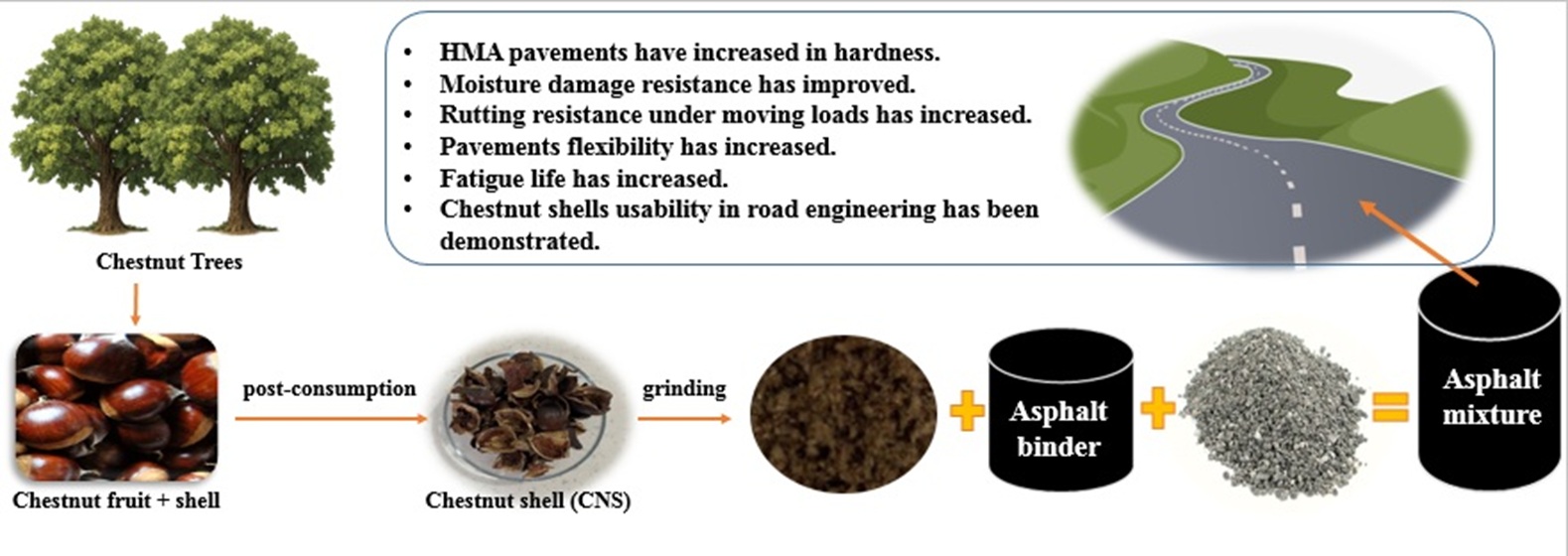
This study aims to investigate the feasibility and performance effects of using waste chestnut shells (CNS), derived from agricultural biomass, as a filler replacement material in hot mix asphalt mixtures. The influence of CNS on the mechanical behavior of hot mix asphalt mixtures was evaluated through a comprehensive experimental program. Initially, the physical and conventional properties of the B50/70 asphalt binder, aggregates, and CNS material were characterized to establish a reference framework for mixture design. The optimum asphalt content (OAC) for the control mixture was established using the Marshall mix design procedure. Mixture specimens incorporating CNS were produced by introducing the material at four different proportions, corresponding to filler substitution levels ranging from 5% to 20% by weight. The prepared specimens were evaluated through a series of mechanical and durability-related tests, including Marshall stability and flow, Retained Marshall, moisture damage, dynamic creep stiffness, indirect tensile strength (ITS), fatigue performance, and indirect tensile stiffness modulus (ITSM). The results indicated that mixtures with 10% CNS replacement exhibited notable improvements in stability, water sensitivity, ITS, ITSM, dynamic creep, and fatigue resistance, suggesting that CNS has the potential to enhance the performance characteristics of hot mix asphalt pavements.
Keywords: hot mix asphalt; chestnut shells; biomass; fatigue; creep stiffness; stability; sustainable pavement hot mix asphalt; chestnut shells; biomass; fatigue; creep stiffness; stability; sustainable pavement
Graphical Abstract