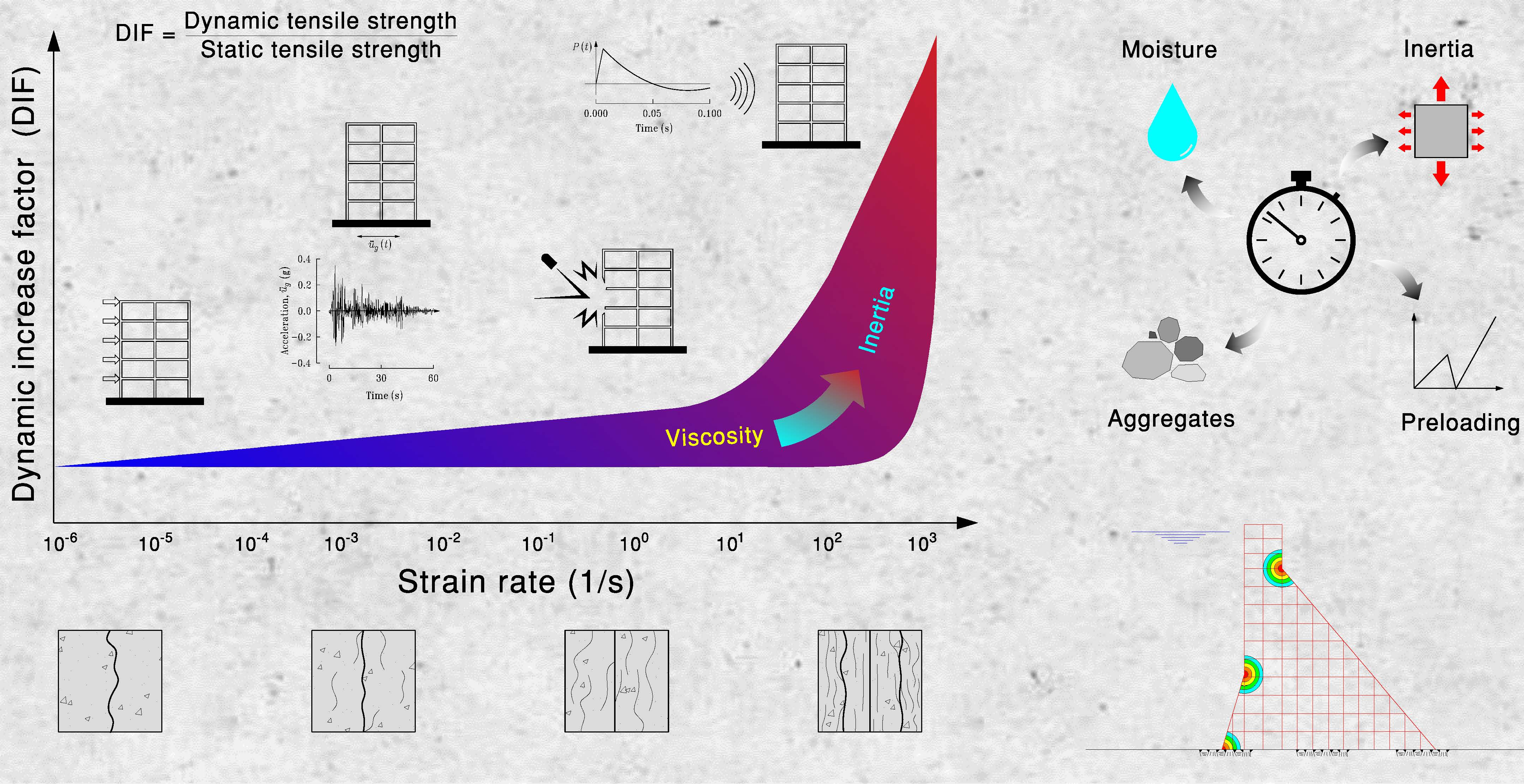
Dynamic Tensile Strength of Concrete: A Review of Mechanisms, Test Results, and Applications for Dam Safety

 , ,
, ,  and
and
Abstract
1. Introduction
2. Crack Evolution
3. Techniques
4. Dynamic Increase Factor (DIF)

| Author | Dynamic Increase Factor | Applicability | Parameters |
|---|---|---|---|
| 1. Simple Logarithmic Models | |||
| 1.1 Linear Logarithmic | |||
| [200] | |||
| Dynamic strain rate, | |||
| [36] | |||
| Dynamic strain rate, | |||
| [36] | |||
| Wet concrete | Dynamic strain rate, | ||
| [206] | |||
| Dynamic strain rate, | |||
| 1.2 Quadratic Logarithmic | |||
| [156] | Dynamic strain rate, | ||
| [207] | |||
| Dynamic strain rate, | |||
| [208] | Dynamic strain rate, | ||
| 2. Power-Law Models | |||
| 2.1 Simple Power Law | |||
| [24] | |||
| Dynamic strain rate, | |||
| Compressive strength (MPa), | |||
| [209] | |||
| Dynamic strain rate, | |||
| 2.2 Variable Exponent Power Law | |||
| [23] | |||
| Dynamic strain rate, | |||
| [210] | |||
| Dynamic strain rate, | |||
| [211] | |||
| Dynamic strain rate, | |||
| HSV (DT) = | |||
| HSV (MOR) = | |||
| D = diameter of specimen (mm) | |||
| L = length of specimen (mm) | |||
| b = width of specimen (mm) | |||
| h = height of specimen (mm) | |||
| l = span length of specimen (mm) | |||
| 3. Bilinear/Piecewise Formulations | |||
| [203] | |||
| = 10 (MPa) | |||
| Dynamic strain rate, | |||
| Compressive strength (MPa), | |||
| [155,160] | |||
| = 10 (MPa) | |||
| Dynamic strain rate, | |||
| Compressive strength (MPa), | |||
| [212] | |||
| Dynamic strain rate, | |||
| [213] | |||
| Dynamic strain rate, | |||
| [66] | |||
| Dynamic strain rate, | |||
| [153] | |||
| = 10 (MPa) | |||
| Dynamic strain rate, | |||
| Compressive strength (MPa), | |||
| [153] | |||
| High-strength concrete | |||
| = 10 (MPa) | |||
| Dynamic strain rate, | |||
| Compressive strength (MPa), | |||
| [68] | = | ||
| = 10 (MPa) | |||
| Dynamic strain rate, | |||
| Compressive strength (MPa), | |||
| [205] | |||
| Dynamic strain rate, | |||
| [205] | |||
| Dynamic strain rate, | |||
| 4. Fiber-Reinforced Concrete Models | |||
| [214] | |||
| = 10 (MPa) | |||
| , hooked fiber | |||
| , twisted fiber | |||
| Dynamic strain rate, | |||
| Compressive strength (MPa), | |||
| [215] | Plain concrete | Dynamic strain rate, | |
0.5 % steel fiber | |||
1.0 % steel fiber | |||
1.5 % steel fiber | |||
| [216] | |||
| = 10 (MPa) | |||
| k = 0.8, straight fiber | |||
| k = 0.95, hooked fiber | |||
| k = 1.3, twisted fiber | |||
| Dynamic strain rate, | |||
| Compressive strength (MPa), | |||
| Fiber volume fraction, m | |||
| [217] | Dynamic strain rate, | ||
| Concrete with fiber | |||
| [145] | Dynamic strain rate, | ||
| Concrete with fiber | |||
| 5. Piecewise Linear/Polynomial Models | |||
| [218] | Dynamic strain rate, | ||
| [219] | Dynamic strain rate, | ||
| [187] | Dynamic strain rate, | ||
| [170] | Dynamic strain rate, | ||
| [217] | Dynamic strain rate, | ||
| [220] | Dynamic strain rate, | ||
| 6. Direct Power-Law Models | |||
| [221] | Dynamic strain rate, | ||
| [222] | Dynamic strain rate, | ||
| [204] | Dynamic strain rate, | ||
| 7. Complex/Special Models | |||
| [223] | Dynamic strain rate, | ||
| [224] | is the limit enhancement are the curve fitting parameters | ||
| [225] | n = axial compression ratio Dynamic strain rate, | ||
5. Inertia Effects
6. Influence of Free Water
7. Influence of Load History
7.1. Monotonic Loading
7.2. Cyclic Loading
8. Large-Aggregate Concrete
9. Concrete Quality
10. High Strain Rates
11. Numerical Simulation
12. Dynamic Properties in Guidelines for Concrete Dams
Comparison with DIF Formulations
13. Discussion
13.1. Mechanisms
13.2. Established Knowledge and Uncertainties
13.3. Knowledge Gaps
13.4. Engineering Practice and Research Priorities
14. Conclusions
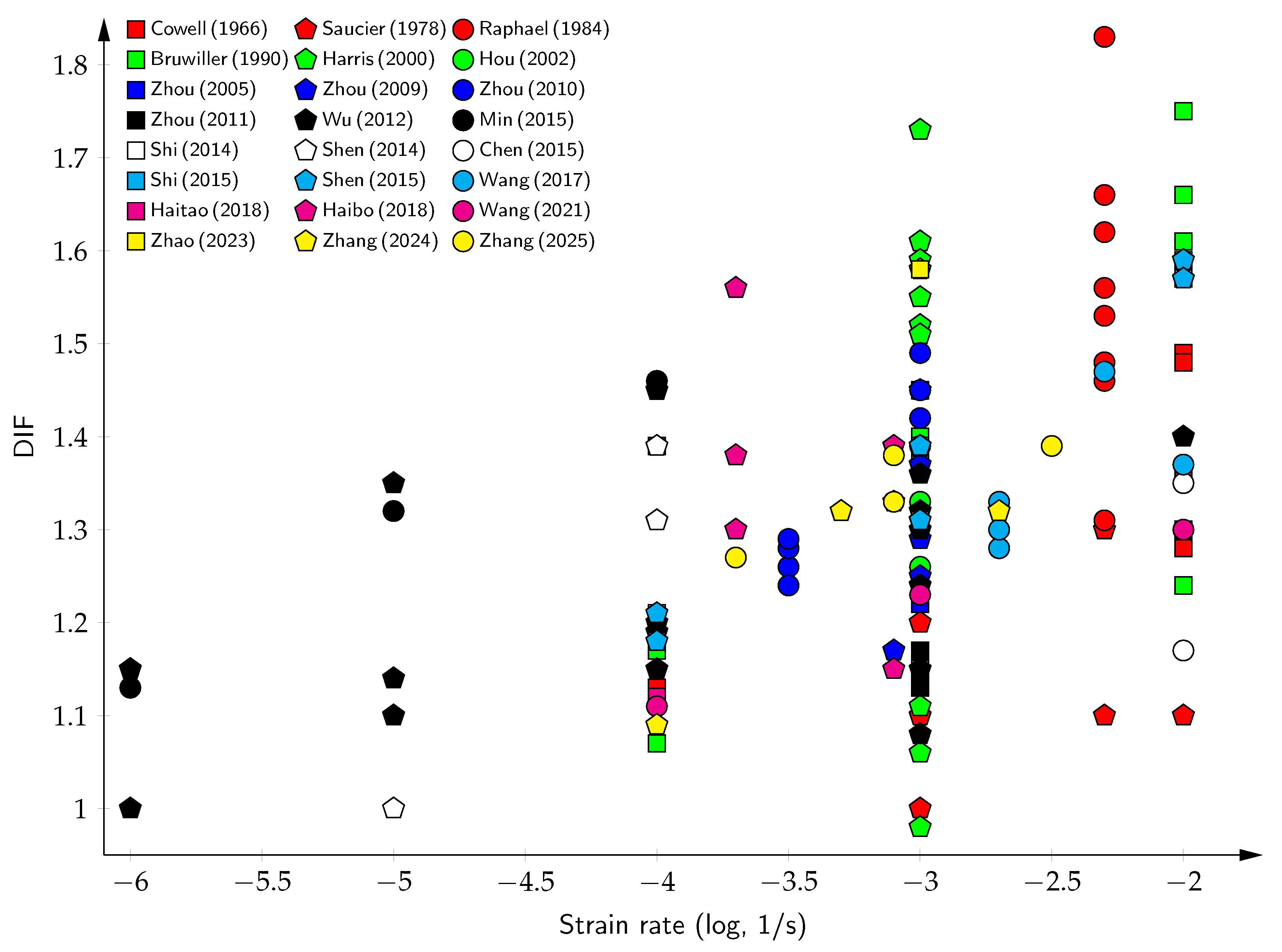
- DIFs of 1.2–1.8 are well established for seismic strain rates ( to s−1), with a consensus between experimental data, empirical formulations, and international design guidelines.
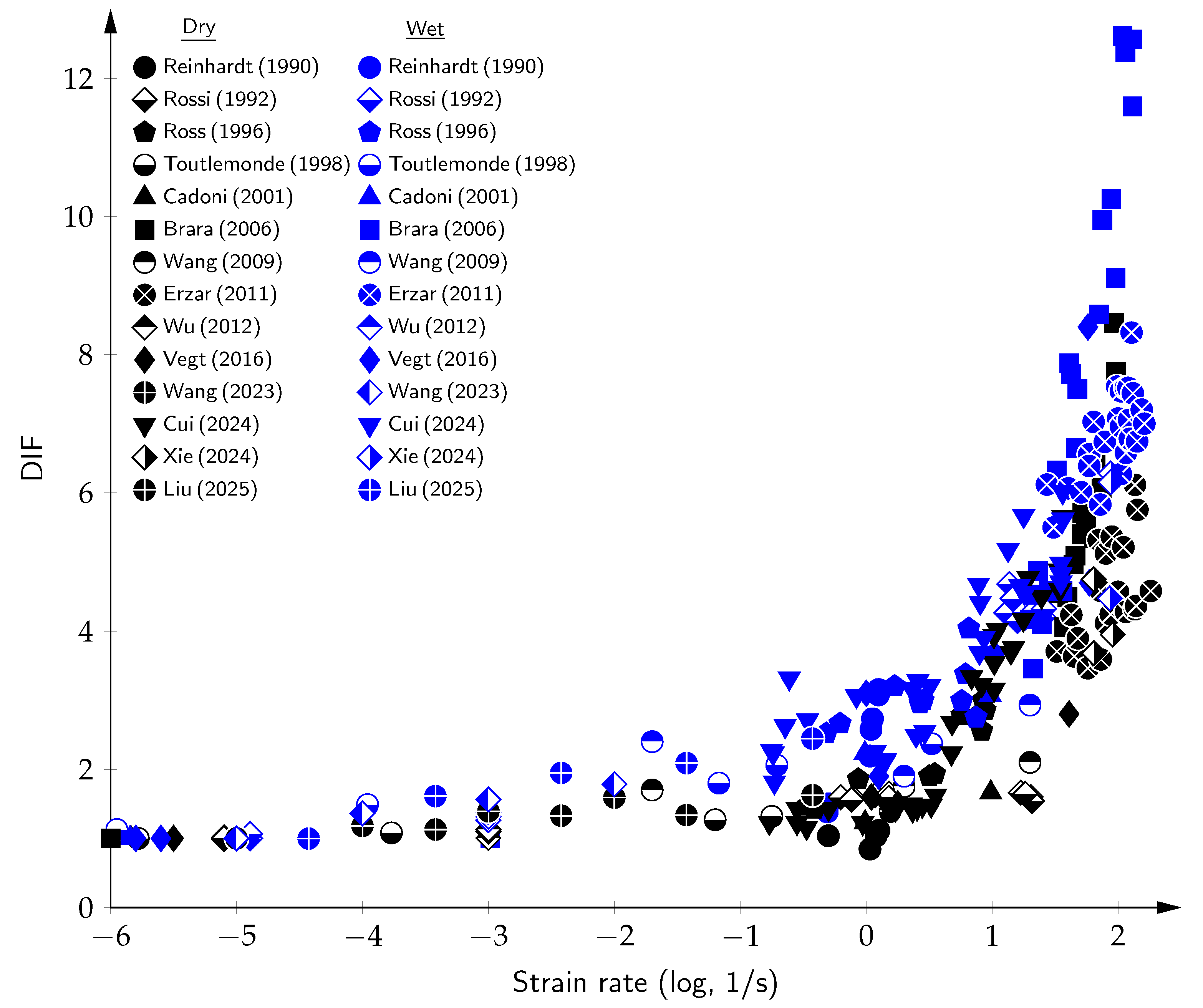
- Moisture content significantly influences the DIF through the Stefan effect. At seismic strain rates ( to s−1), saturated concrete exhibits DIF values of 20–50% higher than those of dry concrete, with the effect becoming more pronounced at higher strain rates within this range. At rates >1 s−1, moisture amplification increases to 2–3×, yet moisture effects are rarely addressed in current design codes.
- Moderate preloading (up to 70–80% of the static tensile strength) within the elastic limit can enhance the dynamic tensile strength by 10–25%, while excessive preloading (>80%) causes degradation.
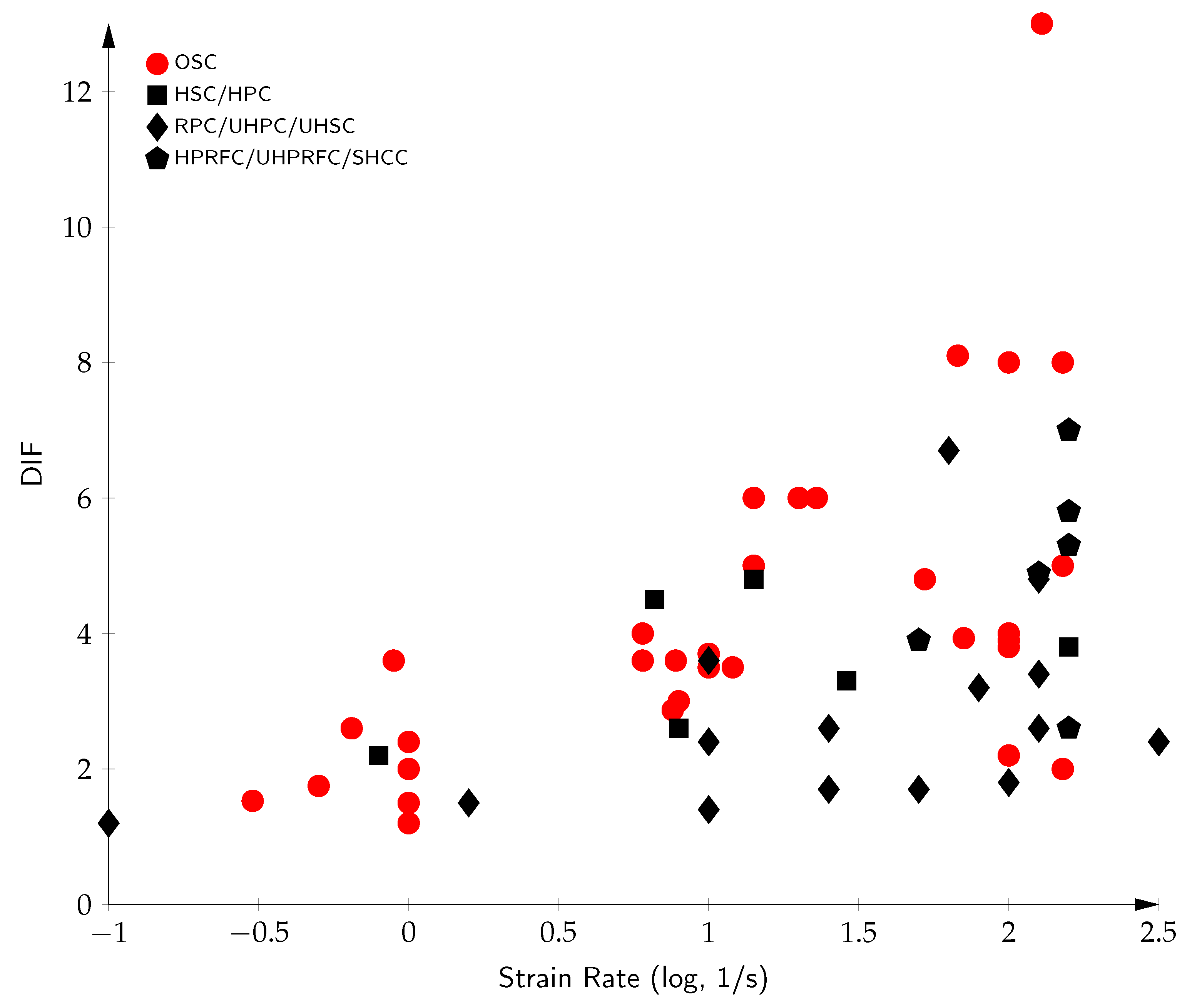
- Ultra-high-performance concrete exhibits ∼30% lower DIFs than ordinary concrete at equivalent strain rates, confirming an inverse quality–rate sensitivity relationship.
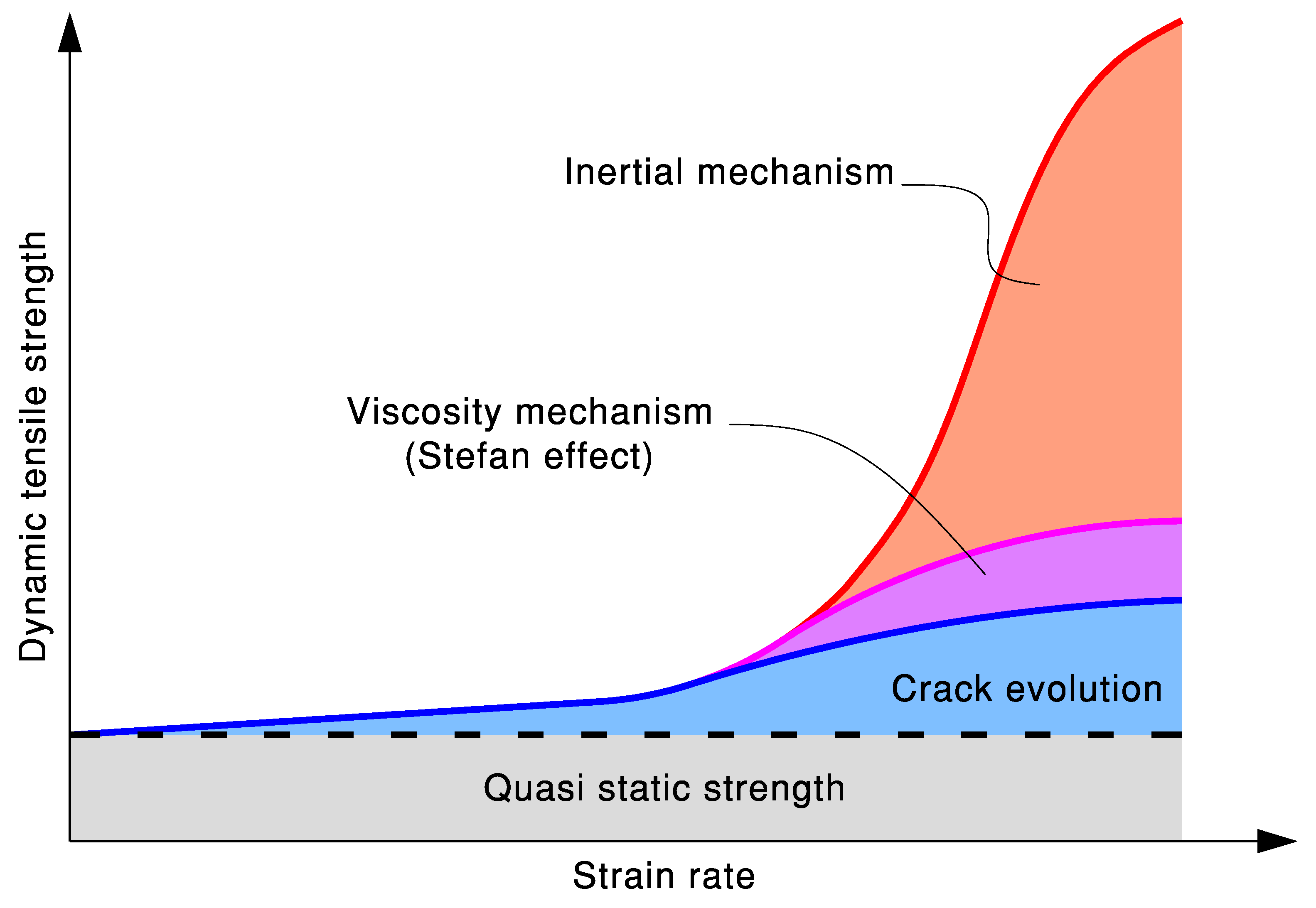
- Inertial effects contribute 20–50% of the apparent strength enhancement at high rates (>10 s−1) but are negligible for seismic analysis (<1 s−1).
- Strain rate effects on large-aggregate dam concrete (NMSA ≥ 40 mm) remain critically understudied, with only 15 investigations conducted at seismic rates, compared to 100+ studies on conventional concrete.
- Cyclic loading produces slightly lower DIFs (5–10% reduction) compared to monotonic loading at equivalent preload levels due to fatigue damage accumulation, with frequency effects—higher frequencies leading to higher DIFs.
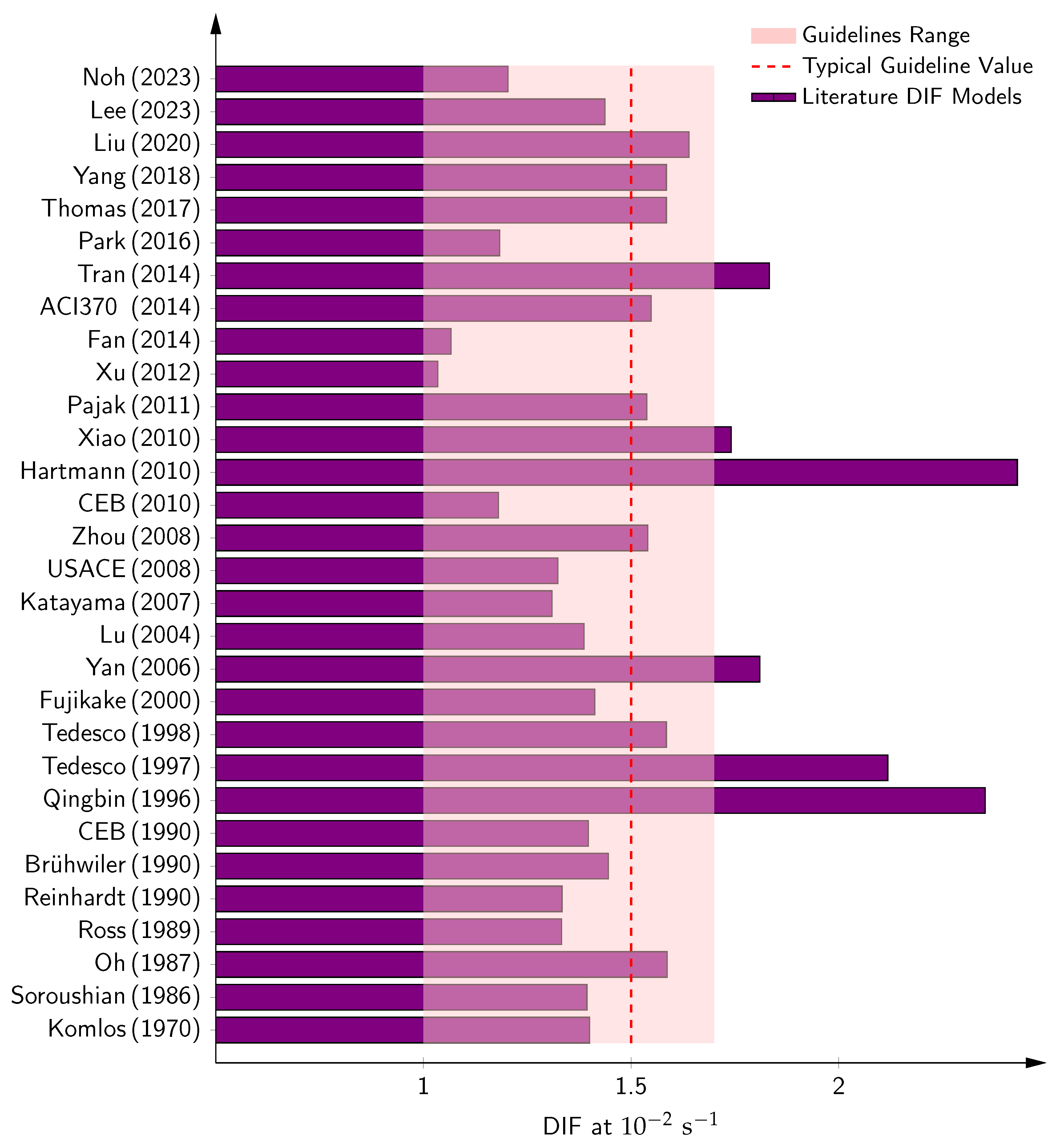
- The current design guidelines are validated by comparison with research-based formulations but should be refined to specify moisture and load history conditions.
- No existing constitutive model simultaneously captures the rate sensitivity, moisture effects, and load history in a unified framework.
- For engineering practice, a DIF = 1.5 is recommended for the seismic analysis of dams, with a 20–30% increase for saturated conditions and a 10–15% increase accounting for operating hydrostatic loads.
Author Contributions
Funding
Data Availability Statement
Conflicts of Interest
Abbreviations
| ANCOLD | Australian National Committee on Large Dams |
| AFP | Air-Fired Projectile |
| BPM | Bonded Particle Model |
| CAGBBD | Compressed Air Gun Block Bar Device |
| CEB-FIP | Comité Euro-international du béton and Fédération Internationale de la Précontrainte |
| CZM | Cohesive Zone Model |
| DEM | Discrete Element Method |
| DIF | Dynamic Increase Factor |
| EMS | Equivalent Momentum Scheme |
| FEM | Finite Element Method |
| FERC | Federal Energy Regulatory Commission |
| FRC | Fiber-Reinforced Concrete |
| FDM | Finite Difference Method |
| HPC | High-Performance Concrete |
| HJC | Holmquist–Johnson–Cook |
| HSC | High-Strength Concrete |
| HSV | High Stress Volume |
| JSCE | Japan Society of Civil Engineers |
| K&C | Karagozian and Case |
| K&I | Kamran and Iqbal |
| MSHPB | Modified Split Hopkinson Pressure Bar |
| NRC | National Research Council |
| NMSA | Nominal Maximum Size Aggregate |
| OFEN | Office Fédéral de l’Énergie |
| OSC | Ordinary-Strength Concrete |
| PD | Peridynamics |
| RBSM | Rigid-Body Spring Model |
| RFC | Reinforced Fiber Concrete |
| RPC | Reactive Powder Concrete |
| SEFIM | Strain Energy Frame Impact Machine |
| SERC | Swedish Energy Research Centre |
| SHCC | Strain Hardening Cement-Based Composite |
| SHPB | Split Hopkinson Pressure Bar |
| USACE | United States Army Corps of Engineers |
| USBR | United States Department of the Interior—Bureau of Reclamation |
| UPHC | Ultra-High-Performance Concrete |
| UHSC | Ultra-High-Strength Concrete |
| UHPGC | Ultra-High-Performance Geopolymer Concrete |
| UHTCC | Ultra-High-Toughness Cementitious Composite |
References
- Abrams, D.A. Effect of Rate of Application of Load on the Compressive Strength of Concrete. In Proceedings of the American Society for Testing Materials: Twentieth Annual Meeting, Atlantic City, NJ, USA, 26–29 June 1917; Volume 17, pp. 364–377. [Google Scholar]
- Raphael, J.M. Tensile Strength of Concrete. J. Proc. 1984, 81, 158–165. [Google Scholar] [CrossRef]
- Pan, J.; Zhong, W.; Wang, J.; Zhang, C. Size Effect on Dynamic Splitting Tensile Strength of Concrete: Mesoscale Modeling. Cem. Concr. Compos. 2022, 128, 104435. [Google Scholar] [CrossRef]
- Ross, C.A.; Tedesco, J.W.; Kuennen, S.T. Effects of strain rate on concrete strength. ACI Mater. J. 1995, 92, 37–47. [Google Scholar] [CrossRef]
- Brara, A.; Klepaczko, J. Experimental characterization of concrete in dynamic tension. Mech. Mater. 2006, 38, 253–267. [Google Scholar] [CrossRef]
- Erzar, B.; Forquin, P. Free water influence on the dynamic tensile behaviour of concrete. Appl. Mech. Mater. 2011, 82, 45–50. [Google Scholar] [CrossRef]
- Landon, J.W.; Quinney, H. Experiments with the Hopkinson Pressure Bar. Proc. R. Soc. Lond. Ser. A Contain. Pap. A Math. Phys. Character 1923, 103, 622–641. [Google Scholar] [CrossRef]
- Teller, L. Discussion on Transverse Testing of Concrete. Proc. Am. Soc. Test. Mater. 1927, 27, 418–420. [Google Scholar]
- Klettke, A.; Webster, D.; White, F. Effect of the Speed of Loading on the Modulus of Rupture of Plain Concrete. Bachelor’s Thesis, University of Wisconsin, Madison, WI, USA, 1933. [Google Scholar]
- Goldbeck, A. Tensile and Flexural Strengths of Concrete. In Report on Significance of Tests of Concrete and Concrete Aggregates, 2nd ed.; American Society for Testing Materials: West Conshohocken, PA, USA, 1943; pp. 9–14. [Google Scholar]
- Wright, P.; Garwood, F. The effect of the method of test on the flexural strength of concrete. Mag. Concr. Res. 1952, 4, 67–76. [Google Scholar] [CrossRef]
- Fox, E. Some Exploratory Tests on the Strength of Concrete Beams under Pulse Loads. In Mechanical Properties of Non-Metallic Brittle Materials; Butterworths Scientific Publications: London, UK, 1958; pp. 283–299. [Google Scholar]
- McHenry, D.; Shideler, J. Review of Data on Effect of Speed in Mechanical Testing of Concrete. In Symposium on Speed of Testing of Non-Metallic Materials; ASTM Special Technical Publication; ASTM International: West Conshohocken, PA, USA, 1956. [Google Scholar] [CrossRef]
- Ashton, G.D. Effect of High Rates of Loading on the Strength Properties of Plain Concrete. Master’s Thesis, The University of Arizona, Tucson, AZ, USA, 1963. Available online: http://hdl.handle.net/10150/319465 (accessed on 1 December 2025).
- Lundeen, R. Dynamic and Static Tests of Plain Concrete Specimens; Waterways Experiment Station: Vicksburg, MS, USA, 1964; Volume 609, Available online: https://apps.dtic.mil/sti/tr/pdf/AD0752803.pdf (accessed on 1 December 2025).
- Cowell, W.L. Dynamic Properties of Plain Concrete; Naval Civil Engineering; Lab Port Hueneme Calif: Port Hueneme, CA, USA, 1966; Available online: https://apps.dtic.mil/sti/trecms/pdf/AD0635055.pdf (accessed on 1 December 2025).
- Hatano, T. Dynamical behaviours of concrete under impulsive tensile load. Trans. Jpn. Soc. Civ. Eng. 1961, 73, 28–34. [Google Scholar] [CrossRef]
- Mellinger, F.; Birkimer, D. Measurement of Stress and Strain on Cylindrical Test Specimens of Rock and Concrete Under Impact Loading; Technical Report 4-46; U.S. Army Corps of Engineers: Cincinnati, OH, USA, 1966; p. 71. Available online: https://apps.dtic.mil/sti/tr/pdf/AD0480990.pdf (accessed on 1 December 2025).
- Birkimer, D. Critical Normal Fracture Strain of Portland Cement Concrete. Ph.D. Thesis, University of Cincinnati, Cincinnati, OH, USA, 1968. [Google Scholar]
- Takeda, J.I.; Tachikawa, H. Deformation and fracture of concrete subjected to dynamic load. In Proceedings of the Conference on Mechanical Behavior of Materials, Kyoto, Japan, 15–20 August 1972; pp. 267–277. [Google Scholar]
- Körmeling, H.A.; Reinhardt, H.W.; Zieliński, A.J. Experiments on Concrete Under Single and Repeated Uniaxial Impact Tensile Loading; Stevin Laboratory Report 5–80–3; Delft University of Technology: Delft, The Netherlands, 1980. [Google Scholar]
- McVay, M. Spall Damage of Concrete Structures; Technical Report SL-88-22; U.S. Army Corps of Engineers, Waterways Experiment Station: Vicksburg, MS, USA, 1988. Available online: https://hdl.handle.net/11681/11179 (accessed on 1 December 2025).
- Ross, C.A.; Thompson, N.P.Y.; Tedesco, J.W. Split-Hopkinson pressure-bar tests on concrete and mortar in tension and compression. Mater. J. 1989, 86, 475–481. [Google Scholar] [CrossRef]
- Reinhardt, H.W.; Rossi, P.; van Mier, J.G. Joint investigation of concrete at high rates of loading. Mater. Struct. 1990, 23, 213–216. [Google Scholar] [CrossRef]
- Antoun, T.H. Constitutive/Failure Model for the Static and Dynamic Behaviors of Concrete Incorporating Effects of Damage and Anisotropy. Ph.D. Thesis, University of Dayton, Dayton, OH, USA, 1991. [Google Scholar]
- John, R.; Antoun, T.; Rajendran, A.M. Effect of strain rate and size on tensile strength of concrete. In Shock Compression of Condensed Matter—1991; Elsevier: Amsterdam, The Netherland, 1992; pp. 501–504. [Google Scholar] [CrossRef]
- Toutlemonde, F.; Rossi, P. Major parameters governing concrete dynamic behaviour and dynamic failure of concrete structures. DYMAT J. 1995, 2, 69–77. [Google Scholar]
- Ross, C.A.; Jerome, D.M.; Tedesco, J.W.; Hughes, M.L. Moisture and strain rate effects on concrete strength. Mater. J. 1996, 93, 293–300. [Google Scholar] [CrossRef]
- Cadoni, E.; Albertini, C.; Labibes, K.; Solomos, G. Behavior of plain concrete subjected to tensile loading at high strain-rate. In Proceedings of the 4th International Conference on Fracture Mechanics of Concrete and Concrete Structures, FraMCoS-4, Cachan, France, 28 May–1 June 2001; Volume 1, pp. 341–348. Available online: https://framcos.org/FraMCoS-4/341.pdf (accessed on 1 December 2025).
- Brara, A.; Camborde, F.; Klepaczko, J.; Mariotti, C. Experimental and numerical study of concrete at high strain rates in tension. Mech. Mater. 2001, 33, 33–45. [Google Scholar] [CrossRef]
- Daimaruya, M.; Kobayashi, H.; Shizawa, H.; SIREGAR, R.; Ishihata, Y. Effect of Impact Loading on Tensile Strength of Concretes. In Proceedings of ICF10; Advances in Fracture Research: Honolulu, HI, USA, 2001. [Google Scholar]
- Verleysen, P.; Degrieck, J.; Taerwe, L. Experimental investigation of the strain rate dependent impact behaviour of cementitious composites. Mag. Concr. Res. 2002, 54, 257–262. [Google Scholar] [CrossRef]
- Lok, T.S.; Zhao, P.J.; Lu, G. Using the split Hopkinson pressure bar to investigate the dynamic behaviour of SFRC. Mag. Concr. Res. 2003, 55, 183–191. [Google Scholar] [CrossRef]
- Lok, T.S.; Zhao, P.J. Impact response of steel fiber-reinforced concrete using a split Hopkinson pressure bar. J. Mater. Civ. Eng. 2004, 16, 54–59. [Google Scholar] [CrossRef]
- Wu, H.; Zhang, Q.; Huan, F.; Jin, Q. Experimental and numerical investigation on the dynamic tensile strength of concrete. Int. J. Impact Eng. 2005, 32, 605–617. [Google Scholar] [CrossRef]
- Yan, D.; Lin, G. Dynamic properties of concrete in direct tension. Cem. Concr. Res. 2006, 36, 1371–1378. [Google Scholar] [CrossRef]
- Fujikake, K.; Senga, T.; Ueda, N.; Ohno, T.; Katagiri, M. Effects of strain rate on tensile behavior of reactive powder concrete. J. Adv. Concr. Technol. 2006, 4, 79–84. [Google Scholar] [CrossRef]
- Schuler, H.; Hansson, H. Fracture behaviour of high performance concrete (HPC) investigated with a hopkinson-bar. J. Phys. IV 2006, 134, 1145–1151. [Google Scholar] [CrossRef]
- Cadoni, E.; Asprone, D.; Prota, A. High strain-rate testing of concrete and steel for the assessment of the Tenza Bridge under blast loading. In New Trends in Fractures Mechanics of Concrete; FraMCoS-6: Catania, Italy, 2007; pp. 627–635. Available online: https://framcos.org/FraMCoS-6/134.pdf (accessed on 1 December 2025).
- Weerheijm, J.; Van Doormaal, J. Tensile failure of concrete at high loading rates: New test data on strength and fracture energy from instrumented spalling tests. Int. J. Impact Eng. 2007, 34, 609–626. [Google Scholar] [CrossRef]
- Brara, A. On the substantial enhancement of concrete tensile strength at high strain rate loadings. In Proceedings of the Concrete under Severe Conditions: Environment and Loading, Tours, France, 4–6 June 2007. [Google Scholar]
- Kim, D.J.; El-Tawil, S.; Naaman, A.E. Rate-dependent tensile behavior of high performance fiber reinforced cementitious composites. Mater. Struct. 2009, 42, 399–414. [Google Scholar] [CrossRef]
- Asprone, D.; Cadoni, E.; Prota, A. Experimental Analysis on Tensile Dynamic Behavior of Existing Concrete under High Strain Rates. ACI Struct. J. 2009, 106, 106–113. [Google Scholar] [CrossRef]
- Millon, O.; Riedel, W.; Thoma, K.; Fehling, E.; Nöldgen, M. Fiber-reinforced ultra-high performance concrete under tensile loads. In Proceedings of the 9th International Conference on the Mechanical Behaviour of Materials under Dynamic Loading, DYMAT, Brussels, Belgium, 7–11 September 2009; pp. 671–677. [Google Scholar] [CrossRef]
- Millard, S.; Molyneaux, T.; Barnett, S.; Gao, X. Dynamic enhancement of blast-resistant ultra high performance fibre-reinforced concrete under flexural and shear loading. Int. J. Impact Eng. 2010, 37, 405–413. [Google Scholar] [CrossRef]
- Erzar, B.; Forquin, P. An experimental method to determine the tensile strength of concrete at high rates of strain. Exp. Mech. 2010, 50, 941–955. [Google Scholar] [CrossRef]
- Wu, S.; Chen, X.; Zhou, J. Influence of strain rate and water content on mechanical behavior of dam concrete. Constr. Build. Mater. 2012, 36, 448–457. [Google Scholar] [CrossRef]
- Caverzan, A.; Cadoni, E.; Prisco, M.D. Tensile behaviour of high performance fibre-reinforced cementitious composites at high strain rates. Int. J. Impact Eng. 2012, 45, 28–38. [Google Scholar] [CrossRef]
- Rong, Z.; Sun, W. Experimental and numerical investigation on the dynamic tensile behavior of ultra-high performance cement based composites. Constr. Build. Mater. 2012, 31, 168–173. [Google Scholar] [CrossRef]
- Cadoni, E.; Solomos, G.; Albertini, C. Concrete behaviour in direct tension tests at high strain rates. Mag. Concr. Res. 2013, 65, 660–672. [Google Scholar] [CrossRef]
- Hanus, J.L.; Magnain, B.; Durand, B.; Alanis-Rodriguez, J.; Bailly, P. Processing dynamic split Hopkinson three-point bending test with normalized specimen of quasi-brittle material. Mech. Ind. 2012, 13, 381–393. [Google Scholar] [CrossRef]
- Nöldgen, M.; Riedel, W.; Thoma, K.; Fehling, E. Properties of Ultra High Performance Concrete (UHPC) in tension at high strain rates. In Proceedings of the 8th International Conference on Fracture Mechanics of Concrete and Concrete Structures, FraMCoS 2013, Toledo, Spain, 10–14 March 2013; pp. 988–1000. Available online: https://www.framcos.org/FraMCoS-8/p325.pdf (accessed on 1 December 2025).
- Min, F.; Yao, Z.; Jiang, T. Experimental and numerical study on tensile strength of concrete under different strain rates. Sci. World J. 2014, 2014, 173531. [Google Scholar] [CrossRef]
- Chen, X.; Wu, S.; Zhou, J. Large-beam tests on mechanical behavior of dam concrete under dynamic loading. J. Mater. Civ. Eng. 2015, 27, 06015001. [Google Scholar] [CrossRef]
- Brara, A. Advances in experimental assessment of dynamic tensile strength of concrete by the spalling technique. EPJ Web Conf. 2015, 94, 01045. [Google Scholar] [CrossRef]
- Lu, Y.; Yu, S.; Cai, Y. Experimental study on dynamic splitting of recycled concrete using SHPB. EPJ Web Conf. 2015, 94, 01008. [Google Scholar] [CrossRef]
- Tran, N.T.; Tran, T.K.; Kim, D.J. High rate response of ultra-high-performance fiber-reinforced concretes under direct tension. Cem. Concr. Res. 2015, 69, 72–87. [Google Scholar] [CrossRef]
- Ranade, R.; Li, V.C.; Heard, W.F. Tensile rate effects in high strength-high ductility concrete. Cem. Concr. Res. 2015, 68, 94–104. [Google Scholar] [CrossRef]
- Pyo, S.; Wille, K.; El-Tawil, S.; Naaman, A.E. Strain rate dependent properties of ultra high performance fiber reinforced concrete (UHP-FRC) under tension. Cem. Concr. Compos. 2015, 56, 15–24. [Google Scholar] [CrossRef]
- Su, Y.; Li, J.; Wu, C.; Wu, P.; Li, Z.X. Influences of nano-particles on dynamic strength of ultra-high performance concrete. Compos. Part B Eng. 2016, 91, 595–609. [Google Scholar] [CrossRef]
- Su, Y.; Li, J.; Wu, C.; Wu, P.; Li, Z.X. Effects of steel fibres on dynamic strength of UHPC. Constr. Build. Mater. 2016, 114, 708–718. [Google Scholar] [CrossRef]
- Cao, S.; Hou, X.; Rong, Q.; Li, G. Dynamic splitting tensile test of hybrid-fiber-reinforced reactive powder concrete. Emerg. Mater. Res. 2018, 7, 52–57. [Google Scholar] [CrossRef]
- Pyo, S.; El-Tawil, S.; Naaman, A.E. Direct tensile behavior of ultra high performance fiber reinforced concrete (UHP-FRC) at high strain rates. Cem. Concr. Res. 2016, 88, 144–156. [Google Scholar] [CrossRef]
- Curosu, I.; Mechtcherine, V.; Millon, O. Effect of fiber properties and matrix composition on the tensile behavior of strain-hardening cement-based composites (SHCCs) subject to impact loading. Cem. Concr. Res. 2016, 82, 23–35. [Google Scholar] [CrossRef]
- Cadoni, E.; Forni, D. Experimental analysis of the UHPFRCs behavior under tension at high stress rate. Eur. Phys. J. Spec. Top. 2016, 225, 253–264. [Google Scholar] [CrossRef]
- Park, S.H.; Kim, D.J.; Kim, S.W. Investigating the impact resistance of ultra-high-performance fiber-reinforced concrete using an improved strain energy impact test machine. Constr. Build. Mater. 2016, 125, 145–159. [Google Scholar] [CrossRef]
- Wille, K.; Xu, M.; El-Tawil, S.; Naaman, A. Dynamic impact factors of strain hardening UHP-FRC under direct tensile loading at low strain rates. Mater. Struct. 2016, 49, 1351–1365. [Google Scholar] [CrossRef]
- Park, J.K.; Kim, S.W.; Kim, D.J. Matrix-strength-dependent strain-rate sensitivity of strain-hardening fiber-reinforced cementitious composites under tensile impact. Compos. Struct. 2017, 162, 313–324. [Google Scholar] [CrossRef]
- Tran, N.T.; Kim, D.J. Synergistic response of blending fibers in ultra-high-performance concrete under high rate tensile loads. Cem. Concr. Compos. 2017, 78, 132–145. [Google Scholar] [CrossRef]
- Guo, Y.B.; Gao, G.F.; Jing, L.; Shim, V.P.W. Quasi-static and dynamic splitting of high-strength concretes–tensile stress–strain response and effects of strain rate. Int. J. Impact Eng. 2019, 125, 188–211. [Google Scholar] [CrossRef]
- Ma, H.; Wu, Z.; Yu, H.; Zhang, J.; Yue, C. Experimental and three-dimensional mesoscopic investigation of coral aggregate concrete under dynamic splitting-tensile loading. Mater. Struct. 2020, 53, 12. [Google Scholar] [CrossRef]
- Gao, X.; Zhou, L.; Ren, X.; Li, J. Rate effect on the stress–strain behavior of concrete under uniaxial tensile stress. Struct. Concr. 2021, 22, E815–E830. [Google Scholar] [CrossRef]
- Huang, Z.; Chen, W.; Hao, H.; Aurelio, R.; Li, Z.; Pham, T.M. Test of dynamic mechanical properties of ambient-cured geopolymer concrete using split Hopkinson pressure bar. J. Mater. Civ. Eng. 2022, 34, 04021440. [Google Scholar] [CrossRef]
- Guo, Y.; Gao, G.; Jing, L.; Shim, V. Dynamic properties of mortar in high-strength concrete. Int. J. Impact Eng. 2022, 165, 104216. [Google Scholar] [CrossRef]
- Li, Q.; Jiang, X.; Zeng, T.; Xu, S. Experimental investigation on strain rate effect of high-performance fiber reinforced cementitious composites subject to dynamic direct tensile loading. Cem. Concr. Res. 2022, 157, 106825. [Google Scholar] [CrossRef]
- Vu, V.T.; Tran, T.K.; Kim, D.J.; Nguyen, D.L.; Tran, N.T. Strain rate sensitivity of strain-hardening fiber-reinforced concrete subjected to dynamic direct tensile loading. Struct. Concr. 2024, 25, 869–885. [Google Scholar] [CrossRef]
- Zhang, X.; Chiu, Y.; Hao, H.; Cui, J. Dynamic Enhancing Effect of Free Water on the Dynamic Tensile Properties of Mortar. Mater. Struct. 2023, 56, 123. [Google Scholar] [CrossRef]
- Cui, J.; Shi, Y.; Sun, T.; Zhang, X.; Li, M.; Guan, X. Influence of Water Saturation on Dynamic Tensile and Compressive Behaviors of Concrete. J. Mater. Civ. Eng. 2024, 36, 04024144. [Google Scholar] [CrossRef]
- Khan, M.; Iqbal, M. Strain rate and size effects on dynamic tensile behaviour of standard and high-strength concrete: An experimental study. Structures 2024, 63, 106325. [Google Scholar] [CrossRef]
- Lin, Y.; Yang, C.; Shi, H.; Wang, Y.; Zong, Z.; Qian, H.; Hou, S.; Li, S.; Chen, T.; Cai, J. Dynamic mechanical properties of one-part ultra-high performance geopolymer concrete. J. Build. Eng. 2024, 95, 110173. [Google Scholar] [CrossRef]
- Liu, J.; Wang, W.; He, K.; Kong, D.; Dai, X.; Zhao, X. Dynamic tensile and stress wave transmitting characteristics of high strength and high ductility concrete. Constr. Build. Mater. 2024, 449, 138259. [Google Scholar] [CrossRef]
- Liu, J.; Zheng, L.; Jin, X.; Zhao, X.; Kong, D.; Fu, L.; Wang, B. Water saturation effect on the dynamic tensile behavior of high ductility concrete. Compos. Part B Eng. 2025, 296, 112219. [Google Scholar] [CrossRef]
- Ruiz, G.; Ortiz, M.; Pandolfi, A. Three-dimensional finite-element simulation of the dynamic Brazilian tests on concrete cylinders. Int. J. Numer. Methods Eng. 2000, 48, 963–994. [Google Scholar] [CrossRef]
- Pedersen, R.R.; Sluys, L.; Weerheijm, J.; Simone, A. A computational study of the fracture behaviour of concrete in a modified Split Hopkinson bar test. In Proceedings of the 11th International Conference on Fracture, Turin, Italy, 20–25 March 2005; pp. 1241–1246. Available online: https://www.gruppofrattura.it/ocs/index.php/ICF/ICF11/paper/viewFile/10488/9845 (accessed on 1 December 2025).
- Tian, R.; Du, X.; Peng, Y. Numerical simulation on dynamic bending strength of three-graded concrete beam based on meso-mechanics. Trans. Tianjin Univ. 2008, 14, 371–375. [Google Scholar] [CrossRef]
- Erzar, B.; Forquin, P. Experiments and mesoscopic modelling of dynamic testing of concrete. Mech. Mater. 2011, 43, 505–527. [Google Scholar] [CrossRef]
- Knell, S.; Sauer, M.; Millon, O.; Riedel, W. Mesoscale simulation of concrete spall failure. Eur. Phys. J. Spec. Top. 2012, 206, 139–148. [Google Scholar] [CrossRef]
- Erzar, B.; Forquin, P. Analysis and modelling of the cohesion strength of concrete at high strain-rates. Int. J. Solids Struct. 2014, 51, 2559–2574. [Google Scholar] [CrossRef]
- Hao, Y.; Hao, H.; Zhang, X. Numerical Analysis of Concrete Material Properties at High Strain Rate under Direct Tension. Int. J. Impact Eng. 2012, 39, 51–62. [Google Scholar] [CrossRef]
- Chen, X.; Wu, S.; Zhou, J. Quantification of Dynamic Tensile Behavior of Cement-Based Materials. Constr. Build. Mater. 2014, 51, 15–23. [Google Scholar] [CrossRef]
- Ma, H.; Chen, H.Q.; Li, B.K. Meso-structure numerical simulation of concrete specimens. Shuili Xuebao/J. Hydraul. Eng. 2004, 35, 27–35. [Google Scholar]
- Ma, H.; Chen, H.Q.; Li, B.K. Influence of meso-structure heterogeneity on dynamic bending strength of concrete. Shuili Xuebao/J. Hydraul. Eng. 2005, 36, 846–852. [Google Scholar]
- Ožbolt, J.; Bošnjak, J.; Sola, E. Dynamic Fracture of Concrete Compact Tension Specimen: Experimental and Numerical Study. Int. J. Solids Struct. 2013, 50, 4270–4278. [Google Scholar] [CrossRef]
- Pedersen, R.R.; Simone, A.; Sluys, L.J. Mesoscopic modeling and simulation of the dynamic tensile behavior of concrete. Cem. Concr. Res. 2013, 50, 74–87. [Google Scholar] [CrossRef]
- Du, X.; Jin, L.; Ma, G. Numerical Simulation of Dynamic Tensile Failure of Concrete at Meso-Scale. Int. J. Impact Eng. 2014, 66, 5–17. [Google Scholar] [CrossRef]
- Forquin, P.; Sallier, L.; Pontiroli, C. A Numerical Study on the Influence of Free Water Content on the Ballistic Performances of Plain Concrete Targets. Mech. Mater. 2015, 89, 176–189. [Google Scholar] [CrossRef]
- Gu, X.; Zhang, Q.; Huang, D.; Yv, Y. Wave dispersion analysis and simulation method for concrete SHPB test in peridynamics. Eng. Fract. Mech. 2016, 160, 124–137. [Google Scholar] [CrossRef]
- Barani, O.R.; Majidaie, S.; Mosallanejad, M. Numerical Modeling of Water Pressure in Propagating Concrete Cracks. J. Eng. Mech. 2016, 142, 04016011. [Google Scholar] [CrossRef]
- Das, S. A Strain-Rate Dependent Tensile Damage Model for Brittle Materials Under Impact Loading. Ph.D. Thesis, The University of Sydney, Camperdown, Australia, 2016. Available online: http://hdl.handle.net/2123/15612 (accessed on 1 December 2025).
- Ma, H.; Xu, W.; Li, Y. Random aggregate model for mesoscopic structures and mechanical analysis of fully-graded concrete. Comput. Struct. 2016, 177, 103–113. [Google Scholar] [CrossRef]
- Zhou, W.; Tang, L.; Liu, X.; Ma, G.; Chen, M. Mesoscopic Simulation of the Dynamic Tensile Behavior of Concrete Based on a Rate-Dependent Cohesive Model. Int. J. Impact Eng. 2016, 95, 165–175. [Google Scholar] [CrossRef]
- Zhang, S.; Lu, Y.; Chen, X.; Teng, X.; Yu, S. Further Investigation on the Real Rate Effect of Dynamic Tensile Strength for Concrete-like Materials. Lat. Am. J. Solids Struct. 2016, 13, 201–223. [Google Scholar] [CrossRef]
- Su, Y.; Li, J.; Wu, C.; Wu, P.; Tao, M.; Li, X. Mesoscale study of steel fibre-reinforced ultra-high performance concrete under static and dynamic loads. Mater. Des. 2017, 116, 340–351. [Google Scholar] [CrossRef]
- Guo, Y.; Gao, G.; Jing, L.; Shim, V. Response of high-strength concrete to dynamic compressive loading. Int. J. Impact Eng. 2017, 108, 114–135. [Google Scholar] [CrossRef]
- Chen, X.; Ge, L.; Zhou, J.; Wu, S. Dynamic Brazilian test of concrete using split Hopkinson pressure bar. Mater. Struct. 2017, 50, 1–15. [Google Scholar] [CrossRef]
- Sharath, R.; Arumugam, D.; Dhanasekaran, B.; Subash, T. Numerical modeling of ‘concrete response’ to high strain rate loadings. In Proceedings of the 11th European LS-DYNA User Conferene, Salzburg, Austria, 9–11 May 2017. [Google Scholar]
- Jin, X.; Hou, C.; Fan, X.; Lu, C.; Yang, H.; Shu, X.; Wang, Z. Quasi-static and dynamic experimental studies on the tensile strength and failure pattern of concrete and mortar discs. Sci. Rep. 2017, 7, 15305. [Google Scholar] [CrossRef] [PubMed]
- Zhou, R.; Song, Z.; Lu, Y. 3D mesoscale finite element modelling of concrete. Comput. Struct. 2017, 192, 96–113. [Google Scholar] [CrossRef]
- Khosravani, M.R.; Silani, M.; Weinberg, K. Fracture studies of ultra-high performance concrete using dynamic Brazilian tests. Theor. Appl. Fract. Mech. 2018, 93, 302–310. [Google Scholar] [CrossRef]
- Chen, J.; Xiang, D.; Wang, Z.; Wu, G.; Wang, G. Dynamic tensile strength enhancement of concrete in split Hopkinson pressure bar test. Adv. Mech. Eng. 2018, 10, 1687814018782301. [Google Scholar] [CrossRef]
- Le, J.; Eliáš, J.; Gorgogianni, A.; Vievering, J.; Kveton, A. Rate-Dependent Scaling of Dynamic Tensile Strength of Quasibrittle Structures. J. Appl. Mech. (ASME Digit. Collect.) 2018, 85, 021003. [Google Scholar] [CrossRef]
- Zhang, S.; Lu, Y.; Jiang, X.; Jiang, W. Inertial Effect on Concrete-Like Materials Under Dynamic Direct Tension. Int. J. Prot. Struct. 2018, 9, 377–396. [Google Scholar] [CrossRef]
- Ma, H.; Xu, W.; Zhou, J.; Chen, H. Mesoscopic Insight into the Damage Mechanism for the Static Preload Effect on Dynamic Tensile Strength of Concrete. J. Mater. Civ. Eng. 2019, 31, 04018380. [Google Scholar] [CrossRef]
- Jin, L.; Yu, W.; Du, X.; Yang, W. Mesoscopic numerical simulation of dynamic size effect on the splitting-tensile strength of concrete. Eng. Fract. Mech. 2019, 209, 317–332. [Google Scholar] [CrossRef]
- Cao, P.; Li, G.; Yu, G.; Zhang, M.; Jin, F.; Zhao, Z. Research and application of random aggregate model in determining the fracture behavior of four-point bending beam with notch. Constr. Build. Mater. 2019, 202, 276–289. [Google Scholar] [CrossRef]
- Jin, L.; Yu, W.; Du, X.; Yang, W. Dynamic size effect of concrete under tension: A numerical study. Int. J. Impact Eng. 2019, 132, 103318. [Google Scholar] [CrossRef]
- Tang, L.; Zhou, W.; Liu, X.; Ma, G.; Chen, M. Three-Dimensional Mesoscopic Simulation of the Dynamic Tensile Fracture of Concrete. Eng. Fract. Mech. 2019, 211, 269–281. [Google Scholar] [CrossRef]
- Chen, X.; Shi, C.; Zhang, Y.L.; Yang, J.X. Numerical and Experimental Study on Strain Rate Effect of Ordinary Concrete under Low Strain Rate. KSCE J. Civ. Eng. 2021, 25, 1790–1805. [Google Scholar] [CrossRef]
- Ai, D.; Zhao, Y.; Wang, Q.; Li, C. Crack Propagation and Dynamic Properties of Coal Under SHPB Impact Loading: Experimental Investigation and Numerical Simulation. Theor. Appl. Fract. Mech. 2020, 105, 102393. [Google Scholar] [CrossRef]
- Shu, Z.; Lu, Y.; Zhao, D.; Xing, C. Inertia Effect in Dynamic Tensile Tests of Concrete-like Materials. J. Syst. Simul. 2020, 29, 1531–1538. [Google Scholar] [CrossRef]
- Ying, L.; Peng, Y.; Kamel, M.M. Mesoscopic numerical analysis of dynamic tensile fracture of recycled concrete. Eng. Comput. 2020, 37, 1899–1922. [Google Scholar] [CrossRef]
- Yu, Q.; Chen, Z.; Yang, J.; Rong, K. Numerical study of concrete dynamic splitting based on 3D realistic aggregate mesoscopic model. Materials 2021, 14, 1948. [Google Scholar] [CrossRef]
- Shilko, E.; Konovalenko, I.; Konovalenko, I. Nonlinear Mechanical Effect of Free Water on the Dynamic Compressive Strength and Fracture of High-Strength Concrete. Materials 2021, 14, 4011. [Google Scholar] [CrossRef]
- Wu, Y.; Huang, D.; Ma, Q.; Li, Z. Peridynamic Modeling for Impact Failure of Wet Concrete Considering the Influence of Saturation. Int. J. Damage Mech. 2022, 31, 1448–1474. [Google Scholar] [CrossRef]
- Wessling, A.; Larsson, S.; Kajberg, J. A statistical bonded particle model study on the effects of rock heterogeneity and cement strength on dynamic rock fracture. Comput. Part. Mech. 2024, 11, 1313–1327. [Google Scholar] [CrossRef]
- Zhao, S.; Liu, J.; Liu, R. Steel/Plastic-Steel Hybrid Fiber UHPC Dynamic Tensile Performance: An Experimental and Numerical Simulation Study. J. Build. Eng. 2024, 92, 109706. [Google Scholar] [CrossRef]
- Cui, J.; Shi, Y.; Sun, T.; Zhang, X.; Li, M. Development of a Concrete Constitutive Model Considering Free Water Effect for Predicting Dynamic Responses of Concrete Structures. J. Mater. Civ. Eng. 2024, 150, 04024020. [Google Scholar] [CrossRef]
- Jin, L.; Lu, B.; Yu, W.; Xie, C.; Du, X. Direct Tensile Failures of Concrete with Various Moisture Contents and Sizes at Low Temperatures via Mesoscale Simulations with Ice Explicit Modelling. Constr. Build. Mater. 2024, 449, 138300. [Google Scholar] [CrossRef]
- Krzaczek, M.; Tejchman, J.; Nitka, M. Coupled DEM/CFD Analysis of Impact of Free Water on the Static and Dynamic Response of Concrete in Tension Regime. Comput. Geotech. 2024, 172, 106449. [Google Scholar] [CrossRef]
- Zhou, X.; Lu, Q.; Wang, X. Mesoscale Modeling of Microcapsule-Based Self-Healing Cementitious Composites under Dynamic Splitting Tension. Buildings 2024, 14, 3203. [Google Scholar] [CrossRef]
- Liu, T.; Zhu, Q.M.; Ge, R.; Chen, L.; Hong, S. Numerical Analysis on Dynamic Response and Damage Assessment of FRP Bars Reinforced-UHPC Composite Beams under Impact Loading. Comput. Concr. 2024, 34, 409–425. [Google Scholar] [CrossRef]
- Xiao, Q.; Ju, G.; Ye, F.; Wang, Y.; Jin, L.; Fu, W. An innovative approach for assessing the tensile strength of concrete: Experimental and numerical investigations. Constr. Build. Mater. 2024, 417, 135249. [Google Scholar] [CrossRef]
- Bi, Z.; Liu, J.; Zhao, M.; Cui, X. Research on Dynamic Constitutive Model of Concrete Material with Different Matrix Strength under Medium-High Strain Rates. KSCE J. Civ. Eng. 2025, 29, 100059. [Google Scholar] [CrossRef]
- Qiu, H.; Chen, R.; Wang, Y.; Liu, R.; Lai, D.; Liao, F.; Fang, Y.; Wang, F. Experimental and numerical study of the dynamic crack propagation behavior of mortar-granite specimens with different inclination interfaces. Theor. Appl. Fract. Mech. 2025, 136, 104831. [Google Scholar] [CrossRef]
- Zhao, F.; Liu, J.; Wang, Y.; Liu, Z.; Yao, Y. Experimental and Numerical Research on Spalling Behavior of Steel Fiber Reinforced Concrete (SFRC). Constr. Build. Mater. 2025, 463, 140021. [Google Scholar] [CrossRef]
- Peng, Y.; Yu, L.; Qian, J.; Li, W.; Zhang, T.; Zhou, L. Dynamic Tensile Behavior and Crack Propagation in Coral Aggregate Seawater Shotcrete: Experimental Investigation and Numerical Simulation. Cem. Concr. Compos. 2025, 159, 106010. [Google Scholar] [CrossRef]
- Zhou, M.; Zhang, W.; He, F.; Wang, Y.; Dong, S.; Pan, X. Numerical Study on Dynamic Fracture of Rock-Concrete Bi-Material Brazilian Disks with a Central Interface Crack. Eng. Fract. Mech. 2025, 315, 110816. [Google Scholar] [CrossRef]
- Wang, J.; Wu, Z.; Deng, S.; Wang, M.; Tao, J.; Xie, A.; Wang, Z. The dynamic tensile strength prediction model and tensile behavior of concrete considering pores based on the impact splitting tensile test. J. Build. Eng. 2025, 104, 112272. [Google Scholar] [CrossRef]
- Fu, H.; Erki, M.; Seckin, M. Review of effects of loading rate on reinforced concrete. J. Struct. Eng. 1991, 117, 3660–3679. [Google Scholar] [CrossRef]
- Fan, H.; Yu, H.; Ma, H. Dynamic Increase Factor (DIF) of Concrete with SHPB Tests: Review and Systematic Analysis. J. Build. Eng. 2023, 79, 107666. [Google Scholar] [CrossRef]
- Khosravani, M.; Weinberg, K. A Review on Split Hopkinson Bar Experiments for Dynamic Characterization of Concrete. Constr. Build. Mater. 2018, 190, 1264–1283. [Google Scholar] [CrossRef]
- Malvar, L.J. Review of static and dynamic properties of steel reinforcing bars. ACI Mater. J. 1998, 95, 609–614. [Google Scholar] [CrossRef]
- Sun, L.; Liu, S.; Zhao, H.; Muhammad, U.; Chen, D.; Li, W. Dynamic performance of fiber-reinforced ultra-high toughness cementitious composites: A comprehensive review from materials to structural applications. Eng. Struct. 2024, 317, 118647. [Google Scholar] [CrossRef]
- Shi, C.; Wu, Z.; Xiao, J.; Wang, D.; Huang, Z.; Fang, Z. A review on ultra high performance concrete: Part I. Raw materials and mixture design. Constr. Build. Mater. 2015, 101, 741–751. [Google Scholar] [CrossRef]
- Noh, H.W.; Truong, V.D.; Cho, J.Y.; Kim, D.J. Dynamic increase factors for fiber-reinforced cement composites: A review. J. Build. Eng. 2022, 56, 104769. [Google Scholar] [CrossRef]
- Pai, A.; Rodriguez-Millan, M.; Beppu, M.; Valverde-Marcos, B.; Shenoy, S. Experimental techniques for performance evaluation of shielding materials and configurations subjected to Blast and Ballistic impacts: A State-of-the-Art Review. Thin-Walled Struct. 2023, 191, 111067. [Google Scholar] [CrossRef]
- Das, N.; Nanthagopalan, P. State-of-the-art review on ultra high performance concrete-Ballistic and blast perspective. Cem. Concr. Compos. 2022, 127, 104383. [Google Scholar] [CrossRef]
- Wu, H.; Shen, A.; Ren, G.; Ma, Q.; Wang, Z.; Cheng, Q.; Li, Y. Dynamic mechanical properties of fiber-reinforced concrete: A review. Constr. Build. Mater. 2023, 366, 130145. [Google Scholar] [CrossRef]
- Kasopa, E.; Chen, X.; Yao, G.; Zhao, X. Dynamic Behavior of Concrete: A Review. Int. J. Res. Appl. Sci. Eng. Technol. 2023, 11, 294–304. [Google Scholar] [CrossRef]
- Rizwanullah; Sharma, H. Blast loading effects on UHPFRC structural elements: A review. Innov. Infrastruct. Solut. 2022, 7, 341. [Google Scholar] [CrossRef]
- Hong, S.; Kang, T. Dynamic mechanical responses of concrete under the influence of extreme loads. In Proceedings of the World Congress on Advances in Civil, Environmental, and Materials Research, ACEM, Incheon, Republic of Korea, 25–29 August 2015; pp. 25–29. Available online: http://i-asem.org/publication_conf/asem15/3.CTCS15/2t/T4D.2.MS542_1931F1.pdf (accessed on 1 December 2025).
- Hong, S.; Kang, T.H.K. Dynamic Strength Properties of Concrete and Reinforcing Steel Subject to Extreme Loads. ACI Struct. J. 2016, 113, 983. [Google Scholar] [CrossRef]
- Thomas, R.; Sorensen, A.D. Review of strain rate effects for UHPC in tension. Constr. Build. Mater. 2017, 153, 846–856. [Google Scholar] [CrossRef]
- Bhujangrao, T.; Froustey, C.; Iriondo, E.; Veiga, F.; Darnis, P.; Mata, F.G. Review of Intermediate Strain Rate Testing Devices. Metals 2020, 10, 894. [Google Scholar] [CrossRef]
- Malvar, L.J.; Ross, C.A. Review of strain rate effects for concrete in tension. ACI Mater. J. 1998, 95, 735–739. [Google Scholar] [CrossRef]
- Soroushian, P.; Choi, K.B.; Fu, G. Tensile Strength of Concrete at Different Strain Rates. Mater. Res. Soc. Symp. Proc. 1986, 64, 87–92. [Google Scholar] [CrossRef]
- Seabold, R.H. Dynamic Shear Strength of Reinforced Concrete Beams—Part II; Technical Report; U.S. Naval Civil Engineering Laboratory: Port Huenerne, CA, USA, 1967; Available online: https://apps.dtic.mil/sti/tr/pdf/AD0644823.pdf (accessed on 1 December 2025).
- Seabold, R.H. Dynamic Shear Strength of Reinforced Concrete Beams—Part III; Technical Report; U.S. Naval Civil Engineering Laboratory: Port Huenerne, CA, USA, 1970; Available online: https://apps.dtic.mil/sti/tr/pdf/AD0713659.pdf (accessed on 1 December 2025).
- Komlos, K. Factors Affecting the Stress-Strain Relation of Concrete in Uniaxial Tension. ACI J. Proc. 1969, 66, 111–114. [Google Scholar] [CrossRef] [PubMed]
- Malvar, L.J.; Crawford, J. Dynamic Increase Factors For Concrete. In Proceedings of the 28th DDESB Seminar Orlando, Orlando, FL, USA, 18–20 August 1998; pp. 1–17. Available online: https://apps.dtic.mil/sti/pdfs/ADA500715.pdf (accessed on 1 December 2025).
- Kvirikadze, O. Determination of the ultimate strength and modulus of deformation of concrete at different rates of loading. In Proceedings of the RILEM International Symposium: Testing In-Situ of Concrete Structures, Budapest, Hungary, 5–9 September 1977; pp. 109–117. [Google Scholar]
- Toutlemonde, F.; Rossi, P. Are high performance concretes (HPC) suitable in case of high rate dynamic loading. In Proceedings of the 4th International Symposium on Utilization of High Strength/High Performance Concrete, Paris, France, 29–31 May 1996; pp. 695–704. [Google Scholar]
- Toutlemonde, F. Résistance au Choc des Structures en béton: Du Comportement du Matériau au Calcul des Ouvrages. Ph.D. Thesis, Ecole Nationale des Ponts et Chaussées, Champs-sur-Marne, France, 1994. Available online: https://pastel.hal.science/tel-00529490v1/file/1994TH_TOUTLEMONDE_F_NS18473.pdf (accessed on 1 December 2025).
- Birkimer, D.; Lindemann, R. Dynamic Tensile Strength of Concrete Materials. ACI J. 1971, 68, 47–49. [Google Scholar] [CrossRef]
- Tedesco, J.W.; Ross, C.A.; Kuennen, S.T. Experimental and numerical analysis of high strain rate splitting tensile tests. ACI Mater. J. 1993, 90, 162–169. [Google Scholar] [CrossRef]
- Hughes, M.L.; Tedesco, J.; Ross, C. Numerical analysis of high strain rate splitting-tensile tests. Comput. Struct. 1993, 47, 653–671. [Google Scholar] [CrossRef]
- Tedesco, J.; Ross, C.; McGill, P.; O’Neil, B. Numerical analysis of high strain rate concrete direct tension tests. Comput. Struct. 1991, 40, 313–327. [Google Scholar] [CrossRef]
- Ross, C.A. Fracture of concrete at high strain-rate. In Toughening Mechanisms in Quasi-Brittle Materials; Springer: Dordrecht, The Netherlands, 1991; pp. 577–596. [Google Scholar] [CrossRef]
- Tedesco, J.W.; Ross, C.A.; Brunair, R.M. Numerical analysis of dynamic split cylinder tests. Comput. Struct. 1989, 32, 609–624. [Google Scholar] [CrossRef]
- Pająk, M. The influence of the strain rate on the strength of concrete taking into account the experimental techniques. Archit. Civ. Eng. Environ. 2011, 3, 77–86. Available online: https://www.acee-journal.pl/cmd.php?cmd=download&id=dbitem:article:id=195&field=fullpdf (accessed on 1 December 2025).
- Parant, E.; Rossi, P.; Jacquelin, E.; Boulay, C. Strain rate effect on bending behavior of new ultra-high-performance cement-based composite. ACI Mater. J. 2007, 104, 458–463. [Google Scholar]
- Xu, M.; Wille, K. Fracture energy of UHP-FRC under direct tensile loading applied at low strain rates. Compos. Part B Eng. 2015, 80, 116–125. [Google Scholar] [CrossRef]
- Rossi, P.; van Mier, J.G.M.; Boulay, C.; Le Maou, F. The dynamic behaviour of concrete: Influence of free water. Mater. Struct. 1992, 25, 509–514. [Google Scholar] [CrossRef]
- Houqun, C.; Shengxin, W.; Faning, D. Chapter 1—General description. In Seismic Safety of High Arch Dams; Chen, H., Wu, S., Dang, F., Eds.; Academic Press: Oxford, UK, 2016; pp. 1–23. [Google Scholar] [CrossRef]
- Yu, W.; Jin, L.; Du, X.; Deng, X. Effect of initial damage state on static and dynamic fracture of concrete with different sizes: An experimental study. Eng. Fract. Mech. 2022, 274, 108797. [Google Scholar] [CrossRef]
- Zhang, Y.; Zhong, H.; Li, D.; Li, C.; Wang, H.; Li, Z.; Dong, W. Experimental and numerical research on fracture properties of mass concrete under quasi-static and dynamic loading. Buildings 2024, 14, 3312. [Google Scholar] [CrossRef]
- Ožbolt, J.; Sharma, A.; İrhan, B.; Sola, E. Tensile behavior of concrete under high loading rates. Int. J. Impact Eng. 2014, 69, 55–68. [Google Scholar] [CrossRef]
- Zielinski, A.J. Model for tensile fracture of concrete at high rates of loading. Cem. Concr. Res. 1984, 14, 215–224. [Google Scholar] [CrossRef]
- Zielinski, A.J. Fracture of Concrete and Mortar under Uniaxial Impact Tensile Loading. Ph.D. Thesis, Delft University of Technology, Delft, The Netherlands, 1982. Available online: https://resolver.tudelft.nl/uuid:07a0b5de-8835-4dfb-b271-7db6c352f0b6 (accessed on 1 December 2025).
- Kessler-Kramer, C.; Mechtcherine, V.; Müller, H. Fatigue behaviour of concrete in tension. In Fracture Mechanics of Concrete Structures; de Borst, R., Mazars, J., Pijaudier-Cabot, G., van Mier, J.G.M., Eds.; Sweets & Zeitlinger: Lisse, The Netherlands, 2001; pp. 573–578. Available online: https://framcos.org/FraMCoS-4/573.pdf (accessed on 1 December 2025).
- Reinhardt, H.W. Concrete under impact loading: Tensile strength and bond. Delft Univ. Technol. HERON J. 1982, 27, 1–48. Available online: https://resolver.tudelft.nl/uuid:f1b74b6e-670b-4ee3-ae60-ddd810cdd984 (accessed on 1 December 2025).
- Belaoura, M.; Brara, A. Tensile Behavior of Concrete at High Strain Rates. In Proceedings of the SE-40EEE: Skopje earthquake: 40 years of European Earthquake Engineering, Skopje/Ohrid, Republic of Macedonia, 26–29 August 2003; p. 5. [Google Scholar]
- Wang, H.; Wang, L.; Song, Y.; Wang, J. Influence of free water on dynamic behavior of dam concrete under biaxial compression. Constr. Build. Mater. 2016, 112, 222–231. [Google Scholar] [CrossRef]
- Caverzan, A.; Peroni, M.; Solomos, G. Compressive behaviour of dam concrete at higher strain rates. Eur. Phys. J. Spec. Top. 2016, 225, 283–293. [Google Scholar] [CrossRef]
- American Concrete Institute. ACI PRC-446.4-04: Report on Dynamic Fracture of Concrete; Technical Report; First Printing; American Concrete Institute: Farmington Hills, MI, USA, 2004. [Google Scholar]
- Wu, M.; Zhang, C. Influence of static pre-loading on the dynamic bending strength of concrete with particle element modeling. Sci. China Technol. Sci. 2014, 58, 284–296. [Google Scholar] [CrossRef]
- Zhou, X.Q.; Hao, H. Mesoscale modelling of concrete tensile failure mechanism at high strain rates. Comput. Struct. 2008, 86, 2013–2026. [Google Scholar] [CrossRef]
- Zhao, X.; Zou, B.; Wang, M.; Li, H.; Lou, Z. Influence of free water on dynamic tensile behavior of ultra-high toughness cementitious composites. Constr. Build. Mater. 2021, 269, 121295. [Google Scholar] [CrossRef]
- Liu, J.; Wenxuan, Y.; Xiuli, D.; Dong, L. Meso-scale modelling of the size effect on dynamic compressive failure of concrete under different strain rates. Int. J. Impact Eng. 2019, 125, 1–12. [Google Scholar] [CrossRef]
- Vegt, I.; Weerheijm, J. Influence of Moisture on the Fracture Behaviour of Concrete Loaded in Dynamic Tension. In Proceedings of the 9th International Conference on Fracture Mechanics of Concrete and Concrete Structures (FraMCoS-9), FraMCoS, Berkeley, CA, USA, 29 May–1 June 2016; Available online: https://framcos.org/FraMCoS-9/Full-Papers/167.pdf (accessed on 1 December 2025).
- Zielinski, A.; Reinhardt, H.; Körmeling, H. Experiments on concrete under uniaxial impact tensile loading. Matériaux Constr. 1981, 14, 103–112. [Google Scholar] [CrossRef]
- Hwang, Y.K.; Bolander, J.E.; Lim, Y.M. Evaluation of dynamic tensile strength of concrete using lattice-based simulations of spalling tests. Int. J. Fract. 2020, 221, 191–209. [Google Scholar] [CrossRef]
- Cho, S.H.; Ogata, Y.; Kaneko, K. Strain-rate dependency of the dynamic tensile strength of rock. Int. J. Rock Mech. Min. Sci. 2003, 40, 763–777. [Google Scholar] [CrossRef]
- Kolsky, H. An Investigation of the Mechanical Properties of Materials at very High Rates of Loading. Proc. Phys. Soc. Sect. B 1949, 62, 676. [Google Scholar] [CrossRef]
- Weidner, A.M.; Pantelides, C.P.; Richins, W.D.; Larson, T.K.; Blakeley, J.E. Drop Hammer Test of Concrete Cylinders Considering Fiber Reinforcement and Elevated Temperature; Technical Report October; U.S. Department of Energy: Idaho Falls, ID, USA, 2012. Available online: https://digital.library.unt.edu/ark:/67531/metadc827911/m2/1/high_res_d/1084658.pdf (accessed on 1 December 2025).
- Khan, M.M.; Iqbal, M.A. Design, development, and calibration of split Hopkinson pressure bar system for Dynamic material characterization of concrete. Int. J. Prot. Struct. 2024, 15, 195–223. [Google Scholar] [CrossRef]
- Perogamvros, N.; Mitropoulos, T.; Lampeas, G. Drop tower adaptation for medium strain rate tensile testing. Exp. Mech. 2016, 56, 419–436. [Google Scholar] [CrossRef]
- Hamouda, A.; Hashmi, M. Testing of composite materials at high rates of strain: Advances and challenges. J. Mater. Process. Technol. 1998, 77, 327–336. [Google Scholar] [CrossRef]
- Kuhn, H.; Medlin, D. High Strain Rate Tension and Compression Tests. In Mechanical Testing and Evaluation; Kuhn, H., Medlin, D., Eds.; ASM International: Almere, The Netherlands, 2000; Volume 8, pp. 429–446. [Google Scholar] [CrossRef]
- Komlos, K. Investigation of Rheological Properties of Concrete in Uniaxial Tension. Mater. Pruf. 1970, 12, 300–304. [Google Scholar] [CrossRef]
- Mihashi, H.; Izumi, M. A stochastic theory for concrete fracture. Cem. Concr. Res. 1977, 7, 411–422. [Google Scholar] [CrossRef]
- Mihashi, H.; Wittmann, F.H. Stochastic Approach To Study the Influence of Rate of Loading on Strength of Concrete. Delft Univ. Technol. HERON J. 1980, 25, 1–54. Available online: https://resolver.tudelft.nl/uuid:d34f01f0-49b2-4ef2-b085-ed037e65064a (accessed on 1 December 2025).
- Comité Euro-International du Béton and Fédération Internationale de la Précontrainte (CEB-FIP). CEB-FIP Model Code 1990: Design Code; Bulletin 65; Thomas Telford Ltd.: London, UK, 1993. [Google Scholar] [CrossRef]
- Liu, P.; Zhou, X.; Qian, Q.; Berto, F.; Zhou, L. Dynamic splitting tensile properties of concrete and cement mortar. Fatigue Fract. Eng. Mater. Struct. 2020, 43, 757–770. [Google Scholar] [CrossRef]
- Lee, K. Dynamic Splitting and Uniaxial Tensile Test Methods to Obtain Dynamic Increase Factor of Concrete in Tension. Available online: https://hdl.handle.net/10371/181224 (accessed on 1 December 2025).
- Xiao, S.; Li, H.; Monteiro, P.J.M. Influence of strain rates and load histories on the tensile damage behaviour of concrete. Mag. Concr. Res. 2010, 62, 887–894. [Google Scholar] [CrossRef]
- Qingbin, L.; Chuhan, Z.; Guanglun, W. Dynamic damage constitutive model of concrete in uniaxial tension. Eng. Fract. Mech. 1996, 53, 449–455. [Google Scholar] [CrossRef]
- Katayama, M.; Itoh, M.; Tamura, S.; Beppu, M.; Ohno, T. Numerical analysis method for the RC and geological structures subjected to extreme loading by energetic materials. Int. J. Impact Eng. 2007, 34, 1546–1561. [Google Scholar] [CrossRef]
- Brühwiler, E.; Wittmann, F. Failure of dam concrete subjected to seismic loading conditions. Eng. Fract. Mech. 1990, 35, 565–571. [Google Scholar] [CrossRef]
- Fujikake, K.; Mori, K.; Uebayashi, K.; Ohno, T.; Mizuno, J. Dynamic properties of concrete materials with high rates of tri-axial compressive loads. Struct. Mater. 2000, 8, 511–522. [Google Scholar]
- Chen, X.; Wu, S.; Zhou, J.; Chen, Y.; Qin, A. Effect of testing method and strain rate on stress-strain behavior of concrete. J. Mater. Civ. Eng. 2013, 25, 1752–1761. [Google Scholar] [CrossRef]
- Comité Euro-International du Béton and Fédération Internationale de la Précontrainte (CEB-FIP). CEB-FIP Model Code 2010: Final draft; Bulletin 65; Thomas Telford Ltd.: Lausanne, Switzerland, 2012. [Google Scholar] [CrossRef]
- Hartmann, T.; Pietzsch, A.; Gebbeken, N. A hydrocode material model for concrete. Int. J. Prot. Struct. 2010, 1, 443–448. [Google Scholar] [CrossRef]
- Tran, T.K.; Kim, D.J. High strain rate effects on direct tensile behavior of high performance fiber reinforced cementitious composites. Cem. Concr. Compos. 2014, 45, 186–200. [Google Scholar] [CrossRef]
- Hao, Y.; Hao, H. Mechanical properties and behaviour of concrete reinforced with spiral-shaped steel fibres under dynamic splitting tension. Mag. Concr. Res. 2016, 68, 1110–1121. [Google Scholar] [CrossRef]
- Yang, L.; Lin, X.; Gravina, R.J. Evaluation of dynamic increase factor models for steel fibre reinforced concrete. Constr. Build. Mater. 2018, 190, 632–644. [Google Scholar] [CrossRef]
- Xu, Z.; Hao, H.; Li, H. Mesoscale modelling of dynamic tensile behaviour of fibre reinforced concrete with spiral fibres. Cem. Concr. Res. 2012, 42, 1475–1493. [Google Scholar] [CrossRef]
- Tedesco, J.W.; Powell, J.C.; Ross, C.A.; Hughes, M.L. A strain-rate-dependent concrete material model for ADINA. Comput. Struct. 1997, 64, 1053–1067. [Google Scholar] [CrossRef]
- Zhou, X.Q.; Hao, H. Modelling of compressive behaviour of concrete-like materials at high strain rate. Int. J. Solids Struct. 2008, 45, 4648–4661. [Google Scholar] [CrossRef]
- American Concrete Institute. ACI 370R-14: Report for the Design of Concrete Structures for Blast Effects; Technical Report; First Printing; American Concrete Institute: Farmington Hills, MI, USA, 2014. [Google Scholar]
- Lu, Y.; Xu, K. Modelling of dynamic behaviour of concrete materials under blast loading. Int. J. Solids Struct. 2004, 41, 131–143. [Google Scholar] [CrossRef]
- U.S. Army Corps of Engineers and Naval Facilities Engineering Command and Air Force Civil Engineer Support Agency. UFC 3-340-02: Structures to Resist the Effects of Accidental Explosions; Department of Defense: Washington, DC, USA, 2008. Available online: https://www.wbdg.org/FFC/DOD/UFC/ARCHIVES/ufc_3_340_02.pdf (accessed on 1 December 2025).
- Oh, B.H. Behavior of Concrete under Dynamic Tensile Loads. Mater. J. 1987, 84, 8–13. [Google Scholar] [CrossRef]
- Gebbeken, N.; Ruppert, M. A new material model for concrete in high-dynamic hydrocode simulations. Arch. Appl. Mech. 2000, 70, 463–478. [Google Scholar] [CrossRef]
- Fan, G.; Song, Y.; Wang, L. Experimental study on the seismic behavior of reinforced concrete beam-column joints under various strain rates. J. Reinf. Plast. Compos. 2014, 33, 601–618. [Google Scholar] [CrossRef]
- Sun, B.; Chen, R.; Ping, Y.; Zhu, Z.; Wu, N.; Shi, Z. Research on dynamic strength and inertia effect of concrete materials based on large-diameter split hopkinson pressure bar test. Materials 2022, 15, 2995. [Google Scholar] [CrossRef] [PubMed]
- Weerheijm, J.; Forquin, P. Response mechanisms of concrete under impulsive tensile loading. In Understanding the Tensile Properties of Concrete; Woodhead Publishing: Cambridge, UK, 2013; pp. 181–217. [Google Scholar] [CrossRef]
- Cotsovos, D.; Pavlović, M. Numerical investigation of concrete subjected to high rates of uniaxial tensile loading. Int. J. Impact Eng. 2008, 35, 319–335. [Google Scholar] [CrossRef]
- Lu, Y.; Li, Q. About the dynamic uniaxial tensile strength of concrete-like materials. Int. J. Impact Eng. 2011, 38, 171–180. [Google Scholar] [CrossRef]
- Hao, Y.; Zhang, X.; Hao, H. Numerical Analysis of Concrete Material Properties at High Strain Rate under Direct Tension. Procedia Eng. 2011, 14, 336–343. [Google Scholar] [CrossRef]
- Hao, Y.; Hao, H. Finite element modelling of mesoscale concrete material in dynamic splitting test. Adv. Struct. Eng. 2016, 19, 1027–1039. [Google Scholar] [CrossRef]
- Ožbolt, J.; Weerheijm, J.; Sharma, A. Dynamic Tensile Resistance of Concrete: Split Hopkinson Bar Test. In Proceedings of the 8th International Conference on Fracture Mechanics of Concrete and Concrete Structures (FraMCoS-8). FraMCoS, Toledo, Spain, 10–14 March 2013; pp. 205–216. Available online: https://www.framcos.org/FraMCoS-8/p361.pdf (accessed on 1 December 2025).
- Vegt, I. Concrete in Dynamic Tension: The Fracture Process. Ph.D. Thesis, Delft University of Technology, Delft, The Netherlands, 2016. [Google Scholar] [CrossRef]
- Zhang, Q.; Zhao, J. A Review of Dynamic Experimental Techniques and Mechanical Behaviour of Rock Materials. Rock Mech. Rock Eng. 2014, 47, 1411–1478. [Google Scholar] [CrossRef]
- Zhong, W.; Pan, J.; Wang, J.; Zhang, C. Size effect in dynamic splitting tensile strength of concrete: Experimental investigation. Constr. Build. Mater. 2021, 270, 121449. [Google Scholar] [CrossRef]
- Wang, H.; Jin, W.; Li, Q. Saturation effect on dynamic tensile and compressive strength of concrete. Adv. Struct. Eng. 2009, 12, 279–286. [Google Scholar] [CrossRef]
- Rossi, P. A physical phenomenon which can explain the mechanical behaviour of concrete under high strain rates. Mater. Struct. 1991, 24, 422–424. [Google Scholar] [CrossRef]
- Xie, F.; Jin, Z.; Yang, T.; Han, X.; Chen, X. Dynamic Splitting Tensile Strength of Precast Concrete Samples with Varying Moisture Contents. J. Mater. Civ. Eng. 2024, 36, 04023547. [Google Scholar] [CrossRef]
- Stefan, J. Versuche über die scheinbare Adhäsion. Ann. Phys. 1875, 230, 316–318. [Google Scholar] [CrossRef]
- Rossi, P. Influence of cracking in the presence of free water on the mechanical behaviour of concrete. Mag. Concr. Res. 1991, 43, 53–57. [Google Scholar] [CrossRef]
- Rossi, P.; Van Mier, J.G.M.; Toutlemonde, F.; Le Maou, F.; Boulay, C. Effect of loading rate on the strength of concrete subjected to uniaxial tension. Mater. Struct. 1994, 27, 260–264. [Google Scholar] [CrossRef]
- Zheng, D.; Li, Q. An explanation for rate effect of concrete strength based on fracture toughness including free water viscosity. Eng. Fract. Mech. 2004, 71, 2319–2327. [Google Scholar] [CrossRef]
- Kaji, T.; Fujiyama, C. Mechanical properties of saturated concrete depending on the strain rate. Procedia Eng. 2014, 95, 442–453. [Google Scholar] [CrossRef]
- Toutlemonde, F.; Rossi, P. Free Water in Concrete Pores: An Attempt of Physical Explanation of Concrete Dynamic Behavior. Spec. Publ. 1998, 175, 261–280. [Google Scholar] [CrossRef]
- Rossi, P.; Toutlemonde, F. Effect of loading rate on the tensile behaviour of concrete: Description of the physical mechanisms. Mater. Struct. 1996, 29, 116–118. [Google Scholar] [CrossRef]
- Rossi, P. Strain rate effects in concrete structures: The LCPC experience. Mater. Struct. 1997, 30, 54–62. [Google Scholar] [CrossRef]
- Selyutina, N.; Petrov, Y.V. Fracture of saturated concrete and rocks under dynamic loading. Eng. Fract. Mech. 2020, 225, 106265. [Google Scholar] [CrossRef]
- Wang, H.; Wang, L.; Ghiassi, B.; Song, Y.; Zhou, L.; Hou, D. Relationship between dynamic tensile strength and pore structure of saturated concrete under lateral pressure. KSCE J. Civ. Eng. 2023, 27, 1166–1173. [Google Scholar] [CrossRef]
- Hou, S.; Li, J.; Cao, J.; Wang, J.; Guo, Y. Dynamic Tests and Study on the Fully-Graded Concrete for High Arch Dam. Hydropower 2002, 1, 51–53. [Google Scholar]
- Lin, G.; Yan, D.; Yuan, Y. Response of concrete to dynamic elevated-amplitude cyclic tension. ACI Mater. J. 2007, 104, 561–566. [Google Scholar] [CrossRef]
- Zhou, J.; Wu, S.; Shen, D.; Chen, H.Q. Experimental study on dynamic flexural-tensile mechanical behavior of three-graded concrete in Xiaowan Arch Dam. J. Hydraul. Eng. 2009, 40, 1108–1115. [Google Scholar]
- Zhou, J.K.; Wu, S.X.; Su, S.; Chen, H.Q. Experimental Study on Dynamic Flexural-Tensile Mechanical Behavior of Wet Sieving Concrete of Xiaowan Arch Dam. J. Hydraul. Eng. (Shuili Xuebao) 2010, 41, 73–79. [Google Scholar]
- Wang, H.; Li, C.; Tu, J.; Li, D. Dynamic tensile test of mass concrete with Shapai Dam cores. Mater. Struct./Mater. Constr. 2017, 50, 44. [Google Scholar] [CrossRef]
- Wu, S.; Chen, X.; Zhou, J. Tensile Strength of Concrete under Static and Intermediate Strain Rates: Correlated Results from Different Testing Methods. Nucl. Eng. Des. 2012, 250, 173–183. [Google Scholar] [CrossRef]
- Tinic, C.; Brühwiler, E. Effect of compressive loads on the tensile strength of concrete at high strain rates. Int. J. Cem. Compos. Lightweight Concr. 1985, 7, 103–108. [Google Scholar] [CrossRef]
- Brühwiler, E. Fracture of mass concrete under simulated seismic action. Dam Eng. 1990, 1, 153–176. Available online: https://infoscience.epfl.ch/server/api/core/bitstreams/6a0a37ec-aec0-4388-a27e-e38f5d0a5022/content (accessed on 1 December 2025).
- Saucier, K.L.; Carpenter, L. Dynamic Properties of Mass Concrete. In Dynamic Geotechnical Testing; Silver, M.L., Tiedemann, D., Eds.; ASTM International: West Conshohocken, PA, USA, 1978; pp. 163–178. [Google Scholar] [CrossRef]
- Chen, H.; Ge, L.; Yuan, H.; Zhou, J. Effect of Prestatic Loading on Dynamic Tensile Strength of Concrete. ASCE J. Struct. Eng. 2016, 28, 06016018. [Google Scholar] [CrossRef]
- Wu, S.; Wang, Y.; Shen, D.; Zhou, J. Experimental study on dynamic axial tensile mechanical properties of concrete and its components. ACI Mater. J. 2012, 109, 517–527. [Google Scholar] [CrossRef]
- Darbar, S.R.; Queen, D.; Hatton, C.; Dolen, T.; Bartojay, K. Static and Dynamic Mass Concrete Material Properties of a Concrete Gravity Dam. In Proceedings of the 36th Annual USSD Conference: Celebrating the Value of Dams and Levees—Yesterday, Today and Tomorrow, U.S. Society on Dams, Denver, CO, USA, 11–15 April 2016; pp. 727–747. [Google Scholar]
- U.S. Department of the Interior, Bureau of Reclamation (USBR). Design of Gravity Dams: Design Manual for Concrete Gravity Dams; A Water Resources Technical Publication; United States Department of the Interior, Bureau of Reclamation: Denver, CO, USA, 1976; p. 553. Available online: https://www.usbr.gov/tsc/techreferences/hydraulics_lab/pubs/manuals/GravityDams.pdf (accessed on 1 December 2025).
- U.S. Department of the Interior, Bureau of Reclamation (USBR). Design Criteria for Concrete Arch and Gravity Dams; Engineering Monograph 19; A Water Resources Technical Publication; United States Department of the Interior, Bureau of Reclamation: Denver, CO, USA, 1977; p. 33. Available online: https://www.usbr.gov/tsc/techreferences/hydraulics_lab/pubs/EM/EM19.pdf (accessed on 1 December 2025).
- U.S. Department of the Interior, Bureau of Reclamation (USBR). Design of Arch Dams: Design Manual for Concrete Arch Dams; A Water Resources Technical Publication; United States Department of the Interior, Bureau of Reclamation: Denver, CO, USA, 1977; p. 882. Available online: https://www.usbr.gov/tsc/techreferences/hydraulics_lab/pubs/manuals/ArchDams.pdf (accessed on 1 December 2025).
- U.S. Department of the Interior, Bureau of Reclamation (USBR). Design of Small Dams; A Water Resources Technical Publication; U.S. Department of the Interior, Bureau of Reclamation: Denver, CO, USA, 1987; p. 860. Available online: https://www.usbr.gov/tsc/techreferences/hydraulics_lab/pubs/manuals/SmallDams.pdf (accessed on 1 December 2025).
- U.S. Army Corps of Engineers (USACE). Engineer Manual 1110-2-2201: Arch Dam Design; U.S. Army Corps of Engineers (USACE): Washington, DC, USA, 1994. Available online: https://www.publications.usace.army.mil/Portals/76/Publications/EngineerManuals/em_1110-2-2201.pdf (accessed on 1 December 2025).
- U.S. Army Corps of Engineers (USACE). Engineer Manual 1110-2-2200: Gravity Dam Design; U.S. Army Corps of Engineers (USACE): Washington, DC, USA, 1995. Available online: https://www.publications.usace.army.mil/portals/76/publications/engineermanuals/em_1110-2-2200.pdf (accessed on 1 December 2025).
- Federal Energy Regulatory Commission (FERC). Engineering Guidelines for the Evaluation of Hydropower Projects: Chapter 11—Arch Dams; Engineering Guidelines; Federal Energy Regulatory Commission (FERC): Washington, DC, USA, 1999. Available online: https://www.ferc.gov/sites/default/files/2020-04/chap11.pdf (accessed on 1 December 2025).
- Hydro-Québec. Guide Pour L’évaluation de la Sécurité Sismique des Barrages; Hydro-Québec: Montréal, QC, Canada, 2003; p. 246. Available online: https://www.hydroquebec.com/data/loi-sur-acces/pdf/c-5977-document-5.pdf (accessed on 1 December 2025).
- U.S. Department of the Interior, Bureau of Reclamation (USBR). State-of-Practice for the Nonlinear Analysis of Concrete Dams at the Bureau of Reclamation; U.S. Department of the Interior, Bureau of Reclamation: Denver, CO, USA, 2006. Available online: https://ntrl.ntis.gov/NTRL/dashboard/searchResults/titleDetail/PB2006108499.xhtml (accessed on 1 December 2025).
- U.S. Army Corps of Engineers (USACE). Engineer Manual 1110-2-6053: Earthquake Design and Evaluation of Concrete Hydraulic Structures; U.S. Army Corps of Engineers (USACE): Washington, DC, USA, 2007; p. 247. Available online: https://www.publications.usace.army.mil/Portals/76/Publications/EngineerManuals/EM_1110-2-6053.pdf (accessed on 1 December 2025).
- Japan Society of Civil Engineers (JSCE). Standard Specifications for Concrete Structures: Dam Concrete; JSCE Guidelines for Concrete No. 18; Japan Society of Civil Engineers (JSCE): Tokyo, Japan, 2007; p. 101. Available online: https://www.jsce-int.org/system/files/JGC18_Standard_Specifications_Dam_Concrete_1.1.pdf (accessed on 1 December 2025).
- International Commission on Large Dams (ICOLD). ICOLD Bulletin 145: The Physical Properties of Hardened Conventional Concrete; International Commission on Large Dams (ICOLD): Paris, France, 2009; Available online: https://www.icoldchile.cl/boletines/145.pdf (accessed on 1 December 2025).
- U.S. Department of the Interior, Bureau of Reclamation (USBR). Design of Double-Curvature Arch Dams: Planning, Appraisal, Feasibility Level; A Water Resources Technical Publication; United States Department of the Interior, Bureau of Reclamation: Denver, CO, USA, 2013; p. 98. Available online: https://www.usbr.gov/tsc/techreferences/mands/mands-pdfs/Arch_Dam_EM_36_10-19-2012_FinalDraft.pdf (accessed on 1 December 2025).
- Federal Energy Regulatory Commission (FERC). Engineering Guidelines for the Evaluation of Hydropower Projects: Chapter 3—Gravity Dams; Engineering Guidelines; Federal Energy Regulatory Commission (FERC): Washington, DC, USA, 2016. Available online: https://www.ferc.gov/sites/default/files/2020-04/chap3.pdf (accessed on 1 December 2025).
- Office Fédéral de L’énergie (OFEN). Directive Relative à la Sécurité des Ouvrages D’accumulation: Partie C3, Sécurité aux Séismes; Office Fédéral de L’énergie (OFEN): Berne, Switzerland, 2016; p. 65. Available online: https://www.bfe.admin.ch/bfe/fr/home/approvisionnement/surveillance-et-securite/barrages/directives-et-moyens-auxiliaires.html (accessed on 1 December 2025).
- Swedish Energy Research Centre (SERC). Guideline for FE Analyses of Concrete Dams; Report 2016:270; Swedish Energy Research Centre (SERC): Stockholm, Sweden, 2016; p. 160. Available online: https://www.diva-portal.org/smash/get/diva2:1253008/FULLTEXT01.pdf (accessed on 1 December 2025).
- Australian National Committee on Large Dams (ANCOLD). Guidelines for Design of Dams and Appurtenant Structures for Earthquake; Australian National Committee on Large Dams (ANCOLD): Melbourne, Australia, 2017; p. 153. [Google Scholar]
- Thimbo, A. Fissuration Sismique des Barrages-Poids: Modélisation de l’Effet du Taux de Déformation sur la Résistance Dynamique bu Béton. Master’s Thesis, École Polytechnique de Montréal, Montréal, QC, Canada, 2018. Available online: https://publications.polymtl.ca/3067/1/2018_AmadouThimbo.pdf (accessed on 1 December 2025).
- Segura, R.L. Seismic Fragility Assessment of Concrete Gravity Dams Using Meta-Model-Based Multivariate Functions. Ph.D. Thesis, University of Sherbrooke, Sherbrooke, QC, Canada, 2019. Available online: https://usherbrooke.scholaris.ca/items/7809b7c5-7df0-4193-a75e-2bdba6b439b2 (accessed on 1 December 2025).
- Segura, R.L.; Bernier, C.; Durand, C.; Paultre, P. Modelling and Characterizing a Concrete Gravity Dam for Fragility Analysis. Infrastructures 2019, 4, 62. [Google Scholar] [CrossRef]
- Arici, Y.; Soysal, B.F. Predicting seismic damage on concrete gravity dams: A review. Struct. Infrastruct. Eng. 2022, 20, 1354–1373. [Google Scholar] [CrossRef]
- Ingle, S.; Lin, L.; Li, S.S. Seismic Assessment of Concrete Gravity Dam via Finite Element Modelling. GeoHazards 2025, 6, 53. [Google Scholar] [CrossRef]
- Akpinar, U.; Arici, Y.; Binici, B. Post-earthquake effects on the seismic performance of concrete gravity dams. Struct. Infrastruct. Eng. 2023, 21, 10–23. [Google Scholar] [CrossRef]
- Shi, L.; Wang, L.; Song, Y.; Shen, L. Dynamic multiaxial strength and failure criterion of dam concrete. Constr. Build. Mater. 2014, 66, 181–191. [Google Scholar] [CrossRef]
- Harris, D.W.; Mohorovic, C.E.; Dolen, T.P. Dynamic properties of mass concrete obtained from dam cores. ACI Mat. J. 2000, 97, 290–296. [Google Scholar] [CrossRef][Green Version]
- Zhang, K.; Guo, S.; Wang, H.; Li, D.; Tu, J.; Zhong, H.; Zhao, L.; Li, C. Strain-Rate Effect on Mechanical Properties of Fully Graded and Wet-Screened Dam Concrete Based on Flexural and Compressive Tests. Buildings 2025, 15, 344. [Google Scholar] [CrossRef]
- Shen, L.; Shi, L.; Song, Y. Experimental Study on Uniaxial Dynamic Tensile Properties of Three-Graded Concrete and Wet-Screened Concrete. J. Dalian Univ. Technol. 2014, 54, 452–460. [Google Scholar]
- Shen, L.; Wang, L.; Song, Y.; Shi, L. Comparison between dynamic mechanical properties of dam and sieved concrete under biaxial tension-compression. Constr. Build. Mater. 2017, 132, 43–50. [Google Scholar] [CrossRef]
- Wang, H.; Li, D.; Li, C. Dynamic Tensile Test of Dam Concrete with Fully-Graded Cylindrical Specimens. In Proceedings of the 16th European Conference on Earthquake Engineering, Thessaloniki, Greece, 18–21 June 2018. [Google Scholar]
- Zhou, J.; Wu, S.; Zhao, L.; Chen, H. Experimental study on fully-graded concrete in static and dynamic states based on the different modulus elasticity theory. Chin. J. Hehai Univ. 2005, 33, 94–98. [Google Scholar]
- Zhou, J.; Chen, X.; Wu, S.; Chen, H. Experimental Study of Size Effect on Static/Dynamic Flexural-Tensile Strength of Three-Graded Concrete. Adv. Sci. Lett. 2011, 4, 958–962. [Google Scholar] [CrossRef]
- Wang, H.; Sun, H.; Zhuang, X. Uniaxial Dynamic Tensile Properties of Hydraulic Concrete after Freezing-Thawing Cycles. Electron. J. Struct. Eng. 2018, 18, 94–100. [Google Scholar] [CrossRef]
- Wang, H.; Sun, H.; Shen, J.; Fan, W. Experimental study on dynamic biaxial tension-compression properties of hydraulic concrete. Aust. J. Civ. Eng. 2021, 19, 98–106. [Google Scholar] [CrossRef]
- Shi, L.; Wang, L.; Song, Y.; Shen, L. Dynamic properties of large aggregate concrete under triaxial loading. Mag. Concr. Res. 2015, 67, 282–293. [Google Scholar] [CrossRef]
- Zhao, L.; Wang, H.; Huang, H. Experimental study on uniaxial dynamic performance of concrete core samples of Xiluodu dam. In Water Conservancy and Civil Construction Volume 1; CRC Press: London, UK, 2023; pp. 365–370. [Google Scholar] [CrossRef]
- Mazars, J.; Millard, A. Dynamic Behavior of Concrete and Seismic Engineering; Wiley-ISTE: Hoboken, NJ, USA, 2009; pp. xiv + 374. [Google Scholar] [CrossRef]
- Bischoff, P.H.; Perry, S.H. Compressive behaviour of concrete at high strain rates. Mater. Struct. 1991, 24, 425–450. [Google Scholar] [CrossRef]
- Hentz, S.; Donzé, F.V.; Daudeville, L. Discrete element modelling of concrete submitted to dynamic loading at high strain rates. Comput. Struct. 2004, 82, 2509–2524. [Google Scholar] [CrossRef]
- Toutlemonde, C.; Boulay, C.; Rossi, P. High Strain Rate Tensile Behaviour of Significant Parameters. In Proceedings of the 2nd International Conference on Fracture Mechanics of Concrete Structures (FraMCoS-2), Zurich, Switzerland, 25–28 July 1995; Wittmann, F.H., Ed.; AEDIFICATIO Publishers: Freiburg, Germany, 1995; pp. 709–714. Available online: https://framcos.org/FraMCoS-2/1-7-1.pdf (accessed on 1 December 2025).
- Ross, C.A. Split-Hopkinson Pressure Bar Tests; ESL-TR-88-82. Engineering and Services Laboratory, Air Force Engineering and Services Center: Tyndall AFB, FL, USA, 1989. Available online: https://apps.dtic.mil/sti/tr/pdf/ADA242549.pdf (accessed on 1 December 2025).
- Weerheijm, J. Concrete Under Impact Tensile Loading and Lateral Compression. Ph.D. Thesis, Delft University of Technology, Delft, The Netherlands, 1992. Available online: https://publications.tno.nl/publication/2306495/FBybR5/Proefschrift-Weerheijm-1992.pdf (accessed on 1 December 2025).
- Cadoni, E.; Solomos, G.; Albertini, C. Mechanical Characterization of Concrete at High Strain-rate by a Modified Hopkinson Bar: A Tool in Blast and Impact Structural Assessment and Design. In Proceedings of the 2nd fib Congress (Fédération Internationale du Béton), Session 11, Blast Protection of Concrete Structures, Naples, Italy, 5–8 June 2006; pp. 1–12. Available online: https://publications.jrc.ec.europa.eu/repository/handle/JRC33916 (accessed on 1 December 2025).
- Schuler, H.; Mayrhofer, C.; Thoma, K. Spall experiments for the measurement of the tensile strength and fracture energy of concrete at high strain rates. Int. J. Impact Eng. 2006, 32, 1635–1650. [Google Scholar] [CrossRef]
- Vegt, I.; van Breugel, K.; Weerheijm, J. Failure Mechanisms of Concrete under Impact Loading. In Fracture Mechanics of Concrete and Concrete Structures; Taylor & Francis: London, UK, 2007; pp. 579–587. Available online: https://framcos.org/FraMCoS-6/238.pdf (accessed on 1 December 2025).
- Cadoni, E.; Caverzani, A.; di Priscoi, M. Dynamic behaviour of HPFRCC in tension. EPJ Web Conf. 2012, 26, 01014. [Google Scholar] [CrossRef]
- Mechtcherine, V.; Millon, O.; Butler, M.; Thoma, K. Mechanical behaviour of strain hardening cement-based composites under impact loading. Cem. Concr. Compos. 2011, 33, 1–11. [Google Scholar] [CrossRef]
- Forquin, P.; Lukić, B. Experimental Techniques to Characterize the Mechanical Behaviour of Ultra-High-Strength-Concrete Under Extreme Loading Conditions. Dyn. Behav. Mater. 2016, 1, 229–237. [Google Scholar] [CrossRef]
- Forquin, P.; Riedel, W.; Weerheijm, J. Dynamic test devices for analyzing the tensile properties of concrete. In Understanding the Tensile Properties of Concrete; Woodhead Publishing: Cambridge, UK, 2013; pp. 137–181. [Google Scholar] [CrossRef]
- Forquin, P.; Safa, K.; Gary, G. Influence of free water on the quasi-static and dynamic strength of concrete in confined compression tests. Cem. Concr. Res. 2010, 40, 321–333. [Google Scholar] [CrossRef]
- Jankowiak, T.; Lodygowski, T. Identification of parameters of concrete damage plasticity constitutive model. Found. Civ. Environ. Eng. 2005, 6, 53–69. [Google Scholar]
- Holmquist, T.; Johnson, G. A computational constitutive model for glass subjected to large strains, high strain rates and high pressures. ASME J. Appl. Mech. 2011, 78, 051003. [Google Scholar] [CrossRef]
- Riedel, W. Beton unter Dynamischen Lasten: Meso-Und Makromechanische Modelle und Ihre Parameter; Fraunhofer-Institut für Kurzzeitdynamik, Ernst-Mach-Institut EMI; Fraunhofer IRB Verlag: Freiburg im Breisgau, Germany, 2000; pp. 117–143. [Google Scholar]
- Riedel, W.; Kawai, N.; Kondo, K.I. Numerical assessment for impact strength measurements in concrete materials. Int. J. Impact Eng. 2009, 36, 283–293. [Google Scholar] [CrossRef]
- Kamran, M.; Iqbal, M. A new material model for concrete subjected to high rate of loading. Int. J. Impact Eng. 2023, 180, 104673. [Google Scholar] [CrossRef]
- Clough, R.W.; Ghanaat, Y. Concrete dams: Evaluation for seismic loading. In Proceedings of the International Workshop on Dam Safety Evaluation, Grindelwald, Switzerland, 26–28 April 1993; Volume 4, pp. 137–169. [Google Scholar]
- National Research Council (NRC). Earthquake Engineering for Concrete Dams: Design, Performance, and Research Needs; The National Academies Press: Washington, DC, USA, 1990; p. 148. [Google Scholar] [CrossRef]
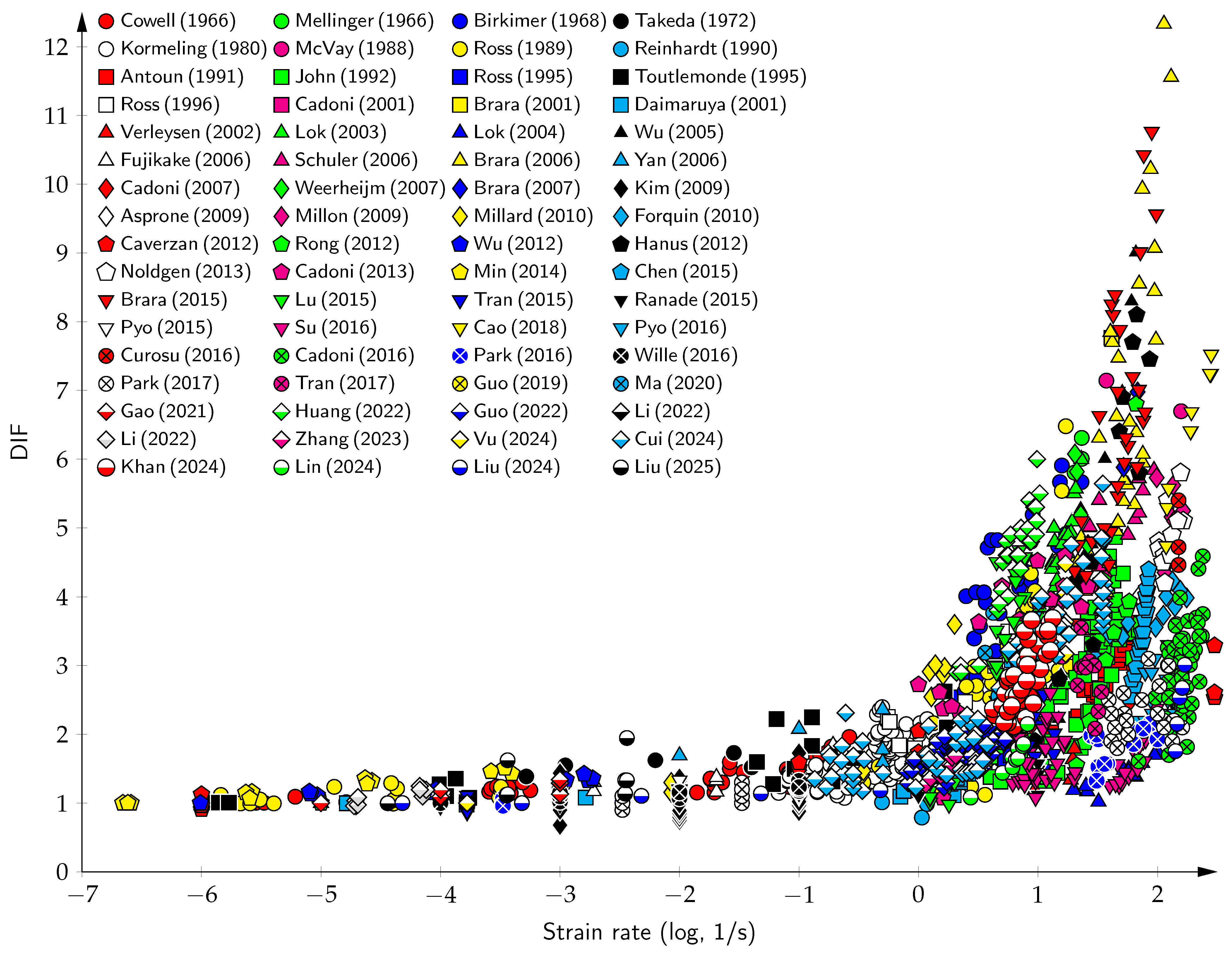
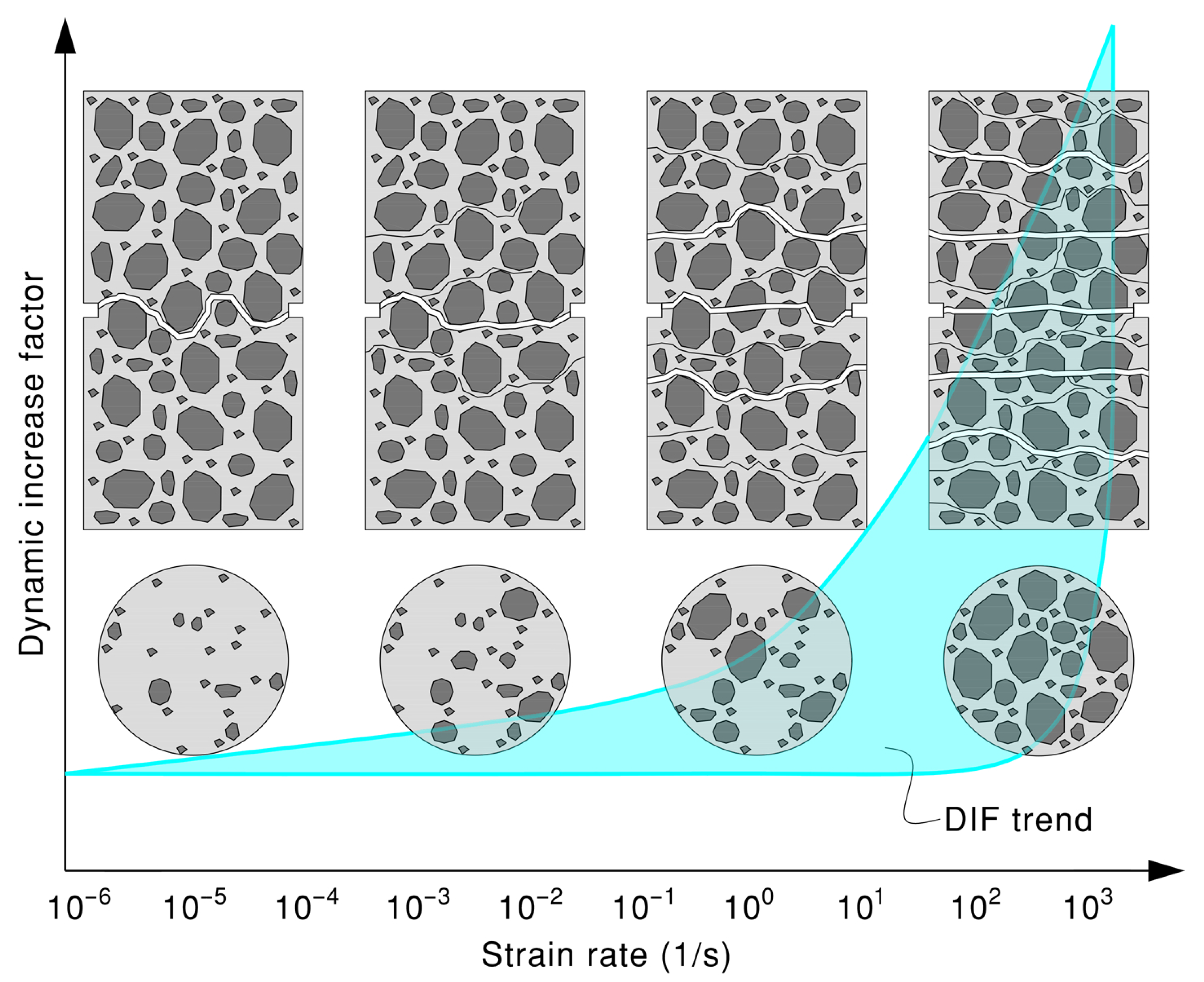
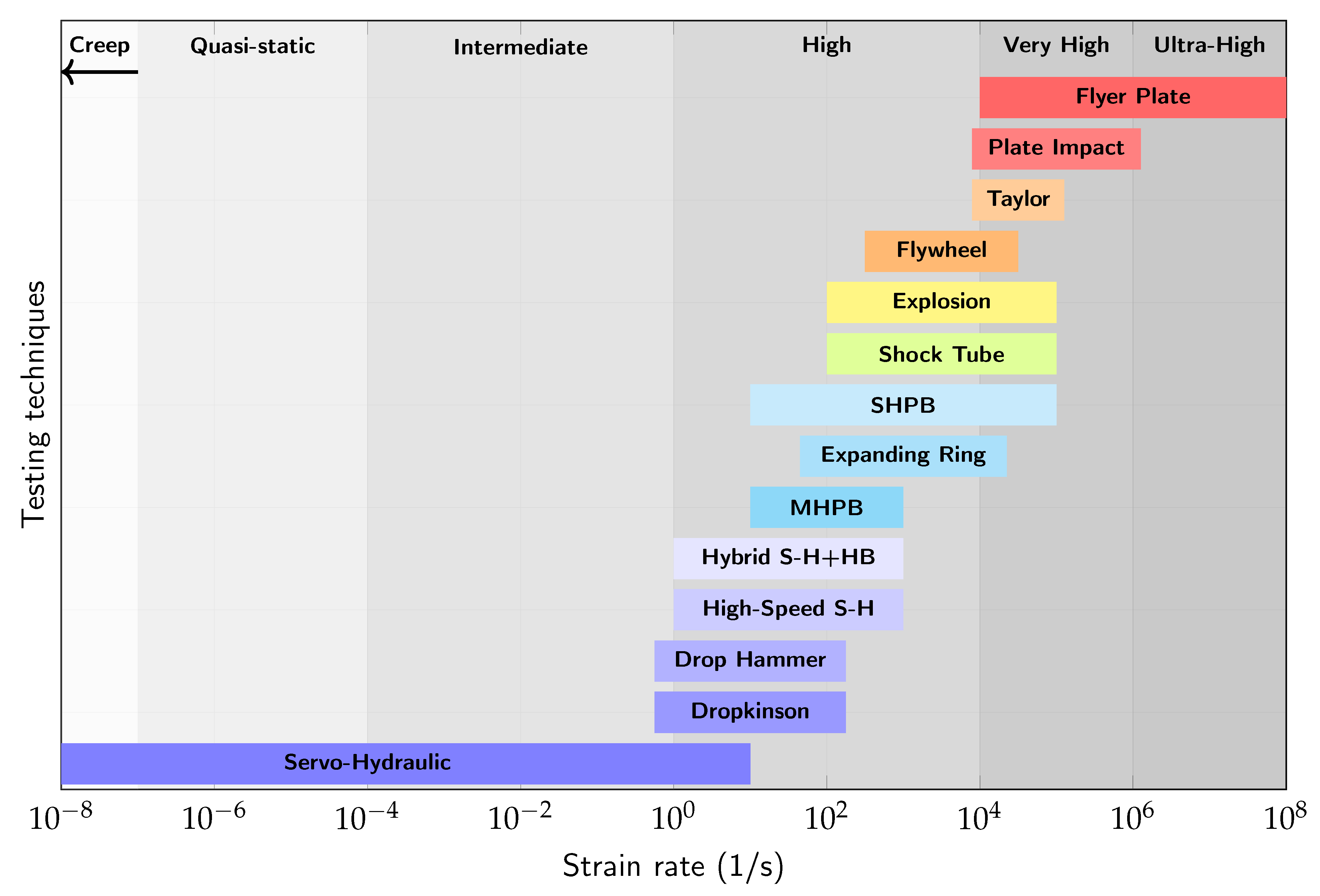


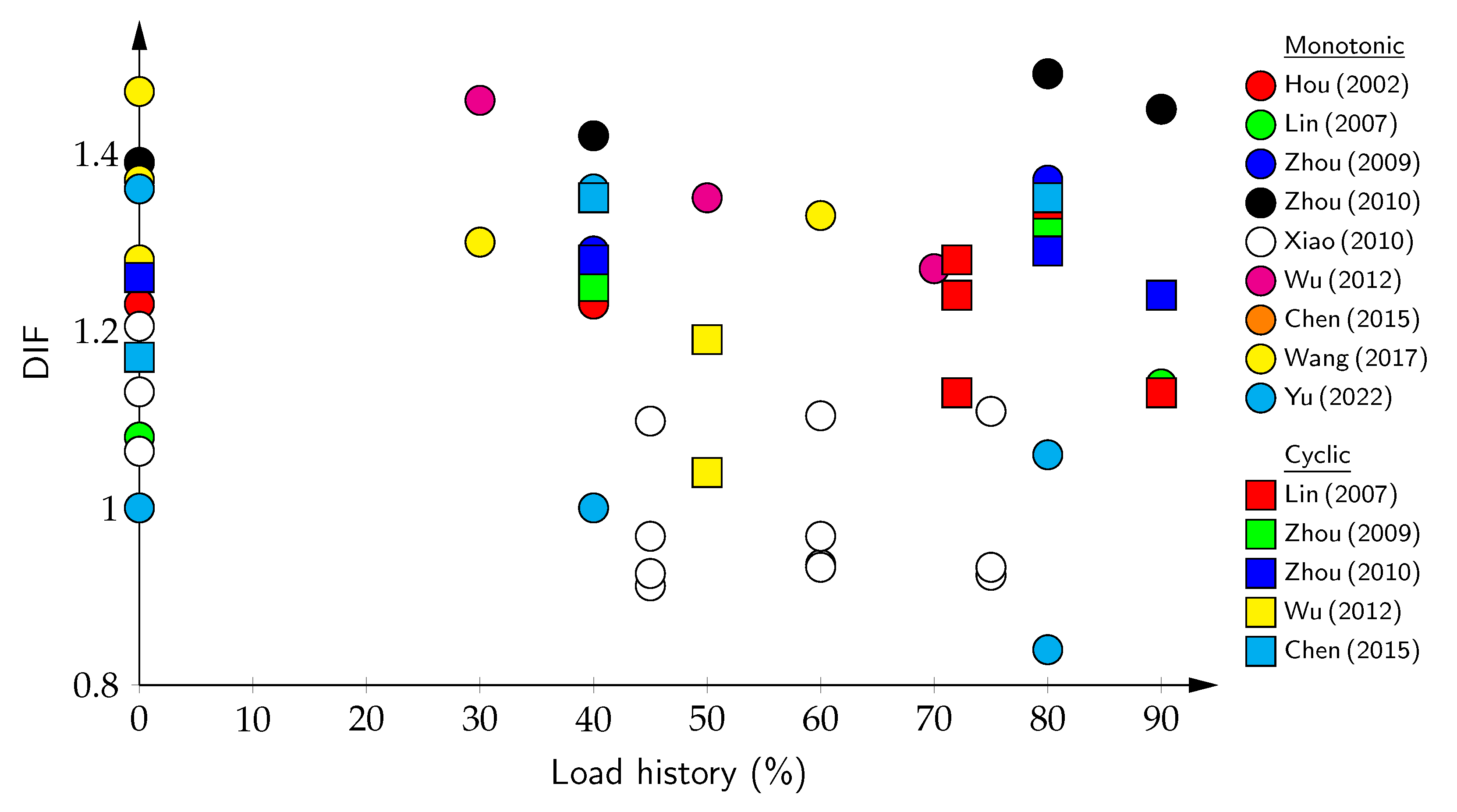
| Classification | Load Type | Technique | Strain Rate (1/s) | Method Description |
|---|---|---|---|---|
| Static to quasi-static | Earthquake Construction Traffic Vehicle impact | Servo-hydraulic | to | Applies loads to a specimen using a hydraulic actuator |
| Intermediate strain rates | Traffic Vehicle impact Crashworthiness Collisions Construction Aircraft landing | Dropkinson | to | Dropkinson test combines a drop tower and a Hopkinson bar |
| Drop Hammer Drop Tower | to | Drops a heavyweight hammer or a mass to impact a clamped specimen | ||
| High-Speed Servo-Hydraulic | Up to | Designed to cope with the dynamics of intermediate strain rate testing | ||
| Hybrid Servo-Hydraulic Hopkinson Bar | Up to | Combines a servo-hydraulic machine and the split Hopkinson bar technique | ||
| Intermediate to high strain rates | Blast Explosion Vehicle impact Hard impact | Split Hopkinson Pressure Bar (SHPB) | to | Involves two bars with a specimen placed between them A striker bar generates stress waves that propagate through the specimen |
| Modified Hopkinson Bar | to | Variation of the SHPB designed for tensile testing | ||
| High strain rates | Induced shock Hard impact Blast Explosion | Expanding Ring | to | Impact load is applied internally to thin ring specimens by the sudden radial acceleration of the driving ring due to the detonation of an explosive charge or electromagnetic loading |
| Shock Tube | to | A specimen placed at the end of a tube is exposed to a shock wave impact | ||
| Rotating Wheel or Flywheel | to | Uses the kinetic energy from a rotating flywheel to fracture the specimen | ||
| Very high strain rates | Blast Explosion Induced shock | Taylor Test or Rod Impact | to | Launches a cylindrical specimen that impacts a rigid target |
| Explosion | to | Specimen is subjected to blast loading generated by explosives | ||
| Very high to ultra-high strain rates | Bullet impact Explosion | Pressure Shear Plate Impact | to | An inclined flyer plate impacts the inclined target plate specimen |
| Plate Impact Flyer Plate Test | to | Impacts a flat plate on a target sample in a planar manner |
| Reference | Strain Rate Range (s−1) | DIF (Dry) | DIF (Wet) |
|---|---|---|---|
| Reinhardt [24] | – | 0.9–1.1 | 1.4–3.1 |
| Rossi [173] | – | 1.0–1.7 | 1.0–4.7 |
| Ross et al. [28] | – | 0.9–3.0 | 0.9–4.0 |
| Toutlemonde and Rossi [244] | – | 1.0–1.4 | 1.1–2.4 |
| Cadoni et al. [29] | – | 1.0–1.7 | 1.0–3.1 |
| Brara and Klepaczko [5] | – | 1.0–8.7 | 1.0–12.6 |
| Wang et al. [236] | – | 1.7–2.1 | 1.9–2.9 |
| Erzar and Forquin [6] | – | 3.5–6.1 | 4.5–8.3 |
| Wu et al. [47] | – | 0.9–1.4 | 1.3–1.4 |
| Vegt and Weerheijm [190] | – | 1.0–3.9 | 1.0–8.4 |
| Wang et al. [248] | – | 1.0–1.6 | 1.0–1.8 |
| Cui et al. [78] | – | 1.1–5.7 | 1.6–6.0 |
| Xie et al. [238] | – | 3.7–4.8 | 4.5–6.3 |
| Liu et al. [82] | – | 1.0–1.6 | 1.0–2.5 |
| Study | Strain Rate, 1/s/ Frequency, Hz | DIF as Function of Preload Level | |||
|---|---|---|---|---|---|
| No Preload | 30–50% Preload | 60–80% Preload | 90% Preload | ||
| Monotonic | |||||
| Hou [249] | 1.23–1.26 | 1.23–1.26 | 1.33–1.49 | – | |
| Lin [250] | 1.08 | – | 1.24 | 1.14 | |
| Zhou [251] | 1.17 | 1.25–1.29 | 1.31–1.37 | – | |
| Zhou [252] | – | 1.26–1.39 | 1.28–1.42 | 1.29–1.49 | 1.24–1.45 |
| Xiao [206] | – | 1.00–1.21 | 0.91–1.10 | 0.93–1.10 | 0.93–1.10 |
| Wu [47] | 1.26 | 1.46 | 1.27–1.35 | – | |
| Chen [54] | 1.17 | 1.35 | 1.35 | – | |
| Wang [253] | – | 1.28–1.47 | 1.30 | 1.33 | – |
| Yu [175] | – | 1.00–1.36 | 1.00–1.36 | 0.84–1.06 | – |
| Cyclic | |||||
| Zhou [251] | 1 Hz | 1.17 | 1.25 | 1.31 | – |
| Chen [54] | 5 Hz | 1.17 | 1.35 | 1.35 | – |
| Zhou [252] | 1 Hz | 1.26 | 1.28 | 1.29 | 1.24 |
| Wu [259] | 1–5 Hz | – | 1.04–1.19 | – | – |
| Lin [250] | 0.5–2 Hz | 1.13 | – | 1.24–1.28 | 1.13–1.24 |
| Reference | DIF (Dry) | DIF (Wet) | Strain Rate s−1 | Load History (Preload) | Tension Test | Concrete Type | NMSA (mm) |
|---|---|---|---|---|---|---|---|
| [257] | 1.1 | 1.3 | – | Precycled | Stress Reversal and Direct Tension | Mass | 75 |
| [2] | 1.31–1.83 | – | – | Direct and Split Tension | Dam cores | 38–127 | |
| [256] | 1.07–1.75 | – | – | Compression (72%) and compression cycles (38–57%) | Direct | Fully graded | 80–120 |
| [285] | 1.06–1.73 | 1.58–1.61 | – | – | Split | Dam cores | 75–150 |
| [249] | 1.23–1.49 | – | Tension (40–80%) | Flexural | Fully graded and wet-screened | 40–150 | |
| [290] | 1.22 | – | – | – | Flexural | Fully graded | 40–80 |
| [251] | 1.17–1.37 | – | – | Tension (40–80%) | Flexural | Three-graded | 40–80 |
| [252] | 1.24–1.49 | – | – | Tension (40–90%) | Flexural and cyclic | Wet-screened | 40 |
| [291] | 1.13–1.17 | – | – | Flexural | Three-graded | 40–80 | |
| [254] | 1.1–1.45 | – | – | – | Flexural, direct and split | Mass | 40 |
| [47] | 1.14–1.46 | 1.15–1.32 | – | – | Split | Mass | 40–150 |
| [287] | 1.18–1.59 | – | – | – | Direct | Three-graded and wet-screened | 80 |
| [53] | 1.13–1.46 | – | – | – | Split | Mass | 40 |
| [284] | 1.18–1.59 | – | – | – | Direct | Fully graded and wet-screened | 80 |
| [54] | 1.17–1.80 | – | Tension (40–80%) | Flexural, monotonic and cyclic | Fully graded | 150 | |
| [294] | 1.18–1.59 | – | – | – | Direct | Mass | 80 |
| [288] | 1.18–1.59 | – | – | – | Direct | Fully graded and wet-screened | 80 |
| [253] | 1.28–1.47 | – | Tension (30–60%) | Direct | Dam cores | 80 | |
| [292] | 1.12–1.30 | 1.08–1.19 | – | Freeze–thaw cycles | Direct | Hydraulic concrete | 80 |
| [289] | 1.15–1.56 | – | – | Direct tension and cyclic | Fully graded and wet-screened | 80 | |
| [293] | 1.11–1.30 | – | – | – | Direct | Mass | 80 |
| [295] | 1.09–1.32 | – | – | – | Split | Dam cores | 150 |
| [176] | 1.58 | – | – | Direct | Mass | 40–80 | |
| [286] | 1.27–1.39 | – | – | – | Flexural | Fully graded and wet-screened | 150 |
| Reference | Method | Test Type | Material | Parameter | Strain Rate (1/s) | DIF |
|---|---|---|---|---|---|---|
| Ordinary-Strength Concrete (OSC) | ||||||
| [18] | AFP | Spall | OSC | Tensile strength | 20 | 6 |
| [19] | AFP | Spall | OSC | Tensile strength | 23 | 6 |
| [179] | SHPB | Direct | OSC | Tensile strength | 0.5 | 1.75 |
| [300] | SHPB | Split | OSC | Tensile strength | 0.9 | 3.6 |
| [300] | SHPB | Direct | OSC | Tensile strength | 0.65 | 2.6 |
| [301] | SHPB | Direct | OSC | Tensile strength | 0.3 | 1.53 |
| [165] | SHPB | Split | OSC | Tensile strength | 7.7 | 3.6 |
| [28] | SHPB | Split | OSC | Tensile strength | 8 | 3.0 |
| [31] | SHPB | Spall | OSC | Tensile strength | 100 | 4.0 |
| [31] | SHPB | Split | OSC | Tensile strength | 100 | 4.0 |
| [29] | SHPB | Direct | OSC | Tensile strength | 10 | 3.5 |
| [302] | SHPB | Direct | OSC | Tensile strength | 10 | 3.7 |
| [303] | SHPB | Spall | OSC | Tensile strength | 53 | 4.8 |
| [39] | SHPB | Direct | OSC | Tensile strength | 70 | 3.93 |
| [304] | SHPB | Spall | OSC | Tensile strength | 100 | 2.2 |
| [46] | SHPB | Spall | OSC | tensile strength | 100 | 3.8 |
| [51] | SHPB | Flexural | OSC | Tensile strength | 67 | 8.1 |
| [305] | SHPB | Direct | OSC | Tensile strength | 150 | 2.0 |
| [50] | MSHPB | Direct | OSC | Tensile strength | 12 | 3.5 |
| [56] | SHPB | Split | OSC | Tensile strength | 100 | 3.9 |
| [79] | SHPB | Split | OSC | Tensile strength | 7.6 | 2.87 |
| High-Strength/-Performance Concrete (HSC/HPC) | ||||||
| [38] | SHPB | Spall | HPC | Tensile strength | 29 | 3.3 |
| [306] | SHPB | Spall | HPC | Tensile strength | 160 | 3.8 |
| [74] | SHPB | Split | HSC | Tensile strength | 0.8 | 2.2 |
| [73] | SHPB | Split | HSC | Tensile strength | 6.6 | 4.5 |
| [78] | SHPB | Split | Wet HSC | Tensile strength | 14 | 4.8 |
| [78] | SHPB | Split | Dry HSC | Tensile strength | 14 | 4.8 |
| [79] | SHPB | Split | HSC | Tensile strength | 7.9 | 2.6 |
| Reactive Powder and Ultra-High-Performance Concrete (RPC/UHPC/UHSC) | ||||||
| [37] | Servo-hydraulic | Direct | RPC | Tensile strength | 50 | 1.7 |
| [171] | CAGBBD | Flexural | UHPC | Tensile strength | 10 | 3.6 |
| [45] | Drop weight | Flexural | UHPC | tensile strength | 1.7 | 1.5 |
| [49] | SHPB | Spall | UHPC | Tensile strength | 66 | 6.7 |
| [52] | SHPB | Spall | UHPC | Tensile strength | 125 | 4.8 |
| [57] | SEFIM | Direct | UHPC | Tensile strength | 11 | 2.4 |
| [59] | Servo-hydraulic | Direct | UHPC | Tensile strength | 0.1 | 1.2 |
| [58] | Servo-hydraulic | Direct | UHPC | Tensile strength | 10 | 1.4 |
| [307] | SHPB | Spall | UHSC | Tensile strength | 80 | 3.2 |
| [65] | SHPB | Direct | UHPC | Tensile strength | 420 | 3.6 |
| [66] | SEFIM | Direct | UHPC | Tensile strength | 26 | 1.7 |
| [63] | SEFIM | Direct | UHPC | Tensile strength | 120 | 3.4 |
| [60] | SHPB | Direct | UHPC | Tensile strength | 100 | 1.8 |
| [61] | SHPB | Direct | UHPC | Tensile strength | 300 | 2.4 |
| [67] | Servo-hydraulic | Direct | UHPC | Tensile strength | 0.1 | 1.2 |
| [69] | SEFIM | Direct | UHPC | Tensile strength | 26 | 2.6 |
| [68] | SEFIM | Direct | UHPC | Tensile strength | 125 | 2.6 |
| Fiber-Reinforced and Strain-Hardening Concretes (HPRFC, UHPRFC, SHCC) | ||||||
| [22] | Explosive | Spall | RFC | Tensile strength | 157 | 7.0 |
| [306] | SHPB | Spall | HPRFC | Tensile strength | 160 | 5.3 |
| [306] | SHPB | Spall | SHCC | Tensile strength | 160 | 5.8 |
| [49] | SHPB | Spall | UHPRFC | Tensile strength | 56 | 3.9 |
| [305] | SHPB | Direct | HPRFC | Tensile strength | 150 | 2.6 |
| [44] | SHPB | Spall | UHPRFC | Tensile strength | 128 | 4.89 |
| Moisture-Conditioned Concrete (Dry vs. Wet) | ||||||
| [24] | SHPB | Direct | Wet OSC | Tensile strength | 1 | 2.4 |
| [24] | SHPB | Direct | Wet OSC | Elastic modulus | 1 | 1.2 |
| [163] | Shock tube | Slab | Dry OSC | Tensile strength | 1 | 1.5 |
| [163] | Shock tube | Slab | Wet OSC | Tensile strength | 1 | 2.0 |
| [28] | SHPB | Split | Dry OSC | Tensile strength | 6 | 3.6 |
| [28] | SHPB | Split | Wet OSC | Tensile strength | 6 | 4.0 |
| [5] | SHPB | Spall | Dry OSC | Tensile strength | 100 | 8.0 |
| [5] | SHPB | Spall | Wet OSC | Tensile strength | 128 | 13.0 |
| [6] | SHPB | Spall | Wet OSC | Tensile strength | 150 | 8.0 |
| [6] | SHPB | Spall | Dry OSC | Tensile strength | 150 | 5.0 |
| [78] | SHPB | Split | Wet OSC | Tensile strength | 14 | 6.0 |
| [78] | SHPB | Split | Dry OSC | Tensile strength | 14 | 5.0 |
| Reference | Numerical Method | Key Focus |
|---|---|---|
| [83] | 3D FEM Cohesive surface elements | Dynamic fracture Brazilian tests Exploring size effects |
| [30] | 2D DEM Voronoï-based particle meshing Delaunay lattice bonding | Dynamic spalling and fracture in concrete |
| [84] | 2D FEM Isotropic local damage model Viscoplastic damage model | Modified SHB test fracture behavior under ultra-high loading rates |
| [35] | FEM LS-DYNA Continuum damage accumulation model | Dynamic tensile failure (spalling) |
| [85] | Mesoscale FEM Dynamic damage model | Dynamic bending strength of large fully graded beams Influence of load history |
| [86] | Mesoscopic FEM Anisotropic damage model | Dynamic tensile behavior in SHPB/spalling tests Influence of water content |
| [87] | 3D mesoscale FEM | Dynamic spalling and fracture in concrete |
| [49] | FEM LS-DYNA JHC model | Dynamic tensile behavior of UHPCC |
| [88] | FEM ABAQUS DFH model | Dynamic spalling and fracture in concrete |
| [53] | Thermodynamic model | Dynamic splitting tensile strength of concrete |
| [89] | Mesoscale FEM AUTODYN Drucker–Prager model | Lateral inertia confinement and specimen size influence |
| [90] | FEM LS-DYNA | Dynamic tensile behavior of cement mortar |
| [91] | 2D mesostructural FEM | Influence of aggregate size, distribution, and ITZ properties |
| [92] | Mesoscale FEM Random aggregate model | Dynamic bending strength Material heterogeneity Influence of load history and aggregate grading |
| [93] | 3D FEM Microplane model | Strain rate vs. structural inertia |
| [94] | 2D mesoscopic FEM VEVPD model | Water content and ITZ strength SHB and MSHP tests |
| [95] | 2D mesoscale FEM ABAQUS CDP model | Mesostructural heterogeneity |
| [96] | FEM ABAQUS DFH-KST coupled model | Influence of free water content on concrete’s ballistic resistance |
| [97] | Bond-based peridynamics Fortran90 Prototype microelastic brittle | Dynamic failure of concrete Brazilian discs in SHPB tests |
| [98] | Partially saturated FEM Barton’s empirical model | Influence of water pressure and crack permeability during crack growth in concrete dams |
| [99] | FEM ABAQUS Three-parameter damage model | Dynamic tensile failure of brittle materials |
| [100] | Mesoscale FEM Random aggregate model Occupation and removal method | Flexural failure behavior of fully graded concrete for dams with realistic aggregate shapes and gradations Influence of load history |
| [101] | 2D mesoscale FEM ABAQUS Maxwell-type rheological model | Influence of ITZ properties, aggregate content, and porosity |
| [102] | FEM ABAQUS Drucker–Prager model | Influence of the inertial effect |
| [103] | 3D mesoscale FEM LS-DYNA | Dynamic tensile behavior of UHPC using explicitly modeled fiber reinforcement |
| [104] | FEM ABAQUS Concrete damaged plasticity | Influence of the inertial effect |
| [105] | 3D FEM LS-DYNA Johnson–Holmquist concrete | Dynamic Brazilian tests in SHPB apparatus |
| [106] | FEM LS-DYNA Comparison of models | Blast loads, missile penetration, and three-point bending |
| [107] | 3D FEM ABAQUS | Comparing mortar vs. concrete dynamic behavior |
| [108] | 3D mesoscale FEM LS-DYNA Karagozian and Case model | Developing a high-fidelity 3D mesoscale concrete model Influence of ITZ and aggregate size distribution |
| [109] | 2D XFEM (ABAQUS) | Dynamic tensile strength and elastic modulus of UHPC from Brazilian tests |
| [110] | FEM LS-DYNA Holmquist–Johnson–Cook model | Comparing numerical results (inertia only) vs. SHPB experiments (inertia + strain rate) |
| [111] | Finite weakest link model | Influence of strain rate on size effect and cracking |
| [112] | 3D FEM ABAQUS Drucker–Prager model | Strain rate vs. inertial effects |
| [113] | Mesoscale FEM Random aggregate model | Influence of load history |
| [114] | 3D Mesoscopic FEM Concrete damaged plasticity model | Size and inertial effects |
| [115] | FEM ABAQUS Random aggregate model Concrete damage plasticity | Influence of aggregate volume fraction and beam depth |
| [116] | 2D FEM with random aggregate model | Dynamic tensile failure and size effect in concrete |
| [117] | 3D FEM ABAQUS Rheological traction separation model | Dynamic crack initiation and propagation under spall tests |
| [118] | 3D DEM Particle flow code | Concrete strength, modulus, crack pattern, and damage evolution |
| [119] | Bond-based peridynamic model | Fracture behavior of coal under SHPB loading |
| [120] | FEM ABAQUS Drucker–Prager model | Isolating and quantifying the inertial effect |
| [121] | Base force element method | Mesoscale dynamic behavior of recycled aggregate concrete |
| [122] | 3D mesoscopic FEM model | Meso-level failure mechanisms of concrete under dynamic splitting tension |
| [123] | Mesoscale 2D discrete element method | Nonlinear effect of pore water |
| [3] | 2D mesoscale bonded particle model Particle Flow Code | Size, inertia, and multiple crack effects |
| [124] | Modified Intermediately Homogenized Peridynamic Ordinary State-Based Peridynamics Framework | Influence of water content |
| [125] | 3D bonded particle model LS-DYNA | Influence of grain heterogeneity and cement interface strength |
| [126] | 3D stochastic mesoscale FEM model LS-DYNA | Dynamic splitting tensile behavior of UHP-HFRC under SHPB loading |
| [127] | FEM LS-DYNA Karagozian and Case model | Influence of water content |
| [128] | FEM ABAQUS Thermal–mechanical sequential coupled mesoscale | Influence of water content, temperature, and size effect |
| [129] | DEM-CFD YADE Fully coupled hydro-mechnical model | Influence of water content on strength and fracture |
| [130] | 2D and 3D mesoscale FEM models | Dynamic tensile behavior of multi-scale self-compacting concrete |
| [131] | 3D FEM LS-DYNA | Dynamic response of FRP-reinforced UHPC beams under impact |
| [132] | 2D DEM Parallel bonded model | Propose and validate a new specimen design for direct tensile testing of concrete using concentric cylindrical cuts from a cube |
| [133] | FEM ANSYS/LS-DYNA Holmquist–Johnson–Cook model | Influence of matrix strength |
| [134] | FEM ABAQUS | Dynamic crack propagation in mortar–granite interfaces |
| [135] | FEM ABAQUS Johnson–Holmquist–Cook model | Influence of steel fiber volume on spalling strength |
| [136] | Coupled FDM-DEM PFC3D FLAC3D Parallel bond model | Dynamic splitting behavior of coral aggregate seawater shotcrete under SHPB |
| [137] | Coupled FDM-DEM Particle Flow Code | Dynamic fracture behavior of bimaterial rock–concrete Brazilian disks with a central interface crack under SHPB loading |
| [138] | FEM ABAQUS Cohesive element model | Influence of pore structure on concrete’s impact tensile behavior |
| Year | Guideline | Agency | Reference | DIF | |||
|---|---|---|---|---|---|---|---|
| 1976 | Design of gravity dams | USBR | [261] | 1 | 1 | 1 | 1 |
| 1977 | Design Criteria for Concrete Arch and Gravity Dam | USBR | [262] | 1 | 1 | 1 | 1 |
| 1977 | Design of arch dams | USBR | [263] | 1 | 1 | 1 | 1 |
| 1987 | Design of small dams | USBR | [264] | 1.7 | 1 | 1.2 | 1 |
| 1994 | Arch dam design | USACE | [265] | 1.3 | 1.3 | 1.2 | 1.25 |
| 1995 | Gravity dam design | USACE | [266] | 1.5 | 1 | 1 | 1 |
| 1999 | Engineering guidelines for evaluation of hydropower projects— Chapter 11 Arch Dams | FERC | [267] | 1.5 | 1.3 | 1.25 | 1 |
| 2003 | Guide pour l’évaluation de la sécurité sismique | Hydro-Quebec | [268] | 1.5 | 1.25 | 1.25 | 1.25 |
| 2006 | State-of-Practice for the Nonlinear Analysis of Concrete Dams | USBR | [269] | 1.5 | 1.2 | 1.5 | 1 |
| 2007 | Earthquake Design and Evaluation of Concrete Hydraulic Structures | USACE | [270] | 1.5 | 1.15 | 1.15 | 0.7 |
| 2007 | Standard Specifications for Concrete Structures— Dam concrete | JSCE | [271] | 1.3 | 1.3 | 1 | 1 |
| 2009 | The Physical Properties of Hardened Conventional Concrete in Dams | ICOLD | [272] | 1.35 | 1 | 1 | 1 |
| 2013 | Design of Double Curvature Arch Dams | USBR | [273] | 1 | 1 | 1 | 1 |
| 2016 | Engineering guidelines for evaluation of hydropower projects— Chapter 3 Gravity Dams. | FERC | [274] | 1 | 1 | 1 | 1 |
| 2016 | Directive relative à la sécurité des ouvrages d’accumulation Partie C3: sécurité aux séismes | OFEN | [275] | 1.3 | 1.3 | 1.25 | 1 |
| 2016 | Guideline for FE analyses of concrete dams | SERC | [276] | 1.5 | 1 | 1.25 | 1 |
| 2017 | Guidelines for Design of Dams and Appurtenant Structures for Earthquake | ANCOLD | [277] | 1.5 | 1 | 1.25 | 1 |
Disclaimer/Publisher’s Note: The statements, opinions and data contained in all publications are solely those of the individual author(s) and contributor(s) and not of MDPI and/or the editor(s). MDPI and/or the editor(s) disclaim responsibility for any injury to people or property resulting from any ideas, methods, instructions or products referred to in the content. |
© 2025 by the authors. Licensee MDPI, Basel, Switzerland. This article is an open access article distributed under the terms and conditions of the Creative Commons Attribution (CC BY) license (https://creativecommons.org/licenses/by/4.0/).
Share and Cite
Barbosa dos Santos, A.; Bandini, P.A.C.; Segura, R.L.; Paultre, P. Dynamic Tensile Strength of Concrete: A Review of Mechanisms, Test Results, and Applications for Dam Safety. Materials 2025, 18, 5669. https://doi.org/10.3390/ma18245669
Barbosa dos Santos A, Bandini PAC, Segura RL, Paultre P. Dynamic Tensile Strength of Concrete: A Review of Mechanisms, Test Results, and Applications for Dam Safety. Materials. 2025; 18(24):5669. https://doi.org/10.3390/ma18245669
Chicago/Turabian StyleBarbosa dos Santos, Anderssen, Pedro Alexandre Conde Bandini, Rocio Lilen Segura, and Patrick Paultre. 2025. "Dynamic Tensile Strength of Concrete: A Review of Mechanisms, Test Results, and Applications for Dam Safety" Materials 18, no. 24: 5669. https://doi.org/10.3390/ma18245669
APA StyleBarbosa dos Santos, A., Bandini, P. A. C., Segura, R. L., & Paultre, P. (2025). Dynamic Tensile Strength of Concrete: A Review of Mechanisms, Test Results, and Applications for Dam Safety. Materials, 18(24), 5669. https://doi.org/10.3390/ma18245669