Article

Multi-Objective Hierarchical Optimization for Suppressing Zero-Order Radial Force Waves and Enhancing Acoustic-Vibration Performance of Permanent Magnet Synchronous Motors


by
Tianze Xu
1,
Yanhui Zhang
1,*,
Weiguang Zheng
1,
Chengtao Zhang
1 and
Huawei Wu
2
1
School of Mechanical and Automotive Engineering, Guangxi University of Science and Technology, Liuzhou 545006, China
2
Hubei Key Laboratory of Power System Design and Test for Electrical Vehicle, Hubei University of Arts and Science, Xiangyang 441053, China
*
Author to whom correspondence should be addressed.
Energies 2026, 19(2), 475; https://doi.org/10.3390/en19020475 (registering DOI)
Submission received: 12 December 2025 / Revised: 14 January 2026 / Accepted: 15 January 2026 / Published: 17 January 2026

Abstract

To address the significant vibration and noise problems caused by the zero-order radial electromagnetic force (REF) in integer-slot permanent magnet synchronous motors (PMSMs), while simultaneously improving the motor’s overall electromagnetic performance, this paper proposes a hierarchical iterative optimization strategy integrating Taguchi methods and genetic algorithms. The optimization objectives include minimizing the zero-order REF amplitude, cogging torque, and torque ripple, while maximizing the average torque, with efficiency and back electromotive force total harmonic distortion (back-EMF THD) treated as constraints. First, an 8-pole 48-slot double-layer embedded PMSM model is constructed. An innovative parameter selection strategy, combining theoretical analysis with finite-element analysis, is employed to investigate the spatial order and frequency characteristics of the electromagnetic force. Subsequently, a sensitivity analysis is performed to stratify parameters: highly sensitive parameters undergo first-round optimization via the Taguchi method, followed by second-round optimization using a multi-objective genetic algorithm. The results demonstrate significant reductions in both the zero-order REF amplitude and cogging torque. Specifically, the motor’s peak vibration acceleration is reduced by 32.96%, and the peak sound pressure level (SPL) drops by 9.036 dB. Vibration acceleration and sound pressure across all frequency bands are significantly reduced to varying extents, validating the effectiveness of the proposed optimization approach.

1. Introduction

Due to their high reliability, environmental sustainability, and driving flexibility, the adoption of electric vehicles (EVs) continues to rise significantly. The traction motor serves as the power core of an EV, whose performance directly influences the vehicle’s overall operational characteristics. Permanent magnet synchronous motors (PMSMs), characterized by their compact size, low mass, high efficiency, and reliable operation, have emerged as the dominant choice in the EV market [1]. EVs have stringent demands for vibration and noise control. However, the interaction between the fundamental and harmonic components of the air gap magnetic field in PMSMs generates electromagnetic forces acting on the stator core, leading to severe vibration and noise issues. These issues undermine both the motor’s operational stability and its service life. Consequently, the effective mitigation of electromagnetic vibration and noise in PMSMs is crucial and warrants thorough investigation.
Motor noise is typically categorized into three types: aerodynamic noise, mechanical noise, and electromagnetic noise. Electromagnetic noise, resulting from electromagnetic vibrations, is the primary source of motor noise [2]. Radial electromagnetic force (REF) causes radial deformation of the stator and rotor, leading to periodic vibrations that serve as the primary source of electromagnetic noise in motors. Tangential electromagnetic forces induce bending in stator teeth relative to their roots, thus constituting a secondary source of electromagnetic noise in motors [3]. For integer-slot PMSMs, the stator zero-order modal vibration caused by zero-order REF is the primary source of vibration and noise [4], and zero-order vibration contributes much more significantly to overall vibration than the lowest non-zero-order vibration component [5].
Multi-objective optimization is frequently employed in motor NVH (Noise, Vibration, Harshness) research. Common multi-objective combinations typically focus on high efficiency, high power density, high output torque, low torque ripple, and low back electromotive force total harmonic distortion (back-EMF THD). Gu et al. [6] developed a novel optimization framework combining orthogonal experimental design and non-parametric regression techniques, with output torque and torque ripple as the optimization objectives. Experimental validation demonstrated substantial improvements in vibration and noise performance, with surface vibration velocity reduced by 37.7% and peak noise levels attenuated by 8.5%. Chu et al. [7] focused on output torque, torque ripple, and iron loss as the optimization objectives and employed the Non-dominated Sorting Genetic Algorithm-II (NSGA-II) for iterative optimization. The optimization results showed that the cogging torque decreased by 0.71 Nm, the torque ripple was reduced by 17%, and the iron loss exhibited a slight decrease.
The length, width, and thickness of permanent magnets are frequently chosen as multi-objective optimization parameters. Baek et al. [8] considered the length and width of the permanent magnet as optimization parameters. Song et al. [9] considered the width and height of the permanent magnet, the magnet angle, as well as the inner and outer magnetic bridge thicknesses as optimization parameters. Ahmadi et al. [10] considered the rotor-side magnet angle, the width and thickness of the side magnet, and the thickness and width of the center magnet as optimization parameters.
Stator skew slots and rotor skew poles are among the most commonly used techniques for mitigating motor vibration and acoustic noise. Nevertheless, their effectiveness is limited in suppressing vibration components at the 0th order and multiples of the rotor pole number order [11]. Wang et al. [12] proposed an improved rotor design using double triangular flux barriers and semicircular notches to reduce REF. This design reduces the peak sound pressure level (SPL) from 87.4 dB to 75.3 dB. Xing et al. [13] improved stator slot parameters by coupling a high-fidelity model with a deep neural network (DNN) and an immune clonal algorithm. This approach resulted in a significant reduction in vibration acceleration at the 6th natural frequency. Ge et al. [14] proposed an optimization method using a piecewise inverse cosine function to modify the rotor shape. Zhu et al. [15] proposed a slotting scheme that involved opening auxiliary slots on the stator teeth and magnetic isolation holes on the rotor. Compared to the traditional method of only slotting on the stator teeth or only drilling holes on the rotor, this method performs better in suppressing the motor’s REF amplitude and total harmonic distortion rate.
Intelligent algorithms are increasingly employed in the optimal design of motors. Li et al. [16] used a GA-BP neural network to develop a motion prediction model within a four-objective optimization framework and utilized NSGA-III for global search optimization. This integrated approach results in significant improvements in the electromagnetic characteristics of synchronous reluctance motors. Cen et al. [17] employed the particle swarm optimization (PSO) algorithm to globally optimize the stator slot dimensions, leading to a substantial reduction in the peak cogging torque and peak back-EMF. Yan et al. [18] proposed a comprehensive optimization strategy for linear motors that integrates a neural network and an enhanced cuckoo search algorithm. The accuracy of the optimized results was verified through prototype testing. As a local optimization approach, the Taguchi method facilitates the concurrent optimization of multiple motor performance metrics. Its orthogonal experimental design improves efficiency by reducing development time and costs, thereby enabling the rapid identification of optimal parameter configurations [19].
Existing research has limited studies directly focusing on optimizing the amplitude of specific-order electromagnetic force waves. Furthermore, using the dimensions of the permanent magnet as variables results in unbounded material consumption, while traditional optimization algorithms suffer from high computational costs, and the Taguchi method exhibits limited global optimization capabilities. This study directly employs the 0th-order REF wave as the optimization objective. Leveraging the fast calculation speed and high optimization efficiency of the Taguchi method, along with the superior optimization capabilities of genetic algorithms, a multi-objective optimization method combining the Taguchi method and genetic algorithm is proposed to directly optimize the stator-rotor structure. The optimization parameters do not include permanent magnet selection as a parameter.
The primary contribution of this study is a comprehensive multi-physics, multi-objective optimization framework for NVH suppression, integrating analytical modeling with finite-element analysis. The optimization targets include cogging torque, torque ripple, average torque, and specific-order REF harmonics identified through analytical methods as key contributors to NVH. Unlike conventional approaches that focus on permanent magnet optimization, our method directly optimizes motor body parameters under constant excitation while concurrently refining both stator and rotor geometries through novel parameter selection. To enhance computational efficiency, we implement hierarchical optimization: initially employing the Taguchi method for design space reduction, followed by global refinement using a genetic algorithm.
The structure of this paper is as follows: Section 2 presents the research methodology and motor specifications. Section 3 provides theoretical and finite-element analyses of electromagnetic force harmonics. Section 4 describes the multi-objective optimization framework. Section 5 presents a comparative vibroacoustic analysis between baseline and optimized designs through modal and NVH evaluations. Section 6 analyzes additional performance metrics before and after optimization. Finally, Section 7 summarizes the key conclusions.

2. Study of Electromagnetic Vibration Noise Under Multi-Physics Coupling

2.1. Research Approach

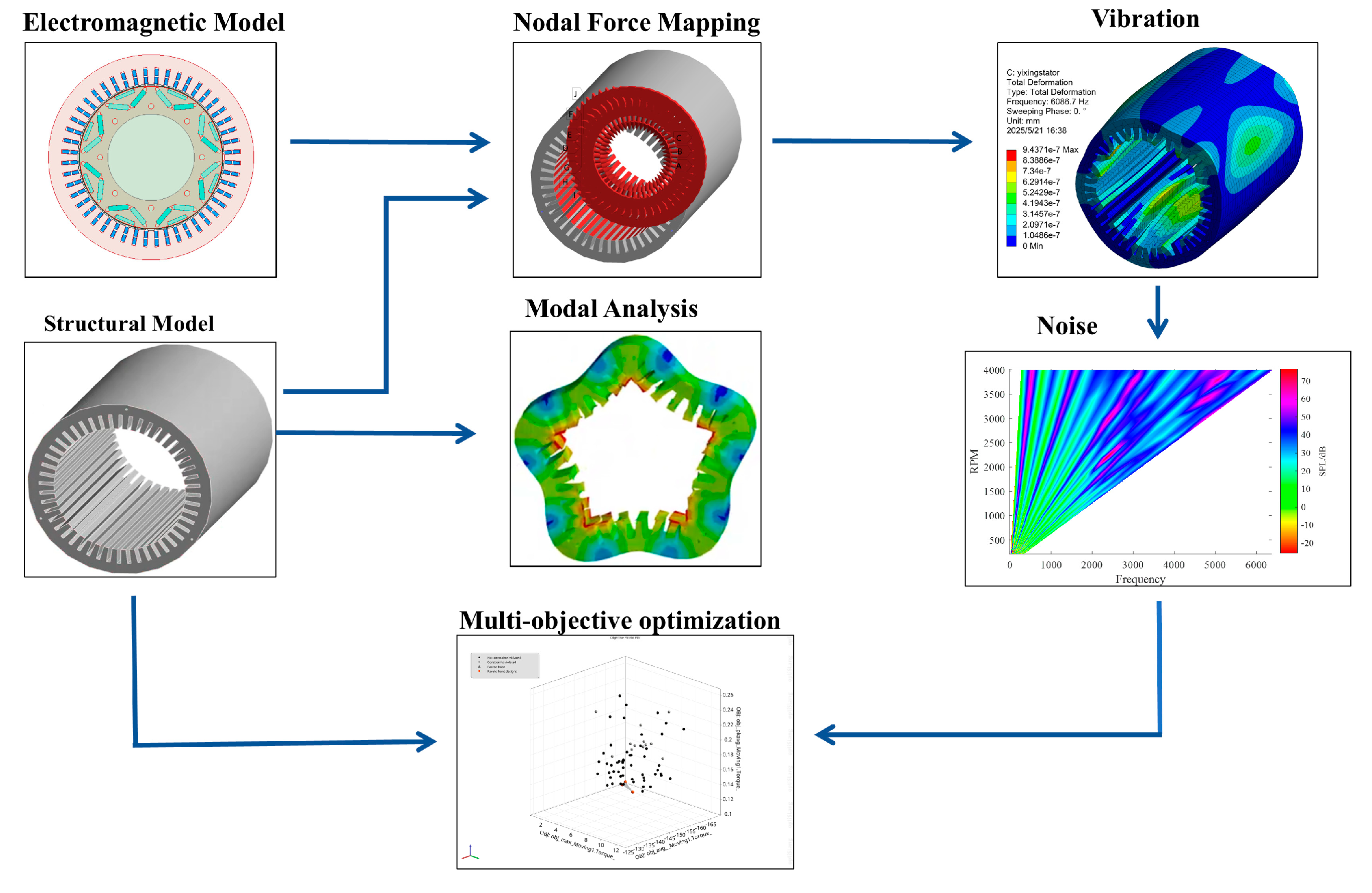
Forces acting on stator teeth were calculated using a 2D electromagnetic model and transferred to a 3D structural framework. Based on modal analysis results from this structural model, stator surface vibration acceleration was obtained through modal superposition. A 1 m-radius acoustic domain enveloping the motor was established, defining the stator acceleration as the boundary excitation [20]. The multi-objective optimization consists of five steps: determination of optimization objectives and parameters, sensitivity layering, Taguchi method preliminary optimization, response surface modeling, and genetic algorithm two-phase optimization. The flowchart of multi-physics coupling and multi-objective optimization design is presented in Figure 1.

2.2. Basic Parameters and Topology of the Motor

The motor used in this paper is an 8-pole, 48-slot, double-layer, interior permanent magnet synchronous motor suitable for compact electric vehicles. The basic parameters are presented in Table 1.
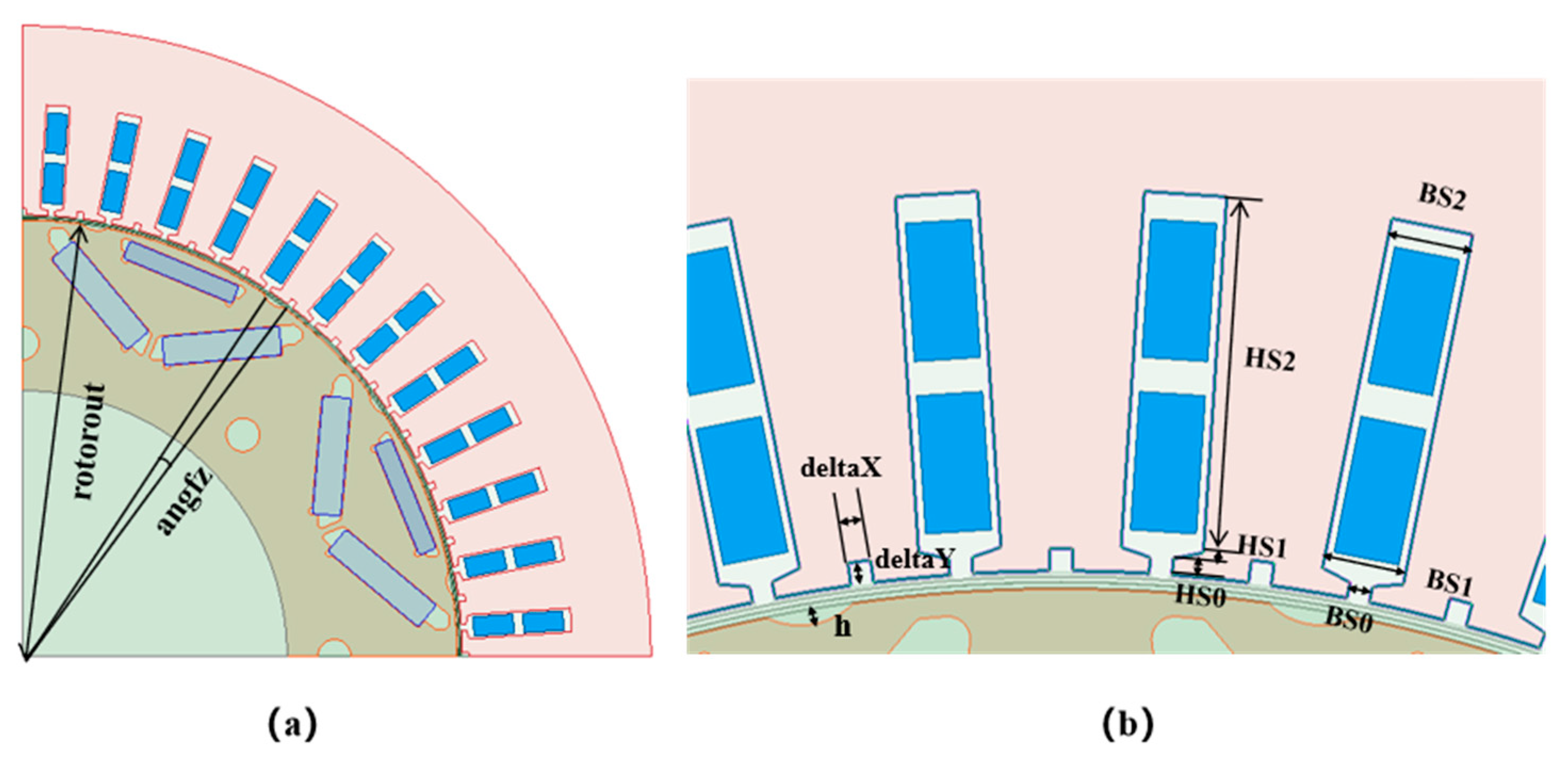
Compared to a single-layer permanent magnet rotor, the double-layer permanent magnet rotor leads to a reduction in cogging torque by approximately 44.4% and torque ripple by approximately 29.3% [21], which plays a critical role in mitigating vibration, noise, and torque ripple. However, this approach poses challenges concerning the complexity and comprehensiveness of parametric modeling and multi-objective optimization. Parametric modeling involves defining data input interfaces for the motor structure using parameterized values. These values facilitate the modification of the motor structure, rendering parametric modeling an essential tool for motor analysis and design. The structural cross-section is illustrated in Figure 2. A total of 11 structural parameters were selected for parametric analysis and design optimization, and the selection of these parameters is guided by two criteria: electromagnetic performance and vibration performance. These parameters are considered as independent variables in the parametric modeling and optimization process.

3. Electromagnetic Force and Harmonic Analysis

3.1. Electromagnetic Force and Harmonic Theory Analysis

Operational magnetic interactions between stator and rotor fields in the air gap induce spatiotemporally varying REF on the stator core. As the primary source of vibroacoustic noise in motors, these forces excite periodic vibrations that radiate acoustic energy. Maxwell’s stress tensor method provides a mathematical description of the REF distribution at the stator inner surface:
f r = 1 2 μ 0 B r 2 B t 2
In the equation, the following variables are defined: f r is the REF density; B r is the radial magnetic flux density; B t is the tangential magnetic flux density; μ 0 is the magnetic permeability of vacuum, where the value of is 4 π × 10 7 H / m .
Due to the substantially higher relative permeability of ferromagnetic materials compared with air, the air-gap magnetic flux lines are approximately perpendicular to the ferromagnetic–air interfaces. Because the tangential flux density is much smaller than the radial component, the tangential component is neglected in the REF expression, yielding:
f r = B r 2 2 μ 0
The air-gap magnetic flux density can be expressed as the superposition of B R , produced by the rotor permanent-magnet magnetomotive force (MMF), and B S , produced by the stator armature-reaction MMF. Accordingly, Equation (2) can be rewritten as Equation (3):
f r = 1 2 μ 0 B R + B S 2 = 1 2 μ 0 B R 2 + 1 2 μ 0 B S 2 + 1 μ 0 B R B S
Here, B R and B S are given by Equations (4) and (5), respectively:
B R = F R Λ
B S = F S Λ
In this equation, the variables are defined as follows: F R is the air-gap permanent-magnet field magnetomotive force (MMF); F S is the armature-reaction MMF; Λ = Λ 0 + k Λ k cos k Z θ is the equivalent air-gap permeability; Λ 0 is the constant amplitude part of the air gap magnetic permeability; Λ k (k = 1, 2, 3…) is the kth harmonic component (amplitude) of the air-gap permeability; Z is the number of stator slots.
F R and F S can be calculated according to Equations (6) and (7)
F R = V R F R m ν R cos ν R P θ - ω t
F S = μ ν S F m φ μ , ν S cos ν S P θ - μ ω t + φ μ , ν S
In the equation, F R m ν R is the ν R order amplitude of permanent magnet magnetomotive force; ν R is the harmonic order of the rotor permanent magnet magnetic field, with a value of 2 k + 1 k = 0 , 1 , 2 ; P is the number of pole pairs of the motor; θ is the mechanical angle of the rotor; ω is the angular velocity of the rotor; t is time; F m φ μ , ν S is the amplitude of the harmonic magnetic field generated by the stator current; μ is the harmonic order of the three-phase current flowing through the stator winding, with a value of 6   k μ +   1   k μ =   0 , ± 1 , ± 2 ; ν S is the harmonic order of the armature reaction magnetic field, with a value of 6 k S   +   1 k S = 0 , ± 1 , ± 2 ; the positive and negative signs indicate the forward and reverse rotation of the harmonic magnetic field, respectively; φ μ , ν S is the initial phase angle of the magnetic field.
The order and frequency of the REF are determined from Equations (8) and (9).
R f = ν R ± ν S P
f = ν R ± 1 f 0
In Equations (8) and (9), R f denotes the spatial order of the REF. f denotes the force-wave frequency. f 0 is the fundamental electrical frequency of the motor.
The deformation of the stator core induced by electromagnetic forces is inversely proportional to the fourth power of the spatial order of these forces, indicating that low-order force harmonics dominate electromagnetic vibration [22]. For high-order electromagnetic forces where R f 8 , their amplitudes are comparatively small, and their contribution is negligible. Therefore, this study primarily focuses on the zeroth spatial order R f = 0 , often termed the breathing mode.
R f min = G C D Z / m , 2 P
In this expression: GCD denotes the greatest common divisor; m denotes the number of motor phases.
According to Equation (10), the lowest nonzero spatial order of the electromagnetic force for the 8-pole/48-slot motor is 8. Based on this rule, the dominant electromagnetic force-wave orders and their corresponding frequencies for the 8-pole/48-slot motor considered in this study are derived and summarized in Table 2. In each ordered pair, the first entry denotes the spatial order, and the second entry denotes the temporal (frequency) order.
The number of tooth-harmonic pole pairs is denoted by V i = P ± iZ (i = 1,2,…), and the corresponding tooth-harmonic order is defined as V i = V i P . Accordingly, for an 8-pole/48-slot motor, the first-order tooth harmonics of the stator are V 1 =   - 11 and V 1 =   13 . The dominant contributors to electromagnetic vibroacoustic noise in PMSMs under both no-load and load conditions include these first-order tooth harmonics ( V 1 =   - 11 and V 1 =   13 ) as well as the interaction harmonics ( μ = 11 and μ = 13) associated with the main pole-pair number and the stator slot number. These components superpose to produce a spatial zero-order electromagnetic force; according to Equation (9), its frequency is 12 ƒ 0 . The analytical results indicate that the zeroth-order force at the 12th temporal order (i.e.,12 ƒ 0 ) has the most pronounced effect on electromagnetic vibration and noise in an 8-pole/48-slot PMSM. Compared with higher spatial-order force components, the zeroth-order force tends to dominate the vibration acceleration and sound pressure level (SPL). Specifically, zeroth-order electromagnetic force excitation typically excites a breathing mode, characterized by in-phase, circumferentially uniform radial deformation, high acoustic radiation efficiency, and limited spatial cancelation.

3.2. Electromagnetic Force and Harmonic Finite Element Analysis

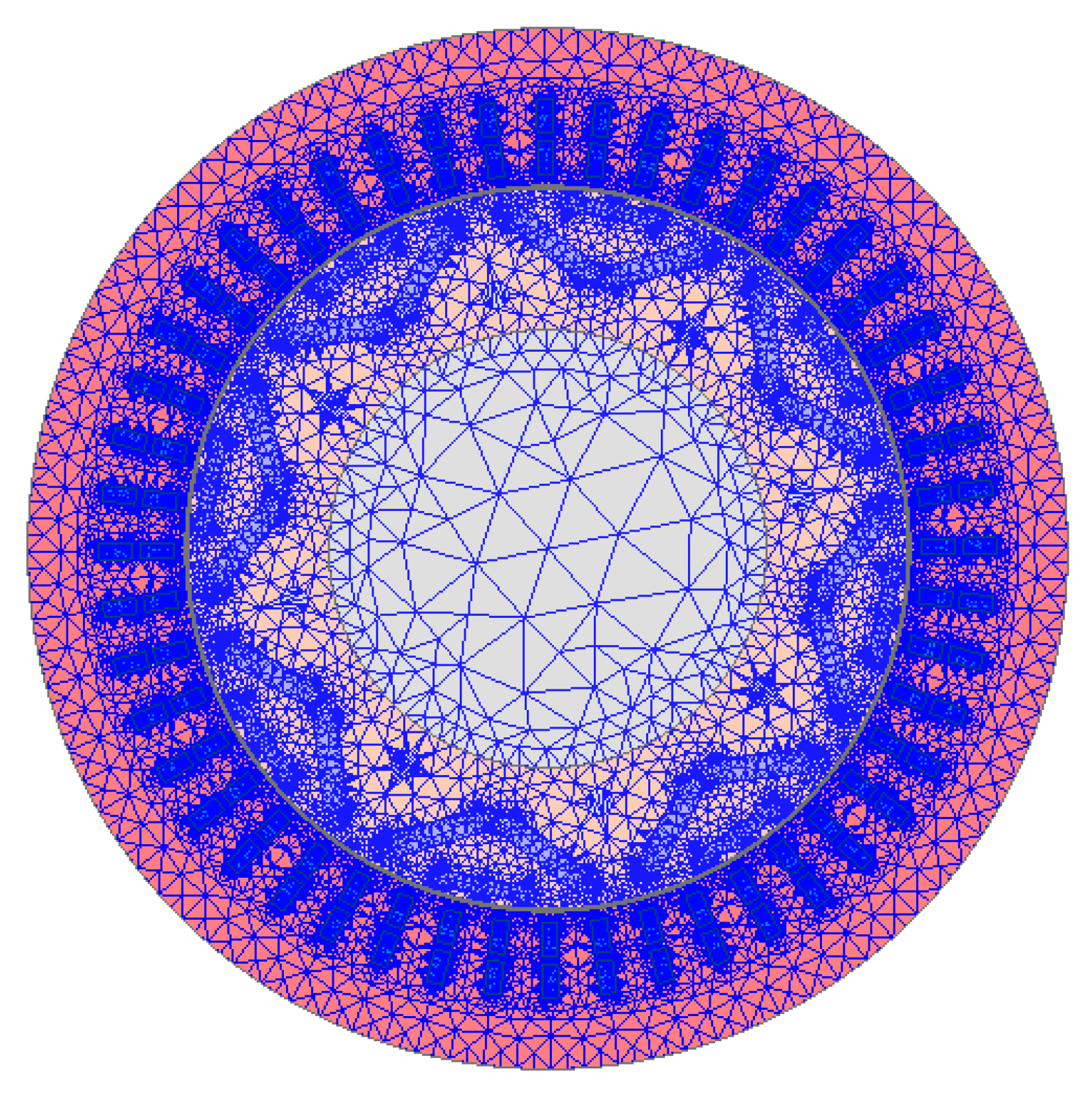
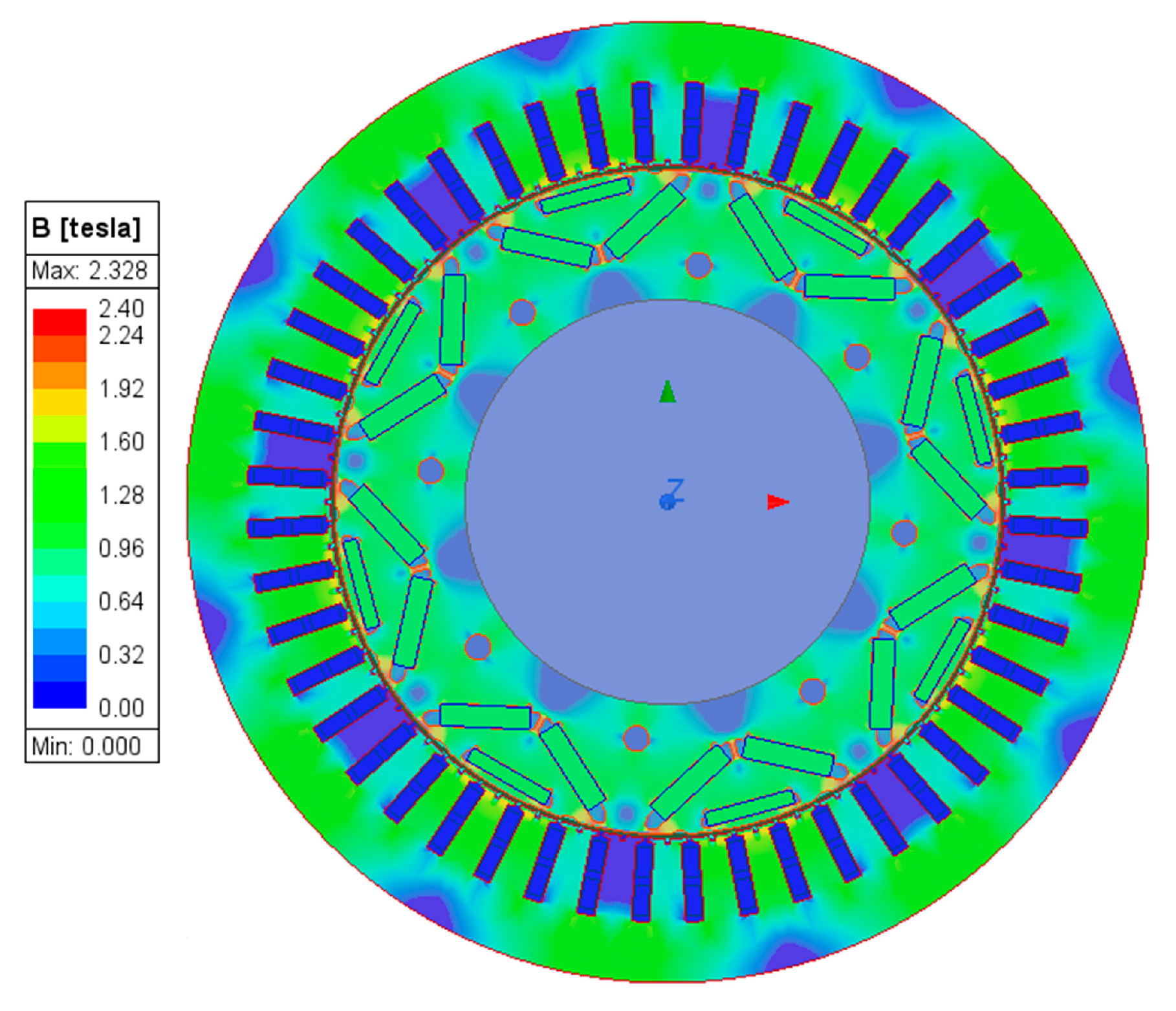
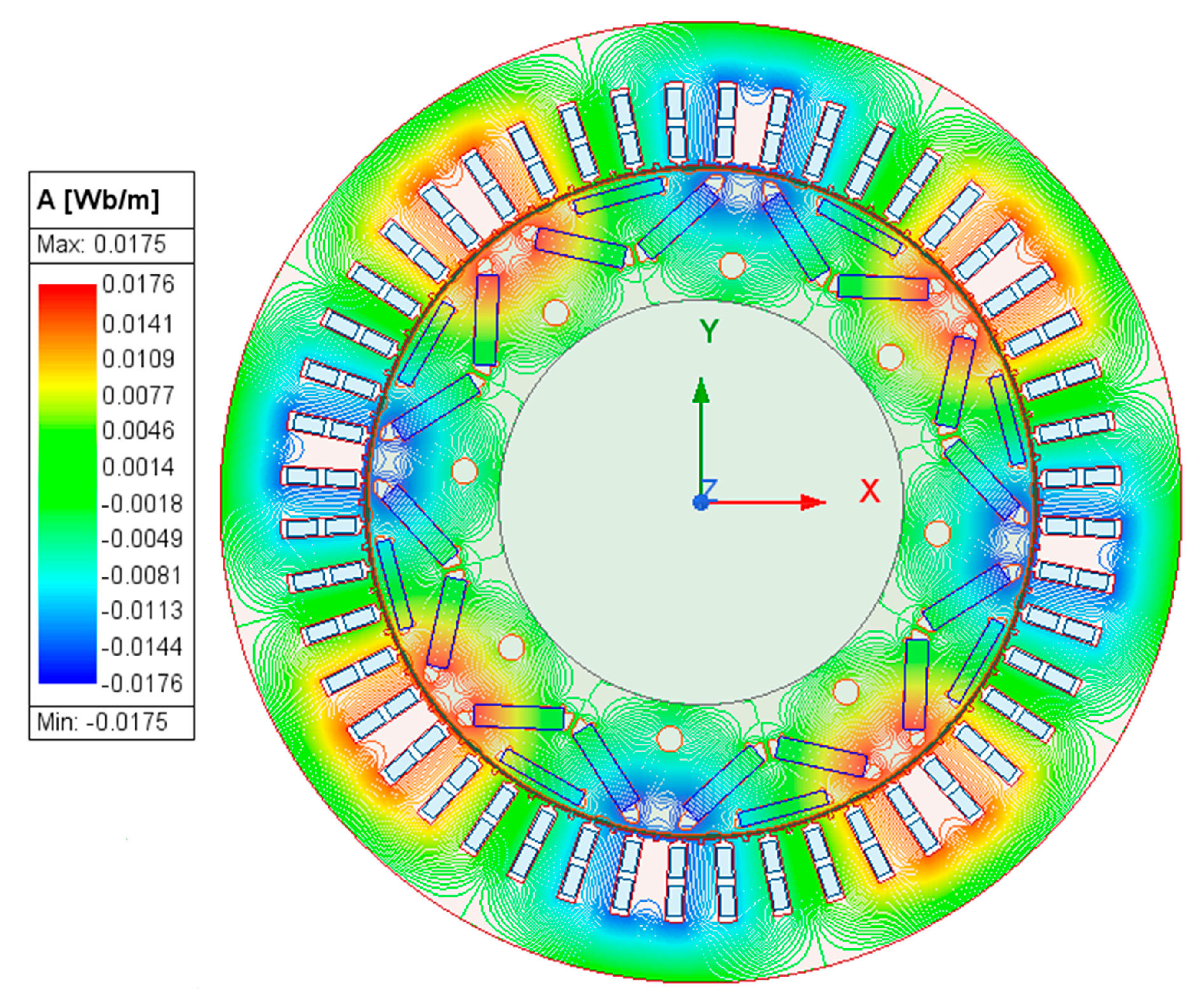
The electromagnetic simulations were performed using ANSYS Maxwell 2024 R1. For the electromagnetic model, a zero vector potential boundary was imposed on the outer boundary, which was set coincident with the stator outer diameter. The model was discretized into 58,990 mesh elements, and the corresponding mesh distribution is illustrated in Figure 3. Flux-density contour maps and flux-line distributions are shown in Figure 4 and Figure 5. The peak flux density (2.328 T) is concentrated at the rotor magnetic bridge, while the air-gap flux lines predominantly penetrate the stator teeth. This value is below the saturation flux density of the silicon steel (2.35 T), indicating that the magnetic core operates without significant saturation.
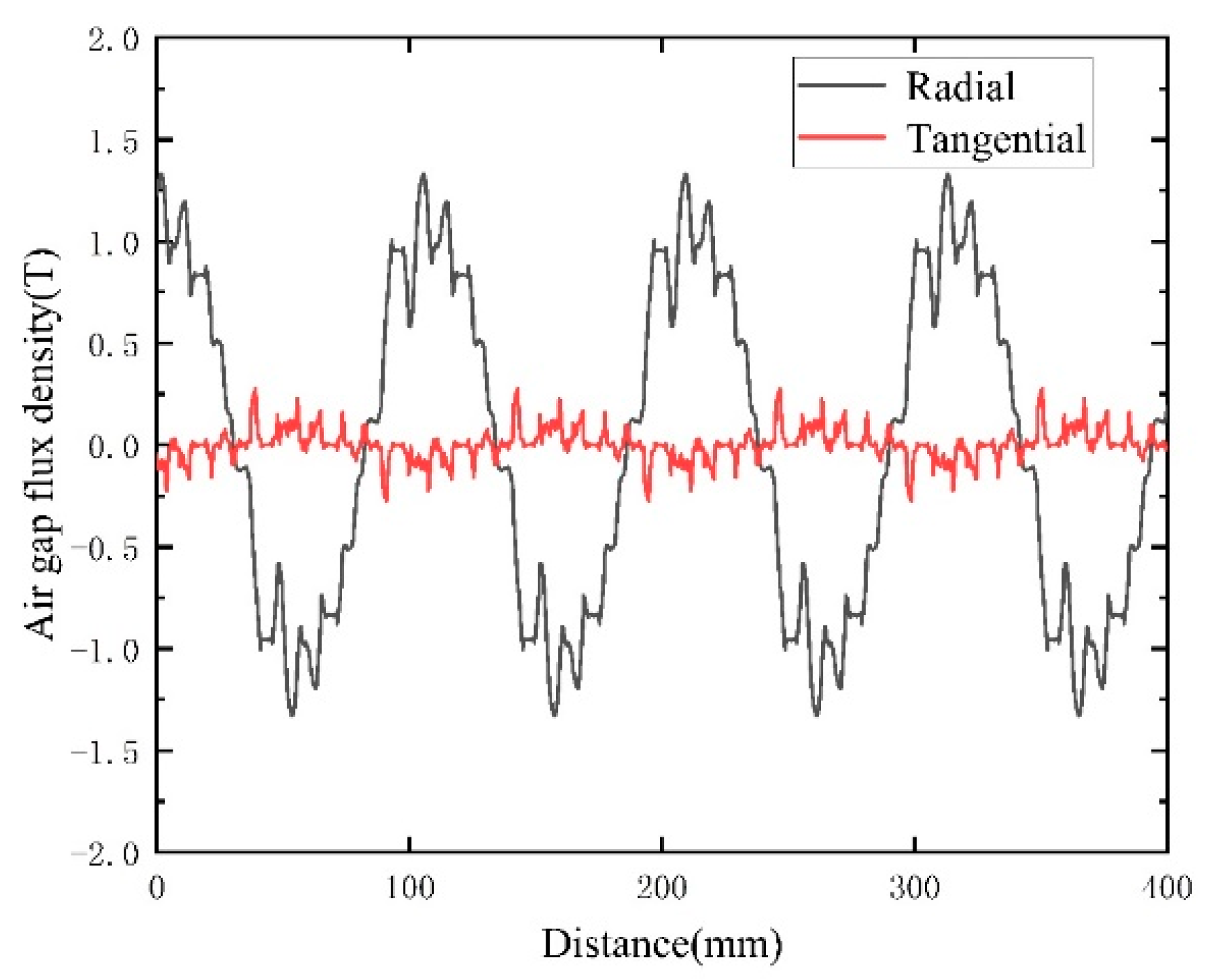
As shown in Figure 6, the radial air-gap magnetic flux density has an amplitude of 1.33 T, whereas the tangential component is 0.244 T. Because this study does not consider high-frequency vibration or loss mechanisms, the effect of the tangential air-gap flux density is neglected in the subsequent analysis.
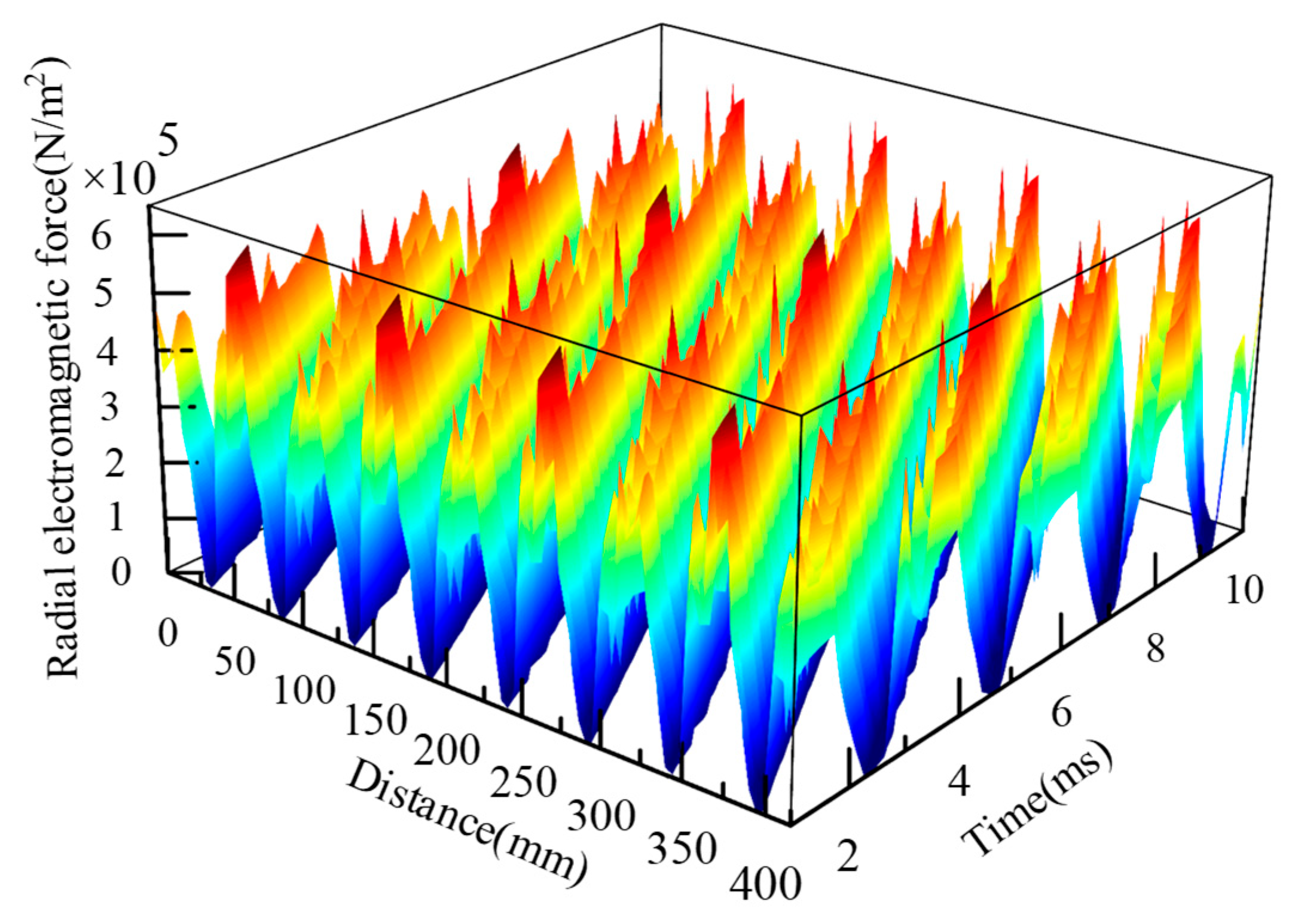
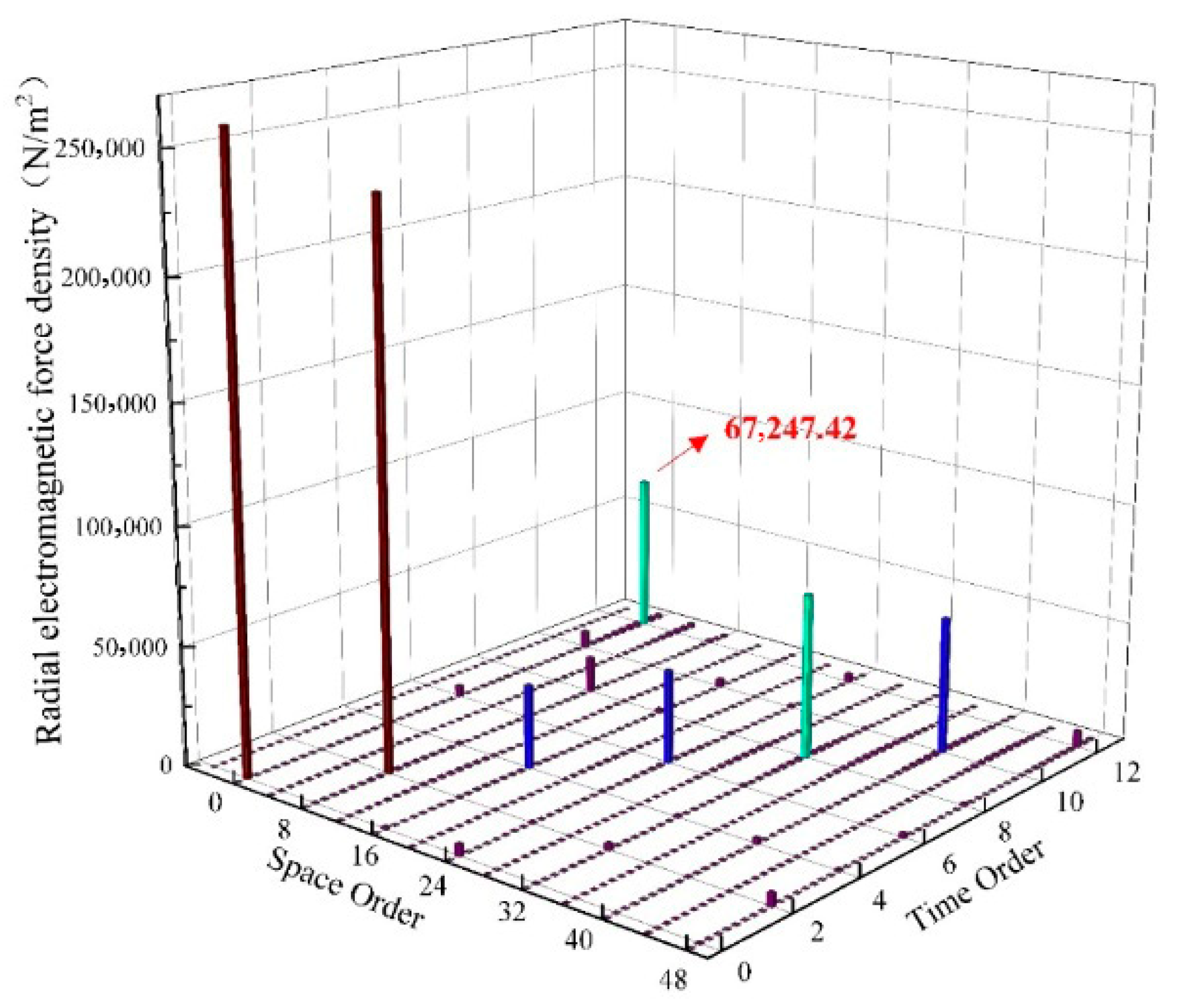
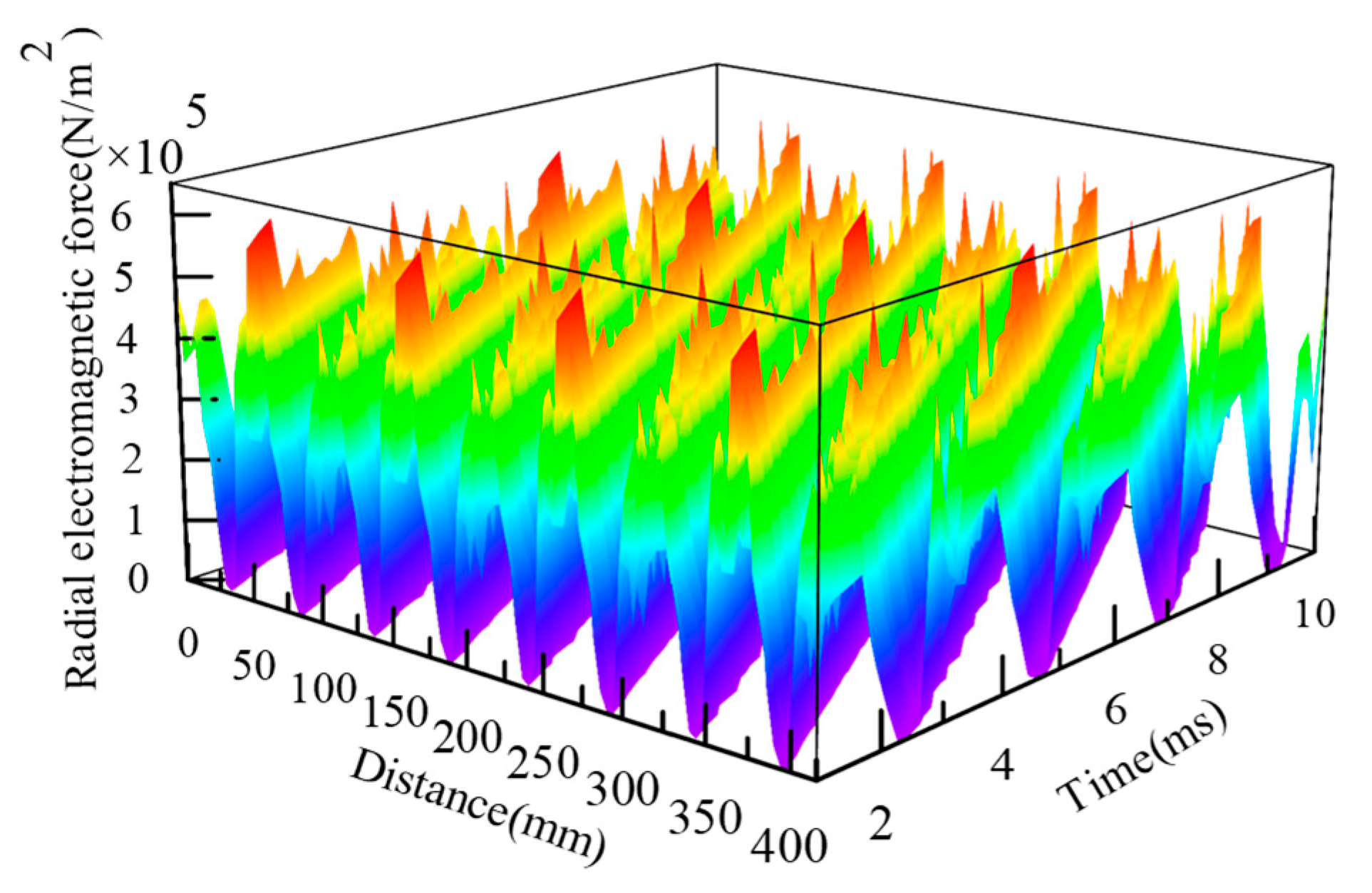
First, used the field calculator to transform the magnetic flux density from Cartesian coordinates to polar coordinates and then implemented the radial electromagnetic force expression according to Equation (2). A circular path was defined at the mid-air-gap radius, and a field report was exported by selecting this path together with the defined expression, thereby extracting the radial electromagnetic force of the electromagnetic model. As illustrated in Figure 7, the electromagnetic forces exhibit pronounced spatiotemporal distribution characteristics. Electromagnetic forces can be expressed as the superposition of a set of rotating waves with different frequencies and spatial orders [23]. Figure 8 shows the Fourier decomposition of the REF. The decomposition indicates that when the temporal order is an even multiple of the fundamental frequency and the spatial order is an integer multiple of the greatest common divisor (GCD) of the pole and slot numbers, the REF harmonics are relatively larger and occur more frequently across the spectrum.

4. Multi-Objective Optimization Analysis

4.1. Sensitivity Analysis

The optimization objective set in this study comprises four key motor performance metrics:
  • Objective 1: Maximize the average torque.
  • Objective 2: Minimize the cogging torque.
  • Objective 3: Minimize the torque ripple.
  • Objective 4: Minimize the amplitude of the zeroth-order radial electromagnetic force (REF).
Moreover, two constraints are enforced during the multi-objective optimization for two reasons: (i) efficiency and back-EMF quality are critical to overall motor performance, and (ii) explicit constraints reduce the feasible design space, thereby guiding the algorithm toward feasible designs with improved overall performance. The constraints are defined as follows:
  • Constraint 1: Efficiency > 95%;
  • Constraint 2: Back-EMF THD < 6%.
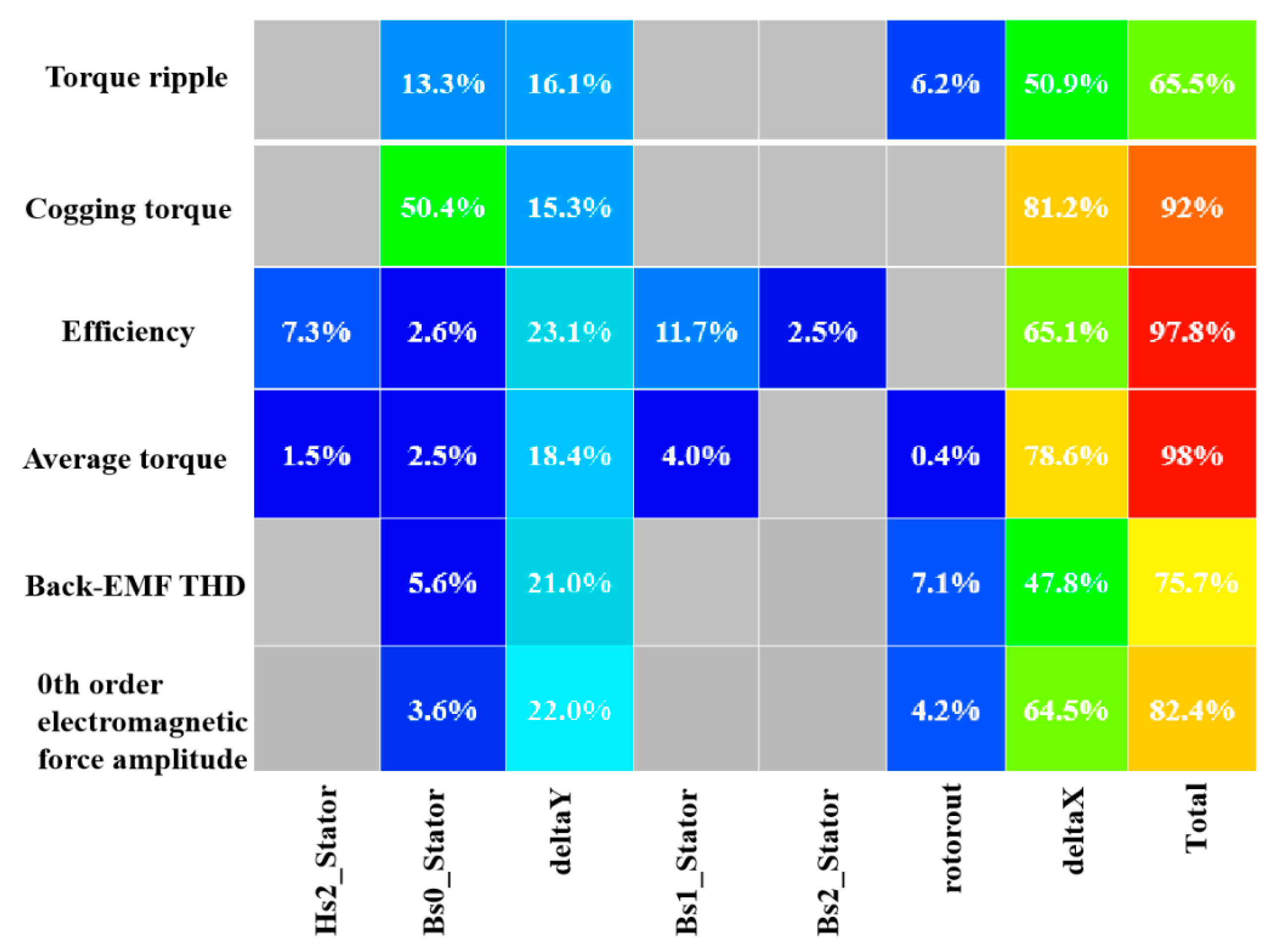
A sensitivity analysis was performed using an improved Latin hypercube sampling (LHS) method, which ensures a uniform sample distribution across the design space while preserving randomness, thereby enabling efficient sample generation [24]. As shown in Figure 9, the sensitivity analysis produces a correlation matrix, from which seven variables with strong correlations are selected from the 11 parameters for subsequent optimization. This matrix quantifies the linear relationships between the input structural parameters and the selected motor performance metrics. Each matrix entry represents the correlation coefficient between a given input–output pair. Importantly, different structural parameters have different levels of influence on motor performance.
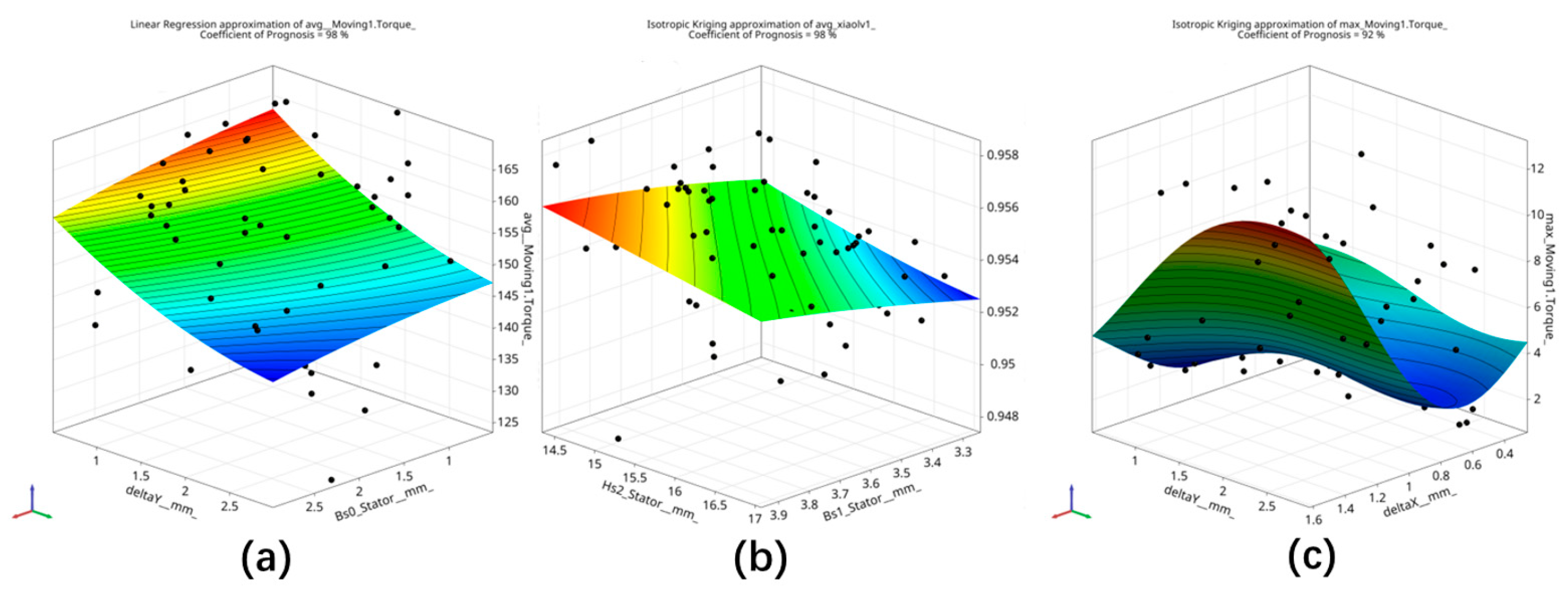
Given the multiple optimization objectives and parameters involved in this study, only a few three-dimensional response surfaces (Figure 10) are presented as representative examples. The relationships between the optimization objectives and design parameters were modeled using response surface methodology (RSM). The coefficient of determination (R2) quantifies the proportion of variance explained by the model, value of R2 close to 1 indicate a good fit. For Figure 10, R2 = 0.98 in (a), R2 = 0.98 in (b), and R2 = 0.92 in (c). The model’s predicted values align closely with experimental data, demonstrating its strong predictive capability.

4.2. Preliminary Optimization Using Taguchi Method

Based on the sensitivity analysis, seven design parameters were selected from the 11 candidates for optimization in this study: deltaY, deltaX, rotorout, Bs2_stator, Bs1_stator, Bs0_stator, and Hs2. First, the Taguchi method was applied to preliminarily optimize the three parameters with the strongest influence on motor performance—deltaY, deltaX, and Bs0_stator—in the first stage. Each parameter was assigned three levels, denoted as Levels 1–3 in ascending order (Table 3).
Given the number of selected design parameters and the number of levels assigned to each parameter, an orthogonal experimental design table was constructed (Table 4). The orthogonal design is expressed using the notation L n   =   ( q   t ) , where L denotes an orthogonal array, n is the number of experiments, q is the number of levels, and t is the number of factors (parameters). In this study, three design parameters were considered with three levels each; therefore, the corresponding orthogonal array is L 9 ( 3 3 ) .
Using the conventional finite-element-based design approach for electric motors requires 3 3 = 27 simulations. In contrast, applying the Taguchi method to construct an orthogonal array reduces the number of required simulations to 3 2 = 9 . This approach preserves motor performance while significantly shortening the design cycle. The parameter-level settings from each experiment were used in simulations to compute key performance metrics, including average torque, torque ripple, cogging-torque amplitude, and the (0, 12 ƒ ) force wave amplitude. Parametric sweeps were performed using the Optimetrics module in ANSYS Maxwell. The parameters deltaX, deltaY, and Bs0_Stator were varied with uniform linear step sizes. The parametric sweep results are summarized in Table 5.
To evaluate how the levels of each design variable affect the performance metrics and to quantify their relative contributions, a statistical analysis was conducted based on the data in Table 5. Specifically, the procedure consisted of calculating the means, performing an analysis of variance, and then identifying the optimal level combination. The calculation is shown in the formula.
m = 1 n i = 1 n m i
In the formula: m denotes the mean value of a given performance metric reported in Table 5; n is the total number of experiments; m   i is the value of the corresponding performance metric obtained from the i-th experiment.
Variance quantifies data dispersion about the mean. The ratio of variances computed from the level-specific means of a given performance metric relative to the overall (grand) mean reflects the relative contribution of each optimization variable to that metric. The variance is computed as:
S A = 1 Q i = 1 Q m A i - m 2
In this equation: A represents each optimization variable. S A defined as the variance of a specific performance indicator associated with the variable A.Q represents the number of levels for each parameter, and in this study, Q is fixed at 3. m is the mean of a specific performance indicator presented in Table 6. m A i is the mean of the performance indicator for level i of the optimization variable A, as shown in Table 6.
The magnitude of the variance values quantifies the relative influence of variations in the optimization parameters on performance metrics, as detailed in Table 7. Notably, the optimization variable deltaX has the most pronounced effect across all metrics. In pursuit of the objectives to maximize average output torque, minimize torque ripple, reduce cogging torque amplitude, and minimize the (0, 12 ƒ ) force wave amplitude, the optimal solution is identified as Group 2 in Table 5: deltaX = 0.25 mm, deltaY = 1 mm, and Bs0_stator = 0.5 mm.

4.3. Multi-Objective Genetic Algorithm

The ranges for the highly sensitive variables (deltaX, deltaY, Bs0_Stator) were refined using Taguchi methods. Subsequent optimization was performed iteratively using a multi-objective genetic algorithm on deltaX, deltaY, rotorout, Bs0_Stator, Bs1_Stator, Bs2_Stator, and Hs2_Stator. Parameter descriptions and variation ranges are summarized in Table 8. The selection of variable ranges adheres to the following principles: First, ensuring the ranges encompass the optimal intervals for the parameters; second, ensuring that the extreme values of the variables are structurally feasible within the design constraints.
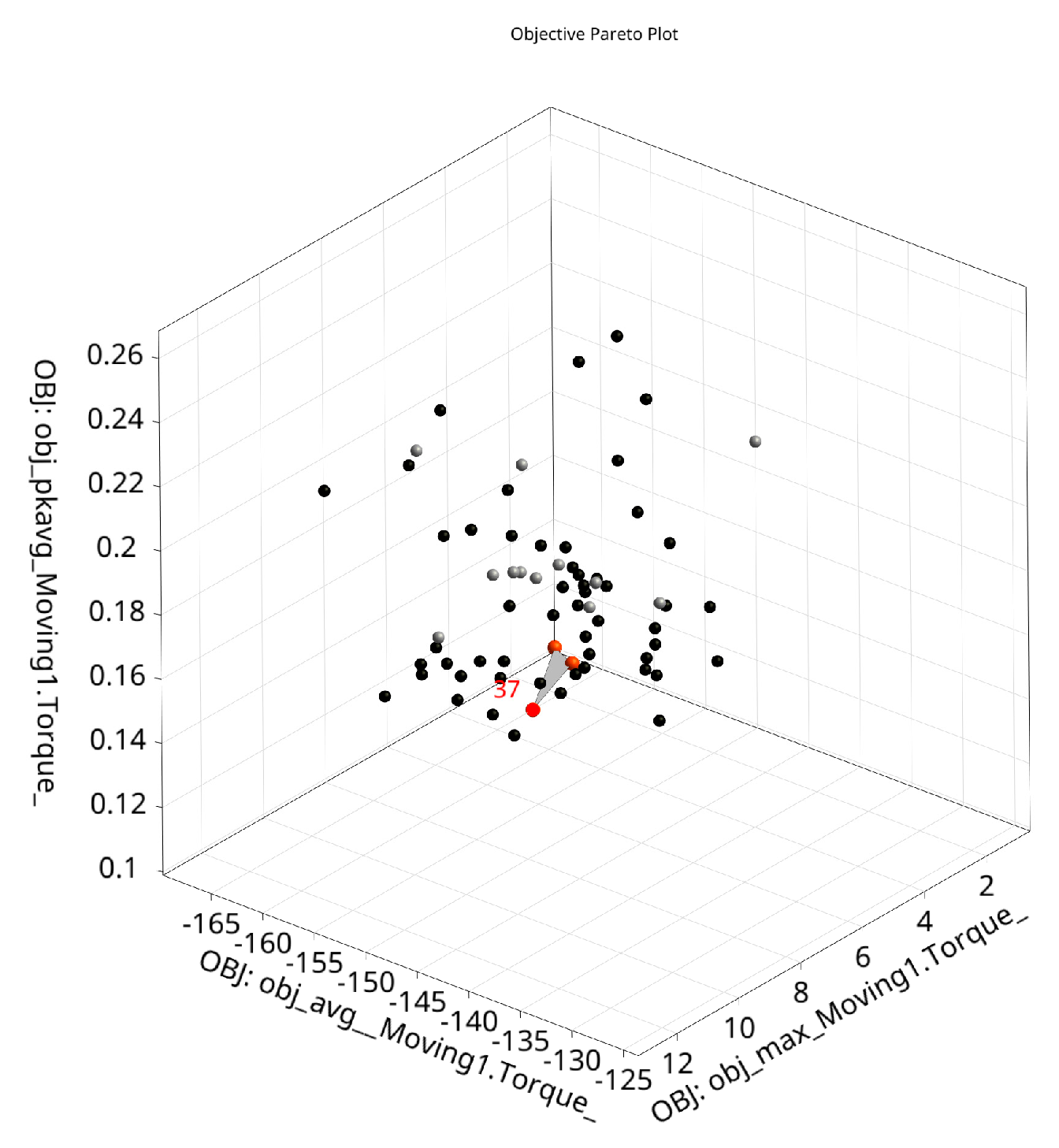
In each iteration of the genetic algorithm (GA), a complete FEM simulation is directly invoked to calculate the objective function and constraints, producing reliable outcomes. The multi-objective Pareto frontier obtained is depicted in Figure 11. Using the Pareto frontier, the optimal solution was determined.
Table 9 provides a comparison between the initial and optimized plans. The comparison shows significant changes: the average torque shows little variation, torque ripple is reduced by 37.05%, and both the zero-order REF amplitude and cogging torque show significant reductions. The optimized configuration yields overall improvements across multiple performance objectives while satisfying the prespecified constraints. This hierarchical optimization approach can be applied to larger motors or more complex systems.

5. Modal and Vibration Noise Analysis

5.1. Modal Analysis

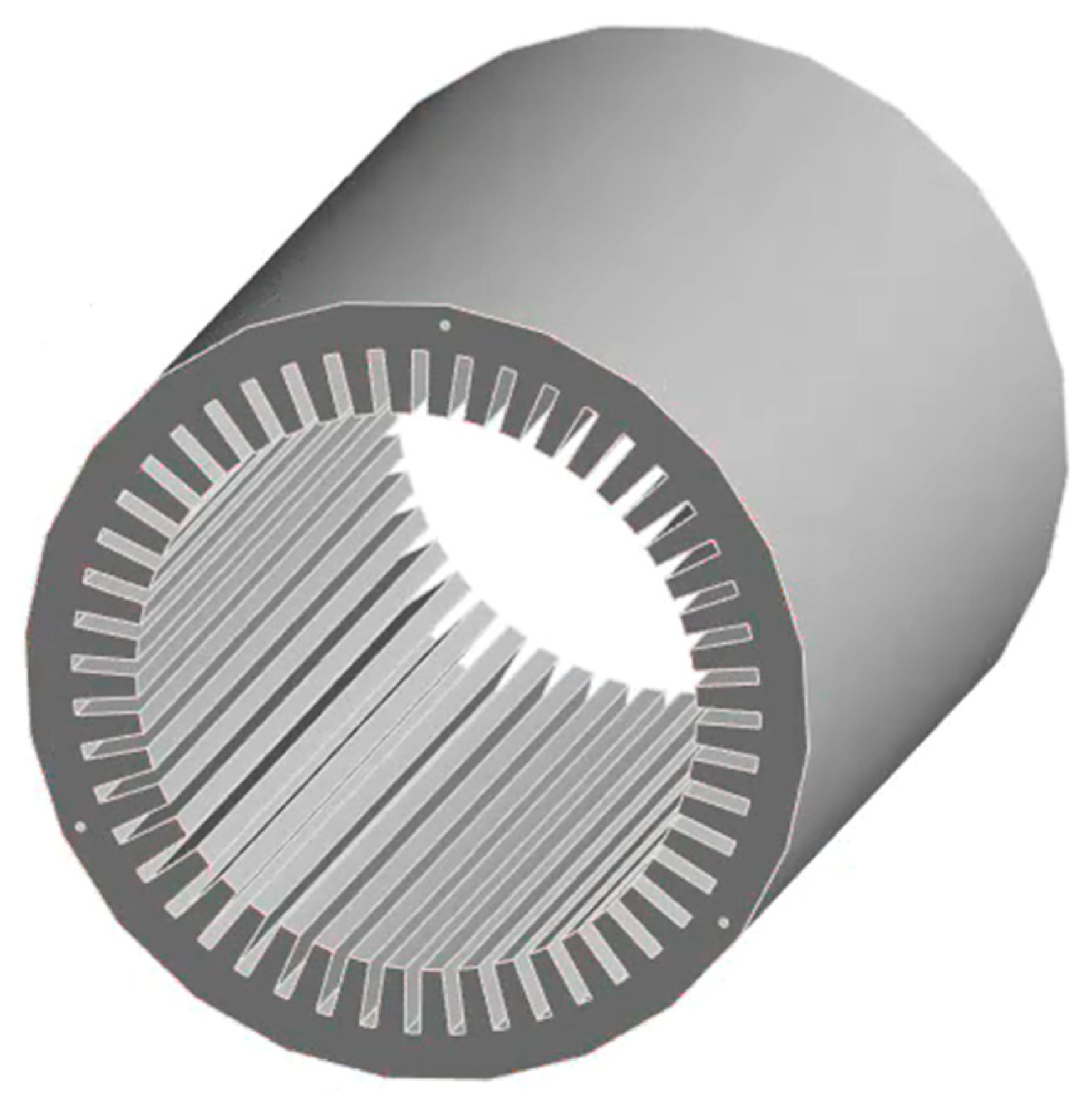
As the frequency of the electromagnetic force approaches the motor’s natural modal frequency, resonance may occur. This resonance may induce considerable mechanical deformation and structural stresses in the motor, potentially leading to severe or even catastrophic failures [25]. Therefore, finite element analysis was employed to perform modal analysis on the motor to avoid resonance. Considering the frame and end caps, the zeroth-order modal frequency of the motor stator core system remains almost unchanged. Therefore, this study models the motor without the frame and end caps, as shown in Figure 12. The stator core consists of multiple axially stacked silicon steel laminations. The layered axial structure induces direction-dependent mechanical characteristics, resulting in significant orthotropic anisotropy in material parameters. Precise modeling is crucial, as it directly influences the accuracy of the electromagnetic vibration and noise simulation results [26]. This study considers orthotropic anisotropy, with material mechanical parameters, as shown in Table 10, taken from Ref. [27].
The modal superposition method sums the decomposed modal shapes from modal analysis to compute the dynamic response of the motor, and is given by:
M i = 1 n Φ i y ¨ i + C i = 1 n Φ i y ˙ i + K i = 1 n Φ i y i = F
Among them, y i is the node displacement in modal coordinates, Φ i is the modal mode shape, {F} is the magnetic node force varying with time, n is the number of modes required to be summed, and [M], [C], and [K] are the mass matrix, damping matrix, and stiffness matrix, respectively.
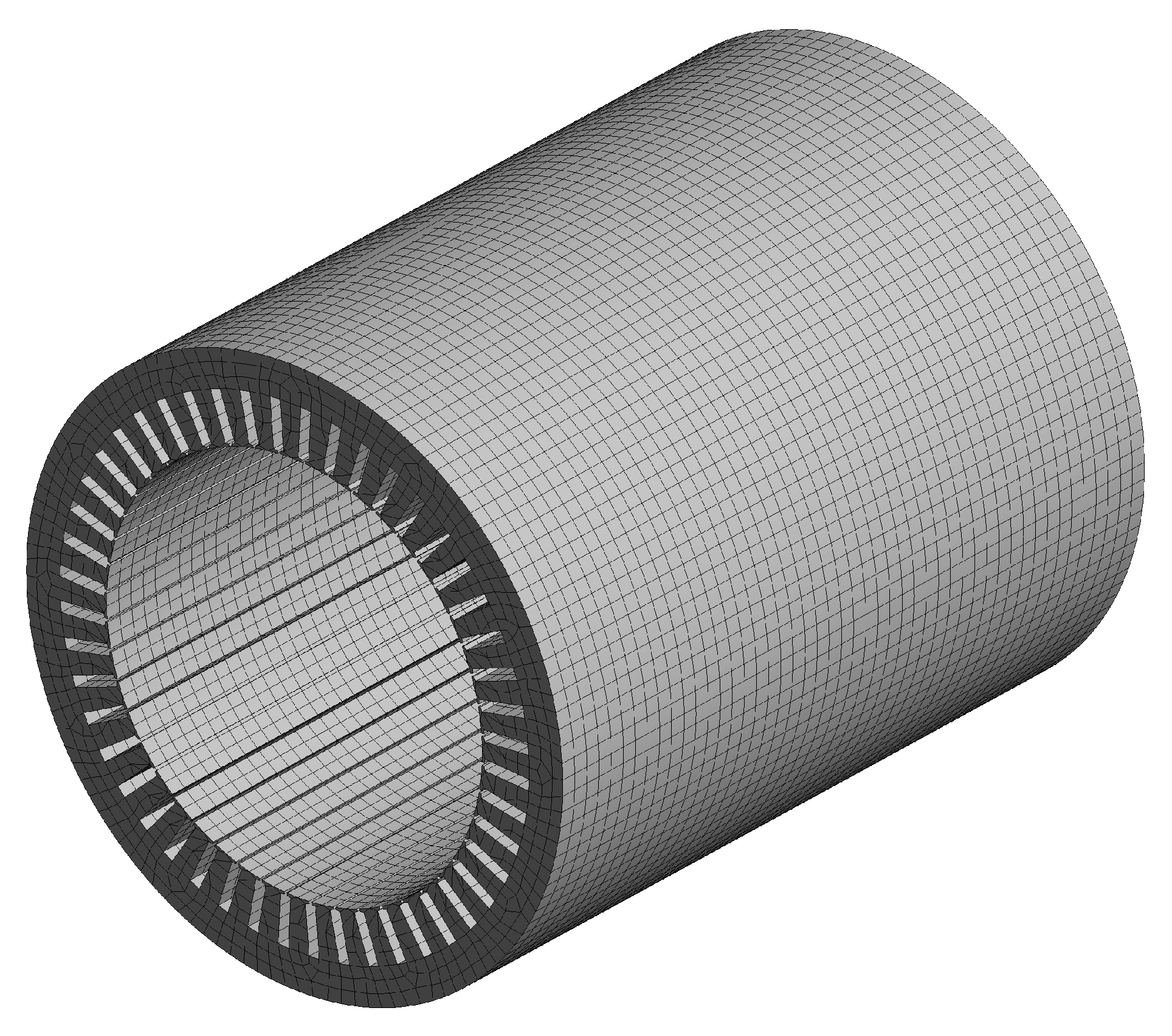
This paper performs free modal analysis without applying any constraints. The standard Mechanical is selected for Error Limits, and the mesh size is set to 5 mm, the mesh quality is 0.80012, indicating good mesh quality, as shown in Figure 13. Evaluate all results to see the expanded modal shapes and frequencies for each mode.
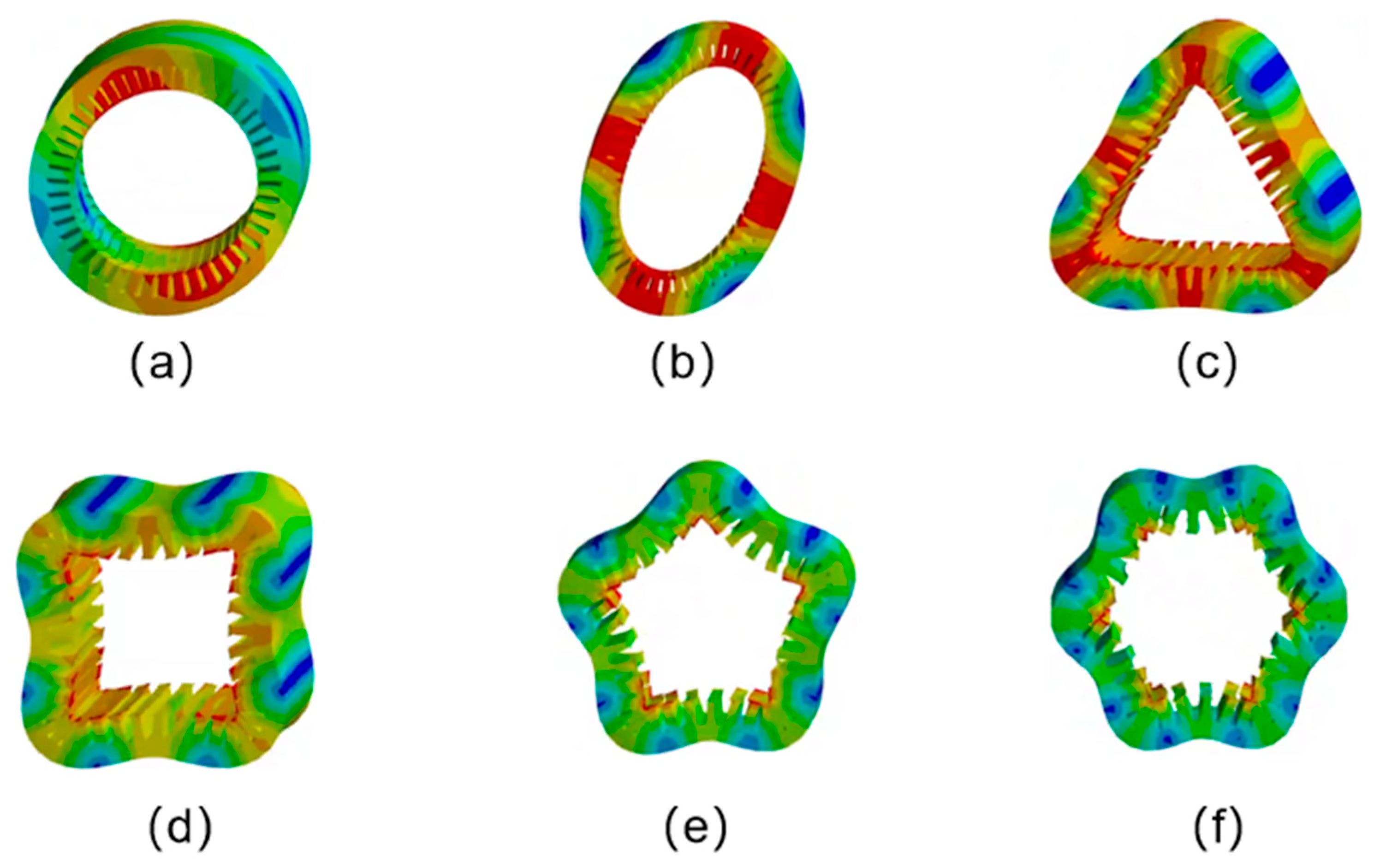
Figure 14 shows the vibration modes and natural frequencies for different mode orders. When the harmonic frequency nears a natural frequency, the corresponding harmonic amplitude increases significantly. Therefore, natural frequencies must be considered when analyzing variations in harmonic amplitudes. After optimization, the natural frequencies of all motor modes shifted by varying amounts, effectively mitigating resonance risks.

5.2. Vibration Analysis

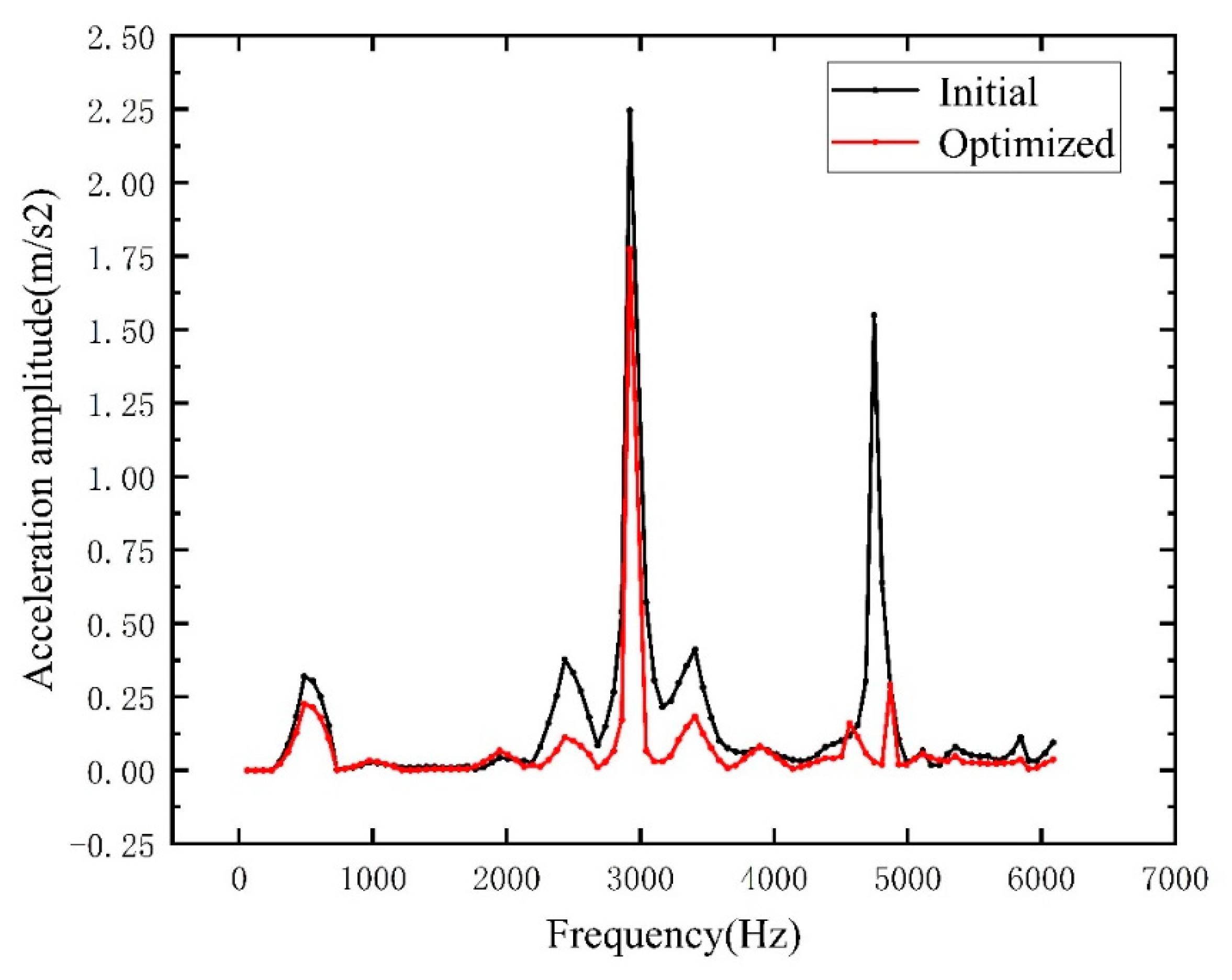
The electromagnetic vibration and noise analysis was conducted using current source excitation, with a rated speed of 3652 rpm, a rated torque of 165 Nm, a peak current of 212 A, and a three-phase phase difference of 120°. Figure 15 shows the vibration acceleration spectra of the motor at rated speed before and after optimization. The vibration acceleration amplitude shows prominent peaks at even frequency multiples. The peak vibration acceleration occurs at 12 ƒ (2921.6 Hz), which aligns with the theoretical analysis indicating that the zeroth-order 12 ƒ electromagnetic force exerts the most significant influence on electromagnetic vibration noise. The optimized vibration acceleration is 1.7743 m/s2, a reduction of 32.96%, compared to the pre-optimization value of 2.6464 m/s2, demonstrating a significant optimization effect. Varying degrees of reduction are observed at other points with relatively high amplitude values, such as 2 ƒ (486.93 Hz), 10 ƒ (2434.7 Hz), 14 ƒ (3408.5 Hz), and 20 ƒ (4869.3 Hz). When the frequency reaches 20 ƒ (4869.3 Hz), it approaches the natural frequency of the motor stator’s zero-order mode (4895.1 Hz), resulting in a secondary peak that aligns with theoretical predictions. After the optimization proposed herein, the vibration acceleration at this frequency is significantly reduced.
Modal and vibration analyses indicate that the natural frequencies across modes are substantially distinct from the REF frequency. Hence, resonance is unlikely to occur both before and after optimization, validating the soundness of the optimization design.

5.3. Noise Analysis

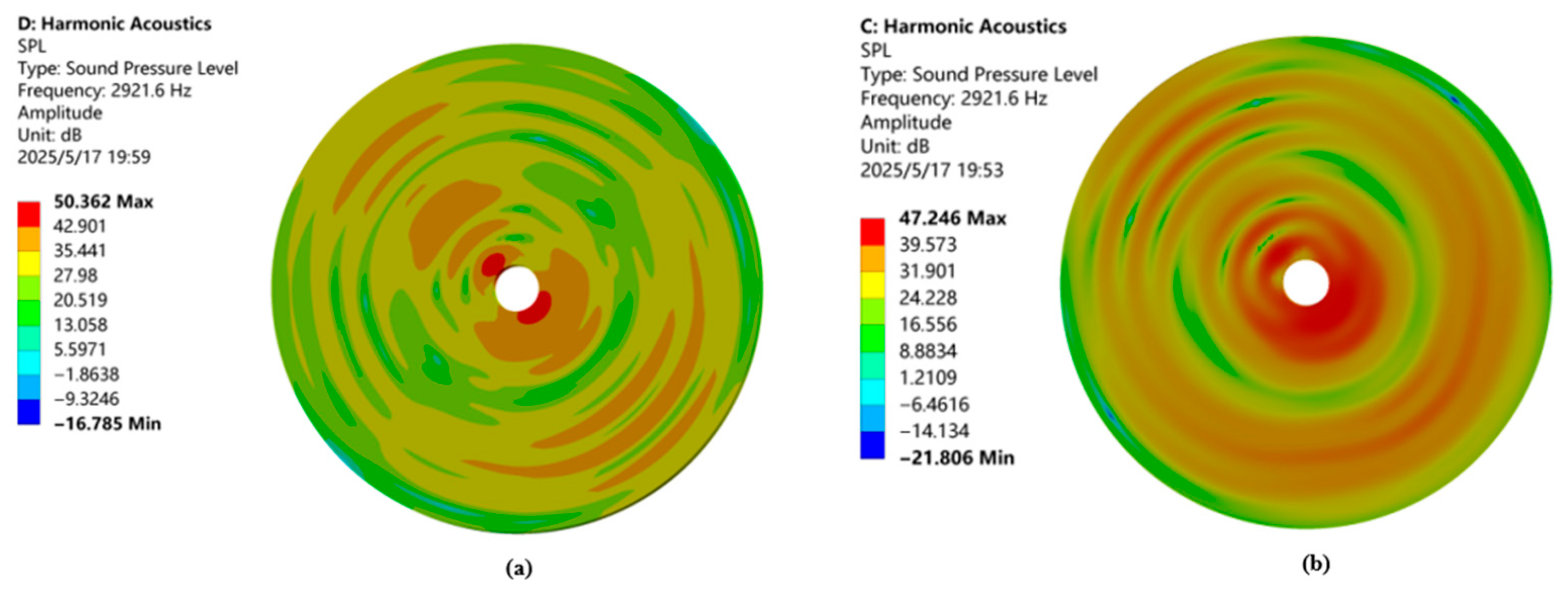
Based on the harmonic response analysis, the Harmonic Acoustics module in ANSYS Workbench 2024 R1 was used to create a circular air domain with a radius of 1 m. For optimal noise transmission, a uniform mesh with a mesh size of 5 mm was employed, and a frequency range of 0–6000 Hz was applied. The inner surface of the air domain was selected, and the vibration velocity load from the stator’s outer surface in the harmonic response analysis was imported, with the unit in mm/s. The radiation boundary was set to the outer surface of the air domain. By including a sound pressure contour plot in the solution, the results presented in Figure 16 were obtained. In terms of energy dissipation mechanisms, the stator vibration induced by REF excitation converts a portion of the electromagnetic energy into structural vibration energy, which is then dissipated through radiated acoustic power. Figure 16 shows the sound pressure cloud diagram at the motor’s rated speed before and after optimization, demonstrating that sound pressure decreases with distance, and the peak value reduces from 50.362 dB to 47.246 dB.
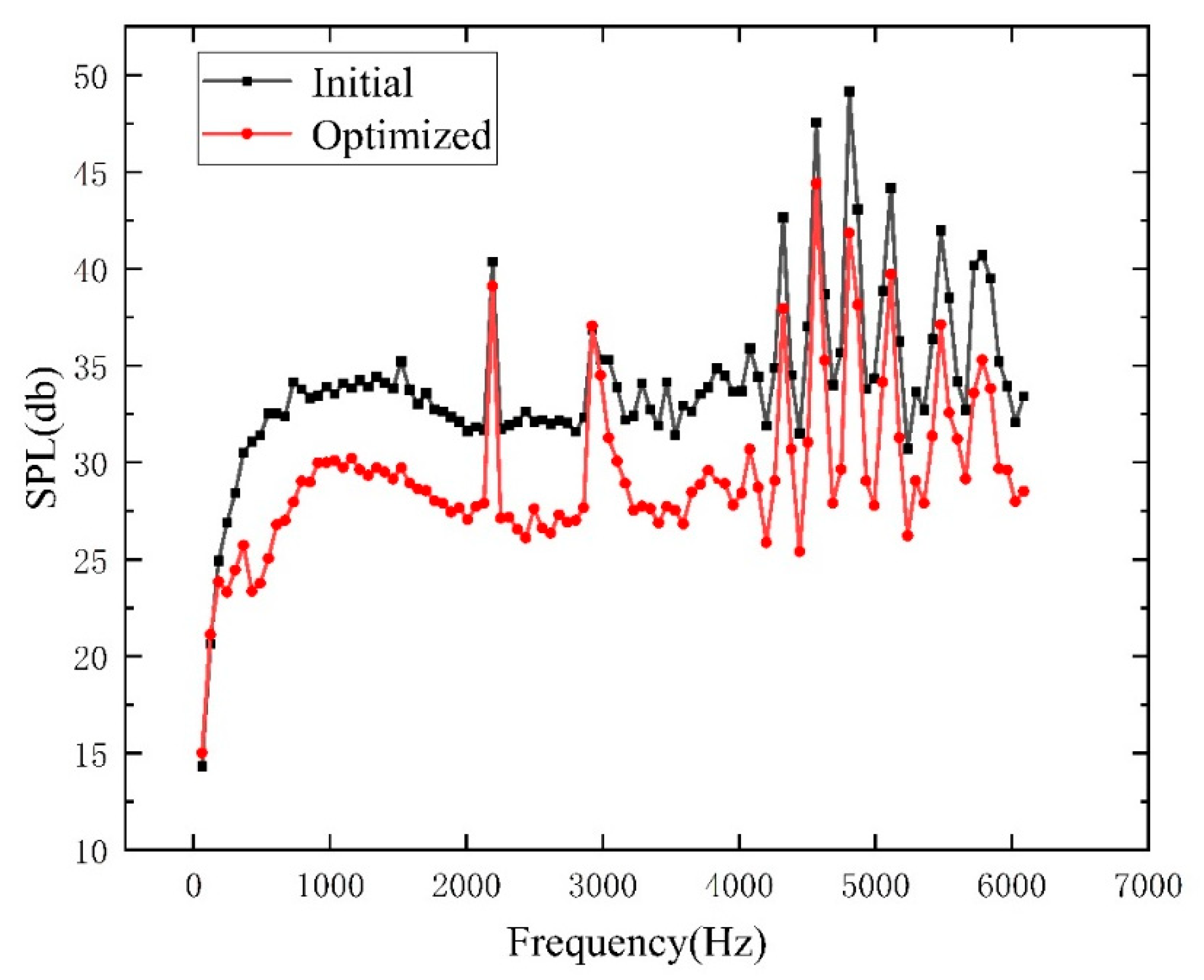
The motor predominantly operates at its rated speed. Figure 17 presents a comparison of the motor’s SPL before and after optimization. Results indicate that SPL peaks occur at even multiples of the fundamental frequency. Specifically, the pre-optimization maximum of 49.16 dB at 20 ƒ was reduced to 41.87 dB post-optimization, representing a 14.83% decrease. Moreover, the optimized motor exhibited significant reductions in SPL across all frequency bands, demonstrating pronounced noise suppression effects.
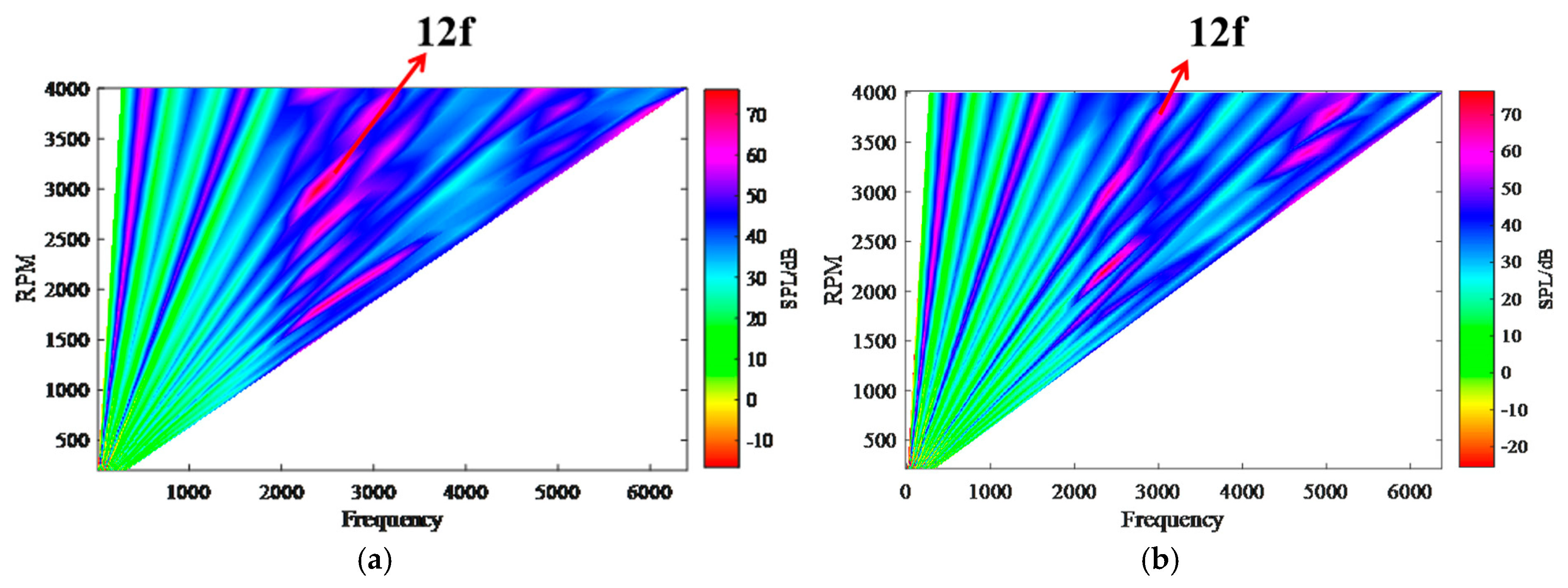
As the motor speed increases from 500 rpm to 4000 rpm, the corresponding waterfall plots of the noise spectra at various speeds, both before and after optimization, are presented in Figure 18. The study concentrates on the zero-order 12 ƒ electromagnetic force, encompassing both theoretical analysis and harmonic response, with the order line determined using the relationship ƒ = p × n 60 . Although the maximum SPL value in the optimized waterfall diagram increases, it does not reappear on the 12 ƒ order line, which is not the focus of this paper. The noise induced by the zero-order 12 ƒ electromagnetic force was decreased from 75.896 dB in the pre-optimization state to 66.86 dB in the post-optimization state, a reduction that validates the effectiveness of the multi-objective optimization procedure proposed in this study.

6. Discussion

6.1. Average Torque

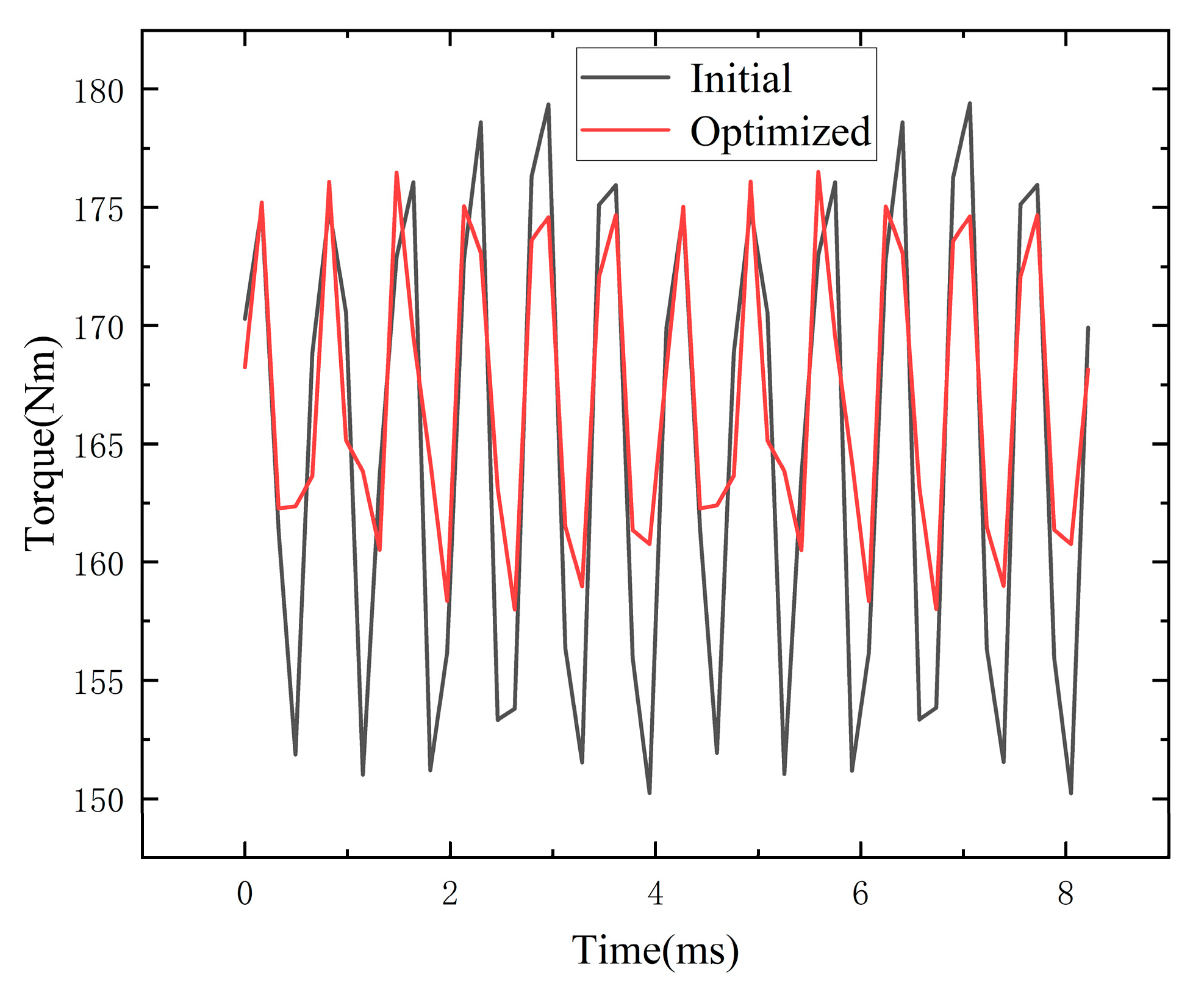
Figure 19 shows the torque curves of the motor before and after optimization. The average torque increased from 165.065 Nm to 166.932 Nm after optimization.

6.2. Cogging Torque

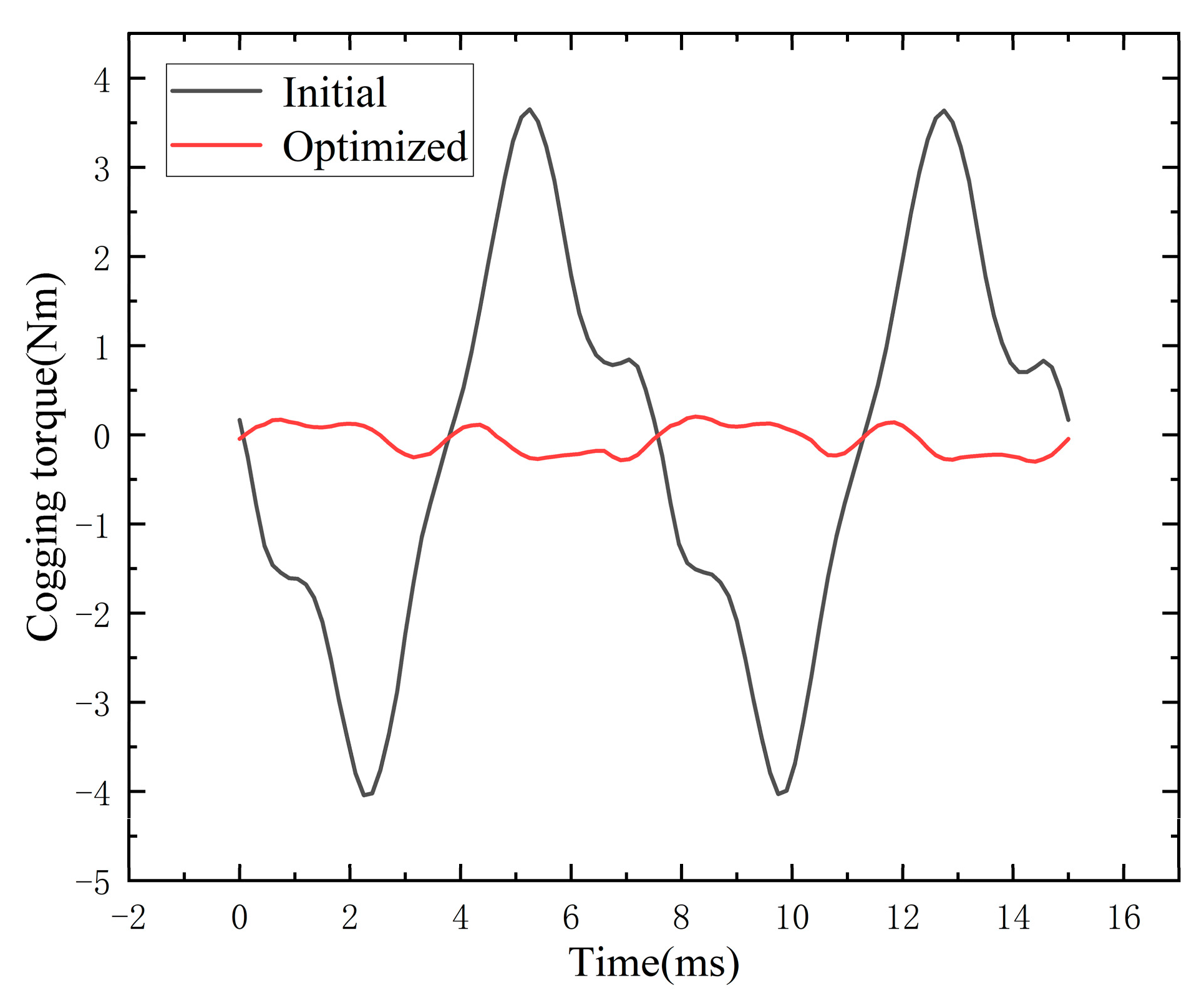
Before optimization, the peak-to-peak value of the cogging torque was 7.694 Nm. After optimization, the peak-to-peak value decreased to 0.506 Nm, a reduction of 93.42%. The cogging torque reduction effect is significant, as shown in Figure 20.

6.3. Analysis of Optimized Electromagnetic Force Waves

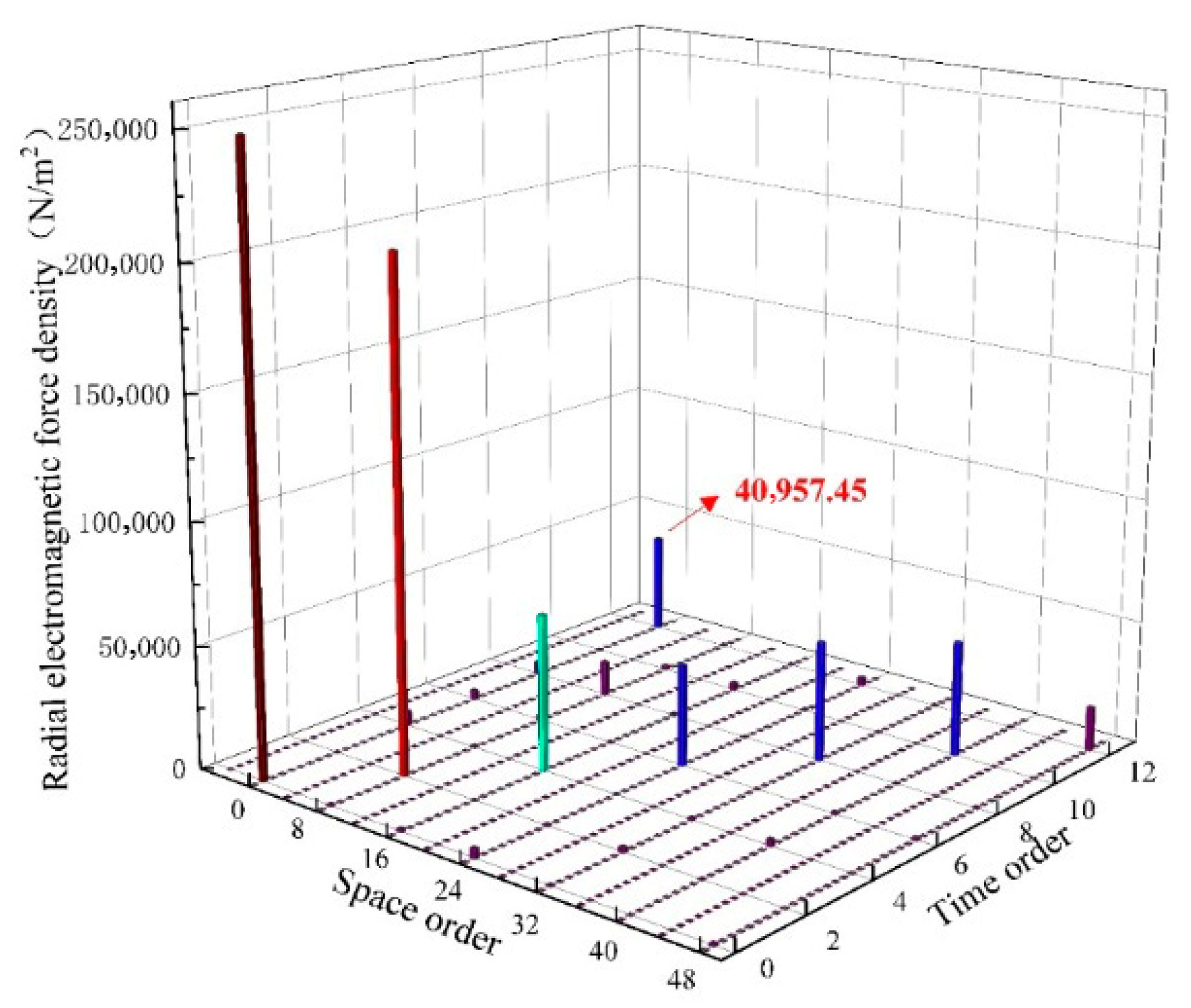
Figure 21 displays the spatiotemporal distribution of the optimized REF, demonstrating a substantial overall amplitude reduction. Figure 22 presents the FFT spectrum of the optimized electromagnetic force. Except for the amplitude increase at (16, 4 ƒ ), the REF amplitudes at (0, 12 ƒ ), (8, 2 ƒ ), (24, 6 ƒ ), (32, 8 ƒ ), and (40, 10 ƒ ) exhibit varying degrees of reduction, which contributes to the mitigation of electromagnetic vibration noise. No effect of the 0 Hz REF on electromagnetic vibration noise is observed. The (0, 12 ƒ ) electromagnetic force, which exerts the most significant influence on electromagnetic vibration noise, was reduced from 67,247.42 to 40,957.45, reflecting a 39.09% reduction. In terms of energy conversion efficiency, this paper significantly reduces the harmonic amplitude, thereby lowering iron losses and additional losses associated with harmonics.

6.4. Efficiency Map

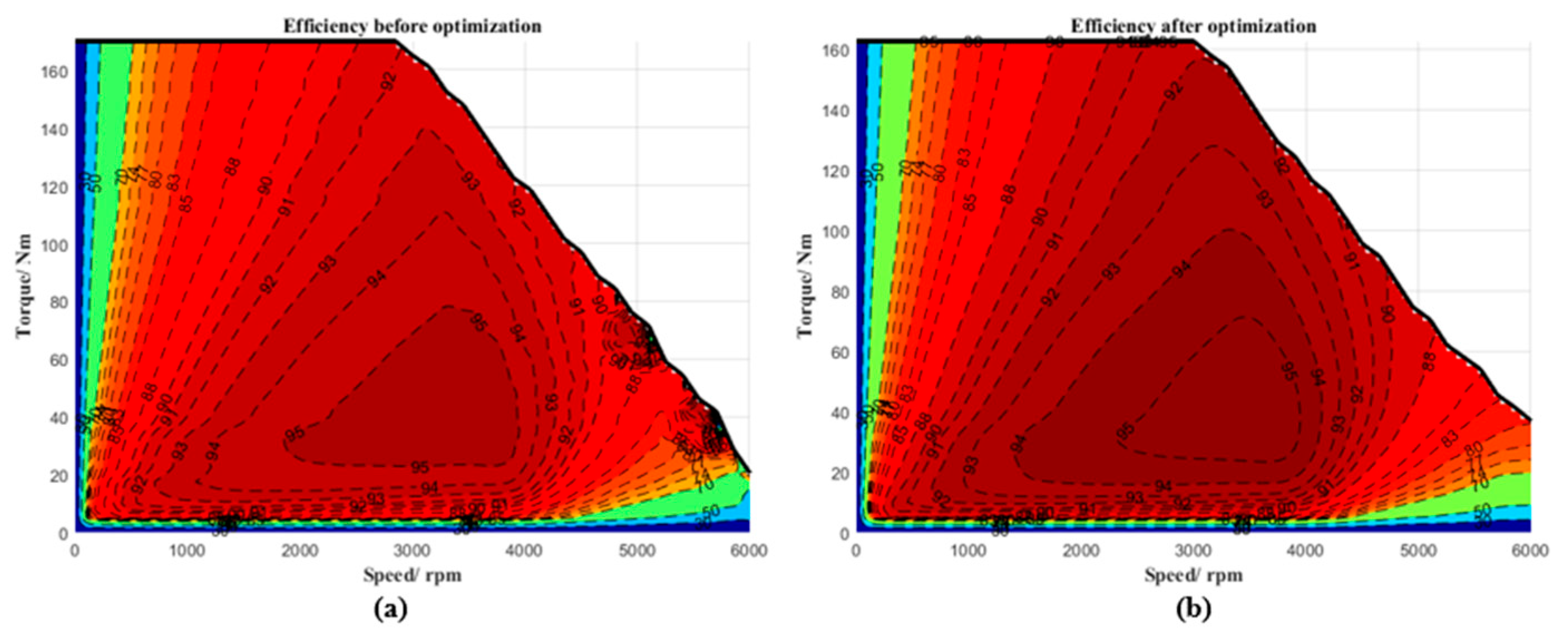
As depicted in Figure 23, before motor optimization, the percentages of efficiency exceeding 80%, 85%, and 90% were 82.68%, 76%, and 60.28%, respectively. Post-optimization, the corresponding percentages for efficiency above 80%, 85%, and 90% were 82.13%, 75.63%, and 59.06%, respectively. No notable change was observed in the high-efficiency zone between the pre- and post-optimization results. The slight decrease in efficiency is primarily due to the simultaneous implementation of stator slotting and rotor drilling to suppress electromagnetic force harmonics and vibration noise, which affects the magnetic reluctance and consequently the magnetic flux. This study achieves improved NVH performance without increasing the amount of permanent magnets or significantly altering the high-efficiency operating region, which has positive implications for improving overall vehicle energy efficiency and reducing costs. From the perspective of electric vehicle traction systems, this small reduction in efficiency is reasonable and acceptable from an engineering standpoint.

6.5. Rotor Stress Distribution Diagram

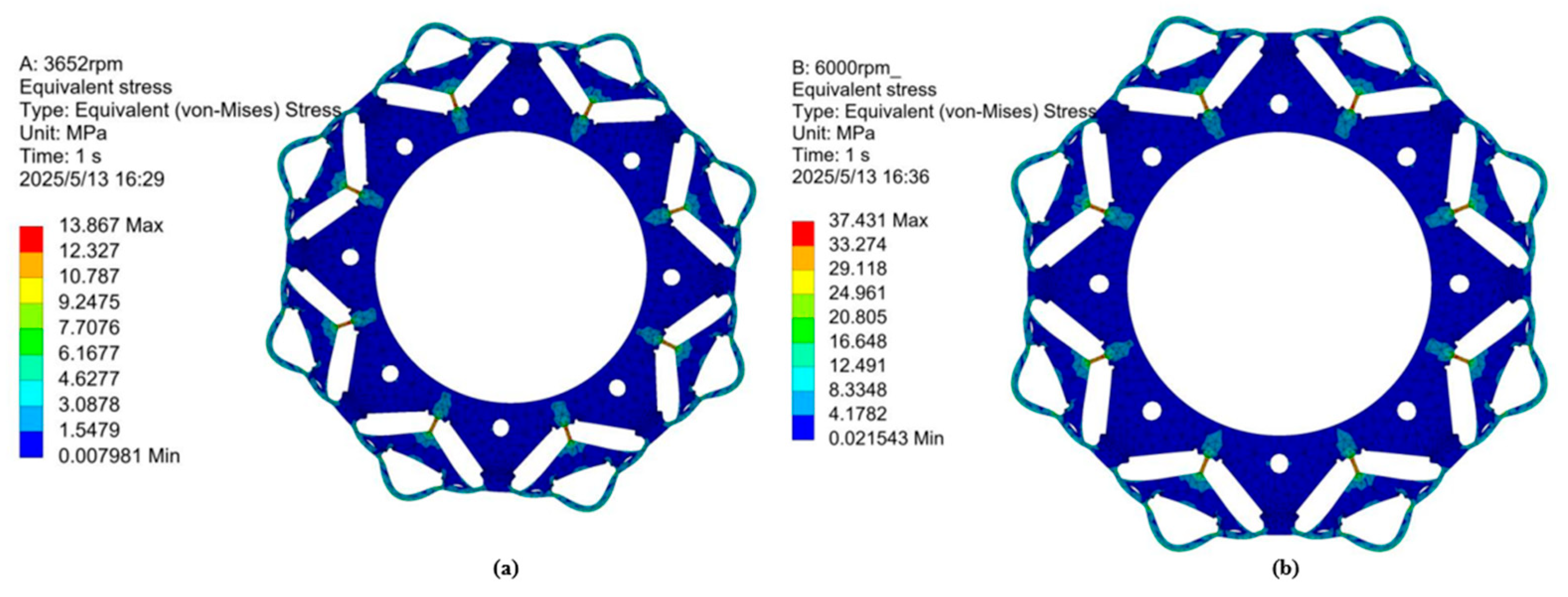
Owing to the rotor surface optimization, the addition of micro-grooves may weaken the structural strength, thus necessitating the verification of rotor strength [28]. At high rotational speeds, the rotor is primarily subjected to centrifugal forces. Analyses were performed at the rated speed of 3652 rpm and maximum speed of 6000 rpm. Figure 24 displays the equivalent stress contour of the optimized rotor, indicating a peak stress of 37.43 MPa—well below the material’s 400 MPa yield strength. This provides confirmation that the optimized rotor’s structural strength remains safely within acceptable limits.

7. Conclusions

This study examines an 8-pole, 48-slot double-layer interior permanent magnet synchronous motor while proposing a hierarchical iterative optimization method. A comparative analysis of the electromagnetic vibration and acoustic performance, both before and after optimization, led to the following conclusions:
(1)
The FFT analysis indicates that the zero-order 12 ƒ electromagnetic force wave has the greatest impact on the motor’s vibration and noise. Post-optimization, the amplitude decreased from 67,247.42 to 40,957.45, a reduction of 39.09%.
(2)
The peak vibration acceleration is observed at the 12 ƒ (2921.6 Hz). The optimized vibration acceleration is 1.77 m/s2, a 32.96% reduction compared to the pre-optimization value of 2.65 m/s2.
(3)
The noise generated by the zero-order 12 ƒ electromagnetic force decreased from 75.89 dB to 66.86 dB, and the sound pressure level in all frequency bands showed varying degrees of reduction.
These conclusions demonstrate that the proposed optimization method and process are effective and reasonable [29].

Author Contributions

Conceptualization, T.X.; Methodology, T.X.; Formal analysis and investigation, T.X.; Writing—original draft preparation, T.X.; Writing—review and editing, T.X. and W.Z.; Funding acquisition, W.Z.; Resources, W.Z. and H.W.; Supervision, Y.Z. and C.Z. All authors have read and agreed to the published version of the manuscript.

Funding

This research was funded by the National Natural Science Foundation of China (Grant Number 52472405), Guangxi Science and Technology Program (Guike AB24010197), Guangxi Transportation Science and Technology Promotion Project (GXJT-ZDSYS-2023-03-03), Open Fund of Hubei Longzhong Laboratory (2024KF-22), and the Special Fund of Hubei Longzhong Laboratory of Xiangyang Science and Technology Plan.

Data Availability Statement

Data will be made available upon request, with the exception of confidential or proprietary information.

Conflicts of Interest

The authors declare no conflicts of interest.

References

  1. Hao, Z.; Ma, Y.; Wang, P.; Luo, G.; Chen, Y. A Review of Axial-Flux Permanent-Magnet Motors: Topological Structures, Design, Optimization and Control Techniques. Machines 2022, 10, 1178. [Google Scholar] [CrossRef]
  2. Yang, Z.; Li, W.; Gou, Y.; Cai, T. Research on Radial Force of Permanent Magnet Synchronous Motor Based on Maxwell. J. Electr. Eng. Technol. 2020, 15, 2601–2608. [Google Scholar] [CrossRef]
  3. Wu, B.; Qiao, M.; Wu, Y.-C. A Review of the Research Progress of Motor Vibration and Noise. Int. Trans. Electr. Energy Syst. 2022, 2022, 5897198. [Google Scholar] [CrossRef]
  4. Wu, Z.; Zuo, S.; Huang, Z.; Hu, X.; Chen, S.; Liu, C. Modelling, Calculation and Analysis of Electromagnetic Force and Vibroacoustic Behavior of Integer-Slot Permanent Magnet Synchronous Motor Considering Current Harmonics. J. Vib. Eng. Technol. 2022, 10, 1135–1152. [Google Scholar] [CrossRef]
  5. Wang, S.; Hong, J.; Sun, Y.; Cao, H. Analysis of Zeroth-Mode Slot Frequency Vibration of Integer Slot Permanent-Magnet Synchronous Motors. IEEE Trans. Ind. Electron. 2020, 67, 2954–2964. [Google Scholar] [CrossRef]
  6. Gu, D.; Shi, D.; Liu, Z.; Xu, Z.; Pan, B.; Geng, T.; Wen, B. Vibration and noise performance analysis and optimal design of V-rotor in permanent magnet synchronous motor: A new strategy for high efficiency and low noise. J. Vibroeng. 2025, 27, 882–898. [Google Scholar] [CrossRef]
  7. Chu, J.; Cheng, H.; Sun, J.; Peng, C.; Hu, Y. Multi-Objective Optimization Design of Hybrid Excitation Double Stator Permanent Magnet Synchronous Machine. IEEE Trans. Energy Convers. 2023, 38, 2364–2375. [Google Scholar] [CrossRef]
  8. Baek, S.-W.; Lee, S.W. Design Optimization and Experimental Verification of Permanent Magnet Synchronous Motor Used in Electric Compressors in Electric Vehicles. Appl. Sci. 2020, 10, 3235. [Google Scholar] [CrossRef]
  9. Song, T.; Liu, H.; Zhang, Q.; Zhang, Z. Multi-physics and multi-objective optimisation design of interior permanent magnet synchronous motor for electric vehicles. IET Electr. Power Appl. 2020, 14, 2243–2254. [Google Scholar] [CrossRef]
  10. Ahmadi, S.; Lubin, T.; Vahedi, A.; Taghavi, N. Sensitivity-Based Optimization of Interior Permanent Magnet Synchronous Motor for Torque Characteristic Enhancement. Energies 2021, 14, 2240. [Google Scholar] [CrossRef]
  11. Peng, C.; Wang, D.; Wang, B.; Li, J.; Wang, C.; Wang, X. Different Rotor Segmented Approaches for Electromagnetic Vibration and Acoustic Noise Mitigation in Permanent Magnet Drive Motor: A Comparative Study. IEEE Trans. Ind. Electron. 2024, 71, 1223–1233. [Google Scholar] [CrossRef]
  12. Wang, S.; Li, H. Reduction of Electromagnetic Vibration and Noise in Permanent Magnet Motor for EVs by Optimizing Design of Rotor Based on GPR-PSO Model. J. Electr. Eng. Technol. 2020, 15, 1231–1243. [Google Scholar] [CrossRef]
  13. Xing, Z.; Wang, X.; Zhao, W. Optimization of Stator Slot Parameters for Electromagnetic Vibration Reduction of Permanent Magnet Synchronous Motors. IEEE Trans. Transp. Electrif. 2022, 8, 4337–4347. [Google Scholar] [CrossRef]
  14. Ge, H.; Qiu, X.; Guo, B.; Yang, J.; Bai, C.; Jin, Z. Optimized Rotor Shape for Reducing Torque Ripple and Electromagnetic Noise. IEEE Trans. Magn. 2022, 58, 8102905. [Google Scholar] [CrossRef]
  15. Zhu, Z.; Wang, A.; Tang, M. Research on Electromagnetic Vibration and Noise Suppression of PMaSynRM with Slotted Stator and Rotor. Prog. Electromagn. Res. C 2024, 143, 35–43. [Google Scholar] [CrossRef]
  16. Li, G.; Sun, H.; Hu, W.; Li, Y.; Bai, Y.; Guo, Y. Multi-Objective Optimization Design of the External Rotor Permanent Magnet-Assisted Synchronous Reluctance Motor Based on the Composite Algorithm. Electronics 2023, 12, 4004. [Google Scholar] [CrossRef]
  17. Cen, Y.; Shen, H.; Wang, X.; Wu, Y.; Du, J. Multi-Objective Optimization Analysis of Electromagnetic Performance of Permanent Magnet Synchronous Motors Based on the PSO Algorithm. Energies 2024, 17, 4637. [Google Scholar] [CrossRef]
  18. Yan, B.; Yang, Y.; Wang, X. Design of a Large Capacity Line-Start Permanent Magnet Synchronous Motor Equipped With Hybrid Salient Rotor. IEEE Trans. Ind. Electron. 2021, 68, 6662–6671. [Google Scholar] [CrossRef]
  19. Yu, Y.; Zhao, P.; Hao, Y.; Zeng, D.; Hu, Y.; Zhang, B.; Yang, H. Multi Objective Optimization of Permanent Magnet Synchronous Motor Based on Taguchi Method and PSO Algorithm. Energies 2022, 16, 267. [Google Scholar] [CrossRef]
  20. Dong, J.; Yin, H.; Li, G.; Wang, X.; Luo, M. The Multiphysics Analysis and Suppression Method for the Electromagnetic Noise of Permanent-Magnet Motors Used in Electric Vehicle. World Electr. Veh. J. 2025, 16, 136. [Google Scholar] [CrossRef]
  21. Zhao, K.; Luo, J. Performance Comparison and Analysis of Different Rotor Structures of Vehicle Permanent Magnet Synchronous Flat Wire Motor. Machines 2022, 10, 212. [Google Scholar] [CrossRef]
  22. Kim, C.; Yun, G.; Lee, S.; Choo, Y.; Lukman, G.F.; Lee, C. Analysis of Vibration and Noise in a Permanent Magnet Synchronous Motor Based on Temperature-Dependent Characteristics of Permanent Magnet. Energies 2023, 16, 6452. [Google Scholar] [CrossRef]
  23. Deng, W.; Zuo, S. Electromagnetic Vibration and Noise of the Permanent-Magnet Synchronous Motors for Electric Vehicles: An Overview. IEEE Trans. Transp. Electrif. 2019, 5, 59–70. [Google Scholar] [CrossRef]
  24. Ahn, J.-M.; Baek, M.-K.; Park, S.-H.; Lim, D.-K. Optimal Design of IPMSM for EV Using Subdivided Kriging Multi-Objective Optimization. Processes 2021, 9, 1490. [Google Scholar] [CrossRef]
  25. Li, Z.; Yuan, C.; Chen, S.; Wang, Y.; Lian, Z.; Qiu, H.; Wu, X. The Effect of Magnetic Slot Wedges on the Vibration of High-Voltage Line-Starting Permanent Magnet Synchronous Motor. J. Electr. Eng. Technol. 2025, 20, 4077–4085. [Google Scholar] [CrossRef]
  26. Li, D.; Xie, Y.; Cai, W.; Zhang, F.; Sun, Y. An Analytical Prediction Method for Zero-Order Vibration and Noise of Permanent Magnet Synchronous Motor. IEEE Trans. Appl. Supercond. 2024, 34, 5209206. [Google Scholar] [CrossRef]
  27. Li, X.; He, W.; Zhao, R.; Feng, A.; Liu, Y.; Lu, Y. Modal analysis of the stator system of a permanent magnet synchronous motor with integer slot multi-pole pair for electric vehicles. IET Electr. Power Appl. 2021, 16, 1–14. [Google Scholar] [CrossRef]
  28. Liu, C.; Zhang, H.; Wang, S.; Wang, Y.; Lei, G.; Zhu, J. Multiphysical Design and Optimization of High-Speed Permanent Magnet Synchronous Motor with Sinusoidal Segmented Permanent Magnet Structure. J. Electr. Eng. Technol. 2023, 19, 1459–1473. [Google Scholar] [CrossRef]
  29. Wang, D.; Yang, W.; Yang, J.; Jiang, K.; Fu, Y. Research on Electromagnetic Vibration Characteristics of a Permanent Magnet Synchronous Motor Based on Multi-Physical Field Coupling. Energies 2023, 16, 3916. [Google Scholar] [CrossRef]
Figure 1. Design Process.
Energies 19 00475 g001
Figure 2. (a) cross-section of motor structure; (b) stator and rotor structural dimensions and parameters.
Energies 19 00475 g002
Figure 3. Mesh division diagram.
Energies 19 00475 g003
Figure 4. Magnetic flux density cloud map.
Energies 19 00475 g004
Figure 5. Magnetic field line distribution diagram.
Energies 19 00475 g005
Figure 6. Comparison of radial air gap magnetic flux density and tangential air gap magnetic flux density.
Energies 19 00475 g006
Figure 7. Spatiotemporal distribution of REF before optimization.
Energies 19 00475 g007
Figure 8. Two-dimensional Fourier decomposition diagram of REF before optimization.
Energies 19 00475 g008
Figure 9. Sensitivity Matrix.
Energies 19 00475 g009
Figure 10. Response surface. (a) Average torque. (b) Efficiency. (c) Cogging torque.
Energies 19 00475 g010
Figure 11. Multi-objective Pareto frontier diagram.
Energies 19 00475 g011
Figure 12. Motor structure diagram.
Energies 19 00475 g012
Figure 13. Modal mesh partitioning diagram.
Energies 19 00475 g013
Figure 14. Stator modal shapes and frequencies: (a) 0th order mode = 4895.1 Hz; (b) 2th order mode = 795.35 Hz; (c) 3th order mode = 2150.8 Hz; (d) 4th order mode = 3904.7 Hz; (e) 5th order mode = 5935.8 Hz; (f) 6th order mode = 8045.4 Hz.
Energies 19 00475 g014
Figure 15. Vibration acceleration spectrum comparison.
Energies 19 00475 g015
Figure 16. Sound pressure cloud diagram: (a) before optimization; (b) after optimization.
Energies 19 00475 g016
Figure 17. Contrast results of SPL frequency spectrum.
Energies 19 00475 g017
Figure 18. Multi-speed waterfall diagram: (a) before optimization; (b) after optimization.
Energies 19 00475 g018
Figure 19. Average torque before and after optimization.
Energies 19 00475 g019
Figure 20. Cogging torque diagrams before and after optimization.
Energies 19 00475 g020
Figure 21. Spatiotemporal distribution map of optimized REF.
Energies 19 00475 g021
Figure 22. Two-dimensional Fourier decomposition diagram of the optimized REF.
Energies 19 00475 g022
Figure 23. Efficiency map: (a) before optimization; (b) after optimization.
Energies 19 00475 g023
Figure 24. Rotor stress distribution diagram: (a) rated speed; (b) peak speed.
Energies 19 00475 g024
Table 1. The main parameters of PMSM.
ParameterValueParameterValue
Rated speed3652 rpmRated power64 kW
Stator outer diameter190 mmStator inner diameter133 mm
Rotor inner diameter80 mmAxial Length240 mm
PM materialN38UHStator core materialB30AVH1500
Table 2. REF wave order and frequency.
ν R 135791113
ν S
10/0
8/2
8/2
−5 8/40/68/8
7 8/40/68/8
−11 8/100/128/14
13 8/100/12
Table 3. Optimization parameters and factor level configuration table.
ParametersdeltaX/mmdeltaY/mmBs0_stator/mm
Level10.250.50.25
Level20.7510.5
Level31.251.50.75
Table 4. L 9 ( 3 3 ) Orthogonal Experimental Design Table.
GroupsdeltaX/mmdeltaY/mmBs0_stator/mm
1111
2122
3133
4212
5223
6231
7313
8321
9332
Table 5. L 9 ( 3 3 ) orthogonal experiment table results.
Number of ExperimentsDelta XDeltayBs0_StatorAverage Torque/NmTorque Ripple/%Cogging Torque/Nm(0, 12 ƒ ) Amplitude
10.250.50.25166.8410.470.5441,566.73
20.2510.5166.8611.040.2840,747.14
30.251.50.75166.6611.130.3142,439.44
40.750.50.5164.3313.442.9344,491.1
50.7510.75162.0315.213.0942,713.33
60.751.50.25159.9816.354.2344,012.56
71.250.50.75160.2516.715.5945,123.78
81.2510.25154.5120.288.5443,128.6
91.251.50.5149.7422.989.6545,436.11
Table 6. Average values of each performance indicator at each level of the optimization variable.
Optimization VariablesLevelAverage Torque/NmTorque Ripple/%Cogging Torque Amplitude/Nm(0, 12 ƒ ) Amplitude
deltaX1166.79 10.88 0.38 41,584.44
2162.11 15.00 3.42 43,739.00
3154.83 19.99 7.93 44,562.83
deltaY1163.81 13.54 3.02 43,727.20
2161.13 15.51 3.97 42,196.36
3158.79 16.82 4.73 43,962.70
Bs0_stator1160.44 15.70 4.44 42,902.63
2160.31 15.82 4.29 43,558.12
3162.98 14.35 3.00 43,425.52
Table 7. Variance and proportion of performance indicators at three levels of each optimization variable.
VariableAverage Torque/NmTorque Ripple/%Cogging Torque Amplitude/Nm(0, 12 ƒ ) Amplitude
Variance ValueProportion/%Variance ValueProportion/%Variance ValueProportion/%Variance ValueProportion/%
deltaX24.19 80.9213.87 85.989.62 91.381,576,850.78 69.46
deltaY4.20 14.031.82 11.260.49 4.65613,214.70 27.01
Bs0_stator1.51 5.050.44 2.750.42 3.9780,072.89 3.53
Total29.90 100.0016.14 100.0010.53 100.002,270,138.37 100.00
Table 8. Initial values and ranges of optimization variables.
VariableInitialRange
deltaX0.25[0.1–0.5]
deltaY1[0.9–1.1]
Hs2_Stator15.5414[15–16]
Bs0_Stator0.5[0.375–0.625]
Bs1_Stator3.6[3.5–3.7]
Bs2_Stator3.6[3–4]
rotorout65.7[63–66]
Table 9. Comprehensive comparison of the initial plan and the optimized plan.
VariableInitialOptimizedVariableInitialOptimized
Average torque
Cogging torque
Torque ripple
REF amplitude
Efficiency
Back-EMF THD
165.065
3.847
17.675
67,247.42
95.74%
1.4%
166.932
0.253
11.098
40,957.45
95.71%
2.6%
deltaX
deltaY
Bs0_Stator
Bs1_Stator
Bs2_Stator
Hs2_Stator
rotorout
0.25
1
0.5
3.6
3.6
15.54
65.7
0.261
0.971
0.57
3.64
3.33
15.08
63.948
Table 10. Material mechanical parameters.
Structural PartsDensity (kg/m3)Elastic Modulus (pa)Shear Modulus (pa)Poisson’s Ratio
Stator core7410 E x = E y = 2 . 06 × 10 11
E z = 1 . 5 × 10 11
G xz = G yz = 7 . 3 × 10 10
G xy = 8 × 10 10
0.3
Disclaimer/Publisher’s Note: The statements, opinions and data contained in all publications are solely those of the individual author(s) and contributor(s) and not of MDPI and/or the editor(s). MDPI and/or the editor(s) disclaim responsibility for any injury to people or property resulting from any ideas, methods, instructions or products referred to in the content.