Article

Bi-Objective Intraday Coordinated Optimization of a VPP’s Reliability and Cost Based on a Dual-Swarm Particle Swarm Algorithm

1
Shenzhen Power Supply Bureau Co., Ltd., Shenzhen 518001, China
2
Key Laboratory of Control of Power Transmission and Conversion, Shanghai Jiao Tong University, Shanghai 200240, China
*
Author to whom correspondence should be addressed.
Energies 2026, 19(2), 473; https://doi.org/10.3390/en19020473 (registering DOI)
Submission received: 30 October 2025 / Revised: 11 December 2025 / Accepted: 18 December 2025 / Published: 17 January 2026

Abstract

With the increasing penetration of renewable energy, power systems are facing greater uncertainty and volatility, which poses significant challenges for Virtual Power Plant scheduling. Existing research mainly focuses on optimizing economic efficiency but often overlooks system reliability and the impact of forecasting deviations on scheduling, leading to suboptimal performance. Thus, this paper presents a reliability-cost bi-objective cooperative optimization model based on a dual-swarm particle swarm algorithm: it introduces positive and negative imbalance price penalty factors to explicitly describe the economic costs of forecast deviations, constructs a reliability evaluation system covering PV, EVs, air-conditioning loads, electrolytic aluminum loads, and energy storage, and solves the multi-objective model via algorithm design of “sub-swarms specializing in single objectives + periodic information exchange”. Simulation results show that the method ensures stable intraday operation of VPPs, achieving 6.8% total cost reduction, 12.5% system reliability improvement, and 14.8% power deviation reduction, verifying its practical value and application prospects.

1. Introduction

As the penetration of renewable energy generation increases, its randomness, volatility, and uncertainty significantly heighten the difficulty of maintaining real-time power balance [1]. The substantial influx of intermittent renewables imposes greater requirements on the grid’s regulation capabilities. In response, the concept of a Virtual Power Plant (VPP) has been proposed to address the challenge of integrating distributed resources [2]. By effectively aggregating and coordinating distributed PV, wind power, controllable loads, and energy storage, a VPP can not only mitigate the stochastic fluctuations in renewable outputs but also flexibly respond to load demands, thus providing strong support for the stable operation of power systems [3]. In the future energy landscape, VPPs will play an increasingly vital role.
However, owing to the large number and diverse output characteristics of distributed resources, as well as the current limitations in communication infrastructure and algorithmic models, VPPs still face numerous challenges—particularly in precise forecasting, real-time dispatch, and secure coordination. Consequently, enhancing operational accuracy is crucial to achieving reliable and efficient performance. In [4], an integrated day-ahead and intraday optimization model was developed by leveraging the temporal complementarity between renewable energy intermittency and heterogeneous loads. To reduce the discrepancy between actual operation and the scheduled plan caused by forecasting errors, intraday optimization was performed to minimize the sum of the total building-system operating cost and the net load variance. In [5], different types of distributed resources were classified, aggregated, and scheduled with consideration of participant satisfaction, thereby improving system frequency regulation. Reference [6] constructed a VPP optimization scheduling model focusing on operational economics, then extended it to a robust stochastic framework. In [7], a wind-curtailment penalty was incorporated into the objective function or constraints to optimize the coordination of multiple energy resources, thereby reducing wind curtailment. Nevertheless, these studies do not adequately account for the positive and negative imbalance prices arising from forecasting deviations in the intraday context, making it difficult to simultaneously ensure cost-effectiveness and operational stability. In contrast, this work introduces a positive–negative imbalance price penalty mechanism in the intraday stage. By directly incorporating forecasting deviations into the scheduling costs, the proposed approach not only preserves economic efficiency but also effectively reduces deviations induced by power uncertainties and strengthens overall system stability.
However, the overlapping and interaction of emerging energy sources and diversified loads during multiple intraday intervals pose even more critical challenges to the secure and stable operation of the VPP. In [8], adjustable uncertainty sets are employed to model the volatility of renewable energy output, and a robust optimization framework is established to minimize energy purchase costs, carbon costs, and demand response compensation costs under worst-case scenarios. Reference [9] utilizes interval-based uncertainty descriptions for renewables and loads within a VPP, formulating a response interval evaluation model that aims to minimize operating costs, and then transforms it via scenario decomposition into a two-stage robust optimization model addressing the worst-case and best-case scenarios. In [10], high- and low-frequency characteristics, as well as the distinct operating behaviors of controllable devices, are considered separately to design high-frequency and low-frequency scheduling models for the VPP, and a dual-mode economic model predictive control strategy is proposed for optimal VPP operation. Most previous studies focus primarily on economic benefits and pay less attention to operational stability. Even when stability is considered, it is usually treated as a secondary objective and is difficult to balance against economic cost.
To overcome this single-objective limitation, this paper develops credibility assessment indices for various dispatchable resources. These indices are then integrated into a scheduling model with two objectives—minimizing cost and maximizing reliability—thereby achieving a holistic approach to both economic performance and operational stability, ultimately enhancing the overall intraday scheduling capability of the VPP.
Regarding multi-objective optimization, existing literature predominantly utilizes intelligent algorithms or mathematical models. In [11], a “target cascade optimization” framework is introduced, decomposing the overall optimization problem into multiple hierarchical stages. Through hierarchical objective-setting and propagation, complex constraints and multi-objective demands are handled more effectively. Reference [12] adopts a normalization-plane constraint method to generate a uniformly distributed Pareto front and subsequently employs an improved entropy-weighted two-anchor-point approach to identify a compromise solution. In [13], a dynamic learning particle swarm algorithm is proposed to simultaneously minimize operating costs and environmental impact in a bi-objective optimization setting. However, most existing double-objective methods assume the same direction (either both to be minimized or both maximized), and their reliance on conventional mathematical models can significantly increase computational complexity. By contrast, this paper addresses the case of one maximization and one minimization objective, thus introducing a dual-swarm collaborative particle swarm algorithm. In this method, the original population is divided into two sub-swarms, each retaining its own “sub-swarm best solution” set, while periodically conducting “information exchange.” In so doing, they share a pool of promising solutions and jointly maintain an external elite archive of all non-dominated solutions. This collaborative mechanism enables one sub-swarm to concentrate on high-quality solutions for one objective in the early stage, while the other focuses on the other objective. By periodically sharing solutions, the algorithm avoids extreme bias toward either objective.
Therefore, in this work, positive and negative imbalance price penalties are introduced into the intraday scheduling model to explicitly capture the additional economic costs caused by forecasting deviations. Concurrently, a credibility metric system—encompassing output uncertainties, user behavior biases, and response fatigue—is constructed for various resources, including renewable energy, EVs, air-conditioning loads, and industrial loads, to more precisely characterize their dispatchability and stability. Finally, by formulating a bi-objective scheduling model that minimizes cost and maximizes reliability and solving it via the dual-swarm particle swarm algorithm, the proposed method effectively bolsters the VPP’s stability and reliability in intraday operation while enhancing economic returns.

2. VPP Operational Framework

In this paper, the proposed VPP model primarily comprises PV units, EVs, electrolytic aluminum loads, air-conditioning (AC) loads, and energy storage. The detailed framework is illustrated in Figure 1:
In this paper, we address the challenge of balancing economic efficiency and the reliability of the intraday scheduling of a VPP by proposing a comprehensive solution. First, positive–negative imbalance price penalty factors are introduced into the intraday scheduling model, thereby directly converting forecast deviations into economic costs. This mechanism proactively regulates dispatch in the face of forecasting errors, mitigating risks arising from power imbalances while enhancing overall operational stability. A multidimensional credibility evaluation system is developed for renewable generation, loads, and storage resources. This system incorporates user behavior deviations and response fatigue, providing a more accurate representation of resource dispatchability and stability. As a result, the VPP can maintain cost-effectiveness while ensuring high reliability during intraday operation.
Building on these elements, a multi-objective scheduling framework is constructed as shown in Figure 1, comprising two primary objectives: cost minimization and credibility maximization. To tackle these two objectives—which differ in direction (one minimized, one maximized)—a dual-swarm particle swarm algorithm is proposed. In this method, the original particle swarm is partitioned into two sub-swarms, each specializing in one of the objectives, and valuable solutions are periodically exchanged between them. An external elite archive is also maintained to store all non-dominated solutions. This collaborative co-evolution enables one sub-swarm to concentrate on high-quality solutions for a single objective in the early stages, while complementary information exchange prevents convergence to local optima, ultimately achieving both economic benefits and robust system reliability.

3. Intraday Resource Modeling

3.1. PV Output Modeling

The PV output can be represented by the following formula, which is predominantly influenced by module efficiency, panel area, solar irradiance, and temperature:
P p v = η A G t ( 1 β ( T T r e f ) )
Here, η denotes the PV efficiency (ranging from 0.1 to 0.2); A is the panel area; β is the temperature derating coefficient (typical value of 0.04); T r e f is the reference temperature (generally set to 25 °C); G t represents the solar irradiance, T is the module temperature.

3.2. EV Modeling

Based on the Battery Health Management principles, the following SOC threshold constraints are established. We define the SOC of electric vehicles, ranging from 20% to 100%. The minimum SOC value, representing the battery’s state before charging starts, is set to 20%, while the target SOC value is typically set to 80%. The model assumes that EV charging starts when the minimum SOC value is reached and continues until the target SOC value is achieved. This setting optimizes EV charging scheduling by preventing overcharging or inefficient charging. As shown in Table 1, the participation in EV charging scheduling:
Here, S O C d denotes the SOC level desired by the EV owner.
Charging time anxiety in EVs has attracted considerable attention [14,15]. Since participating in scheduling may prolong the required charging duration, such extensions could negatively impact drivers’ willingness to engage in dispatch programs. Hence, it is crucial to ensure that any additional charging time remains within an acceptable range for EV owners.
Taking these charging-anxiety constraints into account, the supportable energy can be expressed as:
E a = ( t s t a y , a v e + t t o l ) P a v e ( S O C d S O C i ) Q a v e
where t s t a y , a v e represents the average dwell time for an EV at the charging station, and t t o l is the maximum extra charging time acceptable to EV owners, obtained from charging station data on average parking and completion times, combined with user surveys via OEM apps or platforms. Q a v e denotes the average battery capacity; both t s t a y , a v e and Q a v e can be obtained from the charging station.
The SOC level evolves according to the following formula:
S O C ( t + 1 ) = S O C ( t ) + P c h a η c h a t Q P d i s c h a t Q η d i s c h a
Here, P c h a and P d i s c h a denote the charging and discharging power, respectively, while, η c h a and η d i s c h a represent the charging and discharging efficiencies.
Given that the number of EVs connecting to the system varies across different time slots, an EV aggregator can flexibly adjust the energy supply in accordance with the real-time EV access. This dynamic scheduling approach guarantees sufficient energy availability during peak load periods and avoids surplus energy during off-peak intervals, thereby enhancing the overall operational efficiency of the power grid. Specifically, the energy provision can be expressed as:
E a = K ( t ) E a
where K(t) adopts a normal distribution function:
K ( t ) = 1 σ 2 π exp [ ( t μ ) 2 2 σ 2 ]
With σ being the standard deviation of the normal distribution, μ the mean, and the normally distributed variable.

3.3. AC Load Modeling

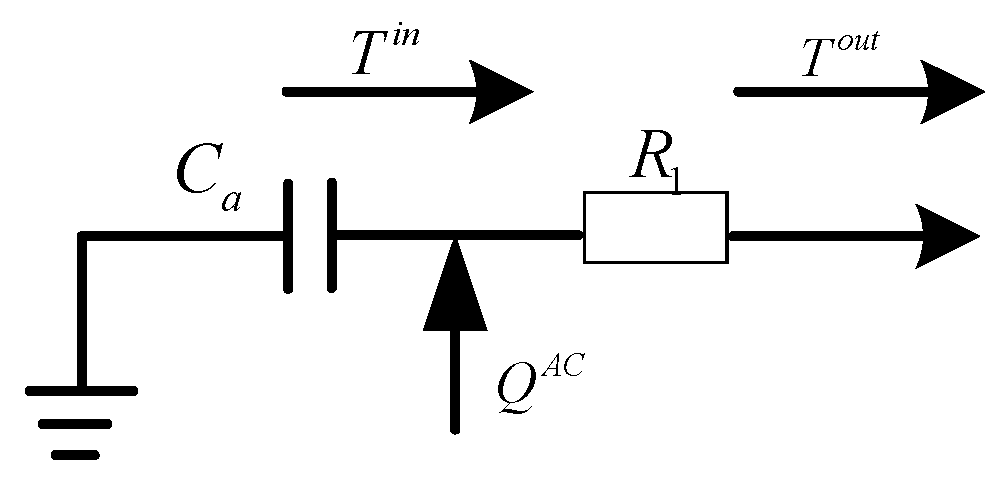
The AC load is modeled using an Equivalent Thermal Parameter (ETP) approach based on circuit analogy. The EPT model is shown in the Figure 2 below. To simplify computations, a first-order equivalent parameter model is adopted for analysis [16]:
The governing differential equation is expressed as:
d T i n d t = ( T o u t T i n ) R 1 C a Q A C C a
where T o u t is the outdoor temperature, T i n is the indoor temperature, Q A C is the cooling capacity of the AC unit; C a is the equivalent thermal capacitance, and R 1 is the thermal resistance.
To explore the relationship between the cooling capacity and the power consumption of the AC unit, an electrothermal conversion model is introduced [17]. The power consumption P A C and cooling capacity Q A C of a variable-speed AC system are related to the compressor frequency f A C , which can be described as:
P A C = k 1 f A C + l 1
Q A C = k 2 f A C + l 2
where k 1 , k 2 , l 1 and l 2 are linear model coefficients. Based on these equations, the relationship between P A C and Q A C can be derived as:
Q A C = k 2 k 1 P A C + k 1 l 2 k 2 l 1 k 1
The maximum adjustable capacity of a single AC load is defined as the cooling energy provided when the AC unit operates at maximum power. It represents the energy required to reduce the indoor temperature from the upper comfort limit to the current temperature. If the indoor temperature is at the upper comfort threshold, the AC regulation capacity is positive. Using the differential equation and integral expansion, the adjustable cooling energy E t A C and the maximum cooling capacity Q A C max can be obtained as:
E t A C = P max A C R 1 C a ( ln ( A B ) 1 B ( T i n T i n , 0 )
Q A C max = k 2 k 1 P A C max + k 1 l 2 k 2 l 1 k 1
Here, E t A C represents the adjustable energy of the AC load at time t, P A C max denotes the maximum power limit of the AC load; Q A C max is the upper limit of cooling capacity for the AC load; and T max is the upper bound of the temperature comfort zone. Constants A and B are given, and the corresponding formulation is expressed as follows:
A = T t o u t T max Q max A C R 1
B = T t o u t T i n , 0 Q max A C R 1

3.4. Electrolytic Aluminum Load

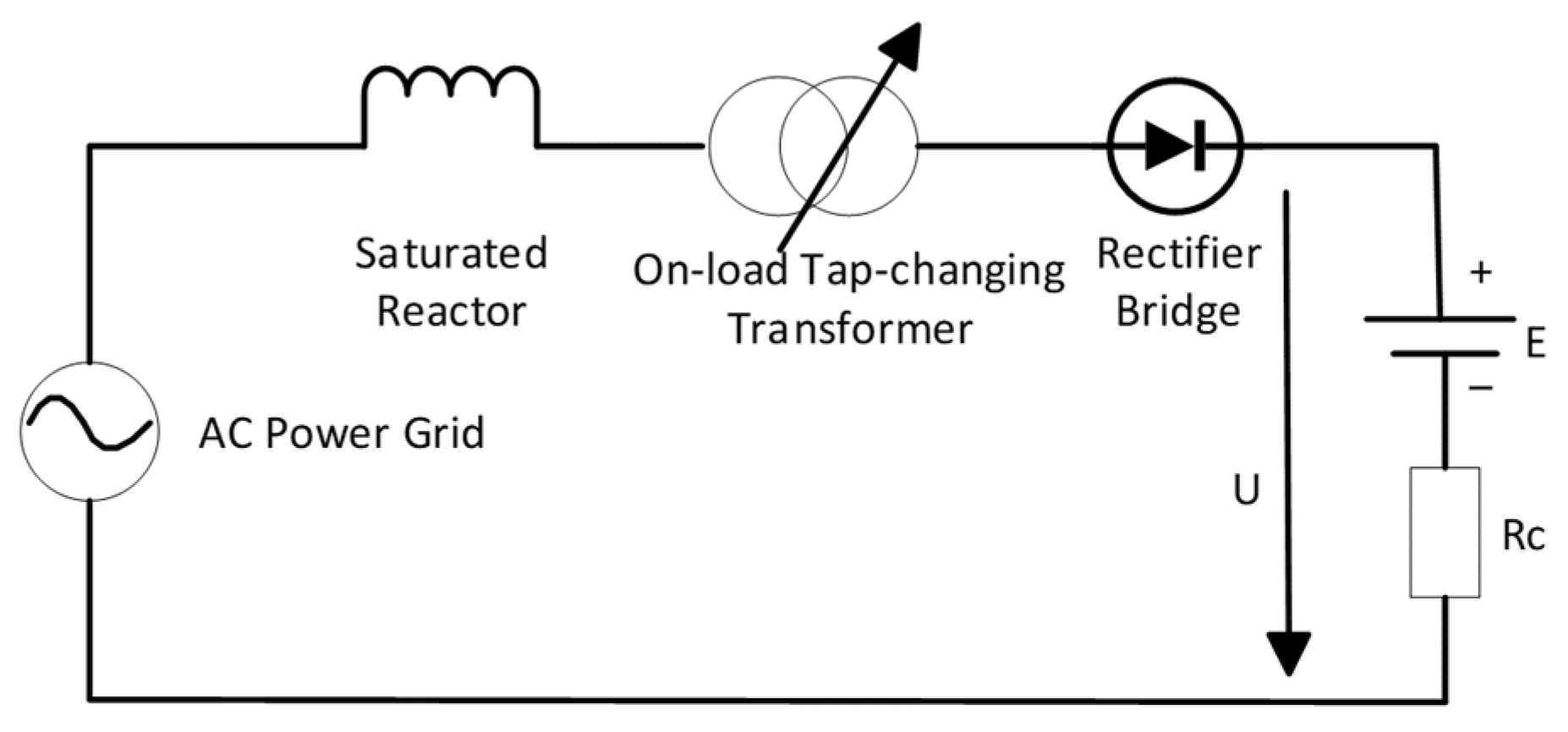
For electrolytic cell modeling, a constant voltage source model is adopted, shown in Figure 3, where the terminal voltage of the electrolytic cell remains constant regardless of variations in electrolyte temperature and electrolytic current [18]:
Based on KCL and KVL transformations, the relationship between the electrolytic cell power and the electrolyte temperature is derived as follows:
P e ( t ) k η ( W h + W r ) I ( t ) S 1 h 1 ( T e ( t ) T s ( t ) ) = c e m e ( T e ( t + 1 ) T e ( t ) )
S 1 h 1 ( T e ( t ) T s ( t ) ) S 2 h 2 ( T s ( t ) T 0 ( t ) ) = c s m s ( T s ( t + 1 ) T s ( t ) )
Here, P e ( t ) represents the industrial load at time t; W h , W r denote the electrical energy consumption per unit mass of aluminum production for the electrochemical reaction and the heating of reactants, respectively; η is the current efficiency of the electrolytic cell; S 1 represents the heat dissipation area of the electrolytic cell and its shell, h 1 is the convective heat transfer coefficient between the electrolyte and the electrolytic cell shell; T e ( t ) , T s ( t ) represent the electrolyte temperature and the electrolytic cell shell temperature, respectively, c e , m e denote the specific heat capacity and mass of the electrolyte. The industrial load power has theoretical maximum and minimum limits, which are determined by the on-load tap changer (OLTC) of the electrolytic aluminum transformer and the adjustable range of the reactor.
The industrial load power has theoretical maximum and minimum limits, which are determined by the on-load tap changer (OLTC) of the electrolytic aluminum transformer and the regulation range of the saturated reactor [19]:
P e , max = 3 2 π U ( U 1 / K min U R min ) E U R C
P e , min = 3 2 π U ( U 1 / K max U R max ) E U R C
Here, U 1 , U R represent the AC bus voltage and the voltage drop across the saturated reactor, respectively, while K denotes the tap ratio of the OLTC transformer. Consequently, the adjustable output range of the industrial load in terms of power regulation, Δ P e 1 ( t ) and Δ P e 2 ( t ) is given by:
0 Δ P e 1 ( t ) P e , max P e ( t )
0 Δ P e 2 ( t ) P e ( t ) P e , min

3.5. BESS

The BESS output model includes power constraints, SOC constraints, and energy balance constraints between adjacent time periods. The power constraint limits the maximum output power of the BESS; the SOC constraint ensures that the battery operates within a reasonable charging and discharging range; and the energy balance constraint maintains the continuity of stored energy between consecutive time periods:
E t B = ( 1 λ ) E t 1 B + η B , c P t B , c Δ t P t B , d η B , d Δ t
s . t 0 P B , c u B P max B , c 0 P B , d ( 1 u B ) P max B , d S O C min S O C t S O C max
Here, E t B represents the stored energy of the BESS at time period t; λ denotes the self-discharge rate of the battery; and P t B , d are the charging and discharging power of the BESS, respectively; and η B , c and η B , d denote the charging efficiency and discharging efficiency of the BESS, respectively.

4. Intraday Resource Credibility Modeling

4.1. PV Credibility Index

The PV Credibility Index (PV-CI) is categorized into two metrics: PV Firm Capacity and PV Load-Carrying Capability [20]. PV Firm Capacity refers to the equivalent capacity of PV that can be considered comparable to conventional generators under a given reliability requirement. This paper adopts the Equivalent Firm Capacity (EFC) metric, which quantifies the proportion of PV capacity that can replace a 100% reliable conventional generator from a generation-side perspective. Specifically, in an actual system, if PV generation is removed and replaced with a certain amount of virtual conventional generation with zero forced outage rate, while maintaining the same system reliability, the ratio of the virtual conventional capacity to the PV installed capacity defines the PV credibility. The corresponding formula is expressed as follows:
t T R t ( P p v , t + g G C g , d t ) = t T R t ( C c , E F C + g G C g , d t )
Here, C g represents the conventional generation capacity, d t denotes the system load level at time t, P p v , t is the PV output, and C c refers to the PV firm capacity. R t ( a , b ) represents the system reliability under generator capacity a and load level b.
Equivalent Load-Carrying Capability (ELCC): This metric is defined from a load-side perspective, quantifying the effective contribution of PV to system reliability. Specifically, ELCC represents the difference in the system’s load-serving capability before and after PV integration while maintaining the same reliability level. The ratio of this additional supported load to the installed PV capacity defines the PV firm capacity, which serves as a critical indicator of PV reliability. The corresponding mathematical formulation is expressed as follows:
t T R t ( P p v , t + g G C g , d t ) = t T R t ( g G C g , d t C c , LCC )
where R t is defined as:
R t = 1 L O L P t
Here, L O L P t represents the Loss of Load Probability (LOLP) at time ttt, calculated as:
L O L P t = P ( g G C g + P p v ( t ) < d t )
where d t denotes the total system load demand at time t.
By combining the EFC and ELCC metrics, the PV-CI is formulated as:
I P V = α E F C + β E L C C
where α and β are weighting coefficients for the two reliability indices. The weights α and β are essentially a trade-off between capacity contribution and reliability contribution. They can be determined in three ways: first, calculate and normalize them based on the sensitivity of EFC and ELCC to system reliability; second, assign weights according to the contribution of EFC and ELCC to shortage risk in different typical operation scenarios; third, adjust according to policies and operation needs, increasing α\alphaα when capacity reliability is prioritized, and increasing β\betaβ when consumption capability is prioritized.

4.2. EV Credibility Index

The EV Credibility Index (EV-CI) is influenced by multiple factors, including EV dwell time, arrival time accuracy, current SOC level, and historical transaction credibility. These factors collectively determine the ability of EVs to participate in V2G services or demand response programs. Specifically, dwell time and arrival time precision affect the forecasting accuracy of available EV capacity, while the SOC level at the time of arrival impacts the actual energy availability for scheduling. Additionally, historical transaction credibility reflects the user’s willingness to participate in scheduling programs in the past, which helps assess the likelihood of future availability. By incorporating these factors, a more scientific and rational EV-CI can be established to optimize scheduling strategies and support resource allocation.

4.2.1. EV Punctuality

If there is a discrepancy between the planned and actual trip schedules, meaning deviations exist in arrival and departure times, then the predicted and actual times will differ. The relationship between the actual and predicted EV arrival/departure times is given as follows:
t A T A = t E T A + t E r r , A t A T D = t E T D + t E r r , D
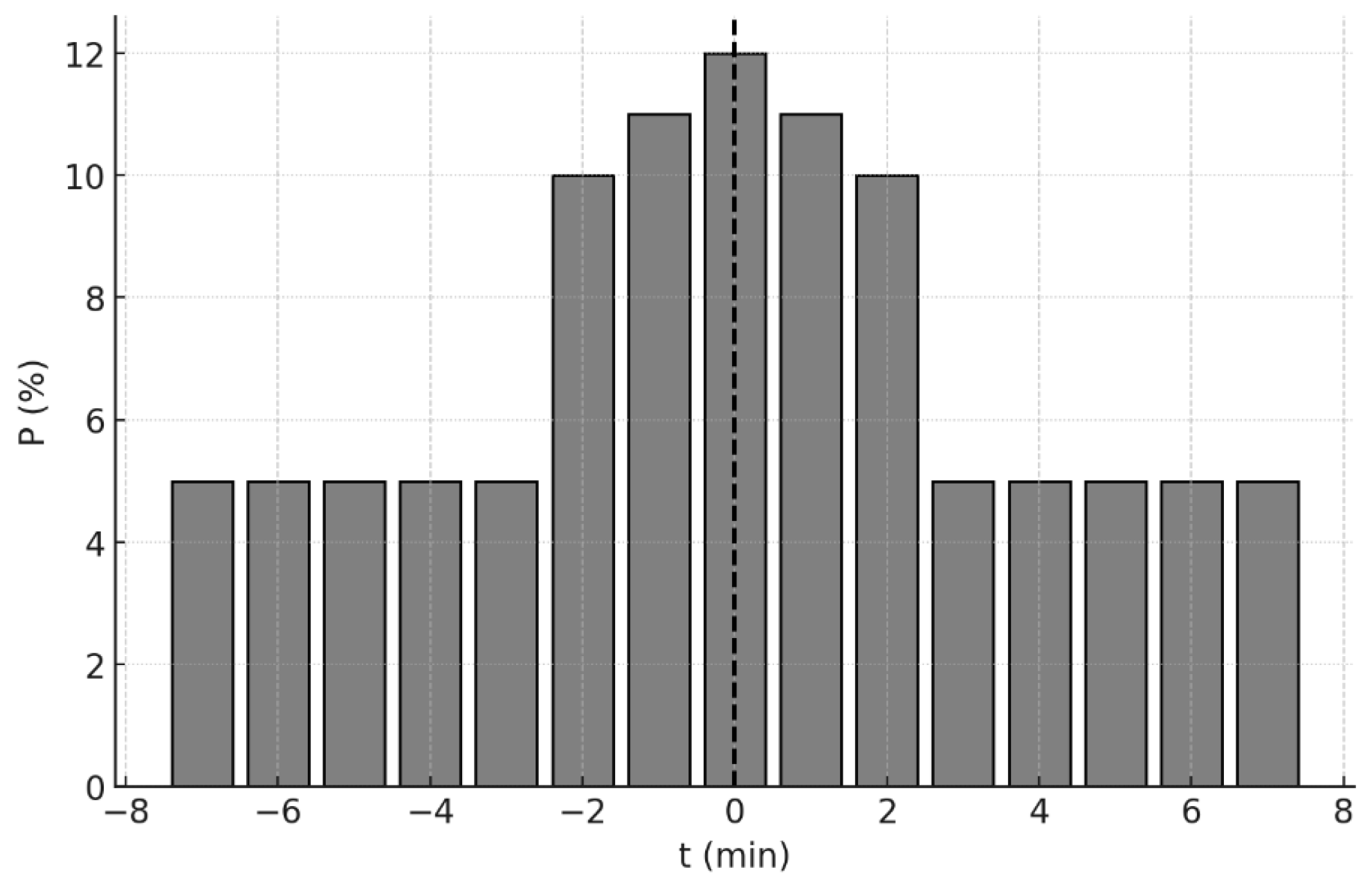
where t E r r , A and t E r r , D denote the arrival and departure time errors, respectively. A negative value indicates an earlier-than-expected event, while a positive value signifies a delayed occurrence. Research findings indicate that most travel survey reports follow a rounding convention in increments of 5 min intervals [21]. For instance, based on data from the National Household Travel Survey (NHTS), 82.87% of reported daily departure times are in multiples of 5 min [22]. According to studies by Rietveld et al., planned and unplanned activities both exhibit time deviation patterns, with four-minute intervals leading to larger deviations than five-minute intervals. In this context, if a user’s reported time is not a multiple of 5 min, it is considered less reliable [21]. Thus, the time adherence condition can be expressed as:
t A T A = t E T A t E T A mod 5 0 t A T D = t E T D t E T D mod 5 0
Thus, based on the above theoretical analysis, the probability distribution of error deviations is given as Figure 4:
Based on the above theoretical analysis, the probability distribution of time deviation errors is formulated as follows:
I t = 1 i t i P i

4.2.2. SOC Level

The SOC level of an EV plays a crucial role in determining its participation in scheduling. The SOC state directly affects the EV’s available charging and discharging capacity, which in turn defines its credibility for scheduling. When power demand requires an EV to provide support via discharging, the available regulation capacity is determined by the difference between the current SOC level and the target SOC level S O C d . The method to obtain the dynamic SOC limits is through the safe charge and discharge range provided in real time by the battery management system, and regression analysis of historical charge and discharge data to identify SOC limit trends under different scenarios. To quantify this, the charging credibility index I S O C , c is defined as:
I S O C , c = ( S O C d S O C i ) Q S O C i < S O C d 0 S O C i S O C d
Similarly, when an EV provides discharge support for demand response, its SOC level constrains the available discharge capacity. Under normal conditions, the SOC level should not exceed certain safety thresholds, as exceeding them may negatively impact battery lifespan and the EV’s regular operation. Hence, the discharging credibility index I S O C , d is defined as follows:
I S O C , d = ( S O C i 0.2 ) · Q S O C i > 0.2 0       S O C i 0.2
Thus, based on the above theoretical analysis, the probability distribution of error deviations is given as follows:
I S O C = I S O C , d + I S O C , c

4.2.3. Historical Transaction Credibility

When an EV participates in regulation services, its historical transaction credibility serves as a key metric for evaluating the user’s contract fulfillment capability. If an EV user fails to provide services as per historical transaction records, it may adversely impact system stability. Therefore, we define the Historical Transaction Credibility Index I h i s to assess an EV’s compliance with past transactions. The Historical Transaction Credibility Index is calculated as follows [23]:
I h i s = k m R i t s + ( 1 k m ) R r e c , k < m R i t s , k m
Here, k represents the number of transactions in which an EV has participated in demand response, and m is the predefined transaction threshold. When the transaction count k is below m, the historical transaction data alone may be insufficient to reliably evaluate the EV’s credibility. In such cases R r e c is introduced for correction. The value of R r e c is set based on the operator’s experience when transaction records are insufficient, which may introduce some subjectivity. But it will be gradually replaced by the dynamic update mechanism during operation to reduce the impact of manual assumptions. Conversely, when k reaches or exceeds mmm, the historical transaction data is considered sufficient, and the R r e c can be directly applied.
The R r e c evaluates an EV’s fulfillment of past demand response transactions, and is calculated as follows:
R i t s = 1 1 1 T e t = 1 T e P c , t , r e a l + P d , t , r e a l P c , t , h i s + P d , t , h i s
where T e is the transaction period duration. P c , t , r e a l , P d , t , r e a l denote the actual charging and discharging power executed by the EV during demand response events. P c , t , h i s , P d , t , h i s represent the historical reported charging and discharging power values.
When historical transaction data is insufficient, the R r e c can be used for credibility estimation. This index is derived based on the EV’s physical characteristics and registration time, including battery capacity C, maximum charging/discharging power P, and vehicle registration duration T. The calculation formula is as follows:
R r e c = ω 1 C C max + ω 2 P P max + ω 3 T T max
where Cis the current battery capacity, and C max is the maximum battery capacity. P represents the discharging power, and P max is the maximum discharging power. T denotes the EV registration duration, and T max is the maximum observed registration duration. ω 1 , ω 2 , ω 3 are weighting coefficients.

4.2.4. Comprehensive Credibility Index

Finally, the overall EV credibility index I E V integrates transaction credibility I h i s , SOC credibility I S O C and EV punctuality I t , and is computed as follows:
I E V = α I t + β I S O C + γ I h i s
where α , β , γ are the weighting coefficients for different factors, satisfying α + β + γ = 1 .

4.3. AC Load Credibility Index

The credibility of AC loads quantifies their reliable adjustability during demand response events. Since AC load adjustment involves multiple factors, including operating time periods, comfort variations, and post-response recovery characteristics, this study adopts the approach from [24] and constructs three-dimensional credibility indices.

4.3.1. Time Period Credibility

The time-dependent nature of AC load credibility is particularly significant during demand response periods, as AC operating states may dynamically change. The following time period index is introduced to characterize the adjustability of AC loads over a response period:
I E U P = 1 t t m i d t e n d t s t a r t ,   t m i d ( t e n d t s t a r t ) t t m i d ( t e n d t s t a r t ) 0 else
where t e n d , t s t a r t represent the start and end times of the AC response period, respectively. The midpoint time t m i d is calculated as follows:
t m i d = t e n d + t s t a r t 2

4.3.2. Remaining Credibility

The credibility of AC loads depends not only on time periods but also on indoor temperature variations. The user’s comfort tolerance directly determines the stability of AC load response. Therefore, the comfort index I C F is introduced to quantify temperature regulation during the response period:
I C F = 1 ,   T e , min T i n T e , max 1 T i n T e , max T s e t , max T e , max ,   T e , max < T i n 1 T e , min T i n T e , min T s e t , min ,   T i n < T e , min
where T i n represents the indoor temperature, T s e t , max and T s e t , min are the preset upper and lower temperature limits of the simulated AC setting, and T e , min , T e , max denote the user-expected temperature comfort range.
This index is used to assess whether the AC load response meets user comfort expectations. If the temperature deviates from the user-defined comfort range, the credibility of the AC load response decreases.

4.3.3. Response Fatigue Credibility

During the demand response process, frequent participation of AC loads can lead to increased response fatigue. Therefore, the response fatigue index I R F , A C is introduced to reflect the impact of frequent participation on response fatigue. The shorter the recovery interval after a response, the greater the degree of response fatigue [18]:
I R F , A C = t t l a s t t s e t , R F ,   t t l a s t + t s e t , R F 1 ,   t t l a s t + t s e t , R F
where t l a s t represents the last participation time, and t s e t , R F is the expected recovery period. This index is used to quantify the recovery speed of AC loads after a response. If the recovery period is short, the credibility is higher; however, if the recovery time is prolonged or if there is a strong rebound effect, credibility decreases.

4.3.4. Comprehensive Credibility Calculation

By integrating the above three indices, the overall AC load credibility index is defined as:
I A C = ( I R F , A C I C F I E U P ) 1 3
I C F is the comfort index for AC load response based on temperature variations. I R F , A C is the response fatigue index, quantifying the impact of frequent participation in demand response. I E U P is the Extreme usage point index, reflecting the adjustability of the AC load over time.

4.4. Electrolytic Aluminum Load Credibility Index

As a large-scale industrial load, the electrolytic aluminum load has demand response capability that is primarily affected by its adjustable capacity and response fatigue. Therefore, the credibility index of electrolytic aluminum loads is assessed from two perspectives:

4.4.1. Response Capacity Index

The adjustable capacity of electrolytic aluminum loads is a key factor in determining their credibility. Since industrial loads must ensure stable production, their regulation range is typically constrained between maximum and minimum operating power. Hence, the response capacity index is defined as follows:
I R C = min ( P e , max P e ( t ) , P e ( t ) P e , min )
where P e , max and P e , min denote the maximum and minimum operating power of the electrolytic aluminum load, respectively, and P e ( t ) represents the current power consumption P e ( t ) .
This index is used to evaluate the load’s adjustable range under its current operating conditions. When the load power approaches the upper or lower limit, its available response capacity decreases, leading to lower credibility.

4.4.2. Response Fatigue Index

Frequent power regulation of electrolytic aluminum loads can impact the stability of production equipment and electrolytic cells. Over extended demand response cycles, the load may experience response fatigue, which manifests as prolonged recovery times or a decline in regulatory capability. Therefore, the response fatigue index is introduced to quantify the recovery dynamics of electrolytic aluminum loads after long-term regulation:
I R F , A l = t t l a s t t s e t , R F ,   t t l a s t + t s e t , R F 1 ,   t t l a s t + t s e t , R F
where t l a s t represents the last participation time, and t s e t , R F denotes the expected recovery duration required for the load to return to steady-state operation.

4.4.3. Comprehensive Credibility Calculation

To comprehensively evaluate the overall credibility of electrolytic aluminum loads, a geometric mean method is applied by integrating the response capacity index and the response fatigue index. The total credibility index for electrolytic aluminum loads is defined as follows:
I A l = I R C I R F , A l

4.5. BESS Credibility Index

Since BESS can precisely regulate charging and discharging during demand response and possess strong response capabilities, their credibility is generally considered the most stable. For simplicity, this paper assumes the credibility index of BESS to be constantly equal to 1:
I E S = 1
The assumption IES = 1 is based on storage devices being commercial units with mature BMS management and high response availability in the intraday period, so no extra uncertainty is introduced to simplify the analysis. Actual verification can be performed by checking operation records for execution success rate, BMS data for available capacity in key periods, and event records for faults and delays to ensure the assumption is reasonable.

5. Intraday Precision Coordinated Optimization

5.1. Construction of the Cost Objective Function

To optimize power system operating costs, this paper develops a cost objective function that comprehensively considers imbalance prices, power deviation penalties, and resource dispatch costs. The function aims to minimize the following power imbalance cost:
min f 1 = t = t 0 Δ T γ t s e l l Δ + P t + γ t b u y Δ P t + + C t E V + C t A C + C t E S + C t A l + C t P V
where t 0 represents the initial time of the current dispatch period.; Δ T denotes the intraday dispatch cycle duration, set to 4 h; γ t s e l l , γ t b u y represent the electricity purchasing price from the grid.; Δ + , Δ are positive and negative imbalance price factors. Multiplied by the day-ahead selling or buying price, they give the positive or negative imbalance price, which depends partly on the real-time market price. P t is a positive deviation in intraday (actual output > planned output, more generation/less purchase), and the extra power needs to be sold at the market settlement price. P t + is a negative deviation in intraday (actual output < planned output, less generation/more purchase), and power needs to be bought from the market, with the settlement price usually higher than the predicted day-ahead/intraday price. When a VPP has positive or negative deviations in intraday scheduling, the difference between actual and predicted prices causes revenue or cost changes. The model calculates the economic penalty or compensation based on the deviation and price difference to quantify the economic cost of forecast deviations.
The cost function is:
C t E V = a E V ( P t E V + P t E V ) / 2
where a E V represents the EV energy consumption coefficient, and P t E V denotes the aggregated charging or discharging power of all electric vehicles participating in the VPP at t, with positive values indicating charging and negative values indicating discharging:
C t A C = a A C ( P t A C ) 2 + b A C P t A C + c A C
where a A C , b A C , c A C are the cost coefficients of AC load regulation.
C t E S = λ e s ( P t B , c + P t B , d )
where λ e s represents the unit operating cost of the BESS.
C t P V = a p v Q + b p v P p v
where a p v , b p v denote the fixed operation cost coefficient and variable operation cost coefficient, respectively. Q is the total PV capacity, and P p v is the PV output capacity.

5.2. Construction of the Credibility Objective Function

To ensure the reliability of dispatch solutions, this paper constructs a credibility objective function, aiming to maximize the overall credibility of dispatchable resources in the power grid. This function comprehensively considers the credibility indices of EVs, loads, and storage resources, thereby enhancing the stability and execution reliability of demand response: f 2 = max ( I p v + I E V + I A C + I A l + I E S ) .

5.3. Constraint Conditions

1. Power Balance Constraint.
P s y s + ( 1 u E V ) P E V , c + ( 1 u A l ) P A l , c + ( 1 u B ) P B , c + ( 1 u g r i d ) P s e l l u E V P E V , d + P P V + P A C + u A l P A l , d + u B P B , d + u g r i d P b u y
where P s y s represents the required dispatch power of the system, and P b u y is the power purchased from the grid.
2. PV Constraints.
0 P P V P P V max
3. EV Constraints.
0 P E V , d u E V P E V , a 0 P E V , c ( 1 u E V ) P E V , a E E V , min E E V , a E E V , max S O C min S O C t S O C max
4. AC Load Constraints.
s . t T min T t i n T max P t A C + Δ P e 1 A C P A C max P t A C P e 2 A C P A C min
5. Electrolytic Aluminum Load Constraints.
0 P A l , c ( t ) P e , max P e ( t ) 0 P A l , d ( t ) P e ( t ) P e , min T e , min T e ( t ) T e , max I min I ( t ) I max t = 1 24 k η I ( t ) t = 1 24 k η I 0 ( t )
Above are the temperature constraint and the current constraint. The last one is the aluminum production constraint, which ensures avoiding frequent regulation to protect product quality. I 0 ( t ) is the electrolytic cell current when the industrial load does not participate in regulation. T is electrolyte temperature. I is the electrolysis current. η is the current efficiency. k is the heat transfer coefficient. These constraints ensure the aluminum load operates within safe limits: the first two limit the adjustable power, the temperature constraint keeps the electrolyte temperature within bounds, the current constraint maintains the electrolysis current, and the final constraint ensures the current meets the baseline requirement for stable industrial production.
6. BESS Contraints.
0 P B , c u B P max B , c 0 P B , d ( 1 u B ) P max B , d S O C min S O C t S O C max
These constraints ensure the charging and discharging power limits for the battery. The first two constraints regulate the charging and discharging power based on the battery’s operational status, and the last constraint limits the SOC within its allowable range.

5.4. Multi-Objective Optimization Based on Dual-Subpopulation Cooperative PSO

The economic objective is to minimize cost, and the reliability objective is to maximize credibility. These two objectives are in conflict. Traditional single-swarm algorithms often switch direction frequently and converge slowly. This paper uses a dual-swarm PSO. One swarm optimizes cost and the other optimizes credibility. They share non-dominated solutions through periodic information exchange and an elite archive. This keeps diversity, improves convergence, and allows the model to keep economic performance while maintaining stability and feasibility.
The original particle swarm is divided into two subpopulations, each solving Objective 1 and Objective 2, respectively. During the evolutionary process, both subpopulations maintain their own “subpopulation-best solutions” while periodically performing “information exchange” to share high-quality solutions. Additionally, they jointly maintain an external elite archive to store all non-dominated solutions.
The particle update process not only considers individual best and global best but also introduces the concept of “archive best”, which guides the dual-objective search toward Pareto front approximation. Unlike traditional linear transition mechanisms, this study adopts a dynamic inertia weight factor as referenced in [13], which improves the convergence performance of the algorithm.
Multi-Objective Optimization Process Using Dual-Subpopulation PSO:
1. Data Initialization: Randomly generate N particles with initial positions and velocities, assigning half to Subpopulation A and the other half to Subpopulation B. The external elite archive is initialized as empty. The algorithm parameters for subpopulations, the physical model parameters of flexible VPP resources, and the credibility model parameters are defined. The particle swarm is initialized, with each particle corresponding to a specific flexible resource dispatch scheme.
2. Subpopulation Preference Evaluation: The cost objective function and the credibility objective function are set, and the system’s operating cost, credibility, and constraint violation penalties are computed as the fitness value. The objective function is normalized using linear normalization, where each objective is scaled to a range [0, 1] based on its minimum and maximum values. The individual best solution of each particle is recorded, and all non-dominated solutions from the current iteration are stored in the external elite archive. Constraint violations are handled using the penalty method. When a particle violates constraints, a penalty is added to its fitness, discouraging infeasible solutions.
3. External Elite Archive Maintenance: When the number of solutions in the archive exceeds the limit, a crowding distance mechanism is applied to filter solutions, ensuring a more uniform distribution.
4. Velocity and Position Update: For velocity and position updates, particles in Subpopulation A are updated to improve Objective 1, while those in Subpopulation B are updated to improve Objective 2. Each particle updates its position and velocity by referencing its own individual best, the subpopulation best, and the external archive best. Thus, the overall velocity update is performed accordingly:
v i ( t + 1 ) = ω ( t ) v i ( t ) + α 1 ( t ) γ 1 [ p B e s t ( t ) x i ( t ) ] +   α 2 ( t ) γ 2 [ l B e s t ( t ) x i ( t ) ] + α 3 ( t ) γ 3 [ a r c h B e s t ( t ) x i ( t ) ]
where ω ( t ) represents the adaptive inertia weight; α 1 , α 2 , α 3 are the weight coefficients for different learning components, and γ 1 , γ 2 , γ 3 are random numbers in the range [0, 1]. The p B e s t ( t ) refers to the individual best solution, l B e s t ( t ) represents the best guide solution selected within the subpopulation, and a r c h B e s t ( t ) is the optimal guide solution selected from the external elite archive, ensuring that the algorithm evolves in the direction of the Pareto front. The leader is selected as the Archive Best, which is the best non-dominated solution stored in the external elite archive. This guides the particle swarm towards Pareto front approximation.
5. Adaptive Segmented Transition Strategy:
ω = ω e + ( ω s ω e ) ( M I I T ) M I
where IT represents the current iteration count., MT is the total number of iterations. ω s , ω e are the initial and final values of the inertia weight factor. The adaptive inertia weight ω\omegaω decreases with iterations to balance global and local search. When the Pareto front is complex and the exchange period is not suitable, it may cause local convergence. To avoid this, the external elite archive and information exchange are used to guide the search with diverse non-dominated solutions during the weight decrease, reducing the risk of being trapped in a local Pareto front.
6. Subpopulation Interaction and Reallocation: Every G generations, the two subpopulations exchange part of their non-dominated solutions, allowing Subpopulation A to gain more information about Objective 2 and Subpopulation B to learn more about Objective 1. The setting of G is not a fixed empirical value. The exchange period G is situational and cannot be quantified. It is dynamically adjusted based on convergence characteristics and the diversity of the Pareto front. Typically, a longer exchange period is used initially, and shorter periods are used later.
7. Termination Conditions and Output: The algorithm terminates when either the maximum number of iterations M is reached, or when the external elite archive remains unchanged for multiple consecutive updates, indicating convergence.
The details are presented in the Table 2.
Partitioning the particle swarm into two sub-swarms and exchanging information periodically effectively approximates the Pareto front, but it also faces issues of higher computational complexity and potential inconsistent optimality, especially in large-scale problems. Future work could explore ways to reduce computational complexity and improve algorithm efficiency.

6. Example Analysis

6.1. Parameter Settings

The parameters in this study are categorized into two types: system operation and model parameters and multi-objective PSO parameters. The detailed parameter sittings are presented in the Table 3 and Table 4:
PSO parameters:
Table 4. Multi-objective PSO parameters.
Max IterationsSwarm SizeGrid Inflation FactorLeader Selection PressureArchive/Repository SizeDeletion PressureMutation Rate
5001500.121001.50.2

6.2. Multi-Objective Optimization Results

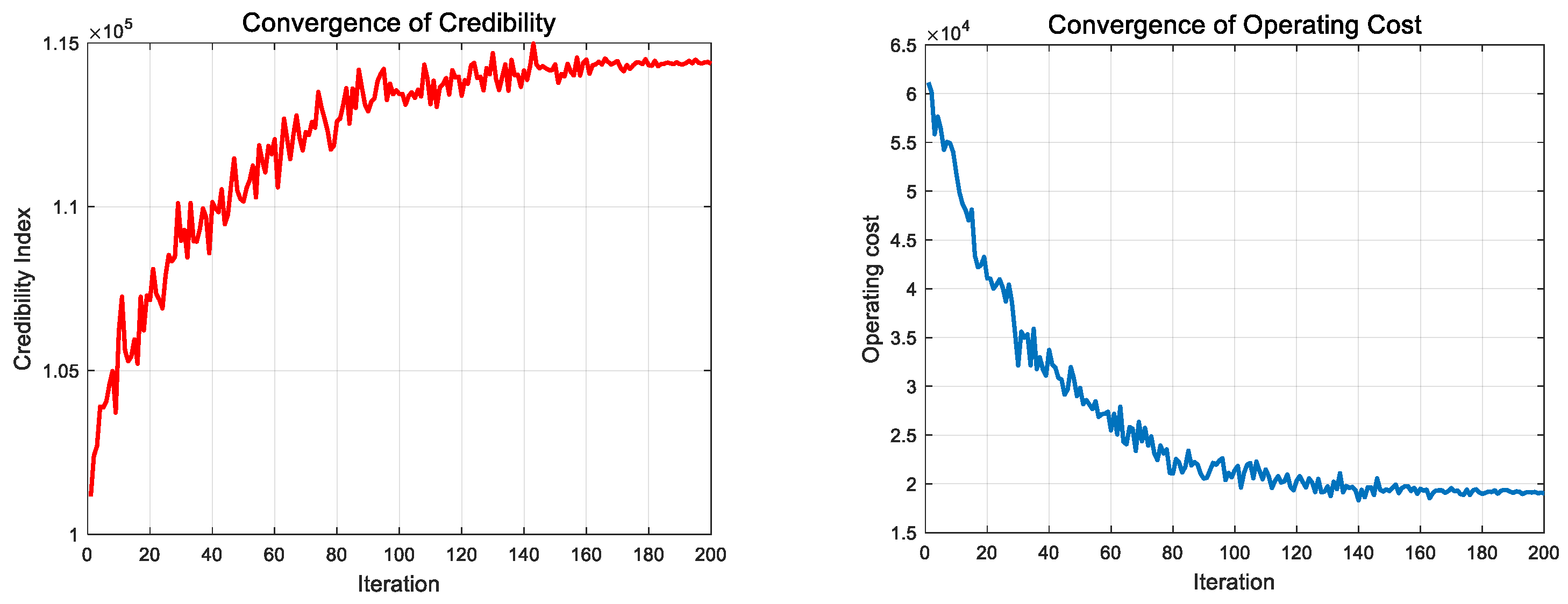
The results of the convergence test are as follows:
The convergence behavior of the proposed MOSPO algorithm is shown in Figure 5. The operating cost curve exhibits a clear downward trend and gradually stabilizes as the optimization progresses, demonstrating that the algorithm can effectively improve economic performance while maintaining search stability. Meanwhile, the credibility index increases progressively and eventually reaches a steady state, indicating that the multi-objective mechanism is able to consistently enhance system reliability during optimization. The stable trends observed in both curves confirm that the proposed method achieves convergence and maintains robustness in the optimization process.
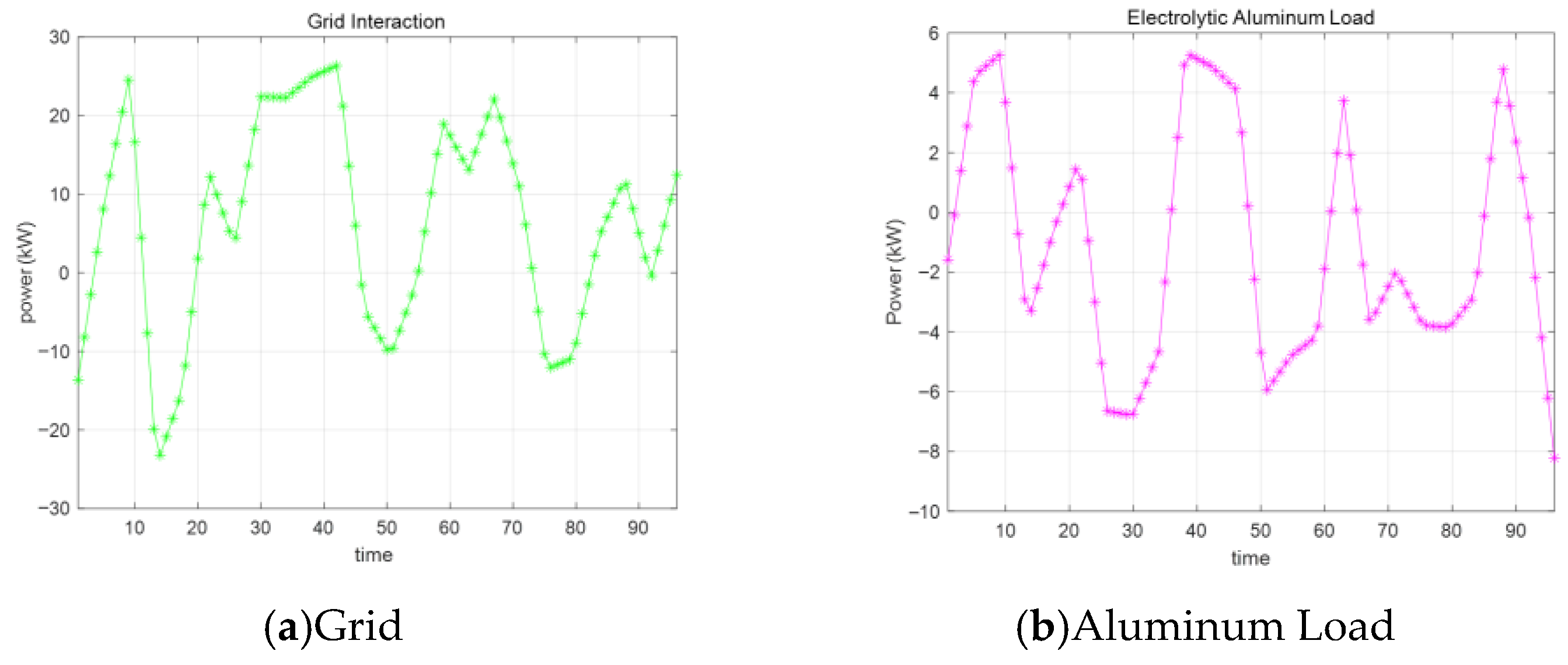
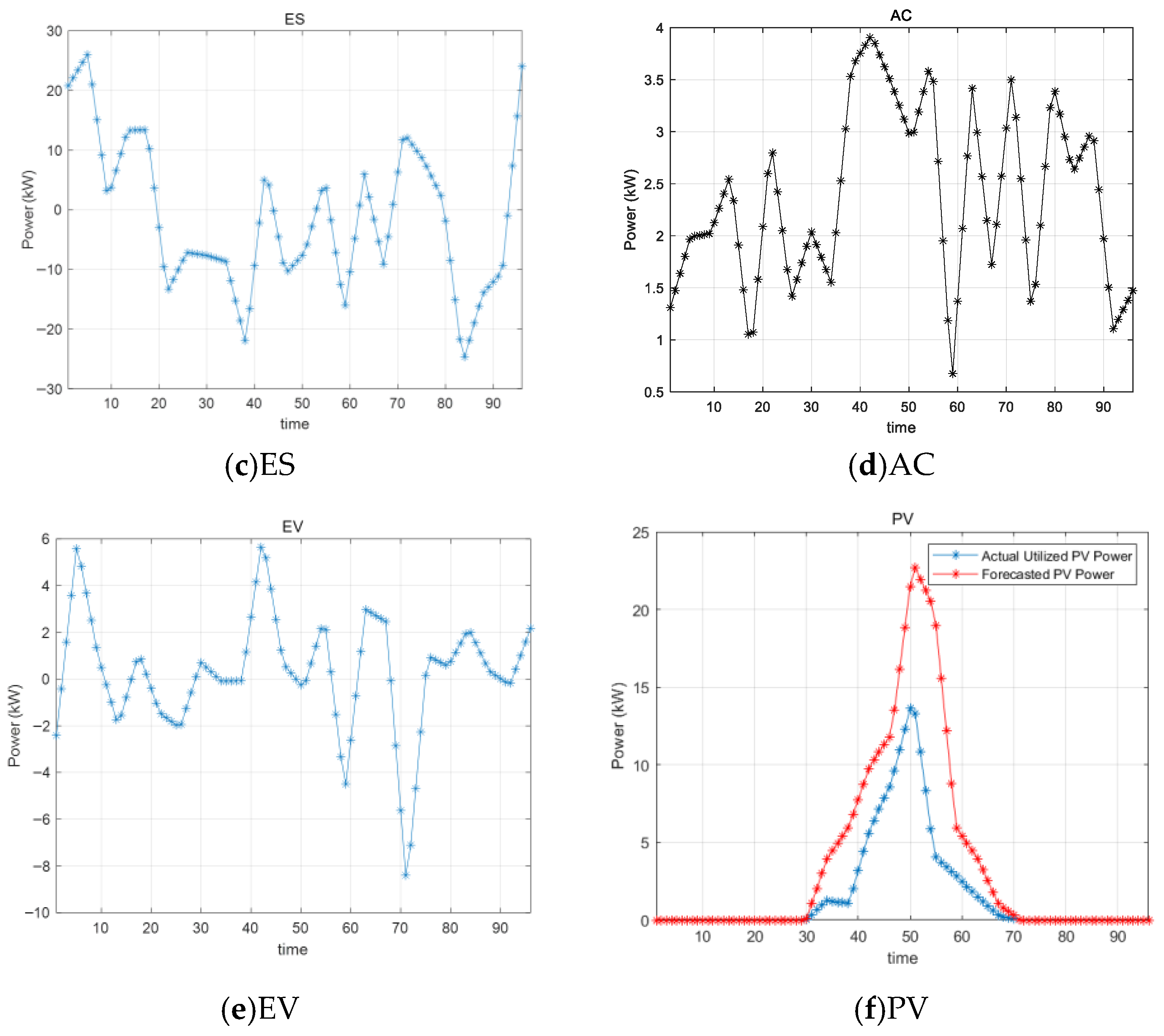
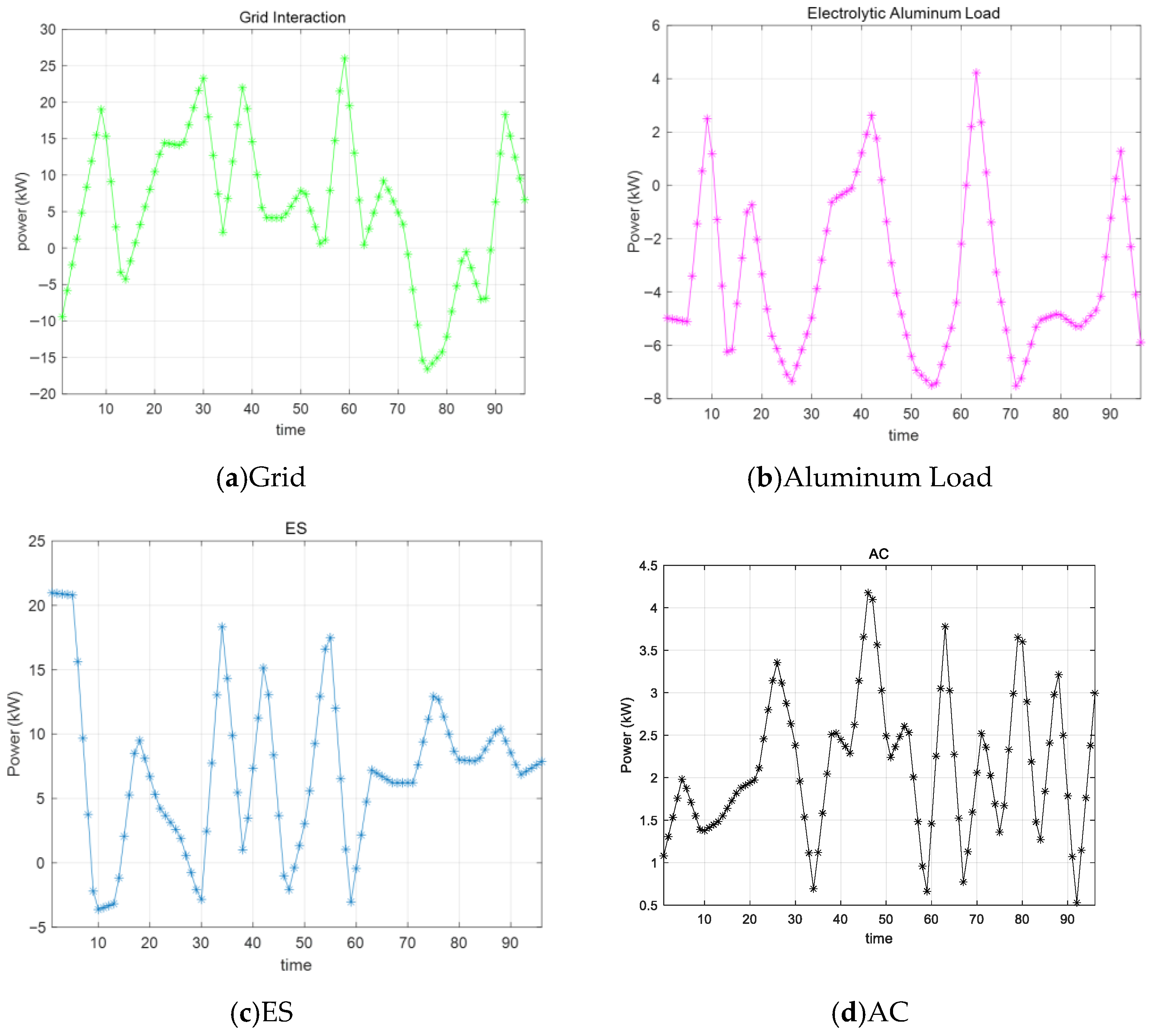
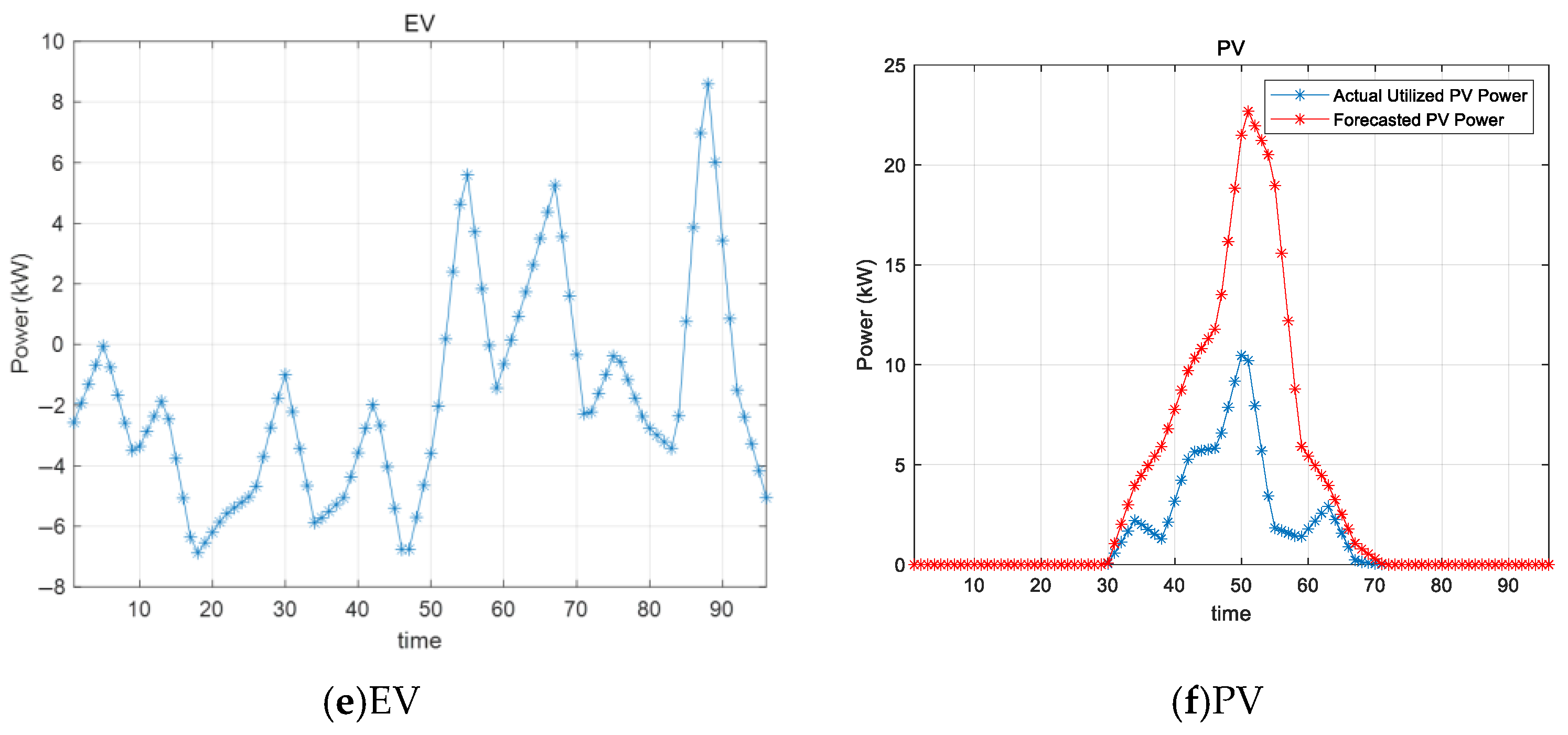
From the Figure 6, it can be observed that the interaction power with the main grid exhibits positive and negative fluctuations across different time periods, indicating that the VPP achieves dynamic balance between purchasing and selling electricity through flexible scheduling. The industrial load shows significant fluctuations, reflecting its high energy intensity and intermittent process demands. The AC load undergoes multiple significant variations during both daytime and nighttime, suggesting that user comfort preferences and external temperature jointly influence its power adjustment magnitude. The AC frequency and power level oscillate over time, demonstrating real-time regulation during demand response. The EV load is influenced by vehicle connection periods and SOC levels, resulting in a relatively concentrated fluctuation range. PV generation peaks at noon, and a comparison between the actual and predicted curves reveals some deviations, highlighting the need to account for the stochastic nature and uncertainty of renewable energy output in intraday optimization. Overall, various resources exhibit strong time-varying characteristics and uncertainty, fully reflecting the complexity and flexibility of VPP operations in multi-energy management. The results are presented as follows:

6.3. Optimized Cost Results with Imbalance Price Coefficients Results

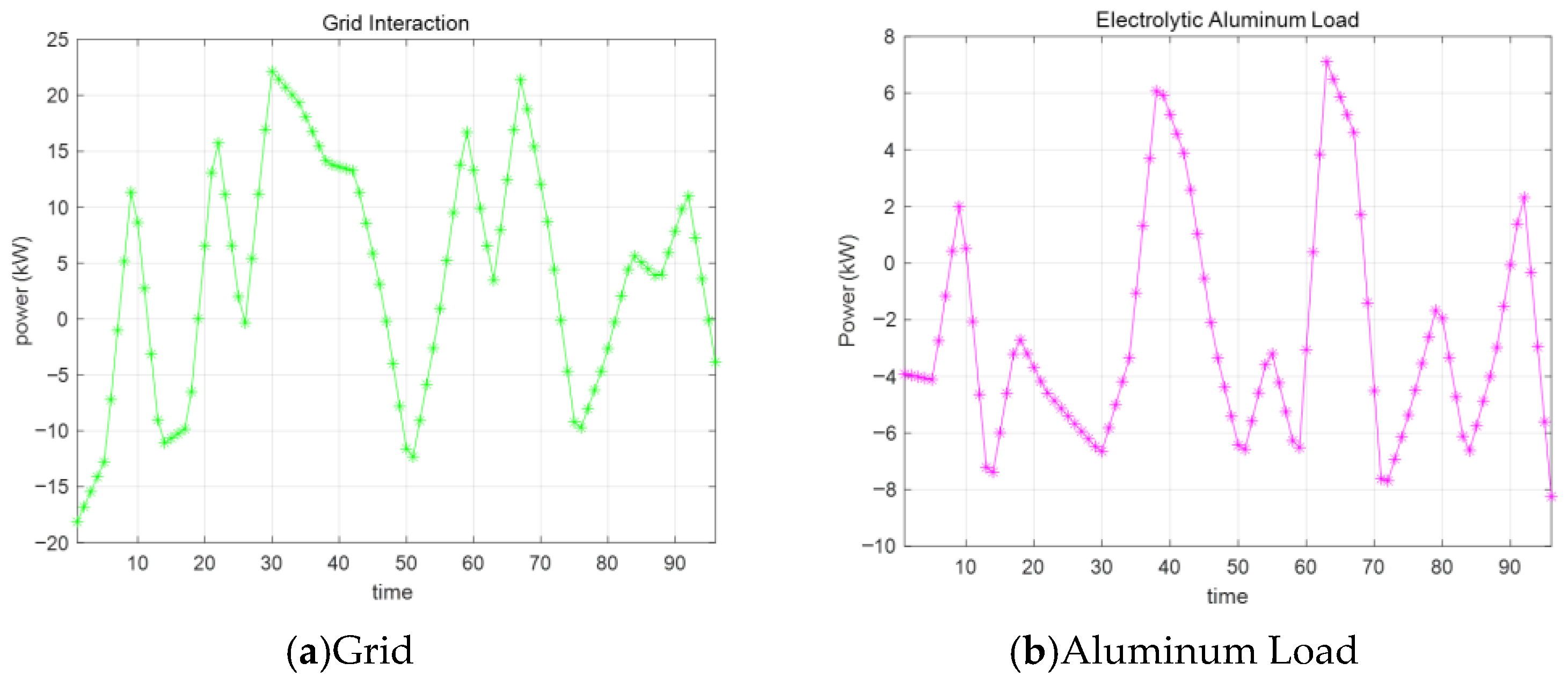
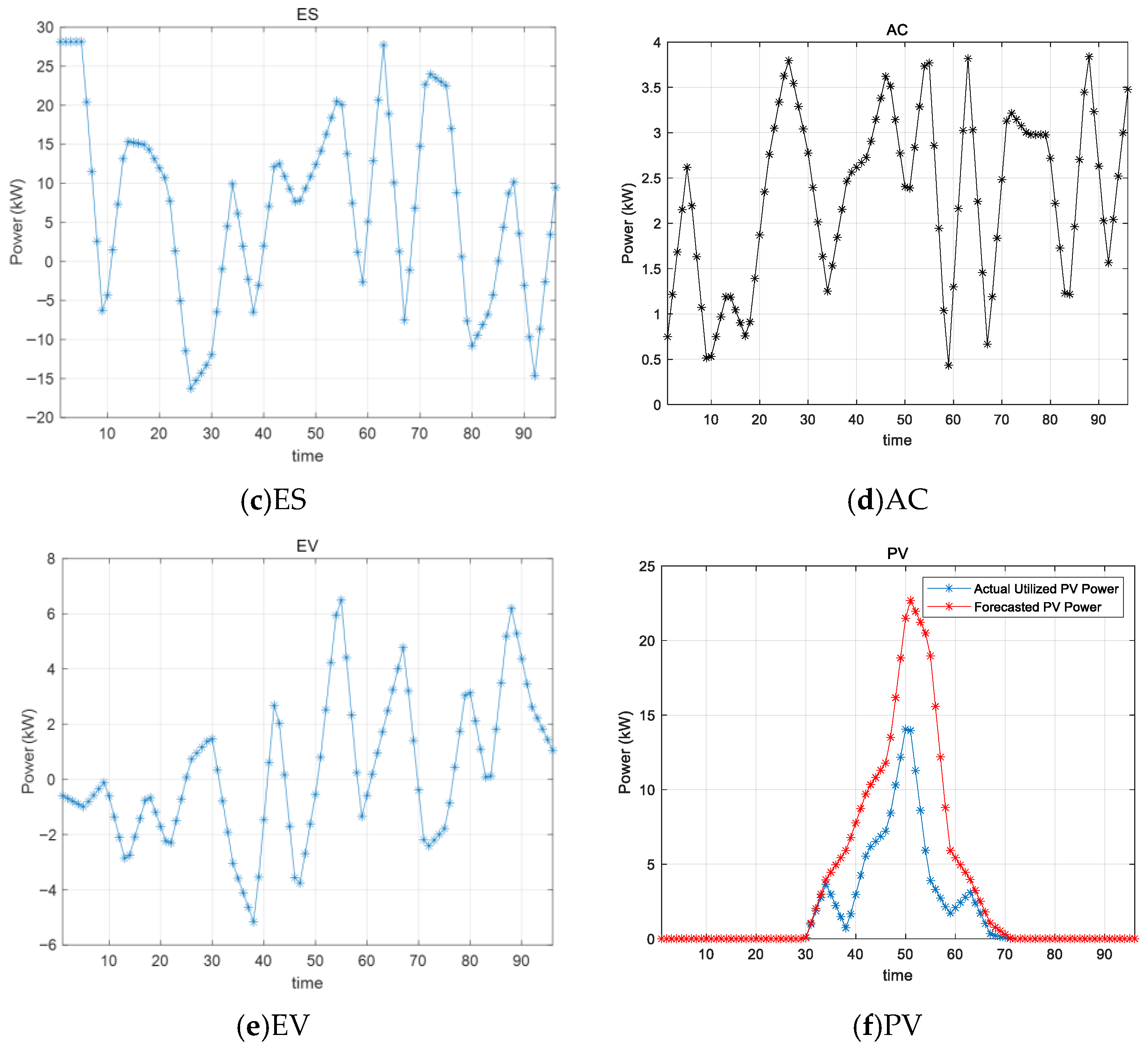
Comparison of Figure 6 and Figure 7:
In terms of power variation range and smoothness:
In dual-objective regulation, the power fluctuation range is relatively smaller, showing smoother power variations. This indicates that when considering credibility, the VPP may be more inclined to adopt a robust regulation strategy to ensure stable resource utilization and reliable grid operation. When only cost is considered, power fluctuations become more intense, especially during demand peaks or troughs. This strategy may reduce costs, but it could sacrifice system stability and reliability.
In terms of response consistency and resource utilization:
Dual-objective optimization is more inclined to balance the utilization of various resources, achieving a more balanced system operation state. As shown in the figure, the output of each resource is more coordinated and consistent in the dual-objective strategy. In the single-objective cost strategy, some resources may experience sharp increases or decreases, which may lead to uneven resource utilization, uneven system stress distribution, and further affect equipment lifespan and maintenance costs.
In terms of overall system performance:
The dual-objective strategy not only pursues cost optimization but also considers overall system performance, such as reliability and response stability. This means that when facing grid demand fluctuations, it can provide more reliable services, reducing negative impacts caused by grid fluctuations. The single-objective strategy may focus too much on economic efficiency, ignoring the long-term health and stability of the grid, which may result in insufficient response capability when encountering unexpected events in actual operation.
From the overall quantitative comparison of different strategies, the bi-objective optimization achieves more balanced benefits compared with single-objective cost optimization: the former reduces the VPP’s intraday scheduling total cost by 6%~8%, while improving system reliability by 12%~15%. After introducing the positive and negative imbalance price penalty, compared with the scheme without this mechanism, the power deviation decreases by 14%~18%, effectively avoiding additional economic losses caused by forecasting deviations. In general, the multi-objective coordination strategy shows significant advantages in cost control and reliability guarantees.

6.4. Standard Cost Minimization Results

Compared to Figure 7 and Figure 8, the cost function considering positive and negative imbalance price coefficients results in smoother output for various resources. This is because the cost function, by introducing penalties via price coefficients, incentivizes the VPP to adjust its output during peak and low-load periods of the grid, in order to avoid significant power fluctuations, thereby reducing potential grid stability issues caused by rapid variations. Moreover, the VPP tends to increase its output during grid demand peaks and reduce its output during low-demand periods. This strategy effectively addresses grid load fluctuations, helps balance the supply-demand relationship of the grid, and enhances the economic operation efficiency of the system. It significantly improves the balance of resource utilization, especially in the coordinated operation of renewable energy and energy storage facilities. Through precise cost control and resource scheduling, the VPP can ensure cost efficiency while also optimizing resource allocation, reducing losses caused by excessive or insufficient resource utilization.
Compared to 6.3 and 6.4, the cost reduction in Figure 7 comes from the timing optimization of storage and EV after adding the imbalance price. In Figure 5, storage and EV only charge at low prices and discharge at high prices based on peak–valley prices. In Figure 7, the model considers penalty costs from price forecast errors. It charges in low penalty or low price periods and discharges in high penalty or high price periods. This raises the value of each cycle without many extra cycles. In Figure 5, storage and EV work mainly in peak–valley periods, showing a two-period response with little use in the middle of the day. In Figure 7, they work in more periods through the day, forming a multi-period high-frequency response that improves resource use and deviation control.

6.5. Compare

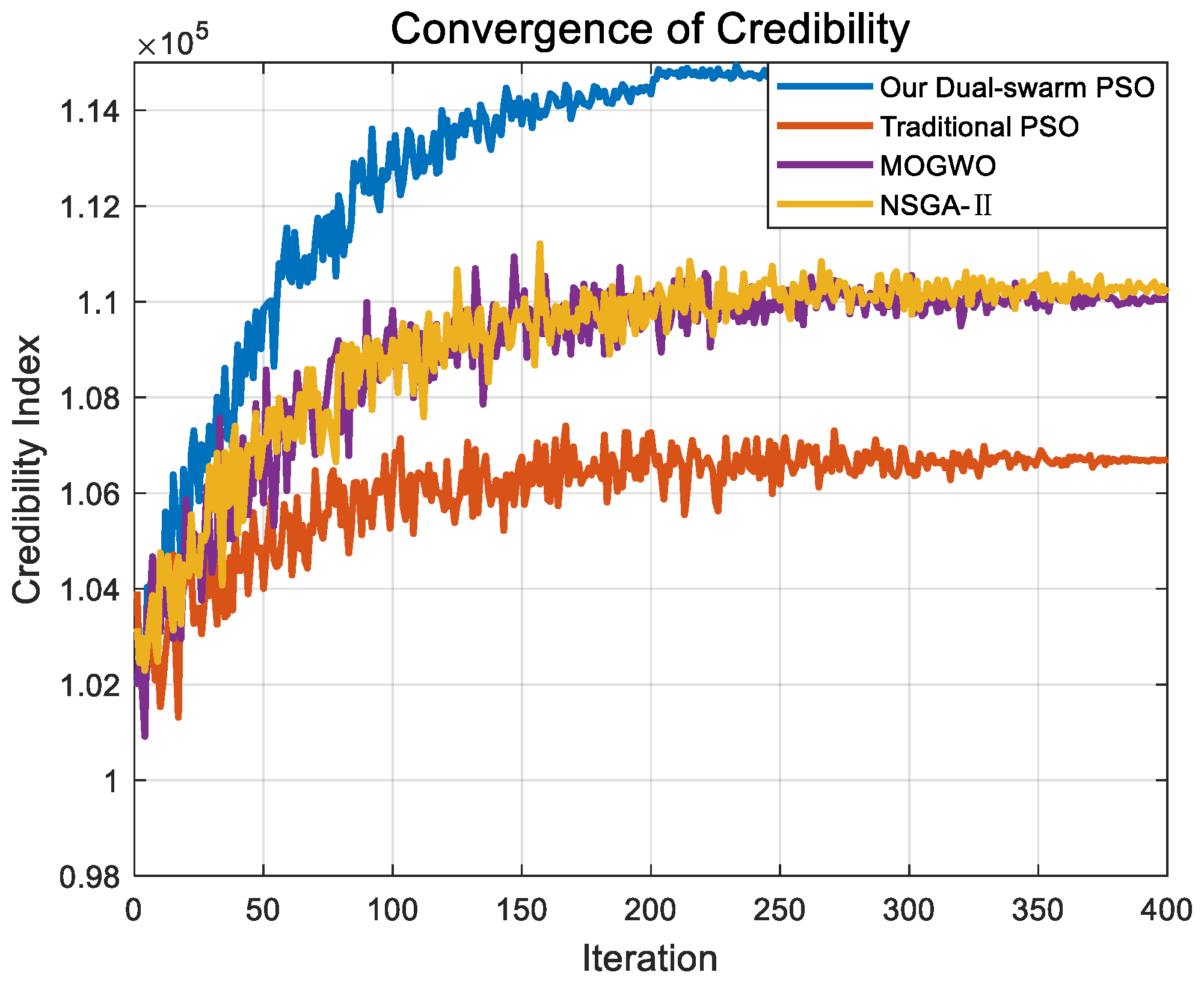
To verify the superiority of the proposed method, traditional PSO, NSGA-II, and MOGWO are selected for performance comparison shown in Figure 9, with the results shown in the Table 5:
Our method outperforms other methods mainly due to its “sub-swarm specialization + periodic information exchange” mechanism, which can accurately coordinate the conflicting objectives of cost and reliability, addressing the single-objective limitation of traditional PSO and the insufficient adaptability of NSGA-II to multi-resource coupling. Meanwhile, the introduction of dynamic inertia weight and external elite archive greatly improves convergence efficiency, being more than 40% faster than NSGA-II and 30% faster than traditional PSO. In addition, it has higher response sensitivity to constraints such as positive and negative imbalance prices, with a power deviation reduction rate 30%~50% higher than MOGWO, effectively avoiding economic losses caused by forecasting deviations.

7. Conclusions

This paper proposes a bi-objective cooperative optimization model for VPP scheduling based on a dual-swarm particle swarm algorithm, aiming to optimize both economic efficiency and reliability. The model addresses the limitations of traditional scheduling methods when facing uncertainties and forecasting deviations. By introducing imbalance price coefficients, we effectively account for the economic losses caused by forecasting errors and integrate reliability evaluations for various resources, including PV, EVs, AC, electrolytic aluminum loads, and energy storage. Simulation results show that the proposed method reduces the VPP’s operational costs while significantly improving system reliability and reducing power deviation. This study provides a new approach for intraday scheduling in virtual power plants and demonstrates the application potential of bi-objective optimization in multi-energy coordination. Future research could further integrate more real-world data and multi-scenario validation to enhance the practical applicability and scalability of the optimization model.

Author Contributions

Methodology, J.Z.; formal analysis, X.S.; resources, Y.L.; data curation, W.S. and J.J.; writing original draft preparation, J.J. and Y.G.; writing-review and editing J.Z. and X.S.; supervision, Y.L.; project administration, W.S. and Y.G. All authors have read and agreed to the published version of the manuscript.

Funding

Research and Application of Large-Scale Regional Demand-Side Resource Collaborative Interaction Technology: 090000KC22120002.

Data Availability Statement

The original contributions presented in this study are included in the article. Further inquiries can be directed to the corresponding author.

Conflicts of Interest

Authors Jun Zhan, Xiaojia Sun, Yang Li and Wenjing Sun are employed by the company Shenzhen Power Supply Bureau Co., Ltd. The remaining authors declare that the research was conducted in the absence of any commercial or financial relationships that could be construed as a potential conflict of interest.

References

  1. Kang, C.; Du, E.; Guo, H.; Li, Y.W.; Fang, Y.C.; Zhang, N.; Zhong, H.W. Primary Exploration of Six Essential Factors in New Power System. Power Syst. Technol. 2023, 47, 1741–1750. [Google Scholar]
  2. Nosratabadi, S.M.; Hooshmand, R.-A.; Gholipour, E. A Comprehensive Review on Microgrid and Virtual Power Plant Concepts Employed for Distributed Energy Resources Scheduling in Power Systems. Renew. Sustain. Energy Rev. 2017, 67, 341–363. [Google Scholar] [CrossRef]
  3. Gao, Y.; Ai, Q. Research on Demand Side Response Strategy of Multi-Microgrids Based on Improved Co-evolution Algorithm. CSEE J. Power Energy Syst. 2021, 7, 8–16. [Google Scholar]
  4. Dong, Y.; Chen, Y.; Zhu, Y.; Liu, Y.; Hu, Z. Research on Coordinated Scheduling of Heterogeneous Loads in Smart Buildings Under Multi-time Scales. Acta Energiae Solaris Sin. 2024, 45, 210–217. [Google Scholar]
  5. Mo, L.; Lan, J.; Zhou, L.; Ye, M.; Ma, L.; Chen, H. Multi-timescale Frequency Regulation Control of Flexible Resources in Virtual Power Plant. Autom. Electr. Power Syst. 2024, 48, 76–86. [Google Scholar]
  6. Zhang, D.; Yun, Y.; Wang, X.; He, J. Multi-time Scale of New Energy Scheduling Optimization for Virtual Power Plant Considering Uncertainty of Wind Power and Photovoltaic Power. Acta Energiae Solaris Sin. 2022, 43, 529–537. [Google Scholar]
  7. Gao, Y.; Ai, Q. Novel Optimal Dispatch Method for Multiple Energy Sources in Regional Integrated Energy Systems Considering Wind Curtailment. CSEE J. Power Energy Syst. 2022, 10, 2166–2173. [Google Scholar] [CrossRef]
  8. Liu, J.; Hu, G.; Peng, J.; Li, W.; Yuan, Y. Low-carbon Economic-robust Optimization Scheduling of Multi-energy Complementary Virtual Power Plants. Proc. CSEE 2024, 44, 9718–9731. [Google Scholar]
  9. Niu, H.; Dou, W.; Yuan, J.; Li, C.; Li, Z.; Jing, T. Response Interval Evaluation Method of Virtual Power Plant Considering Multiple Uncertainties. Electr. Power Autom. Equip. 2024, 44, 145–153. [Google Scholar]
  10. Knutsen, D.; Willén, O. A Study of Electric Vehicle Charging Patterns and Range Anxiety. Department of Engineering Sciences, Uppsala University, Uppsala, Sweden, Rep. UPTEC STS13 015, June 2013. Available online: http://www.diva-portal.org/smash/record.jsf?pid=diva2%3A626048&dswid=516 (accessed on 19 August 2025).
  11. Gao, Y.; Ai, Q.; He, X.; Fan, S. Coordination for Regional Integrated Energy System Through Target Cascade Optimization. Energy 2023, 276, 127606. [Google Scholar] [CrossRef]
  12. Jiang, Z.; Gao, C.; Liu, Y.; Zhang, Z.; Ye, R.; Li, W.; Xie, Q. Multi-objective Scheduling Optimization of An Integrated Energy System Considering Variable Efficiency of Energy Conversion Devices. Power Syst. Prot. Control. 2025, 53, 71–83. [Google Scholar]
  13. Zeng, Y.; Zhao, H.; Liu, C.; Chen, S.; Hao, X.; Sun, X. Multi-objective Optimization Dispatching of Microgrid Based on Improved Particle Swarm Algorithm. Electr. Power Sci. Eng. 2021, 37, 1–7. [Google Scholar]
  14. Alsabbagh, A.; Wu, B.; Ma, C. Distributed Electric Vehicles Charging Management Considering Time Anxiety and Customer Behaviors. IEEE Trans. Ind. Inform. 2020, 17, 2422–2431. [Google Scholar] [CrossRef]
  15. Yan, L.; Chen, X.; Zhou, J.; Chen, Y.; Wen, J. Deep Reinforcement Learning for Continuous Electric Vehicles Charging Control with Dynamic User Behaviors. IEEE Trans. Smart Grid 2021, 12, 5124–5134. [Google Scholar] [CrossRef]
  16. Yin, S.; Ai, Q.; Wang, D.; Ding, Y.; Wu, J.; Xie, Y. Day-ahead Robust Bidding Strategy for Prosumer Considering Virtual Energy Storage of Air-conditioning Load. Autom. Electr. Power Syst. 2020, 44, 24–34. [Google Scholar]
  17. Song, M.; Gao, C.; Yan, H.; Yang, J. Thermal Battery Modeling of Inverter Air Conditioning for Demand Response. IEEE Trans. Smart Grid 2018, 9, 5522–5534. [Google Scholar] [CrossRef]
  18. Wang, C. Low-Carbon Economic Dispatch of Power System Considering Electrolytic Aluminum Load for Demand Response; Huazhong University of Science and Technology: Wuhan, China, 2022. (In Chinese) [Google Scholar]
  19. Yang, Z.; Chen, L.; Hao, L.; Xv, F.; Min, Y. Industrial Load Peak Regulation and its Secondary Frequency Regulation Capacity Assessment Considering Intra-Production Segment Characteristics. Power Syst. Technol. 2025, 49, 3613–3622. [Google Scholar]
  20. Zhang, N.; Kang, C.; Xiao, J.; Hui, L. Review and Prospect of Wind Power Capacity Credit. Proc. CSEE 2015, 35, 82–94. [Google Scholar]
  21. Rietveld, P. Rounding of arrival and departure times in travel surveys: An interpretation in terms of scheduled activities. J. Transp. Statist. 2002, 5, 71–82. [Google Scholar]
  22. Clarke, M.; Dix, M.; Jones, P. Error and Uncertainty in Travel Surveys. Transportation 1981, 10, 105–126. [Google Scholar] [CrossRef]
  23. Huang, Z.; Cheng, N.; Jiang, Y. Multi-time-scale Scheduling Strategy of V2G Aggregators Considering EV Peak Regulating Demand Response Reliability. High Volt. Eng. 2025, 51, 401–411. [Google Scholar]
  24. Ma, P.; Qi, J.; Xiong, Y.; Hu, K.; Han, Y.; Zhao, X. Demand-side Precision Peak Shaving Strategy Considering Response Reliability and Economy. Autom. Electr. Power Syst. 2025, 49, 176–186. [Google Scholar]
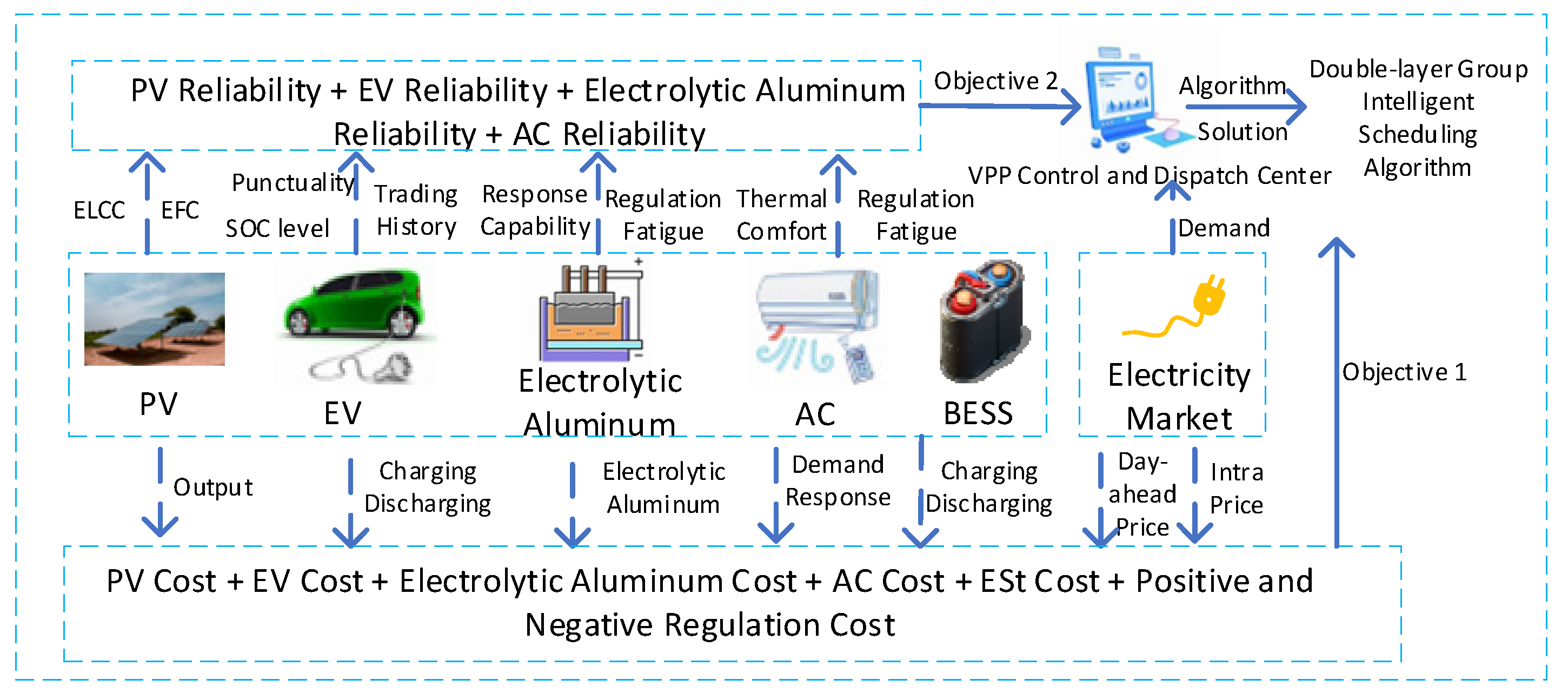
Figure 1. VPP Operational Framework and Optimization Method Overview:This figure illustrates the overall VPP operational framework, integrating resources such as PV, EVs, AC, electrolytic aluminum loads, and BESS, along with the dual-swarm particle swarm optimization method (created by the authors).
Energies 19 00473 g001
Figure 2. Equivalent Circuit Model of AC.
Energies 19 00473 g002
Figure 3. Electrolytic Aluminum Load Model.
Energies 19 00473 g003
Figure 4. The probability distribution of error deviations.
Energies 19 00473 g004
Figure 5. The results of the convergence test.
Energies 19 00473 g005
Figure 6. Dual-Objective Optimization Results without Imbalance Price Coefficients: This figure shows the dual-objective optimization results without imbalance price coefficients, focusing on the balance between cost minimization and system reliability.
Energies 19 00473 g006aEnergies 19 00473 g006b
Figure 7. Power fluctuations of different energy systems. (a) illustrates the power variation of the grid; (b) shows the power fluctuations of the electrolytic aluminum load; (c) displays the power fluctuations of the energy storage system; (d) depicts the power fluctuations of the air conditioning load; (e) presents the charging and discharging power variations of the electric vehicle; and (f) shows the power fluctuations of photovoltaic generation. Optimized cost results with imbalance price coefficients: This figure presents the optimization results with imbalance price coefficients, considering the economic losses due to forecasting deviations, and optimizing both cost and power deviation.
Energies 19 00473 g007aEnergies 19 00473 g007b
Figure 8. Power fluctuations of different energy systems. (a) illustrates the power variation of the grid; (b) shows the power fluctuations of the electrolytic aluminum load; (c) displays the power fluctuations of the energy storage system; (d) depicts the power fluctuations of the air conditioning load; (e) presents the charging and discharging power variations of the electric vehicle; and (f) shows the power fluctuations of photovoltaic generation. Single-Objective Cost Minimization Results: This figure shows the single-objective cost minimization results, focusing only on cost reduction, without considering system reliability or forecasting deviations.
Energies 19 00473 g008aEnergies 19 00473 g008b
Figure 9. Comparison of Algorithm Convergence.
Energies 19 00473 g009
Table 1. EV Participation in Dispatch.
Charging Participation DispatchDischarging Participation Dispatch
S O C < 20 %
20 % S O C S O C d
S O C > S O C d
Table 2. Dual-Subpopulation Cooperative PSO for Multi-Objective Optimization Algorithms.
Algorithm: Dual-Subpopulation Cooperative PSO for Multi-Objective Optimization
1. Initialize particle positions, velocities, divide into Subpopulations A and B, initialize Elite Archive.
2. Cold-start phase: Compute instance representativeness, select top representative instances, query labels and update target.
3. Main learning phase: Repeat until query budget is reached:
   - Compute fitness value and update particle positions
   - Compute label uncertainty, update target
   - Update prediction network
4. Termination condition: Terminate when max iterations or query budget is reached, output non-dominated solutions from Elite Archive
Table 3. System operation and model parameters.
EVACBESSElectrolytic Aluminum Load
SOCdSOCmaxSOCminQRCTinToutSOCmin η RcUacUR β
901002040 kWh 0.5   Ω 5 kWh/°C24 °C35 °C50.9 0.5   Ω 400 V10 V0.9
Table 5. Methods comparison.
Optimization MethodTotal Cost Reduction RateSystem Reliability Improvement RatePower Deviation Reduction RateConvergence Speed
Our method6.8%12.5%14.8%200 iterations
Traditional PSO3.4%4.6%7.9%350 iterations
NSGA-II4.5%8.1%10.2%400 iterations
MOGWO3.5%7.9%9.1%380 iterations
Disclaimer/Publisher’s Note: The statements, opinions and data contained in all publications are solely those of the individual author(s) and contributor(s) and not of MDPI and/or the editor(s). MDPI and/or the editor(s) disclaim responsibility for any injury to people or property resulting from any ideas, methods, instructions or products referred to in the content.