Article

Simulated Impact of Shortened Strings in Commercial and Utility-Scale Photovoltaic Arrays

1
Pordis LLC, Austin, TX 78729, USA
2
Florida Solar Energy Center, University of Central Florida, Cocoa, FL 32922, USA
*
Author to whom correspondence should be addressed.
Energies 2023, 16(21), 7222; https://doi.org/10.3390/en16217222
Submission received: 1 September 2023 / Revised: 17 October 2023 / Accepted: 20 October 2023 / Published: 24 October 2023

Abstract

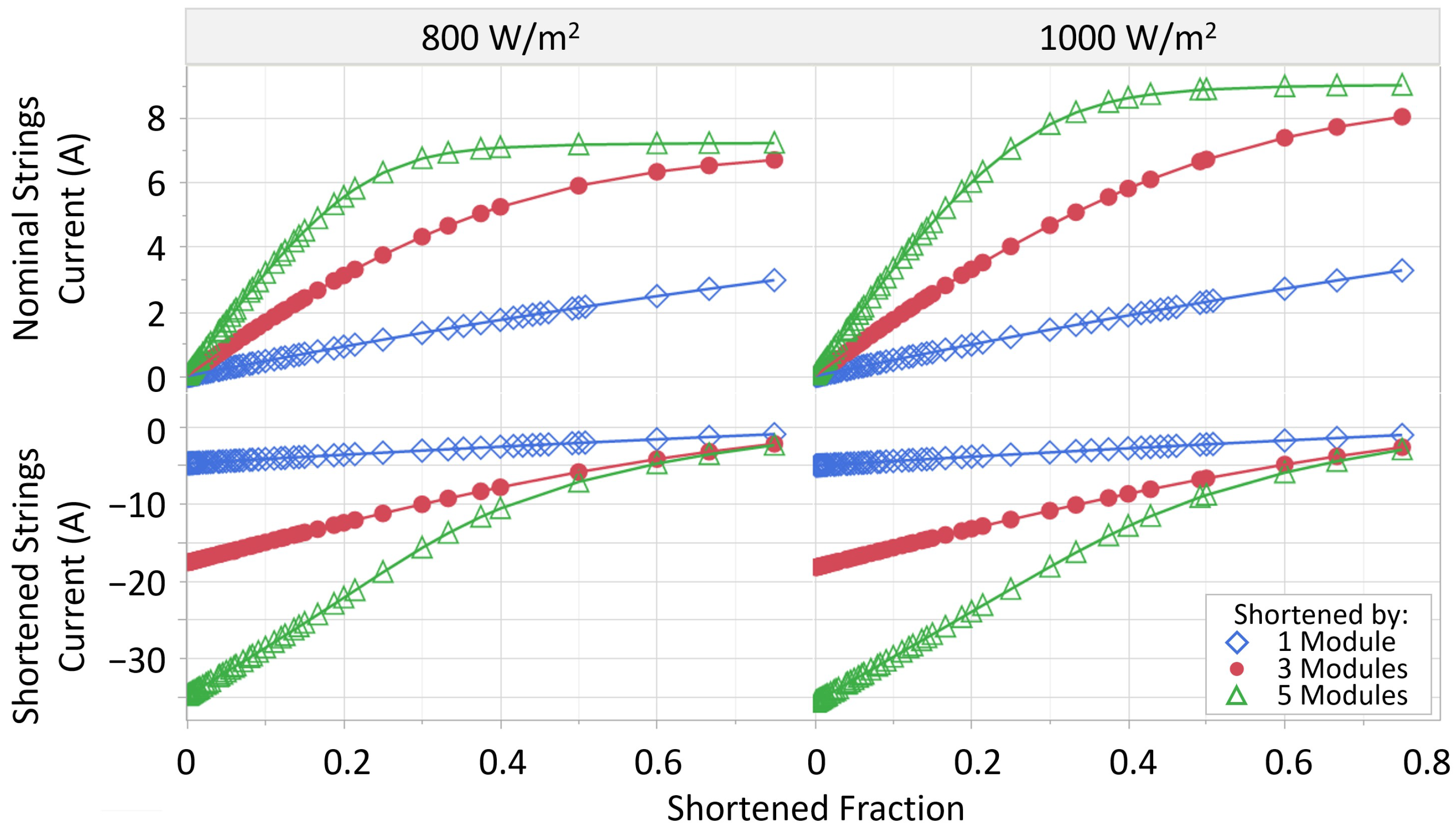
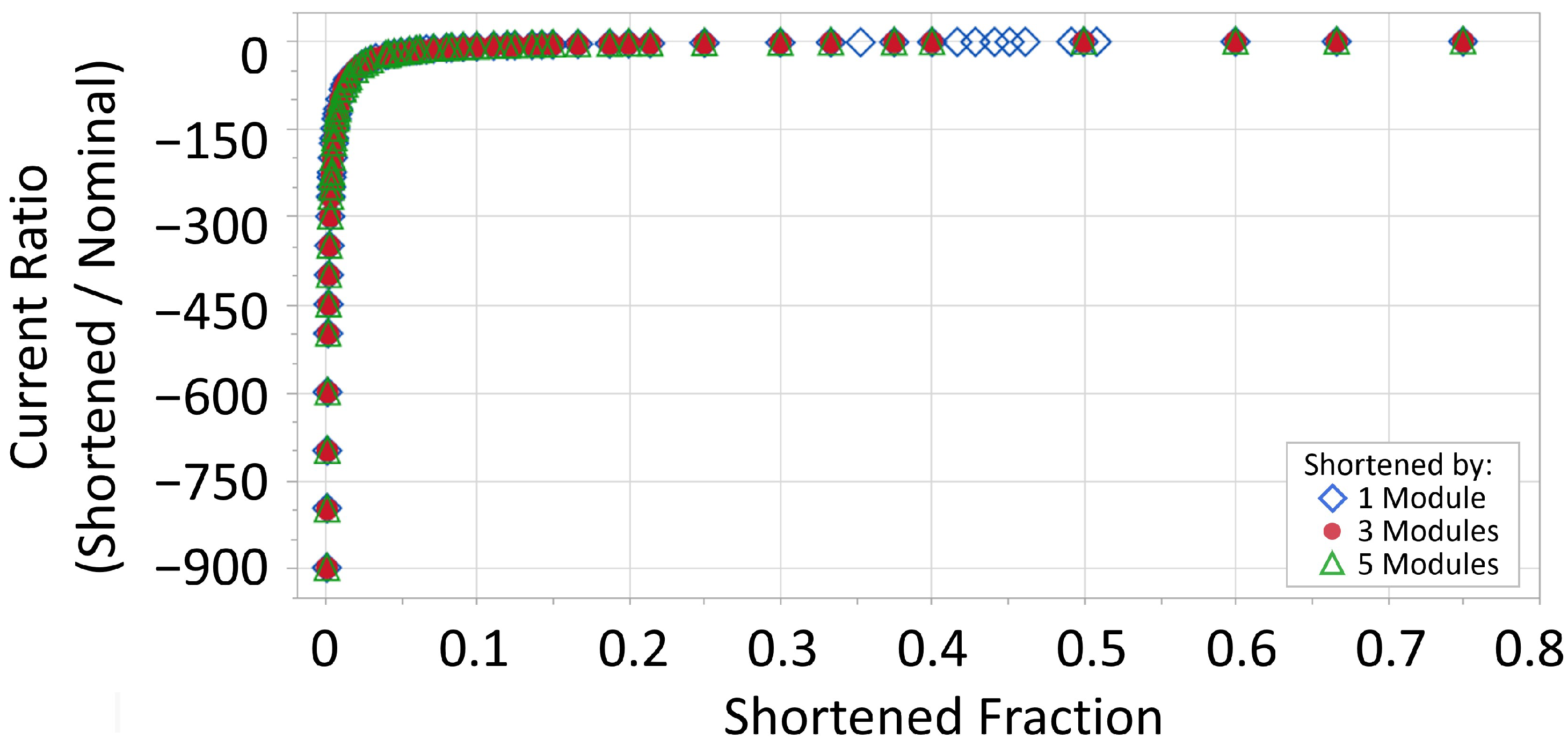
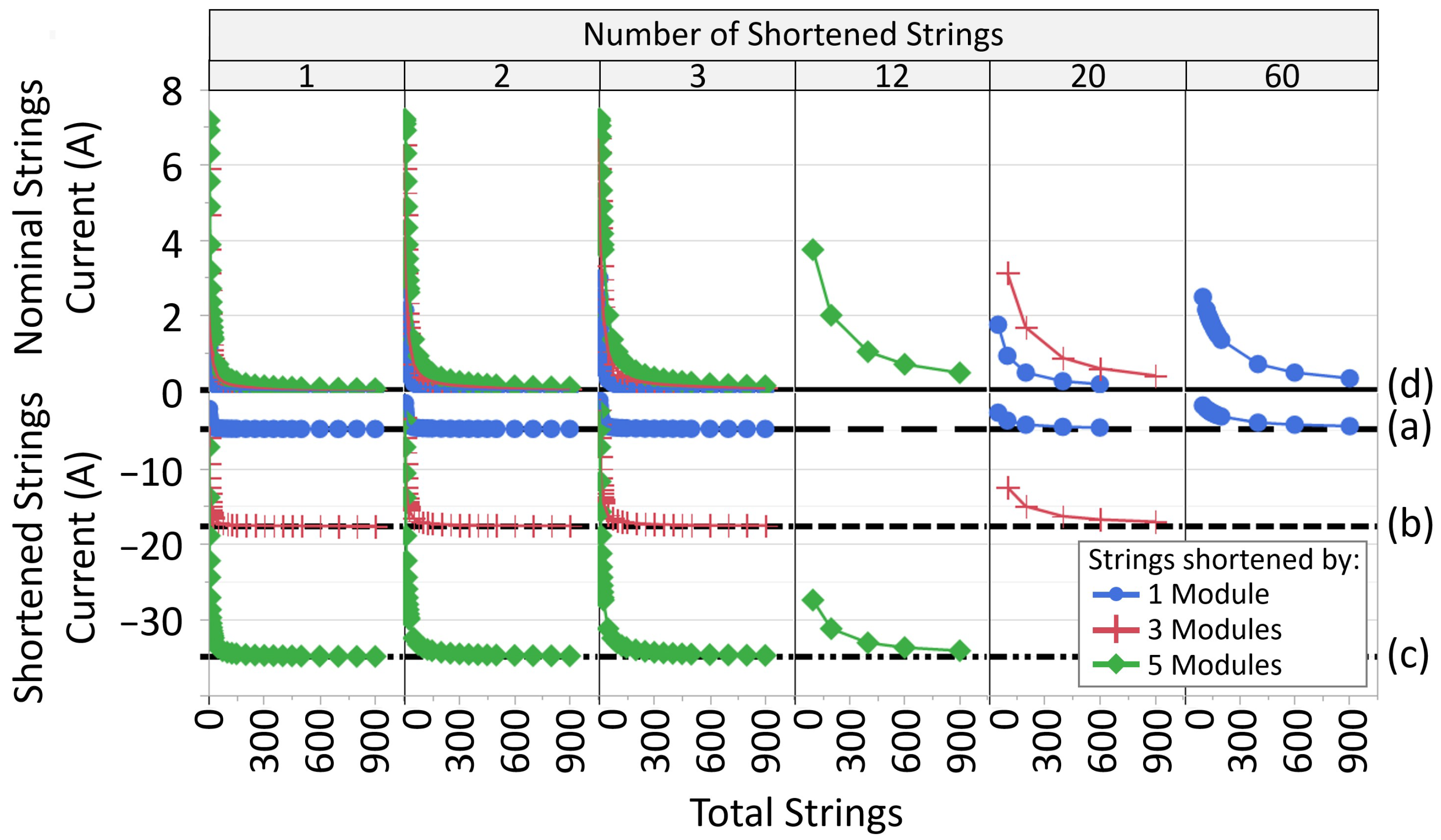
The deliberate removal of photovoltaic modules from a string can occur for various reasons encompassing maintenance, measurements, theft, or failure, reducing that string length relative to others when replacement modules are not available and there are not any viable alternative makes and models that could be inserted. This phenomenon, delineated in our prior experimentally validated research, manifests two significant effects: (1) a shift in the ideal maximum power point and (2) the induction of potentially substantial reverse currents in the shortened strings at open-circuit voltage, VOC. However, the scalability and asymptotic limits of these observed behaviors concerning array size remained undetermined. In this study, we elucidate the operational dynamics of such arrays by manipulating two mismatch-contributing variables in simulated arrays of up to 900 strings: the number of removed modules per string (indicative of the level of mismatch, ranging up to 5) and the quantity of shortened strings (1 to 60). Simulation outcomes underscore that mismatch severity impacts array operation more than the proportion of shortened strings. This research delves into the practical ramifications of operating with shortened strings, including implications for low-irradiance operation and the manifestation of deleterious reverse currents (>35 A in specific cases), emphasizing the need for careful array configuration for optimal performance and safety in these implementations.
Keywords: photovoltaic string; mismatch; reverse current; modeling; shortened; utility-scale photovoltaic string; mismatch; reverse current; modeling; shortened; utility-scale