Abstract
Compared to the voltage source inverter, the current source inverter (CSI) can boost voltage and improve filtering performance. However, the DC side of CSI is not a real current source, and the DC input current comprises a DC power supply and an inductor. In the switching process, the DC-link inductor is charged or discharged and is in an uncontrollable state. This paper proposes a novel CSI topology containing five switching tubes and a modulation strategy based on the hysteresis control strategy of the DC-link current. Due to the conduction and switching loss being positive to the DC-link current, the calculation method for the least reference value of the DC-link current is derived to meet power requirements. By constructing a virtual axis, we then present the control strategy of the output voltage in a two-phase rotating reference frame. Finally, we carry out the simulation and experiment are to validate the proposed topology, modulation, and control strategy.
1. Introduction
Inverters can be categorized as voltage source inverters (VSI) [1] and current source inverters (CSI) [2] according to the characteristics of input power supplies. Some unique advantages of CSIs have been discovered [3], such as their boost capacity, inherent short-circuit protection capacity, and AC filtering structure. CSI, therefore, has potential applications [4] in the solar photovoltaic industry, wind energy power generation, motor drive systems, and HVDC transmission systems.
In recent years, various control and modulation strategies for CSI have been proposed [5], such as decoupling methods, low common voltage modulation, and digital vector control strategy. However, the DC-link current is considered a constant value in the above studies in which the charging or discharging process of the DC-link inductor has been ignored, leading to the DC-link current being discontinuous or continuously increasing.
Unlike VSI, the DC-link current of CSI is formed by the DC input voltage DC-link inductor, and constant DC-link current output is a necessary condition for high performance operation of CSI [6]. In [7,8,9,10,11], several novel CSI topologies are proposed to achieve control of the DC-link current. In [7], a three-phase current source rectifier (CSR) is introduced to adjust the DC-link current, but this topology is very complex and only suitable for AC-DC-AC applications. A buck converter is added to the DC side to regulate the DC-link current in [8]. In [6], the buck converter is replaced with a bi-directional converter that can control the current, and the buck operation can also be realized. However, the switching and conduction losses increase as the converter is introduced. In [9], a buck-boost CSI is proposed, which has the advantages of a simple structure and large voltage output range, but the control strategy is difficult to implement. The current-fed quasi-Z-source inverter is proposed in [10]. However, with the addition of many passive components, both efficiency and power density are greatly reduced.
In [11], an additional switching tube and diode are connected in parallel with the DC-side inductor of the three-phase CSI. The DC-side inductor can self-continuate when the switch is turned on. During the zero vector period, the continuous current mode is used to replace the traditional magnetizing mode, which can prevent the increase of the DC-link current. On this basis, a novel single-phase five-switch CSI topology is proposed in this paper. The modulation and control strategies are studied to obtain the constant DC-link current and high-quality AC voltage output. Finally, the simulation and experimental verification are carried out.
2. Topology and Operating Modes of the Proposed Single-Phase CSI
2.1. Analysis of the Proposed Single-Phase CSI’s Operating Modes
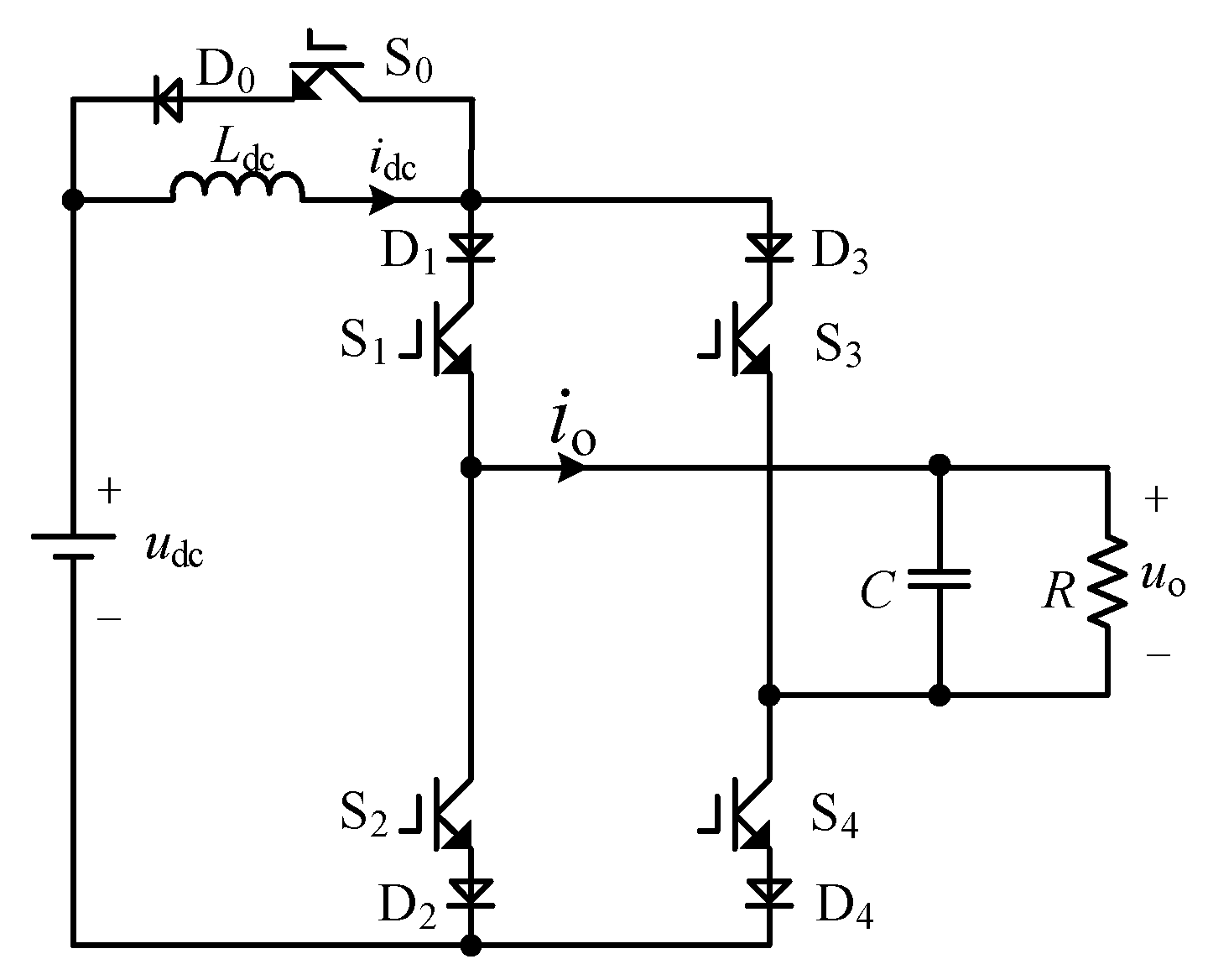
The topology of the proposed single-phase CSI is shown in Figure 1. The DC side is composed of a DC voltage source and DC-link inductance Ldc. The inverter part is composed of switching tubes (S1, S2, S3, S4) and diodes (D1, D2, D3, D4). The AC side contains the filter capacitor C and the resistive load R. The switching tube S0 and diode D0 are parallel with Ldc.
Figure 1.
The topology of the proposed single-phase CSI.
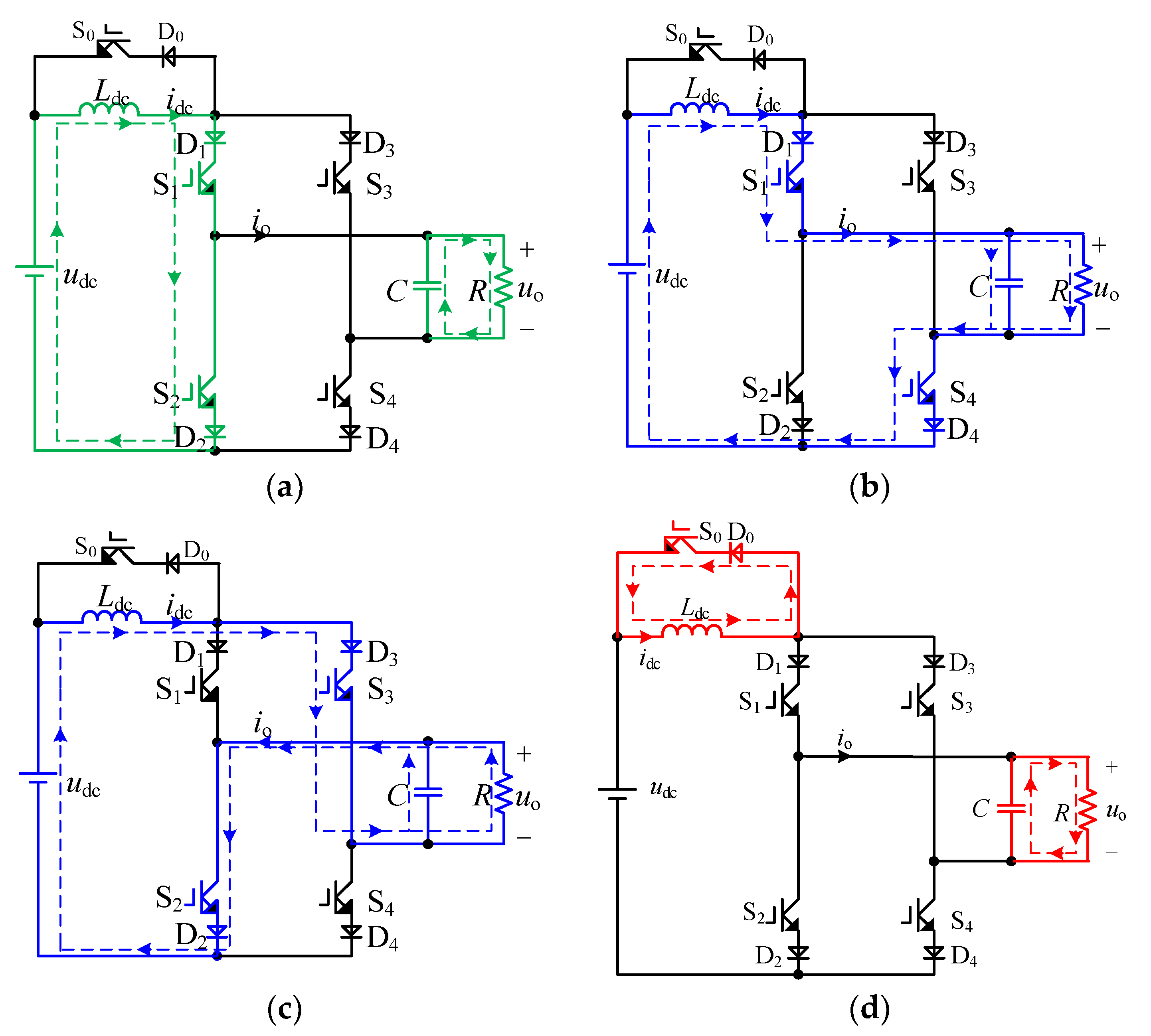
There are four operating modes of the proposed single-phase CSI. The corresponding switching states are shown in Table 1.
Table 1.
The operating modes, switching state, and switching function.
(1) Magnetizing mode: S1 and S2 are turned on, and the equivalent circuit under magnetizing mode is shown in Figure 2a. At this moment, io is equal to 0 A, the udc is charging to Ldc, and C provides energy for the load separately.
Figure 2.
The operating modes of the proposed single-phase CSI: (a) magnetizing mode; (b) energy-supplying mode I; (c) energy-supplying mode II; (d) freewheeling model.
(2) Energy-supplying mode I: S1 and S4 are turned on, and the equivalent circuit under this operating mode is shown in Figure 2b. At this moment, io is equal to idc, and the udc and Ldc provide energy to the AC load together.
(3) Energy-supplying mode II: S2 and S3 are turned on, and the equivalent circuit under this operating mode is shown in Figure 2c. Different from energy-supplying mode I, the polarity of the output current is negative; io is equal to −idc.
(4) Freewheeling model: Only S0 is turned on, and the equivalent circuit under the freewheeling model is shown in Figure 2d. The idc freewheels through S0, and C provides energy for the load separately.
Two switching functions (p and q) are defined and shown in Table 1. The p is used to indicate whether the CSI is operating in energy-supplying mode, and the math relationship between idc and io can be expressed as
The state equation of uo follows:
q is used to indicate whether the CSI is operating in magnetizing mode. The state equation of io follows:
Since the conduction current of all switching tubes is idc, the current stresses of all switching tubes are equal to the DC-link current. The voltage stresses can be derived according to Figure 2, and the voltage stresses of all switching tubes under different operating modes are summarized in Table 2.
Table 2.
Voltage stresses of all switching tubes under different operating modes.
2.2. Comparison of Different CSI Topologies
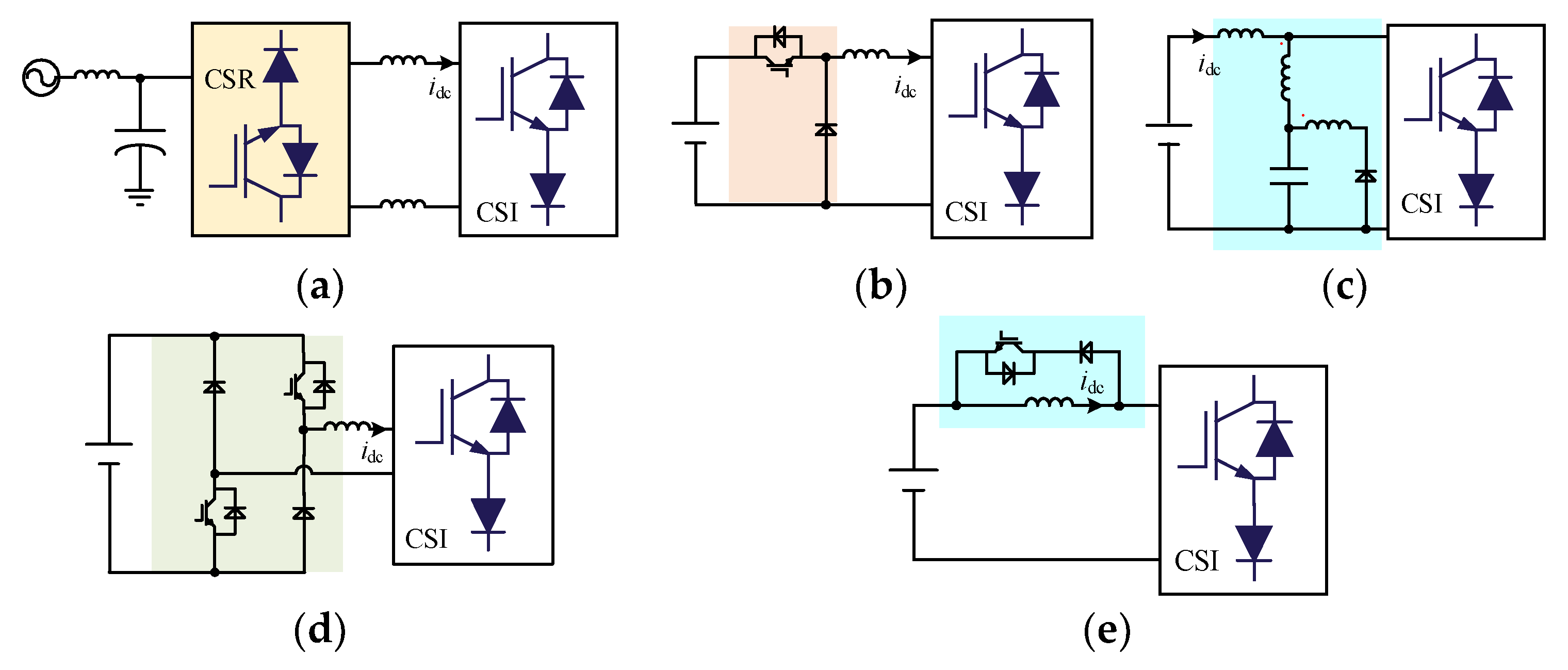
The recent literature presents many CSI structures comprising distinct tradeoffs among different topologies, as shown in Figure 3. According to [12,13], a cost function (CF) is established in (4) to carry out a fair comparison of different CSI topologies:
where NV is the number of DC voltages, NUS is the number of unidirectional switches, NBS is the number of bidirectional switches, ND is the number of diodes, NC is the number of capacitors, Ndrv is the number of individual drivers, NT is the number of transformers, and Nl is the number of output current levels.
Figure 3.
The topologies of different CSI: (a) current source rectifier; (b) buck converter; (c) quasi-Z source network; (d) bidirectional DC chopper; (e) proposed single-phase CSI.
The comparison result is presented in Table 3. Although the quasi-Z source network receives the lowest CF, it contains numerous passive components, and its control system is too complex. The proposed single-phase CSI and the buck converter have the same CF. However, the buck converter contains more switches than the proposed single-phase CSI. The bidirectional DC chopper’s CF is slightly higher than the proposed one because of the additional two diodes and switching tubes. The current source rectifier rates the worst CF because it includes too many components.
Table 3.
Comparison of different CSI topologies.
3. Modulation Strategy Based on DC-Link Current Control
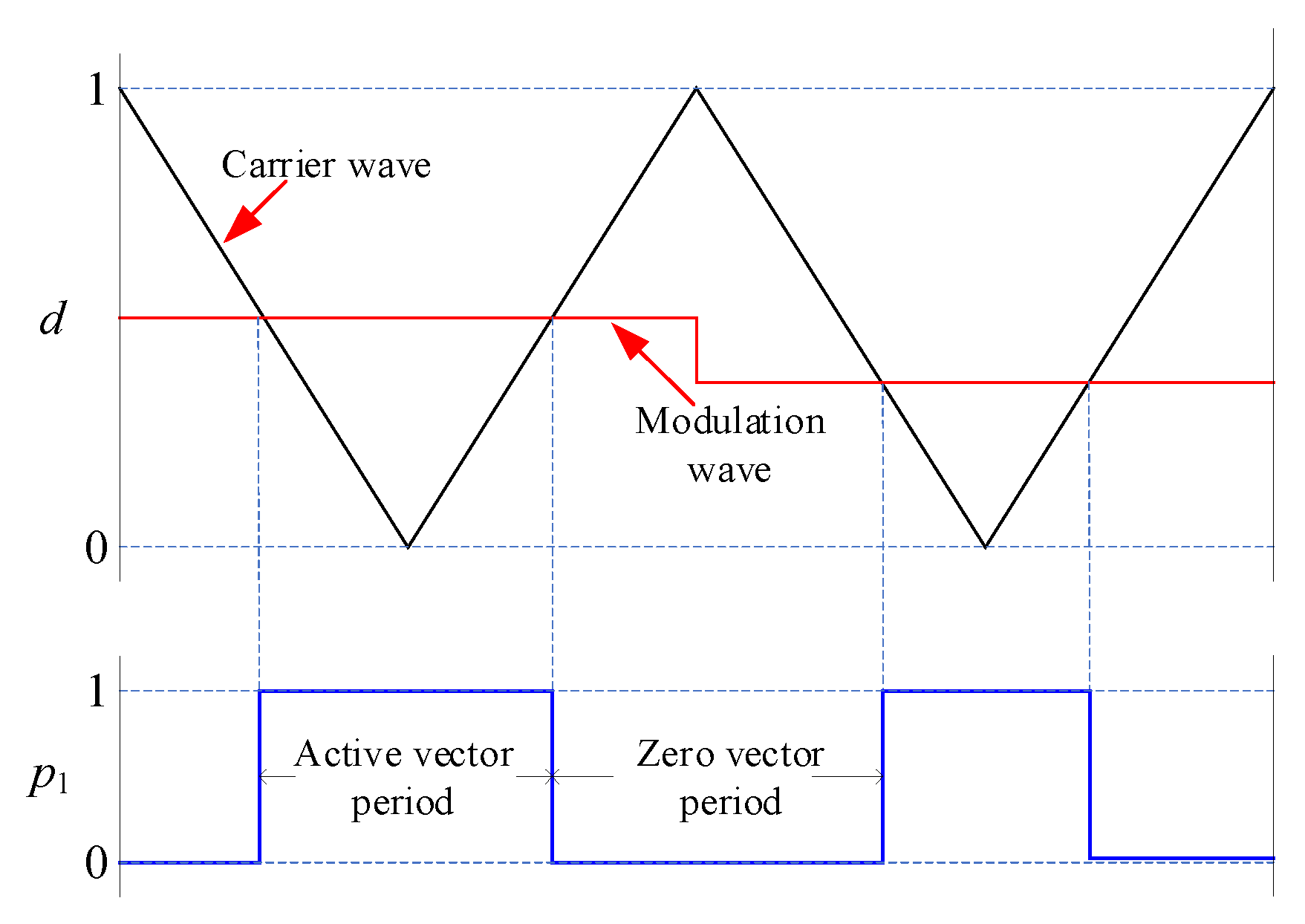
Unlike VSI, switching signals cannot be directly generated by comparing modulated signals with carrier waves [14]. In [15], a logic conversion circuit is adopted to convert the switching signals, which will delay them. In this section, a novel modulation strategy is presented which can be implemented by the DSP without a logic conversion circuit. Three logic signals (p1, p2, and p3) are set, where p1 represents the comparison result between the modulation wave and carrier wave, as shown in Figure 4, and where d is the duty cycle and is defined as
Figure 4.
The diagram of p1, carrier wave, and modulation wave.
p1 = 1 represents the active vector period, and the CSI operates at energy-supplying mode I or II, which is determined by the polarity of io. p2 represents the polarity of io. If io > 0, p2 = 1; otherwise, p2 = 0.
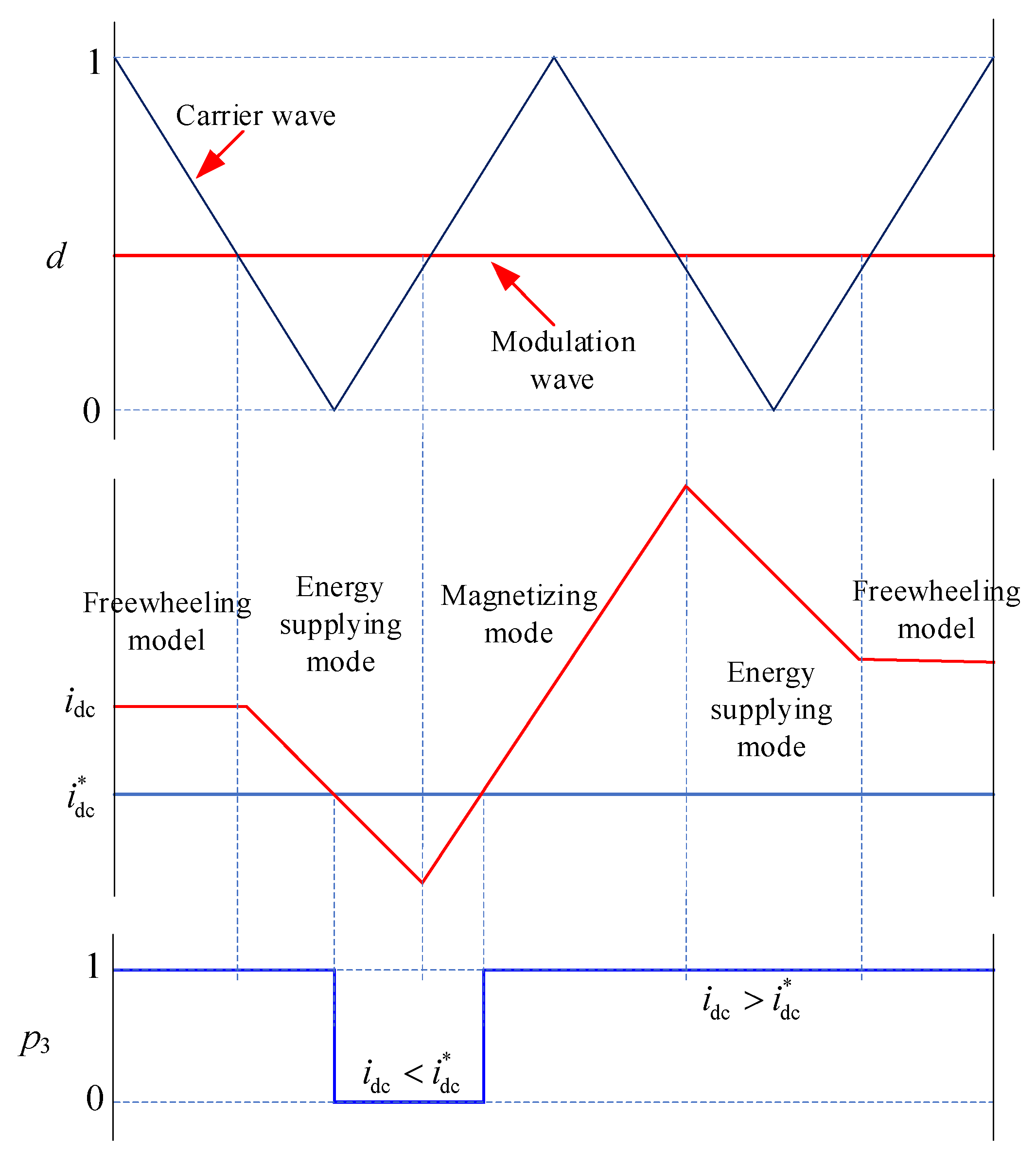
p1 = 0 represents the zero vector period, and the CSI operates on either the magnetizing mode or freewheeling model, which is determined by idc. If idc > the reference value , the freewheeling model will be selected to prevent idc from increasing in the zero vector period. Otherwise, the magnetizing mode will be implemented to charge Ldc in the zero vector period. p3 is defined to represent the math relationship between idc and . If idc > , p3 = 1; else, p3 = 0. The changing process of idc and p3 is described in Figure 5. idc can be adjusted according to p3. This approach belongs to a hysteresis control method [16].
Figure 5.
The changing process of idc and p3.
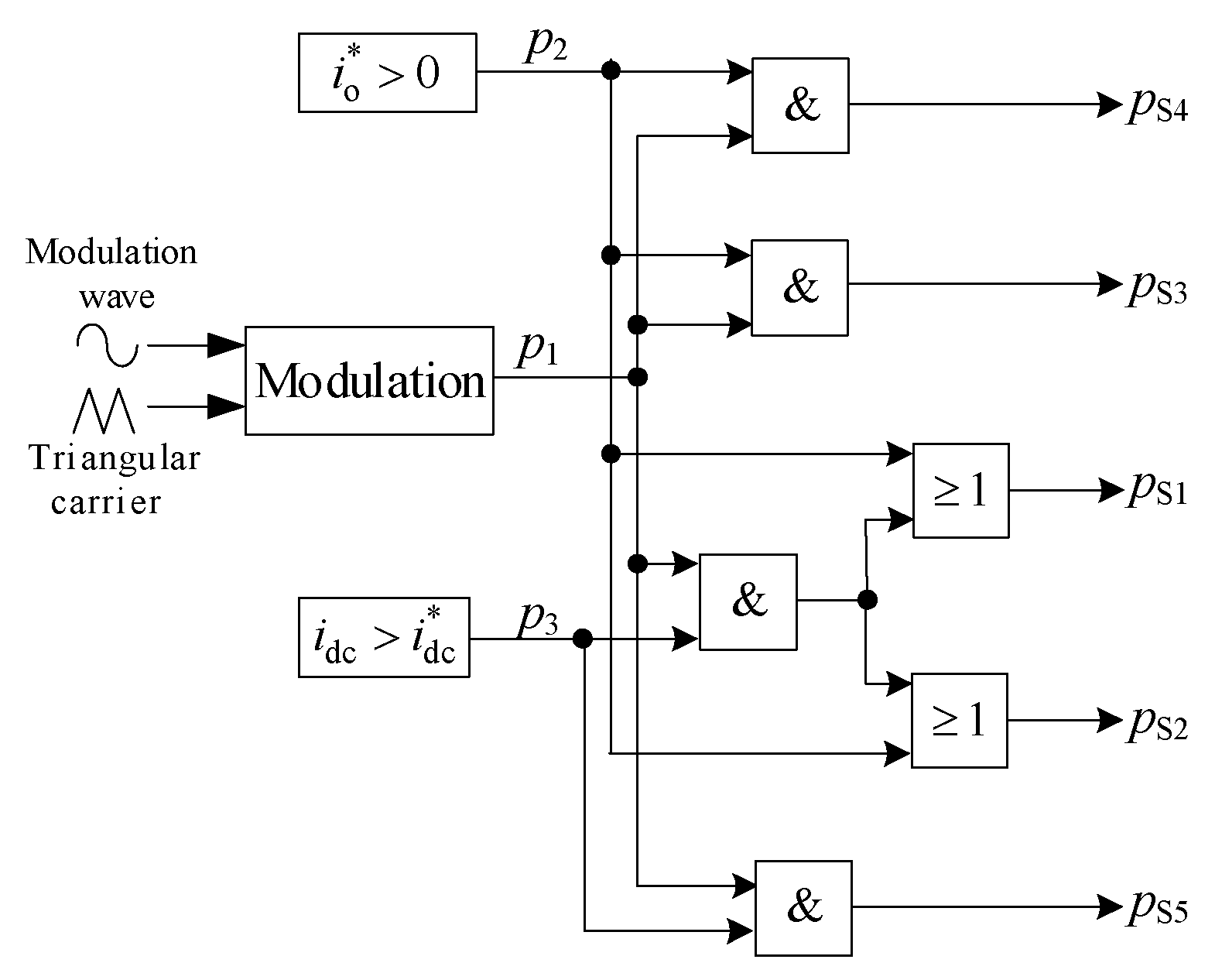
Based on the above settings and analysis, the production logic of the five switching signals is shown in Figure 6. The specific logic expression for each switching is described as follows:
where pS1, pS2, pS3, pS4, and pS5 represent the driving logic of switch S1, S2, S3, S4, and S5, respectively.
Figure 6.
Logical conversion for the proposed single-phase CSI.
4. Calculation for the Optimal Reference of DC-Link Current
In Section 3, a DC-link current hysteresis control is introduced into the modulation scheme. However, the reference of the DC-link current must be determined for the following reasons [17]. If is set too small, the DC-link current is unable to provide sufficient power to the AC load. If is set too great, the conduction loss, switching loss, and harmonic distortion will increase. Thus, the DC-link current should be reduced to satisfy the current requirements. The calculation method for the optimal reference of the DC-link current is derived in this section.
It is assumed that uo remains in a constant state in a switching period. Under energy-supplying mode, the reduction ∆idc_down of idc can be expressed as follows:
The increment of ∆idc_up under magnetizing mode can be expressed as
According to (7) and (8), the total reduction ∆idc of idc in a switching period can be expressed as
By substituting (5) with (9), ∆idc can be rewritten as
Ignoring the harmonic component and initial phase, uo is expressed as
where U represents the fundamental amplitude of uo, and ω represents the fundamental frequency. io is expressed as
where I represents the amplitude of io, and θ represents the initial phase of io. Due to the load of the inverter consisting of the resistance and the capacitance paralleling with the load, the following relations are satisfied:
Substituting (11) and (12) with (10), the following can be obtained:
Formula (14) is simplified as follows:
The maximum reduction ∆idcmax of idc in a switching period is shown as follows:
If ∆idcmax < 0, idc can continue increasing in any switching period, which consists of magnetizing mode and energy-supplying mode. Thus, idc needs to be satisfied as follows:
Substituting (13) with (17), and replacing idc with , Formula (17) can be rewritten as follows:
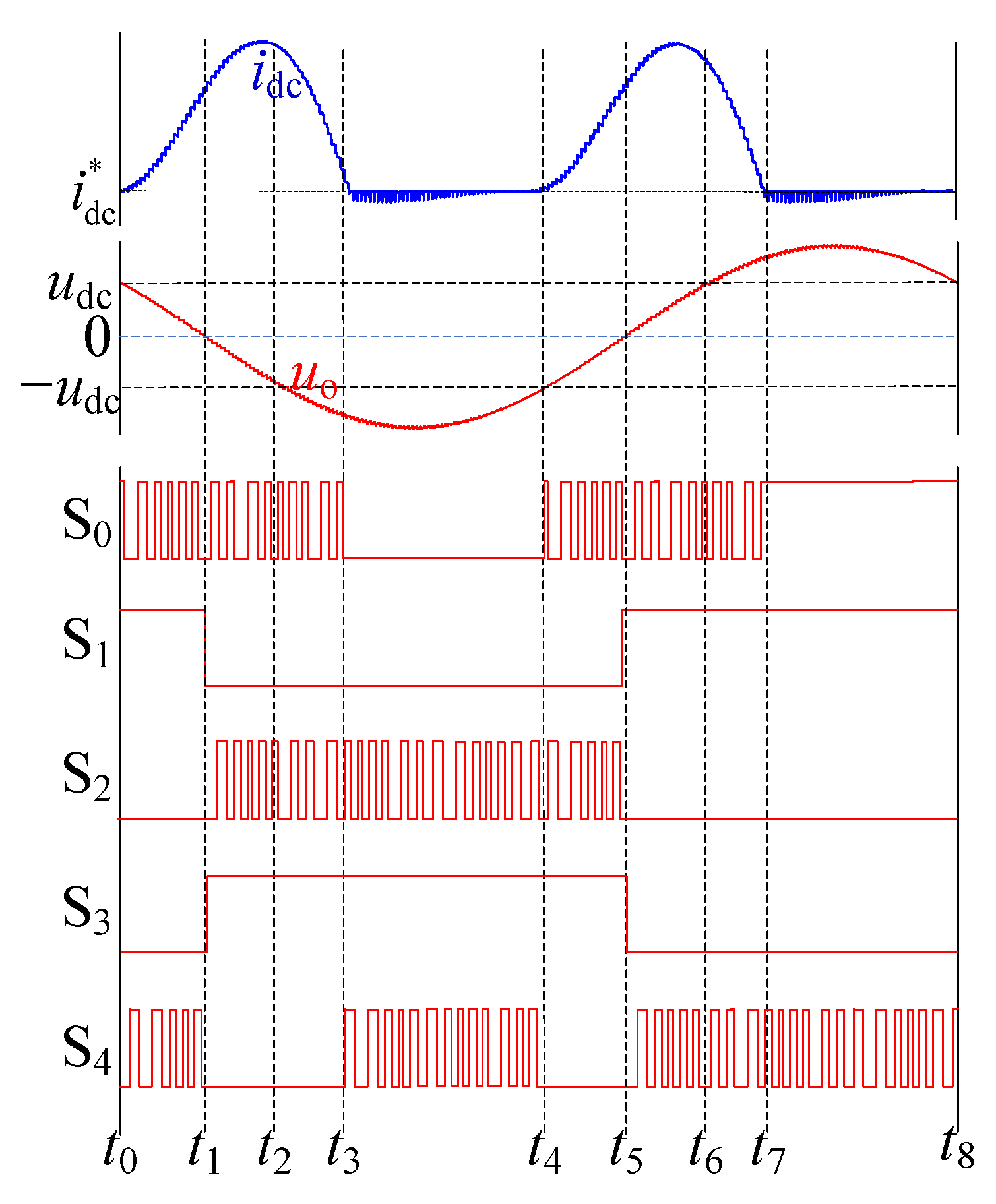
The theoretical waveforms in a fundamental period, including idc, uo, and switching signals are presented in Figure 7. Based on the operation mode, switching signals, DC-link current optimal reference, and control strategy, the theoretical waveform is divided into eight stages:
Figure 7.
The theoretical waveforms in a fundamental period.
(1) Stage 1 (t0 − t1): 0 < uo < udc, Ldc is charged in energy-supplying mode I; S1 remains on-state; S0 is turned on in the zero vector period to prevent idc from continuously increasing.
(2) Stage 2 (t1 − t2): −udc < uo < 0, Ldc is charged in energy-supplying mode II; S3 remains on-state; S0 is turned on in the zero vector period to prevent idc from continuously increasing.
(3) Stage 3 (t2 − t3): uo < −udc; Ldc discharges in energy-supplying mode II due to idc being still greater than ; S0 is also turned on in the zero vector period; idc begins to decrease.
(4) Stage 4 (t3 − t4): uo < −udc and idc < ; to prevent idc further decrease, S4 is turned on in the zero vector period, since is the optimal reference of the DC-link current; idc will be clamped near .
(5) Stage 5 (t4 − t5), Stage 6 (t5 − t6), Stage 7 (t6 − t7), and Stage 8 (t7 − t8) are similar to Stage 1 (t0 − t1), Stage 2 (t1 − t2), Stage 3 (t2 − t3), and Stage 4 (t3 − t4), respectively.
5. Control Strategy of the Output Voltage
Since the PI controller is not suitable for AC models, the math model of the singe phase CSI is established in d-q frame. The fundamental component of uo is represented as follows:
where uod = U, and uoq = 0. The quadrature virtual component of uo is introduced, which is shown as follows:
The d-q frame components uod and uoq can be obtained as follows:
The same representation for io is shown as follows:
where iod and ioq are the DC component. Substituting Equations (21) and (22) with (2), it yields the following:
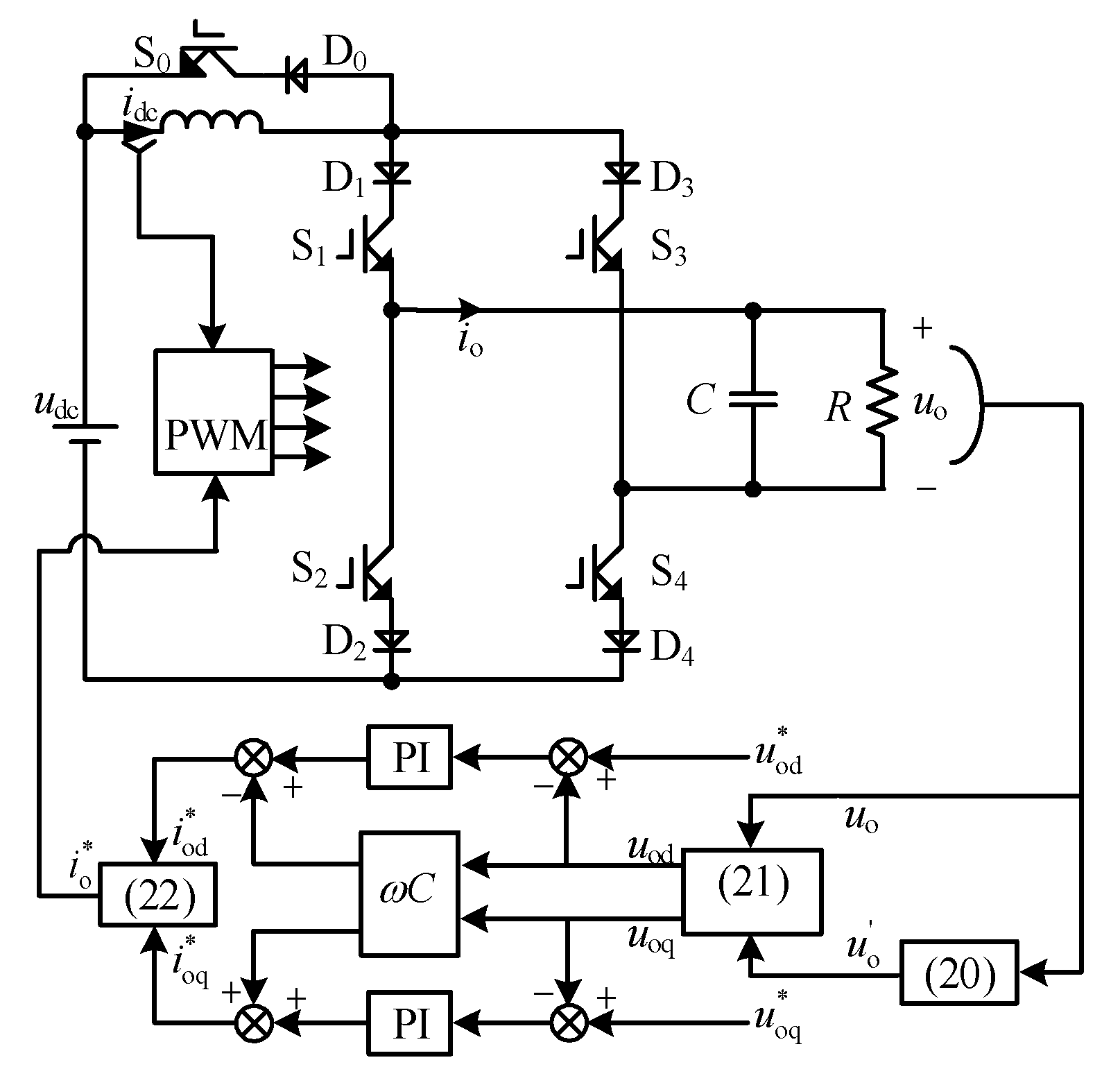
uod and uoq are adjusted by the PI controller, and feedback decoupling is adopted to cancel out the coupling terms ωCuod and ωCuoq. The control strategy of uo is shown in Figure 8, where and are the reference of uod and uoq, and and are the reference of iod and ioq, respectively. and are expressed as follows:
where kp and ki are the proportional coefficient and integral coefficient, respectively.
Figure 8.
Control strategy diagram of output voltage.
Considering the digital delay, the open-loop transfer function Gopen(s) can be derived as follows:
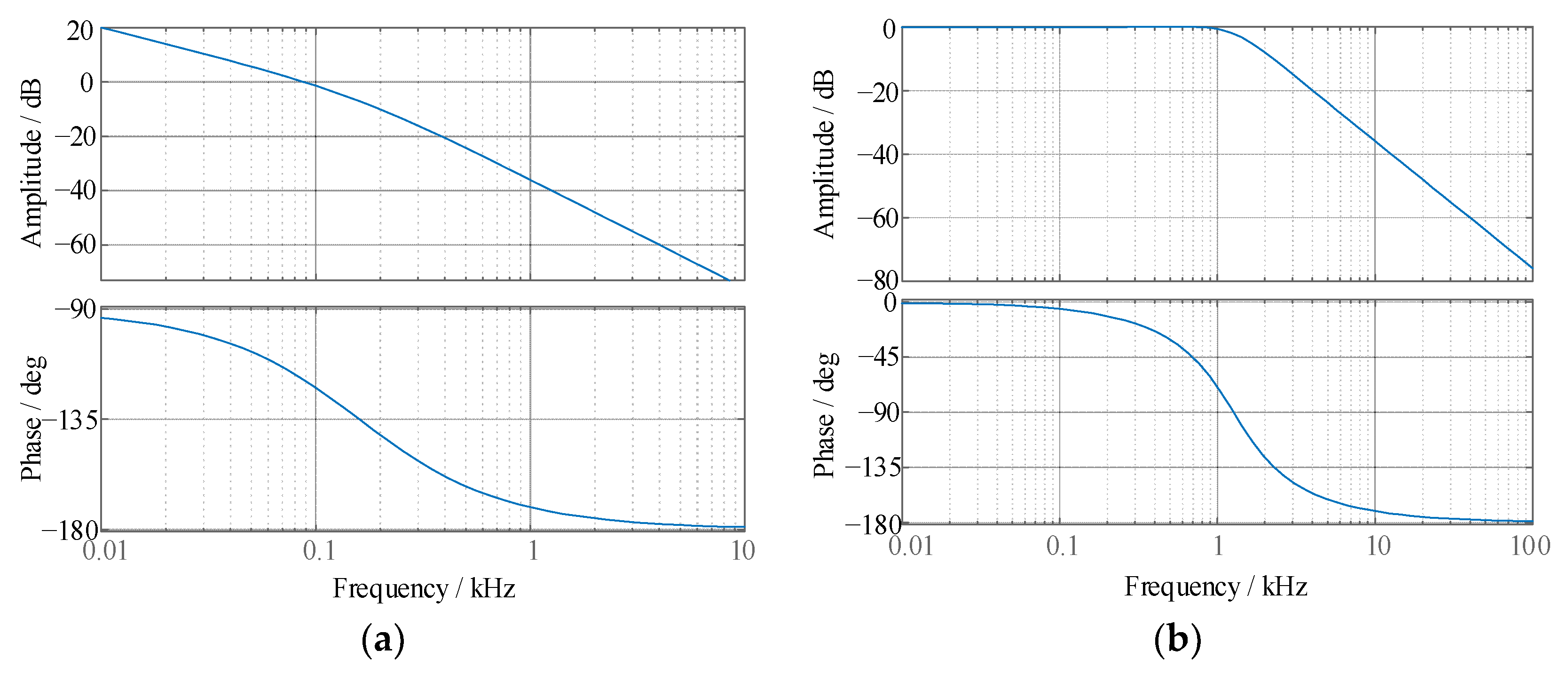
where Ts is the switching period and is equal to 100 μs. Zero point is set to offset the pole, and the cutoff frequency is set at 1 kHz. kp and ki are set as 2000πRC and 2000π. The Bode plot of Gopen(s) is shown in Figure 9a, and the Bode plot of the closed-loop transfer function Gclose(s) is shown in Figure 9b. Good track performance and fast dynamic response can thus be achieved.
Figure 9.
The Bode-plots of the output voltage control: (a) Gopen(s), (b) Gclose(s).
6. Experimental Results
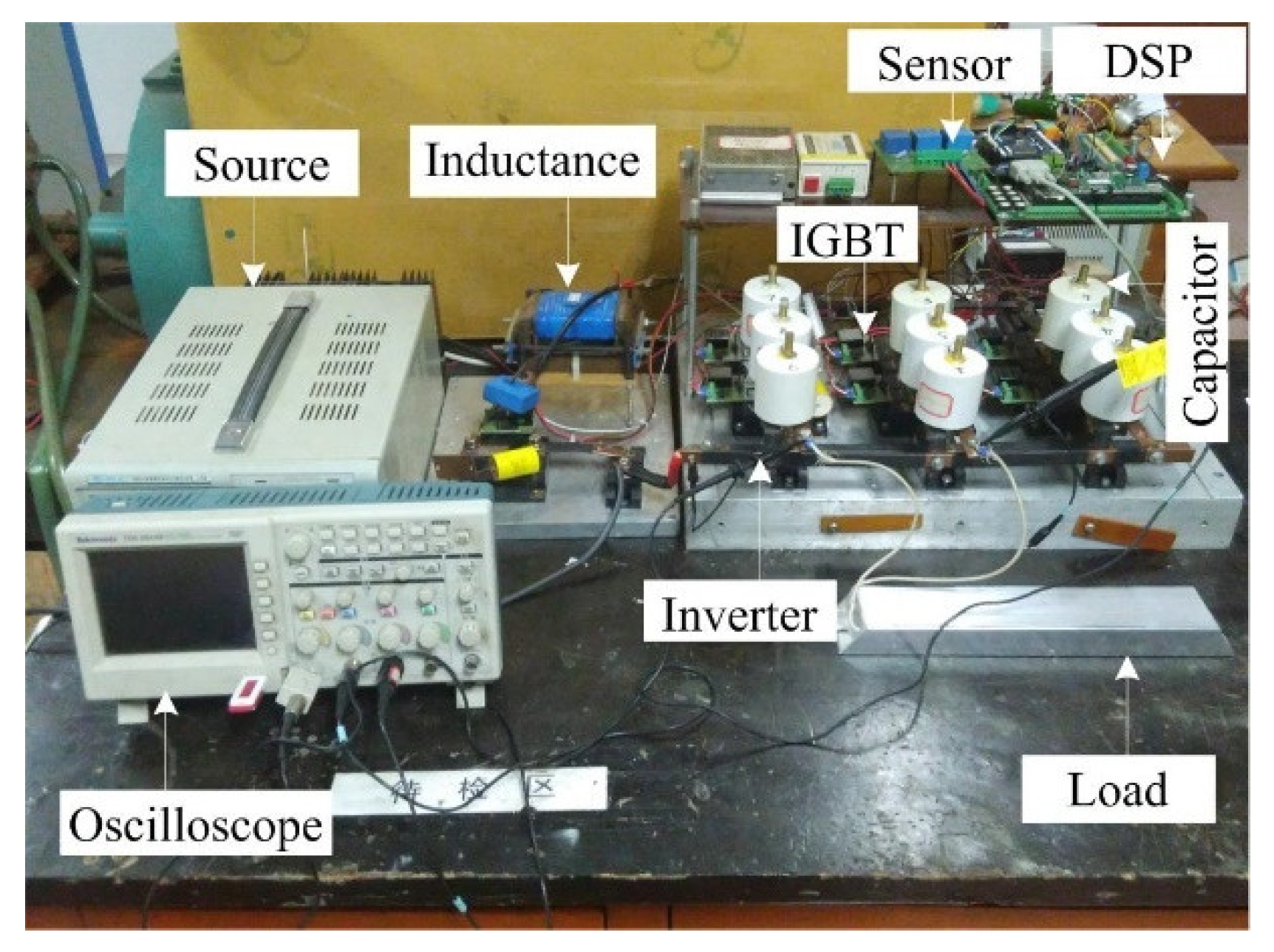
An experimental prototype of a single-phase CSI is established and shown in Figure 10. The corresponding soft simulation is presented in the Supplementary Material. The algorithm of modulation and control are implemented by TMS320F28335, and the IGBT and diode are PM400HSA120 and RM300HA-24F, respectively. udc is supplied by a DC power supply. The parameters of the passive components are consistent with Table 4.
Figure 10.
Experimental prototype of proposed single-phase CSI.
Table 4.
Parameters of experiment.
6.1. Experimental Results of Steady-State
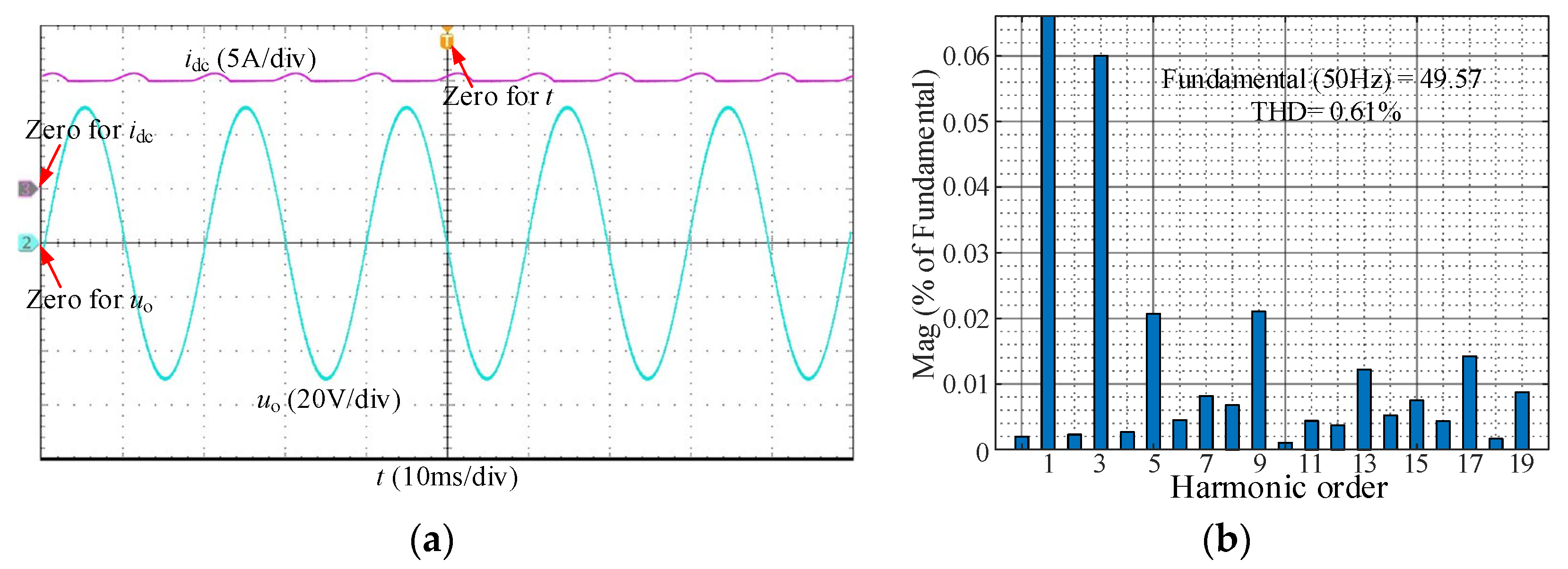
The amplitude and frequency of the reference of uo are 50 V and 50 Hz. is set to 13.5 A. The experimental waveforms of idc and uo are shown in Figure 11a, where the amplitude and frequency of uo are consistent with the reference, and idc is maintained in the range of 13.5 A to 15 A. Figure 11b shows that uo’s THD is only 0.61%, and its harmonics are limited.
Figure 11.
Experimental results under = 13.5 A: (a) experimental waveforms of idc and uo; (b) FFT results.
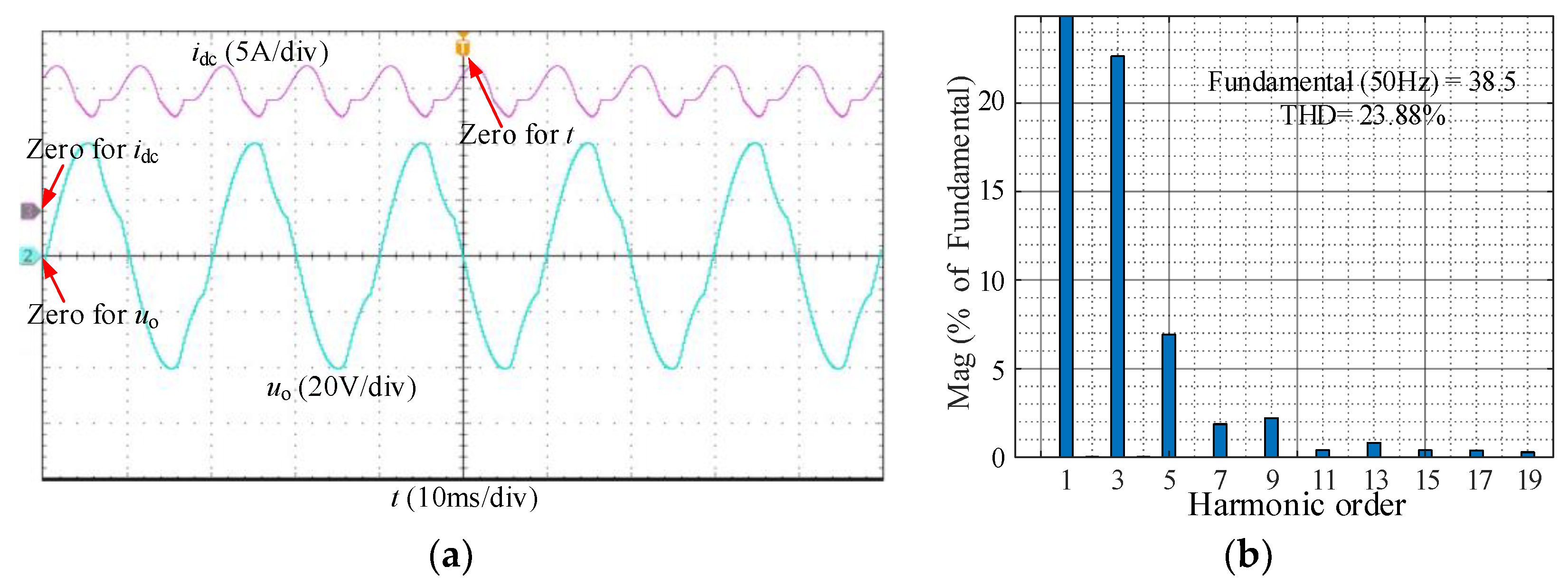
In order to verify that = 13.5 A is the optimal reference of the DC-link current, a steady-state experiment is carried out in Figure 12, where is set to 11.5 A. A large fluctuation occurs in idc, which cannot maintain above 11.5 A. In some switching periods, idc cannot meet the requirement of current for the AC load. Therefore, significant low-order harmonic distortion occurs in uo, whose THD is 23.88%, and fundamental amplitude is 38.5 V, lower than the reference 50 V.
Figure 12.
Experimental results under = 11.5 A: (a) experimental waveforms of idc and uo; (b) FFT results.
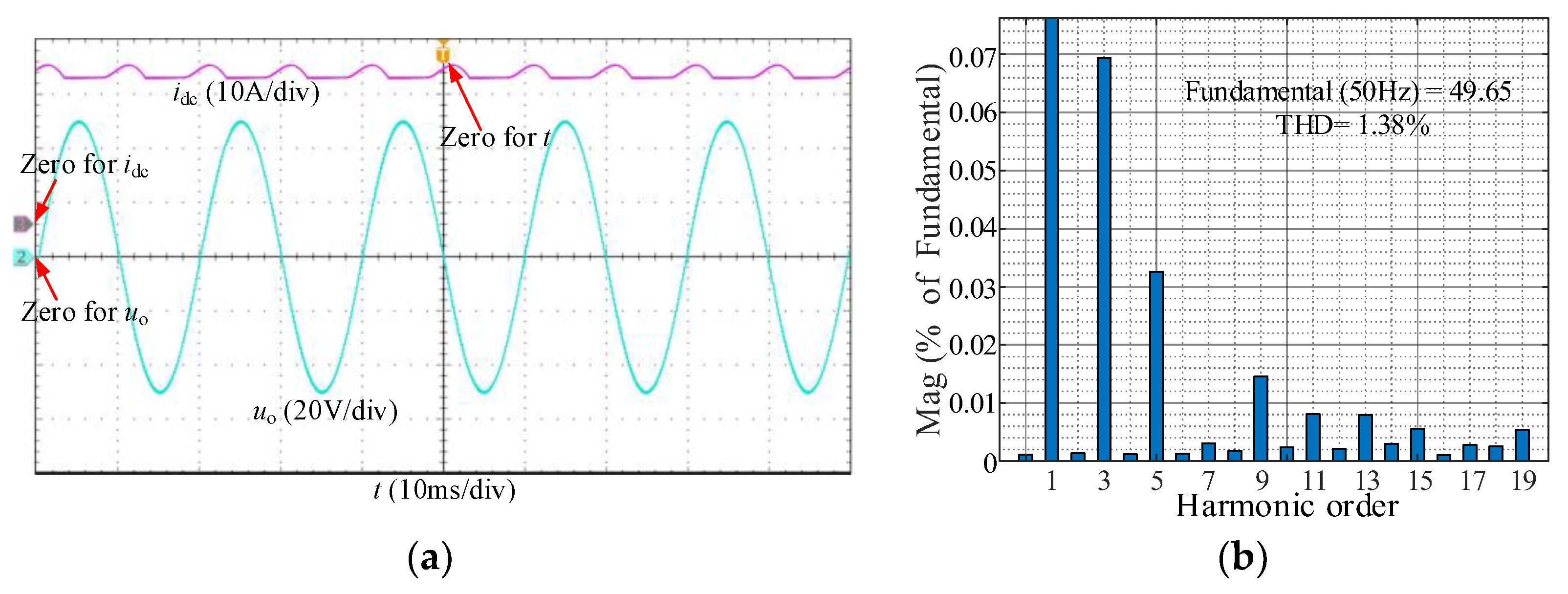
In Figure 13, is set to 20 A, and idc maintains above 20 A with small fluctuation. Since idc is higher than the amplitude of io, uo can track the reference. uo’s THD is 1.38%, greater than the one when = 13.5 A. Meanwhile, the switching loss and conduction loss of IGBT and diode are positively related to idc. The above experimental results show that the calculation method for the optimal reference of DC-link current is correct and feasible.
Figure 13.
Experimental results under = 20 A: (a) Experimental waveforms of idc and uo; (b) FFT results.
6.2. Experimental Results of Dynamic-State
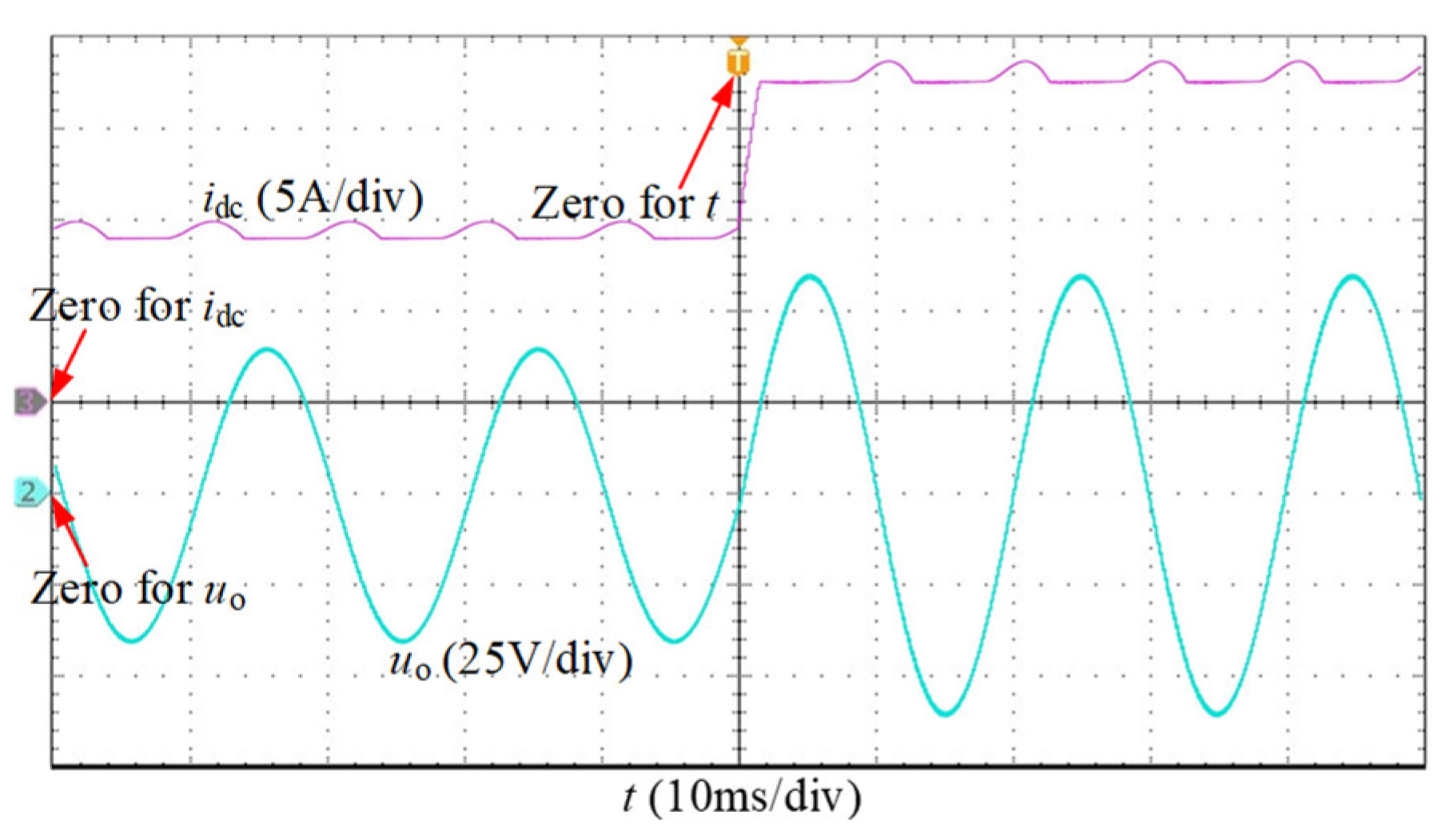
The dynamic performance of the output voltage control strategy will be verified in this section. The frequency remains 50 Hz, and the amplitude of the reference voltage is adjusted from 40 V to 60 V. According to Formula (18), is set to 9 A and 17.5 A, respectively. The experimental waveforms of idc and uo are shown in Figure 14. idc reaches the steady state again after 2 ms and remains above 17.5 A. In Figure 14, the uo‘s amplitude is adjusted to 60 V with smooth changing.
Figure 14.
The dynamic-state experimental waveforms under amplitude changing.
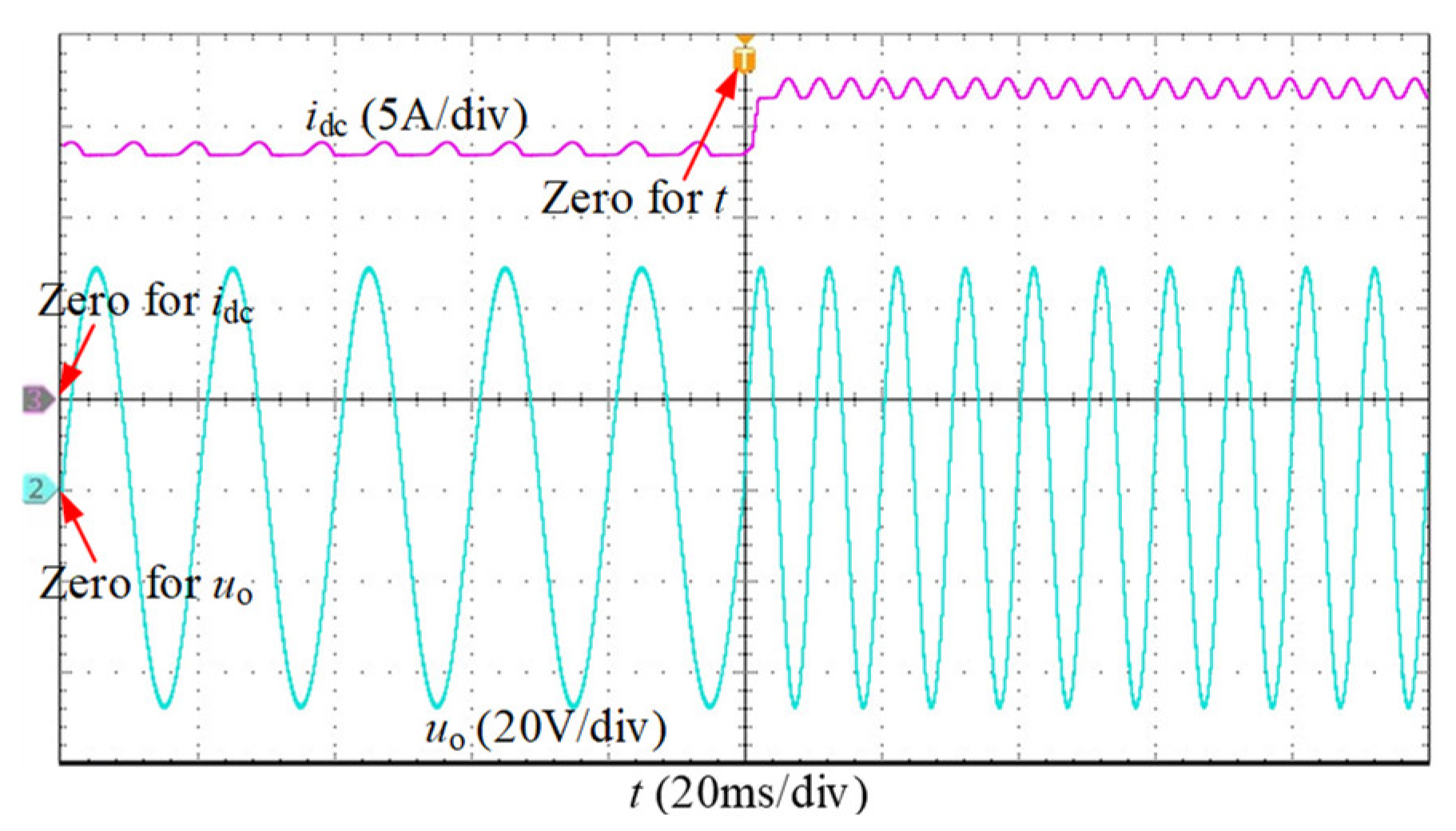
Figure 15 shows the experimental waveforms when the amplitude is set to 50 V, and the frequency ω changes from 50 Hz to 100 Hz. According to (18), is related to ω, so it should be adjusted from 13.5 A to 16.5 A. In Figure 15, idc and uo can track the reference quickly. In conclusion, the superior steady-state and dynamic-state performance of the output voltage control strategy can be fully proved, and the DC-link current reference from the proposed calculation method is the minimum value that can meet the power demand.
Figure 15.
The dynamic-state experimental waveforms under frequency changing.
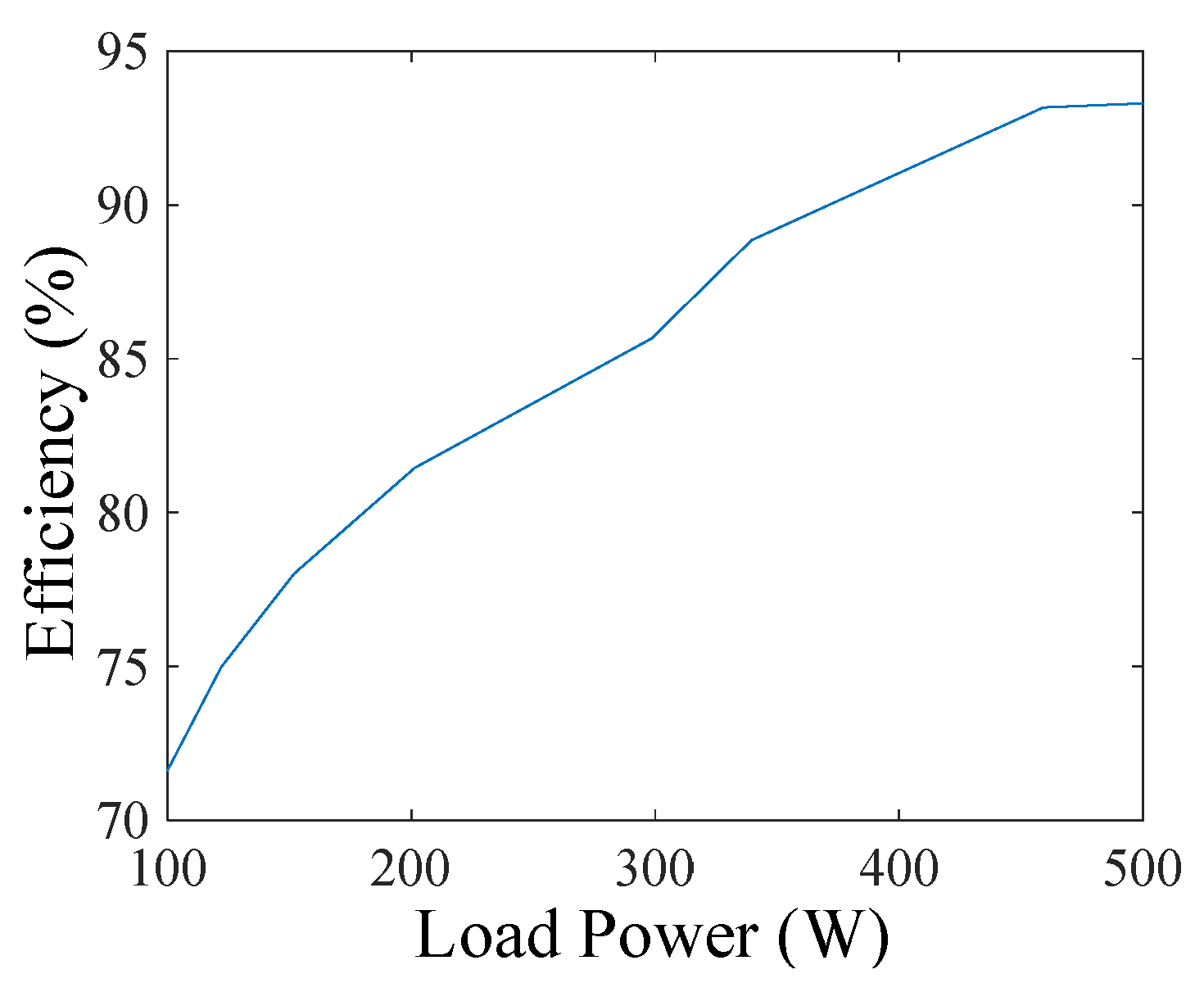
Finally, the CSI’s efficiency has been tested under different load powers from 100 W to 500 W. A curve map of the CSI’s efficiency is illustrated in Figure 16. When the load power increases, the power loss in the conduction and switching increases relatively more slowly than the load power, so the CSI’s efficiency rises with the increased load power.
Figure 16.
The efficiency map of the proposed single-phase CSI.
7. Conclusions
This paper proposes a novel PWM modulation method to control DC-link current for the improved topology of single-phase CSI; the corresponding operating modes and modulation strategy with DC-link current hysteresis control are also introduced in detail. The relationship between the optimal reference of DC-link current and output voltage is derived. A voltage control strategy based on d-q frame components is discussed. A series of simulations and experiments is set up to demonstrate the feasibility of the proposed method. The conclusions are summarized as follows:
(1) DC-link current can remain in the expected range by adopting the improved PWM modulation, and the number of switching activities is the same as the traditional modulation.
(2) The calculation method of optimal reference for DC-link current can meet the AC side load demand, improving current utilization and reducing loss.
(3) The control of DC-link current is implemented by switching magnetizing mode and freewheeling mode, which is separated from output voltage control. Thus, the DC-side model can be considered a controlled current source.
Supplementary Materials
The following supporting information can be downloaded at: https://www.mdpi.com/article/10.3390/en16186729/s1. Figure S1. Simulation waveforms in steady state: (a) DC-link current; (b) AC output volt-age. Figure S2. Simulation waveforms on the traditional single-phase CSI when the initial DC-link current is 0A: (a) DC-link current; (b) AC output voltage. Figure S3. Simulation waveforms on the traditional single-phase CSI when the initial DC-link current is 16A: (a) DC-link current; (b) AC output voltage.
Author Contributions
Methodology, Y.Z. and T.Y.; Software, T.Y.; Writing—original draft, Y.Z.; Writing—review and editing, Y.M. All authors have read and agreed to the published version of the manuscript.
Funding
This work is supported by the Youth project of science and technology research program of Chongqing Education Commission of China (No. KJQN202001105).
Data Availability Statement
The data presented in this study are available on request from the corresponding author. The data are not publicly available due to the funder’s requirement.
Conflicts of Interest
The authors declare no conflict of interest.
Nomenclature
| VSI | Voltage Source Inverter |
| CSI | Current Source Inverter |
| HVDC | High Voltage Direct Current |
| Ldc | DC-link inductance (mH) |
| C | AC side’s filter capacitor (μF) |
| R | AC side’s resistive load (Ω) |
| idc | DC side’s current (A) |
| io | Output current on the resistive load R (A) |
| udc | DC side’s voltage (V) |
| uo | Output voltage on the resistive load R (A) |
| p/q | Switching functions for S0, S1, S2, S3, and S4 (-) |
| d | Duty cycle (%) |
| Reference of the output current io (A) | |
| Reference of the DC side’s current idc (A) | |
| ∆idc_down | Decrement of idc when discharging (A) |
| ∆idc_up | Increment of idc when charging (A) |
| Ts | Switching period (s) |
| U | Fundamental amplitude of uo (V) |
| I | Fundamental amplitude of io (A) |
| θ | Initial phase of io (rad) |
| ω | Fundamental frequency of io (Hz) |
| ∆idcmax | Maximum reduction of idc (A) |
| uod/uod | d-q frame components of uo |
| Reference of uod/uod | |
| iod/iod | d-q frame components of io |
| Reference of iod/iod |
References
- Chakrabarti, A.; Sarkar, K.; Kasari, P.R.; Das, B.; Biswas, S.K. A CB-PWM Technique for Eliminating CMV in Multilevel Multiphase VSI. IEEE Trans. Ind. Electron. 2022, 70, 8666–8675. [Google Scholar] [CrossRef]
- He, J.; Zhang, C.; Lei, M.; Han, J.; Guo, P.; Li, Y. An Active Bypass Pulse Injection-Based Low Switching Frequency PWM Approach for Harmonic Compensation of Current-Source Converters. IEEE Trans. Power Electron. 2021, 36, 1614–1625. [Google Scholar] [CrossRef]
- Rajeev, M.; Agarwal, V. Single phase current source inverter with multiloop control for transformerless grid–PV interface. IEEE Trans. Ind. Appl. 2018, 54, 2416–2424. [Google Scholar] [CrossRef]
- Titus, J.; Harikrishnan, P.; Hatua, K. An SCR-Based CSI-Fed Induction Motor Drive for High Power Medium Voltage Applications. IEEE Trans. Ind. Electron. 2020, 68, 4657–4666. [Google Scholar] [CrossRef]
- Guo, X.-Q.; Sui, S.; Wang, B.; Zhang, W. A Current-Based Approach for Short-Circuit Fault Diagnosis in Closed-Loop Current Source Inverter. IEEE Trans. Ind. Electron. 2019, 67, 7941–7950. [Google Scholar] [CrossRef]
- Miao, Y.; Liao, W.; Huang, S.; Liu, P.; Wu, X.; Song, P.; Li, G. DC-Link Current Minimization Scheme for IM Drive System Fed by Bidirectional DC Chopper-Based CSI. IEEE Trans. Transp. Electrif. 2023, 9, 2839–2850. [Google Scholar] [CrossRef]
- Li, Y.W.; Pande, M.; Zargari, N.R.; Wu, B. DC-link current minimization for high-power current-source motor drives. IEEE Trans. Power Electron. 2008, 24, 232–240. [Google Scholar]
- Geng, Y.; Yang, K.; Lai, Z.; Zheng, P.; Liu, H.; Deng, R. A Novel Low Voltage Ride Through Control Method for Current Source Grid-Connected Photovoltaic Inverters. IEEE Access 2019, 7, 51735–51748. [Google Scholar] [CrossRef]
- Wang, W.; Gao, F.; Yang, Y.; Blaabjerg, F. Operation and modulation of H7 current-source inverter with hybrid SiC and Si semiconductor switches. IEEE J. Emerg. Sel. Top. Power Electron. 2017, 6, 387–399. [Google Scholar] [CrossRef]
- Yang, S.; Peng, F.Z.; Lei, Q.; Inoshita, R.; Qian, Z. Current-fed quasi-Z-source inverter with voltage Buck–Boost and regeneration capability. IEEE Trans. Ind. Appl. 2010, 47, 882–892. [Google Scholar] [CrossRef]
- Guo, X.; Wang, N.; Zhang, J.; Wang, B.; Nguyen, M.-K. A Novel Transformerless Current Source Inverter for Leakage Current Reduction. IEEE Access 2019, 7, 50681–50690. [Google Scholar] [CrossRef]
- Nascimento, A.J.P.; de Menezes, B.F.; de Mesquita, S.J.; Costa, K.R.; Tofoli, F.L.; Daher, S.; Antunes, F.L.M. Bidirectional Isolated Asymmetrical Multilevel Inverter. IEEE Trans. Circuits Syst. II Express Briefs 2022, 70, 151–155. [Google Scholar] [CrossRef]
- Sun, R.; Wang, X.; Ye, Y. Seventeen-Level Inverter Based on Switched-Capacitor and Flying-Capacitor-Fed T-type Unit. IEEE Access 2022, 10, 33561–33570. [Google Scholar] [CrossRef]
- Ding, L.; Li, Y.W. Simultaneous DC current balance and common-mode voltage control with multilevel current source inverters. IEEE Trans. Power Electron. 2018, 33, 9188–9197. [Google Scholar] [CrossRef]
- Guo, Q.; Zhou, C.; Li, S. A Multiple Loops Control Strategy Based on DC Link Voltage of Current Source PWM Rectifiers. Trans. China Electrotech. Soc. 2022, 37, 2051–2063. [Google Scholar]
- Wu, F.; Feng, F.; Luo, L.; Duan, J.; Sun, L. Sampling period online adjusting-based hysteresis current control without band with constant switching frequency. IEEE Trans. Ind. Electron. 2014, 62, 270–277. [Google Scholar] [CrossRef]
- Wang, Z.; Wu, B.; Xu, D.; Cheng, M.; Xu, L. DC-link current ripple mitigation for current-source grid-connected converters under unbalanced grid conditions. IEEE Trans. Ind. Electron. 2016, 63, 4967–4977. [Google Scholar] [CrossRef]
Disclaimer/Publisher’s Note: The statements, opinions and data contained in all publications are solely those of the individual author(s) and contributor(s) and not of MDPI and/or the editor(s). MDPI and/or the editor(s) disclaim responsibility for any injury to people or property resulting from any ideas, methods, instructions or products referred to in the content. |
© 2023 by the authors. Licensee MDPI, Basel, Switzerland. This article is an open access article distributed under the terms and conditions of the Creative Commons Attribution (CC BY) license (https://creativecommons.org/licenses/by/4.0/).