1. Introduction
For economic growth and welfare of developing countries, one of the most critical infrastructure essentials is electricity. Over the last few years, the electric industry has seen drastic shifts all over the world. This shift occurs as a result of open bidding, bilateral power sharing, and the implementation of a power exchange [
1]. The modernization of the electrical power industry eliminates the monopoly existence of generation, allowing consumers to choose between different providers and bringing competition to multiple stages. This type of electricity market allows generation companies (GENCOs) to establish optimum competitive bidding strategies in order to optimize benefit [
2]. In a perfect competitive world, the marginal production rate and the bid rates of generating firms (GENCOs) are quite comparable. This theory, however, is entirely false, because in practice, the competitive system is an oligopoly, with premiums greater than the marginal output expense [
3]. This is attributed to a variety of characteristics of the electricity sector, including the effects of various generation restrictions and the small number of suppliers [
4]. In this setting, all GENCOs depend on optimal bidding strategy (BS) to maximize profits. The benefit of a power producer is primarily determined by the market clearing price (MCP). The MCP is calculated by independent system operators (ISO), which is the intersection point among the power supply and demand. MCP uses the market clearing process to determine the price of the next unit of energy generated, resulting in a viable solution to the issue of strategic bidding. When the electricity market is not fully competitive, oligopolistic market structures are used. As a result, in the oligopolistic pool model, power producers increase their benefit by conducting strategic bidding.
In the past few decades, numerous strategies for optimizing bidding issues have been developed and found to be effective in removing the traditional monopoly in the electric industry. In [
5], the authors published a short review of the literature summary regarding competing bidding techniques within the energy sector. Since, instead of being deterministic, the strategic bidding dilemma is stochastic, a variety of studies using stochastic optimization methods have been reported in recent years. Complexity of the electricity market is modeled by the allocation of competing bids in these optimization methods, and the problem is solved for power suppliers benefit maximization. In [
6], a stochastic optimization technique was suggested that used the Monte Carlo (MC) approach to forecast opponent actions and the bidding issue was solved by utilizing the golden section search method. MC simulation was used in this approach to repeatedly compute the best one player’s bid strategy when competing against unsystematic opponents. An optimum bidding strategy was determined by the average bidding constraint importance. Following that, a number of research papers using stochastic optimization methods such as genetic algorithm (GA) [
7], particle swarm optimization (PSO) [
8], fuzzy adaptive particle swarm optimization (FAPSO) [
9], gravitational search algorithm (GSA) [
10], fuzzy adaptive gravitational search algorithm (FAGSA) [
11], krill herd algorithm (KHA) [
12], bat inspired algorithm (BIA) [
13], and many more to study strategic bidding mechanisms for finding optimal solution in day-ahead energy markets were published. In terms of profit, this produces a suboptimal result. Still, there is an opportunity to increase the solution’s quality in order to maximize profits.
Electricity generation is transitioning from fossil fuel conventional power plants to greener facilities throughout the world, but there has not been a total change yet [
14]. It may take a few more years to achieve carbon-free electricity generation on a long-term basis. In order to sell their power, fossil fuel producers compete with renewable in energy markets [
15]. Renewable energy facilities have minimal operating expenses, allowing them to offer their energy at a low cost [
16]. Due to this reason, fossil fuel producers may not be able to sell their energy at high rates on a continuous basis. Therefore, researchers have been interested in the bidding strategies of renewable power producers with amalgamation of the fossil fuel power producers in recent years [
17]. However, owing to weather dependence, many green energy sources, such as solar PV or wind, are uncertain, posing problems such as suggesting bidding quantity will differ from the quantity produced, which are leading to financial penalties [
18]. As a result, these renewable energy providers should be supplied with a well-thought-out strategy in a deregulated electricity market. Moreover, to decrease the uncertainty and maximize profit, precise renewable energy sources modeling is required.
There are a variety of optimization techniques that may be used to address the issue of bidding strategy and maximize supplier advantage. A functional heuristic optimization strategy must necessarily meet three criteria, according to literature. To begin, regardless of the original system’s parameter settings, the technique should discover the global solution. Second, rapid convergence is needed. Third, the method can include a small set of control parameters to make it easier to use. The GA [
7], PSO [
8], GSA [
10], KHA [
12], and BIA [
13] are examples of heuristic optimization approaches that are sensitive to parameter selection such as selections of crossover and mutation in GA, learning factors and inertia weight selection in PSO, initialization of population in GSA, poor exploitation capability in KHA, and control and tuning of parameters in BIT. The no-free-lunch (NFL) algorithm [
19] reasonably demonstrates that a single method cannot be credited with dealing with a variety of optimization problems. As a result, this algorithm enables researchers to suggest novel approaches or alter existing strategies for tackling complicated problems in the literature. The strategic bidding challenge is one of these difficult issues. Therefore, the idea of oppositional based learning (OBL) has been used in a number of studies. OBL has also been shown to improve the performance of algorithms. Tizoosh [
20] proposed an OBL concept. When dealing with the curse of dimensionality, OBL is a very useful paradigm. Because of the large exploration space and the random temperament of variables, the curse of dimensionality is unavoidable in the strategic bidding formulation issue. As a result, in dynamic replication, establishing a global best might be difficult. OBL provides a one-of-a-kind solution to this problem and may provide a way out of the local minima trap. By producing opposing points in search space, OBL improve the exploration ability of any algorithm.
Therefore, in this paper, the authors suggested and considered the following:
A new variation of the GSA algorithm to tackle the strategic bidding issue with renewable sources in an emerging electricity market. In OGSA, the opposing number concept is incorporated with the GSA for population initialization and new population generation to improve the exploration ability of the algorithm;
The proposed version is assessed first on standard IEEE 30-bus and 57-bus arrangements and then standard arrangements with the renewable sources;
The Weibull and Beta probability distribution functions have been used to build an authentic uncertainty modeling of wind and solar respectively in order to decrease projected error while maintaining the profit. Furthermore, the probabilities for wind and solar have been adjusted to reflect physical circumstances;
The Kantorovich distance (KD) technique to decrease the scenarios for wind and solar;
Cost formulas for underestimation and overestimation to compute the renewable power anomalies.
4. Handling of the Uncertainty Related to Renewable Energy Sources
A vast number of possibilities is required for every stochastic process for proper modeling. The amount of computing power required to solve scenario-based optimization representation is relative to the number of possible situations. As a result, the original scenario set must be decreased so that the reduced set contains a lesser number of possibilities, but the stochastic characteristics remain same. The quantity of reduced scenarios depends according to the problem’s form and character to be improved and it has to be less than one-fourth of all scenarios created [
24].
The scenario reduction’s primary premise is to eliminate possibilities with extremely low probability and group those that are extremely similar. As a result, scenario-reduction algorithms choose a subset of situations and compute probabilities for new scenarios in such a way that in terms of a given probability distance, the reduced probability measure approaches the original probability measure.
Using the Kantorovich distance (KD) matrix [
25], the scenario-reduction method reduces and bundles the scenarios. The probability distance between two separate scenario sets representing the same stochastic process is known as KD. It is most commonly used to compare the similarity of several situations’ positions. KD ensures that the highest number of potential situations is minimized while adhering to a set of tolerance requirements. All removed possibilities are considered to have a probability of zero. The fresh prospect of conserved possibilities is the sum of their previous probabilities and the likelihood of deleting instances that are the most similar to it. Steps for the Kantorovich distance (KD) matrix are as follows:
Step 1: Compute the Euclidian detachment involving each case and all other potential circumstances. The distance linking any two distinct possibilities
and
is computed as:
Step 2: Find the least separation between every opportunity and the opportunity .
Step 3: Replicate or develop with the same likelihood calculated in Step 2.
Step 4: Diminish the smallest feasible gap and situation. Then, for the next closest possibility, apply the likelihood of the removed circumstances.
Step 5: Repeat Steps 2–4 until the stoppage condition is met.
6. Formulation of Strategic Bidding with Renewable Sources
The revenue and production costs of thermal generators, as well as the revenues and imbalance costs of wind and solar facilities are represented as the objective function of stochastic strategic bidding.
The revenue of the thermal generator is defined by the first term of the objective function. Every power suppler submits their bid as a linear supply function (non-decreasing) as given in Equation (23) to the impendent system operator in the single sided pool-based electricity market.
where
is the bidding amount in MW; and
and
are non-negative bidding parameters.
The ISO matches total bidding amount with total forecasted demand of the system after receiving bid data from power utilities. After that, it reduces the cost of procuring while increasing profit. Furthermore, it takes use of the provider for power dispatch while taking into account other market limitations such as inequality and equality constraints. Following are the equality constraints of the power market:
where
R is the market clearing price.
Following are the inequality constraints of the power market:
The generating limits of thermal generators are shown in Equation (26).
reflects the load predicted by pool, as follows:
where
Lc is the regular load and
k is the load flexibility factor.
Without taking inequality restrictions into account, the solutions to Equations (24) and (25) become:
If the solution breaches its limit for Equation (29) after getting the value of MCP, it must be brought to the appropriate limit as indicated by Equation (26).
The production cost of a thermal generator is expressed in the second objective function term. It is considered as:
where
am and
bm are the production cost parameters.
The revenues of the considered renewable power sources are defined by the third (for wind source) and fifth (for solar source) terms of the objective function.
Imbalance costs of the considered renewable power sources are defined by the fourth (for wind source) and sixth (for solar source) terms of objective function. The imbalance costs of the wind and solar power sources are calculated as follows [
18]:
where
and
are the cost for overestimation of the renewable power output (wind and solar), respectively.
and
are the cost for underestimation of the wind and solar power output respectively. The costs for overestimation and underestimation of the renewable (wind and solar) power output are calculated as follows:
here
and
are the penalty coefficients for overestimation and underestimation of the wind and solar power output, respectively.
Probabilistic Modeling of Bid Parameters
Because the power market model is based on secret bids, the data necessary for following bidding periods are unknown, making the optimization problem difficult to solve. Using the probability density function and bidding data from previous bids, the estimation of rival bidding coefficients may be derived [
6]. From the
ith utility standpoint, bidding coefficients
and
are follow the probability density function (PDF) of a joint normal distribution obeyed by
jth rivals is as follows:
This pdf can be viewed in a compressed format. −×)
where
is the parameter of correlation;
and
are the mean values;
and
are the standard deviations values.
The problem described in Equation (22) is optimized using the OGSA method in subsequent sections, taking into account all of the restrictions listed above, to discover the best solution for the strategic bidding issue that maximizes generator profit during an one hour trading period.
7. An Overview of Gravitational Search Algorithm
Agents are treated such as objects in GSA [
26], and their presentation is assessed by their masses. The gravitational strength attracts all of these things, causing a universal progress of all substance towards the ones through heavier weights. The masses collaborate through gravitational force, which is the shortest form of contact. The heavier weights (which are appropriate for high-quality solutions) travel at a slower rate than the lighter masses. This ensures the algorithm’s exploitation stage.
Inertial mass, position, passive, and active gravitational mass are the four parameters for each mass (agent) in GSA. A fitness function is used to determine the gravitational and inertial masses, which correlates to the problem’s solution. To put it another way, each mass is a solution. By appropriately changing the inertial and gravitational masses, the algorithm may be navigated. It is predicted that the heaviest mass would attract masses over time. In the exploration space, this mass will provide an optimal clarification.
Let us take a look at a structure with n representatives (masses). The
kth agent’s location is determined by:
where
represents the
kth agent’s location in the
Dth dimension. The force exerted on the
kth mass from the
jth mass is described as in the following equation at a given time
t.
where
is the small constant;
G(
t) represents the gravitational constant at time
t;
is the
kth agent’s passive gravitational mass linked at time
t;
is the active gravitational mass associated with the
jth agent at time t;
Rkj(
t) is the Euclidian distance between the two agents
k and
j is given by the equation:
To give the method a stochastic quality, the total force acting on the
kth agent in the
Dth dimension is anticipated to be a randomly weighted sum of the
Dth components of the forces exerted by other agents, as indicated by the equation:
where
randj is a random number between 0 and 1. As a result of Newton’s law of motion, the acceleration of the
kth agent in the
Dth dimension at time t is given by the equation:
where
is the
kth agent’s inertial mass. Equations (44) and (45) can be used to compute an agent’s position and velocity, respectively.
In Equation (44)
randk is a random number between 0 and 1. This random integer is used to give the search a randomized characteristic. To regulate the search accuracy, the gravitational constant (
G) is established at the start and lowered over time. In other terms,
G is represented as the following Equation as a function of the starting value (
G0) and time (
t):
G(
t) is the gravitational constant value at time t in Equation (46). The gravitational constant
G(
t0) is the value at the first cosmic quantum period of time,
t0.
G(
t) is calculated in GSA using the following equation:
where
is set to 20,
G0 is set to 100, iteration is the current number of iterations, and
iterationmax is the total number of iterations. The fitness evaluation can easily compute inertial and gravitational masses. A more efficient agent has a higher mass. Better agents are more attractive and move more slowly as a result of this. Assuming that the gravitational mass and the mass of inertia are identical, the map of fitness is used to determine the mass values. The following equations are used to calculate gravitational and inertial masses:
where for a maximization issue,
fitk(t) is the fitness value of the
kth agent at time
t, and
worst(t) and
best(t) are defined in Equations (51) and (52), respectively.
The progressive reduction of the number of agents is one way to establish a good balance between exploration and exploitation. As a result, a collection of agents with bigger masses is supposed to exert their forces on one and all. However, this strategy must be implemented with caution because it has the potential to diminish exploration power while increasing exploitation capabilities. To prevent becoming trapped in a neighboring best, the algorithm be required to employ exploration at the start. Investigation must fade away and exploitation must emerge after a number of cycles. Only the Kbest agents will entice the others to increase GSA’s performance by regulating exploration and exploitation. Kbest is a time-dependent function that starts at K0 and lowers with time. As a result, all agents apply the pressures at the start, and Kbest decreases linearly with time. In the end, just one agent will be using force against the others. As a result, Equation (42) may be changed as follows:
In Equation (53), Kbest refers to the first 2% K agents having the highest fitness values and the largest populations.
7.1. An Overview of Oppositional Gravitational Search Algorithm
Starting with certain starting solutions (initial population), evolutionary optimization methods aim to enhance them until they reach a most favorable result (s). When certain preset criteria are met, the search procedure comes to an end. We generally start with random guesses when we do not have any a priori information about the answer. The gap between these initial estimations and the best answer, among other things, affects computing time. By testing the opposing solution at the same time, we can increase our chances of starting with a closer (better) solution. As a result, the best match (guess or opposite guess) can be selected as the first answer. In reality, based on theory of probability, a guess is 50% more likely to be inaccurate than the opposing guess. As a result, starting with the closer of the two predictions (as determined by fitness) has the potential to speed up convergence. Not only can the same method be used to find initial solutions, but it can also be used to find each solution in the present population. The components of the opposing point
entirely characterize as:
is the agent’s (kth) opposing placement in the oppositional community’s Dth aspect; and are the lower bound and upper bound values.
7.2. Opposition Based Fitness Evaluation
At the same time, the algorithm assesses the strength of an agent and its adversary. Further computations are performed using the agent with the better fitness score, while the additional agent is rendered worthless.
8. Results
The proposed algorithm has been tested on IEEE 30 bus and IEEE 57 bus systems. For the IEEE 30-bus [
18] and 57-bus [
18] networks, the load demands are as 500 and 1500 MW, respectively. Firstly, the standard evaluation bus systems are used to develop the bidding approach initially. Secondly, one solar photovoltaic generator and one wind power generator, each with a capacity of 200 megawatts, have been considered to be installed at any two different buses. The proposed procedure was investigated in a MATLAB R-2014a setting with 4 GB of RAM and an i5 Core Processor. The OGSA is put to the test using a search agent that prefers 1000 iterations. The maximum number of distinct runs is set at 100.
To prove the superiority of the suggested version, the proposed technique was first tested on standard IEEE 30-bus and 57-bus arrangements. Bidding criteria are exercised to build bidding approach in a dynamic power market. As a consequence, it is calculated using a combined pdf (Equation (13)) and optimized using the OGSA approach. The bidding criteria cannot be preferred independently in order to get the desired results (optimize revenues while generating utilities). One coefficient
of bidding is fixed for each utility, while another coefficient
is calculated with OGSA in the selected criteria [b
m, 10b
m] [
6]. MCP is then computed using the optimal bid constraints. The computed MCP is used to evaluate the overall profit of generating energy and total energy production dispatch in this scenario.
Table 4 and
Table 5 describe the results of different optimization approaches such as OGSA, GSA [
26], PSO [
27], and GA [
28] for the standard IEEE 30-bus and 57-bus arrangements, correspondingly.
Table 4 and
Table 5 shows that the utilization of OGSA, the overall advantages of power supplies with IEEE 30-bus and 57-bus systems have increased to
$5317.72 and
$14,077.77, respectively. In addition, the values of MCPs for IEEE 30-bus and 57-bus systems have increased to 14.15
$/MW and 12.97
$/MW, respectively. In contrast to GSA [
26], PSO [
27], and GA [
28], for both cases for IEEE 30-bus and 57-bus systems, the total profit of power supplies and values of MCPs are the largest. The superiority of the OGSA method is demonstrated by judging against simulation results of GSA, PSO, and GA.
Due to inherent unpredictability, the success of evolutionary algorithms cannot be measured by the results of a sole run. Several pursuits among varied initializations should be conducted to make a clear finish regarding the effectiveness of the techniques. It is important to remember that an algorithm is only regarded stable if it provides acceptable results in a variety of scenarios. Because the OGSA, GA, GSA, and PSO algorithms are indiscriminate, as a result, the bidding data were run 20 times for each technique.
Table 6 shows a comparison of the outcomes of several approaches for the OGSA method’s robustness and validation. When compared to other approaches, it can be deduced that the OGSA methodology has the lowest standard deviation for the IEEE 30-bus and IEEE 57 bus arrangements, correspondingly. Furthermore, in terms of best, worst, and mean, OGSA delivers better results. The suggested approach accuracy is higher, allowing producers to gain a bigger profit by using OGSA. For both the standard bus arrangements, the OGSA approach is more successful, perfect, and the modeling of the strategic bidding practice is achievable, according to the outcome’s investigation.
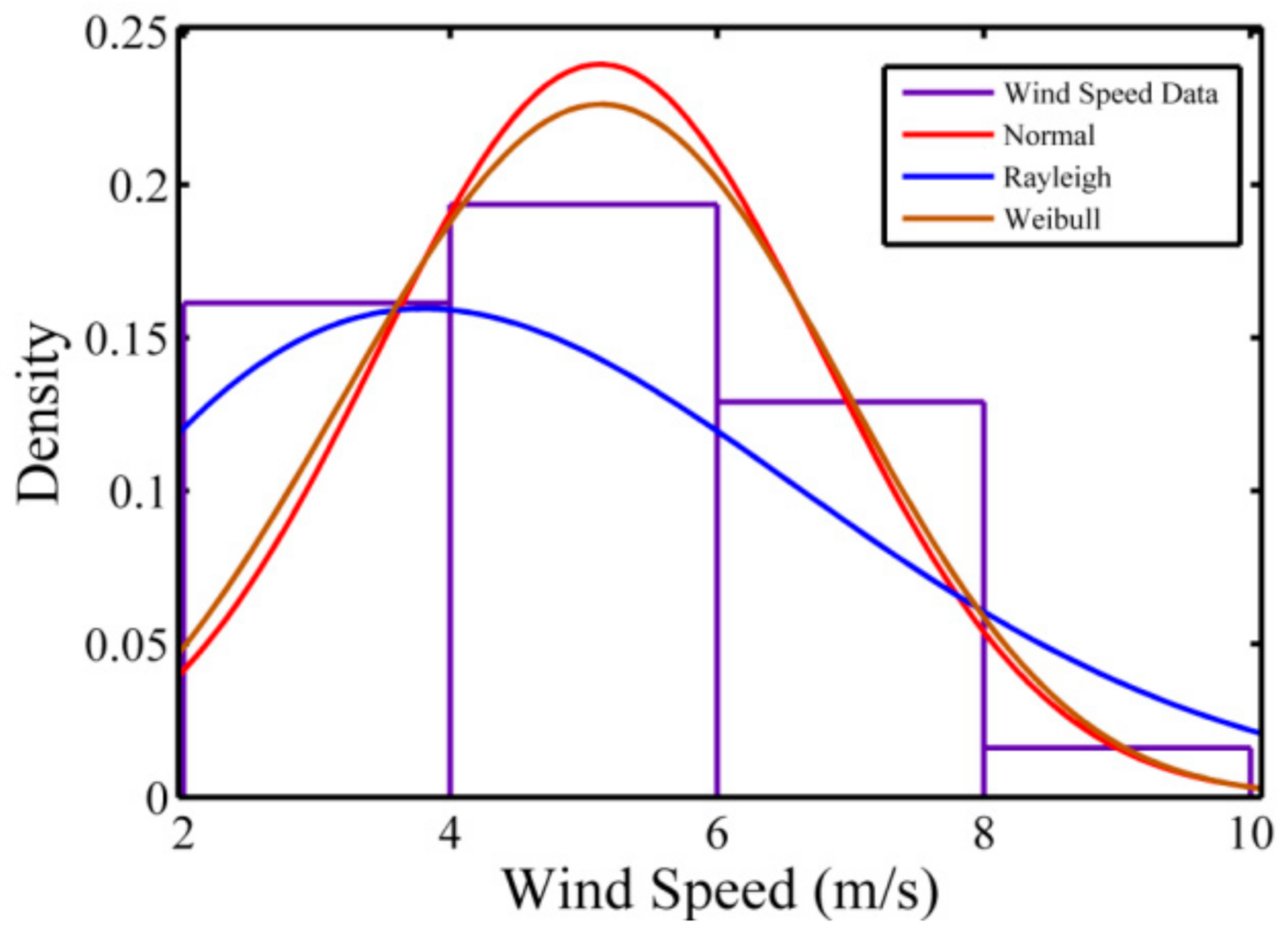
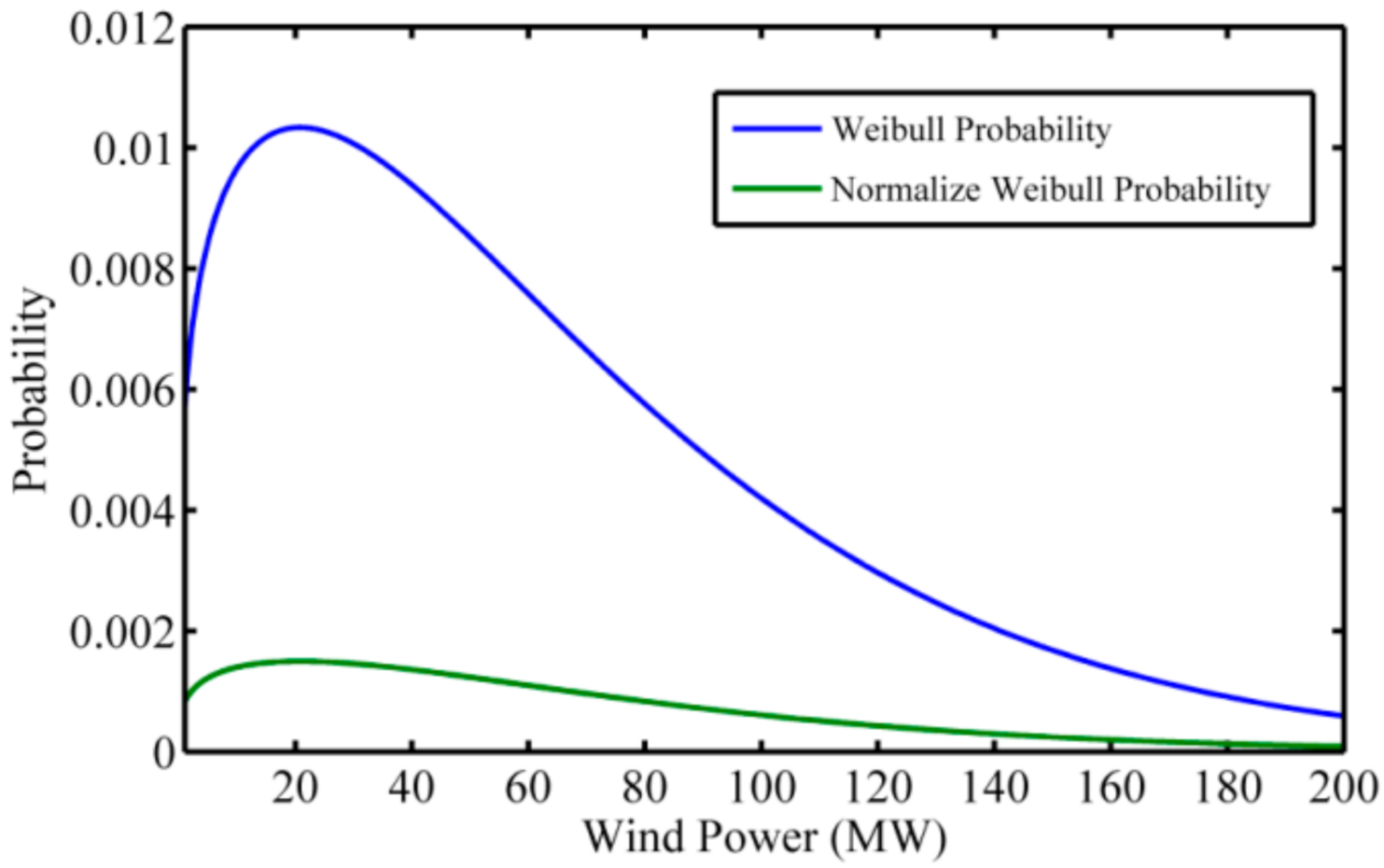
After demonstrating the superiority of the suggested version, OGSA was used to evaluate the proposed optimum bidding methods with three cases, i.e., with wind, with solar, and with both wind and solar. The values of 7.93 and 3.34 m/s for scale and shape parameters, respectively, were derived from Equations (2) and (3). Then, utilizing the wind speed power connection, a thousand speeds for wind possibilities were created and transformed into power situations at 100 m hub height for considered turbine [
29]. To make their total equal to unity, each produced scenario was given a probability of normalization calculated using the Weibull distribution. For produced power situations, we used the density of the Weibull pdf as shown in
Figure 3.
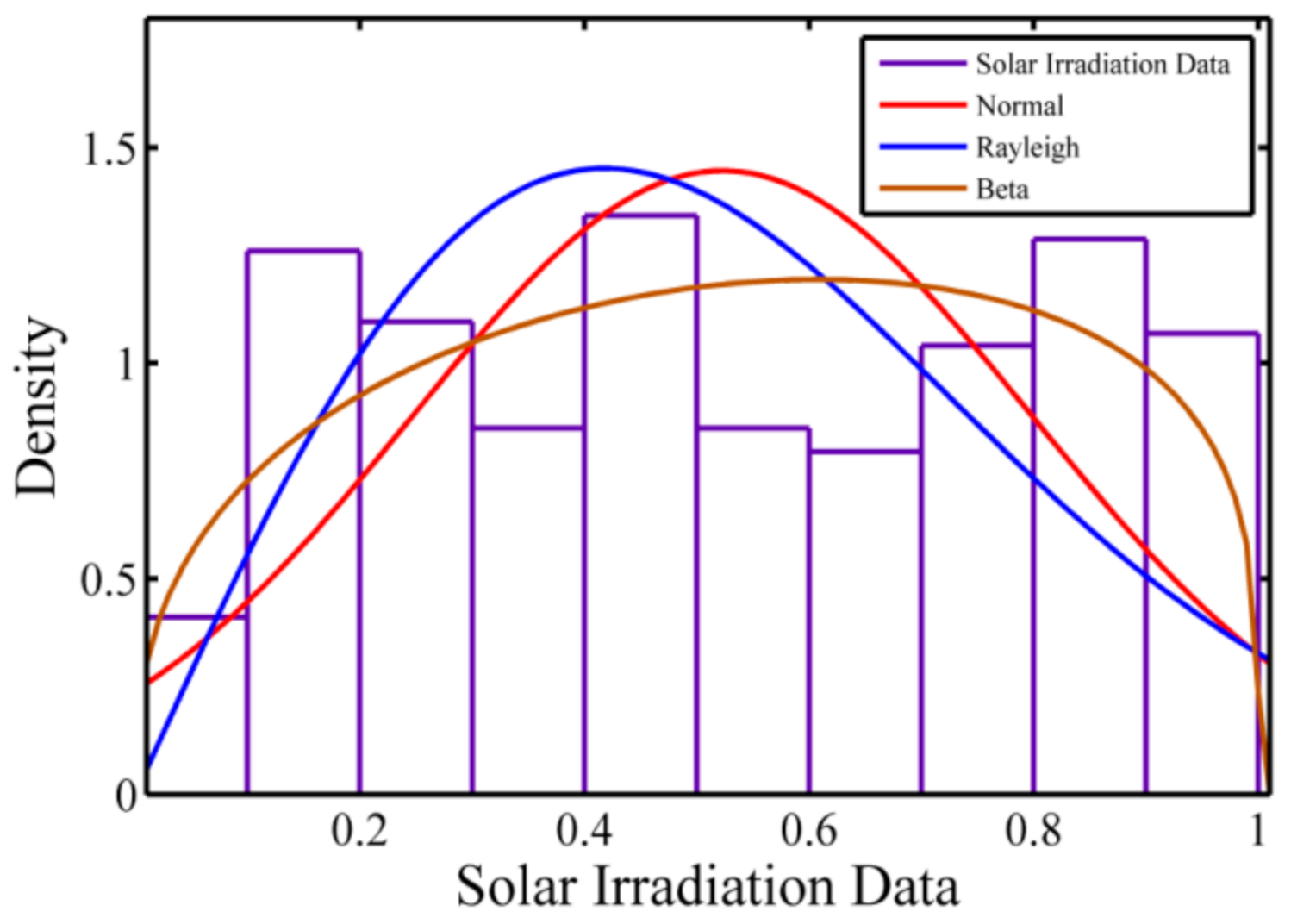
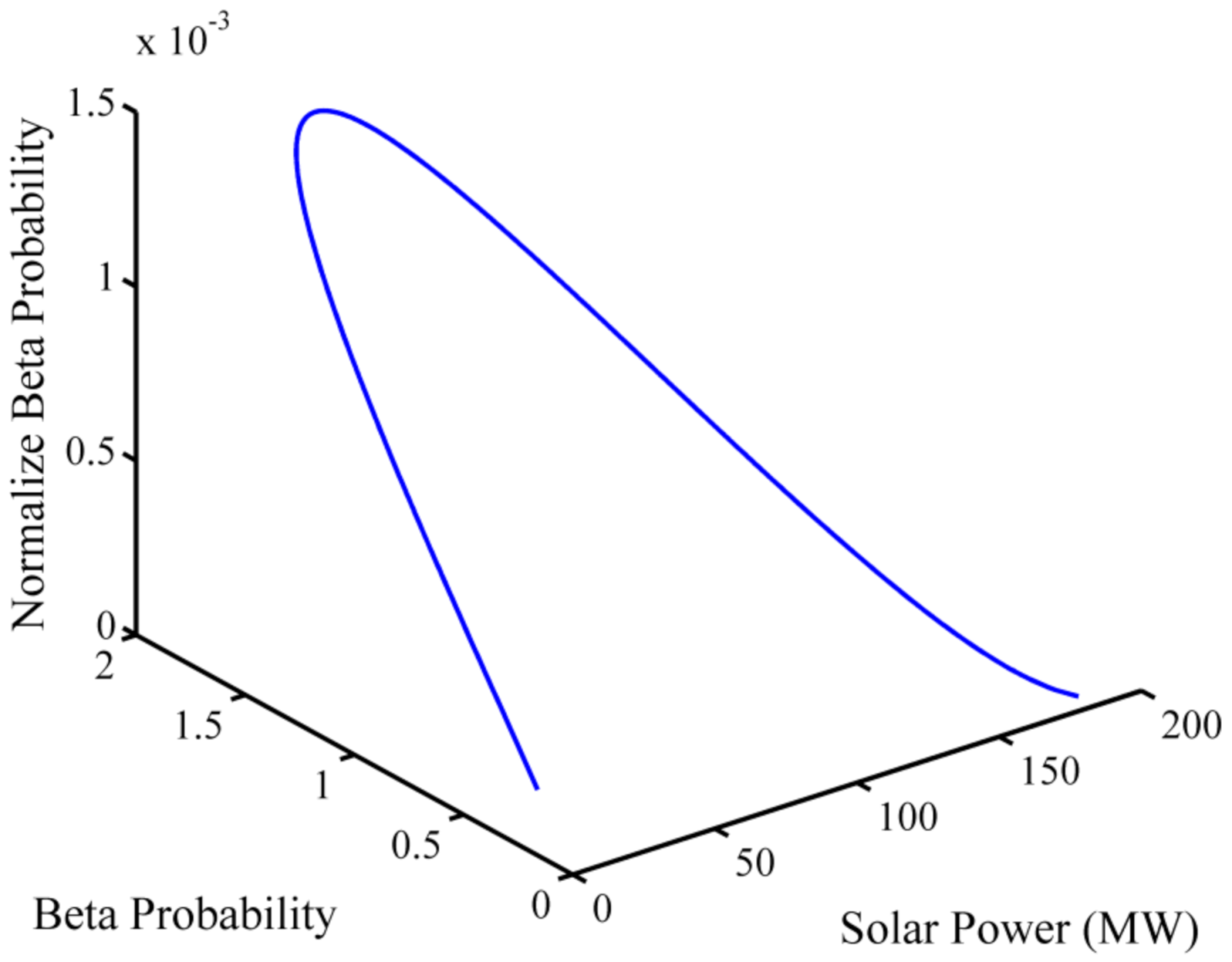
For the past date of solar irradiation, the values of Beta pdf parameters A and B were 1.3909 and 1.2518, respectively, as determined by Equations (10) and (11). Following that, a thousand sun irradiation scenarios were generated and translated into power scenarios using PV module specs. To make their total equal to unity, each created scenario was given a possibilities’ normalization calculated with the Beta pdf. For generated power situations, we took the Beta and normalized the probability density curve as shown in
Figure 4.
The unpredictability of renewable power (wind and solar) was predicted by the vast variety of possibilities. However, only a few cases showed the same conclusion. The KDM approach was used to remove such scenarios in order to improve renewable power modeling.
Table 7 shows 10 concentrated situations created from 1000 possibilities for considered renewable sources, respectively. The predicted values of solar and wind powers are 73.29 and 49.54 MW, respectively, depending on the ultimate values of renewable (wind and solar) power outputs, as well as the likelihood associated with them.
After calculating the wind and solar power outputs, suggested optimum bidding methods were then examined on both the arrangements using OGSA with solar, wind, and both the solar and wind together.
Table 8 and
Table 9 show the optimal values for factors of bidding for TPS with solar only, wind only, and combined wind-solar electricity using OGSA for both systems, respectively. The impacts of renewable energy sources were studied in order on both systems. For the bidding approach considering renewable influence, the ISO was permitted to alter the current requirement, which was a real requirement apart from renewable influence contribution, and the bidding factors were then updated to reflect the changing demand.
The new MCP was determined using this technique, which considered wind and solar electricity amount. First, the wind supplier was taken into account, and a new MCP value was considered by revising the bidding coefficients at the modified demand. In the same way, MCP considered the collective benefits of wind and solar suppliers, as well as the incorporation of solar supplier. The operational costs of these renewable energy sources were not taken into description of this work. However, because of the intermittent nature of renewable energy sources, it is necessary to assess the cost of their imbalance. This cost was calculated based on overestimation and underestimating of solar and wind power, and the impact of this cost was measured in terms of total income minus the imbalance cost for renewable energy providers. Furthermore, the coefficients for penalty and reserve associated with underestimation and overestimation, respectively, were treated as 50% of MCP and identical to MCP [
18].
Table 8 and
Table 9 show the outcomes of the suggested bidding method on examined systems with only wind, solely solar, and combined solar and wind, respectively, using OGSA.
Table 4 shows that the market was secured at an MCP of 14.15
$/MW, total production for TPS was 500 MW, and total profit TPSs was
$5317.72 with an IEEE 30 bus system that excludes solar and wind electricity. However, if just wind power was included, MCP dropped to
$12.99 per MW, and TPSs total production fell to 450.46 MW. TPSs net profit was also down
$4352.19, owing to the decreased value of MCP and traditional system production. The expenses of wind power overestimation and underestimation were
$227.9703 and
$46.7718, respectively, with a net profit
$368.7903 for the wind supplier. The total earnings, overestimation, and underestimating costs in the next situation only solar with TPSs were
$532.3688,
$119.1724, and
$257.9840, respectively. The MCP value in this scenario was
$12.41 per MW, with a total production of TPSs 426.71 MW, which was less than traditional with wind because of the large amount of solar energy produced. Finally, MCP was 11.56
$/MW when both solar and wind were included with TPSs, which was the lowest of all the previously studied situations.
Table 5 shows that the market was cleared at 12.97
$/MW, total TPSs production was 1500 MW, and total profit for TPSs was
$14,077.77 for IEEE 57 bus system without renewable suppliers. However, if just wind influence was incorporated with TPSs, MCP fell to
$12.71 per MW, and net TPSs production fell to 1450.46 MW. Furthermore, the total profit for TPSs was lowered by
$1426.7103, owing to the lower value of MCP and conventional production. The wind power total profit, overestimation, and underestimating, respectively, were
$223.0564,
$45.7637, and
$360.8410. The total profit, overestimation, and underestimating costs in the second scenario, i.e., solely solar power with TPSs, respectively, were
$537.9455,
$120.4208, and
$260.6865. The MCP in this scenario was
$12.54/MW, with total TPSs output of 1426.7103 MW, which was lesser than traditional and wind because of the large amount of solar energy produced. Finally, MCP was
$12.25/MW when both wind and solar were included with TPSs, which was the lowest of all the previously studied scenarios of IEEE 57-bus system.



 ,
,