Article

Conjugated Numerical Approach for Modelling DBHE in High Geothermal Gradient Environments

1
Energy and Power, Cranfield University, Cranfield MK43 0AL, UK
2
James Watt School of Engineering, University of Glasgow, Glasgow G13 8QQ, UK
*
Author to whom correspondence should be addressed.
Energies 2020, 13(22), 6107; https://doi.org/10.3390/en13226107
Submission received: 5 October 2020 / Revised: 16 November 2020 / Accepted: 17 November 2020 / Published: 21 November 2020
(This article belongs to the Special Issue Geothermal Resources)

Abstract

Geothermal is a renewable energy source that can be untapped through various subsurface technologies. Closed geothermal well solutions, such as deep geothermal heat exchangers (DBHEs), consist of circulating a working fluid to recover the available heat, with less dependency on the local geological settings than conventional geothermal systems. This paper emphasizes a double numerical method to strengthen the assessment of DBHE performances. A computational fluid dynamics (CFD) commercial software and the 1D coupled wellbore-reservoir geothermal simulator T2Well have been used to investigate the heat transfer and fluid flow in a vertical DBHE in high geothermal gradient environments. The use of constant water properties to investigate the energy produced from DBHEs can lead to underestimating the overall heat transfer at high temperature and low mass flow rate. 2D axisymmetric CFD modelling improves the understanding of the return flow at the bottom of the DBHE, readjusting and better estimating the pressures losses commonly obtained with 1D modelling. This paper highlights the existence of convective cells located at the bottom of the DBHE internal tubing, with no significant effects due to the increase of injected water flow. Both codes are shown to constrain the numerical limitations to access the true potential of geothermal heat extraction from DBHEs in high geothermal gradient environments and demonstrate that they can be used for geothermal energy engineering applications.
Keywords: deep wellbore heat exchanger; modeling; geothermal energy CFD deep wellbore heat exchanger; modeling; geothermal energy CFD
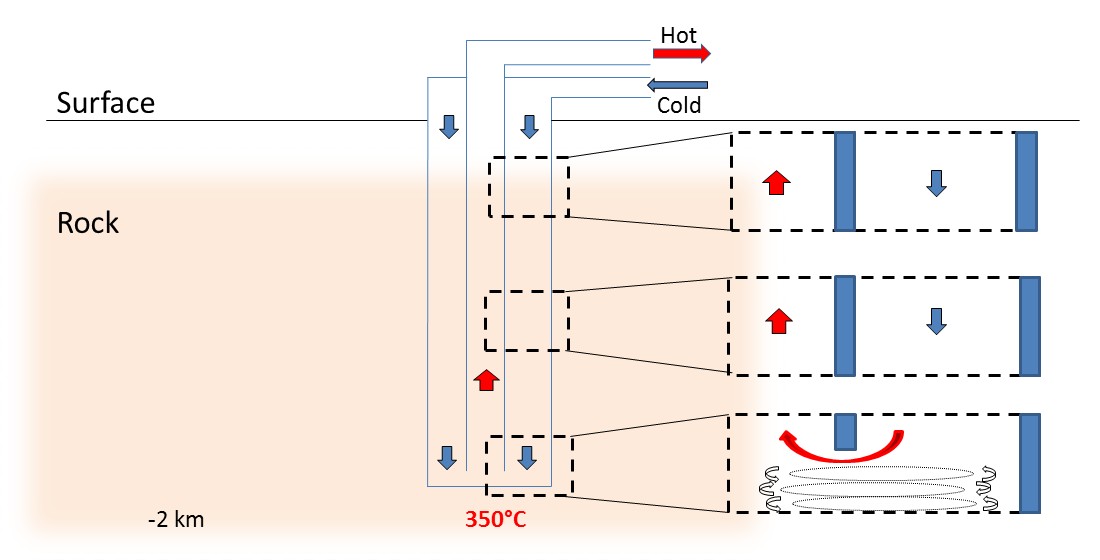
Graphical Abstract