


Awareness and Use of Folic Acid Among Pregnant Women in Western Ukraine: A Pilot Study


Highlights
- This pilot study addresses an important public health concern in Ukraine: persistently high rates of neural tube defects (NTDs), which remain among the highest in Europe.
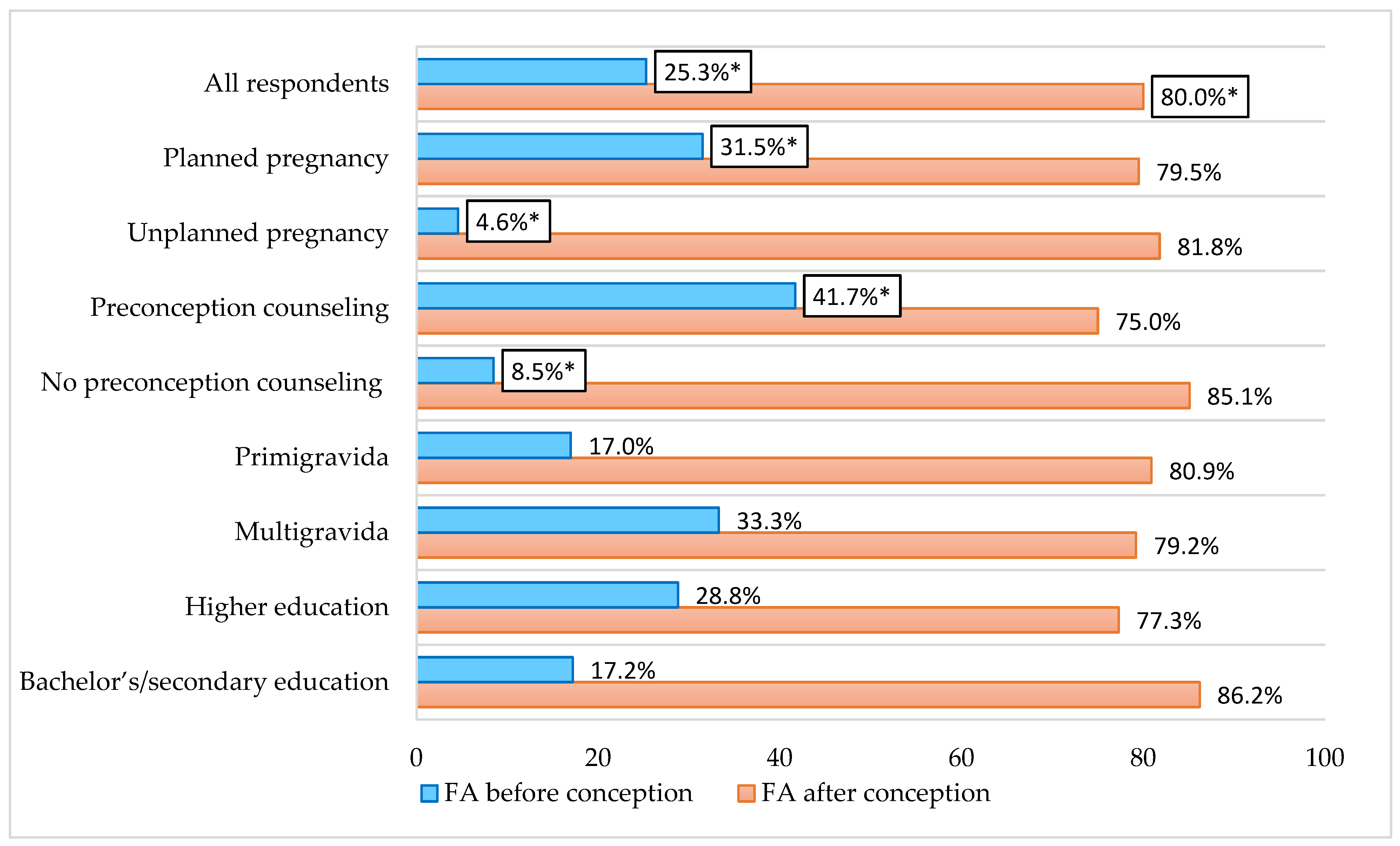
- It identifies a substantial gap between recommended and actual folic acid (FA) use, with low preconception supplementation (25.3%) compared to high post-conception initiation (80.0%), reflecting missed opportunities for effective NTD prevention.
- Based on cross-sectional data, the study provides preliminary evidence on determinants of FA supplementation, demonstrating that preconception counseling, pregnancy planning, and prior supplementation behavior strongly influence preconception intake.
- The findings show that knowledge alone does not translate into preventive behavior, suggesting limitations in current NTD prevention strategies in Ukraine.
- Results support strengthening preconception counseling and promoting folic acid supplementation among women of reproductive age.
- Implementation of national food fortification policies with folic acid and conduction of larger, population-based studies to develop evidence-based prevention strategies in Ukraine are recommended.
Abstract
1. Introduction
2. Materials and Methods
2.1. Study Design and Setting
2.2. Participants
2.3. Data Collection Tool
- −
- Sociodemographic characteristics, including age, place of residence (urban/rural), and educational level;
- −
- Anthropometric information, including self-reported pre-pregnancy body weight and height;
- −
- Reproductive history, including gravidity, pregnancy planning status, number of previous pregnancies, presence of children, and family history of birth defects;
- −
- Folic acid supplementation practices, including use before conception, timing of initiation during pregnancy, duration of intake, and previous use in earlier pregnancies;
- −
- Knowledge and awareness of folic acid, including awareness of the necessity of FA before and during pregnancy, knowledge of recommended duration of FA supplementation, knowledge of its role in neural tube defect prevention;
- −
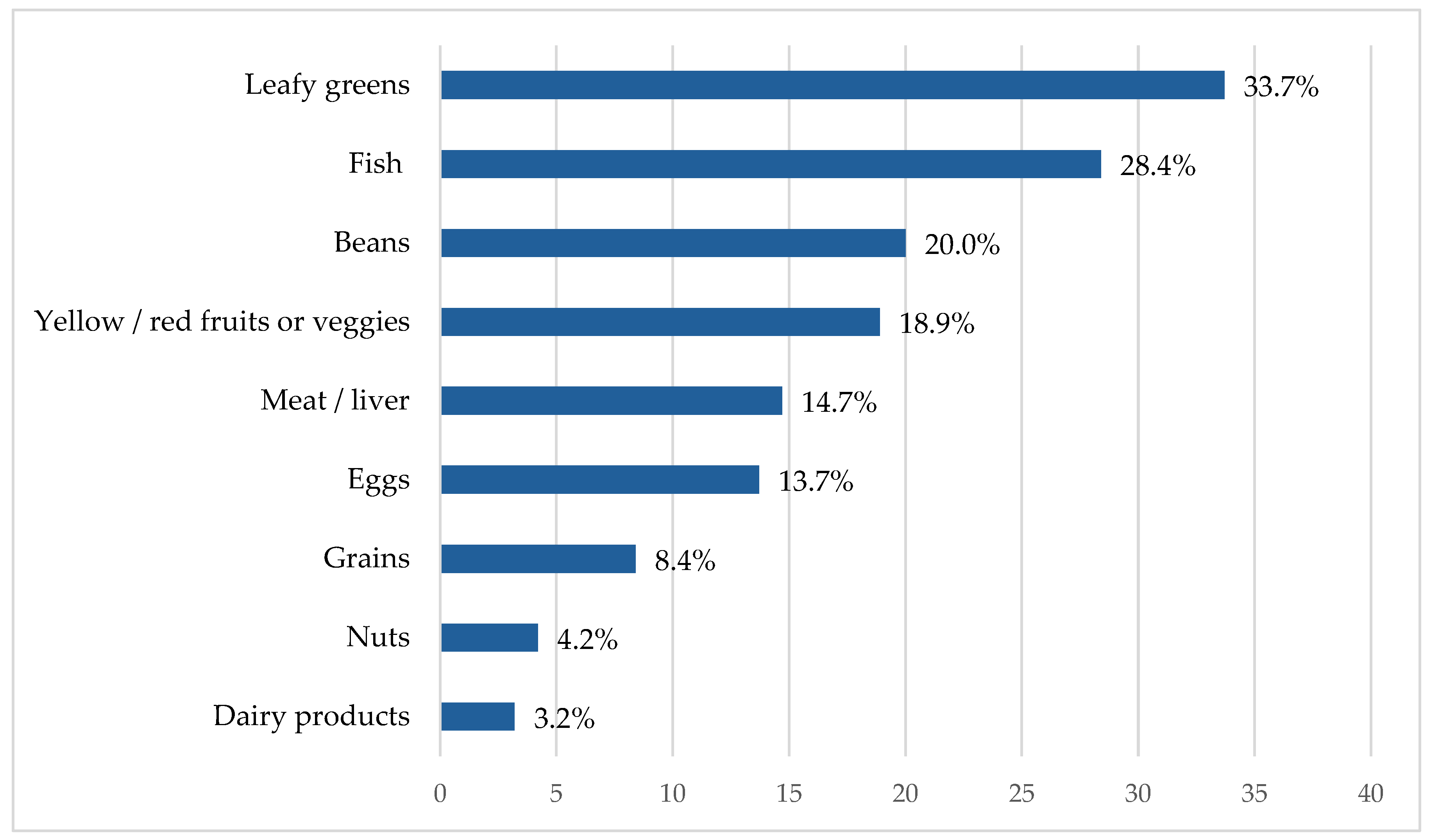
- Awareness of dietary sources of folate was assessed using a two-step approach. Participants were first asked whether they were aware of food sources of folate (yes/no). Subsequently, all participants were provided with a predefined list of food items and asked to identify those they considered to be sources of folate. Multiple selections were allowed.
2.4. Variables and Grouping
2.5. Statistical Analyses
3. Results
3.1. Sociodemographic Characteristics and Reproductive History
3.2. Folic Acid Supplementation Practices
3.3. Knowledge and Awareness of Folic Acid
4. Discussion
4.1. Interpretation of Folic Acid Supplementation Practices
4.2. Determinants of Pre- and Post-Conception Folic Acid Supplementation
4.3. Knowledge and Awareness of Folic Acid Use, Role and Supplementation
5. Limitations
6. Conclusions
Author Contributions
Funding
Institutional Review Board Statement
Data Availability Statement
Conflicts of Interest
References
- Karsonovich, T.; Munakomi, S. Spina Bifida. [Updated 4 May 2025]; In StatPearls [Internet]; StatPearls Publishing: Treasure Island, FL, USA, 2025. Available online: https://www.ncbi.nlm.nih.gov/books/NBK559265/ (accessed on 5 March 2026).
- Bazylevych, A.; Tychkivska, O.; Yevtushok, L.; Wertelecki, W. Epidemic of neural tube defects in Ukraine, or why children’s death and disabilities are not prevented. Proc. Shevchenko Sci. Soc. Med. Sci. 2016, 47, 47–56. [Google Scholar] [CrossRef]
- Salih, M.A.; Murshid, W.R.; Seidahmed, M.Z. Classification, clinical features, and genetics of neural tube defects. Saudi Med. J. 2014, 35, S5–S14. [Google Scholar] [PubMed] [PubMed Central]
- Pektaş, A.; Boyacı, M.G.; Koyuncu, H.; Pektaş, M.K.; Kundak, A.A. Timeliness of postnatal surgery in newborns with open neural tube defects: A single center experience. Turk. J. Pediatr. 2021, 63, 683–690. [Google Scholar] [CrossRef] [PubMed]
- Boyarchuk, O.R.; Koshmaniuk, M.V.; Hlushko, K.T.; Lovga, M.I.; Savkiv, D.V. Spina bifida health issues of children in Ukraine. Modern Pediatr. Ukraine 2023, 2, 40–49. [Google Scholar] [CrossRef]
- Boyarchuk, O.R.; Koshmaniuk, M.V. The program of multidisciplinary online support of children with spina bifida in Ukraine during the war. Child’s Health 2023, 18, 370–375. [Google Scholar] [CrossRef]
- Morris, J.K.; Addor, M.C.; Ballardini, E.; Barisic, I.; Barrachina-Bonet, L.; Braz, P.; Cavero-Carbonell, C.; Den Hond, E.; Garne, E.; Gatt, M.; et al. Prevention of Neural Tube Defects in Europe: A Public Health Failure. Front. Pediatr. 2021, 9, 647038. [Google Scholar] [CrossRef] [PubMed] [PubMed Central]
- Çaylan, N.; Yalçin, S.S.; Tezel, B.; Aydin, Ş.; Üner, O.K.F. Evaluation of neural tube defects from 2014 to 2019 in Turkey. BMC Pregnancy Childbirth 2022, 22, 340. [Google Scholar] [CrossRef] [PubMed] [PubMed Central]
- Blencowe, H.; Kancherla, V.; Moorthie, S.; Darlison, M.W.; Modell, B. Estimates of global and regional prevalence of neural tube defects for 2015: A systematic analysis. Ann. N. Y. Acad. Sci. 2018, 1414, 31–46. [Google Scholar] [CrossRef] [PubMed]
- Dobrovolska, L.I.; Boyarchuk, O.R.; Kinash, M.I. Dietary intake of folate and the frequency of its deficiency in children with type 1 diabetes mellitus and healthy children. Ukr. Biochem. J. 2022, 94, 40–46. [Google Scholar] [CrossRef]
- Abate, B.B.; Kumsa, H.; Kibret, G.A.; Wodaynew, T.; Habtie, T.E.; Kassa, M.; Munie, M.A.; Temesgen, D.; Tilahun, B.D.; Merchaw, A.; et al. Preconception Folic Acid and Multivitamin Supplementation for the Prevention of Neural Tube Defect: An Umbrella Review of Systematic Review and Meta-analysis. Neuroepidemiology 2025, 59, 412–425. [Google Scholar] [CrossRef]
- Wertelecki, W.; Ievtushok, B.; Zymak-Zakutnia, N.; Kalynka, S.; Korzhynskyy, Y.; Lapchenko, S.; Sosyniuk, Z. Birth defects, Polissia, Chornobyl. Neonatol. Surg. Perinat. Med. 2016, 6, 5–14. [Google Scholar] [CrossRef][Green Version]
- Wertelecki, W.; Yevtushok, L.; Kuznietsov, I.; Komov, O.; Lapchenko, S.; Akhmedzanova, D.; Ostapchuk, L. Chornobyl, radiation, neural tube defects, and microcephaly. Eur. J. Med. Genet. 2018, 61, 556–563. [Google Scholar] [CrossRef] [PubMed]
- van Rooij, D.; Mou, Y.; White, T.; Voortman, T.; Jansen, P.W.; Buitelaar, J.K. Prenatal Vitamin D, Multivitamin, and Folic Acid Supplementation and Brain Structure in Children with ADHD and ASD Traits: The Generation R Study. Nutrients 2025, 17, 2979. [Google Scholar] [CrossRef] [PubMed]
- Peng, L.; Gao, Y.; Yuan, C.; Kuang, H. Maternal red blood cell folate and vitamin B metabolism with pregnancy outcomes: A retrospective study. BMC Pregnancy Childbirth 2025, 25, 688. [Google Scholar] [CrossRef] [PubMed]
- World Health Organization. Guideline: Optimal Serum and Red Blood Cell Folate Concentrations in Women of Reproductive Age for Prevention of Neural Tube Defects; WHO: Geneva, The Netherland, 2015. Available online: https://iris.who.int/server/api/core/bitstreams/39db82a4-395b-43cc-ad5d-949f6d647d8a/content (accessed on 20 February 2026).
- CDC. Recommendations for the use of folic acid to reduce the number of cases of spina bifida and other neural tube defects. MMWR Recomm Rep. 1992, 41, 1–7. [Google Scholar]
- National Institute for Health and Care Excellence. Maternal and Child Nutrition: Nutrition and Weight Management in Pregnancy, and Nutrition in Children up to 5 Years. 2025. Available online: https://www.nice.org.uk/guidance/ng247/resources/maternal-and-child-nutrition-nutrition-and-weight-management-in-pregnancy-and-nutrition-in-children-up-to-5-years-pdf-66143961638341 (accessed on 20 February 2026).
- Linnell, A.; Murphy, N.; Godwin, J.; Cremona, A. An evaluation of adherence to folic acid supplementation in pregnant women during early gestation for the prevention of neural tube defects. Public Health Nutr. 2022, 25, 3025–3035. [Google Scholar] [CrossRef] [PubMed] [PubMed Central]
- Medawar, G.; Wehbe, T.; Jaoude, E.A. Awareness and Use of Folic Acid among Women of Childbearing Age. Ann. Glob. Health 2019, 85, 54. [Google Scholar] [CrossRef] [PubMed] [PubMed Central]
- Köken, G.N.; Derbent, A.U.; Erol, O.; Saygın, N.; Ayık, H.; Karaca, M. Awareness and use of folic acid among reproductive age and pregnant women. J. Turk. Ger. Gynecol. Assoc. 2013, 14, 87–91. [Google Scholar] [CrossRef] [PubMed] [PubMed Central]
- Nilsen, R.M.; Leoncini, E.; Gastaldi, P.; Allegri, V.; Agostino, R.; Faravelli, F.; Ferrazzoli, F.; Finale, E.; Ghirri, P.; Scarano, G.; et al. Prevalence and Determinants of Preconception Folic Acid Use: An Italian Multicenter Survey. Ital. J. Pediatr. 2016, 42, 65. [Google Scholar] [CrossRef]
- Yamamoto, S.; Wada, Y. Awareness, use and information sources of folic acid supplementation to prevent neural tube defects in pregnant Japanese women. Public Health Nutr. 2018, 21, 732–739. [Google Scholar] [CrossRef] [PubMed] [PubMed Central]
- Jin, Y.J.; Kim, H.W. Influence of folic acid knowledge on effective folic acid intake in Chinese pregnant women: A cross-sectional study. Korean J. Women Health Nurs. 2023, 29, 291–301. [Google Scholar] [CrossRef] [PubMed] [PubMed Central]
- Teshome, F.; Kebede, Y.; Girma, K.; Birhanu, Z. A survey on women’s awareness of iron and folic acid intake during preconception period and its associated factors in Manna District, Oromia region, Southwest Ethiopia. Nurs. Open 2022, 9, 950–958. [Google Scholar] [CrossRef] [PubMed] [PubMed Central]
- Zadarko-Domaradzka, M.; Kruszyńska, E.; Zadarko, E. Effectiveness of Folic Acid Supplementation Recommendations among Polish Female Students from the Podkarpackie Region. Nutrients 2021, 13, 1001. [Google Scholar] [CrossRef] [PubMed] [PubMed Central]
- Hlushko, K.; Boyarchuk, O.; Kinash, M.; Burbela, E.; Rohalska, Y.; Dobrovolska, L. Awareness of folic acid use and its effects among medical students in Ukraine. Wiad. Lek. 2021, 74, 2033–2038. [Google Scholar] [CrossRef] [PubMed]
- Panasiuk, A.; Hozyasz, K.K. Knowledge and supplementation of folic acid among female university students in southeastern Poland. Actual Gyn. 2023, 15, 95–103. [Google Scholar]
- Bitzer, J.; von Stenglin, A.; Bannemerschult, R. Women’s awareness and periconceptional use of folic acid: Data from a large European survey. Int. J. Womens Health 2013, 5, 201–213. [Google Scholar] [CrossRef] [PubMed] [PubMed Central]



| Variable | Category | n (%) |
|---|---|---|
| Sociodemographic Characteristics | ||
| Age (years) | 18–24 | 23 (24.2) |
| 25–34 | 55 (57.9) | |
| ≥35 | 17 (17.9) | |
| Educational Level | Master’s degree | 66 (69.5) |
| Bachelor’s degree/school | 29 (30.5) | |
| Occupation | Student | 7 (7.4) |
| Housewife | 26 (27.4) | |
| On maternity leave | 35 (36.8) | |
| Employed | 27 (28.4) | |
| Residence | Urban | 79 (83.2) |
| Rural | 16 (16.8) | |
| Family Income Level (self-assessment) | Low | 10 (10.5) |
| Lower-middle | 14 (14.7) | |
| Middle | 63 (66.3) | |
| Upper-middle | 8 (8.4) | |
| Pregnancy and Reproductive History | ||
| Pregnancy Planning | Planned | 73 (76.8) |
| Unplanned | 22 (23.2) | |
| Gravidity | Primigravida | 47 (49.5) |
| Multigravida | 48 (50.5) | |
| Trimester of Pregnancy | First trimester | 6 (6.3) |
| Second trimester | 45 (47.4) | |
| Third trimester | 44 (46.3) | |
| Preconception Counseling | Yes | 48 (50.5) |
| No | 47 (49.5) | |
| Parity | Nulliparous | 50 (52.6) |
| Primiparous | 33 (34.7) | |
| Multiparous | 12 (12.7) | |
| Outcome of Previous Pregnancies * | Abortion | 10 (10.5) |
| Stillbirth | 2 (2.1) | |
| Live birth | 44 (46.3) | |
| Other | 2 (2.1) | |
| Family History of Congenital Defects | Yes | 16 (16.8) |
| –Congenital heart defects | 8 (8.4) | |
| –Nervous system defects | 6 (6.3) | |
| –Skeletal defects | 2 (2.1) | |
| –Renal defects | 1 (1.1) | |
| No | 79 (83.2) | |
| Preconception BMI | Normal weight (including underweight *) | 57 (60.0) |
| Overweight | 27 (28.4) | |
| Obesity | 11 (11.6) |
| Variable | OR | 95% CI | p-Value |
|---|---|---|---|
| Age (per year) | 1.09 | 1.00–1.19 | 0.046 |
| BMI (per kg/m2) | 1.070 | 0.96–1.19 | 0.205 |
| Place of residence (urban vs. rural) | 1.02 | 0.29–3.51 | 0.979 |
| Educational level (higher vs. college/school) | 1.94 | 0.65–5.84 | 0.238 |
| Planned pregnancy (yes vs. no) | 9.7 | 1.22–76.25 | 0.031 |
| Preconception counseling (yes vs. no) | 7.7 | 2.37–24.85 | 0.001 |
| Multigravida (vs. primigravida) | 2.44 | 0.92–6.42 | 0.072 |
| Previous FA supplementation (yes vs. no) | 3.11 | 1.20–8.33 | 0.020 |
| Variable | OR | 95% CI | p-Value |
|---|---|---|---|
| Age (per year) | 1.01 | 0.92–1.11 | 0.821 |
| BMI (per kg/m2) | 0.97 | 0.68–5.36 | 0.222 |
| Place of residence (urban vs. rural) | 1.42 | 0.40–5.03 | 0.585 |
| Educational level (higher vs. college/school) | 0.54 | 0.16–1.81 | 0.321 |
| Planned pregnancy (yes vs. no) | 1.16 | 0.34–3.96 | 0.808 |
| Preconception counseling (yes vs. no) | 1.91 | 0.68–5.36 | 0.222 |
| Multigravida (vs. primigravida) | 0.90 | 0.33–2.46 | 0.837 |
| Previous FA supplementation (yes vs. no) | 4.1 | 1.10–14.29 | 0.036 |
| Knowledge Item | Total (n = 95) n (%) | Higher Education (n = 66) n (%) | College/School (n = 29) n (%) | p-Value * |
|---|---|---|---|---|
| Is it necessary to take FA before pregnancy? | 0.03 | |||
| Yes | 34 (35.8) | 27 (40.9) | 7 (24.1) | |
| No | 9 (9.5) | 3 (4.6) | 6 (20.7) | |
| Do not know | 52 (54.7) | 36 (54.6) | 16 (55.2) | |
| Recommended duration of FA intake before pregnancy | 0.03 | |||
| ≤1 month | 5 (5.3) | 5 (7.6) | 0 (0.0) | |
| 1–2 months | 10 (10.5) | 5 (7.6) | 5 (17.2) | |
| ≥2 months | 6 (6.3) | 5 (7.6) | 1 (3.5) | |
| ≥2 months and throughout attempts to conceive | 13 (13.7) | 12 (18.2) | 1 (3.5) | |
| Do not know | 52 (54.7) | 36 (54.6) | 16 (55.2) | |
| Is it necessary to take FA during pregnancy? | 0.31 | |||
| Yes | 46 (48.4) | 34 (51.5) | 12 (41.4) | |
| No | 3 (3.2) | 1 (1.5) | 2 (6.9) | |
| Do not know | 46 (48.4) | 31 (47.0) | 15 (51.7) | |
| Recommended duration of FA intake during pregnancy | 0.63 | |||
| ≤1 month | 3 (3.2) | 2 (3.0) | 1 (3.5) | |
| 1–2 months | 15 (15.8) | 11 (16.7) | 4 (13.8) | |
| ≥2 months | 25 (26.3) | 19 (28.8) | 6 (20.7) | |
| Do not know | 49 (51.6) | 33 (50.0) | 16 (55.2) |
Disclaimer/Publisher’s Note: The statements, opinions and data contained in all publications are solely those of the individual author(s) and contributor(s) and not of MDPI and/or the editor(s). MDPI and/or the editor(s) disclaim responsibility for any injury to people or property resulting from any ideas, methods, instructions or products referred to in the content. |
© 2026 by the authors. Licensee MDPI, Basel, Switzerland. This article is an open access article distributed under the terms and conditions of the Creative Commons Attribution (CC BY) license.
Share and Cite
Hlushko, K.; Boyarchuk, O. Awareness and Use of Folic Acid Among Pregnant Women in Western Ukraine: A Pilot Study. Int. J. Environ. Res. Public Health 2026, 23, 339. https://doi.org/10.3390/ijerph23030339
Hlushko K, Boyarchuk O. Awareness and Use of Folic Acid Among Pregnant Women in Western Ukraine: A Pilot Study. International Journal of Environmental Research and Public Health. 2026; 23(3):339. https://doi.org/10.3390/ijerph23030339
Chicago/Turabian StyleHlushko, Kateryna, and Oksana Boyarchuk. 2026. "Awareness and Use of Folic Acid Among Pregnant Women in Western Ukraine: A Pilot Study" International Journal of Environmental Research and Public Health 23, no. 3: 339. https://doi.org/10.3390/ijerph23030339
APA StyleHlushko, K., & Boyarchuk, O. (2026). Awareness and Use of Folic Acid Among Pregnant Women in Western Ukraine: A Pilot Study. International Journal of Environmental Research and Public Health, 23(3), 339. https://doi.org/10.3390/ijerph23030339