

Monkeypox (Mpox), a Resurging Global Public Health Concern: An Updated Outlook Through 2025
 , , ,
, , ,  , , , ,
  , , , , and
Abstract
1. Introduction
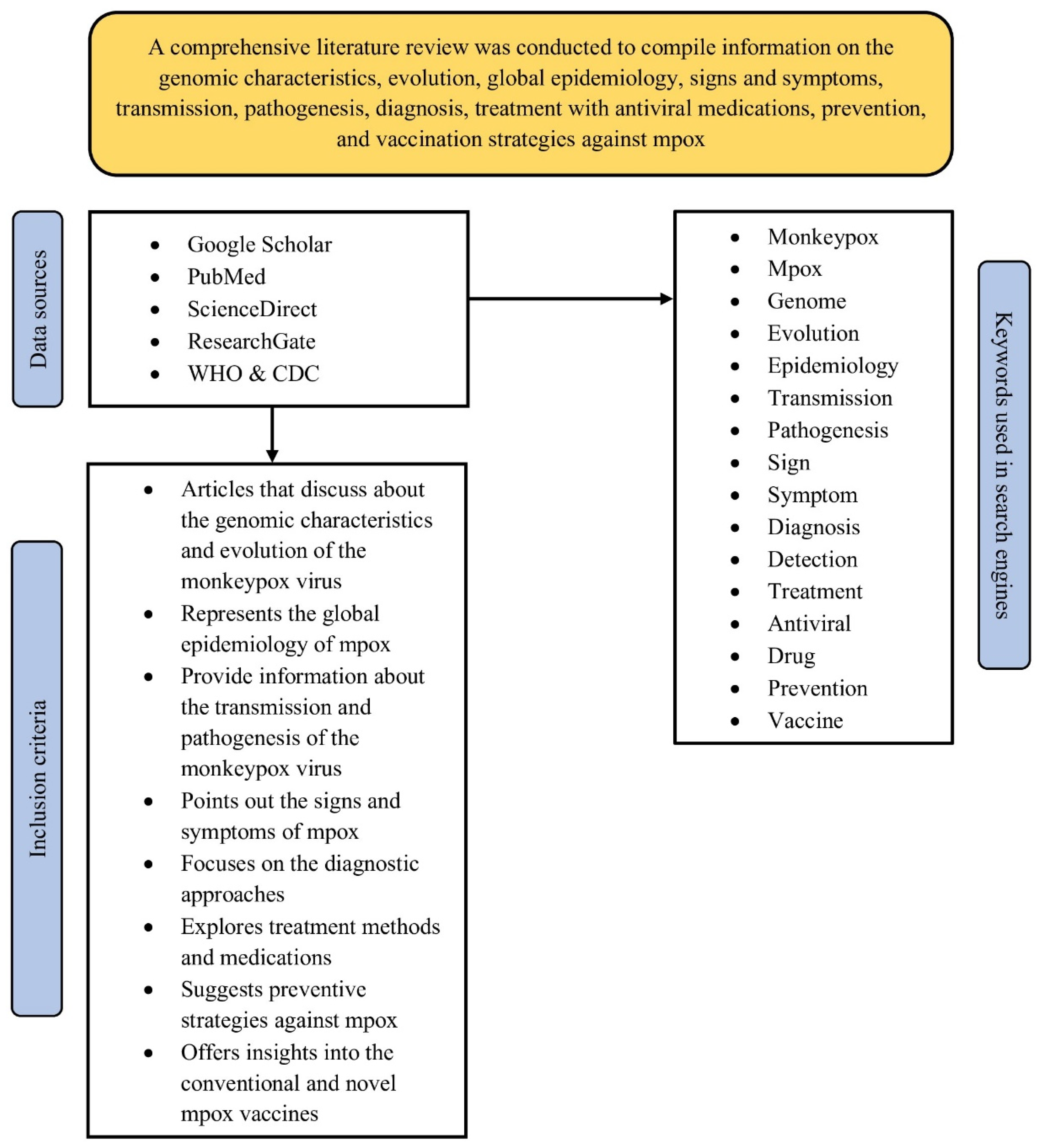
2. Methodology
3. Review of Literature
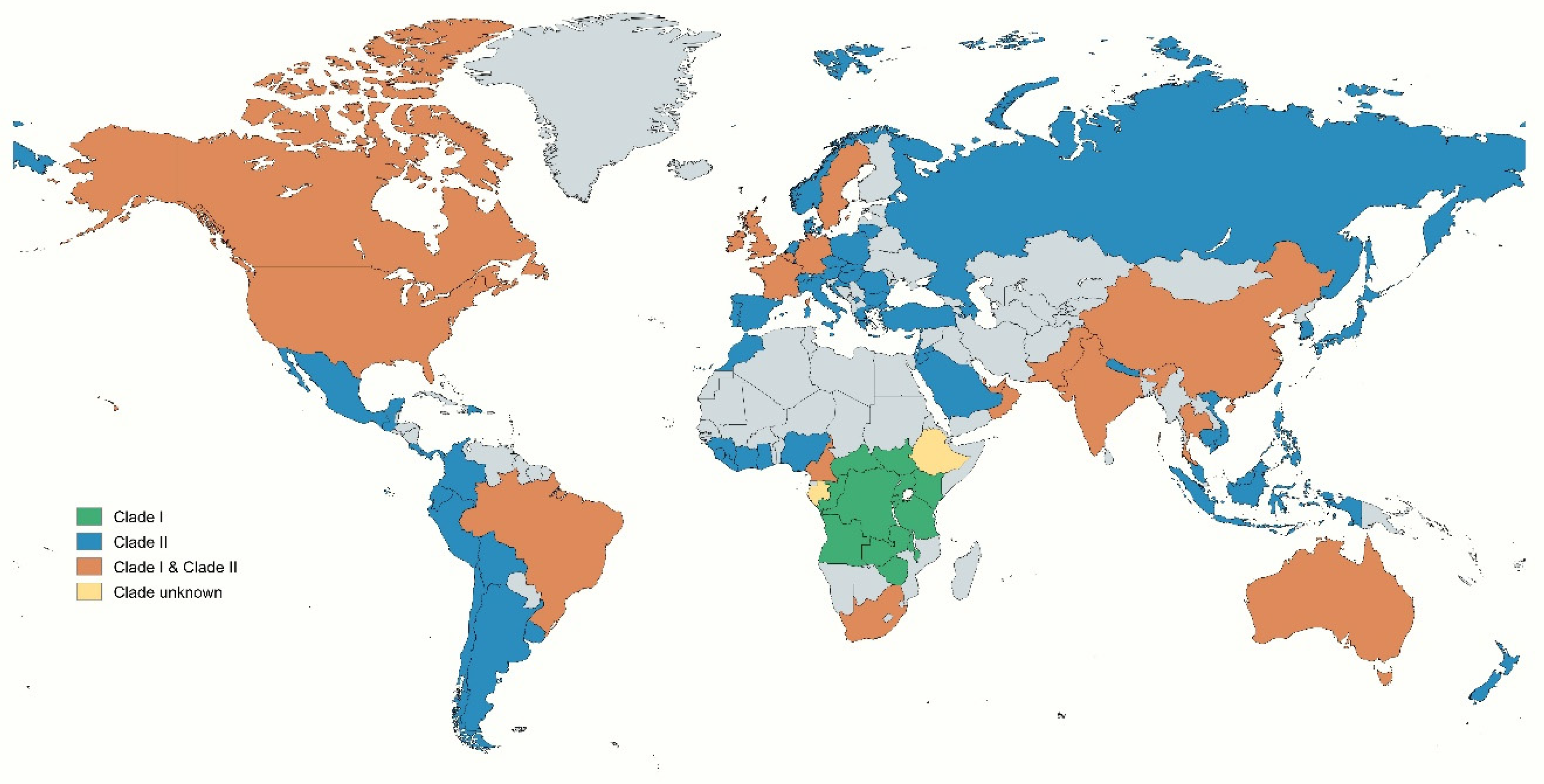
3.1. Evolution of Mpox Virus and Global Distribution
3.2. Genomic Characteristics of Mpox Virus
3.3. Global Epidemiology of Mpox
3.3.1. Epidemiology of Mpox Within the African Continent
3.3.2. Epidemiology of Mpox Outside of the African Continent
3.3.3. Global Outbreak of Mpox in 2022–2025
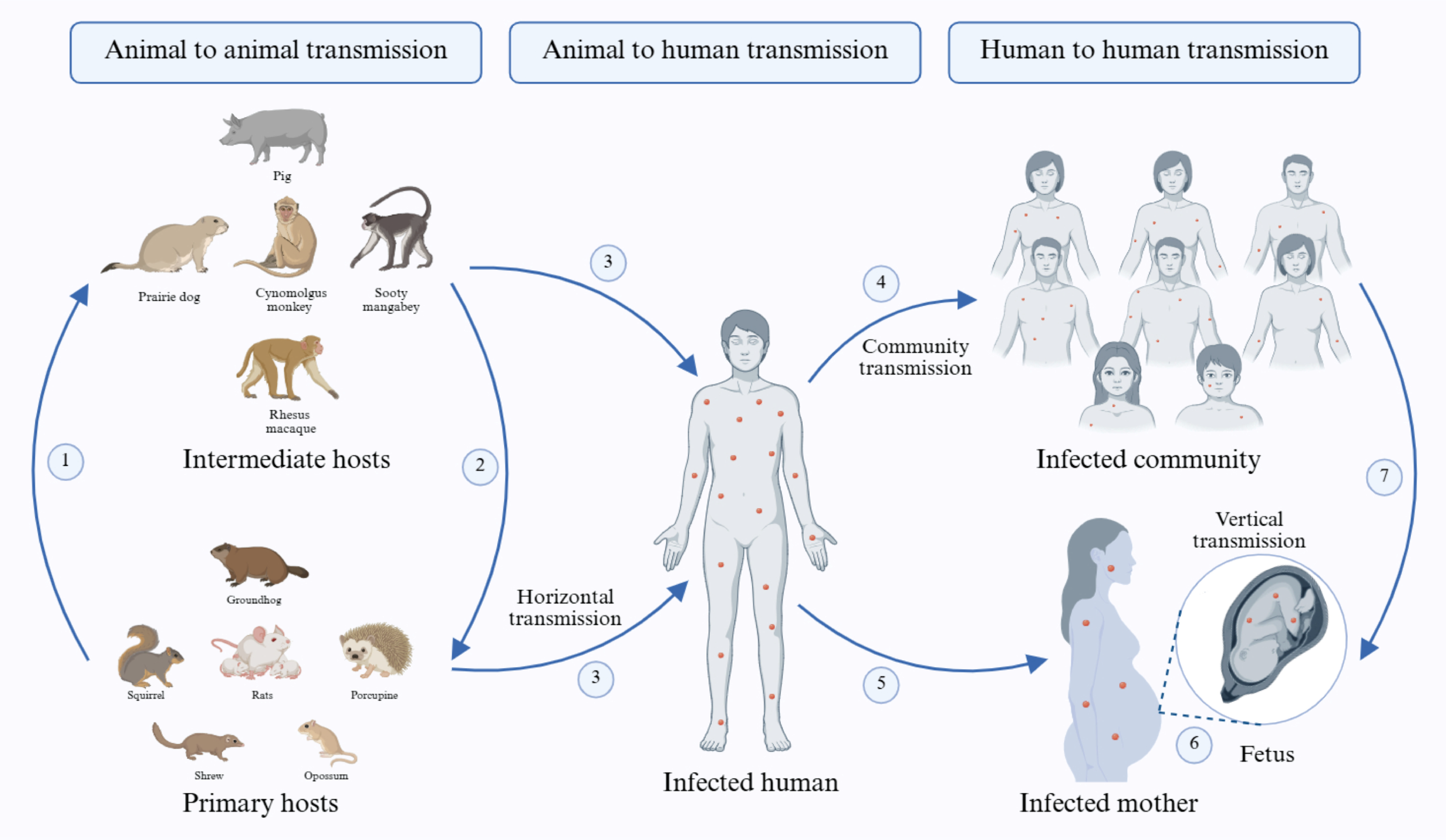
3.4. Transmission
3.5. Pathogenesis
3.5.1. Signs and Symptoms in Phases of Mpox Infection
Incubation Period
Prodromal Period
Rash Period
Crusting Period
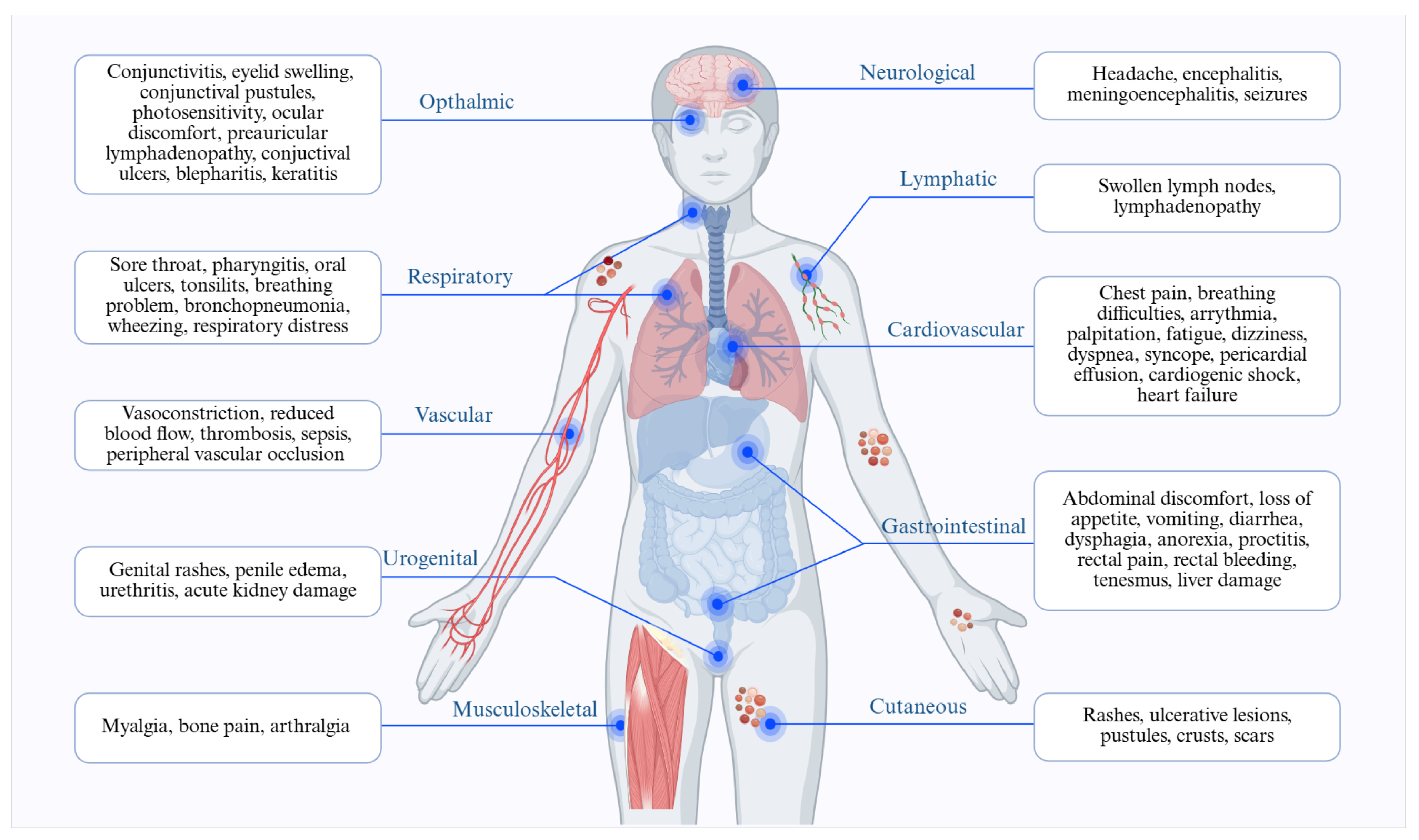
3.5.2. Clinical Complications of Mpox Infection in Different Body Parts
Neurologic Complications
Ophthalmic Complications
Cardiovascular Complications
Gastrointestinal Complications
Pulmonary Complications
3.6. Diagnosis of Mpox
3.6.1. Polymerase Chain Reaction (PCR)
3.6.2. Immunologic Assays
3.6.3. Electron Microscopy
3.6.4. Other Diagnostic Approaches
3.7. Treatment Approaches and Medications for Mpox
3.7.1. Supportive Care and Conventional Therapeutic Supports
3.7.2. Antiviral Drugs to Treat Mpox
3.7.3. Antimicrobial Drugs to Treat Mpox
3.8. Vaccines Against Mpox
3.8.1. Traditional Mpox Vaccine Candidates
3.8.2. Novel Mpox Vaccine Candidates
3.9. Preventive Measures of Mpox
4. Future Perspectives and Recommendations
5. Limitations of This Review
6. Conclusions
Author Contributions
Funding
Institutional Review Board Statement
Informed Consent Statement
Data Availability Statement
Conflicts of Interest
References
- WHO. Mpox (Monkeypox) Outbreak. Available online: https://www.who.int/emergency/situations/monkeypox-oubreak-2022 (accessed on 16 December 2025).
- Luna, N.; Muñoz, M.; Bonilla-Aldana, D.K.; Patiño, L.H.; Kasminskaya, Y.; Paniz-Mondolfi, A.; Ramírez, J.D. Monkeypox Virus (Mpxv) Genomics: A Mutational and Phylogenomic Analyses of B. 1 Lineages. Travel Med. Infect. Dis. 2023, 52, 102551. [Google Scholar] [CrossRef] [PubMed]
- Cuetos-Suárez, D.; Gan, R.K.; Cuetos-Suárez, D.; Arcos González, P.; Castro-Delgado, R. A Review of Mpox Outbreak and Public Health Response in Spain. Risk Manag. Healthc. Policy 2024, 17, 297–310. [Google Scholar] [CrossRef] [PubMed]
- WHO. Multi-Country Outbreak of Mpox, External Situation Report #51-29 April 2025. Available online: https://www.who.int/publications/m/item/multi-country-outbreak-of-mpox--external-situation-report--51---29-april-2025 (accessed on 1 December 2025).
- Yadav, R.; Chaudhary, A.A.; Srivastava, U.; Gupta, S.; Rustagi, S.; Rudayni, H.A.; Kashyap, V.K.; Kumar, S. Mpox 2022 to 2025 Update: A Comprehensive Review on Its Complications, Transmission, Diagnosis, and Treatment. Viruses 2025, 17, 753. [Google Scholar] [CrossRef] [PubMed]
- WHO. Fourth Meeting of the International Health Regulations (2005) Emergency Committee Regarding the Upsurge of Mpox 2024. Available online: https://www.who.int/news/item/10-07-2025-fourth-meeting-of-the-international-health-regulations-(2005)-emergency-committee-regarding-the-upsurge-of-mpox-2024 (accessed on 1 December 2025).
- Bunge, E.M.; Hoet, B.; Chen, L.; Lienert, F.; Weidenthaler, H.; Baer, L.R.; Steffen, R. The Changing Epidemiology of Human Monkeypox—A Potential Threat? A Systematic Review. PLoS Negl. Trop. Dis. 2022, 16, e0010141. [Google Scholar] [CrossRef]
- Petersen, B.W.; Kabamba, J.; McCollum, A.M.; Lushima, R.S.; Wemakoy, E.O.; Tamfum, J.-J.M.; Nguete, B.; Hughes, C.M.; Monroe, B.P.; Reynolds, M.G. Vaccinating Against Monkeypox in the Democratic Republic of the Congo. Antivir. Res. 2019, 162, 171–177. [Google Scholar] [CrossRef]
- Raccagni, A.R.; Candela, C.; Mileto, D.; Canetti, D.; Bruzzesi, E.; Rizzo, A.; Castagna, A.; Nozza, S. Monkeypox Infection among Men Who Have Sex with Men: Pcr Testing on Seminal Fluids. J. Infect. 2022, 85, 573. [Google Scholar] [CrossRef]
- Hoffmann, C.; Jessen, H.; Wyen, C.; Grunwald, S.; Noe, S.; Teichmann, J.; Krauss, A.S.; Kolarikal, H.; Scholten, S.; Schuler, C. Clinical Characteristics of Monkeypox Virus Infections Among Men with and Without Hiv: A Large Outbreak Cohort in Germany. HIV Med. 2023, 24, 389–397. [Google Scholar] [CrossRef]
- Vivancos-Gallego, M.J.; Sánchez-Conde, M.; Rodríguez-Domínguez, M.; Fernandez-Gonzalez, P.; Martínez-García, L.; Garcia-Mouronte, E.; Martínez-Sanz, J.; Moreno-Zamora, A.M.; Casado, J.L.; Ron, R. Human Monkeypox in People with Hiv: Transmission, Clinical Features, and Outcome. Open Forum Infect. Dis. 2022, 9, ofac557. [Google Scholar] [CrossRef]
- Orviz, E.; Negredo, A.; Ayerdi, O.; Vázquez, A.; Muñoz-Gomez, A.; Monzón, S.; Clavo, P.; Zaballos, A.; Vera, M.; Sánchez, P. Monkeypox Outbreak in Madrid (Spain): Clinical and Virological Aspects. J. Infect. 2022, 85, 412–417. [Google Scholar] [CrossRef]
- Patel, A.; Bilinska, J.; Tam, J.C.; Fontoura, D.D.S.; Mason, C.Y.; Daunt, A.; Snell, L.B.; Murphy, J.; Potter, J.; Tuudah, C. Clinical Features and Novel Presentations of Human Monkeypox in a Central London Centre During the 2022 Outbreak: Descriptive Case Series. BMJ 2022, 378, e072410. [Google Scholar] [CrossRef]
- Ogoina, D.; Damon, I.; Nakoune, E. Clinical Review of Human Mpox. Clin. Microbiol. Infect. 2023, 29, 1493–1501. [Google Scholar] [CrossRef] [PubMed]
- Soheili, M.; Nasseri, S.; Afraie, M.; Khateri, S.; Moradi, Y.; Mortazavi, S.M.M.; Gilzad-Kohan, H. Monkeypox: Virology, Pathophysiology, Clinical Characteristics, Epidemiology, Vaccines, Diagnosis, and Treatments. J. Pharm. Pharm. Sci. 2022, 25, 297–322. [Google Scholar] [CrossRef] [PubMed]
- Damon, I.K. Status of Human Monkeypox: Clinical Disease, Epidemiology and Research. Vaccine 2011, 29, D54–D59. [Google Scholar] [CrossRef] [PubMed]
- McCollum, A.M.; Damon, I.K. Human Monkeypox. Clin. Infect. Dis. 2014, 58, 260–267. [Google Scholar] [CrossRef] [PubMed]
- Harapan, H.; Ophinni, Y.; Megawati, D.; Frediansyah, A.; Mamada, S.S.; Salampe, M.; Bin Emran, T.; Winardi, W.; Fathima, R.; Sirinam, S. Monkeypox: A Comprehensive Review. Viruses 2022, 14, 2155. [Google Scholar] [CrossRef]
- Wang, L.; Shang, J.; Weng, S.; Aliyari, S.R.; Ji, C.; Cheng, G.; Wu, A. Genomic Annotation and Molecular Evolution of Monkeypox Virus Outbreak in 2022. J. Med. Virol. 2023, 95, e28036. [Google Scholar] [CrossRef]
- WHO. Multi-Country Monkeypox Outbreak in Non-Endemic Countries. Available online: https://www.who.int/emergencies/disease-outbreak-news/item/2022-DON385 (accessed on 16 December 2025).
- Beer, E.M.; Rao, V.B. A Systematic Review of the Epidemiology of Human Monkeypox Outbreaks and Implications for Outbreak Strategy. PLoS Negl. Trop. Dis. 2019, 13, e0007791. [Google Scholar] [CrossRef]
- Hayat, C.; Shahab, M.; Khan, S.A.; Liang, C.; Duan, X.; Khan, H.; Zheng, G.; Ul-Haq, Z. Design of a Novel Multiple Epitope-Based Vaccine: An Immunoinformatics Approach to Combat Monkeypox. J. Biomol. Struct. Dyn. 2023, 41, 9344–9355. [Google Scholar] [CrossRef]
- Sallam, M.; Al-Mahzoum, K.; Al-Tammemi, A.a.B.; Alkurtas, M.; Mirzaei, F.; Kareem, N.; Al-Naimat, H.; Jardaneh, L.; Al-Majali, L.; AlHadidi, A. Assessing Healthcare Workers’ Knowledge and Their Confidence in the Diagnosis and Management of Human Monkeypox: A Cross-Sectional Study in a Middle Eastern Country. Healthcare 2022, 10, 1722. [Google Scholar] [CrossRef] [PubMed]
- Melendez-Rosado, J.; Thompson, K.M.; Cowdell, J.C.; Sanchez Alvarez, C.; Ung, R.L.; Villanueva, A.; Jeffers, K.B.; Imam, J.S.; Mitkov, M.V.; Kaleem, T.A. Reducing Unnecessary Testing: An Intervention to Improve Resident Ordering Practices. Postgrad. Med. J. 2017, 93, 476–479. [Google Scholar] [CrossRef] [PubMed]
- Dumonteil, E.; Herrera, C.; Sabino-Santos, G. Monkeypox Virus Evolution before 2022 Outbreak. Emerg. Infect. Dis. 2023, 29, 451. [Google Scholar] [CrossRef] [PubMed]
- Yu, J.; Zhang, X.; Liu, J.; Xiang, L.; Huang, S.; Xie, X.; Fang, L.; Lin, Y.; Zhang, M.; Wang, L. Phylogeny and Molecular Evolution of the First Local Monkeypox Virus Cluster in Guangdong Province, China. Nat. Commun. 2023, 14, 8241. [Google Scholar] [CrossRef] [PubMed]
- Scarpa, F.; Azzena, I.; Ciccozzi, A.; Branda, F.; Locci, C.; Perra, M.; Pascale, N.; Romano, C.; Ceccarelli, G.; Terrazzano, G. Update of the Genetic Variability of Monkeypox Virus Clade Iib Lineage B. 1. Microorganisms 2024, 12, 1874. [Google Scholar] [CrossRef] [PubMed]
- Yu, X.; Shi, H.; Cheng, G. Mpox Virus: Its Molecular Evolution and Potential Impact on Viral Epidemiology. Viruses 2023, 15, 995. [Google Scholar] [CrossRef]
- WHO. Mpox. Available online: https://www.who.int/news-room/fact-sheets/detail/mpox (accessed on 16 December 2025).
- CDC. Mpox in the United States and around the World: Current Situation. Available online: https://www.cdc.gov/mpox/situation-summary/index.html (accessed on 10 July 2025).
- Isidro, J.; Borges, V.; Pinto, M.; Sobral, D.; Santos, J.D.; Nunes, A.; Mixão, V.; Ferreira, R.; Santos, D.; Duarte, S. Phylogenomic Characterization and Signs of Microevolution in the 2022 Multi-Country Outbreak of Monkeypox Virus. Nat. Med. 2022, 28, 1569–1572. [Google Scholar] [CrossRef]
- Lu, J.; Xing, H.; Wang, C.; Tang, M.; Wu, C.; Ye, F.; Yin, L.; Yang, Y.; Tan, W.; Shen, L. Mpox (Formerly Monkeypox): Pathogenesis, Prevention, and Treatment. Signal Transduct. Target. Ther. 2023, 8, 458. [Google Scholar] [CrossRef]
- Nakweya, G. Mpox Virus Evolving Due to Sustained Human Transmission. Available online: https://www.nature.com/articles/d44148-023-00318-6 (accessed on 1 December 2025).
- Karagoz, A.; Tombuloglu, H.; Alsaeed, M.; Tombuloglu, G.; AlRubaish, A.A.; Mahmoud, A.; Smajlović, S.; Ćordić, S.; Rabaan, A.A.; Alsuhaimi, E. Monkeypox (Mpox) Virus: Classification, Origin, Transmission, Genome Organization, Antiviral Drugs, and Molecular Diagnosis. J. Infect. Public Health 2023, 16, 531–541. [Google Scholar] [CrossRef]
- Monzón, S.; Varona, S.; Negredo, A.; Vidal-Freire, S.; Patiño-Galindo, J.A.; Ferressini-Gerpe, N.; Zaballos, A.; Orviz, E.; Ayerdi, O.; Muñoz-Gómez, A. Monkeypox Virus Genomic Accordion Strategies. Nat. Commun. 2024, 15, 3059. [Google Scholar] [CrossRef]
- Kugelman, J.R.; Johnston, S.C.; Mulembakani, P.M.; Kisalu, N.; Lee, M.S.; Koroleva, G.; McCarthy, S.E.; Gestole, M.C.; Wolfe, N.D.; Fair, J.N.; et al. Genomic Variability of Monkeypox Virus Among Humans, Democratic Republic of the Congo. Emerg. Infect. Dis. 2014, 20, 232. [Google Scholar] [CrossRef]
- Di Giulio, D.B.; Eckburg, P.B. Human Monkeypox: An Emerging Zoonosis. Lancet Infect. Dis. 2004, 4, 15–25, Erratum in Lancet Infect. Dis. 2004, 4, 251. https://doi.org/10.1016/S1473-3099(04)00979-X.. [Google Scholar] [CrossRef]
- Berthet, N.; Descorps-Declère, S.; Besombes, C.; Curaudeau, M.; Nkili Meyong, A.A.; Selekon, B.; Labouba, I.; Gonofio, E.C.; Ouilibona, R.S.; Simo Tchetgna, H.D. Genomic History of Human Monkey Pox Infections in the Central African Republic between 2001 and 2018. Sci. Rep. 2021, 11, 13085. [Google Scholar] [CrossRef]
- Xu, Y.; Wu, Y.; Zhang, Y.; Gao, K.; Wu, X.; Yang, Y.; Li, D.; Yang, B.; Zhang, Z.; Dong, C. Essential and Multifunctional Mpox Virus E5 Helicase-Primase in Double and Single Hexamer. Sci. Adv. 2024, 10, eadl1150. [Google Scholar] [CrossRef] [PubMed]
- Xie, Y.; Kuai, L.; Peng, Q.; Wang, Q.; Wang, H.; Li, X.; Qi, J.; Ding, Q.; Shi, Y.; Gao, G.F. Structural Basis of DNA Replication Fidelity of the Mpox Virus. Proc. Natl. Acad. Sci. USA 2025, 122, e2411686122. [Google Scholar] [CrossRef] [PubMed]
- Shi, D.; He, P.; Song, Y.; Cheng, S.; Linhardt, R.J.; Dordick, J.S.; Chi, L.; Zhang, F. Kinetic and Structural Aspects of Glycosaminoglycan–Monkeypox Virus Protein A29 Interactions Using Surface Plasmon Resonance. Molecules 2022, 27, 5898. [Google Scholar] [CrossRef] [PubMed]
- Sagdat, K.; Batyrkhan, A.; Kanayeva, D. Exploring Monkeypox Virus Proteins and Rapid Detection Techniques. Front. Cell. Infect. Microbiol. 2024, 14, 1414224. [Google Scholar] [CrossRef]
- Liang, C.-Y.; Chao, T.-L.; Chao, C.S.; Liu, W.-D.; Cheng, Y.-C.; Chang, S.-Y.; Chang, S.-C. Monkeypox Virus A29l Protein as the Target for Specific Diagnosis and Serological Analysis. Appl. Microbiol. Biotechnol. 2024, 108, 522. [Google Scholar] [CrossRef]
- Rehm, K.E. The Poxvirus A35 Protein Promotes Virulence by Regulating the Host Adaptive Immune Response; East Carolina University: Greenville, NC, USA, 2010. [Google Scholar]
- von Magnus, P.; Andersen, E.K.; Petersen, K.B.; Birch Andersen, A. A Pox-Like Disease in Cynomolgus Monkeys. Acta Pathol. Microbiol. Scand. 1959, 46, 156–176. [Google Scholar] [CrossRef]
- Arita, I.; Henderson, D. Smallpox and Monkeypox in Non-Human Primates. Bull. World Health Organ. 1968, 39, 277. [Google Scholar]
- Arita, I.; Gispen, R.; Kalter, S.; Wah, L.T.; Marennikova, S.; Netter, R.; Tagaya, I. Outbreaks of Monkeypox and Serological Surveys in Nonhuman Primates. Bull. World Health Organ. 1972, 46, 625. [Google Scholar]
- Durski, K.N. Emergence of Monkeypox—West and Central Africa, 1970–2017. MMWR Morb. Mortal. Wkly. Rep. 2018, 67, 306–310, Erratum in MMWR Morb. Mortal. Wkly. Rep. 2018, 67, 479. [Google Scholar] [CrossRef] [PubMed]
- Osadebe, L.; Hughes, C.M.; Shongo Lushima, R.; Kabamba, J.; Nguete, B.; Malekani, J.; Pukuta, E.; Karhemere, S.; Muyembe Tamfum, J.-J.; Wemakoy Okitolonda, E. Enhancing Case Definitions for Surveillance of Human Monkeypox in the Democratic Republic of Congo. PLoS Negl. Trop. Dis. 2017, 11, e0005857. [Google Scholar] [CrossRef] [PubMed]
- Ladnyj, I.; Ziegler, P.; Kima, E. A Human Infection Caused by Monkeypox Virus in Basankusu Territory, Democratic Republic of the Congo. Bull. World Health Organ. 1972, 46, 593. [Google Scholar]
- Cho, C.T.; Wenner, H.A. Monkeypox Virus. Bacteriol. Rev. 1973, 37, 1–18. [Google Scholar] [CrossRef] [PubMed]
- Elsayed, S.; Bondy, L.; Hanage, W.P. Monkeypox Virus Infections in Humans. Clin. Microbiol. Rev. 2022, 35, e0009222. [Google Scholar] [CrossRef] [PubMed]
- Rimoin, A.W.; Mulembakani, P.M.; Johnston, S.C.; Lloyd Smith, J.O.; Kisalu, N.K.; Kinkela, T.L.; Blumberg, S.; Thomassen, H.A.; Pike, B.L.; Fair, J.N. Major Increase in Human Monkeypox Incidence 30 Years After Smallpox Vaccination Campaigns Cease in the Democratic Republic of Congo. Proc. Natl. Acad. Sci. USA 2010, 107, 16262–16267. [Google Scholar] [CrossRef]
- Reynolds, M.G.; Damon, I.K. Outbreaks of Human Monkeypox After Cessation of Smallpox Vaccination. Trends Microbiol. 2012, 20, 80–87. [Google Scholar] [CrossRef]
- Jezek, Z.; Khodakevich, L.; Wickett, J.F. Smallpox and Its Post-Eradication Surveillance. Bull. World Health Organ. 1987, 65, 425. [Google Scholar]
- Heymann, D.L.; Szczeniowski, M.; Esteves, K. Re-Emergence of Monkeypox in Africa: A Review of the Past Six Years. Br. Med. Bull. 1998, 54, 693–702. [Google Scholar] [CrossRef]
- Sklenovská, N.; Van Ranst, M. Emergence of Monkeypox as the Most Important Orthopoxvirus Infection in Humans. Front. Public Health 2018, 6, 383729. [Google Scholar] [CrossRef]
- Obi, C.L.; Mkolo, N.M.; Mugivhisa, L.L.; Ogunrombi, M.O.; Mphephu, M.M.; Naidoo, C.M. Mpox: An Emerging or Re-Emerging Infection with a Potential Colossal Burden on Healthcare Globally. Afr. J. Lab. Med. 2025, 14, 2644. [Google Scholar] [CrossRef]
- Hutin, Y.; Williams, R.J.; Malfait, P.; Pebody, R.; Loparev, V.N.; Ropp, S.L.; Rodriguez, M.; Knight, J.C.; Tshioko, F.K.; Khan, A.S. Outbreak of Human Monkeypox, Democratic Republic of Congo, 1996 to 1997. Emerg. Infect. Dis. 2001, 7, 434. [Google Scholar] [CrossRef]
- Huang, Y.; Mu, L.; Wang, W. Monkeypox: Epidemiology, Pathogenesis, Treatment and Prevention. Signal Transduct. Target. Ther. 2022, 7, 373. [Google Scholar] [CrossRef] [PubMed]
- Yinka-Ogunleye, A.; Aruna, O.; Dalhat, M.; Ogoina, D.; McCollum, A.; Disu, Y.; Mamadu, I.; Akinpelu, A.; Ahmad, A.; Burga, J. Outbreak of Human Monkeypox in Nigeria in 2017–18: A Clinical and Epidemiological Report. Lancet Infect. Dis. 2019, 19, 872–879. [Google Scholar] [CrossRef] [PubMed]
- Alakunle, E.; Moens, U.; Nchinda, G.; Okeke, M.I. Monkeypox Virus in Nigeria: Infection Biology, Epidemiology, and Evolution. Viruses 2020, 12, 1257. [Google Scholar] [CrossRef]
- Ogoina, D.; Iroezindu, M.; James, H.I.; Oladokun, R.; Yinka-Ogunleye, A.; Wakama, P.; Otike-Odibi, B.; Usman, L.M.; Obazee, E.; Aruna, O. Clinical Course and Outcome of Human Monkeypox in Nigeria. Clin. Infect. Dis. 2020, 71, e210–e214. [Google Scholar] [CrossRef]
- Farahat, R.A.; Sah, R.; El-Sakka, A.A.; Benmelouka, A.Y.; Kundu, M.; Labieb, F.; Shaheen, R.S.; Abdelaal, A.; Abdelazeem, B.; Bonilla-Aldana, D.K. Human Monkeypox Disease (Mpx). Infez. Med. 2022, 30, 372. [Google Scholar]
- CDC, MMWR. Multistate Outbreak of Monkeypox—Illinois, Indiana, and Wisconsin, 2003. Available online: https://www.cdc.gov/mmwr/preview/mmwrhtml/mm5223a1.htm (accessed on 16 December 2025).
- Update: Multistate Outbreak of Monkeypox—Illinois, Indiana, Kansas, Missouri, Ohio, and Wisconsin, 2003. Available online: https://www.cdc.gov/mmwr/preview/mmwrhtml/mm5224a1.htm (accessed on 16 December 2025).
- Xiang, Y.; White, A. Monkeypox Virus Emerges from the Shadow of Its More Infamous Cousin: Family Biology Matters. Emerg. Microbes Infect. 2022, 11, 1768–1777. [Google Scholar] [CrossRef]
- Vaughan, A.; Aarons, E.; Astbury, J.; Brooks, T.; Chand, M.; Flegg, P.; Hardman, A.; Harper, N.; Jarvis, R.; Mawdsley, S. Human-to-Human Transmission of Monkeypox Virus, United Kingdom, October 2018. Emerg. Infect. Dis. 2020, 26, 782. [Google Scholar] [CrossRef]
- Ng, O.T.; Lee, V.; Marimuthu, K.; Vasoo, S.; Chan, G.; Lin, R.T.P.; Leo, Y.S. A Case of Imported Monkeypox in Singapore. Lancet Infect. Dis. 2019, 19, 1166. [Google Scholar] [CrossRef]
- Costello, V.; Sowash, M.; Gaur, A.; Cardis, M.; Pasieka, H.; Wortmann, G.; Ramdeen, S. Imported Monkeypox from International Traveler, Maryland, USA, 2021. Emerg. Infect. Dis. 2022, 28, 1002. [Google Scholar]
- Erez, N.; Achdout, H.; Milrot, E.; Schwartz, Y.; Wiener-Well, Y.; Paran, N.; Politi, B.; Tamir, H.; Israely, T.; Weiss, S. Diagnosis of Imported Monkeypox, Israel, 2018. Emerg. Infect. Dis. 2019, 25, 980. [Google Scholar] [CrossRef] [PubMed]
- Mauldin, M.R.; McCollum, A.M.; Nakazawa, Y.J.; Mandra, A.; Whitehouse, E.R.; Davidson, W.; Zhao, H.; Gao, J.; Li, Y.; Doty, J. Exportation of Monkeypox Virus from the African Continent. J. Infect. Dis. 2022, 225, 1367–1376. [Google Scholar] [CrossRef] [PubMed]
- WHO. Monkeypox-United Kingdom of Great Britain and Northern Ireland. Available online: https://www.who.int/emergencies/disease-outbreak-news/item/2022-DON381 (accessed on 16 December 2025).
- Gessain, A.; Nakoune, E.; Yazdanpanah, Y. Monkeypox. N. Engl. J. Med. 2022, 387, 1783–1793. [Google Scholar] [CrossRef] [PubMed]
- Vivancos, R.; Anderson, C.; Blomquist, P.; Balasegaram, S.; Bell, A.; Bishop, L.; Brown, C.S.; Chow, Y.; Edeghere, O.; Florence, I. Community Transmission of Monkeypox in the United Kingdom, April to May 2022. Eurosurveillance 2022, 27, 2200422, Erratum in Eurosurveillance 2022, 27, 220609c. [Google Scholar] [CrossRef]
- CDC. Ongoing 2022 Global Outbreak Cases and Data. Available online: https://archive.cdc.gov/#/details?archive_url=https://archive.cdc.gov/www_cdc_gov/poxvirus/mpox/response/2022/index.html (accessed on 16 December 2025).
- Thornhill, J.P.; Barkati, S.; Walmsley, S.; Rockstroh, J.; Antinori, A.; Harrison, L.B.; Palich, R.; Nori, A.; Reeves, I.; Habibi, M.S. Monkeypox Virus Infection in Humans across 16 Countries—April–June 2022. N. Engl. J. Med. 2022, 387, 679–691. [Google Scholar] [CrossRef] [PubMed]
- Noe, S.; Zange, S.; Seilmaier, M.; Antwerpen, M.H.; Fenzl, T.; Schneider, J.; Spinner, C.D.; Bugert, J.J.; Wendtner, C.-M.; Wölfel, R. Clinical and Virological Features of First Human Monkeypox Cases in Germany. Infection 2023, 51, 265–270. [Google Scholar] [CrossRef] [PubMed]
- Antinori, A.; Mazzotta, V.; Vita, S.; Carletti, F.; Tacconi, D.; Lapini, L.E.; D’Abramo, A.; Cicalini, S.; Lapa, D.; Pittalis, S. Epidemiological, Clinical and Virological Characteristics of Four Cases of Monkeypox Support Transmission through Sexual Contact, Italy, May 2022. Eurosurveillance 2022, 27, 2200421. [Google Scholar] [CrossRef]
- Heskin, J.; Belfield, A.; Milne, C.; Brown, N.; Walters, Y.; Scott, C.; Bracchi, M.; Moore, L.S.; Mughal, N.; Rampling, T. Transmission of Monkeypox Virus Through Sexual Contact—A Novel Route of Infection. J. Infect. 2022, 85, 334–363. [Google Scholar] [CrossRef]
- WHO. 2022-24 Mpox (Monkeypox) Outbreak: Global Trends. Available online: https://worldhealthorg.shinyapps.io/mpx_global/ (accessed on 16 December 2025).
- Harris, E. What to Know About Monkeypox. JAMA 2022, 327, 2278–2279. [Google Scholar] [CrossRef]
- Li, K.; Yuan, Y.; Jiang, L.; Liu, Y.; Liu, Y.; Zhang, L. Animal Host Range of Mpox Virus. J. Med. Virol. 2023, 95, e28513. [Google Scholar] [CrossRef]
- Alakunle, E.; Kolawole, D.; Diaz-Canova, D.; Alele, F.; Adegboye, O.; Moens, U.; Okeke, M.I. A Comprehensive Review of Monkeypox Virus and Mpox Characteristics. Front. Cell. Infect. Microbiol. 2024, 14, 1360586. [Google Scholar] [CrossRef] [PubMed]
- Lum, F.-M.; Torres-Ruesta, A.; Tay, M.Z.; Lin, R.T.; Lye, D.C.; Rénia, L.; Ng, L.F. Monkeypox: Disease Epidemiology, Host Immunity and Clinical Interventions. Nat. Rev. Immunol. 2022, 22, 597–613. [Google Scholar] [CrossRef] [PubMed]
- Petersen, E.; Kantele, A.; Koopmans, M.; Asogun, D.; Yinka-Ogunleye, A.; Ihekweazu, C.; Zumla, A. Human Monkeypox: Epidemiologic and Clinical Characteristics, Diagnosis, and Prevention. Infect. Dis. Clin. 2019, 33, 1027–1043. [Google Scholar]
- Kaler, J.; Hussain, A.; Flores, G.; Kheiri, S.; Desrosiers, D. Monkeypox: A Comprehensive Review of Transmission, Pathogenesis, and Manifestation. Cureus 2022, 14, e26531. [Google Scholar] [CrossRef]
- Wang, Y.; Leng, P.; Zhou, H. Global Transmission of Monkeypox Virus—A Potential Threat under the COVID-19 Pandemic. Front. Immunol. 2023, 14, 1174223, Erratum in Front. Immunol. 2025, 16, 1592351. [Google Scholar] [CrossRef]
- Kumar, P.; Chaudhary, B.; Yadav, N.; Devi, S.; Pareek, A.; Alla, S.; Kajal, F.; Nowrouzi-Kia, B.; Chattu, V.K.; Gupta, M.M. Recent Advances in Research and Management of Human Monkeypox Virus: An Emerging Global Health Threat. Viruses 2023, 15, 937. [Google Scholar] [CrossRef]
- Beeson, A.; Styczynski, A.; Hutson, C.L.; Whitehill, F.; Angelo, K.M.; Minhaj, F.S.; Morgan, C.; Ciampaglio, K.; Reynolds, M.G.; McCollum, A.M. Mpox Respiratory Transmission: The State of the Evidence. Lancet Microbe 2023, 4, e277–e283. [Google Scholar] [CrossRef]
- Walter, K.; Malani, P.N. What Is Monkeypox? JAMA 2022, 328, 222. [Google Scholar] [CrossRef]
- Simpson, K.; Heymann, D.; Brown, C.S.; Edmunds, W.J.; Elsgaard, J.; Fine, P.; Hochrein, H.; Hoff, N.A.; Green, A.; Ihekweazu, C. Human Monkeypox–After 40 Years, an Unintended Consequence of Smallpox Eradication. Vaccine 2020, 38, 5077–5081. [Google Scholar] [CrossRef]
- O’Neill, M.; LePage, T.; Bester, V.; Yoon, H.; Browne, F.; Nemec, E.C. Mpox (Formally Known as Monkeypox). Physician Assist. Clin. 2023, 8, 483. [Google Scholar] [CrossRef]
- Guarner, J.; Del Rio, C.; Malani, P.N. Monkeypox in 2022—What Clinicians Need to Know. JAMA 2022, 328, 139–140. [Google Scholar] [CrossRef] [PubMed]
- Sah, R.; Abdelaal, A.; Reda, A.; Katamesh, B.E.; Manirambona, E.; Abdelmonem, H.; Mehta, R.; Rabaan, A.A.; Alhumaid, S.; Alfouzan, W.A. Monkeypox and Its Possible Sexual Transmission: Where Are We Now with Its Evidence? Pathogens 2022, 11, 924. [Google Scholar] [CrossRef] [PubMed]
- Baud, D.; Nielsen-Saines, K.; Mattar, C.; Musso, D.; Tambyah, P.; Dashraath, P. Monkeypox Exposure During Pregnancy: What Does Uk Public Health Guidance Advise?—Authors’ Reply. Lancet 2022, 400, 1509–1510. [Google Scholar] [CrossRef]
- Khalil, A.; Samara, A.; O’Brien, P.; Morris, E.; Draycott, T.; Lees, C.; Ladhani, S. Monkeypox and Pregnancy: What Do Obstetricians Need to Know? Ultrasound Obs. Gynecol. 2022, 60, 22–27. [Google Scholar] [CrossRef] [PubMed]
- Allan-Blitz, L.-T.; Gandhi, M.; Adamson, P.; Park, I.; Bolan, G.; Klausner, J.D. A Position Statement on Mpox as a Sexually Transmitted Disease. Clin. Infect. Dis. 2023, 76, 1508–1512. [Google Scholar] [CrossRef]
- Saied, A.A.; Dhawan, M.; Metwally, A.A.; Fahrni, M.L.; Choudhary, P.; Choudhary, O.P. Disease History, Pathogenesis, Diagnostics, and Therapeutics for Human Monkeypox Disease: A Comprehensive Review. Vaccines 2022, 10, 2091. [Google Scholar] [CrossRef]
- Kumar, N.; Acharya, A.; Gendelman, H.E.; Byrareddy, S.N. The 2022 Outbreak and the Pathobiology of the Monkeypox Virus. J. Autoimmun. 2022, 131, 102855. [Google Scholar] [CrossRef]
- Kmiec, D.; Kirchhoff, F. Monkeypox: A New Threat? Int. J. Mol. Sci. 2022, 23, 7866. [Google Scholar] [CrossRef] [PubMed]
- Upadhayay, S.; Arthur, R.; Soni, D.; Yadav, P.; Navik, U.; Singh, R.; Singh, T.G.; Kumar, P. Monkeypox Infection: The Past, Present, and Future. Int. Immunopharmacol. 2022, 113, 109382. [Google Scholar] [CrossRef] [PubMed]
- Hudson, P.N.; Self, J.; Weiss, S.; Braden, Z.; Xiao, Y.; Girgis, N.M.; Emerson, G.; Hughes, C.; Sammons, S.A.; Isaacs, S.N. Elucidating the Role of the Complement Control Protein in Monkeypox Pathogenicity. PLoS ONE 2012, 7, e35086. [Google Scholar] [CrossRef] [PubMed]
- Moss, B. Poxvirus Cell Entry: How Many Proteins Does It Take? Viruses 2012, 4, 688–707. [Google Scholar] [CrossRef]
- Wang, X.; Lun, W. Skin Manifestation of Human Monkeypox. J. Clin. Med. 2023, 12, 914. [Google Scholar] [CrossRef] [PubMed]
- Malik, S.; Ahmed, A.; Ahsan, O.; Muhammad, K.; Waheed, Y. Monkeypox Virus: A Comprehensive Overview of Viral Pathology, Immune Response, and Antiviral Strategies. Vaccines 2023, 11, 1345. [Google Scholar] [CrossRef] [PubMed]
- Reynolds, M.G.; McCollum, A.M.; Nguete, B.; Shongo Lushima, R.; Petersen, B.W. Improving the Care and Treatment of Monkeypox Patients in Low-Resource Settings: Applying Evidence from Contemporary Biomedical and Smallpox Biodefense Research. Viruses 2017, 9, 380. [Google Scholar] [CrossRef] [PubMed]
- Chenchula, S.; Ghanta, M.K.; Chavan, M.; Amerneni, K.C.; Padmavathi, R.; Gupta, R. Novel Clinical Manifestations of Human Monkeypox Virus Infection and Current Therapeutic and Preventive Strategies: A Systematic Review. medRxiv 2023. [Google Scholar] [CrossRef]
- Anwar, F.; Haider, F.; Khan, S.; Ahmad, I.; Ahmed, N.; Imran, M.; Rashid, S.; Ren, Z.-G.; Khattak, S.; Ji, X.-Y. Clinical Manifestation, Transmission, Pathogenesis, and Diagnosis of Monkeypox Virus: A Comprehensive Review. Life 2023, 13, 522. [Google Scholar] [CrossRef]
- Babu, A.; Nair, C.V.; Moni, M.; Sathyapalan, D.T. Re-Emergence of Monkeypox: Changing Epidemiology, Clinical Manifestations, and Preventive Strategies. Amrita J. Med. 2023, 19, 2–8. [Google Scholar] [CrossRef]
- Shuvo, P.A.; Roy, A.; Dhawan, M.; Chopra, H.; Emran, T.B. Recent Outbreak of Monkeypox: Overview of Signs, Symptoms, Preventive Measures, and Guideline for Supportive Management. Int. J. Surg. 2022, 105, 106877. [Google Scholar] [CrossRef]
- Sharma, A.; Prasad, H.; Kaeley, N.; Bondalapati, A.; Edara, L.; Kumar, Y.A. Monkeypox Epidemiology, Clinical Presentation, and Transmission: A Systematic Review. Int. J. Emerg. Med. 2023, 16, 20. [Google Scholar] [CrossRef]
- Altindis, M.; Puca, E.; Shapo, L. Diagnosis of Monkeypox Virus—An Overview. Travel Med. Infect. Dis. 2022, 50, 102459. [Google Scholar] [CrossRef]
- Hatmal, M.m.M.; Al-Hatamleh, M.A.; Olaimat, A.N.; Ahmad, S.; Hasan, H.; Ahmad Suhaimi, N.A.; Albakri, K.A.; Abedalbaset Alzyoud, A.; Kadir, R.; Mohamud, R. Comprehensive Literature Review of Monkeypox. Emerg. Microbes Infect. 2022, 11, 2600–2631. [Google Scholar] [CrossRef] [PubMed]
- Bryer, J.; Freeman, E.E.; Rosenbach, M. Monkeypox Emerges on a Global Scale: A Historical Review and Dermatologic Primer. J. Am. Acad. Dermatol. 2022, 87, 1069–1074. [Google Scholar] [CrossRef] [PubMed]
- Cheema, A.Y.; Ogedegbe, O.J.; Munir, M.; Alugba, G.; Ojo, T.K. Monkeypox: A Review of Clinical Features, Diagnosis, and Treatment. Cureus 2022, 14, e26756. [Google Scholar] [CrossRef] [PubMed]
- Zong, Y.; Kamoi, K.; Zhang, J.; Yang, M.; Ohno-Matsui, K. Mpox (Monkeypox) and the Eye: Ocular Manifestation, Diagnosis, Treatment and Vaccination. Viruses 2023, 15, 616. [Google Scholar] [CrossRef] [PubMed]
- Lucena-Neto, F.D.; Falcão, L.F.; Vieira-Junior, A.S.; Moraes, E.C.; David, J.P.; Silva, C.C.; Sousa, J.R.; Duarte, M.I.; Vasconcelos, P.F.; Quaresma, J.A. Monkeypox Virus Immune Evasion and Eye Manifestation: Beyond Eyelid Implications. Viruses 2023, 15, 2301. [Google Scholar] [CrossRef] [PubMed]
- Kaufman, A.R.; Chodosh, J.; Pineda, R. Monkeypox Virus and Ophthalmology—A Primer on the 2022 Monkeypox Outbreak and Monkeypox-Related Ophthalmic Disease. JAMA Ophthalmol. 2023, 141, 78–83, Erratum in JAMA Ophthalmol. 2023, 141, 104. https://doi.org/10.1001/jamaophthalmol.2022.6121. [Google Scholar] [CrossRef]
- Chakravarty, N.; Hemani, D.; Paravastu, R.; Ahmad, Z.; Palani, S.N.; Arumugaswami, V.; Kumar, A. Mpox Virus and Its Ocular Surface Manifestations. Ocul. Surf. 2024, 34, 108–121. [Google Scholar] [CrossRef]
- Jaiswal, V.; Sultana, Q.; Lahori, S.; Mukherjee, D.; Agrawal, V.; Doshi, N.; Shrestha, A.B.; Huang, H.; Nasir, Y.M.; Naz, S. Monkeypox-Induced Myocarditis: A Systematic Review. Curr. Probl. Cardiol. 2023, 48, 101611. [Google Scholar] [CrossRef]
- El-Qushayri, A.E.; Tawfik, A.G.; Mahmoud-Elsayed, H. Cardiovascular Manifestations of Monkeypox Virus Outbreak: An Overview of the Reported Cases. Heart Lung 2023, 59, 67–72. [Google Scholar] [CrossRef]
- Maqbool, K.U.; Arsh, H.; Kumar, D.; Veena, F.; Punshi, A.K.; Payal, F.; Kumar, S.; Kumar, S.; Rani, D.; Malik, J. Cardiovascular Manifestations of Human Monkeypox Virus: An Updated Review. Curr. Probl. Cardiol. 2023, 48, 101869. [Google Scholar] [CrossRef]
- Shaik, T.A.; Voloshyna, D.; Nasr, T.H.; Makki, A.; Kosuru, S.H.; Khan, M.H.; Ghobriel, N.G.; Sandhu, Q.I.; Saleem, F. Monkeypox-Associated Pericarditis: A Maiden Case. Cureus 2022, 14, e29638. [Google Scholar] [CrossRef] [PubMed]
- Maqbool, K.U.; Akhtar, M.T.; Ayub, S.; Simran, F.; Malik, J.; Malik, M.; Zubair, R.; Mehmoodi, A. Role of Vaccination in Patients with Human Monkeypox Virus and Its Cardiovascular Manifestations. Ann. Med. Surg. 2024, 86, 1506–1516. [Google Scholar] [CrossRef] [PubMed]
- Ramakrishnan, R.; Shenoy, A.; Madhavan, R.; Meyer, D. Mpox Gastrointestinal Manifestations: A Systematic Review. BMJ Open Gastroenterol. 2024, 11, e001266. [Google Scholar] [CrossRef] [PubMed]
- Simadibrata, D.M.; Lesmana, E.; Pratama, M.I.A.; Annisa, N.G.; Thenedi, K.; Simadibrata, M. Gastrointestinal Symptoms of Monkeypox Infection: A Systematic Review and Meta-Analysis. J. Med. Virol. 2023, 95, e28709. [Google Scholar] [CrossRef]
- Reynolds, M.G.; Yorita, K.L.; Kuehnert, M.J.; Davidson, W.B.; Huhn, G.D.; Holman, R.C.; Damon, I.K. Clinical Manifestations of Human Monkeypox Influenced by Route of Infection. J. Infect. Dis. 2006, 194, 773–780. [Google Scholar] [CrossRef]
- Ghaseminia, M. Preventing Monkeypox Outbreaks: Focus on Diagnosis, Care, Treatment, and Vaccination. J. Clin. Transl. Sci. 2023, 7, e60. [Google Scholar] [CrossRef]
- Subbaram, K.; Naher, Z.U.; Faiz, R.; Huda, A.; Manandhar, P.L.; Ali, S.; Tazerji, S.S.; Duarte, P.M. Re-Emerging Disease: Detection and Laboratory Diagnosis of Monkeypox Virus—A Narrative Review. J. Basic Clin. Microbiol. 2024, 1, 19. [Google Scholar] [CrossRef]
- He, S.; Zhao, J.; Chen, J.; Liang, J.; Hu, X.; Zhang, X.; Zeng, H.; Sun, G. Urogenital Manifestations in Mpox (Monkeypox) Infection: A Comprehensive Review of Epidemiology, Pathogenesis, and Therapeutic Approaches. Infect. Drug Resist. 2025, 18, 209–226. [Google Scholar] [CrossRef]
- Licheri, M.; Licheri, M.F.; Probst, L.; Sägesser, C.; Bittel, P.; Suter-Riniker, F.; Dijkman, R. A Novel Isothermal Whole Genome Sequencing Approach for Monkeypox Virus. Sci. Rep. 2024, 14, 22333, Correction in Sci. Rep. 2025, 15, 4346. [Google Scholar] [CrossRef]
- Ferdous, J.; Barek, M.A.; Hossen, M.S.; Bhowmik, K.K.; Islam, M.S. A Review on Monkeypox Virus Outbreak: New Challenge for World. Health Sci. Rep. 2023, 6, e1007. [Google Scholar] [CrossRef] [PubMed]
- Khattak, S.; Rauf, M.A.; Ali, Y.; Yousaf, M.T.; Liu, Z.; Wu, D.-D.; Ji, X.-Y. The Monkeypox Diagnosis, Treatments and Prevention: A Review. Front. Cell. Infect. Microbiol. 2023, 12, 1088471. [Google Scholar] [CrossRef] [PubMed]
- Burnette, W.N. “Western Blotting”: Electrophoretic Transfer of Proteins from Sodium Dodecyl Sulfate-Polyacrylamide Gels to Unmodified Nitrocellulose and Radiographic Detection with Antibody and Radioiodinated Protein A. Anal. Biochem. 1981, 112, 195–203. [Google Scholar] [CrossRef] [PubMed]
- Farlow, J.; Ichou, M.A.; Huggins, J.; Ibrahim, S. Comparative Whole Genome Sequence Analysis of Wild-Type and Cidofovir-Resistant Monkeypoxvirus. Virol. J. 2010, 7, 110. [Google Scholar] [CrossRef] [PubMed]
- Sajal, S.S.A.; Islam, D.Z.; Khandker, S.S.; Solórzano-Ortiz, E.; Fardoun, M.; Ahmed, M.F.; Jamiruddin, M.R.; Azmuda, N.; Mehta, M.; Kumar, S. Strategies to Overcome Erroneous Outcomes in Reverse Transcription-Polymerase Chain Reaction (Rt-Pcr) Testing: Insights from the COVID-19 Pandemic. Cureus 2024, 16, e72954. [Google Scholar]
- Li, Y.; Zhao, H.; Wilkins, K.; Hughes, C.; Damon, I.K. Real-Time Pcr Assays for the Specific Detection of Monkeypox Virus West African and Congo Basin Strain DNA. J. Virol. Methods 2010, 169, 223–227. [Google Scholar] [CrossRef]
- Li, Y.; Olson, V.A.; Laue, T.; Laker, M.T.; Damon, I.K. Detection of Monkeypox Virus with Real-Time Pcr Assays. J. Clin. Virol. 2006, 36, 194–203. [Google Scholar] [CrossRef]
- Müller, M.; Ingold-Heppner, B.; Stocker, H.; Heppner, F.L.; Dittmayer, C.; Laue, M. Electron Microscopy Images of Monkeypox Virus Infection in 24-Year-Old Man. Lancet 2022, 400, 1618. [Google Scholar] [CrossRef]
- Gentile, M.; Gelderblom, H.R. Rapid Viral Diagnosis: Role of Electron Microscopy. New Microbiol. 2005, 28, 1–12. [Google Scholar]
- Gelderblom, H.R.; Madeley, D. Rapid Viral Diagnosis of Orthopoxviruses by Electron Microscopy: Optional or a Must? Viruses 2018, 10, 142. [Google Scholar] [CrossRef]
- Zhou, Y.; Chen, Z. Mpox: A Review of Laboratory Detection Techniques. Arch. Virol. 2023, 168, 221. [Google Scholar] [CrossRef] [PubMed]
- Chen, Q.; Gul, I.; Liu, C.; Lei, Z.; Li, X.; Raheem, M.A.; He, Q.; Haihui, Z.; Leeansyah, E.; Zhang, C.Y. Crispr–Cas12-Based Field-Deployable System for Rapid Detection of Synthetic DNA Sequence of the Monkeypox Virus Genome. J. Med. Virol. 2023, 95, e28385. [Google Scholar] [CrossRef]
- Mao, L.; Ying, J.; Selekon, B.; Gonofio, E.; Wang, X.; Nakoune, E.; Wong, G.; Berthet, N. Development and Characterization of Recombinase-Based Isothermal Amplification Assays (Rpa/Raa) for the Rapid Detection of Monkeypox Virus. Viruses 2022, 14, 2112. [Google Scholar] [CrossRef]
- da Silva, S.J.R.; Kohl, A.; Pena, L.; Pardee, K. Clinical and Laboratory Diagnosis of Monkeypox (Mpox): Current Status and Future Directions. iScience 2023, 26, 106759. [Google Scholar] [CrossRef]
- Becherer, L.; Borst, N.; Bakheit, M.; Frischmann, S.; Zengerle, R.; von Stetten, F. Loop-Mediated Isothermal Amplification (Lamp)–Review and Classification of Methods for Sequence-Specific Detection. Anal. Methods 2020, 12, 717–746. [Google Scholar] [CrossRef]
- Stefano, J.S.; e Silva, L.R.G.; Kalinke, C.; de Oliveira, P.R.; Crapnell, R.D.; Brazaca, L.C.; Bonacin, J.A.; Campuzano, S.; Banks, C.E.; Janegitz, B.C. Human Monkeypox Virus: Detection Methods and Perspectives for Diagnostics. TrAC Trends Anal. Chem. 2023, 167, 117226. [Google Scholar] [CrossRef]
- Fan, G.; Kuang, J.; Zhang, S.; Yang, Y.; Liu, Y.; Lu, H. Diagnostic Approaches for Monkeypox Virus. iLABMED 2024, 2, 6–13. [Google Scholar] [CrossRef]
- Davi, S.D.; Kissenkötter, J.; Faye, M.; Böhlken-Fascher, S.; Stahl-Hennig, C.; Faye, O.; Faye, O.; Sall, A.A.; Weidmann, M.; Ademowo, O.G. Recombinase Polymerase Amplification Assay for Rapid Detection of Monkeypox Virus. Diagn. Microbiol. Infect. Dis. 2019, 95, 41–45. [Google Scholar] [CrossRef] [PubMed]
- Li, J.; Macdonald, J.; Von Stetten, F. A Comprehensive Summary of a Decade Development of the Recombinase Polymerase Amplification. Analyst 2019, 144, 31–67, Erratum in Analyst 2020, 145, 1950–1960. [Google Scholar] [CrossRef]
- Berson, S.A.; Yalow, R.S. General Principles of Radioimmunoassay. Clin. Chim. Acta 1968, 22, 51–69. [Google Scholar] [CrossRef]
- Houldcroft, C.J.; Beale, M.A.; Breuer, J. Clinical and Biological Insights from Viral Genome Sequencing. Nat. Rev. Microbiol. 2017, 15, 183–192. [Google Scholar] [CrossRef]
- Li, D.; Wilkins, K.; McCollum, A.M.; Osadebe, L.; Kabamba, J.; Nguete, B.; Likafi, T.; Balilo, M.P.; Lushima, R.S.; Malekani, J. Evaluation of the Genexpert for Human Monkeypox Diagnosis. Am. J. Trop. Med. Hyg. 2017, 96, 405. [Google Scholar] [CrossRef]
- Karem, K.L.; Reynolds, M.; Braden, Z.; Lou, G.; Bernard, N.; Patton, J.; Damon, I.K. Characterization of Acute-Phase Humoral Immunity to Monkeypox: Use of Immunoglobulin M Enzyme-Linked Immunosorbent Assay for Detection of Monkeypox Infection During the 2003 North American Outbreak. Clin. Vaccine Immunol. 2005, 12, 867–872. [Google Scholar] [CrossRef]
- Adnan, N.; Haq, M.A.; Tisha, T.A.; Khandker, S.S.; Jamiruddin, M.R.; Sajal, S.S.A.; Akter, S.; Ahmed, M.F.; Raqib, R.; Khondoker, M.U. Optimizing SARS-CoV-2 Immunoassays for Specificity in Dengue-Co-Endemic Areas. Cureus 2023, 15, e47683. [Google Scholar] [CrossRef]
- Osborn, L.J.; Villarreal, D.; Wald-Dickler, N.; Bard, J.D. Monkeypox: Clinical Considerations, Epidemiology, and Laboratory Diagnostics. Clin. Microbiol. Newsl. 2022, 44, 199–208, Erratum in Clin. Microbiol. Newsl. 2024, 46, 1–2. [Google Scholar] [CrossRef] [PubMed]
- McCarthy, M.W. Recent Advances in the Diagnosis Monkeypox: Implications for Public Health. Expert Rev. Mol. Diagn. 2022, 22, 739–744. [Google Scholar] [CrossRef] [PubMed]
- Patel, M.; Adnan, M.; Aldarhami, A.; Bazaid, A.S.; Saeedi, N.H.; Alkayyal, A.A.; Saleh, F.M.; Awadh, I.B.; Saeed, A.; Alshaghdali, K. Current Insights into Diagnosis, Prevention Strategies, Treatment, Therapeutic Targets, and Challenges of Monkeypox (Mpox) Infections in Human Populations. Life 2023, 13, 249. [Google Scholar] [CrossRef] [PubMed]
- Yang, X.; Cheng, X.; Wei, H.; Tu, Z.; Rong, Z.; Wang, C.; Wang, S. Fluorescence-Enhanced Dual Signal Lateral Flow Immunoassay for Flexible and Ultrasensitive Detection of Monkeypox Virus. J. Nanobiotechnology 2023, 21, 450. [Google Scholar] [CrossRef]
- de Lima, L.F.; Barbosa, P.P.; Simeoni, C.L.; de Paula, R.F.d.O.; Proenca-Modena, J.L.; de Araujo, W.R. Electrochemical Paper-Based Nanobiosensor for Rapid and Sensitive Detection of Monkeypox Virus. ACS Appl. Mater. Interfaces 2023, 15, 58079–58091. [Google Scholar] [CrossRef] [PubMed]
- Qu, J.; Zhang, X.; Liu, K.; Li, Y.; Wang, T.; Fang, Z.; Chen, C.; Tan, X.; Lin, Y.; Xu, Q. A Comparative Evaluation of Three Diagnostic Assays for the Detection of Human Monkeypox. Viruses 2024, 16, 1286. [Google Scholar] [CrossRef]
- Gulinaizhaer, A.; Yang, C.; Zou, M.; Ma, S.; Fan, X.; Wu, G. Detection of Monkeypox Virus Using Helicase Dependent Amplification and Recombinase Polymerase Amplification Combined with Lateral Flow Test. Virol. J. 2023, 20, 274. [Google Scholar] [CrossRef]
- Zhou, J.; Xiao, F.; Fu, J.; Jia, N.; Huang, X.; Sun, C.; Liu, C.; Huan, H.; Wang, Y. Rapid Detection of Monkeypox Virus by Multiple Cross Displacement Amplification Combined with Nanoparticle-Based Biosensor Platform. J. Med. Virol. 2023, 95, e28479. [Google Scholar] [CrossRef]
- Adler, H.; Gould, S.; Hine, P.; Snell, L.B.; Wong, W.; Houlihan, C.F.; Osborne, J.C.; Rampling, T.; Beadsworth, M.B.; Duncan, C.J. Clinical Features and Management of Human Monkeypox: A Retrospective Observational Study in the UK. Lancet Infect. Dis. 2022, 22, 1153–1162, Correction in Lancet Infect. Dis. 2022, 22, e177. [Google Scholar] [CrossRef]
- CDC. What to Do If You Are Sick. Available online: https://www.cdc.gov/mpox/caring/index.html?CDC_AA_refVal=https%3A%2F%2Fwww.cdc.gov%2Fmpox%2Fcaring%2Fpatients-guide-to-mpox-treatment-with-tpoxx-tecovirimat.html#cdc_caring_for_yourself_and_others_what_to_watch_out_for-when-extra-help-is-needed (accessed on 16 December 2025).
- Rao, A.S.C.; Alarcon, J.; Dretler, A. Situational Update for Clinicians About Severe Monkeypox Virus Infections. Available online: https://restoredcdc.org/www.cdc.gov/coca/hcp/trainings/severe-monkeypox-virus-infections.html (accessed on 16 December 2025).
- CDC. Monkeypox Virus Infection in the United States and Other Non-Endemic Countries—2022. Available online: https://archive.cdc.gov/#/details?url=https://www.cdc.gov/han/2022/han00466.html (accessed on 16 December 2025).
- CDC. Clinical Treatment of Mpox. Available online: https://www.cdc.gov/mpox/hcp/clinical-care/?CDC_AAref_Val=https://www.cdc.gov/poxvirus/mpox/clinicians/treatment.html (accessed on 16 December 2025).
- Brown, K.; Leggat, P.A. Human Monkeypox: Current State of Knowledge and Implications for the Future. Trop. Med. Infect. Dis. 2016, 1, 8. [Google Scholar] [CrossRef] [PubMed]
- Pütz, M.M.; Midgley, C.M.; Law, M.; Smith, G.L. Quantification of Antibody Responses against Multiple Antigens of the Two Infectious Forms of Vaccinia Virus Provides a Benchmark for Smallpox Vaccination. Nat. Med. 2006, 12, 1310–1315. [Google Scholar] [CrossRef] [PubMed]
- O’Laughlin, K. Clinical Use of Tecovirimat (Tpoxx) for Treatment of Monkeypox under an Investigational New Drug Protocol—United States, May–August 2022. MMWR Morb. Mortal. Wkly. Rep. 2022, 71, 1190–1195. [Google Scholar] [CrossRef] [PubMed]
- Titanji, B.K.; Hazra, A.; Zucker, J. Mpox Clinical Presentation, Diagnostic Approaches, and Treatment Strategies: A Review. JAMA 2024, 332, 1652–1662. [Google Scholar] [CrossRef]
- Food and Drug Administration. FDA Approves Cidofovir for Treatment of CMV Retinitis. J. Int. Assoc. Physicians AIDS Care 1996, 2, 30. [Google Scholar]
- Hutson, C.L.; Kondas, A.V.; Mauldin, M.R.; Doty, J.B.; Grossi, I.M.; Morgan, C.N.; Ostergaard, S.D.; Hughes, C.M.; Nakazawa, Y.; Kling, C. Pharmacokinetics and Efficacy of a Potential Smallpox Therapeutic, Brincidofovir, in a Lethal Monkeypox Virus Animal Model. mSphere 2021, 6, e00927-20, Correction in mSphere 2021, 6, e00126-21. https://doi.org/10.1128/msphere.00126-21. [Google Scholar] [CrossRef]
- Center for Drug Evaluation and Research. 2021. Available online: https://www.accessdata.fda.gov/drugsatfda_docs/nda/2021/214460Orig1s000,%20214461Orig1s000Approv.pdf (accessed on 16 December 2025).
- Hoy, S.M. Tecovirimat: First Global Approval. Drugs 2018, 78, 1377–1382. [Google Scholar] [CrossRef]
- Baker, R.O.; Bray, M.; Huggins, J.W. Potential Antiviral Therapeutics for Smallpox, Monkeypox and Other Orthopoxvirus Infections. Antivir. Res. 2003, 57, 13–23. [Google Scholar] [CrossRef]
- Center for Drug Evaluation and Research. 2018. Available online: https://www.accessdata.fda.gov/drugsatfda_docs/nda/2018/208627Orig1s000MedR.pdf (accessed on 16 December 2025).
- Raccagni, A.R.; Candela, C.; Bruzzesi, E.; Mileto, D.; Canetti, D.; Rizzo, A.; Castagna, A.; Nozza, S. Real-Life Use of Cidofovir for Treatment of Severe Monkeypox Cases. J. Med. Virol. 2022, 95, e28218. [Google Scholar] [CrossRef] [PubMed]
- Ali, R.; Alonga, J.; Biampata, J.-L.; Basika, M.K.; Berry, I.M.; Bisento, N.; Blum, E.; Bonnett, T.; Cone, K.; Crozier, I. Placebo-Controlled Trial of Tecovirimat for Endemic (Clade I MPXV) Mpox, Drc. N. Engl. J. Med. 2025, 392, 1484. [Google Scholar]
- Zucker, J.; Fischer, W.A.; Zheng, L.; McCarthy, C.; Saha, P.T.; Javan, A.C.; Greninger, A.; Hamill, M.M.; Leslie, K.; Brooks, K.M. Tecovirimat for the Treatment of Mpox. N. Engl. J. Med. 2026, 394, 884–895. [Google Scholar] [CrossRef] [PubMed]
- Bloch, E.M.; Sullivan, D.J.; Shoham, S.; Tobian, A.A.; Casadevall, A.; Gebo, K.A. The Potential Role of Passive Antibody-Based Therapies as Treatments for Monkeypox. mBio 2022, 13, e0286222. [Google Scholar] [CrossRef] [PubMed]
- Saghazadeh, A.; Rezaei, N. Insights on Mpox Virus Infection Immunopathogenesis. Rev. Med. Virol. 2023, 33, e2426. [Google Scholar] [CrossRef]
- Li, H.; Huang, Q.-Z.; Zhang, H.; Liu, Z.-X.; Chen, X.-H.; Ye, L.-L.; Luo, Y. The Land-Scape of Immune Response to Monkeypox Virus. eBioMedicine 2023, 87, 104424. [Google Scholar] [CrossRef]
- Siegrist, E.A.; Sassine, J. Antivirals with Activity Against Mpox: A Clinically Oriented Review. Clin. Infect. Dis. 2023, 76, 155–164. [Google Scholar] [CrossRef]
- De Clercq, E. Cidofovir in the Treatment of Poxvirus Infections. Antivir. Res. 2002, 55, 1–13. [Google Scholar] [CrossRef]
- Andrei, G.; Snoeck, R. Cidofovir Activity Against Poxvirus Infections. Viruses 2010, 2, 2803. [Google Scholar] [CrossRef]
- Smee, D.F.; Sidwell, R.W.; Kefauver, D.; Bray, M.; Huggins, J.W. Characterization of Wild-Type and Cidofovir-Resistant Strains of Camelpox, Cowpox, Monkeypox, and Vaccinia Viruses. Antimicrob. Agents Chemother. 2002, 46, 1329–1335. [Google Scholar] [CrossRef]
- Magee, W.C.; Hostetler, K.Y.; Evans, D.H. Mechanism of Inhibition of Vaccinia Virus DNA Polymerase by Cidofovir Diphosphate. Antimicrob. Agents Chemother. 2005, 49, 3153–3162. [Google Scholar] [CrossRef]
- Jesus, D.M.; Costa, L.T.; Gonçalves, D.L.; Achete, C.A.; Attias, M.; Moussatché, N.; Damaso, C.R. Cidofovir Inhibits Genome Encapsidation and Affects Morphogenesis During the Replication of Vaccinia Virus. J. Virol. 2009, 83, 11477–11490. [Google Scholar] [CrossRef]
- Cihlar, T.; Chen, M.S. Identification of Enzymes Catalyzing Two-Step Phosphorylation of Cidofovir and the Effect of Cytomegalovirus Infection on Their Activities in Host Cells. Mol. Pharmacol. 1996, 50, 1502–1510. [Google Scholar] [CrossRef]
- Parker, S.; Handley, L.; Buller, R.M. Therapeutic and Prophylactic Drugs to Treat Orthopoxvirus Infections. Future Virol. 2008, 3, 595–612. [Google Scholar] [CrossRef] [PubMed]
- Saalbach, K.P. Treatment and Vaccination for Smallpox and Monkeypox. Poxviruses 2024, 1451, 301–316. [Google Scholar]
- Merchlinsky, M.; Albright, A.; Olson, V.; Schiltz, H.; Merkeley, T.; Hughes, C.; Petersen, B.; Challberg, M. The Development and Approval of Tecoviromat (Tpoxx®), the First Antiviral Against Smallpox. Antivir. Res. 2019, 168, 168–174. [Google Scholar] [CrossRef] [PubMed]
- Yang, G.; Pevear, D.C.; Davies, M.H.; Collett, M.S.; Bailey, T.; Rippen, S.; Barone, L.; Burns, C.; Rhodes, G.; Tohan, S. An Orally Bioavailable Antipoxvirus Compound (St-246) Inhibits Extracellular Virus Formation and Protects Mice from Lethal Orthopoxvirus Challenge. J. Virol. 2005, 79, 13139–13149. [Google Scholar] [CrossRef] [PubMed]
- Russo, A.T.; Grosenbach, D.W.; Chinsangaram, J.; Honeychurch, K.M.; Long, P.G.; Lovejoy, C.; Maiti, B.; Meara, I.; Hruby, D.E. An Overview of Tecovirimat for Smallpox Treatment and Expanded Anti-Orthopoxvirus Applications. Expert Rev. Anti-Infect. Ther. 2021, 19, 331–344. [Google Scholar] [CrossRef]
- Mazurkov, O.Y.; Kabanov, A.S.; Shishkina, L.N.; Sergeev, A.A.; Skarnovich, M.O.; Bormotov, N.I.; Skarnovich, M.A.; Ovchinnikova, A.S.; Titova, K.A.; Galahova, D.O.; et al. New Effective Chemically Synthesized Anti-Smallpox Compound Nioch-14. J. Gen. Virol. 2016, 97, 1229–1239. [Google Scholar] [CrossRef]
- Delaune, D.; Iseni, F. Drug Development Against Smallpox: Present and Future. Antimicrob. Agents Chemother. 2020, 64, e01683-19. [Google Scholar] [CrossRef]
- WHO. Who Advisory Committee on Variola Virus Research: Report of the Twenty-Third Meeting, Virtual Meeting, 3–4 November 2021. Available online: https://iris.who.int/handle/10665/354260 (accessed on 16 December 2024).
- Kolodziej, M.; Joniec, J.; Bartoszcze, M.; Gryko, R.; Kocik, J.; Knap, J. Research on Substances with Activity Against Orthopoxviruses. Ann. Agric. Environ. Med. 2013, 20, 1–7. [Google Scholar]
- Garriga, D.; Headey, S.; Accurso, C.; Gunzburg, M.; Scanlon, M.; Coulibaly, F. Structural Basis for the Inhibition of Poxvirus Assembly by the Antibiotic Rifampicin. Proc. Natl. Acad. Sci. USA 2018, 115, 8424–8429. [Google Scholar] [CrossRef]
- Wittek, R. Vaccinia Immune Globulin: Current Policies, Preparedness, and Product Safety and Efficacy. Int. J. Infect. Dis. 2006, 10, 193–201. [Google Scholar] [CrossRef] [PubMed]
- Rizk, J.G.; Lippi, G.; Henry, B.M.; Forthal, D.N.; Rizk, Y. Prevention and Treatment of Monkeypox. Drugs 2022, 82, 957–963. [Google Scholar] [CrossRef] [PubMed]
- Wang, X.; Gu, Z.; Sheng, S.; Song, R.; Jin, R. The Current State and Progress of Mpox Vaccine Research. China CDC Wkly. 2024, 6, 118–125. [Google Scholar] [CrossRef] [PubMed]
- Gieryńska, M.; Szulc-Dąbrowska, L.; Struzik, J.; Gregorczyk-Zboroch, K.P.; Mielcarska, M.B.; Toka, F.N.; Schollenberger, A.; Biernacka, Z. Orthopoxvirus Zoonoses—Do We Still Remember and Are Ready to Fight? Pathogens 2023, 12, 363. [Google Scholar] [CrossRef] [PubMed]
- Martín-Delgado, M.C.; Sánchez, F.J.M.; Martínez-Sellés, M.; García, J.M.M.; Guillén, S.M.; Rodríguez-Artalejo, F.; Ruiz-Galiana, J.; Cantón, R.; Ramos, P.D.L.; García-Botella, A.; et al. Monkeypox in Humans: A New Outbreak. Rev. Esp. Quimioter. 2022, 35, 509. [Google Scholar] [CrossRef]
- Lozano, J.M.; Muller, S. Monkeypox: Potential Vaccine Development Strategies. Trends Pharmacol. Sci. 2023, 44, 15–19. [Google Scholar] [CrossRef]
- Hajra, D.; Datey, A.; Chakravortty, D. Attenuation Methods for Live Vaccines. Vaccine Deliv. Technol. Methods Protoc. 2021, 2183, 331–356. [Google Scholar]
- Reina, J.; Iglesias, C. Vaccines against Monkeypox. Med. Clín. (Engl. Ed.) 2023, 160, 305–309. [Google Scholar] [CrossRef]
- Jandrasits, D.; Züst, R.; Siegrist, D.; Engler, O.B.; Weber, B.; Schmidt, K.M.; Jonsdottir, H.R. Third-Generation Smallpox Vaccines Induce Low-Level Cross-Protecting Neutralizing Antibodies Against Monkeypox Virus in Laboratory Workers. Heliyon 2024, 10, e31490. [Google Scholar] [CrossRef] [PubMed]
- Meseda, C.A.; Garcia, A.D.; Kumar, A.; Mayer, A.E.; Manischewitz, J.; King, L.R.; Golding, H.; Merchlinsky, M.; Weir, J.P. Enhanced Immunogenicity and Protective Effect Conferred by Vaccination with Combinations of Modified Vaccinia Virus Ankara and Licensed Smallpox Vaccine Dryvax in a Mouse Model. Virology 2005, 339, 164–175. [Google Scholar] [CrossRef] [PubMed]
- WHO. Summary Report on First, Second and Third Generation Smallpox Vaccines; WHO: Geneva, Switzerland, 2013. [Google Scholar]
- Pugh, C.; Keasey, S.; Korman, L.; Pittman, P.R.; Ulrich, R.G. Human Antibody Responses to the Polyclonal Dryvax Vaccine for Smallpox Prevention Can Be Distinguished from Responses to the Monoclonal Replacement Vaccine Acam2000. Clin. Vaccine Immunol. 2014, 21, 877–885. [Google Scholar] [CrossRef] [PubMed]
- Dryvax® (Smallpox Vaccine, Dried, Calf Lymph Type) Wyeth Laboratories, Inc. Available online: https://biotech.law.lsu.edu/blaw/bt/smallpox/dryvax_label.htm (accessed on 16 December 2025).
- Hatch, G.J.; Graham, V.A.; Bewley, K.R.; Tree, J.A.; Dennis, M.; Taylor, I.; Funnell, S.G.; Bate, S.R.; Steeds, K.; Tipton, T.; et al. Assessment of the Protective Effect of Imvamune and Acam2000 Vaccines Against Aerosolized Monkeypox Virus in Cynomolgus Macaques. J. Virol. 2013, 87, 7805–7815. [Google Scholar] [CrossRef]
- Islam, M.R.; Hossain, M.J.; Roy, A.; Hasan, A.N.; Rahman, M.A.; Shahriar, M.; Bhuiyan, M.A. Repositioning Potentials of Smallpox Vaccines and Antiviral Agents in Monkeypox Outbreak: A Rapid Review on Comparative Benefits and Risks. Health Sci. Rep. 2022, 5, e798. [Google Scholar] [CrossRef]
- Rock, M.T.; Yoder, S.M.; Talbot, T.R.; Edwards, K.M.; Crowe, J.E. Cellular Immune Responses to Diluted and Undiluted Aventis Pasteur Smallpox Vaccine. J. Infect. Dis. 2006, 194, 435–443. [Google Scholar] [CrossRef]
- WHO. Overview of Available Vaccines against Smallpox & Monkeypox; WHO: Geneva, Switzerland, 2022. [Google Scholar]
- Greenberg, R.N.; Kennedy, J.S. Acam2000: A Newly Licensed Cell Culture-Based Live Vaccinia Smallpox Vaccine. Expert Opin. Investig. Drugs 2008, 17, 555–564. [Google Scholar] [CrossRef]
- Nalca, A.; Zumbrun, E.E. Acam2000™: The New Smallpox Vaccine for United States Strategic National Stockpile. Drug Des. Dev. Ther. 2010, 4, 71–79. [Google Scholar] [CrossRef] [PubMed]
- CDC. About Smallpox Vaccines. Available online: https://www.cdc.gov/smallpox/hcp/vaccines/index.html (accessed on 16 December 2025).
- WHO. Recommendation for an Emergency Use Listing of “Freeze-Dried Smallpox Vaccine Prepared in Cell Culture Lc16 “Kmb” (Lc16m8 Vaccine) Submitted by Km Biologics, Japan; WHO: Geneva, Switzerland, 2024. [Google Scholar]
- Kenner, J.; Cameron, F.; Empig, C.; Jobes, D.V.; Gurwith, M. Lc16m8: An Attenuated Smallpox Vaccine. Vaccine 2006, 24, 7009–7022. [Google Scholar] [CrossRef]
- Kennedy, J.S.; Gurwith, M.; Dekker, C.L.; Frey, S.E.; Edwards, K.M.; Kenner, J.; Lock, M.; Empig, C.; Morikawa, S.; Saijo, M.; et al. Safety and Immunogenicity of Lc16m8, an Attenuated Smallpox Vaccine in Vaccinia-Naive Adults. J. Infect. Dis. 2011, 204, 1395–1402. [Google Scholar] [CrossRef]
- WHO. Policy Brief on Vaccination against Monkeypox in the Who European Region; WHO: Geneva, Switzerland, 2022. [Google Scholar]
- Rao, A.K. Use of JYNNEOS (Smallpox and Monkeypox Vaccine, Live, Nonreplicating) for Preexposure Vaccination of Persons at Risk for Occupational Exposure to Orthopoxviruses: Recommendations of the Advisory Committee on Immunization Practices—United States, 2022. MMWR Morb. Mortal. Wkly. Rep. 2022, 71, 886. [Google Scholar] [CrossRef] [PubMed]
- Full Prescribing Information. Available online: https://www.fda.gov/media/131078/download (accessed on 16 December 2025).
- Frey, S.E.; Winokur, P.L.; Salata, R.A.; El-Kamary, S.S.; Turley, C.B.; Walter, E.B., Jr.; Hay, C.M.; Newman, F.K.; Hill, H.R.; Zhang, Y. Safety and Immunogenicity of Imvamune® Smallpox Vaccine Using Different Strategies for a Post Event Scenario. Vaccine 2013, 31, 3025–3033. [Google Scholar] [CrossRef] [PubMed]
- Saadh, M.J.; Ghadimkhani, T.; Soltani, N.; Abbassioun, A.; Pecho, R.D.C.; Kazem, T.J.; Yasamineh, S.; Gholizadeh, O.; Taha, A. Progress and Prospects on Vaccine Development Against Monkeypox Infection. Microb. Pathog. 2023, 180, 106156. [Google Scholar] [CrossRef] [PubMed]
- Sánchez-Sampedro, L.; Perdiguero, B.; Mejías-Pérez, E.; García-Arriaza, J.; Di Pilato, M.; Esteban, M. The Evolution of Poxvirus Vaccines. Viruses 2015, 7, 1726–1803. [Google Scholar] [CrossRef] [PubMed]
- Wiser, I.; Balicer, R.D.; Cohen, D. An Update on Smallpox Vaccine Candidates and Their Role in Bioterrorism Related Vaccination Strategies. Vaccine 2007, 25, 976–984. [Google Scholar] [CrossRef]
- de la Calle-Prieto, F.; Muñoz, M.E.; Ramírez, G.; Díaz-Menéndez, M.; Velasco, M.; Galparsoro, H.A.; Lletí, M.S.; Forte, T.M.; Blanco, J.L.; Mora-Rillo, M. Treatment and Prevention of Monkeypox. Enferm. Infecc. Microbiol. Clín. (Engl. Ed.) 2023, 41, 629–634. [Google Scholar] [CrossRef]
- Monath, T.P.; Caldwell, J.R.; Mundt, W.; Fusco, J.; Johnson, C.S.; Buller, M.; Liu, J.; Gardner, B.; Downing, G.; Blum, P.S. Acam2000 Clonal Vero Cell Culture Vaccinia Virus (New York City Board of Health Strain)—A Second-Generation Smallpox Vaccine for Biological Defense. Int. J. Infect. Dis. 2004, 8, 31–44. [Google Scholar] [CrossRef]
- Ferrier-Rembert, A.; Drillien, R.; Meignier, B.; Garin, D.; Crance, J.-M. Safety, Immunogenicity and Protective Efficacy in Mice of a New Cell-Cultured Lister Smallpox Vaccine Candidate. Vaccine 2007, 25, 8290–8297. [Google Scholar] [CrossRef]
- Eto, A.; Saito, T.; Yokote, H.; Kurane, I.; Kanatani, Y. Recent Advances in the Study of Live Attenuated Cell-Cultured Smallpox Vaccine Lc16m8. Vaccine 2015, 33, 6106–6111. [Google Scholar] [CrossRef]
- Kennedy, J.S.; Greenberg, R.N. Imvamune®: Modified Vaccinia Ankara Strain as an Attenuated Smallpox Vaccine. Expert Rev. Vaccines 2009, 8, 13–24. [Google Scholar] [CrossRef] [PubMed]
- Petersen, B.W. Clinical Guidance for the Use of JYNNEOS. Advisory Committee on Immunization Practices. Meeting: Orthopoxvirus. 2021. Available online: https://stacks.cdc.gov/view/cdc/111305 (accessed on 16 December 2025).
- Rao, A.K.; Minhaj, F.S.; Carter, R.J.; Duffy, J.; Satheshkumar, P.S.; Delaney, K.P.; Quilter, L.A.S.; Kachur, R.E.; McLean, C.; Moulia, D.L.; et al. Use of JYNNEOS (Smallpox and Mpox Vaccine, Live, Nonreplicating) for Persons Aged ≥18 Years at Risk for Mpox During an Mpox Outbreak: Recommendations of the Advisory Committee on Immunization Practices—United States, 2023. MMWR Morb. Mortal. Wkly. Rep. 2025, 74, 385–392. [Google Scholar] [CrossRef] [PubMed]
- Vetter, V.; Denizer, G.; Friedland, L.R.; Krishnan, J.; Shapiro, M. Understanding Modern-Day Vaccines: What You Need to Know. Ann. Med. 2018, 50, 110–120. [Google Scholar] [CrossRef] [PubMed]
- Pollard, A.J.; Bijker, E.M. A Guide to Vaccinology: From Basic Principles to New Developments. Nat. Rev. Immunol. 2021, 21, 83–100, Correction in Nat. Rev. Immunol. 2021, 21, 129. [Google Scholar] [CrossRef] [PubMed]
- Ullah, A.; Shahid, F.A.; Haq, M.U.; Qamar, M.T.U.; Irfan, M.; Shaker, B.; Ahmad, S.; Alrumaihi, F.; Allemailem, K.S.; Almatroudi, A. An Integrative Reverse Vaccinology, Immunoinformatic, Docking and Simulation Approaches Towards Designing of Multi-Epitopes Based Vaccine Against Monkeypox Virus. J. Biomol. Struct. Dyn. 2023, 41, 7821–7834. [Google Scholar] [CrossRef] [PubMed]
- Golden, J.W.; Hooper, J.W. The Strategic Use of Novel Smallpox Vaccines in the Post-Eradication World. Expert Rev. Vaccines 2011, 10, 1021–1035. [Google Scholar] [CrossRef]
- Buchman, G.W.; Cohen, M.E.; Xiao, Y.; Richardson-Harman, N.; Silvera, P.; DeTolla, L.J.; Davis, H.L.; Eisenberg, R.J.; Cohen, G.H.; Isaacs, S.N. A Protein-Based Smallpox Vaccine Protects Non-Human Primates from a Lethal Monkeypox Virus Challenge. Vaccine 2010, 28, 6627–6636. [Google Scholar] [CrossRef]
- Bhattacharya, M.; Chatterjee, S.; Nag, S.; Dhama, K.; Chakraborty, C. Designing, Characterization, and Immune Stimulation of a Novel Multi-Epitopic Peptide-Based Potential Vaccine Candidate Against Monkeypox Virus Through Screening Its Whole Genome Encoded Proteins: An Immunoinformatics Approach. Travel Med. Infect. Dis. 2022, 50, 102481. [Google Scholar] [CrossRef]
- Shantier, S.W.; Mustafa, M.I.; Abdelmoneim, A.H.; Fadl, H.A.; Elbager, S.G.; Makhawi, A.M. Novel Multi Epitope-Based Vaccine Against Monkeypox Virus: Vaccinomic Approach. Sci. Rep. 2022, 12, 15983. [Google Scholar] [CrossRef]
- Heraud, J.-M.; Edghill-Smith, Y.; Ayala, V.; Kalisz, I.; Parrino, J.; Kalyanaraman, V.S.; Manischewitz, J.; King, L.R.; Hryniewicz, A.; Trindade, C.J.; et al. Subunit Recombinant Vaccine Protects Against Monkeypox. J. Immunol. 2006, 177, 2552–2564. [Google Scholar] [CrossRef]
- Hirao, L.A.; Draghia-Akli, R.; Prigge, J.T.; Yang, M.; Satishchandran, A.; Wu, L.; Hammarlund, E.; Khan, A.S.; Babas, T.; Rhodes, L.; et al. Multivalent Smallpox DNA Vaccine Delivered by Intradermal Electroporation Drives Protective Immunity in Nonhuman Primates against Lethal Monkeypox Challenge. J. Infect. Dis. 2011, 203, 95–102. [Google Scholar] [CrossRef] [PubMed]
- Mucker, E.M.; Thiele-Suess, C.; Baumhof, P.; Hooper, J.W. Lipid Nanoparticle Delivery of Unmodified Mrnas Encoding Multiple Monoclonal Antibodies Targeting Poxviruses in Rabbits. Mol. Ther.-Nucleic Acids 2022, 28, 847–858. [Google Scholar] [CrossRef]
- Nuzzo, J.B.; Borio, L.L.; Gostin, L.O. The Who Declaration of Monkeypox as a Global Public Health Emergency. JAMA 2022, 328, 615–617. [Google Scholar] [CrossRef] [PubMed]
- Jiang, R.-M.; Zheng, Y.-J.; Zhou, L.; Feng, L.-Z.; Ma, L.; Xu, B.-P.; Xu, H.-M.; Liu, W.; Xie, Z.-D.; Deng, J.-K.; et al. Diagnosis, Treatment, and Prevention of Monkeypox in Children: An Experts’ Consensus Statement. World J. Pediatr. 2023, 19, 231–242. [Google Scholar] [CrossRef]
- Maldonado, M.S.; Lucchetti, A.J.; Pacheco, R.A.P.; Cevallos, L.C.M.; Saavedra, E.U.Z.; Zapata, L.R.P.; Huayta, F.A.L.; Prado, E.D.M. Epidemiologic Characteristics and Clinical Features of Patients with Monkeypox Virus Infection from a Hospital in Peru between July and September 2022. Int. J. Infect. Dis. 2023, 129, 175–180. [Google Scholar] [CrossRef] [PubMed]
- Decousser, J.-W.; Romano-Bertrand, S.; Glele, L.A.; Baron, R.; Carre, Y.; Cassier, P.; Dananche, C.; Depaix-Champagnac, F.; Fournier, S.; Racaud, J.; et al. Healthcare Worker Protection Against Mpox Contamination: Position Paper of the French Society for Hospital Hygiene. J. Hosp. Infect. 2023, 140, 156–164. [Google Scholar] [CrossRef] [PubMed]
- Kampf, G. Efficacy of Biocidal Agents and Disinfectants Against the Monkeypox Virus and Other Orthopoxviruses. J. Hosp. Infect. 2022, 127, 101–110. [Google Scholar] [CrossRef]
- Hasan, S.; Saeed, S. Monkeypox Disease: An Emerging Public Health Concern in the Shadow of COVID-19 Pandemic: An Update. Trop. Med. Infect. Dis. 2022, 7, 283. [Google Scholar] [CrossRef]
- CDC. Mpox Monitoring and Risk Assessment for People Exposed in the Community. Available online: https://www.cdc.gov/mpox/php/monitoring/index.html (accessed on 16 December 2024).
- CDC. Interim Guidance for Prevention and Treatment of Monkeypox in Persons with HIV Infection—United States, August 2022. Available online: https://www.cdc.gov/mmwr/volumes/71/wr/mm7132e4.htm (accessed on 16 December 2024).
- Sah, R.; Mohanty, A.; Hada, V.; Singh, P.; Govindaswamy, A.; Siddiq, A.; Reda, A.; Dhama, K. The Emergence of Monkeypox: A Global Health Threat. Cureus 2022, 14, e29304. [Google Scholar] [CrossRef]
- Nolen, L.D.; Osadebe, L.; Katomba, J.; Likofata, J.; Mukadi, D.; Monroe, B.; Doty, J.; Malekani, J.; Kabamba, J.; Bomponda, P.L.; et al. Introduction of Monkeypox into a Community and Household: Risk Factors and Zoonotic Reservoirs in the Democratic Republic of the Congo. Am. J. Trop. Med. Hyg. 2015, 93, 410. [Google Scholar] [CrossRef]
- Reynolds, M.G.; Carroll, D.S.; Karem, K.L. Factors Affecting the Likelihood of Monkeypox’s Emergence and Spread in the Post-Smallpox Era. Curr. Opin. Virol. 2012, 2, 335–343. [Google Scholar] [CrossRef] [PubMed]
- Farahat, R.A.; Head, M.G.; Tharwat, S.; Alabdallat, Y.; Essar, M.Y.; Abdelazeem, B.; Ould Setti, M. Infodemic and the Fear of Monkeypox: Call for Action. Trop. Med. Health 2022, 50, 63. [Google Scholar] [CrossRef] [PubMed]
- Emery, N.; Dugerdil, A.; Flahault, A. Infodemics in an Era of Pandemics. Int. J. Public Health 2022, 67, 1605209. [Google Scholar] [CrossRef] [PubMed]
- Alam, A.M.; Azim Majumder, M.A.; Haque, M.; Ashraf, F.; Khondoker, M.U.; Mashreky, S.R.; Wahab, A.; Siddiqui, T.H.; Uddin, A.; Joarder, T.; et al. Disproportionate COVID-19 Vaccine Acceptance Rate Among Healthcare Professionals on the Eve of Nationwide Vaccine Distribution in Bangladesh. Expert Rev. Vaccines 2021, 20, 1167–1175. [Google Scholar] [CrossRef]
- Mou, T.J.; Afroz, K.A.; Haq, M.A.; Jahan, D.; Ahmad, R.; Islam, T.; Chowdhury, K.; Kumar, S.; Irfan, M.; Islam, M.S. The Effect of Socio-Demographic Factors in Health-Seeking Behaviors Among Bangladeshi Residents During the First Wave of COVID-19. Healthcare 2022, 10, 483. [Google Scholar] [CrossRef]
- Deputy, N.P.; Deckert, J.; Chard, A.N.; Sandberg, N.; Moulia, D.L.; Barkley, E.; Dalton, A.F.; Sweet, C.; Cohn, A.C.; Little, D.R.; et al. Vaccine Effectiveness of JYNNEOS Against Mpox Disease in the United States. N. Engl. J. Med. 2023, 388, 2434–2443. [Google Scholar] [CrossRef]




| Major Phases | Periods | Symptoms | Sites of Lesions | Time Periods | References |
|---|---|---|---|---|---|
| Invasive | Incubation | Fever, chills, swollen lymph nodes, headache, backaches, muscle pain, exhaustion, crusting | Mouth, nose, pharynx, skin | Generally lasts 6–13 days, but can sometimes last up to 21 days. | [105,111] |
| Prodromal | Fever, headache, itching, enlarged lymph nodes, myalgia, sore throat | Skin, mouth, nose | Lasts 1–4 days in most cases. Primary fever after the rash can last 2–3 days, and secondary fever can occur during the rash and last 2–3 days. | [16,17,80] | |
| Cutaneous | Rash | Macules, papules, vesicles, pustules, crust and scabs | Face, arms, legs, genitals, scalp, palms, soles of feet, mouth, eyes. | Rashes usually appear 1–3 days after fever onset. Each stage lasts 1–2 days, while the pustular phase may last 5–7 days. Macules can persist for 2–4 weeks. | [49,63,105] |
| Crusting | Erythema or pigmentation, paraphimosis, necrotic crust, proctitis | Oral mucosa, pharyngeal wall, tongue, tonsils | Scab shedding usually occurs within 2–4 weeks after the initial onset, but can extend up to 8 weeks in some cases. | [63,112] |
| Test | Working Principle | Sample Type | Detection Time | Advantages & Limitations | References |
|---|---|---|---|---|---|
| Electron microscopy | Morphologically identifies the Mpox virus | Skin specimens/lesion | Around 1 week | Accurate, expensive | [140,141,142] |
| Virus isolation, culture and CPE screening | Uses HeLa, Vero, BSC-1, and RK-13 cell lines and chicken embryos to grow the Mpox virus and detect it through CPE screening methods | Lesion | Around 1–4 days, sometimes more | Expensive, trained staff and BSL3 level lab required, time-consuming | [129,141,142] |
| PCR | Detects and verifies the existence of Mpox DNA in the sample. | Skin specimen/lesion | 3–5 h | Sensitive, rapid, inexpensive | [17,130,143] |
| Real-time PCR | Detects Mpox-specific conserved portions of the extracellular envelope protein gene (B6R), DNA polymerase gene, and E9L gene | Virus isolates | 1–3 h | Highly sensitive, specific, rapid, inexpensive | [134,138,139] |
| ELISA | Detects Mpox by detecting particular antibodies in Mpox-infected patients’ serum | Serum | 3–4 h | Incapable of type differentiation | [62,109] |
| CRISPR | Detects viral nucleic acid through a CRISPR-Cas12-based reverse-transcriptase- mediated isothermal amplification approach | Virus isolates | Around 35 min | Technological research in progress | [144,145,146] |
| LAMP | Amplifies DNA using Bst DNA polymerase and specific primer sets under isothermal conditions | Lesions, crusts, swabs | 30–60 min | Efficient, specific, no need for thermal cycling equipment, complex primer designing | [113,147,148,149] |
| RPA | Works through isothermal DNA amplification based on the activities of recombinases, single-stranded binding proteins and polymerases | Lesions, crusts, swabs | 5–15 min | No need for a complex thermocycler, conducts reaction at low temperature for a short time | [149,150,151] |
| HIA | Detects viral antigens through virus-specific antibodies | Serum | 30–60 min | Simple, inexpensive, needs fresh red blood cells, not sufficiently specific | [149,152] |
| WB | Separates viral DNA through agarose gel electrophoresis | Virus isolates | 3–4 h | High amount of sample required, limited sample throughput | [130,135,143] |
| Whole genome sequencing | Detects Mpox based on metagenomic sequencing or tiled-PCR amplification | Virus isolates | 5–10 days | Accurate, expensive, time-consuming | [132,136,153] |
| Cepheid GeneXpert system | An analytical workstation that can detect the Mpox virus through combined sample preparation and real-time PCR amplification | Virus isolates | About 1 h | Rapid POC testing, reduced contamination, and minimised sample amount | [143,154] |
| Antiviral Drug | Trade Name | Trade Number | First Manufacturing Company | Mode of Action | Administration Route | Formulations and Doses | Animal Models | Trial on Human | FDA Approval Status | References |
|---|---|---|---|---|---|---|---|---|---|---|
| Tecovirimat | TPOXX | NDA 208627 | SIGA Technologies (New York, NY, USA) | Inhibits VP37 envelope wrapping protein, prevents virus maturation, and release | Oral, intravenous | 600 mg, three capsules orally, twice a day for 14 days | Monkeys | Yes | Smallpox (2018) | [172,179,186] |
| Brincidofovir | Tembexa | NDA 214460 | Chimerix (Durham, NC, USA) | Inhibits viral DNA polymerase interrupts viral replication. | Oral | 10 mg/mL oral suspension, 100 mg tablets | Rabbits, prairie dogs | Yes | Smallpox (2021) | [175,176,186] |
| Cidofovir | Vistide | NDA 020638 | Gilead Sciences (Foster City, CA, USA) | Inhibits viral DNA polymerase, prevents viral replication | Intravenous | 5 mg/kg intravenously once a week for two weeks, a 375 mg/5 mL vial for injection. | Mice | Yes | CMV (1996) | [173,174,186] |
| Vaccine | First Manufacturing Company | Generation | Vaccine Type | Type of Virus Used | Mode of Action | Number of Doses | Interval Between Doses (Days) | Animal Models | Trial on Human | FDA Approval Status | Ref |
|---|---|---|---|---|---|---|---|---|---|---|---|
| Dryvax | Wyeth Laboratories, Inc. (Marietta, PA, USA) | 1st generation | Live vaccinia virus-based vaccine | Replication-competent vaccinia virus strain | Boosts humoral and cell-mediated immune responses. Induces neutralising antibody and T cell responses. | 1 | Single dose (No interval) | Mice, Rabbits and Monkeys | Yes | Smallpox (1931) | [213,214,215] |
| Aventis Pasteur Smallpox Vaccine (APSV) | Sanofi-Aventis (Bridgewater, NJ, USA) | 2nd generation | Live vaccinia virus-based vaccine | Replication-competent vaccinia virus strain | Boosts humoral and cell-mediated immune responses. Induces neutralising antibody and T cell responses. | 1 | Single dose (No interval) | NR | Yes | Authorised as IND/EUA | [217,218,219] |
| ACAM2000 | Acambis, Inc (Cambridge, UK and Cambridge, MA, USA) | 2nd generation | Attenuated vaccinia virus-based vaccine | Replication-competent vaccinia virus strain | Boosts humoral and cell-mediated immune responses. Induces neutralising antibody and T cell responses. | 1 | Single dose (No interval) | Mice, prairie dogs, rabbits and monkeys | Yes | Smallpox (2007) | [220,221,222] |
| LC16m8 | KM Biologics Co., Ltd. (Kumamoto, Japan) | 3rd generation | Attenuated vaccinia virus-based vaccine | Replication-competent Lister strain of vaccinia virus | Boosts humoral and cell-mediated immune responses. Induces neutralising antibody and T cell responses. | 1 | Single dose (No interval) | Mice, Rabbits and Monkeys | Yes | No | [223,224,225,226] |
| JYNNEOS | Bavarian Nordic A/S (Hellerup, Denmark) | 3rd generation | Attenuated vaccinia virus-based vaccine | Replication-deficient MVA strain | Boosts humoral and cell-mediated immune responses. Induces neutralising antibody and T cell responses. | 2 | 28 | Mice, Rabbits and Monkeys | Yes | Smallpox and Mpox (2019) | [222,227,228,229] |
Disclaimer/Publisher’s Note: The statements, opinions and data contained in all publications are solely those of the individual author(s) and contributor(s) and not of MDPI and/or the editor(s). MDPI and/or the editor(s) disclaim responsibility for any injury to people or property resulting from any ideas, methods, instructions or products referred to in the content. |
© 2026 by the authors. Licensee MDPI, Basel, Switzerland. This article is an open access article distributed under the terms and conditions of the Creative Commons Attribution (CC BY) license.
Share and Cite
Islam, D.Z.; Tamanna, F.S.; Fuad, M.; Shanta, M.S.A.; Khanom, A.; Hasan, M.M.; Sujan, M.S.I.; Khandker, S.S.; Reza, M.S.; Akter, S.; et al. Monkeypox (Mpox), a Resurging Global Public Health Concern: An Updated Outlook Through 2025. Curr. Issues Mol. Biol. 2026, 48, 340. https://doi.org/10.3390/cimb48040340
Islam DZ, Tamanna FS, Fuad M, Shanta MSA, Khanom A, Hasan MM, Sujan MSI, Khandker SS, Reza MS, Akter S, et al. Monkeypox (Mpox), a Resurging Global Public Health Concern: An Updated Outlook Through 2025. Current Issues in Molecular Biology. 2026; 48(4):340. https://doi.org/10.3390/cimb48040340
Chicago/Turabian StyleIslam, Dewan Zubaer, Fahmida Sultana Tamanna, Mohtasim Fuad, Mst. Sanzida Akter Shanta, Akhi Khanom, Md. Mehedi Hasan, Md. Shiful Islam Sujan, Shahad Saif Khandker, Md Shahin Reza, Salma Akter, and et al. 2026. "Monkeypox (Mpox), a Resurging Global Public Health Concern: An Updated Outlook Through 2025" Current Issues in Molecular Biology 48, no. 4: 340. https://doi.org/10.3390/cimb48040340
APA StyleIslam, D. Z., Tamanna, F. S., Fuad, M., Shanta, M. S. A., Khanom, A., Hasan, M. M., Sujan, M. S. I., Khandker, S. S., Reza, M. S., Akter, S., Ahmed, M. F., Azmuda, N., Adnan, N., & Sina, A. A. I. (2026). Monkeypox (Mpox), a Resurging Global Public Health Concern: An Updated Outlook Through 2025. Current Issues in Molecular Biology, 48(4), 340. https://doi.org/10.3390/cimb48040340