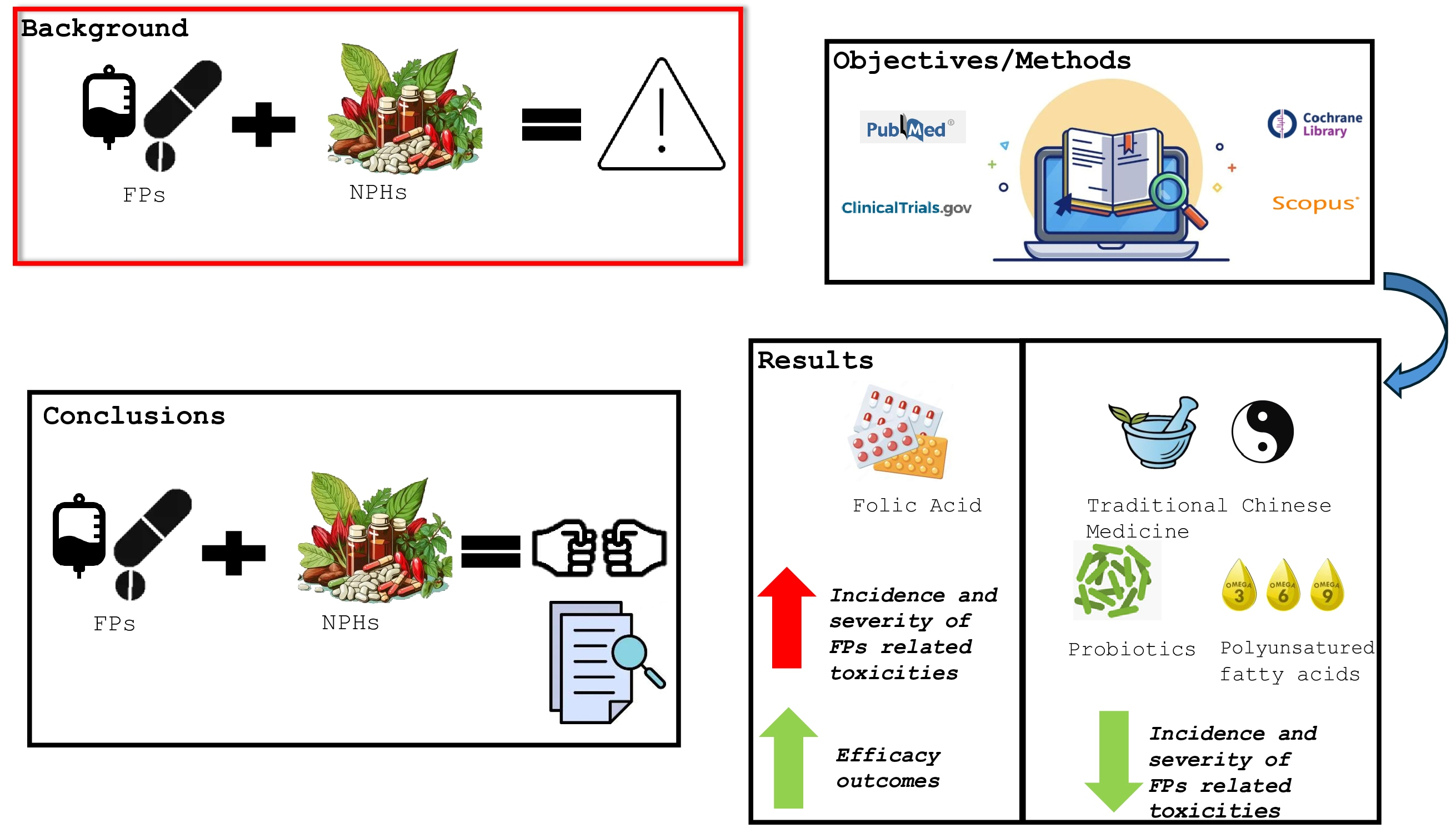
Effects of Natural Health Products in Combination with FP-Based Chemotherapy

 , , ,
, , ,  , and
, and
Abstract
1. Introduction
2. Methodology
3. Results

| Study Design | Country | Patients (n) | Type of Cancer | Sex (F%) | Median Age and Age Range (Years) | Food Supplements | Concomitant Drugs | Follow-Up | Efficacy Outcomes | Main Results and Conclusion | Jadad Score | Ref. |
|---|---|---|---|---|---|---|---|---|---|---|---|---|
| RCT | Iran | 46 INT-g: 23 CT-g: 23 | CRC | 30.5 | 58.3 (48–68) | Mediterranean diet regime with EVOO | FOLFOX or CAPOX or CAP | NA | Valuation of muscle strength, lean body mass, nutritional status, inflammatory markers, QOL, serum albumin and total protein | A significant increase in weight, lean mass, fat mass, fat percentage, muscle strength and total serum protein was recorded in the INT-g compared to the CT-g (p < 0.001). In addition, there was a significant reduction in TNF-α, Hs-CRP and IL-6 in the INT-g group compared to the CT-g group (p < 0.001). | 3 | [14] |
| RCT | China | 52 pz INT-g: 27 CT-g: 25 | GC | 41 | 69.3 (65–75) | Elemene (active principle of Chinese herbal medicine Wenyujin, member of the ginger family) 0.6 gr | Lobaplatin perfusion (50 mg/m2) CapeOx | 9.04 ± 4.30 (3.00–17.90) | Incidence of ADR myelosuppression, immune function, average hospital length of stay | Compared to patients in the INT-g, patients in the CT-g showed no difference in the incidence of complications during hospitalisation, but had an increase in length of hospital stay (p = 0.045) and severe myelosuppression (p = 0.027). Furthermore, the immune function of patients in the INT group was less compromised (p < 0.001) than in the CT-g group. | 2 | [29] |
| Randomized, placebo-controlled, triple-blind clinical trial | Brazil | 56 INT-g (FOG group): 28 CT-g (PG group): 28 | GI | 47 | 54.5 (41–63) | EPA and DHA (Omega 3 Concentrate®) 1.55 gr/day | CAPOX or OX + FU or FU + LV | 6 and 12 months | AEs | No difference between groups in the occurrence of adverse events. However, patients in CT-g showed more severe diarrhoea than patients in INT-g (p = 0.03) and a worse performance status score (p = 0.02). | 5 | [30] |
| Pilot, randomized, triple-blinded, placebo-controlled clinical trial | Iran | 110 INT-g: 55 CT-g: 55 | CRC | 66.7 | 56.3 (42–68) | Alpha® ointment: combination of Lawsonia inermis (Henna, 2-hydroxy-1,4-naphthoquinone) and Curcuma longa (curcumin) 3 g and 0.15/30 gr for three weeks | XELOX + LAP | 2 months | Alpha® ointment prevention of HFS | No significant difference in HFS prevention (p > 0.05) was found between the groups. However, in the intervention group, a delay in the onset of HFS episodes and a worsening of symptoms were observed (p < 0.001). | 3 | [31] |
| Randomized, double-blinded, placebo-controlled, phase II trial | Japan | 100 INT-g: 52 CT-g: 48 | CRC | 44 | 65 (20–80) | L-cystine (700 mg), L-theanine (270 mg) and other ingredients (maltitol, aspartame and citric acid) to a total of 1.5 g | CAP 1250 mg/m2 twice daily orally for 2 weeks followed by a 1-week’s suspension in a 3-week cycle. | 6 months | Incidence of diarrhea of grade 1 or higher, incidence of other AEs | The incidence of grade 1 or higher diarrhoea and grade 1 or higher HFS is lower in the INT-g than in the CT-g, but without reaching statistical significance. | 5 | [15] |
| Randomized, double-blinded, placebo-controlled clinical trial | China | 370 INT-g: 186 CT-g: 184 | CRC | 42.7 | 60.3 (32–75) | PRM1201(Ligustrum lucidum, Cistanche deserticola, Iphigenia indica, Vitis quinquangularis, Panax ginseng, Akebia trifoliata, and Salvia miltiorrhiza twice a day for 6 months | FOLFOX or CAPOX | 113 | ADRs | Grade 3–4 neutropenia, diarrhea, vomiting, and nausea was less recurring in the INT-g than in the CT-g, but without reaching statistical significance. | 5 | [32] |
| Double blind, placebo-controlled pilot study | Slovenia | 60 INT-g: 30 PL-g: 30 | CRC | 41 | 62.1 (46–74) | Glutamine 30 gr t.i.d for 5 weeks | Radiotherapy + oral CAP at a daily dose of 1650 mg/m2. | NA | G.I toxicity indicated by diarrhea, variation of inflammatory and metabolic parameters | Glutamine supplementation did not reduce the incidence and severity of diarrhoea and did not affect inflammatory and metabolic activity compared to maltodextrin placebo treatment. | 4 | [16] |
| Double-blind, placebo-controlled, randomized phase II study | Japan | 90 INT-g: 43 CT-g: 47 | CRC | 44.2 | 67 (29–85) | TJ-14 (Pinelliae tuber, Scutellariae Radix, Glycyrrhizae Radix, Zizyphi Fructus, Ginseng Radix, Zingiberis Processum rhizoma, and Coptidis rhizome) 2.5 g t.i.d for 14 or 21 days | FOLFOX FOLFIRI or XELOX | Until AEs are resolved or no longer clinically significant | Safety of TJ-14 in reducing the incidence of severe oral mucositis (WHO grade ≥ 3) | Patients in the INT group had a shorter median duration of grade ≥2 mucositis (p = 0.018) compared to those treated with placebo and a lower incidence of grade ≥2 oral mucositis compared to CT-g, but without reaching statistical significance. | 4 | [33] |
| Pilot, randomized, double-blind, placebo-controlled clinical trial | Iran | 18 INT-g: 9 CT-g: 9 | CRC | 55.6 | 53.9 (44–73) | Topical hydrogel (H.gel) containing the hydroalcoholic extract (10%) of Henna (0.62 mg Lawsone in each 100 g) Qid. | CAP or 5-FU | Two weeks | To evaluate the number of participants who experienced at least one grade improvement in HFS based on CTCAE v4.03 at any point during the protocol treatment. | No statistically significant differences were found between the two groups at baseline, after treatment, or in grade variations. | 5 | [17] |
| Multi-center, phase III, randomized, placebo-controlled trial | China | 400 INT-g: 200 CT-g: 200 | CRC | 43.1 | 60.3 (60–80) | JPBS (Codonopsis pilosula, Atractylodes Macrocephala, Wolfiporia Cocos, Rhizoma Pinelliae, Citri Reticulatae Pericarpiu, Radix Glycyrrhizae Preparata, Astragalus membranaceus, Cuscuta chinensis Lam, Fructus Ligustri Lucidi, Angelicae Sinensis Radix, Herba Ecliptae, Fructus Psoraleae) | CAPOX | NA | Chemotherapy-related toxicities, AEs, and SAEs | JPBS decreased the incidence of grade ≥2 vomiting (p = 0.007) but led to an increase in grade ≥2 thrombocytopenia (p = 0.012). | 5 | [34] |
| Multi-institutional randomized-controlled trial | Japan | 22 INT-g: 12 CT-g: 10 | CRC | 59 | 66.2 (56–79) | Eppikajututo TJ-28 (extract granules from gypsum, ephedra herb, Atractylodes lancea, jujube, glycyrrhiza, and ginger) 7500 mg/day | 8 cycles of capecitabine 2500 mg/m2 per day for 14 days, followed by a 7-day rest period | Every 3 weeks | Effectiveness of TJ-28 in preventing HFS | TJ-28 did not significantly prevent CAP-associated HFS when compared to pyridoxine. | 2 | [18] |
| Multicenter, randomized, double-blindplacebo-controlled clinical trial | China | 112 INT-g: 56 PL-g: 56 | CRC | 39.3 | 63.1 (52–74) | Hezhong granules (Pinellia ternata, Evodia rutaecarpa, and Zingiber officinal) 6 g three times daily, for a total daily dose of 18 g from days 1–14 of chemotherapy, followed by a 7-day break. | FU-based chemotherapy (CAPEOX, mFOLFOX6, FOLFIRI, and CAP monotherapy (plus 5-HT3-receptor antagonist, DXM) | NA | Efficacy and safety in the prevention of CINV | The INT-g showed statistically significant improvements of approximately 20% for both nausea and vomiting (p = 0.053; p = 0.035) compared to the CT-g, but only in the delayed phase. In addition, the daily incidence of CINV events showed a mean difference of 19% (p < 0.05). | 4 | [19] |
| Single-center, randomized double-blind, placebo-controlled phase 3 trial | Singapore | 208 INT-g: 104 CT-g: 104 | Breast, CRC, and other cancers. | 77 | 58 (26–82) | Pyridoxine (200 mg) | CAP 1000 mg/m2 on a 3-weekly cycle (8 cycles) | NA | Incidence and time to onset of grade 2 or greater HFS | The incidence of grade 2 or higher HFS did not differ between groups. No significant differences were found in the severity and incidence of other AEs. | 5 | [20] |
| Randomized, multiple-center, double-blind, and parallel-controlled trial | China | 156 INT-g: 78 CT-g: 78 | CRC | 70.4 | 55.5 (38–72) | Chinese herbal compound LC09 (Astragalus membranaceus, flowers carthami, lithospermum, geranium wilfordii, and radix angelicae) 110 gr per day | CAP-containing chemotherapy for 2 weeks and then they pause for 1 week | 1 month and 3 months after completing the trial | HFS improvement rate (based on NCI grading), Numerical Rating Scale (NRS) pain scores, and pain reduction rate. | After treatment, the INT-g showed a higher effectiveness rate in managing HFS (p < 0.01) and greater pain relief compared to the control group (p < 0.01). | 5 | [21] |
| Study Design | Country | Type of Cancer | Patients (n) | Sex (F%) | Median Age and Age Range (Years) | Food Supplements | Concomitant Drugs | Follow-Up | Safety Outcomes | Main Results and Conclusion | NOS | Ref. |
|---|---|---|---|---|---|---|---|---|---|---|---|---|
| Not Randomized clinical trial (volunteers bias) | Israel | CRC | 100 INT-g: 50 CT-g: 50 | 44.4 | 64 (29–83) | WGJ young grass extract of the common wheat plant Triticum aestivum, containing: chlorophyll, flavonoids, 17 amino acids, eight of which are essential, vitamins A, C, and E, and high mineral content (iron, calcium, magnesium, zinc) | 1. CAP alone or 2. CAP + OX or 3.5-FU/LV + OX | 16 months | Difference in chemotherapic effects between CC patients with and without supportive treatment of WGJ | A significant increase in monocyte count (p = 0.002), reduction of vascular damage, chemotherapy-related thrombogenicity (levels of tissue factor p = 0.029 and endothelial protein C receptor p = 0.005), growth factors, cytokines (p = 0.00), and endothelial EVs (p = 0.0015) were observed in the INT-g group compared to the CT-g group. | 6 | [22] |
| Prospective study | China | CRC | 126 Low folate-g = 63 High folate-g = 63 | 50 | 60 (55–68) | Folate supplements | CAP- or CAPOX-based treatment | Every three weeks | Evaluate whether serum and red-cell folate levels are predictors of CAP-related toxicity. | Serum folate level (p = 0.002), but not red-cell folate, was an independent predictor of grade ≥2 CAP-related toxicity. | 7 | [23] |
| Phase II single-arm clinical trial with historical CT-g group | United Kingdom | GC | 58 INT-g: 21 Historical CT-g: 37 | 27.6 | 66.5 (36–81) | Omega-3 fatty acids (Omegaven®) once a week for a 4 h infusion once a week | EOX (E 50 mg/m2 and OX 130 mg/m2 every 21 days and oral CAP) | Minimum of 12 months | Tumour radiological response and toxicity | Grade 3 or 4 toxicity, particularly thromboembolism and GI disorders was less frequently observed in INT-g (p = 0.04). | 6 | [39] |
| Prospective study | Italy | 54 CRC, 16 GC, 6 pancreatic, 1 breast 1 unknown primary cancer | INT-g: 76 CT-g: Historical data | 36.8 | 67 (NA) | Lactobacillus kefiri LKF01 (Kefibios®) 5 drops/day | FP-based treatment (FOLFOX, FLOT, XELOX, FOLFIRI, FOLFIRINOX, FOLFOXIRI) | 6 months | Assess the clinical efficacy of Kefibios® in the prevention or treatment of severe diarrhea induced by FPs treatment | Supplementation with Kefibios® has been shown to be effective in the prevention and treatment of severe diarrhea in cancer patients treated with FP. | 6 | [35] |
| Cross-sectional study | Malaysia | 243 CRC, 61 Breast, 29 GC, 13 Nasopharyngeal, 9 pancreatic, 5 oesophageal, 9 others | 369 HFS-g: 185 no-HFS-g: 184 | 50.4 | 57 (NA) | folic acid intake | CAP, CAPOX | 4.5 | Estimate HFS CAP-induced prevalence and impact and risk factors | Significant risk factors for grade ≥ 2 HFS included higher dose of CAP and folic acid intake (p = 0.008 and p = 0.612, respectively). | 8 | [24] |
| Prospective cohort study | Netherlands | CRC | 290 Dietary/supplemental intake at diagnosis g = 280/283 Dietary/supplemental intake during chemotherapy-g 262/266 Biomarkers at diagnosis -g: 212 Biomarkers during chemotherapy-g: 221 | 38 | 64 (60–69) | Dietary folate intake and folate supplements 10 µg DFE/day | CAPOX, CAP alone: 800–1000 mg/m2, administered twice daily for 14 d followed by a 7-d rest period | 6 | Association between folate intake and biomarkers with toxicities | Folate intake and plasma folate levels were not associated with the risk of toxicity. It should be noted, however, that the use of folic acid supplements during treatment and the presence of folic acid in the plasma at the time of diagnosis were associated with an increased risk of toxicity. | 8 | [25] |
| Retrospective study | China | GC | 129 INT-g: 64 CT-g: 65 | 28.7 | NA (18–75) | “Fuzheng jiedu Quyu Method” recipe (FJQR) (Astragalus, Pseudostellariae radix, Spica Prunellae, Curcumae radix, Herba Oldenlandiae). The principal chemical components are Astragalus polysaccharides, Radix Prunella, Prunella vulgaris saponins 15 g Bid | CAP-based treatment (CAP 1000 mg/m 2 per os, Qid) | <1 month | Safety | The incidence of grade III-IV AEs was significantly lower than in the CT-g (p < 0.05). No significant difference was found in the incidence of other grades of AEs. | 7 | [26] |
| Prospective cohort study | Netherlands | CRC | 325 INT-g: 127 CT-g: 193 | 32.6 | 67 (58–76) | Multivitamins/multiminerals, folate supplements, herbal supplements | 5-FU, CAPOX | 6 weeks–6, 12 and 24 months | Association between supplement use with fatigue | No statistically significant differences in fatigue scores over time were observed between groups. In the interindividual analysis, INT-g showed greater fatigue than CT-g. | 8 | [36] |
| A single-arm phase II clinical trial with historical cohort | USA | CRC | 24 | 25 | 54.5 (50–62) | YIV-906 Glycyrrhiza uralensis Fisch (G), Paeonia lactiflora Pall (P), Scutellaria baicalensis Georgi (S), and Ziziphus jujuba Mill (Z) 800 mg bid on days 1–4 of RT each week | CAP (orally at a dose of 825 mg/m 2 bid, on days 1–5 of RT (pelvic radiation therapy) each week or FOLFIRI or CAPOX or FOLFOX | 61.9 | Reduction in GI side effects | Adding YIV-906 to CAP-based chemoradiation resulted in lower rates of GI toxicity compared to historical controls, particularly for grade 3 or higher diarrhea. | 6 | [27] |
| Retrospective study | China | GC | 100 INT-g: 50 CT-g: 50 | 51 | 55.5 (48–63) | Zhipu Liujunzi decoction (Panax ginseng, Polygonatum sibiricum, Scrophularia ningpoensis, Ganoderma sinense, Smilax glabra, Cremastra appendiculata and Bambusa tuldoides, Astragalus mongholicus, Atractylodes macrocephala, Amomum villosum, Citrus medica var. sarcodactylis, Citrus reticulata, Pinellia ternata, Zingiber officinale) These herbs all were decocted in water to be oral administered once a daily for 2 continuous weeks. | OX 130 mg/m2 e.v b.i.d once a day and orally taking 1500 mg of CAP b.i.d for consecutive 14 day | 1 month | Evaluate the clinical safety of co-administration of Zhipu Liujunzi decoction with CAPOX treatment | INT-g demonstrated lower rate of toxicities than the CT-g (p < 0.05). | 6 | [37] |
| Retrospective study | China | GC | 115 INT-g: 57 CT-g: 58 | 31 | 54.8 (48–62) | Shengbai decoction (Radix Astragali 10 g, Radix Salviae Miltiorrhizae 10 g, Ganoderma Lucidumseu Sinensis 6 g, Rhizoma Atractylodis Macrocephalae 10 g, Radix Angelicae Sinensis 10 g, Caulis Spatholobi 15 g, Fructus Ligustri Lucidi 10 g, Rhizoma Polygonati 10 g, Fructus Psoraleae 10 g and Herba Dendrobii 10 g) 100 mL twice a day half an hour before meals | SOX, CAPOX, FOLFOX | Every 3 months | Effect of Shengbai decoction on the improvement of myelosuppression induced by chemotherapy | Patients who took Shengbai decoction tolerated the therapy better, with fewer hematological ADRs than the CT-g (p < 0.05). | 7 | [38] |
| Multicenter, open-label, dose escalation phase I/II safety and efficacy clinical trial | USA | Hepato cellular | 42 Phase I: 18 Phase II: 24 | 51 | NA (18–80) | PHY906 (consists of a mixture of four herbs: (Scutellaria baicalensis Georgi, Glycyrrhiza uralensis Fisch., Paeonia lactiflora Pall., and the fruit of Ziziphus jujube Mill.) (600, 800, or 1000 mg bid) was administered orally on days 1–4 and 8–11 of each 21-day course | CAP 750 or 1000 mg/m2 bid was administered orally starting on day 1, and continued for 14 consecutive days followed by 7 days’ rest | For all toxicity duration, documentation of disease progression and OS | Toxicity, and QoL | The combination of PHY906 and capecitabine was well tolerated and AEs were not related to CAP/PHY906 administration. | 5 | [28] |
| Clinical trial | China | GC | 60 INT-g: 30 CT-g: 30 | NA | NA (18–75) | Kanglaite® Injection (Coix Seed Oil) 100 mL intravenous per day during chemotherapy | DOC | Every three weeks | Side effects of Kanglaite® injection | GI side effects and myelosuppression were lower in INT-g than in CT-g (p < 0.05). | 6 | [40] |
3.1. Role of NHPs in Contrasting Fluoropyrimidine-Induced Gastrointestinal Disorders
3.2. NHPs and FP-Related Hematological Toxicity
3.3. NHPs and Capecitabine-Associated Hand-Foot Syndrome
3.4. The Role of NHPs in Enhancing the Efficacy of FP-Based Therapy
3.5. The Effects of NHPs Combined with Folate Supplements
| Study Design | Country | Patients (n) | Type of Cancer | Sex (F%) | Median Age and Age Range (Years) | Food Supplements | Concomitant Drugs | Follow-Up | Efficacy Outcomes | Main Results and Conclusion | Jadad Scale or NOS | Ref. |
|---|---|---|---|---|---|---|---|---|---|---|---|---|
| RANDOMIZED CONTROLLED TRIAL-EFFICACY | ||||||||||||
| RCT | Iran | 46 INT-g: 23 CT-g: 23 | CRC | 30.5 | 58.3 (48–68) | Mediterranean diet regime with EVOO | FOLFOX or CAPOX or CAP | NA | Valuation of muscle strength, lean body mass, nutritional status, inflammatory markers, QOL, serum albumin and total protein | A significant increase in weight, lean mass, fat mass, fat percentage, muscle strength and total serum protein was found in the INT-g compared to the CT-g (p < 0.001). In addition, there was a significant reduction in TNF-α, Hs-CRP and IL-6 in the INT-g group compared to the CT-g group (p < 0.001). | 3 | [14] |
| RCT | China | 52 pz INT-g: 27 CT-g: 25 | GC | 41 | 69.3 (65–75) | Elemene | Lobaplatin perfusion (50 mg/m2), CAPOX | 9.04 ± 4.30 (3.00–17.90) | OS | No OS benefit was observed in the INT-g.
Elemene can decrease the occurrence of myelosuppression in metastatic GC. | 2 | [29] |
| Randomized, placebo-controlled, triple-blind clinical trial | Brazil | 56 INT-g: 28 CT-g: 28 | GI | 47 | 54.5 (41–63) | EPA and DHA 1.55 gr/day | CAPOX or OX + FU or FU+LV | 6 and 12 months | Treatment response, performance status | Fish oil can result in a better performance status for GC patients undergoing chemotherapy. No treatment response difference was found between groups. | 5 | [30] |
| Randomised double-blinded, placebo-controlled clinical trial | China | 370 INT-g: 186 CT-g:184 | CRC | 42.7 | 60.3 (32–75) | PRM1201 twice a day for 6 months | FOLFOX or CAPOX | 29.60 months | DFS, QOL | An increase in the 3-year DFS rate (p = 0.024) and QoL (p < 0.05) was observed in the INT-g compared to CT-g. | 5 | [32] |
| Placebo-Controlled, Prospective Randomised Trial | Brazil | 24 INT-g: 14 CT-g: 10 | CRC | 62.5 | 63.2 (50–75) | Zinc sulfate, 154 mg (corresponding to 35 mg of elemental zinc), two capsule | CAPOX or CAP or 5-FU/LV | 4 months | Impact of zinc supplementation on antioxidant enzymes, vitamins, and lipid peroxidation during chemotherapy cycles | Patients treated with zinc showed increased SOD activity and reduced GPx activity compared to those treated with placebo (p < 0.05). Vitamin E levels remained stable in the INT group, while they decreased in the CT group (p < 0.05). Furthermore, zinc supplementation did not affect lipid peroxidation (p < 0.05). | 3 | [80] |
| Multi-center, phase III, randomized, placebo-controlled trial | China | 400 INT-g: 200 CT-g: 200 | CRC | 43.1 | 60.3 (60–80) | JPBS | CAPOX | NA | Chemotherapy completion rate, QOL | Successful completion of chemotherapy cycles was significantly higher in the INT-g than in the CT-g (p = 0.003), with improved completion rates in stage II patients (p = 0.001) and younger patients (p = 0.004), without compromising tolerability. QOL also improved in stage II patients and younger patients. | 5 | [34] |
| Double-blind, randomized, controlled trial | China | 92 INT-g: 60 CT-g: 32 | CRC | 41.9 | NA (36–78) | Taohongsiwu Decoction (for external Application) (Semen Persicae, Flos Carthami, Radix Rehmanniae Praeparata, Radix Angelicae Sinensis, Rhizoma Chuanxiong, Radix Paeoniae Alba, Ramulus Cinnamomi, Radix Cyathula, Radix Glycyrrhizae, and Jujubae >39 °C decoction during soaking on hands and feet for 30 min, once a day, for 30 min each time, for 7 days. | CAP, SF, GEF | 3 months | Effectiveness and QoL | A significant difference was observed in the effective rate of the INT-g, which was higher (88.3%) than the 50% of the CT-g (p = 0.00). Modified Taohongsiwu decoction is effective in treating patients with HFS and enhances their QoL, as measured by the HFS-14. | 5 | [76] |
| Multicenter, randomized, double-blind placebo-controlled clinical trial | China | 112 INT-g: 56 PL-g: 56 | CRC | 39.3 | 63.1 (52–74) | Hezhong granules 6 g three times daily, for a total daily dose of 18 g from days 1–14 of chemotherapy, followed by a 7-day break. | FU-based chemotherapy (CAPEOX, mFOLFOX6, FOLFIRI, and CAP monotherapy (plus 5-HT3-receptor antagonist, DXM) | NA | Efficacy and safety in the prevention of CINV (chemotherapy- induced nausea and vomiting) | In the delayed phase, significant improvements in INT-g were observed in both CRR (p = 0.053; p = 0.035) and ORR (p = 0.037; p = 0.043) for nausea and vomiting. Additionally, the daily frequency of CINV events showed a mean difference of 19% (p < 0.05). No serious adverse events were attributed to phytotherapy. | 4 | [19] |
| Randomized, Multiple-center, double-blind, and parallel-controlled trial | China | 156 INT-g: 78 CT-g: 78 | CRC | 70.4 | 55.5 (38–72) | Chinese herbal compound LC09 110 gr per day | CAP-containing chemotherapy for 2 weeks, followed by a 1-week break | 1 month and 3 months after completing the trial | Chemotherapy completion rate | The chemotherapy completion rate in the INT-g group (62.86%) was significantly higher than that in the CT-g group (40.28%), p = 0.0021. | 5 | [21] |
| OBSERVATIONAL STUDIES—EFFICACY | ||||||||||||
| Not Randomized clinical trial (volunteers bias) | Israel | CRC | 100 INT-g: 50 CT-g: 50 | 44.4 | 64 (29–83) | WGJ | 1. CAP alone 2. CAP + OX 3. 5-FU/LV + OX | NA | Difference in chemotherapic effects | The INT group showed a reduction in vascular damage and chemotherapy-related thrombogenicity (tissue factor levels p = 0.029 and endothelial protein C receptor p = 0.005), growth factors, cytokines (p = 0.0001), endothelial VEs (p = 0.0015) compared to the CT group. | 6 | [22] |
| Phase II single-arm clinical trial with historical CT-g group | United Kingdom | GC | 58 INT-g: 21 Historical CT-g: 37 | 27.6 | 66.5 (36–81) | Omega-3 fatty acids (Omegaven®) once a week for a 4 h infusion, once a week | EOX (Epirubicin 50 mg/m2 and OX 130 mg/m2 every 21 days and oral CAP) | 3 months following completion of treatment | Improvement of radiological response | Partial response (p = 0.03) was higher in the INT-g than in the CT-g. However, no statistically significant difference in stable disease, progressive disease, OS and PFS was found between the two groups. Significant reductions in IL-2, TNF-α and VEGF concentrations were observed (p = 0.009, p < 0.0001, p = 0.002, respectively) after each treatment. | 06 | [39] |
| Retrospective study | Japan | HNSCC | 437 low folate intake-g: 135 medium folate intake-g: 143 high folate intake-g: 144 unknown: 15 | 22 | 61 (21–79) | Dietary folate intake (low/medium < 320 μg/day; high ≥ 320 μg/day) | CDDP + 5-FU NDP+ 5-FU CDDP alone | 4.9 years | Association between dietary folate intake and MTHFR and TYMS polymorphisms with OS and DFS in HNSCC. | Patients with high folate intake had significantly higher survival than patients with low or average folate intake (p = 0.020). No significant association was found between MTHFR and TYMS polymorphisms and survival. | 7 | [89] |
| Retrospective study | China | GC | 129 INT-g: 64 CT-g: 65 | 28.7 | NA (18–75) | “Fuzheng jiedu Quyu Method” recipe (FJQR) 15 g Bid | CAP-based treatment (CAP 1000 mg/m 2 per os, Qid) | <1 month | Evaluate efficacy of FJQR combined with CAP-based chemotherapy | The mPFS in the INT-g was significantly higher than the CT-g group (6.3 vs. 5.0 months, p = 0.03). | 7 | [26] |
| Retrospective study | Japan | GC | 132 Low folate intake group: 44 Medium folate intake group: 44 High folate intake group: 44 | 31 | 58 (30–80) | Dietary folate intake low (≤260 μg/d), medium (>260 and ≤340 μg/d), high (>340 μg/d) | S1+CDDP S1+docetaxel S1+irinotecan 5-FU+CDDP 5-FU+methotorexate | NA | Assess role of dietary folate intake and polymorphisms on OS and PFS in gastric cancer | Patients with folate intake > 260 μg/day, carrying the MTHFR 677 TT polymorphism and TYMS-3′ untranslated region 6-bp insertion had significantly better OS (p = 0.030; 0.039; 0.01). Better PFS was significantly associated with the presence of the MTHFR 677 TT polymorphism (p = 0.046) and the insertion of the 6-bp untranslated region of TYMS-3′ (p = 0.029). | 8 | [90] |
| A single-arm phase II clinical trial with historical cohort | USA | CRC | 24 | 25 | 54.5 (50–62) | YIV-906 800 mg bid on days 1–4 of RT each week | CAP (orally at a dose of 825 mg/m 2 bid, on days 1–5 of RT (pelvic radiation therapy) each week or FOLFIRI or CAPOX or FOLFOX | 61.9 months | OS, PFS | The 3- and 5-year overall survival rates were 91.2% and 82.0%, respectively. The mean progression-free survival was 58.3 months (95% CI: 47.8–68.8), with corresponding 3- and 5-year rates of 74.6% and 58.5%. | 6 | [27] |
| Retrospective study | China | GC | 100 INT-g: 50 CT-g: 50 | 51 | 55.5 (48–63) | Zhipu Liujunzi decoction | OX 130 mg/m2 e.v b.i.d once a day and orally taking 1500 mg of CAP b.i.d for consecutive 14 day | 1 month | Evaluate the clinical efficacy of co-administration of Zhipu Liujunzi decoction with CAPOX treatment | Patients in the INT group showed significantly greater cancer resistance, lower tumour marker levels (p < 0.001); higher rates of objective remission and disease control (p < 0.05); better immune parameters (p < 0.001) and QOL, (p < 0.001). | 6 | [37] |
| Retrospective study | China | GC | 115 INT-g: 57 CT-g: 58 | 31 | 54.8 (48–62) | Shengbai decoction 6 g, 100 mL twice a day half an hour before meals | SOX, CAPOX, FOLFOX | Every 3 months | Evaluate effect of Shengbai decoction on long-term survival | Patients in the INT-g showed significantly better 3-year RFS (p = 0.0369) and 3-year OS (p = 0.0455) compared to CT-g. | 7 | [38] |
| Clinical trial | China | GC | 60 INT-g: 30 CT-g: 30 | NA | NS (18–75) | Kanglaite® 100 mL intravenous per day during chemotherapy | DOC | Every three weeks | Efficacy of Kanglaite® injection | The response rate and KPS score in the INT-g improved compared to those in the CT-g (p < 0.05). In addition, gastrointestinal and haematological adverse reactions were lower than in the CT-g (p < 0.05). | 5 | [40] |
4. Conclusions
Author Contributions
Funding
Institutional Review Board Statement
Informed Consent Statement
Data Availability Statement
Conflicts of Interest
References
- Longley, D.B.; Harkin, D.P.; Johnston, P.G. 5-Fluorouracil: Mechanisms of Action and Clinical Strategies. Nat. Rev. Cancer 2003, 3, 330–338. [Google Scholar] [CrossRef]
- Afzal, S.; Jensen, S.A.; Vainer, B.; Mouridsen, H.T.; Pfeiffer, P. Efficacy of capecitabine in heavily pretreated patients with metastatic breast cancer. Ann. Oncol. 2009, 20, 1660–1666. [Google Scholar] [CrossRef]
- Thorn, C.F.; Marsh, S.; Carrillo, M.W.; McLeod, H.L.; Klein, T.E.; Altman, R.B. PharmGKB summary: Fluoropyrimidine pathways. Pharmacogenet. Genom. 2011, 21, 237–242. [Google Scholar] [CrossRef] [PubMed]
- van Laarhoven, H.W.M.; Punt, C.J.A.; Kamm, Y.J.L.; Heerschap, A. Monitoring fluoropyrimidine metabolism in solid tumors with in vivo 19F magnetic resonance spectroscopy. Crit. Rev. Oncol. Hematol. 2005, 56, 321–343. [Google Scholar] [CrossRef] [PubMed]
- Peixoto, M.; Alves, D.; Lopes, A.; Queiróz, L.; Almeida, M. Fluoropyrimidine toxicities and DPYD genotyping: A clinical case. Cureus 2024, 16, e63814. [Google Scholar] [CrossRef] [PubMed]
- Conti, V.; De Bellis, E.; Manzo, V.; Sabbatino, F.; Iannello, F.; Dal Piaz, F.; Izzo, V.; Charlier, B.; Stefanelli, B.; Torsiello, M.; et al. A Genotyping/Phenotyping Approach with Careful Clinical Monitoring to Manage the Fluoropyrimidines-Based Therapy: Clinical Cases and Systematic Review of the Literature. J. Pers. Med. 2020, 10, 113. [Google Scholar] [CrossRef]
- Conti, V.; Polcaro, G.; De Bellis, E.; Donnarumma, D.; De Rosa, F.; Stefanelli, B.; Corbi, G.; Sabbatino, F.; Filippelli, A. Natural health products for anti-cancer treatment: Evidence and controversy. J. Pers. Med. 2024, 14, 685. [Google Scholar] [CrossRef]
- Costantino, M.; Conti, V.; Corbi, G.; Filippelli, A. Hydropinotherapy with sulphurous mineral water as complementary treatment to improve glucose metabolism, oxidative status, and quality of life. Antioxidants 2021, 10, 1773. [Google Scholar] [CrossRef]
- Molassiotis, A.; Fernández-Ortega, P.; Pud, D.; Ozden, G.; Scott, J.A.; Panteli, V.; Margulies, A.; Browall, M.; Magri, M.; Selvekerova, S.; et al. Use of complementary and alternative medicine in cancer patients: A European survey. Ann. Oncol. 2005, 16, 655–663. [Google Scholar] [CrossRef]
- Ćorić, N.; Vukoja, A.; Banjari, I. The Use of Dietary Supplements in Cancer Patients. Proceedings 2023, 91, 131. [Google Scholar]
- Stefanelli, B.; Sellitto, C.; De Bellis, E.; Torsiello, M.; Bertini, N.; Pezzullo, A.M.; Corbi, G.; Sabbatino, F.; Pepe, S.; Tesse, A.; et al. Concomitant administration of capecitabine and folate supplements: Need to encourage medication reconciliation. Pharmaceuticals 2022, 15, 1388. [Google Scholar] [CrossRef] [PubMed]
- Jadad, R.; Moore, R.A.; Carroll, D.; Jenkinson, C.; Reynolds, D.J.; Gavaghan, D.J.; McQuay, H.J. Assessing the quality of reports of randomized clinical trials: Is blinding necessary? Control Clin. Trials 1996, 17, 1–12. [Google Scholar] [CrossRef] [PubMed]
- Wells, B.G.A.; Shea, D.; O’Connell, J.; Peterson, V.; Welch, M.; Losos, M.; Tugwell, P. The Newcastle-Ottawa Scale (NOS) for Assessing the Quality of Non Randomised Studies in Meta-Analyses. Available online: https://www.ohri.ca/programs/clinical_epidemiology/oxford.asp (accessed on 24 September 2025).
- Bagheri, A.; Zeraati, H.; Abolghasemi, J.; Rezaei, S.; Shokri, S.; Faghih, S. The effect of Mediterranean diet on body composition, inflammatory factors, and nutritional status in patients with cachexia induced by colorectal cancer: A randomized clinical trial. Integr. Cancer Ther. 2023, 22, 15347354231195322. [Google Scholar] [CrossRef] [PubMed]
- Hamaguchi, R.; Tsuchiya, T.; Miyata, G.; Sato, T.; Takahashi, K.; Ariyoshi, K.; Oyamada, S.; Iwase, S. Efficacy of Oral Administration of Cystine and Theanine in Patients with Colorectal Cancer Undergoing Capecitabine-Based Adjuvant Chemotherapy after Surgery: Study Protocol for a Multi-Institutional, Randomised, Double-Blinded, Placebo-Controlled, Phase II Trial. BMJ Open 2018, 8, e020171. [Google Scholar]
- Kozjek, N.R.; Kompan, L.; Soeters, P.; Oblak, I.; Mlakar Mastnak, D.; Mozina, B. Oral glutamine supplementation during preoperative radiochemotherapy in patients with rectal cancer: A randomised double-blinded, placebo-controlled pilot study. Clin. Nutr. 2011, 30, 567–570. [Google Scholar] [CrossRef]
- Mohajerani, R.; Karami, C.; Aghaei, M.; Esfandbod, M.; Shakeri, F.; Khodadadi, N. Efficacy of topical Lawsonia inermis L. (Henna) hydrogel in fluorouracil-induced hand-foot syndrome: A pilot randomized double-blind placebo-controlled clinical trial. Iran. J. Pharm. Res. 2021, 20, 157–167. [Google Scholar] [CrossRef]
- Watanabe, K.; Ishibe, A.; Watanabe, J.; Ota, M.; Fujii, S.; Ichikawa, Y.; Oba, M.S.; Endo, I. The effect of TJ-28 (Eppikajutsuto) on the prevention of hand-foot syndrome using capecitabine for colorectal cancer: The Yokohama Clinical Oncology Group Study (YCOG1102). Indian J. Gastroenterol. 2020, 39, 246–253. [Google Scholar] [CrossRef]
- Wu, Z.; Fu, X.; Jing, H.; Huang, W.; Li, X.; Xiao, C.; Li, Z.; You, F. Herbal medicine for the prevention of chemotherapy-induced nausea and vomiting in patients with advanced colorectal cancer: A prospective randomized controlled trial. J. Ethnopharmacol. 2024, 325, 117853. [Google Scholar] [CrossRef]
- Yap, Y.; Kwok, L.; Syn, N.; Chay, W.Y.; Chia, J.W.K.; Tham, C.K.; Wong, N.S.; Lo, S.K.; Dent, R.N.; Tan, S.; et al. Predictors of hand-foot syndrome and pyridoxine for prevention of capecitabine–induced hand-foot syndrome. JAMA Oncol. 2017, 3, 1538–1545. [Google Scholar] [CrossRef]
- Yu, R.; Wu, X.; Jia, L.; Lou, Y. Effect of Chinese herbal compound LC09 on patients with capecitabine-associated hand-foot syndrome: A randomized, double-blind, parallel-controlled trial. Integr. Cancer Ther. 2020, 19, 1534735420928466. [Google Scholar] [CrossRef]
- Avisar, A.; Tzur-Bitan, D.; Mazor, E.; Eini, H.; Kohn, Y.; Rottenberg, Y. Extracellular vesicles reflect the efficacy of wheatgrass juice supplement in colon cancer patients during adjuvant chemotherapy. Front. Oncol. 2020, 10, 1659. [Google Scholar] [CrossRef]
- Chan, S.L.; Chan, A.W.H.; Mo, F.; Ma, B.B.Y.; Wong, K.C.W.; Lam, D.; Mok, F.S.T.; Chan, A.T.C.; Mok, T.; Chan, K.C.A. Association between serum folate level and toxicity of capecitabine during treatment for colorectal cancer. Oncologist 2018, 23, 1436–1445. [Google Scholar] [CrossRef]
- King, C.K.; Yusof, Z.M.; Fong, L.M.; Lee, M.T.; Tan, W.L.; Ong, S.Y. Hand-foot syndrome in cancer patients on capecitabine: Examining prevalence, impacts, and associated risk factors at a cancer centre in Malaysia. Asia-Pac. J. Clin. Oncol. 2018, 14, e95–e101. [Google Scholar] [CrossRef] [PubMed]
- Kok, D.E.; van Zutphen, M.; van Duijnhoven, F.J.; Winkels, R.M.; van Harten-Gerritsen, A.; Vink-Börger, E.; Kampman, E. Intake and biomarkers of folate and folic acid as determinants of chemotherapy-induced toxicities in patients with colorectal cancer: A cohort study. Am. J. Clin. Nutr. 2024, 43, 313–322. [Google Scholar] [CrossRef] [PubMed]
- Kong, F.; Zhao, L.; Wang, N.; Zhang, D.; Wang, Z.; Mei, Q.; Yu, Y.; Jia, Y. The FJQR has synergistic effect with fluoropyrimidine in the maintenance treatment for HER-2 negative gastric cancer. Recent Pat. Anticancer. Drug. Discov. 2024, 19, 165–175. [Google Scholar] [CrossRef]
- Verma, A.; Wang, J.; Wu, Z.; Xu, W.; Li, Y.; Chen, Y.; Liu, Y. A single-arm phase 2 clinical trial of YIV-906 with neoadjuvant concurrent chemo-radiation therapy in patients with locally advanced rectal cancer. Front. Oncol. 2024, 14, 1290546. [Google Scholar] [CrossRef]
- Yen, Y.; So, S.; Rose, M.; Saif, M.W.; Chu, E.; Liu, S.H.; Cheng, Y.C. Phase I/II study of PHY906/capecitabine in advanced hepatocellular carcinoma. Anticancer. Res. 2009, 29, 4083–4092. [Google Scholar]
- Chen, Z.X.; Li, J.; Liu, W.B.; Zhang, S.R.; Sun, H. Elemene-containing hyperthermic intraperitoneal chemotherapy combined with chemotherapy for elderly patients with peritoneal metastatic advanced gastric cancer. World J. Clin. Cases 2022, 10, 1498–1507. [Google Scholar] [CrossRef]
- de Quadros Camargo, C.; Alves de Souza, J.; Rangel, L.B.A.; Buzanovsky, A.A.; Gonçalves, L.G.; Ribeiro, A.Q.; Oliveira, C.L.; Rodrigues, A.L.; Ferreira, M.A. Fish oil decreases the severity of treatment-related adverse events in gastrointestinal cancer patients undergoing chemotherapy: A randomized, placebo-controlled, triple-blind clinical trial. Clin. Nutr. ESPEN. 2019, 31, 61–70. [Google Scholar] [CrossRef]
- Elyasi, S.; Shojaee, S.; Hatamipour, M.; Nikoofal-Sahlabadi, S.; Barzegar-Fallah, A.; Moghaddas, A.; Vaezi, M.; Hosseini, S.; Sahebkar, A. Topical henna and curcumin (Alpha®) ointment efficacy for prevention of capecitabine-induced hand-foot syndrome: A randomized, triple-blinded, placebo-controlled clinical trial. Support. Care Cancer 2022, 30, 9295–9303. [Google Scholar] [CrossRef]
- Jia, R.; Liu, N.; Cai, G.; Zhang, Y.; Xiao, H.; Zhou, L.; Ji, Q.; Zhao, L.; Zeng, P.; Liu, H.; et al. Effect of PRM1201 Combined With Adjuvant Chemotherapy on Preventing Recurrence and Metastasis of Stage III Colon Cancer: A Randomized, Double-Blind, Placebo-Controlled Clinical Trial. Front. Oncol. 2021, 11, 618793. [Google Scholar] [CrossRef]
- Matsuda, C.; Munemoto, Y.; Mishima, H.; Nagata, N.; Oshiro, M.; Kataoka, M.; Watanabe, T.; Sadahiro, S.; Sakamoto, J. Double-blind, placebo-controlled, randomized phase II study of TJ-14 (Hangeshashinto) for infusional fluorinated-pyrimidine-based colorectal cancer chemotherapy-induced oral mucositis. Int. J. Clin. Oncol. 2015, 20, 767–775. [Google Scholar] [CrossRef]
- Sun, L.; Zhang, Y.; Li, J.; Yang, J.; Chen, W.; Xu, J.; Wang, Y.; He, J. Chinese herbal medicine (JianPi-BuShen) and completion rate of adjuvant chemotherapy for patients with stage II and III colon cancer: A randomized clinical trial. JAMA Netw. Open 2024, 7, e2423465. [Google Scholar] [CrossRef] [PubMed]
- Ghidini, M.; Botticelli, A.; Tomasello, G.; Schepisi, G.; De Giorgi, U.; Di Bartolomeo, M.; Pignata, S.; Fornarini, G.; Cascinu, S.; Petrelli, F. Lactobacillus kefiri LKF01 (Kefibios®) for prevention of diarrhoea in cancer patients treated with chemotherapy: A prospective study. Nutrients 2021, 13, 385. [Google Scholar] [CrossRef] [PubMed]
- Koole, J.L.; Bours, M.J.L.; Breedveld-Peters, J.J.L.; van Roekel, E.H.; Huysentruyt, C.J.; van Duijnhoven, F.J.B.; Weijenberg, M.P. Is dietary supplement use longitudinally associated with fatigue in stage I–III colorectal cancer survivors? Clin. Nutr. 2018, 37, 1317–1324. [Google Scholar] [CrossRef] [PubMed]
- Wang, Y.; Liu, Q.; Zhao, X.; Li, J.; Yang, S.; Zhang, H. Effect of combining early chemotherapy with Zhipu Liujunzi decoction under the concept of strengthening and consolidating body resistance for gastric cancer patients and nursing strategy. J. Cancer Res. Ther. 2021, 17, 1458–1465. [Google Scholar] [CrossRef]
- Yao, L.; Feng, W.; Tao, Y.; Tang, C. Effect of Shengbai decoction on chemotherapy-induced myelosuppression and survival of gastric cancer patients after radical resection: A retrospective study. Med. Sci. Monit. 2022, 28, e935936. [Google Scholar] [CrossRef]
- Eltweri, A.M.; Thomas, A.L.; Metcalfe, M.; Calder, P.C.; Dennison, A.R.; Bowrey, D.J. The effect of supplementary Omegaven® on the clinical outcome of patients with advanced esophagogastric adenocarcinoma receiving palliative epirubicin, oxaliplatin, and capecitabine chemotherapy: A phase II clinical trial. Anticancer. Res. 2019, 39, 853–861. [Google Scholar] [CrossRef]
- Zhan, Y.P.; Huang, X.E.; Cao, J.; Lu, Y.Y.; Wu, X.Y.; Liu, J.; Xu, X. Clinical safety and efficacy of Kanglaite® (Coix Seed Oil) injection combined with chemotherapy in treating patients with gastric cancer. Asian Pac. J. Cancer. Prev. 2012, 13, 4773–4776. [Google Scholar] [CrossRef]
- Vincenzi, B.; Schiavon, G.; Pantano, F.; Santini, D.; Tonini, G. Predictive factors for chemotherapy-related toxic effects in patients with colorectal cancer. Nat. Clin. Pract. Oncol. 2008, 5, 455–465. [Google Scholar] [CrossRef]
- Mattison, L.K.; Fourie, J.; Hirao, Y.; Koga, T.; Desmond, R.A.; King, J.R.; Diasio, R.B. The uracil breath test in the assessment of dihydropyrimidine dehydrogenase activity: Pharmacokinetic relationship between expired 13CO2 and plasma [2-13C] dihydrouracil. Clin. Cancer Res. 2006, 12, 549–555. [Google Scholar] [CrossRef] [PubMed]
- Bilia, A.R.; Bergonzi, M.C.; Garrard, I. Traditional Chinese herbal medicine in European Union: State of art, challenges, and future perspectives focusing on Italian market. Chin. Herb. Med. 2017, 9, 101–112. [Google Scholar] [CrossRef] [PubMed]
- Fan, M.; Jin, C.; Li, D.; Deng, Y.; Yao, L.; Chen, Y.; Ma, Y.L.; Wang, T. Multi-level advances in databases related to systems pharmacology in traditional Chinese medicine: A 60-year review. Front. Pharmacol. 2023, 14, 1289901. [Google Scholar] [CrossRef] [PubMed]
- Li, W.F.; Jiang, J.G.; Chen, J. Chinese medicine and its modernization demands. Arch. Med. Res. 2008, 39, 246–251. [Google Scholar] [CrossRef]
- Zhou, L.-H.; Feng, Y.-Y.; Wang, Y.; Sun, X.-T.; Li, C.-P.; Zhu, H.-R.; Liu, X.; Deng, W.-L. Bushen Jiedu Sanjie Recipe alcohol extract inhibits cell proliferation through HIPK2-p53 signaling pathway in colorectal cancer. Chin. J. Tradit. Chin. Med. Pharm. 2017, 32, 32234–32237. [Google Scholar]
- Sun, X.-T.; Feng, Y.-Y.; Liu, X.; Wang, Y.; Zhou, L.-H.; Deng, W.-L.; Li, C.-P.; Zhu, H.-R. Bushen Jiedu Sanjie Recipe inhibits invasion and metastasis of colorectal cancer through Wnt/β-catenin signaling pathway. Acta Univ. Tradit. Medicalis Sin. Pharmacol. Shanghai 2017, 31, 4–11. [Google Scholar]
- Chen, D.; Guo, Y.; Yang, Y. Liujunanwei decoction attenuates cisplatin-induced nausea and vomiting in a rat-pica model partially mediated by modulating the gut microbiome. Front. Cell Infect. Microbiol. 2022, 12, 876781. [Google Scholar] [CrossRef]
- Liu, J.; Zhang, M.; Zhang, S.; Chen, H.; Li, X.; Liu, X. Efficacy of modified Wuzhuyu decoction granule for migraine patients with cold and stasis obstructing meridian syndrome: A randomized, double-blind, placebo-controlled trial. Chin. J. Integr. Med. 2018, 24, 409–414. [Google Scholar] [CrossRef]
- Liu, J.; Wang, S.; Chen, X.; Li, Y.; Huang, Q.; Zhao, Z. Treatment of gastroesophageal reflux disease with Chinese herbal medicine (Banxia Xiexin decoction): Evidence from a meta-analysis. Evid. Based Complement. Altern. Med. 2022, 2022, 1500660. [Google Scholar]
- Lian, Z.; Lu, Y.; Hou, E.; Wang, X. Combination of GP regimen and Kanglaite in the treatment of advanced nonsmall cell lung cancer. Zhongguo Fei Ai Za Zhi 2006, 9, 74–77. [Google Scholar]
- Hajjaji, N.; Bougnoux, P. Selective sensitization of tumors to chemotherapy by marine-derived lipids: A review. Cancer Treat Rev. 2013, 39, 473–488. [Google Scholar] [CrossRef]
- Cai, F.; Sorg, O.; Granci, V.; Lecumberri, E.; Miralbell, R.; Dupertuis, Y.M.; Pichard, C. Vitamin E content in fish oil emulsion does not prevent lipoperoxidative effects on human colorectal tumors. Clin. Nutr. 2013, 32, 491–496. [Google Scholar] [CrossRef] [PubMed][Green Version]
- Siddiqui, R.A.; Harvey, K.A.; Xu, Z.; Bammerlin, E.M.; Walker, C.; Altenburg, J.D. Docosahexaenoic acid: A natural powerful adjuvant that improves efficacy for anti-cancer treatment with no adverse effects. Oncotarget 2011, 2, 749–770. [Google Scholar] [CrossRef] [PubMed]
- Yaqoob, P.; Calder, P.C. Glutamine requirements of proliferating T lymphocytes. Nutrition 1997, 13, 646–651. [Google Scholar] [CrossRef] [PubMed]
- Li, P.; Yin, Y.-L.; Li, D.; Kim, S.W.; Wu, G. Amino acids and immune function. Br. J. Nutr. 2007, 98, 237–252. [Google Scholar] [CrossRef]
- Savarese, D.M.; Savy, G.; Vahdat, L.; Wischmeyer, P.E.; Corey, B. Prevention of chemotherapy and radiation toxicity with glutamine. Cancer Treat Rev. 2003, 29, 501–513. [Google Scholar] [CrossRef]
- Erbil, Y.; Berber, E.; Barbaros, U.; Giriş, M.; Yanik, B.T.; Bozbora, A.; Toker, G. The effect of glutamine on radiation-induced organ damage. Life Sci. 2005, 78, 376–382. [Google Scholar] [CrossRef]
- Salman, B.; Başaran, M.; Coskun, H.; Yüksel, O.; Yildiz, P.; Yüney, E.; Hanoğlu, A.; Küpelioğlu, A.; Demirci, S. Effect of timing of glutamine-enriched enteral nutrition on intestinal damage caused by irradiation. Adv. Ther. 2007, 24, 648–661. [Google Scholar] [CrossRef]
- Plaza-Díaz, J.; Ruiz-Ojeda, F.J.; Gil-Campos, M.; Gil, A. Mechanisms of action of probiotics. Adv Nutr. 2019, 10 (Suppl. S1), S49–S66. [Google Scholar] [CrossRef]
- von Bultzingslowen, I.; Adlerberth, I.; Wold, A.E.; Dahlén, G.; Jontell, M. Oral and intestinal microflora in 5-fluorouracil-treated rats: Translocation to cervical and mesenteric lymph nodes and effects of probiotic bacteria. Oral. Microbiol. Immunol. 2003, 18, 278–284. [Google Scholar] [CrossRef]
- Carasi, P.; Racedo, S.M.; Jacquot, C.; Romanin, D.E.; Serradell, M.A.; Urdaci, M.C. Impact of kefir-derived Lactobacillus kefiri on the mucosal immune response and gut microbiota. J. Immunol. Res. 2015, 2015, 361604. [Google Scholar] [CrossRef]
- Toscano, M.; De Grandi, R.; Miniello, V.L.; Mattina, R.; Drago, L. Ability of Lactobacillus kefiri LKF01 (DSM32079) to colonize the intestinal environment and modify the gut microbiota composition of healthy individuals. Dig. Liver Dis. 2017, 49, 261–267. [Google Scholar] [CrossRef] [PubMed]
- Lam, W.; Bussom, S.; Guan, F.; Jiang, Z.; Zhang, W.; Gullen, E.A.; Liu, S.H.; Cheng, Y.C. The four-herb Chinese medicine PHY906 reduces chemotherapy-induced gastrointestinal toxicity. Sci. Transl. Med. 2010, 2, 45ra59. [Google Scholar] [CrossRef] [PubMed]
- Farrell, M.P.; Kummar, S. Phase I/IIA randomized study of PHY906, a novel herbal agent, as a modulator of chemotherapy in patients with advanced colorectal cancer. Clin. Colorectal. Cancer. 2003, 2, 253–256. [Google Scholar] [CrossRef] [PubMed]
- Patt, Y.Z.; Hassan, M.M.; Aguayo, A.; Lozano, R.D.; Hoque, A.; Frome, A.; Ellis, L.M.; Vauthey, J.N.; Curley, S.A.; Schnirer, I.; et al. Oral capecitabine for the treatment of hepatocellular carcinoma, cholangiocarcinoma, and gallbladder carcinoma. Cancer 2004, 101, 578–586. [Google Scholar] [CrossRef]
- von Delius, S.; Lersch, C.; Mayr, M.; Schulte-Frohlinde, E.; Schmid, R.M.; Schneider, T. Capecitabine for treatment of advanced hepatocellular carcinoma. Hepatogastroenterology 2007, 54, 2310–2314. [Google Scholar]
- Crawford, J.; Herndon, D.; Gmitter, K.; Weiss, J. The impact of myelosuppression on quality of life of patients treated with chemotherapy. Future Oncol. 2024, 20, 1515–1530. [Google Scholar] [CrossRef]
- European Medicines Agency (EMA). Xeloda: EPAR—Product Information. Available online: https://www.ema.europa.eu/en/documents/product-information/xeloda-epar-product-information_it.pdf (accessed on 3 September 2025).
- Matos, L.C.; Machado, J.P.; Monteiro, F.J.; Greten, H.J. Understanding Traditional Chinese Medicine Therapeutics: An Overview of the Basics and Clinical Applications. Healthcare 2021, 9, 257. [Google Scholar] [CrossRef]
- Bao, J.; Li, Z.; Zhang, D. β-elemene: A promising natural compound in lung cancer therapy. Eur. J. Pharmacol. 2025, 997, 177399. [Google Scholar] [CrossRef]
- Li, H.; Ji, L.; Shen, Y.; Fu, D.; Wu, D.; Ye, B. Bushen Jianpi Quyu formula alleviates myelosuppression of an immune-mediated aplastic anemia mouse model via inhibiting expression of the PI3K/AKT/NF-κB signaling pathway. Evid. Based Complement. Alternat. Med. 2022, 2022, 9033297. [Google Scholar] [CrossRef]
- Gao, W.; Zhang, K. Network meta-analysis of 8 types of traditional Chinese medicine injection combined with chemotherapy in colorectal cancer treatment. J. Cancer Res. Clin. Oncol. 2023, 149, 9823–9838. [Google Scholar] [CrossRef]
- Bangera, D.; Sikalgar, F.R.; Shetty, P.P.; Alva, R.; Paul, Y.; Muralidharan, S. Therapeutic potential of wheatgrass juice: A comprehensive narrative review. J. Pharm. Bioallied Sci. 2025, 17 (Suppl. S1), S152–S154. [Google Scholar] [CrossRef]
- Yoneda, J.; Nishikawa, S.; Kurihara, S. Oral administration of cystine and theanine attenuates 5-fluorouracil-induced intestinal mucositis and diarrhea by suppressing both glutathione level decrease and ROS production in the small intestine of a mucositis mouse model. BMC Cancer 2021, 21, 1343. [Google Scholar] [CrossRef] [PubMed]
- Zhao, C.; Chen, J.; Yu, B.; Wu, X.; Dai, C.; Zhou, C.; Chen, X.; Zhao, C. Effect of modified Taohong Siwu decoction on patients with chemotherapy-induced hand-foot syndrome. J. Tradit. Chin. Med. 2014, 34, 10–14. [Google Scholar] [PubMed][Green Version]
- Cheng, Y.; Li, J.; Feng, X.; Wu, Y.; Wu, X.; Lau, B.W.M.; Ng, S.S.M.; Lee, S.M.Y.; Seto, S.W.; Leung, G.P.H.; et al. Taohong Siwu decoction enhances the chemotherapeutic efficacy of doxorubicin by promoting tumor vascular normalization. Phytomedicine 2024, 113, 155995. [Google Scholar] [CrossRef] [PubMed]
- Ali, M.; Al-Snafi, A.E. A review on Lawsonia inermis: A potential medicinal plant. Asian J. Pharm. Clin. Res. 2018, 11, 1–8. [Google Scholar]
- Abdel-Sattar, E.; El-Mekkawy, S.; El-Masry, T.; El-Bakry, A. Evaluation of antibacterial efficacy of Lawsonia inermis (henna) against periodontal pathogens using agar well diffusion and broth microdilution methods: An in-vitro study. Biomedicine 2017, 42, 401–404. [Google Scholar]
- Ribeiro, S.M.F.; Braga, C.B.M.; Peria, F.M.; Martinez, E.Z.; Rocha, J.J.R.D.; Cunha, S.F.C. Effects of zinc supplementation on fatigue and quality of life in patients with colorectal cancer. Einstein 2017, 15, 24–28. [Google Scholar] [CrossRef]
- Robien, K. Folate during antifolate chemotherapy: What we know… and do not know. Nutr. Clin. Pract. 2005, 20, 411–422. [Google Scholar] [CrossRef]
- Contrucci, R.R.; ter Heine, R.; Hendriks, L.E.L.; de Rouw, N. Folinic acid to prevent pemetrexed-associated neutropenia after intrathecal administration: A quick win. J. Thorac. Oncol. 2023, 18, e81–e82. [Google Scholar] [CrossRef]
- Zwart, N.R.K.; Franken, M.D.; Tissing, W.J.; Lubberman, F.J.; Mckay, J.A.; Kampman, E.; Kok, D.E. Folate, folic acid, and chemotherapy-induced toxicities: A systematic literature review. Crit. Rev. Oncol. Hematol. 2023, 188, 104061. [Google Scholar] [CrossRef]
- Carreras, C.W.; Santi, D.V. The catalytic mechanism and structure of thymidylate synthase. Annu. Rev. Biochem. 1995, 64, 721–762. [Google Scholar] [CrossRef] [PubMed]
- Joerger, M.; Huitema, A.D.R.; Boot, H.; Cats, A.; Doodeman, V.D.; Smits, P.H.M.; Vainchtein, L.; Rosing, H.; Meijerman, I.; Zueger, M.; et al. Germline TYMS genotype is highly predictive in patients with metastatic gastrointestinal malignancies receiving capecitabine-based chemotherapy. Cancer Chemother. Pharmacol. 2015, 75, 763–772. [Google Scholar] [CrossRef] [PubMed]
- Romiti, A.; Roberto, M.; D’Antonio, C.; Onesti, C.E.; Barucca, V.; Milano, A.; Gentile, G.; Lionetto, L.; Medda, E.; Mazzuca, F.; et al. The TYMS-TSER polymorphism is associated with toxicity of low-dose capecitabine in patients with advanced gastrointestinal cancer. Anticancer. Drugs 2016, 27, 1044–1049. [Google Scholar] [CrossRef] [PubMed]
- Mandola, M.V.; Stoehlmacher, J.; Zhang, W.; Groshen, S.; Yu, M.C.; Iqbal, S.; Lenz, H.J.; Ladner, R.D. A 6 bp polymorphism in the thymidylate synthase gene causes message instability and is associated with decreased intratumoral TS mRNA levels. Pharmacogenetics 2004, 14, 319–327. [Google Scholar] [CrossRef]
- Pullmann, R., Jr.; Abdelmohsen, K.; Lal, A.; Martindale, J.L.; Ladner, R.D.; Gorospe, M. Differential stability of thymidylate synthase 3′-untranslated region polymorphic variants regulated by AUF1. J. Biol. Chem. 2006, 281, 23456–23463. [Google Scholar] [CrossRef]
- Kawakita, D.; Matsuo, K.; Sato, F.; Oze, I.; Hosono, S.; Ito, H.; Watanabe, M.; Yatabe, Y.; Hanai, N.; Hasegawa, Y.; et al. Association between dietary folate intake and clinical outcome in head and neck squamous cell carcinoma. Ann. Oncol. 2012, 23, 186–192. [Google Scholar] [CrossRef]
- Shitara, K.; Matsuo, K.; Ito, H.; Yokoi, T.; Takahari, D.; Yokota, T.; Shibata, T.; Kondo, C.; Ura, T.; Muro, K.; et al. Folate intake along with genetic polymorphisms in methylenetetrahydrofolate reductase and thymidylate synthase in patients with advanced gastric cancer. Cancer Epidemiol. Biomark. Prev. 2010, 24, 613–619. [Google Scholar] [CrossRef]
- Perrotta, P.L. Red Blood Cell Folate Testing. College of American Pathologists Test Ordering Program. Originally published July 2017; reviewed and updated May 2023. Available online: https://documents.cap.org/documents/RBCFolate-Full-Module-112923.pdf (accessed on 29 October 2025).
Disclaimer/Publisher’s Note: The statements, opinions and data contained in all publications are solely those of the individual author(s) and contributor(s) and not of MDPI and/or the editor(s). MDPI and/or the editor(s) disclaim responsibility for any injury to people or property resulting from any ideas, methods, instructions or products referred to in the content. |
© 2025 by the authors. Licensee MDPI, Basel, Switzerland. This article is an open access article distributed under the terms and conditions of the Creative Commons Attribution (CC BY) license (https://creativecommons.org/licenses/by/4.0/).
Share and Cite
Conti, V.; Stefanelli, B.; Romeo, C.; De Stefano, A.; Valentino, D.; Corbi, G.; Sabbatino, F.; De Bellis, E.; Filippelli, A. Effects of Natural Health Products in Combination with FP-Based Chemotherapy. Pharmaceuticals 2025, 18, 1767. https://doi.org/10.3390/ph18111767
Conti V, Stefanelli B, Romeo C, De Stefano A, Valentino D, Corbi G, Sabbatino F, De Bellis E, Filippelli A. Effects of Natural Health Products in Combination with FP-Based Chemotherapy. Pharmaceuticals. 2025; 18(11):1767. https://doi.org/10.3390/ph18111767
Chicago/Turabian StyleConti, Valeria, Berenice Stefanelli, Carmineantonio Romeo, Alessandra De Stefano, Dominga Valentino, Graziamaria Corbi, Francesco Sabbatino, Emanuela De Bellis, and Amelia Filippelli. 2025. "Effects of Natural Health Products in Combination with FP-Based Chemotherapy" Pharmaceuticals 18, no. 11: 1767. https://doi.org/10.3390/ph18111767
APA StyleConti, V., Stefanelli, B., Romeo, C., De Stefano, A., Valentino, D., Corbi, G., Sabbatino, F., De Bellis, E., & Filippelli, A. (2025). Effects of Natural Health Products in Combination with FP-Based Chemotherapy. Pharmaceuticals, 18(11), 1767. https://doi.org/10.3390/ph18111767