Exploring Smart Furniture: A Systematic Review of Integrated Technologies, Functionalities, and Applications

 ,
,  , , ,
, , ,  ,
,  , and
, and 
Highlights
- Identifies three core technological pillars in smart furniture—data collection (sensors), transmission/processing (IoT), and actuation—with health monitoring as the dominant application.
- Reveals a pre-commercial gap; 37% of prototypes were validated only in laboratory settings, 20% exclusively through user testing, and just 23% underwent both types of validation. Only one study achieved TRL 9 and is already commercialised.
- Urges participatory design: Highlights the need for co-creation with end-users to bridge the gap between prototypes and market-ready solutions.
- Calls for standardisation: Emphasises ethical data governance and interoperable frameworks to enable scalable, context-aware smart furniture systems.
Abstract
1. Introduction
2. Materials and Methods
2.1. Study Design
2.2. Data Sources and Search Strategy
2.3. Eligibility Criteria
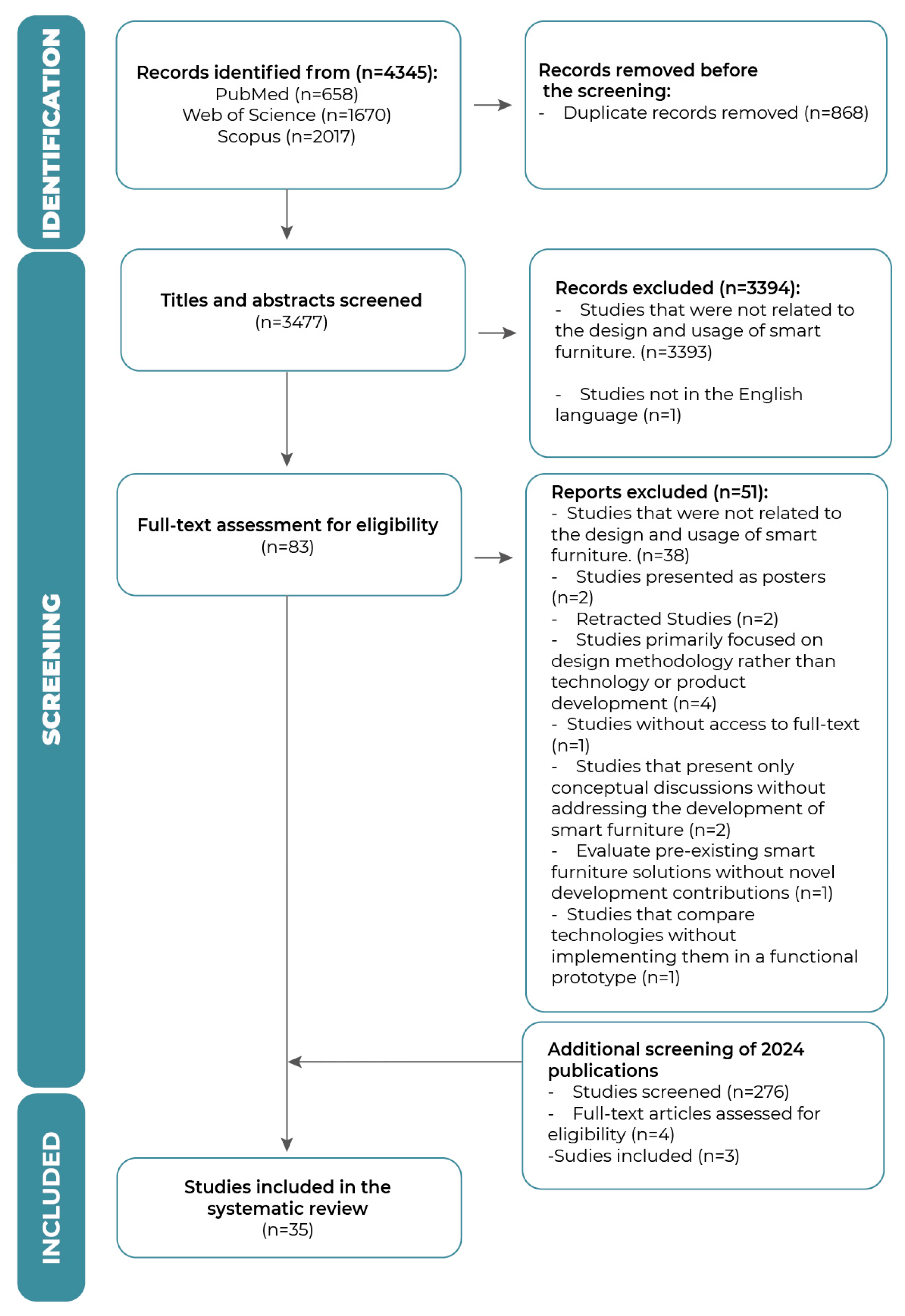
2.4. Article Search and Selection
2.5. Data Extraction and Synthesis
2.6. Validity Assessment
2.7. Use of Generative Artificial Intelligence
3. Results
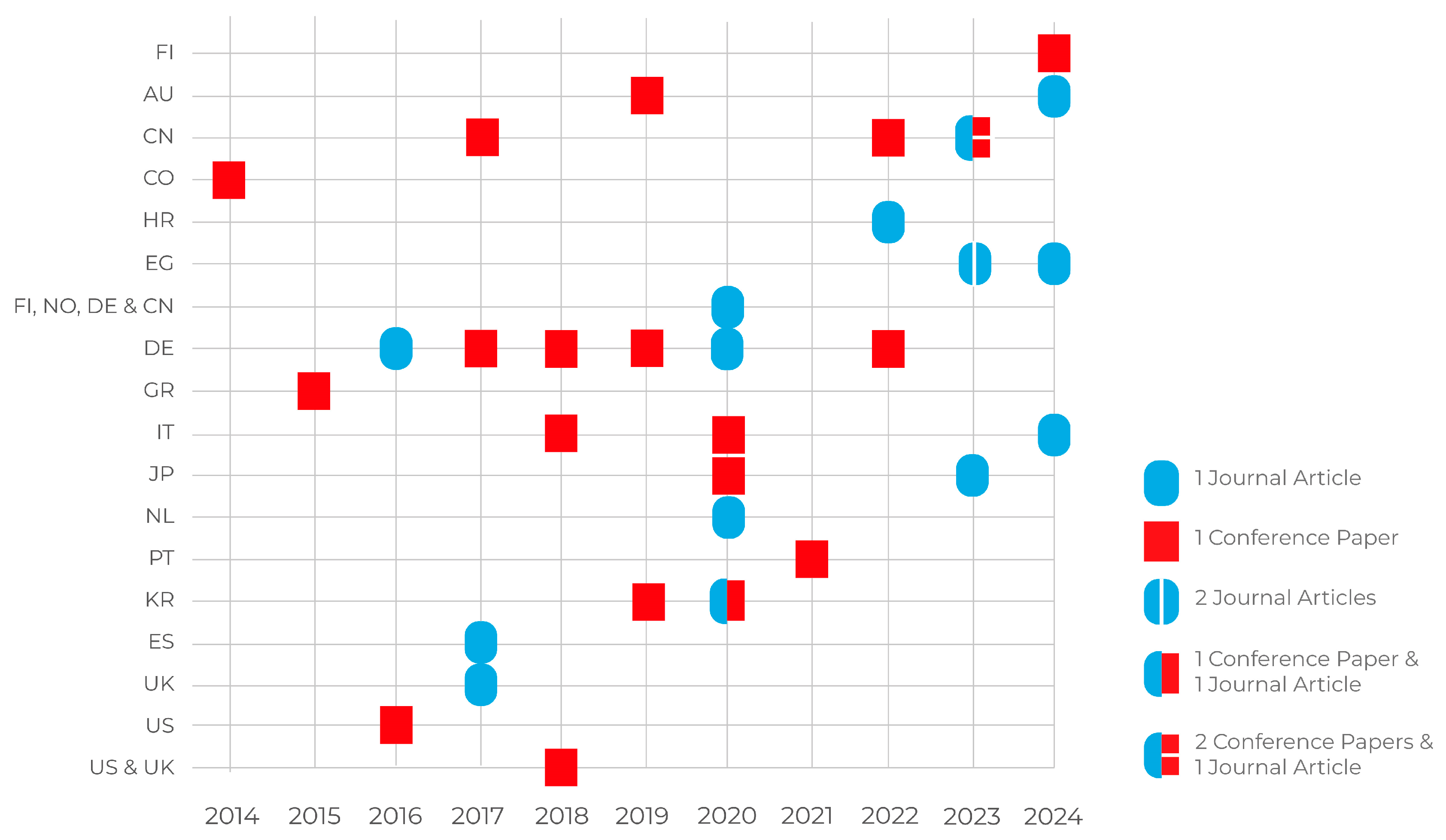
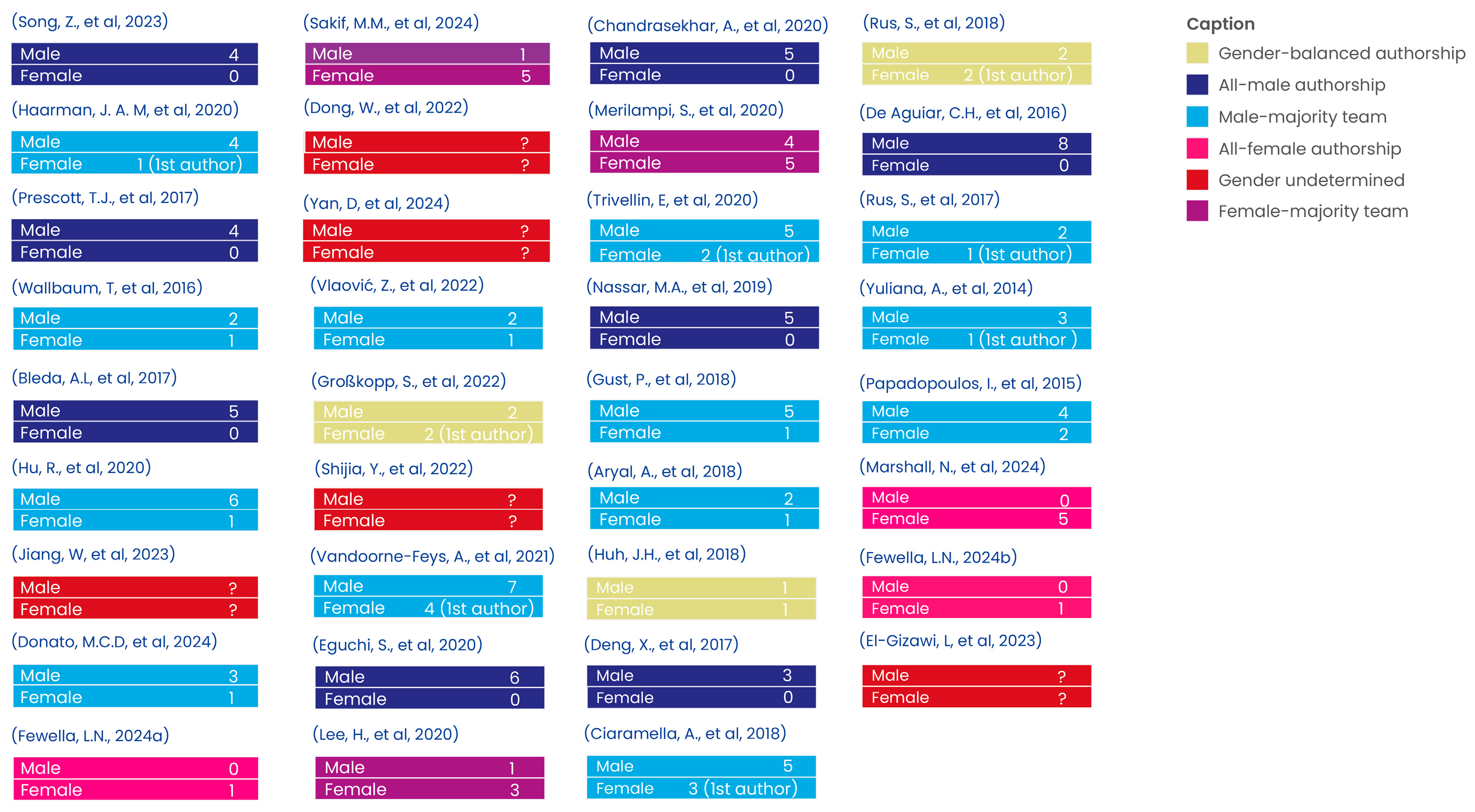
3.1. Study Characteristics
3.2. Technologies Identified in Smart Furniture
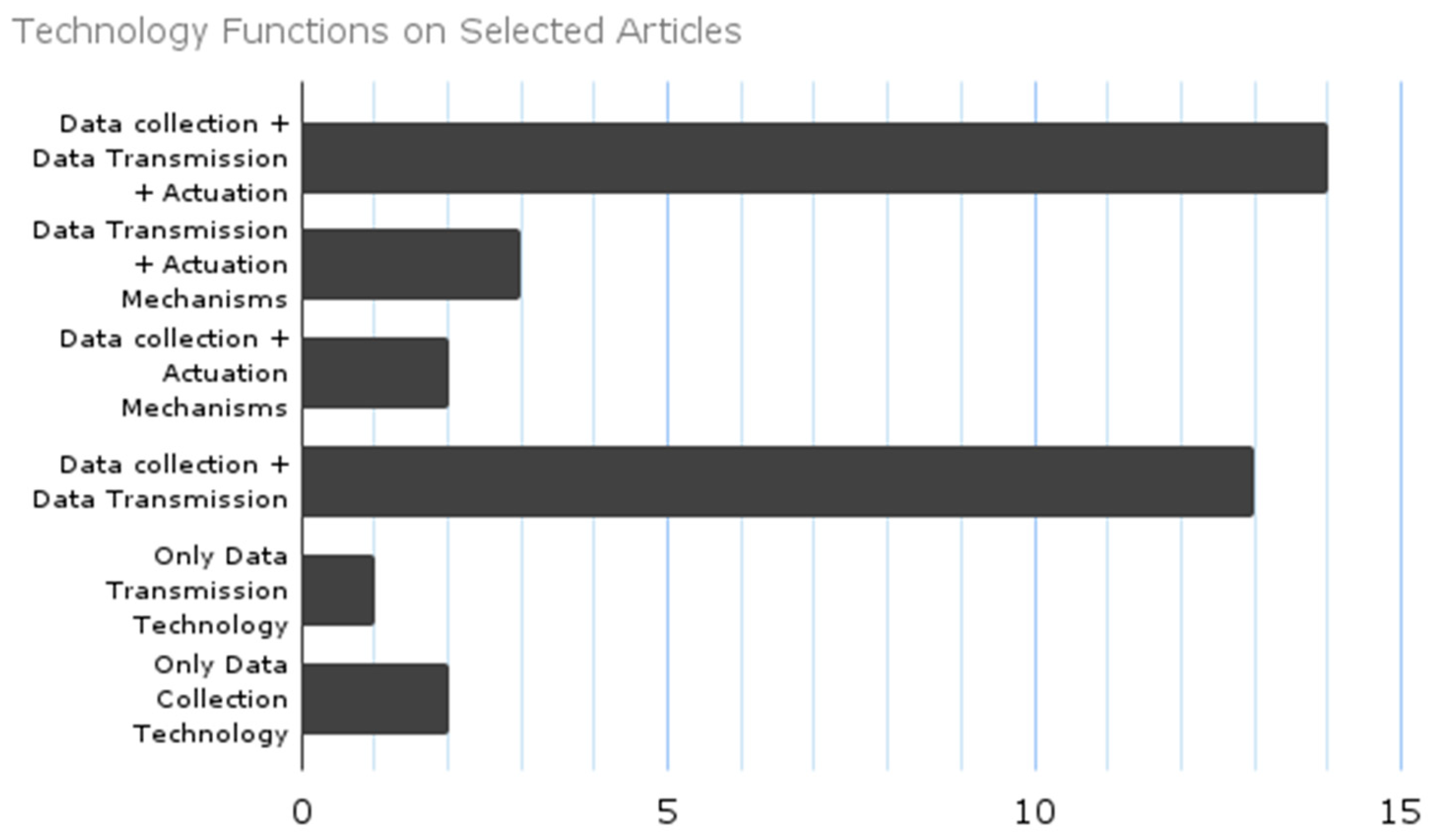
3.3. Technological Roles
3.4. Furniture Types and Application Domains
3.5. Technology Validation
3.6. Technology Maturity Assessment
3.7. Commercialisation
4. Discussion
4.1. Trends and Technological Priorities
4.2. Design, Use Cases, and Contextual Integration
4.3. Gaps in Validation and Path to Market
4.4. Challenges and Future Directions
4.5. Limitations of the Review
5. Conclusions
Author Contributions
Funding
Institutional Review Board Statement
Data Availability Statement
Acknowledgments
Conflicts of Interest
Abbreviations
| IoT | Internet of Things |
| TRL | Technology Readiness Level |
| HCD | Human-centred Design |
| PRISMA | Preferred Reporting Items for Systematic Reviews and Meta-Analyses |
| WoS | Web Of Science |
| AAL | Ambient Assisted Living |
| ECG | Electrocardiogram |
| PPG | Photoplethysmography |
| SVM | Support Vector Machine |
| TENG | Triboelectric Nanogenerators |
| PLCs | Programmable Logic Controllers |
| RIE | Reactive-ion etching |
| WOZ | Wizard of Oz |
| GDPR | General Data Protection Regulation |
| FDA | Food and Drug Administration |
Appendix A
Appendix A.1

| Database (Results) | Search String |
|---|---|
| PubMed | (“Smart furniture”[TIAB] OR (IoT[TIAB] AND furniture[TIAB]) OR (“Ambient assisted living”[TIAB] AND furniture[TIAB]) OR (Domotics[TIAB] AND furniture[TIAB]) OR (“Smart Homes”[TIAB] AND furniture[TIAB]) OR (technology[TIAB] AND furniture[TIAB]) OR (“Assistive technology”[TIAB] AND furniture[TIAB]) OR (Ergonomic[TIAB] AND furniture[TIAB] AND technology[TIAB]) OR (furniture[TIAB] AND “health monitoring”[TIAB]) OR (“Ambient intelligence”[TIAB] AND furniture[TIAB])) |
| Web of Science | “Smart furniture” OR (IoT AND furniture) OR (“Ambient assisted living” AND furniture) OR (Domotics AND furniture) OR (“Smart Homes” AND furniture) OR (technology AND furniture) OR (“Assistive technology” AND furniture) OR (Ergonomic AND furniture AND technology) OR (Furniture AND “health monitoring”) OR (“Ambient intelligence” AND furniture) |
| Scopus | TITLE-ABS-KEY (“Smart furniture” OR (“IoT” AND furniture) OR (“Ambient assisted living” AND furniture) OR (domotics AND furniture) OR (“Smart Home” AND furniture) OR (technology AND furniture) OR (“Assistive technology” AND furniture) OR (ergonomic AND furniture AND technology) OR (furniture AND “health monitoring”) OR (“Ambient intelligence” AND furniture) |
| Total | n = 4621 |
Appendix A.2
| Reference | Year | Type of Pub. | Region/Country | Integrated Technology | Technology Role | Furniture Typology | Smart Furniture Functions | Notes on Smart Furniture Functions | Type of Data Collected | Validation Process | Technology Readiness Levels (TRL) | Info. About Commercialization? |
|---|---|---|---|---|---|---|---|---|---|---|---|---|
| [13] | 2019 | Journal Article | Japan | Ultrahigh-frequency-band radiofrequency identification (RFID) | Data collection | Can be built into existing furniture such as desk, etc | Environment monitoring | Monitoring eathquakes | Observational vibration results from a long-term monitoring earthquakes | Describes the process to validate the system’s functionalities: vibrations from earthquakes (experimental testing) | 6—Tested in controlled environment, but with real data | No |
| [14] | 2019 | Journal Article | Netherlands | Load cell HX711 24-Bit Analogue-to-Digital Converter (ADC) LED | Data collection, Process/transmit information, Execute physical/digital actions | Table | Social interaction and communication, Health and well-being | Sensory Interactive Table that allows to study the eating behaviours and social interaction of people in a social setting | Eating Behaviour Detection: Amount of food consumed by individuals. Monitors water intake. Identifies which foods are eaten first or left untouched. Detects the arrangement of dining items (plates, glasses, pots) on the dining table. Behavioural analysis during meals. Monitoring food and water consumption patterns. | Describes the process to validate the system’s functionalities: Load cells to measures pressure. (experimental testing) | 5—Validated in the laboratory with feeding behaviour tests. | No |
| [15] | 2024 | Journal Article | United Kingdom | APRIL tags Robotic components | Data collection, Execute physical/digital actions | Table | Targeted to older people, Efficiency and Daily Life Management | Cantilever table able to move around by itself, or under user control. | Movement validation metrics Orientation data Relative spatial coordinates | No | 4—Prototype without testing in real scenarios. | No |
| [16] | 2014 | Journal Article | Germany | Raspberry Pi LED Arduino Mega RFID-tags proximity sensor | Data collection, Process/transmit information, Execute physical/digital actions | Table | Social interaction and communication | Table that promotes non-verbal communication between people living over a distance. | User Identification Data Event-Driven Interaction Data | Laboratory observation with usability tasks and questionnaires. lab study in a controlled environment. (experimental testing and user testing) | 5—Tested in a controlled environment with users. | No |
| [17] | 2022 | Journal Article | Spain | Wireless Sensor Networks (WSN) Zigbee modules Microcontrollers Wireless node (AT86RF230) Load cells (LAA-W1) 3-axis accelerometers—ADXL345BCCZ-RL Moisture sensor Magnetic contact sensor Infrared temperature sensors (MLX90614)—temperature sensor Infrared distance sensors (GP2Y0A21YK0F) Passive infra-red (PIR) sensors- presence sensor Light sensor (APDS-9007-020) LED Thermistor (NTCLE100E3103JB0)—temperature sensor Motor actuators | Data collection, Process/transmit information, Execute physical/digital actions | Bed, an armchair and a bedside table | Targeted to older people, Health and well-being | Smart Sensory Furniture that anticipates human needs, inferring a potentially dangerous action of an elderly person living alone at home. | Motion and Presence Detection Monitor user proximity, detect fever anomalies, and infer presence. Detect liquid spills (e.g., urine, water) for hygiene alerts. Measure weight distribution; detect user presence/activity (e.g., falls). Detect furniture tilt/impact (fall detection), monitor bed positioning. Monitor room activity; trigger assistive lighting. Adjust ambient lighting automatically (e.g., nighttime safety). Enable real-time data transmission between nodes and base station. | Two stages process validation: Off-Furniture Tests (Lab Testing); In-Furniture Tests (Real-World Testing) (experimental testing and user testing) | 6—Tested in real environment, but on a small scale | No |
| [18] | 2020 | Journal Article | Germany | Electrocardiogram (ECG) sensors Pressure-sensing mattresses Kinect motion sensors thermal cameras. Cloud-based platform AI-based predictive analytics. Internet of Things (IoT) | Data collection, Process/transmit information | interactive kitchen & dining furniture bed | Health and well-being, Targeted to older people | Furniture that encourages activity and customised healthcare in the context of an ageing society. Monitors health, cognitive and physical activation. | ECG signals, respiration rate, temperature, pressure data Gesture tracking, stand-up counting, Room conditions, light levels, and object positioning | 7—Pilot phase with industrial partners (pre-commercialisation). | Future iterations aim for market deployment through European industries and healthcare providers | |
| [19] | 2020 | Journal Article | China | Optical fibre sensor | Data collection | Sofa | Environment monitoring, Health and well-being | A multifunctional embedded optical fibre system for furniture, enabling light guidance and environmental or user interaction monitoring | Temperature, humidity, and carbon dioxide levels. Detection of sitting duration and stress on the furniture. Monitoring of structural integrity and stress on the 3D-printed components. | Several experiments: Temperature Sensing Experiment; Structural Strength Experiment (experimental testing) | 4—Validated only in the laboratory. | No |
| [20] | 2017 | Journal Article | Italy | Internet of Things (IoT) LoRa, FSK, UWB cloud computing | Process/transmit information | Can be built into existing furniture such as desk, etc | Environment monitoring | Detects earthquakes, signals the presence of individuals and supports rescue operations | Presence detection, environmental monitoring, acceleration data for earthquake detection. | Validated through prototype testing, laboratory experiments, simulations, and UAV-assisted localization tests. (experimental testing) | 7—In operational implementation phase | Ongoing implementation in the VITALITY project; aims for TRL 7 (real operational environment) and future commercialization. |
| [21] | 2018 | Journal Article | Egypt | Motion Sensors: Ultrasonic sensors Microcontroller: Arduino | Data collection, Process/transmit information | Wall-mounted mirror and a drawer unit | Social interaction and communication, Health and well-being | The technologies were chosen to create an interactive piece of furniture that promotes family integration, especially for children with ADHD | User Presence and Height, Behavioural Responses interacted with the furniture and how the lighting responses influenced their behaviour, and user feedback | Prototype Testing using technical testing; User Testing (experimental testing and user testing) | 5—Tested with users (ADHD), but not on a large scale. | Is in the process of being patented, with potential for commercialization in the Egyptian market and beyond. |
| [22] | 2024 | Conference Paper | Finland | IFTTT (If This Then That) Cloud-Based Web Interface, NFC tags | Data collection, Process/transmit information, Execute physical/digital actions | Table | Targeted to older people, Social interaction and communication, Health and well-being | Accessible smart mobile devices available for people with motor or cognitive difficulties (older people, patients with dementia, etc.). They can be used in home or assisted living environments to promote autonomy and simple interaction. | User Interaction, system performance and environmental Data. | The system was validated through functionality testing and practical evaluation. (experimental testing) | 4—Functional prototype, without large-scale testing. | No |
| [23] | 2023 | Conference Paper | China | Artificial Intelligence (AI), Internet of Things (IoT), Bluetooth, Artificial Neural Networks (ANN) algorithm, temperature and sound sensors | Data collection, Process/transmit information, Execute physical/digital actions | Sofa | Social interaction and communication, Health and well-being | Light adjustment, wireless charging, Bluetooth connectivity, mood-based lighting, temperature and sound sensing, entertainment integration integrated in a smart sofa for young people living alone. | User mood, behaviour, sound, temperature, and lighting preferences | No | 3—Without physical prototype or validation | No |
| [24] | 2020 | Conference Paper | China | Deep Learning, Chip for Voice Recognition (LD3320) and sensors for blood pressure, heart rate, body temperature, and blood oxygen monitoring. GPRS Communication, Mechanical Actuators for Electric Motors and Heating Elements | Data collection, Process/transmit information, Execute physical/digital actions | Sofa | Health and well-being, Targeted to older people | Health Monitoring, Voice Control, Massage Function, Heating Function, Childcare Function, Stand-Up Assistance and Autonomous Learning. Integrated into a cognitive smart sofa that uses advanced technologies for autonomous interaction with the user. | Blood pressure, heart rate, body temperature, and blood oxygen levels are collected and stored in the cloud. User Preferences, voice Data for authentication and control purposes, sitting patterns and usage frequency. Assistance with sitting and standing up and massages | The smart sofa was validated through user testing. (user testing) | 4—Limited user testing (no real environment). | No |
| [25] | 2019 | Journal Article | Croatia | Force-sensitive resistors (FSR), capacitive sensors, photoplethysmographic (PPG) electrocardiographic (ECG), radar sensors, and flex sensors connected to IoT, Microcontrollers, Arduino, Raspberry Pi, and ESPino32. | Data collection, Process/transmit information, Execute physical/digital actions | Office chairs | Health and well-being, Work/office spaces | Posture Monitoring Health Monitoring. Activity Recognition Posture Correction Assistive Functions Occupancy Detection. Smart chairs combine sensors, IoT and machine learning to promote occupational health in the workplace. | Monitor sitting posture and pressure distribution—provides feedback for correction; heart rate, respiration rate, blood pressure, and blood oxygen levels, user activities based on pressure and movement data. | Validated through user testing and machine learning validation processes. (experimental testing and user testing) | 6—Tested in real environment (office). | No |
| [26] | 2017 | Conference Paper | Germany | Projector; Camera and Object Recognition; Smartphone Integration, LED Matrix, recorder | Data collection, Process/transmit information, Execute physical/digital actions | Table | Social interaction and communication | Social Interaction Enhancement Media Sharing Object Recognition Remote Communication Recording and Replaying. An interactive table designed to strengthen social connections in smart homes. | Images and other digital media shared by users; information about physical objects placed on the table and their interactions with the system. User Interaction Data, and health Data like heart rate or speed from mobile devices is displayed. | The Prototype was validated through a field study in three households. (user testing) | 5—Tested in 3 homes (real scenario, but small sample). | No |
| [27] | 2020 | Conference Paper | China | Hetai HT66F2390 microcontroller LCD12864 LCD Display Fingerprint module adopts ATK-AS608 fingerprint recognition module HC-SR501 human body sensing module Bluetooth audio receiver module M38 5 W power amplifier module | Process/transmit information, Execute physical/digital actions | Bedside Table | Efficiency and Daily Life Management | Night light and brightness adjustment refrigeration function heating and insulation device fingerprint unlocking LED light LCD screen. A smart bedside table with multiple integrated functionalities, to optimise space in the bedroom and improve the user experience. | Temperature humidity fingerprint data user interaction data | Used processes to validate the system’s functionalities such as dark environments (to test the nightlight) and with user interactions (such as using the fingerprint module). (experimental testing and user testing) | 4—Basic functionalities validated in the laboratory. | No |
| [28] | 2016 | Conference Paper | Portugal | Lifting mechanisms (electric, crank, pin slide) LED light sensor Arduino Relay | Process/transmit information, Execute physical/digital actions | Desk | Work/office spaces | Reconfigurable and ergonomic three-level desk | The article does not give attention to data collection, only mentions light intensity data (for automatic lamp activation) | A prototype was built to test the ergonomics and functionality of the table (experimental testing) | 6—Ergonomics tests on prototype | Considerations have been made such as: marketing plan, product cost, target market and use of sustainable materials, but it is not yet commercialised |
| [29] | 2023 | Conference Paper | Japan | Six-axis sensor (MPU9250) and an ultrasonic sensor (HC-SR04) | Process/transmit information, Execute physical/digital actions | Chair | Efficiency and Daily Life Management | Allows four different ways of sitting, adapting to different user needs and behaviours. | Posture data Load/weight data | Sensor tests (experimental testing) | 4—Without testing in real use | No |
| [30] | 2020 | Conference Paper | Republic of Korea | Infrared communication sensors and servo motors. Arduino UNO Voice commands | Data collection, Process/transmit information, Execute physical/digital actions | Storage Cabinets | Efficiency and Daily Life Management | Assist users’ organising and finding behaviour | User interaction data: Voice commands User feedback: Perceived usefulness, ease of use, perceived intelligence, product evaluation (via questionnaires). | User testing WOZ technique: Simulated robotic behaviour. Quantitative measurements: Questionnaires (experimental testing and user testing) | 5—Tested with users (WOZ technique). | No |
| [31] | 2021 | Journal Article | Republic of Korea | Triboelectric Nanogenerator (TENG) Arduino Uno Reactive-Ion Etching (RIE). | Data collection, Process/transmit information, Execute physical/digital actions | Desk | Efficiency and Daily Life Management | Smart desk that triggers an alarm if an intruder accesses it | Electrical output data generated by TENG. Intrusion detection data: Signals triggered by contact with the table. | Electrical performance testing Stability testing Real-time application testing Finite element simulation: COMSOL Multiphysics to validate the working mechanism. (experimental testing) | 5—Validated in laboratory and simulations (without external testing). | No |
| [32] | 2016 | Journal Article | Finland, Norway, Germany and China | force plates—FP3 infrared sensors camera and facial recognition module Bluetooth pressure sensors | Data collection, Process/transmit information | 2 Chairs 1 Mirror | Health and well-being, Targeted to older people | Fall detection and monitoring Older person monitoring and check-in | chairs: quantitative data on physical function (user’s position) mirror: facial data | usability studies with older adults interviews (user testing) | 6—Tested in usability studies. | No |
| [33] | 2023 | Conference Paper | Italy | Cloud platform Sensors: temperature, humidity, air quality (PM10, PM2.5, PM1, CO, CH4, VOC), atmospheric pressure, brightness, and soil moisture. | Data collection, Process/transmit information | Outdoor furniture (e.g., benches, vases, fountains, street furniture) | Environment monitoring | Monitors and controls garden parameters. Provides automated garden management via IoT. Enhances user experience through interaction with an app. | Air quality, temperature, humidity, pollution levels. Soil moisture, irrigation status. App usage and system control. | Rapid prototyping; Testing of 3D-printed models and manual/digital modifications. Scenario-based design: Application scenarios defined through focus groups and iterative revisions. (experimental testing and user testing) | 4—Tested in simulated scenarios. | No |
| [34] | 2023 | Conference Paper | Australia | Wireless sensor nodes (Arduino Uno R3, ESP-13 WiFi shield) ultrasonic sensors temperature sensors | Data collection, Process/transmit information | Outdoor furniture—bins, seats, bus shelters | Environment monitoring | Environmental monitoring (temperature, humidity, garbage level, air quality), crowd measurement (via WiFi-enabled devices), and real-time data communication. | Environmental data (temperature, humidity, garbage level, air quality), WiFi probe requests (MAC addresses, signal strengths). | Experiments conducted with five bins deployed, comparing static and dynamic communication models (experimental testing) | 5—Tested in an urban environment (small scale). | No |
| [35] | 2024 | Conference Paper | Germany | capacitive sensors microcontrollers Bluetooth actuators | Data collection, Execute physical/digital actions | Office chairs | Health and well-being, Work/office spaces | Promotes dynamic sitting posture, reduces muscular tension, and supports active health through haptic feedback. | Sitting posture, pressure distribution, duration in specific positions, and force-displacement measurements. | Experiments with 12 test subjects, force-displacement measurements, FEM optimisation, and sensor testing. (experimental testing) | 6—Tested with 12 users (empirical data). | No |
| [36] | 2020 | Conference Paper | USA and UK | IoT sensors (temperature, humidity, CO2, volatile organic compounds VOC, PM, illuminance, motion, sound level, distance) Raspberry Pi RFID tag PoE (Power over Ethernet)—only in version 1 prototype Machine learning algorithms motorised sit-stand feature | Data collection, Process/transmit information, Execute physical/digital actions | Desk | Health and well-being, Work/office spaces | Personalises indoor environmental conditions (thermal, visual, and acoustic comfort), reduces sedentary time, and improves posture and ergonomics. | Thermal comfort data (temperature, humidity), visual comfort data (illuminance, correlated colour temperature), air quality data (CO2, VOC, PM), occupancy state, power consumption, and user preferences. | Ongoing development with iterative versions of the desk (Version 1, 2, and 3), incorporating user feedback and sensor data to refine functionality. (experimental testing and user testing) | 6—Iterative development (versions 1–3 with user feedback). | No |
| [37] | 2018 | Conference Paper | Republic of Korea | Raspberry Pi Arduino UNO Pressure sensors Convolutional Neural Network (CNN) IoT x-y floater and motor Deep Learning (AI) | Data collection, Process/transmit information, Execute physical/digital actions | shoe cabinet | Efficiency and Daily Life Management | Automatic shoe storage, shoe type and colour classification, and shoe recommendation based on user input (clothing and destination). | Shoe images (type and colour), user input (clothing type and destination), and shoe storage status. | No, only prototyped | 3—Conceptual prototype without validation. | No |
| [38] | 2020 | Conference Paper | China | Raspberry Pi TFT LCD display infrared frame Baidu Voice Assistant | Data collection, Process/transmit information | Mirror | Environment monitoring, Efficiency and Daily Life Management, Social interaction and communication | Acts as a smart home centre platform, controlling home appliances, displaying real-time information (weather, news, time), monitoring home environments, and enabling remote interaction. | Real-time home environment data, user interaction data (touch, voice), and monitoring data (images, security alerts). | No, only prototyped | 4—Patent pending (no large-scale testing). | The project is pending patent applications, but no explicit commercialisation details are provided in the text. |
| [39] | 2017 | Conference Paper | Italy | Sensors (environmental, acoustic, presence) RFID WiFi NFC | Data collection, Process/transmit information | Smart urban furnishings (benches, worktops, digital islands) | Environment monitoring | Provides innovative services to citizens, monitors urban environments, and enhances public services through data collection and processing. | Environmental data (pollution, emissions, noise levels), urban dynamics, and user interaction data. | Prototype development and testing (collaboration between academia and industry partners) (experimental testing) | 5—Tested in academia-industry collaboration. | The project aims to define a sustainable business plan, but no explicit commercialisation details are provided in the text. |
| [40] | 2018 | Conference Paper | Germany | Capacitive proximity sensors machine learning algorithms (C4.5 Decision Tree, kNN, SVM, Naive Bayes, Random Forest). | Data collection, Process/transmit information | Sofa | Health and well-being | Detects proximity and motion of the human body to recognise emotional states (e.g., anxiety, interest, relaxation). | proximity, motion, posture, and movement data. | Study with 15 participants, using both elicited and acted emotions, and machine learning evaluation with leave-one-subject-out cross-validation. (user testing) | 5—Tested with 15 participants. | No |
| [41] | 2022 | Conference Paper | USA | ultrasonic sensors Xbee 802.15.4 PRO RF Modules Leap Motion controller Arduino stepper motors linear actuators LED | Execute physical/digital actions, Data collection, Process/transmit information | Robotic furniture suite (chair, side table, and screen). | Targeted to older people, Efficiency and Daily Life Management | Assists elderly users with mobility and daily activities, enabling ageing in place. | User gestures, chair occupancy, and table/screen positioning data. | Initial experiments with senior citizens, focusing on usability and functionality. (user testing) | 4—Initial usability testing. | No |
| [42] | 2017 | Conference Paper | Germany | Textile capacitive sensing electrodes OpenCapSense board (microcontroller) | Data collection, Process/transmit information | Sofa | Health and well-being | Posture detection and recognition | Capacitive sensor data for posture recognition (e.g., sitting upright, leaning back, lying down) | Leave-one-subject-out cross-validation with 15 test persons and 14 postures (user testing) | 5—Validated with 15 users (cross-validation). | No |
| [43] | 2015 | Conference Paper | Colombia | Proximity and distance sensors ultrasonic sensors Raspberry Pi Zigbee wireless communication traction mechanisms | Data collection, Process/transmit information, Execute physical/digital actions | Chairs and tables | Efficiency and Daily Life Management | Automated spatial configuration of work environments. The furniture pieces move around to adapt to the needs of the occasion. | Distance measurements, spatial positioning data, and user input for configuration settings | No | 4—Prototype without testing in a real environment. | No |
| [44] | 2022 | Conference Paper | Greece | Weight Sensors PLC (Programmable Logic Controller) | Data collection, Execute physical/digital actions | Main entrance furniture piece | Efficiency and Daily Life Management | Face recognition, reminders, information display, storage for small objects | Face recognition data, user interaction data (e.g., reminders, clothing suggestions), and sensor data for object detection | No | 5—Market plan, but without implementation. | The product is intended for both the Greek and European markets, with a profit-loss analysis suggesting potential profitability if launched in both markets. Prices are competitive for high-value furniture, but no specific commercialization details are provided. |
| [45] | 2024 | Journal Article | Australia | Sensors Wi-Fi IoT | Data collection, Process/transmit information, Execute physical/digital actions | Hub: Street Furniture | Environment monitoring Social interaction and communication | Create flexible places to meet, work, and play. combat rising urban temperatures. Capture local environmental conditions | Number of users; Environmental Data; Resource Consumption Data: Power usage, water usage; Performance and status of the public furnishings | surveys with both users and non-users to evaluate public perception and usage (user testing) | 9—Actual system proven in operational environment | Product already commercialised |
| [46] | 2024 | Journal Article | Egypt | IoT, Sensors | Data collection, Process/transmit information, Execute physical/digital actions | Mirror and Drawer | Efficiency and Daily Life Management | Monitor environmental conditions; Collect real-time data on space usage | Real-time user behaviour, environmental conditions, space usage patterns | Conceptual framework; proposed validation via simulation and pilot deployments (experimental testing) | 4—Prototype without testing in real scenarios. | No (theoretical framework only) |
| [47] | 2024 | Journal Article | Egypt | IoT, Sensors, Arduino, User interfaces, LED | Data collection, Process/transmit information Execute physical/digital actions | Table | Targeted at old people Health and well-being | Surface colour changes to warn users (children, deaf and older people) of hot components that could harm Them. | Surface temperature, presence of thermal objects, and thermal risk level | Lab Testing (experimental testing) | 4—Prototype without testing in real scenarios. | No |
References
- Xu, L. Research on Design Trends and User Experience of Smart Home Furniture. Appl. Math. Nonlinear Sci. 2024, 9, 1–12. [Google Scholar] [CrossRef]
- Samancioglu, N.; Väänänen, K.; Castaño-Rosa, R. Aligning smart home technology attributes with users’ preferences: A literature review. Intell. Build. Int. 2024, 16, 129–143. [Google Scholar] [CrossRef]
- Aheleroff, S.; Xu, X.; Lu, Y.; Aristizabal, M.; Pablo Velásquez, J.; Joa, B.; Valencia, Y. IoT-enabled smart appliances under industry 4.0: A case study. Adv. Eng. Inform. 2020, 43, 101043. [Google Scholar] [CrossRef]
- Krejcar, O.; Maresova, P.; Selamat, A.; Melero, F.J.; Barakovic, S.; Husic, J.B.; Herrera-Viedma, E.; Frischer, R.; Kuca, K. Smart furniture as a component of a smart city—Definition based on key technologies specification. IEEE Access 2019, 7, 94822–94839. [Google Scholar] [CrossRef]
- Krejcar, O.; Maresova, P.; Brida, P.; Barakovic, S.; Husic, J.B.; Kuca, K.; Selamat, A. Technology Analysis of Global Smart Furniture Development Using Patent Data. In Proceedings of the 2020 ELEKTRO, Taormina, Italy, 25–28 May 2020; pp. 1–6. [Google Scholar]
- Maulana, F.I.; Kurniawan, B.K.; Pramono, A.; Purnomo, A.; Abdulah, M.E.B.Z.; Mohamed, M. Internet of Things for Smart Furniture: A Systematic Review. In Proceedings of the 2024 International Conference on ICT for Smart Society (ICISS), Yogyakart, Indonesia, 4–5 September 2024; pp. 1–6. [Google Scholar]
- Hu, M.; Han, S.; Ghorbany, S.; Zhang, K. Healthy Aging in Place with the Aid of Smart Technologies: A Systematic Review. Encyclopedia 2024, 4, 1918–1932. [Google Scholar] [CrossRef]
- Ma, C.; Guerra-Santin, O.; Mohammadi, M. Smart home modification design strategies for ageing in place: A systematic review. J. Hous. Built Environ. 2022, 37, 625–651. [Google Scholar] [CrossRef]
- Muñoz, F.J.M. Soluciones TIC para Envejecimiento Activo y Saludable en el Hogar, en el Puesto de Trabajo y en la Sociedad. Ph.D. Thesis, Universidad Politécnica de Cartagena, Cartagena, Spain, 2023. [Google Scholar]
- Dangkua, N.Y.; Nandito, M.A.; Jamil, F.H.P.; Rahayu, M. Implementing Human-Centric Design in Developing a Multifunctional Chair and Storage Solution for Children. J. Sist. Tek. Ind. 2024, 26, 180–190. [Google Scholar] [CrossRef]
- Page, M.J.; Moher, D.; Bossuyt, P.M.; Boutron, I.; Hoffmann, T.C.; Mulrow, C.D.; Shamseer, L.; Tetzlaff, J.M.; Akl, E.A.; Brennan, S.E.; et al. PRISMA 2020 explanation and elaboration: Updated guidance and exemplars for reporting systematic reviews. BMJ 2021, 372, n160. [Google Scholar] [CrossRef] [PubMed]
- Ouzzani, M.; Hammady, H.; Fedorowicz, Z.; Elmagarmid, A. Rayyan—A web and mobile app for systematic reviews. Syst. Rev. 2016, 5, 210. [Google Scholar] [CrossRef]
- Song, Z.; Rahmadya, B.; Sun, R.; Takeda, S. A Feasibility Study on Monitoring Earthquake-Caused Furniture Vibrations Using Radiofrequency Identification Sensor Tags. Sensors 2023, 23, 3279. [Google Scholar] [CrossRef]
- Haarman, J.A.M.; de Vries, R.A.J.; Harmsen, E.C.; Hermens, H.J.; Heylen, D.K.J. Sensory Interactive Table (SIT)-Development of a Measurement Instrument to Support Healthy Eating in a Social Dining Setting. Sensors 2020, 20, 2636. [Google Scholar] [CrossRef]
- Prescott, T.J.; Conran, S.; Mitchinson, B.; Cudd, P. IntelliTable: Inclusively-Designed Furniture with Robotic Capabilities. Stud. Health Technol. Inform. 2017, 242, 565–572. [Google Scholar]
- Wallbaum, T.; Heuten, W.; Boll, S. RemoTable: Sharing Daily Activities and Moods Using Smart Furniture. Stud. Health Technol. Inform. 2016, 229, 345–354. [Google Scholar]
- Bleda, A.L.; Fernandez-Luque, F.J.; Rosa, A.; Zapata, J.; Maestre, R. Smart Sensory Furniture Based on WSN for Ambient Assisted Living. IEEE Sens. J. 2017, 17, 5626–5636. [Google Scholar] [CrossRef]
- Hu, R.; Linner, T.; Trummer, J.; Guettler, J.; Kabouteh, A.; Langosch, K.; Bock, T. Developing a Smart Home Solution Based on Personalized Intelligent Interior Units to Promote Activity and Customized Healthcare for Aging Society. J. Popul. Ageing 2020, 13, 257–280. [Google Scholar] [CrossRef]
- Jiang, W.; Lu, D.; Zhao, N. A New Design Approach: Applying Optical Fiber Sensing to 3D-Printed Structures to Make Furniture Intelligent. Sustainability 2023, 15, 16715. [Google Scholar] [CrossRef]
- Donato, M.C.D.; Corradini, F.; Fornari, F.; Re, B. SAFE: An ICT platform for supporting monitoring, localization and rescue operations in case of earthquake. Internet Things 2024, 27, 101273. [Google Scholar] [CrossRef]
- Fewella, L.N. The behavioral smart furniture and its relevance to family emotional dynamics. Ain Shams Eng. J. 2024, 15, 103030. [Google Scholar] [CrossRef]
- Sakif, M.M.; Ihalainen, T.; Merilampi, S.; Petäjistö, S.M.; Raumonen, P.; Vuohijoki, T.; Virkki, J. Enabling Living Spaces Through Customizable NFC-Enabled Smart Table System. In Proceedings of the 2024 18th European Conference on Antennas and Propagation (EuCAP), Glasgow, UK, 17–22 March 2024. [Google Scholar]
- Dong, W.; Long, Y. Research on Modern Intelligent Sofa Design for Solitary Youth. In Proceedings of the 2nd International Conference on Artificial Intelligence, Robotics, and Communication (ICAIRC 2022), Fuzhou, China, 25–27 November 2022; Volume 1063, pp. 55–65. [Google Scholar]
- Yan, D.; Chang, M.; Chen, S.; Wang, Y. Research on the design of cognitive intelligent furniture model. In Proceedings of the 2023 IEEE 6th Information Technology, Networking, Electronic and Automation Control Conference (ITNEC), Chongqing, China, 24–26 February 2023; pp. 1775–1778. [Google Scholar]
- Vlaović, Z.; Jaković, M.; Domljan, D. Smart Office Chairs with Sensors for Detecting Sitting Positions and Sitting Habits: A Review. Drv. Ind. 2022, 73, 227–243. [Google Scholar] [CrossRef]
- Großkopp, S.; Hoff, T.Z.; Gerhardt, E.C.; Malburg, T. WeHub: The Social Center of Smart Homes. In Proceedings of the MuC ’22: Mensch und Computer 2022, Darmstadt, Germany, 4–7 September 2022; pp. 597–600. [Google Scholar]
- Shijia, Y.; Weiqiang, Y.; Xiehua, Y. Design of the Smart Bedside Table Based on Single-Chip Microcomputer. In Proceedings of the 2022 12th International Conference on Information Technology in Medicine and Education (ITME), Xiamen, China, 18–20 November 2022; pp. 761–765. [Google Scholar]
- Vandoorne-Feys, A.; Nicoara, G.G.; Carasel, I.S.; Karpiak, M.; Kocheski, N.; Malheiro, B.; Ribeiro, C.; Justo, J.; Silva, M.; Ferreira, P.; et al. Reconfigurable and Ergonomic Smart Desk An EPS@ISEP 2021 Project. In Proceedings of the TEEM’21: Ninth International Conference on Technological Ecosystems for Enhancing Multiculturality, Barcelona, Spain, 26–29 October 2021; pp. 464–470. [Google Scholar]
- Eguchi, S.; Yazaki, Y.; Kato, R.; Arita, Y.; Moriya, T.; Tanaka, H. Proto-chair: Posture-sensing smart furniture with 3D-printed auxetics. In Proceedings of the CHI ’20: CHI Conference on Human Factors in Computing Systems, Honolulu, HI, USA, 25–30 April 2020. [Google Scholar]
- Lee, H.; Kang, D.; Kwak, S.S.; Choi, J. Designing Robotic Cabinets That Assist Users’ Tidying Behaviors. In Proceedings of the 2020 29th IEEE International Conference on Robot and Human Interactive Communication (RO-MAN), Naples, Italy, 31 August–4 September 2020; pp. 253–258. [Google Scholar]
- Chandrasekhar, A.; Vivekananthan, V.; Khandelwal, G.; Kim, W.J.; Kim, S.J. Green energy from working surfaces: A contact electrification–enabled data theft protection and monitoring smart table. Mater. Today Energy 2020, 18, 100544. [Google Scholar] [CrossRef]
- Merilampi, S.; Poberznik, A.; Saari, S.; Serrano, J.A.; Güttler, J.; Langosch, K.; Bock, T.; Zou, L.; Magne, T.A. Modular smart furniture system for independent living of older adults: User experience study. Gerontechnology 2020, 19, 1–13. [Google Scholar] [CrossRef]
- Trivellin, E.; Marseglia, M.; Filieri, J.; Lotti, G.; Cantini, F.; Tanzini, A.; Matteucci, E. Smart Garden (SMAG): A System of Outdoor Furniture Equipped with Artificial Intelligence. In Proceedings of the Advances in Manufacturing, Production Management and Process Control (AHFE 2020), Virtual, 16–20 July 2020; Volume 1216, pp. 140–146. [Google Scholar]
- Nassar, M.A.; Luxford, L.; Cole, P.; Oatley, G.; Koutsakis, P. Adaptive low-power wireless sensor network architecture for smart street furniture-based crowd and environmental measurements. In Proceedings of the 2019 IEEE 20th International Symposium on “A World of Wireless, Mobile and Multimedia Networks” (WoWMoM), Washington, DC, USA, 10–12 June 2019. [Google Scholar]
- Gust, P.; Kampa, S.P.; Feller, N.; Stein, M.V.; Haase, I.; Virzi, V. Intelligent seating system with haptic feedback for active health support. In Proceedings of the Future Technologies Conference (FTC) 2018, Vancouver, BC, Canada, 13–14 November 2018; Volume 880, pp. 856–873. [Google Scholar]
- Aryal, A.; Anselmo, F.; Becerik-Gerber, B. Smart IoT desk for personalizing indoor environmental conditions. In Proceedings of the IOT ’18: 8th International Conference on the Internet of Things 2018, Santa Barbara, CA, USA, 15–18 October 2018. [Google Scholar]
- Huh, J.H.; Seo, K. Artificial intelligence shoe cabinet using deep learning for smart home. In Proceedings of the Advanced Multimedia and Ubiquitous Engineering. MUE FutureTech 2018, Salerno, Italy, 23–25 April 2018; Volume 518, pp. 825–834. [Google Scholar]
- Deng, X.; Peng, Z.; Wu, W. A smart home center platform solution based on smart mirror. In Proceedings of the 2017 3rd International Conference on Mechanical, Electronic and Information Technology Engineering (ICMITE 2017), Chengdu, China, 16–17 December 2017; Volume 139. [Google Scholar]
- Ciaramella, A.; Bellintani, S.; Savio, L.; Carbonaro, C.; Pagani, R.; Pennacchio, R.; Peretti, G.; Thiebat, F. Smart furniture and smart city. In IOP Conference Series: Materials Science and Engineering; IOP Publishing: Bristol, UK, 2018; Volume 365. [Google Scholar]
- Rus, S.; Joshi, D.; Braun, A.; Kuijper, A. The Emotive Couch—Learning Emotions by Capacitively Sensed. Procedia Comput. Sci. 2018, 130, 263–270. [Google Scholar] [CrossRef]
- De Aguiar, C.H.; Fateminasab, R.; Frazelle, C.G.; Scott, R.; Wang, Y.; Wooten, M.B.; Green, K.E.; Walker, I.D. The networked, robotic home+furniture suite: A distributed, assistive technology facilitating aging in place. In Proceedings of the 2016 IEEE International Conference on Automation Science and Engineering (CASE), Fort Worth, TX, USA, 21–24 August 2016; Volume 2016, pp. 1067–1072. [Google Scholar]
- Rus, S.; Braun, A.; Kuijper, A. E-textile couch: Towards smart garments integrated furniture. In Proceedings of the Ambient Intelligence (AmI 2017), Málaga, Spain, 26–28 April 2017; Volume 10217, pp. 214–224. [Google Scholar]
- Yuliana, A.; Felipe, O.; Byron, S.; Liliana, L.; Andres, V. Configuration of work environments with smart furniture. In Proceedings of the 2014 III International Congress of Engineering Mechatronics and Automation (CIIMA), Cartagena, Colombia, 22–24 October 2014. [Google Scholar]
- Papadopoulos, I.; Trigkas, M.; Karagouni, G.; Dedoulis, E.; Papadopoulou, A.; Blanas, G. Techno-economic analysis of furniture innovation: Developing a green and smart furniture for mass production. In Proceedings of the 7th International Conference on ICT in Agriculture, Food & Environment, Kavala, Greece, 17–20 September 2015; Volume 1498, pp. 393–400. [Google Scholar]
- Marshall, N.; Bishop, K.; Rahmat, H.; Thompson, S.; Steinmetz-Weiss, C. Smart Street Furniture: User and Non-User Perspectives of the ChillOUT Hub. Land 2024, 13, 2084. [Google Scholar] [CrossRef]
- Fewella, L.N. Smartification furniture manufacturing: A furniture prototype with thermal-based sensors (Visions and Challenges). Results Eng. 2024, 24, 103508. [Google Scholar] [CrossRef]
- El-Gizawi, L.; Aliaa, Y.; Nanees, E. Smart furniture technologies supporting functional employees’ needs in workspace: A case study of office building in Egypt. Civ. Eng. Arch. 2023, 11, 3681–3701. [Google Scholar] [CrossRef]
- Vrettas, G.; Sanderson, M. Conferences versus journals in computer science. J. Assoc. Inf. Sci. Technol. 2015, 66, 2674–2684. [Google Scholar] [CrossRef]
- Gbadegeshin, S.A.; Natsheh, A.A.; Ghafel, K.; Mohammed, O.; Koskela, A.; Rimpiläinen, A.; Tikkanen, J.; Kuoppala, A. Overcoming the Valley of Death: A New Model for High Technology Startups. Sustain. Futures 2022, 4, 100077. [Google Scholar] [CrossRef]
- Raynaud, M.; Goutaudier, V.; Louis, K.; Al-Awadhi, S.; Dubourg, Q.; Truchot, A.; Brousse, R.; Saleh, N.; Giarraputo, A.; Debiais, C.; et al. Impact of the COVID-19 pandemic on publication dynamics and non-COVID-19 research production. BMC Med. Res. Methodol. 2021, 21, 255. [Google Scholar] [CrossRef]
- Singh, M.; Prasad, C.P.; Shankar, A. Publication charges associated with quality open access (OA) publishing and its impact on low middle income countries (LMICs), time to reframe research policies. Asian Pac. J. Cancer Prev. APJCP 2021, 22, 2743. [Google Scholar] [CrossRef]
- Busse, C.E.; Anderson, E.W.; Endale, T.; Smith, Y.R.; Kaniecki, M.; Shannon, C.; August, E.T. Strengthening research capacity: A systematic review of manuscript writing and publishing interventions for researchers in low-income and middle-income countries. BMJ Glob. Health 2022, 7, e008059. [Google Scholar] [CrossRef]
- Chan, R.C.H. A social cognitive perspective on gender disparities in self-efficacy, interest, and aspirations in science, technology, engineering, and mathematics (STEM): The influence of cultural and gender norms. Int. J. STEM Educ. 2022, 9, 37. [Google Scholar] [CrossRef]
- Verdugo-Castro, S.; Sánchez-Gómez, M.C.; García-Holgado, A. Factors associated with the gender gap in the STEM sector: Comparison of theoretical and empirical concept maps and qualitative SWOT analysis. Heliyon 2023, 9, e17499. [Google Scholar] [CrossRef]
- Gómez-Carmona, O.; Sádaba, J.; Casado-Mansilla, D. Enhancing street-level interactions in smart cities through interactive and modular furniture. J. Ambient Intell. Humaniz. Comput. 2022, 13, 5419–5432. [Google Scholar] [CrossRef]
- Elmi, Y.A. Interoperable IoT Devices and Systems for Smart Homes: A Data Analytics Approach to Enhance User Experience and Energy Efficiency. J. Digit. Realism Mastery (DREAM) 2023, 2, 51–66. [Google Scholar] [CrossRef]
- Maresova, P.; Krejcar, O.; Barakovic, S.; Husic, J.B.; Lameski, P.; Zdravevski, E.; Chorbev, I.; Trajkovik, V. Health–related ICT solutions of smart environments for elderly–systematic review. IEEE Access 2020, 8, 54574–54600. [Google Scholar] [CrossRef]
- Francés Morcillo, L.; Morer-Camo, P.; Isabel Rodriguez Ferradas, M.; Cazón Martín, A. The Wearable Co-Design Domino: A User-Centered Methodology to Co-Design and Co-Evaluate Wearables. Sensors 2020, 20, 2934. [Google Scholar] [CrossRef] [PubMed]
- Bai, Y.; Kamarudin, K.M.; Alli, H. A systematic review of research on sitting and working furniture ergonomic from 2012 to 2022: Analysis of assessment approaches. Heliyon 2024, 10, e28384. [Google Scholar] [CrossRef]
- Lindsay, S.; Jackson, D.; Schofield, G.; Olivier, P. Engaging older people using participatory design. In Proceedings of the SIGCHI Conference on Human Factors in Computing Systems, Austin, TX, USA, 5–10 May 2012; pp. 1199–1208. [Google Scholar]
- Steen, M.; Manschot, M.; Koning, N.D. Benefits of Co-design in Service Design Projects. Int. J. Des. 2011, 5, 53–60. [Google Scholar]
- Zuboff, S. The Age of Surveillance Capitalism: The Fight for a Human Future at the New Frontier of Power; Public Affairs: New York, NY, USA, 2019. [Google Scholar]
- WHO. Leapfrogging to a Healthy Ageing Society Through Inclusive Technology. Available online: https://www.who.int/china/news/feature-stories/detail/leapfrogging-to-a-healthy-ageing-society-through-inclusive-technology (accessed on 8 September 2025).
- Şerban, A.C.; Lytras, M.D. Artificial intelligence for smart renewable energy sector in europe—Smart energy infrastructures for next generation smart cities. IEEE Access 2020, 8, 77364–77377. [Google Scholar] [CrossRef]
- Ntoa, S. Usability and User Experience Evaluation in Intelligent Environments: A Review and Reappraisal. Int. J. Hum.-Comput. Interact. 2025, 41, 2829–2858. [Google Scholar] [CrossRef]
- Li, B.; Kong, S.C.; Chen, G. Development and validation of the smart classroom inventory. Smart Learn. Environ. 2015, 2, 3. [Google Scholar] [CrossRef]
- Righi, V.; Sayago, S.; Blat, J. When we talk about older people in HCI, who are we talking about? Towards a ‘turn to community’in the design of technologies for a growing ageing population. Int. J. Hum.-Comput. Stud. 2017, 108, 15–31. [Google Scholar] [CrossRef]
- Stojčić, N.; Dabić, M.; Kraus, S. Customisation and co-creation revisited: Do user types and engagement strategies matter for product innovation success? Technovation 2024, 134, 103045. [Google Scholar] [CrossRef]
- Frischer, R.; Krejcar, O.; Maresova, P.; Fadeyi, O.; Selamat, A.; Kuca, K.; Tomsone, S.; Teixeira, J.P.; Madureira, J.; Melero, F.J. Commercial ICT smart solutions for the elderly: State of the art and future challenges in the smart furniture sector. Electronics 2020, 9, 149. [Google Scholar] [CrossRef]
- Markowski, N.; Grosser, K.; Kuhl, R. Analysis of barriers and obstacles in knowledge transfer between universities and SME. In Duesseldorf Working Papers in Applied Management and Economics; Duesseldorf University of Applied Sciences: Düsseldorf, Germany, 2008. [Google Scholar]
- Otero-Neira, C.; Tapio Lindman, M.; Fernández, M.J. Innovation and performance in SME furniture industries: An international comparative case study. Mark. Intell. Plan. 2009, 27, 216–232. [Google Scholar] [CrossRef]
- Merilampi, S.; Leino, M.; Huhtasalo, J.; Jyräkoski, T.; Tchuenbou-Magaia, F.; Morrissey, H.; Tokarz, K.; Koivisto, A.; Petäjistö, S.-M.; Virkki, J. Exploring Smart Furniture’s Benefits and Use Cases for End Users and Care Professionals. J. Ambient. Intell. Smart Environ. 2025. [Google Scholar] [CrossRef]
- Stokey, N.L. Catching up and falling behind. J. Econ. Growth 2015, 20, 1–36. [Google Scholar] [CrossRef]


| Criteria Type | Inclusion Criteria | Exclusion Criteria |
|---|---|---|
| Publication Date | Articles published between 2014 and 2024 | Articles published before 2014 or after 2024 |
| Language | Written in English | Written in other languages |
| Study Format | Journal articles and conference papers | Posters, notes, abstracts, patents, or grey literature. |
| Technological Focus | Furniture with embedded smart systems, IoT devices, AAL technologies, or domotics | Studies focused on materials, logistics, adhesives, or unrelated industrial aspects |
| Application Context | Health monitoring, smart home technologies, and urban smart furniture | Studies without prototype development or with purely conceptual discussions |
| Prototype Development | Describes the development and/or validation of a smart furniture prototype/system | Studies that only compare technologies or evaluate existing solutions without novelty |
| Availability | Full-text available | Only the abstract is available or inaccessible |
| Reference | Furniture Type | Integrated Technology | Technology Role | Application |
|---|---|---|---|---|
| [13] | Can be built into existing furniture such as desk, etc | Ultrahigh-frequency-band radiofrequency identification (RFID) | Data collection | Environment monitoring |
| [14] | Table | Load cell HX711 24-Bit Analogue-to-Digital Converter (ADC) LED | Data collection, Process/transmit information, Execute physical/digital actions | Social interaction and communication, Health and well-being |
| [15] | Table | APRIL tags Robotic components | Data collection, Execute physical/digital actions | Targeted to older people, Efficiency and Daily Life Management |
| [16] | Table | Raspberry Pi LED Arduino Mega RFID-tags proximity sensor | Data collection, Process/transmit information, Execute physical/digital actions | Social interaction and communication |
| [17] | Bed, an armchair and a bedside table | Wireless Sensor Networks (WSN) Zigbee modules Microcontrollers Wireless node Load cells Accelerometers Moisture sensor Magnetic contact sensor Infrared temperature Infrared distance sensors Motor actuators Presence sensor Light sensor | Data collection, Process/transmit information, Execute physical/digital actions | Targeted to older people, Health and well-being |
| [18] | interactive kitchen & dining furniture bed | Electrocardiogram (ECG) sensors Pressure-sensing mattresses Kinect motion sensors thermal cameras. Cloud-based platform AI-based predictive analytics. (IoT) | Data collection, Process/transmit information | Health and well-being, Targeted to older people |
| [19] | Sofa | Optical fibre sensor | Data collection | Environment monitoring, Health and well-being |
| [20] | Can be built into existing furniture such as desk, etc | Internet of Things LoRa, FSK, UWB cloud computing | Process/transmit information | Environment monitoring |
| [21] | Wall-mounted mirror and a drawer unit | Motion Sensors: Ultrasonic sensors Microcontroller: Arduino | Data collection, Process/transmit information | Social interaction and communication, Health and well-being |
| [22] | Table | IFTTT (If This Then That) Cloud-Based Web Interface, NFC tags | Data collection, Process/transmit information, Execute physical/digital actions | Targeted to older people, Social interaction and communication, Health and well-being |
| [23] | Sofa | Artificial Intelligence (AI) IoT Bluetooth Artificial Neural Networks (ANN) algorithm temperature and sound sensors | Data collection, Process/transmit information, Execute physical/digital actions | Social interaction and communication, Health and well-being |
| [24] | Sofa | Deep Learning Chip for Voice Recognition Sensors for blood pressure, heart rate, body temperature, and blood oxygen monitoring. GPRS Communication Mechanical Actuators for Electric Motors and Heating Elements | Data collection, Process/transmit information, Execute physical/digital actions | Health and well-being, Targeted to older people |
| [25] | Office chairs | Force-sensitive resistors (FSR), capacitive sensors, photoplethysmographic (PPG) electrocardiographic (ECG) radar sensors, and flex sensors connected to IoT Microcontrollers Arduino Raspberry Pi ESPino32. | Data collection, Process/transmit information, Execute physical/digital actions | Health and well-being, Work/office spaces |
| [26] | Table | Projector Camera and Object Recognition Smartphone Integration LED Matrix recorder | Data collection, Process/transmit information, Execute physical/digital actions | Social interaction and communication |
| [27] | Bedside Table | Microcontroller LCD Display Fingerprint module adopts Recognition module Human body sensing Bluetooth audio receiver modulePower amplifier module | Process/transmit information, Execute physical/digital actions | Efficiency and Daily Life Management |
| [28] | Desk | Lifting mechanisms (electric, crank, pin slide) LED light sensor Arduino Relay | Process/transmit information, Execute physical/digital actions | Work/office spaces |
| [29] | Chair | Six-axis sensor Ultrasonic sensor (HC-SR04) | Process/transmit information, Execute physical/digital actions | Efficiency and Daily Life Management |
| [30] | Storage Cabinets | Infrared communication sensors and servo motors. Arduino UNO Voice commands | Data collection, Process/transmit information, Execute physical/digital actions | Efficiency and Daily Life Management |
| [31] | Desk | Triboelectric Nanogenerator (TENG) Arduino Uno Reactive-Ion Etching (RIE). | Data collection, Process/transmit information, Execute physical/digital actions | Efficiency and Daily Life Management |
| [32] | 2 Chairs 1 Mirror | Infrared sensorscamera and facial recognition module Bluetooth pressure sensors (Biometrics Ltd., UK) | Data collection, Process/transmit information | Health and well-being, Targeted to older people |
| [33] | Outdoor furniture (e.g., benches, vases, fountains, street furniture) | Cloud platform Sensors: temperature, humidity, air quality, atmospheric pressure, brightness, and soil moisture. | Data collection, Process/transmit information | Environment monitoring |
| [34] | Outdoor furniture—bins, seats, bus shelters | Wireless sensor nodes (Arduino Uno R3 (Arduino, Ivrea, Italy), ESP-13 WiFi shield (Espressif Systems, Xangai, China)) ultrasonic and temperature sensors | Data collection, Process/transmit information | Environment monitoring |
| [35] | Office chairs | Capacitive sensors microcontrollers Bluetooth actuators | Data collection, Execute physical/digital actions | Health and well-being, Work/office spaces |
| [36] | Desk | IoT sensors Raspberry Pi RFID tag Power over Ethernet Machine learning algorithms | Data collection, Process/transmit information, Execute physical/digital actions | Health and well-being, Work/office spaces |
| [37] | shoe cabinet | Raspberry Pi Arduino UNO Pressure sensors Convolutional Neural Network (CNN) IoT, Deep Learning (AI) | Data collection, Process/transmit information, Execute physical/digital actions | Efficiency and Daily Life Management |
| [38] | Mirror | Raspberry Pi, TFT, LCD display, infrared frame, Baidu Voice Assistant | Data collection, Process/transmit information | Environment monitoring, Efficiency and Daily Life Management, Social interaction and communication |
| [39] | Smart urban furnishings (benches, worktops, digital islands) | Sensors RFID WiFi NFC | Data collection, Process/transmit information | Environment monitoring |
| [40] | Sofa | Sensorsmachine learning algorithms | Data collection, Process/transmit information | Health and well-being |
| [41] | Robotic furniture suite (chair, side table, and screen). | Sensors Modules, Leap Motion controller Arduino Stepper motors Linear actuators LED | Execute physical/digital actions, Data collection, Process/transmit information | Targeted to older people, Efficiency and Daily Life Management |
| [42] | Sofa | Textile capacitive sensing electrodesmicrocontroller | Data collection, Process/transmit information | Health and well-being |
| [43] | Chairs and tables | Sensors Raspberry Pi Zigbee wireless | Data collection, Process/transmit information, Execute physical/digital actions | Efficiency and Daily Life Management |
| [44] | Main entrance furniture piece | Weight Sensors PLC (Programmable Logic Controller) | Data collection, Execute physical/digital actions | Efficiency and Daily Life Management |
| [45] | Hub: Street Furniture | Sensors Wi-Fi IoT | Data collection, Process/transmit information, Execute physical/digital actions | Environment monitoring Social interaction and communication |
| [46] | Mirror and Drawer | IoT, Sensors | Data collection, Process/transmit information, Execute physical/digital actions | Efficiency and Daily Life Management |
| [47] | Office furniture | Sensors Ergonomic mechanisms Modular systems | Data collection, Process/transmit information, Execute physical/digital actions | Work/Office spaces |
| Reference | Publication Type | Country | Year | Validation | TRL | Commercialisation |
|---|---|---|---|---|---|---|
| [13] | Journal Article | Japan | 2019 | Experimental Test | 6—Tested in controlled environment, but with real data | No |
| [14] | Journal Article | Netherlands | 2019 | Experimental Test | 5—Validated in the laboratory with feeding behaviour tests. | No |
| [15] | Journal Article | United Kingdom | 2024 | Not Specified | 4—Prototype without testing in real scenarios. | No |
| [16] | Journal Article | Germany | 2014 | Experimental + User Study | 5—Tested in a controlled environment with users. | No |
| [17] | Journal Article | Spain | 2022 | Experimental + User Study | 6—Tested in real environment, but on a small scale | No |
| [18] | Journal Article | Germany | 2020 | Not Specified | 7—Pilot phase with industrial partners (pre-commercialisation). | Future iterations aim for market deployment through European industries and healthcare providers |
| [19] | Journal Article | China | 2020 | Experimental Test | 4—Validated only in the laboratory. | No |
| [20] | Journal Article | Italy | 2017 | Experimental Test | 7—In operational implementation phase | Ongoing implementation in the VITALITY project; aims for TRL 7 (real operational environment) and future commercialization. |
| [21] | Journal Article | Egypt | 2018 | Experimental + User Study | 5—Tested with users (ADHD), but not on a large scale. | Is in the process of being patented, with potential for commercialization in the Egyptian market and beyond. |
| [22] | Conference Paper | Finland | 2024 | Experimental Test | 4—Functional prototype, without large-scale testing. | No |
| [23] | Conference Paper | China | 2023 | Not Specified | 3—Without physical prototype or validation | No |
| [24] | Conference Paper | China | 2020 | User Study | 4—Limited user testing (no real environment). | No |
| [25] | Journal Article | Croatia | 2019 | Experimental + User Study | 6—Tested in real environment (office). | No |
| [26] | Conference Paper | Germany | 2017 | User Study | 5—Tested in 3 homes (real scenario, but small sample). | No |
| [27] | Conference Paper | China | 2020 | Experimental + User Study | 4—Basic functionalities validated in the laboratory. | No |
| [28] | Conference Paper | Portugal | 2016 | Experimental Test | 6—Ergonomics tests on prototype | No |
| [29] | Conference Paper | Japan | 2023 | Experimental Test | 4—Without testing in real use | No |
| [30] | Conference Paper | Republic of Korea | 2020 | Experimental + User Study | 5—Tested with users (WOZ technique). | No |
| [31] | Journal Article | Republic of Korea | 2021 | Experimental Test | 5—Validated in laboratory and simulations (without external testing). | No |
| [32] | Journal Article | Finland, Norway, Germany and China | 2016 | User Study | 6—Tested in usability studies. | No |
| [33] | Conference Paper | Italy | 2023 | Experimental + User Study | 4—Tested in simulated scenarios. | No |
| [34] | Conference Paper | Australia | 2023 | Experimental Test | 5—Tested in an urban environment (small scale). | No |
| [35] | Conference Paper | Germany | 2024 | Experimental Test | 6—Tested with 12 users (empirical data). | No |
| [36] | Conference Paper | USA and UK | 2020 | Experimental + User Study | 6—Iterative development (versions 1–3 with user feedback). | No |
| [37] | Conference Paper | Republic of Korea | 2018 | Not Specified | 3—Conceptual prototype without validation. | No |
| [38] | Conference Paper | China | 2020 | Not Specified | 4—Patent pending (no large-scale testing). | The project is pending patent applications, but no explicit commercialisation details are provided in the text. |
| [39] | Conference Paper | Italy | 2017 | Experimental Test | 5—Tested in academia-industry collaboration. | The project aims to define a sustainable business plan, but no explicit commercialisation details are provided in the text. |
| [40] | Conference Paper | Germany | 2018 | User Study | 5—Tested with 15 participants. | No |
| [41] | Conference Paper | USA | 2022 | Experimental + User Study | 4—Initial usability testing. | No |
| [42] | Conference Paper | Germany | 2017 | User Study | 5—Validated with 15 users (cross-validation). | No |
| [43] | Conference Paper | Colombia | 2015 | Not Specified | 4—Prototype without testing in a real environment. | No |
| [44] | Conference Paper | Greece | 2022 | Not Specified | 5—Market plan, but without implementation | No |
| [45] | Journal Article | Australia | 2024 | User Study | TRL 9—Actual system proven in operational environment | Product already commercialised |
| [46] | Journal Article | Egypt | 2024 | User Study | 4—Prototype without testing in real scenarios. | No |
| [47] | Journal Article | Egypt | 2023 | User testing | 6—Prototype demonstrated in relevant environment | No |
Disclaimer/Publisher’s Note: The statements, opinions and data contained in all publications are solely those of the individual author(s) and contributor(s) and not of MDPI and/or the editor(s). MDPI and/or the editor(s) disclaim responsibility for any injury to people or property resulting from any ideas, methods, instructions or products referred to in the content. |
© 2025 by the authors. Licensee MDPI, Basel, Switzerland. This article is an open access article distributed under the terms and conditions of the Creative Commons Attribution (CC BY) license (https://creativecommons.org/licenses/by/4.0/).
Share and Cite
Mimoso, I.; Brites-Pereira, M.; Alcântara, L.; Morgado, M.I.; Morgado, G.; Saavedra, I.; Muñoz, F.J.M.; Louceiro, J.; Costa, E. Exploring Smart Furniture: A Systematic Review of Integrated Technologies, Functionalities, and Applications. Sensors 2025, 25, 6900. https://doi.org/10.3390/s25226900
Mimoso I, Brites-Pereira M, Alcântara L, Morgado MI, Morgado G, Saavedra I, Muñoz FJM, Louceiro J, Costa E. Exploring Smart Furniture: A Systematic Review of Integrated Technologies, Functionalities, and Applications. Sensors. 2025; 25(22):6900. https://doi.org/10.3390/s25226900
Chicago/Turabian StyleMimoso, Inês, Marcelo Brites-Pereira, Leovaldo Alcântara, Maria Inês Morgado, Gualter Morgado, Inês Saavedra, Francisco José Melero Muñoz, Juliana Louceiro, and Elísio Costa. 2025. "Exploring Smart Furniture: A Systematic Review of Integrated Technologies, Functionalities, and Applications" Sensors 25, no. 22: 6900. https://doi.org/10.3390/s25226900
APA StyleMimoso, I., Brites-Pereira, M., Alcântara, L., Morgado, M. I., Morgado, G., Saavedra, I., Muñoz, F. J. M., Louceiro, J., & Costa, E. (2025). Exploring Smart Furniture: A Systematic Review of Integrated Technologies, Functionalities, and Applications. Sensors, 25(22), 6900. https://doi.org/10.3390/s25226900