Article

A Risk-Based IoT Decision-Making Framework Based on Literature Review with Human Activity Recognition Case Studies
1
School of Computing, Ulster University, Jordanstown, Co. Antrim BT37 0QB, UK
2
BT Labs, Adastral Park, Martlesham Heath, Ipswich IP5 3RE, UK
*
Author to whom correspondence should be addressed.
Sensors 2021, 21(13), 4504; https://doi.org/10.3390/s21134504
Submission received: 4 May 2021 / Revised: 16 June 2021 / Accepted: 29 June 2021 / Published: 30 June 2021
(This article belongs to the Section Internet of Things)

Abstract

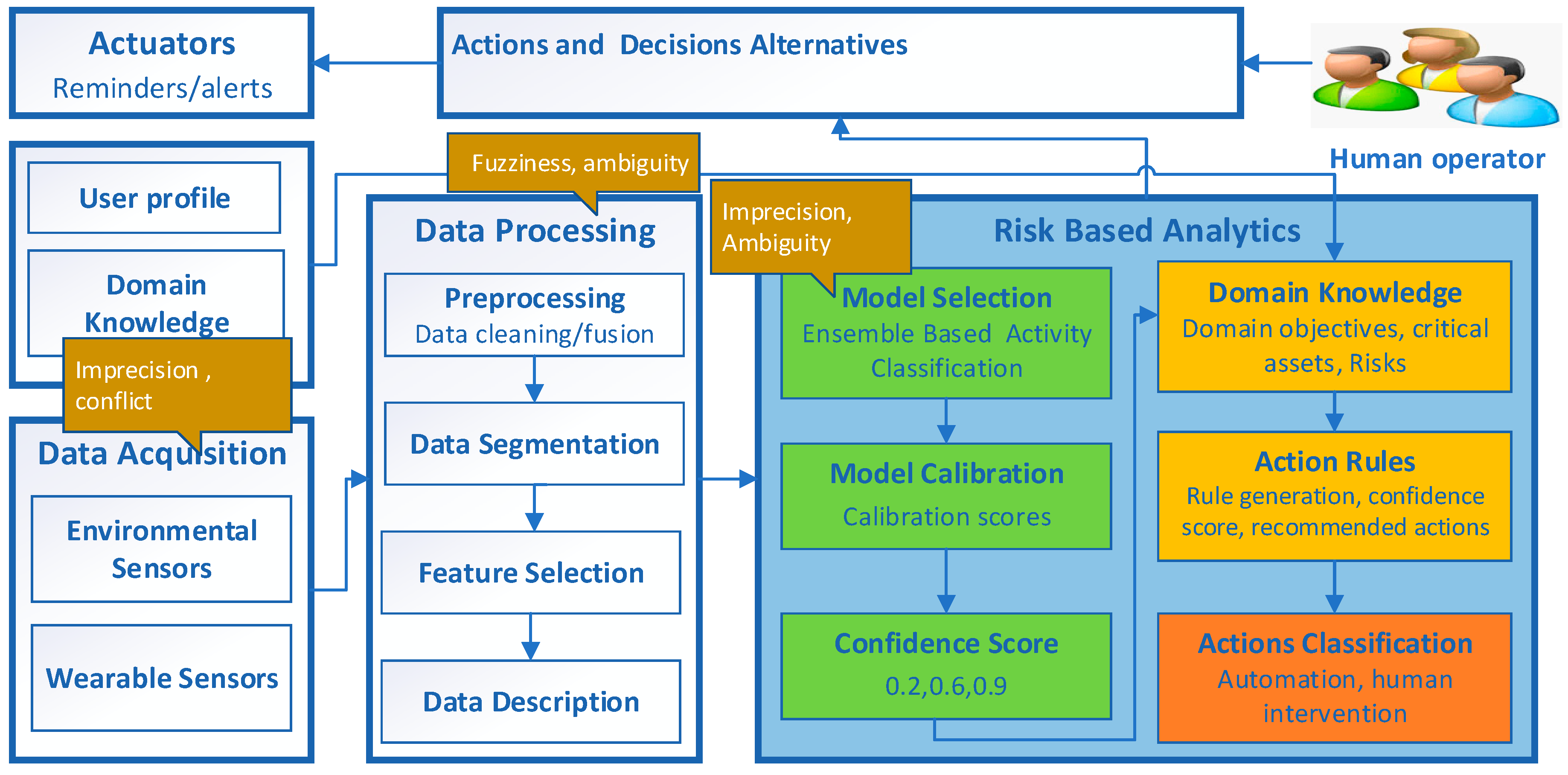
The Internet of Things (IoT) is a key and growing technology for many critical real-life applications, where it can be used to improve decision making. The existence of several sources of uncertainty in the IoT infrastructure, however, can lead decision makers into taking inappropriate actions. The present work focuses on proposing a risk-based IoT decision-making framework in order to effectively manage uncertainties in addition to integrating domain knowledge in the decision-making process. A structured literature review of the risks and sources of uncertainty in IoT decision-making systems is the basis for the development of the framework and Human Activity Recognition (HAR) case studies. More specifically, as one of the main targeted challenges, the potential sources of uncertainties in an IoT framework, at different levels of abstraction, are firstly reviewed and then summarized. The modules included in the framework are detailed, with the main focus given to a novel risk-based analytics module, where an ensemble-based data analytic approach, called Calibrated Random Forest (CRF), is proposed to extract useful information while quantifying and managing the uncertainty associated with predictions, by using confidence scores. Its output is subsequently integrated with domain knowledge-based action rules to perform decision making in a cost-sensitive and rational manner. The proposed CRF method is firstly evaluated and demonstrated on a HAR scenario in a Smart Home environment in case study I and is further evaluated and illustrated with a remote health monitoring scenario for a diabetes use case in case study II. The experimental results indicate that using the framework’s raw sensor data can be converted into meaningful actions despite several sources of uncertainty. The comparison of the proposed framework to existing approaches highlights the key metrics that make decision making more rational and transparent.
Keywords: IoT framework; machine learning; uncertainty; domain knowledge; human activity recognition IoT framework; machine learning; uncertainty; domain knowledge; human activity recognition