1. Introduction
In modern chemical processes, fault detection and identification have become important tasks to ensure process safety, product quality, and environmental sustainability [
1,
2,
3]. The effective detection and identification of abnormal operations are also crucial concerns for engineers and operators [
1,
4,
5,
6]. Many fault detection and identification methods have been proposed and detailed in several studies [
2,
3,
4,
5,
6,
7,
8]. Moreover, due to the development of sensors, computer applications, and distributed control technology, extensive chemical process data can be collected and stored [
9,
10], so data-driven methods reveal many advantages [
11,
12]. Compared with the methods based on knowledge and analytical models, data-driven methods that are implemented only by analyzing and mining useful information for fault detection and diagnosis do not require precise mathematical modeling and process knowledge [
13,
14,
15]. For example, principal component analysis (PCA) can extract the principal components (PCs) that effectively represent almost all information in the training data set, and the statistics Hotelling’s
and squared prediction error (SPE) are constructed for fault detection [
16]. Recently, some experts and scholars proposed some variations of data-driven methods to obtain better detection performances [
17,
18,
19,
20,
21,
22,
23]. Fault detection methods based on k-Nearest Neighbor (k-NN) theory have been developed to successfully monitor continuous and batch processes [
20,
24]. However, due to the large amount of calculation involved in these methods and the need to store many intermediate values, the k-NN method has higher requirements for calculation speed and computer storage space. In order to solve these problems, He et al. proposed a PC-k-NN method, which uses the principal component of the original sample as a modeling sample to reduce the computational effort and save storage space [
25]. However, the method ignores anomalous information that occurs in the residual space. Subsequently, Li et al. proposed a batch process fault detection method that was based on Feature Space k-Nearest Neighbor (FS-k-NN), which combines the principal part and the residual part of the feature space, and it achieved satisfactory results [
26].
As is well known, fault detection is very important for ensuring the safety of chemical processes. Although the fault detection method based on k-NN theory has achieved satisfactory results, there are few studies on fault diagnosis and abnormal variable identification. Once abnormality has been detected, it is necessary to extract effective fault information, study the relationship between various faults and abnormal variables, establish an accurate “fault–symptom” table, and, finally, search for the fault roots from a set of possible faulty variables. So, fault identification is the next significant task. In the framework of statistical theory, a contribution plot is commonly used to identify anomalous variables. Such plots can be divided into an SPE contribution plot and
contribution plot [
27]. These methods can be used to visualize the contribution value of each variable in the form of a histogram, so the variables that contribute the most to the statistical indicators are considered to be the responsible variables that may cause a process failure. However, the methods do not determine the control threshold of the contribution variables: that is, the contribution of each variable only plays a guiding role, and the ultimate cause of a fault needs further analysis and determination. In other words, they can only sort the variables according to their contributions and then roughly locate the abnormal variables, but the current methods cannot identify all abnormal variables in the process [
28]. Kourti and MacGregor used this method to find faulty quality-related variables and process variables of a high-pressure low-density polyethylene reactor, and they also suggested that contribution plots may not always reveal assignable causes of abnormal events [
29]. In addition, a reconstruction-based approach was proposed for isolating faulty variables from the subspace of faults [
30], Carlos and Qin also proposed a reconstruction-based contribution for process monitoring and fault diagnosis [
31]. These methods have been applied to reconstruct the data of faulty variables before performing a prediction for a soft sensor model. A combined index of SPE and
was developed to isolate faulty variables [
32], and it achieved more feasible solutions than the reconstruction-based approach. This is because the reconstruction-based contribution (RBC) approach does not suffer from the smearing effect that afflicts the contribution plots of PCA. In fact, the confidence intervals of RBC plots and the control limits were derived on the basis of normal operating data, and the magnitude of the smearing of faulty variables compared with the non-faulty ones was under the corresponding control limits, so the smearing effect of RBC can be observed [
33]. Thus, fault identification for chemical processes on the basis of k-NN variable contribution and CNN data reconstruction methods has certain challenges, and it also has certain academic research value and practical significance.
This paper proposes a novel fault identification method based on k-NN variable contribution and CNN data reconstruction methods for chemical processes. First, the k-NN strategy is applied to normal process modeling and fault detection to check whether there are abnormalities in a real-time process. Second, when there is an abnormality detected in a real-time sample, a variable contribution plot method based on k-NN is proposed; it is similar to the classical contribution plot used for calculating the contribution index of each variable, and the feasibility of this method is verified by contribution decomposition theory, which includes a feasibility analysis of a single abnormal variable and multiple abnormal variables. Third, the variables that have larger contribution indices can be reconstructed using the CNN reconstruction method. Fourth, for the new sample (after reconstruction), the first step is revisited to check whether there are abnormalities. Finally, all faulty variables are determined. The method proposed in this paper has the following advantages: (1) the k-NN method can deal with non-Gaussian and nonlinear characteristics of modeling data effectively from the aspect of fault detection. (2) The CNN method can ensure accuracy of data reconstruction. Furthermore, this method can also ensure the effectiveness of fault identification.
The rest of this paper is organized as follows: we start by recalling the main idea of the k-nearest neighbor method and k-NN fault detection framework in
Section 2. The proposed fault detection and identification methods are described in
Section 3, including the k-NN contribution method and the feasibility of this method. The data reconstruction strategy and faulty variable identification using the CNN method are proposed and described in
Section 4. In
Section 5, a numerical example and the Continuous Stirred Tank Reactor system are introduced to illustrate the effectiveness of the proposed method from the aspect of fault detection and identification. The concluding remarks and plans for future work are provided in
Section 6.
2. Preliminaries
2.1. The Rule of k-Nearest Neighbor
Recently, k-NN theory has been used for data classification, process monitoring, fault detection, image processing, and other fields as a nonparametric supervised classification method, and it has unique advantages in these applications [
25,
26]. For data classification, similar attributes among samples are divided in the learning sample using the k-NN method. The unknown class or label of an observation can then be predicted. The basic idea of the k-NN method is that if an observation point is close enough to a class with almost all the same samples, it should have the same attributes as this type of data; otherwise, it is different from these samples. Details of the k-NN method are as follows.
Consider a training data set , where n is the number of samples, and m is the number of variables. The ith sample is , is the mth variable in each sample, and all of the sample points belong to the same class and have the same properties. There are several important concepts that must be explained to describe the k-NN classification method better:
(1) k represents the number of selected neighbor samples, so it is a positive integer fixed by the experimenter;
(2) is the kth nearest neighbor of .
Assuming there is a new sample
, the statistical index
can be calculated according to Equation (
1).
belongs to the same class as
X when the cumulative distance index
is small enough. Conversely,
is different from other samples in
X.
2.2. Fault Detection Method Using k-NN Theory
Because the k-NN rule has certain advantages in the field of data classification, it has been widely applied for pattern classification and fault detection. A fault detection method based on the k-nearest neighbors (FD-k-NN) rule [
24] and its extension were researched to answer some specific questions, such as the analysis of non-Gaussian, nonlinear data and the computation of complex calculations. When the data reveal non-Gaussian statistics, the monitoring results based on the PCA method may lead to false alarms and produce undesired results. Unlike PCA, FD-k-NN constructs the threshold using the kernel density estimation (KDE) method [
34], so the k-NN method can effectively deal with non-Gaussian data. In addition, it makes no assumption of the linearity of the data set because the k-NN rule is a nonlinear classifier.
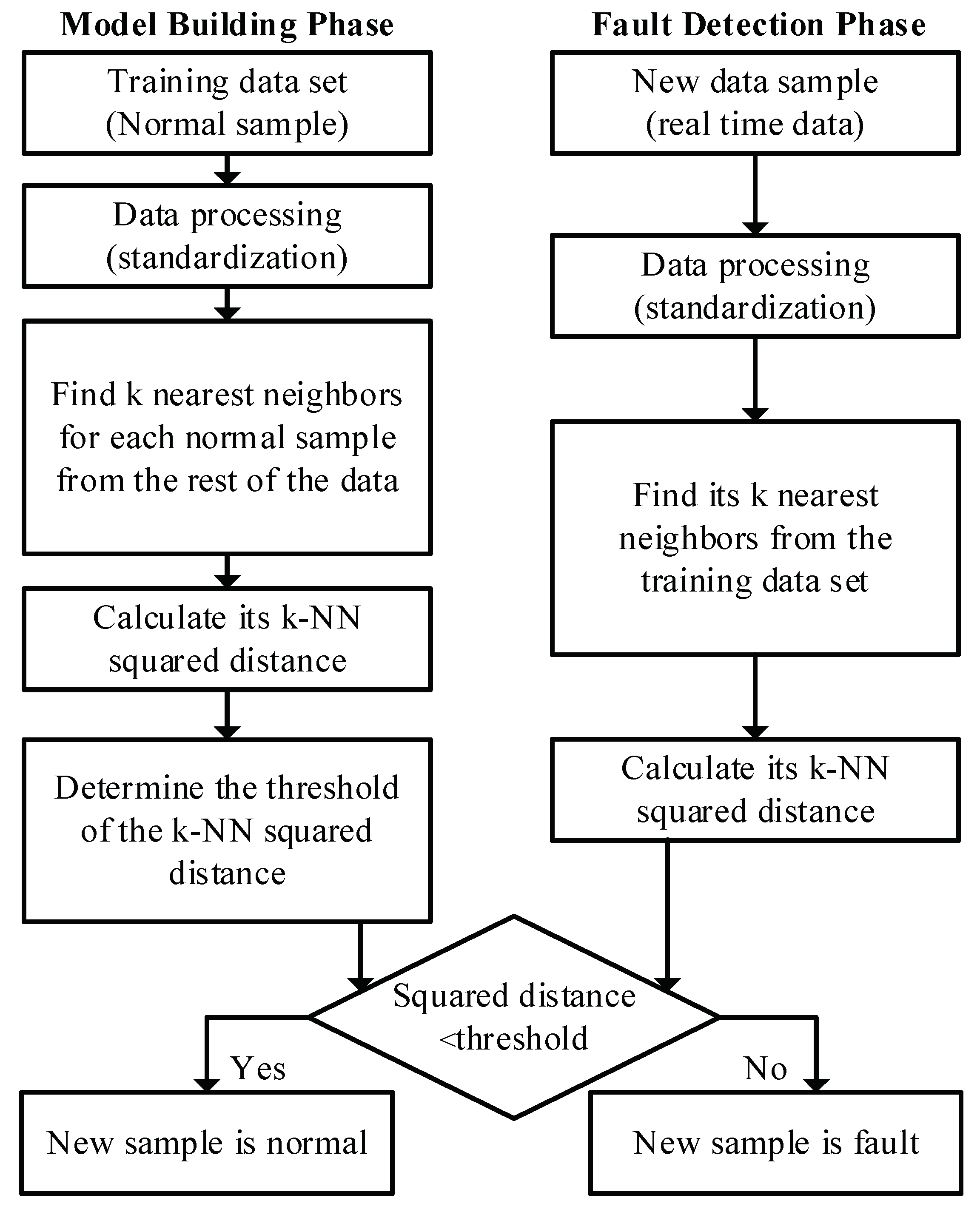
From the perspective of fault detection, there is only one class of data (normal operating data) available as training data, as the basic idea of FD-k-NN is that the trajectory of a new normal sample is similar to the training samples; on the other hand, the trajectory of a new faulty sample must show some deviation from normal training samples. In other words, relative to a given threshold, the distance between a faulty sample and the nearest neighboring training samples must be greater, and the distance between a normal sample and the nearest neighboring training samples must be smaller. However, the training samples only contain normal samples, and there are no faulty samples under normal operating conditions. Therefore, if we can determine the distribution of the distances between a training sample and its nearest neighboring training samples, a threshold distance for a given confidence level will be defined. When the new samples’ distance to its nearest neighboring training samples is below the threshold, it is considered normal. Otherwise, it is a fault. The FD-k-NN method is described in detail below, which consists of two parts: model building and fault detection phases, as shown in
Figure 1.
Model building phase:
(1) Collect and standardize the training data: the z-score data standardization method is used to scale each variable to the same level—i.e., for a given variable, the value of each sample in the training data minus the mean and divided by the standard deviation of the variable.
(2) For each standardized sample, find its k nearest neighbors in the training data set using the Euclidean distance as the indicator. For example, the ith neighbor of called .
(3) Calculate the k-NN squared distance for each sample:
is the sum of squared distances of sample
to its k-nearest neighbors, as calculated according to Equation (
2),
(4) Determine the 95% or 99% confidence limit
using the KDE method [
34].
Fault detection phase:
(1) For a new unknown sample , standardize it using the mean and variance of the training data and find its k nearest neighbors in the training data set;
(2) Calculate its k-NN squared distance ;
(3) Compare with the threshold . If , it is a normal sample. Otherwise, it is detected as a fault.
3. The k-NN Variable Contribution Theory
The k-NN contribution analysis method is similar to the traditional contribution plot, and it can give the contribution value of all variables to a control index. When there is a fault, the k-NN distance contribution values of each variable can be calculated and compared. According to the k-NN modeling process, the k-NN squared distance
can be transformed into Equation (
3):
where
is a row vector, its
lth element is 1, and the remaining elements are 0.
Here, the contribution value of the
lth variable in the sample
to the distance statistic index
can be defined as Equation (
4),
According to Equations (3) and (4), the relationship between the k-NN statistical index and the distance contribution value of each variable is as follows:
According to the above analysis, the contribution value of the lth variable of sample to the distance statistical index is actually equal to the lth component of the square distance between the sample and its kth nearest neighbor. That is to say, the influence of the variable itself is only considered in this method, and the relationship between variables is not considered, which can effectively avoid smearing or diffusion effects between variables. However, when the process is faulty, the contribution of abnormal variables to statistical indicators is greater than that of other variables. This needs to be further explained. The feasibility of the k-NN variable contribution method is analyzed for two cases: a single abnormal variable and multiple abnormal variables.
3.1. The Feasibility Analysis of Single Abnormal Variable
Assume that
is a faulty sample, and the
rth variable deviates from the normal operating range.
can be broken down into the following forms
where
is the normal component of
, and
is the faulty component.
is the direction of the fault, and
is the amplitude of the fault in the corresponding direction. According to Equations (4) and (6), the contribution value of each variable can be obtained by Equation (
7):
where
is the
jth nearest neighbor of
in the training data set, and
is the normal component of
, so the following relations exist:
. The contribution value of each variable can be transformed into Equation (
8):
where
is the contribution value of the
lth variable of sample
to the distance statistical index, and
and
should satisfy Equation (
9):
From the above, when
r is not equal to
l,
, the greatest contribution of abnormal variables is
The following conclusion can be drawn according to the above analysis: The k-NN distance contribution analysis method can ensure that an abnormal variable has the greatest contribution value when only a single variable is abnormal.
3.2. The Feasibility Analysis of Multiple Abnormal Variables
Assume that
is a faulty sample and that several variables deviate from the normal operating range: variable
a, variable
b, and variable
c.
can be broken down into the following forms:
where
is the normal component of
,
,
, and
are the faulty components.
and
f are the directions and amplitudes of the fault. According to Equations (4) and (11), the contribution value of each variable can be obtained as Equation (
12):
The following relations exist:
. The contribution value of each variable can be transformed into Equation (
13):
Similar to a single abnormal variable, when
,
,
and
can be represented as Equation (
14):
The following conclusion can be drawn according to the above analysis: The k-NN distance contribution analysis method can ensure abnormal variables have the greater contribution value when there are several abnormal variables.
4. Data Reconstruction and Faulty Variable Identification Strategy
In order to solve the multi-sensor fault problem, the k-NN and proposed CNN data reconstruction strategy are described in detail below, and the comparison and analysis of two methods are given in
Section 4.3.
4.1. The k-NN Data Reconstruction Method
In this subsection, the data reconstruction method based on k-NN is given [
35]. When there is a fault in a new sample, we can use the data reconstruction method as follows.
Step 1: Standardize the new sample using the mean and variance of the training data. The result is , and , is the label of the variable.
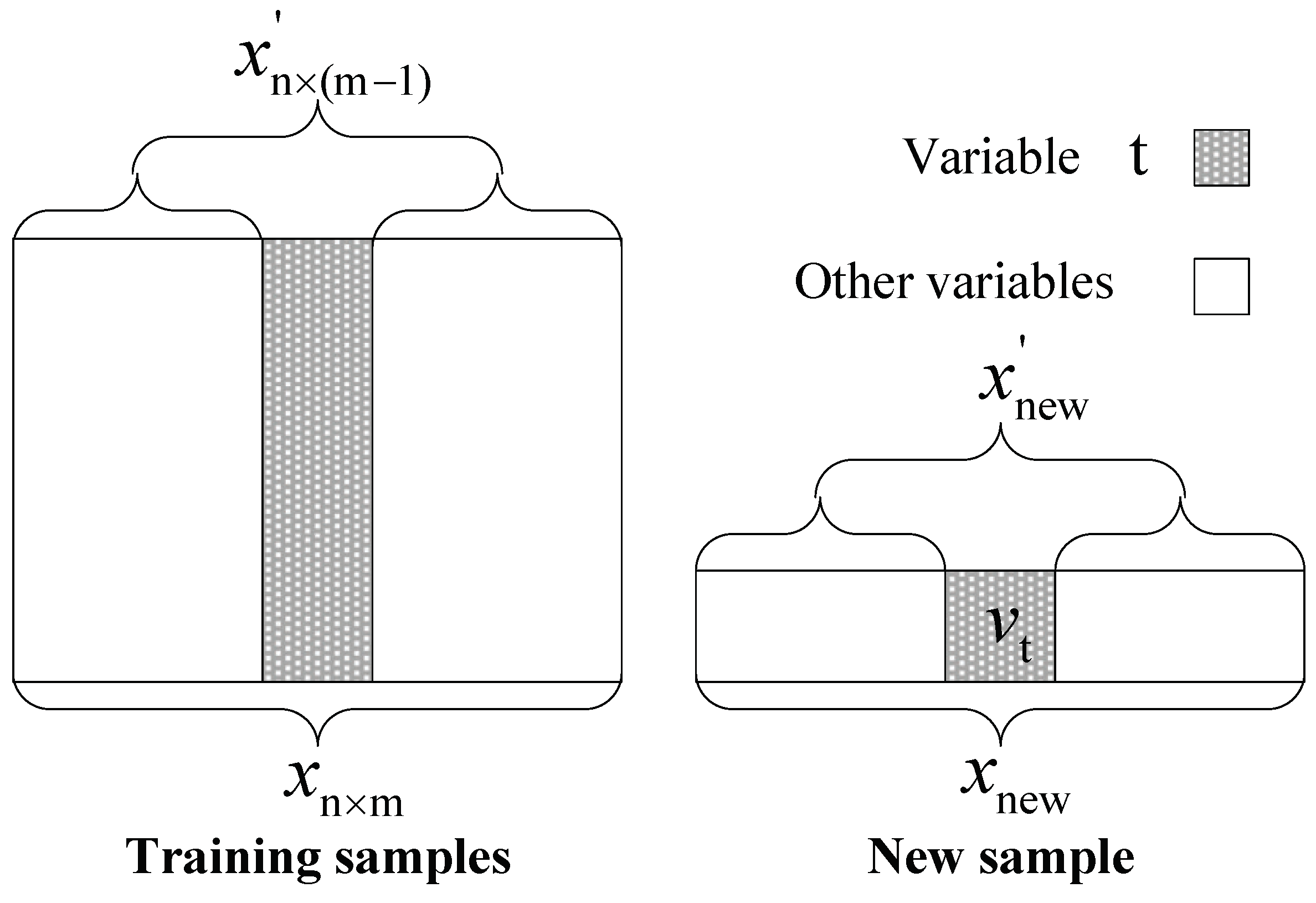
Step 2: Reconstruct each variable
according to Equation (
15) and
Figure 2, where
is the
ith nearest neighbor of
in training sample
, and
is the
tth variable of
. The parameter
k is a constant value of experience.
4.2. The CNN Data Reconstruction Method
In this section, the CNN data reconstruction strategy is proposed. When there is a fault in the new sample, we can use the CNN data reconstruction method as follows:
Step 1: Standardize the new sample using the mean and variance of the training data, the result is , and , is the label of the variable.
Step 2: Determine the
k value, which should satisfy Equation (
16) according to
Figure 2:
Step 3: Reconstruct the
tth variable of
according to Equation (
15) when the
k value is determined.
4.3. Comparison and Analysis of Two Methods
As an important parameter, the choice of
k is an open question, and it is usually critical in the k-NN data reconstruction method. Smaller values of
k cannot reflect the global data features accurately; larger values of
k reduce the effect of noise but make boundaries between close and long-range samples less distinct. So, a practical approach is to try several different values of
k using historical data and choose the one that gives the best cross-validation result. In the k-NN reconstruction method, the influence of different
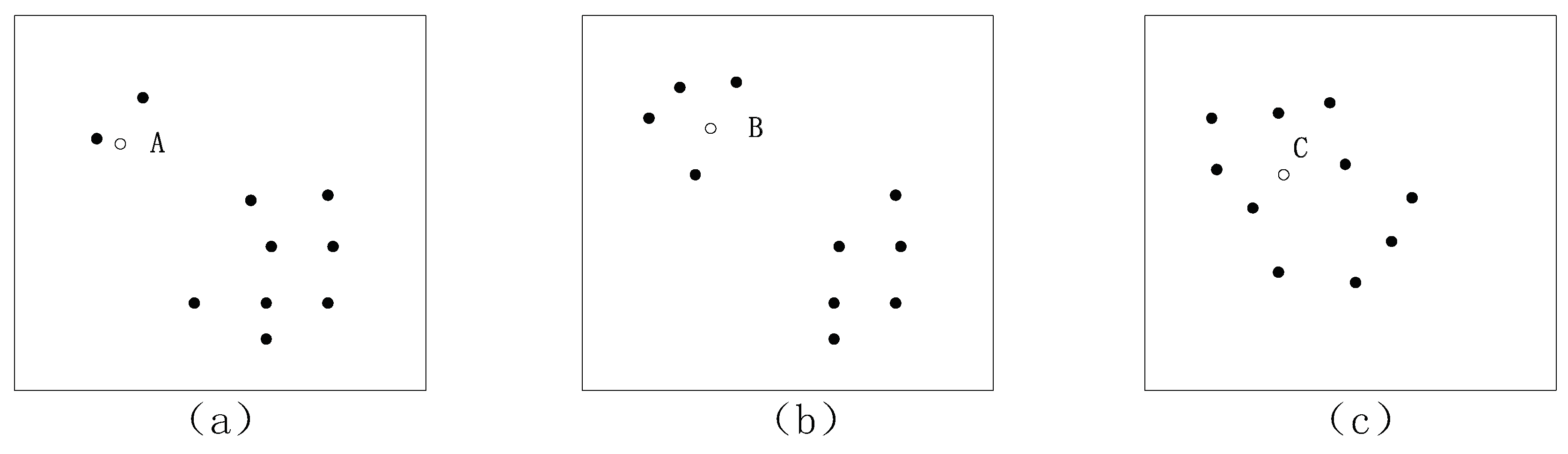
k values on the reconstruction accuracy can vary in magnitude. In other words, it can determine the accuracy of the fault diagnosis. In order to better introduce the reconstruction methods, three scatterplots are given in
Figure 3, where A, B, and C are samples which need to be reconstructed.
Through the summary and comparison using the above methods in
Section 4.1 and
Section 4.2, we can appreciate that different
k values are suitable for different situations. With the data distribution shown in
Figure 3a, if data point A needs to be reconstructed,
can be applied, and the reconstruction result is accurate because there are a few neighboring samples for sample A on the basis of experience. The result is more suitable for data point B in
Figure 3b when
, and a reasonable
k can be determined according to Equation (
16). The CNN method has reasonable computing processes for parameter
k; it avoids the imprecise selection of parameter
k, so this method can be used as a common approach. So, in
Figure 3a, the reconstruction accuracy is satisfactory when
;
is suitable for
Figure 3b; for
Figure 3c,
k is an open question that needs to be further assessed according to Equation (
16).
4.4. Faulty Variable Identification Method
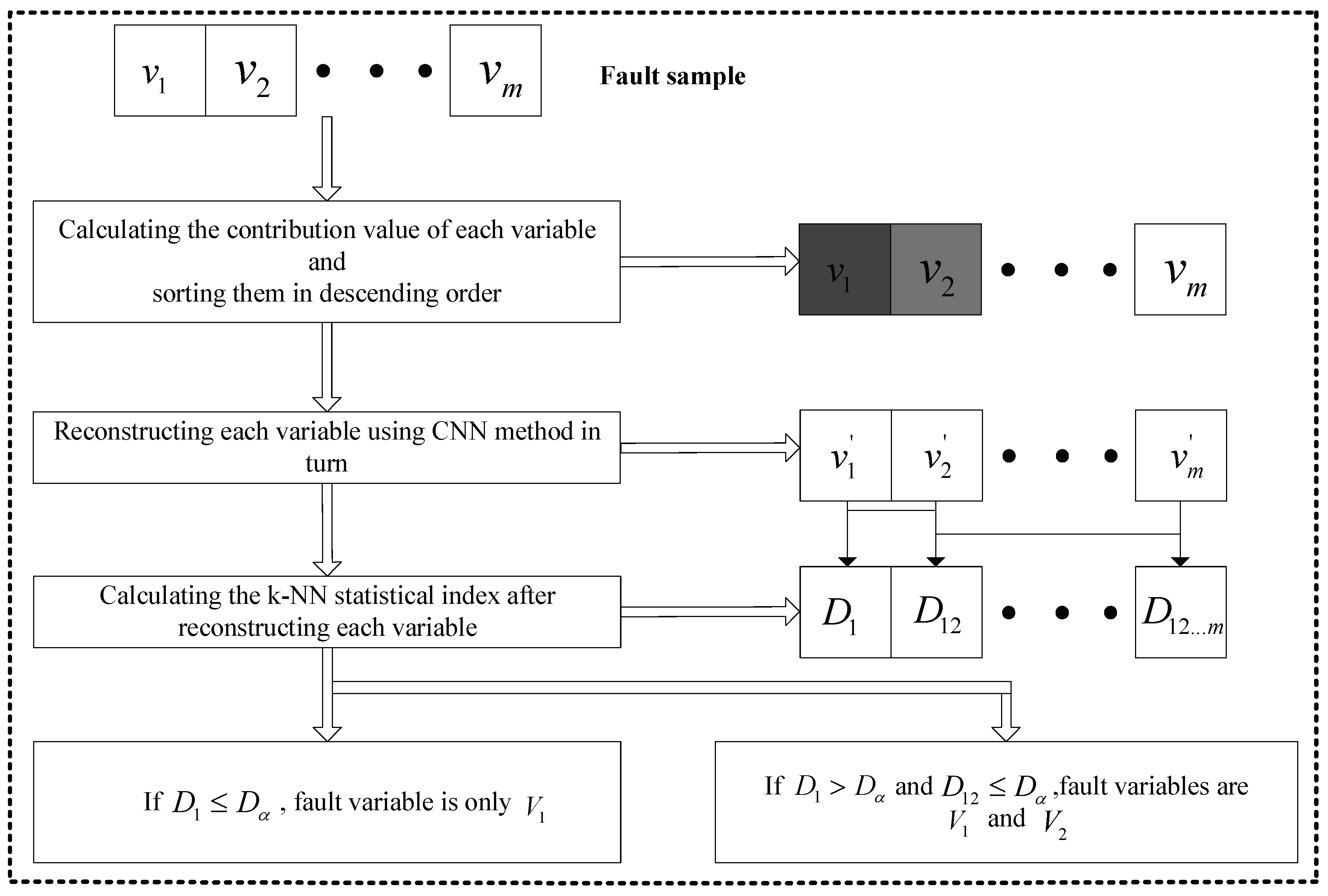
When the fault has been detected, the next goal is to identify the faulty variables: the k-NN variable contribution method is used in this paper. This method can be used as a guide to reconstruct the variables.
Suppose that there is a sample which contains a fault. The steps of faulty variable identification on the basis of reconstruction are as follows:
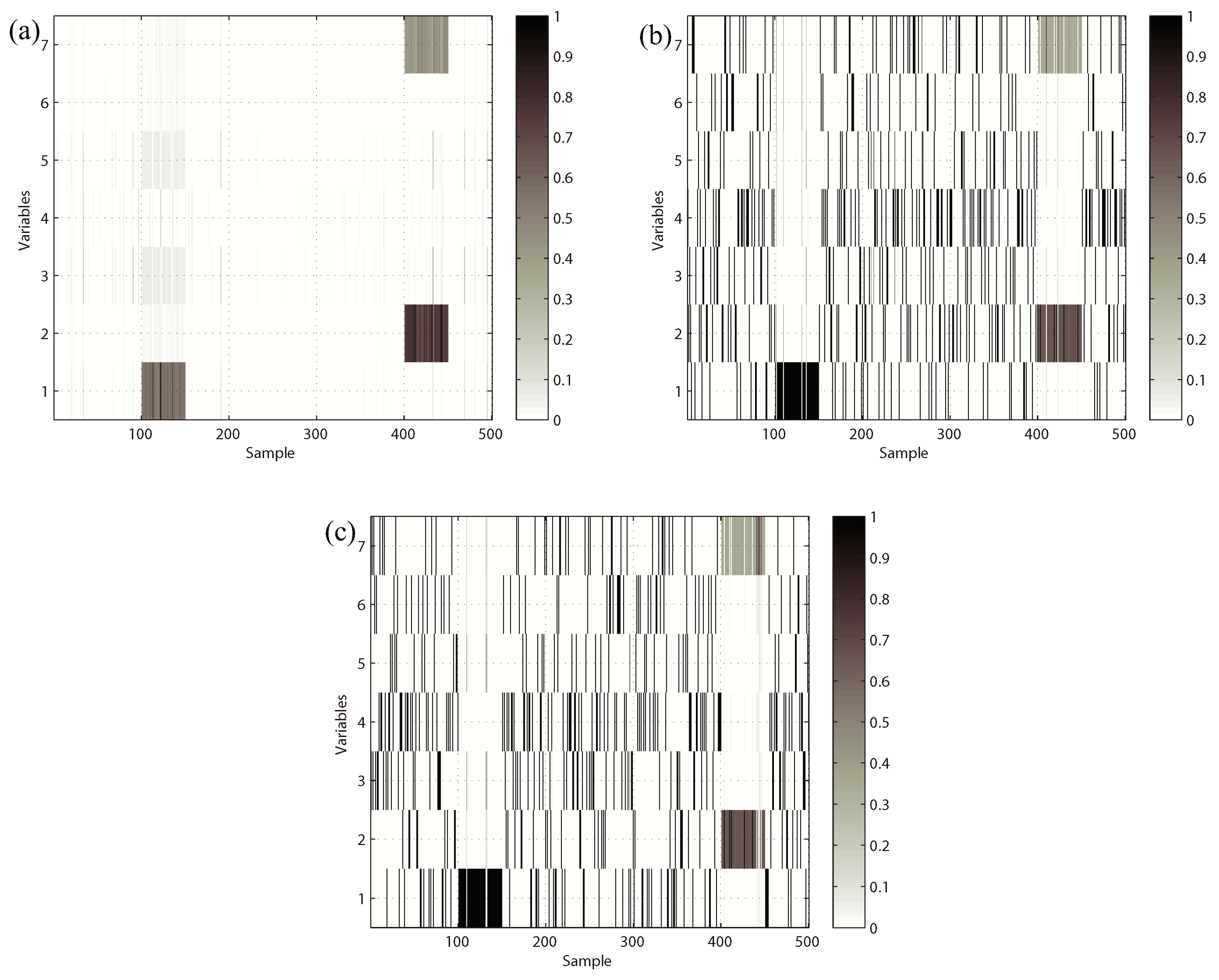
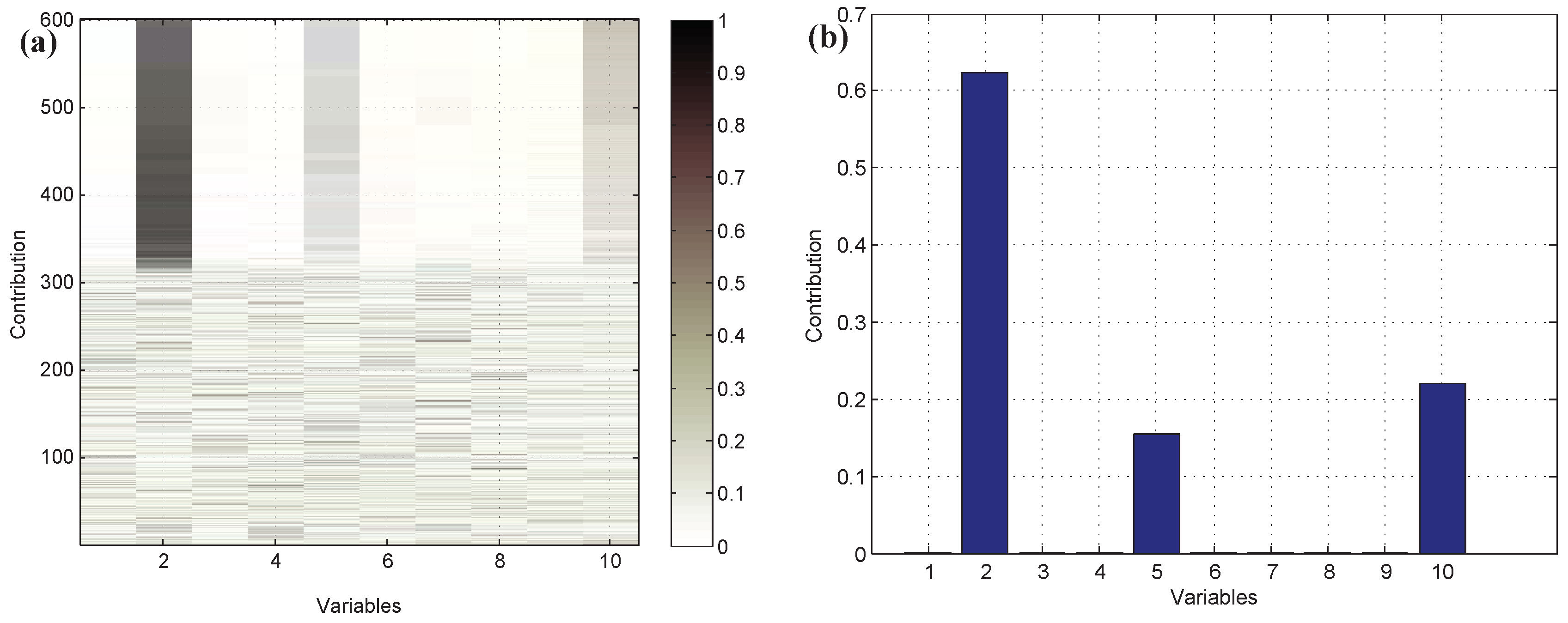
Step 1: Calculate the contribution values of each variable and sort them in descending order. The deeper the color, the bigger the contribution value in
Figure 4;
Step 2: Reconstruct each variable using the CNN method in turn;
Step 3: Calculate the k-NN statistical index after reconstructing each variable. represents the statistical index after reconstructing , is the statistical index after reconstructing and ;
Step 4: For example, if <, the faulty variable is only ; if > and <, the faulty variables are and .
6. Discussion and Conclusions
In this work, a novel fault identification method for chemical processes based on k-NN variable contribution and CNN data reconstruction methods was presented, and the results showed that it can reveal all faulty variables accurately. This method has a certain generalizability and can be applied to different chemical processes. This paper first reviewed the k-NN fault detection method for process monitoring. Then, a contribution plot method based on k-NN was proposed for calculating the contribution index of each variable. The feasibility of the k-NN variable contribution method was analyzed in two cases: a single abnormal variable and multiple abnormal variables. This method uses k-NN variable contribution theory to evaluate which variables are most likely to be abnormal. Finally, the fault variable identification method based on the CNN data reconstruction strategy was presented and applied to restructure the variables which have the larger contribution. When there are no abnormalities in the processes, the restructured variables are the faulty variables. The reliability and validity of the proposed method were verified by a numerical example and the Continuous Stirred Tank Reactor system. In
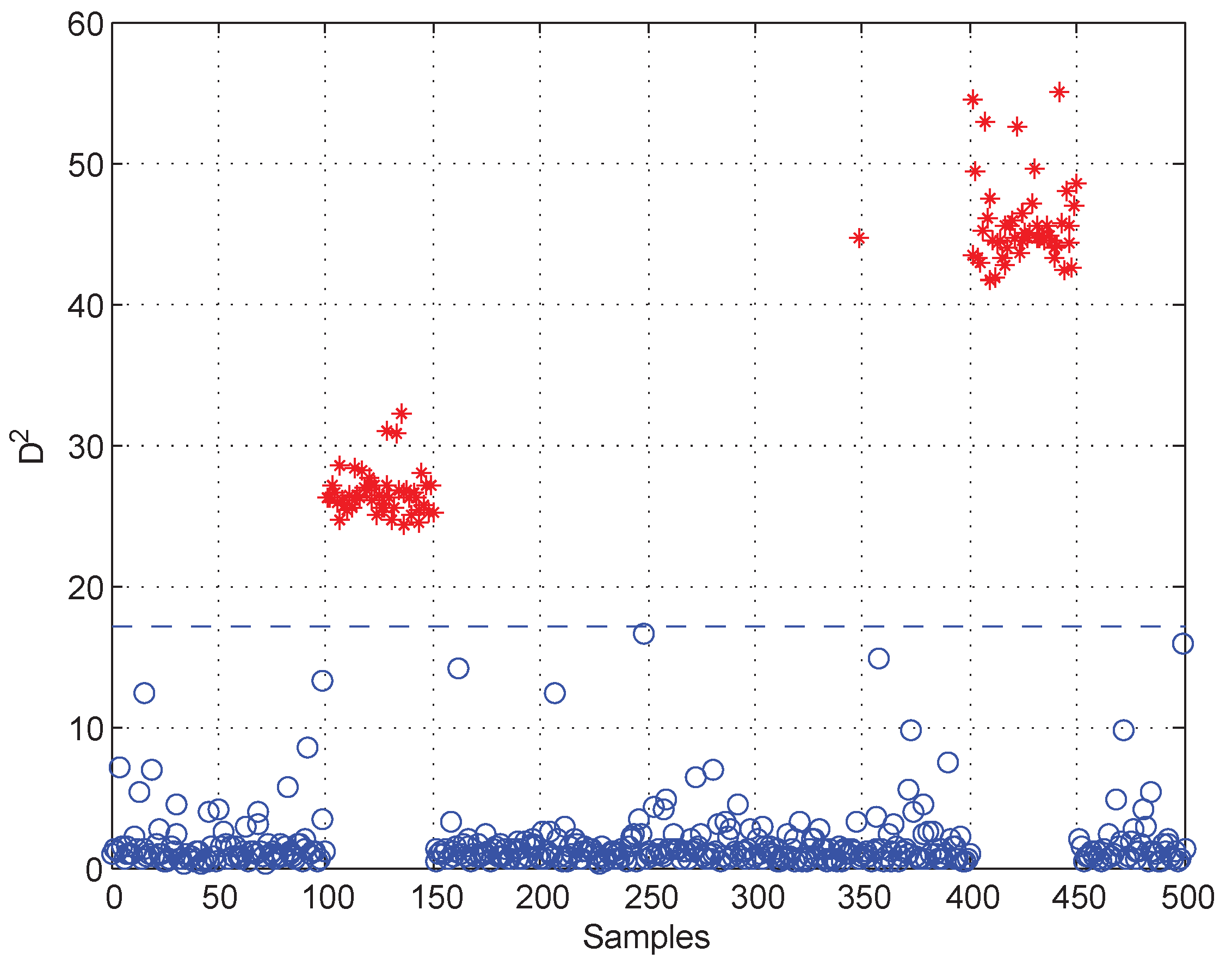
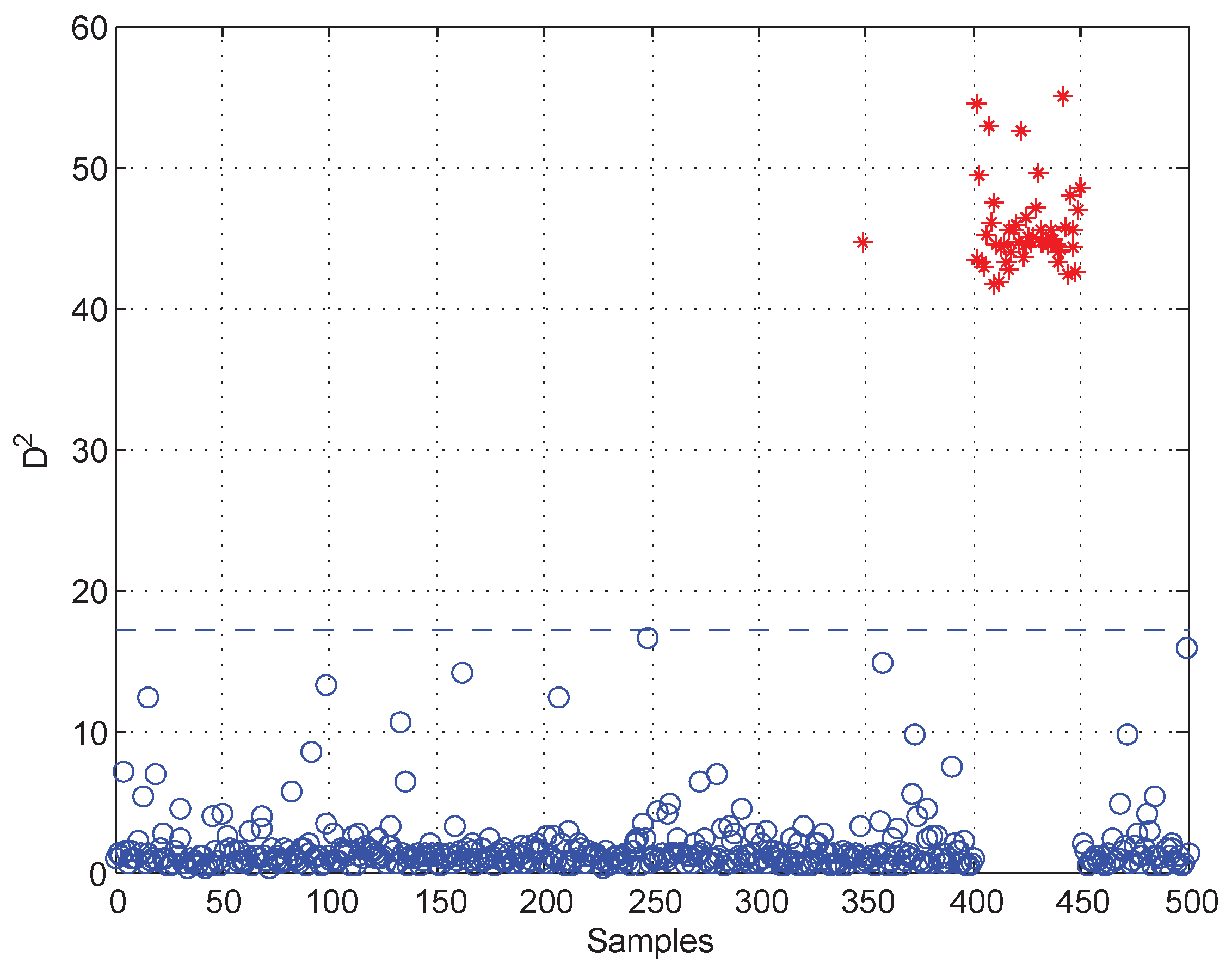
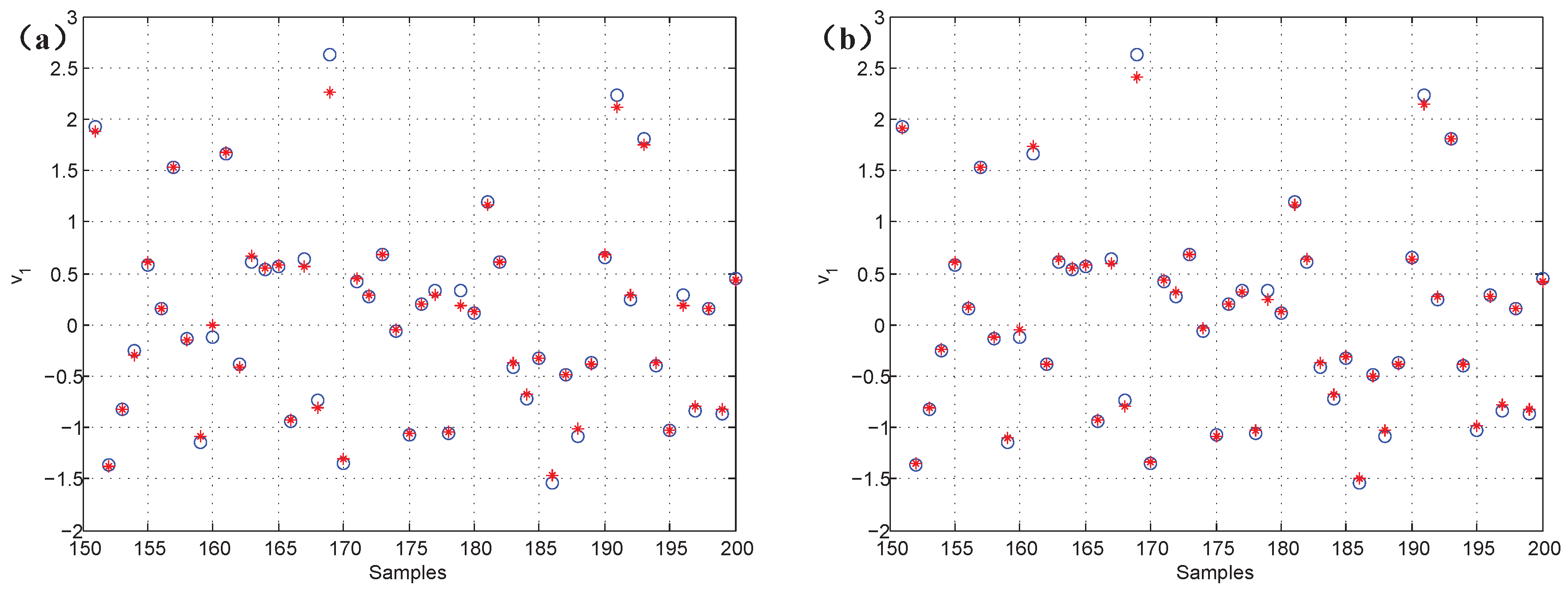
Section 5.1, the simulated numerical example mainly focused on validating the performances of the CNN data reconstruction strategy and multi-sensor faulty variable identification. The reconstruction results of the CNN and k-NN methods were also given and compared. The simulation results show the “fault–symptom” relationship for different periods of time. The result of recognition is consistent with the result of the failure setting. In addition, as a practical industrial example, the Continuous Stirred Tank Reactor system was used to verify the validity of the proposed algorithm in
Section 5.2.
The proposed method has the following advantages: (1) the k-NN method can deal with non-Gaussian and nonlinear characteristics of modeling data effectively for fault detection; (2) the CNN method is far superior for data reconstruction, and it can guarantee the accuracy of fault recognition. However, it is worth noting that the selection of parameter
k is still an open question in the k-NN method. More advanced parameter optimization methods may yield a more accurate result. So, we will consider the weight as a new idea and apply the weighted method to reconstruct variable data, which may have a better result than the method discussed in this work. In addition, this paper introduces the proposed method in detail and compares it with the traditional methods (PCA-SPE-based contribution plot and RBC-based contribution plot), the validity of the proposed algorithm is verified, but we will also consider analysing the experimental results using some superior statistical testing methods [
38,
39] for our future works.