The TRiC/CCT Complex at the Crossroads of Metabolism and Hypoxia in GBM: Implications for IDH-Dependent Therapeutic Targeting
 , ,
, ,  ,
,  ,
,  and
and
Abstract
1. Introduction
2. TCA Cycle as a Target Therapy for Glioblastoma
3. The CCT Complex in Tumors
4. The CCT Complex in GBM
5. Role of the CCT Complex in the Metabolic Reprogramming of Healthy and GBM Cells
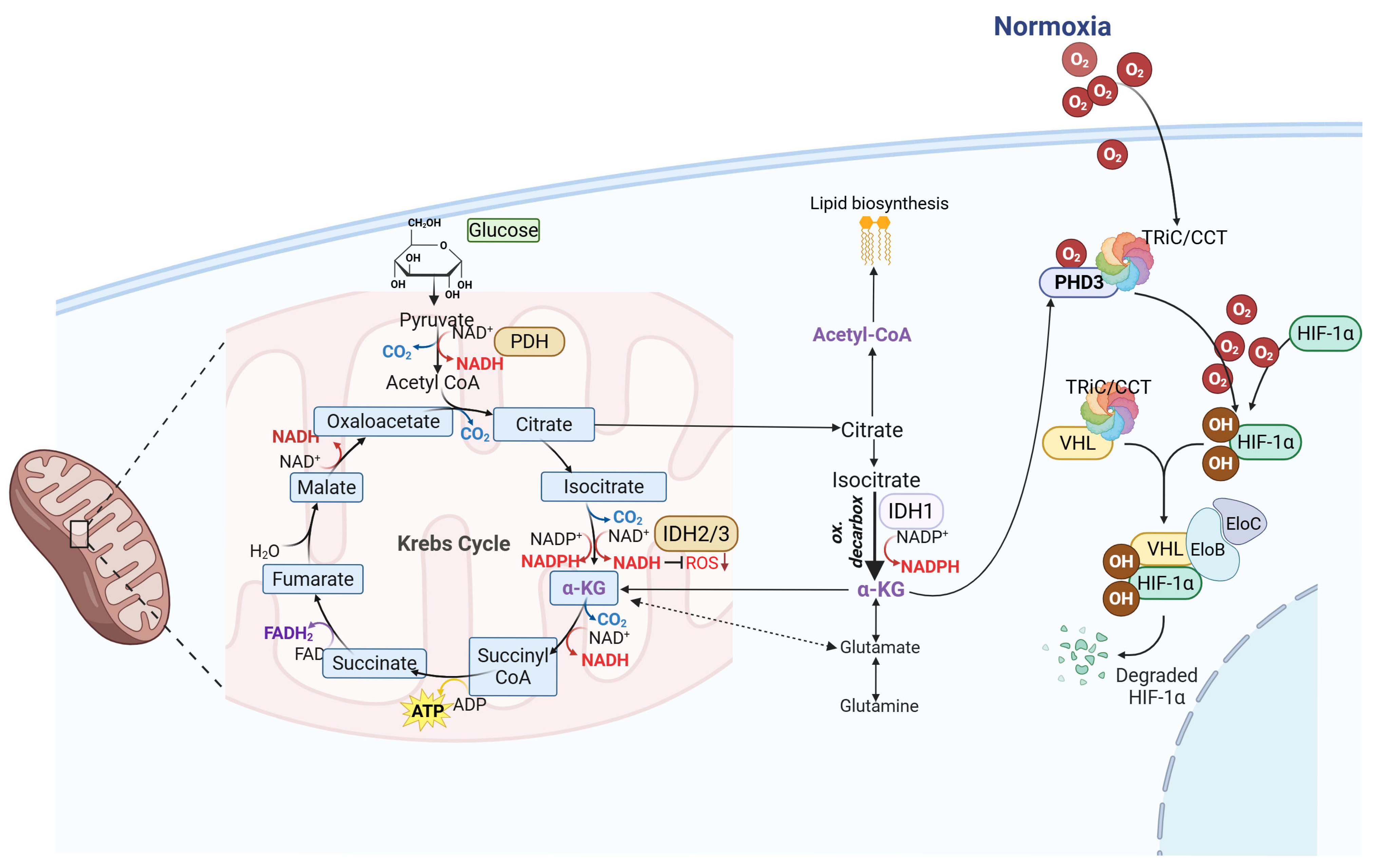
5.1. Metabolic Programming in Healthy Normoxic Conditions
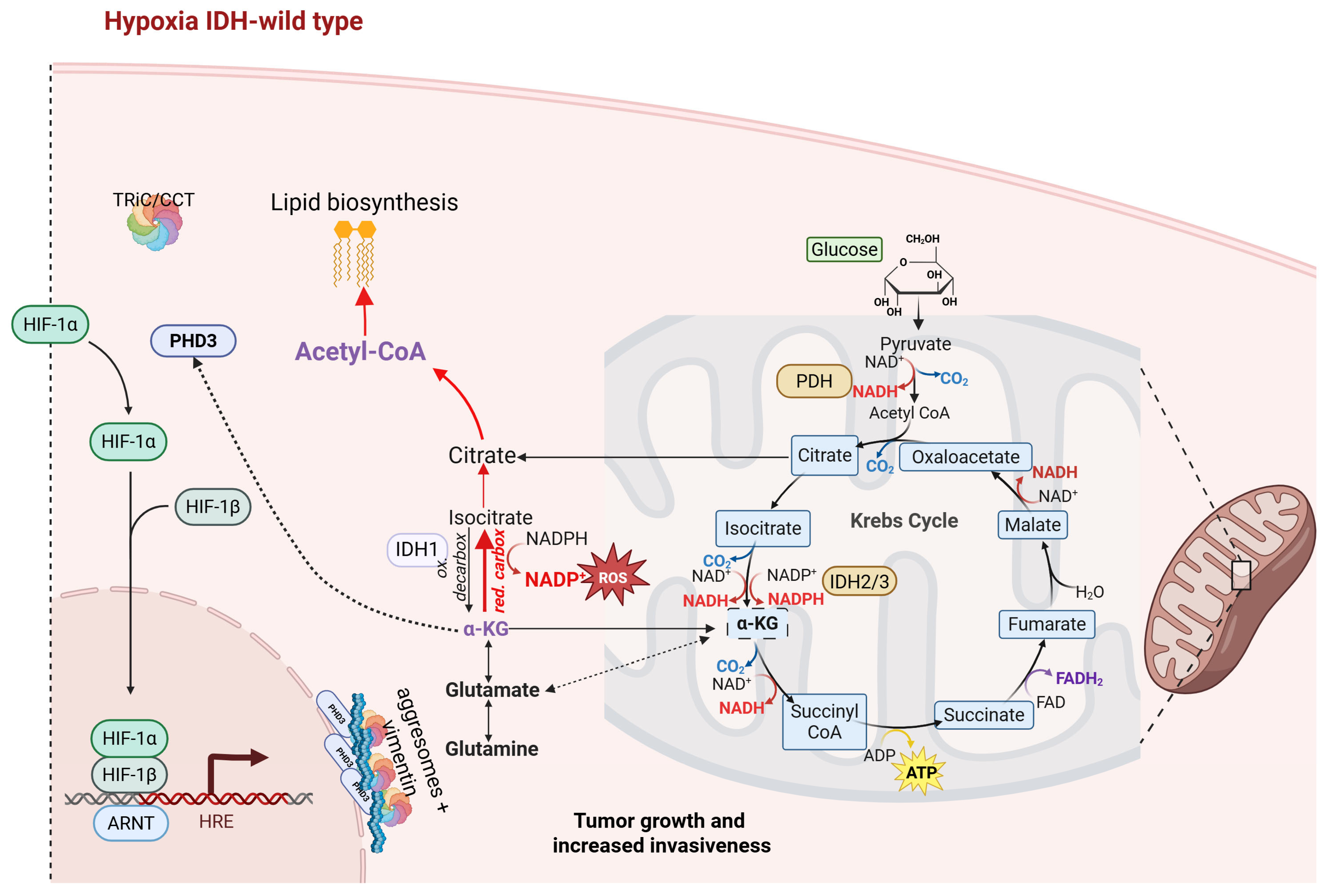
5.2. GBM: Metabolic Reprogramming in the Wild-Type IDH Condition
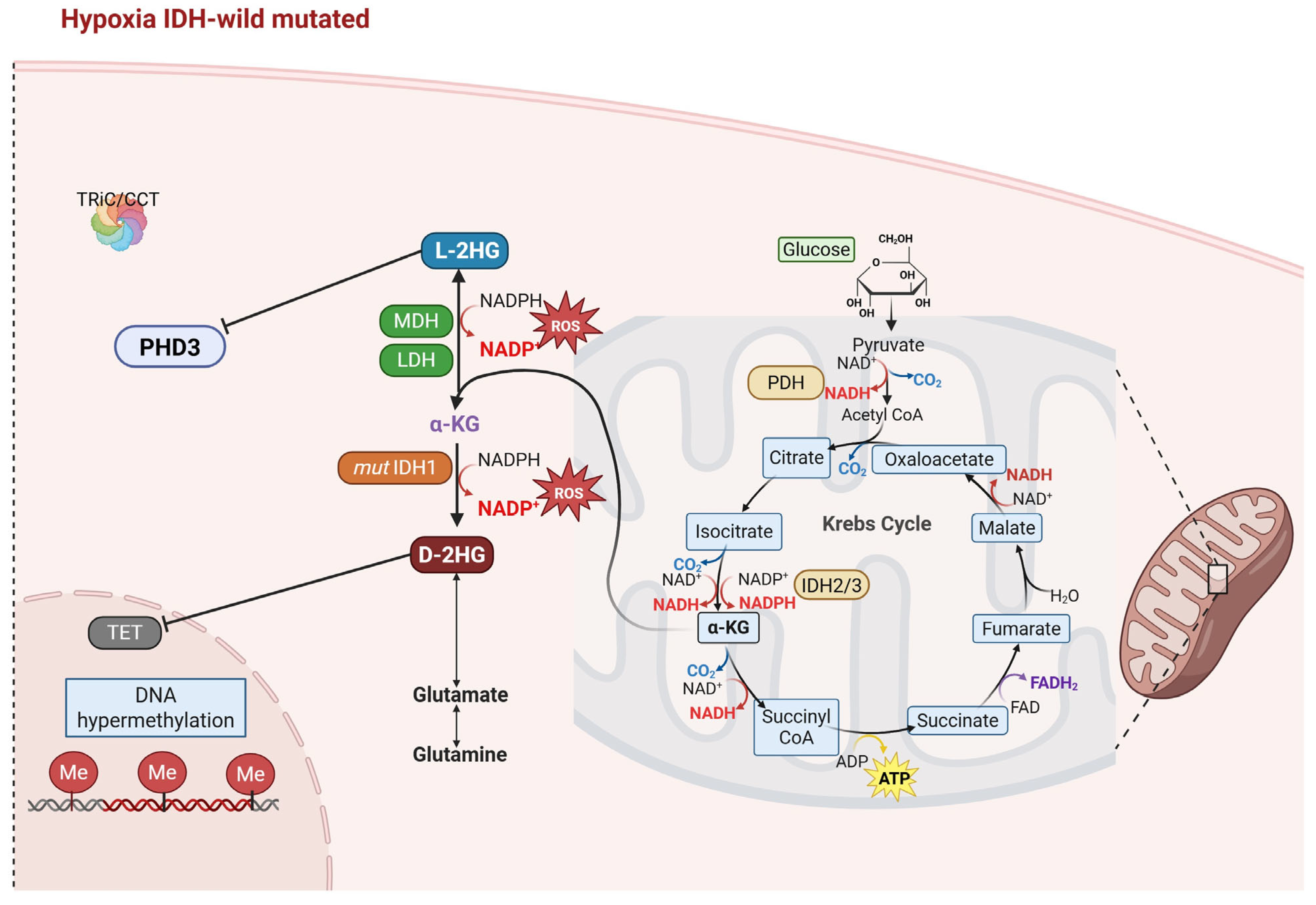
5.3. GBM: Metabolic Reprogramming in IDH Mutant Condition
6. Discussion
7. Future Directions: TRIC/CCT Therapeutic Implications in GBM
Author Contributions
Funding
Institutional Review Board Statement
Informed Consent Statement
Data Availability Statement
Acknowledgments
Conflicts of Interest
Abbreviations
| AA | arachidonic acid |
| ARNT | aryl hydrocarbon nuclear receptor translocator |
| 3-BP | 3-bromopyruvate |
| CCT | chaperonin containing TCP1 |
| CDKN2A | cyclin-dependent kinase inhibitor 2A |
| CoA | acetyl coenzyme A |
| cPLA2 | a cytosolic phospholipase A2 |
| CNS | Central Nervous System |
| CS | chaperone system |
| CUSA | cavitron ultrasonic surgical aspirator |
| 2-DG | 2-deoxy-D-glucose |
| DMF | dimethyl fumarate |
| DON | 6-Diazo-5-oxo-L-norleucine |
| D2-HG | (D)2-hydroxyglutarate |
| EGFR | epidermal growth factor receptor |
| EMT | epithelial–mesenchymal transition |
| Ep-GBM | epithelial-like GBM |
| EPIC | epicocconone |
| EVs | extracellular vesicles |
| 2-FC | 2-fluorocitrate |
| GBM | Glioblastoma |
| GLS | glutaminase |
| GSCs | glioma stem cells |
| HIF | hypoxia-inducible factor |
| HSPs | Heat shock proteins |
| ICT | isocitrate |
| IDH | isocitrate dehydrogenase |
| KPS | Karnofsky performance status |
| MCC | mitotic checkpoint system |
| mTOR | mammalian target of rapamycin |
| NADH | nicotinamide adenine dinucleotide |
| NF-κB | nuclear factor kappa-light-chain |
| NOS | not otherwise specified |
| 2-OG | 2-oxoglutarate |
| OXPHOS | oxidative phosphorylation |
| PDHA | pyruvate dehydrogenase alpha |
| PHD | prolyl hydroxylase domain |
| PI3K | phosphatidylinositol 3-kinase |
| pVHL | Von Hippel Lindau tumor suppressor protein |
| SDHA | succinate dehydrogenase A |
| ROS | Reactive Oxygen Species |
| TCA | tricarboxylic acid |
| TGF-β | Transforming Growth Factor Beta |
| TRiC | Tailless complex polypeptide 1 ring complex |
| TMZ | temozolomide |
| US FDA | United States Food and Drug Administration |
| VEGF | aascular endothelial growth factor |
| Wint | Wingless |
| WHO | World Health Organization |
| αKG | α-ketoglutarate |
| αKGD | α-KG-dependent dioxygenases |
References
- Nam, J.Y.; De Groot, J.F. Treatment of Glioblastoma. J. Oncol. Pract. 2017, 13, 629–638. [Google Scholar] [CrossRef] [Scilit]
- Tan, A.C.; Ashley, D.M.; López, G.Y.; Malinzak, M.; Friedman, H.S.; Khasraw, M. Management of Glioblastoma: State of the Art and Future Directions. CA A Cancer J. Clin. 2020, 70, 299–312. [Google Scholar] [CrossRef] [Scilit]
- Davis, M. Glioblastoma: Overview of Disease and Treatment. Clin. J. Oncol. Nurs. 2016, 20, S2–S8. [Google Scholar] [CrossRef] [Scilit] [PubMed]
- Burko, P.; D’Amico, G.; Miltykh, I.; Scalia, F.; Conway De Macario, E.; Macario, A.J.L.; Giglia, G.; Cappello, F.; Caruso Bavisotto, C. Molecular Pathways Implicated in Radioresistance of Glioblastoma Multiforme: What Is the Role of Extracellular Vesicles? Int. J. Mol. Sci. 2023, 24, 4883. [Google Scholar] [CrossRef] [Scilit] [PubMed]
- Vaz-Salgado, M.A.; Villamayor, M.; Albarrán, V.; Alía, V.; Sotoca, P.; Chamorro, J.; Rosero, D.; Barrill, A.M.; Martín, M.; Fernandez, E.; et al. Recurrent Glioblastoma: A Review of the Treatment Options. Cancers 2023, 15, 4279. [Google Scholar] [CrossRef] [Scilit]
- Rong, L.; Li, N.; Zhang, Z. Emerging Therapies for Glioblastoma: Current State and Future Directions. J. Exp. Clin. Cancer Res. 2022, 41, 142. [Google Scholar] [CrossRef] [Scilit]
- Alberti, G.; Amico, M.D.; Caruso Bavisotto, C.; Rappa, F.; Marino Gammazza, A.; Bucchieri, F.; Cappello, F.; Scalia, F.; Szychlinska, M.A. Speeding up Glioblastoma Cancer Research: Highlighting the Zebrafish Xenograft Model. Int. J. Mol. Sci. 2024, 25, 5394. [Google Scholar] [CrossRef] [Scilit]
- Ocampo-Navia, M.I.; Marín Navas, F.; Agudelo-Arrieta, M.; Taub-Krivoy, A.; Feo Lee, O.H. Molecular Markers in Gliomas: A Practical Review and Algorithm Proposal. Interdiscip. Neurosurg. 2025, 41, 102062. [Google Scholar] [CrossRef] [Scilit]
- Virtuoso, A.; D’Amico, G.; Scalia, F.; De Luca, C.; Papa, M.; Maugeri, G.; D’Agata, V.; Caruso Bavisotto, C.; D’Amico, A.G. The Interplay between Glioblastoma Cells and Tumor Microenvironment: New Perspectives for Early Diagnosis and Targeted Cancer Therapy. Brain Sci. 2024, 14, 331. [Google Scholar] [CrossRef] [Scilit]
- Zhang, P.; Xia, Q.; Liu, L.; Li, S.; Dong, L. Current Opinion on Molecular Characterization for GBM Classification in Guiding Clinical Diagnosis, Prognosis, and Therapy. Front. Mol. Biosci. 2020, 7, 562798. [Google Scholar] [CrossRef] [Scilit]
- Louis, D.N.; Perry, A.; Reifenberger, G.; Von Deimling, A.; Figarella-Branger, D.; Cavenee, W.K.; Ohgaki, H.; Wiestler, O.D.; Kleihues, P.; Ellison, D.W. The 2016 World Health Organization Classification of Tumors of the Central Nervous System: A Summary. Acta Neuropathol. 2016, 131, 803–820. [Google Scholar] [CrossRef] [Scilit] [PubMed]
- Yang, P.; Cai, J.; Yan, W.; Zhang, W.; Wang, Y.; Chen, B.; Li, G.; Li, S.; Wu, C.; Yao, K.; et al. Classification Based on Mutations of TERT Promoter and IDH Characterizes Subtypes in Grade II/III Gliomas. Neuro Oncol. 2016, 18, 1099–1108. [Google Scholar] [CrossRef] [Scilit] [PubMed]
- Louis, D.N.; Perry, A.; Wesseling, P.; Brat, D.J.; Cree, I.A.; Figarella-Branger, D.; Hawkins, C.; Ng, H.K.; Pfister, S.M.; Reifenberger, G.; et al. The 2021 WHO Classification of Tumors of the Central Nervous System: A Summary. Neuro Oncol. 2021, 23, 1231–1251. [Google Scholar] [CrossRef] [Scilit] [PubMed]
- Macario, A.J.L.; De Macario, E.C. Chaperonopathies by Defect, Excess, or Mistake. Ann. N. Y. Acad. Sci. 2007, 1113, 178–191. [Google Scholar] [CrossRef] [Scilit]
- Macario, A.J.L.; De Macario, E.C. Sick Chaperones, Cellular Stress, and Disease. N. Engl. J. Med. 2005, 353, 1489–1501. [Google Scholar] [CrossRef] [Scilit]
- Augello, M.A.; Shadan, N.; D’Amico, G.; Barone, R.; Caruso Bavisotto, C.; Scalia, F.; Vitale, A.M. Beneficial Handling of Molecular Chaperones (Chaperonotherapy) in Glioblastoma and Neuroblastoma: Novel Therapeutic Targets or Potential Agents? Cells 2025, 14, 1447. [Google Scholar] [CrossRef] [Scilit]
- Scalia, F.; Vitale, A.M.; Santonocito, R.; Conway De Macario, E.; Macario, A.J.L.; Cappello, F. The Neurochaperonopathies: Anomalies of the Chaperone System with Pathogenic Effects in Neurodegenerative and Neuromuscular Disorders. Appl. Sci. 2021, 11, 898. [Google Scholar] [CrossRef] [Scilit]
- Scalia, F.; Marino Gammazza, A.; Conway De Macario, E.; Macario, A.J.L.; Cappello, F. Myelin Pathology: Involvement of Molecular Chaperones and the Promise of Chaperonotherapy. Brain Sci. 2019, 9, 297. [Google Scholar] [CrossRef] [Scilit]
- Roh, S.-H.; Kasembeli, M.; Bakthavatsalam, D.; Chiu, W.; Tweardy, D. Contribution of the Type II Chaperonin, TRiC/CCT, to Oncogenesis. Int. J. Mol. Sci. 2015, 16, 26706–26720. [Google Scholar] [CrossRef] [Scilit]
- Jin, M.; Liu, C.; Han, W.; Cong, Y. TRiC/CCT Chaperonin: Structure and Function. In Macromolecular Protein Complexes II: Structure and Function; Harris, J.R., Marles-Wright, J., Eds.; Springer International Publishing: Cham, Switzerland, 2019; Volume 93, pp. 625–654. [Google Scholar]
- Grantham, J. The Molecular Chaperone CCT/TRiC: An Essential Component of Proteostasis and a Potential Modulator of Protein Aggregation. Front. Genet. 2020, 11, 172. [Google Scholar] [CrossRef] [Scilit]
- Zhao, M.; Spiess, M.; Johansson, H.J.; Olofsson, H.; Hu, J.; Lehtiö, J.; Strömblad, S. Identification of the PAK4 Interactome Reveals PAK4 Phosphorylation of N-WASP and Promotion of Arp2/3-Dependent Actin Polymerization. Oncotarget 2017, 8, 77061–77074. [Google Scholar] [CrossRef] [Scilit] [PubMed]
- Cox, A.; Nierenberg, D.; Camargo, O.; Lee, E.; Khaled, A.S.; Mazar, J.; Boohaker, R.J.; Westmoreland, T.J.; Khaled, A.R. Chaperonin Containing TCP-1 (CCT/TRiC) Is a Novel Therapeutic and Diagnostic Target for Neuroblastoma. Front. Oncol. 2022, 12, 975088. [Google Scholar] [CrossRef] [Scilit]
- Wu, Z.; Deng, L.; Tao, J.; Lu, Y.; Zeng, X.; Jia, W.; Chen, H. CCT8 Promotes Cell Migration and Tumor Metastasis in Lung Adenocarcinomas. J. Cancer 2023, 14, 3238–3247. [Google Scholar] [CrossRef] [Scilit] [PubMed]
- Li, W.; Liu, J.; Zhao, H. Prognostic Power of a Chaperonin Containing TCP-1 Subunit Genes Panel for Hepatocellular Carcinoma. Front. Genet. 2021, 12, 668871. [Google Scholar] [CrossRef] [Scilit]
- Liao, Q.; Ren, Y.; Yang, Y.; Zhu, X.; Zhi, Y.; Zhang, Y.; Chen, Y.; Ding, Y.; Zhao, L. CCT8 Recovers WTp53-Suppressed Cell Cycle Evolution and EMT to Promote Colorectal Cancer Progression. Oncogenesis 2021, 10, 84. [Google Scholar] [CrossRef] [Scilit]
- Ghozlan, H.; Showalter, A.; Lee, E.; Zhu, X.; Khaled, A.R. Chaperonin-Containing TCP1 Complex (CCT) Promotes Breast Cancer Growth Through Correlations With Key Cell Cycle Regulators. Front. Oncol. 2021, 11, 663877. [Google Scholar] [CrossRef] [Scilit]
- Zeng, C.; Han, S.; Pan, Y.; Huang, Z.; Zhang, B.; Zhang, B. Revisiting the Chaperonin T-complex Protein-1 Ring Complex in Human Health and Disease: A Proteostasis Modulator and Beyond. Clin. Transl. Med. 2024, 14, e1592. [Google Scholar] [CrossRef] [Scilit] [PubMed]
- Hallal, S.; Russell, B.P.; Wei, H.; Lee, M.Y.T.; Toon, C.W.; Sy, J.; Shivalingam, B.; Buckland, M.E.; Kaufman, K.L. Extracellular Vesicles from Neurosurgical Aspirates Identifies Chaperonin Containing TCP1 Subunit 6A as a Potential Glioblastoma Biomarker with Prognostic Significance. Proteomics 2019, 19, 1800157. [Google Scholar] [CrossRef] [Scilit]
- Wang, J.-Z.; Zhu, H.; You, P.; Liu, H.; Wang, W.-K.; Fan, X.; Yang, Y.; Xu, K.; Zhu, Y.; Li, Q.; et al. Upregulated YB-1 Protein Promotes Glioblastoma Growth through a YB-1/CCT4/mLST8/mTOR Pathway. J. Clin. Investig. 2022, 132, e146536. [Google Scholar] [CrossRef] [Scilit]
- Zhao, J.; Ma, X.; Gao, P.; Han, X.; Zhao, P.; Xie, F.; Liu, M. Advancing Glioblastoma Treatment by Targeting Metabolism. Neoplasia 2024, 51, 100985. [Google Scholar] [CrossRef] [Scilit]
- Tang, J.; Karbhari, N.; Campian, J.L. Therapeutic Targets in Glioblastoma: Molecular Pathways, Emerging Strategies, and Future Directions. Cells 2025, 14, 494. [Google Scholar] [CrossRef] [Scilit] [PubMed]
- Li, C.; Zhang, G.; Zhao, L.; Ma, Z.; Chen, H. Metabolic Reprogramming in Cancer Cells: Glycolysis, Glutaminolysis, and Bcl-2 Proteins as Novel Therapeutic Targets for Cancer. World J. Surg. Oncol. 2015, 14, 15. [Google Scholar] [CrossRef] [Scilit]
- Veeramachaneni, R.K.; Suter, R.K.; Rowland, E.; Jermakowicz, A.; Ayad, N.G. Glutaminase 2 as a Therapeutic Target in Glioblastoma. Biochim. Biophys. Acta (BBA)—Rev. Cancer 2024, 1879, 189182. [Google Scholar] [CrossRef] [Scilit] [PubMed]
- Yang, S.; Zhao, J.; Cui, X.; Zhan, Q.; Yi, K.; Wang, Q.; Xiao, M.; Tan, Y.; Hong, B.; Fang, C.; et al. TCA-Phospholipid-Glycolysis Targeted Triple Therapy Effectively Suppresses ATP Production and Tumor Growth in Glioblastoma. Theranostics 2022, 12, 7032–7050. [Google Scholar] [CrossRef] [Scilit] [PubMed]
- Shang, E.; Nguyen, T.T.T.; Westhoff, M.-A.; Karpel-Massler, G.; Siegelin, M.D. Targeting Cellular Respiration as a Therapeutic Strategy in Glioblastoma. Oncotarget 2023, 14, 419–425. [Google Scholar] [CrossRef] [Scilit]
- Trejo-Solís, C.; Serrano-García, N.; Castillo-Rodríguez, R.A.; Robledo-Cadena, D.X.; Jimenez-Farfan, D.; Marín-Hernández, Á.; Silva-Adaya, D.; Rodríguez-Pérez, C.E.; Gallardo-Pérez, J.C. Metabolic Dysregulation of Tricarboxylic Acid Cycle and Oxidative Phosphorylation in Glioblastoma. Rev. Neurosci. 2024, 35, 813–838. [Google Scholar] [CrossRef] [Scilit]
- Willison, K.R. The Substrate Specificity of Eukaryotic Cytosolic Chaperonin CCT. Philos. Trans. R. Soc. B 2018, 373, 20170192. [Google Scholar] [CrossRef] [Scilit]
- Pereira, J.H.; McAndrew, R.P.; Sergeeva, O.A.; Ralston, C.Y.; King, J.A.; Adams, P.D. Structure of the Human TRiC/CCT Subunit 5 Associated with Hereditary Sensory Neuropathy. Sci. Rep. 2017, 7, 3673. [Google Scholar] [CrossRef] [Scilit]
- Melville, M.W.; McClellan, A.J.; Meyer, A.S.; Darveau, A.; Frydman, J. The Hsp70 and TRiC/CCT Chaperone Systems Cooperate In Vivo To Assemble the Von Hippel-Lindau Tumor Suppressor Complex. Mol. Cell. Biol. 2003, 23, 3141–3151. [Google Scholar] [CrossRef] [Scilit]
- Feldman, D.E.; Thulasiraman, V.; Ferreyra, R.G.; Frydman, J. Formation of the VHL–Elongin BC Tumor Suppressor Complex Is Mediated by the Chaperonin TRiC. Mol. Cell 1999, 4, 1051–1061. [Google Scholar] [CrossRef] [Scilit]
- Vallin, J.; Grantham, J. The Role of the Molecular Chaperone CCT in Protein Folding and Mediation of Cytoskeleton-Associated Processes: Implications for Cancer Cell Biology. Cell Stress Chaperones 2019, 24, 17–27. [Google Scholar] [CrossRef] [Scilit]
- Wang, D.Y.; Kamuda, K.; Montoya, G.; Mesa, P. The TRiC/CCT Chaperonin and Its Role in Uncontrolled Proliferation. In HSF1 and Molecular Chaperones in Biology and Cancer; Mendillo, M.L., Pincus, D., Scherz-Shouval, R., Eds.; Springer International Publishing: Cham, Switzerland, 2020; Volume 1243, pp. 21–40. [Google Scholar]
- Trinidad, A.G.; Muller, P.A.J.; Cuellar, J.; Klejnot, M.; Nobis, M.; Valpuesta, J.M.; Vousden, K.H. Interaction of P53 with the CCT Complex Promotes Protein Folding and Wild-Type P53 Activity. Mol. Cell 2013, 50, 805–817. [Google Scholar] [CrossRef] [Scilit] [PubMed]
- Macario, A.J.L.; Conway De Macario, E. Chaperonins in Cancer: Expression, Function, and Migration in Extracellular Vesicles. Semin. Cancer Biol. 2022, 86, 26–35. [Google Scholar] [CrossRef] [Scilit] [PubMed]
- Noori, L.; Filip, K.; Nazmara, Z.; Mahakizadeh, S.; Hassanzadeh, G.; Caruso Bavisotto, C.; Bucchieri, F.; Marino Gammazza, A.; Cappello, F.; Wnuk, M.; et al. Contribution of Extracellular Vesicles and Molecular Chaperones in Age-Related Neurodegenerative Disorders of the CNS. Int. J. Mol. Sci. 2023, 24, 927. [Google Scholar] [CrossRef] [Scilit] [PubMed]
- Liu, Y.; Yu, L.; Wu, X.; Chen, Y.; Ge, J.; Li, Q.; Xue, Z. Silencing CCT6A Suppresses Cell Migration and Invasion in Glioblastoma in Vitro. Int. J. Clin. Exp. Med. 2017, 10, 13263–13271. [Google Scholar]
- Qiu, X.; He, X.; Huang, Q.; Liu, X.; Sun, G.; Guo, J.; Yuan, D.; Yang, L.; Ban, N.; Fan, S.; et al. Overexpression of CCT8 and Its Significance for Tumor Cell Proliferation, Migration and Invasion in Glioma. Pathol.—Res. Pract. 2015, 211, 717–725. [Google Scholar] [CrossRef] [Scilit]
- Lee, D.; Gimple, R.C.; Wu, X.; Prager, B.C.; Qiu, Z.; Wu, Q.; Daggubati, V.; Mariappan, A.; Gopalakrishnan, J.; Sarkisian, M.R.; et al. Superenhancer Activation of KLHDC8A Drives Glioma Ciliation and Hedgehog Signaling. J. Clin. Investig. 2023, 133, e163592. [Google Scholar] [CrossRef] [Scilit]
- Nussinov, R.; Yavuz, B.R.; Jang, H. Molecular Principles Underlying Aggressive Cancers. Signal Transduct. Target. Ther. 2025, 10, 42. [Google Scholar] [CrossRef] [Scilit]
- Zhao, J.; Jin, D.; Huang, M.; Ji, J.; Xu, X.; Wang, F.; Zhou, L.; Bao, B.; Jiang, F.; Xu, W.; et al. Glycolysis in the Tumor Microenvironment: A Driver of Cancer Progression and a Promising Therapeutic Target. Front. Cell Dev. Biol. 2024, 12, 1416472. [Google Scholar] [CrossRef] [Scilit]
- Seyfried, T.N.; Lee, D.C.; Duraj, T.; Ta, N.L.; Mukherjee, P.; Kiebish, M.; Arismendi-Morillo, G.; Chinopoulos, C. The Warburg hypothesis and the emergence of the mitochondrial metabolic theory of cancer. J. Bioenerg. Biomembr. 2025, 57, 57–83. [Google Scholar] [CrossRef] [Scilit]
- Zangari, J.; Petrelli, F.; Maillot, B.; Martinou, J.-C. The Multifaceted Pyruvate Metabolism: Role of the Mitochondrial Pyruvate Carrier. Biomolecules 2020, 10, 1068. [Google Scholar] [CrossRef] [Scilit] [PubMed]
- Alzial, G.; Renoult, O.; Paris, F.; Gratas, C.; Clavreul, A.; Pecqueur, C. Wild-Type Isocitrate Dehydrogenase under the Spotlight in Glioblastoma. Oncogene 2022, 41, 613–621. [Google Scholar] [CrossRef] [Scilit] [PubMed]
- Ni, Y.; Shen, P.; Wang, X.; Liu, H.; Luo, H.; Han, X. The Roles of IDH1 in Tumor Metabolism and Immunity. Future Oncol. 2022, 18, 3941–3953. [Google Scholar] [CrossRef] [Scilit] [PubMed]
- Chen, X.; Ding, J. Molecular insights into the catalysis and regulation of mammalian NAD-dependent isocitrate dehydrogenases. Curr. Opin. Struct. Biol. 2023, 82, 102672. [Google Scholar] [CrossRef] [Scilit]
- Fiorini, G.; Schofield, C.J. Biochemistry of the hypoxia-inducible factor hydroxylases. Curr. Opin. Chem. Biol. 2024, 79, 102428. [Google Scholar] [CrossRef] [Scilit]
- Yu, M.; Lun, J.; Zhang, H.; Zhu, L.; Zhang, G.; Fang, J. The non-canonical functions of HIF prolyl hydroxylases and their dual roles in cancer. Int. J. Biochem. Cell Biol. 2021, 135, 105982. [Google Scholar] [CrossRef] [Scilit]
- Song, B.; Modjewski, L.D.; Kapust, N.; Mizrahi, I.; Martin, W.F. The origin and distribution of the main oxygen sensing mechanism across metazoans. Front. Physiol. 2022, 13, 977391. [Google Scholar] [CrossRef] [Scilit]
- Fong, G.-H.; Takeda, K. Role and Regulation of Prolyl Hydroxylase Domain Proteins. Cell Death Differ. 2008, 15, 635–641. [Google Scholar] [CrossRef] [Scilit]
- Appelhoff, R.J.; Tian, Y.-M.; Raval, R.R.; Turley, H.; Harris, A.L.; Pugh, C.W.; Ratcliffe, P.J.; Gleadle, J.M. Differential Function of the Prolyl Hydroxylases PHD1, PHD2, and PHD3 in the Regulation of Hypoxia-Inducible Factor. J. Biol. Chem. 2004, 279, 38458–38465. [Google Scholar] [CrossRef] [Scilit]
- Myllyharju, J.; Koivunen, P. Hypoxia-inducible factor prolyl 4-hydroxylases: Common and specific roles. Biol. Chem. 2013, 394, 435–448. [Google Scholar] [CrossRef] [Scilit]
- Lee, S.; Nakamura, E.; Yang, H.; Wei, W.; Linggi, M.S.; Sajan, M.P.; Farese, R.V.; Freeman, R.S.; Carter, B.D.; Kaelin, W.G.; et al. Neuronal Apoptosis Linked to EglN3 Prolyl Hydroxylase and Familial Pheochromocytoma Genes: Developmental Culling and Cancer. Cancer Cell 2005, 8, 155–167. [Google Scholar] [CrossRef] [Scilit] [PubMed]
- Ye, D.; Guan, K.-L.; Xiong, Y. Metabolism, Activity, and Targeting of D- and L-2-Hydroxyglutarates. Trends Cancer 2018, 4, 151–165. [Google Scholar] [CrossRef] [Scilit] [PubMed]
- Mao, K.; You, C.; Lei, D.; Zhang, H. Potential regulation of glioma through the induction of apoptosis signaling via Egl-9 family hypoxia-inducible factor 3. Oncol. Lett. 2017, 13, 893–897. [Google Scholar] [CrossRef] [Scilit] [PubMed]
- Xue, J.; Li, X.; Jiao, S.; Wei, Y.; Wu, G.; Fang, J. Prolyl Hydroxylase-3 Is Down-Regulated in Colorectal Cancer Cells and Inhibits IKKβ Independent of Hydroxylase Activity. Gastroenterology 2010, 138, 606–615. [Google Scholar] [CrossRef] [Scilit]
- Miikkulainen, P.; Högel, H.; Rantanen, K.; Suomi, T.; Kouvonen, P.; Elo, L.L.; Jaakkola, P.M. HIF prolyl hydroxylase PHD3 regulates translational machinery and glucose metabolism in clear cell renal cell carcinoma. Cancer Metab. 2017, 5, 5. [Google Scholar] [CrossRef] [Scilit]
- Druker, J.; Wilson, J.W.; Child, F.; Shakir, D.; Fasanya, T.; Rocha, S. Role of Hypoxia in the Control of the Cell Cycle. Int. J. Mol. Sci. 2021, 22, 4874. [Google Scholar] [CrossRef] [Scilit]
- Masson, N.; Appelhoff, R.J.; Tuckerman, J.R.; Tian, Y.; Demol, H.; Puype, M.; Vandekerckhove, J.; Ratcliffe, P.J.; Pugh, C.W. The HIF Prolyl Hydroxylase PHD3 Is a Potential Substrate of the TRiC Chaperonin. FEBS Lett. 2004, 570, 166–170. [Google Scholar] [CrossRef] [Scilit]
- Rantanen, K.; Pursiheimo, J.; Högel, H.; Himanen, V.; Metzen, E.; Jaakkola, P.M. Prolyl Hydroxylase PHD3 Activates Oxygen-Dependent Protein Aggregation. Mol. Biol. Cell 2008, 19, 2231–2240. [Google Scholar] [CrossRef] [Scilit]
- Heritz, J.A.; Backe, S.J.; Mollapour, M. Molecular chaperones: Guardians of tumor suppressor stability and function. Oncotarget 2024, 15, 679–696. [Google Scholar] [CrossRef] [Scilit]
- Smith, T.M.; Willardson, B.M. Mechanistic insights into protein folding by the eukaryotic chaperonin complex CCT. Biochem. Soc. Trans. 2022, 50, 1403–1414. [Google Scholar] [CrossRef] [Scilit]
- Calvert, A.E.; Chalastanis, A.; Wu, Y.; Hurley, L.A.; Kouri, F.M.; Bi, Y.; Kachman, M.; May, J.L.; Bartom, E.; Hua, Y.; et al. Cancer-Associated IDH1 Promotes Growth and Resistance to Targeted Therapies in the Absence of Mutation. Cell Rep. 2017, 19, 1858–1873. [Google Scholar] [CrossRef] [Scilit] [PubMed]
- Martínez-Reyes, I.; Chandel, N.S. Mitochondrial TCA Cycle Metabolites Control Physiology and Disease. Nat. Commun. 2020, 11, 102. [Google Scholar] [CrossRef] [Scilit]
- He, Q.; Chen, J.; Xie, Z.; Chen, Z. Wild-Type Isocitrate Dehydrogenase-Dependent Oxidative Decarboxylation and Reductive Carboxylation in Cancer and Their Clinical Significance. Cancers 2022, 14, 5779. [Google Scholar] [CrossRef] [Scilit] [PubMed]
- Semenza, G.L. Hypoxia-Inducible Factor 1: Control of Oxygen Homeostasis in Health and Disease. Pediatr Res 2001, 49, 614–617. [Google Scholar] [CrossRef] [Scilit] [PubMed]
- Myllyharju, J. Prolyl 4-hydroxylases, Master Regulators of the Hypoxia Response. Acta Physiol. 2013, 208, 148–165. [Google Scholar] [CrossRef] [Scilit]
- Higuchi-Sanabria, R.; Frankino, P.A.; Paul, J.W.; Tronnes, S.U.; Dillin, A. A Futile Battle? Protein Quality Control and the Stress of Aging. Dev. Cell 2018, 44, 139–163. [Google Scholar] [CrossRef] [Scilit]
- Miikkulainen, P.; Högel, H.; Seyednasrollah, F.; Rantanen, K.; Elo, L.L.; Jaakkola, P.M. Hypoxia-Inducible Factor (HIF)-Prolyl Hydroxylase 3 (PHD3) Maintains High HIF2A mRNA Levels in Clear Cell Renal Cell Carcinoma. J. Biol. Chem. 2019, 294, 3760–3771. [Google Scholar] [CrossRef] [Scilit]
- Henze, A.-T.; Riedel, J.; Diem, T.; Wenner, J.; Flamme, I.; Pouyseggur, J.; Plate, K.H.; Acker, T. Prolyl Hydroxylases 2 and 3 Act in Gliomas as Protective Negative Feedback Regulators of Hypoxia-Inducible Factors. Cancer Res. 2010, 70, 357–366. [Google Scholar] [CrossRef] [Scilit]
- D’Angelo, G.; Duplan, E.; Boyer, N.; Vigne, P.; Frelin, C. Hypoxia Up-Regulates Prolyl Hydroxylase Activity: A Feedback Mechanism That Limits HIF-1 Responses during Reoxygenation. J. Biol. Chem. 2003, 278, 38183–38187. [Google Scholar] [CrossRef] [Scilit]
- Yang, M.; Su, H.; Soga, T.; Kranc, K.R.; Pollard, P.J. Prolyl Hydroxylase Domain Enzymes: Important Regulators of Cancer Metabolism. Hypoxia 2014, 2, 127–142. [Google Scholar] [CrossRef] [Scilit]
- Dunn, A.Y.; Melville, M.W.; Frydman, J. Review: Cellular Substrates of the Eukaryotic Chaperonin TRiC/CCT. J. Struct. Biol. 2001, 135, 176–184. [Google Scholar] [CrossRef] [Scilit] [PubMed]
- Behrends, C.; Langer, C.A.; Boteva, R.; Böttcher, U.M.; Stemp, M.J.; Schaffar, G.; Rao, B.V.; Giese, A.; Kretzschmar, H.; Siegers, K.; et al. Chaperonin TRiC Promotes the Assembly of polyQ Expansion Proteins into Nontoxic Oligomers. Mol. Cell 2006, 23, 887–897. [Google Scholar] [CrossRef] [Scilit] [PubMed]
- Pavel, M.; Imarisio, S.; Menzies, F.M.; Jimenez-Sanchez, M.; Siddiqi, F.H.; Wu, X.; Renna, M.; O’Kane, C.J.; Crowther, D.C.; Rubinsztein, D.C. CCT Complex Restricts Neuropathogenic Protein Aggregation via Autophagy. Nat. Commun. 2016, 7, 13821. [Google Scholar] [CrossRef] [Scilit] [PubMed]
- Boudiaf-Benmammar, C.; Cresteil, T.; Melki, R. The Cytosolic Chaperonin CCT/TRiC and Cancer Cell Proliferation. PLoS ONE 2013, 8, e60895. [Google Scholar] [CrossRef] [Scilit]
- Morrow, C.S.; Porter, T.J.; Xu, N.; Arndt, Z.P.; Ako-Asare, K.; Heo, H.J.; Thompson, E.A.N.; Moore, D.L. Vimentin Coordinates Protein Turnover at the Aggresome during Neural Stem Cell Quiescence Exit. Cell Stem Cell 2020, 26, 558–568.e9. [Google Scholar] [CrossRef] [Scilit]
- Longuespée, R.; Wefers, A.K.; De Vita, E.; Miller, A.K.; Reuss, D.E.; Wick, W.; Herold-Mende, C.; Kriegsmann, M.; Schirmacher, P.; von Deimling, A.; et al. Rapid Detection of 2-Hydroxyglutarate in Frozen Sections of IDH Mutant Tumors by MALDI-TOF Mass Spectrometry. Acta Neuropathol. Commun. 2018, 6, 21. [Google Scholar] [CrossRef] [Scilit]
- Dang, L.; White, D.W.; Gross, S.; Bennett, B.D.; Bittinger, M.A.; Driggers, E.M.; Fantin, V.R.; Jang, H.G.; Jin, S.; Keenan, M.C.; et al. Cancer-Associated IDH1 Mutations Produce 2-Hydroxyglutarate. Nature 2009, 462, 739–744. [Google Scholar] [CrossRef] [Scilit]
- Andronesi, O.C.; Kim, G.S.; Gerstner, E.; Batchelor, T.; Tzika, A.A.; Fantin, V.R.; Vander Heiden, M.G.; Sorensen, A.G. Detection of 2-Hydroxyglutarate in IDH-Mutated Glioma Patients by in Vivo Spectral-Editing and 2D Correlation Magnetic Resonance Spectroscopy. Sci. Transl. Med. 2012, 4, 116ra4. [Google Scholar] [CrossRef] [Scilit]
- Kayabolen, A.; Yilmaz, E.; Bagci-Onder, T. IDH Mutations in Glioma: Double-Edged Sword in Clinical Applications? Biomedicines 2021, 9, 799. [Google Scholar] [CrossRef] [Scilit]
- Chou, F.-J.; Liu, Y.; Lang, F.; Yang, C. D-2-Hydroxyglutarate in Glioma Biology. Cells 2021, 10, 2345. [Google Scholar] [CrossRef] [Scilit]
- Koivunen, P.; Lee, S.; Duncan, C.G.; Lopez, G.; Lu, G.; Ramkissoon, S.; Losman, J.A.; Joensuu, P.; Bergmann, U.; Gross, S.; et al. Transformation by the (R)-Enantiomer of 2-Hydroxyglutarate Linked to EGLN Activation. Nature 2012, 483, 484–488. [Google Scholar] [CrossRef] [Scilit] [PubMed]
- Bora-Singhal, N.; Saha, B.; Mohankumar, D.; Padmanabhan, J.; Coppola, D.; Chellappan, S. A Novel PHD2/VHL-Mediated Regulation of YAP1 Contributes to VEGF Expression and Angiogenesis. Cancer Res. Commun. 2022, 2, 624–638. [Google Scholar] [CrossRef] [Scilit] [PubMed]
- McHugh, F.A.; Jiang, J.; Luton, H.; Parkinson, J.; Cook, R.; Newey, A.; Choi, C.; Kastelan, M.; Horsley, P.; Back, M.; et al. 2-Hydroxyglutarate Magnetic Resonance Spectroscopy for Preoperative IDH Molecular Profiling—A Review of the Literature and Real-World Clinical Translation in a Busy Neurosurgical Neuro-Oncology Unit. J. Clin. Neurosci. 2025, 133, 111062. [Google Scholar] [CrossRef] [Scilit] [PubMed]
- Inoue, S.; Li, W.Y.; Tseng, A.; Beerman, I.; Elia, A.J.; Bendall, S.C.; Lemonnier, F.; Kron, K.J.; Cescon, D.W.; Hao, Z.; et al. Mutant IDH1 Downregulates ATM and Alters DNA Repair and Sensitivity to DNA Damage Independent of TET2. Cancer Cell 2016, 30, 337–348. [Google Scholar] [CrossRef] [Scilit]
- Wang, P.; Wu, J.; Ma, S.; Zhang, L.; Yao, J.; Hoadley, K.A.; Wilkerson, M.D.; Perou, C.M.; Guan, K.-L.; Ye, D.; et al. Oncometabolite D-2-Hydrox,yglutarate Inhibits ALKBH DNA Repair Enzymes and Sensitizes IDH Mutant Cells to Alkylating Agents. Cell Rep. 2015, 13, 2353–2361. [Google Scholar] [CrossRef] [Scilit]
- Shi, D.D.; Anand, S.; Abdullah, K.G.; McBrayer, S.K. DNA Damage in IDH-Mutant Gliomas: Mechanisms and Clinical Implications. J. Neurooncol. 2023, 162, 515–523. [Google Scholar] [CrossRef] [Scilit]
- Semukunzi, H.; Roy, D.; Li, H.; Khan, G.J.; Lyu, X.; Yuan, S.; Lin, S. IDH Mutations Associated Impact on Related Cancer Epidemiology and Subsequent Effect toward HIF-1α. Biomed. Pharmacother. 2017, 89, 805–811. [Google Scholar] [CrossRef] [Scilit]
- Zhao, S.; Lin, Y.; Xu, W.; Jiang, W.; Zha, Z.; Wang, P.; Yu, W.; Li, Z.; Gong, L.; Peng, Y.; et al. Glioma-Derived Mutations in IDH1 Dominantly Inhibit IDH1 Catalytic Activity and Induce HIF-1α. Science 2009, 324, 261–265. [Google Scholar] [CrossRef] [Scilit]
- Hansen, W.J.; Ohh, M.; Moslehi, J.; Kondo, K.; Kaelin, W.G.; Welch, W.J. Diverse Effects of Mutations in Exon II of the von Hippel-Lindau (VHL) Tumor Suppressor Gene on the Interaction of pVHL with the Cytosolic Chaperonin and pVHL-Dependent Ubiquitin Ligase Activity. Mol. Cell. Biol. 2002, 22, 1947–1960. [Google Scholar] [CrossRef] [Scilit]
- Boso, D.; Rampazzo, E.; Zanon, C.; Bresolin, S.; Maule, F.; Porcù, E.; Cani, A.; Della Puppa, A.; Trentin, L.; Basso, G.; et al. HIF-1α/Wnt Signaling-Dependent Control of Gene Transcription Regulates Neuronal Differentiation of Glioblastoma Stem Cells. Theranostics 2019, 9, 4860–4877. [Google Scholar] [CrossRef] [Scilit]
- Hu, Y.; Fu, P.; Zhao, H.; Zhang, F.; Jiang, X.; Zhao, W.; Lv, P. Chaperonin-containing tailless complex polypeptide 1 subunit 6A correlates with increased World Health Organization grade, less isocitrate dehydrogenase mutation, and deteriorative survival of astrocytoma patients. J. Clin. Lab. Anal. 2021, 35, e23917. [Google Scholar] [CrossRef] [Scilit]
- Waitkus, M.S.; Diplas, B.H.; Yan, H. Biological Role and Therapeutic Potential of IDH Mutations in Cancer. Cancer Cell 2018, 34, 186–195. [Google Scholar] [CrossRef] [Scilit]
- Carr, A.C.; Khaled, A.S.; Bassiouni, R.; Flores, O.; Nierenberg, D.; Bhatti, H.; Vishnubhotla, P.; Perez, J.M.; Santra, S.; Khaled, A.R. Targeting Chaperonin Containing TCP1 (CCT) as a Molecular Therapeutic for Small Cell Lung Cancer. Oncotarget 2017, 8, 110273–110288. [Google Scholar] [CrossRef] [Scilit]
- Gestwicki, J.E.; Shao, H. Inhibitors and Chemical Probes for Molecular Chaperone Networks. J. Biol. Chem. 2019, 294, 2151–2161. [Google Scholar] [CrossRef] [Scilit]
- Manganelli, V.; Misasi, R.; Riitano, G.; Capozzi, A.; Mattei, V.; Caglar, T.R.; Ialongo, D.; Madia, V.N.; Messore, A.; Costi, R.; et al. Role of a Novel Heparanase Inhibitor on the Balance between Apoptosis and Autophagy in U87 Human Glioblastoma Cells. Cells 2023, 12, 1891. [Google Scholar] [CrossRef] [Scilit]
- Kumar, Y.; Gambhir, L.; Sharma, G.; Sharma, A.; Kapoor, N. Heparanase as a Therapeutic Target for Mitigating Cancer Progression. Biochim. Biophys. Acta (BBA)—Rev. Cancer 2025, 1880, 189441. [Google Scholar] [CrossRef] [Scilit]


| Treatment/Strategy | Advantages | Disadvantages |
|---|---|---|
| Surgical Resection | Improves overall survival; reduces tumor mass and intracranial pressure; provides tissue for histopathological diagnosis and molecular profiling | Risk of neurological damage; not always feasible (tumor location/size); surgical morbidity (infection, bleeding, postoperative edema) |
| Radiotherapy + Temozolomide (TMZ) | Current standard of care; increases median survival (~15–24 months) | Limited long-term efficacy; resistance often develops; radiation-related toxicity |
| Bevacizumab (anti-VEGF) | Reduces peritumoral edema; improves quality of life and symptom control | No significant survival benefit as monotherapy; potential for hypertension, thromboembolism, impaired wound healing |
| Bevacizumab + other angiogenic drugs | May slightly improve survival in combinations (e.g., with carboplatin, irinotecan) | Modest and non-reproducible benefits |
| TMZ rechallenge (for recurrence) | Potential benefit in patients with prior good response and MGMT-methylated tumors | Limited to select patients; often ineffective in resistant tumors |
| Nitrosoureas (e.g., Lomustine, Carmustine) | Alternative for TMZ-resistant or recurrent GBM | Limited efficacy; hematologic toxicity (myelosuppression) and cumulative side effects |
| Reirradiation | Provides palliative benefit and symptom control | Not curative; limited by cumulative radiation dose and toxicity |
| Reoperation for recurrence | Enables tumor reduction and updated molecular profiling | Surgical morbidity and recovery time |
| Molecular/Genetic Profiling (e.g., IDH, MGMT, EGFR) | Enables personalized therapies and better prognostic stratification | Limited availability of effective targeted therapies for most genetic alterations; requires specialized facilities and may increase cost |
| IDH Inhibitors (e.g., Ivosidenib, Vorasidenib) | Targeted treatment for IDH-mutant GBM; improved survival in selected patients | Applicable only to IDH-mutant cases (minority); resistance can develop over time |
| CCT Complex Targeting (under investigation) | Potential future biomarker; involved in multiple tumor pathways | No direct therapies are available yet; still under early investigation |
| Gboxin | Targets oxidative phosphorylation selectively in GBM mitochondria; promising preclinical cytotoxicity | Needs further clinical validation; long-term effects unknown |
| Metformin | Inhibits mitochondrial metabolism and AMPK pathway; widely available and low-cost | Limited efficacy as monotherapy |
| CB-839 (GLS inhibitor) | Blocks glutaminolysis in oxidative GBM subtypes; promising preclinical data | Clinical efficacy still under investigation; not effective in all subtypes |
| 6-Diazo-5-oxo-L-norleucine (DON) | Broad glutamine pathway inhibition; potent antimetabolic effects in preclinical models | Severe gastrointestinal toxicity |
| methyl-POM-DON (DON derivative) | Improved safety and bioavailability and enhanced preclinical efficacy compared to DON | Still in early-stage research; no clinical data yet |
| Epicocconone (EPIC) | Inhibits succinate dehydrogenase (SDHA), disrupting the TCA cycle; potential metabolic vulnerability | Specificity and human safety profile still unknown |
| Arachidonic Acid (AA) inhibitors (e.g., cPLA2) | Disrupt fatty acid metabolism and inflammatory signaling | Potential off-target metabolic disruptions |
| 2-Deoxy-D-glucose (2-DG) | Inhibits glycolysis; enhances other metabolic inhibitors | Non-specific cytotoxicity; toxicity at high doses |
| CPI-613 (Devimistat) | Inhibits pyruvate and α-ketoglutarate dehydrogenase | Efficacy and side effects in GBM still under investigation |
| 2-Fluorocitrate (2-FC) | Inhibits aconitase in the TCA cycle; effective in vitro | High toxicity risk |
| Oxaloacetate/Citrate + TMZ or 3-BP | Potential synergy with standard chemotherapy; effective in vitro | In vivo efficacy not yet confirmed |
| Dimethyl Fumarate (DMF) | Antitumor and neuroprotective properties; synergistic with TMZ and radiotherapy in preclinical models | Requires GBM-specific clinical validation; long-term safety unclear |
Disclaimer/Publisher’s Note: The statements, opinions and data contained in all publications are solely those of the individual author(s) and contributor(s) and not of MDPI and/or the editor(s). MDPI and/or the editor(s) disclaim responsibility for any injury to people or property resulting from any ideas, methods, instructions or products referred to in the content. |
© 2025 by the authors. Licensee MDPI, Basel, Switzerland. This article is an open access article distributed under the terms and conditions of the Creative Commons Attribution (CC BY) license.
Share and Cite
Alberti, G.; D’Amico, G.; Augello, M.A.; Cappello, F.; Szychlinska, M.A.; Caruso Bavisotto, C.; Scalia, F. The TRiC/CCT Complex at the Crossroads of Metabolism and Hypoxia in GBM: Implications for IDH-Dependent Therapeutic Targeting. Int. J. Mol. Sci. 2026, 27, 373. https://doi.org/10.3390/ijms27010373
Alberti G, D’Amico G, Augello MA, Cappello F, Szychlinska MA, Caruso Bavisotto C, Scalia F. The TRiC/CCT Complex at the Crossroads of Metabolism and Hypoxia in GBM: Implications for IDH-Dependent Therapeutic Targeting. International Journal of Molecular Sciences. 2026; 27(1):373. https://doi.org/10.3390/ijms27010373
Chicago/Turabian StyleAlberti, Giusi, Giuseppa D’Amico, Maria Antonella Augello, Francesco Cappello, Marta Anna Szychlinska, Celeste Caruso Bavisotto, and Federica Scalia. 2026. "The TRiC/CCT Complex at the Crossroads of Metabolism and Hypoxia in GBM: Implications for IDH-Dependent Therapeutic Targeting" International Journal of Molecular Sciences 27, no. 1: 373. https://doi.org/10.3390/ijms27010373
APA StyleAlberti, G., D’Amico, G., Augello, M. A., Cappello, F., Szychlinska, M. A., Caruso Bavisotto, C., & Scalia, F. (2026). The TRiC/CCT Complex at the Crossroads of Metabolism and Hypoxia in GBM: Implications for IDH-Dependent Therapeutic Targeting. International Journal of Molecular Sciences, 27(1), 373. https://doi.org/10.3390/ijms27010373